

1. Introduction
The campaign for the 2005 Bundestag election in Germany was characterized by clear statements from the parties about desired and rejected coalition alliances after the election. The incumbent governing parties SPD under Chancellor Gerhard Schroeder and the Greens were in favor of continuing the red–green coalition. The opposition parties CDU, CSU (which together form one party faction in the Bundestag) and FDP aimed for a conservative–liberal government. Various high-ranking politicians from the two strongest parties, SPD and CDU/CSU, explicitly ruled out a grand coalition as a possibility. For example, Angela Merkel, the CDU/CSU’s candidate for chancellor, said just six days before the election: “There will be no grand coalition.”
After the polling stations closed, early projections showed the SPD and CDU/CSU neck and neck, with neither securing enough support from preferred coalition partners. A tense televised debate followed. In response to whether he could form a government after excluding a grand coalition and being rejected by the liberals, Chancellor Gerhard Schroeder said: “Do you seriously believe that my party would respond to an offer of talks from Mrs. Merkel in this situation, in which she says she wants to become chancellor? I mean, we need to keep things in perspective.” He added: “But she [Angela Merkel, CDU/CSU] will not be able to form a coalition under her leadership with my social democratic party. That is clear. Don’t kid yourself about that.” (own translations). A month later, after failed talks with smaller parties, SPD and CDU/CSU began coalition negotiations. Three weeks on, both parties reached a joint coalition agreement and appointed a cabinet ten days later.
The above situation is not uncommon in parliamentary systems where the need to form coalition governments turns former “foes’’ into “friends.” Parties that previously stood in sharp conflict with each other as members of the opposition and government suddenly face the need to draft and implement a joint policy program. While there is a vast literature on which parties enter a coalition and how they govern together, many existing explanations are static, treating coalition governance as a one-shot game (Müller et al., Reference Müller, Bäck and Hellström2024: 13) and thereby ignoring the dynamic complexities of how past and present are intertwined. We contribute to this literature by adopting a dynamic perspective, focusing on how past conflict between government and opposition parties affects their ability to work together. Given that the government–opposition divide is at the heart of legislative politics in parliamentary systems, there is an obvious need to understand its impact on future coalitions that include parties from both sides of the division.
We put forward a novel argument that provides one mechanism for how past government–opposition conflict affects the formation and governance of a new coalition. Our focus is on the selection of cabinet ministers, who, after the dust of parties fighting over which coalition to form, are the ones sitting at a table with their former adversaries. We argue that party leaders can choose between selecting members of parliament (MPs) who presented themselves as conscientious MPs according to their party’s status in the government–opposition conflict or selecting MPs who were more accommodating to the prospective coalition partner.
We test our theoretical expectations with an innovative approach that uses legislative speeches to estimate individual legislators’ position on the prevailing conflict between government and opposition. Our case selection is the German Bundestag from 1961 to 2021, which allows us to hold the institutional setting constant, while focusing on how the dynamics of changing coalition governments have impacted the appointment of cabinet members. We find empirical evidence that party leaders appoint more loyal members as ministers. For parties that come from opposition and join in new government, MPs with a stronger critical stance on the previous government are more likely to be selected as the next minister, while for MPs in parties that remain in government, a more opposition leaning position mitigates the chance to be appointed as minister. This finding indicates that party leaders are less willing to minimize expected conflict at the cabinet table by selecting more moderate ministers.
The remainder of this paper is organized as follows. In the next section, we review the literature on ministerial appointments as well as coalition governance. Then, in the third section, we present our novel argument on ministerial selection in coalition governments and derive hypotheses. In the fourth section, we explain our case selection and methodological approach. We present our empirical findings in the fifth section, followed by our conclusion and discussion of avenues for future research.
2. Ministerial appointments and coalition governance
The literature on ministerial appointments splits into two strands: one focuses on individual professionalization as a qualification for cabinet roles, the other sees appointments as delegation in coalition governments, emphasizing preference screening. While connected to coalition governance research, the latter has not yet been linked to the government–opposition dynamic in modern democracies.
Classic studies on ministerial appointments examine the social and political characteristics of those who are selected as ministers, such as political expertise (Bakema and Secker, Reference Bakema and Secker1988; Blondel and Thiébault, 1991; Fleischer and Seyfried, Reference Fleischer and Seyfried2015; Martocchia Diodati and Verzichelli, Reference Martocchia Diodati and Verzichelli2017) and social background (Thiébault, Reference Thiébault, Blondel and Thiébault1991; Best and Cotta, Reference Best and Cotta2000; Blondel and Müller-Rommel, Reference Blondel, Müller-Rommel, Dalton and Klingemann2009). These scholars find that the selection of ministers is highly selective, with those appointed often recruited from the political elite. More recently, scholars have studied the appointment of ministers among MPs, revealing a gender dynamic in ministerial selection (Baumann et al., Reference Baumann, Bäck and Davidsson2019; Goddard, Reference Goddard2021). Moreover, scholars investigate pre-parliamentary career trajectories of parliamentarians and identify different career patterns for selected ministers (Ohmura et al., Reference Ohmura, Bailer, Meiβner and Selb2017; Turner‐zwinkels and Mills, Reference Turner‐zwinkels and Mills2020; Kerby and Snagovsky, Reference Kerby and Snagovsky2021). In summary, all these scholars find that ministers differ in their (perceived) political professionalization due to their prior occupations or sequences of public and party offices (see Müller-Rommel et al., Reference Müller-Rommel, Kroeber, Vercesi, Andeweg, Elgie, Helms, Kaarbo and Müller-Rommel2020: 232–35).
Another strand of research investigates the appointment of ministers as part of the “chain of democratic delegation”: MPs select the head of government, who then appoints ministers who are responsible for drafting the policies in their assigned jurisdictions. However, there are several, and often competing principals for ministers, which raises questions about the possibility that ministers deviate from the agreed-upon government program. Scholars of this strand have in common that they examine policy positions of principals and agents (in a one- or two-dimensional space) (Giannetti and Laver, Reference Giannetti and Laver2005; Kam et al., Reference Kam, Bianco, Sened and Smyth2010; Bäck et al., Reference Bäck, Debus and Müller2016). They find that MPs who have a closer policy position to the most important principal in that institutional setting are more likely to be selected as ministers. All these studies reveal that the preferences of MPs and their deviation from the dominant principal are important factors in explaining the appointment of ministers.
However, existing research on ministerial appointments and coalition governance largely overlooks the dynamic nature of coalition politics, treating ministerial selections as an isolated event unaffected by past coalition experience and conflict between parties (see also Müller et al., Reference Müller, Bäck and Hellström2024). They regard the ministerial selection as part of a new coalition’s life cycle, without considering the previous cycle. Scholars of coalition politics “come a long way from its one-time conception of coalition bargaining as episodic and mutually isolated events, brought about spontaneously and exogenously by a general election or the sudden fall of an incumbent government” (Strøm, Reference Strøm2008: 537).
We argue that the previous life cycle needs to be incorporated into the explanation of ministerial selection in the next cycle for two reasons. First, it is a well-established finding that legislative behavior is dominantly structured by the government–opposition divide in parliaments (Louwerse, Reference Louwerse2011; Hix and Noury, Reference Hix and Noury2016; Proksch et al., Reference Proksch, Lowe, Wäckerle and Soroka2019; Curini et al., Reference Curini, Hino and Osaka2020). For instance, MPs’ voting behavior can be more driven by government–opposition interests than ideological positions of their political parties (Hix and Noury, Reference Hix and Noury2016). Moreover, the government–opposition dynamic of parliamentary parties is shaped by the likelihood of winning office in future elections (Tuttnauer, Reference Tuttnauer2018), thus also a strategic and nonideological component is underlying the opposition behavior of parties (Martin, Reference Martin2011; Tuttnauer and Wegmann, Reference Tuttnauer and Wegmann2022; Whitaker and Martin, Reference Whitaker and Martin2022). Second, scholars of coalition politics have shown that the past coalition throws its shadow on the next coalition formation. Parties that form pre-electoral alliances and reject certain constellations of coalitions shape their chances to govern together (Martin and Stevenson, Reference Martin and Stevenson2001; Debus, Reference Debus2009). Furthermore, previous experience of governing together positively affects the chances for future coalition formations (Bäck et al., Reference Bäck, Hellström, Lindvall and Teorell2024). So far, the role of past government–opposition dynamics in MPs’ legislative behavior on the coalition formation, in particular the minister appointments, has been widely neglected in the research.
3. Theoretical framework
At the heart of our argument is the idea that a legislator’s behavior toward a potential coalition partner during the previous government term influences whether or not they are invited to join the cabinet table in the current government term. These are novel expectations given the current state of the art in coalition research. As many authors have been pointing out (for an overview, see Müller et al., Reference Müller, Bäck and Hellström2024), there is a lack of dynamic theories of coalition governance that connect the various stages in the life cycle of a coalition with each other. Our theory fills this void by spelling out a mechanism that connects parties and legislators’ past behavior to future events of cabinet appointments.
Our reasoning builds on the principal–agent model of delegation. Ministers, once appointed, act as “double agents” (Andeweg, Reference Andeweg2000: 377), accountable to both their own party and the entire cabinet. Party leaders therefore face the risk of agency loss when deciding whom to appoint. To reduce this risk, leaders seek ministers who have proven themselves as faithful agents of the party. Past behavior in parliament provides an observable track record: legislators who consistently acted in line with their party’s expected role signal that they can be trusted to defend the party line in government.
This trade-off becomes particularly consequential when coalition governments are formed between parties that previously occupied opposing roles in parliament. From the perspective of party leaders, the critical consideration is whether legislators demonstrated consistent adherence to their expected roles in the preceding term. Legislators who fulfilled these roles are likely to be perceived as loyal and reliable agents, whereas those whose behavior deviated from party expectations are regarded as less predictable and ambiguous in their commitment.
We therefore distinguish between two types of agents. Legislators who consistently fulfilled their expected parliamentary role, with government members defending the cabinet and opposition members criticizing it, can be considered loyal agents. By contrast, legislators whose rhetorical behavior was less clearly aligned with their party’s role, such as government members who occasionally criticized cabinet policy or opposition members who expressed weaker criticism than their leadership, are best described as ambiguous agents with more moderate expressed positions (see Figure 1). Importantly, this distinction does not capture ideological extremism or personal hostility toward potential coalition partners; rather, it reflects the extent to which legislators signaled loyalty to the party’s role in the government–opposition conflict in their speech behavior.
Schematic design of MP’s positioning in government–opposition conflict.

We derive this argument from two key considerations that are well established in the literature: party cohesion and intraparty competition, which both affect the cost–benefit analysis of party leaders.
Party cohesion. Regardless of whether a party is in government or in opposition, party leaders have an incentive to demonstrate internal cohesion (Katz, Reference Katz1987). Leaders of governing parties seek to project unity to avoid appearing weak, as they must maintain the continuous support of their party to remain viable coalition partners. Similarly, opposition leaders aim to present a credible and stable alternative to the sitting government, which also requires unity. Therefore, we expect party leaders to favor members who demonstrate an understanding of their respective roles as government or opposition actors.
Furthermore, the costs of opposing the sitting cabinet are particularly high for members of governing parties. Government backbenchers are generally expected to support their party to demonstrate cohesiveness and display loyalty. Cabinet ministers, even more so, are expected to defend the decisions made by the cabinet, a requirement known as the doctrine of collective cabinet responsibility (Andeweg, Reference Andeweg2000). For members of the opposition, in contrast, being critical of the government aligns with their expected parliamentary behavior—to hold the government accountable for its actions.
Intraparty competition. From an intraparty perspective, appointing loyal members for higher office serves to reward those who dutifully fulfilled their expected roles, which makes justifying such appointments easier within the party. Minister positions are among the biggest rewards party members can receive, and they are usually reserved for the most loyal members (Giannetti and Laver, Reference Giannetti and Laver2005; Kam et al., Reference Kam, Bianco, Sened and Smyth2010; Bäck et al., Reference Bäck, Debus and Müller2016). In addition, major opposition parties can appoint designated ministers, also called ‘shadow cabinet’ ministers in Westminster systems (Kam et al., Reference Kam, Bianco, Sened and Smyth2010; Eggers and Spirling, Reference Eggers and Spirling2018), that are selected as ministers if the party wins office. It would be costly for a party leader to reward those who have demonstrated willingness to work across party lines instead of rewarding loyalty, as granting or denying rewards is a mechanism of party leaders to ensure party unity (Baumann et al., Reference Baumann, Debus and Klingelhöfer2017).
Finally, rewarding loyal performers carries fewer risks than appointing ambiguous or extreme ones. Legislators understand that defending or attacking the government is part of the institutional “rules of the game” in parliamentary democracies. Strong rhetorical loyalty in the past is not interpreted as ideological rigidity or as evidence that someone cannot cooperate in a future coalition.
From this reasoning we derive the following expectation:
Hypothesis: Legislators who consistently demonstrated loyalty to their party’s role in the previous government–opposition divide are more likely to be appointed as (designated) ministers than legislators whose behavior was less clearly aligned with their party leadership.
We acknowledge that many other factors influence appointment decisions, such as policy expertise, competence, gender, regional, or religious representation. If, as we postulate, loyalty along the government–opposition divide plays a role too, party leaders potentially face trade-offs when selecting cabinet members. Those who have proven themselves as faithful agents of the party in debates may not necessarily be the most qualified for the job; and those with the greatest policy expertise may come from outside parliament, meaning they have fewer opportunities to demonstrate rhetorical loyalty. As such, our theoretical expectations open up interesting avenues for future research to explore how party leaders balance these competing traits. For now, our focus is on the government–opposition dynamic as an additional factor that shapes party leaders’ choices—and one that, to the best of our knowledge, has not been systematically investigated yet.
4. Data and methods
We select Germany as a case for investigating the effect of position taking on the chances of being selected as a minister, because Germany has a pronounced government–opposition conflict in parliament and is characterized by party leaders who predominantly select their members from the ranks of representatives in parliament.
Germany is a parliamentary democracy, where the checks and balances in parliament are primarily between the governing party and the opposition. In international comparison, the parliamentary opposition in Germany has average control over the government and an above-average role in presenting an alternative to the government (Garritzmann, Reference Garritzmann2017). While oppositional behavior of parties and their MPs is a necessary condition for testing the role of government–opposition conflict in ministerial selection, the federal structure might dampen the conflict in Germany. Opposition parties tend to also adopt “cooperative” strategies; i.e., opposition party leaders and MPs are inclined to accommodate the government’s policy agenda due to the existence and power of a second legislative chamber, which allows opposition parties in the lower chamber of parliament to be part of a regional government represented in the upper chamber (Hohendorf et al., Reference Hohendorf, Saalfeld and Sieberer2021). Moreover, representational quotas in minister appointments are more pronounced in the federal system of Germany and might mitigate the effect of government–opposition positioning on ministerial selection, because party leaders need to consider more regional party branches and intraparty wings in their ministerial appointments. Thus, Germany is a least-likely case to find an effect of an MP’s government–opposition behavior on ministerial selection. If we find evidence for our proposed argument here, we are confident that we will find it in other contexts of government–opposition conflict, e.g., other parliamentary systems with a more clear-cut government–opposition cleavage.
The average cabinet size in Germany is 18 ministers, ranging from a minimum of 14 ministers (cabinet Schroeder II) to a maximum of 25 ministers (cabinet Kohl IV).Footnote 1 Ministers are predominantly selected from members of the German Bundestag, the lower chamber of parliament. Bäck et al. (Reference Bäck, Meier, Persson and Fischer2012) show that 91% of the selected ministers were previously MPs. While the Chancellor has the formal prerogative to appoint his or her cabinet, it is the parties and their party leaders who, in practice, appoint ministers (Saalfeld, Reference Saalfeld and Wolfgang2000: 58; Debus et al., Reference Debus, Döring, Ecker, Debus, Döring and Ecker2021: 261), which makes them the key principals for minister selection.
In addition to minister appointments, we also consider shadow cabinet appointments. While shadow cabinets are predominantly a feature of Westminster systems, where the major opposition party presents a “government in the waiting” (Eggers and Spirling, Reference Eggers and Spirling2018), it is not uncommon for the main opposition parties to present a team of potential office-takers if included in the next government.Footnote 2 In coalition governments, not all these designated ministers are guaranteed a seat at the cabinet table, but the appointment of these planned office-takers allows party leaders to reward politicians for their loyalty without being restricted by coalition politics. Thus, we also consider these appointments in our analysis with separate models. In total, we have 101 shadow cabinet appointments, as coded in (Küpper, Reference Küpper2014) (see Table A.1 in the supplementary material).
In the following section, we first explain our measure of individual legislators’ position on the government–opposition dimension, i.e., the core explanatory variable for the subsequent analysis. We then explain the structure of our dataset to model ministerial appointments.
5. Estimating expressed government–opposition conflict
Our key independent variable is individual legislators’ position on the latent government–opposition conflict dimension. These positions measure the extent to which a legislator supported or opposed a sitting government. We derive this measure from an analysis of legislative debates, which are ideally suited for our purpose for multiple reasons.
First, previous work on legislative debates has consistently shown that the main dimension underlying expressed position-taking in speeches is the divide between government and opposition parties (Louwerse, Reference Louwerse2011; Lauderdale and Herzog, Reference Lauderdale and Herzog2016; Proksch et al., Reference Proksch, Lowe, Wäckerle and Soroka2019; Curini et al., Reference Curini, Hino and Osaka2020). This also holds for the German Bundestag, for which Mueller et al. point out that “[as] in other parliamentary systems, the content of debates predominantly represents conflicts between government and opposition” (Müller et al., Reference Müller, Stecker, Blätte, Müller, Stecker and Blätte2021: 376). Second, in contrast to voting behavior, legislators have more freedom to express their individual positions, which allows us to estimate individual-level positions and intraparty variation. Third, legislative debates are available over the entire time period of the German Bundestag, which allows us to test our hypothesis across multiple cabinets—a necessity given that our argument relies on changes in the party composition of the government.Footnote 3
Our initial data consist of all parliamentary speeches from the German Bundestag from 1949 to 2021. We extracted speeches from the GermaParl project (Blaette and Leonhardt, Reference Blaette and Leonhardt2024), using the provided raw XML files. We use this data repository because it provides the longest time series of legislative speeches from the German Bundestag. Further, the raw GermaParl XML files include an identifier for each agenda item parsed from the official parliamentary transcripts. These identifiers allow grouping speeches that are held in the same debate, which is a necessary step for applying the Wordshoal scaling method discussed below. Supplementary material B provides further details on a number of pre-processing steps of speech data extracted from the XML files.
To estimate individual legislators’ position in the government–opposition conflict, we apply the Wordshoal algorithm (Lauderdale and Herzog, Reference Lauderdale and Herzog2016), a method that was specifically designed for scaling legislative speeches. Wordshoal is a two-step estimation strategy that was built on Wordfish, a scaling method that estimates positions on a latent dimension based on variation in word frequencies (Slapin and Proksch, Reference Slapin and Proksch2008). In the first stage, Wordshoal applies Wordfish to each legislative debate separately. The separation of speeches by debates is necessary when scaling legislative speeches because differences in the vocabulary and word frequencies between debates would mask any word variation due to individual behavior.Footnote 4 In the second stage, Wordshoal uses a Bayesian factor analysis model applied to the individual legislator positions estimated from each debate.
The second-stage factor analysis model identifies positions on the main latent dimension of conflict underlying expressed positions across all debates. Previous application of this approach has shown that this main dimension of conflict is typically the divide between government and opposition parties (Lauderdale and Herzog, Reference Lauderdale and Herzog2016). As such, the Wordshoal method applied to the German Bundestag debates is ideally suited for our goal to estimate the extent to which individual legislators have supported or opposed the parties in government. We estimate one Wordshoal model for each government in our data—using as input all legislative debates held under a government—for a total of 20 models. We then scale the output of all models to have a mean of zero and a standard deviation of one and fix the direction of the main dimension such that negative values are associated with government parties and positive values with the opposition.Footnote 5
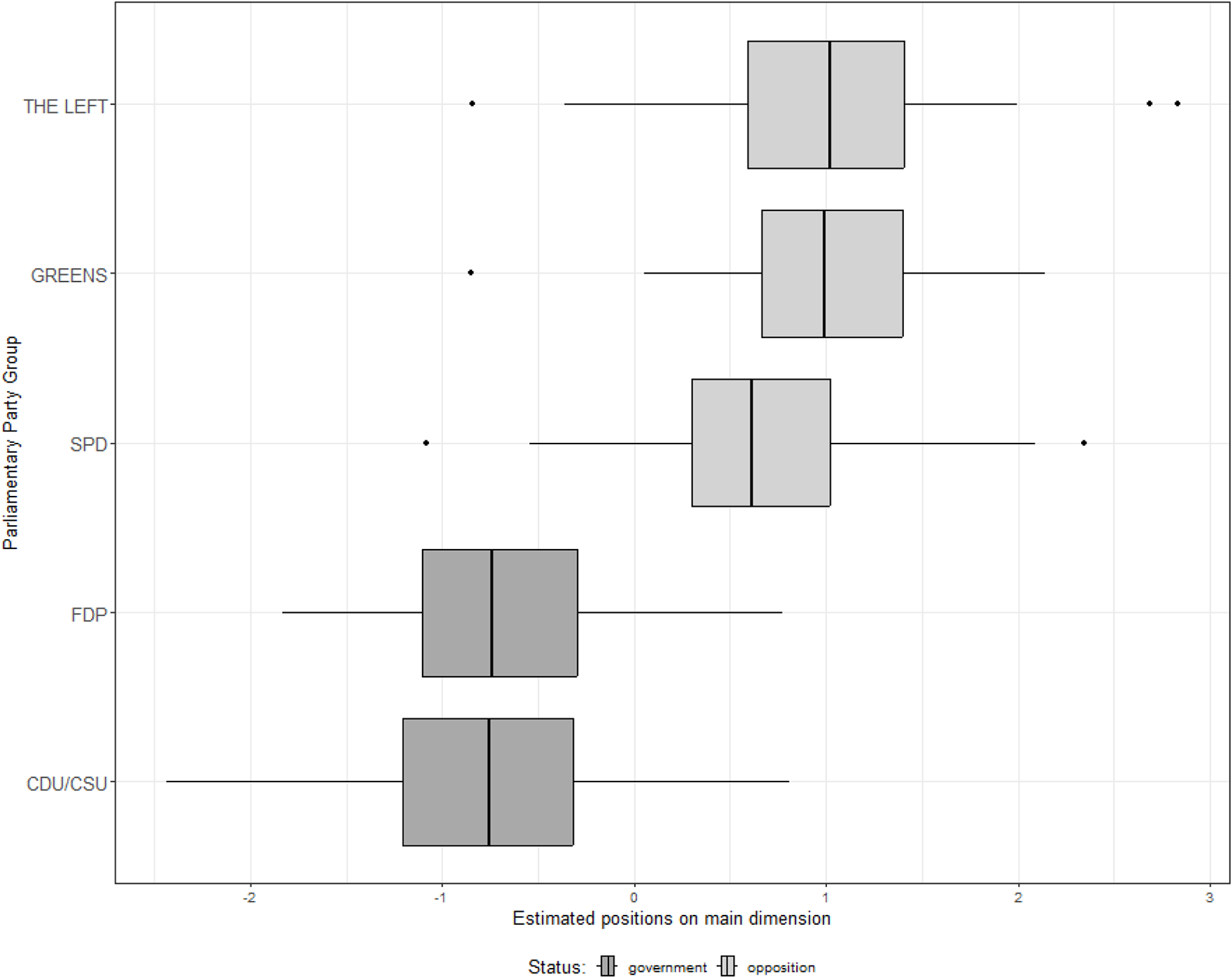
Figure 2 provides an example of the results from our application of the Wordshoal method to the debates during the Merkel II cabinet, which was in office from 2009 to 2013. The figure shows the distribution of estimated positions for all legislators grouped by parties and displayed as boxplots.
Distribution of estimated Wordshoal positions during cabinet Merkel II, by political parties.

Looking first at the difference between parties, we see clear polarization between the government and the opposition: the two government parties—CDU/CSU and FDP—are both located at the left side of the estimated dimension with similar median positions; the three opposition parties—SPD, Greens, and the Left party—are located on the right. Among the opposition members, the Greens and the Left have similar median positions. The SPD, in contrast, which was the largest opposition party at that time and the future coalition partner of the CDU/CSU in the following cabinet, has a position between the government and the two smaller opposition parties, but is still considerably closer to the other opposition parties than to the government parties. We also observe significant within-party variation, which is essential for testing our argument.
We find similar polarization between government and opposition parties in most of the cabinets included in our sample, though in some of our estimates the government-opposition division is less clear-cut than in the above example (see Figure C.1 in the supplementary material C). A reason for not finding strong differences in estimated Wordshoal positions is simply the possibility that the government–opposition conflict was less pronounced in some cabinets than in others. However, because there is still intraparty variation in estimated positions, this finding does not invalidate our theoretical argument. We still expect that, under the conditions laid out above, legislators expressing support of (or opposition to) the government—relative to their party leader’s position in that conflict dimension—have a potential impact on their appointment. If anything, the empirical effect should be weaker under less polarization, which makes it more difficult for our modeling strategy to identify an effect.
Finally, we calculate the difference between an MP’s Wordshoal position and the position of their parliamentary party group (PPG) leader at the time.Footnote 6 Party leaders are the main principals who select their agents in the cabinet, i.e., the ministers. It is therefore an MP’s deviation from the party leadership that is relevant for examining ministerial selection. Let  ${x_{ipc}}$ denote the position of legislator i from party p during cabinet term c. We then calculate as our key independent variable:
 \begin{equation*}deviatio{n_{ipc}} = {x_{ipc}} - {x_{PPG{\text{ }}leader{\text{ }}}}\end{equation*}
where  ${x_{PPG{\text{ }}leader{\text{ }}}}$is the position of the PPG leader from the same party p and the same cabinet c as legislator i. If there is more than one leader, or if the leadership changes during a cabinet term, we use the average of their Wordshoal positions as a reference point.
Before describing our data, we first analyze our Wordshoal estimates to show that the latent positions we estimate indeed reflect government–opposition expressed position-taking. We estimate a multilevel linear regression model using the estimated positions as the dependent variable and a series of independent variables that plausibly explain legislators’ position on the government–opposition conflict: cabinet role (ministerial and junior ministerial positions), role in PPG (member of the parliamentary group chair committee), party government status (opposition or government), party affiliation (as some parties have rarely or never been in government during our window of observation), and deviation from the party line in roll-call votes.Footnote 7 We include an interaction between party chair function and government status because, depending on the party’s government status, the effect should be more positive, i.e., oppositional, for leadership members in opposition parties and more negative, i.e., more pro-government, for leadership members in governing parties. Furthermore, we add the length of legislative service (standardized) and gender. The model includes random intercepts for MPs (to account for repeated measures) and fixed effects for cabinets and parties.
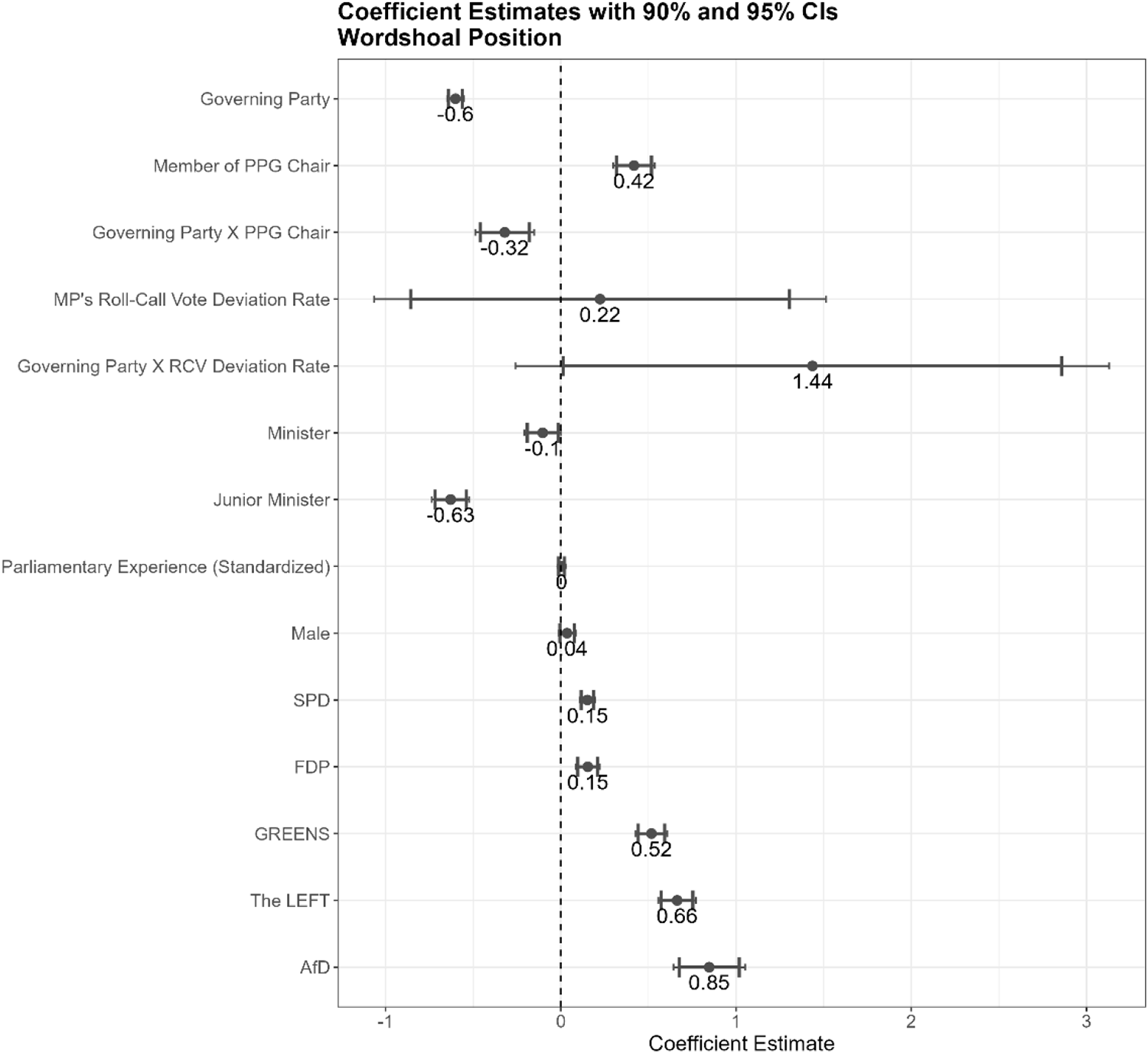
The results, summarized in Figure 3, show that MPs belonging to a government party have significantly smaller Wordshoal estimates; i.e., they are much closer to the government side on what we interpret as the government–opposition conflict dimension. The interaction effect is also negative and statistically significant; i.e., MPs with a role in the leadership of the parliamentary group of parties in government have even more negative values than MPs without a role in the leadership of these parties. Wordshoal position is also negatively correlated with government offices, which also supports our interpretation of the latent dimension as conflict between government and opposition because government members are typically expected to defend the government’s agenda. Interestingly, junior ministers have an even stronger pro-government position on this conflict dimension than ministers. A possible reason is the career ambitions of junior ministers, who might try to signal their suitability for a minister position by more strongly defending the government and its policy agenda.
Coefficient plot of mixed effects linear regression model of Wordshoal positions.

Figure 3 Long description
Coefficients estimates with 90 percent and 95 percent CIs Wordshoal Position A single coefficient plot with horizontal error bars and point markers for multiple categories listed on the left. A vertical dashed reference line is drawn at coefficient estimate 0. The x-axis is labeled Coefficient Estimate. Tick labels shown are minus 1, 0, 1, 2, 3. Each row shows a point estimate with two horizontal confidence intervals (one shorter and one longer). Numeric labels appear next to several points: Governing Part y: minus 0.6. Member of PPG Chair: 0.42. Governing Part y times PPG Chair: minus 0.32. MP’s Roll Call Vote Deviation Rate: 0.22. Governing Part y times RCV Deviation Rate: 1.44. Minister: 0.1. Junior Minister: minus 0.63. Parliamentary Experience (Standardized): a point near 0 with no numeric label. Male: 0.04. SPD: 0.13. FDP: 0.15. GREENS: 0.32. The LEFT: 0.18. AfD: 0.85.
A stronger deviation rate in roll-call votes is associated with more government-critical stances of government MPs, which is reasonable because deviating MPs could justify their dissenting position on the plenary floor, which makes them appear more oppositional in their speech-making. For opposition MPs, the deviation rate is uncorrelated with the measured Wordshoal position. Gender and seniority show neither a substantively meaningful nor a statistically significant correlation with position-taking. In contrast, there are clear differences between the party groups. Parties that were never in government during the observation window (The Left and AfD) have significantly more positive, i.e., oppositional, values than MPs from the CDU/CSU, which was in government in 12 out of 19 cabinets during the observation window (see Table A.1 in supplementary material A). MPs from the SPD and FDP, who often alternate between government and opposition status and coalesce with the CDU/CSU, have a less pronounced difference from the CDU/CSU, especially in comparison to the Greens.Footnote 8
All in all, the results support our argument that the underlying latent dimension that we measure with the Wordshoal positions is the overarching conflict dynamic between governing and opposition parties in parliament.
6. Sample and variables
Having explained our measure of individual legislators’ positions, we turn to a description of our data structure and variables. Our data are organized at the MP-by-cabinet level: each observation in our data set represents a single MP for each cabinet, with MPs who were in office during more than one cabinet appearing multiple times in the data set.
Our dependent variable is the dichotomous indicator of an MP being selected as minister (0: no, 1: yes) in a cabinet. For each cabinet, we therefore restrict our sample to MPs from the parties that formed the cabinet because only they have a realistic chance to be selected as minister. We further restrict our sample to those MPs who spoke during the previous legislative term, as our measure of individual legislators’ position on the government-opposition conflict is based on MPs’ debate behavior during that term. As a result, we must omit newly elected MPs because they do not have a speaking record. We also must exclude ministers who were selected from outside the Bundestag, such as ministers recruited from state parliaments or those without any previous legislative mandate.Footnote 9 On average, there were five such outside appointments in each cabinet, ranging from zero (cabinet Merkel IV) to twelve appointments (cabinet Kohl IV).Footnote 10 We add to our sample ministers without a legislative seat, but who were appointed ministers and also spoke during the previous legislative term (either as minister or member of the parliament). We present more details on our data sources and coding decisions in supplementary material A.
Our dependent variable, whether or not an MP from a government party was selected as minister, includes all ministers who were appointed at the time of cabinet formation as well as a small number of those who came into office during a cabinet’s term to replace an outgoing minister. Our final sample consists of a total of 4,146 MP-by-cabinet observations, including 299 minister appointments across 19 cabinets (see Table A.1 in the supplementary material A for cabinet-wise information).
We control for variables that confound our relationship of interest. Most importantly, we control for MPs’ ministerial experience in previous cabinets. MPs with governing experience have a higher chance to be (re-)selected as ministers. Either the governing party remains in office and ministers in office are re-appointed as cabinet members or the party comes from the opposition and appoints MPs with government experience. Also, MPs with government experience can have different speech behavior; e.g., ministers in office can represent the government’s position more strongly and previous ministers in opposition mode could more harshly criticize the government than backbenchers. We also consider whether an MP was a cabinet minister at the state (Bundesland) level, which is another avenue to gain government experience and to increase one’s chances to be appointed at the national level (Kaiser and Fischer, Reference Kaiser and Fischer2009). We here draw on information on regional ministers from (Jäckle, Reference Jäckle2023; Koch et al., Reference Koch, Kuhlen, Müller and Stecker2024) and identify MPs who were members of a regional government before serving in the German Bundestag. We also control for parliamentary experience (measured as days in office and standardized), because more senior MPs may behave differently in parliament than rookies (Bailer and Ohmura, Reference Bailer and Ohmura2018) and because seniority is an important criterion when selecting members for higher offices. Furthermore, we control for other previous offices, in particular whether a politician was a junior minister before or member of the chair of the PPG during the previous cabinet term (both are coded with 1 for “yes” and 0 for “no”). In addition, we control for the MP’s gender, because women speak differently on different topics than men (Bäck et al., Reference Bäck, Debus and Müller2014; Bäck and Debus, Reference Bäck and Debus2018), are less conflictual in legislative behavior than male colleagues (De Vet and Devroe, Reference De Vet and Devroe2022; Karlsson et al., Reference Karlsson, Mårtensson and Persson2024), and are less likely to be selected as minister. We also control for party fixed effects, as parties differ in their internal organization, culture and cohesion, which may influence the role of deviations of individual MPs as well as the preferences of PPG leaders. All information on MP’s sociodemographic and political career characteristics (e.g., offices and length of legislative service) is derived from the BTVote dataset (Bergmann et al., Reference Bergmann, Bailer, Ohmura, Saalfeld, Sieberer and Hohendorf2018).
7. Descriptive analysis
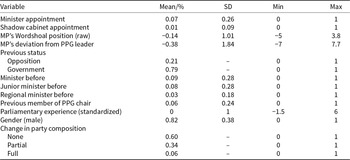
Before presenting our multivariate findings, we provide descriptive information on the sample. Table 1 summarizes the model variables. Out of the 4,146 MPs included in our sample, 21 percent belonged to a party newly entering government and 79 percent were from parties that remained in power. There are two reasons why we observe such a high share of MPs from previously governing parties: first, in a majority of cabinet formations, the incumbent parties stayed in power (12 out of 19 cabinets, or 60 percent of MPs in our sample); second, many cabinets only see a partial change in party composition (6 out of 19 cabinets, or 34 percent of MPs), that is, a new coalition was formed between a former government party and a former opposition party. Only one cabinet in the sample represents a full change in party composition: cabinet Schroeder I, where the new SPD-Greens coalition replaced the coalition between the CDU/CSU and the FDP.
Descriptive statistics of variables included in the model estimation

Table 1 Long description
The table reports descriptive statistics for model variables, listing each variable’s mean or percentage, standard deviation, and observed minimum and maximum. Appointments are uncommon: minister appointment averages 0.07 and shadow cabinet appointment 0.01, both ranging from 0 to 1. Two position measures show wide spread: the MP’s Wordshoal position has a mean of minus 0.14 with values from minus 5 to 3.8, and deviation from the PPG leader averages minus 0.38 with values from minus 7 to 7.7. Prior status is mostly government at 0.79 versus opposition at 0.21. Prior roles are infrequent, including minister before 0.09, junior minister before 0.08, regional minister before 0.03, and previous PPG chair membership 0.06, each bounded between 0 and 1. Parliamentary experience is standardized with mean 0 and standard deviation 1, spanning from minus 1.5 to 6. Gender is mostly male at 0.82. Party composition change is most often none at 0.60, followed by partial at 0.34 and full at 0.06. Some categorical rows show no standard deviation reported, so variability for those categories is not provided in the table.
When examining ministerial appointments, about seven percent of MPs from parties that enter a coalition are appointed as ministers. The variable “minister before” is a dummy variable that captures whether or not an MP held a national ministerial office at some point in their career prior to the cabinet formation under investigation. This is the case for, on average, nine per cent of MPs. As we have explained above, we expect this variable to be strongly associated with our dependent variable, especially because ministers have a high likelihood to be reappointed when the same coalition partners continue to stay in power.
We next provide descriptive insights that explain the logic of our argument and modeling strategy. Figure 4 displays a situation in which an outgoing government party, the SPD, and a former opposition party, the CDU/CSU, formed a new coalition—a grand coalition between the two largest parties led by Angela Merkel (cabinet Merkel I, 2005–2009). The boxplots show variation in estimated positions for all legislators from the two government parties who were in office at the time of the cabinet formation. These legislators form the pool of possible candidates from which the parties could select their ministers, with those who were appointed highlighted with gray triangles and labeled with their last names.Footnote 11
Appointed ministers in Merkel I cabinet (2005–2009) with estimated position on the government–opposition conflict under Schroeder II (2002–2005).

Figure 4 Long description
Cabinet formation in Merkel I Estimated Wordshoal positions from debates in Schroeder II. The horizontal axis label is Estimated positions on main dimension. The visible tick labels are negative 2, 0 and 2. The vertical axis shows two category labels: CDU slash CSU and SPD. A legend labeled Role shows two marker types: Leader shown with a filled circle and Minister shown with a triangle. Text labels next to plotted markers include: Merkel, Muenfering, Zypries, Schmidt, Steinmeier, Schaeuble, Gabriel, Glo and Wiczorek Zeul. Additional labels are present but are not fully legible at this resolution. Two boxplots are shown, one aligned with CDU slash CSU and one aligned with SPD. The CDU slash CSU boxplot is centered near the 0 tick on the horizontal axis and contains the label Merkel. The SPD boxplot is positioned left of 0 and contains the label Muenfering. Markers appear along the CDU slash CSU row and the SPD row. Several CDU slash CSU markers are positioned to the right of 0, with multiple labels clustered around the 1 to 2 region. Several SPD markers are positioned left of 0, with labels around the negative 2 to 0 region. Exact coordinate values for individual markers are not printed.
The positions displayed in Figure 4 are estimated from legislators’ speeches during the previous legislative term, when the SPD was part of a coalition with the Green Party (cabinet Schroeder II, 2002–2005). These positions therefore capture legislators’ behavior during the time when the SPD and the CDU/CSU stood on opposite sides of the government–opposition conflict, which is our key variable of interest.
Did the parties select “friends or foes” when appointing their ministers? In line with our theoretical argument, Figure 4 shows that most appointed ministers in the Merkel I cabinet held more extreme positions than their party leadership (indicated by black circles), relative to other members of their party. That is, party leaders selected ministers who, during the previous legislative term, expressed strong support or opposition to the government in line with their expected roles as government or opposition members.Footnote 12
The descriptive findings from the Merkel I cabinet offer initial empirical evidence for our theoretical claim that parties tend to appoint more extreme rather than moderate ministers. Investigating whether this claim holds across all cabinets in our sample, and when accounting for confounding variables, requires estimating an appropriate statistical model, which we turn to next.
8. Model estimation and results
The goal of our empirical models is to estimate an individual legislator’s likelihood of being appointed as a (shadow) minister conditional on our key independent measure and confounders. We estimate mixed-effect models for our binary dependent variable. As we have repeated observations of the same MPs in our sample, we include random intercepts for individual MPs in order to account for random variability of individual legislators. We include fixed effects for cabinets and parties to control for cabinet-specific and party-specific features that might affect the relationship of interest.Footnote 13
Figure 5 presents the results from our models on minister and shadow cabinet appointments. The models use the full data set, which includes all cabinets from 1961 to 2021 and shows empirical support for our hypothesis. Recall that estimated positions are scaled such that positive values indicate a more government-critical (i.e., opposition friendly) position. Thus, deviations larger than 0 represent MPs who were more opposition friendly than their PPG leadership, while negative deviations indicate MPs who, compared to their PPG leadership, were more government friendly. In line with our expectations, we find a positive effect of an MP’s deviation from their PPG leadership on ministerial appointments for legislators from former opposition parties (p-value is 0.05), but this effect turns negative when interacted with previous government status (p-value < 0.05). Substantively, this means that members with more extreme positions than their PPG leadership have a higher likelihood of being selected than those with moderate positions. We further substantiate this finding below when presenting predicted probabilities from the model.
Coefficient plot of mixed effects linear regression models of minister and shadow cabinet appointments.

Figure 5 Long description
Coefficient Estimates with 90 percent and 95 percent CIs A horizontal coefficient plot with multiple rows of predictors and two model series shown by different point markers. A vertical dashed reference line is drawn at coefficient estimate equals 0. The x-axis is labeled Coefficient Estimate (log-odds). Tick labels shown are minus 2, 0, 2 and 4. Row: MP’s Deviation From PPG Leader. Two point estimates are shown to the right of 0, labeled 0.55 and 0.35, each with horizontal confidence intervals. Row: Previous Government Status. One point estimate is shown to the left of 0, labeled minus 0.67, with a horizontal confidence interval. Row: MP’s Deviation times Government Status. One point estimate is shown slightly to the left of 0, labeled minus 0.41, with a horizontal confidence interval. Row: Was National Minister Before. One point estimate is shown to the right of 0, labeled 2.11, with a horizontal confidence interval. Row: Was Junior Minister Before. Two point estimates are shown to the right of 0, labeled 1.36 and 1.69, each with horizontal confidence intervals. Row: Was Regional Minister Before. One point estimate is shown to the right of 0, labeled 1.45, with a horizontal confidence interval. Row: Was Member of Previous PPG Chair. Two point estimates are shown to the right of 0, labeled 1.14 and 2.40, each with horizontal confidence intervals. Row: Parliamentary Experience (Standardized). Two point estimates are shown close to 0, labeled minus 0.07 and minus 0.01, each with horizontal confidence intervals. Row: Male. Two point estimates are shown to the left of 0, labeled minus 0.18 and minus 0.10, each with horizontal confidence intervals. A legend at the bottom shows Model 1: Minister Appointments and Model 2: Shadow Cabinet Appointments.
For shadow cabinet appointments, we expect a less pronounced effect of MPs’ loyalty because, in the absence of a coalition partner, party leaders are less constrained in their appointment decisions, which are more driven by intraparty considerations. Shadow cabinets are appointed by opposition parties or governing junior coalition parties, who enter into competition with their current coalition partner. We hence do not consider that the effect of MP’s deviation from PPG leader is moderated by government status because both opposition parties and coalition partners have an incentive to propose an alternative to the current government. In our model, we find a very similar effect: a more government-critical stance increases the chance of being appointed as a shadow cabinet member.Footnote 14
Looking at our control variables, an MP’s prior government experience and membership in the chair committee of the PPG all have positive and statistically significant effects on being (re-)appointed. Ceteris paribus, serving a longer duration in parliament than the average MP has no clear effect on becoming (shadow) minister; we also do not find evidence of gender differences in the likelihood of minister selection in our sample.Footnote 15
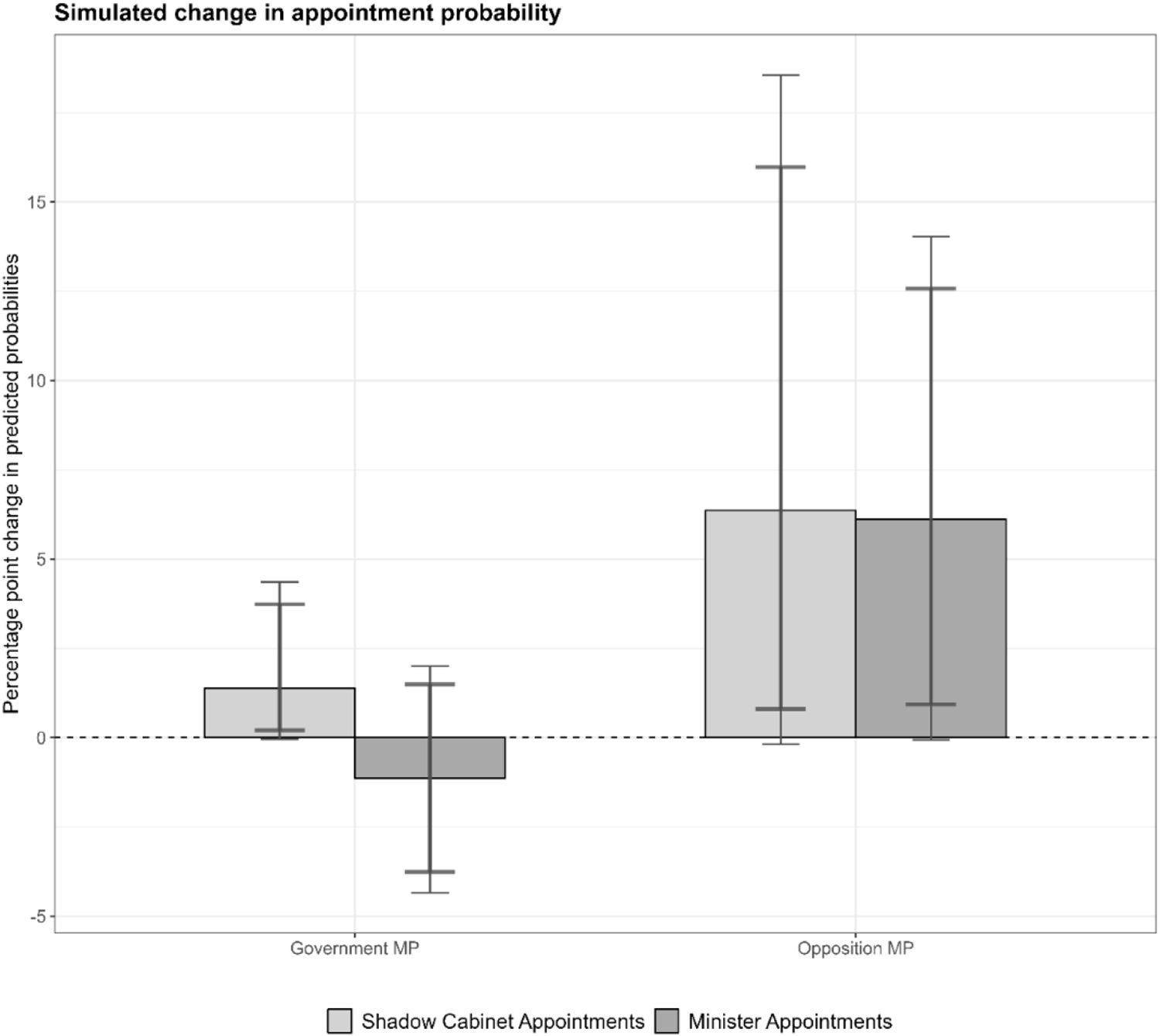
To better gauge the substantive effects of the logistic regression model, we present changes in predicted probabilities of being appointed as a minister when varying our key explanatory variable—an MP’s deviation from their PPG leadership—from the 5th percentile to the 95th percentile. For MPs from a former opposition party, this reflects a shift from a moderate (i.e., government friendly) stance to a more loyal (i.e., government critical) position; for former government members, it reflects a change from a loyal (i.e., government friendly) to a moderate (i.e., government critical) position. Figure 6 presents the corresponding changes in average predicted probabilities for two scenarios: MPs from government parties and MPs from opposition parties.Footnote 16
Changes in predicted probabilities for different MPs by previous government status.

Figure 6 shows that for minister appointments there are substantial differences between MPs coming from an opposition party. For MPs joining from a former opposition party, a stronger opposing stance toward the previous government increases the chance of ministerial appointment by about 6 percentage points. For MPs whose party was part of the previous government, being critical of that same previous government is rather harmful: their estimated likelihood of being selected as minister decreases by about 1 percentage point when they move from an extreme to a more moderate position but does not reach statistical significance.
For shadow cabinet appointments, we find that government MPs with a more critical stance toward their own government are associated with a higher chance of being selected as potential ministers. This means that party leaders of junior coalition partners reward MPs who were critical toward the previous government, because those MPs represent a plausible alternative to the previous government. In practical terms, this represents MPs from the SPD while governing as a junior coalition partner in a grand coalition with the CDU/CSU.
How robust are these findings with respect to the cabinets included in our analysis? Over time, the government–opposition dynamic in the Bundestag intensified as party fragmentation increased—shifting from SPD and CDU/CSU alternations with the FDP to more complex coalitions with the entry of the Greens (1984) and PDS (predecessor of the Left, 1990). To account for this, we re-estimated our model on a subset starting with the Kohl I cabinet (1982–2021). As shown in Table E.1 (in the supplementary material E), our key findings are even stronger in this more polarized context, suggesting that the main model is more conservative than we would expect in more recent and contentious parliaments.Footnote 17 Additional robustness checks confirm our results are not sensitive to speech data processing choices (see supplementary material E).
Furthermore, we test an alternative expectation: that party leaders appoint members whose expressed position-taking is closest to their own on the government–opposition conflict, regardless of whether those positions are moderate or extreme. We model this by using the absolute distance between a party member and their PPG leadership. As shown in Model 4 in Table E.1, the corresponding coefficient is not statistically significant. This supports our original expectation that it is the direction on the government–opposition dimension, rather than mere proximity to the leadership, that guides appointment decisions.
Finally, we test for robustness of our findings when using the extra-parliamentary party leader as reference point for MPs’ Wordshoal position, where available. The effect remains positive, is slightly stronger and gains statistical significance, which is why we are confident that our key findings are robust.
9. Discussion and conclusion
Legislative behavior in parliamentary systems is shaped by the conflict between government and opposition: members of governing parties, particularly those with seats at the cabinet table, are expected to support and defend the government’s agenda, while opposition members are responsible for holding the government accountable and presenting a credible alternative to the incumbent. In this paper, we study how past government–opposition conflict affects the cabinet formation, specifically, the selection of cabinet ministers in newly formed coalition governments.
Our theoretical and empirical approach makes novel contributions to research on both coalition governance and legislative behavior. In terms of theory development, there is broad agreement in coalition research on the need for more dynamic theories of cabinet formation that account for how past government experiences and interparty conflicts shape future coalition decisions (Bäck and Dumont, Reference Bäck and Dumont2008; Strøm, Reference Strøm2008; Müller et al., Reference Müller, Bäck and Hellström2024). This is precisely our contribution: examining how ministers are selected based on their past behavior toward members of the opposing camp in parliament. By doing so, we also examine what we believe is an understudied feature of cabinet formation in parliamentary systems, namely that former “foes” have to become “friends.”
Empirically, our paper is, to the best of our knowledge, the first that connects past speech-behavior in legislative debates to cabinet formation in the following period. As others have shown (Louwerse, Reference Louwerse2011; Lauderdale and Herzog, Reference Lauderdale and Herzog2016; Proksch et al., Reference Proksch, Lowe, Wäckerle and Soroka2019), legislative speaking behavior is strongly influenced by whether an MP belongs to the government or the opposition. As a result, scaling methods, such as the Wordshoal approach that we use in this paper, provide summaries of legislators’ stance toward the opposite camp rather than ideal points on policy dimensions. We leverage this feature by using the Wordshoal approach to estimate legislators’ latent positions that reflect their behavior along the dominant government–opposition conflict dimension.
We argue in this paper that party leaders have incentives to appoint more loyal rather than moderate party members along this dimension: government members who dutifully defended the government’s actions in parliamentary debates, and opposition members who consistently took a strong stance against the government. We developed this argument based on the logic of party cohesiveness and intraparty competition. Both provide party leaders with incentives to appoint faithful party agents rather than less-loyal members who demonstrated openness toward a future coalition partner from the opposing camp. Our empirical analysis of ministerial appointments in 19 German cabinets and 10 shadow cabinet appointments and over nearly 60 years (1963–2021) provides empirical support for our hypothesis.
Our findings open up promising avenues for future research. Does the selection of loyal ministers, i.e., those who more harshly criticized the other parliamentary camp in the government–opposition conflict, lead to less cooperative cabinets, or are ministers able to move beyond the shadow of their past conflict and work effectively in cross-party collaboration? As such, our results align with recent work by König et al. (Reference König, Xiao and Silva2025), who show that ministers may shift their behavior from competitive to cooperative (or vice-versa) in response to interactions within the cabinet. The link between parliamentary behavior prior to cabinet appointment and cooperative behavior as minister would be interesting to explore in further studies.
Future research could also explore more nuanced patterns of opposition behavior, such as when opposition members primarily target one specific coalition partner—a possibility that requires a more fine-grained analysis of speech-behavior that is beyond the scope of this paper. Comparative studies across countries with varying institutional settings and government formation types (e.g., single-party governments, or opposition behavior under minority government) could shed light on how different configurations of government–opposition conflict influence cabinet appointments and broader coalition governance dynamics. In addition, it would be interesting to investigate how ideological differences between coalition partners, which may increase conflict in coalitions, drive speech behavior and subsequent appointment decisions.
Supplementary material
The supplementary material for this article can be found at https://doi.org/10.1017/psrm.2026.10114. To obtain replication material for this article, please visit https://url.uk.m.mimecastprotect.com/s/BW6DC6RooToX2BPnUpf3c5PZi7?domain=doi.org.
Funding statement
The authors declare that no funding was received.
Competing interests
The authors declare none.





 Open access

