


A substantial body of literature has described changes in the incidence of schizophrenia in the second half of the 20th century, much of it suggesting a decline (Reference Harrison and MasonHarrison & Mason, 1993; Reference Munk-JorgensenMunk-Jorgensen, 1995). However, there are considerable methodological problems inherent in such research (Reference Kendell, Malcolm and AdamsKendell et al, 1993). In particular, changes in service organisation can affect admission rates, and evolving diagnostic concepts can influence clinical diagnosis. Few studies have examined the incidence of schizophrenia in a defined area over more than a decade using consistent diagnostic criteria. We carried out such a study by examining the incidence (all contacts, not just admissions) of schizophrenia as defined by the Research Diagnostic Criteria (RDC; Reference Spitzer, Endicott and RobinsSpitzer et al, 1978) and DSM—III—R (American Psychiatric Association, 1987) in Camberwell, an area of south-east London, between 1965 and 1997, taking into account, as far as possible, the changing population.
METHOD
This study was carried out using the Camberwell Psychosis Database, which has been compiled over the past four decades. Previous publications have demonstrated trends in incidence in Camberwell up to 1984 (Reference Castle, Wessely and DerCastle et al, 1991), and compared it with incidence in south-west Scotland (Allardyce et al, Reference Allardyce, Morrison and McCreadie2000, Reference Allardyce, Boydell and van Os2001).
Sample
We collected clinical and demographic data on all people from the geographically defined area of Camberwell in south-east London, who presented with psychosis between 1965 and 1997. This 33-year period was broken down into two 4-year and five 5-year periods (1965-1968=1, 1969-1972=2, 1973-1977=3, 1978-1982=4, 1983-1987=5, 1988-1992=6, 1993-1997=7). Cases were initially identified using the Camberwell Case Register (Reference Wing and HaileyWing & Hailey, 1972) and then psychiatric hospital computer records (from 1984), by generating a list of all people admitted to any hospital serving the Camberwell catchment area, with any possible psychotic illness (ICD-9 codes 295, 295.6, 297, 296.0, 296.2, 296.4, 298, 292.1 (World Health Organization, 1978) and ICD—10 codes F20, F25, F22, F30, F31.3, F31.2, F31.6, F28, F29, F12.5, F16.6, F19.5, F16.75, F19.75 (World Health Organization, 1992)). In addition, all case records of all patients from the area were examined to identify those who made contact with services but were not admitted. The records of those not admitted were of a similar standard to the records of those admitted. Patients who were admitted to hospitals outside the area would usually be transferred back to local hospitals or referred to local services for continuing care. These records were also identified in the comprehensive search of all case notes. The methodology and the characteristics of the area are more fully described by Castle et al (Reference Castle, Wessely and van Os1998) and Allardyce et al (Reference Allardyce, Boydell and van Os2001).
Diagnostic procedure
Patients' records were then checked to ensure that they were true incident cases (i.e. had not had previous psychiatric treatment for a psychotic or possible psychotic illness), and then were rated using the Operational Criteria (OPCRIT) checklist. All cases presenting between 1992 and 1997 were rated by J.B., who monitored interrater reliability for RDC schizophrenia by independently rating a random sample of case records that were already on the database. Reliability was found to be good (kappa=0.79 for RDC schizophrenia). Previous interrater reliability exercises have been detailed by Castle et al (Reference Castle, Wessely and Der1991, Reference Castle, Wessely and van Os1998) and van Os et al (Reference van Os, Castle and Takei1996). The OPCRIT checklist is based on phenomenological descriptions in the Present State Examination (Reference Wing, Cooper and SartoriusWing et al, 1974) and enables computer diagnoses to be made using the OPCRIT program (Reference McGuffin, Farmer and HarveyMcGuffin et al, 1991). The OPCRIT checklists were then used to generate RDC (Reference Spitzer, Endicott and RobinsSpitzer et al, 1978) diagnoses using the computer program. RDC schizophrenia was chosen for this analysis because the criteria have been incorporated in the OPCRIT system since it was devised, and because of a preference for using a broad definition of schizophrenia for research. (The earlier OPCRIT were rated before ICD—10 and DSM—IV (American Psychiatric Association, 1994) criteria were available.) OPCRIT-derived DSM—III—R diagnoses were also analysed to check the results, as this is a narrower definition of schizophrenia (Table 1).
Number of cases not diagnosable by Operational Criteria (OPCRIT) checklist

| Time period | RDC not diagnosable by OPCRIT | DSM—III—R not diagnosable by OPCRIT | Total subjects per time band |
|---|---|---|---|
| 1 (1965-1968) | 25 | 4 | 102 |
| 2 (1969-1972) | 13 | 1 | 123 |
| 3 (1973-1977) | 17 | 8 | 131 |
| 4 (1978-1982) | 17 | 4 | 162 |
| 5 (1983-1987) | 32 | 4 | 166 |
| 6 (1988-1992) | 20 | 1 | 185 |
| 7 (1993-1997) | 0 | 3 | 197 |
Denominator data
Population data were estimated using the 10-year censuses (data from the Office of Population Censuses and Surveys, Population Estimates Unit, 1997) and London Research Centre (1997) projections for 1997, which include corrections for under-numeration. Corrections were applied as appropriate throughout the time period.
Statistical analyses
A correction was made for notes known to be missing (as a percentage of total subjects in each time period). More notes were definitely missing from the case register, which made the analysis more conservative. Raw and corrected figures are shown in Table 2. All further analyses and results pertain to the corrected figures.
Numbers of cases with RDC and DSM—III—R schizophrenia and other psychosis (non-schizophrenia) diagnoses and the effect of correcting for missing notes

| Time period | RDC raw (before correction) | RDC after correction (as % of total subjects per time band) | DSM raw (before correction) | DSM after correction (as % of total subjects per time band) | RDC other diagnosis | DSM other diagnosis | Missing notes | Total subjects per time band |
|---|---|---|---|---|---|---|---|---|
| 1 (1965-1968) | 52 | 58 (57%) | 32 | 35 (34%) | 17 | 58 | 8 | 102 |
| 2 (1969-1972) | 64 | 72 (59%) | 43 | 48 (39%) | 31 | 64 | 15 | 123 |
| 3 (1973-1977) | 73 | 78 (60%) | 44 | 47 (36%) | 32 | 71 | 9 | 131 |
| 4 (1978-1982) | 99 | 102 (63%) | 57 | 57 (35%) | 43 | 99 | 3 | 162 |
| 5 (1983-1987) | 93 | 96 (58%) | 54 | 55 (33%) | 37 | 104 | 4 | 166 |
| 6 (1988-1992) | 121 | 122 (66%) | 68 | 68 (37%) | 43 | 115 | 1 | 185 |
| 7 (1993-1997) | 121 | 121 (61%) | 87 | 87 (44%) | 76 | 108 | 0 | 197 |
Indirect standardisation was carried out using rates for the total population, stratifying for age and gender, as the standard and applying them to each time period, using the ISTDIZE procedure in the STATA statistical program (StataCorp, 1999). This allowed the number of expected cases in each time period to be determined. By dividing the actual observed cases by the expected cases, the standardised incidence ratio (SIR) was calculated. Incidence of schizophrenia was also modelled with Poisson regression analysis (StataCorp, 1999), which allowed for examination of interactions between age and gender on the one hand and time period on the other.
RESULTS
In total, 1055 sets of case notes were rated: there were 1055 cases of any psychosis, spanning the 33 years. Over this time, 623 cases met the RDC for schizophrenia and 385 met the DSM—III—R criteria, using the OPCRIT computer program to generate the diagnoses. A number of cases could not be diagnosed by the OPCRIT program (Table 1). Considerably more cases could not be diagnosed by OPCRIT using the RDC systems than when using DSM—III—R. Of those that could be given a DSM—III—R diagnosis but no RDC diagnosis (106/124), only 12 were classified as schizophrenia (DSM—III—R). Overall, approximately 60% (373/623) of the cases with RDC schizophrenia met the criteria for DSM—III—R schizophrenia. Therefore, we estimate that only 20 RDC cases were missed because of the non-diagnosis. This suggests that OPCRIT sensitivity is high for RDC schizophrenia but not for other RDC psychotic disorders. There were very few cases not diagnosable by OPCRIT using DSM—III—R.
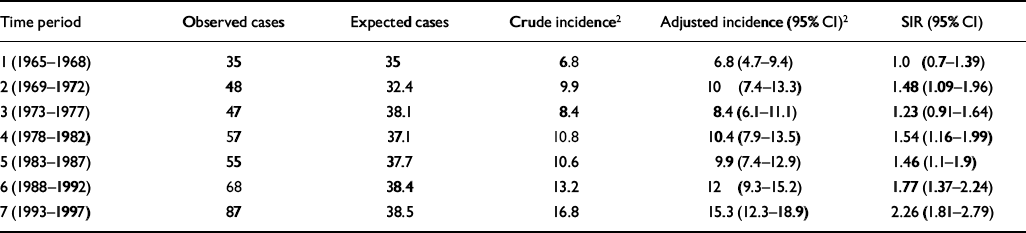
The crude and adjusted incidence and SIRs, which are shown in Tables 3 and 4, indicate that the incidence of schizophrenia approximately doubled over the period of investigation.
Crude and adjusted incidence and standardised incidence ratios (SIRs) using Research Diagnostic Criteria diagnosis for schizophrenia1

| Time period | Observed cases | Expected cases | Crude incidence2 | Adjusted incidence (95% CI)2 | SIR (95% CI) |
|---|---|---|---|---|---|
| 1 (1965-1968) | 58 | 58 | 11.2 | 11.2 (8.5 14.5) | 1.0 (0.76-1.29) |
| 2(1969-1972) | 72 | 53.5 | 14.9 | 15.1 (11.8-19) | 1.35 (1.05-1.69) |
| 3(1973-1977) | 78 | 62.6 | 14 | 14 (11-17.4) | 1.25 (0.98-1.55) |
| 4(1978-1982) | 102 | 60.78 | 19.4 | 18.8 (15.3-22.9) | 1.68 (1.37-2.04) |
| 5(1983-1987) | 96 | 62.23 | 18.5 | 17.3 (14-21.1) | 1.54 (1.23-1.88) |
| 6(1988-1992) | 122 | 64.01 | 23.7 | 21.4 (17.7-25.5) | 1.91 (1.58-2.28) |
| 7(1993-1997) | 121 | 64.63 | 23.3 | 21 (17.4-25.1) | 1.87 (1.55-2.24) |
Crude and adjusted incidence and standardised incidence ratios (SIRs) using DSM-III-R diagnosis of schizophrenia1
| Time period | Observed cases | Expected cases | Crude incidence2 | Adjusted incidence (95% CI)2 | SIR (95% CI) |
|---|---|---|---|---|---|
| 1 (1965-1968) | 35 | 35 | 6.8 | 6.8 (4.7-9.4) | 1.0 (0.7-1.39) |
| 2 (1969-1972) | 48 | 32.4 | 9.9 | 10 (7.4-13.3) | 1.48 (1.09-1.96) |
| 3 (1973-1977) | 47 | 38.1 | 8.4 | 8.4 (6.1-11.1) | 1.23 (0.91-1.64) |
| 4 (1978-1982) | 57 | 37.1 | 10.8 | 10.4 (7.9-13.5) | 1.54 (1.16-1.99) |
| 5 (1983-1987) | 55 | 37.7 | 10.6 | 9.9 (7.4-12.9) | 1.46 (1.1-1.9) |
| 6 (1988-1992) | 68 | 38.4 | 13.2 | 12 (9.3-15.2) | 1.77 (1.37-2.24) |
| 7 (1993-1997) | 87 | 38.5 | 16.8 | 15.3 (12.3-18.9) | 2.26 (1.81-2.79) |
Poisson regression analysis, using schizophrenia as the dependent variable and time period as the independent variable, revealed a highly significant increase in the rate ratio over the seven time periods. The rate ratio linear trend (IRR) for RDC schizophrenia was 1.13 (95% CI 1.08-1.17; P<0.001), and adjusting for age (10-year age groups) and gender had little effect (IRR=1.12; 95% CI 1.08-1.16; P<0.001). For DSM—III—R, the IRR was 1.14 (95% CI 1.08-1.2; P<0.001) and 1.13 (95% CI 1.08-1.19; P<0.001) after adjusting for age and gender. This means that there was a statistically significant overall increase for both RDC and DSM—III—R schizophrenia.
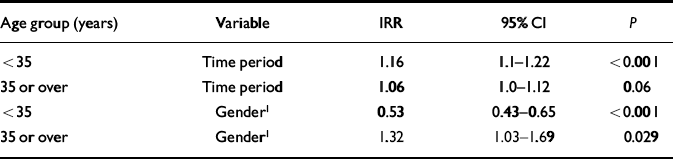
There was a significant negative interaction between age and time period (IRR=0.96, P=0.007, RDC schizophrenia), meaning that the age of onset decreased as time period increased. To clarify this further, subjects were a priori classified as under 35 years of age or 35 years and older at the time of presentation. Table 5 shows that the increase with time was more significant in the younger age group. There was also a highly significant interaction between age and gender because, as expected, age at onset is later for women (IRR=1.44, P<0.001, RDC schizophrenia). However, there was no three-way interaction between age, gender and time period (IRR=0.996, P=0.71, RDC schizophrenia), indicating that the increase has been greatest in young people, not just young men. The results for DSM—III—R concurred.
Interactions between age and time period, and between age and gender for RDC schizophrenia
| Age group (years) | Variable | IRR | 95% CI | P |
|---|---|---|---|---|
| <35 | Time period | 1.16 | 1.1-1.22 | <0.001 |
| 35 or over | Time period | 1.06 | 1.0-1.12 | 0.06 |
| <35 | Gender1 | 0.53 | 0.43-0.65 | <0.001 |
| 35 or over | Gender1 | 1.32 | 1.03-1.69 | 0.029 |
DISCUSSION
Methodological strengths
-
(a) The study covered a defined area and spanned over 30 years.
-
(b) All psychiatric contacts were included, not just admissions, thereby minimising the effects of any change in service provision.
-
(c) All possible cases of any psychosis were initially identified, to avoid missing cases who might have been given different diagnoses, minimising any effect of administrative inaccuracy or diagnostic delay.
-
(d) Case notes were checked to ensure that the patients were genuine incident cases and had not had previous contact with any psychiatric service for psychosis.
-
(e) Diagnostic consistency was maximised by using computer-generated diagnoses based on criteria that were used throughout the study.
-
(f) Age and gender standardisation was carried out.
Methodological weaknesses
-
(a) The study could not include people who never made contact with psychiatric services, and therefore any change in referral patterns would have affected the results. However, it is thought that in the UK nearly all patients with schizophrenia come into contact with psychiatric services at some time (Reference Kendell, Malcolm and AdamsKendell et al, 1993; Reference Prince and PhelanPrince & Phelan, 1994).
-
(b) There was a change in the method of case ascertainment in 1984, from a results case register to computer records. We do not believe that this affected the results, because both are comprehensive and the increase began before the change and continued after it.
-
(c) The raters were not blind to year of presentation but, as the ratings were made to compile a case register, there were no a priori hypotheses; also, the diagnoses themselves were made by computer.
-
(d) The quality and comprehensiveness of the case records improved slightly over the years of the study, but this had little impact on the resultant schizophrenia diagnoses.
Findings
We demonstrated a large increase in the incidence of schizophrenia (whether broadly or narrowly defined) in south-east London between 1965 and 1997. The increase occurred particularly in young people and was not gender-specific. The total numbers of all cases with any psychosis also increased with each time period.
Interpretation
We have not reported the breakdown of the non-schizophrenia psychosis cases, because OPCRIT is poor at producing RDC diagnoses for these cases (as discussed above) and the change in version means that DSM and ICD would not be reliable. This does not apply to the schizophrenia diagnoses. The total number of psychosis cases increased over time and the proportion of schizophrenia cases remained stable, so diagnostic shift cannot be an explanation for our findings.
Our results were not adjusted for ethnicity because the population data before the 1981 census were based on approximate head-of-household figures unadjusted for age and gender (Reference Castle, Wessely and DerCastle et al, 1991), whereas later figures are considerably more accurate (Reference van Os, Castle and Takeivan Os et al, 1996). We cannot therefore definitively address the question of whether migration into Camberwell may have contributed to the increase in incidence; nor can any conclusions be drawn from our study regarding aetiology of schizophrenia. This does not alter the implications of our findings for service provision and the need for greater resources.
Comparison with other studies
Comparison with other longitudinal studies is complex, because different methodologies and different definitions of schizophrenia have been used (Reference JablenskyJablensky, 1997). Most studies have shown a decline in incidence (Reference Geddes, Black and WhalleyGeddes et al, 1993; Reference Munk-JorgensenMunk-Jorgensen, 1995). However, many examined only admissions, at a time when a smaller proportion of psychiatric patients was being admitted to hospital, when routine case registers may not have been accurate and when clinical diagnoses were susceptible to change over time.
Some studies have shown little or no change. Oldehinkel & Giel (Reference Oldehinkel and Giel1995), for example, found little change in all first psychiatric contacts between 1976 and 1990, for broadly defined schizophrenia in The Netherlands. Folnegovic et al (Reference Folnegovic, Folnegovic-Smalc and Kulcar1990) found that admission rates did not change between 1965 and 1984. In Nottingham (UK), where the diagnoses were made by consensus, there has been an increase in psychosis as a whole but a decrease in narrowly defined schizophrenia (Reference Brewin, Cantwell and DalkinBrewin et al, 1997).
Two studies used methodology similar to that used in our study. The first was conducted in parallel with this study, in rural south-west Scotland between 1979 and 1998. It showed that an apparent decline in the administrative incidence of schizophrenia was in fact due to a narrowing of the concept of schizophrenia that local clinicians were using (Reference Allardyce, Morrison and McCreadieAllardyce et al, 2000). There was no change in consistent OPCRIT-derived ICD and DSM schizophrenia diagnoses. The second study, in south Verona in Italy, found a decrease in ICD-10 paranoid and undifferentiated schizophrenia, but only in males, between 1975 and 1995 (Reference Balestrieri, Rucci and NicolaouBalestrieri et al, 1997).
Some studies have examined period effects (changes in how many people present at a particular time) and cohort effects (how many people present from successive birth cohorts), in an attempt to disentangle the influence of service and diagnostic factors and early aetiological factors (Reference Takei, Lewis and ShamTakei et al, 1996; Reference Suvisaari, Haukka and TanskanenSuvisaari et al, 1999). We were not able to repeat this because we did not have comprehensive birth cohort and follow-up data for the area.
Further research
Further research might investigate the role of migration, social change (especially decreasing social cohesion) and drug misuse in contributing to the increased incidence of schizophrenia.
Clinical Implications and Limitations
CLINICAL IMPLICATIONS
-
▪ There has been a large increase in schizophrenia, whether broadly or narrowly defined.
-
▪ The increase is mainly in younger people.
-
▪ Far greater clinical resources are needed now and are likely to needed in the future.
LIMITATIONS
-
▪ The study only looked at one part of London therefore the findings may not apply to other areas.
-
▪ The study was retrospective, using case records.
-
▪ Period and cohort effects could not be examined separately.
Acknowledgements
We acknowledge the contributions of Professor Simon Wessely and Dr Nori Takei to the early part of the data collection.
We are greateful to the Stanley Foundation and the Gordon Small Trust for financial support.




eLetters
No eLetters have been published for this article.