





According to Livy (26.18.3–26.19.2), in late 211 Publius Cornelius Scipio was elected priuatus cum imperio pro consule by the comitia centuriata and sent to Spain in charge of the legions formerly led by his father Publius and his uncle Gnaeus. This was the beginning of a new phase in the Hannibalic War, which would ultimately lead Rome to victory against its most dangerous enemy. As has long been recognized, Livy assigns Scipio a central role in the narrative development of the Third Decade. For most critics, this centrality coincides with (and is the result of) Livy's admiration: in his view, Scipio is the fatalis dux, the commander sent by Providence to lead Rome to victory; Footnote 2 he is Hannibal's rival par excellence, the only leader capable of matching the enemy's military genius and blocking his relentless advance against the Republic;Footnote 3 he is, above all, the most shining example of the Roman virtues.Footnote 4
In the last few decades, however, our consideration of Livy as a historian has radically changed, and we are now much more conscious of the complexity and ambiguity of his historiographical point of view and, especially, of his moralizing attitude towards Roman history.Footnote 5 In the light of our new understanding of Livy's historiographical attitude, some scholars have carefully reconsidered some of the most famous episodes concerning Scipio, in order to highlight more controversial aspects of his political and moral behaviour.Footnote 6 The Pleminius episode (29.8.6–29.9.12, 29.16.6–29.19.7)Footnote 7 and the so–called Trial of the Scipios (38.50.4–38.60.10)Footnote 8 provide two excellent cases in this respect. In both of these episodes Livy does not take an explicit position against Scipio, but seems to shape his account with the precise purpose of raising questions about his integrity by means of intratextual allusions, conscious contradictions and a very careful use of his sources. This, of course, does not change the fact that Livy shows high consideration for Scipio as a military and political leader; however, it reveals the complexity of his moral reading of Roman history and his artistry as a historian.Footnote 9
Following in the footsteps of these studies, the aim of this paper is to reconsider a passage of remarkable importance for our understanding of Scipio's representation in the Third Decade, namely the portrait of the commander after his election as proconsul in Spain. It will be argued that this portrayal, far from being a mere eulogy of the hero of the Second Punic War, provides an excellent example of Livy's conscious problematization of the behaviour of a great Roman leader. The moral issues of this portrayal have been noted by critics,Footnote 10 but the narrative importance of the section requires more detailed analysis. The first section of this paper will trace the differences between Livy's account and its sources, in order to show how Livy shapes a very personal image of the hero of the Second Punic War. The second section will propose a close linguistic and stylistic analysis of Livy's portrait, suggesting his intention of stressing ambiguous traits of Scipio's leadership, not taken into account by Polybius.
Livy's portrait of Scipio (26.19.3–9) comes at the end of a particularly animated section of his account: after the capture of Capua brought momentary peace to Italy and Sicily, the Senate is persuaded to turn to the Spanish front once again, where the situation is still uncertain (26.18.1 Hispaniae populi nec qui post cladem acceptam defecerant redibant ad Romanos, nec ulli noui deficiebant), and to ask the comitia to elect a new commander. To the great despair of the assembly, nobody is willing to take on such a crucial office in a war zone in which the Republic has just suffered, in the space of a month, the loss of two of its most valiant magistrates (26.18.3–6). When all seems lost, however, young Scipio comes forward and reawakens hope in the assembly which immediately and unanimously elects him proconsul (26.18.7–9). But after initial enthusiasm the voters realize the extent of the responsibility placed on the young man and fear that they have been guided by fauor rather than by ratio in electing him (26.18.10–11). Eventually these concerns are dispelled by Scipio himself, who, sensing the voters’ feelings, succeeds in revitalizing their praise with a magnanimous and high-minded speech (26.19.1–2).
This highly dramatic series of reversalsFootnote 11 is suddenly brought to an end by Livy's own voice, which intervenes in the narrative to paint a picture of Scipio whose explicit purpose is to explain to readers how he managed to obtain such an important charge from the comitia despite never having held any major magistracy before. The passage in question is the following (26.19.3–9):
[3] fuit enim Scipio non ueris tantum uirtutibus mirabilis, sed arte quoque quadam ab iuuenta in ostentationem earum compositus, [4] pleraque apud multitudinem aut per nocturnas uisa species aut uelut diuinitus mente monita agens, siue et ipse capti quadam superstitione animi, siue ut imperia consiliaque uelut sorte oraculi missa sine cunctatione exsequerentur. [5] ad hoc iam inde ab initio praeparans animos, ex quo togam uirilem sumpsit nullo die prius ullam publicam priuatamque rem egit quam in Capitolium iret ingressusque aedem consideret et plerumque solus in secreto ibi tempus tereret. [6] hic mos per omnem uitam seruatus seu consulto seu temere uolgatae opinioni fidem apud quosdam fecit stirpis eum diuinae uirum esse, [7] rettulitque famam in Alexandro magno prius uolgatam, et uanitate et fabula parem, anguis immanis concubitu conceptum, et in cubiculo matris eius uisam persaepe prodigii eius speciem interuentuque hominum euolutam repente atque ex oculis elapsam. [8] his miraculis nunquam ab ipso elusa fides est; quin potius aucta arte quadam nec abnuendi tale quicquam nec palam adfirmandi. [9] multa alia eiusdem generis, alia uera, alia adsimulata, admirationis humanae in eo iuuene excesserant modum; quibus freta tunc ciuitas aetati haudquaquam maturae tantam rerum molem tantumque imperium permisit.
For Scipio was remarkable not only for his real abilities, but thanks to a certain skill also had from his youth adapted himself to their display, doing most of his actions before the public either as if they were prompted by visions in the night or inspired by the gods, whether because he also was possessed by a certain superstition, or in order that men might carry out without hesitation his commands and advice, as though emanating from an oracular response. More than that, preparing men's minds from the very beginning, from the time when he put on the manly gown, there was not a day on which he did any business public or private without going first to the Capitol, and after he had entered the temple, sitting down and usually passing the time there alone in seclusion. This custom, which he maintained throughout his lifetime, confirmed in some men the belief, whether deliberately circulated or by chance,Footnote 12 that he was a man of divine race. And it revived the tale previously told of Alexander the Great and rivalling it as unfounded gossip, that his conception was due to an immense serpent, and that the form of the strange creature had very often been seen in his mother's chamber, and that, when persons came in, it had suddenly glided away and disappeared from sight. He himself never made light of men's belief in these marvels; on the contrary, it was rather promoted by a certain studied practice of neither denying such a thing nor openly asserting it. Many other things of the same sort, some true, some pretended, had passed the limits of admiration for a mere man in the case of this youth. Such were the things on which the citizens relied when they then entrusted to an age far from mature the great responsibility of so important a command.Footnote 13
HISTORIOGRAPHICAL ANALYSIS. LIVY'S REWORKING OF HIS SOURCES
An enquiry into the stylistic and ideological peculiarities of Livy's portrait should first consider his sources. It has long been notedFootnote 14 that the section has remarkable points in common with the discussion of Scipio's character found in Polybius’ Book 10. Polybius’ portrait is included in his account of military operations in Spain in 209–208 b.c. (10.2.1–10.3.2, 10.3.7, 10.5.5–9), but it incorporates digressions on two earlier episodes of Scipio's career: the rescue of his wounded father at the Ticinus (10.3.3–6) and his election to the aedileship (10.4.1–10.5.4).Footnote 15 Given the length of the portrait, I will limit myself to a synthesis of the passages that are most relevant for the purposes of this discussion.Footnote 16 Polybius states that
1) some historians falsely ascribe Scipio's successes to Fortune or FateFootnote 17 and fail to recognize his rational attitude, under the mistaken impression that this makes him ‘more divine’ (θειότερος) and ‘more worthy of admiration’ (θαυμαστότερος) to the readers (10.2.1–7);Footnote 18
2) Scipio resembles Lycurgus inasmuch as he was not guided by oracles, dreams or premonitions, but consciously used religion to instil bravery and obedience in his subordinates (10.2.8–13);Footnote 19
3) it is universally acknowledged that Scipio was ‘beneficent and magnanimous’ (εὐεργετικὸς καὶ μεγαλόψυχος), but no one will admit that he was also ‘shrewd, discreet and with a mind always concentrated’ (ἀγχίνους καὶ νήπτης καὶ τῇ διανοίᾳ … ἐντεταμένος) except those who knew him personally, especially Gaius Laelius, who inspired Polybius’ opinion on Scipio (10.3.1–2);Footnote 20
4) Scipio as a commander demonstrated wisdom (νοῦς) in the years after his generous, but rash, rescue of his father at the Ticinus (10.3.7);Footnote 21
5) rumours of Scipio's special relationship with the gods spread after his brilliant election to the aedileship, which was actually owed to his ‘kind, munificent and agreeable’ nature (εὐεργετικὸς καὶ μεγαλόδωρος καὶ προσφιλής) and his ability to take advantage of opportunities (καιρός), namely acting as though he was inspired by the gods, which Polybius openly considers a positive trait (10.5.5–8);Footnote 22
6) readers should not ignore Scipio's best character-traits (10.5.9), such as his cleverness (ἐπιδεξιότης) and his hard work (φιλοπονία).
This synthesis shows that Livy's portrait of Scipio follows the pattern of Polybius’ Book 10. In both accounts, the overall narrative context is Scipio's departure for Spain; both stress the enthusiastic nature of popular support for him, especially during elections, although Polybius refers it to his election to the aedileship; and, above all, both agree in rejecting the so-called ‘Scipionic legend’—a complex of stories about Scipio's link to the supernatural widely testified to by the sources—Footnote 23 as completely false, while stressing Scipio's ‘propagandistic’ ability to exploit these rumours for his own political purposes. But alongside these similarities, the two accounts show evident discrepancies, which have significant consequences for the general tone of Livy's portrait.
These differences can be summarized as follows:
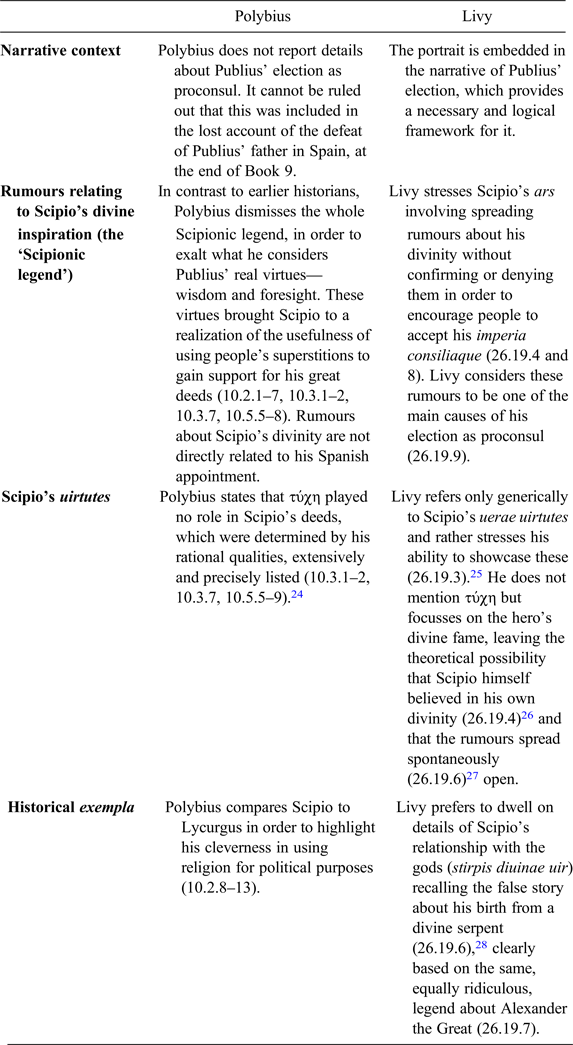
This comparison demonstrates the extent to which Livy modified both the substance of Polybius’ account, adding details and eliminating others, and its narrative context.Footnote 29 In both accounts the theme of Scipio's virtues is closely bound to that of the Scipionic legend, but the two authors develop this link in a completely different way. Polybius enumerates Scipio's many virtues with great terminological precision and deals with the Scipionic legend with the sole purpose of showing just how unfounded it was. His intention is to silence tales of Scipio's supernatural powers, which in his view overshadow the commander's exceptional intelligence. To this end, he emphasizes Scipio's tactical and rational abilities: his exploitation of the supernatural is referred to only briefly and immediately reduced to a simple, though effective, communication strategy. For Polybius the divine element must be removed prior to the narrative of his undertakings in Spain in order to dispel any possible misunderstanding relating to the real reason for his success, namely his skilful use of rational abilities. Admittedly, such a representation implies a certain insincerity on Scipio's part,Footnote 30 but Polybius’ portrait is completely positive and consciously unblemished, as is demonstrated by the parallel between Scipio and the wise Lycurgus.
In his portrait, Livy almost completely overlooks Scipio's virtues, which are mentioned at the beginning of the section (19.3) and then literally vanish: Scipio's exploitation of people's belief in a link with the divine is the object of the whole portrait. Undoubtedly, Livy's reworking of Polybius is partly due to the former's stylistic and literary attitudes as opposed to the latter's—for instance his desire to deliver a dramatic and compelling narrative, in which the portrait is organically embedded. But it would be far too simplistic to regard the thematic shift of Livy's portrait as pure embellishment. On the contrary, it tells us much about his historical perspective. Whereas Polybius was interested in arguing against historians who were incapable of grasping Scipio's military merits, Livy's main concern is to show his readers how the commander could have played such a crucial role in the most important war in Roman history at the age of just 24 (§9 tunc ciuitas aetati haudquaquam maturae tantam rerum molem tantumque imperium permisit). The answer provided in the portrait is that he managed to win people's consensus by skilfully exploiting their beliefs, so that they unconsciously contributed to bringing his objectives to fruition.Footnote 31 Such a representation implies an interpretation of Scipio as a political and military leader,Footnote 32 and adds, in comparison to Polybius, substantial elements of ambiguity to his behaviour.
Admittedly, it cannot be ruled out that this ambiguity was drawn from an annalistic source, rather than being the result of Livy's own reworking of Polybius. Given the fragmentary state of the annalistic tradition, it is very difficult to verify this hypothesis, and later sources concerning Scipio's portrait do not help in tracing variants earlier than Livy, for they clearly rely on him (or on Polybius). We do know, however, that Valerius Antias gave an unflattering version of the famous episode of Scipio's continence in Spain, claiming that he actually accepted the beautiful prisoner and kept her in deliciis amoribusque, rather than returning her to her family.Footnote 33 Gellius, who transmits the notice (7.8.6), states that Antias was the only historian who gave such a negative image of the leader's mores (Valerium Antiatem aduersus ceteros omnes scriptores de Scipionis moribus sensisse). If we were to speculate on the annalist from whom Livy could have taken the ambiguous traits of his portrait, Antias would thus be the principal suspect.Footnote 34 But, even ignoring the fact that this would mean denying Livy any critical autonomy, this hypothesis is unlikely. Livy's representation is very subtle and very far from Antias’ bold claim recorded by Gellius; moreover, in his account of the episode of Scipio's continence Livy does not even mention Antias’ version. Evidently, it is much more probable that he intentionally departed from Polybius’ eulogy of Scipio to stress more ambiguous traits of the commander's leadership.
THE AMBIGUITIES OF A LEADER
The comparison with Polybius’ Book 10 demonstrates that the portrait of Book 26 is not only a very good example of Livy's artistry but also a crucial section for understanding the complexity of his representation of the hero of the Second Punic War. Unlike other historians, Livy tends to avoid protracted portraits when characters first appear,Footnote 35 usually postponing these until after their deaths.Footnote 36 Admittedly, this is not the first mention of Scipio in the narrative,Footnote 37 but there is little doubt that his sudden appearance at the comitia and his subsequent election as proconsul represent the moment of his investiture as a central player in this new phase of Rome's history. The importance of the moment is emphasized by its very position within the structure of the Third Decade. As has long been noted, Book 26 serves as a structural and narrative pivot for the whole decade, opening the new pentad focussed on Rome's recovery from the terrible defeats suffered during the first years of the war.Footnote 38 This pre-eminent narrative position is matched by the section's length. Even adopting Bernard's purely quantitative method, at 190 words it stands out as one of the longest portraits in the surviving books, comparable with those recognized by that critic as especially relevant to the narrative.Footnote 39
Livy's subtle ambiguity in the treatment of Scipio is suggested from the very first sentence of the portrait. The conjunction enim establishes a strong causal relationship between what the historian is about to say on the commander and the previous account of his triumphant election; however, Livy's first statement—that Scipio was certainly full of virtues, but it was his ars, his skill in showcasing them to an audience, that allowed him to be elected—is quite surprising: the contrast between uirtutes and ars comes across as strikingly ambiguous,Footnote 40 for the connotation of the virtues as uerae implicitly points to ars as falsa, or at least as something other than authentic moral greatness.
This view is supported by Livy's specific use of the term ars throughout his work, and especially in the Third Decade, as ‘military stratagem’.Footnote 41 In general, Roman thinking displays an ambivalent attitude to ars in warfare. In most cases it conveys negative connotations of deceit or fraud, and it is thus considered somehow alien to the ethics of warfare as dictated by the mos maiorum, which tends to consider battle as a certamen between peers strictly governed by honour and fides. Footnote 42 In the Roman view, with its traps and stratagems ars is dangerously close to perfidia, a lack of fides. The clearest statement of this attitude is found at 42.47.1–9, where the elder senators, moris antiqui memores, explicitly condemn the new methods adopted by Roman imperialism, claiming that Roman ars does not turn to insidiae and nocturna proelia and it is to be contrasted with uersutia Punica and calliditas Graeca.Footnote 43 Obviously, the reference to the Carthaginians is not casual; it reflects a stereotype common in Roman mentality and of special relevance in the Third Decade.Footnote 44 In Livy's view, the Second Punic War was fought against an enemy who represented the very incarnation of fraus and, therefore, of deceptive ars. On many occasions, Livy stresses the fact that Hannibal's success was not the result of fair fighting but rather of trickery and calculation, and he invariably uses the term ars to express this attitude: for example 21.34.1 non bello aperto sed suis artibus, fraude insidiis; 50.2 contra eludere Poenus et arte non ui rem gerere; 54.3 Mago locum monstrabit quem insideatis; hostem caecum ad has belli artes habetis; 27.16.2 totus in suas artes uersus insidiis locum quaerebat [sc. Hannibal]. Admittedly, on some occasions the Romans resort to ars for victory too, and sometimes Livy regards it as a desirable quality in a capable commander;Footnote 45 but it is significant that, even in these cases, ars is considered as alien to Roman customs and explicitly presented as ‘Punic’: for example 22.16.5 nec Hannibal fefellit suis se artibus peti; 32.1 consules … Fabi artibus cum summa inter se concordia bellum gesserunt; 25.39.1 arte Punica; 27.16.10 Hannibal … ‘et Romani suum Hannibalem—inquit—habent; eadem qua ceperamus arte Tarentum amisimus’. Footnote 46 In Livy's view, therefore, ars is a very problematic attitude, and we should not see it as a straightforward quality.Footnote 47
Furthermore, the reference to Scipio's ars induces readers to reconsider what they have just learnt about Scipio's election in the light of attitude to ostentatio uirtutum. And ostentation does play a central role in Livy's narrative of the comitia, which describes the crowd's state of mind through an effective use of visual details: at first they simply look around at one another, incapable of finding someone brave enough to take command (26.18.6 in magistratus uersi circumspectant ora principum aliorum alios intuentium); but then, as Scipio suddenly appears on higher ground so that he can be seen by everyone (26.18.7 in superiore unde conspici posset loco constitit), all those gazing in hesitation finally find a leader to focus their attention on (26.18.8 in quem postquam omnium ora conuersa sunt).Footnote 48 The conclusion that readers must draw is that the election was the result of a well-orchestrated and intentional coup de théâtre in which they, just like the comitia, have fallen victim to Scipio's ars.
From this point forward, the portrait can be considered a protracted exemplification of Scipio's ars and ostentatio, focussing on his relationship with the masses and the supernatural. Livy immediately highlights the practices on which Scipio's ars rested, stating that he usually behaved as though inspired by nocturnal visions or by the gods themselves (26.19.3 pleraque apud multitudinem aut per nocturnas uisa species aut uelut diuinitus mente monita agens), apparently suspending judgement on the underlying reasons for this habit. In fact, he suggests two alternative motivations, namely that he was affected by genuine superstitio or that he consciously planned his behaviour in order to gain the same total obedience that the masses usually attribute to an oracle. This twofold explanation recurs later in relation to rumours about his divine birth (26.19.6 seu consulto seu temere uolgatae opinioni fidem apud quosdam fecit) and seems to present readers with the, at least virtual, possibility that Scipio's behaviour was motivated by real belief.Footnote 49 However, it should be noted that in both cases suspension of judgement is followed by a strong affirmation of Scipio's deliberate and calculated action, thus implicitly refuting the hypothesis of genuine religious interest. After the hypothetical siue et ipsi capti quadam superstitione animi (26.19.4), Livy affirms that Scipio prepared people's minds with frequent visits to the temple of Jupiter Capitolinus (26.19.5 ad hoc iam inde ab initio praeparans animos), where the expression praeparare animos Footnote 50 can only point to a self-conscious persuasion strategy, with the implication that these visits to the temple were nothing more than a means of enhancing Scipio's own legend. Similarly, the correlative seu consulto seu temere at 26.19.6 is followed by a new reference to the ars with which Scipio neither confirmed nor denied rumours of his divine birth, preferring instead to adroitly boost these (26.19.8 his miraculis numquam ab ipso elusa fides est; quin potius aucta arte quadam nec abnuendi tale quicquam nec palam adfirmandi).Footnote 51 Therefore, although Livy seems to be open to the possibility that the rumours actually resulted from Scipio's special religiosity, this hypothesis is not actually developed in this section which, on the contrary, conveys an image of a cunning and calculating leader.Footnote 52
What is more, even accepting Scipio's belief in his own myth would in no way make Livy's portrait less ambiguous, for the latter refers to his religiosity with the highly problematic term superstitio.Footnote 53 As is well known, although at first the term was not pejorative in connotation, it went through a major moment of semantic formalization only a generation before Livy, namely in Cicero's work.Footnote 54 In Cicero's philosophical writings we find the first clear-cut distinction between religio, the meticulous observance of religious duties, and superstitio, which takes on the sense of an excessive fear of the gods, meaningless religiosity leading to non-compliance with the mos maiorum.Footnote 55 There is little doubt that, in his conception of superstitio, Livy aligns himself with Cicero's use: superstitio and superstitiosus occur seven other times in the surviving books and invariably with negative connotations. In five cases superstitio indicates a proliferation of religious phenomena following traumatic events, such as a plague (for example 6.5.6, 29.14.2),Footnote 56 and it is mostly in open conflict with civic religion. A most significant case occurs at 1.31.6, where Livy states that Tullus Hostilius was so exhausted by illness that he turned to every kind of superstitio even though he had always dedicated himself to the sacra of the city.Footnote 57 The same juxtaposition between superstitio and civic sacra is found also in 4.30.9–10, where, depicting the dissemination of foreign cults in Rome, Livy describes citizens with the exact same words also used for Scipio (sunt capti superstitione animi) and states that in this case superstitio was so widespread that the aediles had to intervene to bring Romans back to the places of cult prescribed by the mos patrium.Footnote 58 But in addition to the foreign connotation shared by all these passages, superstitio may also correspond to the idea of secrecy, resulting in shocking and subversive phenomena such as the Samnites’ dreadful rites (10.39.2)Footnote 59 or the infamous Bacchanals.Footnote 60 It can thus be demonstrated that in Livy's view superstitio, like and more than ars, represents a threat to social order which could somehow lead to the dismantling of the rigorous socio-political structure of the res publica.Footnote 61
From the very beginning of Scipio’ portrait, then, readers are faced with a dilemma: Livy's declared purpose is to lay bare the reasons for the commander's huge and sudden success. The section, however, is rhetorically designed to leave the audience with the unsettling impression that superstitiones and adsimulata—that is, what has implicitly been labelled as falsa in the first sentence of the portrait—outweigh Scipio's undeniable virtues, at least in gaining people's support.Footnote 62 The commander emerges as a figure somehow alien from the model of traditional Roman-ness usually celebrated by Livy.Footnote 63
The next paragraphs of the portrait (26.19.5–7) deal specifically with Scipio's public behaviour and the rumours they generated. The ostentation of this privileged relationship with Jupiter had disseminated the belief that Scipio had been conceived, just like Alexander the Great, by the father of the gods himself who, in the guise of a serpent, had lain with Scipio's mother.Footnote 64 Livy's judgement on these legends could not be clearer: they are nothing more than silly fairy tales, just like those about Alexander (26.19.6 famam in Alexandro magno prius uolgatam, et uanitate et fabula parem). This section of the portrait has been invoked as evidence of Livy's rationalist approach to religion,Footnote 65 and his condemnation of Scipio's divinization by the people has also been stressed.Footnote 66 It is difficult, however, to regard Livy's criticism as aimed solely at the rumours per se or, as Polybius did, at those who tried to divinize Scipio, for the point of the whole portrait is that the commander was ultimately responsible for his own myth.Footnote 67 P. Davies, who gave a thorough analysis of the religious implications of this portrayal, pointed out how transgressive Scipio's attitude is for traditional Roman religiosity, especially when it comes to his appropriation of the authority institutionally assigned to priests.Footnote 68 It is difficult to deny, therefore, that Livy's condemnation of these false beliefs should be read as an implicit criticism of Scipio's creation of religious propaganda to ensure absolute obedience.
This conclusion gains further support if one considers the fact that, with this reference to Alexander, Livy seems to suggest a broader parallel between him and Scipio.Footnote 69 Critics usually consider this parallel as a means of isolating Scipio from Roman commanders as a whole, in order to stress his greatness in a ‘Hellenistic’ way,Footnote 70 but this view does not take into account the highly negative connotation accorded to Alexander in a famous digression of Book 9 (9.16.19–9.19.7), in which Livy speculates on the outcome of a hypothetical war between the Macedonian king and the Roman Republic.Footnote 71
The Alexander digression provides an interesting perspective on Scipio's behaviour and greatly contributes to shedding an ambiguous light on his attitude towards religion. Like the portrait, it refers to rumours which insisted in comparing a great Roman general, Papirius Cursor, with Alexander (9.16.9), and describes Zeus’s paternity of Alexander in terms which closely resemble the terms in Book 26: 9.18.4 uanitatem ementiendae stirpis (compare 26.19.6 stirpis eum diuinae uirum esse … famam in Alexandro magno prius uolgatam, et uanitate et fabula parem). Except that in Book 9 Alexander's divine birth is clearly presented as having been made up by the king himself.Footnote 72 In fact, since Alexander claimed his divinity by visiting Zeus/Ammon's oracle at Siwah,Footnote 73 readers may wonder whether Scipio's visits to the temple of Jupiter could have served a similar purpose.
Moreover, the general tone of the digression advises against considering Alexander as a virtuous model for Livy. There, Livy eulogizes Roman collective heroism claiming that Roman generals are superior to Alexander because they achieved their extraordinary successes within the boundaries of the Republican constitution, facing up to the temporal and civic limits of their power, whereas Alexander won his victories as a monarch, completely unbound by any institutional restraints.Footnote 74 This makes the Scipio/Alexander parallel even more problematic: it is precisely during the Second Punic War that the real effectiveness of appointing magistrates on an annual basis becomes a pressing problem in Rome, where opinion is divided between those who consider the iteration of office as the only possible solution in the face of HannibalFootnote 75 and those concerned by the threat of adfectatio regni. Scipio himself will later be accused by Fabius Maximus of exploiting his military success to obtain consecutive office and thereby showing a monarchical attitude: 28.42.22 ego patres conscripti, P. Cornelium rei publicae nobisque, non sibi ipsi priuatim creatum consulem existimo, exercitusque ad custodiam urbis atque Italiae scriptos esse, non quos regio more per superbiam consules quo terrarum uelint traiciant.Footnote 76
This is not the only case in which Livy's criticism of Alexander is paralleled by similar accusations by Fabius against Scipio. In 9.18.3–4 Livy states that Alexander's army would have arrived in Italy already weakened by Persian luxuria, completely oblivious of its homeland and led by a commander dressed in Eastern garments: Dareo magis similis quam Alexandro in Italiam uenisset et exercitum Macedoniae oblitum degenerantemque iam in Persarum mores adduxisset. referre in tanto rege piget superbam mutationem uestis.Footnote 77 Similar criticism is to be found in Fabius’ invective against Africanus after the Pleminius scandal, except that Scipio's soldiers are said to have forgotten not simply their homeland but even their enemy: 29.19.11–13 etiam imperatoris non Romanus modo sed ne militaris quidem cultus iactabatur: cum pallio crepidisque inambulare in gymnasio, libellis eum palaestraeque operam dare … cohortem totam Syracusarum amoenitate frui, Carthaginem atque Hannibalem excidisse de memoria.Footnote 78 These coincidences demonstrate that the Alexander reference is anything but a straightforward eulogy; on the contrary, it clearly plays a role in distancing Scipio from the model of Roman hero praised by Livy throughout his work (and particularly in Book 9) pointing to criticism of him by his contemporaries.
The final section of the portrait is perhaps also the most striking. After mentioning Scipio's ambiguous and skilful behaviour before the people once more (26.19.8 his miraculis numquam ab ipso elusa fides est; quin potius aucta arte quadam nec abnuendi tale quicquam nec palam adfirmandi), Livy states that, as a result of his ars, admiration for the commander among citizens exceeded human limits: 26.19.9 multa alia eiusdem generis, alia uera, alia adsimulata, admirationis humanae in eo iuuene excesserat modum. This final comment definitively undermines the previous account of Scipio's election: his immense fauor populi, earlier presented as a sign of his greatness,Footnote 79 now takes on unsettling connotations of excess and a lack of modus. It is an especially perilous excess as it touches on the religious sphere: the term humanus contextualizes Scipio's behaviour into a man–god antithesis, already suggested at the end of the election, when it is said that Scipio ‘filled men with a more assured hope than belief in a man's promise or reasoning based upon confidence of his success usually inspires’ (26.19.2 ut … impleret homines certioris spei quam tantam fides promissi humani aut ratio ex fiducia rerum subicere solet). In this respect too, Livy's portrait seems to anticipate criticism against the commander: during the aforementioned debate on the African expedition, he will defend himself from the accusation of immodestia made by Fabius Maximus: 28.44.18 modestiae certe et temperando linguae adulescens senem uicero. And moderatio is one of the most important virtues in the moral order of Livy's history, a trait often considered as a prerequisite for the righteous exercise of power.Footnote 80
Did Livy think that Scipio was a bad commander, or even a bad Roman citizen? Of course not. In the Third Decade, Scipio's virtues emerge very often and in much less ambiguous terms than here: a little later on in Book 26, the narrative of the siege of Nova Carthago (26.41.1–26.47.10) leaves no doubt about his military acumen, and the subsequent episode of Allucius’ fiancée (26.50.1–13) seems specifically designed to exalt his continence and restraint. But it is significant that when Livy explains the reasons behind Scipio's election—one of the rare occasions in which he voices his own views—he chooses to focus on Scipio's duplicitous attitude towards the people rather than on his virtues, in a portrayal which seems to stress precisely the ambiguity of his behaviour and which foreshadows more substantial criticism against him. In doing so, Livy consciously and radically modifies the historiographical tradition on Scipio which he inherited from Polybius and the Annalists, condensing information which he is less interested in and expanding more problematical aspects. Scipio thus emerges as a living and controversial character defined by a remarkable moral ambiguity. The young general, whose merits are beyond doubt, saved the res publica with his uerae uirtutes but also by means of his innate ability to trick people, however noble his motives. Like many other passages in the Ab urbe condita, therefore, this portrayal reflects Livy's concern with confronting his reader with a challenging and non-simplistic moral representation, especially when the nature of political and military power is concerned.

 Open access

