

Introduction
Scholars generally regard policy specialization in the U.S. Congress as benefitting the institution collectively and members individually. For individual members of Congress (MCs) aiming to make good public policy (Fenno Reference Fenno1978), focusing on a few select issue areas, often rooted in one’s background and district needs, is key to lawmaking success (Volden and Wiseman Reference Volden and Wiseman2014). Indeed, several studies offer empirical support for the view that policy specialization enhances legislative success among MCs (Anderson et al., Reference Anderson, Box-Steffensmeier and Sinclair-Chapman2003, Hibbing Reference Hibbing1991, and Moore and Thomas Reference Moore and Thomas1991; but see Frantzich Reference Frantzich1979). Even MCs concerned solely with reelection presumably benefit politically from policy specialization. “Whatever else it may be,” wrote Mayhew (Reference Mayhew1974), “the quest for specialization in Congress is a quest for credit. Every member can aspire to occupy a part of at least one piece of policy turf small enough that he can claim personal responsibility for some of the things that happen on it.” Specialization also helps Congress fulfill its institutional role as the nation’s chief lawmaking body. The development and evolution of the committee system—which cultivates specialized expertise by parceling out jurisdiction over policy domains to committees and subcommittees—reflects Congress’s prioritization of specialization, while simultaneously serving MCs’ individual political and policy needs (Bimber Reference Bimber1991; Krehbiel Reference Krehbiel1992).
Interest groups also value specialization and expertise (DeGregorio Reference DeGregorio1997; Esterling Reference Esterling2007). Many interest groups seek to advance their goals in relatively narrow and well-defined policy areas (Halpin and Thomas Reference Halpin and Thomas III2012). This is especially true for business trade groups and corporations (Drutman Reference Drutman2015), whose lobbyists seek relationships with lawmakers who possess expertise in specialized and increasingly complex policy domains. The benefits of specialization are evidently so important to access-seeking interest groups that many stop contributing campaign dollars to House incumbents who are “exiled” from committees (due to majority party status loss) with jurisdiction over a group’s policy concerns (Grimmer and Powell Reference Grimmer and Powell2013). Similarly reflecting the value of expertise to interest groups is that MCs with more analytical knowledge in a policy domain area tend to receive more campaign money than do MCs with less expertise from groups with policy interests in that domain (Esterling Reference Esterling2007).
Despite the perceived benefits of specialization to both MCs and interest groups, MCs appear to be less specialized than one would expect. For example, Volden and Wiseman (Reference Volden and Wiseman2020) find that most legislators’ portfolios are overextended. They show that legislators with moderately generalized agendas are the most successful legislatively but that most legislators are not sufficiently specialized to achieve optimal effectiveness.
We offer an explanation for policy generalization among MCs that focuses on the significant growth of business lobbying activity in the DC policy world (Drutman Reference Drutman2015) and the opportunities that such growth affords MCs to tap into campaign funds from business political action committees (PACs). This growth in demand for access from business groups has outpaced the supply of access—lawmaker time is finite and congressional staff has declined in numbers and capacity (Crossen, Furnas, LaPira, and Burgat Reference Crosson, Furnas, LaPira and Burgat2020)—creating conditions of access scarcity. The result of business demand for MC attention outpacing supply is that the most valuable MCs in a policy domain from an interest group’s perspective—those with committee jurisdiction and substantive and political expertise in a group’s domain—cannot possibly meet the rising demand (McKay Reference McKay2022). This unmet demand for attention from business groups incentivizes MCs to expand the business domains in which they legislate to profit (in the form of increased business PAC contributions) from business groups unable to secure access to MCs with the most expertise in that domain. In short, lower levels of congressional capacity (less supply) and more business lobbyists (more demand) produce access shortages, which in turn motivates MCs to become active in new domains to satisfy the unmet need.
Congressional data from 1990 to 2020 offers empirical evidence consistent with this theory. We show first that MCs have increased the number of domains in which they legislate over time but that this increase is largely driven by an expansion in the number of business sectors in which MCs are legislating. House members legislating in non-business domains remained relatively constant, with only a slight increase over time. We then show that the more business domains an MC legislates in, the more business PAC contributions he or she raises. Importantly, though—and key to our theory—the relationship between business domains and business PAC money is conditioned by the growth of business advocacy in DC. That is, the more business group activity there is in Washington, the stronger the relationship is between business domains and business PAC contributions. We also show that the relationship between business domains and business PAC contributions is positively conditioned by the experience of an MC’s political staff. We interpret this to mean that more experienced political staff are more entrepreneurial in terms of seeing opportunities for their principals. Finally, we provide evidence suggesting that members who legislate in more business domains attract a more diverse donor network.
In addition to contributing to the academic literature on lawmaking and interest group influence, our findings also have significant normative importance. The fact that business PAC campaign money appears to motivate MCs to broaden their legislative activity within business domains amplifies fears that business’s structural and kinetic power allow it to crowd out labor and non-business concerns on the congressional agenda (Witko et al., Reference Witko, Morgan, Kelly and Enns2021).
The Rationale for Legislative Specialization and Generalization
For members of Congress, the choice to be a generalist or a specialist comes with costs and benefits (Volden and Wiseman Reference Volden and Wiseman2020). The key benefit of policy specialization is expertise. Specialization in a policy domain expertise enables a lawmaker to exert outsized influence in the policy area (Hall Reference Hall1996; Loomis Reference Loomis1988; Volden and Wiseman Reference Volden and Wiseman2020). Not surprisingly, then, members organized the institution in ways designed to cultivate such expertise (Krehbiel Reference Krehbiel1992). Even today, when lawmaking power is more centralized in party leadership offices, policy specialization and expertise remain avenues for influence. As Curry and Lee (Reference Curry, Lee, Frances, Lee and McCarthy2019, 203–4) observe, the support of congressional experts can be vital in building support for a proposal, and party leaders often have little choice but to listen to them.
Yet as Volden and Wiseman (Reference Volden and Wiseman2020) argue, specialization comes with risks. If the issue in which a member specializes falls off the congressional agenda, the member risks being relegated to the policy sidelines. Working in multiple policy domains guards against such marginalization. There are also positive benefits to generalization. With policy problems increasingly complex and cutting across multiple domains (Drutman Reference Drutman2015; Jones, Theriault, and Wayman Reference Jones, Theriault and Whyman2019), lawmakers who work in several policy areas are better positioned to assemble coalitions of diverse actors and interests (Volden and Wiseman Reference Volden and Wiseman2020). Finally, members who generalize may benefit electorally (Atkinson and Windett Reference Atkinson and Windett2019) if legislating in additional domains appeals to campaign donors (Volden and Wiseman Reference Volden and Wiseman2020, 27) or helps an MC respond to shortcomings brought up by a challenger in a previous campaign (Sulkin Reference Sulkin2005).
Interest groups may provide direct incentives to generalize. In the lawmaking arena, groups provide members with information and expertise (Hall and Deardorff Reference Hall and Deardorff2006; McKay Reference McKay2022), “subsidies” that are especially valuable in less familiar policy terrain, and in an era of diminishing staff resources (Crosson, Furnas, LaPira, and Burgat Reference Crosson, Furnas, LaPira and Burgat2020) and increasing policy complexity (Drutman Reference Drutman2015). In the electoral arena, interest groups provide significant sums of financial support to the campaigns of members of Congress. Such funds have always been important to members, of course, but now, the threat of independent spending campaigns enabled by Citizens United (2010) and the need to pay five- and six-figure party dues (Canes-Wrone & Miller, Reference Canes-Wrone and Miller2022; Heberlig and Larson Reference Heberlig and Larson2012) makes the scramble for funds particularly acute. Business groups, with their significant financial resources to spend on lobbying and campaign contributions, have substantial “kinetic” power (Witko et al., Reference Witko, Morgan, Kelly and Enns2021) to shape lawmaker incentives regarding the degree to which to specialize or generalize.
When we give interest groups center stage, members’ calculations about the costs and benefits of specialization versus generalization look different. The connection between interest group financial support and members’ legislative activity (Hall and Wayman Reference Hall and Wayman1990; McKay Reference McKay2022) means that the risk of being sidelined can cost the member significant financial support from groups. In this sense, working in multiple policy domains protects a lawmaker from losses in group donations associated with the ebb and flow of legislative activity in any single policy domain. Moreover, for groups with diffuse interests that span multiple policy domains, a lawmaker who tends toward generalization might prove to be an especially valuable champion.
Finally, as we show in the next section, lawmakers need not look far to find interest groups in need of their assistance. This especially true for business groups, the growth of which has significantly outpaced that of non-business groups (Drutman Reference Drutman2015) and whose demand for congressional attention has significantly outstripped the available congressional supply (McKay Reference McKay2022).
The Broadening of MCs’ Legislative Agendas: The Role of Business Groups
Trends in Legislative Specialization
Volden and Wiseman (Reference Volden and Wiseman2020) find that most legislators’ portfolios are overextended. Specifically, they show that lawmakers with moderately broad agendas are the most effective at moving bills through to passage but that most MCs are insufficiently specialized to achieve optimal effectiveness. Using Volden and Wiseman’s data, Figure 1 plots the average number of total policy domains an MC introduces legislation in between the 101st and 116th Congress. As the figure shows, MCs have indeed become more generalist in their legislative orientation over time. While the typical MC introduced legislation in 5.5 domains in the 100th Congress, the typical MC in the 116th Congress introduced legislation in 7.2 policy domains. Although this increase seems relatively small, broadening one’s legislative agenda by even one additional domain moves MCs away from the optimal level of specialization identified by Volden and Wiseman (Reference Volden and Wiseman2020) and stretches overtaxed congressional staff (LaPira et al., 2020) even thinner.
Total business, and non-business domains, 100th–116th congress.
Source: Volden and Wiseman Data.
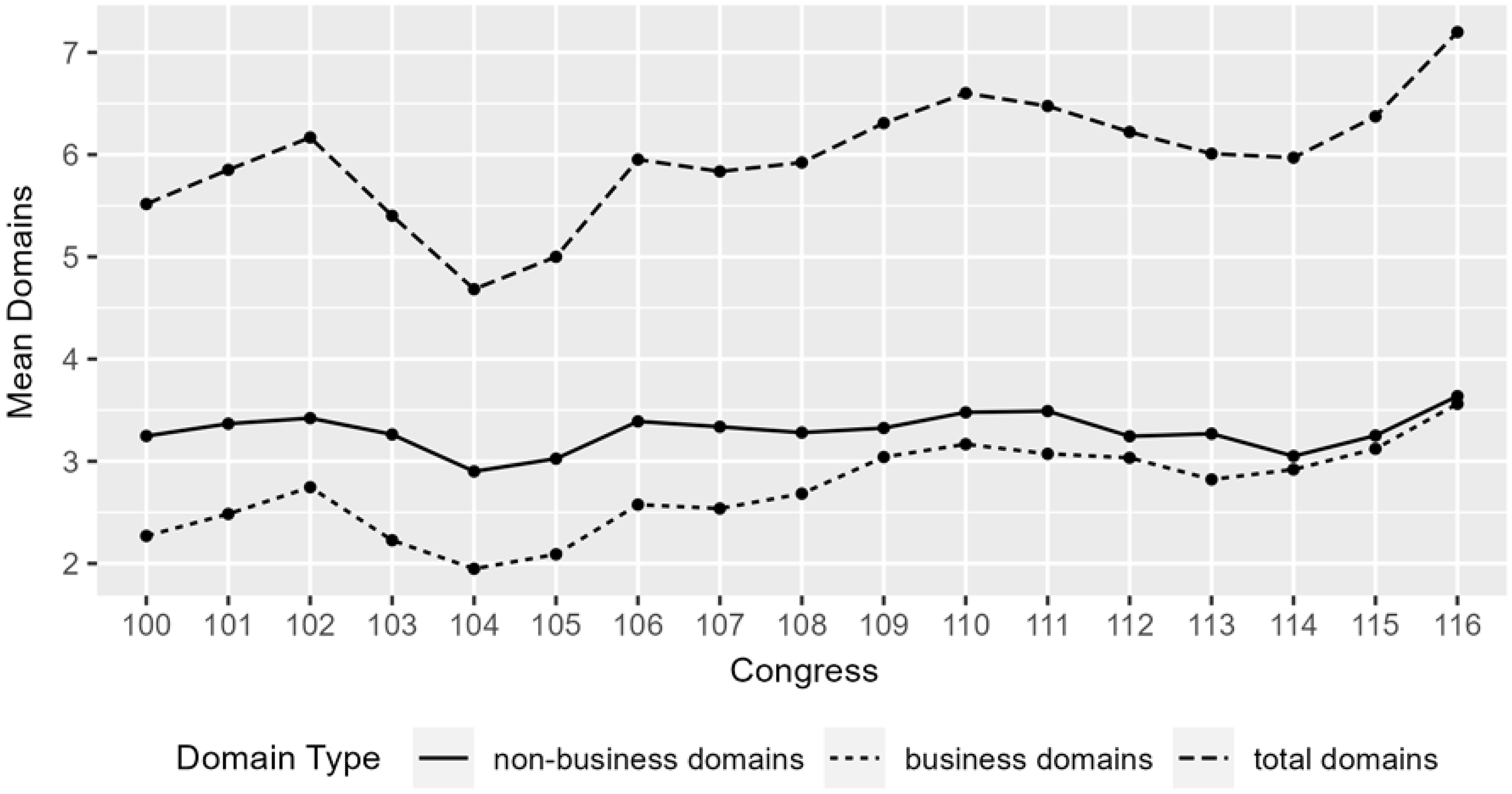
Figure 1 also shows that the increase in MC domain expansion is driven mainly by an increase in MC domains in business sectors. Based on Volden and Wiseman’s use of Policy Agenda Project coding of legislation, we classify the following issue areas as business policy domains: agriculture, commerce, defense, energy, foreign trade, health, housing, macroeconomics, science and technology, and transportation. Nonbusiness policy domains include civil rights, education, environment, government operations, international relations, labor, law/crime, public lands, and welfare. While lawmakers’ average level of policy generalization in non-business domains has remained mostly stable between the 100th and 116th Congresses, they have become increasingly more generalized in business domains between these Congresses.Footnote 1 What’s more, the gap had almost fully closed by the 116th Congress. In short, MCs have increasingly expanded their legislative agendas with business domains over time.
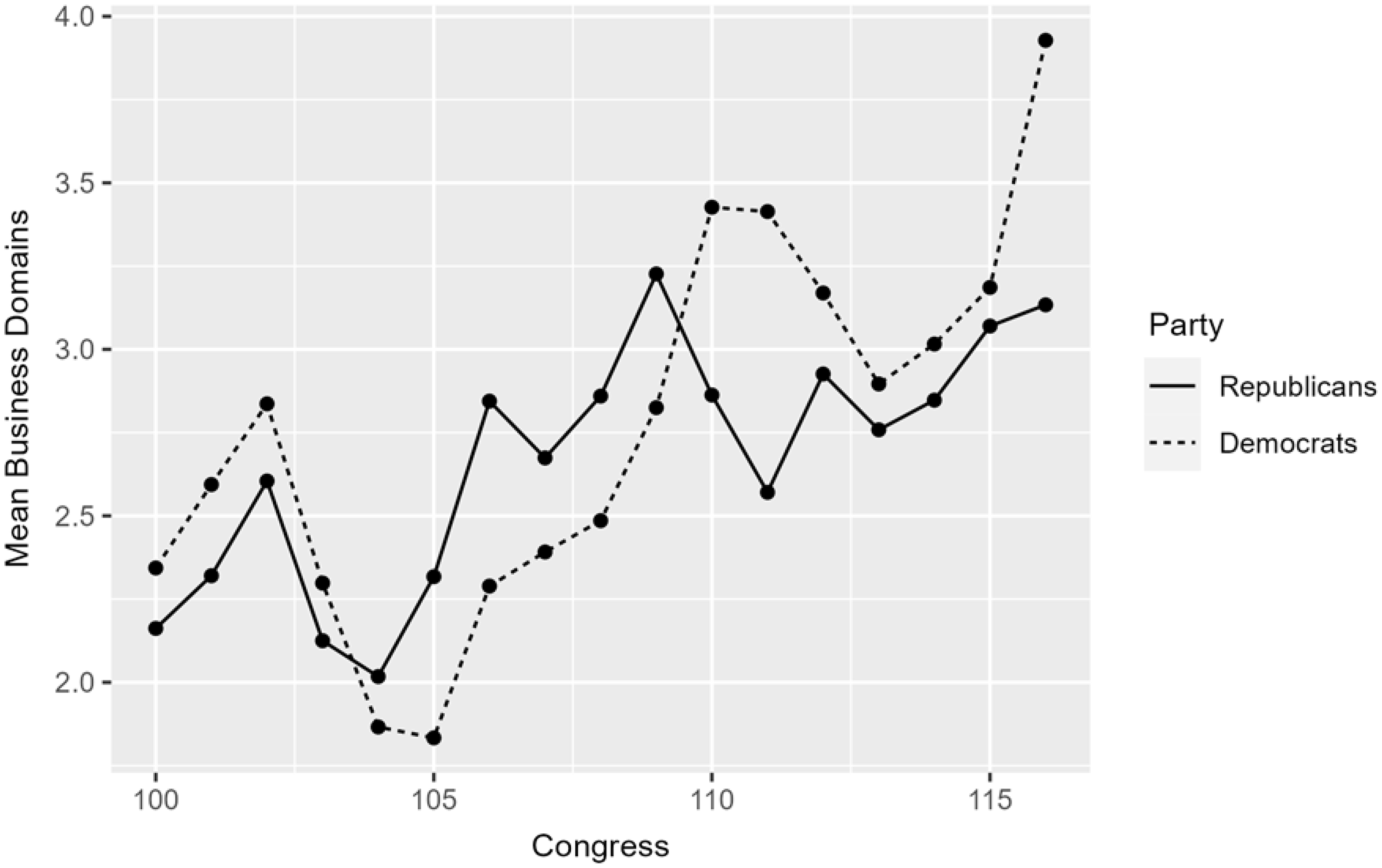
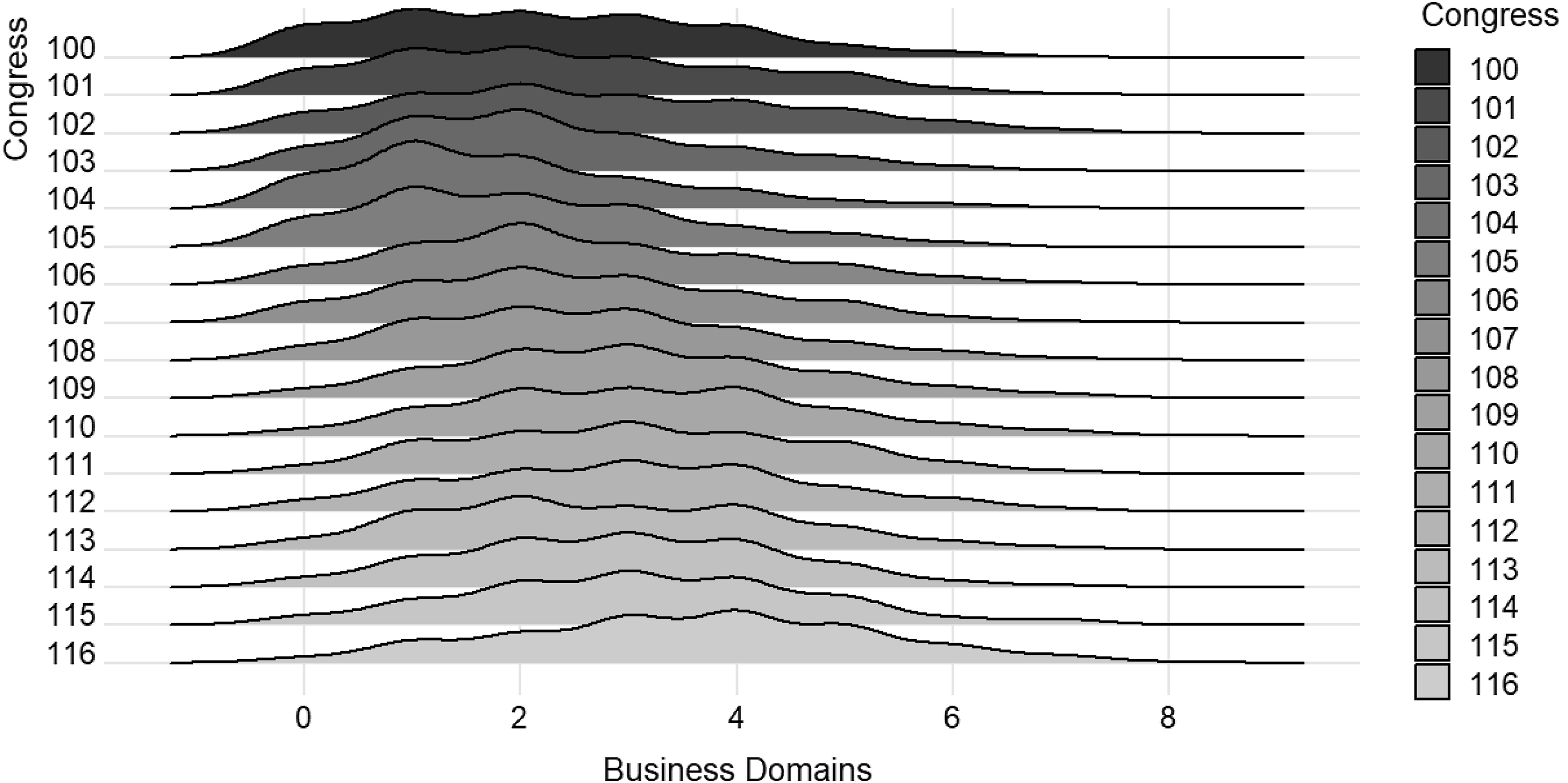
A consequence of members expanding their agendas into more business domains is an increase in business legislation as a share of the congressional agenda. In the 101st Congress (1989–1991), 49.7% of bill introductions were in business domains, by the 116th Congress (2019–2021), business legislation comprised 57.7% of bill introductions. This shift does not appear to be due to Republicans taking up more of the agenda in their natural ideological space. The percentage of business domain legislation for Republicans increased from 48.9% to 55.8% (6.9%) while Democrats increased slightly more from 50.2% to 58.6% (8.4%). Figure 2, which graphs changes in business domains separately by party, reinforces the bipartisan nature of the change. It suggests a common factor, such as financial incentives from business organizations, is driving members of both parties to shift their legislative agendas toward business domains. Figure 3, which presents Kernel Density Plots for business domains by Congress, shows that the entire distribution of lawmakers’ business domain legislation has shifted rightward, toward more business domains, over the Congresses in our data set.
Mean business domains by party.
Kernel density plots of business domains by congress.
Why Have Lawmakers Broadened their Business Agendas Over Time?
A legislator might generalize his/her legislative portfolio for a number of reasons: a change in their personal interests, a change in their district, an identification of policy space that is underserved and in which the member can make a mark, a change in institutional responsibilities—such an obtaining an additional committee assignment (Burden Reference Burden2007; Hall Reference Hall1996; Miler Reference Miler2010; Schiller Reference Schiller2000; Sinclair Reference Sinclair1989, 142–52; Sulkin Reference Sulkin2005), or changes in the broader political incentive structure.Footnote 2 We argue that the increased demand for access by business groups, and their willingness to signal their desire for access with campaign contributions to MCs who are active in their policy domains, has incentivized members to shift their discretionary legislative portfolios to tap these financial incentives.
Our theory posits that the growth of business group lobbying has created an incentive structure to encourage MCs to expand the number of business domains in which they legislate. As Drutman (Reference Drutman2015) observes, a key change in the Washington policy community in the past several decades has been the sharp expansion in corporate lobbying activity. Once satisfied to get their representation mainly through DC trade groups, corporations began establishing a greater DC presence in the 1970s and 1980s to push back against increasing regulation of business (Drutman Reference Drutman2015; Pierson Reference Pierson, Pierson and Skocpol2007; Jones, Theriault, and Whyman Reference Jones, Theriault and Whyman2019). Surveys by Schlozman et al., (Reference Schlozman, Jones, You, Burch, Verba and Brady2014, Reference Schlozman, Brady and Verba2018) confirm the increasing portion of the DC advocacy world made up by business interests.
For our purposes, the most important consequence of the increase in business group activity is that it has increased competition for lawmaker attention. Veteran lobbyists interviewed by Drutman highlight this change:
-
“The biggest change is there are more people doing it. The hallways are more crowded, the hearing rooms are more crowded, everything is more crowded.”
-
“The noise level has gotten ridiculous. The biggest problem is to be heard.”
-
“It’s gotten more brutal, more cut-throat… All in all, it becomes harder to penetrate Capitol Hill because there’s so much white noise.”
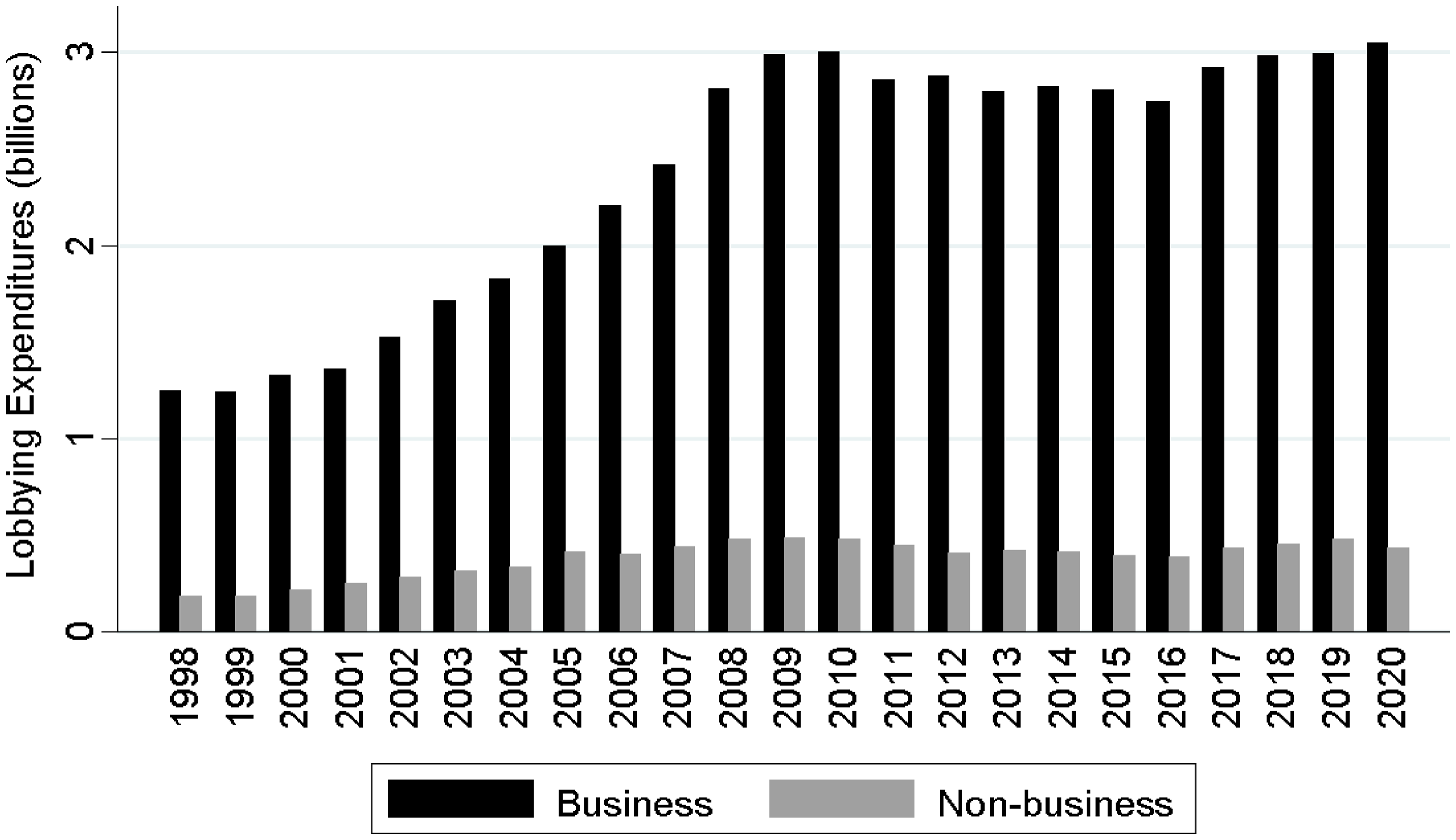
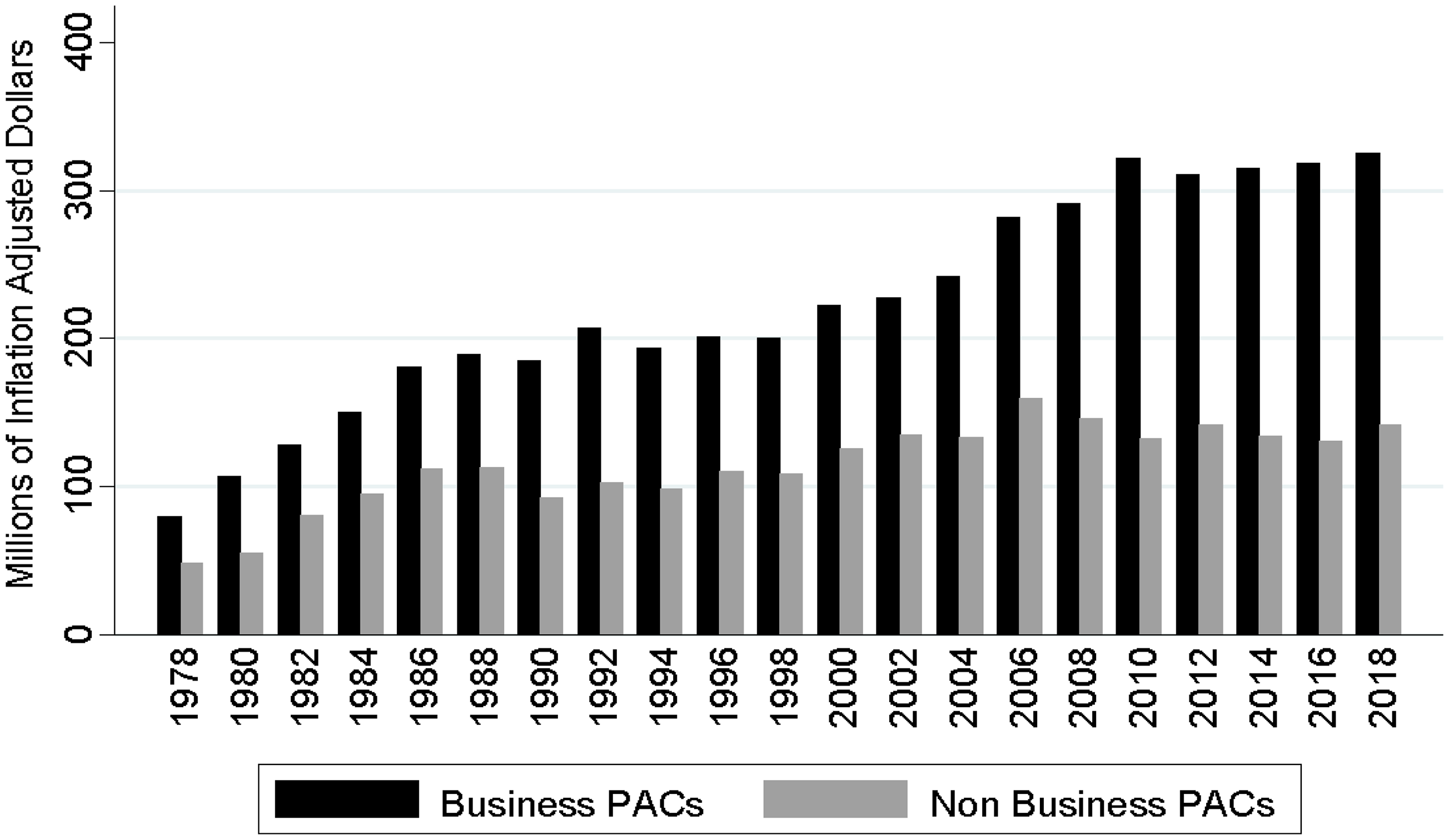
Figure 4 shows lobbying expenditures in business and non-business policy domains between 1998 and 2020. The growth in business PAC contributions relative to non-business PACs (Figure 5) also demonstrates business’s increased presence in DC advocacy politics. Employer mobilization of employee contributions (Hertel-Fernandez Reference Hertel-Fernandez2018; Stuckatz Reference Stuckatz2022) is likely only to increase business’s visibility among lawmakers.
Total business and non-business lobbying expenses 1998–2020.
Source: Center for Responsie Politics.
Business and non-business PAC conditions to congressional candidates, 1978–2018.
Source: Federal Election Commission.
Attention in Washington has always been a scarce and valuable commodity, and gaining the attention of policy makers is among the key functions of lobbyists (Baumgartner et al., Reference Baumgartner, Berry, Hojnacki, Leech and Kimball2009; Bauer, Poole and Dexter Reference Bauer, de Sola Pool and Lewis Dexter1963; Wright Reference Wright1996). But the sharp growth in corporate lobbying, alongside increasing competition within the business lobbying world (Drutman Reference Drutman2015), has increased group competition and demand for the attention of policymakers.
Of course, the number of congressional lawmakers available to serve business groups has not increased; nor has lawmakers’ time. As importantly, congressional capacity has diminished, as indicated by a decline in the number of congressional staff, particularly legislative staff (Crosson, Furnas, LaPira, and Burgat Reference Crosson, Furnas, LaPira and Burgat2020), and a congressional staff workforce that has less procedural and substantive knowledge than might be expected (Miler Reference Miler2007). In short, while the rise in business lobbying has increased the demand for lawmakers’ attention, the supply of attention, expertise, and overall legislative capacity lawmakers can devote to groups has remained flat at best and—given staff changes—significantly declined.
McKay (Reference McKay2022) outlines the consequences of this mismatch between attention’s supply and demand for interest groups. Ideally, a business group would gain access to lawmakers with sufficient power and expertise in the group’s issue domain to help deliver for the group. That is, they would prioritize access to members of the committee of jurisdiction (Grimmer and Powell Reference Grimmer and Powell2013; Krozner and Strattman Reference Kroszner and Stratmann2000), particularly the chair, who are in alignment with the group’s policy preferences. Indeed, there is substantial evidence that groups seek access to build relationships with the most effective legislators (Box-Steffensmeier and Grant Reference Box-Steffensmeier and Tobin Grant1999; Esterling Reference Esterling2007; Hall and Deardorff Reference Hall and Deardorff2006; Hall and Wayman Reference Hall and Wayman1990). The most efficient approach would be for the group to rely on a champion (DeGregorio Reference DeGregorio1997), or small group of champions, repeatedly over time to address their needs in particular policy areas. Here, however, like-minded interest groups face a collective action problem because everyone in the industry has an incentive to seek access to the same effective lawmakers, bidding up the cost of access (Denzau and Munger Reference Denzau and Munger1986, 98). Therefore, as McKay posits with her “inverse-pull” hypothesis, the most powerful lawmakers have less time to spend with lobbyists, making competition for these MCs’ time and attention ever-more fierce. In an unregulated campaign finance market, business groups willing to pay more for the services of the most skilled lawmakers could outbid competing business groups by making larger campaign contributions. But strict caps on direct business campaign contributions to lawmakers make this option impossible. The implication is that business groups and their lobbyists need to find other, perhaps less than ideal, allies in Congress. As McKay (Reference McKay2022, 34–35) writes,
While more legislatively productive and powerful Members are very desirable targets for lobbyists to focus on, it is consequently much harder for lobbyists to get these legislators’ attention… Lobbyists thus face a tradeoff: They can seek out meetings with high-importance lawmakers who may not be motivated to pay much attention to what the lobbyist has to say, or spend the same amount of time requesting and attending meetings with a larger number of lower-powered Members who may be happy to cooperate with the lobbyist, even though such Members have limited ability to carry out the group’s legislative request.
For most business groups, enlisting the assistance of an under-specialized member—even if that member may be less successful than a member with more specialized expertise—is likely to be preferable than having no champion on the Hill at all. Although groups would prefer to work with lawmakers with more expertise (Hall and Deardorff Reference Hall and Deardorff2006),Footnote 3 it seems likely that most groups would be willing to provide more extensive legislative subsidies to less-specialized lawmakers if the alternative to doing so is having no or less representation on the Hill. Moreover, legislators with less specialized knowledge who are reliant on the group’s subsidy are more likely to defer to the group’s expertise and legislative drafts. Often groups merely seek a tweak in the language of a bill (Drutman Reference Drutman2015, 30–1; MacKay Reference McKay2020), and getting these tweaks inserted into a bill does not require a high level of legislative expertise. Although recruiting less specialized members may not be ideal, the fact that language from a lawmaker’s bill often finds its way into successful legislation (Casas et al., Reference Casas, Denny and Wilkerson2020) implies that a wider array of lawmakers can be helpful to interest groups.Footnote 4 Finally, the idea that lawmakers other than the most effective ones have something valuable to offer interest groups is evidenced by the fact that some large PACs give to hundreds of incumbents—far more than the number who could be considered the most effective lawmakers.Footnote 5
Short of delivering actual legislation, there are many ways that lawmakers without high levels of specialization on a group’s priorities can help the group, and much of this assistance can likely be undertaken without prohibitively costly legislative subsidies on the part of the group. For example, sponsoring bills containing language supplied by the group helps to build awareness of the group’s priorities, “educates potential allies,” and “conveys a sense of momentum” (Baumgartner et al., Reference Baumgartner, Berry, Hojnacki, Leech and Kimball2009, 155; Gelman Reference Gelman2017; Reference Gelman2020). Even speaking on the House floor about business priorities, a form of agenda setting that requires little specialization, is rewarded by business PACs (Witko et al., Reference Witko, Morgan, Kelly and Enns2021).
At the least, when a legislator authors legislation in the group’s policy domain, the group has to decide the extent to which it should devote resources to developing a relationship with the legislator. If the legislator’s activities can affect the group’s policy goals and would benefit from the group’s feedback, the group has an incentive to seek a relationship with the legislator by using a contribution to signal shared interests and priorities and a desire for access (Hall and Deardorff Reference Hall and Deardorff2006). From this opening, the group can develop opportunities over time to provide information, persuade, and make specific legislative asks from the representative (Wright Reference Wright1996). A group is likely to desire more access to someone who is active in their policy domain than someone who is not, and the contribution provides evidence of that desire.
We are not arguing that PACs prefer ineffective legislators. Indeed, we control for legislative effectiveness in our empirical models. In reality, many groups already have relationships with legislators who have established expertise and recurring policy activism in their domains. Instead, we are positing that, by broadening their policy domains into new areas (in which they may have less expertise), lawmakers have been able to attract financial support from business groups that have exhausted their ability to influence the most effective specialists. In a hyper-saturated lobbying environment in which the demand for congressional attention far outstrips the available supply, most business groups cannot hold out for lawmakers with the most expertise in their issue area. The relative value of the non-specialist increases to the interest group as the cost of the expert becomes prohibitive.
When business groups are unable to obtain access from their ideal allies, it is likely that they will turn to legislators who are active in multiple policy domains adjacent to their own, since efficiency is greater where expertise is more transferable (Rumelt Reference Rumelt1974). Legislators who are active in multiple business domains show indicators of ability to move into the group’s policy domain successfully–transferability of expertise, ability to synthesize across policy domains, an understanding of diverse coalitions, and adaptability of legislative skills. They have the advantage of understanding how a group’s interests connect across policy domains. Generalist lawmakers who can engage across multiple policy domains would be valuable in an environment where legislation has become more complex and in which much successful legislation is packaged into omnibus bills (LaPira and Thomas Reference LaPira and Thomas2017; Sinclair Reference Sinclair2000). Indeed, a group lessens its policy risks by developing relationships with legislators who can reliably assist them regardless of the specifics of the issue agenda in any particular Congress.
The theoretical perspective we outline above generates several hypotheses:
H1. The more business domains a U.S. House member legislates in, the more campaign receipts he or she raises from business PACs, on average.
H2. The effect of MC domain expansion on business PAC receipts will be conditioned by business group advocacy levels (measured alternatively as aggregate business lobbying expenses and aggregate business PAC contributions), with domain expansion leading to more business PAC money as business’s demand for legislative allies outstrips supply.
The prospect of raising additional business PAC funds can be a critically important inducement in the overheated fundraising environment facing congressional incumbents. With relentless pressure to raise campaign money—not only for their own campaigns but also for the party (Canes-Wrone & Miller, Reference Canes-Wrone and Miller2022; Heberlig and Larson Reference Heberlig and Larson2012)—MCs never cease thinking about how to expand their donor lists (Canes-Wrone & Miller, Reference Canes-Wrone and Miller2022). For MCs willing to expand the business domains they legislate in, then, the excess demand for legislative allies produced by the explosion in corporate lobbying represents an opportunity to expand the number of business donors willing to give to their campaigns.
An interest group’s ability to subsidize legislative activities becomes increasingly important as declining congressional capacity in staff resources exacerbates the increasing competition among business interest groups for congressional attention. MCs in the contemporary Congress essentially face a choice of hiring the maximum number of staffers allowable (18) at relatively uncompetitive salaries or hiring fewer staffers at higher salaries and presumably more experience (Reynolds Reference Reynolds, LaPira, Drutman and Kosar2020). Yet MCs have undercut their own policy-making capacity by reallocating staff positions from legislative to communication and constituent staffers (Crosson, Furnas, LaPira, and Burgat Reference Crosson, Furnas, LaPira and Burgat2020).
MCs seeking to profit politically by cultivating relationships with new business groups would benefit from knowledgeable and well-connected staffers attentive to such opportunities (McCrain Reference McCrain2018). Although much of the newer research on the relationship between staff and legislative effectiveness has focused on legislative staff (Crosson, Furnas, LaPira, and Burgat Reference Crosson, Furnas, LaPira and Burgat2020; Crosson, Lorenz, Volden, and Wiseman Reference Crosson, Lorenz, Volden, Wiseman, LaPira, Drutman and Kosar2020), the task of cultivating relationships with business groups in need of legislative allies would seem most relevant to political management staff. Crosson, Furnas, LaPira, and Burgat (Reference Crosson, Furnas, LaPira and Burgat2020) define political management staff as “staff whose primary responsibilities are to manage the member’s relationships with other elites in Washington, such as leaders of political parties and issue caucuses, lobbyists, and major donors” (763). Experience among political management staff—which likely broadens and deepens a staffer’s connections in the DC lobbying network—seems especially important to helping MCs identify a leadership vacuum (Sinclair Reference Sinclair1989, 150) containing politically profitable opportunities for collaboration with business groups seeking congressional attention. Political management staff help the MC identify and recruit potential allies in the Washington community (Henderson et al., Reference Henderson, Hertel-Fernandez, Mildenberger and Stokes2023). The interest groups on the receiving end of such contacts are likely to see the outreach as a signal of accessibility of the MC’s office.Footnote 6 These observations suggest a hypothesis regarding congressional staff and a lawmaker’s expansion into additional business domains:
H3 The greater the level of experience of an MC’s political management staff, the larger the number of business domains an MC will legislate in.
H4 The relationship between business domain expansion and business PAC money is conditioned by the level of experience possessed by an MC’s political staff. That is, the greater the level of experience an MC’s political management staff possesses, the greater the payoff (in terms of business PAC money) the MC will receive from expanding into new business sectors.
Our theoretical perspective also implies that legislating in more domains should create a more diverse donor coalition as the growth of business advocacy has increased. For legislators, the motivation for meeting the increased demands for legislative allies among DC business groups is to tap into additional business sector donors—that is, to attract support from a larger and more diversified donor pool. Just as generalization allows a legislator more opportunities for success in a political environment in which issue salience can change dramatically (Volden and Wiseman Reference Volden and Wiseman2020), a diverse donor base stabilizes members’ fundraising capacity across the ebb and flow of electoral issues and environments (Loomis Reference Loomis1988, 206). This perspective leads to our final hypotheses:
H5. The more business domains in which a U.S. House member legislates, the more donor sectors from which the MC raises campaign money.
H6. The effect of business domains on donor sector diversity is conditioned by the growth of business advocacy, with domain expansion leading to contributions from business PACs in a greater number of domains as business’s demand for legislative allies outstrips supply.
Data and models
Our key dependent variable is the sum of campaign contributions a U.S. House member receives from business PACs, in inflation-adjusted 2020 dollars, for each election cycle from 1990 through 2020 as reported to the Federal Election Commission (FEC). We measure business contributions as the incumbents’ total PAC contributions from the following industries, as aggregated by the Center for Responsive Politics (CRP): agriculture, communications and electronics, construction, defense, energy, finance, health, lawyers and lobbyists, miscellaneous business, and transportation.
Among our independent variables of primary interest is the number of business domains in which an MC introduces legislation, as shown in Figure 1. We view sponsored legislation as a measure of an MC’s legislative agenda in business. Legislators use their legislative agendas as a signaling device of shared interests and priorities to multiple attentive constituencies (Campbell Reference Campbell1982; Gelman Reference Gelman2020; Kessler and Krehbiel Reference Kessler and Krehbiel1996; Schiller Reference Schiller2000; Sulkin Reference Sulkin2005; Wilson and Young Reference Wilson and Young1997). Even if a bill’s introduction is more position-taking than serious legislation (Mayhew Reference Mayhew1974), allied groups see evidence that the legislator shares their priorities. Writing legislation on an issue is a demonstration of interest and expertise on the issue as well as a commitment of time and organizational resources (Hall Reference Hall1996; Rocco and Gordon Reference Rocca and Gordon2010). We count the number of business domains in which each member has introduced legislation from Volden and Wiseman’s data based on the Policy Agenda Project coding of legislation. We classify the following issue areas as business policy domains: agriculture, commerce, defense, energy, foreign trade, health, housing, macroeconomics, science and technology, and transportation.
We use two alternative variables to measure business advocacy at the congressional session-level. The first is aggregate business lobbying expenditures, by Congress, in inflation-adjusted 2020 dollars. These data come from the CRP. Because business lobbying expenditure data is available only back to 1998, we also estimate a second model in which business advocacy by Congress is measured using aggregate business PAC campaign contributions given to all House and Senate candidates running for election, in inflation-adjusted 2020 dollars. This measure allows us to make use of our full range of data (1990–2020). These two measures of business political activity are highly correlated (r = 0.86, p. 0.00), suggesting that they are both tapping similarly into levels of congress-level business advocacy activity.
As can be the case with regression models that include interactive terms, extreme multi-collinearity poses challenges to our model by producing unstable slope coefficients. The Pearson’s correlation coefficient r for business domains and our interactive term using total lobbying expenditures (business domains*total lobbying expenditures) is .89. Similarly, r = .91 for business domains and our interactive term using total business PAC contributions (business domains*total business PAC contributions). To address this problem, we follow Jaccard and Turrisi’s (Reference Jaccard and Turrisi2003, 27) strategy of mean centering the variables that make up the interactive term prior to computing the interactive term.Footnote 7 (See also Lewis-Beck and Lewis-Beck Reference Lewis-Beck and Lewis-Beck2015, 81–82; and Shieh Reference Shieh2011).
To measure the average experience of an MC’s professional political staff team, we divide an MC’s total expenditures on political management staff in a given Congress by the number of political management staff he or she employs. The assumption here is that larger average salaries for an MC’s political management staff signify higher levels of experience among political management staffers. Our data on staff comes from Crosson, Furnas, LaPira, and Burgat (Reference Crosson, Furnas, LaPira and Burgat2020).
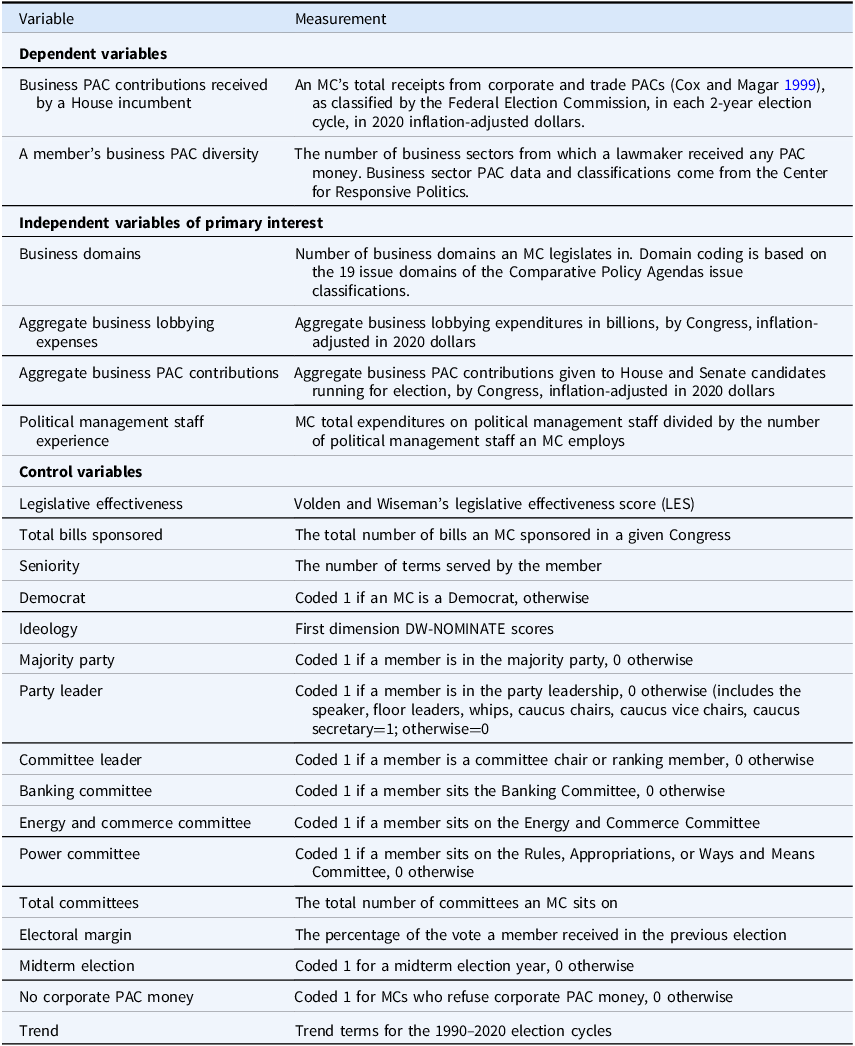
Additionally, we include multiple control variables that, based on past research, are expected to be related to the sum of business PAC contributions a member raises. These variables and their measurement are summarized in Appendix B, Table B1. We do not present the results for the controls in the tables to streamline our presentation and focus our attention on the variables of key theoretical interest. The control variables consistently have the expected effects. (See Appendix B, Table B2).
Our data includes all U.S. House members who ran for reelection between 1990 and 2020 (n = 7085).Footnote 8 Importantly, the models vary in the number of observations they include based on the independent variables included in each. For example, we have lobbying expenditure data for only the 105th–116th Congresses (1998–2020) and political management staff data for only the 103rd–113th Congress (excluding the 109th). Thus, models that include these variables have a smaller number of observations. Since we use data from multiple sessions of Congress and numerous members appear in the data set repeatedly, we estimate the model using OLS regression with member-level fixed effects to capture individualized effort and talent at fundraising.Footnote 9
Model results
Table 1 provides the results of the various models. Model 1 shows that the number of business domains in which an MC legislates is positively and statistically related to their business PAC receipts.Footnote 10 For each one additional business domain a lawmaker legislates in, they raise, on average, $12,299 in business PAC money. Considered across a −/+1 standard deviation change in business domains around the mean, this coefficient generates an average increase of $40,709 in business contributions for lawmakers. For perspective, $40,709 represents a little more than 9 percent of the mean amount of business PAC contributions raised by members in our data set. Whether this increase is large is of course relative. But with fundraising pressures on House members relentlessly intensifying, “You always have to broaden it [the list]. Always.”Footnote 11 In short, domain expansion into new business areas is profitable and helps lawmakers enhance their campaign accounts, an imperative in the current political environment. In contrast, domain expansion into nonbusiness policy domains is unrelated to campaign receipts (results in Appendix B, Table B1).
The Effect of MC Business Domains on Business PAC Receipts, Conditioned by Business Activity and Political Staff Experience (Fixed Effects Regression)
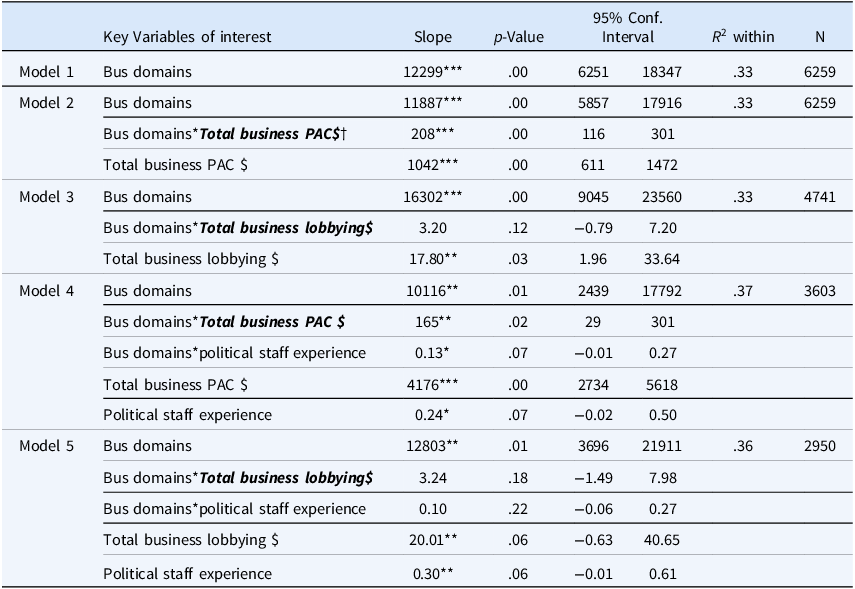
Note: Total business PAC money and Total Business Lobbying are congress-level variables and are measured in millions of inflation-adjusted dollars. ***p < .01; **p < .05; *p < .10, two-tailed.
†In models 1, 2, and 4, business activity at the Congress level is measured with total business PAC contributions given during a given election cycle. In models 3 and 5, business activity at the Congress level is measured with total business lobbying expenses made during a given election cycle.
Specific lawmakers illustrate these estimations. Rob Andrews (D-NJ) was consistently active in a wide variety of domains. In the 104th Congress, he authored bills in 14 domains, evenly split between business and non-business domains. In the 105th Congress, he added legislation in an additional business domain and saw his business PAC contributions increase by a modest $21,260 and ideological PAC contributions increase by $10,673.Footnote 12 In the 110th Congress, liberal Earl Blumeauer (D-OR), introduced a single bill in five business domains, four of them were new domains. He increased his fundraising from business PACs by $302,158. This was a substantial increase from the seven previous election cycles: Blumenauer had received more than $100,000 from Business PACs in only one cycle, averaging $59,500 from business PACs in all but one outlying cycle.
The results for Model 2 also demonstrate that the added contributions MCs reap for expanding into new business domains is, as predicted, conditioned by business’s level of political activity. The statistically significant and positive coefficient for the interaction term shows, as competition for lawmakers’ attention grows (measured in this model as the sum of business PAC money available in a given Congress), the value of expanding into additional business domains grows significantly. At the same time, the main effects coefficient for business domains remains positive and statistically significant. Where Rob Andrews increased his funding from Business PACs in 1998 by $21,260 for adding a single business domain, Bill Foster (D-IL) increased his fundraising by $109,088 with the addition of a single business domain in 2020. Again, we interpret these results to mean that as the presence of business has grown in the Washington policy world, the demand for lawmaker attention has outpaced supply, making it politically profitable for MCs to expand their legislative efforts into new business domains.
Model 3 reinforces these findings, this time using total business lobbying expenditures in a given Congress (rather than total business PAC contributions) as the measure of business political activity. Although the main effects coefficient for business domains is positive and statistically significant, the positive coefficient for the interactive term (Bus domains*Total business lobbying $) falls just short of statistical significance (p < .11). Note that the number of observations in Model 3 is smaller (n = 4741) than in Models 1 and 2 (n = 6259), owing to unavailability of business lobbying data prior to 1998 (the 105th Congress). Given the results parallel those in Model 2, this weaker finding also suggests that the value to MCs of expanding one’s agenda into new business domains increases as the advocacy presence of business intensifies. Especially in light of our findings in Model 2, it seems likely that the inclusion of business lobbying expenditure data for the earlier Congresses (the 101th–104th) in our data set (were these data available) would strengthen and provide even more certainty to our findings.
Tables 2 and 3 show the predicted values of member business PAC receipts for a −1/+1 standard deviation change of business domains with aggregate business PAC spending and aggregate lobbying expenditures set at −1/+1 standard deviations from their respective means, holding the values of the control variables at their means. Consistent with our expectations, the results in both tables show that the fundraising value of legislation sponsored in business domains is significantly larger when the business advocacy space in Washington DC is more crowded. For example, a member with business domain sponsorships at +1 standard deviation from the mean increases her haul from business PACs by an average of $48,249 ($702,382–$654,133) when business lobbying expenditures move from −1 to +1 standard deviations across the mean of aggregate lobbying expenditures in the data set. In short, legislating in business domains is more profitable for House members as business’s demand for congressional attention has grown.
Predicted Business PAC Contributions Received by Individual MCs at…

*Values of all control variables held at their means.
Predicted business PAC contributions received by individual MCs at…

*Values of all control variables held at their means.
Model 4 in Table 1, which adds the experience of political management staff to the model specification in Model 2, demonstrates that political staff indeed matters in a predictable way. In particular, the positive and marginally statistically significant interactive term (p < .08) for Business domains*political staff experience shows that the business PAC dollars raised by an MC for expanding into new business domains increases as does the mean level of experience of the MC’s political management staff. Moreover, the interactive term for business domains and business political activity (Bus domains*Total business PAC $) remains positive and statistically significant, if a little smaller than in Model 2. Since the responsibility of political management staff is managing the MC’s relationships with DC actors including interest groups (Crossen, Furnas, LaPira, and Burgat Reference Crosson, Furnas, LaPira and Burgat2020, 763), we interpret the evidence in Model 4 to mean that having an experienced political management staff helps an MC identify politically profitable opportunities for collaboration with business groups seeking congressional attention.
Model 5 also evaluates the impact of staff, this time adding the political management staff variables to the specification in Model 3—which uses total business lobbying expenditures in a given Congress (rather than total business PAC contributions) as the measure of business political activity. All of the coefficients for the main effect variables remain statistically significant and in the predicted direction, but neither of the interactive terms are statistically significant. These less certain results seem likely to be a function of an even further reduced number of observations in Model 5 (n = 2950), owing to the considerably smaller number of Congresses for which we have both political management staff data and business lobbying expenditure data. However, that the coefficients are similarly signed to those in Model 4 gives us confidence that our theory has merit.
Although we don’t focus on the results of the control variables, it is notable that an MC’s legislative effectiveness score (LES), as measured by Volden and Wiseman (Reference Volden and Wiseman2014), has a large and statistically significant effect on MC business PAC receipts in each of the models we estimate (as do seniority and committee and party leadership positions as other measures of legislative power). This reinforces our argument that interest groups desire to work with the most influential members, but seek out legislators new to the domain (presumably for less arduous tasks) as access to the ideal legislators become prohibitive.Footnote 13 It is also worth noting members who serve on more committees receive significantly less money—compared to the increase in funds for legislators who actually expanded their legislative efforts into additional business policy domains.Footnote 14
To analyze the concentration of an incumbent’s donor pool, we calculate the Herfindahl-Hirschman Index– a measure used in economics to calculate the degree of monopoly in an industry. It is calculated by taking the square of the proportion of donor categories (CRP industry sectors, ideological PACs, labor PACs, individual donors) and adding them together. We calculate a separate index for the member’s business PAC donors only. Higher values of the index indicate greater concentration of the donor sectors. A positive relationship with legislating in business domains indicates more concentrated donor pool, a negative relationship indicates a more diverse donor pool. We expect a negative relationship: legislating in more business domains will result in less concentrated donor pools. We estimate the models of donor concentration using the same fixed-effect regression models and controls as in our previous results.
We use the Herfindahl index as our measure of donor diversity, in part, because it turns out that the percentages of U.S. House incumbents who received any campaign money at all from each of the CRP sectors are exceedingly high. Indeed, the average MC in our data set received contributions from 8.86 of the 10 CRP sectors. This figure has climbed only slightly over time. These figures indicate that MCs business PAC fundraising profiles are already very diverse, with most House incumbents raising at least some campaign money from most sectors. The higher business PAC receipts associated with MC business domains reflects either larger PAC contributions coming from existing sectors in an MC’s donor profile or new PACs organizing in a sector and giving to the MC (or a combination of both). We plan to explore this question in future work.
Table 4 shows mixed support for our donor concentration hypotheses. Model 1 shows a marginally significant relationship (p < .09) between business domains and greater donor diversity. That is, the evidence shows that legislators who introduce legislation in more business domains have more diverse donor pools, though with weak levels of confidence. Model 2 for Business PACs, however, shows no relationship between business domains and the breadth of funding across industry groups. This result may be partially driven by our finding that almost all MCs receive at least some PAC funds from most industries. Further analysis shows that legislating in business domains diversifies the member’s donor pool mainly by decreasing their reliance on individual donors (the largest source of funds for most members of the House), and increasing the member’s proportion of funds from business while ideological and labor PAC percentages remain stable (3% and 10% respectively). For example, introducing legislation in one business domain (from zero), increases the legislator’s proportion of funding from business PACs from 33% to 36% on average, and decreases their proportion of funds from individual donors from 53% to 50%. These proportions stay largely stable as the number of business domains in which members introduce legislation increases. No industry contributes to these trends more than others, leading to the nonsignificant result in donor pool diversity model run with business PACs only. Interacting the member’s business domain legislation with aggregate business PAC money, business lobbying expenses, and (at the member level) political management staff does not produce any significant relationships with donor diversity (results not shown).
The effect of MC business domains on the concentration of the MC’s donor pool (fixed effects regression)

***p < .01; **p < .05; *p < .10, two-tailed.
Conclusion
Business has long held a privileged position in American politics because of its structural and kinetic power (Bachrach and Baratz 1962; Dwyre and Kolodny Reference Dwyre and Kolodny2024; Schattschneider Reference Schattschneider1960; Witko et al., Reference Witko, Morgan, Kelly and Enns2021). This paper examines one mechanism by which business is able to exercise these powers—its ability to subsidize legislative activities in business-related policy domains. Our theory and evidence suggest that business’s electoral and lobbying resources incentivize legislators to introduce legislation in business policy domains, which over time, has increased the share of business legislation relative to non-business legislation as a proportion of the congressional agenda.
We view our analysis as a first cut at the question of why House lawmakers have expanded their legislative agendas in the business realm relative to non-business policy areas. We have not, for example, provided direct causal evidence that business money changes individual legislators’ agenda or the institutional agenda, though our theory and evidence are consistent with this perspective. Further work could include amassing more direct evidence for the role of business money in the expansion of lawmakers’ business agendas, pinning down more fully the causal mechanisms at work between business’s sharply growing presence in the DC policy world and lawmakers’ behavior, testing additional implications of our theoretical perspective, and considering and testing potentially competing explanations for the trends we observe.
Our theory specifies how business has overcome potential limitations to influence as a result of access scarcity—a simultaneous increase in demand for access from business and a decrease in the supply of access due to the decline in legislative staff. Our findings are consistent with the story that, especially under conditions of access limitation, business PACs expand their targets of access by increasing their giving to legislators who are broadly active in business domains. These legislators may not be specialists in the industries’ policies, but their involvement in related domains offers the potential to transfer their expertise and political contacts to assist in developing policies that synergize across business policy domains. The industry may not be able to expand access to their ideal champions (McKay Reference McKay2022), but they can develop relationships with additional champions to facilitate achievement of their legislative goals.
The consequence of this dynamic for legislators is that they have an incentive to expand their legislative agendas to attract the interest of new and additional donors. They generalize not because it improves their probability of legislating successfully, we argue, but because it helps them expand their coalitions, in this case, their donor coalitions. In fact, Volden and Wiseman (Reference Volden and Wiseman2020) observe that members with an overly diffuse legislative portfolio tend to be less legislatively effective. Following these financial incentives may produce individual representatives and an institution collectively that is spread too thin in its expertise and coalition-building capacity to be an efficient and effective policy-making body. At the same time, however, legislators do not have a financial incentive to expand legislating into any or every policy area that might benefit their constituents or serve the public interest. They have a financial incentive to legislate in a limited number of policy domains that business PACs will subsidize.
Our results also suggest that many MCs are not passive objects of business groups’ financial entreaties. MCs with more experienced political staff appear to have greater ability to forge connections with monied business groups as the scarcity of access increases. We find that congressional offices with more experienced political staff reap more business PAC largess. We argue that experienced political staff help their bosses identify financially beneficial legislative opportunities; their experience likely places them in personal and informational networks that help them identify and exploit such opportunities.
Finally, we provide suggestive evidence that MCs have an incentive to legislate across multiple business policy domains not only because doing so generates more business PAC contributions but also because a broader legislative portfolio increases the diversity of their donor lists. Our results are consistent with the story that legislating on a greater variety of topics signals to a greater variety of donors that the MC shares their interests and priorities and therefore gives them a reason to support the legislator financially. Having a more diverse donor pool is likely to help mitigate the risk shifts in the political environment and give an incumbent greater ability to withstand the inevitable attrition of donors from earlier election cycles.
The theoretical perspective and findings we present are consistent with Hall and Wayman’s contention (Reference Hall and Wayman1990) that the influence of political money is more likely to be found in a lawmaker’s commitment of effort to legislating than in their vote choices. Hall and Wayman (Reference Hall and Wayman1990) further suggest that the ability of PAC money to mobilize legislators to allocate more time and effort toward legislative activities favored by their donors opens the possibility for donors to skew the congressional agenda toward the priorities of those donors. Our data and analysis are consistent with the argument that business’s growing share of the congressional agenda is rooted in its increasing demand for congressional attention (Drutman Reference Drutman2015), fortified by the valuable financial resources business PACs are able to offer incumbents. Schattschneider (Reference Schattschneider1960) famously argues that political mobilization is biased, often toward the well-heeled. Our findings would seem to provide yet more evidence consistent with Schattschneider’s argument by highlighting the importance of business financial resources in winning congressional attention in a market in which the demand for such attention has thoroughly outpaced supply.
Competing interests
The authors declare no conflicts of interest in this research.
Appendix A. Alternative measures of policy specialization among members of congress
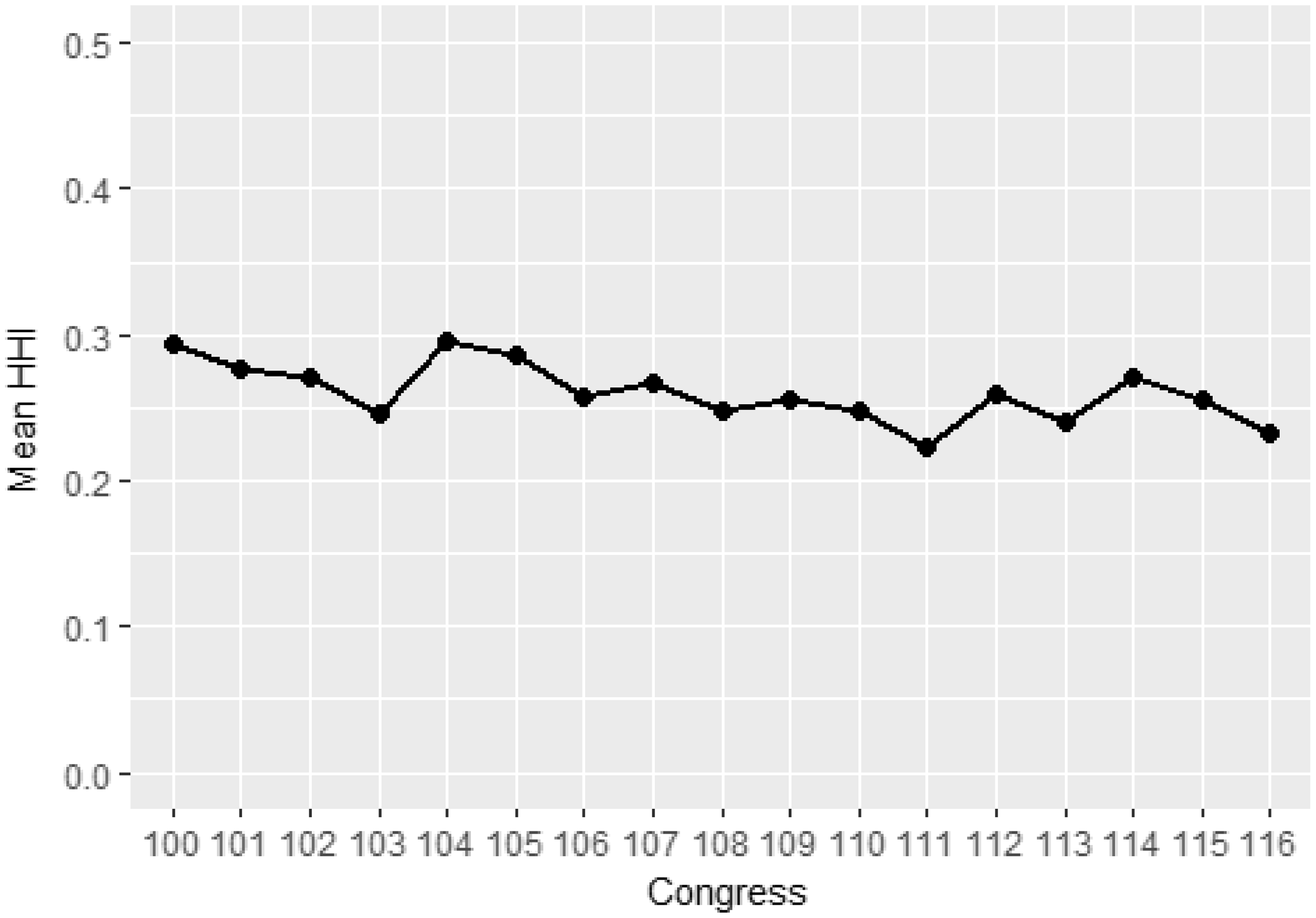
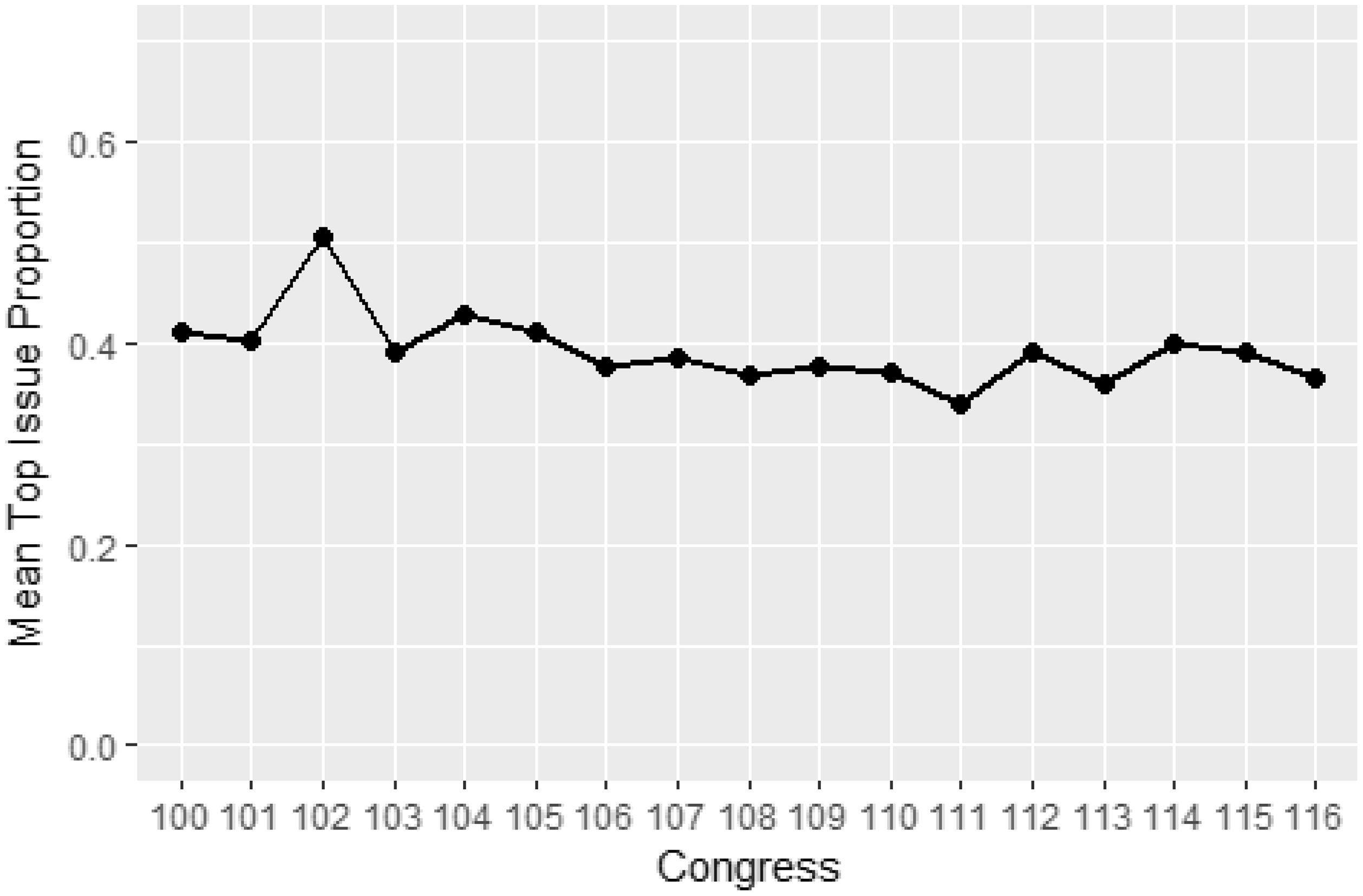
Figures A1 and A2 show that MC domain expansion is robust to multiple metrics of domain expansion besides the measure we use in the paper (the count of the total number of issue domains in which a MC has introduced legislation). Figure A1 shows trends in an MC’s Top Issue Proportion, which is calculated by taking the total bills sponsored in the MC’s most active issue domain and dividing by his or her total number of bills (Volden and Wiseman Reference Volden and Wiseman2020). A higher proportion of bills in the legislator’s most active domain indicates greater specialization. Figure A2 then maps out trends in the Herfindahl-Hirschman Index (HHI), which captures the degree of issue concentration for a legislator in a given Congress. It is calculated by taking the square of the proportion of bills in each of the 19 issue domains and adding them together. Higher values of the index indicate greater concentration of the MC’s legislative agenda—that is, greater specialization. Both metrics show that MCs have broadened their legislative agendas over time.
Mean HHI, 100th–116th Congress.
Source: Compiled from Volden and wiseman LES Data.
Top Issue Proportion, 100th–116th Congress.
Source: Compiled from Volden and wiseman LES Data.
Appendix B.
Variables in the Models
Results for the control variables for models 1–5 in Table 1
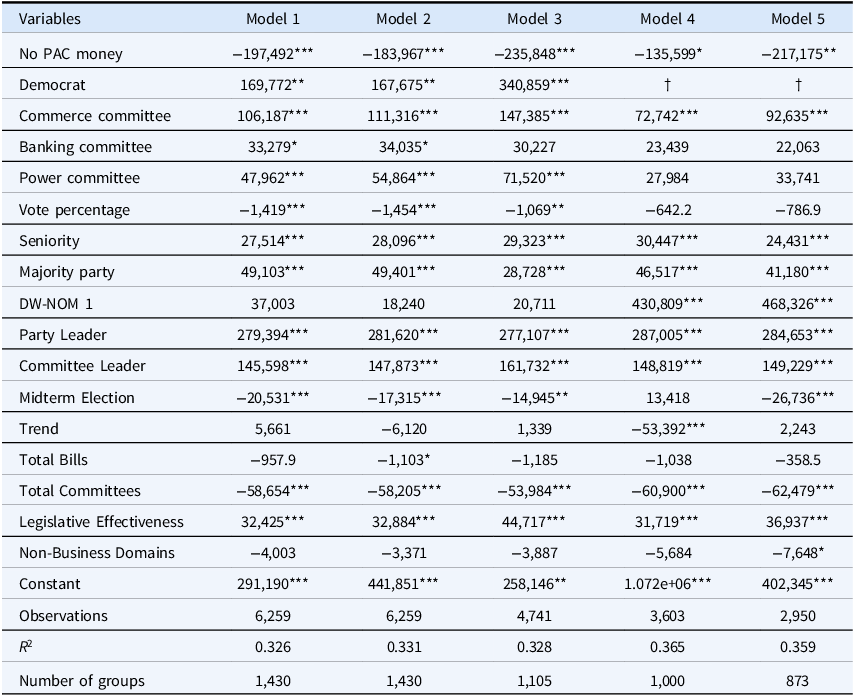
Note: Standard errors in parentheses; ***p < 0.01, **p < 0.05, *p < 0.1. Fixed effects can estimate a coefficient for Democrats in models 1–3 only because there are several party switchers in the data for these models. This is not true for models 4 and 5. † = omitted because of collinearity.


 Open access

