


1. Introduction
Interconnected systems and advanced technologies are reshaping innovation, making Data-Driven Design (DDD) a vital part of modern product and service development. By utilizing data from diverse sources, DDD enables designers to make informed decisions throughout the development process, enhancing efficiency, addressing increasingly complex user needs, and improving outcomes (Lee and Ahmed-Kristensen, 2025). Among these, human-centric data is particularly valuable, providing insights into behaviors, preferences, and emotions that support user-centered solutions. By integrating behavioral data, physiological signals, emotional responses, and subjective feedback, human data enables a deeper understanding of both explicit and implicit needs, fostering a more holistic design approach.
Despite its critical role, the full potential of human data remains underappreciated in practice due to several challenges (Reference Quan, Li, Zeng, Wei and HuVictorelli et al., 2019; Reference Victorelli, dos, Hornung and PradoQuan et al., 2023). Human data provides opportunities to uncover latent user needs, refine existing solutions, and frame problems in ways beyond the limits of conventional data approaches (Reference Cantamessa, Montagna, Altavilla and Casagrande-SerettiCantamessa et al., 2020). Exploring the types and sources of human data, as well as analyzing how it is integrated into DDD practices, presents an opportunity to optimize its use and address inherent challenges. This analysis will not only highlight pathways to enhance the design process but also ensures outcomes that better align with user needs while fostering innovation.
This paper explores the role of human data in Data-Driven Design processes, with the primary objectives:
1. Provide a structured overview of the different types and sources of human data relevant to DDD.
2. Investigate how human data enhances key aspects of the design process, such as problem framing, iterative refinement, customization, and emotional engagement.
3. Through real-world examples illustrate the role of human data in developing innovative products and services.
4. Examine critical ethical challenges, including privacy, bias, and transparency, to advocate for responsible use of human data in design practices.
The primary contribution of this work lies in drawing together insights from case studies, frameworks, and other works across diverse domains to present a detailed exploration of the use of human data in design. This was achieved through a literature study-style approach, employing a focused yet flexible approach to identify and analyze papers that address the role of human data in DDD processes from diverse fields.
This paper is organized to provide a clear and structured exploration of how human data is used in DDD. Section 2 begins by defining human data, categorizing its different types and sources, before then discussing data ownership. Section 3 focuses on the advantages of using human data, such as its role in problem framing, iterative refinement, personalization, and emotional design, with real-world case studies to illustrate these points. Section 4 addresses the challenges and ethical considerations of working with human data, including concerns about privacy, bias, and the importance of transparency. Finally, Section 5 brings the discussion together, summarizing the key findings and offering suggestions for future research to optimize how human data is integrated into design processes.
2. Defining human data and its sources
Human data refers to information generated by or about individuals that provides insights into their behaviors, preferences, emotions, or physical characteristics. This data is unique in its ability to bridge the gap between quantitative metrics and qualitative understanding, making it valuable in creating user-centered designs. By capturing the complexity of user interests, preferences, behaviors, and experiences, human data enables designers to align their products and services with actual user needs and expectations (Reference Mortati, Magistretti, Cautela and Dell’EraMortati et al., 2023).
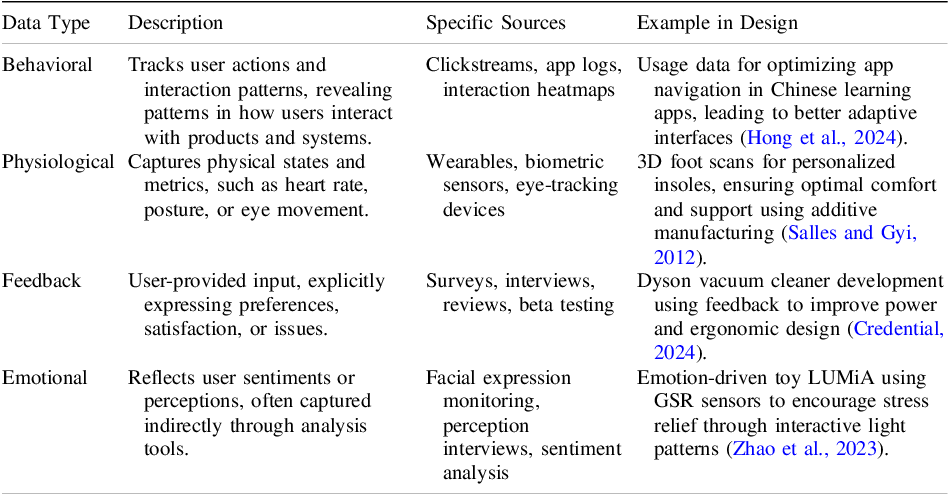
To better understand the role of human data in design, it is essential to distinguish between the various types of data and their specific contributions to the design process. Table 1 presents an overview of four key data types - behavioral, physiological, feedback, and emotional - along with their descriptions, specific sources, and examples of their application in design. Each type of human data plays a distinct role, offering unique insights that enhance the user experience. This data informs design at multiple stages, from early conceptualization to iterative refinement and final product evaluation.
By integrating behavioral, physiological, feedback, and emotional data, designers gain a holistic perspective on user experience. This comprehensive approach enables the development of solutions that are not only functional but also emotionally resonant. As a result, products and services are more effectively designed with the complexity of user needs and expectations. Here we briefly describe these four types of data.
2.1. Sources of human data
When considering the sources of human data, one effective approach is to group them based on how the data is collected. Human data is generated through a variety of processes and interactions, by understanding the methods of data collection, researchers and organizations can better address issues of data quality, privacy, and ethical use. The primary categories of human data collection are self-reported data, observational data, human-machine interactions, sensor data, and biological and physiological data.
Self-reported data refers to information that individuals voluntarily provide about themselves. This data is often collected through user feedback mechanisms such as surveys, questionnaires, interviews, and focus groups. Additionally, users provide demographic details and personal preferences when creating accounts on platforms like social media and e-commerce websites (Reference LongLong, 2022). Self-reported data allows for the direct capture of human perspectives, user pain points, and design preferences, making it a critical input for understanding user experience. While self-reported data provides valuable user insights, it is prone to biases, such as social desirability bias, where individuals may unintentionally modify their responses to align with perceived expectations (Reference Khare and VedelKhare and Vedel, 2019). However, it plays a crucial role in the early stages of design ideation, concept development, and validation of design assumptions.
Observational data offers authentic insights into human behavior, enabling designers to create more user-centric solutions. By capturing real-world actions without interference, key collection methods like web and app analytics track user navigation, clicks, and time spent on pages, providing vital usability feedback (Reference RossRoss, 2018). Video and image recordings analyze movement and spatial interactions, while in-person observations offer rich, contextual insights into social behaviors (Reference BasilBasil, 2011). Its strength lies in revealing natural, unfiltered actions that inform user-focused design decisions. When used ethically, observational data becomes a powerful tool for shaping intuitive, user-friendly designs aligned with real world needs. Despite capturing real-world behaviors, observational data can reflect biases in both data collection and interpretation. Datasets derived from online interactions often over-represent digitally active demographics, potentially leading to design decisions that do not account for broader user populations (Reference Chu, Donato-Woodger, Khan, Shi, Leslie, Abbasgholizadeh-Rahimi, Nyrup and GrenierChu et al., 2024). Recognizing and mitigating these biases is essential for ensuring inclusive and representative design outcomes.
Types of Human Data and their Examples in Design

Sensor data, collected from wearable devices, smart environments, and Internet of Things (IoT) connected devices, play a critical role in DDD. It powers health, fitness, and smart home products by providing real-time insights into user movement, heart rate, sleep patterns, and environmental conditions like temperature or air quality. Wearables, such as smartwatches, enable behavior tracking and goal-setting tools, while environmental sensors in smart homes support adaptive user interfaces and context-aware systems Dian et al. (Reference Dian, Vahidnia and Rahmati2020).
Biological and physiological data helps drive personalization, usability, and user-centric innovation. This data can be collected through sensors, like heart rate, brain activity (EEG), eye tracking, galvanic skin response (GSR), and muscle movement (EMG) (Reference Sabry, Eltaras, Labda, Alzoubi and MalluhiSabry et al., 2022). While more specialized methodologies are also required to obtain genetic information or medical imaging for example. Access to this data allows designers to better understand human behavior, emotions, and cognitive load as well as their medical and health needs, enabling the creation of more effective and personalized designs.
Collecting human data is a multifaceted process, drawing from self-reported inputs, observational insights, human-machine interactions, sensor tracking, and physiological measurements. Each method provides unique perspectives that enhance DDD, enabling more personalized and adaptive solutions. However, its effectiveness depends on availability, accessibility, and quality, which are shaped by ethical constraints, user consent, and the techniques used to gather and process data.
2.2. Types of human data ownership
The sources of human data can also be classified into first-party, second-party, third-party, and zero-party categories, which reflect how the data is collected as well as the varying degrees of transparency, user consent, and ethical considerations involved in the data collection process.
First-Party Data is information collected directly from users as they engage with an organization’s products, services, or platforms (Reference LongLong, 2022). This type of data includes self-reported inputs, such as survey responses and user feedback, as well as observational data from app analytics, website tracking, and behavioral analysis. Some sensor-based and physiological data, like fitness tracking from wearables or biometric readings (e.g., heart rate, EEG, and GSR), also fall under first-party data. As organizations collect this data firsthand, it is typically accurate and relevant for improving user experiences. Ethical concerns arise when organizations collect data without explicit user awareness, particularly in passive tracking or biometric monitoring. Ethical use of first-party data requires transparency, user consent, and clear options to modify, delete, or opt out of tracking to maintain trust and uphold informed consent principles (Reference ZahidZahid, 2024).
Second-Party Data is first-party data that is shared between trusted partners through an agreement. Second-party data is not openly sold but exchanged between two organizations that have a direct relationship (Reference Schneider, Jagpal, Gupta, Li and YuSchneider et al., 2017). For example, a company may obtain purchasing behavior data from a retail partner to improve targeted advertising. This type of data is generally more reliable than third-party data but raises ethical considerations regarding transparency and user consent. Organizations must clearly inform users when their data is shared with external partners and provide opt-out mechanisms to maintain trust.
Unlike first- and second-party data, which come from direct user interactions or trusted partnerships, third-party data is aggregated from multiple external sources and sold by entities like market research firms or data brokers. It includes demographic insights, lifestyle analytics, and industry-wide trends (Reference SalomSalom, 2014). While offering broad context, third-party data is often generalized and lacks specificity for user-centered design. More significantly, its lack of transparency raises ethical concerns, as users are often unaware of how their information was obtained or used. This has led to stricter regulations like GDPR and CCPA (Reference BarrettBarrett, 2019), prompting organizations to reduce reliance on third-party data.
Zero-Party Data represents the most transparent and ethically sound form of data collection. It is voluntarily and intentionally shared by users, typically in exchange for personalized experiences (Reference Lin, Morris and PolonioliLin et al., 2022). Examples include users specifying preferences for product customization, providing feedback through surveys or quizzes, and adjusting privacy or notification settings in their user profiles. Unlike first-party data, which may be passively collected through behavioral tracking, zero-party data is shared with full user awareness and consent. This active participation fosters user trust and aligns with ethical design principles that prioritize autonomy and user control. Since users have full visibility over what data they provide and why it is being collected, zero-party data is seen as the most privacy-friendly approach (Reference KimKim, 2023). For designers, it serves as a precise and user-driven foundation for personalization, allowing for design processes where users play an active role in shaping their own experiences.
The key differences between first-, second-, third-, and zero-party data lie in how they are collected, the transparency of the process, and the level of user consent and control. First- and second-party data involve direct or trusted partnerships, third-party data relies on external aggregation with limited transparency, and zero-party data ensures the highest level of user control and ethical integrity. For designers committed to ethical, user-centered approaches, prioritizing zero-party and first-party data, carefully managing second-party data, and minimizing reliance on third-party data ensures greater privacy, transparency, and trust.
3. The value of human data in design
Building on the different types and sources of human data, this section explores how such data enhances the design process by enabling more user-centric, effective, and inclusive outcomes. By blending quantitative metrics (e.g., interaction or physiological data) with qualitative insights (e.g., feedback or emotional data), human data helps bridge the gap between functional efficiency and empathetic design. The following highlight the unique advantages human data provides, supported by examples where its use has led to better products and services.
3.1. Problem framing
A well-defined problem is the foundation of any successful design, human data can play a critical role in uncovering needs, pain points, and contextual factors that may not be immediately apparent. The needs of users are often collected through ethnographic studies, interviews, observations, or focus groups to inform the requirements at the end of problem framing. Behavioral and real-time data are can also be valuable in identifying patterns of use or disengagement, while feedback data provides a direct look into user challenges. By blending these data types, designers can frame problems more comprehensively, leading to innovative and user-centered solutions.
When Avanade redesigned the intranet system for a multinational bank, the design team conducted interviews, workshops, and focus groups to understand employees’ frustrations, needs, workflows, and communication gaps (Reference Mortati, Magistretti, Cautela and Dell’EraMortati et al., 2023). These insights revealed shortcomings in existing tools for collaboration and accessibility. To refine these findings, big data from demographic surveys and digital interaction logs was used to validate needs on a larger scale. By integrating qualitative human-centered data with quantitative analysis, the team identified both obvious issues and subtle contextual factors that might have been overlooked. This approach demonstrates how human data not only addresses explicit pain points but also uncovers hidden opportunities, enabling designers to drive innovation beyond conventional problem framing.
In the case of Pella Corporation, human data was key to identifying and solving a critical issue in window installation (Colback (Reference Colback2024)). Through direct observations and feedback from installers, the company learned that traditional window installation methods posed significant safety risks, particularly for workers on tall buildings. This insight led to the development of a mechanism that allows windows to be installed from inside a building, improving both safety and efficiency. This human-centered approach addressed the installers’ pain points while enhancing project timelines and reducing costs.
An example of quantitative human data supporting problem framing is seen in a study on vehicle interior design (Reference Hanson and HögbergHanson and Högberg, 2012). Precise anthropometric measurements, such as body dimensions and reach capabilities, were used to define the optimal seat adjustment range. Digital human modeling tools enabled designers to simulate user interactions with vehicle components, highlighting ergonomic challenges like accessibility and comfort for a diverse user population. This approach addressed the needs of both “average” and atypical users, illustrating how quantitative data can uncover hidden constraints and opportunities, ultimately driving human-centered design innovations that prioritize comfort, accessibility, and safety.
These examples demonstrate the versatility of human data in problem framing, allowing designers to uncover hidden challenges, seize new opportunities, and create solutions that are both innovative and deeply aligned with user needs.
3.2. Feedback loop
The iterative nature of design relies on cycles of prototyping, testing, and improvement. Human data accelerates and enriches this process by providing evidence for what works and what does not. Feedback data and first-party interaction logs are particularly useful, as they highlight user frustrations and areas for enhancement.
A popular example is Dyson’s vacuum cleaner development. The company collects extensive feedback during early product testing, identifying issues with power and ergonomic design. Usage data from first-party sources, such as beta testers, it was revealed how users handled the product in real-life settings (Reference CredentialCredential, 2024). This combination of feedback and behavioral data informed design iterations that improved usability and performance, resulting in a product that addressed user needs more effectively. Human data can significantly reduce the risk of design missteps during product iterations. During the development of the Garmin HRM-Fit, a heart rate monitor designed for women, user feedback revealed discomfort caused by traditional chest straps, particularly when worn under sports bras (Reference Harrison and GreenHarrison and Green, 2024). This insight led Garmin to redesign the device to clip directly onto a sports bra using three anchor points, resulting in a more comfortable and secure ft without compromising accuracy. This proactive use of human data allowed designers to address potential issues before mass production, minimizing costly redesigns and enhancing product-market ft.
In educational technology, feedback and interaction data are invaluable for identifying pain points and areas for improvement. During the development of Chinese learning apps, user feedback revealed dissatisfaction with features like limited language options and insufficient personalization (Reference Hong, Hu and FangHong et al., 2024). Behavioral data, such as interaction patterns with app navigation and content, highlighted the need for better adaptive interfaces and interactive learning formats. These insights guided design iterations, leading to enhancements like adjustable fonts, multilingual support, and intelligent learning aids, resulting in a product that met user needs better.
Iterative refinement powered by human data ensures that design decisions are user-informed, reducing guesswork and can enhance product quality.
3.3. User-Centered Personalization and Emotional Design
User-centered design increasingly relies on both personalization and emotional engagement to create products that cater to individual needs and foster deeper connections with users. Customization and emotional design work together to enhance user experience, utilizing physiological, behavioral, and emotional data to optimize comfort, usability, and satisfaction.
Customization plays a crucial role in modern design, as users expect products tailored to their unique requirements. Zero-party data, particularly behavioral and physiological insights, play a central role in creating these personalized experiences. For example, in the design of custom-ft bicycle helmets, biometric data collected from 3D head scans enabled designers to produce helmets that ft precisely, enhancing both comfort and safety (Reference Ellena, Mustafa, Subic and PangEllena et al., 2018). This approach allowed manufacturers to address individual differences in head shape while maintaining scalability in production.
Similarly, the design of personalized insoles relies on physiological data captured through techniques such as 3D foot scanning. Researchers have demonstrated a process involving foot scanning, anthropo-metric measurements, and CAD-based insole design to deliver custom-ft insoles manufactured using additive manufacturing (Reference Salles and GyiSalles and Gyi, 2012). This ensures optimal comfort, support, and ft, addressing individual variations in foot shape while maintaining scalability. Superfeet, a leading company in this domain, leverages similar methodologies to design insoles that cater to a range of user needs (Superfeet, 2024).
Personalization is also critical in assistive technologies, such as 3D-printed wheelchair cushions, which can be customized based on an individual’s specific pressure distribution needs, weight, posture, and susceptibility to pressure ulcers (Reference Polydorides and RogersPolydorides and Rogers, 2024). By using 3D printing technologies, designers can create cushions that not only provide optimal pressure relief but also allow users to personalize the cushion design through accessible, open-source tools. This ensures that wheelchair users receive products tailored to their unique body profiles, improving comfort and reducing the risk of pressure-related complications.
An example of personalized design using physiological data collected from sensors is custom-fitted hand orthoses (Reference Tan, Ahmed-Kristensen, Cao, Zhu, Chen and NanayakkaraTan et al., 2021). Soft pressure sensor skins use finite element analysis (FEA) and artificial neural networks (ANN) to predict and adjust contact pressure at critical spots. This approach identifies areas of excessive pressure, enabling clinicians to make precise, data-driven adjustments. By minimizing discomfort and side effects, this method improves patient comfort and rehabilitation outcomes. Beyond physical personalization, emotional design ensures that products resonate with users on a deeper level. Emotional and feedback data are key to understanding and addressing these aspects. Norman’s emotional design framework, which identifies visceral, behavioral, and reflective levels, provides a foundational understanding of how emotional responses influence interactions with products (Reference NormanNorman, 2004).
The visceral aspect of emotional design can be observed in the study of vase aesthetics (Reference Mata, Ahmed-Kristensen, Brockhoff and YanagisawaMata et al., 2017). According to this study, the perception of a vase’s form is closely linked to aesthetic features. This initial impression occurs at the visceral level, where users make immediate judgments based on sensory input. Vases perceived as “beautiful” were often characterized by curved lines, simplicity, and a tall, slender form. The visceral response to form and geometry shapes users’ emotional connections with products, guiding designers to create visually appealing forms that evoke positive emotions.
The behavioral aspect of emotional design is demonstrated in the design of external-ear devices, which emphasized how ft, usability, and comfort significantly influence user experience (Reference Stavrakos and Ahmed-KristensenStavrakos and Ahmed-Kristensen, 2016). Behavioral emotional design focuses on user interaction during product use, with comfort playing a crucial role in sustaining satisfaction over time. By leveraging 3D anthropometric data, researchers developed models of ear dimensions and human-product interaction points, optimizing headphone components for a more precise ft. This study highlights the importance of behavioral-level considerations, such as ergonomic alignment, pressure distribution, and physical load reduction, which promote positive experiences during prolonged use.
Another example of behavioral emotional design is in the development of LUMiA, a hand-training toy created to address “mouse hand,” a condition caused by prolonged computer mouse use (Reference Zhao, Cheng, Liu, Li, Marcus, Rosenzweig and SoaresZhao et al., 2023). LUMiA detects users’ emotional states through Galvanic Skin Response (GSR) sensors, which measure skin conductivity as an indicator of emotional arousal. By using this emotional data, the device guides interactive light patterns on the toy, encouraging users to relax their hands while keeping them emotionally engaged.
Reflective emotional design operates at the highest cognitive level, where users form lasting memories, self-identity, and personal connections with a product (Reference NormanNorman, 2004). An example of this is found in the design of therapeutic virtual reality (VR) environments for stress management (Reference Ladakis, Filos and ChouvardaLadakis et al., 2024). Feedback from patients undergoing these experiences revealed that color palettes and sound-scapes played a significant role in promoting calmness and relaxation. Designers blended emotional data with qualitative feedback to create immersive VR environments that were effective in stress reduction and emotionally engaging. This reflective interaction with VR technology highlights how product design can evoke introspection, self-refection, and lasting emotional impact.
By integrating customization with emotional design principles, designers can create products that are both tailored to individual users and emotionally engaging. Personalization enhances user satisfaction by ensuring comfort, usability, and performance, while emotional design fosters deeper connections through aesthetic appeal, usability, and cognitive engagement. Together, these approaches contribute to user-centered design, fostering trust, satisfaction, and long-term relationships with products and services.
3.4. Sustainable design
As sustainability becomes a priority in design, human data offers opportunities to create adaptive systems that reduce waste, optimize resource use, and respond dynamically to user needs. Real-time data can facilitate precise customization and demand-driven production, re excess consumption and improving efficiency. By leveraging human data, adaptive interfaces can optimize energy consumption, reduce material waste in production, and extend product life cycles through demand-driven adjustments.
In the context of smart home technology, real-time human data has been leveraged to drive more sustainable behaviors and automated decision-making. By collecting real-time data on household energy consumption and timely feedback via SMS and email encouraged users to shift laundry to peak solar generation times, reducing grid reliance. (Reference Bourgeois, Linden, Kortuem, Price and RimmerBourgeois et al., 2014). Beyond behavioral nudges, real-time data enables adaptive automation, where smart home systems can autonomously schedule energy-intensive tasks based on renewable energy availability (Reference Verma, Bhambri, Gupta and BuduruVerma et al., 2019). This approach not only enhances sustainability but also reduces the burden on users to actively manage their energy consumption. This approach not only enhances sustainability but also reduces the burden on users to actively manage their energy consumption.
Human data has been used to inform the design of reusable packaging systems (RPS) by aligning product features with consumer preferences and behaviors (Reference Miao, Magnier and MuggeMiao et al., 2023). Interviews revealed that ease of use, hygiene, and aesthetics significantly influence adoption, while concerns about environmental impact, contamination, and product quality act as barriers. These insights highlight the importance of user-centered design in promoting sustainable consumption and long-term engagement.
Human data transforms the design process by enabling more accurate problem framing, iterative improvements, personalized experiences, emotional connections, and sustainable solutions. By integrating various types and sources of data, designers can represent the human experience more fully, resulting in products and services that are not only functional but also deeply user-centric.
4. Challenges and ethical considerations
While the integration of human data into the DDD process offers substantial benefits, it also introduces unique challenges. These challenges primarily concern ethical considerations, such as privacy, data bias, and transparency. Addressing these issues is crucial for ensuring that human data contributes to user-centered and responsible design outcomes.
4.1. Privacy, consent, and transparency
The collection and use of human data in design relies heavily on user trust, which can only be maintained through strong privacy protections, clear consent, and transparent communication. Human data often includes sensitive details, such as biometric metrics or emotional responses, making it especially vulnerable to misuse. Without explicit consent and transparency, even well-meaning data practices can exclude users or violate regulations such as GDPR or CCPA (Reference BarrettBarrett, 2019).
A lack of transparency in how health data is collected, used, and potentially shared with third parties can significantly erode trust in health services (Reference Cascini, Pantovic, Al-Ajlouni, Puleo, Maio and RicciardiCascini et al., 2024). This reduced trust can undermine the patient-practitioner relationship and hinder the adoption of health innovations that rely on data sharing. Similarly, wearable devices that collect physiological data face comparable challenges, as users often express concerns about privacy, security, and the use of their personal information beyond their intended purposes.
Transparency is also critical when collecting zero-party data, which is explicitly shared by users. While inherently more ethical, this data still requires clear explanations of its purpose and application. For instance, personalized e-commerce platforms that explicitly show how user preferences influence recommendations tend to see higher levels of trust and cooperation (Reference KimKim, 2023). By addressing privacy concerns and prioritizing transparency, designers can build systems that respect users’ autonomy while effectively utilizing their data.
4.2. Data bias and inclusivity
Another critical issue is data bias, which occurs when the human data collected is not representative of the intended user base. Bias can arise in various ways, such as through the under-representation of certain demographic groups in the dataset or through assumptions embedded in data collection methods. When biased data informs the design process, it can lead to products or services that exclude or misrepresent specific populations.
For example, facial recognition software used to develop emotionally adaptive devices has been criticized for its inability to accurately detect emotions across diverse ethnic groups due to training on homogeneous datasets (Reference Mattioli and CabitzaMattioli and Cabitza, 2024). Addressing these issues requires designers to ensure data diversity and to critically evaluate the sources of human data used in the design process.
While human data provides valuable insights into user behaviors and preferences, an over-reliance on data-driven decision-making can lead to unintended consequences. User needs that are difficult to quantify can be overlooked when decisions are based solely on quantitative data. To mitigate this, qualitative research methods, such as ethnographic studies, contextual inquiries, and participatory design, should complement data-driven approaches, this can ensure that products and services not only meet explicit requirements but also address the unspoken needs that contribute to a user-centered experience.
4.3. Ethical use of emotional data
Emotional data offers valuable insights for creating engaging and empathetic designs, but it also raises ethical concerns. Capturing and analyzing emotions through techniques like facial recognition or sentiment analysis can feel intrusive, especially if users are unaware of how this data is being used. Additionally, there is potential for misuse, such as manipulating emotions for profit or behavioral control. For example, interactive advertising systems have used emotional data to tailor ads in real-time based on user reactions. While effective in increasing engagement, this practice has been criticized for its manipulative potential and lack of user consent (Reference Quach, Thaichon, Martin, Weaven and PalmatierQuach et al., 2022). Designers working with emotional data must prioritize transparency, clearly communicate its purpose, and ensure it benefits users rather than exploiting them.
To address these ethical risks, regulatory frameworks such as the General Data Protection Regulation (GDPR) and the California Consumer Privacy Act (CCPA) establish guidelines for the responsible use of personal data, including emotional data (European Union, 2016; State of California, 2018). GDPR classifies biometric and emotional data as sensitive personal data, requiring explicit user consent and limiting processing under strict conditions. Similarly, CCPA grants consumers the right to know what data is being collected, request its deletion, and opt out of its sale. These regulations underscore the importance of informed consent, data minimization, and accountability in the handling of emotional data.
By combining privacy, consent, and transparency into a single section, the challenges in this section are now more streamlined. It emphasizes the importance of addressing key issues—privacy, bias, over-reliance on metrics, and emotional data ethics—to ensure that human data contributes to user-centered, inclusive, and ethical design outcomes. These challenges must be tackled head-on to harness the full potential of human data while maintaining trust and accountability.
5. Conclusion
Human data is transforming DDD by integrating technical precision with a deep understanding of user needs and feelings. Drawing on case studies, frameworks, and prior research, this paper demonstrates how human data has been used to enhance the design process by enabling more accurate problem framing, iterative refinement, and personalized, emotionally resonant solutions. By combining quantitative data, like behavioral analytics and physiological responses, with qualitative insights, like user feedback and emotional responses, designers can move beyond just functionality to create products that address emotional and experiential needs.
Real-world case studies are demonstrate the value of human data. From refining wearable device ergonomics to enabling adaptive mobile interfaces, human data helps designers to develop products that meet real-world needs. Iterative feedback loops and interaction data reduce development risks and align products with user expectations. Personalized solutions, like 3D-printed insoles and customized wheelchair cushions, highlight how human data supports inclusive design that caters to diverse user needs.
However, the integration of human data is not without challenges. Privacy, consent, and data bias pose significant ethical concerns. Addressing these requires transparent communication, user control, and ethical safeguards in data collection and usage. Prioritizing first-party and zero-party data is highlighted as a best practice, as these forms of data give users greater control over their information. Ethical design practices, such as bias mitigation, responsible data stewardship, and user consent, are essential to maintain user trust and ensure equitable design outcomes.
Human data serves as a vital bridge between technology and user experience, enabling designers to create functional, personalized, and inclusive products. By responsibly leveraging this data, designers can address both functional and emotional user needs while navigating challenges related to privacy, consent, and bias. As technology and data accessibility evolve, there is a growing opportunity to develop more ethical, human-centered design solutions that foster trust and inclusivity. By prioritizing responsible data use, designers can shape a future where innovation is both user-driven and ethically grounded.
Acknowledgments
This work was supported by the Engineering and Physical Sciences Research Council (grant number EP/T022566/1). DIGIT Lab is a Next Stage Digital Economy Centre.

 Open access

