


10.1 Introduction
Over the past decade, several Latin American countries have increasingly turned to mandatory labelling of processed foods. This has been in response to public health concerns about rising levels of obesity in the population, particularly among children. The main aim of these regulations is to provide consumers with appropriate information about foods that are high in sugar, salt or fat. To this end, all of Pacific Alliance members – Chile, Colombia, Mexico and Peru – have adopted specific labelling as a public health approach. The approach taken in these countries has been to use labels that are similar to the ‘STOP’ transit symbol but in black. This type of legislation first appeared in Chile and was later adopted by Peru, Mexico and Colombia, as well as by other Latin American countries such as Uruguay and Argentina, and its use is currently being discussed in Costa Rica.
The purpose of this chapter is twofold: first, to explore patterns in the legislative trends observed in selected Pacific Alliance countries regarding the labelling of foods containing certain ingredients related to non-communicable diseases and, second, to examine whether this new stop sign approach can evolve into a new legal standard that other countries in the region are likely to follow. This chapter builds on previous work that conducted a comparative case study of Peru and Chile (Boza et al. Reference Boza, Polanco and Saco2020). The main intention is also to focus on Mexican and Colombian legislation, because current developments in Colombia suggest a strong diffusion effect and a quasi-emergence of a Latin American standard for this type of food labelling.
This chapter has two parts: first, I present the legislation enacted in four Pacific Alliance countries; second, I discuss how a common standard on the specifics of food labelling has emerged in Pacific Alliance member states, suggesting important diffusion effects. Focusing on diffusion, I find that the degree and speed of adoption is strongly influenced by three main factors: the authority of the World Trade Organization (WTO) Agreement on Technical Barriers to Trade (TBT) as enforced in discussions in the TBT Committee, the work of health-related organizations, and previous foreign domestic legislation. The fact that the Latin American countries applying this standard are members of the Pacific Alliance is also an indicator that this forum has facilitated diffusion through diplomatic and technical exchanges.
10.2 Regulations in Chile, Peru and Mexico
The regulation of front-of-package labelling (FOPL) for nutrition, which I examine in this chapter, is characterized by the use of a specific form of the transit sign ‘STOP’. This sign was first introduced in Chile. This was followed by Peru, Mexico and Colombia, in chronological order. The regulations adopted in the first three countries are described below, leaving the case of Colombia for a new section.
10.2.1 The Case of Chile
Chile was the first country of the Pacific Alliance members to implement the STOP sign on FOPL. The pertinent Chilean law was approved in 2012 and came into effect in 2016.Footnote 1 Figure 10.1 provides an illustration of its design.
Warning labelling – Chile.
Note: Top right: ‘High in Sugar’; top left: ‘High in Saturated Fats’; bottom left: ‘High in Salt’; and bottom right ‘High in Calories’, all in an octagonal label with a black background and white border that also contains the words ‘Ministry of Health’ for each nutrient in excess.
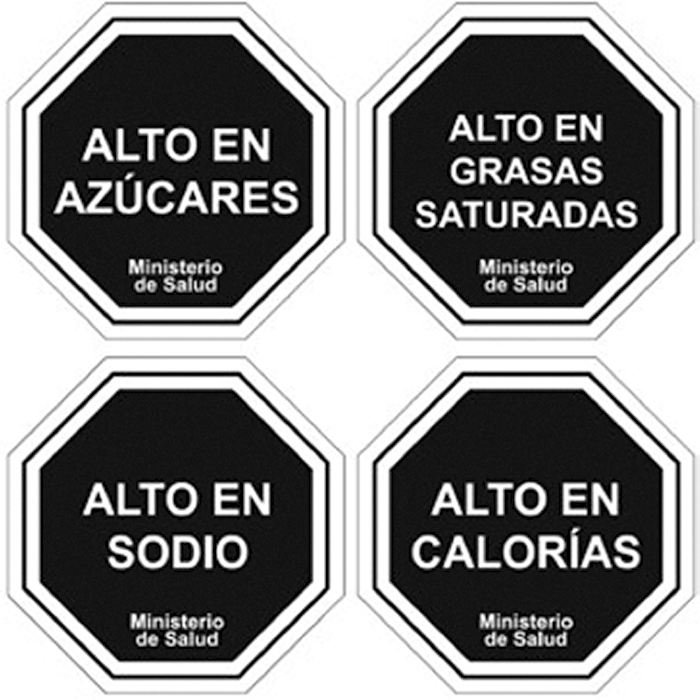
The law and its implementing decree (Decree 13) define that these warnings must be present on all food products sold on the Chilean market, whether local or imported, if the product contains an excess of ‘critical nutrients’ for sodium, sugar, saturated fat and calories. However, some foods are exempt from labelling, such as foods sold in bulk, fractionated or prepared at the point of sale. Table 10.1 provides an overview of the thresholds and the timeframe for implementation as set out in the regulation.
Table 10.1 shows the two categories regulated by Decree No. 13: solids and liquids. The thresholds for critical nutrients are set in portions of 100 grams for solids and in portions of 100 millilitres for liquids. The decree provides for a transition period to gradually reduce the amount of critical nutrients until 2019.
Nutrition labelling was only one of the three pillars of Law 20606. The other two were (ii) a ban on advertising to protect children and (iii) a programme to promote and educate about healthy lifestyles. By way of example, the law prohibits any advertising aimed at children under the age of 14, when the food is subject to mandatory labelling (the octagonal symbol). This also means that companies will not be allowed to offer free toys or other similar promotional strategies related to the products. In addition, labelled products may not be sold or distributed in schools.
10.2.2 The Case of Peru
Peru was the second Pacific Alliance country to introduce the octagonal ‘STOP’ signs. The law was passed in May 2013,Footnote 2 one year after Chilean law (2012). However, it was not until 2019 that the implementing regulation was issued and therefore the law really came into force.Footnote 3
Regarding signs, Peruvian law has some similarities with Chilean law. The signs consist of an octagonal shape with a black background and a white border. The difference is that the Peruvian signs add an additional box below the ‘STOP’ sign that reads: ‘Avoid its excessive consumption’ or ‘Avoid its consumption’, depending on the case (Figure 10.2).
Note: First line from left to right: ‘High in Saturated Fats’; ‘High in Sugar’; ‘High in Salt’ and in the box ‘Avoid Its Excessive Consumption’. In the second line: ‘High in Trans-Fats’ and ‘Avoid Its Excessive Consumption’.
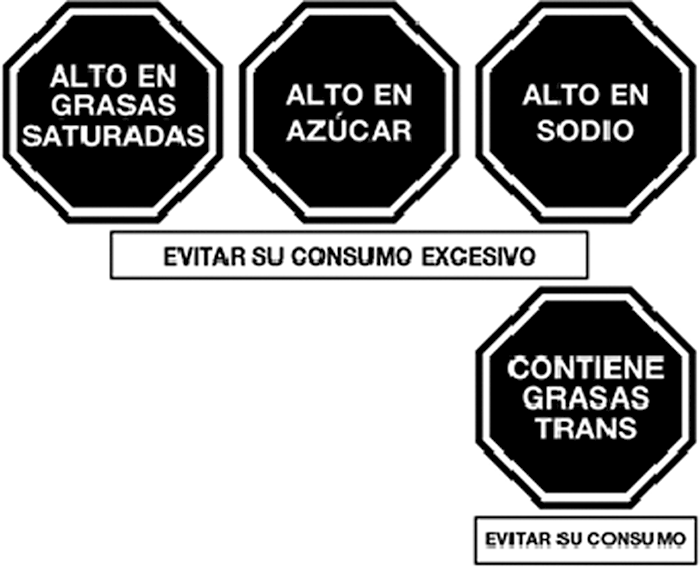
The Peruvian law targets four types of critical nutrients – sugar, sodium/salt, saturated fat and trans-fat – in foods and soft drinks. On this point, the Peruvian labelling differs from the Chilean one; the Chilean ‘High in Calories’ has been replaced by the Peruvian ‘High in Trans-Fat’. Saturated fats, sugar and salt are common to both laws.
Also, the Peruvian law differs from the Chilean one, since in the case of saturated fats, sugar, the octagonal signs are accompanied by a box that reads ‘excessive consumption of the product should be avoided’. If the product contains trans-fats, the text in the box is: ‘Avoid its consumption’. According to Peruvian law, this is the way to provide consumers with ‘clear, legible, conspicuous and understandable’ information.
As in the case of Chile, the Peruvian regulation works with limits and thresholds that are quasi-identical. The thresholds will also decrease over time, after a thirty-nine-month period. As in the case of Chile, the regulations apply differently to solid and liquid products. Table 10.2 provides an overview:
| Nutrient | Classification | 6 months after the approval of the Manual of Advertising WarningsFootnote 5 (18 December 2018) | 39 months after the approval of the Manual of Advertising Warnings (18 December 2021) |
|---|---|---|---|
| Sodium | Solid (mg/100 g) | 800 | 400 |
| Liquid (mg/100 ml) | 100 | 100 | |
| Sugar | Solid (g/100 g) | 22.5 | 10 |
| Liquid (g/100 ml) | 6 | 5 | |
| Saturated fats | Solid (g/100 g) | 6 | 4 |
| Liquid (g/100 ml) | 3 | 3 | |
| Trans-fats | According to the actual regulationFootnote 6 | According to the actual regulation |
Note: The technical parameters applicable after thirty-nine months can be updated according to new information based on scientific evidence.
As in the case of Chile, some foods are exempted. The Peruvian law does not apply to unprocessed foods, which are described in the law as products in a ‘natural state’. Other similarities include the promotion of nutrition education and sports in schools. And in the case of marketing to children under the age of sixteen, the law prohibits promotional activities such as the use of toys, gifts or prizes to encourage consumption, or the use of characters admired by children. In Peru, only ‘healthy foods’ can be sold in schools. In summary, a comparison of the Chilean and Peruvian regimes reveals a high degree of similarity with only minor differences.
10.2.3 The Case of Mexico
The Mexican law was passed in March 2020, partially enacted in October 2020 and fully enacted in April 2021.Footnote 4 Similar to Chile and Peru, it includes octagonal signs to warn customers of adverse health effects. However, the law will be under continuous evaluation until 2025 and may be adjusted during that time.
The law provides for three phases of implementation: the first phase was from October 2021 to September 2023, the second phase is defined from October 2023 to September 2025, and the third and final phase begins in October 2025. The aim of the phases is to implement the regulation gradually and to evaluate its impact on an ongoing basis. The difference between the phases lies in the evaluations that are made to the products, depending on the critical nutrients that are included. In the first phase, all products with sugars, fats and sodium are evaluated. In the second phase, only sugars and fats are evaluated. Finally, in the third phase, all critical nutrients are evaluated.
Regarding the signs, the first difference with the Peruvian and Chilean regulations is that the Mexican law has five octagonal signs. Sugar, salt/sodium and saturated fat are common in Chile, Peru and Mexico. The other two signs are for calories and trans-fats. Mexican legislation uses the four signs from Chile and adds the trans-fat octagon from the Peruvian regulation. (Peruvian law warns of the ‘content’ of trans-fats, while Mexican law of the ‘excess’ of them.) There is an interesting adaptation that can be observed here, as the Mexican regulation draws clearly from the two previous regulations.
In Mexico, octagonal labels also have a black background and require a text box to include the name of the Ministry of Health using a polygonal border, as shown in Figure 10.3.
Warning labelling – MexicoFootnote 7.
Note: From top left to bottom right: ‘Excess in Calories’, ‘Excess in Salt’, ‘Excess in Trans-Fats’, ‘Excess in Sugar’ and ‘Excess in Saturated Fats’.
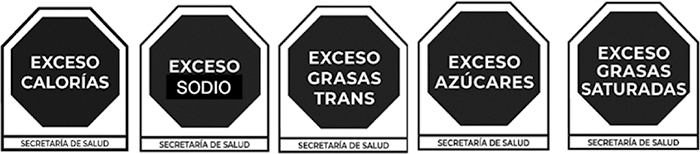
As in the case of Chile and Peru, Mexico also sets thresholds for critical nutrients. If a product, liquid or solid, exceeds the thresholds, the product should carry one or more octagonal symbols. The Mexican thresholds are listed in Table 10.3.
| Calories | Sugars | Saturated fats | Trans-Fats | Salt | |
|---|---|---|---|---|---|
Solid products ,by 100 g of product | ≥275 kcal in total | ≥10% of the total energy originating from free sugars | ≥10% of the total energy originating from saturated fats | ≥1% of the total energy originating from trans-fats | ≥ 1 mg of sodium per kcal or ≥ 300 mg Drinks without calories ≥ 45 mg of sodium |
| Liquid products, by 100 ml of product | ≥70 kcal in total or ≥ 8 kcal of free sugars | ||||
| The product should use | EXCESS IN CALORIES | EXCESS IN SUGAR | EXCESS IN SATURATED FATS | EXCESS IN TRANS-FATS | EXCESS IN SALT |
Despite important similarities, the Mexican regulation also contains minor differences compared to the Peruvian and Chilean legislation. The Mexican regulation introduces an additional scheme based on the size of the package. While Figure 10.3 shows the warning labels that are mandatory for packages larger than 40 cm2, another warning label applies to smaller packagesFootnote 8, as shown in Figure 10.4.
Warning labelling in smaller packagesFootnote 9
Note: From left to right, 1, 2, 3, 4 and 5, the word ‘signs’.
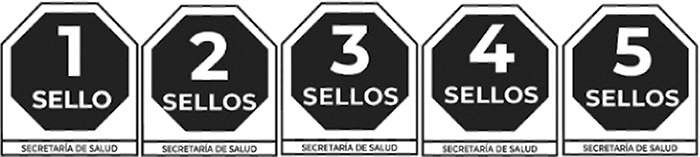
The special labelling for smaller packages or ‘mini-signs’ is an innovation of the Mexican legislation in relation to the previous two countries, Chile and Peru. This innovation can address the criticism of some companies that are against using labels on small packages because they may affect the space they had for their brands and commercial images. At the same time, it allows people to still have information about the critical ingredients present in the products.
Smaller signs could have a greater impact in the case of Peru, for example. In Peru, because its regulation is based on the weight of the products and not on the size, small presentations of the products are not required to carry the octagonal signs; a box containing ten chocolates must carry the octagonal signs, but none of the ten packages of the chocolate bars must bear signs.
Another innovation in the Mexican regulation is that Mexico has gone beyond the octagonal signs and introduced new signs: a sign for caffeine, another for sweeteners, and the so-called positive signs. This can be seen in Figures 10.5, 10.6 and 10.7. These signs do not exist in Chilean or Peruvian regulations.
Additional warning labelling – sweeteners.Footnote 10
Note: left side: ‘contains sweeteners, not recommended for children’.

Additional warning labelling – caffeine.Footnote 11
Note: ‘contains caffeine, avoid in children’.


In the case of Figures 10.5 and 10.6, these labels are additional to the respective octagon. If a product contains trans-fats and uses sweeteners, the product packaging should bear the octagonal trans-fat symbol and below it the Figure 10.5 symbol. The labels in Figures 10.5 and 10.6 are intended to prevent children from consuming these products, which is the reason for the warning ‘not recommended for children’ (Figure 10.5) or ‘avoid in children’ (Figure 10.6).
In this sense, the most relevant difference in the Mexican law is the introduction of ‘positive’ labelling for products that do not have STOP signs or caffeine or sweeteners; these signs were introduced in the first amendment to the Mexican law in 2021.Footnote 13 In this case, ‘positive’ does not mean beneficial to health but wants to publicize that a product has no signs.
The above discussion shows that both Peru and Mexico have closely followed and adapted their labelling schemes to their predecessor(s). From the first mover (Chile), labelling has begun to diffuse, and nine years after the Pan American Health Organization (PAHO) said that ‘the new Mexican labelling as the best model currently available’.Footnote 14 In the next section, we focus on the most recent law adopted among the Pacific Alliance members to see if a tipping point has been reached, while this new standard has the potential to spread quickly to other jurisdictions. The case of Colombia will help prove this.
10.3 Colombian Regulations: The Consolidation of the Octagonal Warning Signs
In this section, we turn to another and final Pacific Alliance member that has recently begun to regulate critical nutrient excesses. It is interesting to observe that the regulation has clearly been shaped and influenced by previous regulation in Pacific Alliance countries. We see a diffusion of regulatory practice. Of particular note is the recognition of the mandatory nature of the practice, specifically the use of octagonal warning labels. This is reflected in the case of Colombia, where even minor attempts to deviate from previous practice have been challenged in the domestic courts, resulting eventually in a mandatory labelling system that is virtually identical to that of other Pacific Alliance members. In the following lines, I will examine the different stages of the regulations, the changes due to judicial involvement, and finally some observations on what mix of factors explains this almost completely copy-paste health regulation.
Colombia has the most recent regulations on warning labels of the Pacific Alliance member countries. In June 2021, the Ministry of Health issued Resolution 810, which regulates the labelling of products. Resolution 810 introduced a new standard for the FOPL for ‘critical nutrients’, and similar to the regulations in Chile, Peru and Mexico, the warning labels must be used when the product, whether liquid or solid, exceeds certain thresholds. In the case of Colombia, these thresholds are shown in Table 10.4.
| Nutrient | Solids (100 g) | Liquids (100 ml) |
|---|---|---|
| Sodium (mg) | ≥=400 | ≥=150 |
| Added sugars (g) | ≥=10 | ≥=5.0 |
| Saturated fats (g) | ≥=4.0 | ≥=3.5 |
If a product is to be sold in the Colombian market and exceeds the above table limits, it should bear a sign that at the time of Resolution 810 looks like in Figure 10.8.
Warning labelling in Colombian law under Decree 810.
Note: From left to right: ‘High in Added Sugars’, ‘High in Salt/Sodium’ and ‘High in Saturated Fats’. Inside the white background reads ‘Minsalud’, which is the short form for ‘Ministry of Health’.

Another sign included in the Colombian Resolution 810 is a positive labelling option for products produced according to best nutritional practices. The Mexican regulation also included a ‘positive’ sign, but in that case the sign indicated the absence of an octagonal warning sign, in the case of Colombia the ‘positive’ sign is only given if the product has a lower content of sodium, sugar or saturated fat. The Colombian ‘positive’ label is shown in Figure 10.9.
Positive labelling in Colombian law.Footnote 16

Just one month after the Ministry of Health issued Resolution 810, in July 2021, the Colombian Congress passed Law 2120. This law instructed the Colombian government to regulate in detail, among other things, the labelling of processed foods that exceed healthy levels of critical nutrients. Politically, this meant a confrontation between the executive and legislative branches.
Following the publication of Law 2120, a group of NGOs requested a judicial process (Acción de cumplimiento) against Resolution 810. Among the challenged provisions of the Resolution was the warning label (round shapes), as shown in Figure 10.7. Regarding the warning signs, the plaintiffs argue that the octagonal shape of the warning signs should be followed in Colombia, and not the round signs.Footnote 17
The plaintiffs’ main argument was that the signs of Resolution 810 did not comply with the requirements of Article 5 of the new law, since the Resolution had a lower hierarchy than the law. Specifically, and with respect to warning signs, that the round signs and the way they were designed in Resolution 810 were not as ‘clear, visible, legible, easily identified and understood by consumers’ as the octagonal sign and did not meet the requirements of the new law.
On 27 October 2022, the Colombian Council of State, the highest court in administrative matters, issued its ruling on the Accion de cumplimiento.Footnote 18 Although the Court did not indicate which is the best type of symbol for labelling, it ordered the Ministry of Health to issue a new regulation in accordance with Law 2021, since Resolution 810 cannot regulate Law 2021, as it precedes the former. On 13 December 2022, The Ministry of Health issued Resolution 2492 to comply with the ruling.Footnote 20 Resolution 2492 modified some articles of Resolution 810, including those regulating warning signs, and adopted the octagonal shape (Figure 10.10).
Warning labelling in Colombian law under Decree 2492.
Notes: From left to right: ‘High in Salt/Sodium’, ‘High in Sugars’, ‘High in Saturated Fats’, ‘Excess in Trans-Fat’ and ‘Contains Sweeteners’. All are accompanied by the legend ‘Minsalud’, which is the short form for ‘Ministry of Health’.
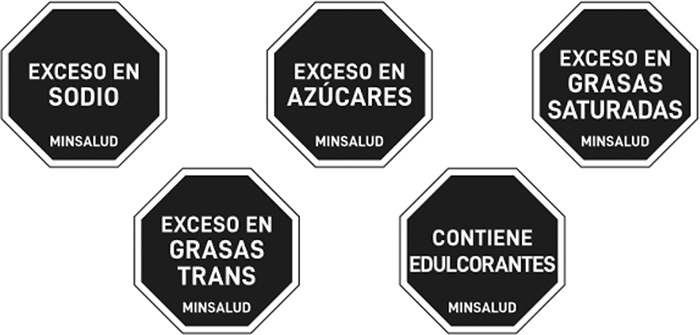
Along with the change in symbols, the thresholds for a product to carry one of these symbols were also changed. These updated thresholds emulate the limits already established in the cases of Chile, Peru and Mexico. Table 10.5 shows the new thresholds according to Article 5 of Resolution 2492 of 2022.
| Nutrient | Solid (100 g) – semisolids | Liquids (100 ml) |
|---|---|---|
| Sodium | ≥=1 mg and/or ≥=300 mg/100 g 300 mg/100 g for packaged raw meat with added salt/sodium | ≥=1 mg/Kcal Or ≥40 mg of sodium per each 100 ml – beverages without alcohol and no energy supply |
| Sugars | ≥=10% of the total energy coming from free sugars | ≥=10% of the total energy coming from free sugars |
| Saturated fats | ≥=10% of the total energy coming from saturated fats | ≥=10% of the total energy coming from saturated fats |
| Trans-fats | ≥=1% of the total energy coming from trans-fats | ≥=1% of the total energy coming from trans-fats |
| Sweeteners | Any quantity of sweeteners | Any quantity of sweeteners |
In the previous paragraphs, I have documented the advertising warning regulations in the Pacific Alliance countries. I chose the Pacific Alliance as an example because all of its members currently have the same octagonal warning system without having coordinated it at the Pacific Alliance level. (It is possible that there will be coordination in the future for a regulation on this matter.) The octagonal warning signs are the first common regulation; a second issue common to these four countries is the thresholds that apply when the octagonal signs are exceeded. Among the four countries, the limits are not only similar, but they show an evolution: the most recent regulation is stricter than the previous ones; for example, in the case of sodium/salt the limit has passed from 800 mg to 300 mg in ten years (Chile 2012 to Colombia 2022), as seen in Table 10.6.
| Chile | Peru (2021) | Mexico | Colombia | |
|---|---|---|---|---|
| Sodium | 800 mg/100 g | 400 mg in 100 g | ≥1 mg of sodium per kcal or ≥300 mg in 100 g | ≥=1 mg and/or ≥=300 mg/100 g |
| Sugars | 22.5 g/100 g | 10 g in 100 g | ≥10% of the total energy originating from free sugars | ≥=10% of the total energy coming from free sugars |
| Saturated fats | 6 g/100 g) | 4 g in 100 g | ≥10% of the total energy originating from saturated fats | ≥=10% of the total energy coming from saturated fats |
| Trans-fats | No octagonal sign | Another law | ≥1% of the total energy originating from trans-fats | ≥=1% of the total energy coming from trans-fats |
| Calories | 350 kcal/100 g | No octagonal sign | ≥275 kcal in total | No octagonal sign |
| Sweeteners | No octagonal sign | No octagonal sign | No octagonal sign | Any quantity of sweeteners |
* Elaborated by the author.
10.4 The Latin American Standard for Labelling Processed Foods: Octagonal Warning Labels
The octagonal warning signs can be seen as a contribution to the front packaging regulation in international trade law, from Latin American countries. The thesis I propose, based on the information presented previously, is that diffusion happened among the four countries. My starting point is Gilardi’s definition of diffusion as ‘the interdependent process that is conducive to the spread of policies’ (Gilardi Reference Gilardi, Carlsnaes, Risse and Simmons2012). Diffusion of international policy refers to a situation ‘when government policy decisions in a given country are systematically conditioned by prior policy choices made in other countries’ (Simmons et al. Reference Simmons, Dobbin and Garrett2006, quoted by Gilardi Reference Gilardi, Carlsnaes, Risse and Simmons2012).
I consider that diffusion, in this case study, has three stages: a first stage that I call ‘creation’, starting in 2012 by Chile; a second stage, ‘consolidation’, having as examples, in an early stage, Peru and ending in the case of Mexico; and a final stage, ‘enforcement’, where the case of Colombia is very relevant. The stages are a manifestation of two types of arguments supporting the choice of octagonal warning signs. The first argument is the scientific basis to support the use of the signs, the second is the coercive nature or legal force of the signs. Both arguments have been developed and refined over more than ten years.
10.4.1 Diffusion of the Octagonal Warning Signs in Latin America
According to Gilardi, this can occur via diffusion mechanisms that can be grouped into four categories: coercion, competition, learning and emulation. Of these, I consider the most appropriate for the octagonal label warning signs to be learning and emulation mechanisms. The learning mechanism
emphasizes the process whereby policy makers use the experience of other countries to estimate the likely consequences of policy change. Before a policy is introduced, its consequences are by definition uncertain. [For] Policy makers … other countries can also be a useful source of information. Looking at outcomes in countries that have already introduced the policy, and maybe comparing them with those of countries that have not adopted it, can be a way for policy makers to evaluate what will likely happen if they choose to pursue the new policy. (Gilardi Reference Gilardi, Carlsnaes, Risse and Simmons2012)
The emulation mechanism requires that political actors shift from the ‘logic of consequences’ to the ‘logic of appropriateness’. According to the former, ‘actors choose among alternatives by evaluating their likely consequences’ (March and Olsen Reference March and Olsen1998; Checkel Reference Checkel2005, both works quoted by Gilardi Reference Gilardi, Carlsnaes, Risse and Simmons2012).
The learning mechanism is more explicit in what I call the ‘consolidation phase’ of the octagonal signs that Peru and Mexico learnt from the Chilean experience. For example, Peru, as a WTO member, knew that the Chilean Law was questioned by more than ten WTO members (including the United States and the European Union (EU)) in different TBT Committee meetings between 2013 and 2016 (Thow Reference Thow, Jones, Hawkes, Ali and Labonté2017, 565; Boza et al. Reference Boza, Polanco and Saco2020). Similarly, Mexico knew that the Peruvian law raised ‘specific trade concerns’ fourteen times between 2013 and 2017, expressed by ten members within the same committee (Argentina, Brazil, Canada, Colombia, Costa Rica, EU, Guatemala, Mexico, Switzerland and the United States). Prior to adopting its own legislation in 2018, Mexico criticized Peru’s octagonal warning signs stating at the time ‘that this “stop sign” could cause confusion among consumers because: (a) the purpose of the nutrient information was to provide consumers with data on the nutrients contained in the food in order to make informed decisions when purchasing food’ (WTO 2018; Boza et al. Reference Boza, Polanco and Saco2020).
Peru learnt from the concerns expressed by other countries about the Chilean legislation, as well as from internal criticism. Peru established a period of five years between the general disposition of the law and the finalization of the specific rules in the implementation of the regulation, giving stakeholders the opportunity to provide input and to adapt to the law.
Another example of the diffusion learning mechanism is related to the criticism in the WTO TBT Committee regarding the transparency and costs of the measure. For example, the EU argued at the TBT Committee in 2013 that ‘adapting to the new labelling requirements would require significant investments for manufacturers and a redesign of packaging for some product categories that have not yet been defined’ (WTO 2014) (Boza et al. Reference Boza, Polanco and Saco2020). To address the lack of transparency in the measures, Peru allowed de facto five years of adjustment because the regulation that complemented it was five years late, but the regulation allowed another three years of adjustment. Mexico and Colombia also have adjustment periods (see above for the three phases in the case of Mexico). Also, in order to avoid criticism of transparency, a significant number of non-governmental organizations, associations, chambers of commerce and companies participate in the consultation process. In the case of Mexico, for example, a list of participants can be found in the text of the law.Footnote 21
Apart from the diffusion learning mechanism, there are also examples of the emulation mechanism of diffusion. The Colombian case is the most evident example of this. In the emulation mechanism, diffusion occurs because countries evaluate the consequences of their policies or laws. The Colombian case shows how diffusion mechanisms operate: these health protection measures travel from one Pacific Alliance country to the other. But Colombian law also illustrates that domestic interest groups might use judicial means to prevent governments from straying from established models. In the case of Colombia, the shift from using round to octagonal warning signs clearly demonstrates the evaluation of consequences, including legal implications that will be discussed later in this chapter.
10.4.2 Scientific and International Legal Grounds Supporting Octagonal Warning Signs in Latin America
Diffusion theory can help explain the reasoning behind political decisions. However, it is important for politicians, congressmen and decision-makers to support their arguments with scientific evidence. In addition, for states with international commitments, decisions must also be supported by international law. For example, when it comes to labelling requirements for product packaging, the commitments made under the TBT Agreement of the WTO are relevant. Furthermore, the TBT Agreement requires that any measures affecting product labelling be supported by technical and scientific evidence.
10.4.2.1 The WTO TBT Agreement
All members of the Pacific Alliance are also members of the WTO and are therefore bound by the TBT Agreement.Footnote 22 Article 2.2 of the TBT Agreement requires parties to ensure that their labelling regulations, which constitute technical regulations, do not create unnecessary obstacles to international trade. Parties also have an obligation to notify the WTO about technical regulations that may affect trade relations. Importantly, regulations that might raise concerns about WTO members are labelled Specific Trade Concerns and are regularly discussed in the TBT Committee.
According to Article 2.2 of the TBT Agreement, technical regulations should not create technical barriers and should not be more trade-restrictive than necessary to achieve a legitimate objective, all the while taking into account the risks that non-fulfilment would create. The four Pacific Alliance members have different reasons for implementing mandatory food labelling, but all are pursuing legitimate goals. The last statement is not contrary to the TBT Agreement, as this treaty does not provide an exhaustive list of public policy objectives that states can protect. Therefore, it is not limited to protecting only health.
In Chile, the objective stipulated by law for using octagonal signs is to inform the population about the nutritional composition of foods that contain excessive amounts of nutrients linked to the development of obesity and other non-communicable diseases. Another goal is to regulate food advertising, particularly targeting children under 14. For the Peruvian law, the objective is to promote and protect public health. In the case of Mexico, the regulation has two objectives for the use of octagonal signs: information and consumer protection. The law seeks to ‘establish commercial and health information that should be clear and truthful’ (Article 1). The Mexican law does not mention health objectives. Finally, the objective of the Colombian law is to promote health and a healthy food environment, as well as the prevention of non-communicable diseases and the promotion of healthy eating habits. In this case, and contrary to what happens in Mexico, ‘accurate information’ is not the objective of the regulation.
The regulations of all four Pacific Alliance member states align with the goals of the TBT Agreement, satisfying the first part of TBT article 2.2. However, demonstrating that the octagonal signs are a ‘no less trade restrictive measure’, as per the second part of Article 2.2, is a complex and contested task (Kapterian Reference Kapterian2010). It is not sufficient, as in the case of Peruvian law, to refer to the WTO TBT Agreement and Decision 562 of the Andean Community,Footnote 23 which confirms the agreement of the law and the decree with these international treaties.
To prove that the octagonal warning signs are not too trade-restrictive, it is important to prove that the measure is proportionate. In response to concerns raised at the TBT Committee, Chile and Peru demonstrated that although there were trade effects, they were not disproportionate. First, because during the initial years of implementing this measure in the Andean countries, the consumption of products with the seals did not decrease dramatically. Some producers utilized this opportunity to modify their product mix, resulting in a shift in consumption from processed products to healthier options without seals (sin sellos).
In Peru, prior to the COVID-19 pandemic, a study conducted in July 2019 found that 67 per cent of Peruvians reduced or replaced their consumption of products with the octagonal warning. A study by Kantar, which concluded in September 2019, showed that consumers chose to buy fewer food products with warnings of saturated fats and sugar (Luna Reference Luna2019; Boza et al. Reference Boza, Polanco and Saco2020). Despite the reduction in consumption, these products continue to be sold. In Mexico, a comparable outcome occurred in 2021, with 72 per cent of consumers finding the octagonal symbols helpful and comprehensible. Additionally, sales of cereals not classified as products with octagonal signs increased from 5.9 per cent to 11 per cent as producers modified their production methods and reduced the use of critical nutrients (El Poder del Consumidor 2021).
There are additional arguments regarding the proportionality of the measure that extend beyond its less-restrictive nature. For example, during a TBT meeting, the US representative to the WTO expressed disappointment that Peru had chosen a labelling approach that failed to educate consumers about the role of different nutrients in a healthy and balanced diet (WTO 2018; Boza et al. Reference Boza, Polanco and Saco2020). Transparency is one such argument. While other criticisms have been raised, there is currently no contentious case before the WTO. However, several authors have presented arguments related to the proportionality of octagonal warning signs that could be used in such cases. It is important to note that these arguments are purely academic at this timeFootnote 24.
Proportionality is related to the scientific arguments of the states. The next section pays particular attention to the role of and interaction in global and regional health and trade institutions. These organizations have played an important transmission role as experts regularly interacted and learnt from experiences in other countries with similar health-related concerns. For instance, Article 5 of the Colombian reformulated law 2120 states that the front label should include a warning label ‘which should have a high preventive effect, be clear, visible, legible, easily identified and understood by consumers, and contain clear messages warning the consumer of excessive levels of critical nutrients’. Article 5 continues stating that the ‘Ministry of Health and Social Protection, will regulate the technical parameters of this libelling, … based on the best scientific evidence available. … For this purpose, it may take into account the scientific evidence provided by the World Health Organization (WHO)’.
10.4.2.2 Health Standards: WHO and PAHO
The World Health Organization (WHO) and the PAHO are responsible for addressing health issues and developing standards. In 2016, PAHO introduced a nutrient profiling model that identifies processed and ultra-processed products as those with excessive amounts of sodium, free sugars, sweeteners, total fat, saturated fats or trans-fats (PAHO 2016). The PAHO considers that the best option to transmit information to the consumers is in the way the octagonal signs do, because the signs are clear, direct and simple. Also, the PAHO highlighted the benefits of the octagonal system over other warning systems:
No evidence is provided to support the argument that the traffic light system offers consumers more choice or that it makes it easier to read and understand the nutritional components of products compared to other systems. In fact, some independent scientific data have shown the opposite: the use of the traffic light system has proved less effective in informing consumers when products contain excessive amounts of sugars, fats or sodium, compared to the nutrition warning system (28, 52, 54) adopted in Chile, Mexico, Peru and Uruguay, and proposed for use in Brazil, Canada and other countries. (PAHO 2020, at 17)
It is a sign of diffusion that PAHO has advocated for the use of octagonal signs, following the example of Peru and Chile, which have already implemented similar laws. This is a common occurrence as diffusion is not limited to states: ‘In political diffusion, all kinds of actors from professionals to politicians, journalists and pundits seek to influence both the spin of policy evaluations and the issue-definition with reports, lobbying, interventions in the political debates, campaigning and so on. The whole process is less structured and more complex because it involves many actors and it spans the whole policy cycle’ (Gilardi and Wasserfallen Reference Gilardi and Wasserfallen2019).
However, it is important to note that PAHO recommendations are not mandatory, and even the WHO does not have a mandatory FOPL system. In contrast, octagonal signs are not forbidden. Nevertheless, the WHO does provide guidelines for warning labelling of food products. According to WHO, ‘Guiding principles and framework manual for front-of-pack labelling for promoting healthy diets’:
Principle 7: The FOPL system should be interpretive, based on symbols, colours, words or quantifiable elements.
Principle 8: The design of FOPL systems should be understandable to all population subgroups, and should be based on the outcome of consumer testing, evidence of system performance and stakeholder engagement (WHO 2019, 18)
If a government plans to develop a new FOPL system, the WHO proposes a checklist to guide implementation. The guidelines explicitly refer to the Chilean approach in the first part and state:
Review the elements of existing systems that are considered to be more effective or less effective in supporting consumers to make informed food purchases and healthier eating choices (using published evidence or primary consumer studies of the usefulness of FOPL system elements, including format such as design and content). The three main categories of systems that can be compared are:
– interpretive systems such as the multiple traffic light labelling system (United Kingdom), Nutri-Score system (France) and warning system (Chile); [underlined by author]
– non-interpretive systems such as percentage reference intakes (European Union); and
– hybrid systems such as the Health Star Rating (Australia and New Zealand). (WHO 2019, 19)
The WHO acknowledges the Chilean model as one that can be followed by other states in the world. The WHO endorsement might have supported the regional diffusion in Latin America.
The report further states: Much of the available evidence on the performance of FOPL in guiding consumers to identify healthier food products comes from developed countries and has tended to focus on the comparison of interpretive (particularly multiple traffic light labels) and non-interpretive nutrient-based systems. Furthermore, evidence suggests that system performance may be moderated by its familiarity in the marketplace, such that increased familiarity with a system improves its understanding. However, emerging findings of primary research studies, in particular from Latin American countries, provide new evidence on the potential effectiveness of other types of systems, including other interpretive nutrient-based systems, summary indicator systems and hybrid systems. Hence, the generalizability of research findings on a FOPL system’s performance across countries may be variable, given differences in prior exposures. It is prudent for countries to undertake consumer testing of proposed FOPL systems to ensure their suitability for the target market [underline not in the original]. (WHO 2019, 17)
This statement is in line with the recommendations outlined in the WHO document ‘Implementing nutrition labelling policies of WHO’, which emphasizes the importance of respecting publicity, transparency and stakeholder relations when implementing an FOPL (WHO 2021). The octagonal system also adheres to the Codex Alimentarius Regulations, which prohibit the provision of false, misleading, or deceptive information that may create an erroneous impression of its character (Codex Alimentarius, Principle 1, CXS-1-1-1985).
It is evident from the dates of the WHO and PAHO documents that the octagonal warning labels used by the Pacific Alliance countries have had an impact and are now considered a model to emulate. These warnings do not contradict the guidelines of these international organizations. Although PAHO and WHO standards are not mandatory, it is reasonable to assume that the standardization work of multilateral and regional intergovernmental health organizations supports the direction of the mandatory labelling system. Additionally, discussions in the WTO have helped to address concerns early on and may have led to policies that are certainly less trade-restrictive.
When comparing the legislative projects of Pacific Alliance member states, it is important to note that none of them directly mention the countries that inspired their labelling policies. However, the existence of boilerplating or close alignment across the cases provides indirect evidence of diffusion mechanisms at play. Regarding specific diffusion mechanisms, one popular mechanism discussed in political science literature is ‘learning’ (Gilardi and Wasserfallen Reference Gilardi and Wasserfallen2019). Countries observe the development and implementation of policies in other countries and learn from the consequences of those policies. If the outcomes are positive, such as a high degree of policy acceptance and little opposition, they update their beliefs and are likely to pursue similar strategies to achieve their public policy objectives. It seems likely that the significant time gap between the acceptance of the law and the implementation regulations was intentional. This gap allows for extensive participation and consultation by interested parties in the final design of the measures. It also provides an opportunity to learn from debates in other countries and within international organizations.
To enhance the diffusion across countries, it would be beneficial to discuss the common regulation of FOPL in the Technical Barriers to Trade Committee of The Pacific Alliance. This committee coordinates positions on TBT matters among its members in the WTO and shares regulatory experiences in informal settings. The feasibility of a common regulation on octagonal warning can be inferred from the precedent set by Decision 9 of 2020Footnote 25.
Decision No. 9 of the Pacific Alliance TBT Committee adds to the Additional Protocol to the Pacific Alliance Framework Agreement an Annex on the Elimination of Technical Barriers to Trade in Food Supplements. The Decision provides guidance on regulating the labelling of food supplements. However, it does not provide in-depth information on octagonal signs. It proposes common criteria for the information that should be shared, such as the measure of 100 grams to oblige the sharing of information on critical nutrients and the mention of the five types of critical elements seen in the Colombian case. Point 13 regulates what refers to ‘positive’ mentions or statements. These decisions and statements will help to protect the health measures from criticism and promote the use of labelling models in the region.
10.5 Conclusions
By 2023, it is clear that octagonal nutrition warning FOPL has become a standard in most Latin American countries. Although this chapter only presents Pacific Alliance member countries, it is worth noting that Argentina and Uruguay also use octagonal labelling. Additionally, Panama, Brazil, Jamaica and Canada are currently discussing its use (Sanchez et al. Reference Sánchez, Balderas, Munguia and Barquera2018).
Latin America has been contributing to international trade law with the use of octagonal warning signs for the past ten years. This regulation was first introduced in Chile in 2013 and was initially criticized before the TBT Committee. The octagonal standard is now widely accepted, but it was not always the case during its consolidation period. At first, Chile and Peru relied on cross-fertilization to advance their legislation due to the lack of clear recommendations beyond those expressed by PAHO in 2016 and 2020. Later on, the Mexican and Colombian processes were aided by the work of these international organizations. These last two processes were not easy. The Mexican food industry criticized the project and was later accused of paying for biased studies.Footnote 26 In the Colombian case, private parties initiated a lawsuit that set an important precedent for achieving the labelling change, thanks to PAHO.
The diffusion of laws among Pacific Alliance members did not result in copy-pasting. Instead, there is evidence of evolution and improvement in the regulations. The Mexican regulation followed the criteria of Chile and Peru by setting thresholds and using octagonal signs but also introduced ‘positive signs’ for products without critical nutrients. Similarly, the Colombian regulation used positive signs and included additional warnings. Colombia broke from the previous standards of Chile, Mexico and Peru and tried to adopt a new approach but lately changed and followed the octagonal signs and positive signs.
Additionally, it is important not to overlook the role of the WTO and the initial criticisms of Chile and Peru, including Mexico, which later adopted the system it had criticized years earlier. The member states of the Pacific Alliance undoubtedly used the criteria of the TBT Agreement to prevent criticism of their legislation. They did this by consulting with the private and public sectors, discussing at length at the legislative level, referencing international standards, and allowing for judicial or administrative review of the process. For example, in Colombia, there is judicial review, while in Peru, administrative review is available.
In conclusion, this chapter discusses the development of a new labelling system led by Chile and adopted by several Latin American countries. The system has become a standard and could serve as a model for countries both within and outside the region. It has been tested in the WTO and is consistent with international health standards. Ultimately, this could be taken as a successful example of balancing trade and health concerns.


 Open access