


Introduction
Polarization of party systems is often seen as a threat to democracy, involving the erosion of democratic norms and political stability, decreased deliberation with opposing viewpoints, and the risk of political stagnation (Barber and McCarty Reference Barber, McCarty and Persily2015; Levitsky and Ziblatt Reference Levitsky and Ziblatt2018; Pierson and Schickler Reference Pierson and Schickler2020; Arbatli and Rosenberg Reference Arbatli and Rosenberg2021). For a long time, the potentially beneficial consequences of polarization have received less attention. However, several studies suggest that polarization can foster political engagement, thereby strengthening a fundamental pillar of democracy.
In this paper, we focus on ideological polarization, which is usually defined as the process by which ideological positions (e.g., on a left-right continuum) become (1) more extreme and (2) increasingly dissimilar between different subsets of a population, be it citizens or elites. While this minimal definition is consistent with most research on polarization, the second part of the definition assumes that ideological polarization is an aggregate-level phenomenon. In this contribution, we address ideological polarization at the individual level, which can provide important additional insights into the consequences of polarization for civic culture. We focus on four forms of political engagement (interest in politics, participation in political polls, frequency of political discussion, party identification) and one measure of political trust (confidence in the federal council) as dependent variables. These indicators for political engagement are standard in the literature (e.g., Verba, Burns, and Schlozman Reference Verba, Burns and Schlozman1997; Norris Reference Norris2002; Zukin Reference Zukin2006). Political interest and party identification may be considered ‘latent forms of participation’ (Ekman and Amnå Reference Ekman and Amnå2012). Party identification is sometimes referred to as ‘conventional political involvement’ (Mair Reference Mair2013) or ‘partisan mobilization’ (Dalton Reference Dalton2007). As part of civic culture, political engagement and trust are considered fundamental pillars of democracy (Verba and Nie Reference Verba and Nie1987; Putnam, Leonardi, and Nonetti Reference Putnam, Leonardi and Nonetti1994; Zmerli and Newton Reference Zmerli and Newton2008; Gabriel Reference Gabriel2017; Warren Reference Warren and Uslaner2018).
There are multiple ways in which ideological polarization could increase political engagement. First, it provides cues about party positions and might facilitate the choice between political competitors and generate party attachments (e.g., Lupu Reference Lupu2015; Béjar et al. Reference Béjar, Moraes and López-Cariboni2020). Second, ideological polarization increases the stakes of elections and political decisions; many studies have demonstrated that citizens are more likely to go to the polls if they think the election is important (e.g., Rosenstone and Hansen Reference Rosenstone and Hansen1993; Franklin Reference Franklin2004; Dowding Reference Dowding2005). Third, the ideological spread of party positions increases the range of choices available and thus the likelihood that citizens will find a party that represents their views (e.g., Wilford Reference Wilford2017). Finally, ideological polarization – especially through the lens of highly partisan media – may make politics more entertaining for citizens (e.g., Berry and Sobieraj Reference Berry and Sobieraj2014).
While several studies show that polarization is positively related to turnout rates and vote intentions (e.g., Béjar et al. Reference Béjar, Moraes and López-Cariboni2020), there are important exceptions showing ambiguous (e.g., Kleiner Reference Kleiner2020) or even contradictory (Rogowski Reference Rogowski2014) results. The impact of polarization on trust in political institutions has received less attention. The scarce literature focuses mostly on affective, rather than ideological polarization, arguing that polarization undermines political trust (Hetherington and Rudolph Reference Hetherington and Rudolph2015).
Identifying causality is one of the main limitations of studies assessing the consequences of ideological polarization. First, it is difficult to disentangle the various processes that take place simultaneously and to isolate the effects of confounding factors. Second, the relationship between polarization and political engagement or trust may be reciprocal. Third, the effect of polarization may differ depending on the form of political engagement or political trust or the type of polarization. While strategies involving panel data or experiments to address causality have been increasingly applied to affective and perceived polarization (Lupu Reference Lupu2015; Broockman, Kalla, and Westwood Reference Broockman, Kalla and Westwood2023; Harteveld and Wagner Reference Harteveld and Wagner2023), the focus on aggregate-level measures has impeded the use of such strategies to ideological polarization.
In this contribution, we propose and apply a measure of individual ideological polarization using data from the Swiss Household Panel (SHP) spanning over 20 years. By exploiting variation within individuals over time, we aim to better understand the mechanisms in place. As the SHP is a household survey, the data also provide information on the spillover effects of polarization on other household members. Including both ideological and affective polarization enables us to investigate the extent to which ideological polarization is independent of, or different from, affective polarization in terms of its impact on civic culture.
To measure ideological polarization at the individual level, we require a definition that applies to individuals rather than to the party system but remains relational. While concepts of aggregate polarization are based on comparisons between individuals or parties, individual-level polarization is based on comparisons within individuals over time. Aggregate and individual-level polarization are directly linked. It is unlikely that changes in the composition of the electorate can entirely explain the increasing polarization of mass publics over time (as would be the case if older citizens are replaced by younger citizens with more extreme ideological preferences); therefore, some of this polarization has to come from individual-level change. In this study, we measure becoming ‘more extreme’ in terms of changes in one’s self-position on the 0–10 left-right scale. To capture the notion of polarization as a process, we consider that an individual becomes polarized if, over time, her ideological position moves away from the scale’s midpoint (5) and gets closer to one of the two poles (0 and 10). We also distinguish right-wing and left-wing polarization, taking into account the growing evidence that polarization at the aggregate level has been asymmetrical in recent decades. Our general hypothesis is then that individual-level polarization drives political engagement but reduces political trust.
Our study makes several contributions to the literature on polarization. First, we add to the emerging literature examining polarization at the individual level, rather than at the societal or elite level. So far, individual-level studies have focused on perceived or affective polarization, leaving the extent to which mechanisms for ideological polarization differ unclear. Second, we gain insights into the causal relationship between polarization and political engagement by using fixed effects and cross-lagged models with panel data spanning over more than two decades. Third, we assess the impact of polarization in the close social environment by studying the effect of cohabiting partners and parents on political engagement. Fourth, we show how polarization affects various indicators of political engagement beyond voter turnout and provide evidence on the consequences for political trust. Finally, we investigate whether the relationship between ideological polarization and political engagement or trust can be explained by affective polarization.
The paper is structured as follows. Section Theory and hypotheses situates our contribution within the literature, presents our concept of polarization as an individual-level process, and derives our hypotheses. Section Data and methods presents our data and measures, followed by our results in Section Results and conclusion in Section Conclusion.
Theory and hypotheses
Concepts and measures of polarization
Polarization is conceptualized and measured in many different ways in scientific literature. A review leads to three main observations.
First, polarization is a multifaceted concept with at least four distinct understandings (see also Wilson, Parker, and Feinberg Reference Wilson, Parker and Feinberg2020). The first, affective polarization, is considered by some scholars to be ‘a more diagnostic indicator of mass polarization’ than ideological polarization and can be defined as ‘the extent to which partisans view each other as a disliked out-group’ (Iyengar, Sood, and Lelkes Reference Iyengar, Sood and Lelkes2012, p. 406). The second, partisan polarization, has been extensively discussed in the United States, where the bipartisan system and culture have facilitated an elite-driven process of ‘sorting’ with self-identified Republicans having become increasingly conservative and Democrats more liberal in their ideological outlook (Levendusky Reference Levendusky2009; Mason Reference Mason2018). The third type is citizens’ perceived polarization of party systems, elites, or citizenry (e.g., Abramowitz and Stone Reference Abramowitz and Stone2006; Hetherington Reference Hetherington, Nivola and Brady2008; Dodson Reference Dodson2010; Aldrich and Freeze Reference Aldrich, Freeze, Sniderman and Highton2011; Lee Reference Lee2013; Roblain and Green Reference Roblain and Green2021).
In this study, we focus primarily on a fourth account of polarization: ideological polarization. Still, there are various ways to conceive and measure ideological polarization. For instance, one definition states that ‘polarization, or the state of being divided into two extreme poles, happens when opinions about political parties, ideologies, and specific issues become concentrated around those poles’ (Marino and Iannelli Reference Marino and Iannelli2023, p. 2). However, not all scholars would agree with this notion of ‘concentration at the poles’ (or ‘bimodality’; see also Lee Reference Lee2015). Some would rather characterize polarization in terms of ‘spread’, ‘dispersion’, ‘distinctness’, ‘coverage’, ‘consistency’, ‘group divergence’, and so forth (DiMaggio, Evans, and Bryson Reference DiMaggio, Evans and Bryson1996; Bramson et al. Reference Bramson, Grim, Singer, Berger, Sack, Fisher, Flocken and Holman2017; Marino and Iannelli Reference Marino and Iannelli2023). Unfortunately, the assumptions underlying the choice of a particular measure of polarization (and its corresponding formulae) are often left unexplained, making it challenging to compare empirical findings.
A second lesson from our literature review is that most research on ideological polarization is conducted at the aggregate level. This is in line with the notion of different groups becoming ‘increasingly dissimilar’, sketched out above. To some extent, the predominance of aggregate analyses is due to the initial focus on elite polarization (e.g., Taylor and Herman Reference Taylor and Herman1971; Poole and Rosenthal Reference Poole and Rosenthal1984). Early analyses of legislative roll-call behavior were later complemented by other sources, such as expert and candidate surveys, as well as actual election results. Importantly, when mass polarization became a subject of inquiry along with the increasing use of survey data, the focus largely persisted on aggregate differences between population groups.Footnote 1 In contrast, approaches for individual-level accounts of ideological polarization are relatively recent. Measures usually take one of two forms: (a) perceived or actual voter–party distance (e.g., Lupu Reference Lupu2015; Enders and Armaly Reference Enders and Armaly2019) or (b) extremity of ideological self-placements or personal opinions (Abramowitz and Saunders Reference Abramowitz and Saunders2008; Baldassarri Reference Baldassarri2011; Lee Reference Lee2013; Kleiner Reference Kleiner2020; Asano Reference Asano2022; Harteveld and Wagner Reference Harteveld and Wagner2023; Verboord et al. Reference Verboord, Janssen, Kristensen and Marquart2023).
The third observation from the literature review is that most measures of ideological polarization are cross-sectional as they typically focus on a single time point or compare measures across different time points (repeated cross-sections). As far as we know, studies using voter-party distance or extremity measures operationalize ideological polarization in the static sense of something that is extreme (rather than becoming more extreme). However, as some scholars have pointed out, ‘[p]olarization is both a state and a process. Polarization as a state refers to the extent to which opinions on an issue are opposed in relation to some theoretical maximum. Polarization as a process refers to the increase in such opposition over time’ (DiMaggio, Evans, and Bryson Reference DiMaggio, Evans and Bryson1996, p. 693). In other words, the term ‘polarization’ ‘can be used to label either the configuration of a population at a time or a particular dynamics in the change of a population configuration over time’ (Bramson et al. Reference Bramson, Grim, Singer, Berger, Sack, Fisher, Flocken and Holman2017, p. 128).
Having outlined the main thrusts of the polarization literature, we now clarify the type of polarization addressed in this paper. First, we are primarily interested in ideological polarization of ordinary citizens. Second, we focus on individual-level polarization. Third, we conceptualize polarization as a process; consequently, we use panel data to ascertain whether individuals’ ideological self-descriptions become more extreme, less extreme, or remain stable over time.
The view of polarization as a dynamic ‘within-individual’ process offers a promising way to approach the consequences of polarization from a causal perspective, as ideological polarization, political engagement, and trust vary at the individual level. Furthermore, this approach aligns with the growing recognition that polarization is a process – in which ‘polarizing’ is more conceptually relevant than just ‘being polarized’. Several scholars have argued that elite polarization and mass polarization have been mutually reinforcing over the years, making it difficult to identify a clear causal pattern (e.g., Brewer Reference Brewer2005; Layman, Carsey, and Horowitz Reference Layman, Carsey and Horowitz2006; Levendusky Reference Levendusky2009; Pierson and Schickler Reference Pierson and Schickler2020; Wilson, Parker, and Feinberg Reference Wilson, Parker and Feinberg2020). However, individuals must polarize at some point in time for this developmental process to take place. More precisely, it is necessary that at least some citizens become more extreme in their ideological preferences and that the total magnitude of shifts away from the ideological midpoint exceeds the total magnitude of shifts toward the midpoint among citizens who become less extreme. It is important to note that individual polarization, on the other hand, is by definition unidirectional (each person follows his or her own trajectory toward more or less extremity) and, as a consequence, increasing individual polarization does not necessarily imply higher aggregate polarization (Broncano-Berrocal and Carter Reference Broncano-Berrocal and Carter2021, pp. 1–6).Footnote 2
To further explain why elite polarization and mass polarization may reinforce each other, scholars have pointed out the role of ‘meso-institutions’ or ‘intermediary actors’ – such as interest groups, state parties, party activists, peer groups, and the traditional and social media (Saunders and Abramowitz Reference Saunders and Abramowitz2004; Layman, Carsey, and Horowitz Reference Layman, Carsey and Horowitz2006; Prior Reference Prior2013; Pierson and Schickler Reference Pierson and Schickler2020). The mass media is an illuminating example in this regard. Research has repeatedly pointed out that the media and their audiences find overt conflict generally appealing (Cottle Reference Cottle2006; Esser and Matthes Reference Esser, Matthes and Kriesi2013; Berry and Sobieraj Reference Berry and Sobieraj2014; Castelli Gattinara and Froio Reference Castelli Gattinara and Froio2019; Koehler and Jost Reference Koehler and Jost2019). The media have paid increasing attention to polarization (Levendusky Reference Levendusky2009, pp. 31–34), their content has become ever more polarized (Wilson, Parker, and Feinberg Reference Wilson, Parker and Feinberg2020; Kubin and von Sikorski Reference Kubin and von Sikorski2021), and the number, diversity, and fragmentation of information sources have grown over the years (Prior Reference Prior2007).
The media may fuel polarization at the individual level in different ways (McCarty Reference McCarty2019, pp. 88–97). The first one is through selective exposure to media news based on ideological preferences (Iyengar and Hahn Reference Iyengar and Hahn2009; Stroud Reference Stroud2010, Reference Stroud2011; Rodriguez et al. Reference Rodriguez, Moskowitz, Salem and Ditto2017). A second way is through persuasion and cue-taking. Media information can polarize individuals by persuading them that ‘their’ camp is indeed a better choice than others (e.g., Jones Reference Jones2002; Druckman, Peterson, and Slothuus Reference Druckman, Peterson and Slothuus2013; Levendusky Reference Levendusky2013; Martin and Yurukoglu Reference Martin and Yurukoglu2017; Baysan Reference Baysan2022). Third, the contemporary media landscape offers individuals not only the opportunity to choose their preferred content from television channels, internet sites, and social media but also the possibility to avoid political news altogether (Prior Reference Prior2007, chap. 7; Arceneaux and Johnson Reference Arceneaux and Johnson2013). If moderates are tempted to exit the ‘political game’ (because they are fed up with highly partisan news) and become unaffiliated with either party, while partisans reinforce their position (because they increase their exposure to news consistent with their preferences), the net result is an increase in mass polarization. Another consequence is that moderate candidates may find less support among a more partisan voting public, leading to a reinforcement of elite polarization.
The consequences of ideological polarization for political engagement and trust
Research on polarization has primarily focused on the consequences for electoral participation, largely neglecting other kinds of political engagement and political trust. There is broad evidence that ideological polarization stimulates (rather than dampens) participation through voting or other campaign activities (Crepaz Reference Crepaz1990; Siaroff and Merer Reference Siaroff and Merer2002; Dalton Reference Dalton2008; Hetherington Reference Hetherington, Nivola and Brady2008; Dodson Reference Dodson2010; Moral Reference Moral2017; Wilford Reference Wilford2017; Béjar, Moraes, and López-Cariboni Reference Béjar, Moraes and López-Cariboni2020; Simas and Ozer Reference Simas and Ozer2021; Wagner Reference Wagner2021). Increasing party polarization is generally considered to be electorally relevant because it clarifies the contrast between parties, making it easier for citizens to discern what parties stand for (Campbell et al. Reference Campbell, Converse, Miller and Stokes1960, pp. 168–187; Nie, Verba, and Petrocik Reference Nie, Verba and Petrocik1976; Levendusky Reference Levendusky2010; Lupu Reference Lupu2015). As party labels and reputations are ‘imbued with more meaning’ (Aldrich and Freeze Reference Aldrich, Freeze, Sniderman and Highton2011, p. 186), citizens are attracted to the polls and to other forms of political engagement. By the same token, ideological polarization may ‘promote participation by helping voters clearly see which candidate they do not want in office’ (Simas and Ozer Reference Simas and Ozer2021, p. 2). Additionally, polarization may enhance issue consistency and ideological voting among politically sophisticated voters (Lachat Reference Lachat2008; Garner and Palmer Reference Garner and Palmer2011). However, scholars are not unanimous on this account. Some studies find a negative effect of polarization on participation (Rogowski Reference Rogowski2014), find no significant relationship (e.g., Franklin Reference Franklin2004), or provide ambiguous results (Fiorina, Abrams, and Pope Reference Fiorina, Abrams and Pope2006; Fiorina and Abrams Reference Fiorina and Abrams2008; Hetherington Reference Hetherington, Nivola and Brady2008; Kleiner Reference Kleiner2020). Besides, some studies indicate that the polarization–politicization relationship is conditional on contextual factors such as the number of political parties (Wilford Reference Wilford2017) and individual-level variables such as education level (Lee Reference Lee2013).
Looking at the consequences beyond electoral participation, it has been argued that ideological polarization facilitates the formation of partisanship (Hetherington Reference Hetherington2001; Berglund et al. Reference Berglund, Holmberg, Schmitt, Thomassen and Thomassen2005; Levendusky Reference Levendusky2009; Lee Reference Lee2013). However, some scholars assume a reverse relationship, seeing mass partisanship as a cause of polarization (Prio Reference Prior2007; Kaufmann, Petrocik, and Shaw Reference Kaufmann, Petrocik and Shaw2008, chap. 3; Curini and Hino Reference Curini and Hino2012).
A few studies examined the relationship between ideological extremity and political engagement. These studies found that more extreme individuals were more likely to turn out to vote (Lee Reference Lee2013; Rogowski Reference Rogowski2014; Simas and Ozer Reference Simas and Ozer2021), identify with a party (Lupu Reference Lupu2015), be members of (political and nonpolitical) associations (Baldassarri Reference Baldassarri2011), make monetary contributions to candidates (Brown et al. Reference Brown, Powell and Wilcox1995: chap. 6), and get involved in various campaign activities (Abramowitz and Saunders Reference Abramowitz and Saunders2008; Lee Reference Lee2013; Simas and Ozer Reference Simas and Ozer2021; Asano Reference Asano2022). Likewise, more extreme attitudes on issues with strong ideological meaning, such as abortion or aid to Blacks in the United States, are positively associated with political activism (Verba, Schlozman, and Brady Reference Verba, Schlozman and Brady1995, chap. 14; Saunders and Abramowitz Reference Saunders and Abramowitz2004; Abramowitz and Stone Reference Abramowitz and Stone2006). Additionally, political interest and involvement in political discussions may be positively related to ideological extremity (Van Hiel and Mervielde Reference Van Hiel and Mervielde2003; Van Swol et al. Reference Van Swol, Prahl, Kolb, Lewis and Carlson2016). However, studies on extremity do not directly address polarization, because they treat extremity in a static sense using cross-sectional data. Thus, they do not account for the relational aspect of polarization either between or within individuals.
Nevertheless, studies on extremity offer interesting insights into the mechanisms involved in political engagement. First, politics may be ‘simpler’ for people with more extreme views (Lammers et al. Reference Lammers, Koch, Conway and Brandt2017), although the feeling of ‘understanding’ political issues prompted by extremity is partly illusory (Fernbach et al. Reference Fernbach, Rogers, Fox and Sloman2013). Individuals with extreme views tend to categorize political objects in a stereotypical, ‘black-and-white’ way (Van Swol et al. Reference Van Swol, Prahl, Kolb, Lewis and Carlson2016), thus ‘forming more tightly defined, homogeneous, and clustered categories, compared to moderates, who see more shades of grey’ (Lammers et al. Reference Lammers, Koch, Conway and Brandt2017, p. 612). This simplified perception of the political world among ideologically extreme individuals may facilitate their political engagement (see also Vitriol et al. Reference Vitriol, Tagar, Federico and Sawicki2019). In a sense, this explanation echoes the aggregate-level assumption that party polarization clarifies political alternatives and enables citizens to take a position. A second mechanism is projection, that is, the tendency to project one’s own attitudes onto others. Building on earlier studies (e.g., Conover and Feldman Reference Conover and Feldman1982; Marks and Miller Reference Marks and Miller1985; Granberg and Brown Reference Granberg and Brown1992), recent research has argued that projection can explain why individuals with more extreme partisan attitudes tend to perceive greater mass polarization (Van Boven, Judd, and Sherman Reference Van Boven, Judd and Sherman2012) or greater elite polarization (Westfall et al. Reference Westfall, Van Boven, Chambers and Judd2015) than individuals with less extreme attitudes. Thus, the effect of ideological extremity on political engagement may partly be mediated by perceptions of aggregate-level polarization. A third potential mechanism that supports the positive relationship between ideological extremity and political engagement comes from the ‘opt-out’ phenomenon outlined in Section Concepts and measures of polarization. Moderate (or less interested) citizens who avoid political news and turn to entertainment programs also lack politically mobilizing information. Thus, ‘without their inadvertent news exposure, entertainment fans lacked the occasional push to the polls’ (Prior Reference Prior2013, p.107). This can result in a greater polarization among voters, even in the absence of a comparable polarization in the electorate. In short, ideological extremity predicts higher political engagement through higher exposure to mobilizing information.
Based on these reflections and previous research, we argue that extremity and individual-level polarization matter for political engagement. In terms of testable hypotheses based on our measure of individual ideological polarization, this assumption can be examined from a dynamic perspective with shifts to more or less extreme positions. Hence, our first hypothesis is as follows:
H1: Individuals whose ideological position gets more extreme (i.e, individuals who become ‘polarized’) become more politically engaged.
The first hypothesis is expected to hold for various forms of political engagement, specifically for voter turnout, political interest, party identification, and the frequency of political discussions. While the cross-sectional equivalent of H1, individuals who are more extreme are more likely to be politically engaged, can also be expected, we do not consider static extremity as a measure of polarization.
The consequences of ideological polarization on political trust have received less attention. We expect polarization to have a less beneficial outcome. According to Hetherington and Rudolph (Reference Hetherington and Rudolph2015, p. 1), ideological polarization results in a polarization of political trust, whereby ‘partisans whose party is out of power have almost no trust at all in a government run by the other side’. Consequently, ‘consensus on issues of policy no longer develops in the public opinion’, so that ‘the public does little to encourage polarized politicians to rise above their basest and most partisan instincts’, which impedes government efficiency (2015, p. 225; see also Carlin and Love Reference Carlin and Love2018; Citrin and Stoker Reference Citrin and Stoker2018; Rudolph and Hetherington Reference Rudolph and Hetherington2021). Moreover, negative news, negative campaigns, incivilities among candidates, and scandals may not discourage people from going to the polls, but they may undermine trust in political institutions, resulting in a disillusioned and cynical citizenry (Nivola and Brady Reference Nivola and Brady2006; von Sikorski, Heiss, and Matthes Reference von Sikorski, Heiss and Matthes2020). Thus, there is a basis to assume that political trust is negatively affected by elite polarization.
At the same time, studies examining changes in political trust within individuals suggest that political trust is hardly affected by changes in individuals’ lives or political opinions (Bauer Reference Bauer2018 on unemployment; Boulianne Reference Boulianne2019 on participation in deliberative events; Devine and Valgarðsson Reference Devine and Valgarðsson2024 on education, income, and ideologies). Kelly and Tilley (Reference Kelly and Tilley2024) find that political trust is highly immune to political scandals. Rather, political trust appears to be primarily determined by stable individual dispositions and socialization. Although previous studies did not examine ideological polarization, the overall picture suggests that the effect of ideological polarization on political trust may be small.
H2: Individuals whose ideological position gets more extreme (ie individuals who become ‘polarized’) become less trusting in political institutions.
While clarification is the most prominent mechanism linking polarization and political engagement, group polarization at the meso-level of small kinship- or friendship-based groups may also play a role. In a nutshell, group polarization occurs when groups of like-minded people engage in discussion with one another and end up ‘thinking the same thing that they thought before – but in a more extreme form’ (Sunstein Reference Sunstein2018, p. 18; see also Baldassarri and Bearman Reference Baldassarri and Bearman2007; Baldassarri Reference Baldassarri2011; Keating, Van Boven, and Judd Reference Keating, Van Boven and Judd2016). Early studies of group polarization (e.g., Stoner Reference Stoner1968, p. 4; Pruitt Reference Pruitt1971; Mackie Reference Mackie1986; Myers and Lamm Reference Myers and Lamm1975) have pointed out the importance of processes of social comparison and social identification within groups because ‘people want to be perceived well by their fellow group members and hence adjust their opinions toward a group mean that is perceived to be more extreme than their own’ (Stroud Reference Stroud2011, p. 131). Building on this argument, a substantial strand of literature shows that an individual’s political positions and engagement can be greatly influenced by those in their immediate personal network, such as partners, parents, or siblings (Zuckerman Reference Zuckerman2005; Iyengar and Krupenkin Reference Iyengar and Krupenkin2018; Iyengar, Konitzer, and Tedin Reference Iyengar, Konitzer and Tedin2018). Based on this literature, we should see increasing political engagement and less trust when influential family members have more extreme ideological positions. Hence, our third hypothesis is:
H3a: If the ideological position of persons living in the same household gets more extreme (i.e., household members become ‘polarized’), individuals become more politically engaged.
H3b: If the ideological positions of persons living in the same household get more extreme (i.e., household members become ‘polarized’), individuals become less trusting.
In addition to the presented hypotheses, the mechanisms linking polarization and political engagement and trust might not be symmetrical for right-wing and left-wing polarization. In the US context, there is some evidence that the Republican Party shifted more strongly toward extremism than the Democrats (Mann and Ornstein Reference Mann and Ornstein2016; Pierson and Schickler Reference Pierson and Schickler2020; Leonard et al. Reference Leonard, Lipsitz, Bizyaeva, Franci and Lelkes2021). For European countries, Bischof and Wagner (Reference Bischof and Wagner2019) show that the entry of radical-right parties has a polarizing effect, whereas Kleiner (Reference Kleiner2020) finds that members of the far right are more likely to become politically active when their social environment is divided over political ideology. As a complement to our main analysis, we also tested models that separate right- and left-wing polarization in the online Appendix (A3). Overall, we found that the same mechanisms apply to polarization on the right and on the left, although the strength of the effects sometimes differs substantially. We will comment on this when discussing the results.
Causality is a legitimate concern in literature addressing the consequences of polarization. Omitted variables or reverse causality may bias the estimated effects on political engagement and political trust (Claassen Reference Claassen2008; Baldassarri Reference Baldassarri2011). For the example of ideological extremity, Claassen (Reference Claassen2007) shows that the inclusion of the proximity between voters and candidates renders the relationship between extremity and participation insignificant. Moreover, because attitudinal extremity is correlated with many dimensions of attitude strength such as importance, certainty, or cognitive complexity (e.g., Krosnick et al. Reference Krosnick, Boninger, Chuang, Berent and Carnot1993; Krosnick and Petty Reference Krosnick, Petty, Petty and Krosnick1995; Van Hiel and Mervielde Reference Van Hiel and Mervielde2003; Visser, Bizer, and Krosnick Reference Visser, Bizer and Krosnick2006; Conway et al. Reference Conway, Thoemmes, Allison, Towgood, Wagner, Davey, Salcido, Stovall, Dodds, Bongard and Conway2008), it is difficult to assess whether ideological extremity is the driving force of political engagement. For example, ideological extremity is positively related to political interest and participation in electoral politics, above and beyond the effect of ideological (un)certainty – but not independently from it (Vitriol et al. Reference Vitriol, Tagar, Federico and Sawicki2019). Although reverse causality is a concern, only a few studies explicitly discuss the assumption that ideological polarization causes political engagement.Footnote 3
Unraveling causal pathways: insights from affective polarization
To better identify causal mechanisms, studies on polarization are increasingly relying on longitudinal and experimental designs. While these are difficult to implement for aggregate-level ideological polarization, several recent studies on affective polarization have followed such approaches. Experiments by Brookman et al. (Reference Broockman, Kalla and Westwood2023) show very small effects of affective polarization on activism. Using repeated longitudinal surveys from Germany, Spain, and the Netherlands, Harteveld and Wagner (Reference Harteveld and Wagner2023) found that affective polarization increases turnout. Their cross-lagged models suggest that the effect of affective polarization on turnout is stronger and more robust than the reverse effect.
As the relationship between affective and ideological polarization remains unclear (Borbáth Hutter and Leininger Reference Borbáth, Hutter and Leininger2023; Johnston Reference Johnston2023), it remains open whether the two relate to political engagement and trust in the same way. Most scholars argue that the key role of group identities and emotions makes affective polarization a distinct phenomenon (Mason Reference Mason2015; Iyengar et al. Reference Iyengar, Lelkes, Levendusky and Westwood2019; Ward and Tavits Reference Ward and Tavits2019; Reiljan Reference Reiljan2020; Wagner Reference Wagner2021; Bradley and Chauchard Reference Bradley and Chauchard2022; Orhan Reference Orhan2022; Renström, Bäck, and Carroll Reference Renström, Bäck and Carroll2023; Shah Reference Shah2025). Several studies present ideological polarization as a determinant of affective polarization (e.g., Medeiros and Noël Reference Medeiros and Noël2014; Banda and Cluverius Reference Banda and Cluverius2018; Orr, Fowler, and Huber Reference Orr, Fowler and Huber2023; Webster and Abramowitz Reference Webster and Abramowitz2017; Algara and Zur Reference Algara and Zur2023), implying that affective polarization may mediate the effect of ideological polarization on political engagement and trust. However, Orhan (Reference Orhan2022) found that the two concepts are unrelated at the aggregate level. Enders and Armaly (Reference Enders and Armaly2019) argue that ideological polarization has weaker effects than perceived polarization, while Harteveld and Wagner (Reference Harteveld and Wagner2023, p. 733) and Orhan (Reference Orhan2022) argue that ideological polarization (at the aggregate level) has weaker effects than affective polarization.
In light of previous studies on affective polarization and the open questions on the potentially differential causal mechanisms for different types of polarization, we will also include affective polarization as control in our empirical models. Due to our focus on ideological polarization and limitations in the data, both in terms of sample size and measurement of affective polarization, we will explore this aspect in an extension to the main models.
Data and methods
Mapping the terrain: Switzerland as a polarized country
The Swiss party system is considered one of the most polarized in established democracies (Dalton Reference Dalton2008; Ladner et al. Reference Ladner, Felder, Gerber and Fivaz2010; Bochsler, Hänggli, and Häusermann Reference Bochsler, Hänggli and Häusermann2015; Kriesi Reference Kriesi2015). Polarization has increased since the 1970s (Hug and Schulz Reference Hug and Schulz2007; Dalton Reference Dalton2008; Kriesi and Trechsel Reference Kriesi and Trechsel2008; Bornschier Reference Bornschier2015) and was particularly strong in the 1990s and at the turn of the millennium. Main drivers were the rise of the populist right Swiss People’s Party, which mobilized against European integration and immigration, mainly at the expense of the moderate right-wing parties (Christian Democrats and Liberals), as well as a shift of the Social Democratic Party to the left. Although party system polarization may have intensified (Dalton Reference Dalton2021), some scholars argue that this was not accompanied by mass polarization at least until the early 2010s (Armingeon and Engler Reference Armingeon, Engler, Freitag and Vatter2015). However, several recent comparative studies suggest that the Swiss citizens have followed the global trend of increasing affective polarization (Boxell, Gentzkow, and Shapiro Reference Boxell, Gentzkow and Shapiro2022; Orhan Reference Orhan2022; Garzia, Ferreira da Silva, and Maye Reference Garzia, Ferreira da Silva and Maye2023). In sum, Switzerland is an illustrative case of both elite and mass polarization.
Sample
We use data from the SHP, an annual panel survey based on a probability sample of the Swiss population living in private households. As an interdisciplinary survey, the SHP includes variables on ideological positions, engagement, and political trust, which allow for a longitudinal analysis. The survey started in 1999 and added refreshment samples in 2004, 2013, and 2020 (Tillmann et al. Reference Tillmann, Voorpostel, Antal, Kuhn, Lebert, Ryser, Lipps and Wernli2016). All household members aged 14 and over are invited to participate.
In this study, we use all available survey waves (from 1999 – 2023). We have restricted our sample to individuals aged 18 and over and include both Swiss (93.3%) and foreigners (6.7%). The pooled sample contains 178,251 observations from 28,187 individuals. The number of interviews per wave varies between 12,874 (in 2020) and 4,284 (in 2003). While the SHP has been conducted by telephone as the main survey mode since its beginning, the web has become more prominent in the most recent subsample. As reported, political engagement tends to be higher in telephone mode than in web mode, and so controlling for mode effects is important.Footnote 4
As with survey data in general, there are different types of non-response in the SHP. Not all households and individuals participate in the initial sample (initial non-response), others drop out in later waves (attrition), and some participants do not answer certain questions (item non-response). Regarding attrition, we found that individuals who are less politically engaged or right-leaning are more likely to drop out of the panel.Footnote 5 To correct for this bias, we include control for socio-demographic characteristics and participation in the panel.
Measurement of political engagement and trust
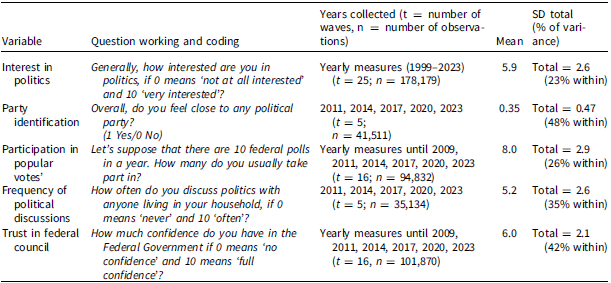
As dependent variables, we include four measures of political engagement (interest in politics, party identification, participation in popular votes, and frequency of political discussion in the household) and one measure of political trust (confidence in the federal council). Interest in politics, participation in polls, and political trust have been collected since 1999, thus covering more than two decades. Party identification and frequency of political discussions were included in 2011 in the survey. The political variables were collected annually until 2009 but have since been part of a triennial module (in 2011, 2014, 2017, 2020, 2023), with the exception of annual measures for political interest. The periodicity of data collection, the scales, and the question wording are shown in Table 1. All variables have repeated measurement per person, with the maximum number of waves varying from five (for party identification and political discussion) to 25 (for political interest).
Descriptive statistics for political engagement and political trust variables
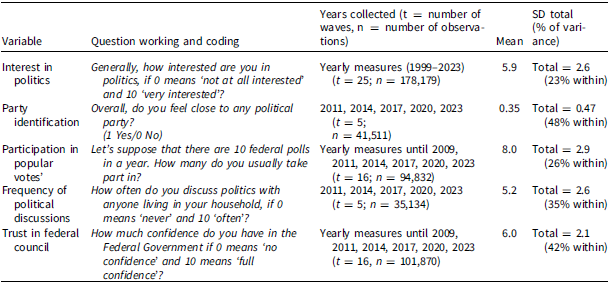
Note: % of variance refers to the variance explained by the clustering (R-squared). Observations were excluded if the polarization measure was missing.
A sufficient amount of variation within individuals over time is an important prerequisite for exploiting panel data using within-models. The last column in Table 1 shows the share of the total variation (standard deviation squared) that is within individuals. Typically for panel data, the between-individual variance is much more important than the within-individual variance, with the latter ranging from 23% (for interest in politics) to 48% (for party identification) of the total variance, which is sufficient for estimating fixed effects models. Within-individual variation stems from both systematic variation within individuals over time and ‘noise’ or measurement imprecision in the data.
Measurement of polarization
Our main independent variable is ideological polarization at the individual level based on the extremity of a respondent’s position on the left-right axis. SHP respondents are asked in each wave to position themselves on the axis, where 0 means left and 10 means right.Footnote 6 This measure allows us to assess extremity both in a cross-sectional perspective (ie comparing individuals with different degrees of ideological extremity) and in a longitudinal perspective (ie as changes in individuals’ ideological extremity over time). The extremity of the political position is the absolute distance from the center of the scale (5) and ranges from 0 to 5. The maximum value is attributed to individuals who are either far left (0) or far right (10). Some individuals (11.6%) indicate ‘no particular tendency’; these observations are excluded from the analysis due to endogeneity concerns.Footnote 7
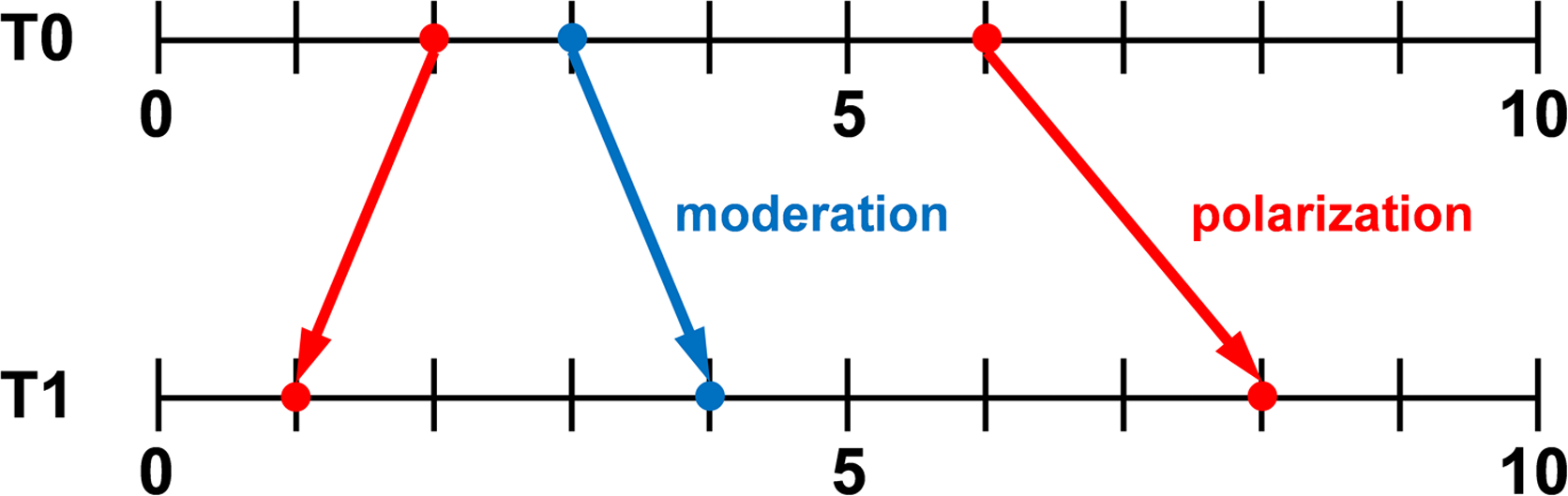
Strictly speaking, our definition of ideological polarization as a dynamic individual process is measured by an individual’s shift to a more extreme position (the shift to a less extreme position is referred to as ‘moderation’). This novel measure of ideological polarization is illustrated in Figure 1, which shows two cases of polarization and one case of depolarization for two consecutive waves. Instead of comparing the positions of different citizens or parties, this perspective compares the positions within individuals over time. Accordingly, this perspective requires an empirical model that analyzes within-individual changes over time, such as a fixed effects model. Nevertheless, we will also analyze extremity using a static cross-sectional (between-person) perspective in line with previous research using extremity measures.
Illustration of individual-level polarization.
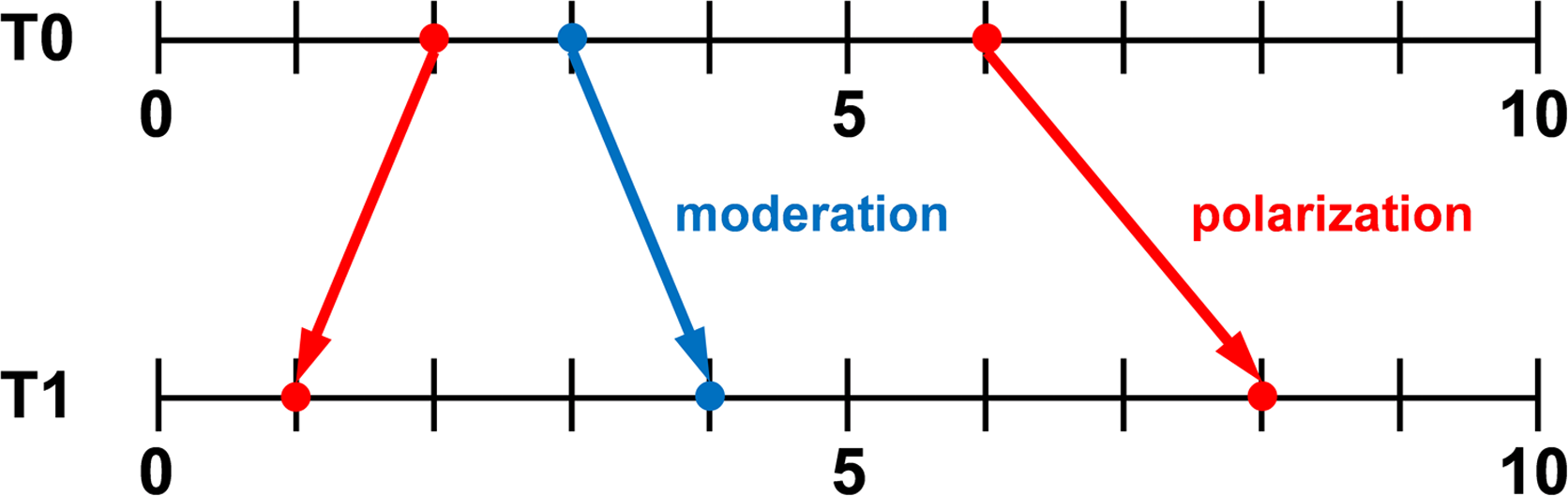
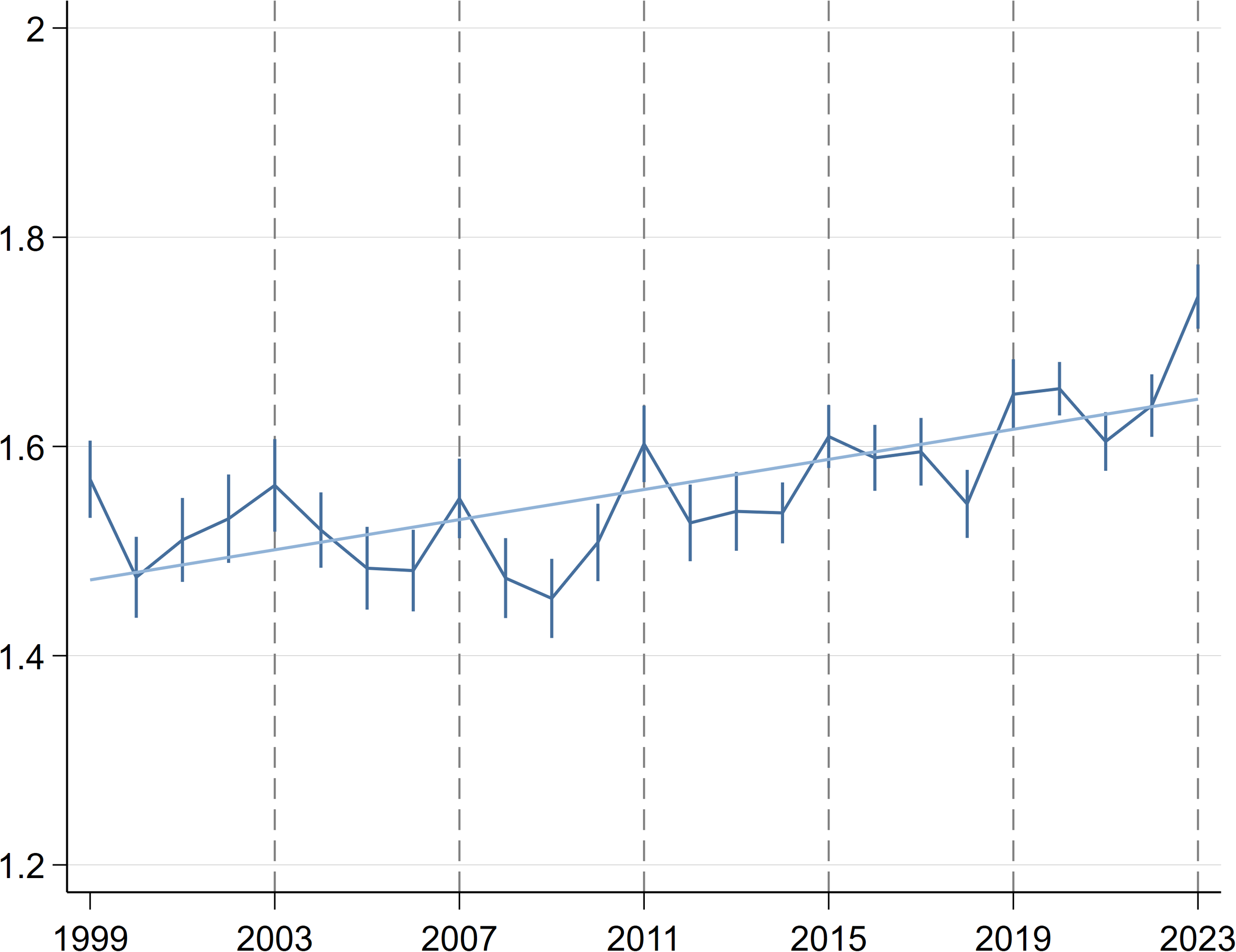
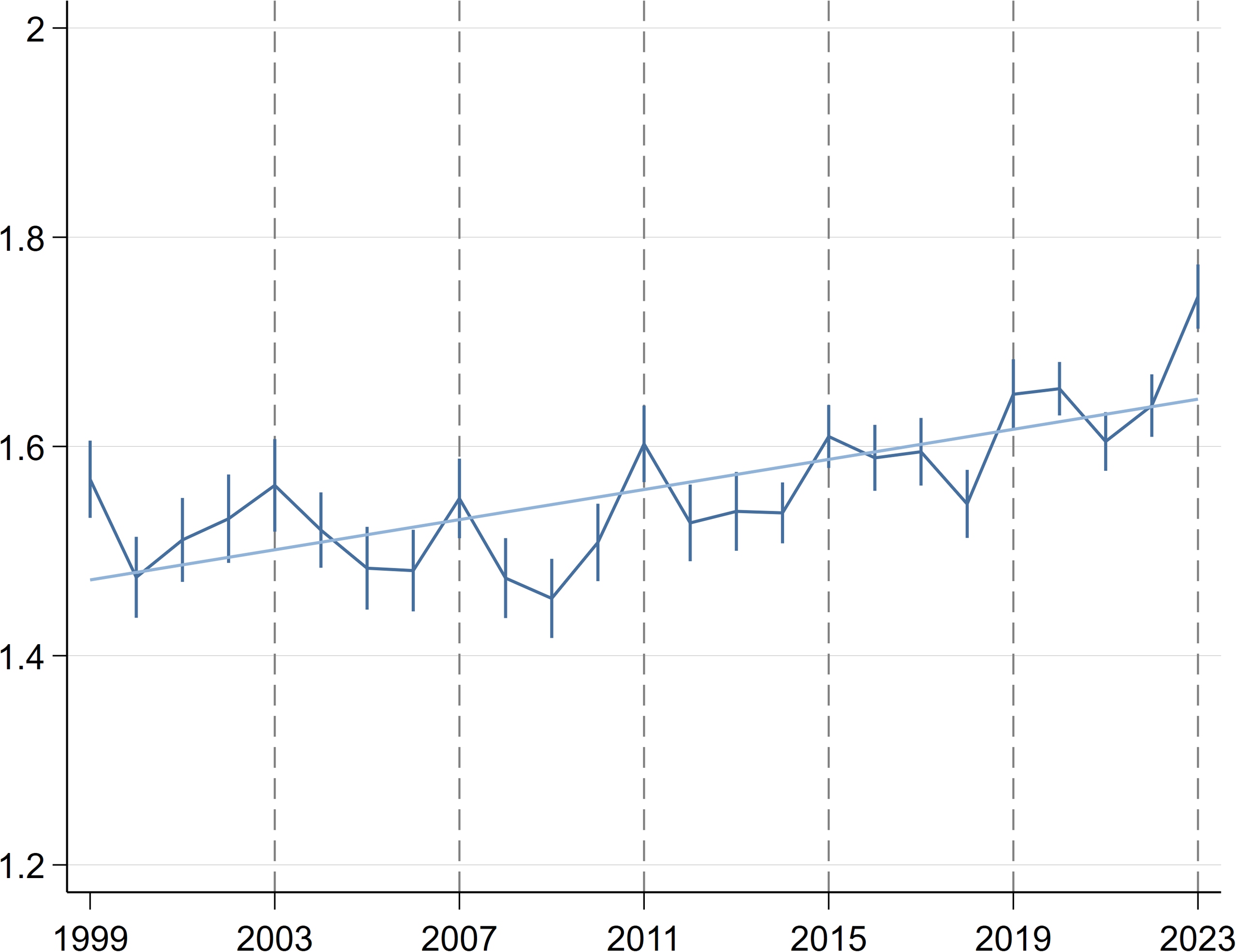
Figure 2 shows the average ideological extremity by year, which is calculated as the average distance to the center of the scale for all respondents. The figure shows a slight (and statistically significant) increase in average extremity from 1999 – 2023. This trend is not linear; rather, ideological extremity peaks in years with federal elections (vertical lines in the figure). A potential drawback of our polarization measures is that they assume the meaning of ‘left’ and ‘right’ remains constant over time. Results with an alternative measure, which uses distance to the year-specific mean left-right position, are consistent (see online Appendix A5.3).
Average individual-level extremity by year.
Note: Average distance to the midpoint of the left-right scale (0–10) by survey years. Vertical lines refer to years with federal elections. Source: SHP 1999–2023.
To test our hypothesis that polarization in the household context affects political engagement (H3a) and political trust (H3b), we use the left-right positioning of other household members. As the SHP collects information from all household members, we have direct estimates of partners and parents who agreed to participate in the survey. The left-right position of the partner is available if the partner lives in the same household. The left-right position of parents is available if the individual lived with them in the same household in the current or previous waves of the panel. The extremity on the left-right axis is constructed in the same way as for individuals. Table 2 presents descriptive statistics of the polarization measures. The correlation between the polarization of different household members is positive, but rather weak.
Descriptive statistics of polarization measures

Note: Descriptive statistics exclude observations with no measure for other family members. a: Pearson’s R correlation with extremity for self.
Control variables
We include a number of control variables: age, gender, educational level, professional situation (in education, working, unemployed, inactive), household income, year dummies, participation in the panel, and interview mode (interviewer-based vs web). Income refers to equivalized disposable household income to take account of household size and standard of living. These values were adjusted for inflation and top-coded at the 99% level. All control variables are described in more detail in online Appendix A1.
For polarization of the partner and parents, a value of zero was assigned to missing information (ie when individuals did not have a cohabiting partner or parent or these persons did not respond to the interview). To distinguish whether a value of zero refers to a minimal extremity score (a score of 5 on the left-right scale) or to no partner information, a control variable indicating whether partner information is available was included in the model. The same procedure was applied to parents.
The share of item non-response varies considerably between variables. As a general rule, we did not impute missing values but dropped incomplete values, as currently used imputation procedures (such as multiple imputation) tend to work well for cross-sectional analysis but are more problematic for within-individual analysis (Westermeier and Grabka Reference Westermeier and Grabka2016). Exceptions are made for disposable income, where the variable provided by the SHP includes imputed values.
Methods of analysis
As our measure of polarization is based on within-individual dynamics, we test our hypotheses using fixed effects (hereafter FE) regression models. These models test whether changes in ideological extremity (which we interpret as ideological polarization) affect changes in political engagement or trust of the same individual. This approach allows us to expand the literature on ideological polarization in two respects. First, FE models rely on weaker assumptions than cross-sectional approaches, because stable characteristics, even if unobserved, cannot bias the estimates. Therefore, highly stable variables, such as gender, educational level, or characteristics of the party system, are not included in the model. Because FE models aim to isolate causal influences (rather than correlations), explained variance is smaller compared to Ordinary Least Squares (OLS) models. Second, FE models allow us to operationalize the concept of individual ideological polarization as a process of becoming more extreme.
Despite the weaker assumptions in the FE models, care must be taken when interpreting the coefficients as causal effects. First, reverse causality cannot be ruled out. To examine possible bidirectional relationships between polarization and political engagement or trust, we tested cross-lagged regression models, which are presented and discussed in online Appendix A6.Footnote 8 Second, the regression coefficient will not reflect a causal relationship if time-varying confounders influence changes in both the dependent and independent variables. For example, anti-establishment and populist movements are seen to contribute to ideological polarization at the elite level, affective polarization at the mass level, and higher voter turnout (Mudde and Rovira Kaltwasser Reference Mudde and Rovira Kaltwasser2018; Reiljan Reference Reiljan2020). Similarly, salient issues (e.g., those related to the Covid-19 pandemic) and electoral campaigns may affect ideological polarization, political engagement, and political trust simultaneously. However, controlling for year dummies and considering the large time span of over 20 years, such period-specific confounders are unlikely to bias results for individual-level analysis.Footnote 9
We complement this dynamic perspective (using FE models) with a cross-sectional perspective using pooled OLS models to relate our analysis to previous literature on extremity. Coefficients in the OLS and FE models should point in the same direction.
Results
Main models for ideological polarization
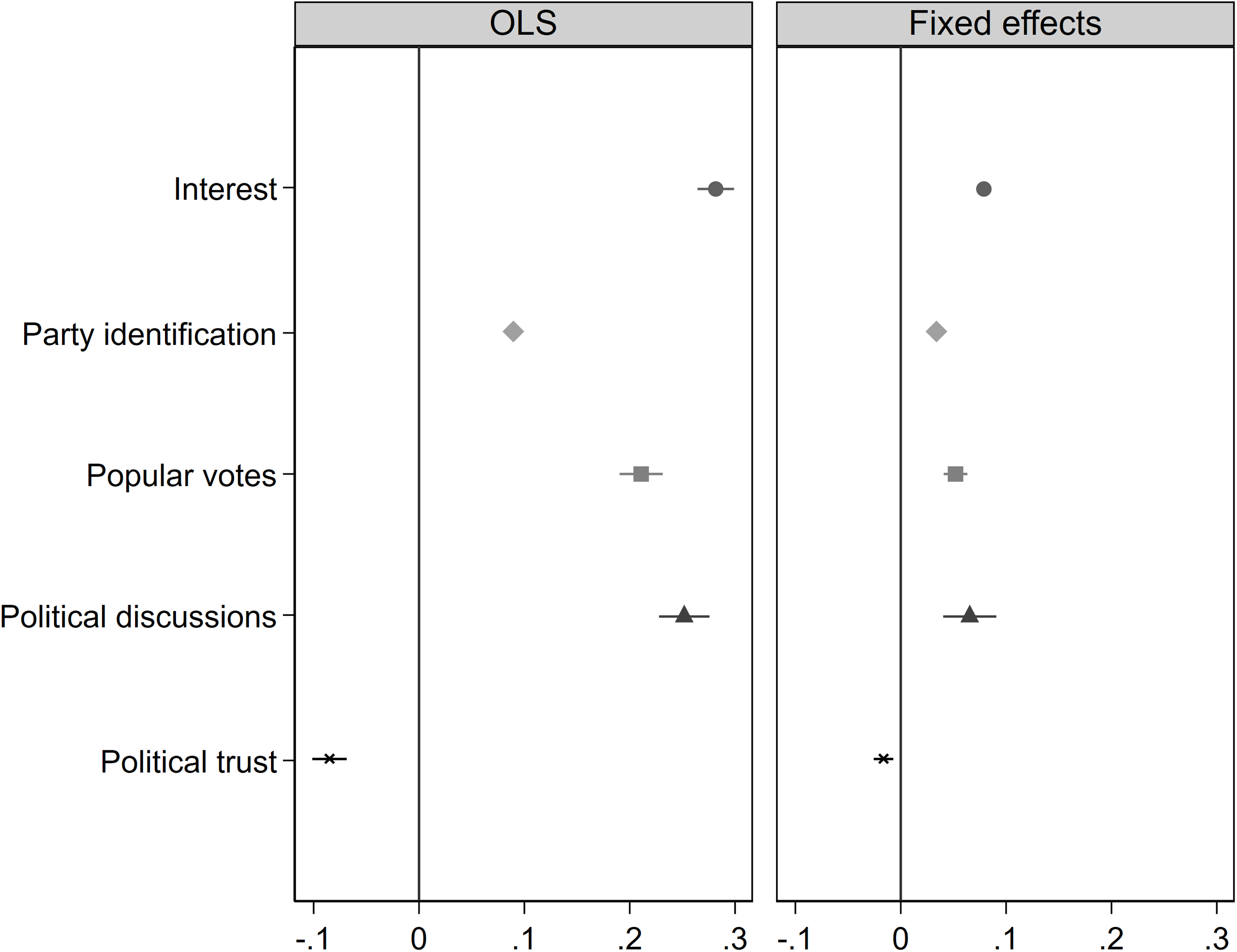
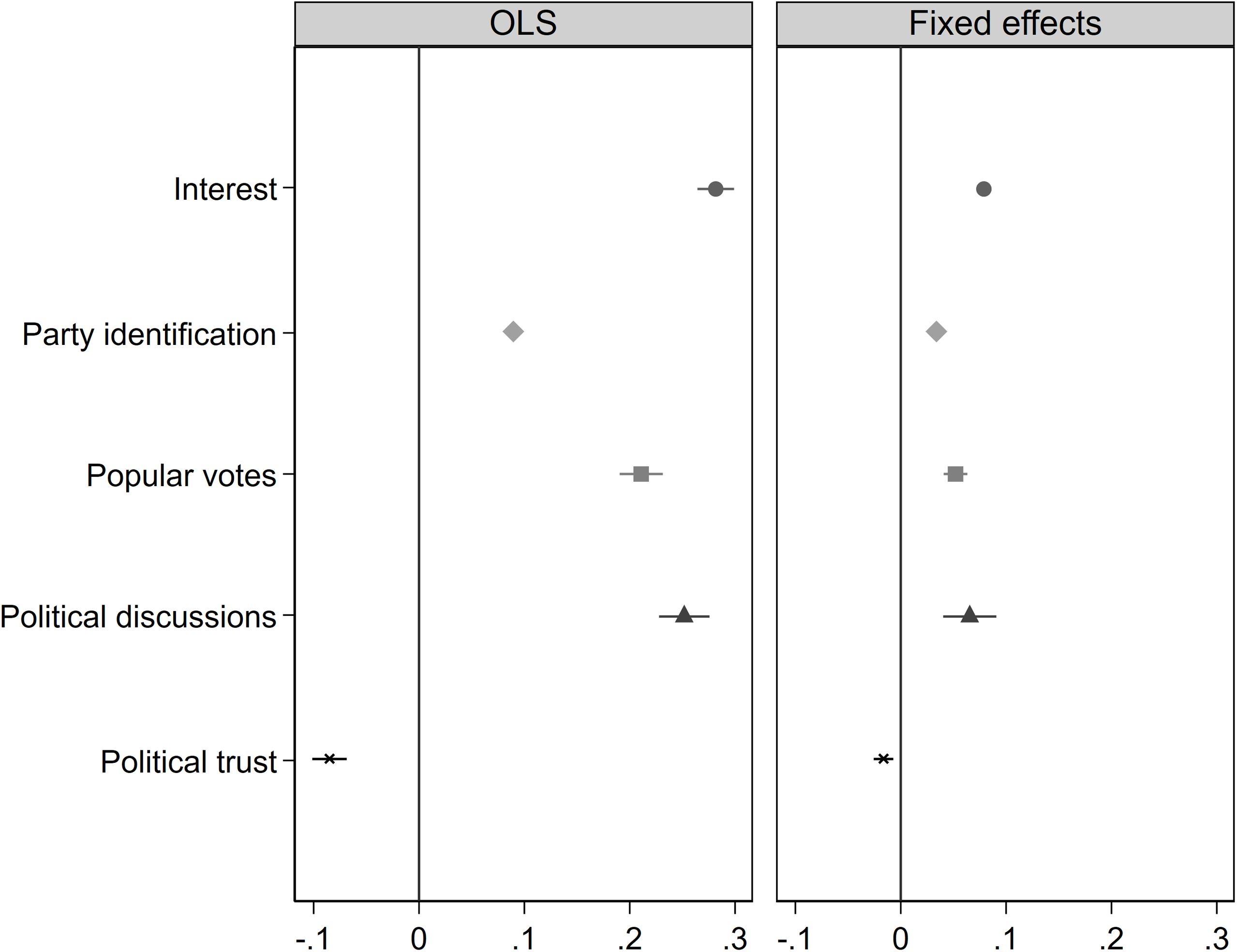
The discussion of the empirical results for ideological polarization is based on OLS and FE regression models (shown in online Appendix A2), visualized in Figures 3 and 4. The size of the coefficients is comparable across models with dependent variables scaled from 0 to 10 (political interest, participation in polls, political discussions, trust), except for party identification, which is a dummy variable.Footnote 10
Predicted effect of individual ideological polarization.
Note: Regression coefficients of ideological extremity (OLS) or polarization (FE) on political engagement and trust from models in Table A2.
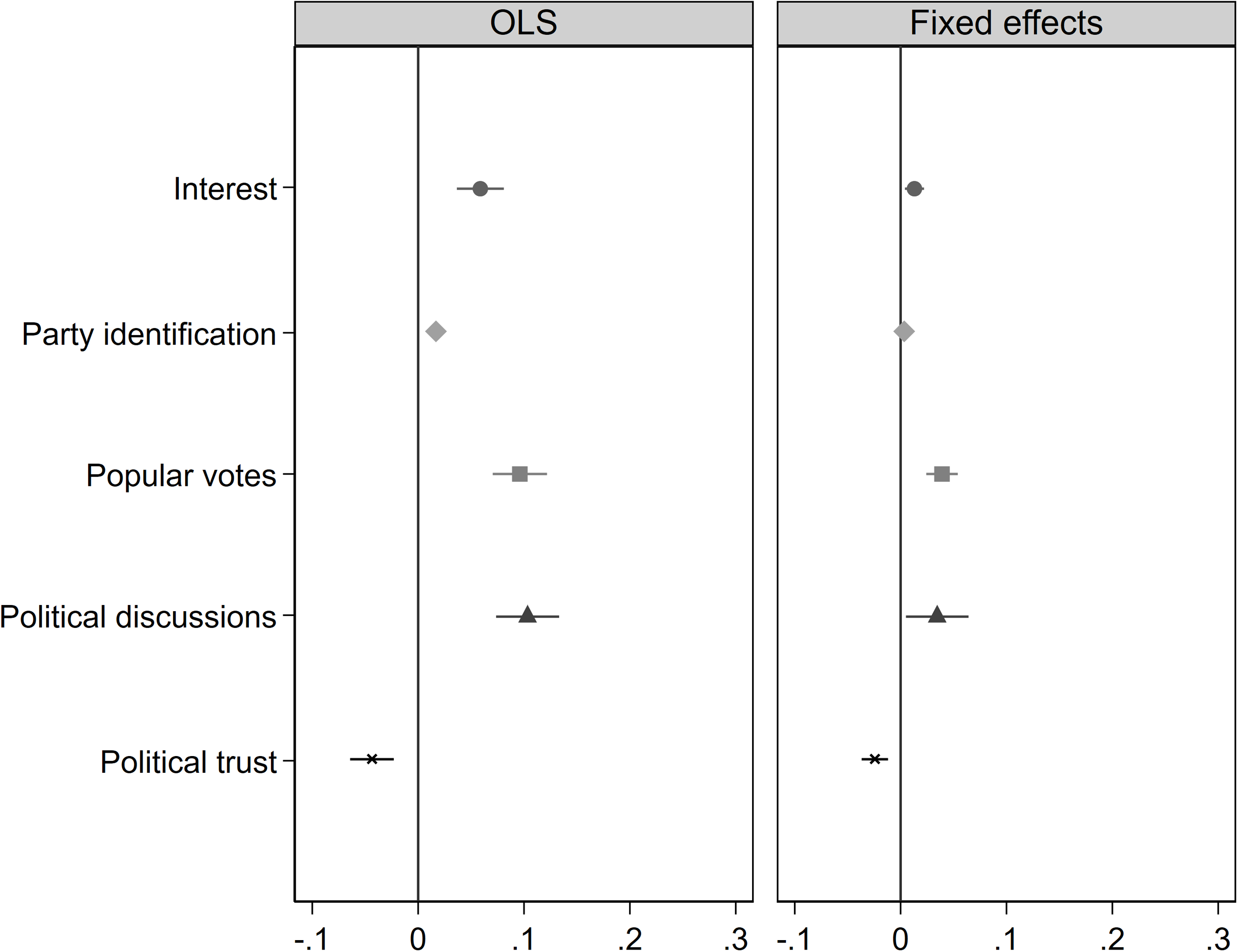
Predicted effect of partners’ ideological polarization.
Note: Regression coefficients of partner’s ideological extremity (OLS) or polarization (FE) on political engagement and trust from models in Table A2.
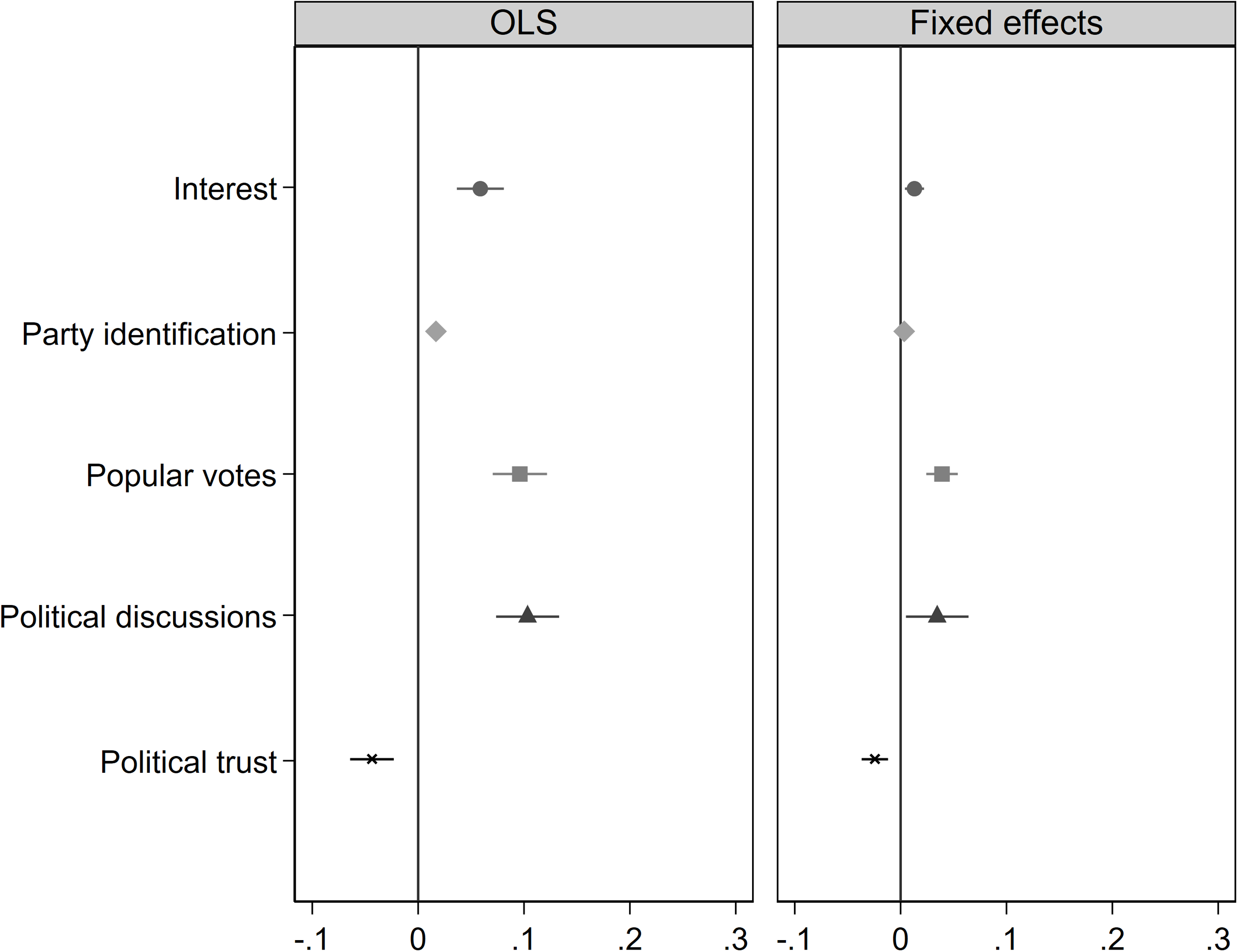
The regression coefficients of one’s own left-right extremity (OLS) or polarization (FE) serve to test the hypotheses that polarizing individuals become more politically engaged overall (H1) and less trusting of political institutions (H2). Figure 3 illustrates how much political engagement is predicted to increase (or decrease) with a one-unit change on the 0–5 polarization scale. In the OLS models (left panel), this one-unit change represents the difference in political engagement between two persons who differ by one unit on the extremity scale. In the FE model (right panel), this one-unit change represents a within-individual ideological polarization over time (e.g., when a person with an average extremity score of 2 reports an extremity score of 3). The cross-sectional analyses show that those with more extreme positions tend to have higher levels of political interest, are more likely to identify with a party, participate more frequently in popular votes, and tend to engage more often in political discussions in their household. All these effects are confirmed in the FE models, which show that individuals become more politically engaged as their positions polarize (become more extreme). As expected, longitudinal effects are weaker than cross-sectional effects on extremity. Given that party identification is coded on a 0–1 scale, it is actually the variable most influenced by ideological polarization. As people become more extreme in their ideological positions, they are more likely to have or to develop a party identification.
Likewise, both cross-sectional and FE models provide evidence that individual polarization is associated with a decline in political trust. In terms of effect size, it is interesting to note that the negative effect of polarization on trust is considerably smaller than the positive effects on the different forms of political engagement. This is not surprising, given that previous studies have found no effect of other within-individual changes on political trust (Devine and Valgarðsson Reference Devine and Valgarðsson2024). Another notable outcome is that the FE model for political trust has relatively greater explanatory power in terms of the R-squared criteria (amounting to 7%), compared to the FE models for political engagement (ranging from 1 to 2%).
The FE models strongly support the polarization–engagement hypothesis (H1) and the polarization–trust hypothesis (H2). The coefficients point to effects that are not exceptionally large for engagement and substantively small for trust, but highly precise (all ps < .001).
The distinction of left- and right-wing polarization (FE models in online Appendix A3) shows larger effects for right-wing polarization on political engagement (the coefficients in the FE models are double for political interest and popular vote). For political trust, effects are only significant for left-wing polarization and are, again, very small. Interestingly, the cross-sectional perspective does not confirm stronger effects for right-wing polarization (OLS models in online Appendix A3), suggesting that unobserved stable characteristics might play a large role and bias coefficients for static extremity measures.
The effects of ideological polarization at the individual level are all the more remarkable as the models also control for polarization of other significant household members (partner, father, mother). This allows us to test the hypothesis that polarization within the family has an additional spillover effect of rising political engagement (H3a) or decreasing political trust (H3b). Interestingly, our models support this and suggest that political engagement and trust also depend on changes in the ideological extremity of people in one’s close surroundings. Figure 4 summarizes the effects of the partner’s polarization. Looking at FE models, we find evidence that when one’s partner polarizes, one becomes more politically interested, more willing to participate in popular votes, more often engaging in political discussion, and less trusting of the federal government. In contrast, party identification is not significantly affected by one’s partner’s ideological polarization in the FE model, although the cross-sectional OLS models show significant coefficients. The distinction of right-wing and left-wing polarization shows no important differences (see online Appendix A3). Overall, the effects of partners are consistent with H3a and H3b.
Polarization of one’s parents is less important. The only exception is that father’s polarization seems to foster participation of their son or daughter in popular votes. In the model distinguishing left- and right-wing polarization (see Table A3 in the online Appendix), some further coefficients are significant: fathers’ right-wing polarization is related to increased interest in politics and formation of party identification, which is in line with stronger effects of right-wing polarization found for own polarization. More puzzling are the coefficients for political discussion, pointing – against expectations – to fewer political discussions when the father polarizes to the left or when the mother polarizes to the right.Footnote 11
Cross-sectional models tell a somewhat different story of parental spillover effects, showing that mothers’ (but not fathers’) ideological extremity triggers political engagement but not political trust. This inconsistency between OLS and FE results may reflect the long-term socialization role of mothers, who tend to be the ‘caregiver’ parent and to spend more time with their children (see also Zuckerman Reference Zuckerman2005; Shulman and DeAndrea Reference Shulman and DeAndrea2014; Gidengil, Wass, and Valaste Reference Gidengil, Wass and Valaste2016). Mothers who are more ideologically extreme may stimulate their children’s political engagement to a greater extent than mothers who are more moderate. However, this effect may only be detected in a cross-sectional analysis, which captures long-term effects and correlations with stable characteristics. FE models that rely on variation during the period studied cannot estimate more general socialization effects.
Overall, the hypothesis that polarization within the family increases political engagement (H3a) and decreases political trust (H3b) is supported for partners, but not for the effect of parents’ polarization on their daughters or sons.
Extension: models for ideological and affective polarization
Finally, we present the models that include affective polarization. Our primary objective is to assess the extent to which affective and individual polarization independently influence political engagement and trust. Affective polarization is measured using Wagner’s (Reference Wagner2021) approach, which is widely applied in multi-party systems. We calculate a spread-of-scores measure based on questions asking how much respondents sympathize with the five largest political parties, on a scale from 0 (‘not at all’) to 10 (‘completely’). These variables were collected in three panel waves (2011, 2014, 2017). The measure of affective polarization ranges – as our measure for ideological polarization – from 0 to 5 and is described in more detail in online Appendix A4. For the regression models, we standardize both affective and ideological polarization to compare coefficients.
Due to the limited number of panel waves for affective polarization, the analytical sample is substantially smaller (a decrease by 80%) than for the main models. We excluded the polarization of family members from the model because the variation within individuals for these variables is insufficient for fixed-effects estimation.Footnote 12 The different sample also limits the direct comparison between the models including and excluding affective polarization.
Apart from the methodological challenges, the unclear theoretical mechanism linking ideological and affective polarization (as discussed in the literature review) implies that regression coefficients can be interpreted in different ways. Assuming that ideological polarization precedes affective polarization, the coefficients reflect the extent to which affective polarization mediates ideological polarization. Assuming that affective polarization precedes ideological polarization, the coefficients show the extent to which ideological polarization contributes to explaining political engagement and trust, in addition to affective polarization. Alternatively, if there is no causal order, we can compare the relative strength of both types of polarization.
Despite these restrictions and uncertainties, the results shown in Figure 5 and online Appendix A4 provide some interesting insights. First, ideological extremity and polarization retain their significant effect on political engagement and trust in all models controlling for affective polarization. Regardless of the causal order, this confirms the findings of several recent studies that ideological and affective polarization are distinct phenomena. Second, affective polarization is significantly associated with political engagement in all models. However, affective polarization is not significantly related to political trust in the FE model. Third, controlling for affective polarization has a relatively strong impact on coefficients for extremity in the OLS models, but a much weaker impact on coefficients of ideological polarization in the FE models.Footnote 13 This suggests that left-right extremity is more closely related to affective polarization than ideological polarization, the latter being captured only in the dynamic perspective.
Predicted effect of ideological polarization and affective polarization.
Note: Regression coefficients of ideological extremity (OLS) or polarization (FE) and of affective polarization on political engagement and trust. Complete results are shown in Table A5.
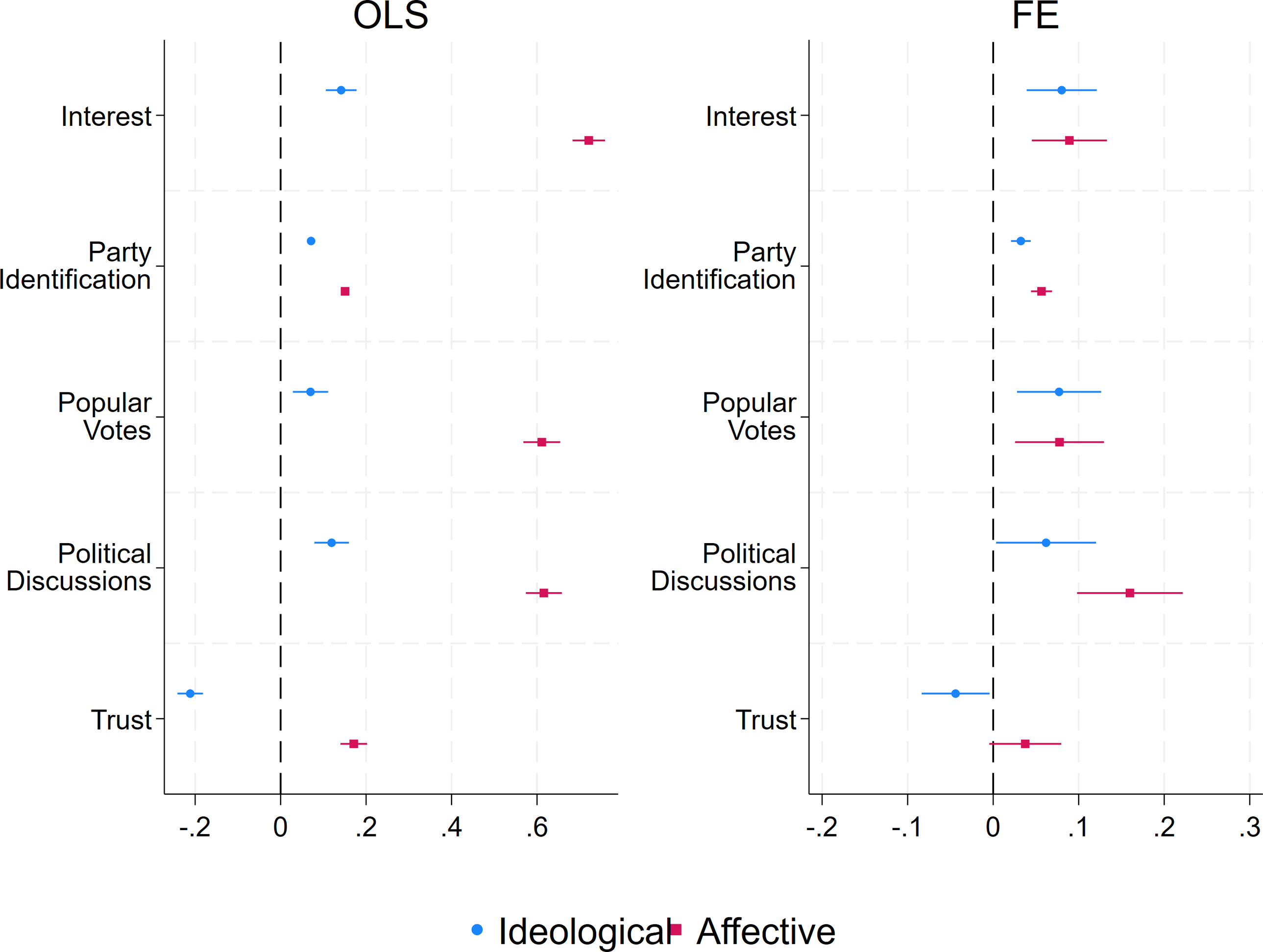
Finally, a rough comparison of the effect sizes of (standardized) affective and ideological individual-level polarization in the FE models in Figure 5 gives a sense of their relative importance. Affective and ideological polarization have a similar effect on political interest and popular votes. For party identification, the effect of affective polarization is slightly, and for frequency of political discussions, much stronger than that of ideological polarization. A possible explanation for these differences among the types of political engagement is that group identities and emotions are likely to play a larger role in party identification and political discussions. For political trust, affective polarization does not play the expected role, with a small effect even pointing to the opposite direction in the OLS model and no significant effect in the FE model. This suggests that the OLS estimates might be biased by unobserved stable characteristics, for example, political knowledge or awareness. However, the negative impact of ideological polarization on political trust remains significant when controlling for affective polarization. These results show that the negative effect of ideological polarization on trust is neither caused nor mediated by affective polarization and that underlying mechanisms differ from those for affective polarization.
Conclusion
In this paper, we examined the relationship between ideological polarization and political engagement and trust at the individual level. We proposed a measure of ideological polarization, which compares positions over time within individuals, and tested this approach alongside more established indicators for extremity and affective polarization. Polarization is often associated with instability, incivility, or legislative stalemate. Consistent with previous studies focusing on ideological polarization of party systems or elites, our results show that polarization can also have desirable effects, in the form of increased political engagement. Individual polarization has a strong and consistent stimulating effect on interest in politics, direct democratic participation, frequency of political discussions, and party identification. For political trust, our findings suggest that polarization contributes to declining trust in political institutions, although the effect is rather small in size.
In particular, by using panel data spanning over two decades, we provide a missing piece for a better understanding of the relationship between ideological polarization and political engagement and trust. FE models, which conceptualize individual-level polarization as increasing ideological extremity over time, show that this relationship is not driven by predispositions or stable contextual factors. In addition, we were able to provide some evidence that polarization is more likely to be a cause of political engagement and trust than the other way round. Both findings are important because they substantiate the hypothesis that individual ideological polarization is a driver of political engagement.
Our results also show the importance of polarization in the close environment. In line with Keating et al. (Reference Keating, Van Boven and Judd2016), who argue that people underestimate group polarization, and with recent studies showing spill-over effects within the household (Foos and de Rooij Reference Foos and de Rooij2017), we find that polarization of the partner leads to increased political engagement and lower political trust. Thus, our conclusions are less pessimistic than those of (mainly American) studies (e.g., Klofstad, McDermott, and Hatemi Reference Klofstad, McDermott and Hatemi2013; Iyengar, Konitzer, and Tedin Reference Iyengar, Konitzer and Tedin2018), which point to increasing partisan homogeneity within families and draw the daunting conclusion that this will fuel polarization even further. An exception is our finding that, in some models, polarization of the parents causes less frequent political discussions within the household.
While left-right extremity is relatively closely related to affective polarization, our dynamic perspective shows that ideological and affective polarization have independent effects on political engagement, which makes us confident that our measures capture different concepts. Like ideological polarization, affective polarization is related to increasing political engagement in the fixed effects models, with effects being particularly strong for political discussions. In contrast, affective polarization is not associated with decreasing political trust. At least for the five variables studied here, affective polarization does not appear to have negative effects on political engagement and trust. Considering the rise of affective polarization observed in many countries, this is an optimistic finding that is consistent with recent experimental studies showing no causal negative effects of affective polarization (Broockman, Kalla, and Westwood Reference Broockman, Kalla and Westwood2023; Harteveld and Wagner Reference Harteveld and Wagner2023).
Despite its politicization effect, we cannot conclude from our findings that ideological and affective polarization are generally beneficial for democracy. First, isolating the effect of ideological polarization from confounding factors allows us to better understand the underlying mechanisms. However, in the real world, confounding factors cannot be held constant in the same way as in statistical models, and they may lead to indirect negative effects. Second, the positive effects of polarization on political engagement are small in terms of effect size and need to be weighed against its negative effects on political trust. Although the effect sizes in our models are even smaller for trust in government, all our models show that ideological polarization has a negative effect on trust, thus potentially undermining an important pillar of democracy. This negative relation may be driven by the phenomenon of ‘polarization of trust’ described by Hetherington and Rudolph (Reference Hetherington and Rudolph2015), which is a type of sorting process. A small minority of individuals who become more ideologically extreme and reduce their trust might be driving this negative relationship. Moreover, political trust is complex and depends on many other factors besides ideological polarization. In Switzerland, the average level of trust has risen over time despite a small increase in ideological polarization. Third, ideological polarization may well clarify the positions of the various parties on salient issues and boost political engagement, but it may also affect further elements of civic culture, which we did not study. Ideological polarization may instill feelings of dislike and hatred toward out-parties, which crystallize into negative attitudes and identifications (e.g., Garry Reference Garry2007; Abramowitz and Webster Reference Abramowitz and Webster2018; Bankert Reference Bankert2021). Likewise, affective polarization among citizens has been shown to undermine support for democratic norms (Kingzette et al. Reference Kingzette, Druckman, Klar, Krupnikov, Levendusky and Ryan2021). In addition, drawing from the American experience, we know that when the media routinely describe the citizenry as deeply divided, there is a misperception of out-partisans as being more extreme than they really are (Ahler Reference Ahler2014; Levendusky and Malhotra Reference Levendusky and Malhotra2016). Thus, our study should not be misinterpreted as a candid demonstration that ideological polarization among citizens is a blessing for democracy. In addition, since our study is the first – to our knowledge – to address the relationship between ideological polarization and political engagement at the individual level, further studies using data from different contexts would be important. Findings for Switzerland, a consensual democracy where the main populist party participates in a stable coalition government, may not generalize easily to other countries.
Our study also has a number of limitations that call for further research. Some of the relationships tested here (such as between polarization and voting participation or interest) may prove to be reciprocal rather than one-directional. Likewise, it might be questioned to what extent individual-level polarization is a mere substitute or by-product of elite-level polarization or whether individual-level polarization and party-system polarization interact to stimulate or dampen political engagement. One may also criticize our (and many other researchers’) focus on the left-right dimension, while there is some evidence of a growing polarization on other (cultural) dimensions, at least at the aggregate level (e.g., Dassonneville and Çakır Reference Dassonneville and Çakır2021).
As a final note, we reiterate that individual ideological polarization is an underexplored type of polarization that awaits confirmation by further studies. Although individual polarization should not be confused with aggregate polarization, we claim that both types of polarization drive political engagement through the same causal mechanisms. Hence, the causal effects we were able to isolate at the individual level should also apply to the aggregate level. The mixed results found in previous studies may be due to various confounding and moderating factors, which usually operate at the aggregate level and which future research should try to account for.
Supplementary material
To view supplementary material for this article, please visit https://doi.org/10.1017/S1475676525100248.
Data availability statement
The data of the Swiss Household panel analyzed for this study (doi 10.48573/swnc-bn46) can be found on SwissUbase (https://www.swissubase.ch) and is freely available to the scientific community upon submission of a data request application. The code (Stata syntax) to replicate the analysis for this contribution is available from the FORS replication service: https://doi.org/10.25597/w0n7-1558.
Acknowledgments
A previous version of this article was presented at the 12th International Conference of Panel Data Users in Switzerland 2023. We thank the anonymous reviewers for their thoughtful and constructive feedback, which greatly improved the manuscript.
This study used data collected by the SHP, which is based at FORS, the Swiss Centre of Expertise in the Social Sciences. The Swiss National Science Foundation finances the project.
Funding statement
There is no specific funding involved in the project.
Competing interests
The authors declare none.



 Open access

