




Introduction
The use of large data datasets for seed plant families to evaluate the effect of paleaoclimate, fire regimes and soil seed banks on global distribution of seed dormancy have resulted in new and interesting general insights on seed dormancy/germination from a world perspective (e.g. Gioria et al., Reference Gioria, Pyšek, Baskin and Carta2020; Zhang et al., Reference Zhang, Liu, Sun, Baskin, Baskin, Cao and Yang2022; Rosbakh et al., Reference Rosbakh, Carta, Fernández-Pascual, Phartyal, Dayrell, Mattana, Saatkamp, Vandelook, Baskin and Baskin2023). In addition, these large datasets have been used to investigate function and phylogenetic assembly of a tropical forest (Yang et al., Reference Yang, Zhang, Ci, Swenson, Cao, Sha, Li, Baskin, Slik and Lin2014) and seed morphospaces (Carta et al., Reference Carta, Vendelook, Ramírez-Barrahona, C, Dickie, Steinbreacher, Thanos, Moles, Leubner-Metzger and Mattana2024). The contribution of these publications to the advancement of seed science is recognized and appreciated. However, much research/information is available on seed science/ecology/evolution at the individual plant family level, especially for highly speciose families. Further, general papers resulting from use of large databases on dormancy/germination do not include much, if any, information on subcategories of the five classes of dormancy. For example, in the case of physiological dormancy (PD), much detail about the fine-tuning of species to their habitats is not covered because no attention is given to the three levels of PD and especially the six types of nondeep PD.
Given the variation in palaeohistory, dispersal patterns on earth, life forms, embryo morphology and subcategories of dormancy within many plant families, much can be learned about the eco-evolutionary aspects of seed dormancy/germination when individual families are considered in detail. To contribute to a better understanding of seed dormancy and germination at the family level, we have reviewed the available information for the Malvaceae. In previous reviews, we have considered the Asteraceae (Baskin and Baskin, Reference Baskin and Baskin2023), Rubiaceae (Baskin and Baskin, Reference Baskin and Baskin2024) and Myrtaceae (Baskin and Baskin, Reference Baskin and Baskin2025). The Malvaceae was chosen for study because (1) various molecular studies have been conducted on the palaeohistory and phylogenetic relationships within the family, (2) many species have seeds with water-impermeable seed coats, i.e. physical dormancy (PY) but some have water-permeable seeds, (3) it has a diversity of life forms and embryo morphologies and (4) species grow in all parts of the world except in regions with long cold winters.
Introduction to the Malvaceae
The Malvaceae is included in the Malvales, which is part of the Rosid clade (Soltis et al., Reference Soltis, Soltis, Endress, Chase, Manchester, Judd, Majure and Mavrodiev2018). Cladistic analysis (Judd and Manchester, Reference Judd and Manchester1997) and molecular phylogeny studies (Bayer et al., Reference Bayer, Fay, De Bruijn, Savolainen, Morton, Kubitzki, Alverson and Chase1999; Soltis et al., Reference Soltis, Soltis, Chase, Mort, Albach, Zanis, Savolainen, Hahn, Hoot, Fay, Axtell, Swenson, Nixon and Farris2000, Reference Soltis, Soltis, Endress, Chase, Manchester, Judd, Majure and Mavrodiev2018) have determined that the Malvaceae also includes the Bombacaceae, Sterculiaceae and Tiliaceae. Currently, the Malvaceae consists of ten subfamilies: Bombacoideae (pantropical), Brownlowioideae (palaeotropical), Byttnerioideae (pantropical, especially South America), Dombeyoideae (palaeotropical), Grewioideae (pantropical), Helicteroideae (pantropical), Malvoideae (tropical to temperate), Matisioideae (neotropical); Sterculioideae (pantropical) and Tilioideae (northern temperate and montane of Central America) (Bayer and Kubitzki, Reference Bayer, Kubitzki and Kubitzki2003; Cvetković et al., Reference Cvetković, Areces-Berazain, Hinsinger, Thomas, Wieringa, Ganesan and Strijk2021; Colli-Silva et al., Reference Colli-Silva, Pérez-Escobar, Ferreira, Maria, Gerace, Boutinho, Yoshikawa, Antonio-Domingues, Hernández-Gutiérrez, Bovini, Duarte, Cheek, Chase, Fay, Christenhusz, Dorr, Schoeplein, Corcoran, Roy, Cable, McLay, Maurin, Forest, Baker and Alexandre Antonelli2025; APG website).
The Malvaceae is the 12th largest angiosperm family and has about 4000 species in 243 genera (Bayer and Kubitzki, Reference Bayer, Kubitzki and Kubitzki2003; APG website; POWO website). Species of Malvaceae grow on all continents except Antarctica and on numerous tropical/subtropical islands, many of which have endemic species of Malvaceae on them, e.g. Kokia drynarioides in Hawaii (Wagner et al., Reference Wagner, Herbst and Sohmer1999) and Lebronnecia kokioides in the Marquesas Islands (Areces-Berazain and Ackerman, Reference Areces-Berazain and Ackerman2020). Species of Malvaceae grow in wet, mesic and dry habitats ranging from rainforests to deserts and in both tropical and temperate zones (Baskin and Baskin, Reference Baskin and Baskin2014). Among the ten subfamilies, the Malvoideae has the most extensive distribution, ranging from c. 56 ºS in Tierra del Fuego at the tip of South America (Neobaclea crispifolia) to c. 70º N in Finland (Malva pusilla) (APG website; POWO website). Malvaceae species usually do not grow in subalpine/boreal or alpine/Arctic tundra regions, but some species of Andeimalva, Nototriche and Tarasa are found at high elevations in the Andes Mountains (Tate, Reference Tate2003; Gonzáles et al., Reference Gonzáles, Navarro, Chanco and Cano2015). Also, Hoheria glabrata grows in the subalpine zone on South Island of New Zealand (Haase, Reference Haase1987) and Malva verticillata on the Tibet Plateau in China (Wang et al., Reference Wang, Shou, Zhang, Ge, Yang, Zhou, Ma, Liu, Qi and Bu2024).
The Malvaceae is highly valued as a source of many products useful to humans such as cotton, jute, stuffing for pillows and mattresses, medicinally-beneficial compounds, timber, firewood, biofuel, ornamentals for parks and gardens, dyes, cocoa, okra, durian and novel food crops (Ţîţei and Teleuţă, Reference Ţîţei and Teleuţă2018; Das and Islam, Reference Das and Islam2019; Basheer et al., Reference Basheer, Ben-Simchon, Cohen and Shelef2021; Das et al., Reference Das, Shin, Ningthoujam, Talukdar, Upadhyaya, Tundis, Das and Patra2021; Gómez-Maqueo and Buen, Reference Gómez-Maqueo and Buen2022; Ezeako et al., Reference Ezeako, Nworah and Osuji2023).
Growth forms of Malvaceae plants are mostly trees, shrubs or herbs, but there are a few climbing species (Mabberley, Reference Mabberley2017; Landrein et al., Reference Landrein, Song, Zhang, Guo, Shen, Jiang and Low2024). In the climbing Malvaceae genera Ayenia, Byttneria and Grewia, the presence of lobed stems promotes climbing. Lobed stems have evolved three times in Byttneria and its allies, once in Ayenia and twice in Byttneria (Luna-Márquez et al., Reference Luna-Márquez, Sharber, Whitlock and Pace2021). Lobed stems have evolved independently in the climbing species of Grewia. Species of Spirotheca (Bombacoideae) in neotropical rainforests begin life as an epiphyte on branches of canopy trees, and they grow like strangler figs, eventually becoming a tree and killing the host tree (Gibbs and Alverson, Reference Gibbs and Alverson2006).
Trees of Malvaceae are concentrated in tropical regions, and there is a decrease in the number of tree species as distance from the equator increases. In the Amazon rainforest, Malvaceae is the ninth of the 10 most species-rich families with 214 species of trees (Cardoso et al., Reference Cardoso, Särkinen, Alexander, Amorim, Bittrich, Celis, Daly, Fiaschi, Funk, Giacomin, Goldenberg and Heiden2017). The Tree Atlas of Panama (website) lists 92 species in 37 genera of Malvaceae, and in Mexico there are 108 species of trees in 32 genera of Malvaceae (Tellez et al., Reference Tellez, Mattana, Diazgranados, Kűhn, Castillo-Lorenzo, Lira, Montes-Leyva, Rodriguez, Ortiz, Way, Dávila and Ulian2020). The Flora of North America (online) lists six subfamilies of Malvaceae (Bombacoideae, Byttnerioideae, Grewioideae, Malvoideae, Sterculioideae and Tilioideae), but Tilioideae is the only subfamily listed as having native trees. Further, in east-central USA and southern Canada, native trees of Malvaceae are represented only by the genus Tilia (Gleason and Cronquist, Reference Gleason and Cronquist1991).
In wet tropical habitats, tall forest trees may have buttresses (Coelostegia, Kostermansia, Pentace and Scaphium), while in dry tropical habitats tree trunks may be swollen and have stored water in them (Brachychiton spp.); the thick trunks of Adansonia digitata are hollow (Bayer and Kubitzki, Reference Bayer, Kubitzki and Kubitzki2003). Also, some (non-mangrove) tree species grow in mangrove swamps (Tomlinson, Reference Tomlinson1986), including Brownlowia argentata (Tomlinson, Reference Tomlinson1986), B. tersa (Raju, Reference Raju2019), Camptostemon philippinensis, C. schultzii (Damayanto et al., Reference Damayanto, Rahmawati, Nurdiansah, Martinsyah, Riastiwi, Broto, Mambrasar and Mirmanto2023), Heritiera fomes, H. globosa (Tomlinson, Reference Tomlinson1986), H. littoralis (Ye et al., Reference Ye, Lu, Wong and N-f-y2004; Wijayasinghe et al., Reference Wijayasinghe, KMGG, Gunatilleke, Gunatilleke and Walck2023), Hibiscus tiliaceus (Wijayasinghe et al., Reference Wijayasinghe, KMGG, Gunatilleke, Gunatilleke and Walck2023), Pavonia paludicola (Florida Natural Areas Inventory, 2000), P. rhizophorae (Alvarez-León and Garcia-Hansen, Reference Alvarez-León and Garcia-Hansen2003) and Thespesia populnea (Ng and Sivasothi, Reference Ng and Sivasothi2001). Unlike other Malvaceae in mangroves swamps, the roots of Camptostemon spp. have knobby pneumatophores (Damayanto et al., Reference Damayanto, Rahmawati, Nurdiansah, Martinsyah, Riastiwi, Broto, Mambrasar and Mirmanto2023).
Leaves of Malvaceae are simple with entire, serrate or lobed margins or palmately compound, and venation is pinnate or palmate. Stipules are absent/inconspicuous (Lasiopetalum) or leaf-like (Brownlowia and Hermannia). Leaves have domatia (Acropogon, Cola, Hampea, Hildegardia, Nesogordonia and Tilia), glandular hairs (Dombeya, Lytonychia and Melhania), nectaries (Hibiscus, Kydia and Urena) or stellate trichomes (Alyogyne and Durio) (Zomlefer, Reference Zomlefer1994; Bayer and Kubitzki, Reference Bayer, Kubitzki and Kubitzki2003; Simpson, Reference Simpson2006).
Flowers of Malvaeae usually are bisexual, actinomorphic, hypogynous and often have an epicalyx of three or more bracts. The calyx and corolla have five (sometimes three to four) sepals and petals, respectively. The number of stamens ranges from five to numerous (>1000 in Adansonia), and filaments are single, in bundles or fused into a tube or staminal column around the style. The stigma is non-lobed or lobed. The ovary has two to many carpels and locules, and the locules have one to nine ovules. In pluricarpellate Malvoideae, a constriction (endoglossum) divides the locules into two one-seeded parts that open independently. The fruit is a loculicidal, septicidal or indehiscent capsule, follicle (Brachychiton), schizocarp of mericarps or rarely a samara (Hildegardia and Pterygota) or berry (Malvaviscus). Capsules (Abroma, Berrya, Burretiodendron, Craigia and Kleinkovia) and samaroid-like fruits (Canavillesia, Maxwellia and Pentace) have two to ten, often five, fin-like wings attached on the longitudinal axis of the fruit (Manchester and O’Leary, Reference Manchester and O’Leary2010).
Trichomes and mucilage are features of many seed coats, and seeds of Durioneae have a well-developed aril. Seed coats of Bombax, Ceiba, Gossypium and Hibiscus have stomata. Ovules have an inner and outer integument that do not line-up perfectly, resulting in a ‘zig-zag’ micropyle. The outer layer of the inner integument (tegmen) often is a palisade layer of Malpighian cells (Corner, Reference Corner1976), which are specialized macrosclereids with a light line (linea lucida) that delineates the barrier to water entry into the seed (Werker, Reference Werker1997). Seeds are endospermic, and endosperm is oily and is firm-fleshy but may be hard, e.g. in Abutilon (Martin, Reference Martin1946). The embryo is fully developed with straight or folded cotyledons (Corner, Reference Corner1976; Zomlefer, Reference Zomlefer1994; Werker, Reference Werker1997; Bayer and Kubitzki, Reference Bayer, Kubitzki and Kubitzki2003; Simpson, Reference Simpson2006; Mabberley, Reference Mabberley2017; Soltis et al., Reference Soltis, Soltis, Endress, Chase, Manchester, Judd, Majure and Mavrodiev2018; Masullo et al., Reference Masullo, Siqueira, Barros, Bovini and De Toni2020).
The Malvaceae is one of 18 angiosperm families that contains species with a water-impermeable seed/fruit coat, i.e. physical dormancy (PY), which prevents imbibition of water and thus inhibits seed germination (Baskin and Baskin, Reference Baskin and Baskin2014). However, many species of Malvaceae, especially those in the tropics, have water-permeable seeds that imbibe water and germinate in only a few days, i.e. the seeds are nondormant (Baskin and Baskin, Reference Baskin and Baskin2014); a few Malvaceae have desiccation sensitive seeds (Hong et al., Reference Hong, Linington and Ellis1998). If seeds of Malvaceae are water permeable but do not germinate for several months, they have a physiological-inhibiting mechanism in the embryo, i.e. physiological dormancy (PD), and they require a dormancy-breaking treatment such as warm stratification to promote germination (Yawalikar et al., Reference Yawalikar, Bhowal and Rudra2012; Mukah et al., Reference Mukah, Osuagwu and Alwell2021). Further, germination tests of various species have revealed that within a seed lot of some species, there may be both ND seeds and seeds with PY (Baskin and Baskin, Reference Baskin and Baskin2014).
Origin and diversification of Malvaceae
The crown age of Malvaceae is reported to be 70.7 (Richardson et al., Reference Richardson, Whitlock, Meerow and Madriñán2015), 98.9 (Hernández-Gutiérrez and Magallón, Reference Hernández-Gutiérrez and Magallón2019) and 110 Ma (Cvetković et al., Reference Cvetković, Areces-Berazain, Hinsinger, Thomas, Wieringa, Ganesan and Strijk2021). However, Zuntini et al. (Reference Zuntini, Carruthers, Maurin, Bailey, Leepoel, Brewer, Epitawalage, Freançoso, Gallego-Paramo, McGinnie, Negrão and Roy2024) obtained maximum constraints of 154 and 247 Ma for the angiosperm crown node, resulting in phylogenetic trees that were referred to as ‘young tree and old tree’. Their crown ages for Malvaceae were 69.59 and 112.28 Ma for young and old tree ages, respectively. With a crown age of ≥110 Ma, it seems feasible that the Malvaceae originated before or shortly after the separation of South America and Africa at 116 to 104.9 Ma (McLoughlin, Reference McLoughlin2001). Pfeil et al. (Reference Pfeil, Brubaker, Cravens and Crisp2002) suggested that eastern Gondwana (Australia) was the center of origin of the Malvaceae. However, the oldest fossils of Malvaceae found thus far are not from Australia.
The best represented subfamily of Malvaceae in the fossil record is the Bombacoideae (Hernández-Gutiérrez and Magallón, Reference Hernández-Gutiérrez and Magallón2019), and it has the oldest fossils. For example, fossils of Bombacoideae have been found in the Upper Cretaceous: (1) Bobbacoxylon langstoni wood (84–74 Ma) from Texas (USA) (Wheeler and Lehman, Reference Wheeler and Lehman2000), and (2) ‘Bombacaceae’ pollen (70 Ma) from New Jersey (USA) (Wolfe, Reference Wolfe1975). Bombacoideae pollen appears in the fossil record in tropical South America in the mid-Palaeocene (60 Ma) (Carvalho et al., Reference Carvalho, Herrera, Jaramillo, Wing and Callejas2011). Bombacadidites bombaxoides first appears in the fossil record of New Zealand in the Palaeocene and in that of Australia in the early Eocene (Macphail et al., Reference Macphail, Alley, Truswell, Sluiter and Hill1994). It should be noted that the Bombacoideae is considered to be one of the younger subfamilies of Malvaceae in terms of crown age (e.g. Hernández-Gutiérrez and Magallón, Reference Hernández-Gutiérrez and Magallón2019), which suggests that the Malvaceae originated prior to the Upper Cretaceous.
The Bombacoideae, Brownlowioideae, Byttnerioideae, Dombeyoideae, Grewioideae, Helicterioideae, Malvoideae, Sterculioideae and Tilioideae originated in the Upper Cretaceous-Palaeocene, during which time the earth’s climate was warm and wet, but they diverged at different times (Hernández-Gutiérrez and Magallón, Reference Hernández-Gutiérrez and Magallón2019; Cvetković et al., Reference Cvetković, Areces-Berazain, Hinsinger, Thomas, Wieringa, Ganesan and Strijk2021; Wang et al., Reference Wang, Moore, Wang, Zhu and Wang2021). Using Fossilized Birth-Death Model 14 that estimates divergence time using extant and extinct species, the crown age of the subfamilies of Malvaceae are Bombacoideae, 48.8 Ma; Brownlowioideae, 33.0 Ma; Byttnerioideae, 71.6 Ma; Dombeyoideae, 61.8 Ma; Grewioideae, 65.3 Ma; Helicterioideae, 69.0 Ma; Malvoideae, 68.6 Ma; Sterculioideae, 48.7 Ma; and Tilioideae, 58.1 Ma (Hernández-Gutiérrez and Magallón, Reference Hernández-Gutiérrez and Magallón2019). Colli-Silva et al. (Reference Colli-Silva, Pérez-Escobar, Ferreira, Maria, Gerace, Boutinho, Yoshikawa, Antonio-Domingues, Hernández-Gutiérrez, Bovini, Duarte, Cheek, Chase, Fay, Christenhusz, Dorr, Schoeplein, Corcoran, Roy, Cable, McLay, Maurin, Forest, Baker and Alexandre Antonelli2025) used phylogenomic data to evaluate the classification of Malvaceae, and they recognized a new subfamily Mastisioideae but did not provide a crown age. The genera Matisia and Quararibea that they placed in Mastisioideae previously were in the Bombacoideae, and Phragmotheca was in the Malvoideae.
Today, the Bombacoideae, Brownlowioideae Byttnerioideae, Dombeyoideae, Grewioideae, Helicterioideae and Sterculioideae are found mostly in subtropical/tropical zones of the earth. The Malvoideae is found in temperate and tropical regions, while the Tilioideae is only in the temperate zone and tropical montane (Baum et al., Reference Baum, Smith, Yen, Alverson, Nyffeler, Whitlock and Oldham2004; Richardson et al., Reference Richardson, Whitlock, Meerow and Madriñán2015; Wang et al., Reference Wang, Moore, Wang, Zhu and Wang2021). Wang et al. (Reference Wang, Moore, Wang, Zhu and Wang2021) dated the stem group of Tilioideae in the mid-Eocene and suggested that climate cooling thereafter (see Zachos et al., Reference Zachos, Pagani, Sloan, Thomas and Billups2001; Westerhold et al., Reference Westerhold, Marwan, Crury, Liebrand, Agnini, Anagnostou, Barnet, Bohaty, Vieeschouwer, Florindo, Frederichs, Hodell, Holbourn, Kroon, Lauretano, Littler, Lourens, Lyle, Pälike, Röhl, Tian, Wilekns, Wilson and Zachos2020) may have played a role in the divergence of this subfamily.
Following its origin in the Upper Cretaceous-Palaeocene, the Malvaceae had high rates of diversification (Hernández-Gutiérrez and Magallón, Reference Hernández-Gutiérrez and Magallón2019), and core shifts in diversification rates for Malvaceae were 59.6 to 33.3 Ma (Magallón et al., Reference Magallón, Sánchez-Reyes and Gómez-Acevedo2019). Richardson et al. (Reference Richardson, Whitlock, Meerow and Madriñán2015) found that rates of Malvaceae diversification in temperate and tropical regions have been similar. In fact, these authors concluded that species richness of Malvaceae currently is higher in tropical than in temperate regions because the family ‘… has existed for longer and occupied more space in tropical than in temperate regions’.
Areces-Berazain and Ackerman (Reference Areces-Berazain and Ackerman2017) used a molecular dataset for Malvoideae to test if fruit type and number of carpels were related to rates of speciation in this subfamily. Most of the diversity in the subfamily is found in the Eumalvoideae, i.e. tribes Gosslypieae, Hibisceae and Malveae with Malveae having the most species. Fruits of Gossypieae and most Hibisceae are dehiscent capsules with three to five carpels and one to many seeds per locule. The Malveae and some Hibisceae produce schizocarps. The schizocarps of Malveae have 3 to 40 carpels, which separate at maturity and are dispersed as individual units (mericarps). Schizocarps of Hibisceae have five mericarps. The euvalvoids diverged c. 82 Ma and began to diversify c. 77 Ma. The capsular fruit is ancestral, and schizocarps evolved three times: twice in Hibisceae and once in Malveae. Lineages with schizocarps diversified faster than those with capsules, and those with five or more carpels diversified faster than those with one to five carpels.
Studies on fossil pollen of two important diagnostic taxa of Malvaceae (Rhoipites guianensis in the Grewioideae, and Malvacipolloides maristellae in the Malvoideae) revealed that uplift of the Andes Mountains and closing of the Central American Seaway that separated Central and South America had major impacts on the distribution of the descendants for these two species (Hoorn et al., Reference Hoorn, van der Ham, Parra, Salamanca, ter Steege, Banks, Star, van Heuven, Langelaan, Carvalho, Rodriguez-Forero and Lagomarsino2019). R. guianensis originated in South America but began to decline in its lowland habitat in the Miocene. However, it migrated northward into Panama and Trichospermum, which was derived from R. guianensis, colonized sites in the newly-uplifting Eastern Cordillera. M. maristellae originated in North America, and several times from the Oligocene to Pliocene it migrated to northern South America and became established in floodplains. The species disappeared from the fossil record of northern South America in the Middle Miocene, but its descendants (e.g. Abutilinae) diversified in the Andes.
Molecular studies (along with fossil evidence) on the evolutionary and phylogenetic relationships within the Malvaceae have revealed many details about the palaeohistory of the family. For example, divergence times of Dombeyoideae in the volcanic Mascarene Islands in the Indian Ocean revealed that taxa were older than the islands (Réunion and Mauritius) where the plants were growing (Le Péchon et al., Reference Le Péchon, Dai, Zhang, Gao and Sauquet2015). Thus, radiation began before the current islands were formed, suggesting that diversification occurred on islands that are now submerged.
Thespesia (Malvoideae) originated in southeast Asia c. 30 Ma, and it began to diversity c. 11 Ma (Areces-Berazain and Ackerman, Reference Areces-Berazain and Ackerman2016). One lineage subsequently diversified in Africa, and today there are five endemic species in eastern Africa. A second lineage diversified into three endemic species in the Greater Antilles in the Caribbean Sea, after supposedly passing though the Central American Seaway that was open between the Pacific and Atlantic oceans until 3.7 to 3.0 Ma (Ibaraki, Reference Ibaraki1997). The widely-distributed T. populnea and T. populneoides seem to have originated in southeast Asia and/or on Pacific Islands and then were dispersed via water to Africa and America.
With uplift of the Andes Mountains in South America (c. 12.7 Ma), diversification of Theobroma (Byttnerioideae) increased, especially in the lowlands on the east and west sides of the mountains (Richardson et al., Reference Richardson, Whitlock, Meerow and Madriñán2015). Theobroma cacao diverged from its most recent (unknown) common ancestor 9.9 Ma, i.e. in the mid- to late Miocene. Also, in South America attention has been given to the relationship between the flora of the rainforest and seasonally dry tropical forest (SDTF). The transition of Bombacoideae from the rainforest to SDTF began in the early Miocene, but there have been a few reversals (Zizka et al., Reference Zizka, Carvalho-Sobrinho, Pennington, Queiroz, Alcantara, Baum, Bacon and Antonelli2020). However, the rates of diversification in the two kinds of forests have not differed. The genus Ceiba (Bombacoideae) has three clades in the neotropics: rainforest in South America, SDTF in Central America and Mexico and SDTF in South America (Pezzini et al., Reference Pezzini, Dexter, Carvalho-Sobrinho, Kidner, Nicholls, de Queiroz and Pennington2021). The species in the rainforest are older than those in the SDTF.
Phylogenetic relationships in the Bombacoideae revealed three major lineages of clades of fruits and/or seeds: winged seeds, spongy endocarp and kapok (Carvalho-Sobrinho et al., Reference Carvalho-Sobrinho, Alverson, Alcantara, Queiroz, Mota and Baum2018). The winged-seed clade is composed of trees in neotropical wet forests in the genera Bernoullia, Gyranthera and Huberodendron. These trees produce dehiscent fruits that contain seeds with an obvious wing. The spongy-endocarp clade consists of (1) Aguiaria, Catostemma and Scleronema growing in wet forests in the Amazon region, (2) Cavanillesia in seasonally dry neotropical forest and (3) Adansonia in tropical and southern Africa, southern Arabian Peninsula, northwestern Australia and Madagascar. Trees with spongy endocarps have fruits of varying sizes, and the exocarp may open. However, the spongy endocarp may, or may not, open. The kapok clade is the largest clade and consists of genera such as Bombax, Ceiba, Eriotheca, Pseudobombax, Rhodognaphalon and Spirotheca; Bombax and Rhodognaphalon are paleotropical and the other genera neotropical. The kapok clade has capsules, and the endocarp is modified into a wooly tissue (kapok) that covers the small, non-winged seeds.
Tribe Malveae has two well-supported clades (Tate et al. Reference Tate, Aguilar, Wagstaff, La Duke, Slotta and Simpson2005). Clade A consists of genera such as Abutilon, Anoda, Batesimalva, Gaya and Plagianthus that have no involucral bracts and are distributed in North and South America and the South Pacific. The base chromosome numbers for members of clade A are x = 6, 7 and 8, but there are members with n = 5, 12, 13, 14, 15, 16, 18, 21, 30, 36 and 45. Clade B consists of genera such as Anisodontea, Malope, Malva, Modiola and Sidalcea, which have involcural bracts, i.e. an epicalyx, and are distributed primarily in North and South America but also in Europe, Asia and South Africa. The base chromosome number of members of clade B is x = 5, but there are members of the clade with n = 6, 10, 12, 13, 14, 15, 20, 21, 22, 25, 38, 42 and 56. Tate et al. (Reference Tate, Aguilar, Wagstaff, La Duke, Slotta and Simpson2005) concluded that ‘aneuploid reduction, hybridization and/or polyploidization have been important evolutionary processes in this group’.
Böhnert et al. (Reference Böhnert, Luebert, Merklinger, Harpke, Stoll, Schneider, Blattner, Quandt and Weigend2022) investigated the historical biogeography of Cristaria in the Atacama Desert of Chile. The genus originated in this desert in the late Miocene (c. 7 Ma). Short pluvial periods in the late Miocene and also in the Pliocene and Pleistocene, as well as the long-lasting intervening dry periods, lead to the divergence of various lineages. Species from these lineages have become established in different habitats in the Atacama Desert. Also, two species of Cristaria grow in the foothills of the Andes in Chile, one species occurs on the Desventuradas Islands off the coast of Chile and another species is found only in Peru.
Embryo morphology
Literature searches over the past 25 years have resulted in us finding drawings/photographs of the embryo morphology for 173 species in 85 genera of Malvaceae (Table S1). In the Malvaceae, we find spatulate, folded and investing embryos (sensu Martin, Reference Martin1946). Cotyledons of spatulate embryos are wider than the hypocotyl/radicle (stalk), and the whole stalk is visible below the cotyledons. Cotyledons of investing embryos are wider than the stalk, and they cover one-half or more of the stalk. Cotyledons of folded embryos are wider than the stalk and are folded/twisted; however, the full length of the stalk is visible but curved around the edge of the cotyledons. In Martin’s (Reference Martin1946) family tree of seed phylogeny, the spatulate embryo is in the middle of the main branch of the tree and is followed (in order) by the bent, folded and investing embryo.
All subfamilies except Brownlowioideae and Sterculioideae have seeds with a folded embryo, and all except Malvoideae, Mastisioideae and Tilioideae have seeds with a spatulate embryo; the Malvoideae, Mastisioideae and Tilioideae only have seeds with a folded embryo (Table 1; Table S1). Some Brownlowioideae, Helicteroideae and Sterculioideae have seeds with an investing embryo. Seeds of clade Byttneriina that includes Grewioideae and Byttnerioideae is sister to all other Malvaceae (Cvetković et al., Reference Cvetković, Areces-Berazain, Hinsinger, Thomas, Wieringa, Ganesan and Strijk2021) have either a folded or spatulate embryo (Table 1). However, seeds of Bombacoideae and Dombeyoideae also have either a folded or spatulate embryo, while seeds of the most advanced Malvoideae have only a folded embryo.
Occurrence of folded, investing and spatulate embryos in the ten subfamilies of Malvaceae. Information from Table S1. x, embryo present in a subfamily

Morphological features that characterize PY in seeds of Malvaceae
In seeds of Malvaceae, the outer epidermis of the inner integument (tegmen) of the seed coat may be a dense palisade layer of Malpighian cells with a light line (Fig. 1) (Venkata Rao, Reference Venkata Rao1953; Singh and Chauhan, Reference Singh and Chauhan1984; Kumar and Singh, Reference Kumar and Singh1989; Paoli, Reference Paoli1995; Wilkins and Chappill, Reference Wilkins and Chappill2002; Muneratto and Souza, Reference Muneratto and Souza2013; Bornand and Beltramini, Reference Bornand and Beltramini2021). A palisade layer of Malpighian cells with a distinct light line is present in seeds of Bombacoideae, Brownlowioideae, Byttnerioideae, Dombeyoideae, Grewioideae, Helicteroideae, Malvoideae, Sterdulioideae and Tilioideae (Table 2). However, in one or more species of Byttnerioideae, Grewioideae, Helicteroideae and Malvoideae the seed coat does not have a palisade layer of Malpighian cells, meaning that the seed coat is water-permeable. Thus, freshly-matured seeds of these species are either ND or have PD. Information on seed coat morphology of Mastisioideae species is not available.
Composite diagram showing (A) longitudinal section of a Malvaceae seed with physical dormancy, and (B) longitudinal section of the seed coat. a, chalazal plug; b, cuticle; c, outer integument; d, light line in upper part of palisade layer of Malpighian cells; e, palisade layer of Malpighian cells; f, subpalisade layer; g, endosperm; h, outer edge of embryo.

Presence of a palisade layer of Malpighian cells with a light line in the outer epidermis of the inner integument in species and subfamilies of Malvaceae

a Palisade layer has radially elongated sclerotic cells instead of Malpighian cells.
b Palisade layer almost undifferentiated.
c Brachysclereids instead of Malpighian cells.
d Lignified walls, not as a palisade (Corner, Reference Corner1976).
e Slightly thickened, and eventually thickens, but not as Malpighian cells (Corner, Reference Corner1976).
f Malpighian cells 500 μm.
g Malpighian cells 70 to 80 μm.
h Malpighian cells 120 to 150 μm.
i Malpighian cells 30 μm.
Note: +, yes; −, no
Malpighian cells with a light line are water impermeable because they are impregnated with water-repellant substances such as callose, cutin, lignin, pectins, phenols, quinones, suberin and waxes (Barritt, Reference Barritt1929; Reeves, Reference Reeves1936a; Simpson et al., Reference Simpson, Adams and Stone1940; Rolston, Reference Rolston1978; Werker, Reference Werker1980/Reference Werker1981, Reference Werker1997; Egley et al., Reference Egley, Paul, Vaughn and Duke1983, Reference Egley, Paul, Duke and Vaughn1985; Sahai and Pal, Reference Sahai and Pal1995). If seeds with these Malpighian cells in the seed coat have PY, then all openings on the seed coat, i.e. micropyle, hilum and chalazal region, are closed, thereby making the seed water-impermeable (Winter, Reference Winter1960; Egley and Pal, Reference Egley and Paul1982, Reference Egley, Paul, Vaughn and Duke1983). As seeds of Malvaceae with a palisade layer of Malpighian cells in the seed coat mature, they undergo maturation drying, which is a critical factor in the development of water-impermeability of the seed coat. In seeds of Malvaceae that develop PY (e.g. Sida spinosa), the chalazal slit remains open and thus is an entry point for water until seed moisture content decreases to below about 15% fresh weight (Egley, Reference Egley and Taylorson1989). With increased seed drying the chalazal slit is closed. Seeds of Gossypium have a deposit of lignin and pentosans on top of the closed chalazal slit (Christiansen and Moore, Reference Christiansen and Moore1959).
The moisture content of Malvaceae seeds at the time they become fully water impermeable varies: Abelmoschus esculentus, c. 10% (Demir, Reference Demir1997), 6% (Standifer et al., Reference Standifer, Wilson and Drummond1989); Bombacopsis quinata, 9.4% via fast-drying over silica get (Srinivasan and Saxena, Reference Srinivasan and Saxena2008); Gossypium hirsutum, 5 to 8% (Raleigh, Reference Raleigh1930), 9 to 12% (Patil and Andrews, Reference Patil and Andrews1985); Malva parviflora, 16 and 21% (Michael et al., Reference Michael, Steadman and Plummer2007); Sida spinosa 8 to 10% (Egley, Reference Egley1976) and Tilia americana, 7 to 9% (Vanstone, Reference Vanstone1978). For some species, there can be provenance/population variability in proportion of seeds with PY and thus differences in seed germination (e.g. Niang et al., Reference Niang, Diouf, Samba, Ndoye, Cissé and Van Damme2015; Loddo et al., Reference Loddo, Bozic, Calha, Dorado, Izquierdo, Šćepanović, Baric, Carlesi, Leskovsek, Peterson, Vasileiadis, Veres, Vrbnićanin and Masin2018). One reason suggested for variability in dormancy/germination is differences in thickness of the seed coat, e.g. Abutilon theophrasti (Schutte et al., Reference Schutte, Davis, Peinado and Ashigh2014) and Adansonia digitata (Niang et al., Reference Niang, Diouf, Samba, Ndoye, Cissé and Van Damme2015). Another possibility for differences between and within populations is that seeds had different moisture contents when they were collected, in which case further drying may have increased the proportion of seeds with PY.
First evidence of PY in seeds of Malvaceae
Although fossil wood (Wheeler and Lehman, Reference Wheeler and Lehman2000) and pollen (Wolfe, Reference Wolfe1975) from the Upper Cretaceous (Campanian-Maastrichtian) tell us that the Malvaceae is a very old family, this information does not inform us about the age of PY in the family. In the case of PY, the fossil record can be informative if sections of fossil seeds reveal a palisade layer of Malpighian cells in the outer epidermis of the tegmen.
Fossil seeds of Daberocarpon gerhardii and Harrisocarpon sahnii (both Malvoideae) from the latest Cretaceous (Maastrichtian) to early Cenozoic (Danian) (most likely Late Maastrichian, 66.136 to 66.056 Ma) Deccan Intertrappean Beds of central India have a palisade layer in the seed coat of what appear to be Malpighian cells (Manchester et al., Reference Manchester, Kapgate, Samant, Mohabey and Dhobale2023), strongly suggesting presence of PY. This is the earliest evidence of Malvoideae in the fossil record. Based on other fossils in the Deccan Intertrappean Beds, the climate was warm and humid, i.e. tropical or subtropical (Kokate, Reference Kokate2013), at the time D. gerhardii and H. sahnii were growing in central India. The significance of these fossil Malvoideae seeds is that throughout much of the history of the Malvaceae PY likely has been present.
We note that seeds with water impermeable seed coats occur in the Bombacoideae, Brownlowioideae, Byttnerioideae, Dombeyoideae, Grewioideae, Helicteroideae, Malvoideae, Sterculioideae and Tilioideae (Table S2). In other members of the Malvales, PY occurs in seeds of the Bixaceae, Cistaceae, Sarcolaenaceae, Sphaerosepalaceae and subfamilies Monotoideae and Pakaraimoideae of Dipterocarpaceae (Gama-Arachchige et al., Reference Gama-Arachchige, Baskin, Geneve and Baskin2013a; Baskin and Baskin, Reference Baskin and Baskin2014). However, seeds of Cytinaceae, Muntingiaceae, Neuradaceae and Thymelaeaceae are water-permeable (Baskin and Baskin, Reference Baskin and Baskin2014).
Evidence for PD in seeds of Malvaceae
In tropical regions of the world, there are at least two species of Malvaceae whose seeds have PD: Cola nitida and Cullenia exarillata. Freshly-matured seeds of C. nitida had a moisture content (MC) of 47.5%, and after soaking in water for 24 hours the MC increased to 61.4% (Kareem et al., Reference Kareem, Owolarafe and Ajayi2013). During dry storage at 30 to 32ºC and 80 to 85% RH, mass of C. nitida seeds decreased ca. 16% due to water loss (Adeleye et al., Reference Adeleye, Bratte and Obetta2015). Mechanical scarification of the seeds had no effect on germination percentages (Mukah et al., Reference Mukah, Osuagwu and Alwell2021). Thus, results of these two studies indicate that the seed coat is water permeable. Germination of freshly-matured seeds of C. nitida was slow and percentages were low (Hammed et al., Reference Hammed, Olaniyan, Olaiya and Bodunde2013; Olaniyan et al., Reference Olaniyan, Kolapo and Hammed2018; Mukah et al., Reference Mukah, Osuagwu and Alwell2021). The reason for concluding that seeds of C. nitida have PD is that germination percentages increase after seeds have been allowed to after-ripen for 3 to 9 (Hammed et al., Reference Hammed, Olaniyan, Olaiya and Bodunde2013), 8 to 12 (Osei-Bonsu and Afrifa, Reference Osei-Bonsu and Afrifa1987–Reference Osei-Bonsu and Afrifa1990) and 12 (Olaniyan et al., Reference Olaniyan, Kolapo and Hammed2018) weeks. Even 2 weeks of dry storage significantly increased germination of small (vs. large) seeds (Osei-Bonsu and Afrifa, Reference Osei-Bonsu and Afrifa1987–Reference Osei-Bonsu and Afrifa1990). Thus, we conclude that a small portion of the seed crop is ND, but many of the seeds have PD. This species has been recorded as having ‘PD, ND’ in Table S2.
Fresh seeds of Cullenia exarillata required 44 to 70 days for germination to begin (Gideon et al., Reference Gideon, Mangaiyarthilagam and Vivekraj2015; Pillai et al., Reference Pillai, Sreekumar, Sreejith and Mallikarjunaswami2016). Since MC of fresh seeds was 48.2% (Pillai et al., Reference Pillai, Sreekumar, Sreejith and Mallikarjunaswami2016), we conclude that seeds have PD. Further, when treated with the fungicide dithane-45 germination was 80 and 20% in treated and control seeds, respectively, after 70 days (Gideon et al., Reference Gideon, Mangaiyarthilagam and Vivekraj2015), suggesting that the fungicide protected the seeds from fungal attack while PD was being broken.
In temperate regions, seeds of some species of Abutilon, Iliamna, Malva, Sidalcea and Sphaeralcea (Malvoideae) have PY+PD, i.e. combinational dormancy (Table S2). Also, seeds of Fremontodendron mexicanum (Bombacoideae) and all species of Tilia (Tilioideae) that have been studied have PY+PD. Scarification (breaks PY) followed by cold stratification (breaks PD) promotes seed germination of Sphaeralcea ambigua, S. coccinea (Dunn, Reference Dunn2011) and Sidalcea malviflora (Jones and Kaye, Reference Jones and Kaye2015). In seeds of F. mexicanum, a hot water treatment broke PY, after which 2 to 3 months of cold stratification were required to break PD (Emery, Reference Emery1988). A hot (boiling) water treatment for 120 sec followed by 28 days of cold stratification at 4ºC resulted in an average of 70% germination for the 15 populations of I. rivularis included in the study (Himanen et al., Reference Himanen, Nygren and Dumrose2012). Germination of Lavatera agrigentina seeds was promoted by dry after-ripening and scarification to break PD and PY, respectively (Santo et al., Reference Santo, Mattana and Bacchetta2015).
Barton (Reference Barton1934) recommended that seeds of Tilia americana could be made permeable by (1) keeping them in moist peat at ca. 20ºC for 4 months, or (2) treating seeds with conc. sulfuric acid for 20 min. After PY was broken, seeds needed to be cold stratified at 1 or 5ºC for 3 to 5 months. Barton also used this method to obtain high germination percentages for seeds of T. cordata and T. platyphyllos. Heit (Reference Heit1969) suggested that seeds of Tilia species be soaked in conc. sulfuric acid for 10 to 40 min to make the seed coat permeable, and then seeds should be cold stratified for 3 months to break the PD. When Yao et al. (Reference Yao, Shen and Shi2015) applied GA3 to scarified seeds of T. miqueliana after they had been cold stratified for 75 days on moist sand at 4ºC, germination increased from 29 to 67%.
Seed dormancy profile of Malvaceae
To supplement information on seed dormancy in Malvaceae in Baskin and Baskin (Reference Baskin and Baskin2014), web searches were conducted using various key words: Malvaceae, names of the subfamilies, seeds, grains, semillas, germination and germação. Information was accumulated for 365 species: 289 tropical and 76 temperate (Table S2). Five categories of seed dormancy were recorded based on the results reported for each species: ND, nondormant; PD&ND, some seeds in the seed lot used for experiments had PD but others were ND, i.e. they germinated without any treatment; PY, physical dormancy; PY&ND, some seeds in the seed lot had PY but others were ND; and PY+PD, combinational dormancy, i.e. individual seeds had both PY and PD. All species names were checked using Plants of the World Online.
Trees, shrubs and herbs account for 208, 97 and 60 species, respectively (Table 3). Rank order of ND for all species of Malvaceae is trees (54.8%) > shrubs (10.3%) > herbs (0%), and for PY it is herbs (86.7%) > shrubs (80.4%) > trees (19.2%). The generally low percentage of PY in tropical trees in the rainforest, semi-evergreen rainforest and tropical deciduous forest is related to the occurrence of 17.7, 23.6 and 25.0%, respectively, of the tree species having seeds with PY&ND. The occurrence of PY and of PY&ND in seeds of rainforest trees and shrubs of Malvaceae does not fully agree with the general conclusion of Rosbakh et al. (Reference Rosbakh, Carta, Fernández-Pascual, Phartyal, Dayrell, Mattana, Saatkamp, Vandelook, Baskin and Baskin2023) that PY ‘is associated with dry climates with strong season temperature and precipitation fluctuations’. However, Malvaceae species whose seeds have PY do occur in dry climates, but members of the family with PY clearly are not restricted to dry climates.
Dormancy profile for 365 species of Malvaceae in relation to life form and occurrence in temperate and/or tropical regions on earth

a 17 of the 31 species grow in semi-evergreen rainforest.
b 29 of the 35 species grow in Mediterranean region.
The combination of PD&ND was found only in rainforest (6.3%) and semi-evergreen rainforest (1.1%) trees. PY+PD was found in tropical herbs (3.2%) and in temperate trees, shrubs and herbs with 61.5, 3.0 and 20.7%, respectively. In both tropical and temperate regions, herbs mostly have seeds with PY. The PY&ND category of seed dormancy was found in tropical trees, shrubs and herbs and in temperate shrubs (Table 3).
The Malvaceae is not the only family in which the seed lot of a species has a mixture of ND and physically dormant seeds. For example, in a study of seed dormancy of 100 species of tropical Fabaceae in Sri Lanka Jayasuriya et al. (Reference Jayasuriya, Wijetunga, Baskin and Baskin2013) listed 73 species as having PY. For 35 of the 73 species, none of the seeds germinated unless they were scarified; thus, all seeds had PY. However, 7 to 27% of the nonscarified seeds of the other 38 species germinated, indicating that the seed lot contained ND seeds that germinated when placed on a moist substrate and those with PY that did not germinate. For 25 species of Fabaceae from northern India, Jayasuriya and Phartyal (Reference Jayasuriya and Phartyal2024) found that seeds of 17 species had PY, two had ND seeds and the seed collection of six species was a mixture, i.e. some seeds had PY and others were ND.
We do not know why the same seed lot of some species of Malvaceae or Fabaceae (and also of other families with PY) has seeds with PY, whereas other seeds that are ND. In wet tropical habitats, it is conceivable that some seeds have PY when dispersed, but others may not have dried enough for PY to develop by the time they are dispersed. If ND seeds are dispersed onto soil in a continuously wet habitat, PY may not develop due to lack of seed drying to the critical point for the seed to become water impermeable (e.g. Egley, Reference Egley1976; Standifer et al., Reference Standifer, Wilson and Drummond1989; Demir, Reference Demir1997). Thus, germination could be expected to occur immediately after seed dispersal. More research is needed on species with PY&ND, especially in wet tropical habitats. That is, if the freshly-collected seed lot of a species of Malvaceae has seeds with PY and other seeds with ND, would further drying cause the ND seeds to develop PY? Seeds of Cardiospermum halicacabum (Sapindaceae) collected from a dry zone and a low-elevation wet zone in Sri Lanka had PD. However, when these seeds were allowed to dry they became water-impermeable, i.e. they had PY+PD (Thusithana et al., Reference Thusithana, Amarasekara, KMGG, Gama-Arachchige, Baskin and Baskin2021). In contrast, freshly-collected seeds of C. halicacabum from a mid-elevation wet zone in Sri Lanka had PY+PD.
Seed dormancy in subfamilies of Malvaceae
The number of genera of trees, shrubs and herbs with ND, PD&ND, PY, PY&ND and PY+PD in each subfamily is based on information in Table S2. To facilitate discussion of these results for tropical trees, shrubs and herbs, the tropics were divided into wet (rainforest, semievergreen rainforest and montane) and dry (dry tropical deciduous forest, savanna and hot desert) regions. Then, the number of genera of trees, shrubs and herbs with each kind/combination of dormancy (and ND) was determined (Table 4). Due to the low number of genera for temperate zone trees, shrubs and herbs, we did not subdivide the genera as occurring in wet vs. dry habitats.
Number of genera of trees, shrubs and herbs with ND, PD&ND, PY, PY&ND and PY+PD in each subfamily of the Malvaceae. Wet, rainforest, semievergreen rainforest and montane; Dry, tropical deciduous, savanna and hot desert; ND, nondormant; PD&ND, physiological dormancy and nondormancy; PY, physical dormancy; PY&ND, physical dormancy and nondormancy; PY+PD, physical + physiological dormancy

a Broad-leaved evergreen forest.
b Deciduous forest.
c Matorral (Mediterranean).
d Seven genera in the matorral, one in broadleaved evergreen and one in woodland zone on mountains.
e Steppe.
f Includes matorral, deciduous forest, steppe, cold desert and montane zone on mountains.
In the wet tropics, genera of trees with ND seeds are found in all subfamilies except Tilioideae (Table 4). Bombacoideae, Brownlowioideae, Byttnerioideae, Grewioideae, Malvoideae and Sterculioideae have both PY and PY&ND, Dombeyoideae and Helicteroideae PY&ND and Helicteroideae and Sterculioideae PD&ND. Tilioideae in the tropical montane have PY+PD. In the dry tropics, genera of trees with ND seeds are found in Bombacoideae, Grewioideae, Malvoideae and Sterculioideae. Bombacoideae, Malvoideae and Sterculioideae have PY, and Bombacoideae have PY&ND. Grewioideae and Malvoideae have only PY.
Five subfamilies have genera of shrubs in the wet tropics (Table 4). Byttnerioideae, Helicteroideae and Malvoideae have genera with ND, PY and PY&ND, and Dombeyoideae and Grewioideae have only PY. In the dry tropics, Byttnerioideae and Grewioideae have PY and Malvoideae ND, PY and PY&PD.
Fourteen genera in four subfamilies in the wet and dry tropics combined are herbs, and 13 of them have PY. Grewioideae and Malvoideae have PY in both wet and dry tropics (Table 4). Byttnerioideae has PY only in wet tropics, and Dombeyoideae has PY only in dry tropics. Dombeyoideae has a genus (Pentapetes) with PY+PD in wet tropics.
In the temperate zone, four genera of trees are found in the broad-leaved evergreen forest: Grewioideae and Helicteroideae, one genus each with ND; and Malvoideae, two genera with PY. The genus Tilia (Tilioideae) in deciduous forests has seeds with PY+PD. Eighteen genera in four subfamilies are shrubs: Bombacoideae (PY, 1 genus and PY+PD, 1), Byttnerioideae (PY, 6), Grewioideae (ND, 1) and Malvoideae (ND, 1; PY, 7 and PY&ND, 1). These 18 genera of shrubs occur in a variety of vegetation regions ranging from matorral to the woodland zone on mountains. Twenty-three genera in Malvoideae are herbs: PY, 18 and PY+PD, 5. The 23 genera grow in vegetation regions ranging from matorral to the montane zone on mountains.
In the tropical zone, all subfamilies are represented by trees; five subfamilies have shrubs and four subfamilies have herbs. In the temperate zone, trees, shrubs and herbs are represented by 4, 4 and 1 subfamily(ies), respectively. The Malvoideae is the only subfamily with trees, shrubs and herbs in both the tropical and temperate zones.
Seeds of Malvoideae genera of wet tropical trees have ND, PY or PY&ND, but those of dry tropical trees have only ND or PY. However, seeds of Malvoideae genera of shrubs in both wet and dry tropics have ND, PY or PY&ND, while genera of herbs in both wet and dry tropical regions have only PY. A few genera of Bombacoideae (PY, 1 genus and PY+PD, 1), Byttnerioideae (PY, 6), Grewioideae (ND, 2) and Helicterioideae (ND, 1) have been studied in the temperate zone, but the Malvoideae is the best represented (studied) subfamily with 34 genera. Although PD has not been reported in tropical trees, shrubs or herbs in the Malvoideae, PD occurs with PY (i.e. PY+PD) in five genera of temperate-zone herbs. We note that the numbers of genera in various subfamilies in tropical and temperature zones presented in this paragraph represent our current state of knowledge; these numbers will change as more studies are conducted on seed dormancy of the Malvaceae.
Seeds of subfamilies Byttnerioideae and Grewioideae in clade Byttneriina, which is sister to all other Malvaceae (Cvetković et al., Reference Cvetković, Areces-Berazain, Hinsinger, Thomas, Wieringa, Ganesan and Strijk2021; Colli-Silva et al., Reference Colli-Silva, Pérez-Escobar, Ferreira, Maria, Gerace, Boutinho, Yoshikawa, Antonio-Domingues, Hernández-Gutiérrez, Bovini, Duarte, Cheek, Chase, Fay, Christenhusz, Dorr, Schoeplein, Corcoran, Roy, Cable, McLay, Maurin, Forest, Baker and Alexandre Antonelli2025) are ND or have PY or PY&ND. PD is not found in Byttneriina, but it is found in Helicteroideae and Sterculioideae as PD&ND and in Bombacoideae, Dombeyoideae, Malvoideae and Tilioideae as PY+PD (Table 4).
Breaking PY in seeds of Malvaceae
Dormancy-break in seeds with PY occurs when changes in environmental conditions cause a water gap on the seed coat to open, thereby allowing water to enter the seed (Gama-Arachchige et al., Reference Gama-Arachchige, Baskin, Geneve and Baskin2013b; Baskin and Baskin, Reference Baskin and Baskin2014). In Malvaceae, the water gap is the chalazal plug/cap. The palisade layer of Malpighian cells does not continue across the chalazal region of the seed, and this gap is plugged with densely packed parenchyma cells with cutinized or lignified cell walls that form a water-tight plug on the seed (Werker, Reference Werker1980/Reference Werker1981). When dormancy-break occurs, this chalazal plug is disrupted (moved), providing a site for water entry into the seeds. Opening of the plug has been studied in detail in seeds of Sida spinosa (Malvoideae) (Egley and Pal, Reference Egley and Paul1981, Reference Egley and Paul1982, Reference Egley and Paul1993; Egley et al., Reference Egley, Paul and Lax1986). In seeds of S. spinosa, the palisade layer of cells in the chalazal region separates from the subpalisade layer of cells, resulting in an up-lifting (blister formation) of the chalazal region. Water can enter the seed via the opening created by the up-lifted plug on the chalazal region. In the Bombacoideae, Brownlowioidea, Byttnerioideae, Grewioideae, Malvoideae (Gama-Arachchige et al., Reference Gama-Arachchige, Baskin, Geneve and Baskin2013a) and Tilioideae (Nandi, Reference Nandi1998), the water gap is the chalazal plug on the seed coat. It is expected that the water gap on seeds of Dombeyoideae, Helicteroideae and Sterculioideae also is a chalazal plug.
Under laboratory conditions, PY may be broken by creating one or more openings/breaks in the palisade layer of the seed coat. Mechanical scarification with a single-edge razor blade or scalpel (Esenowo, Reference Esenowo1991; Dzerefos et al., Reference Dzerefos, Shackleton and Scholes1995; Santos et al., Reference Santos, Morais and Matos2004; Filho et al., Reference Filho, Nunes, Costa, Nogueira and Costa2011; Devi et al., Reference Devi, Satyanarayana, Arundhati and Raghava Rao2012; Nascimento, Reference Nascimento2012; Lukas et al., Reference Lukas, DeFrank and Baldos2016; Koutouan-Kontchoi et al., Reference Koutouan-Kontchoi, Phartyal, Rosbakh, Kouassi and Poschlod2020; Dawar et al., Reference Dawar, Yalamalle, Bana, Kaur, Shivay, Choudhary, Singh, Meena, Vijay, Vijayakumar, Kumar and Yadav2024; Motbaynor et al., Reference Motbaynor, Alemu and Gebremariam2025) or soaking seeds in concentrated sulfuric acid for varying periods of time, depending on the species (Esenowo, Reference Esenowo1991; Neto and Aguiar, Reference Neto and Aguiar2000; Neto et al., Reference Neto, Aguiar, Ferreira and Rodrigues2002; Barbosa et al., Reference Barbosa, Sampaio, Campos, Varela, Gonçalves and Iida2004; Filho et al., Reference Filho, Nunes, Costa, Nogueira and Costa2011; Rodrigues et al., Reference Rodrigues, Amaro, David, Cangussú, Assis and Alves2014; Aldin, Reference Aldin2015; Muthukumar et al., Reference Muthukumar, Kumar and Rao2017; Sánchez et al., Reference Sánchez, Martinez, Pernús and Barros2017, Reference Sánchez, Pernús and Martinez2020; Kempe et al., Reference Kempe, Neinhuis and Lautenschläger2018; Tiwari et al., Reference Tiwari, Chandra and Dubey2018; Isiaka, Reference Isiaka2020; Koutouan-Kontchoi et al., Reference Koutouan-Kontchoi, Phartyal, Rosbakh, Kouassi and Poschlod2020) are very effective methods to make the seed coats permeable to water. On the other hand, exposing seeds to wet heat (hot water) can break PY (Esenowo, Reference Esenowo1991; Netto, Reference Netto1994; Uniyal et al., Reference Uniyal, Bhatt and Todaria2000; Velempini et al., Reference Velempini, Riddoch and Batisani2003; Daws et al., Reference Daws, Orr, Burslem and Mullins2006; Nunes et al., Reference Nunes, Fagundes, Santos, Braga and Gonzaga2006; Filho et al., Reference Filho, Nunes, Costa, Nogueira and Costa2011; Kildisheva et al., Reference Kildisheva, Dumroese and Davis2013; Survase and Pokle, Reference Survase and Pokle2013; Dardour et al., Reference Dardour, Daroui, Boukroute, Kouddane and Berriche2014; Huang et al., Reference Huang, Chien, Wang, Kuo-Huang and Chen2017; Larnyo and Atitsogbui, Reference Larnyo and Atitsogbui2020), presumably by opening the water gap. In some species of Malvaceae, PY is broken when seeds are exposed to dry heat in laboratory ovens (Chawan, Reference Chawan1971; Vazquez-Yanes, Reference Vazquez-Yanes1974; Ward et al., Reference Ward, Koch and Grant1997; Demir, Reference Demir2001; Ribeiro et al., Reference Ribeiro, Pedrosa and Borghetti2013; Kazanci and Tavşanoğlu, Reference Kazanci and Tavşanoğlu2019) or the heat from fire (Baskin and Baskin, Reference Baskin and Baskin1997).
Under natural environmental conditions, dormancy-break in seeds of several species with PY has been shown to be a two-step process (e.g. Taylor, Reference Taylor1981, Reference Taylor2005; Jayasuriya et al., Reference Jayasuriya, Baskin, Geneve and Baskin2008, Reference Jayasuriya, Baskin, Geneve and Baskin2009a; Gama-Arachchige et al., Reference Gama-Arachchige, Baskin, Geneve and Baskin2013b; Baskin and Baskin, Reference Baskin and Baskin2014; Rodrigues-Junior et al., Reference Rodrigues-Junior, Baskin, Baskin and Garcia2018). One, a set of environmental conditions make the seeds sensitive to dormancy-break, but the seeds remain water-impermeable. Two, a second set of environmental conditions cause the water gap on sensitive seeds to open. If conditions are not favourable for opening the water gap on sensitive seeds, the seeds re-enter the nonsensitive state. Thus, cycling between seeds being sensitive and nonsensitive to dormancy break (sensitivity cycling) can occur, e.g. seeds of the Convolvulaceae Ipomoea lacunosa (Jayasuriya et al., Reference Jayasuriya, Baskin, Geneve and Baskin2008, Reference Jayasuriya, Baskin, Geneve and Baskin2009a) and the legume Senna multijuga (Rodrigues-Junior et al., Reference Rodrigues-Junior, Baskin, Baskin and Garcia2018). Based on results of a study by Baker et al. (Reference Baker, Steadman, Plummer and Dixon2005) on germination of Alyogne huegelii (Malvaceae), whose seeds have PY, Jayasuriya et al. (Reference Jayasuriya, Baskin and Baskin2009b) suggested with some reservation that seeds of this species exhibit sensitivity cycling.
Seeds of Heliocarpus donnell-smithii (Grewioideae) germinated to 67% in the center of a gap in the rainforest of Veracruz, Mexico, but to only 25% under the forest canopy (Vazquez-Yanes and Orozco-Segovia, Reference Vazquez-Yanes and Orozco-Segovia1982). The amplitude of daily temperature fluctuations in the gap and under the canopy was 15 (24 to 39ºC) and 5 (21 to 26ºC), respectively. Thus, a high amplitude of temperature fluctuations can promote the breaking of PY. After 110 days of wet incubation at an alternating temperature regime of 40ºC (day) and 25ºC (night), seeds of Sida spinosa had germinated to 50% (Baskin and Baskin, Reference Baskin and Baskin1984). Germination of S. rhombifolia seeds was promoted by a single temperature alternation of 85 ºC (10 min) and 5ºC (10 min) followed by incubation at 35ºC (Seal and Gupta, Reference Seal and Gupta2000).
Ingestion of seeds by animals may break PY, but little evidence for this is available for Malvaceae. Seeds of Adansonia digitata collected from feces in the field and those collected from fruits germinated to 2 and 5%, respectively (Baum, Reference Baum1995). About 80% of the seeds of Malva parviflora ingested by sheep were destroyed, but 1% of the excreted seeds germinated; 2.4% of the control seeds germinated (Michael et al., Reference Michael, Steadman, Plummer and Vercoe2006). Fruits of Guazuma ulmifolia were eaten by cattle, but seed passage through the digestive system had no effect on germination (Peguero and Espelta, Reference Peguero and Espelta2014).
Predispersal seed predation by insects could lead to PY being broken, but whether or not a seed with an insect-made exit hole in it could germinate depends on how much damage was inflicted on the embryo. Exclusion of the insect predator, an unidentified Encemidae beetle, from seeds of Luehea seemanii increased the proportion of seeds that remained dormant after they were buried in soil, suggesting that insect predators broke PY (Tiansawat et al., Reference Tiansawat, Beckman and Dalling2017). Germination percentages and rates of Gossypium sturtianum and G. thurberi seeds increased after they were predated by two seed bugs (Hemiptera) and a boll weevil (Coleoptera), which apparently broke PY by making a hole in the seeds (Karban and Lowenberg, Reference Karban and Lowenberg1992).
As discussed above, the way to break PY is to make the seed/fruit coat permeable to water. Thus, it might seem to make sense that decomposition of the seed/fruit coat by soil microbes (bacteria and fungi) would break PY in nature, and as such various authors have reported dormancy-break in seeds with PY (Baskin and Baskin, Reference Baskin and Baskin2000 and references cited therein). For example, Wu et al. (Reference Wu, Sen, Pritchard, Shen, Wu and Peng2023) suggested that PY in seeds of the malvaceous species Tilia miqueliana, endemic to China, was broken by the activity of soil microbes. On the other hand, Dalling et al. (Reference Dalling, Swaine and Garwood1997) found no evidence of PY being broken by soil microbes in seeds of the three malvaceous species Apeiba membranacea, Guazuma ulmifolia and Ochroma pyramidale that had been buried in soil in a seasonally-dry tropical rainforest in Panama for 22 months. In another study in the same seasonally-dry tropical rainforest on seeds of A. membranacea and G. ulmifolia, Zalamea et al. (Reference Zalamea, Sarmiento, Arnold, Davis and Dalling2015) ‘… found no evidence for an important role of infection by fungi or bacteria, or soil abrasion of seed coats, in influencing germination of dormancy-break’ during 12 months of burial.
In addition to there being little, or no, evidence to support breaking of PY by soil microbes, there are two ecological/evolutionary reasons for this not to be expected to occur in nature. One, species with PY in all 18 plant families, including the Malvaceae, in which PY occurs have an anatomically specialized structure (the ‘water gap’) in the seed/fruit coat (Baskin et al., Reference Baskin, Baskin and Li2000; Daws et al., Reference Daws, Orr, Burslem and Mullins2006; Gama-Arachchige et al., Reference Gama-Arachchige, Baskin, Geneve and Baskin2013a) that opens in response to a particular set (or sequence) of environmental signals, depending on the species, that allows the initial entry of water into the seed. The question is: why would a complicated water gap structure evolve if microbes are the agents that break dormancy in seeds with PY? In other words, did the water gap evolve as a site for microbes to break PY rather than a physical environmental signal detector?
Two, it is generally agreed that a major role of dormancy in seeds is that it controls the timing of germination to occur when environmental conditions are favourable for seedling establishment and growth (Baskin and Baskin, Reference Baskin and Baskin2014). It does not seem to be reasonable that such timing of dormancy-break and germination could be linked with activities of soil microbes. We suggest that to demonstrate PY-break by soil microbes one would need to show that (1) the water gap is the main area of the seed/fruit coat attacked by microbes, without destruction of the embryo, and (2) microbial action is responsible for timing of dormancy-break and germination in nature. To the authors’ knowledge, this has not yet been done.
Prolonged drying of seeds with PY may lead to increased germination percentages, but usually we do not know if the water gap opened or if cracks developed on the seed coat. After 4 years of dry storage, germination on nonscarified seeds of Abutilon pauciflorum increased from 18.4 to 42.0% (Galíndez et al., Reference Galíndez, Ortega-Baes, Seal, Daws, Scopel and Pritchard2010). Germination of Apeiba membranacea, Luehea seemannii and Ochroma pyramidale seeds stored dry at 22ºC for 2 years increased from 20 to 98%, 34 to 96% and 20 to 69%, respectively, due to ‘cracks in the chalazal area or lacked the chalazal plug’ (Zalamea et al. Reference Zalamea, Sarmiento, Arnold, Davis and Dalling2015). With an increase in number of years seeds of Kosteletzkya virginica were stored dry, permeability to water increased (Poljakoff-Mayber et al., Reference Poljakoff-Mayber, Somers, Werker and Gallagher1994). After 2 and 8 years of storage, seeds of K. virginica placed on a moist substrate had a 50% increase in mass after 21 and 52 hours, respectively, indicating that the seeds had become water-permeable.
Seed germination requirements of Malvaceae
Temperature, light/dark and water
Seeds of many species of Malvaceae, especially those of tropical species, have germinated to high percentages when sown under natural temperature conditions in nurseries, shade houses and even at room temperature (Table S2), suggesting that relatively high temperatures are suitable for germination. Often studies do not include a range of temperatures, but if seeds germinated to a high percentage at a particular incubation temperature it was recorded for the species in Table S2. For each tropical species whose seeds were incubated at a controlled temperature, the mean (± s.e.) is similar regardless of dormancy status of fresh seeds: ND, 26.2 ± 1ºC; PY, 25.6 ± 0.7ºC; PY&ND, 27.2 ± 0.6ºC; and PY+PD, 24.4 ± 5.4ºC. In temperate regions, the mean temperature for high germination percentages is: PY, 20.1 ± 0.9ºC and PY+PD, 18.3 ± 1.6ºC.
Water permeable seeds of some tropical species of Mlavaceae have little or no germination at low temperatures, e.g. Adansonia gregorii, 15ºC (Turner and Dixon, Reference Turner and Dixon2009); Cola acuminata, 10 and 15ºC (Oladokun, Reference Oladokun1985); Guazuma ulmifolia, 10 and 15ºC (Neto et al., Reference Neto, Aguiar, Ferreira and Rodrigues2002) and 15ºC (Betoni et al., Reference Betoni, Scalon and Mussury2011); Melochia corchorifolia, 15ºC (Sumudunie and Jayasuriya, Reference Sumudunie and Jayasuriya2019); and Pseudobombax longiflorum, 15ºC (Ladeia et al., Reference Ladeia, Fatima, Coelho and Azevedo2011). On the other hand, scarified seeds of the temperate-zone species Malva parviflora (Dawar et al., Reference Dawar, Yalamalle, Bana, Kaur, Shivay, Choudhary, Singh, Meena, Vijay, Vijayakumar, Kumar and Yadav2024) and M. pusilla (Blackshaw, Reference Blackshaw1990) germinate to high percentages at 15 and 5ºC, respectively.
In Table S2, information is available for gemination in light and in darkness for 45 species: 32, germination percentage same in light and in darkness; 10, germination percentage higher in light than in darkness; 2, germination percentage higher in darkness than in light; and 1, germination only in light. However, the temperature of incubation can affect germination percentage in light and darkness. Scarified seeds of Iliamna corei germinated to 13 and 31% in light and in dark, respectively, at 15/6ºC (Baskin and Baskin, Reference Baskin and Baskin1997) and those of Sida spinosa to 8.0 and 95.3%, respectively, at 15/6ºC (Baskin and Baskin, Reference Baskin and Baskin1984). Scarified seeds of I. remota incubated in light and in dark at 15/6ºC germinated to 47.3 and 57.3%, respectively but at 20/10ºC they germinated to 90.0 and 79.3%, respectively (Baskin and Baskin, unpublished data). The optimum temperatures for germination of scarified seeds of Sida cordifolia in light and dark were 15 to 25 and 30 to 35ºC, respectively, with no germination in light or in dark at 10 or 40ºC (Cardoso, Reference Cardoso1991). Seeds of Pseudobombax munguba germinated to 93 to 97% in light and in dark in both flooded and nonflooded conditions, but seedlings developed only in light in both flooded and nonflooded conditions (Ferreira et al., Reference Ferreira, Piedade and Franco2017).
After PY has been broken, germination of the ND seeds of Malvaceae may be affected by salinity and water stress. Germination of ND Hibiscus tridactylites seeds was reduced from c. 80% to c. 10% when incubated in 250 mM NaCl or in −0.6 MPa PEG 8000 (Chauhan, Reference Chauhan2016). Germination of ND Malva parviflora seeds was reduced from c. 58 to c. 10% and c. 48% to c. 10% when incubated in 80 mM NaCl or in −0.4 MPa PEG 8000, respectively (Chauhan et al., Reference Chauhan, Gill and Preston2006). Germination of ND Sida rhombifolia seeds was reduced from 65% to c. 10% by 150 mM NaCl and by −0.85 MPa PEG 8000 (Chauhan and Johnson, Reference Chauhan and Johnson2008). Germination of ND Guazuma ulmifolia seeds was reduced from 60–70% to c. 10% by −1.60 MPa NaCl at 20º and by −2.00 MPa NaCl at 35ºC (Betoni et al., Reference Betoni, Scalon and Mussury2011). However, seed conditioning (hydration for 4, 11 or 18 hours and then dehydration for 48 hours at 28ºC and 45% RH) increased germination of G. ulmifolia seeds incubated at −0.49, −0.97 and −1.46 MPa (solutions of mannitol) by 28, 25, 16.5 and 23%, respectively, and that of Trichospermum mexicanum seeds by 22.8, 12.0, 10.0 and 14.8%, respectively (Sánchez et al., Reference Sánchez, Rodríguez, Valdes and García2011). It should be noted that seeds of G. ulmifolia can germinate while flooded (Pires et al., Reference Pires, Franco, Piedade, Scudeller, Kruijt and Ferreira2018).
Reproductive traits and germination
Polyembryony occurs in several species of Malvaceae, in particular the Bombacoideae, e.g. Bombax ceiba (Srinivasan and Saxena, Reference Srinivasan and Saxena2008), Bombax glabra (Baker, Reference Baker1960; Duncan, Reference Duncan1970; Mendes-Rodrigues, Reference Mendes-Rodrigues2005), Eriotheca gracilipes (Mendes-Rodrigues et al., Reference Mendes-Rodrigues, Marinho, Balao, Arista, Ortiz, Carmo-Oliveira and Oliveira2019), E. pubescens (Oliveira et al., Reference Oliveira, Gibbs, Barbosa and Talavera1992; Mendes-Rodrigues et al., Reference Mendes-Rodrigues, Carmo-Oliveira, Talavera, Arista, Ortiz and Oliveira2005), Theobroma cacao (Martinson, Reference Martinson1972), Pterospermum acerifolium, P. heyneanum (Venkata Rao, Reference Venkata Rao1949) and Sterculia quadrifida (Guymer, Reference Guymer1988). Adventitious embryony or sporophytic apomixis, in which embryos arise from cells of the nucellus or inner integument of the ovule (Koltunow, Reference Koltunow1993), is the source of nonsexual embryos in some species, e.g. B. glabra (Baker, Reference Baker1960), E. pubescens (Mendes-Rodrigues et al., Reference Mendes-Rodrigues, Carmo-Oliveira, Talavera, Arista, Ortiz and Oliveira2005) and S. quadrifida (Guymer, Reference Guymer1988). Thus, seeds have a sexually-derived embryo and one or more nonsexually-derived embryos. Seeds of B. glabra had 1 to 13 embryos per seed and E. pubescens 1 to 14 per seed, but only seven and five seedlings developed, respectively (Mendes-Rodrigues, Reference Mendes-Rodrigues2005). However, Mendes-Rodrigues et al. (Reference Mendes-Rodrigues, Carmo-Oliveira, Talavera, Arista, Ortiz and Oliveira2005) reported 1 to 28 embryos per seed of E. pubescens.
The initial mass of an embryo in seeds of Eriotheca pubescens ranged from 0.9 to 2397.4 mg, and embryo mass decreased significantly as the number of embryos per seed increased (Mendes-Rodrigues et al., Reference Mendes-Rodrigues, Carmo-Oliveira, Talavera, Arista, Ortiz and Oliveira2005). Seeds of E. pubescens had germinated to 70.5% 11 days after they were sown, and the number of seedlings per seed ranged from one to seven. Seedlings from embryos with a mass <10 mg did not survive, and only 33% of those from embryos with a mass of 10 to 20 mg survived and grew. In further studies on E. pubescens (Mendes-Rodrigues et al., Reference Mendes-Rodrigues, Ranal and Oliveira2011), an increased number of embryos per seed decreased germinability and initial seedling size, but polyembryony did not decrease seedling growth rate.
Studies on two gynodioecious species of Malvaceae have shown that the sex (female [male sterile] vs. hermaphrodite) of the plant that produced the seeds can impact germination. Gynodioecious plant species have females (male sterile) and hermaphrodites in the same population (Baskin and Baskin, Reference Baskin and Baskin2020). In Sidalcea hendersonii, seeds from female plants germinated to 58%, and those from outcrossed and selfed hermaphroditic plants germinated to 27 and 23%, respectively (Marshall and Ganders, Reference Marshall and Ganders2001). In Sidalcea oregana subsp. spicata, seeds from females and hermaphrodites germinated to 54.8 and 40.3%, respectively, in a greenhouse but to 13.6 and 14.8%, respectively, in the field (Ashman, Reference Ashman1992).
Seeds from selfed (inbred) flowers of Dombeya acutangula subsp. acutangula (Gigord et al., Reference Gigord, Lavigne and Shykoff1998) and Kosteletzyka virginica (Ruan et al., Reference Ruan, Li and Mopper2009) germinated to lower percentages than those from cross-pollinated flowers. However, germination percentages of seeds from selfed and out-crossed flowers of Hibiscus laevis (Klips and Snow, Reference Klips and Snow1997), H. trionum var. trionum (Ramsey et al., Reference Ramsey, Seed and Vaughton2003) and H. trionum var. vesicarius (Lhamo et al., Reference Lhamo, Ramsey and Vaughton2006; Seed et al., Reference Seed, Vaughton and Ramsey2006) did not differ significantly. In Hibiscus moscheutos (Snow and Spira, Reference Snow and Spira1993) and Sidalcea hendersonii (Marshall and Ganders, Reference Marshall and Ganders2001), seeds from some inbred flowers germinated to lower percentages than those from outcrossed flowers, but seeds from other inbred flowers germinated as well as those from outcrossed flowers. However, Liu and Spira (Reference Liu and Spira2001) found that germination percentages of H. moscheutos seeds from inbred flowers could be lower, equal to or higher than those for seeds from outcrossed flowers.
Malvaceae with recalcitrant seeds
In the wet tropics, a few species of trees belonging to the Bombacoideae, Bynttnerioideae, Helicteroideae and Sterculioideae have been reported to have recalcitrant (desiccation sensitive) seeds (Table 5). For example, fresh seeds of Cola acuminata had a MC of 59.9% but a MC of 27.1% was lethal (Kanmegne et al., Reference Kanmegne, Famen Kamtat and Fonkou2021). Fresh seeds of C. anomala had a MC of 66.5 to 67.6%, depending on where they were collected, but they lost viability at a MC of 32.2% (Kanmegne et al., Reference Kanmegne, Anoum’a, Mbouobda and Omokolo2016).
Species of Malvaceae reported to have recalcitrant seeds

Dry storage of Cola lepidota seeds in an open container at 4ºC decreased rate of seed death to one seed in 29 weeks, but rate of seed death during storage in open and closed containers at 30ºC was one seed/week and six seeds/week, respectively (Okonkwo et al., Reference Okonkwo, Olubunmi-Koyeja, Oyediran and Ejizu2021). These results indicate that seeds are sensitive to drying, but their tolerance to storage at 4ºC suggests that they may have intermediate storage behaviour.
Malvaceae with persistent soil seed banks
Since malvids are known to have a strong phylogenetic signal on seed banks (Gioria et al., Reference Gioria, Pyšek, Baskin and Carta2020), we expected to find information on persistent soils seeds banks of Malvaceae in the literature. One hundred and ninety published papers dealing with persistent soil seed banks were surveyed for information on soil seed banks, and 42 contained information on species of Malvaceae (Table 6). Seed banks of Malvaceae are found in various kinds of plant communities ranging from rainforests in tropical areas to old fields in temperate areas. However, it should be noted that in various studies researchers have found species of Malvaceae in the standing vegetation but not in the soil seed bank (Saulei and Swaine, Reference Saulei and Swaine1988; Zaman and Khan, Reference Zaman and Khan1992; Amezaga and Onaindia, Reference Amezaga and Onaindia1997; Omomoh et al., Reference Omomoh, Adekunle, Lawal and Akinbi2019; Zebaze et al., Reference Zebaze, Fayolle, Daïnou, Libalah, Droissart, Sonké and Doucet2021; Birhanu et al., Reference Birhanu, Bekele, Tesfaw and Demissew2022; Yadav and Narayan, Reference Yadav and Narayan2023).
Persistent soil seed banks for species of Malvaceae

a Seed bank density is number of seeds m−3.
b This species was one of the 17 most abundant species in open woodland and shrubland of the central Monte Desert.
Note: H, herb; S, shrub; T, tree; +, species present but no number given for seeds m−2
Information on soil seed banks was obtained for 58 species in 30 genera and seven subfamilies of Malvaceae (Table 6). The number of species in the seven subfamilies was: Bombacoideae, 2; Brownlowioideae, 2; Byttnerioideae, 5; Grewioideae, 15; Helicteroideae, 2; Malvoideae, 31; and Tilioideae, 1. Among the 58 species, there were 12 trees, 14 shrubs and 32 herbs. The Malvoideae had seven species of shrubs and 14 of herbs, while the Grewioideae had seven, three and five species of trees, shrubs and herbs, respectively. The Bobmbacoideae, Brownlowioideae and Tilioideae had only trees; Helicteroideae only shrubs; and Byttnerioideae shrubs and herbs. With the exception of Tilia americana, which is a temperate zone climax forest species, the trees listed in Table 6 grow in tropical areas and are pioneer species in secondary forests.
Longevity of buried seeds of Malvaceae
Although viable/germinable seeds of Malvaceae have been found in the soil in various plant communities, we do not know how old the seeds were. One way to determine how long seeds can live in the soil is to bury them and monitor duration of their viability. In the Beal buried seed study, seeds of Malva rotundifolia L. (= Malva pusilla Sm.) were included in the bottles of soil and seeds buried in Michigan (USA), and some were alive when exhumed after 5, 20, 100 and 120 years (Telewski and Zeevaart, Reference Telewski and Zeevaart2002; Fleming et al., Reference Fleming, Stanley, Zallen, Chansler, Burdvig, Lowry, Weber and Telewski2023). In the Duvel buried seed study, seeds of Abutilon theophrasti buried at a soil depth of 20 cm for 5, 12, 21 and 30 years germinated to 0, 70, 70 and 13%, respectively, when exhumed and tested, while those of Hibiscus militaris (= Hibiscus laevis) germinated to 0, 74, 58 and 25%, respectively (Toole and Brown, Reference Toole and Brown1946).
Seeds of 16 species in four subfamilies (Bombacoideae, Byttnerioideae, Grewioideae and Malvoideae) of Malvaceae have been placed in bags that were buried in soil in the field for 1 to 4 years, depending on the species (Table 7). However, with some exceptions such as Abutilon theophrasti (Gómez et al., Reference Gómez, Liebman and Munkvold2013), Apeiba membranacea (Dalling et al., Reference Dalling, Swaine and Garwood1997), Commersonia bartramia (Hopkins and Graham, Reference Hopkins and Graham1987), Guazuma ulmifolia (Motta et al., Reference Motta, Davide and Ferreira2006) and Malva sylvestris (Van Assche and Vandelook, Reference Van Assche and Vandelook2006), seed viability for various species was ≤50% after about 2 years. The projected mean life span of buried seeds of Commersonia bartramia, Hibiscus macrophyllos and Microcos lanceolata was 4.8, 9.5 and 1.9 years, respectively (Kanzaki et al., Reference Kanzaki, Yap, Kimura, Okauchi and Yamakura1997).
Longevity of Malvaceae seeds buried in bags in soil in the field

a Mean life span based on percentage of viable seeds after 3 months of burial.
b Buried in pots of soil at depths of 2, 5 and 10 cm.
Seeds of seven species of Malvaceae were included in the long-term monitoring of germination phenology in a nonheated greenhouse in Lexington, Kentucky (USA). Seeds were sown on the soil surface and subjected to natural seasonal temperature changes (Baskin et al., Reference Baskin, Baskin and Chester2019) and to simulated summer wet/dry and winter wet soil moisture conditions. Germination was monitored weekly (and seedlings removed) for at least 1 year after the last seeds of a species germinated (Baskin et al., Reference Baskin, Baskin, Hu and Zhang2022). The maximum number of years (after seed sowing) that seeds of the seven species germinated is: Abutilon theophrasti, 20; Anoda cristata, 15; Callirhoe bushii, 4; Hibiscus palustris, 17; Napaea dioica, 5, 17, 18 (three different seed sowings), Ripariosida hermaphrodita, 6; and Sida spinosa, 2, 5, 6, 7 and 9 (different seed sowings) (Baskin and Baskin, Reference Baskin and Baskin2014, unpublished data).
Concluding thoughts and future research needs
In both the southern and northern hemispheres, mean maximum plant height decreases with distance from the equator (Moles et al., Reference Moles, Warton, Warman, Swenson, Laffan, Zanne, Pitman, Hemmings and Leishman2009). Whereas mean maximum plant height between 0 and 15º on both sides of the equator is 780 cm, it is 25 and 27 cm between 45 and 60º N and S, respectively. These numbers tell us what we already know, i.e. at high latitudes and elevations (hereafter, high latitudes) we find subshrubs and herbs but no trees. However, the lack of trees at high latitudes does not mean that a family with tall trees in the tropics is not represented at high latitudes/elevations, i.e. in the Arctic and alpine tundra. For example, the Asteraceae and Fabaceae are represented by various tree species in the tropics but by only herbs and subshrubs in tundra vegetation. Although there are many trees of Malvaceae in the tropics, the family is poorly, if at all, represented in the tundra (Hultén, Reference Hultén1968; POWO website).
Herbaceous species in climates with long periods of subfreezing temperatures in winter can avoid being killed by freezing if their above-ground parts senesce, and they overwinter with buds in the soil (Zanne et al., Reference Zanne, Tank, Cornwell, Eastman, Smith, Fitzjohn, McGlinn, O’Meara, Moles, Reich, Royer, Soltis, Stevens, Westoby, Wright, Aarssen, Bertin, Calaminus, Gavaerts, Hemmings, Leishman, Oleksyn, Soltis, Swenson, Warman and Beaulieu2014). These authors suggested that plants in dry habitats have smaller vessels than those in wet habitats and that these small vessels may have allowed some plant species to become adapted to climates with cold winters. In general, it seems that vessel diameters are greater for plants growing in wet-warm habitats than in dry-warm or winter-freezing habitats (Pupuma and Bhat, Reference Pupuma and Bhat1997; Olson and Rosell, Reference Olson and Rosell2013; Olson et al., Reference Olson, Soriano, Rosell, Anfodillo, Donoghue, Edwars, León-Gómez, Dawson, Martinez, Castorena, Echeverria, Espinosa, Fajardo, Gazol, Isnard, Lima, Marcati and Méndez-Alonzo2018; Uzcátegui-Rojas et al., Reference Uzcátegui-Rojas, Valero and León-Hernández2022). Morris et al. (Reference Morris, Gillingham, Plavcová, Gleason, Olson, Coomes, Fichtler, Klepsch, Martínez-Cabrera, Wheeler, Zheng, Ziemińska and Janse2017) found that mean vessel diameter in winter-freezing habitats and in warm dry habitats was 30 and 40 μm, respectively. However, for tropical Malvaceae trees in wet habitats vessel diameter may be ≥100 μm, e.g. Eriotheca globosa, 229.4 μm and Pachira quinata, 286.45 μm (Uzcátegui-Rojas et al., Reference Uzcátegui-Rojas, Valero and León-Hernández2022).
In relation to winter-freezing habitats, Davis et al. (Reference Davis, Sperry and Hacke1999) found that cavitation (break in the water column in the stem) in tracheids and/or vessels in response to freezing could be prevented if the diameter of the water conduit was very small, e.g. <30 μm no cavitation but >40 μm cavitation would occur. Thus, the smaller the plant, the smaller the stem, the smaller the diameter of conduits for water, all of which results in a decreased chance of freezing causing cavitation. Since small plant size can be an adaptation of plant species to tolerate freezing in winter, this helps explain why large woody plants are not present at high latitudes, leaving subshrubs and herbaceous species.
Does the absence of Malvaceae at very high latitudes suggest that the cold tolerance of herbaceous species is not sufficient to ensure plant survival? Even in temperate climates with temperatures below freezing in winter, e.g. eastern North America, plant growth of Malvaceae species is restricted to summer. In temperate eastern North America, the herbaceous, native species of Malvaceae are summer annuals or herbaceous polycarpic perennials that overwinter as seeds or have buds, respectively, in the soil. Seeds of summer annuals and polycarpic perennial Malvaceae in temperate eastern North America that have been investigated have PY, and they germinate in spring (Baskin and Baskin, Reference Baskin and Baskin2014).
In polar and alpine tundra, there are herbaceous species with ND seeds and others whose seeds have MPD, PD or PY. Notably, presence of PY does not prevent some herbaceous species from living and reproducing by seeds in tundra. For example, seeds of herbaceous species of Fabaceae (Anthyllis, Astragalus, Echinospartum, Hedysarum, Hippocrepis, Lupinus, Oxyytopis and Trifolium) and Geraniaceae (Erodium and Geranium) growing in tundra vegetation have PY (Baskin and Baskin, Reference Baskin and Baskin2014). Clearly, PY is broken under natural environmental conditions of the tundra; otherwise, species of Fabaceae and Geraniaceae with PY would not be able to regenerate from seeds and persist in tundra vegetation. However, does PY play a role in preventing herbaceous species of Malvaceae, in particular Malvoideae, which is the geographically the most wide-ranging subfamily of Malvaceae, from becoming established in the tundra?
The fossils of Malvoideae from India with a palisade layer of what appear to be Malpighian cells in the seed coat (Manchester et al., Reference Manchester, Kapgate, Samant, Mohabey and Dhobale2023) suggest that PY may be very old in the Malvaceae. Although many extant species of Malvaceae have seeds with PY, various species have ND seeds and others PD or PY+PD. There is no way to know if PY, PD or ND came first in the Malvaceae. However, comparative phylogenetic methods using dormancy data for 13,000 species in 281 families revealed that various evolutionary transitions between dormancy states have occurred in angiosperms (Willis et al., Reference Willis, Baskin, Baskin, Auld, Venable, Cavender-Bares and Donohue2014). PD has served as an evolutionary hub with transitions from PD to ND, from PD to PY and from PD to PY+PD. Reverse transitions have occurred, but they have been relatively infrequent. Also, there have been reversable transitions between PD and PY and between PY and PY+PD. Considering the diversity of habitats in which extant species of Malvaceae grow, it seems reasonable that dormancy-transitions have occurred in the Malvaceae. Perhaps one of the most significant transitions has been from PD or PY to PY+PD in some Malvaceae growing in temperate winter-cold habitats.
We do not know if PY in seeds of Malvaceae can be broken at high latitudes (elevations) or if it is broken can seedlings survive. As noted previously, dormancy-break in seeds of at least some species with PY is a two-step process. In Kentucky (i.e. temperate eastern North America), seeds of summer annual and polycarpic perennial Malvaceae apparently become sensitive to dormancy-break sometime during autumn-winter, and they germinate (water gap opens) in spring. However, temperatures may be relatively high when seeds begin to germinate. The mean temperature for the week when the first seeds of the following summer annuals (SA) and polycarpic perennials (PP) species subjected to natural temperature temperatures in Kentucky (USA) germinated in spring was Abutilion theophrasti (SA), 9.2, 10.2ºC; Anoda cristata (SA), 18.5ºC; Callirhoe bushii (PP), 21.5ºC; Hibiscus moscheutos (PP), 22.6ºC; Napaea dioica (PP), 11.8, 26,6, 18.5ºC; Ripariosida hermaphrodita (PP) 11.6, 13.9ºC; and Sida spinosa (SA), 11.5, 17.6, 11.6ºC (Baskin et al., Reference Baskin, Baskin, Hu and Zhang2022) (overall mean = 14.9ºC). In contrast, the mean temperature for the week of first germination in spring for seeds nine species of Fabaceae that were also exposed to natural temperatures in Kentucky was 7.2ºC. What all this information is leading up to is a question: What temperatures are required for the germination of seeds of Malvoideae at the latitudinal limits of distribution of this subfamily? Seeds of some Malvaceae such as Gossypium spp. are well known for having a relatively high minimum temperature (11–12ºC) for germination after they imbibe water (Ludwig, Reference Ludwig1932; Kryzanowski and Delouche, Reference Kryzanowski and Delouche2011; Maeda et al., Reference Maeda, Wells, Sheehab and Dever2021).
In general, seeds with PD that overwinter and germinate in spring have Type 2 nondeep PD, and thus there is a lowering of the minimum temperature at which seeds can germinate as dormancy-break progresses during cold stratification (Baskin and Baskin, Reference Baskin and Baskin2014; Soltani et al., Reference Soltani, Baskin and Baskin2017). An important difference between seeds with PY and those with Type 2 nondeep PD may be that seeds with PD can germinate at a lower temperature than those with PY. For 48 species of summer annuals with Type 2 nondeep PD, the mean temperature of the week of first germination in spring in Kentucky (USA) was 12.6ºC; C3 species, 11.1ºC and C4 species 14.4ºC (Baskin and Baskin, Reference Baskin and Baskin2022). For 14 species of summer annuals with PY, the mean temperature of the week of first germination in spring was 13.2ºC. It needs to be determined if seeds of Malvoideae placed outdoors at ≥65ºN would germinate, and if so would they germinate early enough in the growing season for the seedlings to grow large enough to form a perennating bud and to survive the subsequent winter; there are very few annuals in in tundra vegetation (Bliss, Reference Bliss1971). It seems reasonable that a relatively high temperature requirement for germination in spring potentially would delay germination until part of the growing season had passed. Thus, seeds of Malvaceae with PY may be able to germinate at high latitudes, but the seedlings/juveniles cannot survive.
One possible advantage of PD over PY in winter-cold habitats is that seeds with PD may be able to germinate at lower temperatures in spring than those with PY. If that is the case, then we should expect herbaceous perennial species of Malvaceae with PD to occur in tundra vegetation. However, they do not – Why? For Malvoideae that grow at their highest latitudes, we need information on the requirements for breaking PY of the seeds in nature, the minimum temperatures at which seedlings can grow and growth rates of seedlings at various temperatures. Also, information on vessel diameters and freezing-tolerance of over-wintering buds might help us understand the high latitudinal limits for the distribution of Malvaceae.
Seeds of (apparently all) Tilia species have PY+PD and germinate in spring. Although the PY of Tilia seeds is broken in summer, the PD in these seeds is not broken until winter, which delays germination until spring. With an increase in the duration of winter in the montane zone of temperate mountains, seeds of some species have PY+PD and others PY. Why have some species of Malvaceae in winter-cold habitats developed PY+PD? One suggestion is that the ‘addition’ of PD to PY not only moves the time of germination for late-summer/autumn to spring, but it also may result in a slightly lower germination temperature in spring, which would result in a increase in the length of the growing season for seedlings.
Although Tilia species have seeds with PY+PD, the trees do not grow in the tundra. For example, the northwestern limit of distribution of T. cordata in England is in the Lake District at 54º 30’N where trees are at least 100 years old, but seed production and seedling recruitment rarely occur (Pigott and Huntley, Reference Pigott and Huntley1978). The northwestern limit of frequent seed production by T. cordata trees in England is the 20ºC isobar for the mean maximum air temperature in August. Apparently, old trees growing between the 18 and 20ºC isobars became established in a previous period when temperatures in summer were about 2ºC higher than at present (Pigott and Huntley, Reference Pigott and Huntley1981). One limit to seedling recruitment of this species is lack of seed production, which is due in part to little or no pollen tube growth after pollen is on the stigma if temperatures are <15ºC (Pigott and Huntley, Reference Pigott and Huntley1981). Thus, in cool summers fertilization does not occur, but in the infrequent warm summers (e.g. in 1976) relatively low numbers of fertile seeds are produced.
Finally, the effect of PY has on the distribution of Malvaceae, especially the Malvoideae, at high latitudes/elevations needs more research. In particular, we need information/experiments on species of Malvaceae growing at the limits of their latitudinal distribution. Cold tolerance of plants is no doubt very important, but this alone does not explain why polycarpic herbaceous perennials of Malvaceae do not grow in tundra vegetation. We need to know ihe temperature requirements for dormancy-break and germination of seeds of Malvaceae with PY and how these temperature requirements for germination relate to length of the growing season available for newly-emerged seedlings. Is absence of Malvaceae at high latitudes/elevations due to late germination and thus insufficient seedling size is attained during the first growing season for the young plant to survive the subsequent winter?
Supplementary material
The supplementary material for this article can be found at https://doi.org/10.1017/S0960258525100068.
Competing interests
The authors have no conflict to declare.


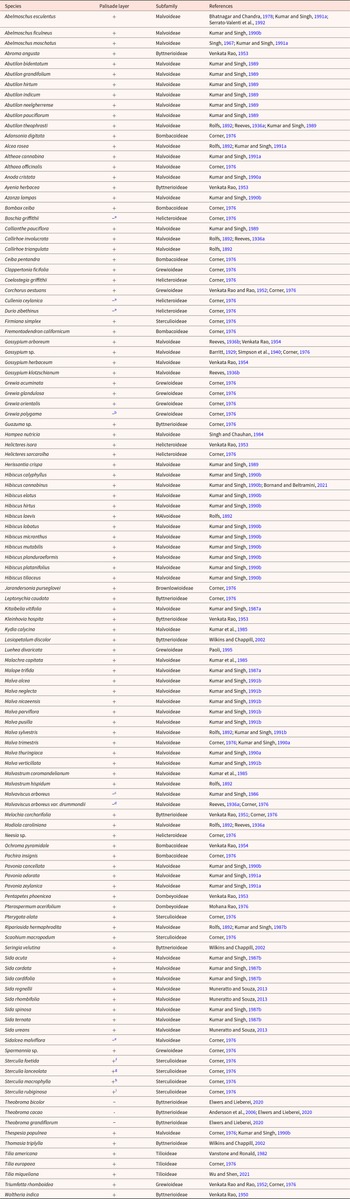
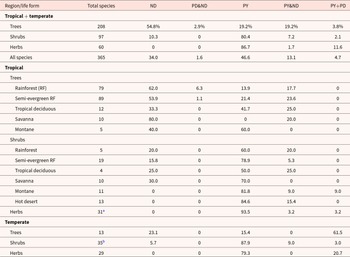
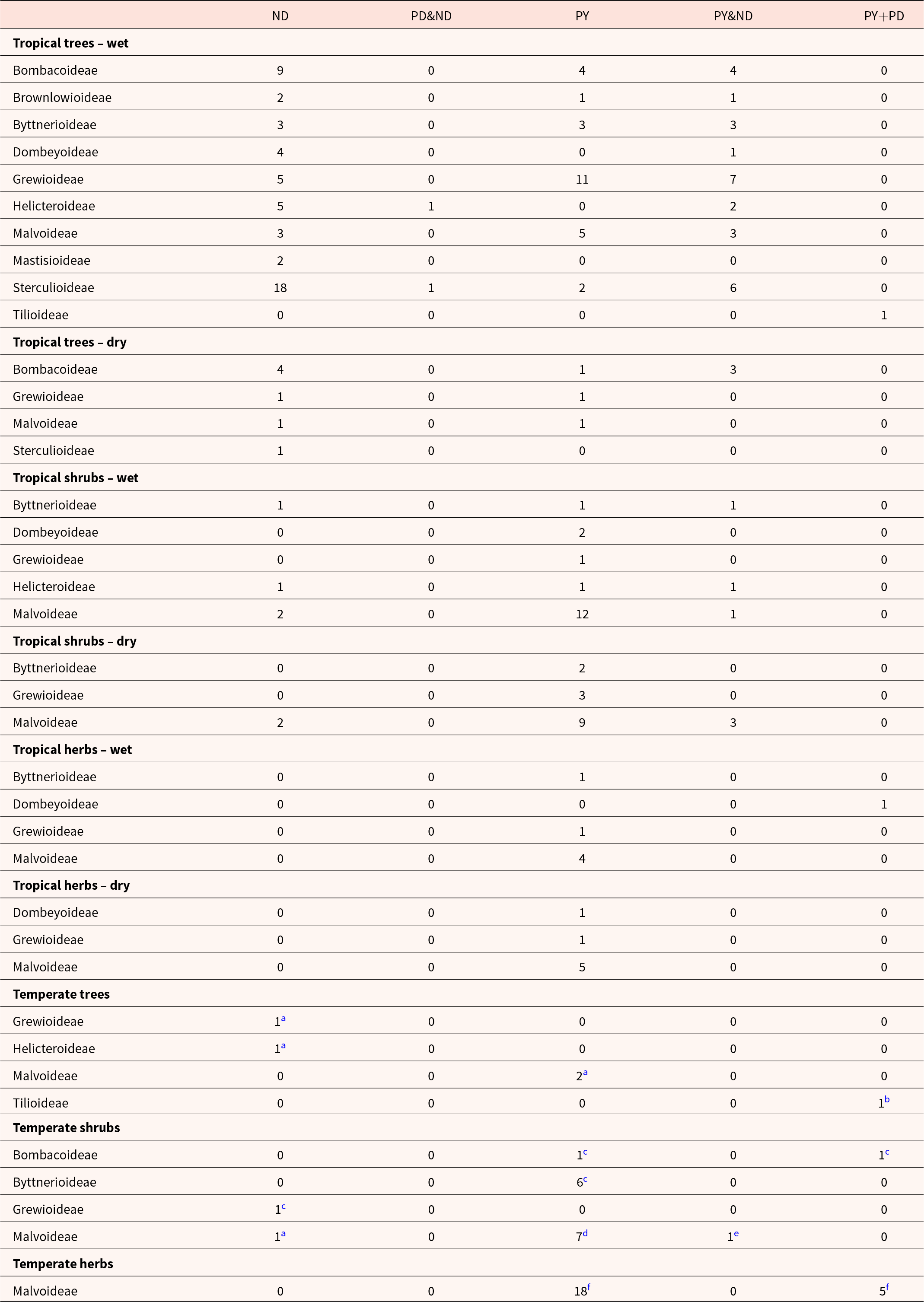
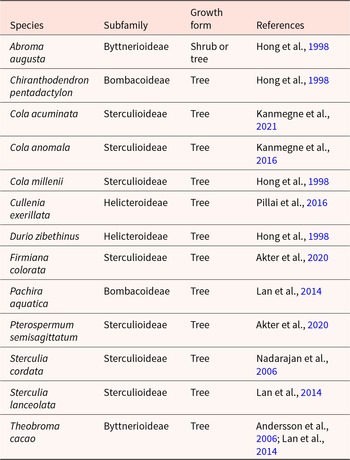


 Open access

