

Introduction
Innovation is the lifeblood of organizations; it is essential for firms to grow, succeed, and maintain competitive advantages (Raffaelli, Glynn, & Tushman, Reference Raffaelli, Glynn and Tushman2019). Digital technologies such as artificial intelligence, cloud computing, virtual reality, blockchain, and the Internet of Things are rapidly penetrating businesses, significantly transforming the nature of product innovation (Nambisan, Lyytinen, Majchrzak, & Song, Reference Nambisan, Lyytinen, Majchrzak and Song2017; Yoo et al., Reference Yoo, Henfridsson, Kallinikos, Gregory, Burtch, Chatterjee and Sarker2024; Yoo, Henfridsson, & Lyytinen, Reference Yoo, Henfridsson and Lyytinen2010). This transformation has led to growing academic and practical interest in digital product innovation – novel products or services that are embodied in or enabled by digital technologies (Firk, Gehrke, Hanelt, & Wolff, Reference Firk, Gehrke, Hanelt and Wolff2022; Lyytinen, Yoo, & Boland, Reference Lyytinen, Yoo and Boland2016; Pesch, Endres, & Bouncken, Reference Pesch, Endres and Bouncken2021).
Digital product innovation exhibits fluid and iterative nature that creates both opportunities and challenges for firms. At its core, digital products are ‘malleable, editable, and open’ (Nambisan et al., Reference Nambisan, Lyytinen, Majchrzak and Song2017: 225), continuing to evolve even after market release through continuous updates and iterations (Lehmann & Recker, Reference Lehmann and Recker2022; Yoo, Boland, Lyytinen, & Majchrzak, Reference Yoo, Boland, Lyytinen and Majchrzak2012). While this enables firms to create unbounded design flexibility across the product lifecycle (Wang, Henfridsson, Nandhakumar, & Yoo, Reference Wang, Henfridsson, Nandhakumar and Yoo2022), it also demands a significant shift in how products are conceptualized from discrete, completed entities to fluid, continuously evolving offerings that blur traditional boundaries between development and deployment (Firk et al., Reference Firk, Gehrke, Hanelt and Wolff2022; Henfridsson & Yoo, Reference Henfridsson and Yoo2014). This shift is particularly challenging for incumbent firms in traditional industrial contexts, where established product development processes are built around fixed release cycles and stable product boundaries (Röth, Schweitzer, & Spieth, Reference Röth, Schweitzer and Spieth2023; Svahn, Mathiassen, & Lindgren, Reference Svahn, Mathiassen and Lindgren2017). Even incumbent firms that show initial ambition in digital product innovation typically ‘end up with incremental optimizations of existing operations and processes’ rather than embracing its fluid, iterative nature (Moschko, Blazevic, & Piller, Reference Moschko, Blazevic and Piller2023: 507).
The distinctive characteristics of digital product innovation create unique cognitive demands for incumbent firms’ executives. Unlike traditional product development that follows predictable patterns, digital product innovation challenges their established cognitive representations by requiring rapid shifts in attention: from completed to continuously evolving offerings, from product to ecosystem thinking, and from predetermined to emergent value creation (Nambisan et al., Reference Nambisan, Lyytinen, Majchrzak and Song2017). Yet they typically rely on fixed cognitive representations deeply ingrained in historical manufacturing contexts, leading to struggles in dealing with these unique demands. For example, Volberda, Khanagha, Baden-Fuller, Mihalache, and Birkinshaw (Reference Volberda, Khanagha, Baden-Fuller, Mihalache and Birkinshaw2021) found that successful digital product innovation requires incumbent executives to continuously shift their cognitive frames to match the fluid and iterative nature of digital products, which is a capability they often lack. Given these cognitive challenges inherent in the transition to digital product innovation, a salient question is: what role does chief executive officer (CEO) cognition play in enabling incumbent firms to successfully pursue digital product innovation?
While empirical research has examined various organizational structures, external relationships, and strategic orientations (e.g., Bockelmann, Werder, Recker, Lehmann, & Bendig, Reference Bockelmann, Werder, Recker, Lehmann and Bendig2024; Ceipek, Hautz, De Massis, Matzler, & Ardito, Reference Ceipek, Hautz, De Massis, Matzler and Ardito2021; Liu, Dong, Ying, & Jiao, Reference Liu, Dong, Ying and Jiao2021), the cognitive characteristics that enable executives to process and act upon the distinctive demands of digital product innovation have been largely overlooked. This gap is particularly significant given that conceptual and case-based studies have revealed how digital product innovation creates unique demands that challenge executives’ established cognitive representations (e.g., Bunduchi, Crisan-Mitra, Salanta, & Crisan, Reference Bunduchi, Crisan-Mitra, Salanta and Crisan2022; McCarthy, O’Raghallaigh, Kelleher, & Adam, Reference McCarthy, O’Raghallaigh, Kelleher and Adam2025). To shed further light on this topic, we examine how cognitive flexibility, defined as the capability to rapidly adjust cognitive representations and attention based on changing situations (Kiss, Libaers, Barr, Wang, & Zachary, Reference Kiss, Libaers, Barr, Wang and Zachary2020; Martin & Rubin, Reference Martin and Rubin1995), enables executives, particularly CEOs, to meet the distinctive demands of digital product innovation. Drawing on upper echelons theory and the attention-based view (ABV), we propose that cognitive flexibility is crucial for incumbent firms’ digital product innovation success. Specifically, cognitively flexible CEOs can dynamically shift attentional focus across multiple strategic domains and direct attention toward novel scenarios when responding to emerging opportunities while facilitating the identification and integration of novel insights that drive innovative digital solutions (Kiss et al., Reference Kiss, Libaers, Barr, Wang and Zachary2020).
This study further proposes a conceptual framework based on the ABV to explore the contingency of the relationship between CEO cognitive flexibility and digital product innovation. As a scarce resource, how attention is allocated to particular issues and answers has important implications for firm activities and performance. The ABV emphasizes that attention structures within organizations are crucial determinants of how decision-makers notice, encode, and process information from their environment (Ocasio, Reference Ocasio1997, Reference Ocasio2011). Specifically, the theory suggests that the effectiveness of attention allocation depends on two key organizational mechanisms: the ‘communication channels and procedures’ that regulate information flow, and the ‘social relationships that regulate and control the distribution and allocation of issues and answers’ (Ocasio, Reference Ocasio1997: 188). These mechanisms not only shape what information reaches decision-makers but also influence how they interpret and act upon that information. Following this theoretical logic, we explore two contextual factors that embody these distinct attention-structuring mechanisms: CEO boundary spanning (Marrone, Reference Marrone2010; Tushman & Scanlan, Reference Tushman and Scanlan1981), which shapes the communication channels through which CEOs access and process external information, and firm social capital (Arregle, Hitt, Sirmon, & Very, Reference Arregle, Hitt, Sirmon and Very2007), which represents the networks that influence how information and resources are distributed within and across organizational boundaries.
To test our hypotheses, we employed a mixed-methods research design combining a field survey (Study 1) and a scenario-based experiment (Study 2). In Study 1, we conducted a survey of 178 machine-building firms in China to examine the relationship between CEO cognitive flexibility and digital product innovation, along with its boundary conditions. Using both perceptual measures and objective patent data, we found that CEO cognitive flexibility was positively associated with digital product innovation. This relationship was strengthened when CEOs engaged in more boundary spanning activities and when firms possessed greater social capital. To further investigate the underlying psychological mechanisms, Study 2 employed a controlled experiment with 134 participants in a simulated decision-making context. The results demonstrated that individuals with high cognitive flexibility were more inclined to pursue digital product innovation compared to those with low cognitive flexibility and this relationship was mediated by insightful information acquisition.
Our research makes contributions to the literature in several significant ways. First, we advance understanding of the cognitive microfoundations of organizational adaptation that enable incumbent firms to successfully pursue digital product innovation (Bunduchi et al., Reference Bunduchi, Crisan-Mitra, Salanta and Crisan2022; Hadjielias, Dada, Cruz, Zekas, Christofi, & Sakka, Reference Hadjielias, Dada, Cruz, Zekas, Christofi and Sakka2021; McCarthy et al., Reference McCarthy, O’Raghallaigh, Kelleher and Adam2025). While previous research has primarily focused on organizational-level factors (Bockelmann et al., Reference Bockelmann, Werder, Recker, Lehmann and Bendig2024; Ceipek et al., Reference Ceipek, Hautz, De Massis, Matzler and Ardito2021), we illuminate how CEO cognitive flexibility enables firms to adapt the fluid, iterative nature of digital product innovation. Second, we extend the ABV by elucidating how cognitive flexibility shapes attention allocation in complex digital environments, demonstrating the dynamic interplay between individual cognitive capabilities and structural elements in determining innovation outcomes (Brielmaier & Friesl, Reference Brielmaier and Friesl2023; Ocasio, Laamanen, & Vaara, Reference Ocasio, Laamanen and Vaara2018). Specifically, we show how cognitive flexibility works through communication channels (manifested in boundary spanning) and social relationships (embodied in firm social capital) to enable effective attention allocation. Third, prior research on strategic leadership has emphasized the importance of understanding cognitive underpinnings of organizational adaptation (Eggers & Kaplan, Reference Eggers and Kaplan2009; Tripsas & Gavetti, Reference Tripsas and Gavetti2000). We advance this literature by theoretically elaborating and empirically validating cognitive flexibility as a crucial yet underexplored cognitive characteristic that enables executives to navigate increasingly fluid digitized environments.
Theoretical Background
Digital Product Innovation in Incumbent Firms
Digital technologies are revolutionizing traditional product domains, significantly transforming the nature of innovation (Verganti, Vendraminelli, & Iansiti, Reference Verganti, Vendraminelli and Iansiti2020; Yoo et al., Reference Yoo, Henfridsson, Kallinikos, Gregory, Burtch, Chatterjee and Sarker2024). It is particularly challenging for incumbent firms, which navigate the transition from established product development paradigms to the fluid, iterative nature of digital innovation processes (Nambisan et al., Reference Nambisan, Lyytinen, Majchrzak and Song2017; Svahn et al., Reference Svahn, Mathiassen and Lindgren2017). While digital product innovation offers unprecedented opportunities for value creation and competitive advantages, its characteristics create significant challenges for incumbent firms, influencing not only their ability to generate digital innovations but also to successfully commercialize these innovations in the market (Oberländer, Röglinger, & Rosemann, Reference Oberländer, Röglinger and Rosemann2021; Vial, Reference Vial2019). Unlike traditional product development that operates within clear temporal phases and spatial boundaries, digital products exist in a state of perpetual evolution (Pesch et al., Reference Pesch, Endres and Bouncken2021; Yoo et al., Reference Yoo, Boland, Lyytinen and Majchrzak2012). They continue to evolve post-release through continuous updates and iterations, with development and market deployment occurring simultaneously (Lehmann & Recker, Reference Lehmann and Recker2022). This ‘ever-in-the-making’ nature conflicts with incumbent firms’ structured development cycles and established quality control processes.
The hybrid nature of digital products creates new possibilities for functionality and value creation, as physical components provide the foundational capabilities while digital elements enable feature expansion (Wang, Reference Wang2021; Yoo et al., Reference Yoo, Henfridsson and Lyytinen2010). However, for incumbent firms, it requires developing new digital capabilities while maintaining excellence in manufacturing, which is difficult to achieve (Moschko et al., Reference Moschko, Blazevic and Piller2023; Stanko & Rindfleisch, Reference Stanko and Rindfleisch2023). The combinatorial potential changes the nature of innovation strategy, requiring to think beyond predetermined feature sets to consider open-ended possibilities for value creation (Bharadwaj, El Sawy, Pavlou, & Venkatraman, Reference Bharadwaj, El Sawy, Pavlou and Venkatraman2013; Nambisan et al., Reference Nambisan, Lyytinen, Majchrzak and Song2017). Moreover, digital products create distinctive forms of value creation through data-driven network effects and ecosystem dynamics (Nambisan, Zahra, & Luo, Reference Nambisan, Zahra and Luo2019; Wang, Reference Wang2021). Unlike traditional products whose value proposition is largely self-contained, digital products often become more valuable as they collect and analyze more user data and connect with more complementary products and services (Lyytinen et al., Reference Lyytinen, Yoo and Boland2016; Verganti et al., Reference Verganti, Vendraminelli and Iansiti2020). This networked value creation generates complex interdependencies between products, users, and complementors, which acquires incumbent firms to transition from linear value chains to ecosystem orchestration.
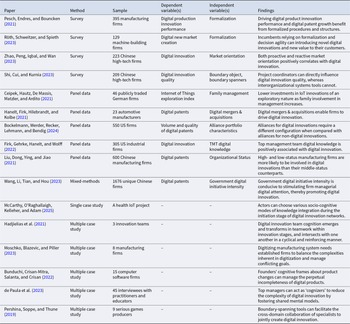
These potential challenges of digital product innovation have motivated scholars to examine its stimulus. In Table 1, we include papers that examine antecedents of digital product innovation. The table reveals three key streams of research: studies examining organizational structures and processes (e.g., formalization, alliance portfolios), external relationships and orientation (e.g., market orientation, boundary spanning), and qualitative investigations of cognitive aspects. While the first two streams have provided valuable insights into organizational enablers of digital product innovation, the cognitive dimension, particularly how executives process and act upon the distinctive demands of digital product innovation, remains undertheorized in quantitative empirical research. The established mental models in traditional product development become increasingly inadequate when confronting digital products’ fluid and iterative nature. Executives need to flexibly understand contradictory paradigms: fixed versus fluid boundaries, product versus ecosystem thinking, predetermined versus emergent value creation. Hence, this study specifically examines cognitive flexibility as a potential mechanism for addressing these cognitive demands.
Summary of articles on antecedents of digital product innovation

Table 1 Long description
The table summarizes research on factors influencing digital product innovation across various industries. Formalization is shown to drive digital innovation performance in manufacturing and machine-building firms. Market orientation positively correlates with digital innovation in Chinese high-tech firms, while top management team digital knowledge is associated with increased digital innovation in US industrial firms. Family management in German firms leads to lower investments in exploratory IoT innovations. Government initiatives in China stimulate digital innovation through increased managerial attention. Case studies highlight the role of cognitive frames and boundary-spanning tools in managing digital innovation complexities. Comparisons reveal diverse strategies and outcomes across different sectors and methodologies.
Cognitive Flexibility
Cognitive flexibility reflects the adaptive capability that helps humans pursue complex tasks by enabling them to rapidly shift attention patterns, manage contradictory demands, and find novel, adaptable solutions to changing situations (Dajani & Uddin, Reference Dajani and Uddin2015; Ionescu, Reference Ionescu2012; Spiro & Jehng, Reference Spiro, Jehng, Nix and Spiro1990). Prior research on cognitive flexibility has highlighted three crucial elements: the awareness of available alternatives in specific situations, the willingness to be flexible and adapt to these situations, and the self-efficacy to implement adaptive responses (Dennis & Vander Wal, Reference Dennis and Vander Wal2010; Martin & Rubin, Reference Martin and Rubin1995). It enables individuals to flexibly allocate attention across different information domains and engage with novel or complex scenarios that demand different cognitive approaches (Liu, Xu, Yu, Wu, & Wang, Reference Liu, Xu, Yu, Wu and Wang2024). While cognitive flexibility’s importance for strategic decision-making is well-established, its operationalization presents both empirical and conceptual challenges (Laureiro-Martínez & Brusoni, Reference Laureiro-Martínez and Brusoni2018). Self-reported measures such as the Cognitive Flexibility Scale (Martin & Rubin, Reference Martin and Rubin1995) offer advantages for field research, capturing individuals’ dispositional tendencies but also entailing limitations such as social desirability bias. However, performance-based measures such as task-switching paradigms (Rogers & Monsell, Reference Rogers and Monsell1995) provide complementary insights but may not fully capture the contextual and motivational factors.
The strategic value of cognitive flexibility emerges primarily through its influence on information processing capabilities that underpin strategic decision-making. When individuals demonstrate higher levels of cognitive flexibility, they exhibit enhanced patterns of information processing across multiple cognitive domains (Laureiro-Martínez & Brusoni, Reference Laureiro-Martínez and Brusoni2018). Rather than filtering information through rigid mental models, cognitively flexible executives can more readily recognize and integrate unconventional or novel information that may challenge existing assumptions, enabling them to identify and capitalize on insightful information (Kiss et al., Reference Kiss, Libaers, Barr, Wang and Zachary2020). This enhanced processing manifests in both the breadth and depth of their information engagement: they actively seek out diverse information sources beyond conventional channels, demonstrate greater thoroughness in their analytical processes, and show increased capacity to synthesize novel insights with existing knowledge structures (Furr, Cavarretta, & Garg, Reference Furr, Cavarretta and Garg2012; Steinbach, Gamache, & Johnson, Reference Steinbach, Gamache and Johnson2019). It is not simply about handling more information, but rather about different approaches to discovering, interpreting, and integrating diverse information streams into actionable strategic insights that can drive organizational adaptation and innovation (Dennis & Vander Wal, Reference Dennis and Vander Wal2010; Souitaris & Maestro, Reference Souitaris and Maestro2010).
Prior research has indicated that cognitive flexibility becomes particularly valuable when executives encounter strategic contexts characterized by novel information processing demands (Helfat & Martin, Reference Helfat and Martin2015). As argued earlier, digital product innovation presents such a context through its distinctiveness (Nambisan et al., Reference Nambisan, Lyytinen, Majchrzak and Song2017). Its characteristics create unique information processing demands that differ from traditional product development paradigms, where executives, particularly CEOs, need to simultaneously process and integrate insights about product architecture, development patterns, and value creation mechanisms (Firk et al., Reference Firk, Gehrke, Hanelt and Wolff2022; McCarthy et al., Reference McCarthy, O’Raghallaigh, Kelleher and Adam2025). Therefore, as we detail next, we expect cognitive flexibility to be a critical determinant of digital product innovation by enabling CEOs to better discover insights and act upon the distinctive information patterns inherent in digital products.
Hypotheses Development
Cognitive Flexibility and Digital Product Innovation
We combine upper echelons theory and the ABV to develop reasoning about the relationship between CEO cognitive flexibility and digital product innovation. Upper echelons theory suggests that firms’ strategic choices are linked to their executives’ filtering and processing of information from external environments (Hambrick, Reference Hambrick2007; Hambrick & Mason, Reference Hambrick and Mason1984). This aligns with the ABV’s core premise that organizational outcomes emerge from the bounded rationality in decision-makers’ attention to information and environmental signals, balancing ‘issues’ (e.g., digital disruption) and ‘answers’ (e.g., innovation strategies) (Gavetti, Greve, Levinthal, & Ocasio, Reference Gavetti, Greve, Levinthal and Ocasio2012; Ocasio, Reference Ocasio1997, Reference Ocasio2011). Together, the theories provide a dual lens: while upper echelons theory emphasizes who filters information (executives’ cognitive traits), the ABV clarifies how they filter it (attentional allocation).
Attention is a key limitation on information processing in complex digital environments, making it crucial for CEOs to allocate their limited attention rationally and efficiently (Ocasio et al., Reference Ocasio, Laamanen and Vaara2018). Unlike traditional innovation contexts where attention allocation may follow stable routines, digital product innovation demands dynamic attentional agility. Cognitively flexible CEOs demonstrate enhanced capabilities in rapid attention switching without experiencing the typical negative consequences such as cognitive strain or decision errors (Dennis & Vander Wal, Reference Dennis and Vander Wal2010; Laureiro-Martínez & Brusoni, Reference Laureiro-Martínez and Brusoni2018). This cognitive adaptability enables concurrent processing of multi-domain information streams spanning operational metrics, emerging technologies, and ecosystem interdependencies (Kiss et al., Reference Kiss, Libaers, Barr, Wang and Zachary2020). It aligns with the core demands of digital product innovation where fluid development cycles require continuous monitoring and integration of diverse technology and market inputs (Lyytinen et al., Reference Lyytinen, Yoo and Boland2016; Nylén & Holmström, Reference Nylén and Holmström2015).
Additionally, the layered modular architecture of digital products integrates physical components with digital elements, creating a tension between manufacturing logic and generative innovation paradigms (Yoo et al., Reference Yoo, Henfridsson and Lyytinen2010). While traditional product development adheres to linear, digital components enable iterative reconfiguration and ecosystem-centric value creation. This structural divergence generates a fragmented information landscape where critical insights emerge from reconciling opposing logics, such as fixed production parameters with open-ended digital adaptability. Incumbent firms’ CEOs often struggle to address this duality as entrenched mental models prioritize physical constraints over digital possibilities (Volberda et al., Reference Volberda, Khanagha, Baden-Fuller, Mihalache and Birkinshaw2021). Cognitively flexible CEOs, however, process these contradictions by maintaining openness to both domains. They synthesize insights from manufacturing limitations (e.g., material scalability, supply chain dependencies) with digital potential (e.g., data-driven customization, platform integration), enabling the design of hybrid solutions. This capability to reframe tensions as synergistic opportunities is pivotal, driving the transformation of legacy offerings into digitally augmented innovations.
Finally, the value of cognitive flexibility extends beyond innovation generation to shape how effectively firms commercialize digital product innovations. Digital products exist in a state of perpetual evolution, requiring firms to simultaneously manage innovation development and market deployment (Nambisan et al., Reference Nambisan, Lyytinen, Majchrzak and Song2017). Cognitively flexible CEOs more effectively process and integrate diverse market signals about evolving customer needs and ecosystem dynamics. This enhanced information processing capability enables better alignment between innovations and market demands. Their ability to recognize and act upon insights facilitates experimentation with novel business models and value capture mechanisms, moving beyond traditional product-centric thinking to embrace ecosystem-based revenue models (Bharadwaj et al., Reference Bharadwaj, El Sawy, Pavlou and Venkatraman2013). In contrast, cognitively rigid CEOs are more likely to neglect signals conflicting with linear development logics, which impedes recognition of fluid digital possibilities (Laureiro-Martínez & Brusoni, Reference Laureiro-Martínez and Brusoni2018). This mismatch intensifies when rigid cognitions confront the temporal dynamics of digital products, which require continuous deployment cycles. Overall, cognitively rigid CEOs prioritize marginal adjustments to existing offerings while underinvesting in digital assets and capabilities, thereby hindering the pursuit of digital product innovation. Accordingly, we predict:
Hypothesis 1 (H1): CEO cognitive flexibility is positively related to digital product innovation in incumbent firms.
In our main hypothesis, drawing on the ABV, we propose that CEO cognitive flexibility promote incumbent firms’ digital product innovation by enabling flexible attentional allocation, which is an adaptive process of shifting focus to identify and act on novel insights (e.g., emerging technologies and user needs). This aligns with ABV’s core premise: innovation outcomes emerge from how decision-makers allocate limited attention to specific ‘issues’ (e.g., digital disruption) and ‘answers’ (e.g., innovation strategies) within structurally constrained environments.
However, the ABV further emphasizes that attentional focus is not solely an individual trait but is structurally distributed, which is shaped by the firm’s communication channels, social relationships, and resource configurations (Joseph, Laureiro-Martinez, Nigam, Ocasio, & Rerup, Reference Joseph, Laureiro-Martinez, Nigam, Ocasio and Rerup2024; Li, Pan, Yang, & Tse, Reference Li, Pan, Yang and Tse2022). Thus, while cognitive flexibility determines a CEO’s capability to adapt attention, the effectiveness of this adaptation largely depends on contextual factors that regulate information flow and interpretation. We identify two critical attention structures that moderate the cognitive flexibility–digital product innovation relationship: CEO boundary spanning and firm social capital. As a communication channel, boundary spanning determines the diversity and novelty of external information entering the CEO’s attentional sphere. As a social relationship embedded in trust and reciprocity, social capital governs how CEOs interpret and act on insights.
Moderating Effects of CEO Boundary Spanning
Boundary spanning encompasses activities through which organizational members establish connections across boundaries to link internal operations with external constituents (Marrone, Reference Marrone2010; Tushman & Scanlan, Reference Tushman and Scanlan1981). It enables CEOs to gather and translate external information, build relationships with diverse stakeholders, and facilitate knowledge transfer across organizational boundaries (Faraj & Yan, Reference Faraj and Yan2009). Recent research demonstrates that boundary spanning shapes how firms identify and interpret technological opportunities, access novel knowledge domains, and integrate external insights into their innovation processes (Pershina, Soppe, & Thune, Reference Pershina, Soppe and Thune2019; Shi, Cui, & Kurnia, Reference Shi, Cui and Kurnia2023). Prior research positions boundary spanning activities as crucial attention structures that regulate both the channels through which decision-makers access information and the cognitive frameworks they use to process this information (Dahlander, O’Mahony, & Gann, Reference Dahlander, O’Mahony and Gann2016). Drawing on this theoretical perspective, we examine how CEO boundary spanning moderates the relationship between CEO cognitive flexibility and digital product innovation.
The ABV suggests that executives’ attention is inherently limited, requiring them to selectively focus on specific environmental signals while necessarily filtering others (Ocasio, Reference Ocasio1997). Cognitive flexibility enables CEOs to dynamically shift their attention across different information domains, but this capability’s value depends critically on the richness and diversity of available information streams. Boundary spanning activities create structured channels through which cognitively flexible CEOs can access and process varied technological perspectives, market signals, and innovation practices (Tippmann, Scott, & Parker, Reference Tippmann, Scott and Parker2017). These channels expose CEOs to divergent thinking patterns, novel technological frameworks, and alternative innovation approaches. As boundary spanning intensifies, cognitively flexible CEOs can more effectively leverage their adaptive attention patterns to identify non-obvious connections between physical and digital domains, recognize emerging technological opportunities, and synthesize insights from different stakeholder perspectives (Zhong, Ma, Tong, Zhang, & Xie, Reference Zhong, Ma, Tong, Zhang and Xie2021).
Boundary spanning further amplifies cognitive flexibility’s impact by enriching the contexts in which attention patterns manifest. Extant literature emphasizes that attention structures not only filter information but also shape how that information is interpreted and integrated into decision-making processes (Ocasio et al., Reference Ocasio, Laamanen and Vaara2018; Vuori & Huy, Reference Vuori and Huy2016). When cognitively flexible CEOs actively span boundaries, they encounter diverse technological frameworks and innovation logics that expand their interpretive repertoire. This exposure enables them to more effectively reconcile seemingly contradictory demands in digital product innovation, such as balancing fixed manufacturing constraints with fluid digital architectures, or integrating traditional product logic with platform-based value creation (Yoo et al., Reference Yoo, Henfridsson and Lyytinen2010). Through boundary spanning interactions, cognitively flexible CEOs develop richer mental models that incorporate both established industry knowledge and emerging digital paradigms, enabling more nuanced attention allocation to innovation opportunities (Maula, Keil, & Zahra, Reference Maula, Keil and Zahra2013; Tippmann et al., Reference Tippmann, Scott and Parker2017).
Without active boundary spanning, cognitive flexibility’s impact on digital product innovation may be constrained by limited exposure to diverse attention sources. When boundary spanning is low, cognitively flexible CEOs lack the rich contextual information and diverse perspectives needed to fully leverage their adaptive attention allocation capabilities. Their ability to recognize novel digital opportunities or challenge existing innovation assumptions becomes limited by narrow information exposure, despite their underlying capability for flexible thinking (Joseph & Wilson, Reference Joseph and Wilson2018). Based on these insights, we posit:
Hypothesis 2 (H2): The positive relationship between CEO cognitive flexibility and digital product innovation in incumbent firms is stronger when the CEO engages in more boundary spanning activities.
Moderating Effects of Firm Social Capital
Social capital represents a firm’s accumulated network of relationships that facilitate resource exchange and information flows through established channels of trust and reciprocity (Arregle et al., Reference Arregle, Hitt, Sirmon and Very2007; Gölgeci & Kuivalainen, Reference Gölgeci and Kuivalainen2020). These network structures, developed through long-term interactions and reputation building with diverse stakeholders including suppliers, customers, industry partners, and research institutions, create institutionalized pathways for knowledge sharing, resource mobilization, and collective learning (Chen, Chen, & Huang, Reference Chen, Chen and Huang2013; Zahra, Reference Zahra2010). Through the lens of ABV, social capital constitutes a critical attention structure that shapes how firms distribute and control information flows across organizational boundaries (Ocasio, Reference Ocasio2011). This network of relationships influences not only the accessibility and quality of strategic information but also the social context through which this information is interpreted and integrated into decision-making processes (White, Hoskisson, Yiu, & Bruton, Reference White, Hoskisson, Yiu and Bruton2008).
We argue that firm social capital enhances cognitive flexibility’s impact on digital product innovation by enriching the social context of attention allocation. The ABV emphasizes that attention patterns are deeply embedded within social relationships that regulate both access to and interpretation of strategic information (Joseph et al., Reference Joseph, Laureiro-Martinez, Nigam, Ocasio and Rerup2024). When firms possess strong social capital, cognitively flexible CEOs can leverage established trust relationships to access deeper insights about technological trajectories, market evolution, and innovation opportunities. These trusted network connections reduce information asymmetries and facilitate more nuanced interpretation of strategic signals, allowing cognitively flexible CEOs to more effectively adjust their mental models in response to emerging digital opportunities (Tippmann et al., Reference Tippmann, Scott and Parker2017). For instance, strong relationships with technology partners can provide early insights into emerging digital capabilities, while trusted customer relationships offer deep understanding of evolving user needs and preferences.
Moreover, social capital provides access to complementary resources that make cognitive flexibility more valuable for digital product innovation. Strong network relationships often come with preferential access to technological capabilities, market intelligence, and innovation partnerships that can support digital initiatives (Arregle et al., Reference Arregle, Hitt, Sirmon and Very2007; Fey & Birkinshaw, Reference Fey and Birkinshaw2005). Cognitively flexible CEOs can leverage these network resources more effectively, rapidly identifying and combining complementary capabilities to support digital product innovation efforts. The combination of cognitive adaptability and resource access through social capital enables firms to more quickly experiment with and implement digital product innovations. Conversely, limited social capital may constrain how effectively cognitive flexibility translates into innovation outcomes. Without strong network relationships, even highly flexible CEOs may struggle to access the rich contextual information needed to validate and refine their strategic insights. Limited social capital also restricts access to complementary resources and capabilities that could support digital innovation initiatives, potentially constraining the value of cognitive flexibility. Thus, we propose:
Hypothesis 3 (H3): The positive relationship between CEO cognitive flexibility and digital product innovation in incumbent firms is stronger when the firm has more social capital.
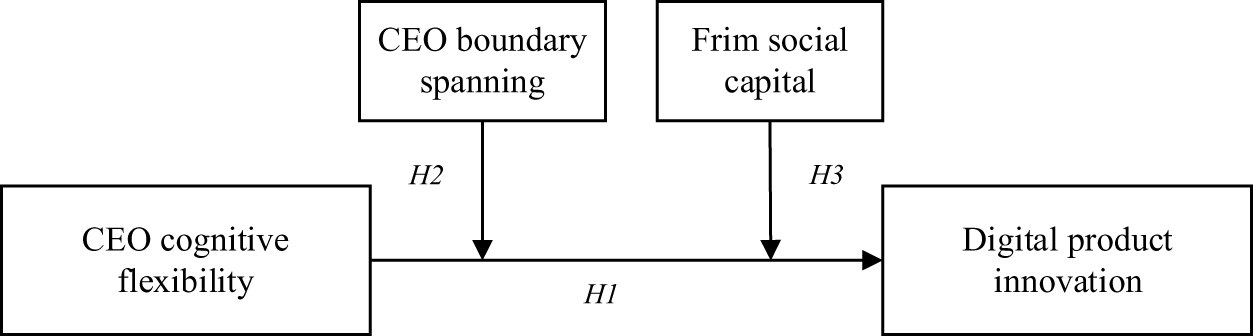
Overall, we summarize the theoretical framework in Figure 1.
Theoretical framework

Figure 1 Long description
A diagram illustrating the relationships between different concepts. On the left, a box labeled 'CEO cognitive flexibility' connects with an arrow labeled 'H1' pointing to 'Digital product innovation' on the right. Above this, 'CEO boundary spanning' is connected with an arrow labeled 'H2' pointing downward to the line connecting 'CEO cognitive flexibility' and 'Digital product innovation'. Another box labeled 'Firm social capital' is connected with an arrow labeled 'H3' pointing downward to the same line. The diagram suggests interactions between these elements in the context of digital product innovation.
Overview of Studies
We employed a mixed-method research design, combining a field survey (Study 1) and a scenario-based experiment (Study 2) to test our hypotheses. This approach leverages complementary operationalizations of cognitive flexibility, that is, dispositional self-report measures that capture CEOs’ behavioral tendencies in organizational settings, and performance-based tasks that assess cognitive switching ability under controlled conditions. Specifically, Study 1 examines the relationship between CEO cognitive flexibility and digital product innovation through a field survey, along with its boundary conditions. It allows us to capture how cognitively flexible CEOs navigate innovation decisions within their organizational contexts. Study 2 employs a controlled experiment to establish causality and unpack the underlying psychological mechanisms. By manipulating cognitive flexibility via a switching task and simulating digital product innovation decisions, we demonstrate that the relationship operates through insightful information acquisition. The convergence of findings across different measures strengthens the robustness of our theoretical model, demonstrating that cognitive flexibility facilitates digital product innovation whether assessed as a cognitive disposition or ability.
Study 1: Field Survey
Sample and Data Collection
Our empirical setting focuses on machine-building firms in China, a choice that offers several compelling advantages for studying the relationship between CEO cognitive flexibility and digital product innovation. First, as per the ‘Digital China Development Report (2023)’ released by the Cyberspace Administration of China, the size of China’s digital economy surged to RMB 50.2 trillion in 2022, contributing 41.5 percent to the country’s GDP. Digitization has become an inextricable theme for both the current and future development of Chinese firms, which provides a rich sample pool related to firms’ digital practices. Recent research has conducted empirical investigations into the relationship between CEO cognitive characteristics and Chinese firms’ innovation strategies or performance in the digitization context (Zhang, Lu, & Wang, Reference Zhang, Lu and Wang2024).
Second, while digital technologies have catalyzed systemic changes across corporate strategies, business models, and organizational structures, machine-building firms’ primary avenue for digitization lies in embedding digital technologies within product innovation processes (Röth et al., Reference Röth, Schweitzer and Spieth2023). This creates a focused context where the tensions between traditional manufacturing practices and digital innovation are especially pronounced. Moreover, despite major opportunities, digital product innovation practices remain non-pervasive in machine-building firms due to significant uncertainties and organizational inertia (Liu et al., Reference Liu, Dong, Ying and Jiao2021). This variation is crucial for our research as it allows us to examine how CEO cognitive flexibility influences firms’ ability to overcome these barriers and successfully pursue digital product innovation.
To test our hypotheses, we conducted a survey and random sampling techniques were used to collect data from Jiangsu, Zhejiang, and Liaoning, where there are more developed manufacturing industries. The survey was originally created in English and then translated into Chinese employing the back-translation process to ensure conceptual equivalence. Prior to the formal survey, to guarantee the clarity, readability, and completeness of questionnaire items, we randomly selected 10 CEOs from machine-building firms to conduct a pre-test (not included in the sample). Some revisions and refinements were made to the questionnaire according to their feedback. Then, a total of 800 machine-building firms were randomly selected from the directory of provincial industrial associations. We distributed formal questionnaires through both on-site and online surveys. An invitation for participation was sent by email and telephone to the CEO of each sampled firm, and of which 396 accepted the invitation.
To conduct the formal investigation, we collaborated with a professional research company to identify trained interviewers conducting face-to-face interviews with CEOs, and an online platform administering questionnaires electronically. This approach is recommended for obtaining reliable and high-quality survey information in China (Jean, Kim, Zhou, & Cavusgil, Reference Jean, Kim, Zhou and Cavusgil2021; Zhao, Peng, Iqbal, & Wan, Reference Zhao, Peng, Iqbal and Wan2023). To ensure data quality and validity, several measures aiming at identifying potentially problematic responses were implemented such as attention checks, logic validations, verification calls, response time monitoring, and IP verification. Following established research protocols, we assured all participants of their anonymity and the strictly academic use of collected data. We excluded samples of firms with incomplete data and potential errors, resulting in a valid sample consisting of 178 machine-building firms. The effective response rate of 22.3% is deemed reasonable and comparable to previous survey research of innovation in the context of China (An, Zhao, Cao, Zhang, & Liu, Reference An, Zhao, Cao, Zhang and Liu2018; Tang, Nadkarni, Wei, & Zhang, Reference Tang, Nadkarni, Wei and Zhang2021).
Our final sample of 178 firms comprises 124 responses collected through online surveys (69.7%) and 54 responses from onsite interviews (30.3%). We compared CEO cognitive flexibility scores between online and onsite data collection methods and the results showed no significant difference (t = −0.084, p = 0.933), confirming that the online survey design provides valid measurements of CEO cognitive flexibility comparable to onsite approach. We also assessed potential method bias by running t tests to compare online and onsite responses (Jean et al., Reference Jean, Kim, Zhou and Cavusgil2021). The results show that there is no significant difference in organizational and CEO characteristics such as firm size, firm age, R&D intensity, CEO gender, CEO age, CEO tenure, and CEO education (all p > 0.10). Therefore, we suggested that method bias is not a concern. To further assess potential non-response bias, we compared early and late respondents following Armstrong and Overton’s (Reference Armstrong and Overton1977) procedure. We divided respondents into two groups based on their response timing: those who responded within the first third of the response period versus those who responded in the last third. Independent samples t-tests were conducted on the above organizational and CEO characteristics. No significant differences were found between early and late respondents, suggesting that non-response bias was not a concern. The dataset supporting the findings of this study is available in the Open Science Framework (DOI: 10.17605/OSF.IO/9M5UG).
Measures
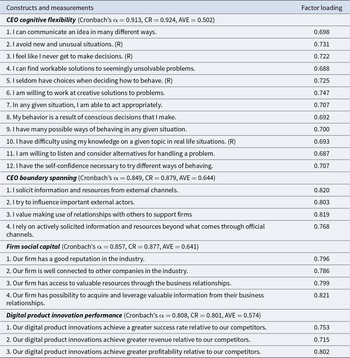
Our measurement scales were constructed based on earlier literature. We required respondents to truthfully answer and indicated to them that the data is confidential and completed anonymously. Seven-point Likert scales from 1 (strongly disagree) to 7 (strongly agree) were used. Table 2 presents a comprehensive overview of all the measures.
Construct measures and reliability index

Table 2 Long description
The table measures constructs related to CEO cognitive flexibility, boundary spanning, firm social capital, and digital product innovation performance. CEO cognitive flexibility includes diverse communication and problem-solving skills, with factor loadings ranging from 0.687 to 0.747. CEO boundary spanning emphasizes external engagement, with factor loadings between 0.768 and 0.820. Firm social capital highlights industry reputation and connections, with factor loadings from 0.786 to 0.821. Digital product innovation performance focuses on success, revenue, and profitability compared to competitors, with factor loadings from 0.715 to 0.802. The data suggests a strong emphasis on external engagement and reputation in driving firm success.
Dependent variable
Our study employs two dependent variables to comprehensively capture digital product innovation. First, we examined firms’ digital patent portfolios to objectively measure innovation generation. Following recent empirical studies (Liu et al., Reference Liu, Dong, Ying and Jiao2021; Wang, Li, Tian, & Hou, Reference Wang, Li, Tian and Hou2023), we obtained detailed patent information for each firm from the China National Intellectual Property Administration (CNIPA). Two coders with expertise in digital product innovation independently analyzed the descriptive content of patents including technical claims and detailed descriptions, which provide information on their functions, processes, features, and technology domains. Patents were categorized as digital product innovations if they demonstrated substantial integration of digital technologies and components into physical products (Liu et al., Reference Liu, Dong, Ying and Jiao2021).Footnote 1 In the actual coding, the coders achieved a Krippendorf’s α of 0.82, indicating strong reliability. All coding disagreements were documented and discussed until reaching unanimous consensus. We then calculated the count of new digital patents granted to each firm within two years of our survey and lagged it by one year to ensure the temporal precedence of the predictors relative to the predicted effect (similar analyses were also conducted with applied patent data and are available upon request).
Second, to complement our patent-based measure, we also examined performance metrics, which capture how successfully these innovations are commercialized in the market. We measured digital product innovation performance using three items developed by Pesch, Endres, and Bouncken (Reference Pesch, Endres and Bouncken2021). At the beginning of the survey, to ensure consistent understanding, we provided respondents with a clear definition of digital product innovation aligned with the conceptualization noted earlier (Lyytinen et al., Reference Lyytinen, Yoo and Boland2016). We asked respondents to evaluate their firm’s digital product innovation relative to competitors across three dimensions: success rate, revenue generation, and profitability.
Independent variable
The independent variable in this study is CEO cognitive flexibility. This construct captures executives’ capacity to adapt their decision-making approaches and attention allocation patterns in response to dynamic business environments. We measured CEO cognitive flexibility by adopting a twelve-item scale developed and validated by Martin and Rubin (Reference Martin and Rubin1995). This scale has been extensively employed in several management research (e.g., Kiss et al., Reference Kiss, Libaers, Barr, Wang and Zachary2020; Liu et al., Reference Liu, Xu, Yu, Wu and Wang2024).
Moderators
CEO boundary spanning
To access CEO boundary spanning, we used a four-item scale developed by Faraj and Yan (Reference Faraj and Yan2009), but their study focused on boundary spanning activities at the team level. It was therefore modified to capture the current context of our research. Specifically, we conducted interviews with ten CEOs participating in the survey on the theme of boundary spanning activities to refine the wording of the measurement items and ensure that they are consistent with the CEO’s actual activity scenario. Next, we made necessary modifications to the items and statement sentences taking into account the interview content, including specifying that the boundary spanning activities were initiated and implemented by the CEO.
CEO boundary spanning
Firm social capital. It reflects the firm’s pool of relationship networks available to access information and resources. Drawing on existing well-established scales (Gölgeci & Kuivalainen, Reference Gölgeci and Kuivalainen2020; Zahra, Reference Zahra2010), we measured firm social capital using a four-item scale.
Control variables
We controlled for multiple variables that are commonly cited as influencing digital product innovation. At the CEO level, we controlled for CEO gender and age, which are directly related to their level of risk-taking and the likelihood that they are willing to invest in digital product innovation activities (Tang et al., Reference Tang, Nadkarni, Wei and Zhang2021). Given that long-tenured CEOs tend to devote their efforts on information searches within the firm and engage in exploitative innovations (Kiss et al., Reference Kiss, Libaers, Barr, Wang and Zachary2020), we controlled for CEO tenure, measured as the number of years spent at the firm. CEO education is controlled as it influences their receptivity to learning about digital innovation knowledge (Firk et al., Reference Firk, Gehrke, Hanelt and Wolff2022). It was measured as the CEO’s highest level of education, categorized into five groups: high school or below, associates, bachelors, masters, and doctorate.
At the firm level, we controlled for firm size (the number of employees) because large firms can leverage their pool of available resources to provide more organizational support for pursuing digital product innovation. Prior research has shown that younger firms are more flexible and less rigid (Eggers & Kaplan, Reference Eggers and Kaplan2009), which are more likely to adapt rapidly to the technological disruption than older firms (Pesch et al., Reference Pesch, Endres and Bouncken2021). We controlled for firm age, which is measured by the number of years since the firm’s inception. R&D intensity, the ratio of R&D expenditure to total sales, is included since innovative firms are more inclined to pursue novel technologies and innovations. Strategic agility enables firms to achieve rapid response to adapt to new technological requirements and market demands (Del Giudice, Scuotto, Papa, Tarba, Bresciani, & Warkentin, Reference Del Giudice, Scuotto, Papa, Tarba, Bresciani and Warkentin2021). We controlled for strategic agility, measured with a three-item scale developed by Ferraris et al. (Reference Ferraris, Degbey, Singh, Bresciani, Castellano, Fiano and Couturier2022) (Cronbach’s α = 0.866). Information technology (IT) capability, which enables firms to mobilize and deploy IT resources to cope with turbulent environments, is positively related to firms’ digital product innovation outcome (Wiesböck, Hess, & Spanjol, Reference Wiesböck, Hess and Spanjol2020). Thus, we measured IT capability using a scale introduced by Lu and Ramamurthy (Reference Lu and Ramamurthy2011) to control for this effect (Cronbach’s α = 0.862).
Results
Common method bias
The informant-based survey data collection method has the risk of generating common method bias (CMB). Our study attempted to minimize CMB by adopting several measures, such as protecting respondents’ anonymity and collecting data over different time frames (Guide & Ketokivi, Reference Guide and Ketokivi2015). Several post-hoc statistical tests were also conducted. Factor analysis was conducted on all items using Harman’s single-factor test method. It was observed that the total interpreted variation of the samples was 63.106%, and the first principal component without rotation contributed to 30.007%, which was deemed acceptable. To further validate this possibility, we included a common latent factor (CLF) in the measurement model to compare the fit of the model with and without the CLF. The results indicated that the model fit indices after adding the CLF (χ2/df = 1.260, IFI = 0.969, TLI = 0.965, CFI = 0.969; RMSEA = 0.038) were not significantly better than that without the CLF (χ2/df = 1.390, IFI = 0.954, TLI = 0.947, CFI = 0.953; RMSEA = 0.047). The small differences (<0.200) (Han & Zhang, Reference Han and Zhang2021) suggested that our results remained unaffected by CMB.
Assessment of measurement model
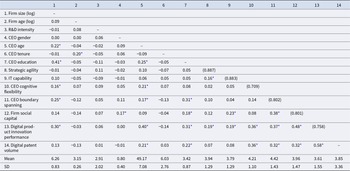
We conducted a test to identify the reliability, convergent validity, and discriminant validity of the measures. As shown in Table 2, the Cronbach’s α coefficients for each measure were within the acceptable range, showing satisfactory reliability. All constructs exhibit a composite reliability value exceeding 0.70, indicating robust internal consistency. Regarding the convergent validity, the factor loading of each item and the average variance extraction (AVE) values were greater than the cut-off point of 0.50. It provides support to the assertion that the indicator is applicable to all structures. Furthermore, all pairs of constructs were subjected to Fornell and Larcker’s (Reference Fornell and Larcker1981) discriminant validity test. The findings reveal that the AVE’s square roots for each construct exceed the inter-scale correlations (see Table 3), providing strong evidence for discriminant validity of our core constructs.
Descriptive statistics and correlation matrix

Table 3 Long description
The table presents descriptive statistics and correlations among various firm and CEO characteristics, including firm size, age, R&D intensity, CEO demographics, and digital innovation metrics. CEO education has a notable positive correlation with firm size, indicating that higher education levels in CEOs are associated with larger firms. Digital product innovation performance is strongly correlated with digital patent volume, suggesting that firms excelling in product innovation also tend to have a higher volume of digital patents. Strategic agility and IT capability show moderate correlations with other variables, highlighting their role in enhancing firm performance. The diagonal values represent the square root of the average variance extracted for each scale, providing insight into the reliability of the measures. Correlations marked with an asterisk are statistically significant, emphasizing the importance of these relationships in the dataset.
* Notes: N = 178. p < 0.05 (two-tailed). Bracketed values on the diagonal are the square root of the AVE value of each scale.
Hypotheses test
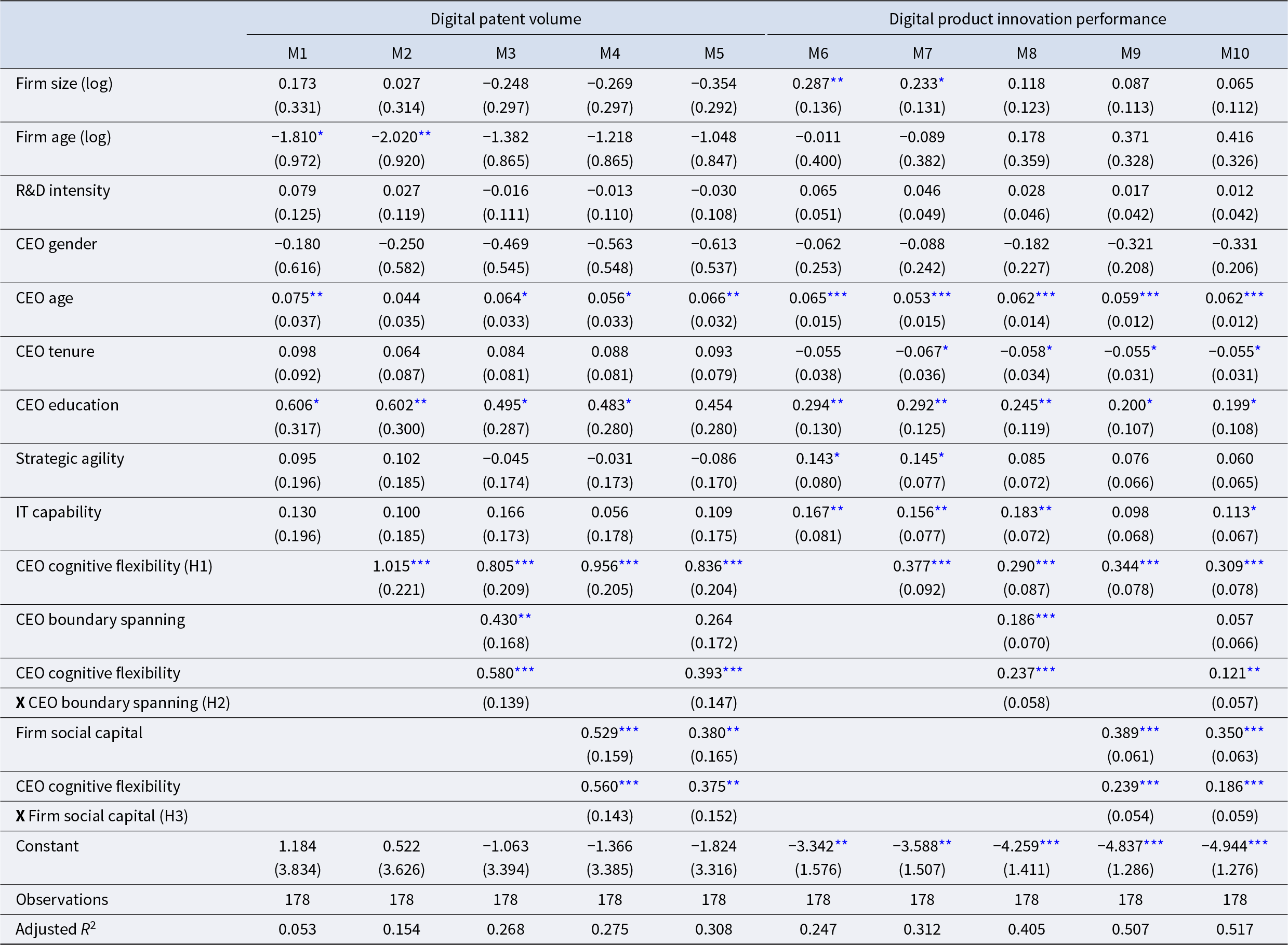
Table 3 reports the descriptive statistics and correlations for all variables in our model. We mean-centered the independent variable and moderators before creating interactions to avoid the multicollinearity issue. We used hierarchical regression analyses to test the hypotheses. For each dependent variable, we first reported the null models that only include control variables and the main effect models that then including the independent variable. We then added and examined the interaction of CEO cognitive flexibility with CEO boundary spanning and firm social capital, respectively. Finally, we also reported the full model containing all interactions in this study, which serves as the basis for hypothesis testing given consistent results across models. The variance inflation factors (VIF) for all study variables were within a reasonable range, with an average of 1.21 and a high of 1.37, well below the acceptable level of 10. Therefore, multicollinearity is not a serious concern.Footnote 2
Table 4 displays the results of the hierarchical regression analyses. For digital patent volume, CEO cognitive flexibility showed a positive relationship (Model 5: β = 0.836, p < 0.01). Similarly, for digital product innovation performance, CEO cognitive flexibility demonstrated a positive effect (Model 10: β = 0.309, p < 0.01). These consistent findings across both dependent variables provide robust support for H1.
Hierarchical regression results

Table 4 Long description
The table presents hierarchical regression results examining the influence of various factors on digital patent volume and digital product innovation performance. Key variables include firm size, firm age, R&D intensity, CEO characteristics, strategic agility, IT capability, and firm social capital. CEO cognitive flexibility shows a strong positive effect on both outcomes, particularly in models M2, M3, M4, M5, M8, M9, and M10. Firm social capital and its interaction with CEO cognitive flexibility also positively influence innovation performance. The adjusted R-squared values indicate that the models explain a moderate to substantial portion of the variance, with the highest values in models M9 and M10. Standard errors are provided in parentheses, and significance levels are noted, highlighting the robustness of certain predictors.
* Notes: p < 0.10, **p < 0.05, ***p < 0.01 (two-tailed tests). Standard errors in parentheses.
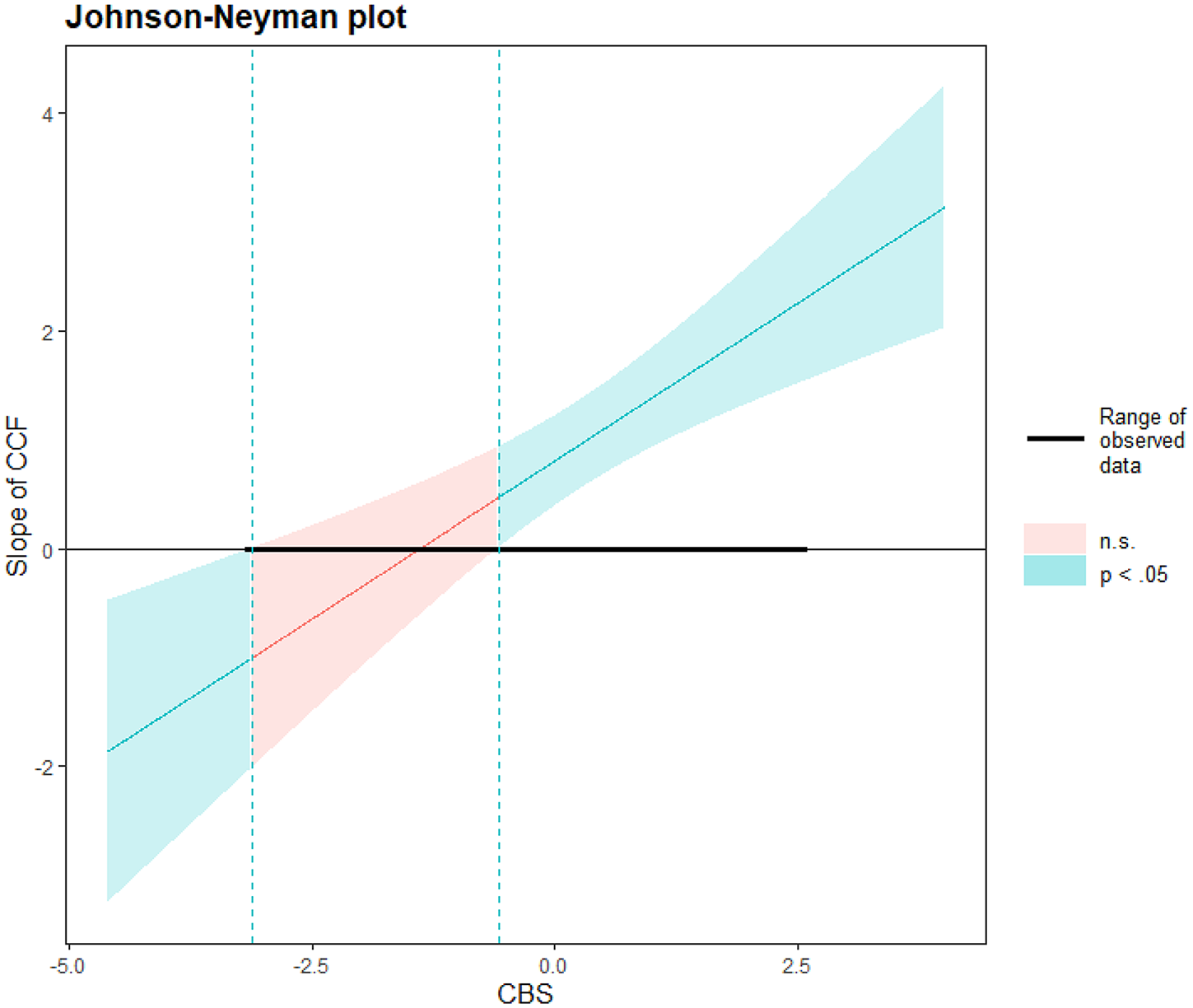
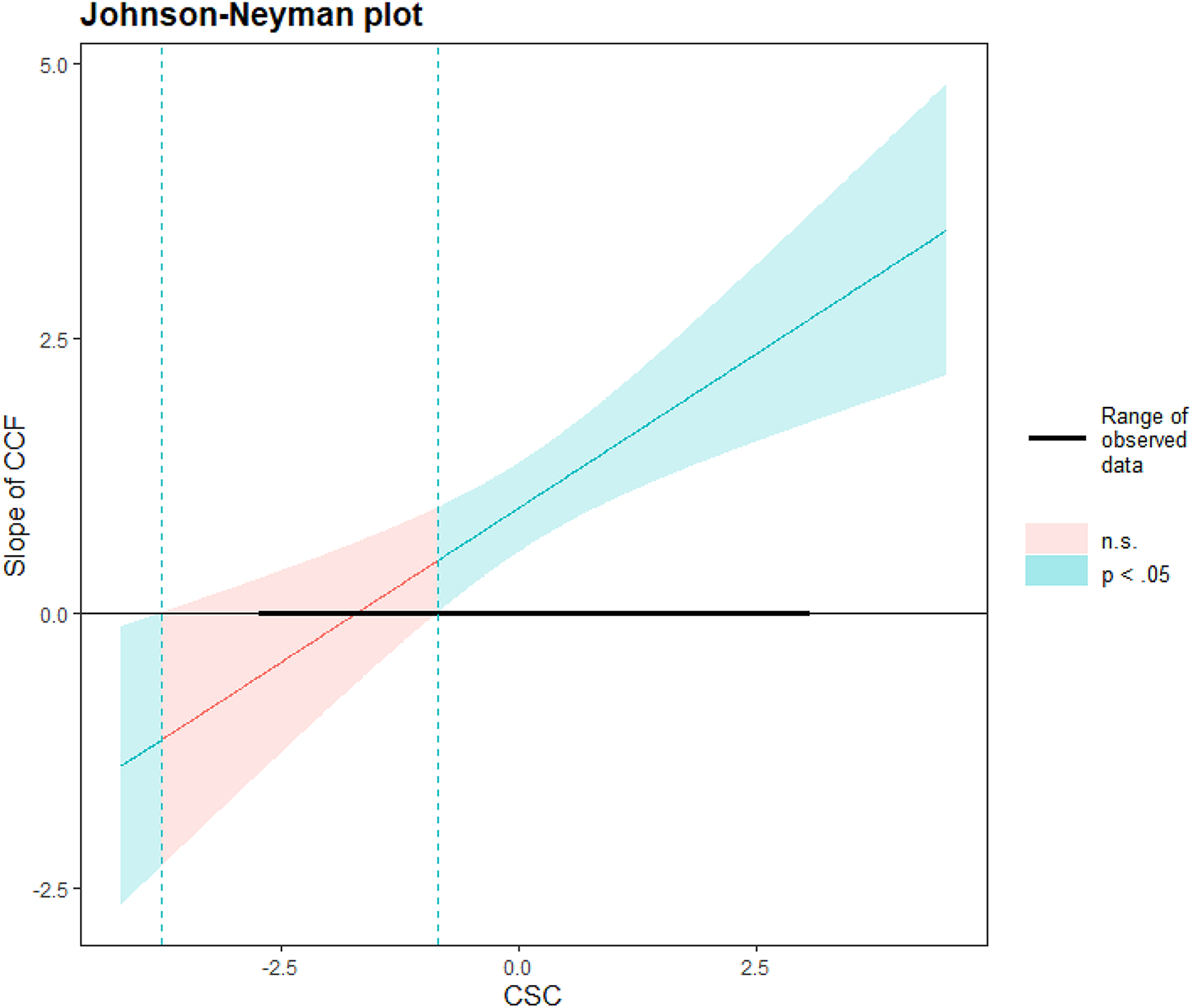
Regarding the predicted moderations, the results show that both CEO boundary spanning (Model 5: β = 0.393, p < 0.01 for patent; Model 10: β = 0.121, p < 0.05 for performance) and firm social capital (Model 5: β = 0.375, p < 0.05 for patent; Model 10: β = 0.186, p < 0.01 for performance) strengthen the relationship between CEO cognitive flexibility and both measures of digital product innovation. Thus, H2 and H3 are supported. Additionally, to provide a more nuanced understanding of the moderating effects, we employed the Johnson-Neyman (J-N) technique to identify the regions of significance (Preacher, Curran, & Bauer, Reference Preacher, Curran and Bauer2006). The relationship between CEO cognitive flexibility and digital patent volume becomes statistically significant when the confidence interval (the colored part in Figs. 2 and 3) does not include zero (similar analyses were also conducted with digital product innovation performance as the dependent variable and are available upon request). As Figure 2 reveals, the simple slope of CEO cognitive flexibility on digital patent volume becomes significant when the mean-centered CEO boundary spanning value is either below −3.12 or exceeds −0.59. Furthermore, the magnitude of this positive relationship strengthens with higher levels of boundary spanning, indicating an amplifying moderation pattern. Similarly, the J-N analysis for firm social capital (Fig. 3) showed that the simple slope of CEO cognitive flexibility on digital patent volume becomes significant when firm social capital is exceeds −0.86, with the effect magnitude intensifying at higher levels of social capital. These findings confirm the positive moderating effect of CEO boundary spanning and firm social capital.
The moderating effect of CEO boundary spanning

Figure 2 Long description
The Johnson-Neyman plot displays the slope of CCF on the y-axis against CBS on the x-axis. The plot includes a shaded region indicating significance levels: a red area for non-significant (n.s.) and a blue area for p less than 0.05. The range of observed data is marked by a black line. Vertical dashed lines indicate boundaries within the CBS range, highlighting where the slope becomes significant.
The moderating effect of firm social capital

Figure 3 Long description
A Johnson-Neyman plot displays the slope of CCF on the y-axis against CSC on the x-axis. The plot includes a shaded region indicating significance at p less than 0.05 in blue and non-significance in red. The range of observed data is marked by a black line. Vertical dashed lines indicate critical values where the slope becomes significant. The plot visually represents the interaction effect and regions of significance for the variables involved.
Study 2: Experimental Research
While Study 1 demonstrated that cognitively flexible CEOs improve their firms’ digital product innovation outcomes, the survey measures and data do not allow us to explicitly establish causality and assess the invisible decision-making processes of firm executives (Song, Cadsby, & Bi, Reference Song, Cadsby and Bi2012). To address these limitations and complement our field survey findings, Study 2 focuses specifically on the fundamental cognitive mechanism that initiates this process: how cognitive flexibility enhances the acquisition and processing of insightful information. This information processing capability represents the foundational mechanism through which cognitively flexible CEOs recognize opportunities and make decisions to pursue digitization, enabling the innovation generation and commercialization outcomes. Specifically, we measured cognitive flexibility through experimental tasks rather than survey items, and simulated the psychological conditions individuals face when making decisions about digital product innovation trajectories in incumbent firms. This experimental design enables us to test the mediating role of insightful information acquisition in linking cognitive flexibility to digital product innovation, while establishing causality through controlled manipulation.
Sample
We recruited 134 undergraduate students to comprise our sample. The selection of this sample was based on several criteria. First, according to the effect sizes from pilot tests, power analyses indicated that a sample of 128 usable respondents was necessary. Second, undergraduate students typically lack decision-making experience in relevant market environments and are more likely to respond based on the mechanisms provided by the experimental setting, making the manipulation less difficult. They have a relatively steep learning curve and low likelihood of opportunistic behavior than professional managers (e.g., MBA students). We recruited 150 undergraduate students from a major university in China and offered them monetary rewards for completing the experimental tasks. Sixteen participants failed the attention check, yielding a final sample of 134 participants (M age = 20.66, SD age = 1.72). Approximately 57% are female.
Procedure
Participants were invited to engage in a ‘Digital Product Innovation Decision-Making Exercise’ in which they were asked to assume the role of CEO of the ‘Refrigerator Manufacturing Company’, a firm that produces traditional refrigerators. We explained the job description and the product characteristics of the refrigerator to the participants in detail. We administered a number-letter switching task to all participants (see Appendix A), which is a commonly used experimental task to measure the level of cognitive flexibility (Rogers & Monsell, Reference Rogers and Monsell1995). Based on the swift cost of reaction time, we distinguished between two groups of high and low cognitive flexibility. They then needed to complete a purportedly irrelevant survey that consisted of measures of insightful information acquisition. Next, participants were requested to review a fictitious segment from a research report centered on the topic of ‘digital product innovation’ released by a leading consulting firm. This research report underscores the significance of digital product innovation as a leading technology trend, while noting the substantial difference between digital product innovation and traditional innovation, necessitating firms to adjust accordingly (see Appendix B). The original version of the research report is in Chinese, and the appendix shows our translated English version. Two doctoral candidates did the translation simultaneously, and discussed the inconsistent statements until a consensus was reached. Finally, they completed a simple questionnaire that includes demographic inquiries and a survey pertaining to decisions on digital product innovation.
Measures
Digital product innovation
Building on previous research (King & Kugler, Reference King and Kugler1993; Teo, Wei, & Benbasat, Reference Teo, Wei and Benbasat2003) and the specific experimental scenario of this study, we measured digital product innovation using a 3-item scale that captures participants’ evaluation and pursuit of digital product innovation. One sample item was ‘I would like to invest in numerous resources to develop digital product innovation’ (1 ‘strongly disagree’ to 7 ‘strongly agree’; Cronbach’s α = 0.74).
Insightful information acquisition
Insightful information is partly a reflection of the quality of information available to decision-makers, which can be analyzed from multiple perspectives to gain unconventional and novel insights. Drawing on Maltz’s (Reference Maltz2000) approach, we adapted a 4-item scale to measure insightful information acquisition. One sample item was ‘I often acquire information that can be interpreted from many perspectives’ (1 ‘strongly disagree’ to 7 ‘strongly agree’; Cronbach’s α = 0.81).
Control variables
We controlled for several factors that could influence participants to make innovation decisions, including age, age squared, and gender.
Results
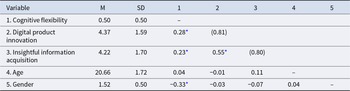
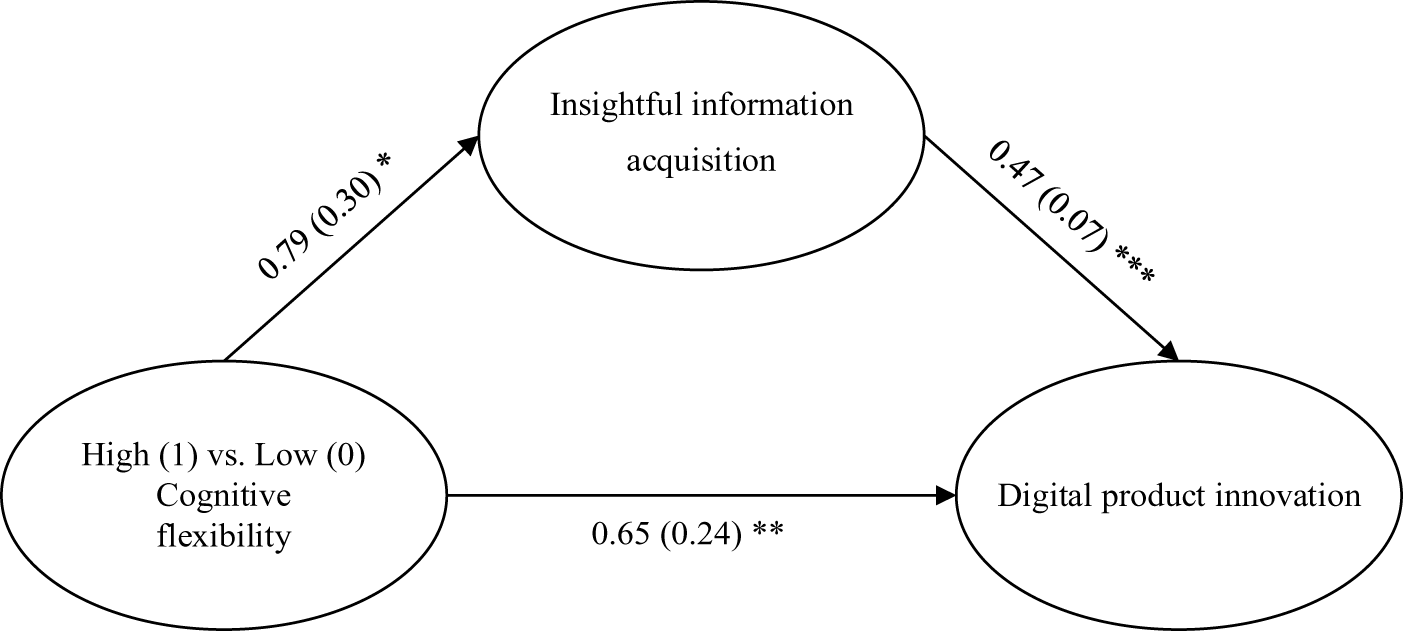
The descriptive statistics and correlations for Study 2 variables are presented in Table 5. First, we examined whether cognitive flexibility influences digital product innovation. Consistent with our theoretical predictions and Study 1 findings, participants with high cognitive flexibility (M = 4.82, SD = 1.38) were more inclined to pursue digital product innovation relative to those with low cognitive flexibility (M = 3.93, SD = 1.68; t(132) = 28.47, p = 0.001). Moreover, with the inclusion of control variables, the results remained robust (B = 0.65, SE = 0.24, p < 0.01).
Means, standard deviations, and correlations, supplementary study

Table 5 Long description
The table presents means, standard deviations, and correlations among five variables: cognitive flexibility, digital product innovation, insightful information acquisition, age, and gender. Cognitive flexibility shows a significant positive correlation with digital product innovation and insightful information acquisition, and a significant negative correlation with gender. Digital product innovation and insightful information acquisition are also positively correlated with each other. Age shows no significant correlation with any other variable. The diagonal values in brackets represent the square root of the average variance extracted for each scale, indicating the reliability of the measures.
* Notes: N = 134; p < 0.01 (two-tailed). Bracketed values on the diagonal are the square root of the AVE value of each scale.
To test the potential mediating role of insightful information acquisition, we used model 4 in the PROCESS macro (Hayes, Reference Hayes2013). We conducted a bootstrap analysis using 5,000 random samples and interpreted the results based on the 95% confidence intervals (CIs). Figure 4 displays the path coefficients, indirect effect, total effect, and CIs. We conducted testing on this model with and without control variables, and found consistent results. The model with control variables is depicted in Figure 4. The indirect effect between cognitive flexibility and digital product innovation through insightful information acquisition was significant (B = 0.37, SE = 0.15, CI = [0.09, 0.68]). As such, the mediating effect of insightful information acquisition was supported.
Mediation analysis, supplementary study

Figure 4 Long description
A diagram illustrating the relationships between three concepts: 'High (1) vs. Low (0) Cognitive flexibility', 'Insightful information acquisition' and 'Digital product innovation'. Arrows indicate the direction of influence. The arrow from 'High (1) vs. Low (0) Cognitive flexibility' to 'Insightful information acquisition' is labeled with '0.79 (0.30) '. The arrow from 'Insightful information acquisition' to 'Digital product innovation' is labeled with '0.47 (0.07) '. The direct arrow from 'High (1) vs. Low (0) Cognitive flexibility' to 'Digital product innovation' is labeled with '0.65 (0.24) '.
Discussion
An increasingly digitized world poses new challenges on how to organize innovation, substantially transforming traditional product development paradigms and demanding novel approaches to value creation (Verganti et al., Reference Verganti, Vendraminelli and Iansiti2020). For incumbent firms, this transformation manifests prominently in the realm of digital product innovation, where they need to navigate the transition from established manufacturing practices to fluid, iterative development processes (Volberda et al., Reference Volberda, Khanagha, Baden-Fuller, Mihalache and Birkinshaw2021). Yet their executives typically rely on fixed cognitive representations deeply ingrained in historical manufacturing contexts, leading to struggles in dealing with the distinctive demands in digital product innovation. Drawing on upper echelons theory and the ABV, this study conducts an empirical inquiry into the role of cognition, and more specifically the role of cognitive flexibility in enabling firms to pursue digital product innovation. Through a mixed-methods approach combining field survey data and experimental evidence, we find that cognitive flexibility enables CEOs to meet the distinctive demands of digital product innovation by facilitating insightful information acquisition and processing. This relationship is strengthened when supported by boundary spanning activities and firm social capital, which serve as critical attention structures that shape how CEOs access and interpret information. These findings offer several important theoretical and practical implications.
Theoretical Implications
Our research makes important contributions to several areas of academic studies. First, we contribute to digital innovation literature by advancing understanding of the cognitive microfoundations that enable incumbent firms to successfully pursue digital product innovation. While previous research has primarily focused on organizational-level factors such as structure, business models, and alliance networks (e.g., Bockelmann et al., Reference Bockelmann, Werder, Recker, Lehmann and Bendig2024; Ceipek et al., Reference Ceipek, Hautz, De Massis, Matzler and Ardito2021), scholars have increasingly called for investigation into the role of individual actors in digital product innovation processes (Bunduchi et al., Reference Bunduchi, Crisan-Mitra, Salanta and Crisan2022; Kohli & Melville, Reference Kohli and Melville2019). Our study responds to these calls by illuminating how executive cognitive characteristics – specifically cognitive flexibility – influence firms’ capacity to dynamically manage the distinctive demands of digital product innovation. Our findings reveal how cognitive flexibility serves as a crucial mechanism enabling CEOs to reconcile seemingly contradictory demands inherent in digital product innovation: balancing fixed manufacturing constraints with fluid digital architectures, integrating product-centric with ecosystem-oriented thinking, and managing both predetermined and emergent value creation logics. This helps explain why some incumbent firms successfully adapt to digital product innovation while others remain trapped in traditional development approaches despite similar organizational capabilities and resources.
Second, we contribute to the ABV by elucidating how cognitive flexibility shapes attention allocation in complex digital environments. While the ABV has traditionally emphasized how organizational structures influence attention patterns (Joseph & Wilson, Reference Joseph and Wilson2018; Ocasio, Reference Ocasio1997, Reference Ocasio2011), our research extends this perspective by demonstrating the dynamic interplay between individual cognitive capabilities and structural elements in determining innovation outcomes. Specifically, we show that cognitive flexibility works through two distinct attention structures identified in ABV: communication channels (manifested in boundary spanning) and social relationships (embodied in firm social capital). This advances recent theoretical developments on the situated nature of attention (Brielmaier & Friesl, Reference Brielmaier and Friesl2023; Ocasio et al., Reference Ocasio, Laamanen and Vaara2018) by demonstrating how cognitive flexibility enables executives to effectively adjust their attentional focus between traditional product development cycles and the fluid evolution of digital products, while simultaneously leveraging structural mechanisms to access and interpret diverse information streams. This contribution enhances our understanding of how attention processes operate at the intersection of individual cognition and organizational structures, particularly in contexts requiring balance between traditional and digital product innovation logics.
Thirdly, we contribute to the strategic leadership research on the role of individual cognition in organizational adaptation (Eggers & Kaplan, Reference Eggers and Kaplan2013; Hambrick, Reference Hambrick2007) by how cognitive flexibility shapes strategic decision-making processes in the face of evolving digital contexts. Specifically, we demonstrate that cognitive flexibility enables CEOs to extract novel insights and interpret information from multiple perspectives, which helps challenge existing assumptions and ultimately pursue digital product innovation. Prior research has emphasized the importance of understanding the cognitive underpinnings of organizational adaptation (Eggers & Kaplan, Reference Eggers and Kaplan2009; Tripsas & Gavetti, Reference Tripsas and Gavetti2000; Vuori & Huy, Reference Vuori and Huy2016), particularly in contexts requiring significant departures from established practices. Our study thus advances this literature by theoretically and empirically demonstrating that cognitive flexibility operates as a crucial yet underexplored adaptive cognitive capability that alters how executives dynamically reconfigure their decision-making approaches in response to novel digitization demands (Kiss et al., Reference Kiss, Libaers, Barr, Wang and Zachary2020; Laureiro-Martínez & Brusoni, Reference Laureiro-Martínez and Brusoni2018). In doing so, we provide actionable insights into which cognitive characteristics matter for navigating digitization, moving beyond general calls for ‘cognitive adaptability’ to specify a measurable construct (Firk et al., Reference Firk, Gehrke, Hanelt and Wolff2022; Volberda et al., Reference Volberda, Khanagha, Baden-Fuller, Mihalache and Birkinshaw2021).
Practical Implications
Our findings offer several practical insights for incumbent firms pursuing digital product innovation. First, we suggest that cognitive flexibility should be an important consideration in executive selection and development, particularly for firms seeking to pursue digital product innovation. Organizations might benefit from assessing cognitive flexibility as part of their executive recruitment processes and developing training programs to enhance this capability among existing leaders. Second, our results highlight the importance of creating organizational conditions that amplify the benefits of cognitive flexibility. Firms should encourage CEO boundary spanning activities by creating formal mechanisms for external engagement and knowledge acquisition. Similarly, investments in building and maintaining social capital through strong stakeholder relationships can enhance the firm’s capacity to leverage its CEO’s cognitive flexibility for digital product innovation. Third, our findings suggest that incumbent firms might benefit from recognizing and addressing the cognitive demands of digital product innovation. This could involve developing organizational practices that support flexible thinking and rapid adaptation, such as experimental learning approaches, cross-functional collaboration, and iterative development processes that align with digital product innovation’s fluid and iterative nature.
Limitations and Future Research Directions
This study offers several limitations and opportunities for future research. First, while our study illuminates the role of cognitive flexibility in digital product innovation, we have not addressed the broader array of cognitive characteristics. In particular, executives in incumbent firms often carry deeply ingrained beliefs and decision-making patterns developed through years of success with traditional product development approaches (Firk et al., Reference Firk, Gehrke, Hanelt and Wolff2022). These cognitive biases, such as overconfidence in existing capabilities or anchoring to past successful strategies, may significantly influence digital product innovation processes and outcomes independently of cognitive flexibility. Future research could explore how various cognitive biases shape incumbent firms’ digital product innovation trajectories.
Second, although we investigate firm social capital as an organizational-level attention mechanism, we do not address how individual-level social relationships, particularly CEOs’ personal networks, might shape attention allocation in digital product innovation. CEOs’ personal ties could serve as crucial channels for accessing and filtering information about digital product innovation (Maula et al., Reference Maula, Keil and Zahra2013). These individual networks likely differ from organizational social capital in both their nature and influence on attention patterns. Future research could explore how CEOs’ personal social networks function as attention structures in digital contexts.
Third, while we employed complementary measures to strengthen construct validity through methodological triangulation, this approach also presents limitations. The self-report measure in Study 1 (Martin & Rubin, Reference Martin and Rubin1995), though ecologically valid for capturing CEOs’ behavioral tendencies in organizational contexts, may be subject to social desirability bias. Conversely, the experimental task-switching measure in Study 2 (Rogers & Monsell, Reference Rogers and Monsell1995), while providing assessment of cognitive switching ability under controlled conditions, may not completely reflect the contextual and motivational factors in actual organizational decision-making (Laureiro-Martínez & Brusoni, Reference Laureiro-Martínez and Brusoni2018). These measurement differences, though theoretically justified by our research designs, mean that we cannot claim that both studies capture the identical aspects of cognitive flexibility. Future research could benefit from employing multiple measures of cognitive flexibility within a single study design.
Finally, our contextual focus on machine-building firms in China may constrain the generalizability of our findings. However, several factors suggest this limitation may not undermine our core findings. First, our random sampling across three provinces with different manufacturing development levels captures meaningful heterogeneity, providing sufficient variance for hypothesis testing. Second, our multi-method triangulation strengthens confidence beyond what sample size alone could provide; convergent findings across perceptual and patent measures in Study 1, combined with causal evidence from Study 2, offer robust support for our hypotheses. Third, consistency between our online and on-site data collection methods, along with non-response bias tests showing no systematic differences, suggests our findings reflect stable patterns rather than sampling artifacts. Moreover, our focus on machine-building firms offers a theoretically relevant context where tensions between traditional manufacturing and digital product innovation are pronounced, making it an ideal setting. Future research could extend our findings to larger, multi-industry samples and different organizational contexts to establish broader generalizability.
Data availability statement
In line with the current standards of methodological transparency, we have made the data, syntax, and results available at https://osf.io/9m5ug/
Acknowledgements
We are grateful to Professor Liangding Jia and three anonymous reviewers for their insightful guidance and developmental feedback throughout the review process. We also thank Eric Yanfei Zhao for the valuable suggestions on previous drafts of this paper, as well as seminar participants at the Inaugural MOR International Conference and Paper Development Workshop for helpful comments. This research is financially supported by grants from the National Natural Science Foundation of China (grant numbers: 72174037; 72002022). All opinions and errors are the authors’ own.
Appendix A. Measures of Cognitive Flexibility: Number-Letter Switching Tasks
Cognitive flexibility reflects people’s ability to adjust their cognitive resources to adjust their behavioral responses in response to changes in the external environment. Experimental tasks frequently used in previous studies to measure the level of cognitive flexibility include the Wisconsin Card Sorting Task (WCST) and the switching task (Deák & Wiseheart, 2015). However, recent studies have indicated that assessing cognitive flexibility through the switching task provides a more refined measurement. This measurement paradigm is commonly consistent across studies, offering easier interpretation and comprehension (Lange, Kip, Klein, Müller, Seer, & Kopp, 2018). Therefore, this study takes the switching cost in the switching task as the basis to distinguish subjects with different levels of cognitive flexibility, and the ‘number-letter switching task’ of Rogers and Monsell (Reference Rogers and Monsell1995) as the specific implementation task.
Specifically, a square grid appears in the center of the screen. Each stimulus is composed of a letter and a number (such as 4E or M5), and the sequence of numbers and letters is random (as shown in Fig. A1). Letters may be vowels (A/E/I/U) or consonants (G/K/M/R); numbers may be odd (3/5/7/9) or even (2/4/6/8), with random combinations of letters and numbers. The task includes an exercise and a formal experiment. The exercise consists of three parts: a letter-only judgment task, a number-only judgment task, and a joint number-letter task, with the order of appearance of the letter-only and number-only judgment tasks counterbalanced between subjects. A total of 32 trials are included in the letter-only judgment exercise, i.e., 16 trials for consonants (half paired with odd numbers and half paired with even numbers) and 16 trials for vowels (half paired with odd numbers and half paired with even numbers). The number-letter stimulus pairs always appear in the upper two squares, and subjects are asked to press the E or I key as quickly and accurately as possible to determine whether the letter is a consonant or a vowel. An ‘×’ appears after an incorrect response and prompts for the correct key to be pressed, and the subject must re-press the key to correct the incorrect response. The number-only judgment exercise is similar to the letter-only exercise, except that the number-letter stimulus pairs always appear in the lower two squares, and subjects are asked to press the E or I key as quickly and accurately as possible to determine whether the number is even or odd. In the joint number-letter exercise task, stimulus pairs are presented one by one in a clockwise direction, and the next number or letter is not the same as the previous one. Subjects are informed before the start of the experiment to do a letter judgment task (i.e., press E or I to determine whether a letter is a consonant or a vowel) when the stimulus pairs appear in the upper two squares, and to do a number judgment task (i.e., press E or I to determine whether a number is even or odd) when the stimulus pairs appear in the lower two squares. A minimum of 80% correct on the joint exercise task was required to enter the formal experiment.
Example of stimulus presentation for a number-letter task

Figure A1 Long description
A square grid divided into four equal sections. The top right section contains the characters '4E'. The other three sections are empty.
The formal experiment requires the completion of 128 joint numeric-letter tasks, where an ‘×’ appears after an incorrect keystroke, but no longer prompts for the correct key. The task switches from a numeric task to a letter task when the stimulus pair moves from the first to the second quadrant, and these two cases are referred to as switching trials. When the stimulus is from the fourth quadrant to the third quadrant, or from the second quadrant to the first quadrant, it does not need to switch the task type, which is a non-switching trial. Record the correct rate and time of the reaction, and reaction time switching cost = average reaction time for correct reactions in switching trials – average reaction time for correct reactions in non-switching trials. Next, the switching cost of reaction time is calculated, which is used as the basis for subsequent experiments to distinguish between subjects with high cognitive flexibility and low flexibility, that is, the switching cost of subjects with high cognitive flexibility is small, and that of subjects with low cognitive flexibility is large.
Appendix B. Digital Product Innovation Decision-Making Exercise
You are the chief executive officer at Refrigerator Manufacturing Company. The scope of your responsibilities encompasses various critical facets aimed at ensuring the seamless functioning of the organization, strengthening market viability and sustaining profitability. This includes leading activities related to product, technology, and sales planning; determining the direction of the company’s technology innovation and product development; and overseeing the execution of the product development and innovation trajectory.
About your firm: Refrigerator Manufacturing Company’s current business focuses mainly on the R&D, design, manufacture and sales of traditional refrigerators, and is committed to providing domestic and neighboring markets with affordable and stable domestic and commercial refrigerator products. Having been immersed in refrigerator manufacturing for over ten years, with the core concept of ‘Craftsmanship Manufacturing, Quality Life’, the company has earned a good reputation in the market through refined production management, strict quality control, and closeness to consumer demands.
Strategic tasks: Your company has been engaged in refrigerator manufacturing for many years, with relatively mature production technology and accumulated a certain number of customers. According to the company’s overall strategy, your task is to continue to expand the company’s market share in the field of refrigerator manufacturing.
Experimental scenario: The following is a segment from a research report released this week by a leading consulting firm. You should spend at least a one minute reading this report.
Title: Digital product innovation: Opportunities and challenges for enterprise transformation
Content: In the current era of rapid development of digital technology, digital products undoubtedly represent the future trend of product development. Digital product innovation enables firms to better understand and predict customer needs, and meet expectations through customized and personalized products, which plays a vital role in attracting customers, especially young customers. They are highly receptive to new things and have a strong desire for technology and innovative products, which provides a good market prospect for digital product innovation. Digital product innovation cannot only improve the performance and functions of products but also create a new user experience to meet the increasingly diverse needs. This is conducive to firms to stand out in the fierce product competition and occupy a favorable market position.
However, digital product innovation differs significantly from traditional approaches to product innovation. It requires firms to not only make large-scale adjustments at the technical level, but also conduct in-depth exploration in organizational practice, such as business models, user experience, data analysis. Such innovations often necessitate structural changes in firms, including organizational restructuring, reshaping of firm culture, and rapid adaptation and application of emerging technologies. Many firms accustomed to producing traditional products are encountering challenges in this transition. Roughly half of conventional firms aiming to leverage the potential of digital product innovation encounter challenges in realizing anticipated returns or even suffer losses. This is often attributed to a limited grasp of new technologies, an inability to swiftly adapt to change, and a lack of adaptability in managing innovation.
Questionnaire: Please complete a short survey combining the above report and the current state of the company’s operations (1 ‘strongly disagree’ to 7 ‘strongly agree’):
• I believe that digital product innovation has great potential for application in our firm.
• I believe that digital product innovation can be detrimental to our firm’s current business. (R)
• I would like to invest in numerous resources to develop digital product innovation.
Qilong Zong (qilong747512@163.com) is a PhD candidate at the School of Economics and Management, Dalian University of Technology. His research mainly focuses on strategic leadership, digitalization, and innovation.
Guohong Wang (wanggh@dlut.edu.cn) is a professor at the School of Economics and Management, Dalian University of Technology. His research mainly focuses on digitalization and technological innovation.
Huan Lin (lh19960603@126.com) is a lecturer at the accounting department of Yantai Vocational College. Her research interests mainly focus on digital transformation and innovation management.
Hao Huang (huangh@dlut.edu.cn) is an associate professor at the School of Economics and Management, Dalian University of Technology. His research concentrates on topics such as digitalization and technological innovation.