

Two of the biggest challenges in public archaeology teaching are getting interlocutors' attention and getting them to feel connection to past people. Inspiring focus and empathy in the short interactions we have can be difficult, especially when the subjects are very distant in time. New and scholarly produced forms of virtual reality show particular promise for getting and keeping the attention of our publics. In this review, I discuss several forms of virtual or augmented reality and assess them as tools for public archaeology practice.
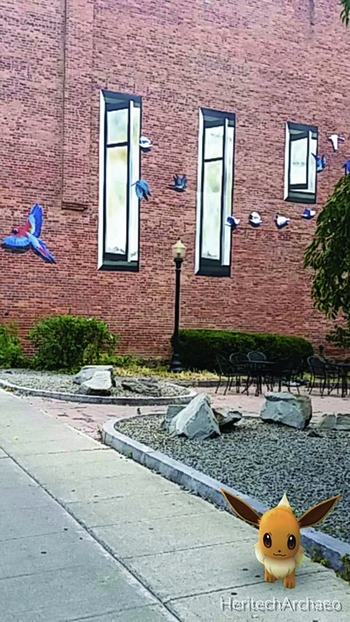
Virtual reality (VR) and augmented reality (AR) are commonly understood as technologies of display (of images, environments, etc.) that sit along a spectrum of constructed realities (Milgram et al. Reference Milgram, Takemura, Utsumi and Kishino1995). VR is the term used to describe replacing human consciousness with constructed surroundings. If you put on a headset with a video game or other virtual world rendered within it but cannot see your body's physical surroundings, you are experiencing virtual reality. (Although it is beyond the scope of this review, deeper critiques of the immersiveness, interactivity, and sensoriality of VR use in archaeology have been produced at length [Eve Reference Eve2012, Reference Eve2017; Graham et al. Reference Graham, Eve, Morgan and Pantos2015; Morgan Reference Morgan2009, Reference Morgan2016]). In contrast, AR refers to situations in which a digital device is employed to modify your normal surroundings. Google Glass and Pokemon GO (Figure 1) are both popular examples of augmented reality, where information (e.g., a picture of a video game character) is projected on top of your regular scope of vision. In AR, human sensory experiences are changed or added to, not replaced. Both VR and AR have different technological and pedagogical qualities.
Viewing this public park in Pokemon GO, I see a wild Evee inviting me to catch it and gain experience in the game. Historic markers and other points of interest are also marked in the game, and visiting them is incentivized. Screenshot of Pokemon GO (Niantic, Inc.) by author.
Studying the effect of immersive experiences that use archaeological themes is not new; nor was it spurred on by the recent availability of virtual reality headsets on the mass market. Work in archaeological phenomenology has challenged the traditional boundaries of archaeological practice to incorporate a personal and embodied approach to researching past people's experiences (Eve Reference Eve2012; Sims Reference Sims2009; Tilley Reference Tilley1994; Van Dyke Reference Van Dyke2007, Reference Van Dyke, Jorge and Thomas2008). Media archaeologists have studied and created representations of archaeology in film as well (Insole and Piccini Reference Insole and Piccini2014; Rogers Reference Rogers2016). There are compelling pedagogical works about the power of gamification and other experiential forms of teaching, where learning outcomes become goals that students can visualize and complete through the mechanism of games (Arya et al. Reference Arya, Hartwick, Graham and Nowlan2012; Copplestone Reference Copplestone2014; Foreman et al. Reference Foreman, Gee, Herz, Hinrichs, Prensky and Sawyer2004). Now that there are open-access, low-cost tools available to make virtual and augmented reality models, more archaeologists are creating and using such technologies to reach the public through experiential learning. Projects range from static models of individual objects to entire landscapes that translate aspects of memory, phenomenology, and materiality into virtual or augmented reality experiences (e.g., Lithodomos VR Reference Lithodomos2017; Paleowest Archaeology 2016; Virtual Curation Museum 2013).
Below, I describe three specific forms of virtual and augmented reality that can be used in public archaeology, and I outline positive and negative aspects of each. I will discuss viewing individual artifact scans on Sketchfab, exploring immersive landscape models, and using an augmented reality phone application to enhance documents. I have used each of the examples during public archaeology teaching and consulting work. Hence, I base my analysis, in part, on real-world experience. I address budget, ease of use for practitioners and the public, wow factor, and portability for each, in addition to relaying my experiences.
ARTIFACTS IN 3D
According to recent scholarly work, interfacing with artifacts either physically or virtually has “direct implications for people's experience with, and understanding of, ancient artefacts” (Giuseppantonio Di Franco et al. Reference Giuseppantonio Di Franco, Matthews and Matlock2016:184), and there is evidence that virtually manipulating digital versions of artifacts may be more effective than observing authentic artifacts that cannot be handled (Giuseppantonio Di Franco et al. Reference Giuseppantonio Di Franco2015). Decontextualized original artifacts are staples in public archaeology teaching, but while they inspire curiosity, people are often shy to pick them up and explore them. Three-dimensional VR reconstructions seem to inspire similar curiosity in visitors without fear of breaking the objects or appearing impolite by treating them too roughly. One of the largest collections of free, open-access 3D artifact scans is on the British Museum's page on Sketchfab (British Museum 2014). There are over 175 models on their profile page, made by the digital humanities team, who have scanned objects in the museum's collection (Deniau Reference Deniau2017a, Reference Deniau2017b, Reference Deniau2017c). If a visitor clicks on a single object, they will visit a page with information on the item and an interactive 3D representation, which they can manipulate with a cursor or by using a touch screen. The site is usable on any device with Internet access. Every model can be viewed using a virtual reality headset (Sketchfab 2017), including the low-cost Google Cardboard. Viewing an artifact in VR can be as easy as going to the website on a smartphone, clicking a button, placing the phone inside Google Cardboard, and looking inside. This form of VR can be done for free on any Internet-connected device, or viewed through a VR headset, costing between $20 and $800 (U.S.).
I have experimented with showing students aged 8–12 virtual reality models of artifacts in a class setting and received positive feedback overall. The tension surrounding the handling of artifacts is nonexistent, and when working with children or other members of the public with lower dexterity, the VR format liberates them from some agility-related difficulties they might face interacting with original artifacts. Another benefit is that using a VR headset forces students to focus on the artifact, blocking out distractions and causing them to be more attentive to spoken information. The wow factor of virtual reality also draws people in more than conventional artifacts, in my experience. My efforts in presenting archaeology at table events and other forms of outreach suggest that VR engagement works well outside of the classroom too.
However, there are definite challenges to teaching with such models. The textures, light-responsive qualities, and weights of genuine artifacts all inform how we identify them, and it is more difficult to communicate those multisensory observations to the public when we use intangible versions of artifacts. Replacing tangible artifacts with VR does not allow us to model careful artifact handling, which may be a key goal for some public archaeologists. Still, presenting virtual artifacts is a good option for settings where physical artifacts are not available or appropriate, or for practitioners who do not have access to a teaching artifacts collection.
Also important to consider is the fact that many archaeology-themed models on the Sketchfab site that do not disclose the original artifact's legal owner or how they came to model it. If a model does not have adequate citation, there is no way to know whether it was created illegally or via breaching common disciplinary ethical codes, or whether the original artifact was obtained illegally or unethically (see Nicholas et al. Reference Nicholas, Bell, Coombe, Welch, Noble, Anderson, Bannister and Watkins2010 for more details on intellectual property issues in heritage management). So I strongly recommend that colleagues research the author of the 3D model before using it, and I suggest the British Museum as a good starting point because they have been transparent about ownership and the appropriate use of their models.
VIRTUAL LANDSCAPES
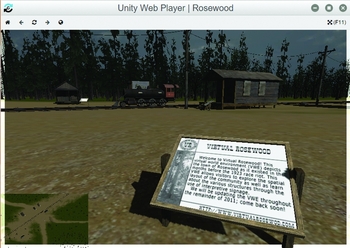
The most common form of virtual and augmented reality used in archaeology is the virtual landscape model. Digital landscape models have been popular research tools and outreach mechanisms for some time, with recent critiques and projects focusing on creating interactive experiences rather than static or representational snapshots of a reconstructed past (Morgan Reference Morgan2009). The promise of virtual landscapes for public archaeology is that we can communicate with the viewer about the human experiences of past people beyond their stuff; in my opinion, the projects that focus on this goal are the ones that are most potent for teaching. There are a limited number of archaeologist-created, interactive landscape models for colleagues to try, due to the specialized labor required to make and maintain them. One well-documented example of an archaeologist-built virtual landscape is Virtual Rosewood (Gonzalez-Tennant Reference Gonzalez-Tennant2011, Reference Gonzalez-Tennant2013), a representation of the African American town of Rosewood, Florida, in 1922, just before racial and economic tensions came to a head in the Rosewood Riot. The virtual town memorializes the inhabitants’ way of life in a way the physical town no longer can, incorporating Gonzalez-Tennant's archaeological research and descendants’ oral histories (Gonzalez-Tennant Reference Gonzalez-Tennant2011). Exploring Virtual Rosewood, viewers can walk around a vast landscape of houses, stores, and landscape features, reading relevant signs (Figure 2). The VR experience is particularly informative if the viewer is familiar with the aftermath of the Rosewood Riot; exploring the model makes it easier to visualize the space where the riot took place, and by extension, the changes it caused in people's lives.
Virtual Rosewood is a large space full of homes, shops, and signs that recount the memories of residents before the town's riot took place. Screenshot of Virtual Rosewood by author.
The practical difficulties of using landscape-level VR in public archaeology are its main drawback. Most scholarly produced landscape models will run only on a computer (or a powerful mobile device) and are comprised of large files to download or require substantial Internet bandwidth to run. Many models hosted online are currently not usable without workarounds; creators must contend with the transition to new technical requirements in order for their 3D models to be viewable in web browsers, which requires financial and labor investment to overcome. These access restrictions may require enough cost or labor to rule out landscape VR for most event-based public archaeology. In teaching, it can be difficult to incorporate landscape models into lessons because most of them do not have sufficient interactivity. In my experience, unless clicking has a clear reward, people express embarrassment that they do not understand how the model works or what it means. Still, there is promise for landscape models as tools for drawing together multiple sources and voices of archaeological research for public consumption.
AUGMENTED REALITY
Anyone with a smartphone can use AR to project historical photos and other media onto the world around them using free applications like Clio (Trowbridge Reference Trowbridge2017) or Harvard University's Point of Interest Visual Optimization Tool (PIVOTtheWorld, Inc. Reference PIVOTtheWorld2016). As easy as these apps may be to use, they are not focused on archaeological principles, and most are limited to a small geographic area. Archaeologist-produced projects like Voices Recognition (Eve et al. Reference Eve, Hoffman, Morgan, Pantos and Kinchin-Smith2014), a multisensory tour of York Cemetery, leverage AR to share archaeological information, memories, and phenomenology. Augmented reality need not take the form of a tour, however, as digital archaeologist and historian Shawn Graham has shown in his Diary in the Attic project (Reference Graham2015), which adds layers of sound and visuals while the viewer reads pages from an anonymous nineteenth-century diary by a woman traveling the Nile (also provided by him). Although it is a proof of concept at this stage, Graham has made the Android app, code, and authoring information freely available so colleagues can create their own versions more easily (Graham Reference Graham2015).
Although augmented reality is a new focus in heritage disciplines compared to the VR topics discussed above, it seems particularly useful for public archaeology teaching. Archaeologists who lead tours or set up table displays could use AR to enrich their surroundings with media that are more easily updated than permanent exhibits and do not require changes to physical facilities. For static items like a building, or in Graham's project, the pages of a historical diary, one can add new movement and sound. I expect that this technology would not be as useful in a lecture, but in most situations, being able to provide a literal “archaeological lens” when we are teaching sounds tantalizing.
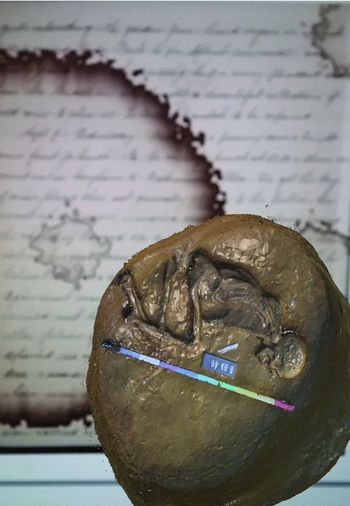
The main difficulty in applying AR in public archaeology is that it takes significant expertise and resourcing to realize these projects. Still, within our discipline there are many scholars working with this technology, and AR projects such as Diary in the Attic are smaller and more scalable than landscape-level VR models. One minor concern I have for document-based AR, based on Diary in the Attic, is that it obscures the text of the document (see the text in the background of Figure 3). This problem of obscuring critical content is consistent with my experience using other AR apps: it seems to be a feature of them and not a glitch. It is easiest to read the document on its own and use the AR app as a magnifying glass, to get additional detail not seen without assistance. Compared to viewing individual objects on a smartphone, AR is only slightly more difficult to use as a teacher or viewer.
While scrolling through the Nile diary using Diary in the Attic, ambient desert sounds play and this 3D model of a human burial appears on the screen. Screenshot by author.
CONCLUSION
Virtual and augmented reality are promising tools we can use to inspire members of the public to focus and empathize with past peoples. The VR and AR projects of fellow archaeologists have shown us new ways to present our archaeological lessons, and novel ways to tie them all together, if we are willing to experiment. The long-term success of programs like the Campus Archaeology Program (2017) at Michigan State University and the Florida Public Archaeology Network (2017), among many others, has been achieved through such an innovative, experimental approach. Projects and technologies I have described here are easy and affordable to use and, in my judgment, worth trying when our collective goal is to attract the curiosity of people of all ages.



