





1. Introduction
Humans tend to see themselves through rose-tinted glasses. Most evidence comes from situations where people are tested on characteristics that they consider relevant, like their level of intelligence (see, e.g., Hoorens, Reference Hoorens2011, Eil & Rao, Reference Eil and Rao2011) or their morality (see, e.g., Messick et al., Reference Messick, Bloom, Boldizar and Samuelson1985, Haisley & Weber, Reference Haisley and Weber2010). In these situations, people tend to predictably oversize their own qualities relative to other people’s (see Zell et al., Reference Zell, Strickhouser, Sedikides and Alicke2020, for a review), with consequent overconfident behaviors in the markets (Odean, Reference Odean1998, Camerer & Lovallo, Reference Camerer and Lovallo1999, Malmendier & Tate, Reference Malmendier and Tate2005).
These biased beliefs can be sustained by motivated memory as an instrument to filter undesirable information (Bénabou & Tirole, Reference Bénabou and Tirole2002, Bénabou & Tirole, Reference Bénabou and Tirole2004). Memory is “motivated” in the sense that forgetting some unpleasant information serves important psychological needs, such as reassuring oneself, protecting one’s self-image, and/or reducing negative emotions.
Motivated memory can lead to market inefficiencies and jeopardize accurate information provision in various economic settings. For instance, investors may selectively recall past gains over losses (Gödker et al., Reference Gödker, Jiao and Smeets2025, Li & Rong, Reference Li and Rong2023), leading to overconfidence and suboptimal portfolio choices. Similarly, consumers who forget attributes of a product may infer false positive attributes (Walters & Hershfield, Reference Walters and Hershfield2020), generating persistent demand for inferior products. The selective recall of teachers’ feedback can lead students to form a skewed view of their relative skills (Roy-Chowdhury, Reference Roy-Chowdhury2022) and make suboptimal educational choices. Motivated memory can also help explain inconsistencies between beliefs and behavior in situations like altruistic actions (Li, Reference Li2013, Saucet & Villeval, Reference Saucet and Villeval2019) and fertility decisions (Müller, Reference Müller2022).
Despite its growing popularity, motivated memory has not reached a consensus among economists. Observing a high recall accuracy of desirable versus undesirable information does not represent, per se, evidence of motivated recall, and the idea that this happens because people recall, to some extent, what they want to recall is still controversial.
The controversy hinges on two points. The first one is theoretical. Memory is known to have an associative structure, that is, cues trigger recall of items that have a relationship of similarity with them (Kahana, Reference Kahana2012, Bordalo et al., Reference Bordalo, Gennaioli and Shleifer2020, Bordalo et al., Reference Bordalo, Coffman, Gennaioli, Schwerter and Shleifer2021, Bodoh-Creed, Reference Bodoh-Creed2020). Unfortunately, the strands of literature on motivated memory and associative memory have proceeded largely in parallel (Amelio & Zimmermann, Reference Amelio and Zimmermann2023), and different theories can offer competing explanations for − and solutions to − the same recall biases. The second point is methodological. The causal mechanism underlying intentional behavior (i.e., behavior conducted in order to bring about some goal) is very hard to prove empirically (Elster, Reference Elster1983, chap. 3), and motivated memory makes no exception (Amelio & Zimmermann, Reference Amelio and Zimmermann2023). Since researchers typically cannot intervene on motivations directly, they instead exclude alternative mechanisms that would predict similar outcomes. Therefore the importance of testing alternative channels.
This paper investigates the role of mood as a plausible alternative channel. Positive mood could generate the same recall patterns that are typically attributed to motivated memory, since pleasant information is easier to recall for individuals in a positive mood. This phenomenon, known as mood congruence, draws from the literature on associative memory and relies on purely cognitive elements, without the need for any motivational factor. In economic models, mood congruence is often given as the typical example of an associative recall process (Fudenberg et al., Reference Fudenberg, Lanzani and Strack2024, p. 3985; Wachter & Kahana, Reference Wachter and Kahana2024, p. 1100). Some economists use mood congruence to explain selective memory (Bodoh-Creed, Reference Bodoh-Creed2020), while others use motivated memory (Bénabou & Tirole, Reference Bénabou and Tirole2002), and some others combine both (Koszegi et al., Reference Koszegi, Loewenstein and Murooka2021, Koszegi et al., Reference Koszegi, Loewenstein and Murooka2022). This paper is the first (i) to highlight the issue that motivated and mood-congruent memories predict similar outcomes in most (yet, not all) situations and (ii) to test the predictive power of each mechanism in a unified framework.
Empirically, there is long-standing evidence of mood congruence (see Blaney, Reference Blaney1986, Faul & LaBar, Reference Faul and LaBar2022, for reviews), therefore positing a credible challenge to the validity of some results from laboratory experiments that claimed to identify motivated memory. When we consider that in all developed countries most people identify themselves as being on the upper part of the happiness scales (Helliwell et al., Reference Helliwell, Layard, Sachs and Neve2023), the role of mood congruence could be more than peripheral. Moreover, young adults tend to be happier than the rest of the population (Easterlin, Reference Easterlin2003, Blanchflower, Reference Blanchflower2021),Footnote 1 and, albeit some field evidence of motivated memory exists (Huffman et al., Reference Huffman, Raymond and Shvets2022, Li & Rong, Reference Li and Rong2023), most economic results come from laboratory experiments on young adults (i.e., college students). The risk is that an influential strand of literature in experimental economics has been explaining recall asymmetries as the result of motivational factors (“subjects recall positive information in order to feel better”), while they could instead be the byproduct of an unobserved characteristic in the experimental population, i.e., their mood (“subjects recall positive information because they feel good”). This reversal has consequences for predicting how people react to negative feedback, as well as how much recall asymmetries are either general or the prerogative of a happier-than-average sample. In short, mood congruence could falsify results that were previously attributed to motivated memory.
Is motivated memory (just) a matter of mood? To address this question, this paper reports new experimental and empirical evidence that tests the role of mood for motivated memory in a task based on the experiment by Florian Zimmermann Reference Zimmermann(2020). In his experiment, subjects undertake an IQ test and receive some feedback about their performance with respect to some peers. One month later, they are asked to recall their feedback. Zimmermann observes that subjects tend to better recall their feedback when they are told that they scored higher than most people in their comparison group (positive feedback) than when they are told the opposite (negative feedback). Using the same design, we investigate the explanatory power of mood in this asymmetric recall pattern. We implement two studies.
First, in a laboratory experiment, we replicate Zimmermann’s Reference Zimmermann(2020) design, but we add an experimental manipulation that generates divergent predictions according to which mechanism, mood congruence or motivated memory, dominates. Before recalling their feedback, subjects are divided into three groups, which are each induced with a specific mood: neutral, positive, or negative. The mood induction procedure is based on Andrade et al. Reference Andrade, Odean and Lin(2015). Their design, which was introduced to study the impact of mood on behavior, consists of watching short video clips specially selected to trigger different emotions. Insofar as mood is successfully induced and positive/negative feedback is perceived by subjects as such, this experimental manipulation allows us to investigate the predictive validity of each mechanism. When people are induced with positive mood, both motivated and mood-congruent memories predict better recall of positive feedback. When people are induced with negative mood, however, motivated memory predicts them to better recall positive feedback while mood congruence predicts them to better recall negative feedback.
Our experimental results support motivated memory as the dominant force of asymmetric feedback recall. As documented by Zimmermann Reference Zimmermann(2020), we find that subjects tend to better recall positive than negative feedback. Importantly, this pattern does not appear as a byproduct of mood-congruent memory, since subjects in negative mood also follow a similar pattern. Overall, the effectiveness of feedback seems to depend more on what people want to recall rather than how people feel at the moment of recalling.
An important shortcoming of our laboratory experiment is its sample, formed of college students, and not representative of the mood distribution of the population. The crucial issue is that if mood-congruent memory is a matter of stocks rather than flows, namely, of baseline mood rather than induced mood, then the results from the lab would offer only a partial picture of the role of mood in motivated recall. Meta-analyses have found that the recall asymmetry for positive information disappears in individuals with low non-induced mood, up to the point of reversing in clinically depressed groups, who tend to better recall negative information (Matt et al., Reference Matt, Vázquez and Campbell1992, Gaddy & Ingram, Reference Gaddy and Ingram2014, Stramaccia et al., Reference Stramaccia, Meyer, Rischer, Fawcett and Benoit2021).
To make progress, we set a subsequent online survey, where participants undertake a recall task à la Zimmermann (recall of self-relevant feedback). We interview a nationally representative sample of US residents, and estimate the relationship between their baseline mood and their propensity to exhibit motivated memory. As in the laboratory experiment, mood-congruent memory, if present, should lead people in low mood to better recall negative feedback. The survey results entirely replicate the experimental ones. We find that participants tend to recall positive feedback better than negative feedback, even among those who report relatively low mood. Mood therefore does not seem to be a necessary condition for the appearance of motivated recall.
The distinction between motivated and mood-congruent memory is relevant in various economic contexts. In an educational setting, the dominant mechanism can help predict students’ reactions to grades. If motivated memory dominates, a bad grade is likely to have a negligible effect on a student’s effort, since the psychological demand for self-esteem leads the student to forget that unpleasant piece of information. Conversely, mood congruence would predict that students in low mood overreact to the bad grade, potentially engaging in a negative spiral where negative feedback is over-sampled from memory (Koszegi et al., Reference Koszegi, Loewenstein and Murooka2022). Another example is job search. Unemployed people tend to report significantly lower mood than the rest of the population (Clark & Oswald, Reference Clark and Oswald1994). In this context, mood congruence predicts that the provision of negative feedback (e.g., a job rejection) would lead to overreaction and underinvestment in future job search, while motivated memory would predict that this feedback is unlikely to discourage future applications. As a third example, consider the expected behavioral bias in an investor’s decision about whether to buy or sell additional stocks. The investor owns a stock whose market value increases initially and decreases subsequently. Models of motivated memory (Gödker et al., Reference Gödker, Jiao and Smeets2025) predict positive overreaction: The investor tends to forget the less preferred outcomes, so that they overinvest in the stock. Models of mood congruence (Bodoh-Creed, Reference Bodoh-Creed2020) predict just the opposite: Selective recall pushes the disappointed investor to oversell the asset.
By demonstrating how people in negative mood recall negative feedback, our experiment informs behavioral models that try to predict how economic agents react to information (see, e.g., Azeredo da Silveira et al., Reference Azeredo da Silveira, Sung and Woodford2024). As Koszegi et al. (Reference Koszegi, Loewenstein and Murooka2021, p.43) put it, “with the kind of biased recall resulting from mood-congruent memory, [the impact of bad experiences] can be more pernicious, because they will be disproportionately likely to be recalled exactly when the individual is in a negative state.” By documenting that relatively high mood is not a necessary condition for motivated memory, our survey can also inform interventions aimed at taming or encouraging self-confidence (see, e.g., Hakimov et al., Reference Hakimov, Schmacker and Terrier2023). This seems particularly relevant when considering that memory failures are the target of one of the most common nudging strategies, namely, reminders (Milkman et al., Reference Milkman, Gromet, Ho, Kay, Lee, Pandiloski, Park, Rai, Bazerman and Beshears2021, DellaVigna & Linos, Reference DellaVigna and Linos2022).
Our study lies at the intersection of two strands of literature. The first one inquires the conditions under which the predictions of motivated cognition are met (see, e.g., Thaler, Reference Thaler2022). We investigate the associative and motivational aspects of memory jointly, thus complementing some recent theoretical work (Fudenberg et al., Reference Fudenberg, Lanzani and Strack2024, Koszegi et al., Reference Koszegi, Loewenstein and Murooka2021, Koszegi et al., Reference Koszegi, Loewenstein and Murooka2022). The objective of this paper is not to prove or disprove that motivated memory is the causal driver of asymmetric recall patterns, but rather to test an alternative important explanation that could undermine the interpretation of results from many recent laboratory experiments. We provide a clean test in the lab by creating a situation where the two theories (motivated and mood-congruent memory) offer sharply divergent predictions, and complement it with additional survey evidence.
The second contribution is to the economic literature on mood and emotions. Given the importance of mood in shaping a variety of economic outcomes, from productivity (Oswald et al., Reference Oswald, Proto and Sgroi2015, Bellet et al., Reference Bellet, De Neve and Ward2024) to risk-taking behavior (Stanton et al., Reference Stanton, Reeck, Huettel and LaBar2014, Nguyen & Noussair, Reference Nguyen and Noussair2014), from asset valuation (Lerner et al., Reference Lerner, Small and Loewenstein2004, Andrade et al., Reference Andrade, Odean and Lin2015) to strategic behavior (Capra, Reference Capra2004, Kirchsteiger et al., Reference Kirchsteiger, Rigotti and Rustichini2006, Castagnetti et al., Reference Castagnetti, Proto and Sofianos2023), from punishing (Noussair et al., Reference Noussair, Tucker, Xu and Breaban2024) to lying (Medai & Noussair, Reference Medai and Noussair2021), the relationship between mood and learning deserves consideration. Our work aligns with the interdisciplinary “era of affectivism” (Dukes et al., Reference Dukes, Abrams, Adolphs, Ahmed, Beatty, Berridge, Broomhall, Brosch, Campos and Clay2021), which refers to the growing interest in how mood and emotions influence cognition and decision-making. Yet, the approach of this paper is very much in line with the economic tradition as outlined by Elster Reference Elster(1998), who differentiates the role of emotions in economics and psychology based on the type of research question: “Whereas economists mainly try to explain behavior, emotion theorists try to explain emotions” (p. 47).Footnote 2
Memory and mood are multifaceted and potentially ambiguous concepts, which must be clearly defined from the onset. The term memory refers to a collection of complex and different systems (see Kahana, Reference Kahana2012), but this study focuses solely on the retrieval process in episodic long-term memory. We will use the general term memory to refer to this specific process. The term mood refers to a relatively lingering feeling (in the order of hours or days), that is not directed toward something in particular (see Loewenstein, Reference Loewenstein1996, Beedie et al., Reference Beedie, Terry and Lane2005, Kaplan et al., Reference Kaplan, Levine, Lench and Safer2016). Mood can be distinguished from emotions, which are more ephemeral feelings (in the order of minutes) and are about something specific. Although this conceptual distinction is gaining some consensus, the two terms are often used interchangeably in the applied memory literature. Experimentally, only negative emotions (and not mood) can be induced in an effective and ethical way. Therefore, studies about the causal effect of mood are typically based on the manipulation of emotions, and so does our experiment. Observational studies, instead, can focus on (non-induced) mood, and so does our survey.
Importantly, the focus of this paper is on mood congruence, which should not be confused with mood dependence. While both are psychological concepts related to how emotions influence memory, they operate differently. Mood congruence refers to the tendency to better recall information that matches one’s current mood, regardless of the emotional status (mood) at the moment of encoding. In contrast, mood dependence refers to the tendency to better recall information that is encoded and retrieved under a similar mood, regardless of the emotional content (valence) of the information (Bower, Reference Bower1981, Blaney, Reference Blaney1986, Faul & LaBar, Reference Faul and LaBar2022). Mood dependence represents a potentially fertile ground of investigation for other recall asymmetries, but it is unlikely to explain asymmetric recall à la Zimmermann, since the valence of the feedback would not matter.
The remainder of the paper is organized as follows. Section 2 reviews the related literature. Section 3 presents the designs and procedures (laboratory experiment and online survey). Section 4 introduces the theoretical predictions of both motivated memory and mood-congruent memory. Section 5 reports the results. Since the survey results entirely replicate the experimental ones, results from both studies are presented in a unified section. Section 6 concludes.
2. Related literature
Decades of research have unveiled that recall errors are, to some extent, systematic and predictable. In the specific case of self-relevant memories, two dominant forces emerge: “A tendency for individuals to recall positive information (a self-enhancement effect), particularly when in a positive mood (a mood-congruent recall effect)” (Baumeister et al., Reference Baumeister, Bratslavsky, Finkenauer and Vohs2001, p.344). In the following paragraphs, we review very briefly some cross-disciplinary key contributions to the understanding of these two phenomena.
2.1. Motivated memory
Theory
In the early 1990s, psychologists modeled recall as the result of a trade-off between one’s motivation to prioritize self-enhancing information and the antagonistic weight of negative but accurate information. Taylor Reference Taylor(1991) describes two temporally distinct processes. At first, negative signals are generally more salient, as they are potentially threatening and require a quick response (mobilization process). In a second stage, information is reviewed in a self-enhancing way and attention is focused on its desirable aspects (minimization process). In an influential article, Kunda Reference Kunda(1990) describes motivated memory as the result of the conflicting desires to be accurate and to reach a certain conclusion. Her distinction between accuracy-oriented and goal-oriented motivated reasoning has penetrated the theoretical literature in economics in the early 2000s.
In economics, imperfect memory has been modeled as largely isomorphic to a multiple-self communication dilemma where disclosing negative information to a future self is detrimental, but hiding it is costly (Bénabou & Tirole, Reference Bénabou and Tirole2002, Gottlieb, Reference Gottlieb2014). In consequence, the demand for a positive self-image can optimistically bias the recall process and generate overconfidence (Köszegi, Reference Köszegi2006, Gödker et al., Reference Gödker, Jiao and Smeets2025). This class of models grants some metacognitive control, so that people are subject to active self-disinformation.Footnote 3 They predict that negative information about the self tends to be suppressed or biased whenever it is not cognitively too costly, while positive information tends to be prioritized.
Empirical evidence
There is long-standing evidence in psychology that favorable self-relevant feedback is better recalled than adverse feedback (see, e.g., Crary, Reference Crary1966, Silverman, Reference Silverman1964, Mischel et al., Reference commenthel, Ebbesen and Zeiss1976). For instance, when recalling the results of a (fake) personality test, people tend to better recall positive than negative traits (Sedikides & Green, Reference Sedikides and Green2000, Sedikides & Green, Reference Sedikides and Green2004, Green et al., Reference Green, Sedikides, Pinter and Van Tongeren2009).
A nascent literature in experimental economics has been investigating this pattern and further dugging into its causes (see Amelio & Zimmermann, Reference Amelio and Zimmermann2023, for a review). It provides evidence in line with motivational biased recall for various self-relevant traits, including IQ (Zimmermann, Reference Zimmermann2020, Chew et al., Reference Chew, Huang and Zhao2020). Both Zimmermann Reference Zimmermann(2020) and Chew et al. Reference Chew, Huang and Zhao(2020) use a Raven IQ test as a measure of intelligence and investigate how people subsequently recall their performance. In his series of studies on motivated beliefs, Zimmermann Reference Zimmermann(2020) provides subjects with some noisy feedback on their relative performance in the Raven test. A few weeks later, he observes that respondents better recall positive than negative feedback. We will describe in more detail Zimmermann’s design, which we replicate in our study. Chew et al. Reference Chew, Huang and Zhao(2020) provide subjects with feedback for each Raven matrix and, months later, ask them to recall if they saw the matrix before and if they solved it correctly. Subjects not only tend to forget matrices they failed to solve more than matrices they correctly solved, but they are also more likely to misattribute a positive outcome to matrices they have never seen or did not solve.
2.2. Mood-congruent memory
Theory
Although the complex relationship between memory and mood has been modeled in several ways in psychology (see Fiedler & Hütter, Reference Fiedler and Hütter2013, for a review and the literature cited therein), mood congruence is typically explained as the result of an associative mechanism, where past information is relatively more accessible if its valence is congruent with people’s current mood. Mood-congruent models therefore consider recall biases as the byproduct of a cognitive heuristic process, where mood is an associative cue. For instance, early contributions by Isen et al. Reference Isen, Shalker, Clark and Karp(1978) and Bower Reference Bower(1981) explain the mood-congruent phenomenon as being due to the spreading of emotionally-related items within a memory network.
Among economists, Mullainathan Reference Mullainathan(2002) sketched the first economic model of associative memory, where recall outcomes are predicted by the informative cues a person receives. Other recent theories on the economic consequences of associative memory can be found in Bordalo et al. Reference Bordalo, Gennaioli and Shleifer(2020) and Bordalo et al. Reference Bordalo, Coffman, Gennaioli, Schwerter and Shleifer(2021), which explore, respectively, how associative recalls distort saliency, and how representative heuristics distort recalls. Nevertheless, these works focus on other memory cues than mood. So far, the only theoretical works on mood congruence in economics are Bodoh-Creed Reference Bodoh-Creed(2020), Fudenberg et al. (Reference Fudenberg, Lanzani and Strack2024), Koszegi et al. (Reference Koszegi, Loewenstein and Murooka2021), Koszegi et al. Reference Koszegi, Loewenstein and Murooka(2022), and Wachter & Kahana Reference Wachter and Kahana(2024). Bodoh-Creed Reference Bodoh-Creed(2020) models memory as an associative process where the current mood is a relevant cue for retrieval. By applying the model to financial behavior, he draws predictions on information overreaction and asset price volatility. More recently, Wachter & Kahana Reference Wachter and Kahana(2024) use a similar model as Bodoh-Creed to explain various stock market puzzles. In their framework, the impact of emotions on decision making is channelled by associative memory, in line with the predictions of mood-congruent memory. Fudenberg et al. (Reference Fudenberg, Lanzani and Strack2024) combine both associative and motivated memory in a unified theoretical setup, and draw conclusions on long-run recall outcomes. They take the special example of situations where the current mood provides contextual cues that bias recall toward a similar signal.Footnote 4 Koszegi et al. Reference Koszegi, Loewenstein and Murooka(2022) formulate a model that endogenizes self-esteem, based on how people learn about themselves. The central mechanism of their recall model is mood congruence (p.2030). In a companion paper (Koszegi et al., Reference Koszegi, Loewenstein and Murooka2021), the authors explore more deeply some relevant psychological mechanisms, including the influence of adaptation and how self-relevant feedback can spill over different life domains.
Empirical evidence
Applied memory literature is replete with examples of mood congruence: People better retrieve information whose content is congruent with people’s current mood (see the literature reviews by Blaney, Reference Blaney1986, Faul & LaBar, Reference Faul and LaBar2022; and the meta-analyses by Matt et al., Reference Matt, Vázquez and Campbell1992, Gaddy & Ingram, Reference Gaddy and Ingram2014, Stramaccia et al., Reference Stramaccia, Meyer, Rischer, Fawcett and Benoit2021). Mood congruence has been particularly influential in consumer research, where consumers have been shown to be significantly happier with a product when they evaluate their past experience in a positive mood (Isen et al., Reference Isen, Shalker, Clark and Karp1978).
Economists have shown that associative memory can explain financial behavior both in the lab (Enke et al., Reference Enke, Schwerter and Zimmermann2020) and in the field (Charles, Reference Charles2022, Jiang et al., Reference Jiang, Liu, Peng and Yan2025). Enke et al. Reference Enke, Schwerter and Zimmermann(2020) set a laboratory experiment where subjects are informed about hypothetical companies via some signals that are embedded in a context of stories and images. Later on, subjects who are prompted with stories and images better recall past signals associated with that context, and this influences their belief formation and choices. Charles (Reference Charles2022) shows that data on holdings and trades of retail investors have patterns consistent with associative memory biases, while Jiang et al. (Reference Jiang, Liu, Peng and Yan2025) finds that investors recall their past performance more positively in periods when the financial market is surging. Overall, though, the economic literature has investigated the impact of mood mostly on behaviors other than recall, from productivity (Oswald et al., Reference Oswald, Proto and Sgroi2015) to risk-aversion (Nguyen & Noussair, Reference Nguyen and Noussair2014), from altruism (Capra, Reference Capra2004) to reciprocity and generosity (Kirchsteiger et al., Reference Kirchsteiger, Rigotti and Rustichini2006), from prudence (Breaban et al., Reference Breaban, Van De Kuilen and Noussair2016) to asset-pricing (Andrade et al., Reference Andrade, Odean and Lin2015). The study by Andrade et al. Reference Andrade, Odean and Lin(2015), on the effect of mood on asset pricing, provides the archetypal procedure for mood manipulation that we replicated in the present study.
Overall, models of motivated memory claim that people try to maintain a positive self-image through biased information processing to sustain psychological needs. Mood-congruent theories claim that people tend to better recall information that is congruent with their current emotional state because the latter acts as an associative cue. The two effects are not mutually exclusive, but understanding which one is the dominant force is crucial for the interpretation of some previous results and will help improve predictions.
Besides, this short literature review underlines that neither motivated memory nor mood congruent needs exceptional circumstances to arise. That is, we would not expect motivated memory to be relevant only among narcissistic or pathologically delusional people, but also among ordinary folks who have a reasonable need for self-esteem. Similarly, we would not expect mood-congruent memory to appear only among ecstatic or clinically depressed individuals, but also in the majority, and the majority tends to experience more positive than negative feelings during the day.
3. Design and procedures
3.1. Experimental design
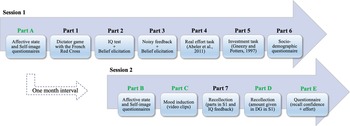
We set a longitudinal experiment where subjects participated in two sessions, separated by an interval of one month. Parts named by a number (1 to 7) are an accurate replication of Zimmermann’s Reference Zimmermann(2020) design. Parts named by a letter (A to E) are specific to our design. Part C is treatment-specific, and is drawn from Andrade et al. Reference Andrade, Odean and Lin(2015). Figure 1 displays the timeline of the experiment. We now describe each session in detail.
Timeline of the experiment

Session 1
Session 1 consisted of seven parts. Parts 1, 4, 5, and 6 were only filler tasks that were aimed at obfuscating the purpose of the experiment (see Zimmermann, Reference Zimmermann2020, p.7).
The experiment started with part A. Subjects answered an emotional questionnaire based on Plutchik and Kellerman’s Reference Plutchik and Kellerman(1980) emotions categorisation and on OECD’s (2013) guidelines to measure happiness, as well as a self-image questionnaire (Schwarzer et al., Reference Schwarzer and Jerusalem1995). This part was not payoff-relevant and aimed at controlling for baseline levels on these two dimensions.
In part 1 (filler task), subjects played a one-shot dictator game. They were endowed with 10 euros and could decide if they wanted to donate part of this amount to the French Red Cross.
In part 2, subjects performed an IQ test in the form of 10 Raven matrices to solve in 10 minutes. Before the test, subjects were explicitly told that this kind of questionnaire is frequently used to measure intelligence and performance is correlated with income and education outcomes. After the test, subjects were informed that they had been randomly matched with nine people who had previously taken the same test.Footnote 5 They were ranked within this 10-person group according to their performance in the Raven test. In case of an equal score between two or more subjects, the computer randomly broke the tie. Then, we elicited subjects’ beliefs about their relative rank.Footnote 6
In part 3, subjects received some noisy feedback about their relative performance. The noisy feedback procedure was based on Eil & Rao Reference Eil and Rao(2011): Three out of nine members of the group were randomly selected, and the subject was informed, for each of them, if they ranked higher or lower. Thus, each subject could receive four kinds of feedback: Three people performed better than them (three negative comparisons out of three), two people performed better than them (two negative comparisons out of three), one person performed better than them (one negative comparison out of three) or no one performed better than them (zero negative comparisons out of three). To rule out inattention, subjects were asked to repeat the information right after receiving the feedback. Then, we measured subjects’ posterior beliefs about their relative rank in the 10-person group.
Part 4 (filler task) consisted in a real-effort task, similar to Abeler et al. Reference Abeler, Falk, Goette and Huffman(2011): Subjects had five minutes to count the number of zeros in tables containing zeros and ones and had to report the correct number for each table. They were paid 0.2 euro per correct report, plus a fixed amount of 5 euros.
In part 5 (filler task), subjects were endowed with 2 euros and had to decide how many cents to put in a risky investment in which the amount invested has one chance out of three to be multiplied by 2.5 and two chances out of three to be void (Gneezy & Potters, Reference Gneezy and Potters1997). They received a fixed payment of 3 euros in addition to the investment return.
Finally, in part 6 (filler task) subjects filled a sociodemographic questionnaire, which paid a fixed amount of 5 euros.
Session 2
Session 2 took place one month later and consisted of five parts. Session 2 combines the recall elicitation task of Zimmermann Reference Zimmermann(2020) with a mood induction procedure based on Andrade et al. Reference Andrade, Odean and Lin(2015).
Session 2 started with part B. This part mirrored part A in session 1 and aimed at controlling for the idiosyncratic baseline levels and variations in emotions and self-esteem.
Part C was treatment-specific. Subjects watched a video clip that combined two excerpts from commercial movies. Depending on the treatment group, the video clips were meant to induce either positive, negative, or no specific emotional state.Footnote 7 Video clips were carefully chosen from the database of Schaefer et al. Reference Schaefer, Nils, Sanchez and Philippot(2010), which assesses the relative efficiency of a large sample of video clips in inducing different emotions.Footnote 8 For each treatment, we selected the two excerpts that were ranked as the most effective ones in inducing − respectively − positive and negative affect, as well as two neutral excerpts for the control group. Each video clip lasted about 4 minutes. After watching it, subjects were asked to report their emotional reaction using a Self-Assessment Manikin scale (Bradley & Lang, Reference Bradley and Lang1994), where they assessed the emotional valence (from “clearly positive” to “clearly negative”) and arousal (from “not intense at all” to “very intense”) of their emotional experience. In addition, they were asked to choose from a list of emotions the ones that best described their feeling. These self-reported measures, which are very common in the literature on emotions, were meant to check that the treatments triggered the desired mood. Both our mood-induction technique and our mood-manipulation check closely replicated the design by Andrade et al. Reference Andrade, Odean and Lin(2015).
Part 7 dealt with two recall tasks. Subjects were asked to briefly summarize each part of session 1 in one sentence and were paid 0.5 euro for a sufficiently accurate description. Once the summary was completed, they were reminded that in session 1 they took an IQ test and received feedback about their relative performance within a randomly selected group. We asked them to recall and report how many people ranked higher than them. Possible answers were “3,” “2,” “1,” “0,” or “I don’t recall.” Subjects were paid 2 euros if they recalled correctly. This memory elicitation procedure accurately followed the design of the Recall treatment in Zimmermann Reference Zimmermann(2020).
In part D, subjects were asked to recall the amount of their donation to the French Red Cross charity in session 1. This measure allowed us to glimpse potential interactions between recalls of two self-relevant traits: intelligence (feedback on IQ) and generosity (donation to a charity). Unfortunately, memories of the donations to the Red Cross turned out to be poorly informative, since 56% of subjects donated nothing in session 1 and, among them, only 3 misrecalled it in session 2.
In part E, subjects answered a short questionnaire providing some feedback on the two sessions. In particular, they reported on a 10-item scale how confident they were with each recall task and how much effort they provided to retrieve the information. Instructions are given in Appendix 1.
3.2. Experimental procedures
The experiment was programmed using Z-tree (Fischbacher, Reference Fischbacher2007). It was conducted at GATE-Lab (Lyon, France), and data were collected in five waves from April 2019 to October 2022 (see Appendix 3, Table 9). Session 1 lasted on average 50 minutes. Session 2 lasted on average 40 minutes. To reduce attrition, all payments from the experiment were made at the end of the second session, except for a 5-euros show-up fee in session 1. Moreover, at the end of session 1, subjects were given a slip of paper stating the exact date and time of session 2 and were reminded twice via email or text message about the second lab session. One month later, subjects came back to the laboratory for session 2 and received 15 euros plus the earnings associated with one randomly selected part of the experiment. Subjects were informed about this payment scheme at the very beginning of the experiment.
A total of 337 subjects were recruited, using Hroot (Bock et al., Reference Bock, Baetge and Nicklisch2014). Forty-three subjects did not show up to the second session and are therefore excluded from the analysis.Footnote 9 96 subjects participated in the Neutral treatment, 98 in the Positive treatment, and 100 in the Negative treatment.Footnote 10 Table 7 in Appendix 3 summarizes the subjects’ characteristics in each treatment, including the attrition sample.
3.3. Survey design
We collected data from a preregistered online survey where the same participants were invited to two sessions, at 10-day distance.Footnote 11 Figure 2 displays the timeline of the survey. Parts 2, 3 and 7 are simplified versions of the tasks in Zimmermann Reference Zimmermann(2020)’s design. Parts A and B refer to the mood elicitation questionnaires.
Timeline of the survey

Transposing the experimental task online allows the recruitment of a large diversified sample, representative of a national population, with greater mood heterogeneity. However, it also entails some specific challenges. First, the suspect of deception: We had to ensure that participants had confidence in the feedback generation process. At the beginning of session 1, we therefore included a no-deception statement, which subjects had to electronically sign. In addition, just before receiving the feedback, the following message was displayed: “We remind you that there is no deception. The three randomly drawn participants are real individuals from Prolific who performed the exact same IQ test as you.” The second main challenge involved low attention/effort. To address this issue, we used four attention checks and incentivized the IQ task with a monetary bonus for the correct solution of a randomly selected Raven matrix. The survey parts largely mimic the experimental counterparts.
Session 1
In session 1, part A contained the same baseline mood questionnaire that we administered in the lab. In part 2, participants had 6 minutes to complete 6 Raven matrices, and we elicited their beliefs about their relative rank in the performance distribution. One matrix was selected at random and participants could receive a bonus payment of $0.5 if they solved it correctly. In part 3, they received a noisy feedback based on Eil and Rao Reference Eil and Rao(2011) procedure and were asked to repeat the information right after receiving the feedback. They were also asked to report the emotional response that they felt in response to the feedback they had just received. For this, they used the Self-Assessment Manikin technique (Bradley & Lang, Reference Bradley and Lang1994), where valence is measured on a five-item scale from “unpleasant” to “pleasant,” and arousal on a five-item scale from “not intense at all” to “very intense.”Footnote 12
Session 2
Session 2 was very brief and consisted of two parts, B and 7. Part B contained the usual baseline mood questionnaire, while part 7 contained the recall task, where participants were asked to recall the feedback they received a few days before. Recall accuracy was incentivized with a bonus payment of $0.5 if correct. At the end of Session 2, one of the two sessions was randomly selected for the delivery of any bonus payment. Instructions are given in Appendix 2.
3.4. Survey procedures
The survey was programmed using Qualtrics, and participants were recruited on Prolific (Palan & Schitter, Reference Palan and Schitter2018). It was preregistered in April 2024, and data collection took place between July and August of the same year. Subjects were recruited to form a representative sample of the US population based on census composition by gender, age, and ethnicity. They were informed that they would be recontacted for a second survey at the very beginning of session 1. Median completion times were 10 minutes and 2 minutes for sessions 1 and 2, respectively. Participation in session 1 paid $1.5, while session 2 paid $0.5. Although the fixed payment in session 2 is quite modest, it corresponds to a per-hour rate about 5 times higher than the average on Prolific (10 times, when considering potential bonus payments).
All of the participants gave their informed consent at the beginning of the study. A total of 1,076 participants completed session 1. Overall, 919 subjects passed the attention checks and were invited to the second session. Next, 775 participated in the second session, of which 22 did not pass the attention check in session 2 and were therefore excluded from the analysis. The analytical sample is based on the remaining 753 individuals. Table 7 in Appendix 3 summarizes the subjects’ characteristics of our online sample, including the attrition sample (N=144).
4. Behavioral conjectures
To formulate our hypotheses, we first need to define (i) what constitutes positive and negative feedback and (ii) how individuals in positive and negative mood are pulled apart.Footnote 13
Regarding the valence of the feedback, we follow Zimmermann’s Reference Zimmermann(2020) definition of positive and negative information: information is positive if subjects are told that they scored higher than most people in their comparison group, and negative if they are told otherwise. In other words, information is positive if subjects received two or three positive comparisons out of three; conversely, it is negative if they received zero or one positive comparisons out of three. Recall is correct if the subjects recall exactly the feedback (number of positive comparisons) they received in session 1.
Regarding positive and negative mood, we consider an individual as being in positive (resp. negative) induced mood if they are exposed to the Positive (resp. negative) treatment in the laboratory. We consider them as being in positive (resp. negative) baseline mood if they score above (resp. below) the median of the national sample in the mood questionnaire.
We discuss the credibility and practical implications of these assumptions in Section 5.1. We check the robustness to alternative definitions of baseline mood in Appendix 7.
We can now spell out the four conjectures that our data can test. An important preliminary check is the assessment of the standard scenario. That is, without any mood consideration, do our data replicate the standard recall asymmetry observed in the literature on motivated memory, namely that individuals better recall positive than negative feedback? This is the aim of the Neutral treatment in the laboratory experiment. In the survey, since no mood was induced, we consider the recall accuracy of the entire sample of subjects. We formulate our first conjecture as follows:
Conjecture 1. Standard scenario
When mood is neither induced nor controlled for, subjects tend to better recall positive than negative feedback.
We now formulate the hypotheses predicted by the two competing theories: motivated memory and mood-congruent memory. Our two studies were designed to investigate memory accuracy of four categories of subjects: those who received positive or negative feedback in session 1, and those who were in positive or negative mood (either induced or baseline) in session 2. These four categories are represented in Table 1. Each letter describes the percentage of subjects who correctly recall their feedback in each possible category. For instance, letter A should be interpreted as follows: Among the people in positive mood who received positive feedback, A% recall it correctly. Since we use a between-subject design, each case is computed on different subjects.
Percentage of correct recalls conditional on the mood and the valence of feedback.

Note: Negative feedback =1 if at least 2 out of the 3 comparisons with the randomly selected group members are negative. Example: Among the people in positive mood who received some positive feedback, A% recall it correctly.
Table 2 summarizes the predictions of both motivated and mood-congruent memory.
Predictions
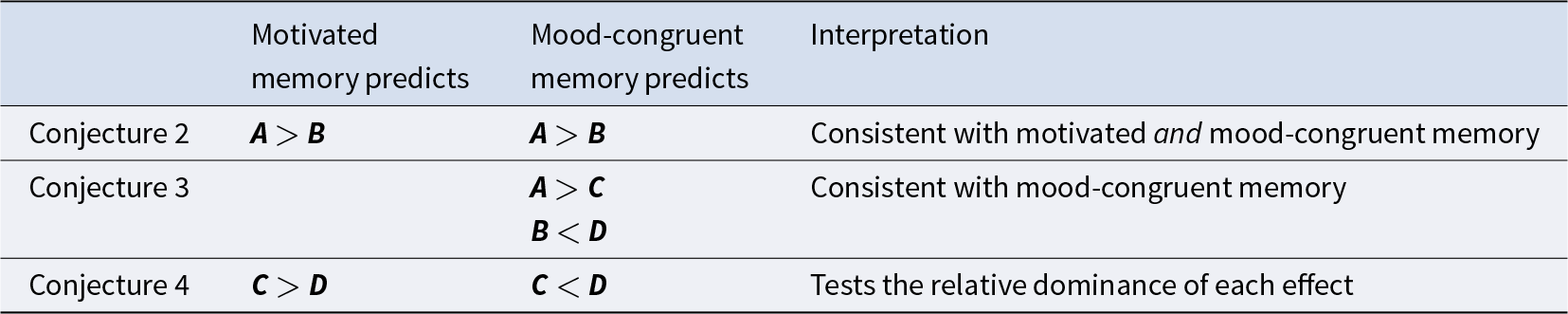
Note: Each letter describes the percentage of subjects who correctly recalled their feedback in each possible state of the world in Table 1.
Conjecture 2. Positive mood
Subjects in positive mood tend to better recall positive than negative feedback. Formally,  $\boldsymbol{A}\% \gt \boldsymbol{B}\%$.
When individuals are in positive mood, both motivated and mood-congruent memory lead subjects to better recall positive feedback, although for different reasons. Motivated memory predicts positive information to meet people’s demand for self-esteem. Mood congruence predicts positive information to be more accessible to recall because it matches one’s current positive mood. Therefore, observing a higher percentage of correct recall for positive than for negative information among individuals in positive mood is consistent with both motivated and mood-congruent memory. However, it is not informative about which mechanism is the dominant force.
To measure the importance of mood congruence in isolation, one needs to compare the percentage of correct recall of individuals in negative versus in positive mood, and conditional on the same type of feedback. Mood-congruent memory predicts that negative mood will favor the recall of negative information and, reversely, positive mood will favor the recall of positive information. Motivated memory is silent about between-treatment comparisons. We state our third conjecture as follows:
Conjecture 3. Mood congruence
Subjects tend to better recall feedback that is consistent with their mood. Formally,  $\boldsymbol{A}\% \gt \boldsymbol{C}\%$ and $\boldsymbol{B}\% \lt \boldsymbol{D}\%$.
Motivated and mood-congruent memories predict similar outcomes in most but not all situations. Motivated memory predicts that subjects in negative mood will better recall positive feedback. In contrast, mood congruence predicts that subjects in negative mood will better recall information that is congruent with their mood, that is, negative feedback. Therefore, the rate of recall accuracy of subjects in negative mood allows to evaluate the relative dominance of the two effects. We state our fourth conjecture as follows:
Conjecture 4. Relative dominance
Do subjects in negative mood recall more accurately positive or negative feedback? (i.e., which effect dominates?).
• If motivated memory dominates, subjects in negative mood recall more accurately positive feedback than negative feedback. Formally, $\boldsymbol{C}\% \gt \boldsymbol{D}\%$.
• If mood-congruent memory dominates, subjects in negative mood recall more accurately negative feedback than positive feedback. Formally,
$\boldsymbol{C}\% \lt \boldsymbol{D}\%$.


Even though either outcome among subjects in negative mood does not discard the existence of the alternative effect, it allows to evaluate their relative predictive validity.Footnote 14
5. Experimental results
5.1. Mood preliminary checks
Mood congruence may arise when the valence of the mood at retrieval aligns with the valence of the feedback to be retrieved. In our two experiments, the identification strategy of mood-congruent memory thus relies on two key assumptions:
(i) Positive (resp. negative) feedback is perceived by subjects as positive (resp. negative) information. While this assumption is taken for granted in most studies (and so we do in our lab experiment), the online survey provides direct empirical evidence (see Section 5.1.1). Importantly, assumption (i) does not assume anything about the mood induced by the signal at encoding. For instance, an individual who receives positive feedback, recognizes it as positive, yet experiences no mood reaction (i.e., remains in their baseline mood − whether positive or negative), still meets assumption (i).
(ii) Subjects are in a positive/negative mood state at the moment of recall. This assumption is central to test the predictive power of motivated vs. mood-congruent memory. Sections 5.1.2 and 5.1.3 provide experimental evidence that our subjects were indeed in different mood states at the time of recall (whether induced or baseline), thereby allowing us to test the four conjectures outlined in Table 2.
5.1.1. Valence of the feedback
To test assumption (i), we carry out a test in the online survey and ask subjects in session 1 to report their emotional reaction to the feedback, using a Self-Assessment Manikin scale (Bradley & Lang, Reference Bradley and Lang1994). In line with the operationalization used in this paper and in Zimmermann Reference Zimmermann(2020), subjects tended to report positive valence when they received two or three positive comparisons out of three. Conversely, they tended to report negative valence when they received zero or one positive comparison out of three.
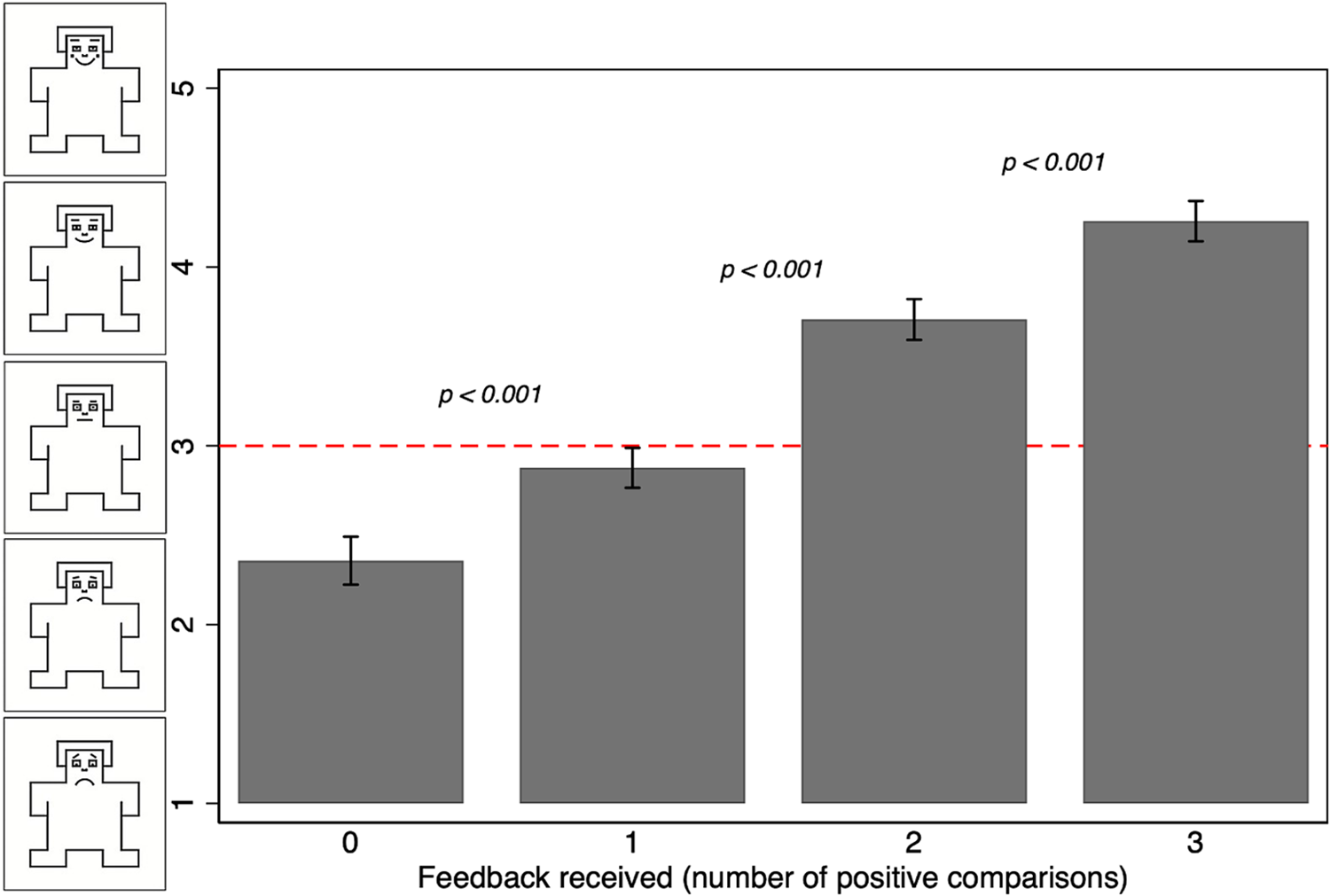
Figure 3 displays the average valence reported by the subjects conditional on the feedback that they received, namely, zero, one, two, or three positive comparisons. The figure shows that the emotional reaction (positive-negative) to the feedback was consistent with the expected direction.Footnote 15 After receiving zero positive comparisons, the average reported valence is 2.47/5. It is 2.76 after receiving one positive comparison, 3.63 after receiving two, and 4.11 after receiving three (p < .001 for all pair-wise comparisons, t-tests). The Pearson correlation coefficient between the number of positive comparisons and the reported valence is 0.551 (p < .001).
Reported mood after receiving feedback

Overall, our online survey provides empirical evidence that positive (resp. negative) feedback is indeed perceived by subjects as positive (resp. negative), thus validating assumption (i). We run this empirical validation in the online survey only, but not in the lab experiment. We therefore assume that survey respondents are good proxies for how the lab subjects react to positive and negative feedback.
5.1.2. Mood manipulation check in the lab
In the lab, a prerequisite for testing our four conjectures is that the mood induction in the second session was effective (assumption (ii)). To check this, we first test and reject the hypothesis that subjects’ levels of mood were different between treatments before watching the video clip (see Appendix 3, Table 9). Then, we compare subjects’ mood after watching the video clip. For this, we follow the manipulation check by Andrade et al. Reference Andrade, Odean and Lin(2015), and elicit subjects’ emotional valence and arousal using the Self-Assessment Manikin technique (Bradley & Lang, Reference Bradley and Lang1994). Valence is measured on a nine-item scale from “unpleasant” to “pleasant,” and arousal on a nine-item scale from “not intense at all” to “very intense.”
Table 3 reports the average emotional valence and arousal after the mood manipulation, by treatment. The average emotional valence in the Positive treatment (7.56) is significantly higher than in the Neutral treatment (5.36, p < .001, Mann–Whitney test). Similarly, the average emotional valence in the Negative treatment (1.80) is significantly lower than in the Neutral treatment (p < .001, Mann–Whitney test). The distribution of the valence is also significantly different between treatments (p < .001, Kolmogorov–Smirnov test). Therefore, subjects in the Positive (resp. Negative) treatment experienced significantly more positive (resp. negative) emotions than those in the Neutral treatment. Figure 4 offers a visual illustration. It plots self-reported valence and arousal by treatment, on a two-dimensional Valence–Arousal space, where each dot represents one subject.
Summary statistics: Subjects’ mood after treatment manipulation

Notes: p-values are from two-tailed Mann–Whitney tests. The Positive and Negative treatments are compared to the Neutral treatment. Standard deviation in parentheses. One observation per subject.
*** p < .01.
Valence–Arousal two-dimensional space, by treatment

Subjects were also asked to report the emotions that best described their feeling after watching the video clip. For this, they could choose one category of emotions from a list. In the Negative treatment, 90% of subjects stated that they felt either “Anxious, scared, terrified” or “Sad, depressed, unhappy.” In the Positive treatment, over 80% of the subjects described their emotional state as “Excited, enthusiastic, happy” or “Calm, relaxed, peaceful” (see Table 10 in Appendix 3).
Overall, these results show that the treatment successfully induced the desired mood.
5.1.3. Distribution of baseline mood
One concern with our experimental data was that the baseline mood of our student sample could be too high. As a result, mood induction, even if effective, may not override the baseline mood. This may prevent the observation of mood-congruent memory. Therefore, we extended our investigations to a nationally representative sample of the US population.
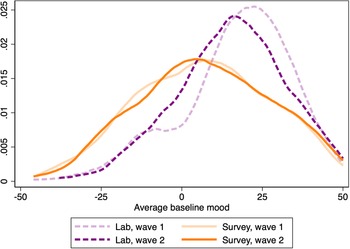
Unlike the lab experiment, the online survey has no mood manipulation. The ability to identify the effects of mood relies instead on between-subject variations of baseline mood. The large and diversified sample we rely on guarantees a good amount of variation. Figure 5 contrasts the distribution of baseline mood (BM) in the survey, compared to the one in the laboratory sample.
Average baseline mood, Lab vs. Survey

First, both samples report, on average, a positive mood. In the representative sample, the average mood score is 7.38 and significantly higher than 0 (t-test, p-value < .001). It is 15.17 in the student sample (t-test, p-value < .001). These findings confirm that mood-congruent memory can be a confounding factor in existing studies on motivated memory, whether using student or non-student samples.
Second, as expected, the distribution is not only more dispersed in the representative survey ( $var(BM_{survey})=433.35$, $var(BM_{lab})=281.66$; p-value < .001; Levine test), but the average mood is also significantly lower ( $mean(BM_{survey})=7.38$, $mean(BM_{lab})=15.17$; p-value < .001; t-test). This confirms that students are a population with a particularly high baseline mood.
We split the sample into two based on the median baseline mood and label as “positive mood” the half of the participants who report a baseline mood score equal or above the median (N = 369) and “negative mood” the rest (N=384).
Overall, these results show that the survey achieved the purpose of interviewing a sample that can offer a more complete picture of the role of baseline mood. It also confirmed the suspicion that our experimental subjects are on average in a good mood, when compared to a nationally representative sample (see Figure 5).
5.2. Main results
We present the four results that correspond to the four conjectures. Each result is based on one-tailed t-tests (empirical counterpart of Table 2) and econometric regressions. Since the results from the experiment and the survey are very similar, we report them in a unified section.
Result 1. Standard asymmetric recall is observed
On average, subjects recall negative feedback with less accuracy than positive feedback.
Result 1 supports Conjecture 1.
Support for Result 1: Table 4 displays subjects’ percentage of correct recalls of the feedback in the laboratory experiment. In the Neutral treatment (no mood induction, column (1)), the average percentage of correct recalls of positive feedback is 89% and the average percentage of correct recalls of negative feedback is 75% (p = .041). When individuals are not induced any mood, they better recall positive than negative feedback.
Average recall accuracy of feedback: Induced mood (lab.)

Note: Neg. feedback =1 if at least 2 out of the 3 comparisons with the randomly selected group members are negative. P-values are from one-tailed t-tests. One observation per subject. Standard deviation in parentheses. Example: Among the subjects in the Neutral treatment who received positive feedback, 89% recall it correctly.
These results are consistent with the original findings by Zimmermann Reference Zimmermann(2020), although the size of the recall asymmetry is less than half than the one observed by Zimmermann in his Recall treatment and double that of the one he observes in his HighRecall treatment. Appendix 4 provides additional analyses based on Zimmermann’s Reference Zimmermann(2020) original dataset, which also shows that subjects in his and our experiments display similar levels of overconfidence.
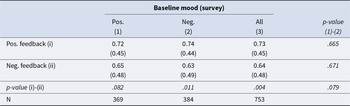
Table 5 displays subjects’ percentage of correct recalls of the feedback in the online survey. Since the survey did not include mood induction, Conjecture 1 can be tested on the whole sample of subjects. Column (1) shows that the average percentage of correct recall is higher for positive than negative feedback (73% vs. 64%, p = .004).
Average recall accuracy of feedback: Baseline mood (survey)

Note: Neg. feedback =1 if at least 2 out of the 3 comparisons with the randomly selected group members are negative. P-values are from one-tailed t-tests. One observation per subject. Standard deviation in parentheses. Example: Among the subjects in positive baseline mood who received positive feedback, 72% recall it correctly.
Table 6 provides coefficients from linear probability models in which the dependent variable is a dummy that takes value 1 if the subject correctly recalled his feedback and 0 otherwise. Models (1) to (4) are run on the laboratory data, while Models (5) to (8) are run on the survey data. The independent variable is a dummy for negative (=1) or positive (=0) feedback. Models (2) and (5) show that, among subjects who were not induced any mood, those who obtained negative feedback recall it with significantly less accuracy one month later (at a 5% and 1% level, two-tailed t-test) compared to those who received positive feedback.
Recall accuracy

Note: Results are from a linear probability model of the likelihood to correctly recall the feedback. Negative feedback =1 if at least 2 out of the 3 comparisons with the randomly selected group members are negative. Robust standard errors in parentheses.
* p< .1, ** p< .05, *** p< .01.
Overall, Result 1 replicates the standard asymmetry observed in the motivated memory literature: Individuals better recall positive than negative feedback. This literature, however, does not take into account individuals’ mood and its effects on the memory of feedback. The next three results investigate individuals’ memory conditional on their mood.
Result 2. Predictions for positive mood are partially met
Subjects in positive mood (whether induced or baseline) recall negative feedback with less accuracy than positive feedback.
Result 2 partially supports Conjecture 2.
Support for Result 2: Table 4, column (2), shows that the percentage of correct recall of subjects induced with positive mood is higher after receiving positive feedback (82%) than after receiving negative feedback (71%). When looking at subjects with positive baseline mood in the online survey, we observe the same pattern: Their percentage of correct recall is higher for positive feedback (72%) than for negative feedback (65%). However, neither of these differences is statistically significant at conventional confidence levels (p = .106 in the experiment; p = .082 in the survey), probably due to an insufficient sample size. Interestingly, when comparing treatments Positive and Neutral in the lab experiment, subjects in the former should have two reasons to recall positive information more accurately, namely, motivated memory and mood congruence. Instead, we observe a stronger recall asymmetry among subjects in the Neutral than in the Positive treatment. The difference is not statistically significant though, as shown in Table 6, Model (2). The regression confirms that the recall asymmetry is present regardless of the induced mood. This is a first hint that mood might not play a decisive role in this recall task.
We now introduce our third result:
Result 3. Predictions of mood congruence are not met
Subjects do not recall more accurately feedback that is congruent with their mood. Specifically, neither subjects in negative mood (whether induced or baseline) recall more accurately negative feedback than subjects in positive mood, nor subjects in positive mood recall more accurately positive feedback than subjects in negative mood.
Result 3 rejects Conjecture 3.
Support for Result 3: Contrary to our initial hypothesis, we find no significant difference in the percentage of recall accuracy for positive and negative feedback between individuals with positive or negative mood.
In the laboratory experiment, subjects in positive mood do not better recall positive feedback (82%) than subjects in negative mood (88%, p = .809). Similarly, subjects in negative mood do not better recall negative feedback (77%) than subjects in positive mood (71%, p = .254).
Just as in the laboratory experiment, subjects in positive mood in the survey do not better recall positive feedback (72%) than subjects in negative mood (74%, p = 0.665); and subjects in negative mood do not better recall negative feedback (63%) than subjects in positive mood (65%, p = .671). The interaction terms in Table 6 (Models (3) and (7)) corroborate this conclusion: Subjects do not better recall information that is consistent with their mood, whether induced or baseline.
We now introduce our fourth result:
Result 4. Motivated memory is the best predictor
Subjects in negative mood (whether induced or baseline) recall more accurately positive feedback than negative feedback. This result is consistent with the prediction of motivated memory.
Result 4 supports the dominance of effects related to motivated memory.
Support for Result 4: In Table 4, column (3) shows that, among people induced with negative mood, the percentage of correct recalls of positive feedback (88%) is higher than the percentage of correct recalls of negative feedback (77%, p = .079). In the regression analysis, introducing the interaction terms between the valence of the feedback and the valence of the mood (Table 6, Model (3)) does not attenuate the size of the coefficient associated with negative feedback. In other words, controlling for mood congruence does not explain away the asymmetry predicted by motivated memory.
In Table 5, column (3) shows that subjects in negative baseline mood better recall positive feedback (74%) than negative feedback (63%, p = .011). Table 6, Model (7) shows that the asymmetric recall bias is observed also when controlling for the interaction terms between the feedback and the mood. Controlling for the belief adjustment predicted by the positive/negative feedback (Models (4) and (8)) does not affect these conclusions.
Overall, Results (2) to (4) show that motivated memory is not just a matter of mood. In a situation where mood-congruent and self-enhancing effects predict diverging outcomes, the latter still offer an accurate prediction of the direction of the recall bias. This is true whether considering mood induced on a population of French students or baseline mood of a representative sample of the US population.
5.3. Robustness checks
Appendix 7 tests the robustness of our results using alternative measures of memory accuracy.
In the laboratory experiment, we follow Zimmermann Reference Zimmermann(2020) (p.354) and analyze how well subjects recall the different parts of session 1 (i.e., IQ-related vs. non-IQ-related). We find that subjects who obtained negative feedback recall fewer IQ-related parts of session 1, compared to those who received positive feedback. Conversely, we find no evidence of mood congruence.
In the laboratory experiment, we also repeat the same type of analysis using two additional memory measures. At the end of session 2, subjects reported on a 10-item scale how confident they were with their memory of the feedback as well as how much effort they put into retrieving this information. When we explore these self-reported measures of effort and confidence, results points in the same directions as Results (1) to (4). In general, subjects find it easier to recall and are more confident about their feedback if it was positive rather than negative. This is also the case in the Negative treatment. Once again, we find no evidence of mood congruence (see Appendix 7, Table 14 for details).
Finally, in the online survey, we consider two alternative measures for positive and negative baseline mood. The first one consists of splitting the sample of subjects based on the mean baseline mood rather than on the median baseline mood. The second one consists of looking only at individuals whose baseline mood is in the top (resp. bottom) 25% of the distribution. Our results are robust to the use of these alternative measures (see Appendix 7), although the recall asymmetry according to the latter definition (which uses only half of the sample) is not statistically significant.
6. Conclusion
This study provides experimental evidence that motivated memory is not just a matter of mood. Our results rule out the hypothesis that some previous influential results about motivated memory can be explained by mood congruence. While the existence of mood-congruent effects is well-documented in several other settings, and we cannot rule out their existence in an experiment à la Zimmermann, they do not appear to be a significant factor for the recall of ego-relevant information. Instead, motivated memory predictions are confirmed.
Our paper mediates between two parallel strands of interdisciplinary literature and complements some recent contributions in economics that integrate mood congruence and motivated memory in the same recall model (Koszegi et al., Reference Koszegi, Loewenstein and Murooka2021, Koszegi et al., Reference Koszegi, Loewenstein and Murooka2022). Our experimental design creates controlled conditions where the two effects predict different outcomes and thereby allows testing which one is the dominant force. Our survey tests the generalizability of the effects across high-mood and low-mood US representative populations. Overall, our data replicate the patterns documented in Zimmermann Reference Zimmermann(2020), and support the predictive validity of motivated memory models.
This paper has some important limitations that we ought to acknowledge. First, in our experiment, the lack of mood-congruence effect might be due to the specific mood induction technique. Although some recent studies have successfully observed mood congruence using video clips (Bland et al., Reference Bland, Howe and Knott2016, Zhang et al., Reference Zhang, Gross and Hayne2019), this is by no means the only mood-induction procedure. Among others, virtual reality goggles (Mol, Reference Mol2019) have been implemented in several mood-induction experiments and look like a promising avenue (Nguyen & Noussair, Reference Nguyen and Noussair2022, Medai & Noussair, Reference Medai and Noussair2021). Besides, a face-reading software could be used for the mood manipulation check (Nguyen & Noussair, Reference Nguyen and Noussair2014, Noussair et al., Reference Noussair, Tucker, Xu and Breaban2024). The fact that we fail to detect mood congruence also in the survey sample, however, suggests that the phenomenon may simply not be a significant factor in a recall task à la Zimmermann. Second, the sample size might play a role: If the detectable effect of mood congruence is smaller than the one of motivated memory, we may fail to observe the former because of a lack of power in our tests. Importantly, this explanation would not affect our conclusions, since it would corroborate the dominance of motivated memory effects. Third, motivated memory is a broad concept that encompasses various types of motivation. When applied to ego-relevant feedback, it is typically interpreted as stemming from an individual’s need for self-esteem or self-image preservation. However, in our lab experiment, when participants are induced into a negative mood, an alternative interpretation could be mood maintenance − the tendency to recall positive signals more than negative ones as a means of restoring or sustaining a positive mood. Insofar as mood maintenance is considered a form of motivation, this interpretation does not alter our conclusion that motivational factors outweigh cognitive ones.
We hope our results will encourage the study of the role of mood for executive cognitive functions, including memory and decision making. In the field, some established methods for tracking moods come from experience sampling methods, where volunteers log their feelings in an app.Footnote 16 The recent inclusion of this feature in many smartphones, as well as some business-research collaborations on this front, can open exciting new avenues.Footnote 17
Overall, our results underline the importance of motivational over cognitive factors in maintaining an inflated self-image. They contribute to the correct understanding of the underlying process of asymmetric recalls, with corresponding implications for the economic settings where motivated memory is used to model behavior. Specifically, this represents a crucial step for any intervention aimed at either mitigating or encouraging self-confidence by the provision of feedback or reminders.
Supplementary material
The supplementary material for this article can be found at https://doi.org/10.1017/eec.2025.10028.
Replication packages
To obtain replication material for this article, https://doi.org/10.17605/OSF.IO/UR726.
Acknowledgements
We are grateful to Nicolas Jacquemet, Stéphane Luchini, Takeshi Murooka, Charles Noussair, Eugenio Proto, Paul Seabright, Sigrid Suetens, Marie Claire Villeval, Florian Zimmermann, and the participants to the IDEE meeting in Bologna, the BEERS seminar in Lyon and the NEEW workshop in Newcastle for helpful comments. We also thank Quentin Thevenet for excellent assistance in the lab, and Isaac Parkes for proofreading the manuscript. This research has been supported by the French National Research Agency (FELIS, ANR-14-CE28–0010-01 and ANR-17-EURE-0020 grants) and the European Research Council, grant 850996, MOREV (Motivated Reading of Evidence) project. All errors are our own.








 Open access

