


In April 2001 the College introduced personal development plans (PDPs) as the mechanism for achieving continuing professional development (CPD) objectives. We moved from an individual, retrospective points counting exercise to a prospective peer-group based activity centring on individuals’ learning objectives (Royal College of Psychiatrists, 2001). The current CPD policy is due for review in 2005. It is largely in line with General Medical Council guidance, Continuing Professional Development (April 2004) and the Academy of Medical Royal Colleges, CPD: The Ten Principles. A Framework for Continuing Professional Development (February 2002), and major revision will not be necessary. Two significant changes will be incorporated in the new policy. The first is an audit procedure whereby a random 5% of returns will be subject to further scrutiny. This is a process audit and necessary for the quality assurance of the system as a whole (Reference Bouch and JacksonBouch & Jackson, 2004). The second will allow us to complete up to 10 h of our 50-h minimum requirement for attending meetings, by engaging in online CPD activities.
CPD and individual psychiatrists
Peer groups
Fundamentally, CPD must have as its chief concern how to support and develop psychiatrists in their ordinary day-to-day clinical practice. We are unique as a Royal College in having a peer group-based CPD process and the feedback about this from participants has been overwhelmingly positive. Three seems to be emerging as the ideal number of members per group. Only two might be regarded as being ‘too cosy’ while more than three leads to practical difficulties in terms of the length and timing of meetings. Having three members allows for a half-day meeting with each person getting an hour to discuss their objectives. A number of peer groups successfully use the ‘ Bridger Model’ (after Harold Bridger) where the roles of reviewer, reviewee and consultant to the process are rotated.
A common question relates to diversity. It can be very comfortable to meet with colleagues from the same psychiatric specialty but we can gain greatly from the differing perspectives offered by colleagues from other areas and contribute to their development with our own personal experience. Having psychiatrists from more than one specialty in a peer group tends to broaden the discussion and can be helpful for suggesting new possibilities for education.
The peer group system was initially conceived as a means of providing both support and accountability. Some groups are going a stage further by developing into ‘action learning sets’ (Reference LavertyLaverty, 2004). The aim of this problem-based approach is to either meet or at least identify the means to meet specific learning objectives within the group.
Learning objectives
As part of the College CPD process participants complete an annual ‘ form E’ at the end of the CPD year. Form Es provide a unique snapshot of individual psychiatrists’ perceived learning needs, constraints and by inference how clearly they understand the process of setting learning objectives.
We personally reviewed the first 100 form Es to be returned to the College in 2002. Eighteen of these were unacceptable (mostly due to insufficient information or eligibility). The remaining 82 contained a total of 292 learning objectives with a range of 1-8 (most commonly 3 or 4). Eighty per cent of returns had learning objectives from two or three different levels. Level 1 objectives relate to being a doctor and include teaching skills, presentation skills and basic medical procedures, e.g. cardiopulmonary resuscitation. Level 2 objectives relate to being a psychiatrist and include knowledge of the Mental Health Act 1983, diagnosis and treatment of psychiatric disorders and leadership of mental health teams. Level 3 learning objectives relate to the particular specialty of the psychiatrist. Level 4 learning objectives relate to the unique job profiles of individuals, including their educational, research, clinical and managerial roles.
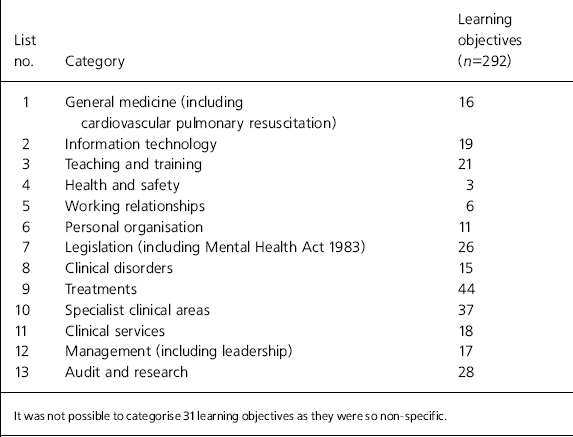
Categorising learning objectives was not straightforward but one of us (J.B.) came up with a total of 13 categories, as shown in Table 1.
Categories of learning objectives
| List no. | Category | Learning objectives (n=292) |
|---|---|---|
| 1 | General medicine (including cardiovascular pulmonary resuscitation) | 16 |
| 2 | Information technology | 19 |
| 3 | Teaching and training | 21 |
| 4 | Health and safety | 3 |
| 5 | Working relationships | 6 |
| 6 | Personal organisation | 11 |
| 7 | Legislation (including Mental Health Act 1983) | 26 |
| 8 | Clinical disorders | 15 |
| 9 | Treatments | 44 |
| 10 | Specialist clinical areas | 37 |
| 11 | Clinical services | 18 |
| 12 | Management (including leadership) | 17 |
| 13 | Audit and research | 28 |
Participants seem to be getting it mostly right with regard to the range and number of learning objectives. In other words three or four well chosen learning objectives covering two or three levels of practice provide appropriate balance and breadth.
Many learning objectives suffered from being too non-specific. For example ‘ maintenance of clinical knowledge’ occurred regularly. This may stem from a desire to be comprehensive. It is quite clear however that unless learning objectives are so broad as to be meaningless, one cannot cover everything under three or four objectives. Becoming more specific might mean changing ‘psychopharmacology’ to ‘updating my knowledge of drug treatments in treatment-resistant recurrent depressive disorder’.
We did not encounter excessive narrowness as a problem area in many form Es, although one registrant had a total of four learning objectives all of which were centred on his current research project.
There was evident confusion between the means of meeting learning objectives and the objectives themselves. Hence ‘attend postgraduate meetings’ and ‘keep up-to-date with the literature’ appeared frequently.
Subjectively, we considered that there was a certain lack of imagination in learning objectives chosen. For this reason we particularly liked where one member had learning objectives which focused on preparing for his retirement and another sought to develop her knowledge of the human condition by attending a medicine and literature study group.
When writing your objectives try to make them SMART; specific, measurable, achievable, resourced and relevant and time-limited. If you write good objectives you should be able to identify how to meet them and see how to assess them when completed. State precisely what you hope you will know, understand or be able to do afterwards that you could not before. Well-chosen objectives should lead to changes in knowledge and understanding, skills or attitudes.
Constraints
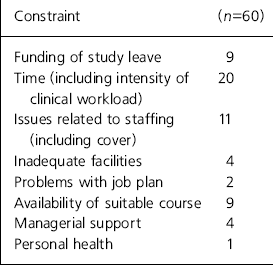
Over half of psychiatrists returning form Es mentioned constraints (see Table 2).
Constraints highlighted on form Es
| Constraint | (n=60) |
|---|---|
| Funding of study leave | 9 |
| Time (including intensity of clinical workload) | 20 |
| Issues related to staffing (including cover) | 11 |
| Inadequate facilities | 4 |
| Problems with job plan | 2 |
| Availability of suitable course | 9 |
| Managerial support | 4 |
| Personal health | 1 |
This is an area of significant concern. The CPD of individual psychiatrists must be seen as an integral part of the working week, not an add-on activity which may or may not be funded. To meet the minimum annual requirement involves 100 h of personal study or research; 50 h of attending meetings (10 h may be completed online); 2 half-days to meet with your peer group; the activities associated with these requirements, including making arrangements, travel and the completion of paperwork. In the new contract a bare minimum to meet these minimum requirements, taking into account annual leave, would be one 4-h programmed activity per week on average.
The paperwork
In the policy document there is a series of suggested forms for developing a PDP. We have received many comments about these forms, signalling a need for their revision. Form A is your PDP and quite straightforward. Form E is mandatory, as it is the end of year sign-off form. Its completion and return to the College is essential to remain in good standing for CPD. You may wish to avoid forms B, C and D but it is important to keep records of all the educational events you attend. You should keep some form of paper evidence relating to the external CPD meetings that you attend; this might be a copy of the programme of the meeting or a certificate of attendance detailing the number of hours involved. The College will require this evidence in the event that your form E is subject to random audit. The audit process is described elsewhere (Reference Bouch and JacksonBouch & Jackson, 2004).
Problems
The CPD Committee often receives suggestions from members that those who work less than full-time should be permitted to undertake pro-rata CPD. We have consistently held to the principle that the CPD requirement is the minimum that should be expected of all career grade psychiatrists in current practice, whether they are full-time, part-time or semi-retired. The basis is that if psychiatrists are involved in the assessment or treatment of patients, no matter how many or how few, they need to be fully up to date in their education relevant to their practice. There can be no such thing as being partially up to date.
Members who do have difficulty with the CPD programme should contact their CPD regional coordinator who may well be able to help find solutions. For example, those who have retired from full-time practice might invite someone with a National Health Service (NHS) contract into their peer group or they might consider joining their group with another group so that it is not exclusively retired doctors. Colleagues in the NHS could then keep their semi-retired colleagues abreast of local seminars, ward rounds and other activities that would count towards their CPD.
The College and CPD
Standard setting and regulation
The College traditionally has had its chief role in terms of standard setting. It is quite clear however that there is an expectation from both the public and the government that the Royal Colleges should play a bigger role in regulation. Initially CPD was in fact conceived as the main mechanism by which the College would deal with poorly performing doctors. It has now become a mechanism that ‘allows (all) doctors to demonstrate that they are maintaining their skills in their practice’ (General Medical Council, 2004). As such it is a vital component of both appraisal and revalidation (Reference BouchBouch, 2003). Our involvement in this process will hopefully be protective against poor performance in most cases but it will probably be insufficient as the only means by which our College addresses poorly performing doctors.
In addition to the Royal Colleges being drawn more into the area of regulation, other bodies are encroaching on the College's traditional role of standard setting. The General Medical Council as mentioned has provided guidance on CPD (albeit with close reference to the Academy of Medical Royal Colleges). The postgraduate medical education and training board is likely to have an important influence on CPD in the future.
CPD provision - general
Of equally significant importance for the College is its role as a CPD provider. This has been a traditional role of the College, although it would not have been described in such terms. The British Journal of Psychiatry, the Psychiatric Bulletin, Gaskell publications and College meetings have all been important means by which psychiatrists have developed their knowledge, skills and attitudes.
In the wake of CPD has come Advances in Psychiatric Treatment, a journal of continuing professional development of the Royal College of Psychiatrists. This has proved to be a hugely successful venture with an annual subscription that has been steadily rising and at the end of 2004 stood at over 2300 individual subscribers. The journal focuses particularly on areas likely to impact upon ordinary clinical practice. A second key development is the recently constituted CPD Online. The College is making a major investment in this area in recognition of the changing personal learning styles of doctors and the technological advances that make it an increasingly attractive medium.
In addition to the College role as a CPD provider to affiliates, members and fellows, the College is likely to have an increasing role as a CPD provider to those not directly involved with the College: to the staff grade and associate specialist psychiatrists who have no membership of or affiliation to the College (at present about 70%); to other medical practitioners involved in mental health (i.e. almost every doctor!); to non-medical professionals involved in mental health, notably registered mental nurses; and lastly to a largely unexploited international market.
However, it is in becoming a better provider to our own membership that the chief challenge lies. The Harrogate 2004 Annual Meeting was the first meeting to be directly influenced by returns of individual members, with a number of workshops directed at meeting the most commonly recorded learning objectives as submitted in annual form Es. The more imaginative and specific learning objectives, the better to inform this process.
CPD provision - training
The term ‘training’ implies a focused and systematic approach to learning where developing competencies is central. The competence-based approach to learning has revolutionised undergraduate medical education, is beginning to do the same with postgraduate training and will in turn impact on CPD. At present there are few training opportunities designed specifically for consultants. The College runs courses with regard to some specialist roles such as electroconvulsive therapy supervisor, educational supervisor and college tutor. Attendance at these is not seen as essential however. Attendance of Section 12 (20 in Scotland) training is mandatory prior to gaining an approved role using the Mental Health Act 1983, but there is no assessment of competencies acquired. Some external organisations have developed relevant courses, especially in the area of treatments, notably the psychotherapies but also in psychopharmacology.
However there are few, if any, identified mechanisms for the training involved in supporting consultants back to work after prolonged absence, where poor performance has been identified or where individuals wish to change their career (either to psychiatry from a different medical specialty, or within psychiatry from one specialty to another). These are important if we are to have a modern and flexible medical workforce; if only to address the significant manpower issues we are currently facing.
Furthermore, there are areas where major concerns have been raised which affect us all, for example racism. Our College is proud that it was the first Royal College to submit to analysis of its processes and procedures with a view to identifying institutional racism. It has strongly supported combating institutional racism and discrimination in the College itself, the NHS and mental health services (Reference GouldGould, 2004). In the light of the David Bennett Inquiry, a College press release talked of ‘Training of psychiatrists at all levels in cultural capability and sensitivity’ and this theme is taken up strongly in a recent BMJ editorial responding to the Department of Health's recently launched policy frameworks (Reference Bhui, Mckenzie and GillBhui et al, 2004). The MRCPsych examinations are being modified in response to these issues. It is surely essential also that we develop training packages for individual consultants in cultural competence.
We are faced with two major challenges: the first is structural - can the College develop a clearly focused and coordinated approach to CPD provision? This might involve, for example, the creation of a clinical training unit; the second challenge is with regard to the development of the training packages - ‘ CPD modules’.
Taking our previous example of cultural competence training for consultants, it is clear that a well-ordered approach to this cannot be achieved by the present system. A more comprehensive and integrated package involving reading, online learning, and workshops would be ideal, possibly with some form of assessment and certification at the end of the process. This cannot be left to the initiative of individual psychiatrists to meet in a piecemeal fashion. Rather, it would involve the bringing together of members, College staff and departments in a more vital and creative way.
Conclusion
The CPD policy, its structures, mechanism and regulation are now clearly embedded. The major challenge facing us as individuals is to continue to make CPD a useful, supportive and integrated part of our ordinary clinical practice. For the College itself the major challenge is to accept the mantle of becoming a major CPD provider.


 Open access


eLetters
No eLetters have been published for this article.