




Introduction
Soil fertility depletion is reported to be the main cause of the widespread decline in land productivity in sub-Saharan Africa (Sanchez and Jama, Reference Sanchez and Jama2001). Tan et al. (Reference Tan, LAL and Wiebe2005) estimated a total NPK deficit on a global scale in 2000 of 20 Tg (1012 g), of which 75% was in developing countries. Soil erosion, nutrient leaching, removal of crop residues and continuous cultivation are major factors responsible for soil fertility depletion (Stoorvogel and Smaling, Reference Stoorvogel and Smaling1998). One bottleneck to increased productivity among low-income smallholder farmers is inadequate use of agricultural inputs to replenish nutrients removed by crops. Soil acidity is also a major yield-limiting factor in crop production. Low-fertility acid Ferralsols and Acrisols (FAO, 2006), which approximately correspond to Oxisols and Ultisols, respectively (USDA, 1999), cover around 43% of land in the tropics and a significant proportion of at least 48 developing countries in tropical areas (Sanchez and Logan, Reference Sanchez, Logan, Lal and Sanchez1992). In some countries, such as Rwanda, the proportion of acid soils under cultivation may be as high as 66%, with half these soils having pH < 5.5 (Nduwumuremyi et al., Reference Nduwumuremyi, Ruganzu, Mugwe and Rusanganwa2013b). The low fertility of acid soils is generally due to excessive levels of soluble aluminium (Al), manganese (Mn) and iron (Fe), and deficiency of phosphorus (P), calcium (Ca), magnesium (Mg), potassium (K), sulphur (S) and zinc (Zn), although Al toxicity and P deficiency are generally the most important factors (Foy and Fleming, Reference Foy and Fleming1978).
Animal manure is a key resource in increasing and maintaining soil fertility, by providing nutrients, increasing soil organic matter, cation exchange capacity (CEC) and pH (acid soils), improving soil physical properties like water-holding capacity (WHC) and reducing soil erosion (Bayu et al., Reference Bayu, Rethman and Hammes2004). Organic amendments, particularly cattle manure, can thus replace or supplement mineral fertilisers and lime in reversing soil degradation. However, animal manure is often only available in limited quantities. Through micro-dosing, farmers who normally cannot afford/access the recommended doses of fertilisers and/or organic manure can make the most of their resources (Fairhurst, Reference Fairhurst2012; Ibrahim et al., Reference Ibrahim, Abaidoo, Fatondji and Opoku2016). However, little is known about the effect of micro-dosing organic/animal manure on crop production and soil properties.
Livestock manure is a valuable asset in smallholder farming, but is often of poor quality because of the low nutrient content of local feeds and inadequate manure handling and storage. Feed quality in terms of, e.g. protein or mineral content is known to affect animal productivity and the fertiliser value of the manure. But little information is available on the effects of livestock diets on the quantity and quality of manure produced under tropical conditions (Muinga et al., Reference Muinga, Mureithi, Juma and Saha2007). Significant increases in nitrogen (N) concentrations in manure from cows fed a diet supplemented with Mucuna and Crotalaria have been reported (Muinga et al., Reference Muinga, Mureithi, Juma and Saha2007), with a linear relationship between N intake and N excretion in faeces and urine (Lekasi et al., Reference Lekasi, Tanner, Kimani and Harris2002). Supplementing low-quality basal feeds with protein-rich concentrates is challenging for low-income smallholder farmers, but leguminous tree/shrubs can be used as valuable sources of protein and mineral supplements in animal diets (Simbaya, Reference Simbaya2002).
This study investigated (i) the effect of cattle manure on soil acidity, nutrient concentrations and water infiltration and retention compared with the effect of NPK fertiliser and lime, and (ii) the effect of supplementing a grass-based animal diet with a forage legume (Acacia angustissima) on soil properties when the resulting manure was applied to soil. The hypothesis was that manure would provide a combined liming and fertiliser effect comparable to that of NPK fertiliser plus lime for soil fertility improvement, and that supplementing the animal diet with legumes would increase the concentrations of N and basic cations in the manure and subsequently in the soil.
Materials and Methods
Site characterization
A field experiment was carried out at Tonga University research station in Rwanda (2°35′15.122″S; 29°43′43.251″E; 1700 m above sea level). Mean annual air temperature at the site is 19.1 °C and mean annual rainfall is 1150 mm (Climate-Data.org, 2019), distributed over two cropping seasons: a short rainy season from September to mid-December (referred to as season A) and a long rainy season from mid-February to mid-June (referred to as season B), with precipitation peaks in November and April. The study was conducted during four cropping seasons (2016B–2018 A). The soil at the site is a former Haplic Ferralsol changed to Anthropic Ferralsol (FAO, 2006) due to radical terracing. The arable horizon has a sandy loam texture with 64% sand, 21% silt, 15% clay and bulk density of 1.23 g cm-3. The soil is acidic (baseline in Figure 2) and has low soil organic carbon (SOC), low CEC and low nutrient concentrations (baseline in Figures 3–4). The land was left fallow for more than 10 years prior to the experiment and the vegetation was dominated by Eucalyptus spp. and Eragrostis curvula. Land preparation involved cutting trees using machetes and hand hoeing.
Experimental design
The layout was a two-factor, randomised complete block design with four replicates and maize (Zea mays L.) as the test crop. Each block was divided into eight (4 m × 3 m) plots established on four consecutive bench terraces. The treatments were grass-only manure combined with lime; grass-only manure without lime; grass+legume manure with lime; grass+legume manure without lime; NPK fertiliser with lime; NPK fertiliser without lime; non-fertilised with lime and non-fertilised without lime. The N in the inorganic fertiliser (NPK17-17-17) was present as NH4 +.
The manures used were collected from cattle fed only Chloris gayana grass (grass-only manure) and cattle fed C. gayana supplemented with leaves from the tree legume Acacia angustissima (grass+legume manure). The liming material used was travertine (33.3% Ca, 1.16% Mg) collected from Mashyuza, Rwanda, and milled to pass through a 2-mm sieve. The manures were applied at 25% of the rate recommended by the National University of Rwanda and lime was used at 25% of the required rate to neutralise soil acidity at the site. NPK17-17-17 treatment served as a positive control where the rate was set to achieve a recommended N availability of 80 kg N ha-1 (Sallah et al., Reference Sallah, Mukakalisa, Nyombayire and Mutanyagwa2009) including the mineral N available in the soil at the start of the first cropping season, while the unamended treatments served as negative control. All additives were concentrated in the planting stations (immediate area around each maize plant), to maximise their effectiveness and use efficiency.
The planting stations comprised 25% of total plot area. Prior to maize planting in each season, 5 t manure dry matter (DM) ha-1 (corresponding to 125 g planting station−1) was applied. The NPK was applied in each planting season, at a total rate of 70 kg N ha-1 (corresponding to 10 g NPK planting station-1) in split doses, with 20% at planting, 40% 6 weeks after planting and 40% 8 weeks after planting. The lime was applied before planting the crop in the first and third seasons, at a rate equivalent to 2 t CaO ha-1 (corresponding to 50 g planting station-1). The maize stover was left on plots after harvest and the same planting points were retained over all growing seasons.
Manure collection, handling and analysis
All cattle feeding and manure collection in each season was performed at the former Gihindamuyaga Animal Teaching and Research Station, University of Rwanda, close to the experimental site. Two lots of six cattle were fed at a daily rate of 30% of their body weight for 30 days. Before collecting manure, a 5-day adaptation to the diet was allowed. The feed was either the basal diet (C. gayana) or C. gayana supplemented with A. angustissima, at a rate of 30% dry weight of the daily ration. Both feeds were fed fresh. The grass was at the flowering stage when harvested and the legume supplement consisted of the leafy fraction (leaves, twigs and succulent stems <8 mm diameter). Water was supplied ad libitum. Faeces and urine were collected directly on excretion, separated according to feed type and bulked in separate composting pits lined and covered with plastic sheeting to reduce loss of nutrients by leaching and volatilisation. This storage method is considered the best farmers’ practice achievable in the area. Composting time varied between 10 and 12 weeks, with frequent turning of the manure. Before application in the field trial, eight subsamples of each manure were taken randomly, pooled and taken to the laboratory for analysis. Samples were dried and milled to <2 mm. Total N was determined using the micro-Kjeldahl method (Anderson and Ingram, Reference Anderson and Ingram1993) and measured colorimetrically. In the same digest, total P was measured colorimetrically without pH adjustment (Okalebo et al., Reference Okalebo, Gathua and Woomer2002), and basic cations (Ca, Mg, K and Na) were determined by atomic absorption spectrophotometry (VARIAN) (Okalebo et al., Reference Okalebo, Gathua and Woomer2002). Organic carbon was determined by the Walkley–Black method (Anderson and Ingram, Reference Anderson and Ingram1993).
Soil sampling and analysis
On setting up the trial, 10 soil samples were taken from the top 0–20-cm layer in each plot using an auger and pooled to form a composite sample per plot. These samples were analysed for soil texture and chemical parameters (baseline in Figures 2–4). Soil sampling was repeated at the planting stations after each cropping season and chemical parameters were evaluated again. To ensure that only treated soil was collected, samples were taken within a distance of 10 cm from the maize plants and to a depth of 0–20 cm. Soil physical characteristics were determined at the end of the fourth cropping season, when water infiltration rates were measured at the planting stations.
Soil pH was determined in distilled water at 1:2.5 soil:water ratio and total exchangeable acidity (TEA: H+ and Al3+) by 1 N KCl extraction and titration with NaOH (Anderson and Ingram, Reference Anderson and Ingram1993). Total nitrogen (TN) was determined by the micro-Kjeldahl method (Anderson and Ingram, Reference Anderson and Ingram1993), SOC by the Walkley–Black method (Anderson and Ingram, Reference Anderson and Ingram1993) and available phosphorus (Av. P) by the Bray-1 test (Bray and Kurtz, Reference Bray and Kurtz1945). Exchangeable bases (Ca2+, Mg2+, K+ and Na+) were determined by ammonium acetate extraction and flame photometry (Anderson and Ingram, Reference Anderson and Ingram1993). The CEC was determined by the acetic acid method (Aprile and Lorandi (Reference Aprile and Lorandi2012). Water infiltration rates were determined by the double-ring infiltrometer method (Anderson and Ingram, Reference Anderson and Ingram1993). Soil WHC was determined in the laboratory using a sand box apparatus (Eijkelkamp Agrisearch Equipment, Giesbeek, The Netherlands) at pF 0, 0.4, 1.0, 1.5 1.8 and 2.0, for undisturbed soil samples and using pressure plate equipment (Soil Moisture Equipment, Santa Barbara CA, USA) at 5 and 15 bar for disturbed samples.
Statistical analysis
Data on soil properties were subjected to two-way analysis of variance (ANOVA) to evaluate the effect of (i) manure/fertiliser application and liming and their interaction, by cropping season, and (ii) manure type and liming and their interaction, by cropping season, using JMP Pro 14 software (JMP® 14.0.0, SAS Institute Inc., Cary NC, USA). When significant effects were found at the 5% level, Tukey’s multiple comparison tests were used to test for differences between treatment least-square means (LSMeans).
Results
Gradual changes in soil properties were observed over time, but only results for the baseline and the end of the fourth maize cropping season are reported here. Data for all seasons can be found in the Supplementary Material.
Chemical composition of manures
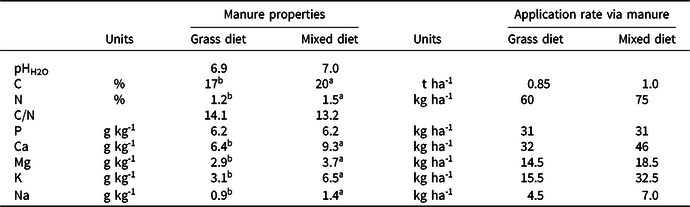
The concentrations of N, SOC, Ca, Mg, K and Na were significantly higher in grass+legume manure than in grass-only manure, but pH, P concentration and C/N ratio were not significantly affected by treatments (Table 1).
Chemical composition of the two manure types and application rates of nutrients via the manures obtained from cattle fed on grass-only diet or a mixed grass+legume diet given as mean of the four seasons

The manures were produced by cattle fed 100% Chloris gayana (grass diet) and cattle fed the grass diet supplemented with Acacia angustissima at 30% of the feed ratio (mixed diet). Data determined after drying the material at 70 °C. Mean value followed by different letters are significantly different (p < 0.05).
Soil physical properties
Manure application increased soil WHC compared with the non-fertilised treatment (Figure 1). NPK fertiliser also increased WHC compared with the non-fertilised, non-limed control, but the differences between the limed and non-limed treatments were not significant. Main effect analysis showed that manure application led to higher WHC (p = 0.0001) than NPK application, with a significant difference (p = 0.033) between lime manure and non-lime manure treatments, although individual treatments did not differ significantly. Main effect analysis also showed that soil infiltration rate increased significantly under the manure treatment with lime compared with the non-fertilised treatment, but not compared with the NPK treatment. WHC was significantly higher after application of grass+legume manure than grass-only manure (p = 0.013), although individual treatments did not differ significantly. Infiltration rates were not significantly affected by manure type.
Response of soil water-holding capacity (WHC) and infiltration rate to soil amendments. Non-fert., non-fertilised; Grass only, manure from C. gayana; Grass+Acacia, manure from C. gayana+A. angustissima. All values shown are mean value for the fourth cropping season. Means with different letters are significantly different (p < 0.05).

Soil chemical properties
Manure and lime application increased soil pH and decreased TEA and Al3+ (p < 0.0001) compared with the baseline and non-fertilised control (Figure 2a, Figure 2b). The non-limed NPK treatment also caused significantly lower pH and higher TEA and exchangeable Al3+ than the limed treatments from the third season on (Supplementary Material Table S1) and did not differ significantly from the baseline (p = 0.1982). There were no significant differences in soil acidity between plots treated with grass-only manure and grass+legume manure.
Effect of manure, NPK fertiliser and lime on total exchangeable acidity (TEA, in a), exchangeable Al3+ (a) and soil pHH2O (b). Non-fert., non-fertilised; Grass only, manure from C. gayana; Grass+Acacia, manure from C. gayana+A. angustissima. Data shown are mean value for the fourth cropping season. Means with different letters are significantly different (p < 0.05).

Soil organic carbon and CEC increased in manured compared with non-fertilised treatments and the baseline (Figure 3a, Figure 3b). SOC and CEC also increased in the NPK treatments compared with the baseline (p < 0.0001), but the effect was not significant for limed and non-limed treatments separately. Liming significantly (p < 0.0001) increased both SOC and CEC when tested across fertiliser treatments, although the effect was not significant for individual fertiliser treatments (Supplementary Material Table S2). Main effect analysis showed that CEC increased more upon application of grass+legume manure than grass-only manure.
Effect of manure, NPK fertiliser and lime on soil organic carbon (SOC, in a), cation exchange capacity (CEC, in b), on soil total nitrogen (N, in c) and available phosphorus (P, in d). Non-fert., non-fertilised; Grass only, manure from C. gayana; Grass+Acacia, manure from C. gayana+A. angustissima. Data shown are mean value for the fourth cropping season. Means with different letters are significantly different (p < 0.05).

Manure and NPK treatments increased soil total N and available P compared with the unfertilised control, but there were no significant differences between the manure and NPK treatments (Figure 3c, Figure 3d). Analysis of lime application treatments showed increased total N (p < 0.0001) and available P (p = 0.0009) from the third season (Supplementary Material Table S3). The effect of the two manure types on soil total N and available P did not differ significantly, although the mean values were higher in soil treated with grass+legume manure.
The manure, lime and NPK treatments all increased the exchangeable Ca2+ and Mg2+ content compared with the baseline (Figure 4) and this occurred from the second season on (Supplementary Material Table S4). The effects of manure and NPK application on Ca2+ were similar, but manure increased Mg2+ compared with NPK. As expected, Ca2+ and Mg2+ were significantly higher in limed, non-fertilised than in non-limed, non-fertilised treatments. No significant differences were observed in soil K+ concentrations. There were no significant differences in soil Ca2+, Mg2+ and K+ concentrations between treatments receiving the two manure types.
Effect of manure, NPK fertiliser and lime on exchangeable Ca2+, Mg2+ and K+. Non-fert., non-fertilised; Grass only, manure from C. gayana, Grass+Acacia manure from C. gayana +A. angustissima. Data shown are mean value for the fourth cropping season. Means with different letters are significantly different (P < 0.05).

Discussion
The composition of manure varies depending on animal diet, animal itself and the way in which manure is collected, stored and applied (Bayu et al., Reference Bayu, Rethman and Hammes2004). In this study, the concentrations of N, C, Ca, Mg and K were significantly higher in grass+legume manure than grass-only manure (Table 1). This reflected the higher concentrations of these nutrients in the mixed grass+legume diet (Mukangango et al., Reference Mukangango, Wredle, Mutimura and Dahlin2018). An increase in N content in manure after supplementation of low-quality forage with protein-rich feeds such as concentrates and legume tree forage has been reported previously (Lekasi et al., Reference Lekasi, Tanner, Kimani and Harris2002; Delve et al., Reference Delve, Cadisch, Tanner, Thorpe, Thorne and Giller2001). Delve et al. (Reference Delve, Cadisch, Tanner, Thorpe, Thorne and Giller2001) reported an increase of 250% in total N content in manure when a cattle diet of barley straw was supplemented to 30% with Calliandra calothyrsus. The enhanced concentrations of multiple nutrients in the manure derived from C. gayana supplemented by A. angustissima in the present study show that feed supplementation may enhance manure quality in more ways than just increasing N concentration. Other factors, like manure handling and composting or storage, have also been reported to affect manure quality through their effects on nutrient losses via volatilisation and leaching (Shah et al., Reference Shah, Shah, Groot, Oenema, Raza and Lantinga2016; Tittonell et al., Reference Tittonell, Rufino, Janssen and Giller2010). The manures in this study were composed of a mixture of faeces and urine and composted for 2.5–3 months in pits lined and covered with plastic sheeting, as an easy and affordable method for smallholder farmers. Based on this manure handling and storage method and reasonable composting time, we expected an increase in manure quality, especially in total N concentration, over the composting period. Previously, Shah et al. (Reference Shah, Groot, Oenema and Lantinga2012) observed an increase in total N from 28.8 g kg-1 DM in fresh manure to 30.1 g kg-1 DM in covered heap manure with a plastic sheet below and above the heap. We did not determine the N concentration in the fresh manure, but the low N concentrations in the composted manure suggest that losses occurred or that even the mixed grass+legume diet was lower in proteins than that used by Shah et al. (Reference Shah, Groot, Oenema and Lantinga2012).
Soil infiltration rate and WHC were higher after manure application than in the NPK and control treatments. Similarly, Li et al. (Reference Li, Chang and Yang2015), Larney and Angers (Reference Larney and Angers2012) and Adeleye and Ayeni (Reference Adeleye and Ayeni2010) observed changes in soil physical properties with organic manure treatment, and an increased concentration of SOC in the manure treatments, as also found in this study (Figure 3a). Increased SOC has been shown to increase the stability of aggregates and macropores and soil porosity (Li et al., Reference Li, Chang and Yang2015), which are all important since water infiltration depends strongly on total porosity and pore size distribution. Water storage in soil, especially the amount of plant-available water, generally increases with SOC content through its effects on pore size distribution (Gilley et al., Reference Gilley, Risse and Eghball2002; Franzluebbers, Reference Franzluebbers2002). Increased infiltration rate can reduce water losses via runoff and, together with increased soil WHC, can increase the amount of available water for plants, increase nutrient solubility and availability and enhance soil microbial activity (Bayu et al., Reference Bayu, Rethman and Hammes2004; Franzluebbers, Reference Franzluebbers2002). The increased water stock can sustain crops through dry spells in the growing season, which are otherwise a challenge in rain-fed agriculture.
Soil analysis before establishing the trial showed that the soil was very acidic (pH 4.3), with low SOC, N, P, K, Ca and Mg concentrations and low CEC. Low fertility restricts crop growth (Hazelton and Murphy, Reference Hazelton and Murphy2007), and lime is used as the main measure for lowering soil acidity, which inhibits the availability of nutrients required for high yields (Fageria and Baligar, Reference Fageria and Baligar2008). Here, the liming effect developed gradually over the four cropping seasons (Supplementary Material Table S1), with a significant increase in soil pH after the second cropping season. We observed an average pH increase (0.19 units) after the first cropping season, which is in line with the pH increase of 0.17 units after 16 weeks reported by Nduwumuremyi et al. (Reference Nduwumuremyi, Mugwe, Ruganzu, Rusanganwa and Nyirinkwaya2013a) at a rate of 1.4 t travertine ha-1. Due to the very low original pH (4.3) and slow dissolution of the crushed travertine, the liming effect was not sufficient to improve conditions for the maize during the first season.
Organic manure derived from livestock generally increases the pH in acid soils, but the effect differs depending on manure composition, dose and soil properties. Our findings are in line with other reported increases in pH after manure application (Whalen et al., Reference Whalen, Chang and Clayton2002; Eghball, Reference Eghball1999; Naramabuye and Haynes, Reference Naramabuye and Haynes2006). The increase in soil pH and decrease in TEA and exchangeable Al3+ resulting from manure application were similar to that of the lime, confirming our hypothesis that animal manure can provide a combined liming and fertiliser effect comparable to that of NPK fertiliser plus lime. Increasing the pH of acidic soils improves the nutrient availability for plants, while reducing the solubility of Al3+ (Haynes and Mokolobate, Reference Haynes and Mokolobate2001). However, although the soil pH increased from very strongly acid (pH between 4.5 and 5) to strongly acid (pH between 5 and 5.5) over the 2 years, pH did not reach values >5.5, at which Al toxicity is substantially alleviated (Rout et al., Reference Rout, Samantaray and DAS2001). Nevertheless, in the longer term, micro-dose manuring would be progressively beneficial to soil fertility improvement and crop production for farmers with limited capacity to purchase lime and produce manure.
Soil pH in the non-limed NPK treatment was similar to that in the non-fertilised control and the baseline (Figure 2b). The acidification often associated with ammonium-based fertilisers (Liu et al., Reference Liu, Yan, Mei, He, Bing, Ding, Liu, Liu and Fan2010; Han et al., Reference Han, AN, Hwang, Kim and Park2016; Ge et al., Reference Ge, Zhu and Jiang2018) thus seems to be insignificant at the study site, probably due to low soil pH limiting the nitrification process. According to Sahrawat (Reference Sahrawat2008), substantial nitrification takes place in soil at pH ranging from 5.5 to about 10.0, with the optimum around 8.5, and nitrification is severely curtailed at soil pH < 5.0. The low original pH at our study site may thus have precluded further acidification by the ammonium-based fertiliser, an otherwise common challenge in the region, where urea and ammonium-based fertilisers dominate the market.
The manure and NPK fertiliser treatments increased SOC and CEC compared with the unfertilised treatments (Figure 3a, Figure 3b). Similarly, Haynes and Naidu (Reference Haynes and Naidu1998) and Adams et al. (Reference Adams, Gillespie, Kar, Koala, Ouattara, KImaro, Bationo, Akponikpe, Schoenau and Peak2016) report significantly increased SOC after application of either reduced or recommended NPK fertiliser rate compared with controls. Tovihoudji et al. (Reference Tovihoudji, Akponikpe, Agbossou, Bertin and Bielders2017) also observed an increase in average SOC content with increasing levels of manure application, but the differences were not significant. The higher values of SOC in the manure treatments were associated with the organic C content of the manure itself (Table 1) and increased above- and below-ground biomass production, while the slight increase in SOC with NPK fertiliser was solely due to increased biomass inputs from maize crop residues (Supplementary Material Table S5). Haynes and Naidu (Reference Haynes and Naidu1998) reported increased organic matter content and CEC in soil due to fertiliser-induced crop yield increases. As CEC is closely related to soil organic matter content, the CEC will change with the SOC, as influenced by the rate and type of fertiliser/soil amendment (Bationo et al., Reference Bationo, Kihara, Vanlauwe, Waswa and Kimetu2007), as demonstrated herein. Due to the inherent nutrient content of SOC and its contribution to soil CEC, maintaining its level through animal manure or crop residues helps in retention and storage of nutrients. The larger increase in SOC in the manure treatments than the NPK treatments was also reflected in increased WHC and water infiltration rate, as discussed above.
Based on soil test interpretation (Hazelton and Murphy, Reference Hazelton and Murphy2007) and soil fertility analysis at the site (baseline in Figures 1–4), the soil was considered to have very low to low levels of nutrients. The cattle manure and NPK fertiliser improved the concentrations of most nutrients at the maize planting stations compared with the baseline and control, whereas no differences were observed in total N (Figure 3c) and exchangeable K (Figure 4) between the NPK-fertilised plots and manured plots. Adams et al. (Reference Adams, Gillespie, Kar, Koala, Ouattara, KImaro, Bationo, Akponikpe, Schoenau and Peak2016) also found no significant difference in soil N and K between a mineral fertiliser micro-dosing option and recommended manure rates. However, Han et al. (Reference Han, AN, Hwang, Kim and Park2016) observed a 17% increase in soil N content after manure treatment, while the content in an NPK fertiliser treatment was similar to that in the control. The increasing available soil P (Figure 3d) at the planting stations in our manure treatments corroborates findings by Tovihoudji et al. (Reference Tovihoudji, Akponikpe, Agbossou, Bertin and Bielders2017). In addition to increasing N, P and K, manure application increased Ca2+ and Mg2+ concentrations at the planting stations. This increase in base cations indicates that manure plays a substantial role in provision of these nutrients, either by direct decomposition of manure and/or by influencing their availability through provision of exchange sites in soil organic matter (Mulia et al., Reference Mulia, McMahon, Purwantara, Bin Purung, Djufry, Lambert, Keane and Guest2019).
Farmers in Rwanda apply NPK fertiliser at an estimated rate of 8–23 kg ha-1 (Kathiresan, Reference Kathiresan2011) and cattle manure at approximately 3.5 t ha-1 (Kim et al., Reference Kim, Tiessen, Beeche, Mukankurunziza and Kamatari2011). The recommended rate for mineral fertiliser to reach full agronomic potential is 232 kg ha-1 (IFDC, 2014), while a rate of 70 kg N ha-1 was used in this study. On average, Rwandan farmers’ fields are thus insufficiently fertilised, but not unfertilised/non-manured. To improve the use efficiency of limited resources, smallholder farmers should practise micro-dosing of mineral fertilisers and manure, as it appears to be beneficial for soil quality and plants by improving soil fertility close to the plant, where it matters most. Over time, however, such micro-dosing may accelerate depletion of soil nutrient stocks, especially between planting points, and of nutrients not applied via fertilisers, by increasing crop production and thus crop nutrient uptake (Vanlauwe and Giller, Reference Vanlauwe and Giller2006; Tovihoudji et al., Reference Tovihoudji, Akponikpe, Agbossou, Bertin and Bielders2017). For example, Ibrahim et al. (Reference Ibrahim, Abaidoo, Fatondji and Opoku2016) found that micro-dosing manure and fertiliser generally exacerbated negative nutrient balance, due to increased crop uptake of more readily available nutrients. Micro-dosing should, therefore, primarily be used as a means of increasing crop production with small investments during a limited period and of stepping up production levels. Inputs then need to increase, possibly including nutrients other than N, P and K. Animal manures (and other organic materials) are able to provide these and also a liming effect and can thus be an important component in integrated soil fertility management (Vanlauwe et al., Reference Vanlauwe, Bationo, Chianu, Giller, Merckx, Mokwunye, Ohiokpehai, Pypers, Tabo and Shepherd2010).
Conclusion
In this study, animal manure, lime (travertine) and NPK fertiliser improved general soil fertility parameters at maize planting stations on an Anthropic Ferralsol. Application of micro-dose of animal manure decreased soil acidity similar to that of liming and also increased soil nutrient concentrations. Thus, animal manure can provide a combined liming and fertiliser effect comparable to that of NPK fertiliser and lime. Manure application also increased soil organic matter more than NPK fertiliser and improved soil CEC, water infiltration and WHC, which can improve nutrient use efficiency and crop productivity. Micro-dosing of animal manure is rarely studied, but seems to be at least as effective in restoring soil fertility as micro-dosing of NPK and other inorganic fertilisers. Micro-dosing of manure is also likely to be a cheaper option for smallholder farmers than micro-dosing of NPK and lime since farmers can produce manure from their own animals or purchase manure at a lower cost than mineral fertiliser. Nutrient concentrations were higher in manure from animals on a mixed grass+legume (Acacia angustissima) diet than in those on a grass-only diet, but soil nutrient concentrations did not differ significantly. Thus, the low-quality animal feed available to most smallholder farmers may not limit the manuring effect on soil variables.
Supplementary Material
To view supplementary material for this article, please visit https://doi.org/10.1017/S0014479720000101
Acknowledgements
We thank the Swedish International Development Agency (Sida) for financial support through the UR-Sweden programme for Research, Higher Learning and Institutional Advancement, and University of Rwanda (UR), Swedish University of Agricultural Sciences (SLU) and those who contributed to this study. The project was part of the CGIAR Research Program on Grain Legumes and Dryland Cereals.
Conflict of Interest
The authors declare that they have no conflict of interest.


 Open access

