




Since the late twentieth century, archaeologists have recognized that protecting the archaeological record requires not only legislation and enforcement but also public education. Eleanor King notes that this is particularly true in the United States, where the vast majority of the population are immigrants and must be educated about a past not their own.Footnote 1 In the United States, the divide between the unwritten past and the written past marks the genocide of Native populations and their replacement by colonial ones. This is in stark contrast to Europe where primary and secondary education (referred to as K-12 education in the United States) around archaeology has focused on helping people recognize their own unwritten past as the prelude to their own written one.Footnote 2 Thus, the focus of archaeology education in Europe has been on assuring a place for prehistory and archaeology in precollegiate curriculum.Footnote 3 In the United Kingdom, lessons at archaeological sites and museums are connected to what is taught in the classroom, lending longevity and stability to archaeology education in the United Kingdom that is not present in the United States. Information on public education in archaeology is scattered piecemeal through various decentralized resources in the United States.
One fundamental challenge is the absence of a clear body of theory situating archaeology education within the broader discipline. While some scholars argue it belongs under the umbrella of heritage education and heritage management, others contend that it should be understood as a branch of applied archaeology.Footnote 4 The lack of consensus has left archaeology education without a stable intellectual home, limiting its ability to develop standardized practices, shared methodologies, and recognized career pathways.
Compounding this issue is a widespread prejudice within the discipline that positions education as a marginal or feminized activity, often perceived as outreach work rather than rigorous scholarship. As King notes, education within archaeology has often been treated as “women’s work,” undervalued in comparison to excavation, analysis, or cultural resource management (CRM).Footnote 5 This gendered bias has discouraged many from investing in education-focused projects, reinforcing a professional culture in which contributions to public and K-12 education are rarely viewed as enhancing career trajectories.
The demographics of the discipline further exacerbate this marginalization. Archaeology in the United States remains dominated by European Americans, with Indigenous, Black, Latinx, and other underrepresented groups occupying only a small fraction of professional positions.Footnote 6 This lack of racial and ethnic diversity shapes not only who participates in archaeology but also whose histories are prioritized and how they are taught. Expanding access to archaeology education, particularly through partnerships with schools and descendant communities, is essential to cultivating a more diverse future generation of archaeologists.
Finally, if archaeology education is to gain coherence and professional legitimacy, it must strengthen its culture of assessment and publication. As Moe emphasizes, archaeologists must begin to systematically evaluate the efficacy of educational programs, develop robust assessment tools, and share results in peer-reviewed venues.Footnote 7 To date, too few of these efforts appear in the published record, and when they do, they are often confined to archaeology-specific outlets. For archaeology education to contribute meaningfully to larger conversations in pedagogy and learning sciences, its results must also be disseminated in interdisciplinary forums, including journals of education, museum studies, and heritage studies.
The Trowels to Teaching Workshop, developed by and for K-12 teachers in collaboration with archaeologists and implemented in 2025, was designed as a response to these persistent challenges. By situating archaeology education squarely within applied archaeology, the program provided teachers with both professional development credits and hands-on archaeological training that could be directly translated into classroom practice. Its structure deliberately countered the marginalization of education within the discipline by elevating it to the same level of importance as excavation, collections management, and research. The inclusion of Indigenous representatives from the Piscataway Conoy Tribe and the Pocomoke Indian Nation addressed the lack of descendant voices in US archaeology, modeling a more inclusive and ethically grounded pedagogy. Finally, through systematic pre- and post-assessment, the workshop produced measurable outcomes that contribute to the much-needed body of peer-reviewed evidence on the efficacy of archaeology education. In these ways, the Trowels to Teaching program exemplifies how university-based applied archaeology initiatives can begin to systematize archaeology education in the United States, while also expanding its inclusivity, rigor, and relevance.
1. Archaeology education
Ellick describes archaeology education as beginning with individuals intent upon sharing the process of archaeology with the general public, in large part to help reduce looting and vandalism on archaeological sites.Footnote 8 In the 1980s, governmental agency archaeologists, law enforcement personnel, and archaeologists working in the private sector of CRM met to identify solutions to the looting epidemic. Individuals and groups began working on responses to these issues in several states.Footnote 9 Ellick provides a comprehensive table of state archaeology education materials and/or programs that arose between 1978 and 1989.Footnote 10 Additionally, two federal programs started in the late 1980s and early 1990s and continue today: Passport in Time (PIT), sponsored by the U.S. Forest Service (FS), and Project Archaeology, sponsored by the Bureau of Land Management (BLM).
PIT is a heritage volunteer program where volunteers work with archaeologists and historians on Forest Service field, lab, and archival projects. Since 1991, over 35,000 PIT volunteers have contributed over 1,670,000 volunteer hours to Forest Service heritage projects.Footnote 11 Project Archaeology is a national heritage education program that provides professional development opportunities and educational materials for educators so that they can teach their students about past and present cultures and encourage students to help protect archeological resources.Footnote 12 As of 2024, Project Archaeology programs have been established in 40 states.Footnote 13 In 2024, 12 states offered 27 professional development workshops for teachers.
In 1988, the Society for American Archaeology (SAA) initiated the Save the Past for the Future project to “help preserve America’s rich archaeological heritage by: (1) understanding why archaeological looting and vandalism occur; (2) determining ways to reduce looting and vandalism; (3) providing diverse opportunities for public education; and (4) devising strategies to improve protection of archaeological resources.”Footnote 14 In 1989, a working conference on looting and vandalism was held at Fort Burgwin Research Center in Taos, New Mexico, resulting in a report published by the SAA that defined more than 100 action items. Within a year, further discussion had led to the creation of the SAA’s Public Education Committee.Footnote 15 The SAA’s Public Education Committee (PEC) was a powerhouse of archaeology education initiatives until it was reoriented by the SAA Board in 2005.Footnote 16 Since 2005, the effectiveness of the SAA’s public education initiatives has dwindled and, commensurately, funding to combat the destruction of archaeological sites has greatly diminished.Footnote 17 While the Society for Historical Archaeology (SHA)’s Public Education and Interpretation Committee (PEIC) and the Archaeological Institute of America (AIA) stepped in to fill some of the void left by the SAA PEC, public education efforts in the discipline became heavily decentralized again. In the last ten years, other organizations such as the Institute for Heritage Education, the Heritage Education Network, and the Conference on Public Archaeology have each contributed to ongoing public education efforts in archaeology.
2. The problem and the solutions
In 2016, Carol Ellick noted that “archaeological education has come to a standstill… Many archaeological education resources are obscure and scattered, few are published, and even fewer are peer-reviewed.”Footnote 18 King goes further to say that public education in archaeology “remains a loose conglomeration of approaches lacking coherence and consistency. There is little discussion of the best practices to use in specific situations and little assessment of effectiveness. One result is that practitioners often reinvent the wheel…and therein lies the heart of the problem: we lack a systematic approach to what we are doing.”Footnote 19 The “Trowels to Teaching” program that we developed and implemented in 2025 seeks to address the three challenges initially described in 2016 by archaeology public education scholars:
-
1. Public education in archaeology is now increasingly viewed as a subset of heritage education and heritage management.Footnote 20 King argues that public education must be recognized as a branch of applied archaeology.Footnote 21 “Archaeological education is a hybrid of archaeology, education, and other fields, such as museology, and, as such, it should draw on theory and practice from all the relevant domains.”Footnote 22 Applied archaeology programs in universities are uniquely situated to address the needed archaeology-education-is-archaeology mentality shift across multiple sectors as part of workforce development.Footnote 23
-
2. Moe states that “collaboration with descendant communities is a moral imperative of our time and for our entire profession. Archaeology education is no exception.”Footnote 24 This is essential from a research standpoint and a pedagogical one.Footnote 25
-
3. King identifies the lack of formal assessment as one of the most problematic issues in public education in archaeology.Footnote 26 Moe supports this, noting that “we will need to research the efficacy of archaeology in improving student learning outcomes, publish our results in education research journals, and present at education conferences.Footnote 27 In short, we will need to become ‘educators’ rather than ‘archaeologists.’”
The Trowels to Teaching Workshop developed and implemented by the authors in 2025 as a collaboration between the Towson University-based Baltimore Community Archaeology Lab (BCAL) and K-12 teachers and was designed to take steps to address each of these issues. In addition, it was designed to be the first step addressing the need for incorporating more hands-on learning and authentic activities into classroom lessons that will enhance students’ engagement with and understanding of history and social studies concepts. In the post-Covid classroom, student engagement is at an alarming low.Footnote 28 According to this poll, 50 percent of students report that they do not feel they are learning in their classes. While this may be due to various factors and distractions (such as cell phones), one tried-and-true method of combatting this is to increase hands-on learning opportunities. The National Institute of Health has found that cognitive empathy (such as hands-on learning through archaeology) improves affective empathy, helping to improve student engagement and combat burnout and apathy.Footnote 29 Additionally, for the first time the National Assessment of Educational Progress Report Card shows a decline in civics scores. Eighth grade students assessed nationwide in 2022 on US History knowledge scored 5 points lower than in 2018, and 9 points lower than in 2014.Footnote 30 This shows a consistent decline that we hoped to address. As an interdisciplinary subject, archaeology taps into students’ curiosity and builds stronger connections between content areas that will increase students’ understanding of history, science, math, and ELA and lead to better test outcomes.Footnote 31 The nature of archaeology as a study is inclusive, as it seeks to uncover missing historical narratives. Therefore, archaeology is a science that fosters empathy by analyzing historical evidence from multiple perspectives.
3. Baltimore Community Archaeology Lab
The BCAL at Towson University was created in 2022 with two primary goals in mind:
-
1. Provide opportunities to educate Towson University students in archaeological methods and cultural heritage development through real-world experience. This goal follows Nolan and Briody’s assertion that the current job market for graduating students requires a curricular reorientation toward the practical applications of anthropology.Footnote 32 Students are paid employees who are funded through CRM projects secured by Sterner as the Director and Principal Investigator. These work opportunities provide paid, practical expertise in the field that extends well beyond the classroom.
-
2. Construct and make accessible to the University community and community at large a holistic narrative of Baltimore’s past that incorporates archaeological investigations, oral histories, and archival records. This goal was intended to address the lack of any cohesive public archaeology program in Baltimore since the dissolution of the Baltimore Center for Urban Archaeology in 1997.Footnote 33 In the three years since its inception, the BCAL has built a social media following of more than 300, held over 20 public programs, participated in dozens of partner outreach programs, and begun distributing a quarterly email newsletter.
The need for a program like the BCAL was starkly evident with the rise of Covid and post-Covid social media broadcast privy-digging activities throughout historic districts in Baltimore.Footnote 34 Public and even institutional support for these activities grew in the absence of any consistently visible professional archaeology being conducted in the city.Footnote 35 Thus, as with the antilooting impetus of archaeology education in the 1980s, the BCAL’s efforts in public education were, at least in part, spurred by looting framed as citizen science to the undiscerning public eye.
4. Trowels to Teaching
The idea for the “Trowels to Teaching” program originated with Mason and Berg, who are veteran social studies teachers and active members of the Archeological Society of Maryland. When they approached staff at the Maryland Historical Trust about funding a workshop for K-12 teachers, it was recommended that they reach out to Sterner at the BCAL, as a possible principal investigator from the archaeological community. Thus, a partnership was born.
When we wrote a grant application to fund this project, we started with the statement “There is a need to bridge the gap between professional archaeologists and the general public, and we believe educators can be that bridge.” Educators are trained to present complicated concepts in a simplified, engaging manner. Educators have the skillset and platform to make archaeology accessible in a way that the professional archaeological community does not. However, as Moe notes, “Classroom teachers do not have time to add anything new to their already packed curricula; our materials…have to help them teach what they [are] already required to teach.”Footnote 36 Thus, the goal of our project was to enable and empower educators to bring archaeology into their classrooms. We planned a five-day workshop designed by and for Maryland K-12 teachers, in partnership with professional archaeologists, to show educators how and why to infuse archaeology lessons into their curriculum.
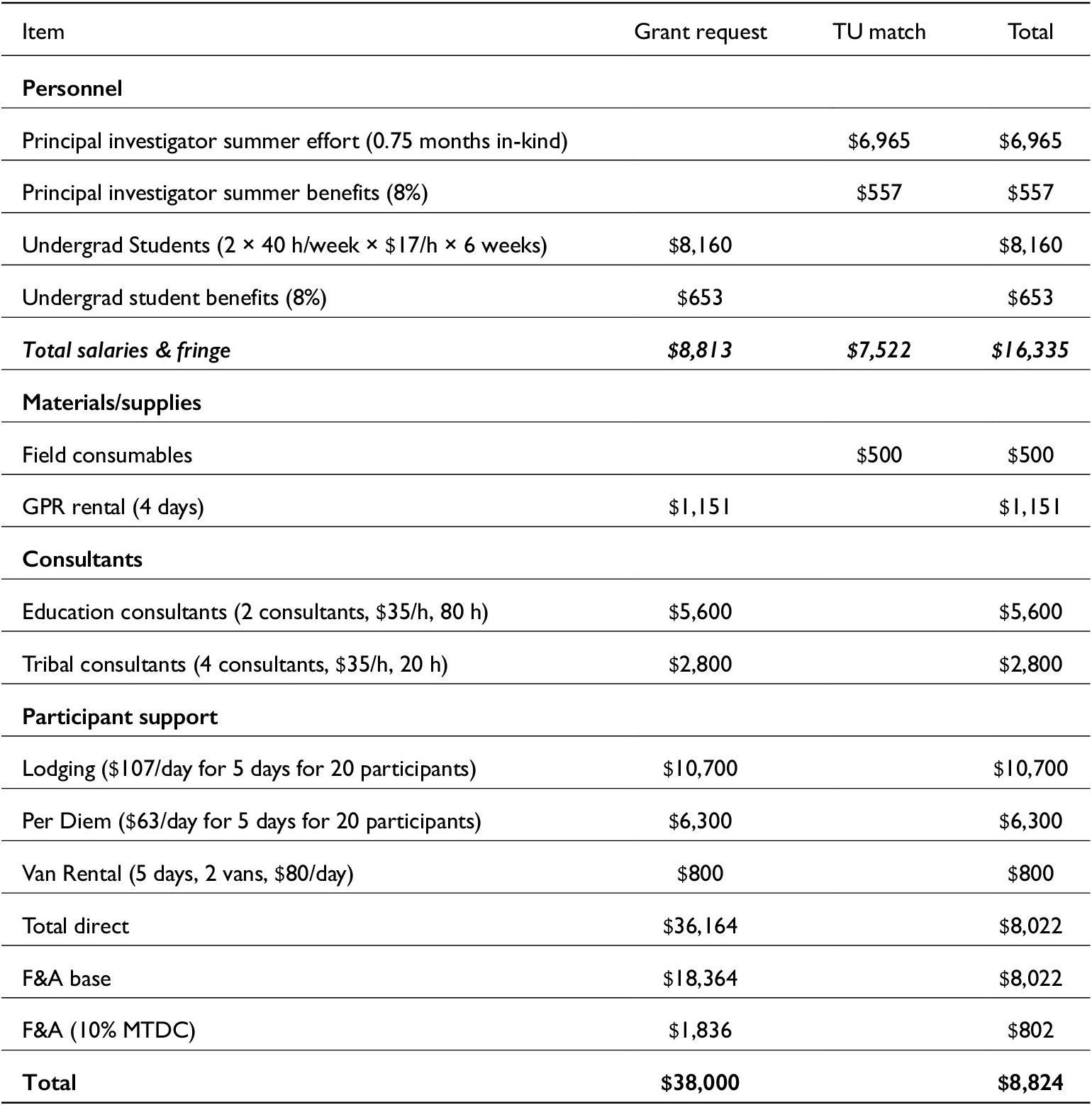
In 2024, we were awarded a Non-Capital Historic Preservation Grant in the amount of $38,000 from the Maryland Historical Trust, as well as a $1,200 grant from the Institute for Heritage Education. A breakdown of the project budget is shown in Table 1. The funded project had both archaeological research and educational goals. The archaeological site on which the project focuses (18BA364, Bob Inman) is a multicomponent Middle and Late Woodland seasonal basecamp located in an active agricultural field in North Point State Park just outside of Baltimore, Maryland. The site was initially identified during a 1988 reconnaissance survey of the land that would become North Point State Park by the Maryland Geological Survey.Footnote 37 The site boundaries were expanded and 183 artifacts were recovered through close interval pedestrian survey by the BCAL archaeological field school in 2024. The plan for the 2025 fieldwork was to conduct a ground penetrating radar (GPR) survey of a 900 m2 sample of the site, comprising approximately 25 percent of the total site area identified through surface survey. The GPR results would be used to identify areas of the site to target with excavation units to determine if intact archaeological features remained below the plowzone. Ballweber’s shovel tests identified shell midden deposits extending into the subsoil at the site.Footnote 38 There are very few pre-contact archaeological sites with intact subsurface deposits within such close proximity to Baltimore, and sites that can contribute to the narrative of pre-contact lifeways in the region are an invaluable resource.
Budget for 2025 Trowels to Teaching Program

Source: Baltimore Community Archaeology Lab, Towson University.
The goal of the teacher workshop was to provide an opportunity for teachers to become familiar with the process, importance, and goals of the field of archaeology in order to effectively infuse these topics into their classrooms and promote responsible archaeological stewardship in our communities. The workshop would include hands-on experience for teachers in the field, in the lab, and in the classroom. Teachers would receive three Continuing Professional Development (CPD) credits from the Maryland State Department of Education (MSDE) upon completion of the course requirements. This would build a cohort of teachers who can support their local professional archaeologists through responsible classroom activities.
4.1. Program structure
The workshop took place over five days. All components of the workshop took place at North Point State Park. The archaeological site under investigation is located in the park, and the lab and classroom activities for the workshop took place in the lab classroom in the park visitor center. Teachers from out-of-town were housed at a nearby hotel and shuttled to North Point State Park using two ten-passenger vans from Towson University, driven by Sterner and her students. The workshop was divided into daily morning and afternoon sessions, running from 9:00 to 4:30 every day.
4.2. Pre-workshop preparation
The MHT grant funded salaries for two student employees to spend a total of four weeks in the field and four weeks in the lab. In addition, Sterner served as a mentor for two students funded through the Towson Inquiry Grants for Undergraduate Research in the Summer (TIGURS), one Anthropology major and one Elementary Education major. These grants provide housing and a living stipend to rising sophomores for five weeks in the summer to learn to work through the research process. Finally, a fifth student, majoring in Electronic Media and Film and minoring in Anthropology applied for and received a Towson University Office of Undergraduate Research and Creative Inquiry Advanced Research Grant to produce a short documentary on archaeological field and lab methods and process. Altogether, this produced a student employee cohort of five, coming from diverse academic backgrounds with diverse goals. Only one student had prior field experience, having been a BCAL employee since taking the 2024 summer field school.
Prior to the teacher workshop, a GPR survey of the Bob Inman site was conducted in early spring 2025. Two weeks prior to the workshop, five student employees and Sterner set up and excavated four 2 × 2 meter test units over GPR anomalies. The goal was to identify excavation areas that would be more productive prior to the arrival of the workshop participants, as they would have very limited time in the field. Two of the units yielded cultural material in quantities that deemed them good candidates for the workshop. In addition, two more units would be opened while the workshop participants were in the field, giving them an opportunity to participate in unit set-up.
4.3. Daily schedule
During the workshop, a standard schedule was observed: (1) vans depart the hotel, (2) arrival at the park visitor center and getting settled, (3) morning learning session, (4) lunch, (5) afternoon learning session, (6) participant lesson development time, (7) reflection and exit ticket, and (8) vans depart for the hotel. On the first and last day, an additional pre-assessment and post-assessment, respectively, were conducted.
4.4. Weekly schedule
An overview of the workshop session themes and presenters can be found in Table 2.
Daily Schedule for 2025 Trowels to Teaching Program

Source: Baltimore Community Archaeology Lab, Towson University.
Each session was introduced and co-led by teachers Julia Berg and Sarah Mason, who designed the structure and content of the workshop sessions.
4.5. Assessment methods
Both qualitative and quantitative measures were used to assess workshop participants’ growth over the course of the program. At the beginning of the workshop, all participants completed a pre-evaluation consisting of five questions with responses recorded using a Likert scale, and a sixth qualitative short answer question. Questions were:
-
1. I understand basic archaeological terms and concepts (e.g., artifact, context, stratigraphy).
-
2. I am familiar with the values and practices of archaeological stewardship.
-
3. I feel confident designing a lesson plan that incorporates archaeological content or strategies.
-
4. I am aware of the role of stakeholders (e.g., Indigenous communities, museums, descendants) in interpreting the past.
-
5. I actively include underrepresented voices when teaching about history or heritage.
-
6. As a result of this workshop, what are you hoping to gain and/or bring back to your classroom and colleagues?
At the end of the workshop, participants completed a post-evaluation with the same five Likert scale questions and two qualitative questions:
-
1. What is one big idea, strategy, or moment from this workshop that you’ll carry into your teaching practice?
-
2. What additional support or resources would help you implement what you have learned?
In addition to the pre- and post-evaluations, workshop participants also completed a daily qualitative reflection/exit ticket with 3–5 questions pertaining to the topics covered that day, how they impacted participants’ understanding of history, and how they would incorporate what they had learned into their lessons.
4.6. Partners
One of the central components of the organization of the Trowels to Teaching workshop was that it would provide participants with access to a broad base of knowledge and perspectives. If our goal was for workshop participants to take back to their students and communities what the best practices are in archaeology, we had to embody those best practices by bringing in voices outside of our own. We wanted to emphasize the importance of relying on a variety of community voices for developing community-relevant research questions and ethical research design. We also wanted to make clear that archaeology does not start or stop with fieldwork. To bring these points home, we relied on the tried-and-true method of bringing in diverse guest speakers to cover topics to which they could contribute a unique perspective. Research has long indicated that guest speakers play an important role in active learning and student success.Footnote 39 We expected this to hold true even when our students are themselves teachers.
We relied on guest speakers in three ways: (1) as professional subject matter experts, (2) as exemplars of professional experiences, and (3) as cultural ambassadors. Dr. Zachary Singer as the State Terrestrial Archaeologist and Scott Strickland as the Deputy Director of the Maryland Archaeological Conservation Laboratory, which serves as the state’s archaeological repository, acted as our subject matter experts. In their presentations, they provided details on archaeological knowledge and processes that could as easily have come from us as educators but carried more weight because of their place as outsiders in the workshop structure as well as their professional roles. Dr. Robert Ahlrichs and Stephanie Soder humanized archaeologists as individuals by providing personalized stories of their career pathways. Their narratives were impactful and memorable in ways that only personalized stories from multiple, diverse individuals can be.
The most valuable external contributions to the workshop came from the perspectives expressed by Indigenous representatives. Representatives from the Piscataway Conoy Tribe shared personal accounts of their experiences with archaeology, including negative encounters during their youth when archaeologists often excluded or misrepresented Native voices and mistreated Native ancestral remains. Their testimonies underscored the lasting effects of extractive practices and highlighted the importance of reciprocal, community-driven engagement. At the same time, they emphasized how their perspectives on archaeology have shifted over time, reflecting a broader trend of Indigenous communities reclaiming space within archaeological research and interpretation.Footnote 40
Complementing these reflections, representatives of the Pocomoke Indian Nation described their ongoing educational programs on Maryland’s Eastern Shore, which integrate archaeology into broader efforts to promote cultural awareness and stewardship. The Nation’s cultural ambassador, serving as a historical interpreter, further illustrated the active role that descendant communities play in shaping public understandings of Native history. These presentations demonstrated to participating teachers that archaeology cannot be divorced from the perspectives of those whose histories are being studied, and that Indigenous voices must be centered in classroom instruction.
By directly engaging with descendant communities, the workshop modeled for educators how archaeology can be taught not as a static body of knowledge but as a dynamic, collaborative practice rooted in respect, dialog, and shared authority.Footnote 41 This model advances both disciplinary best practices and the ethical imperative of recognizing Native peoples as co-producers of historical knowledge.
4.7. Workshop participant composition
A total of 20 teachers registered for the workshop, with 13 actually able to attend due to changes in in-service dates following a particularly snowy school year. Participants were fairly evenly distributed across grade levels with three elementary teachers, four middle school teachers, and six high school teachers. Subject matter focus was disproportionately weighted toward social studies/history, with only four exceptions: Middle School English, Elementary School Gifted and Talented, and Elementary School Math, and Middle School Math. Most (n = 8) participants had more than ten years of experience in teaching, with two teaching for six to ten years, one for four to six years, and two for only one to three years. Participants were mostly (n = 10) from counties on the Eastern Shore of Maryland, with only three from the Western Shore. Somewhat surprisingly, only two teachers were from within commuting distance of the workshop location; the rest stayed at the provided hotel. This was likely in part due to the fact that three of the most populous and closest counties were still doing delayed in-service during the time the workshop was held: Montgomery County, Baltimore County, and Cecil County.
4.8. Workshop participant supports
Two structural supports were essential in making the workshop both possible and valuable for K-12 educators: (1) covering the cost of lodging and per diem and (2) offering three MSDE CPD credits. For many teachers, especially those traveling from across the state, the financial barrier of attending a multiday program can be prohibitive. Research has shown that logistical and financial support is critical to ensuring teacher participation in professional development, as costs are a common obstacle to engagement.Footnote 42 By paying for hotel accommodations and meals, the workshop removed a significant barrier to participation and ensured that educators could engage fully in the experience without the stress of personal expense.
Equally important was the opportunity to earn MSDE CPD credits. In Maryland, teachers are required to complete six CPD credits every five years in order to renew their teaching certification. The workshop’s accreditation for three credits therefore provided not only immediate professional value but also met a critical need within teachers’ recertification requirements. Prior studies of teacher learning emphasize that linking professional development to certification and advancement pathways is essential for incentivizing participation and enhancing long-term professional growth.Footnote 43 This incentive aligned the goals of the program with the practical realities of educators’ professional advancement, creating a strong motivation to participate.
Together, these supports ensured accessibility and reinforced the workshop’s relevance to teachers’ professional trajectories. By simultaneously addressing financial barriers and credentialing needs, the program provided a model for how archaeology-focused professional development can be structured to maximize both participation and impact in educational contexts.
4.9. University study participation
The final component that made this workshop unique was the integration of Towson University undergraduate student employees as active participants in both teaching and learning. These students, who had only recently acquired archaeological skills during their own summer training, were tasked with teaching those same methods to K-12 educators—in one case, to her own former sixth grade Social Studies teacher! This near-peer teaching model created a unique dynamic in which students were not only consolidating their own learning through instruction but also demonstrating to teachers the accessibility and adaptability of archaeological practices in classroom contexts. Prior studies have shown that near-peer instruction can enhance learning for both the instructors and participants by fostering relatability, confidence, and collaborative knowledge-building.Footnote 44
In addition to their teaching role, the student employees attended all guest speaker sessions, enabling them to engage directly with descendant community representatives and professional archaeologists. This exposure broadened their understanding of the ethical, cultural, and professional dimensions of archaeology, reinforcing the importance of integrating multiple perspectives. Finally, the students presented their independent research projects at the Towson University Student Summer Research Conference, providing a professional forum to practice scholarly communication and to link their workshop experience to wider academic discourse. Undergraduate research opportunities of this kind are well documented to support student retention, deepen disciplinary identity, and foster career pathways in archaeology and related fields.Footnote 45
By embedding undergraduate students into the workshop’s design, the program created a multilevel learning environment in which teachers, students, and professionals engaged collaboratively. This structure demonstrated the reciprocal value of experiential learning: teachers gained practical classroom tools, students developed pedagogical and professional skills, and the broader archaeological community benefited from a model of training that emphasized inclusivity, mentorship, and shared authority.
5. Discussion
The workshop’s design, which integrated financial and credentialing supports for teachers, descendant community participation, and undergraduate student involvement, underscores how archaeology education can operate as a truly collaborative and multilevel enterprise. These elements not only shaped the immediate outcomes of the program but also provided insight into broader disciplinary challenges identified by scholars of public archaeology and heritage education. In the discussion that follows, we situate our findings within three of the most pressing concerns in the field: the recognition of archaeology education as applied archaeology, the necessity of descendant involvement, and the importance of systematic assessment.
5.1. Archaeology education as applied archaeology
Our experience demonstrates the value of treating archaeological education as a central component of applied archaeology rather than as an auxiliary or outreach activity. As King notes, public education should be recognized as a branch of applied archaeology, on par with collections management, laboratory analysis, and fieldwork.Footnote 46 Academic programs like the BCAL are uniquely positioned to embed educational workshops like this one into ongoing research projects, thereby advancing workforce development across multiple sectors.Footnote 47 Integrating education into applied archaeology serves a dual purpose: it provides undergraduates with critical training in public communication while also strengthening connections between archaeologists and the broader community. For programs like BCAL, which are still in the process of establishing community trust, partnerships with teachers, who are already deeply embedded within local communities, create pathways for meaningful engagement. For more established applied archaeology programs, these partnerships reify and expand existing community ties through the sustained involvement of teachers and their students. In both cases, education is not an optional add-on, but a professional obligation that shapes the future of archaeology.
5.2. Descendant community involvement
The involvement of descendant communities proved essential to the success of the workshop and its long-term impact. Of the 12 lesson plans developed by participating teachers, 5 explicitly centered on tribal perspectives.Footnote 48 Such an outcome would not have been possible without the direct participation of representatives from the Piscataway Conoy Tribe and the Pocomoke Indian Nation. As Moe emphasizes, collaboration with descendant communities is a moral imperative for the discipline, and archaeology education is no exception.Footnote 49 Our workshop not only gave teachers an opportunity to learn directly from Indigenous voices but also fostered new partnerships between archaeologists and tribal representatives. For example, following the workshop, we collaborated with the Piscataway Conoy Tribe to apply for, and were awarded an MSDE grant to develop a summer enhancement program for Indigenous middle and high school students in Charles County. This initiative will bring Indigenous students into the field to work alongside archaeologists and tribal members, blending contemporary archaeological methods with traditional cultural knowledge. In doing so, the program emphasizes both the scientific and cultural dimensions of the past, reinforcing the importance of environmental stewardship and cultural preservation. Such outcomes highlight the potential of educational initiatives to catalyze deeper and more sustained descendant involvement.
5.3. Assessment and measured outcomes
Finally, this project underscores the importance of formal assessment in archaeological education, a dimension often neglected in university-led outreach.Footnote 50 K-12 educators bring with them deep experience in designing and implementing assessment tools that can capture changes in knowledge, skills, and attitudes.Footnote 51 Berg and Mason’s expertise contributed to meaningful evaluation of the workshop’s impact. The results demonstrate both cognitive and affective learning gains: self-reported understanding of basic archaeological terms and concepts increased from 40 to 100 percent; familiarity with the values and practices of archaeological stewardship rose from 10 to 100 percent; confidence in designing a lesson plan that incorporates archaeological content or strategies increased from 20 to 100 percent; and awareness of the role of stakeholders, including Indigenous communities, museums, and other descendant groups, in interpreting the past grew from 20 to 100 percent. These results illustrate not only the efficacy of the workshop but also the broader potential of integrating formal assessment practices into archaeological education. Our quantitative assessment results contain an element of response-shift bias, which results when participants take a post-test immediately following an experience. Too address this, we plan to conduct a follow-up with the participants in a year using the same assessment tool to more accurately measure the impact of the workshop on their teaching and, by extension, their students. As Moe has argued, archaeologists must embrace the role of educators, systematically measuring outcomes and contributing to education research as part of their professional practice.Footnote 52
6. Future work
Our goal for the Trowels to Teaching Workshop was that it would not be a one-off event, but would be an ongoing established opportunity for growth. The MSDE grant to allow middle and high school students to learn directly from professional archaeologists is one outgrowth of the workshop. But the need to train more K-12 teachers is clear. By equipping educators with knowledge and resources that can be used annually in their classrooms, the Trowels to Teaching Workshop establishes a multiplier effect that extends well beyond a single grant cycle. Thus, we are in the midst of planning another workshop for 2026. As with most initiatives around archaeology education, funding proved to be the largest stumbling block. We have addressed this issue in two ways: (1) by lowering the number of participating teachers to 10 and trimming the total budget from $38,000 to $26,000 and (2) by applying for multiple smaller funding opportunities rather than a single large grant. While as of this writing, final decisions have not been made about any of our funding sources, we feel confident that our initial applications and/or the back-up funding opportunities we can pursue will come through.
A second area of growth is that the 2026 Trowels to Teaching Workshop will further leverage the skills of K-12 educators by including a half-day professional workshop for Council for Maryland Archeology (CfMA, Maryland’s professional archaeological association) members to learn from educators how to meaningfully engage with K-12 audiences. Each year that this workshop continues, there are new opportunities for additional growth and new partnerships.
7. Implications for applied archaeology and teacher professionalization
The Trowels to Teaching Workshop illustrates the potential of university-based applied archaeology programs to make archaeology education a recognized and professionalized branch of the discipline. By embedding a teacher-focused workshop within existing student research at an archaeological site, we demonstrated that such programs do not need to be burdensome add-ons. Instead, they can be incorporated into the natural cycle of applied research, providing meaningful benefits for archaeologists, students, teachers, and communities alike. This case study suggests that applied archaeology programs in universities can play a leading role in developing a standardized theory of archaeological education while simultaneously building capacity for teacher education.
The workshop also revealed the profound benefits of involving undergraduates as instructors. Having recently acquired their own archaeological skills, Towson University student employees deepened their knowledge by teaching teachers, gaining confidence in public communication and broadening their professional preparation. Near-peer teaching created a reciprocal learning environment where both students and teachers benefited from a collaborative exchange of skills and perspectives.
Equally central was the involvement of descendant communities. Presentations and participation by members of the Piscataway Conoy Tribe and the Pocomoke Indian Nation shaped the content of nearly half of the lesson plans teachers produced. Their inclusion not only ensured cultural relevance and ethical practice but also sparked new collaborative initiatives. These outcomes underscore that archaeology education achieves its fullest potential when descendant voices are not peripheral but integral to the process.
Taken together, these elements—applied archaeology integration, undergraduate teaching roles, and descendant community involvement—point toward a model of archaeology education that is collaborative, ethical, and impactful. As the field moves toward greater professionalization and coherence in its educational efforts, programs like this one demonstrate how archaeology education can serve as a bridge between research, teaching, and community engagement, positioning applied archaeology as central to both disciplinary sustainability and public relevance.
Acknowledgements
This project was funded by grants from the Maryland Historical Trust and Institute for Heritage Education. Additional funding was provided by the Towson University Office of Undergraduate Research and Creative Inquiry. The authors would like to thank all of the workshop participants and individuals and organizations that helped develop, implement, and support this project.
Author contribution
Conceptualization: K.S., J.B., S.M.
Conflicts of interests
The authors declare no competing interests.


 Open access

