


Introduction
Acute diarrheal infection (ADI) is a major cause of outpatient visits and hospitalizations in the United States and among those traveling abroad, with an estimated incidence in the United States of 0.6 cases per person per year. Reference Riddle, DuPont and Connor2,Reference Scallan, Hoekstra and Angulo3 Identifying the cause of ADI can be important for clinical management and treatment. Some pathogens require antimicrobials, while others are associated with worse outcomes when treated with antimicrobials (eg, O157:H7 Shiga-toxin producing Escherichia coli). Specific pathogens require mandatory reporting to implement public health control measures to reduce spread. Reference Wikswo, Roberts and Marsh4 Antimicrobial resistance varies among different enteropathogens, so the Infectious Disease Society of America (IDSA) guidelines are therefore increasingly pathogen-specific. Reference Hatchette and Farina5,Reference Shane, Mody and Crump6
Conventional stool pathogen diagnostics are time and labor-intensive, and overlapping clinical presentations across pathogens have led to the preference for multiplex molecular panels for evaluation of infectious diarrhea. Reference Binnicker7 GastrointestinaI pathogen multiplex panels (GIPs) detect multiple pathogens simultaneously and offer a rapid turnaround time and improved sensitivity compared to conventional tests. Reference Cotter, Thomas, Birkholz, Ambroggio, Holstein and Dominguez8 Rapid positive or negative results may decrease the time to optimal therapy. Studies suggest that use of GIPs may significantly lower overall antibiotic usage compared with conventional stool testing and may reduce hospitalization duration, healthcare costs, and unnecessary procedures such as colonoscopies. Reference Axelrad, Freedberg, Whittier, Greendyke, Lebwohl and Green9–Reference Yoo, Kang and Suh14 However, multiplex panels vary in cost depending on the number of pathogens detected, and their true cost-effectiveness is uncertain. Reference Beal, Tremblay, Toffel, Velez and Rand10,Reference Freeman, Mistry and Tsertsvadze15–Reference Moon, Bleak and Rosenthal18 Some studies suggest that use of GIPs may be associated with no change in prescribing practices or even increased antibiotic usage. Reference Meltzer, Newton and Lange19–Reference Saling, Seville and Patron21 Finally, there are limited data exploring clinical decision making and antibiotic management in response to GIP; in one study, 34% of antibiotics prescribed after positive GIP were considered “inappropriate.” Reference Cetin, Telli and Sahin22
More data are needed to evaluate the impact of multiplex GIPs on antimicrobial prescription practices, clinical outcomes, and healthcare costs. In this analysis, we aimed to quantify management changes after positive GIP result for the treatment of suspected ADI, determine the IDSA guideline-adherence of the antimicrobial management changes, and identify predictors of management changes made to identify clinical scenarios in which GIPs are most impactful. Such data could inform diagnostic and antimicrobial stewardship initiatives for cases of suspected infectious diarrhea.
Methods
Study design and setting
We conducted a retrospective study of patients with GIP testing for evaluation of diarrhea in inpatient, outpatient, or emergency room settings at any University of North Carolina Health facility from January 1 to December 31, 2018. Patients experiencing diarrhea at the time of GIP and testing positive for at least one pathogen were included. Individuals who tested positive for Clostridioides difficile by a separate assay but did not have a GIP performed were excluded. Immunocompromised patients were excluded from this study as clinical assessment and treatment of infectious diarrhea may differ in this population. Immunocompromised status was defined as having any of the following: solid organ or stem cell transplant, cancer with active chemotherapy within the past 6 months, neutropenia (absolute neutrophil count <500 cells/μL), human immunodeficiency virus infection with absolute CD4 count <200 cells/µL, primary immunodeficiency, or immunosuppressive medications including biologics and steroids with a prednisone equivalent dose of ≥20 mg/day. Patients for whom there was no documentation beyond the GIP result were also excluded.
Study procedures
Study data were abstracted from electronic health records (EHRs) and managed using the UNC-hosted Research Electronic Data Capture (REDCap) tool. Reference Harris, Taylor and Minor23,Reference Harris, Taylor, Thielke, Payne, Gonzalez and Conde24 Data were collected on patient demographics, comorbidities (including diabetes mellitus, inflammatory bowel disease, irritable bowel syndrome [IBS], sickle cell disease, and cancer), site of sample collection, antibiotic use 30 days prior to testing, clinical presentation, time from sample collection to result, empiric usage of antibiotics or other testing (including invasive studies such as colonoscopy, endoscopy, and radiographic scans), GIP result, and any postGIP result clinical management changes including change in antibiotics prescribed, additional testing, avoidance of further testing, and initiation of isolation precautions.
GIP testing
Gastrointestinal pathogen testing was performed using the Luminex xTAG Gastrointestinal Panel (Luminex Molecular Diagnostics, Austin, TX; see Supplemental Material for complete target list). Testing was performed per manufacturer’s instructions, and during the study period, GIP tests were batched by the laboratory once daily. Results for C. difficile, adenovirus 40/41, Vibrio cholerae, and Entamoeba histolytica were not reported in the EHR. Clostridioides difficile results were masked because of the PCR-based nature of the test, concern for detection of colonization, and availability of a separate in-house assay for C. difficile. For patients with a GIP order, the lab staff verified that patients did not have a positive C. difficile result from the same stool sample; if present, the ordering provider was asked to cancel the GIP. Ordering providers can request a GIP test be processed regardless, though it was rare. C. difficile results from the separate assay were recorded in our data set. Vibrio cholerae and E. histolytica results were masked because of the very low prevalence in our patient population and associated risk of false positives, and adenovirus 40/41 results were masked because a separate standalone adenovirus PCR test covering all serotypes was available.
Definitions and outcomes
We defined diarrhea broadly as any diarrhea documented in the electronic medical record at the time of GIP order. The primary outcome of interest was any change in antimicrobial treatment in response to GIP result, referred to as antimicrobial management change. This included any initiation, discontinuation, or change in antimicrobial treatment that (a) occurred within 24 hours of the GIP test result or (b) was documented in electronic medical record notes as being in response to the GIP result. If an empirically prescribed antimicrobial treatment course was completed prior to GIP test result, this was not included as a management change. Secondary outcomes included guideline adherence based on the 2017 IDSA guidance document for infectious diarrhea and predictors of antimicrobial management change. Reference Shane, Mody and Crump6 A rubric was used to assign guideline adherence of antimicrobial management when there was ambiguity or lack of explicit guidelines for the pathogen (Table S1). We defined potential predictors of antimicrobial management change as sex, race and ethnicity, age, insurance status, comorbidities, empiric use of antimicrobials, antibiotic use 30 days prior to testing, vomiting at time of GIP test, and test collection site (Figure S1).
Data analysis
Descriptive statistics were used to report the study population’s demographic and clinical characteristics and GIP test results. We created a Sankey diagram to illustrate the impact of a positive GIP result on antimicrobial management changes, stratified by empiric antibiotic use. Reference Otto, Culakova and Meng25 To assess associations between predictors and the outcome of antimicrobial management change, we estimated crude and adjusted risk differences for each predictor, using logistic regression models that adjusted for confounding using marginal standardization. Reference Naimi and Whitcomb26 We obtained 95% confidence intervals using bootstrap processes with 2000 resamples. To identify relevant adjustment sets to handle confounding for each predictor, we constructed a directed acyclic graph describing the relationships between each variable in our data (see example in Figure S1). Reference Greenland27,Reference Greenland, Pearl and Robins28 Analyses were completed using SAS version 9.4 (SAS Institute, Inc. Cary, NC) and R Statistical Software version 4.4.1 (The R Foundation, Vienna, Austria).
Results
Of 2,333 GIP tests performed during the study period, there were 241 (10.3%) patients with positive results. Of these, there were 46 positives from immunocompromised patients excluded, and 2 patients were excluded due to lack of data. Ultimately, 193 patients with diarrhea and a positive GIP were included in the analysis. Of these, 55% were male, and the median age was 31 years (interquartile range [IQR] 5, 56) (Table 1). Presenting symptoms and initial antimicrobial management are described in Table S2.
Baseline demographics of cohort with acute diarrheal illness

Note. IQR, interquartile range.
Outpatient clinics performed 73 of 193 (38%) GIP (Table 2). Among patients tested in the emergency department (ED), 21 of 65 (32%) were subsequently admitted. The median time from GIP collection to test result was 31 hours [IQR 24, 52] and did not differ between those with and without an antimicrobial change (Table 2). In 76 hospitalizations, 28 (37%) positive GIP results were reported after discharge. The most frequently identified pathogens were norovirus (n = 55), Salmonella (n = 44), and Campylobacter (n = 35). Nine individuals tested positive for more than one pathogen, of which 2 were positive for C. difficile (1 co-infected with Salmonella and 1 with E. coli).
Details of gastrointestinal pathogen testing

Note. GIP, gastrointestinal pathogen panel; ICU, intensive care unit; IQR, interquartile range.
a Includes E. coli 0157, Enterotoxigenic E. coli, and Shiga-toxin producing E. coli.
b Other pathogens: Shigella, Giardia, Cryptosporidium, and Rotavirus.
A total of 73 of 193 patients (38%) experienced at least one management change in response to a positive GIP, with 86 changes observed (Table 3). Antimicrobial management changes made up 71 of 86 (83%) of all identified clinical management changes, and most of these were initiation of new antimicrobials (66%, 47 of 71). No antimicrobial changes occurred in patients tested in the intensive care unit (n = 3). There were 15 non-antimicrobial management changes, which included Department of Health reporting, letters provided (daycare, work), cessation of other medication (laxatives, steroids), and extension of antibiotic course (without change in antimicrobial).
Changes in clinical management after positive GIP result (n=86) *

Note. GIP, gastrointestinal pathogen panel.
* There were 86 observed changes for 73 individuals.
a Includes: Reported to the Department of Health, counseling provided (eg, daycare, work), other medication stopped (eg, laxatives, steroids), antibiotic course extended but not changed.
Overall, 56 of 193 patients (29%) were prescribed empiric antimicrobials, most of whom were adults aged 18 years and older (84%, 47 of 56) (Table 2). Empiric antimicrobials were discontinued in 16 of 56 patients (29%) in response to a positive GIP result. In the inpatient setting, more patients were treated with empiric antibiotics (46%, 25 of 55) compared with patients tested in outpatient clinics (21%, 15 of 73) and ED settings (25%,16 of 65), and subsequently fewer inpatients experienced antimicrobial initiation after positive GIP result (11%, 6 of 55) compared with outpatient clinics (37%, 27 of 73) and the ED (22%, 14 of 65). Fewer antimicrobial changes were made after GIP in children under 18 years old (23%, 15 of 66) compared with adults aged 18 years and older (44%, 56 of 127). Antibiotics were most often discontinued for norovirus and started for Campylobacter (Figure 1). In 2 patients positive for C. difficile by the separate assay, both were treated for C. difficile infection only, and the organism detected on GIP was considered colonization.
Sankey diagrams demonstrating the impact of GIP result on antimicrobial use by pathogen detected in those who received empiric antimicrobial treatment (A) prior to test result and those who did not (B). “E. coli” includes Shiga-toxin producing Escherichia coli, enterotoxigenic E. coli, and E. coli O157:H7.

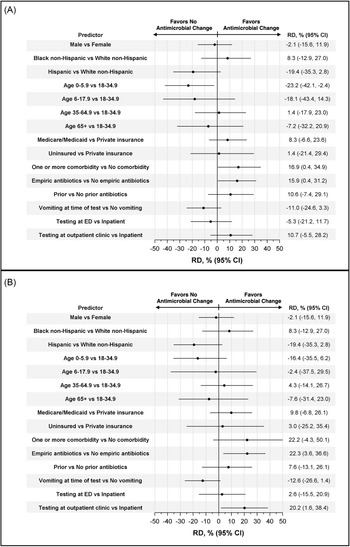
In unadjusted regression models, the age range of 0–5.9 years was associated with a 23% lower risk of experiencing an antimicrobial change after GIP result using age 18–34.9 years as the referent (risk difference [RD] 95% CI: −42%, −2%), whereas having one or more comorbidities (RD 22%, 95% CI: 4%, 50%) and initial treatment with antimicrobials (RD 16%, 95% CI: 0%, 35%) were associated with an increased risk of experiencing an antimicrobial change (Figure 2). In adjusted models, receiving empiric antimicrobial treatment (RD 22%, 95% CI: 4%, 37%) and testing performed in outpatient settings (RD 20%, 95% CI: 2%, 38%) were significantly associated with experiencing an antimicrobial change in response to a positive GIP test. For both unadjusted and adjusted models, there were no significant associations between other covariates and the primary outcome of interest.
Forest plots detailing predictors of antimicrobial management change. (A) Displays risk differences and 95% CI for the crude results. (B) Displays risk differences and 95% CI for adjusted results. For both crude and adjusted models, there were insufficient counts of patients with documented “Asian” or “other” race/ethnicity; no estimates for those groups were made.

Most antimicrobial management changes (86%, 61 of 71) were adherent to the IDSA infectious diarrhea guidelines; 16 of these changes were antimicrobial discontinuation. Guideline adherence was similar among patients who received empiric antibiotics (89%) and those who did not (84%). More antimicrobial management changes observed were guideline-adherent in children younger than 18 years old (93%, 14 of 15) compared with adults aged 18 years and older (84%, 47 of 56). Of 10 guideline non-adherent antimicrobial changes, one was in a pediatric patient (antibiotic started), and 9 were in adults (n = 8 antibiotics started, n = 1 antibiotics discontinued). The majority were treated in the outpatient setting (n = 7) or ED (n = 2). Ultimately, 9 of 47 (19%) antimicrobials initiated in response to GIP were non-adherent to guidelines (5% of the full cohort). The organism most often treated in guideline non-adherent cases was enterotoxigenic E. coli (9 of 10).
Discussion
There are limited data evaluating clinical decision-making and antibiotic management in response to GIP, especially in adults. Reference Axelrad, Freedberg, Whittier, Greendyke, Lebwohl and Green9,Reference Torres-Miranda, Akselrod and Karsner13,Reference Meltzer, Newton and Lange19,Reference Cetin, Telli and Sahin22 In this analysis, most GIP tests during the study period resulted negative or were positive for pathogens or sent in clinical contexts in which the IDSA does not recommend antimicrobial treatment. Approximately one-third of positive GIP tests led to a change in antimicrobial therapy, which was most commonly initiation of a new antimicrobial. At our institution, testing performed in outpatient settings as well as the receipt of empiric antimicrobials prior to test result were most strongly associated with an antimicrobial management change. Most antimicrobial changes were adherent to existing pathogen-specific IDSA guidelines. However, 20% of antibiotics initiated in response to GIP were considered non-adherent to guidelines, and most of these non-adherent changes occurred in adults in the outpatient setting.
Most existing studies examining the clinical impact of GIP have been conducted in pediatric populations, reporting metrics such as the proportion of patients who experienced an antibiotic management change (12–50%), which is consistent with our findings in adults and children. Reference Cotter, Thomas, Birkholz, Ambroggio, Holstein and Dominguez8,Reference Ergun, Kacar and Ozbakir29–Reference Truong, Cointe and Le Roux31 This study is one of the very few attempting to assess antibiotic prescribing practices after GIP, the largest study to do so, and the only using published expert guidance for infectious diarrhea to assess appropriateness. Reference Meltzer, Newton and Lange19,Reference Saling, Seville and Patron21,Reference Cetin, Telli and Sahin22 Most of the antimicrobial changes observed in response to GIP were adherent to the reference guideline, though we did not assess the appropriateness of antimicrobial treatments that were completed before or unchanged after GIP result, nor did we have sufficient patient-specific data to account for other co-occurring conditions that may have influenced antibiotic changes. Notably, one prior study determined that 34% of antimicrobial use was inappropriate based on the detected pathogen; that study included only adult patients. In our study, adult patients experienced the bulk of guideline-discordant antimicrobial changes after GIP. Reference Cetin, Telli and Sahin22
The most frequently identified pathogens were similar to those previously reported. Reference Axelrad, Freedberg, Whittier, Greendyke, Lebwohl and Green9,Reference Torres-Miranda, Akselrod and Karsner13 In our study, a very small number (n = 2) were also positive for C. difficile by a separate GDH/toxin with reflex to PCR assay, but this reflects a laboratory policy to request cancellation of GIP orders for patients with a separate positive C. difficile test on the same stool sample. The median time to GIP result at our institution (31 h) was slightly longer than previously published median times to GIP result. Reference Sobczyk, Jain and Sun12,Reference Yoo, Kang and Suh14 Our study included patients who were seen in outpatient clinics who tend to be less acutely ill, while existing literature has thus far predominantly included sicker patients presenting at the ED and/or patients from an inpatient setting. Additionally, GIP testing was batch run during the study period, whereas other studies assessed random-access multiplex platforms; these factors likely contributed to our longer time to result. Reference Sobczyk, Jain and Sun12–Reference Yoo, Kang and Suh14 Importantly, we found that among inpatients or patients who were admitted to the hospital from the ED, 37% of GIP tests resulted after the patient had been discharged. We hypothesize that prolonged turnaround time during the analysis period for this batched multiplex test impacted the ability for providers to make management changes after GIP result, as short antimicrobial courses could have been completed before GIP results became available. It is possible that shortening time to result either through immediate and/or using a more rapid platform could increase likelihood of a resulting management change.
A strength of our study lies in the granularity of data collected, including exact timing of testing and management changes, antimicrobial treatment(s), and types of management change documented through extensive chart adjudication. Its limitations are in part due to the retrospective nature of this study; we may be missing management changes not clearly documented in the EHR. In addition, the etiology of diarrhea may include pathogens not captured on the GIP, and it is possible that some results may represent prolonged shedding from a previous infection with the current case of diarrhea caused by a non-infectious etiology such as laxative use or postinfectious IBS. Our lab refers antibiotic susceptibility testing (AST) on intestinal pathogens to state health laboratories when indicated. The increasing prevalence of antimicrobial resistance, for example, in Campylobacter and Salmonella, is an important consideration. AST data are frequently missing for enteropathogens and could affect the accuracy of guideline concordance. Additionally, we excluded certain patient populations, including severely immunocompromised hosts, and cannot comment on prescribing practices after GIP for this population. Finally, these data are from 2018; as of October 2024, our institution’s GIP turnaround time is now faster than the test used during the study period, and stewardship practices and diagnostics have evolved, which may limit study generalizability. Implementation of a rapid GIP may facilitate faster utilization of results for treatment decision-making, prior to hospital or ED discharge or completion of empiric antimicrobials.
In conclusion, our results suggest that a focus on interpretation of GIP results, specifically in adults, may improve diagnostic and prescribing practices for ADI. Decision-making after results may be affected by empiric treatment decisions, turnaround times, ordering department, plan for follow-up, and heterogeneity in interpretation of existing guidance documents for infectious diarrhea. Updated pathogen- or panel-specific guidelines for the interpretation of results and treatment of diarrhea would be useful to provide clarity to clinicians, improve pathogen-specific treatment homogeneity, and reduce unnecessary antimicrobial use. As most intestinal pathogens are state-reportable infections, an informed clinical guideline could optimize the use of GIP for both clinical providers and public health surveillance. In addition, further study of the clinical contexts in which non-infectious causes of diarrhea are most likely, and subsequent development of clinical decision support tools, could improve diagnostic stewardship for these tests. Reference Marcelin, Brewer and Beachy32,Reference Saif, Dooley, Baghdadi, Morgan and Coffey33
Supplementary material
The supplementary material for this article can be found at https://doi.org/10.1017/ash.2025.10184
Acknowledgments
We would like to acknowledge Lauren DiBiase, MS, Associate Director of Hospital Epidemiology, UNC Hospitals, and the Carolina Data Warehouse of NC TraCS for their assistance with extraction and collation of data from the electronic medical record.
Financial support
This study was supported by a TraCS $2K pilot grant from the North Carolina Translational and Clinical Sciences Institute at the University of North Carolina School of Medicine to EJC, which is funded by the National Center for Advancing Translational Sciences, National Institutes of Health, through Grant Award Number UM1TR004406. NAM is supported by an Antibacterial Resistance Leadership Group fellowship grant (National Institute of Allergy and Infectious Diseases UM1AI104681). EJC received support from the National Heart, Lung, and Blood Institute (T32HL007106) during the study period and is currently supported by the National Institute of Allergy and Infectious Diseases (K23AI173658). The content is solely the responsibility of the authors and does not necessarily represent the official views of the NIH.
Competing interests
N.A.M. reports no conflicts of interest. M.G.P. reports no conflicts of interest. S.R.E. reports no conflicts of interest. B.W.K. reports no conflicts of interest. M.B.M. is on the scientific advisory board of DiaSorin Molecular (formerly Luminex Molecular Diagnostics) and QIAGEN and serves as a consultant to BioFire (bioMerieux) and Roche Diagnostics. L.A.B. reports no conflicts of interest. A.C.K. reports no conflicts of interest. E.J.C. reports no conflicts of interest.
Research transparency and reproducibility
Access to deidentified data and code can be made available upon request and appropriate ethics approvals.




 Open access

