


Introduction
The growing presence of robotsFootnote 1 in organizations is an unstoppable phenomenon. The International Federation of Robotics (IFR) registered an increase of 5% in 2022 in annual installations worldwide compared to the previous year. This means that 553,000 robots were installed in 2022 (IFR, 2023b). Spain continues to invest in industrial robot2 installations, being part of the top five European countries to expand the national robotic landscape (IFR, 2023a). According to the Spanish Robotic and Automation Association, industrial robot installations grew 25% in 2022, surpassing 4,000 installed units (AER Automation, 2023). Spain is now experiencing growth rates comparable to those observed before the COVID-19 pandemic.
There is general agreement that the introduction of robots is changing the work people do in organizations (Cascio & Montealegre, Reference Cascio and Montealegre2016). However, it remains unclear how this change occurs and in what aspects and direction (Cascio & Montealegre, Reference Cascio and Montealegre2016; Smids et al., Reference Smids, Nyholm and Berkers2020). This is partially due to the scarce number of studies on the topic (Beer & Mulder, Reference Beer and Mulder2020). Understanding how robotization is affecting work characteristics is a crucial issue from a theoretical and practical perspective (Gutelius & Theodore, Reference Gutelius and Theodore2019; Parker & Grote, Reference Parker and Grote2022; Smids et al., Reference Smids, Nyholm and Berkers2020). Theoretically, it is relevant for several reasons. First, considering the growing presence of robots in work settings, we need to understand in what ways their implementation is changing the way human workers are experiencing the characteristics of their jobs. This matters because these perceptions play a role in determining beneficial work experiences and outcomes, including job satisfaction and performance (Campion et al., Reference Campion, Mumford, Morgeson and Nahrgang2005; Humphrey et al., Reference Humphrey, Nahrgang and Morgeson2007). Second, understanding how robotization affects work characteristics can contribute to expanding work design and job characteristics theories (Hackman & Oldham, Reference Hackman and Oldham1976; Morgeson & Humphreys, Reference Morgeson and Humphrey2006) by incorporating unattended antecedents of perceived work features. From a practical perspective, this knowledge may be crucial when it comes to implementing strategies that strengthen the positive aspects of robotization and minimize the undesirable ones. In this way, employees’ working experiences and organizational effectiveness can be improved.
To shed light on this issue, we conducted a qualitative study with the goal of understanding the influence of robotization on the perceived work characteristics of employees of manufacturing companies, as well as the contingencies affecting this relationship. Thus, we interviewed production line workers and supervisors from four companies: an industrial bakery, a reusable packaging manufacturer, a steel door producer, and a cosmetics manufacturer. We focused on the manufacturing sector for two reasons. First, disruptive technology has had a greater impact on manufacturing industries compared to other sectors. Second, advanced manufacturing by means of automation and robotics is vital for economic durability and competitive advantage (EU Industrial Forum, 2023).
With this study, we intend to make several contributions to the literature. First, from a theoretical perspective, we aim to expand work characteristics models (Humphrey, et al., Reference Humphrey, Nahrgang and Morgeson2007; Morgeson & Humphrey, Reference Morgeson and Humphrey2006) and work design theory (Parker, Reference Parker2014; Parker et al., Reference Parker, Wall and Cordery2001, Reference Parker, Van den Broeck and Holman2017) by considering robotization as an antecedent of work characteristics, suggesting ways in which the former affects the later. As Parker et al. (Reference Parker, Wall and Cordery2001) pointed out, the consideration of antecedents is important for several reasons. It uncovers different ways in which work design can be transformed, and it provides greater insight into how big changes (e.g., the introduction of robots) can affect work design. In addition, identifying antecedents can help establish work design as a potential link between those elements that influence the way work is done (e.g., robotization) and outcomes such as well-being and performance. Second, there may be factors that moderate the influence of robotization on work characteristics (Parker & Grote, Reference Parker and Grote2022). As these authors pointed out, there is a need for “detailed studies of work in context” that try to understand “the complex interactions between work design, technology, individuals, and other factors” (p. 1195). In the present study, we explore and suggest some of the moderators that may shape the relationship between robotization and work characteristics. Third, based on the study findings, we propose a research model that can be useful to guide future quantitative research. This model holds the potential to yield valuable insights that can be tested by future quantitative studies. Fourth, from a practical perspective, this study provides relevant information to organizational decision-makers. A deeper understanding of the relationship between work design and robots becomes a crucial asset for stakeholders. It will enable them to make decisions about how robots are implemented, taking into account both the interest of the organization and the quality of employees’ work (Berkers et al., Reference Berkers, Rispens and Le Blanc2023).
Robotization and Work Characteristics
To investigate the relationship between robotization and work characteristics, we will adopt a work design perspective. Work design is defined as “the content and organization of one’s work tasks, activities, relationships, and responsibilities” (Parker, Reference Parker2014, p. 662). After decades of research, we know that work becomes more motivating and enjoyable when certain characteristics are present (e.g., autonomy, skill variety, feedback). The motivation provided by these characteristics, in turn, translates into a sequence of favorable individual and organizational results, such as employee well-being, positive work attitudes (e.g., job satisfaction), and improved performance (Parker et al., Reference Parker, Van den Broeck and Holman2017). In their meta-analysis of the work design literature, Humphrey et al. (Reference Humphrey, Nahrgang and Morgeson2007) found solid evidence supporting the influence of job characteristics on these work outcomes.
According to Morgeson and Humphrey (Reference Morgeson and Humphrey2006), the characteristics that should be present at work are related to the attributes of the task (e.g., task variety), as well as the social and contextual environment in which this takes place (e.g., social relationships). Studies on work design highlight the importance of considering all these aspects when facing advanced and disruptive technological change, something that is frequently ignored (Parker, Reference Parker2014). Moreover, research on work design has generally focused on its outcomes, neglecting its antecedents. This is an important omission because, as stated by Parker and Grote (Reference Parker and Grote2022, p. 1189), “the more that we can map out how, what, and why technology affects work design, the more we will gain important insights into how to optimize technology’s benefits’ and mitigate its potential dysfunctional effects.”
As Coovert and Thompson (Reference Coovert, Thompson, Coovert and Thompson2014) assert, the effects of advanced technology, such as robotics in the workplace, are ubiquitous and can “enable or oppress” (p. 1). This means that technology has the potential to both positively influence and bring unfavorable consequences for those who work in its proximity (Beane & Orlikowksi, Reference Beane and Orlikowski2015; Coovert & Thompson, Reference Coovert, Thompson, Coovert and Thompson2014; Parker & Grote, Reference Parker and Grote2022; Smids et al., Reference Smids, Nyholm and Berkers2020).
For instance, Engberg and Sördal (Reference Engberg and Sördal2019), in a qualitative study with Swedish employees working with robotic process automation (RPA), observed that employees reported both job enlargement and an increase in the skills needed to perform their tasks. In their interviews, these researchers also documented that those employees perceived a transition from performing simpler tasks to performing more complex ones, which also suggests a positive influence of RPA on job complexity.
Some studies report a functional influence of robotization on physical demands, that is, a negative relationship between robotization and the physical demands associated with the job enactment. In a qualitative study conducted with employees of eight logistic warehouses, Berkers et al. (Reference Berkers, Rispens and Le Blanc2023) documented a reduction in the physical demands and the repetitive nature of certain tasks following the introduction of robots. In a quantitative study with 32 robot controllers of an international manufacturing company, Pollak et al. (Reference Pollak, Paliga and Kozusznik2021) examined the robot operator’s tasks using the work design questionnaire within the framework of the work design theory. The authors found physical demands at the lowest level of these employees’ working characteristics, suggesting their jobs did not involve high levels of physical exertion.
However, examples of the dysfunctional influence of robotization can also be found. Robotization has the potential to simplify tasks and leave the human workforce to perform dull duties that lack meaning (Parker & Grote, Reference Parker and Grote2022). In their qualitative study mentioned above, Berkers et al. (Reference Berkers, Rispens and Le Blanc2023) observed that work became more monotonous for order pickers and packers given that robots had taken over certain tasks. Consequently, task variety decreased. The remaining tasks that employees could perform were simpler, which negatively impacted the quality of their jobs. In this study, autonomy was also negatively affected, given that the work of employees became dependent on the robot’s pace and malfunctions (Berkers et al., Reference Berkers, Rispens and Le Blanc2023). When it comes to the social context, robots can also hinder social interactions. The qualitative study by Findlay et al. (Reference Findlay, Lindsay, McQuarrie, Bennie, Corcoran and Van Der Meer2017) showed the potential of robots to damage the social environment. Their analysis of the interviews conducted with multiple stakeholders in the health care setting revealed perceptions of less social interaction from some of the staff after the introduction of robots.
As some authors state, these mixed outcomes may imply the existence of specific conditions (i.e., moderators) under which the influence of robotization on work characteristics might vary (Beane & Orlikowski, Reference Beane and Orlikowski2015; Berkers et al., Reference Berkers, Rispens and Le Blanc2023; Parker & Grote, Reference Parker and Grote2022; Parker et al., Reference Parker, Van den Broeck and Holman2017). Therefore, it is important to identify potential moderators that can help us improve our understanding of how robotization affects work characteristics. This knowledge can be useful to develop and refine work design theory. Thus, in the present qualitative study, we tried to answer the following questions: What is the influence of robotization on the work characteristics of manufacturing employees? What factors seem to moderate this influence?
The Present Study
To respond to these questions, we interviewed a sample of employees from four manufacturing companies. Next, we present some technological, temporal, and work-related aspects that are relevant in the contexts in which the interviews took place.
These manufacturing companies employed different types of robots, including large industrial robots, pick-and-place robots, and cobots, reflecting their specific needs. Large industrial robots are designed to automate and perform heavy and repetitive tasks in a confined, separate space. More specifically, the industrial robots deployed in these facilities lift and position heavy objects (e.g., big sets of reusable packaging or steel door panels) between locations. Pick-and-place robots accelerate the process of picking up relatively small items (e.g., baking goods) and relocating them to different places. Cobots work near human workers with ensured safety, as well as more flexible and easier use and adjustment (Dzedzickis et al., Reference Dzedzickis, Subačiūtė-Žemaitienė, Šutinys, Samukaitė-Bubnienė and Bučinskas2021; Galin et al., Reference Galin, Meshcheryakov, Kamesheva and Samoshina2020; Weiss et al., Reference Weiss, Wortmeier and Kubicek2021). The cobots deployed in company C perform both pick-and-place tasks and palletizing. In addition to the new possibilities that emerge with this new generation of robots, cobots also alleviate the physical demands of the job.
Theoretical models that offer a taxonomy of robot functionality help explain how these similarities and differences shape human experience. Different frameworks have been proposed to analyze human–robot interaction (HRI) (Onnasch & Roesler, Reference Onnasch and Roesler2021). Among these, Smichdtler and colleagues (2015) offer a taxonomy of HRI specifically tailored to the industrial environment. These authors classified the interaction between humans and robots based on elements such as working time, workspace, aim, and contact. The result is three forms of HRI: coexistence, cooperation, and collaboration. Coexistence is characterized by humans and robots working at the same time and sharing the space although they do not necessarily share the same aim, and no direct contact takes place between them. In the cooperation category, humans and robots share time and space, and they both work toward the same goal. And collaboration requires not only shared time, space, and aim but also direct contact between the human and the robotic system. This taxonomy is relevant not only for its applicability to the industrial setting on which our study is based, but also for its emphasis on highlighting the human workforce as a key element in future technological developments. It also prioritizes the reduction of physical and mental strain of industrial jobs when this taxonomy is implemented in technological design (Schmidtler et al., Reference Schmidtler, Knott, Hölzel and Bengler2015). To better explain the robotic context in our study, the types of robots implemented in the participant companies will be classified following this framework.
Following Schmidtler et al (Reference Schmidtler, Knott, Hölzel and Bengler2015) taxonomy of HRI, we identify pick-and-place robots as examples of cooperation. These robots operate alongside workers within the same space and time. While they share a common goal, which is sorting or assembling, no direct interaction takes place. Cobots are examples of human–robot collaboration, reflecting the close physical contact between workers and the robotic system when picking and placing products, as well as the shared time and workspace. In the case of industrial robots, the complete separation between them and the human worker by a fence ensures that the robot will perform its tasks in its designated area, doing so without sharing space or interaction with the human. This conventional and complete form of automation represents the absence of interaction (Kolbeinsson et al., Reference Kolbeinsson, Lagerstedt and Lindblom2019). These taxonomies provide valuable insights into the dynamics of highly automated work settings, where the human workforce operates alongside robots. The different degrees of interaction with different degrees of human-robot engagement have a clear influence on work characteristics, including the alleviation of physical demands, reduction of repetitive tasks, mental stress, and the performance of tasks in settings of high complexity and variability (Schmidtler et al., Reference Schmidtler, Knott, Hölzel and Bengler2015). These taxonomies within the HRI framework are key to ensuring secure and efficient collaboration between machines and humans (Onnasch & Roesler, Reference Onnasch and Roesler2021).
When it comes to their employees, the different responsibilities associated with each role will shape their interaction with the robots. Typically, production line workers’ duties consist of the inspection of products to meet specifications, the observation of machine operations to ensure quality and conformity of products to standards, the monitoring of the production line, watching for problems such as pileups or jams, reporting such malfunctions to a supervisor, and the supply of materials to conveyors. In the case of supervisors, usual responsibilities include the ordering of materials and supplies, the setting up of machines and equipment, determining the production requirements, supervising technology functioning, and monitoring employee performance. Even though both roles dedicate efforts to supervise the appropriate functioning of robots, production line workers and supervisors have different knowledge and abilities to deal with malfunctions. While production line workers can intervene in minor breakdowns, supervisors generally have more expertise to deal with more complex problems.
Finally, the time frame in which robots were installed in each company varies. In company A (industrial bakery), the first generation of robots was installed around 2004. Company B (reusable packaging) started implementing robotic systems in 2018. Company C (cosmetics) had already put in place some robotic systems in 2013. Lastly, company D (steel doors) started using robots in 2003. It is worth noting that the installation of robots in companies is not a static process but one shaped by various contextual factors, such as social and economic conditions. These four robotic installations underwent distinct transitions over the years, ranging from the replacement of older models with more advanced systems equipped with more capabilities, to pauses in their implementation due to economic crisis or the COVID-19 pandemic. Additionally, by the time of the study, the robots had been working alongside employees for some time. Both production line workers and supervisors of the four organizations were familiar with them. Thus, we did not anticipate any differences across firms in the perception of work characteristics related to the temporal aspect.
Method
Ethical Statement
This study was conducted in accordance with the Regulations of the Committee of Ethics and Human Research of our university. Because the questions asked to participants did not include any sensitive, personal privacy, ethical, and/or moral themes, the approval of the committee was not necessary. Informed consent was obtained from all participants who were approached to take part in the study.
Participants
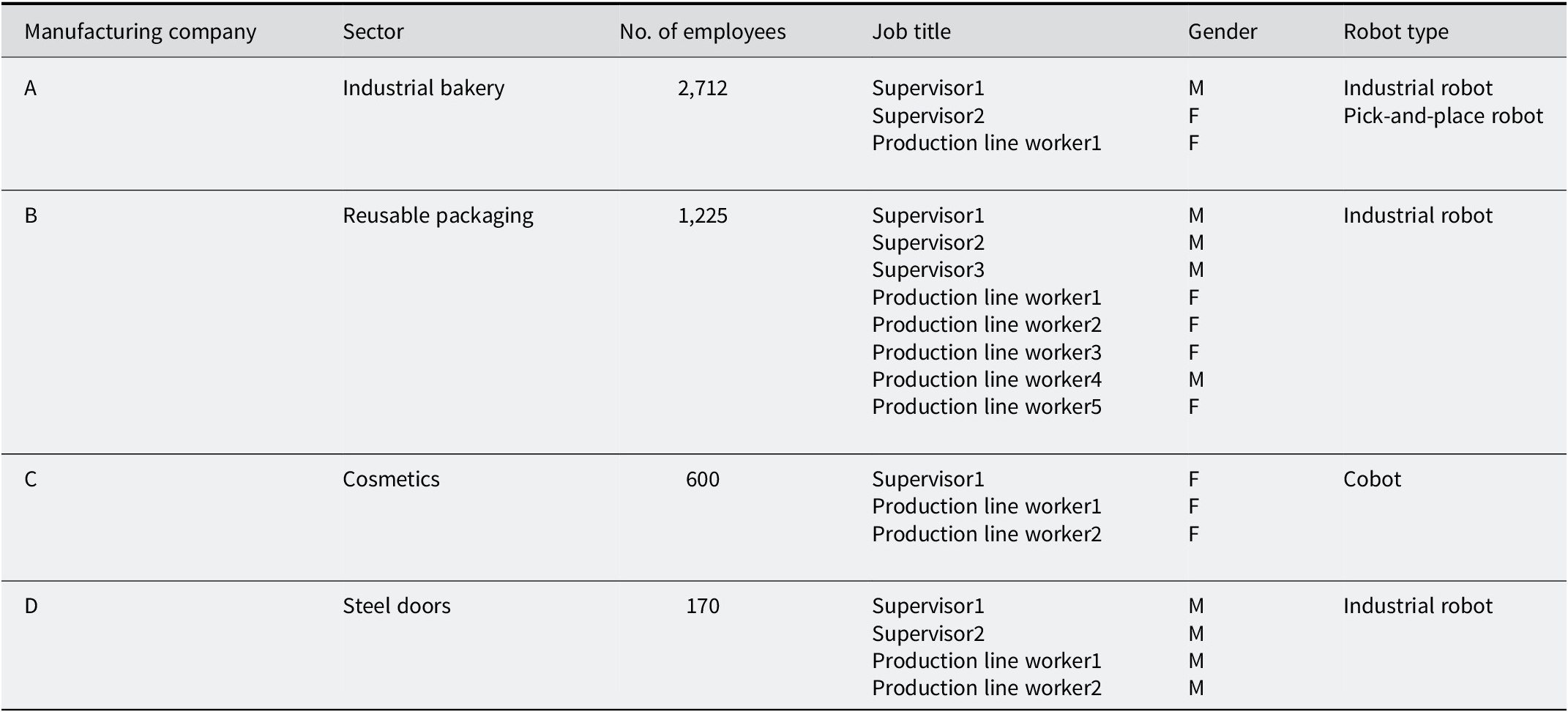
Four Spanish manufacturing companies participated in the study (see Table 1). These companies produce a wide range of products: industrial bakery (2,712 employees), reusable packaging (1,225 employees), steel doors (170 employees), and cosmetics (more than 600 employees). These four companies were very focused on the technological transformation of their factories, with their own teams of engineers leading the implementation of robotic systems. In their robotic introduction strategy, the alleviation of the physical demands of the jobs and the increase in productivity were the main reasons considered. The installation of robots in these companies was mature, and no other major organizational changes were made at the time we started conducting the interviews. A total of 18 employees were interviewed individually: ten production line workers (70% women) and eight supervisors (25% women). They had worked in these organizations for periods ranging from 4 to 28 years. Regarding the type of robots installed in the manufacturing sites, industrial robots and pick-and-place robots were operating in companies A, B, and D, and cobots were in company C.
Description of sample data

The presence of robots in their plants and their willingness to participate were the criteria used to invite companies to take part in the study. The selection of interview participants followed a purposive sampling technique, which is “the deliberate choice of a participant due to the qualities the participant possesses” (Etikan et al., Reference Etikan, Musa and Alkassim2016, p. 2). Therefore, a diverse range of participants was carefully chosen to offer a comprehensive and varied perspective on the influence of robots in the workplace. Individuals were selected to participate in interviews across different hierarchical levels and relevant experience working with robots. The sample size for this study was influenced by the theoretical saturation principle as indicated by the grounded theory (Strauss & Corbin, Reference Strauss and Corbin2016), as well as some constraints and resources of the companies involved, such as production timelines and availability of their personnel. Taking into consideration these two factors, our final sample size was 18 participants. This number is consistent with the conclusions reached by some authors who have focused on the operationalization of the concept of saturation (Guest et al., Reference Guest, Bunce and Johnson2006; Hennink et al., Reference Hennink, Kaiser and Marconi2017). As these authors state, a small number of between 6 and 9 interviews can provide enough information for code and theme creation. However, more interviews will probably be needed for a deeper analysis, between 16 and 24. By conducting 18 interviews, we aimed to achieve a balance between achieving saturation and the organizational constraints.
Data Collection
Before conducting the interviews, several visits were made to these companies. The purpose of the visits was to observe, firsthand, the work development in the production plant and the functioning of robots in these companies. The interviews were semi-structured and on company premises. The advantages of semi-structured interviews are various: they offer more flexibility for both the interviewer and interviewee, allow the interviewer to have a more participatory role in the process of knowledge generation, and provide more opportunities to focus on topics that could be deemed relevant to the research objectives (Denzin & Lincoln, Reference Denzin and Lincoln2018).
Information about the study was provided before the beginning of the interviews, and informed consent was obtained from each participant. The interviewer highlighted that participation in the research was voluntary and that participants had the right to withdraw at any point. Data confidentiality and anonymity of the information were ensured, and permission to record each interview was obtained. The interviews lasted on average 56 minutes.
The interview protocol was designed based on the objectives of the study and a previous review of literature. It tried to uncover the employees’ perceived changes in work characteristics before and after the implementation of robots. Some examples of the questions are: “Can you describe how your job has changed since the introduction of robots?” and “To what extent has the implementation of robots influenced the variety of tasks in your position?” The interviews were conducted in Spanish, which was the native language of the interviewees and interviewers.
Data Analysis
The interviews were recorded, transcribed, and analyzed in different phases with the NVivo Software. The analysis of the interviews was done in three stages following constructivist grounded theory techniques (Charmaz, Reference Charmaz2006). The constructivist grounded theory keeps the main characteristics of the grounded theory by Strauss and Corbin (1990) while acknowledging the active role of the researcher in shaping both the data and the analysis (Länsisalmi et al., Reference Länsisalmi, Peiró, Kivimäki, Caseell and Symon2004; Lewins & Silver, Reference Lewins and Silver2014). In the first phase of the analytical process, open coding, codes were created following an inductive analysis. This was done to identify potential emergent themes without preexisting categories that could affect the identification of relevant information. In a second phase, axial coding, the codes created were grouped into categories. This was done by establishing relationships between them around the conditions that explained how the implementation of robots in companies affected the work characteristics among workers. During the first and second phases, words and phrases were becoming recurrent, and the constant iteration between them allowed us to recognize consistent patterns as well as divergent experiences in the data. For example, the physical demands of the job were frequently mentioned, and it was a consistent experience in the same direction for workers across the different roles. However, for other common elements frequently mentioned, such as autonomy, the constant comparison between cases pointed out the existence of different experiences within this category.
In the third phase, selective coding, the categories were further refined to determine the central theme that had emerged—the impact of robotization on certain work characteristics. It was identified how this core category connected with other categories, and when writing our findings, all these connections were cross-checked to see their fit within the existing literature. This phase also followed an iterative process until data saturation was fulfilled. Morgeson and Humphrey’s (Reference Morgeson and Humphrey2006) classification of work characteristics was used to group our patterns into relevant work characteristics, such as physical demands, skill variety, task variety, job complexity, social support, and autonomy. An iterative approach was adopted, continuously transitioning between the data, pertinent theories, and interpretation.
Findings
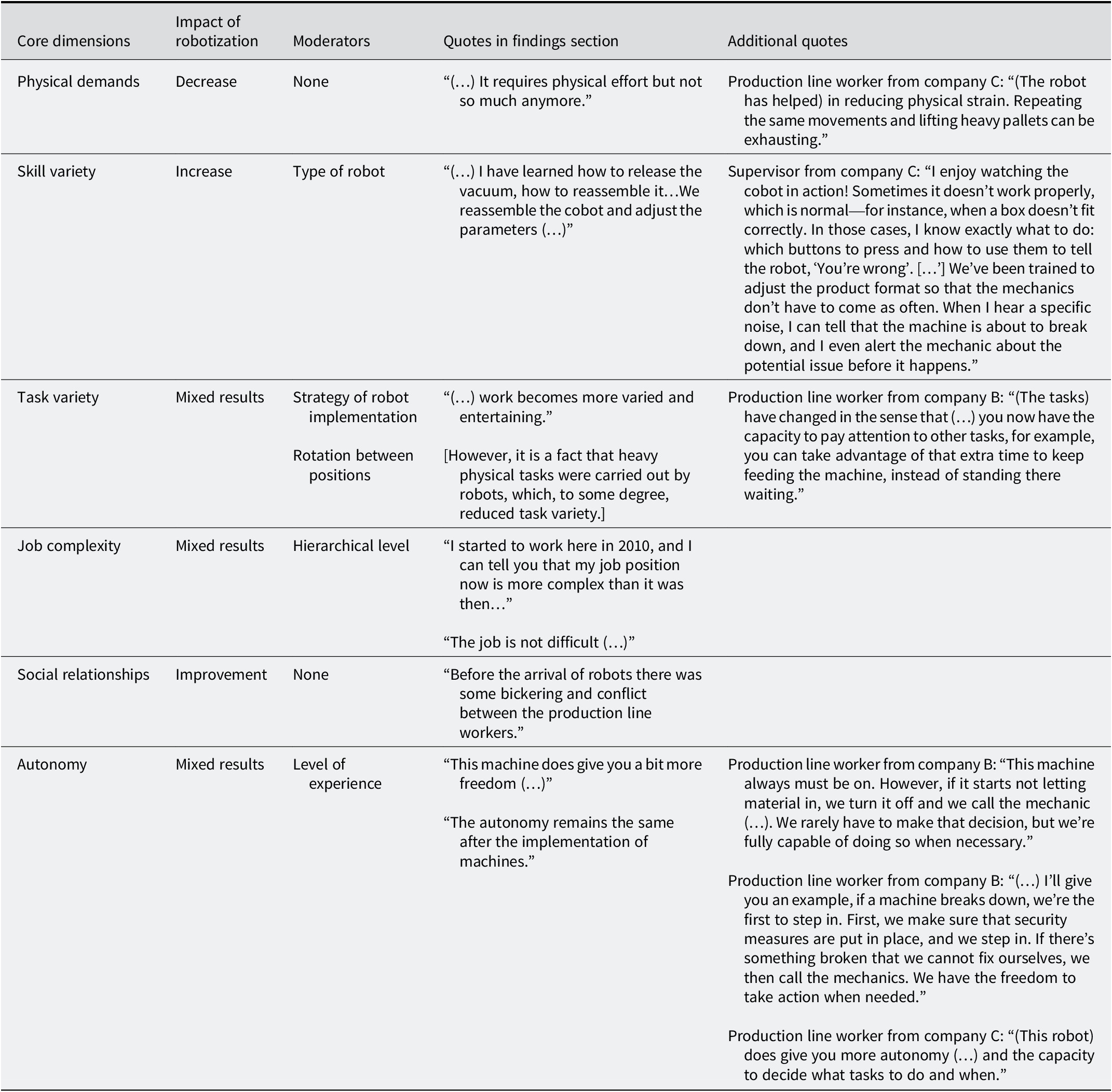
After the analysis, six major overarching dimensions appeared: physical demands, skill variety, task variety, job complexity, social relationships, and autonomy. Our analysis uncovered significant discoveries regarding the perceptions of production line workers and supervisors on work changes due to robotization in regard to those dimensions. In this section, we provide evidence on the influence of robotization on them. For a summary table that collects the verbatim presented for each work characteristic as well as additional quotes to provide further evidence, see Table 2.
Verbatim summary table
Physical Demands
Physical demands refer to “the level of physical activity or effort required in the job” (Morgeson & Humphrey, Reference Morgeson and Humphrey2006, p. 1324). We found that robotization decreases the physical demands associated with work. The work of a production line worker in the participating companies is physically demanding. Before the implementation of robots, the interviewed workers had to handle heavy loads and items (e.g., bottles, boxes, packages, doors). However, after robotization, all participants agreed that work became easier to perform in terms of its physical requirements. Even though the tasks will always require some level of physical labor, robotization makes work more comfortable. As a production line worker from company B stated:
The robot helps us a lot…Yes. Because people who have worked for many years used to feed the machine themselves by hand. And then you look at what we do now, which is…It requires physical effort but not so much anymore.
Similarly, two production line workers from company C affirmed that
compared to how work was done prior to robotization, cobots fundamentally helped us when it comes to the hard physical work.
and
when the machines were implemented, we rarely lifted any weight at all. Everything got better. It went from lifting weights to not doing so at all.
Robots helped to reduce repetitive movements as well. For instance, a production line worker from company B said:
Before, we used to perform the same movements all the time. The introduction of those machines was the best that could have happened because after that we didn’t have to manually feed the machine with the boxes anymore.
In summary, the integration of robots into the workforce played a pivotal role in alleviating physical demands and reducing repetitive movements for both roles (employees and supervisors) interviewed across the four companies we investigated.
Skill Variety
Skill variety refers to “the degree to which a job requires a variety of different activities in carrying out the work, which involve the use of a number of different skills and talents of the person” (Hackman & Oldham, Reference Hackman and Oldham1976, p. 257). Participants reported an increase in the diversity of skills used to perform tasks when employees had to learn new abilities to interact with the robots. This is especially relevant in the case of cobots. Cobots are not separated from workers. Instead, cobots and workers typically operate closely in the same area, and workers are usually trained to work with cobots, modify the cobots’ operating instructions (e.g., to change the arrangement of boxes that a cobot mounts on a pallet), and fix easy operation problems. Thus, as a production line worker from company C reported, working with cobots involves acquiring new skills:
The cobot has suction cups that create a vacuum… Well, I have learned how to release the vacuum, how to reassemble it…We reassemble the cobot and adjust the parameters of the strapping machine using the screenFootnote 2, so that the suction cups fall into place.
In this case, the type of robot could play a role as a moderator in the relationship between robotization and skill variety. According to the International Federation of Robotics (IFR), cobots “are designed to perform tasks in collaboration with workers in industrial sectors.” Compared to industrial robots, which are separated from employees by fences for safety reasons and do not usually offer many interaction opportunities to employees, cobots offer new ways of human–robot collaboration that requires the acquisition of new skills. This may have a positive impact on work design (Weiss et al., Reference Weiss, Wortmeier and Kubicek2021). To sum up, the implementation of cobots seems to contribute to expanding skill variety among production line workers and supervisors.
Task Variety
Task variety refers to “the degree to which a job requires employees to perform a wide range of tasks on the job” (Morgeson & Humphrey, Reference Morgeson and Humphrey2006, p. 1323). The influence of robotization on task variety is not clear because the implementation of robots has led to a decrease in task variety due to some factors, while also increasing it due to others. For instance, with the arrival of robots, some tasks that were carried out by employees (generally, the more physically demanding) were assigned to robots. This change decreased task variety.
However, some employees perceived an increase in task variety after the implementation of robots. For example, a production line worker from company B stated that “our work is more varied, of course, because there are days when the robot fails, and other days nothing fails. In other words, I think every day is different.”
New tasks were related to fixing working problems, malfunctions of the robots, and easy robot programming. The following statement by a supervisor from company C exemplifies this situation:
Years ago, there were tasks that only the technicians would do, and now we do it ourselves. We’ve been trained to switch formats on the cobots, so we don’t need the technicians’ assistance that often. (…) Now the cleaning, the cobot adjustment, and the production start depend on us.
Moreover, automating the production lines results in workers rotating across different positions in the lines. After robotization and automation, instead of performing some tasks themselves, workers supervised how automated machines and robots operated at different points along the production lines. Rotation seems to contribute to an increase in perceived task variety. As a production line worker from company B said, “in many areas, we rotate, and because we change, work becomes more varied and entertaining.”
Finally, as explained above, the implementation of cobots involved new tasks for employees working with them (e.g., changing the cobots’ operating instructions, fixing easy operation problems). This also contributed to an increase in perceived task variety.
Thus, it seems that the influence of robotization on task variety is complex. On the one hand, it seems that robotization decreases task variety because robots take over the more physically demanding tasks that were previously performed by workers. On the other hand, robotization involves the emergence of new tasks related to interacting with robots that are incorporated into workers’ jobs. This suggests that the relationship between robotization and task variety might depend on the strategy of robot implementation followed by the company and the role expected from production line workers. It seems that if workers are allowed to solve small problems related to robot functioning and supervise robots after their installation, then perceived task variety may increase. However, if workers only perform the “leftover” tasks that robots cannot perform (Berkers et al., Reference Berkers, Rispens and Le Blanc2023), then perceived task variety may decrease.
Job Complexity
Job complexity refers to the level of complexity and difficulty involved in performing a job’s tasks (Morgeson & Humphrey, Reference Morgeson and Humphrey2006). The manual work of production line employees is often described as a seemingly easy job but involves more difficulty than one might think. As this supervisor from company A explained when talking about working in a production line, “it seems easy, but it is difficult, and because of this you need to have workers that are 100% focused on what they do.”
The analysis of the interviews suggested that the influence of robotization on job complexity after the implementation of robots could vary depending on the hierarchical level of the interviewee. After robot implementation, supervisors perceived more job complexity than production workers. A supervisor from company B exemplifies this perception:
I started to work here in 2010, and I can tell you that my job position now is more complex than it was then… This company is constantly evolving, implementing changes in the production lines that are then applied to other plants.
However, a production line worker from the same company expressed an opposite view:
“The job is not difficult because you are there and you are focused on your tasks, and everything is automated.”
Thus, the influence of robotization on job complexity seems to be moderated by hierarchical level. Robotization and work automation seem to have different consequences for supervisors and production line workers: increasing complexity for the former but reducing it for the latter.
Social Relationships
Social relationships refer to “the degree to which a job provides opportunities for advice and assistance from others” (Morgeson & Humphrey, Reference Morgeson and Humphrey2006, p. 1324). This characteristic is related to traditional notions of help and friendship opportunities at work, the absence of conflict in the relationships with coworkers, and the overall quality of these relationships (Morgeson & Humphrey, Reference Morgeson and Humphrey2006).
Social relationships among production line workers seemed to improve after the introduction of robots in the workplace. A supervisor from company A stated that “before the arrival of robots there was some bickering and conflict between the production line workers.”
Improved social relationships seemed to happen due to two factors: improved product quality and the reduced number of workers in the production lines. The introduction of robots in the workplace implied an increase in the quality of the goods produced. Thus, disputes and conflicts among colleagues that used to happen because of quality issues (e.g., errors in products processed manually) decreased, and consequently, the quality of social relationships among workers improved. The same supervisor from company A explained the following:
(Regarding interpersonal conflict) It’s not the same to have four or six people manually picking up the product, as having just one person who is checking the package. Moreover, the robot, almost 99% of the time, leaves the product as it should be.
In conclusion, after the robot implementation in the companies, social relationships between production line workers seemed to improve due to two factors: the increase in product quality and the associated decrease in the number of quality-related conflicts among coworkers, and the reduced number of employees working in the production lines.
Autonomy
Autonomy refers to “the degree to which the job provides substantial freedom, independence, and discretion to the individual in scheduling the work and in determining the procedures to be used in carrying it out” (Hackman & Oldham, Reference Hackman and Oldham1975, p. 258). Testimonials about the influence of robotization on job autonomy showed some inconsistency. For some interviewees, the reduced number of workers in the production line brought by the implementation of robots increased autonomy. As a production line worker from company C stated:
This machine does give you a bit more freedom… before you needed at least two colleagues, and now you can do your work by yourself, while another colleague may be doing a different task.
Thus, it seems that not having to coordinate with another coworker might be the reason for this increased sense of autonomy. However, for other production workers, the degree of autonomy they perceived in their jobs did not change after the introduction of robots. As a supervisor from company A and a production line worker from company D stated, “the autonomy remains the same after the implementation of machines.”
In some cases, it seemed that the employees’ level of experience in working with robots was related to the level of autonomy they perceived in performing their job tasks. For example, a production line worker from company B said the following:
And also knowing how machines work, that’s important too. For example, I have been here for a while, so I know how the basic machines work, and I can handle them well [when there is a breakdown]. Someone who has been here for a shorter time [with less experience working with the machines] may have a bit more difficulty with that.
As this production line worker explained, those with less experience on the job might perceive less autonomy than those with more experience, as they may lack the necessary knowledge to make decisions when dealing with robot malfunctions.
In summary, the influence of robotization on job autonomy is not clear. Some testimonials of the interviewed employees suggest that autonomy increases due to a decrease in coworker coordination requirements. However, other testimonials suggest that autonomy does not change. Finally, some testimonials suggest that the influence of robotization on perceived autonomy could vary depending on the workers’ experience with robots. This indicates that the worker’s experience with robots may moderate the influence that robotization has on job autonomy.
Discussion
The overarching themes that emerged from the analysis are reflected in theories related to work design (Hackman & Oldham, Reference Hackman and Oldham1975; Morgeson & Humphrey, Reference Morgeson and Humphrey2006). These theories serve as an interpretative framework for the results obtained. This study aimed to understand the influence of robotization on the work characteristics of employees in four manufacturing companies and to identify potential moderators that could influence this relationship. To answer these research questions, we conducted a series of semi-structured interviews with production line workers and their supervisors. The information provided by them helped us gain a better understanding of the relationships between robotization and the following work characteristics: physical demands, skill variety, task variety, job complexity, social relationships, and autonomy. The findings of our study, reported above, have some theoretical and practical implications that we discuss next.
Implications for Theory and Research
Our study has several theoretical and research implications. Our findings can help expand the theoretical models on job characteristics (Humphrey, et al. Reference Humphrey, Nahrgang and Morgeson2007; Morgeson & Humphrey, Reference Morgeson and Humphrey2006) and work design (Parker, Reference Parker2014; Parker et al., Reference Parker, Van den Broeck and Holman2017; Parker et al., Reference Parker, Wall and Cordery2001) by considering robotization as an antecedent of work characteristics, and, therefore, a factor to take into account when designing work in organizations. This implies that the implementation of robots in companies can affect the work of employees who work in close collaboration with them. By placing robotization as an antecedent of work characteristics, we further the knowledge of how advanced technology can reshape the landscape of work system and job design for the human workforce and help us anticipate the types of jobs that will emerge as a result (Parker et al., Reference Parker, Wall and Cordery2001). This contribution is important because “the more that we can map out how, what, and why technology affects work design, the more we will gain important insights into how to optimize technology’s benefits’ and mitigate its potential dysfunctional effects” (Parker & Grote, Reference Parker and Grote2022, p. 1189).
In this regard, our findings suggest that robotization has functional (i.e., desirable) effects on work characteristics, such as physical demands and social relationships. Consistent with prior research, our results indicate that the introduction of robots in the workplace decreases the physical strain associated with the job, making it easier and more comfortable for workers to perform (Berkers et al., Reference Berkers, Rispens and Le Blanc2023; Pollak et al., Reference Pollak, Paliga and Kozusznik2021). This happens because robots take over the more physically demanding tasks. Regarding social relationships, and contrary to past studies (Findlay et al., Reference Findlay, Lindsay, McQuarrie, Bennie, Corcoran and Van Der Meer2017), our findings reveal that robots can foster improved social relationships among human coworkers in factory settings. This may occur due to two factors: the increase in product quality, which decreases the number of quality-related conflicts, and the reduced number of workers in the production lines, which decreases the degree of required coordination among workers. This finding challenges past notions and invites a reevaluation of the role that robots can play in shaping the dynamics of human interaction within the workplace.
Other relationships are more complex and suggest the existence of moderators that could be incorporated into theoretical models to understand how some contextual, job, and personal factors can influence the relationship between robotization and certain work characteristics. The suggested moderators also provide researchers with interesting ideas that should be investigated in future studies using quantitative methodologies.
Regarding the influence of the type of robot on the relationship between robotization and skill variety, our interviews revealed that employees who worked closely with cobots experienced an increase in the number of skills they were using. This suggests that the influence of robotization on skill variety may be positive only when employees interact with cobots, and negative when employees work with traditional industrial robots. Unlike traditional industrial robots, cobots are more user-friendly and can be easily programmed and deployed. Employees are trained to interact with cobots (i.e., reprogram and solve simple problems), which explains the perception of some workers of an increase in their range of skills. Besides, traditional industrial robots are designed to automate work processes and therefore take over some undesirable tasks (such as heavy lifting). This might lead to a decrease in perceived skill variety among employees working with them. Future studies implementing quantitative methodologies should verify whether the relationship between robotization and skill variety is moderated by robot type.
Regarding the influence of employees’ hierarchical level (supervisor versus production line workers) on the relationship between robotization and job complexity, our findings suggest that supervisors experience higher levels of job complexity than production line workers after robot implementation. It seems that once robots are installed, the jobs of production line workers become simpler. Their work changes from being hands-on, manufacturing products, to supervising the robots that automate those tasks. However, the job of their supervisors increases in difficulty, as they have to not only supervise their teams, but also oversee machines, and the interaction between robots and workers. Moreover, they are usually the first to intervene in more complex robot functioning problems that production line workers are not able to address. These different changes reported by supervisors and production line workers after the implementation of robots could explain that the relationship between robotization and job complexity is moderated by employees’ hierarchical level. Future quantitative studies should examine this suggested moderation.
When it comes to the influence of robotization on perceived autonomy, our findings suggest that it may depend on the workers’ experience with robots. The idea underlying this potential moderation is that workers with more experience with robots have the knowledge and capacity to make informed decisions related to robot malfunctioning problems, whereas workers with less experience are not able to make these decisions because they do not have the required knowledge and capacity to do so. Thus, the robotization-perceived autonomy relationship might be positive only when there is some previous experience working with robots that allows workers to use the associated knowledge and skills to make autonomous decisions to fix robots’ functioning problems. Future quantitative research should test this proposed moderated relationship.
Our findings also suggest that the relationship between robotization and task variety may depend on the strategy of robot implementation followed by the company and the role expected from production line workers. When the strategy followed to implement robots allows production line workers to monitor robots and fix related malfunctions, they should perceive an increase in task variety because the scope of their jobs is extended, and jobs are enriched. On the other hand, when the robot implementation strategy relegates workers to perform the “leftover” tasks (i.e., tasks that robots cannot perform), the perception of task variety decreases because the scope of their job is reduced and jobs become less diverse. Consistent with prior research (Berkers et al., Reference Berkers, Rispens and Le Blanc2023), our findings suggest that the strategy followed by the company to introduce robots can shape work design, contingent upon whether the emphasis is placed on technological efficiency only (at the expense of job quality), or if the social system (the involved workers and their relationships) is also considered. Following sociotechnical systems theory’s (STS) principles (Clegg, Reference Clegg2000; Trist, Reference Trist1981; Trist & Bramforth, Reference Trist and Bamforth1951), both the technological and social systems should be considered to ensure the optimization of work design and job quality. A working system in which technical and social aspects go hand in hand ensures improved work results, as well as a better working experience (Pasmore et al., Reference Pasmore, Winby, Mohrman and Vanasse2019; Wall et al., Reference Wall, Corbett, Martin, Clegg and Jackson1990). Future quantitative research should examine whether the relationship between robotization and task variety is moderated by the company’s strategy of robot implementation.
Finally, another important implication of considering robotization as an antecedent of work design relates to its potential indirect effects on important organizational outcomes, such as well-being, job satisfaction, and job performance (Hackman & Oldham, Reference Hackman and Oldham1976; Humphrey et al., Reference Humphrey, Nahrgang and Morgeson2007; Morgeson & Humphrey, Reference Morgeson and Humphrey2006). This creates a great opportunity for future research to empirically study how robotization influences these work outcomes via work characteristics.
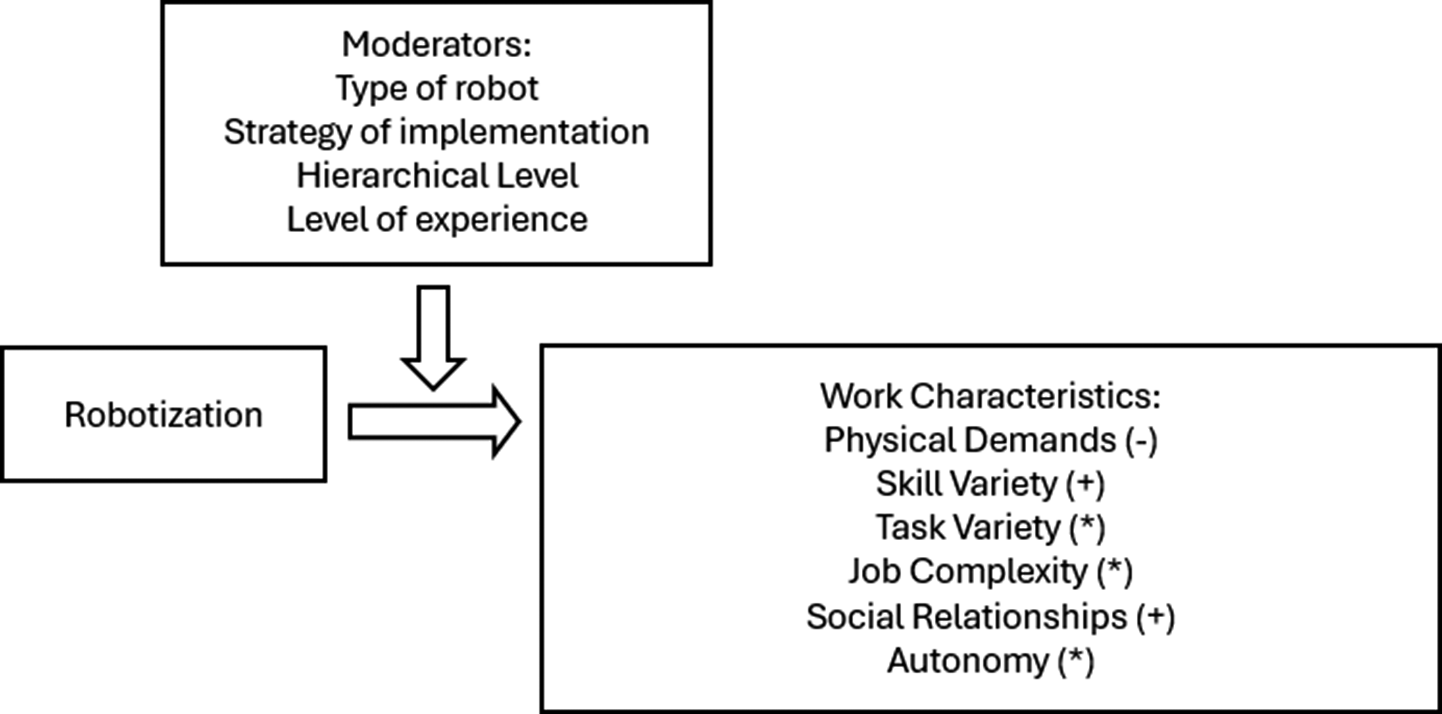
Finally, building upon the findings derived through grounded theory analysis, we present a research model that represents the main relationships uncovered in the data: the influence of robotization on relevant work characteristics, as well as the contingencies affecting this relationship (see Figure 1). This model offers a conceptual framework that can guide further empirical testing.
The proposed model: the relationships between robotization and physical demands, skill variety, task variety, job complexity, social relationships, and autonomy, moderated by type of robot, strategy of implementation, hierarchical level, and level of experience.
Notes: − represents a negative relationship, + represents a positive relationship, *represents mixed results.
While this study analyzes the impact of robotization on work characteristics, we acknowledge that robotization is not a homogeneous process. Contextual factors such as the type of robots and their functionalities, the timing of their introduction, and the roles of the affected workers (production line workers versus supervisors) are necessary elements to better conceptualize this phenomenon.
Implications for Practice
Our findings suggest several practical implications for work design that companies in the manufacturing sector and their managers and human resource professionals should consider. First, in line with previous research (Berkers et al., Reference Berkers, Rispens and Le Blanc2023; Pollak et al., Reference Pollak, Paliga and Kozusznik2021), our findings suggest that robotization can help reduce the physical demands that production line workers must handle when performing their jobs. Thus, when implementing robotic systems, manufacturing companies should consider not only improving productivity but also reducing the level of physical exertion and the number of repetitive tasks involved in certain jobs. This would help improve the well-being of their workers. Second, robotization may help reduce the number of quality-related conflicts among workers, improving social relationships. Therefore, implementing robots could help companies with quality-related conflicts among workers in the production process.
Third, when possible, manufacturing companies should consider the type of robot to implement. Our findings suggest that the implementation of cobots (instead of traditional industrial robots) could help improve the skill variety of jobs. Considering the implications of skill variety on work motivation and outcomes (Hackman & Oldham, Reference Hackman and Oldham1976; Humphrey et al., Reference Humphrey, Nahrgang and Morgeson2007), it is an issue that deserves reflection. Moreover, the upskilling associated with the implementation of cobots can play a key role in helping workers whose skills have become obsolete due to new technologies, easing the challenging transitions they face (Nedelkoska & Quintini, Reference Nedelkoska and Quintini2018). Fourth, our findings point out that, after robotization, supervisors tend to perceive higher levels of job complexity than production line workers. Thus, providing training opportunities to supervisors becomes a powerful instrument to develop the additional competences they will need to perform in their new role. The benefits of training have been largely studied, and organizations recognize that training enhances employee performance and productivity, serving as a valuable tool for mitigating the risks associated with the introduction of new technologies (Dermol & Câter, Reference Dermol and Čater2013). Fifth, our findings suggest that the relationship between robotization and perceived autonomy may depend on the workers’ experience with robots and the knowledge and skills associated with it. Experiencing a sense of autonomy is important because it influences work motivation and outcomes (Hackman & Oldham, Reference Hackman and Oldham1976; Humphrey et al., Reference Humphrey, Nahrgang and Morgeson2007). Moreover, it motivates individuals to surpass expectations and effectively address challenges at work (Parker & Fisher, Reference Parker and Fisher2022). Therefore, before implementing robots, manufacturing companies should consider investing in comprehensive training programs aimed at equipping employees with the skills and knowledge that will allow them to work with robots with some degree of autonomy (e.g., make decisions to fix simple problems). Moreover, this investment may be useful to reduce the costs (i.e., time, waste, money) associated with robots’ malfunctioning problems. Finally, our study suggests that the relationship between robotization and task variety may depend on the strategy followed by companies to implement robots. In this regard, adopting a sociotechnical perspective may be useful. Considering both the technological and social systems of the organization when implementing robots may help companies go above and beyond a restricted technological approach that is only concerned with efficiency and productivity, at the expense of job quality and employee well-being. The implementation of robots offers opportunities to enrich workers’ jobs by expanding the variety of tasks they perform. For instance, new tasks may include supervising robot operations, programming, and reprogramming robot functions, and fixing robots’ operation problems. Thus, by following an implementation strategy that also considers the impact of robots on workers’ jobs, manufacturing companies can increase task variety and improve the work motivation and outcomes of production line workers.
Limitations and Strengths
Our study has several limitations that must be considered when interpreting its findings. First, regarding the sample, only four companies participated in the study, all of them manufacturing companies. Future research should consider expanding the scope to incorporate a diverse range of companies and sectors for a more comprehensive understanding. In addition, the companies included in this study are competitive and successful in the market, with an expanding and growing trend. Likewise, their experiences with robots have been predominantly positive in their introduction and adaptation to the technology, as well as in how their introduction contributed to their expansion. It is worth noting that different results might have been obtained if less successful companies were considered, in both their historical trajectory and their experiences with robots.
Our study also has some strengths that we want to highlight. First, this qualitative study provided valuable insight into the nature of the work of production line workers and their supervisors after the introduction of industrial robots in their companies. As Parker and Grote (Reference Parker and Grote2022) pointed out, there is a need for “detailed studies of work in context” that try to understand “the complex interactions between work design, technology, individuals, and other factors” (p. 1195). In this sense, this study provides detailed information on how robotization impacts the working environment. Second, this in-depth exploration allowed the emergence of potential moderators that influence this relationship, offering valuable insight for future research. Third, the nature of qualitative research is subjective and attached to its context. While we have argued sample and generalizability limitations, we also believe that these “limitations” can also become the strengths of the study. The logic behind the sampling lies in purposively selecting those participants who can give us a better understanding of their experiences and better answer our research question, instead of making standard generalizations (Patton, Reference Patton2002; Staller, Reference Staller2021). One suggestion we offer to improve qualitative studies could be qualitative shadowing. Qualitative shadowing is “a research technique which involves a researcher closely following a member of an organization over an extended period of time” (McDonald, Reference McDonald2005, p. 456). This strategy could better capture the experience of production line workers and their supervisors while performing their jobs as they work alongside robots. This could provide more precise information and a more firsthand experience for the researcher to derive meaning from (McDonald, Reference McDonald2005).
Conclusions
Our study contributes to the understanding of the relationship between robotization and the characteristics of the work performed by manufacturing employees. We expanded the work design literature by considering the role of robotization as an antecedent of work characteristics and the influence of several moderators on this relationship. Our findings offer some ideas for future research that could be tested by conducting quantitative studies. Moreover, our findings and practical implications can guide robot implementations that aim to improve the quality of work life by improving the quality of work.
Data availability statement
The data analyzed in this article are available upon request.
Acknowledgements
We want to thank the four manufacturing companies that collaborated in this study for their support and commitment.
Author contribution
Conceptualization: L.B., V.G.-R.; Data curation: L.B.; Formal analysis: L.B.; Funding acquisition: V.G.-R., J.M.P.; Investigation: L.B., V.G.-R., J.M.P.; Methodology: L.B., V.G.-R.; Project administration: V.G.-R.; Resources: V.G.-R.; Supervision: V.G.-R., J.M.P.; Visualization: L.B.; Writing—original draft: L.B.; Writing—review and editing: V.G.-R., J.M.P.
Funding statement
This study was funded by Generalitat Valenciana, grant Prometeo 2021/048.
Competing interests
The authors declare none.


 Open access

