

1. Introduction
Our focus in this paper is on ‘industrial policy’, which we define as any intervention, or set of interventions, intended to affect conditions in an industry or a closely related set of industries.Footnote 1 Such interventions have greatly increased since 2009, dominated by production subsidies of different types (Evenett and Espejo, Reference Evenett and Espejo2023; Irwin, Reference Irwin2023). They constitute a prominent example of the systemic changes that confront the multilateral trade regime. Trade and trade-related policies are increasingly seen as tools to bolster economic security and resilience to shocks, whether natural or policy-induced, through diversification of imports and exports. Trade policy is also being used more frequently to pursue various non-economic objectives, including greening the economy, combating climate change, and safeguarding fundamental values.
Many of the associated instruments are designed to benefit national firms and actors to the detriment of foreign producers. Our conceptualization of industrial policy is considerably broader than measures that are designed to favor domestic production over imports. We include policies motivated by non-economic objectives that are not driven by a desire to expand domestic production.Footnote 2 Examples include competition, environment, and national/economic security policy, all of which pursue objectives that emerge from civil society and public politics. They do however affect conditions in an industry and may use trade as an instrument to achieve underlying policy objectives. Measures such as the EU Deforestation-Free Products Regulation and Carbon Border Adjustment Mechanism, and the US Inflation Reduction and CHIPS Acts fall under our conceptualization. Similarly, we consider interventions motivated by national (or broader economic) security concerns, such as export control regimes, screening of inward or outward foreign direct investment (FDI), and measures to bolster supply chain resilience or to ensure access to critical supplies to be industrial policies.
Our interest is in the scope and prospects for international cooperation to address negative cross-border spillovers of national industrial policies. We use the theory of economic policy (Johnson, Reference Johnson and Baldwin1965; Bhagwati, Reference Bhagwati, Bhagwati, Jones, Mundell and Vanek1971) as a lens for characterizing national objectives and available policy instruments and their consequences, including international spillovers. A key feature of this theory is the recognition that governments have both economic and non-economic objectives (NEOs). Economic objectives in this theory center on addressing market distortions and promoting efficiency, NEOs do not. The national pursuit of either type of objective through industrial policy instruments can have negative or positive spillover effects. Extant trade agreements and the WTO are designed to address the former but neglect the latter (Hoekman et al., Reference Hoekman, Mavroidis and Nelson2023). International cooperation provides opportunities for states to agree on concerted action and to recognize complementarities across industrial policies motivated by NEOs. Designing such cooperation is more complex than for industrial policy that reflects national commercial interests. Successful cooperation requires national technocrats to be able to exchange information and jointly consider available instruments that are politically feasible and likely to be more effective and efficient than unilateral actions. We argue that the type of objective motivating industrial policies, the prevalence of public politics for different policy domains across countries, and potential trade-offs across objectives will influence the scope for cooperation to reduce adverse spillovers and/or generate positive spillovers.
NEOs motivating industrial policy may be similar across countries, creating opportunities for international cooperation to reduce negative spillovers, recognize positive cross-border externalities, and benefit from concerted action. Determining the scope for such cooperation requires frameworks that support communication and sharing of information between the national agencies charged with the design and implementation of industrial policies. These must support consideration of the relationship between different objectives to identify tradeoffs and potential complementarities. Managing international spillovers requires technical expertise related to a given issue area to identify opportunities for cooperation to better achieve national objectives at lower cost. Technocrats responsible for implementation of policy operate under national legitimacy constraints that come from domestic politics. These affect the policy space available to them and may lead to adoption of instruments that are less effective or more costly.
Creating processes to distinguish efficiency enhancing industrial policy from interventions to attain NEOs and identifying whether states share similar NEOs is a first step in efforts to consider politically feasible policies that reduce negative international externalities and/or generate positive spillover effects. We argue that plurilateral agreements among like-minded states are likely to offer the best prospects for beneficial cooperation on industrial policy intervention to attain national NEOs. Pursuit of plurilateral agreements should ideally occur in the framework of multilateral institutions with wide membership to provide transparency to non-participants and opportunities for feedback and learning.
The paper proceeds as follows. Section 2 summarizes the main elements of the theory of economic policy and how it can be applied to industrial policy choices and their associated spillovers. Section 3 discusses the domestic political constraints that run through the link between legitimacy and policy space. Section 4 considers three illustrative examples of industrial policies that are not prima facie about supporting domestic industries: competition, environmental, and national security policy. These policy areas differ in the relative weight played by economic and non-economic objectives and the use of tax/subsidy instruments v. regulation, but all generate trade spillovers. Section 5 reflects on implications for the design of international cooperation. Section 6 concludes.
2. Spillovers and the Theory of Economic Policy
Using the Global Trade Alert database, Juhász et al. (Reference Juhász, Lane, Oehlsen and Pérez2022), defining industrial policy as measures intended to transform/shape the composition of economic activity, estimate that some 40–45% of all trade-related measures implemented by G20 countries since 2009 constitute industrial policies.Footnote 3 Evenett et al. (Reference Evenett, Jakubik, Martín and Ruta2024) show that much of the industrial policy activity is undertaken by high-income countries and often involves subsidies. Developing countries in contrast tend to use traditional trade measures (Figure 1), a difference Evenett et al. attribute to fiscal capacity constraints. They find that the justification (motivation) offered by governments in the associated decrees and laws for specific industrial policy actions often is commercial in nature (‘strategic competitiveness’) but that other common goals include climate change (environment) and supply chain resilience (economic security). All of these are NEOs.
Industrial policy instruments, by country group and type, 2023
Notes: EMDE: Emerging market & developing economies. AE: Advanced economies. Source: Evenett et al. (Reference Evenett, Jakubik, Martín and Ruta2024).

Managing the international policy spillovers generated by industrial policies faces a tension between public politics and technical design because it calls for technocratic management of exactly the type that creates the sort of suspicion that has become a breeding ground for populist politics. The GATT/WTO system was structured to focus on trade as an economic objective, i.e., it was focused on improving efficiency. The liberal, rules-based order that was established by the GATT in 1947 was a club that did not include Cold War adversaries. Open trade among the group largely reflected US, UK, and other allies’ non-economic, national security-cum-foreign policy goals. Following the collapse of the Soviet Union this security motivation for sustaining a liberal trade regime was attenuated. In conjunction with the gradual expansion of the GATT to now 166 WTO Members with different policy preferences and priorities, the consequence was to greatly increase the scope for political contestation of open trade.
The technocratic management of trade policy that was possible when open trade was a central feature of the foreign policy of the core members of the GATT is more difficult for NEOs that have linkages to trade. WTO members are free to use trade policy to pursue NEOs if they can demonstrate discrimination is necessary to achieve a NEO.Footnote 4 Depending on the NEO, such unilateral action may be inefficient and/or ineffective because of spillover effects that are not considered when designing policy. As many NEOs that motivate trade policies may be shared by states, cooperation centering on policy design and implementation is a potential path towards realizing NEOs at lower cost to trade. The challenge is to determine when this is the case and to identify approaches that will help states realize gains from cooperation.
Research on public economics (e.g. Lipsey and Lancaster, Reference Lipsey and Lancaster1956; Myles, Reference Myles1995) and trade policy (Johnson, Reference Johnson and Baldwin1965, Bhagwati, Reference Bhagwati, Bhagwati, Jones, Mundell and Vanek1971) has developed a theory of economic policy that provides a useful framework to compare policies, with respect to some objective, in terms of whether some policy is good or bad, or better or worse than another, or even optimal in the set of all relevant policies. The great virtue of this framework is not that it is particularly operational, but that it provides much needed structure to organize discourse among those charged with policy design and implementation to consider collective management of policy spillovers. The approach can be summarized in terms of responses to the following series of questions (Francois et al., Reference Francois, Hoekman and Nelson2023):
1. What is the policy objective?
2. What is the set of available instruments? (the policy space)
a. Identify the set of instruments that might affect the objective
b. Restrict the list to those that are politically & socially feasible
3. What is the best policy in the set of available instruments? (the assignment problem)
a. Ranking the available instruments in terms of costs and benefits relative to the objective (where costs and benefits explicitly consider spillovers across policy domains and national boundaries)
b. Given the list, pick the best
The basis on which state actors evaluate outcomes may involve:
• Doing what is perceived as ‘best’ for society (this is the standard assumed in most welfare economics); or
• Doing what is perceived as ‘best’ for the state itself (this is the standard assumption in much political science, in particular realist international relations theory); or
• Doing what is perceived as best for the particular state agent (e.g. maximizing the probability of reelection); or
• Some combination of such objectives (as in Grossman and Helpman, Reference Grossman and Helpman1994).
Most research by economists focuses on economic objectives. These respond to some form of distortion in the economy such that the normal operation of the economy results in sub-optimal outcomes from the point of view of the decision maker's objective function. Thus, the theory of economic policy as it is usually practiced is the identification of distortions.Footnote 5 In analysis of trade policy, the policy space comprises a tariff, production tax-cum-subsidy, and consumption tax-cum-subsidy, all of which are available. Generally, the only costs considered in instrument ranking are the direct effects of the instruments on consumer and producer choices, but deploying any of those instruments will have spillovers, some of which may constrain choices as well as affecting the relevant costs of the given instruments. The factors that generate the policy-space and the final choice from that space are determined in the realm of politics and political economy.Footnote 6
When the issue is the existence of some distortion relative to the competitive case, justification of policy intervention is straightforward and cooperation in remediation should be easy to achieve.Footnote 7 The problem is that whatever the optimal policy might be, any significant change from the status quo is likely to affect non-economic objectives. For example, a standard result from Heckscher–Ohlin–Samuelson trade theory is that liberalization from a tariff distorted equilibrium will redistribute income along the lines identified in the classic Stolper and Samuelson (Reference Stolper and Samuelson1941) analysis. Thus, although the tariff reform in this case is said to be ‘welfare increasing’, the income distribution effect undermines that claim. Although a redistribution of the gains from the liberalization permits a Pareto improvement, such redistributions rarely occur. Not only does this mean that the liberalization may not be an improvement relative to the government's objective function, but the change in income distribution may trigger domestic politics that undermine yet other goals.
3. NEOs, Politics, and Cooperation
The aim of policies motivated by NEOs is not to remediate market distortions (improve efficiency), but to achieve some first-order objective. Some NEOs can be evaluated in terms of economic magnitudes, others cannot. For example, an income distribution goal is non-economic. While governmental preference for a specific income distribution does not respond to a distortion but is rooted in a concern for fairness, equity, etc., the distribution of income is an economic variable and can be used to evaluate the success of the policy. Similarly, many industrial policies seek to stimulate specific industries. The preference for more production in this case does not stem from a distortion, but at least to some extent, the success (or failure) of such a policy can be evaluated in terms of the scale of production of the industry. Other NEOs can only be fully evaluated in terms of non-economic magnitudes. National security is an example as the preference for national security does not generally emerge from a distortion, and the evaluation of the state of security is not obviously measurable in terms of economic magnitudes. Similarly, assessments of environmental sustainability must involve scientific data.Footnote 8
Many NEOs will involve outcomes that can be assessed to some extent in economic terms. For example, a human rights goal is clearly non-economic, but some elements of evaluation might be economic (differences in wages and working conditions), while others involve non-economic judgements (fairness, safety, etc.). A goal like environmental sustainability might involve both fixing price distortions and NEO elements (e.g., protecting biodiversity). Thus, it is common to evaluate carbon emission as an externality, but there may well be elements of security, fairness, etc. that influence policy. The main takeaway is that it will not be possible to determine the best policy solely based on economic metrics. Matters are further complicated by the need to consider the extent to which policy domains are subject to public politics.
The three core questions of the theory of policy can be applied to NEOs, in the process informing the scope for international cooperation. Although ‘what is the problem?’ seems a simple question, it matters for the prospects and design of potential international cooperation because it will help establish the legitimacy of intervention for partner countries that may have similar goals. There is a potentially very wide range of values in terms of which a NEO might be justified. There is at least as wide a range of political factors that might legitimately deploy such values and bodies of technical knowledge that might be used to support claims and consider how policy interventions in response to a given problem spill over to other policy goals. A decision-maker needs to consider how to allocate scarce economic, political, and social resources across a variety of income distribution, defense, environmental, public health, education, goals, etc. While these are often treated independently in both the relevant political institutions and in policy studies, they are obviously linked in the grand general equilibrium, calling for consideration of the main trade-offs across goals. Such trade-offs are often ignored in public consultations and policy deliberations, with a broad range of NEOs implicitly treated as being equally important.
In practice of course, trade-offs are made by governments and national administrative agencies. NEOs are likely to be embedded in public politics and to have overlapping/conflicting bases in the political system. Legislatures may play a major role and there may be multiple epistemic/doxastic communities with a stake in different policy domains. While the distinction is not completely clean, it is convenient to distinguish two different sorts of political domains that are loci of politics that seek to define objectives and constrain both the policy space and the choices from that space: (i) administrative politics; and (ii) public politics. The former is occupied primarily by unelected specialists who seek to legitimate their choices by reference to bodies of technical knowledge. The latter is occupied primarily by specialists in public politics who seek to legitimate their choices by reference to some form of connection to the citizenry or groups of citizens. While these domains should be linked in a well-ordered democracy, the fundamental tensions between them are evident in any moderately complex democracy (Tucker, Reference Tucker2018).
It is in the nature of the administrative politics around a given issue (e.g. specific industrial policies) that they will be relatively easily communicated and relatively well understood by the participants in an international policy management process. The core members of these groups share common understandings of such issues by virtue of being active participants in domestic administrative politics. Note that we are not arguing that administrative politics are not politics, but that the politics are constrained by laws and institutions that stabilize domestic politics involving relatively stable groups of participants in those politics who, while they will generally not share final objectives (or there would not be politics), they do share common languages and understandings about the issues involved.
The situation when there are public politics around a NEO is very different. If an issue is an important topic of public politics, the role of the administrative state is likely to be relatively tightly constrained by those public politics as will be the policy space available to policymakers as interventions will be constantly tested for consistency with the terms of evolving public attitudes and the state of political competition among parties and leaders. The public discourse, however, will proceed at a level of generality that permits the association of chosen policies with broad valence issues. To shield important policies from the chaos of day-to-day politics, implementation of measures related to that public discourse must be delegated to the administrative/judicial state. Effective implementation of policies must build on/link to arcane bodies of knowledge associated with the respective issue areas. This produces the tension between democracy and the administrative/judicial state that has been a driver of the recent wave of populist politics,Footnote 9 which in turn affects the scope for international cooperation. The way a given policy domain attaches to the broader valence issues in a political jurisdiction may be very fluid. Technocrats seeking to collaborate in a policy area will know the way public politics constrain the actions of their own state but are unlikely to have nearly so clear a picture of the domestic politics of their partner states. Having a common framework for evaluating the policy choice problem faced by a given country can make a real contribution to cooperation.Footnote 10
Industrial policy enters the public political discourse in many ways. Sometimes it is product or sector-specific, e.g., stimulating domestic steel, electric vehicle, or battery production. Sometimes it is focused on ensuring reliable access to key inputs that are used in many sectors (‘critical materials’; ‘essential supplies’). In all these instances, industrial policy per se is no more an objective than trade policy. It is an instrument of some more fundamental objective: regional growth; employment; environmental sustainability; national security; bolstering technical capabilities and innovative capacity … the list is long. In public politics, that part of civil society that Habermas calls the ‘public sphere’ (Habermas, Reference Habermas1989, Reference Habermas1996), the meaning of these policies varies, and the expressed goal is often instrumental to the fundamental objective of political mobilization. These goals are frequently NEOs. The claim is that support for an industry will advance a (often not entirely clear) goal considered to be shared by most citizens, or at least to some sizable, and well-defined segment of the citizenry. Because there is a direct linkage to some industry, whose performance can provide data as an input to evaluation of the performance of a policy, such policies will generally lend themselves to assessment using economic metrics.
A multiplicity of goals often will complicate evaluation of effects. Consider stimulation of the green economy. In addition to promoting production and consumption generating fewer greenhouse gas emissions, the clean energy part of the Inflation Reduction Act (IRA) emphasizes reducing consumer energy costs and enhancing energy security as goals. In addition, the act allocates funds to promote racial and economic justice in farming, as well as to support rural communities. It can easily be argued that there is a warrant for them in the broad public discourse around the green economy, even though the link to environmental sustainability may be tenuous.Footnote 11 A theory of policy approach encourages thinking more systematically about spillovers across these, and related, policies by systematically incorporating the non-economic objectives in that analysis. In the case of the IRA, virtually all attempts to evaluate the implications of the program focus on resource flows. But those variables are never linked back to the objectives justifying its various components and there is no attempt to evaluate whether the magnitude of the flows are (or might be) appropriate to accomplishing the objectives. International cooperation can provide a vehicle that helps to do so.
4. Varieties of Industrial Policy
Industrial policies reflecting protectionist goals are central to trade agreements, including the WTO. These are frameworks establishing rules for national trade and subsidy policies that adversely affect conditions of competition for foreign products and producers. These rules are enforced through dispute settlement procedures and retaliation against measures that violate negotiated commitments. These commitments relate to policy acts. That is, they generally do not consider the rationale for industrial policies, i.e., whether they are motivated by NEOs other than supporting domestic production.Footnote 12 Competition law, environmental regulation, and national security motivated interventions are examples of industrial policy that are not, in the first-instance, trade-related, but which have potentially significant trade spillovers. Managing cooperation, or seeking to minimize conflict, in these areas requires understanding of the domestic objectives and the constraints on policy space of governments in the pursuit of industrial policies.
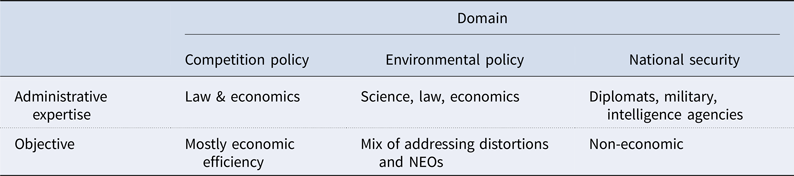
Table 1 characterizes some key features of these policy areas, differentiating between the technical expertise that is associated with the design and implementation of the respective policy areas and the objectives that are pursued. The three types of policies vary in the relative importance of economic and non-economic objectives. Antitrust primarily aims at dealing with market distortions, including in the case of the EU the effects of subsidies (state aids); environmental policy generally reflects a mix of both efficiency and NEOs; and national security is predominantly driven by non-economic objectives. All three require specialized technical expertise and strong bureaucratic and administrative capacity to design and implement policies effectively. They also tend to be relatively insulated from public political discourse – as distinct from issue-specific political engagement by stakeholders on the details of policy application. Experience reveals that the intensity of public politics will wax and wane over time, as does the relative weight accorded in jurisdictions to economic (efficiency) versus non-economic goals. These dynamics affect the set of available (politically feasible) instruments and the choice among these.
Competition, environmental and national security policy
4.1 Competition Law and Policy
Competition policy is generally aimed at promoting market efficiency in an industry by regulating the exercise of market power by firms and collusion within an industry to raise prices. Consider the case of a monopoly in the market for a final good. This creates a distortion by restricting output to raise the price paid by consumers. Because the policy goal is to enhance welfare by increasing efficiency, this is an archetypal economic objective.Footnote 13 While antitrust is now well established as an instrument for the pursuit of an economic objective, the original politics around antitrust in the United States was more concerned with political power than market power. From the early Republic, the US republican tradition has been skeptical of bigness, primarily as a threat to a well-ordered Republic. As the framing of public politics increasingly emphasized democracy, fears about large firms easily fit with perceptions that concentrated power distorted the voice of the people. High prices and the role of railroads and intermediaries in determining them were a key stimulus to populist disaffection, the language of republicanism and democracy fundamentally changed the valence of the public politics around antitrust. As public politics came to be dominated by the New Deal, competition policy came to be dominated by technocrats (lawyers and economists). The politics of regulation continued to be a major concern of Congress but became a mostly ‘inside the beltway’ question, defined by distributive concerns viewed through a nearly purely economic lens, not the valence issues of the earlier time. The result was to permit the emergence of an epistemic community around competition policy that stabilized the economic definition of the issue.Footnote 14 More recently, there has been a shift back to greater prominence of antitrust in public politics, reflecting perceptions that policy had been too lax regarding restrictive practices by dominant firms. The implementation of policy continues to be administered by technocrats, but subject to greater political contestation.
In the EU, competition policy has been a cornerstone of the creation of the single market, with a focus on both the standard elements of antitrust (abuse of dominance; anticompetitive behavior; merger control) and state aid (corporate subsidies and behavior of state-owned enterprises). Enforcement is delegated to the European Commission, which has developed – as in the US – extensive legal and economic expertise in this area and has substantial independence, subject to rulings by the European Court of Justice when decisions are contested by firms (or governments). Competition law enforcement has become more politicized in recent years, in part because of competition from Chinese companies alleged to have benefited from subsidies, and in part because of public concerns regarding the dominance of firms operating internet platforms. The EU has adopted a range of new legislation that aims to tax and regulate the behavior of large services providers (e-commerce, social media, and internet search), most of which are US companies (e.g., Amazon, Alphabet, X, Meta).Footnote 15 At the same time, political pressure has been increasing to relax enforcement of state aid rules and merger control regulations to facilitate mergers to create ‘European champions’ and allow member states to emulate US and Chinese subsidy programs.
Thus, in both the US and EU changes in the salience of public politics have affected the ability of responsible technocrats to implement policy with significant autonomy. As a result, competition policy has come to be seen at a political level as an instrument that should go beyond a focus on market behavior as such (economic objectives) to address competition by foreign firms that have benefitted from subsidies. This dynamic illustrates both changes in the degree to which administrative agencies are subject to public politics and associated constraint, and the relative weight accorded to economic as opposed to NEOs.
There is no international competition regime. Competition law is designed and applied by each jurisdiction autonomously. International cooperation in antitrust tends to be case specific and comity based, with a common focus across jurisdictions on efficiency (dealing with restrictive business practices and exercise of market power). This reflects a presumption of the associated epistemic community that competition policy should complement other industrial policy instruments because competition increases the prospects that policies to support national industries or firms will be effective by ensuring market discipline weeds out less capable firms (Aghion et al., Reference Aghion, Cai, Dewatripont, Du, Harrison and Legros2015). The (changing) mix of objectives pursued by competition policy authorities further complicates cooperation as implementing agencies must consider not just efficiency enhancing interventions in an open economy context but approaches that will help realize NEOs.Footnote 16
4.2 Environmental Policy
The changing balance over time in economic objectives v. NEOs and variation in salience of public politics as a constraint on technocrats charged with policy implementation observed in the domain of competition law also is a feature of environmental policy. One difference between the two policy areas is that environmentally motivated intervention generally reflects a mix of both economic and non-economic goals. Insofar as environmental externalities are not priced, policies that confront producers and/or consumers with the environmental costs of production and/or consumption fix a market distortion. NEOs in this domain have nothing to do with unpriced externalities but reflect a desire to sustain specific natural assets – e.g., wetlands, habitats, forest cover, etc.Footnote 17 As with antitrust, over time national environmental policies have seen changes in the relative weight and balance between economic goals and NEOs.
Environmental policy in the United States was initially driven by groups with NEOs: reducing air pollution, cleaning rivers and lakes, protecting ground water, and safeguarding the natural environment. As with competition policy, the policy was initially implemented (in the 1960s and 1970s) with a high degree of public/political support that backed the establishment of new government agencies at local, state, and federal levels with technical expertise and capacity needed to implement policies (e.g., Kraft, Reference Kraft2000). Like antitrust, economics played a small role in the initial adoption and design of environmental laws and regulations beyond the recognition that there were market failures associated with unpriced environmental externalities caused by industries (Hahn, Reference Hahn2000). This was reflected in use of ‘command and control’ regulation and limited attention for the implementation costs of adopted measures or evaluation of the effectiveness of the regulatory standards. Similarly to competition policy, over time economics became more influential, reflected in greater use of price-based measures (taxes, fees, and tradable permits), cost/benefit analysis, and regulatory assessments. Contrary to antitrust, over time environmental policy became strongly contested in public discourse, notwithstanding the success of the policies in greatly improving the quality of the environment (Shapiro, Reference Shapiro2022). In part, this reflected resistance to the adoption of what economics suggests are efficient instruments to reduce environmental externalities (taxation; market mechanisms). More importantly, resistance appears to reflect a rejection of the data and evidence on the (local) success of environmental policy and importance of action to address global externalities.
Many environmental problems are local or national in nature, but many are cross-border or global. Climate change and depletion of biodiversity and ocean fish stocks are examples of externalities that have long been recognized by environmental groups as problems that call for global solutions. Multilateral environmental treaties addressing specific environmental issues began to be negotiated in the 1970s with a focus on wildlife, e.g., safeguarding wetlands of international importance (1971), regulating trade in endangered species (1973), and protecting migratory species (1979). Subsequent agreements address transboundary pollution (1979), protect the ozone layer (mid 1980s), and global warming: the United Nations Framework Convention on Climate Change (1992); Kyoto Protocol (1997); Paris Agreement (2015). The success of these treaties in achieving underlying NEO varies, but generally pales in comparison to national environmental policies targeting national environmental degradation and the quality of national natural resources. This reflects the collective action nature of the problem.
There is increasing political willingness to use trade as an instrument to address global environmental spillovers. The EU decision to impose a carbon border adjustment mechanism (CBAM) as part of its emissions trading system that puts a price on carbon is an example. Another is the US use of subsidies linked to local content to incentivize domestic investment in and consumption of electric vehicles and the associated supply chain, notably batteries. The EU approach raises the domestic price of foreign products by pricing the embodied carbon at the same level incurred by domestic producers; the US strategy reduces the price for consumers conditional on buying from domestic producers, who may also be subsidized directly. The latter model is protectionist by design. Environmental policy instruments may work at cross purposes with traditional industrial policies that aim at supporting domestic producers, e.g., subsidies given to consumers to invest in solar panels may be offset by tariffs on environmental goods that raise the cost of investments by firms and households in renewable energy. IRA provisions to promote greening of the economy that make consumption subsidies for EVs conditional on sourcing from domestic industries is an example of an environmentally motivated policy that seeks also to promote domestic industries (automotive, batteries). The net effect may be to support realization of environmental NEOs (greening) but at higher cost.
If states have shared NEOs, coordinated, concerted action may allow for differentiation in the instruments used. If the focus is instead on the commercial spillovers of implementing instruments, the result can be retaliatory, tit-for-tat imposition of national discriminatory measures that reduce the effectiveness of policy in attaining a given NEO. These dynamics are evident in recent recourse to industrial policy measures by the US to support domestic steel and aluminum producers. The effort to negotiate a Global Arrangement on Sustainable Steel and Aluminum illustrates that both sides recognize the potential gains from cooperation.Footnote 18 The trigger for these talks was the unilateral imposition of tariffs on steel and aluminum products by the Trump administration and consequent retaliatory measures imposed by the EU. This classic type of trade conflict was complicated by the EU's adoption of CBAM that will imply fees on US steel and aluminum imported into the EU because the US does not have an emissions trading system or a national carbon tax. For the US, the salient NEOs in this case are national (economic) security and simple protectionism (protecting domestic steel manufacturing jobs). For the EU, the NEO at stake is to reduce the carbon footprint of economic activity. The US tried to link permanent removal of its additional tariffs on steel and aluminum products and the associated threat of retaliation by the EU to a deal that conditioned a more liberal trade policy stance in these sectors to agreement by the EU to accept US products as green and thus exempt from the CBAM, and to increase tariffs on imports from China. This was rejected by EU negotiators in October 2023 (Beattie, Reference Beattie2023a, Reference Beattie2023b).
Although the EU used the 2023 Foreign Subsidies Regulation to launch ex officio investigations against EV exports by Chinese companies, complementing extant antidumping and countervailing duties on environmental goods such as solar panels and e-bikes, it was unwilling to simply increase tariffs on Chinese products above its bound levels as this would violate WTO rules. It was also unwilling to gut the legitimacy of the CBAM by offering special treatment to the US. The market access deal proposed by the US failed because it did not consider the public politics around the NEOs driving EU policy – greening the economy and abiding by its WTO commitments. This example illustrates the potential for applying the theory of economic policy in efforts to cooperate in the design of national trade policies. Doing so would have focused attention on the differences in the goals being pursued, and the infeasibility of the attempted issue linkage strategy.
4.3 National Security Policy
National security is perhaps the ultimate NEO. Sovereignty defines the nation state and any threat to sovereignty will be a prime focus of policy. Arnold Wolfers (Reference Wolfers1952) helpfully defines security as: ‘in an objective sense, … the absence of threats to acquired values, in a subjective sense, absence of fear that such values will be attacked.’ Not only is there no link to economic distortions (market failures), but there is no essential link to economic metrics for evaluating security.Footnote 19 Taking Wolfers’ (Reference Wolfers1951) notion of a pole of power and pole of indifference (and presuming some kind of continuum between the two), if the geopolitical environment is well-away from the pole of power, much of this policy domain can be managed by military and diplomatic technocrats, with relatively minimal attachment to non-security issues (like trade).Footnote 20 However, when the geostrategic environment approaches more closely to the pole of power, the reach of national security becomes both more public and more extensive. More issues take on a national security coloring and activists around other issues will seek to associate these with national security.Footnote 21
In the immediate post-Second World War era, as the US moved to construct a peacetime Cold War footing, economic policy was increasingly seen as an instrument of strategic and diplomatic policy (Yergin, Reference Yergin1977; Gaddis, Reference Gaddis1982). Thus, in addition to the Marshal Plan and support for European integration, the US actively pursued the creation of a liberal international economic order (the Bretton Woods institutions and the GATT) as part of the same programme. In the US, this led to de-politicization of trade relative to its centrality in the late-nineteenth and early twentieth centuries, both domestically and internationally (Irwin, Reference Irwin2017, Reference Irwin2020) and a period in which trade policy tended to be relatively effectively managed by diplomatic, legal, and economic technocrats and focus on liberalization.Footnote 22 National security and foreign policy specialists essentially left the trade domain, with the exception of trade in military products and export controls for dual use goods. This administrative/judicial dominance of trade politics began to collapse in the 1980s, which saw several efforts to make trade a public political issue (Dick Gephart, Ross Perot). These efforts tended to fail. Moments in which trade appeared to be politicizing (e.g., around the Japanese auto VER and the Seattle ministerial conference) were short-lived.
The basic structure of the system and its politics remained relatively stable until it was blown up by the Trump administration with its reversion to extensive unilateral imposition of tariffs and its decision to eviscerate the WTO dispute settlement system.Footnote 23 It would be a mistake, however, to treat Trump as more than the proximate cause of systemic disarray. On the one hand, the ideological foundation of support for a strongly market oriented politics was undermined by the 2007–2008 financial crisis and the emergence of a general critique of that orientation as neoliberal. By opening a public political discourse about liberal economic policies and claims this drove the gutting of welfare state support for democratic capitalism, the extension of that critique to liberal international economic policy was to be expected. That context already existed when the world lurched back toward the pole of power (with a land war in Europe and an increasingly bellicose major power in Asia). The return of security to a central position across all international domains, very much including trade, has had the opposite effect.
The linkage between trade and security has become increasingly public, reflecting concerns to protect national security assets and the economy more generally, illustrated in a renewed focus on economic security in many OECD nations. This centers on improving resilience of supply chains to shocks and reducing the scope for ‘weaponization’ of trade by potential adversaries and incentives for foreign trade partners to engage in coercive economic behavior. Associated policy instruments include diversification of sources of supply of critical supplies (e.g., medical products, food, minerals), expanding domestic production capacity by subsidizing domestic firms or industries and scrutiny of inward FDI and foreign takeovers of national companies to retain technological capabilities, and capacity. These types of interventions and instruments often intersect with competition policy and the type of industrial policy that is the focus of the WTO: simple protectionism and discriminatory production subsidies. A corollary challenge for international cooperation is to recognize that industrial policy instruments may be motivated by a mix of NEOs. Some, perhaps many, of these will be shared by like-minded states, but in contrast to competition and environmental policy, the source of concern is the potential behavior of a major state or a group of allied countries. Thus, cooperation to achieve national and economic security goals is likely to involve clubs of like-minded economies that share specific NEOs, with collaboration centering on the choice of instruments that are more effective and efficient than those available to a nation acting autonomously. Efforts to design such cooperation will benefit from the application of the theory of economic policy.
5. Policy Spillovers and Complementarities
A common feature of the policy domains discussed above is that they involve actions that affect international exchange, but restricting trade is not the primary goal. As a result, trade implications are often given insufficient attention by national authorities. The potential gains from international cooperation on industrial policy is evident. They go beyond the extensively analyzed rationales for negotiating trade policy commitments in the international economics literature to address negative commercial spillovers (e.g., Bagwell and Staiger, Reference Bagwell and Staiger2002) because the underlying NEOs may be achieved more readily if states act in concert or consider implications for NEOs before acting based solely on national commercial considerations. The collective action nature of fighting climate change and protecting biodiversity and ocean life calls for cooperation. In the case of national security, policy effectiveness increases, and implementation costs fall if like-minded countries cooperate in the use of export controls, FDI screening, or diversifying sourcing of critical supplies. Competition policy is like national security motivated industrial policy in being a tool that that can potentially be used to constrain foreign anticompetitive behavior, including subsidization that distorts competition on a market, and can be adjusted to recognize security-related NEOs as well as economic objectives.
All these areas of national policy create international spillovers, as do protectionism and support programs for domestic industries of the sort that are the focus in trade agreements. Efforts to address the spillovers need to distinguish between types of objectives, notably those that are efficiency enhancing (address distortions), those that are zero sum ‘strategic’ interventions that center on assisting domestic industry to boost national output and employment (both NEOs insofar as they are not premised on a market failure), and those that reflect other NEOs. In doing so, tradeoffs across objectives must be considered given that a policy intervention may reflect more than one goal. In contrast to the spillovers from commercial policy instruments, where the goal is simple protectionism//support for national production and that lend themselves to reciprocal exchange of policy commitments, the presence of NEOs calls for attention for positive spillovers as well as negative competitive effects. If states have similar NEOs, they should consider both potential tradeoffs across objectives and potential complementarities associated with national policies. This can support joint action, e.g., adoption of common approaches or efforts to recognize the ‘equivalence’ of (different) national policy instruments in fostering realization of NEOs.
The design of such cooperation should focus on identifying where jurisdictions have similar NEOs, assessment of the possible tradeoffs implied by recourse to a policy instrument in attaining a given NEO, and the need to recognize the extent to which issue areas are subject to public politics that influence the policy space available to national technocrats. Cooperation can take many forms. From a theory of policy perspective, a key element is dialogue and deliberation among states and actors involved in the design and implementation of national policy. This can help across all three of the key questions that encompass the framework: defining objectives, identifying potential instruments, and instrument selection – including adjusting instruments over time as experience is obtained and impacts are assessed. As argued at greater length in Hoekman and Nelson (Reference Hoekman and Nelson2020), platforms through which the epistemic/doxastic communities responsible for a policy domain can work together to determine whether NEOs motivate industrial policy and agree on methods to measure and track NEO-related outcome variables can provide a basis for developing approaches that can be adopted by like-minded states. A process centered on exchange of information and dialogue on NEOs motivating national industrial policies, their effectiveness and associated spillover effects would provide a basis for states to consider cooperating with each other to attenuate negative spillovers and harness potential synergies and in attaining a NEO.
As we have argued previously, many industrial policy objectives are common across states – e.g., reducing carbon footprints and environmental degradation, or reducing (excessive) dependence on key suppliers through diversification and/or by allocating subsidies to expand supply of critical materials to bolster economic security. Exchanging information on extant production capacity, stocks, and weak links in supply chains can help identify potential areas for joint action to realize NEOs. Whether and how cooperation and coordination among like-minded nations is a means to enhance the scope for domestic policies to realize NEOs more effectively at lower cost will depend on the specific NEO concerned and the extent to which public politics affect the policy space available to national technocrats.
We are fully cognizant that this call for exploring the scope for cooperation on industrial policies that are driven by NEOs will be difficult to operationalize. Mandating that agencies consider the opportunity costs of national industrial policies and consider the role trade can play in helping to attain shared NEOs confronts the emergence of a general critique of ‘neoliberalism’ and the open trade and investment regime (i.e., the liberal trade order).Footnote 24 Neither of the major parties in the US seems willing to expend political capital on building on the institutions of global liberalism. Although a more vocal proponent of multilateral engagement, the EU is actively pursuing unilateral trade and industrial policy measures. The same is true of China. Matters are further complicated because cooperation on industrial policies that are motivated by NEOs is more complex than dealing with commercial spillovers of protectionist measures as embodied in the GATT/WTO. It requires acceptance of NEOs as legitimate, and recognition of political constraints that confront national implementing agencies.
There is an important outstanding research agenda concerning the feasibility and design of international cooperation on industrial policies that pursue NEOs. Trade agreements are designed to achieve economic objectives (reduce distortions by lowering trade barriers). They are not geared to help signatories attain shared NEOs. In practice, cooperation between states on industrial policies that reflect NEOs will be limited to like-minded states – and in the case of national security policy will have to be. Associated plurilateral agreements, if these emerge from dialogue and deliberation, ideally should be anchored in the framework of multilateral institutions with wide membership to ensure transparency for non-participants and opportunities for signatories to obtain and provide inputs and feedback, and thus provide for learning. Whether this should be the WTO is a matter to be determined by participating countries. In principle, there is a good case to do so.Footnote 25
6. Conclusion
Traditional protectionist measures (tariffs, quotas, et cetera) have become relatively unimportant for the major trading nations. To a considerable extent, this reflects the successful cooperation of those nations via multilateral and regional trade agreements and accompanying institutions. While this pattern began to reverse in some countries, notably the United States, driven by decisions by US administrations starting in 2016 to impose higher import tariffs,Footnote 26 for most states trade-related policies do not take the form of tariffs but of regulatory measures and fiscal interventions. Governments are focusing more on how trade can be used to achieve broader sustainability objectives. In parallel, they increasingly are pursuing policies that seek to promote domestic economic activity through ‘green’ industrial policies and re-shoring or friendshoring of industrial production that is deemed critical for national or economic security.
Faced with challenges that derive from global spillovers, multilateral and regional trade institutions face increasing challenges from growing application of national policies that also have spillovers. Uncoordinated application of such policies will often produce outcomes that are inferior to those that could be achieved with some measure of cooperation. Unfortunately, many of these policies cannot be well managed by the legalistic structures of extant trade institutions, which evolved to deal with what (very) loosely are what Bagwell and Staiger (Reference Bagwell and Staiger2002) call terms-of-trade externalities. The rationale for cooperation is economic efficiency, i.e., what we have called economic objectives, with the source of the distortion addressed by a trade agreement being government interventions that in turn often reflect a specific type of non-economic objective: a desire to expand domestic production at the expense of foreign producers. Much of the extant literature on industrial policy focuses on the associated trade and subsidy measures used by governments in pursuit of this goal.
We argue in this paper that industrial policy should be conceptualized more broadly to recognize that states pursue other NEOs and use associated policy interventions that influence the conditions of competition in an industry. This may be designed to affect trade or affect trade incidentally. The demands for these policies are commonly tied to public politics that are specific to the political contexts of individual countries. Management of cooperation in these contexts requires both detailed information about those contexts as well as a willingness and capacity to find common ground where it exists. We have nothing to say about willingness, but we have argued here that an essential part of developing a basis for international cooperation to address spillovers from industrial policies motivated by NEOs is a language that eases communication about the political and economic foundations of those policies, and we have sketched an outline of just such a language.
It seems clear that trade policy will increasingly be motivated by a heterogenous mix of commercial and non-economic objectives, as opposed to ‘encoding sustainability more profoundly in the DNA’ of the WTO. For the trading system, an implication is that an organization like the WTO should not only monitor the use of trade related policies but provide mechanisms for members to understand the goals motivating policy interventions, consider their effectiveness. and assess their spillover effects.
Acknowledgement
We are grateful to two reviewers and to Sarah Bauerlie Danzman, Charles Hankla, Jonas Meckling, Stephanie Rickard, and participants in seminars at the EUI, Tulane University and the 2023 conference on Politics of Industrial Policy, Princeton School of Public and International Affairs, Washington D.C. for helpful comments and suggestions. This research was partly supported by the Centre for Inclusive Trade Policy, Economic and Social Research Council, grant number ES/W002434/1 and the European Research Council, grant no. 101142666-PIANO-ERC-2023-ADG (Hoekman).


 Open access

