


Few would question the influence of money in contemporary U.S. elections. Recent studies affirm the relationship between fundraising and success by demonstrating that the more money a candidate raises, the more likely she is to win her election (e.g., Jacobson, Reference Jacobson2015; Bonica, Reference Bonica2017; Schuster, Reference Schuster2020; Ferguson et al., Reference Ferguson, Jorgensen and Chen2022).Footnote 1 Various individual-level and contextual factors influence a candidate’s fundraising potential (e.g., Cho and Gimpel, Reference Cho and Gimpel2007; Fouirnaies and Hall, Reference Fouirnaies and Hall2014; Grumbach and Sahn, Reference Grumbach and Sahn2020); chief among them is their ability to raise money early. Raising money well before the election is valuable to a candidate because “early money is seed money for the entire campaign effort; it is needed to organize, plan, and raise more money” (Jacobson, Reference Jacobson1980, pp. 78–79). Early money bolsters later fundraising because it acts as a signal for campaign viability. Candidates who raise money early are thought to have more favorable electoral odds, leading them to raise even more money (e.g., Krasno et al., Reference Krasno, Green and Cowden1994; Adkins and Dowdle, Reference Adkins and Dowdle2005; Feigenbaum and Shelton, Reference Feigenbaum and Shelton2012; Magleby et al., Reference Magleby, Goodliffe and Olsen2018). Work tying early fundraising to a favorable campaign outlook tracks with candidate behavior. The extant work demonstrates that cross-candidate disparities in early fundraising influence challengers’ emergence and dropout decisions (e.g., Epstein and Zemsky, Reference Epstein and Zemsky1995; Box-Steffensmeier, Reference Box-Steffensmeier1996; Norrander, Reference Norrander2000; Goodliffe, Reference Goodliffe2001; Bonica, Reference Bonica2017; Thomsen, Reference Thomsen2023).
Early fundraising is at the heart of questions related to declining electoral competition, inequalities in the path to representation, and the influence of moneyed interests in politics (e.g., Snyder, Reference Snyder1992; Sorensen and Chen, Reference Sorensen and Chen2022; Thomsen, Reference Thomsen2023). However, more clarity on the best practices for measuring early campaign fundraising is needed to assess these critical questions properly. Our survey of the literature reveals nearly a dozen unique measures of early money, and we demonstrate that these approaches produce substantially different estimates for early fundraising. This variability is concerning for two reasons. First, there is a lack of theoretical justification in extant work linking early money measures to quantities of interest. Second, the extent to which existing measures reflect definitional aspects of early money has yet to be empirically validated.
This article offers a theoretical and empirical roadmap to measuring early money. We propose that early money can be conceptualized in two ways: centered on a candidate’s fundraising behavior (candidate-centered) or her fundraising performance relative to her electoral competitors (election-centered). We argue that these approaches capture conceptually distinct attributes of early fundraising. A candidate-centered measure of dollars raised in the initial days of the campaign is best suited for questions about the qualities or quantity of a candidate’s early fundraising. For example, what political influencers financially support candidates in the “invisible” or “money” primary? Is the amount of early dollars a candidate raises predictive of future fundraising success? An election-centered measure of a candidate’s early fundraising relative to her competitors at a fixed time is best suited for questions that assess the interplay between fundraising and competition. For example, do early fundraising deficits motivate candidates to drop out of their election? Are parties and interest groups more likely to endorse front-runners or underdogs? We go on to offer guidance on scope conditions for election- and candidate-centered early money operationalization, specifically addressing (1) what best defines a candidate’s early fundraising window, (2) how long before a candidate’s election must money be raised to be considered early, and (3) what units of measurement are most suitable for expressing early money estimates.
We conclude by presenting empirical applications to demonstrate that candidate- and election-centered early money measures are conceptually district quantities. Specifically, we assess how well candidate- and election-centered early money measures perform as predictors for a candidate’s future fundraising and likelihood of primary election victory in U.S. House elections held from 2010 to 2020. When included in the same model, we find that both a candidate-centered and an election-centered measure for early fundraising exert a statistically significant and independent effect on a candidate’s future fundraising and her electoral success. We find that our candidate-centered measure is the stronger fundraising predictor for total primary fundraising—which is a candidate-centered outcome. We also find that our election-centered measure is a stronger fundraising predictor for primary success—which is an election-centered outcome. In this way, our results align with our expectations regarding the theoretical mechanisms linked to each measurement strategy. In sum, our results emphasize that candidate- and election-centered early money measures capture distinct quantities of interest, reasserting the importance of typing theory to measurement.
This paper seeks to reinvigorate scholarly discussion on the measurement of money in politics and pushes scholars to emphasize the role of money in explaining political outcomes. We demonstrate that measuring early fundraising is not straightforward and that scholars’ measurement choices can have important implications for inference. These challenges, though, should not constrain research. We provide practical advice for measuring early fundraising and offer resources to aid scholars in their early money measurement. Though we center our analysis on campaign finance in U.S. House elections, this examination should serve as a jumping-off point for work assessing fundraising in other electoral contexts; many of the same measurement complexities evident here are present in U.S. elections held at the local and state levels.
1. Why does early money measurement choice matter?
Research on money in politics has conceptualized early fundraising in myriad ways. However, to our knowledge, work has yet to assess if and how estimates of early fundraising vary across these measurement strategies. This section introduces a new classification schema for existing early money measurement approaches. Next, we present modest correlations across these typologies. Finally, we demonstrate how statistical inferences shift depending on the type of measure used to operationalize early money.
1.1. Classifying early money measures
In Table 1, we classify existing approaches for operationalizing early money into two groups of measures.Footnote 2 We identify a first group of “election-centered” measures that operationalize early fundraising based on an election-specific end date; all funds raised before that date are considered early. Some election-centered measures base their fundraising end date on months elapsed within an election cycle (e.g., Green and Krasno, Reference Green and Krasno1988).Footnote 3 Other measures base their fundraising end date on contest-level electoral timing, for example, ending some number of months before the primary (e.g., Leal, Reference Leal2003).Footnote 4 We identify a second group of “candidate-centered” measures that operationalize early fundraising based on a candidate-specific start date; all funds raised for a window after that date are considered early. The start date for early fundraising is unique to each candidate because it is based on that candidate’s fundraising behavior, such as the date she registers her campaignFootnote 5 with the Federal Election Commission (FEC) (e.g., Bonica, Reference Bonica2017, Reference Bonica2020) or the date she receives her first itemized donationFootnote 6 (e.g., Bonica and Grumbach, Reference Bonica and Grumbach2022; Porter and Steelman, Reference Porter and Steelman2023). A candidate’s early fundraising window is often specified as lasting 60 or 90 days after this start date; alternatively, some other work considers all fundraising reported in a candidate’s first quarterly report filed with the FEC to be early (e.g., Biersack et al. Reference Biersack, Herrnson and Wilcox1993; Thomsen, Reference Thomsen2023).Footnote 7
Summary of existing measures for early campaign fundraising

1.2. Variation in early fundraising estimates across measures
In Figure 1, we assess to what extent estimates of early fundraising vary within and across election- and candidate-centered measurement typologies. Average cross-measure correlations for early fundraising include all candidates who ran in elections for the U.S. House of Representatives from 2010 to 2020 (N = 6,001).Footnote 8 All measures are produced using itemized receipts provided by OpenSecrets and aggregate unitemized contribution totals drawn from FEC quarterly reports; for more detail on data preparation, see Appendix Section B. Figure 1(a) includes cross-measure correlations for incumbents who ran for reelection; Figure 1(b) includes cross-measure correlations for non-incumbent challengers. For ease of presentation, we restrict Figure 1 to include the most common early fundraising measures found in the extant literature, described in greater detail in Appendix Table A1.
Average pairwise correlations for popular early money measures. (a) Incumbents and (b) non-incumbents.

Average pairwise correlations in Figure 1(a) and (b) are consistently stronger within measurement typology than across typologies.Footnote 9 For instance, looking at candidate-centered approaches, the three measures presented (fundraising 90 days after a candidate registers with the FEC, fundraising 90 days after a candidate receives her first itemized contribution, and fundraising reported in a candidate’s first FEC quarterly report) have an average correlation of 0.75 for incumbents and 0.86 for non-incumbents.Footnote 10 Pairwise correlations between candidate-centered and election-centered measures are more modest ranging from 0.62 to 0.84 for incumbents and 0.39 to 0.59 for challengers.
We trace these weak correlations to the conceptual differences between candidate- and election-centered measurement approaches, particularly how these strategies define the early fundraising window. To illustrate, Figure 2 depicts fundraising window lengths and early fundraising estimates across various early money measures for Carolyn Maloney (Figure 2(a)) and Suraj Patel (Figure 2(b)), who both ran in the Democratic primary for New York’s 12th Congressional District in 2020. This primary was closely contested, with district incumbent Maloney besting Patel for the Democratic nomination by only 3.4 percentage points. The x-axis in Figure 2 is an election timeline expressing the number of days until New York’s Democratic primary election, which was held on June 23rd, 2020. Horizontal bars reflect the length of early fundraising windows across the same measures from Figure 1. Fundraising totals for each measure are included to the right of each horizontal bar.
Timing of fundraising windows and estimates for early fundraising across extant measurement strategies. (a) Carolyn Maloney (D-NY) and (b) Suraj Patel (D-NY).
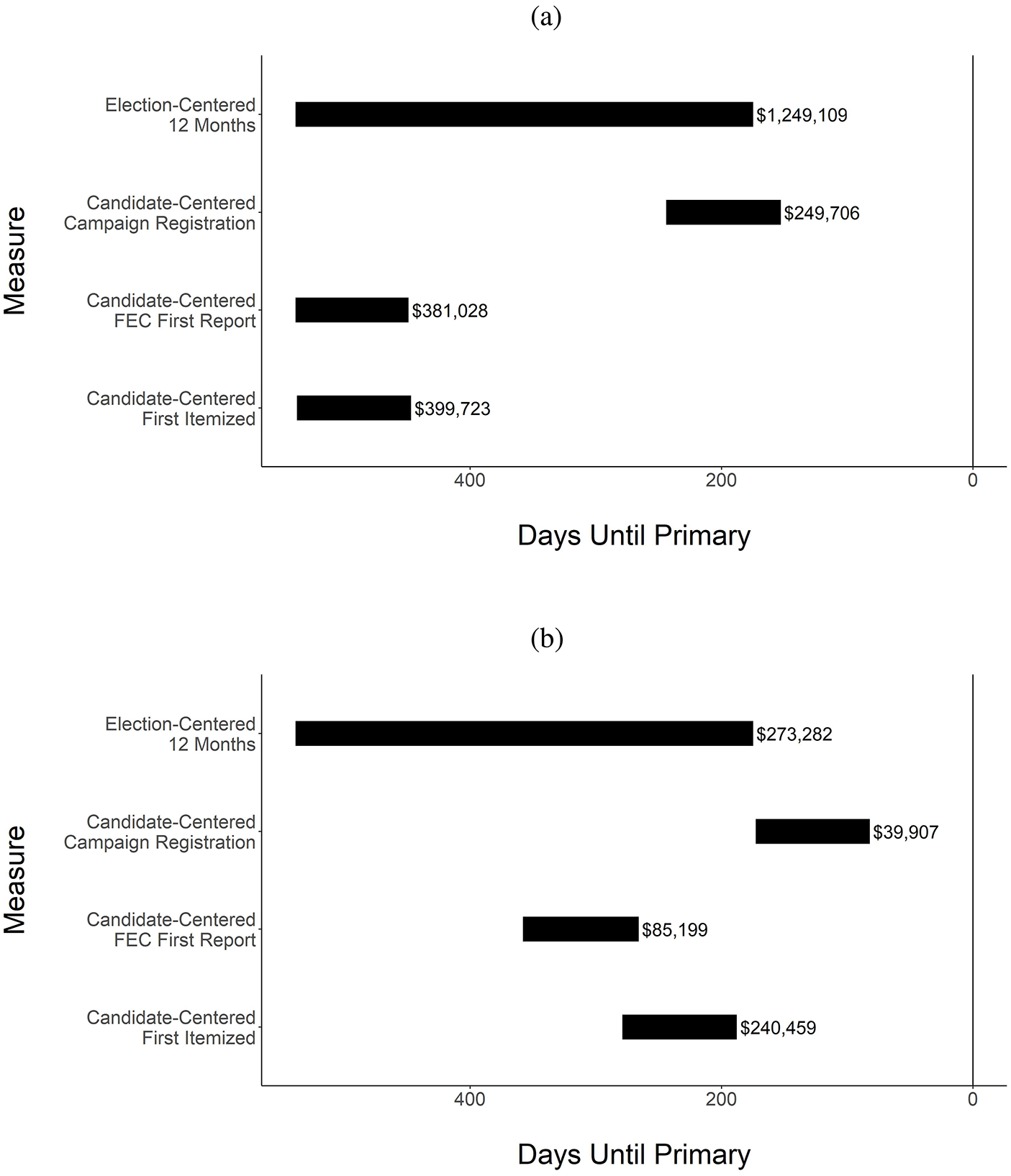
Turning first to Figure 2(a), election- and candidate-centered measures begin during similar periods of the election cycle—with the exception of the campaign registration-based measure.Footnote 11 This symmetry in start dates across fundraising measures aligns with expectations; incumbents consistently begin fundraising within the first few months of an election cycle.Footnote 12 Challengers are less consistent as to when they begin fundraising, as is evident in Figure 2(b). Because Patel and Maloney ran in the same primary election contest, their election-centered fundraising windows span the same campaign period. However, the fundraising windows for Patel’s candidate-centered measures fall much later in the election cycle than Maloney’s because Patel did not begin fundraising until September 2019. Consequently, election- and candidate-centered measurement approaches produce disparate estimates for Patel’s early fundraising. Additionally, Patel and Maloney’s fundraising windows cover fundamentally different windows of the election cycle, despite these two candidates appearing in the same race.
The examples presented here illustrate how differences in operationalization between election- and candidate-centered measurement approaches produce differing estimates of early fundraising. Appendix Figure A2 presents the average lengths and timing for fundraising windows across all incumbent and non-incumbent candidates who ran for the U.S. House of Representatives from 2010 to 2020. For incumbent candidates, average fundraising windows for candidate-centered measures fall within the windows of election-centered measures; variation across measurement typologies is primarily rooted in the length of fundraising windows (e.g., a 90-day candidate-centered window vs. a 12-month election-centered window). For non-incumbent candidates, the fundraising windows for election-centered and candidate-centered measures do not consistently overlap as they do for incumbents. These differences produce the modest cross-typology fundraising correlations for non-incumbents found in Figure 1(b).
1.3. How measurement choice impacts substantive conclusions
Different approaches for measuring early fundraising can produce different conclusions about money’s influence in elections. In Figure 3, we estimate a series of logistic regressions assessing candidate success in congressional primaries. Units of analysis include all candidates who ran in open seat, partisan primary elections for the U.S. House of Representatives from 2010 to 2020. We restrict our analysis to candidates running in open seats because the connection between fundraising and success is most pronounced in these contests, as no incumbent is running for reelection (Thomsen, Reference Thomsen2023). Moreover, the extant work about early fundraising focuses most often on these kinds of contests (e.g., Bonica, Reference Bonica2017, Reference Bonica2020; Porter and Steelman, Reference Porter and Steelman2023). Each model presented in Figure 3 employs a different estimation strategy for candidate-centered and election-centered early fundraising as a primary explanatory variable. We include other control variables in our models, including indicators for candidate partisanship, prior political experience, primary type, district seat safety, and the number of competitors in the race, as well as fixed effects by year and random effects by district partisan primary.
Marginal differences in pairwise comparisons for early money coefficient in primary election success models.
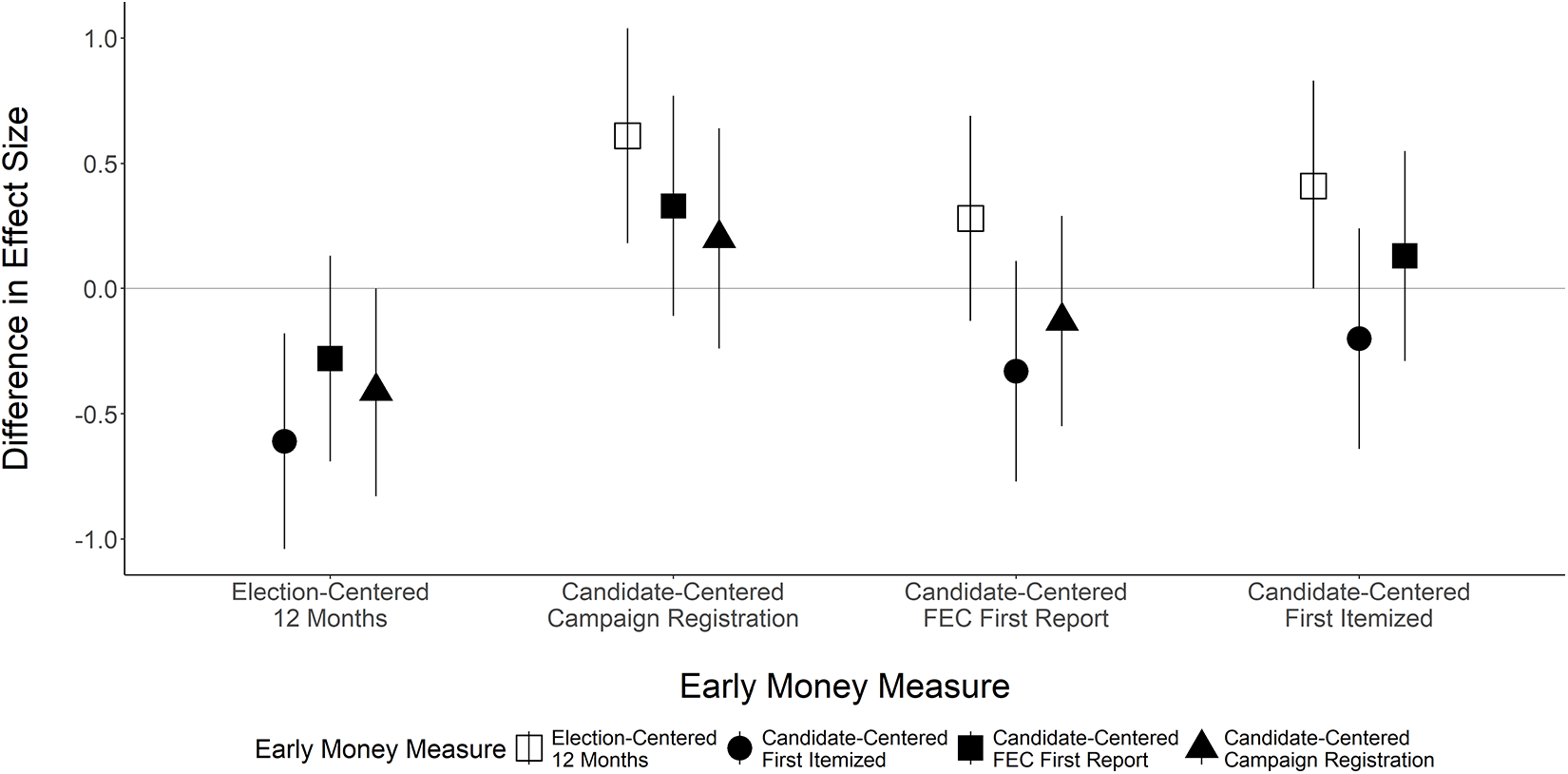
We aim to assess how statistical inferences about the relationship between early fundraising and primary election success change conditional on the choice of early money measure. Because estimates for total early fundraising take on different ranges of values across each mode for measurement, we standardize all early money measures used in our models to have a mean of zero and a standard deviation of 1. Additionally, we follow the guidance of Mize et al. Reference Mize, Doan and Long(2019) to recover the covariance matrices for marginal differences to produce valid confidence intervals for these quantities. In this approach, we stack models using seemingly unrelated estimation to combine estimates from multiple models. We estimate a stacked model for each set of the pairwise model comparisons, producing a total of 10 model outputs. The coefficients estimated in these stacked models are identical to those produced by individual models; standard errors vary between stacked and individual models.
The marginal differences in early money coefficients across model pairwise comparisons are presented in Figure 3 with 95% confidence intervals. The x-axis indicates the focal model used in pairwise comparisons.Footnote 13 The y-axis indicates the difference in effect sizes across pairwise model comparisons. Confidence intervals that do not intersect with the horizontal gray line indicate the differences across pairwise model comparisons (i.e., marginal differences) are statistically significant. Plotted coefficients denoted with outlined shapes are election-centered measures; plotted coefficients denoted with shaded shapes are candidate-centered measures.
We find statistically significant differences across five of the six unique pairwise comparisons made in Figure 3 between election and candidate-centered measures. To place differences between measures in substantive terms, we turn to predicted probabilities. When employing a candidate-centered measure of early money, such as all fundraising reported in a candidate’s first FEC quarterly report, an increase from one standard deviation below the mean to one standard deviation above the mean increases the predicted probability of success from 0.08 to 0.56. Conversely, when employing an election-centered measure of early money, such as all fundraising garnered 9 months before a candidate’s primary, an increase in fundraising from one standard deviation below the mean to one standard deviation above the mean increases the predicted probability of success from 0.14 to 0.43. The difference-in-difference between these two measures is 0.19.Footnote 14
Scholars have traditionally treated early money measures as interchangeable, offering little theoretical rationale for their measurement choices under the assumption that extant strategies produce similar fundraising estimates. Our preceding analyses indicate that this ambivalence is a threat to inference. We demonstrate that election-centered and candidate-centered measurement approaches produce differing estimates of early fundraising. Moreover, we show that these measurement differences have downstream consequences, impacting the substantive conclusions drawn from statistical analyses. To address this disconnect, we argue that scholars should leverage conceptual differences between election- and candidate-centered approaches to better align their empirical measurement of early fundraising with their theoretical motivations.
2. Guidance for early money measurement
In this section, we offer practical guidance for measuring early fundraising. We propose that candidate-centered measures of early fundraising are best suited for assessing a candidate’s initial financial backing; therefore, the quantity of interest for this measurement approach is raw dollars raised. Election-centered measures of early fundraising are best suited for assessing the comparative fundraising performance of candidates at a fixed point in time; therefore, the quantity of interest for this measurement approach is relative fundraising. We additionally highlight other measurement-specific considerations for early fundraising estimation. We specifically offer guidance for selecting early fundraising start/end dates and discuss data considerations for constructing early money estimates. Finally, we highlight a collection of resources we have produced to make early money measurement more straightforward for researchers.
2.1. Theoretical motivations for measuring early fundraising
A candidate-centered measure is well-suited to address research questions centered on the initial financial backing a candidate’s campaign receives. Recall that this family of approaches uses the start of a candidate’s fundraising campaign to define the beginning of her early fundraising window. As such, a candidate-centered approach should reflect those first receipts raised by a candidate. This approach stands in contrast to an election-centered strategy that defines a candidate’s fundraising windows based on the election calendar, which may fail to capture a candidate’s initial fundraising.Footnote 15 By capturing initial donations, a candidate-centered measure should reflect the “seed” funding that helps to get a candidate’s campaign off the ground (Jacobson, Reference Jacobson1980; Biersack et al., Reference Biersack, Herrnson and Wilcox1993). The quicker a candidate can raise seed money, the sooner she can put these resources to use and make herself known to potential voters and donors. The political action committee EMILY’s List embodies in its name the principle that early contributions have an outsized impact on future fundraising, affirming that “Early Money Is Like Yeast” because it “makes the dough rise.” To that end, a body of research seeks to measure the qualities or quantity of a candidate’s early fundraising to identify the political influencers providing financial support to candidates in the “invisible” or “money” primary. For example, Bonica and Grumbach Reference Bonica and Grumbach2022 use early campaign contributions to show that the “selectorate” of donors providing seed funding to candidates skew older and ideologically conservative. Porter and Steelman Reference Porter and Steelman(2023) similarly employ early money to assess the kinds of political influencers active in the “invisible primary” and demonstrate that early monetary support from out-of-district donors is especially predictive of future fundraising success.
An election-centered measure is well-suited to addressing research questions about the interplay between early campaign fundraising and electoral competition. Recall that this family of approaches holds the fundraising window constant for all candidates running in the same electoral contest, allowing for direct comparisons across competitor fundraising at a fixed point in time. In this way, an election-centered approach encapsulates the dynamic of a candidate tailoring her behavior to her competitors’ fundraising performance. This stands in contrast to a candidate-centered strategy where there is no guarantee that early fundraising estimates reflect funds raised at the same point in the election cycle for all candidates in a race.Footnote 16 An election-centered measure should capture the kind of fundraising data that journalists, pollsters, and voters use when making cross-candidate comparisons to glean who is “ahead” or “behind” in a race (Raja, Reference Raja2007; Anderson et al., Reference Anderson, Burden, Butler, Harbridge-Yong and Ryan2023). This dynamic is the subject of research assessing how fundraising disparities influence electoral competition. Epstein and Zemsky Reference Epstein and Zemsky(1995), for instance, argue that challenger entry decisions are, in part, a function of incumbents’ financial signaling—where a strong show in early incumbent fundraising will deter challenger entry. Similarly, Thomsen Reference Thomsen2023 shows that congressional candidates today are increasingly likely to drop out of elections when they are at an early fundraising disadvantage relative to their primary election competitors.
2.2. How to measure candidate-centered early fundraising
Because a candidate-centered measure of early money seeks to measure the initial contributions a candidate receives, the quantity of interest is raw dollars raised by a candidate.Footnote 17 Moreover, for a candidate-centered measure to aptly capture a candidate’s initial “seeds” of fundraising, it should not reflect a protracted period of her fundraising campaign. Based on empirical conclusions drawn from Appendix Sections C and D, we suggest that researchers define a fundraising window as beginning when a candidate’s first itemized contribution is received and set a window length of 90 days. This start date ensures a candidate’s earliest receipt is captured in early fundraising measurement.Footnote 18 Additionally, using a 90-day fundraising window ensures that a candidate’s first FEC quarterly reporting deadline is included in candidate-centered early money measurement. As shown in Appendix Figure A6, deadlines for reporting fundraising to the FEC clearly influence the data generation process for campaign receipts. Extant work finds that candidates are mindful of the vital role fundraising plays in shaping perceptions of campaign viability and, accordingly, ratchet up their fundraising efforts proximate to FEC reporting deadlines (Smidt and Christenson, Reference Smidt and Christenson2011; Magleby et al., Reference Magleby, Goodliffe and Olsen2018). Candidate-centered measures that do not capture a candidate’s first FEC reporting deadline will under-report early fundraising.
When employing a candidate-centered approach, researchers should impose a cutoff date for early money measurement such that funds raised after a specific date are no longer deemed early.Footnote 19 A sizable minority of candidates begin fundraising only a short time before their election; over 10% of all non-incumbent candidates who ran for the U.S. House between 2010 and 2020 began fundraising within 90 days of their primary.Footnote 20 It is undoubtedly the case that campaign fundraising garnered months before the primary versus mere days before the election have differentiated impacts on campaign success. It is important to explicitly acknowledge, however, that imposing such a cutoff will result in some candidates possessing observed fundraising periods that include fewer than 90 days. For instance, if a candidate begins raising money a month prior to a selected cutoff date, their candidate-centered fundraising will only capture a 30-day period.
We propose using state-level filing deadlines to inform a cutoff for early fundraising. Filing deadlines fall at least 2 months before each state’s primary elections. Over 95% of non-incumbent general election winners received their first itemized contribution on or before their state’s filing deadline. Importantly, a cutoff specification employing filing deadlines accounts for state-level variability in primary election timing. Specifying a fixed fundraising cutoff across all elections will not account for this variability.Footnote 21 To illustrate, in the context of congressional elections, primaries are held across 8 months, the earliest occurring in February of the election year and the latest in September.Footnote 22 Specifying an early fundraising cutoff of January 1st would fall only a month from February primaries but over 250 days from September primaries. An early money measure capturing these different campaign phases for February and September primaries will surely fail to measure candidate fundraising consistently. One potential limitation in employing state-level filing deadlines as an early fundraising cutoff is that these deadlines vary across states, inducing disparate fundraising window lengths. Importantly, though, we find no relationship between the number of days in the window of our proposed measure and the number of days before the election that filing deadlines occur. This provides empirical evidence that variation in the timing of state-level filing deadlines will have limited influence on cross-candidate comparisons. For reference, we graphically depict our proposed candidate-centered measure of early money in Appendix Figure A5 using the same motivating example as Figure 2.
2.3. How to measure election-centered early fundraising
Given that an election-centered measure of early money is interested in a candidate’s comparative fundraising performance at a fixed point, our quantity of interest here is not raw dollars raised but, instead, relative fundraising. Research questions seeking to assess whether a candidate is over- or under-performing early fundraising expectations should rely on Bonica’s (Reference Bonica2020) approach for calculating normalized fundraising relative to contest-level averages. For candidate i in primary contest j at time t, let fijt be a candidate’s fundraising total at a fixed point in the primary and njt be the number of candidates competing in the primary contest at that time, such that  $\widehat{Normalized \ Fundraising} = \frac{f_{ijt}}{(\sum \frac{f_{jt}}{n_{jt}})}$. Using this approach, a value of greater than one indicates that a candidate is raising more than the contest average in early fundraising; a value of less than one indicates that a candidate is raising less than the contest-level average. Research questions seeking to assess how a candidate’s early money compares to a specific competitor should rely on Thomsen’s (Reference Thomsen2023) approach for calculating a fundraising share. For candidate i in primary contest j at time t, let fijt be a candidate’s fundraising total at a fixed point in the primary and mjt be the fundraising total for the comparison candidate (e.g., lead fundraiser or incumbent) at the same fixed point, such that $\widehat{Fundraising \ Share} = \frac{f_{ijt}}{m_{jt}}$. A value of greater than one indicates that a candidate is raising more than the comparison candidate in early fundraising; a value of less than one indicates that a candidate is raising less than the comparison candidate.
The date a researcher defines as the end of election-centered early fundraising should be tied to her question of interest.Footnote 23 For example, following Epstein and Zemsky Reference Epstein and Zemsky(1995), if seeking to understand how the size of an incumbent’s campaign war chest deters challenger entry, a fundraising end date early in the election season should be specified. This same end date would not be suitable for examining a different kind of candidate–fundraising relationship, such as the dropout decisions of candidates who are poor fundraisers (Thomsen, Reference Thomsen2023). When choosing an early fundraising end date, it is also important to be mindful of state-level variability in the timing of elections. Researchers should specify a fundraising end date tied to contest-level electoral conditions. For example, Leal Reference Leal(2003) considers receipts early if they are raised 9 months before the primary.Footnote 24 It is important to explicitly note that, unlike our candidate-centered approach proposed above, this approach uses the same observation period across candidates in the same race because it is based on election timing rather than candidate fundraising behavior.
For many applications, the filing deadline for a candidate’s election is an appropriate end date for early fundraising. All federal, state, and local elections require candidates to submit paperwork by a specific date to appear on the ballot. Once a state’s filing deadline passes, the ballot is set, and no more candidates can enter the race. A filing deadline early fundraising cutoff will, therefore, include all ballot-eligible candidates; this is desirable if a researcher seeks to use an election-centered measure to make cross-candidate fundraising comparisons in advance of the election. It is worth noting that while the filing deadline for some states is closer to the primary election than others, this is not problematic for an election-centered measure. Our election-centered measure is calculated as a share rather than raw totals. Therefore, the measure allows for valid comparisons across states given all candidates within a race are evaluated on the same criteria, and all election-centered measures reflect a comparable share of fundraising. For reference, we graphically depict our proposed election-centered measure of early money in Appendix Figure A5 using the same motivating example as Figure 2.
2.4. Data considerations for early fundraising measurement
Campaign contributions data are often reported in two formats: raw itemized contributions from bulk data files and aggregated totals from fundraising disclosure reports. Using each of these sources for data involves trade-offs. The benefit of employing raw contributions is that these data allow for the fine-grained measurement of early money. Because receipt dates are available for itemized contributions, fundraising windows can be precisely and flexibly specified to include contributions garnered across specific dates. The drawback of working with raw data files is that it is computationally intensive. Raw contributions data can be downloaded in bulk from the FEC website, or specific data requests can be queried to the FEC API. Resulting files often contain tens of millions of observations; processing these data and manually calculating candidates’ contribution totals requires data-wrangling skills and knowledge of campaign finance reporting requirements. Additionally, consistent receipt dates are unavailable for unitemized contributions—even in a raw data format (Alvarez et al., Reference Alvarez, Katz and Kim2020). If researchers wish to incorporate small-dollar donations into their early money estimates, they must still rely on aggregate totals provided in disclosure reports.Footnote 25
The benefit of employing contributions data from disclosure reports is tied to ease of use. Accessing disclosure reports (e.g., quarterly reports to the FEC) is straightforward, and pre-aggregated contribution totals are reported in disclosure reports—no manual calculations are required. Moreover, at the federal level, FEC quarterly reports include itemized and unitemized receipts, giving a complete picture of candidate fundraising across a consistent window. The drawback of employing these data is that fundraising totals are pre-aggregated across a fixed reporting period that may not align with a researcher’s specified early fundraising window. Moreover, disclosure reports may not reflect a consistent campaign period (e.g., 90 days in FEC quarterly reports). For example, in Appendix Section E, we demonstrate that about 6% of U.S. House candidates who ran between 2010 and 2020 had a first FEC quarterly reporting period that spanned more than 90 days, and 21% had a first reporting period that spanned less than 45 days.
To aid researchers, we make several resources available to measure early money. First, we provide a new dataset of state filing deadlines for U.S. congressional elections between 2004 and 2020. Second, we produce and make available off-the-shelf measures for early fundraising in U.S. House elections. For our candidate-centered measure, we calculate early money raised 90 days after receipt of a candidate’s first itemized contribution. We cut off a candidate’s early fundraising window if it intersects with her state’s filing election deadline. For our election-centered measure, we calculate early fundraising totals with an end date based on contest-level filing deadlines. Additionally, we calculate and make available election-centered early fundraising totals at the 3-, 6-, and 9-month marks from a candidate’s primary election. All estimates are produced using raw data on itemized campaign receipts and aggregated unitemized receipt totals. For greater detail, see Appendix Section B. Estimates are created based on the recommendations outlined in our preceding discussion. For reference, our candidate-centered estimates correlate with extant candidate-centered measures from Figure 1 at 0.86 and the election-centered estimates correlate with extant election-centered measures at 0.93.
3. Application: employing multiple early money measures
To demonstrate that candidate- and election-centered early money measures capture conceptually distinct quantities of interest, we turn to a series of empirical applications. We assess how well measures of early fundraising perform as predictors for (1) a candidate’s future fundraising success and (2) their likelihood of primary election victory. We expect that both measures will exert independent effects on our outcomes of interest. We also expect model performance to improve when both election- and candidate-centered early fundraising are accounted for in the model specification. Additionally, we expect that the relationship between early money and outcomes will be conditional on measurement. A candidate-centered measurement approach captures the early funds a candidate has at her disposal in the initial days of her campaign. The more funds a candidate raises, the more she can spend on campaign infrastructure (e.g., staff, campaign offices, and advertising). These resources are vital to raising a candidate’s profile in the district and making her known to a broader pool of donors (Herrnson, Reference Herrnson1992; Jacobson, Reference Jacobson1980; Box-Steffensmeier et al., Reference Box-Steffensmeier, Radcliffe and Bartels2005; Hassell and Monson, Reference Hassell and Monson2014). For these reasons, a candidate-centered measure of early fundraising should have a more substantial effect on a candidate’s future fundraising dividends. Unlike a candidate-centered measure that reflects raw receipts, an election-centered measure captures a candidate’s fundraising performance relative to her competitors at a fixed point in time. Existing research shows that political elites are likelier to donate to candidates who already enjoy a fundraising advantage (Box-Steffensmeier et al., Reference Box-Steffensmeier, Radcliffe and Bartels2005; Feigenbaum and Shelton, Reference Feigenbaum and Shelton2012). Journalists often use comparative fundraising to discern a candidate’s likelihood of winning (Raja, Reference Raja2007). Finally, voters tend to view strong fundraisers as more electable, and these judgments impact vote choice (Abramowitz, Reference Abramowitz1989; Anderson et al., Reference Anderson, Burden, Butler, Harbridge-Yong and Ryan2023). For these reasons, an election-centered measure should have a more substantial effect on electoral success.
We run a series of regressions to test these expectations. Units of analysis include all candidates who ran in partisan primary elections for the U.S. House of Representatives from 2010 to 2020. We once again restrict our analyses to candidates running in open seats (i.e., contests where no incumbent ran for reelection) and include the same control variables employed in models specified in Figure 3. We also include fixed effects by year and random effects by partisan primary election. To measure candidate-centered fundraising, we calculate the total dollars raised by a candidate in the 90-day window following the receipt of her first itemized contribution. We do not consider fundraising to be early if it is garnered after the state filing deadline for a candidate’s election. To measure election-centered fundraising, we calculate a candidate’s normalized fundraising relative to her primary election competitors at her state’s filing election deadline. These early fundraising measures reflect the guidance proposed in the preceding sections. Both measures of early fundraising employed in Table 2 are rescaled to have a mean 0 and a standard deviation of 1 to allow for cross-measure comparisons.
Early fundraising and campaign success in open seat contests for the U.S. House of Representatives, 2010–2020

Note: Units of analysis include candidate who ran in open seat primary elections (i.e., races without an incumbent) who raised at least $5,000 prior to their primary election. We exclude non-partisan primaries held in California, Washington, and Louisiana. Both measures of early contributions have been scaled to have a mean of 0 and a standard deviation of 1 to allow for comparisons of effect sizes across measures. *p < 0.05.
Results are presented in Table 2. We specify three models for each outcome variable. In our future fundraising linear regressions, the outcome variable is a candidate’s total fundraising (in thousands of 2020 dollars) garnered between her contest-level filing deadline and the date of her primary. In our electoral success logistic regressions, the outcome variable is a dichotomous indicator for whether or not the candidate won her primary. For each of these outcome variables, we specify a regression that includes only our candidate-centered early fundraising measure (Table 2, Models 1 and 4). We specify a second regression that includes only our election-centered early fundraising measure (Table 2, Models 2 and 5). Finally, we specify a third regression that includes both election- and candidate-centered fundraising measures (Table 2, Models 3 and 6).
Turning first to our future fundraising analyses (Table 2, Models 1–3), we find results consistent with our expectation that both election- and candidate-centered early fundraising predict future pre-primary contributions. This is the case when we specify our models with our candidate-centered or our election-centered measures, as well as when both are accounted for in the same model. Importantly, predictive performance improves when both measures of early fundraising are included in the model specification, as is made evident when comparing the Akaike Information Criterion (AIC) across models.Footnote 26 An ANOVA chi-squared test confirms that modeling performance significantly improves when accounting for both early money measures (p-value < 0.01).
Turning next to our electoral success analyses (Table 2, Models 4–6), we again find that our election- and candidate-centered early fundraising measures exert independent effects when accounted for in the same model. As with our future fundraising analyses, the AIC estimator and ANOVA chi-squared test confirm that including both early fundraising measures in model specification improves performance (p-value < 0.01). Together, these results provide empirical support that candidate-centered and election-centered early money measures capture conceptually distinct quantities of interest important for explaining political outcomes.
Finally, we find support for our expectations regarding the relative strength of predictive effects for each of our early money measures. When comparing early fundraising coefficients in our future fundraising model, the effect for our candidate-centered measure is 149.71 (se = 9.42), and the effect for our election-centered measure is 65.55 (se = 9.21). A t-test confirms that candidate-centered early fundraising has a significantly greater effect on pre-primary contributions (p-value < 0.05). This finding supports our theoretical expectation that raw receipts garnered at the start of a candidate’s campaign have a stronger relationship with future fundraising than an election-centered measure for relative fundraising. When comparing coefficients in our electoral success model, the effect for our election-centered measure is 1.48 (se = 0.16), and the effect for our candidate-centered measure is 0.67 (se = 0.16). A t-test confirms that election-centered early contributions have a significantly greater effect on a candidate’s likelihood of primary election success (p-value < 0.05). This supports our expectation that a candidate’s relative fundraising performance has a stronger relationship with electoral success than a candidate-centered measure of raw dollars.
4. Conclusion
In this article, we put forward a theoretical and empirical roadmap for choosing the appropriate measure for early fundraising. We classify extant early money measures into groups of “election-centered” and “candidate-centered” approaches and demonstrate that these strategies produce substantially different estimates for candidates’ early fundraising. We attribute this variability to conceptual differences in how early money is measured and argue that election-centered and candidate-centered approaches capture two distinct quantities of interest. We recommend that researchers leverage differences across approaches for early money measurement to better connect their empirical strategy with their theoretical quantity of interest. We propose a candidate-centered measure capturing dollars raised in the initial days of a candidate’s campaign is best suited for addressing research questions about the qualities or quantity of a candidate’s early fundraising. To capture early receipts, a candidate-centered measure should define the start of a candidate’s early fundraising window using the date of receipt for her first itemized contribution. This fundraising window should reflect a full FEC reporting quarter (about 90 days) and exclude funds raised proximate to the election. An election-centered measure expressing a candidate’s early receipts relative to her competitors is best suited for research questions that assess the interplay between campaign fundraising and electoral competition. When choosing a date to mark the conclusion of election-centered early fundraising, researchers account for state-level election timing.
Motivated by the growing influence of moneyed interests in politics, scholarship examining the relationship between early fundraising and political outcomes is experiencing a resurgence. We offer practical guidance and empirical tools to equip scholars with the resources needed to engage with research questions tied to early fundraising. The theoretical and empirical framework we present provides an essential introduction to the considerations researchers must engage with to properly conceptualize and measure early fundraising in their own work.
Supplementary material
The supplementary material for this article can be found at https://doi.org/10.1017/psrm.2025.10014. To obtain replication material for this article, https://doi.org/10.7910/DVN/FVLHCX.
Acknowledgements
We thank Adam Bonica, Dino Christenson, Jay Goodliffe, Jeff Harden, Silvia Kim, participants at the 2022 American Political Science Association Annual Conference, and the anonymous reviewers for their helpful feedback.


 Open access

