

I Introduction
There are several reasons why development scholars should be interested in the case of Taiwan. As one author has written: ‘It once had a single dominant party following the Leninist model; it now has a competitive multiparty system. It was once a classic economic dependency relying on the sale of primary products (sugar and rice); it is today a leading exporter of manufactures. Its Land-to-the-Tiller programme offers one of the most successful examples of creating a foundation for social equity and balanced growth’ (Chan, Reference Chan and Chow2002: 174–5).
The achievements of Taiwan are so varied and impressive that it is justified to talk about ‘Taiwan’s development miracle’. After presenting some of the most salient achievements we will search for explanations behind them; thereafter, we will raise the key issue of their replicability in different contexts. Important indicators of Taiwan’s success are as follows:Footnote 1
a. Fast economic growth: The gross national product (GNP) grew at an average of 8.8 per cent between 1953 and 1986, and per capita GNP at 6.2 per cent during the same period. As a result, the relative gap in per capita income between Taiwan and most advanced economies was narrowed down at an amazing speed. Thus, while in 1971 the per capita income in Taiwan represented hardly more than 8 per cent of the per capita income in the United States, its share rose to a staggering 39 per cent twenty years later (in 1991). In the early 1990s, per capita income in Taiwan exceeded that of Greece and Portugal but was smaller than that of Spain. In the 2020s, Taiwan occupies the fifteenth position in the ranking of the world’s countries in terms of gross domestic product (GDP) per capita.
b. Fast economic growth, accompanied by unusually equal income distribution: Incomes in Taiwan are much more equally distributed than in the typical developing country and more equally distributed than in some rich advanced countries, such as the United States and Japan (and South Korea).
c. Rapid improvements in material welfare: In 1982, already, almost all households in the country had electricity, televisions, refrigerators, and motorcycles, while two-thirds had piped water, telephones, and washing machines.
d. Remarkable speed of the demographic transition: The rate of population growth decreased from 3.5 per cent in 1953–62 to 2.9 per cent in 1963–72, 1.9 per cent in 1973–82, and 1.2 per cent in 1986 – that is, a two-thirds fall within about thirty years.
e. Rapid increase in life expectancy, school enrolment, and literacy: Between 1960 and 1977, Taiwan, together with Hong Kong, performed better in both life expectancy and literacy than all other cases in a sample of 100 developing countries, both market and non-market (Communist) countries. By 1982 life expectancy at birth was seventy-five years for women and seventy years for men. Moreover, virtually all primary school-aged children went to school, almost all of them went on to junior high school, and 80 per cent of senior high school graduates went on to schools of higher education.
f. Rapid increase in earnings from manufacturing industries: Real earnings in manufacturing increased at a rate of 15 per cent a year between 1960 and 1980, a period during which Taiwan embarked on industrialisation.
g. Strong competitiveness in international trade: Taiwan is one of the most trade-dependent countries in the world (behind Hong Kong, Singapore, and some small petroleum exporters), and from being a leading exporter of agricultural products it has become a leading exporter of increasingly sophisticated manufactured products (most noticeably, TSMC, from Taiwan, is one of the world’s leading chipmakers in the 2020s). While in 1955, 85 per cent of Taiwanese exports consisted of agricultural or processed agricultural products, based mostly on rice and sugar, industrial products made up no less than 90 per cent of total exports around 1990.
h. Taiwan’s economic transformation happened within a short time period of twenty-five years in a context of remarkable macroeconomic stability, without inflation and without recession. A milestone in Taiwan’s development was its relaxation of stringent foreign exchange controls that had been in place for four decades and which had made Taiwan’s foreign exchange reserves the world’s biggest after Japan (by 1987).
i. Political liberalisation and the democratisation of the country was initiated by the one-party state itself, and proved to be effective and sustainable.
These stunning aspects of Taiwan’s performance have been achieved despite a number of adverse initial conditions. Let us mention the most important of these. First, the newly independent Republic of China had to accommodate a massive influx of immigrants from mainland China who relocated to Taiwan after the defeat of the nationalists against the Communists.Footnote 2 (In this respect, the situation of Taiwan closely resembles that of newly independent Pakistan, where immigrants from India settled in big cities and initially dominated politics.) The process did not go smoothly, and an ethnic conflict broke out which was caused by the seizure of political power by the mainlanders. This was despite the fact that the islanders had originally come from China two or three centuries before (Wade, Reference Wade1990a: 232). Riots quickly erupted and a harsh repression followed, which saw 30,000 Taiwanese people killed in early 1947. In 1949, martial law was declared by the Kuomintang (KMT), the party of the Nationalist immigrants from China, which was to last for thirty-eight years and was used as a way to suppress the political opposition during the years it was active. During the White Terror, as the period is known, 140,000 people were imprisoned or executed for being perceived as anti-KMT or pro-Communist. Many citizens were arrested, tortured, imprisoned, and executed for their real or perceived link to the Chinese Communist Party. Since these people were mainly from the intellectual and social elite, an entire generation of political and social leaders was decimated. On the other side of the coin, a large number of the migrating mainlanders were trained and experienced professionals.
The second adverse initial condition faced by Taiwan is the fact that although the country is comparable in size to Belgium or the Netherlands, it has much less arable land and many more people to feed. The first feature is the result of the fact that two-thirds of the country is mountainous. To make things worse, not only does Taiwan have a rugged topography, but many of its agricultural soils are also of rather poor quality. As for the second feature, Taiwan started with a high population density that was partly attributable to the massive immigration from mainland China. This exceeded 230 people per square kilometre in the early 1950s (reaching 572 people per square kilometre in the early 1990s), which translated into a very high level of effective land pressure given the aforementioned soil characteristics. Finally, the country is endowed with few mineral resources and small quantities of natural gas.
How did Taiwan succeed in overcoming these adverse conditions to engender a continuous and rapid development process that has been considered almost miraculous? To what extent can we attribute the country’s success to other initial conditions that were favourable: in particular, the broadly impressive Japanese colonial legacy, and the massive financial and technical aid received from the US government, which in the 1950s equalled 43 per cent of gross investment (Chang, Reference Chang1965: 152)? And to what extent is the success traceable to efficient institutions and policies? It is impossible to answer these questions since the specific contributions of these factors cannot be adequately disentangled. What can be convincingly argued, however, is that Taiwan has successfully exploited the available opportunities and the advantages it had at its disposal at the start of its development process. As will become clearer in this chapter, both the strategic and institutional choices made by the Taiwanese government, whether helped by US advisers and the Japanese legacy or not, displayed a remarkable degree of pragmatic wisdom and consistency. Moreover, they were backed by strong political resolve and a highly competent administrative machinery. In the following sections, we start by looking at the deep transformation of agriculture and the rural economy initiated in Taiwan after independence. Thereafter, we will try to understand in what ways the Taiwanese state has been a developmental state, a mixture of relation-based authoritarianism, a devoted and competent bureaucracy, and a state apparatus immune from pressures from private interests.
II Transforming The Rural Landscape
A Taking Stock of Impressive Achievements
One of the great challenges of development, as seen by Ragnar Nurkse (Reference Nurkse1953) and Arthur Lewis (Reference Lewis, Agarwala and Singh1954), is how and how fast the surplus labour existing in a large low-productivity sector, whether it consists of agricultural or other informal economic activities, can be absorbed in a modern or formal high-productivity sector, typically industry (and associated services). What Lewis has called the ‘turning point’ or the ‘commercialisation point’ is the threshold beyond which the two sectors start competing with each other on an equal footing: that is, the high-productivity sector must be ready to raise its wages to be able to attract labour from the low-productivity sector. At this point, there is no more excess labour in the latter and labour productivity increases in both sectors. Development is under way. Another related way of defining the turning point is when the absolute size of the agricultural labour force starts declining in absolute terms despite a positive natural growth rate of the rural population.
What do we find for Taiwan? Although an ever-increasing number of farmers left agriculture to live and work in growing urban areas, the population pressure on farmland was severe, especially during the early 1950s (Fei et al., Reference Fei, Ranis and Kuo1979: 46–7). Thus, the agricultural population increased by one-third between 1952 and 1964 (from 4.26 to 5.65 million people) and, since the total farmed area stayed more or less constant, this meant that the average farm size fell to about 1 hectare (from 1.3 hectares in 1952). A few years later, however, the size of the absolute population engaged in agriculture reached a peak of 6.15 million (in 1969), from which point it started to decrease sharply – in particular, until 1975, when it was only 5.3 million (Thorbecke, Reference Thorbecke and Galenson1979: 185). The labour slack that had prevailed during the years 1950–65 had gradually become exhausted: thus, total worker-days of labour in agriculture dropped from a maximum of 306 million in the years 1966–8 to about 285 million in 1973–5. This was the combined effect of a reduction in the number of worker-days per average worker and of the total number of agricultural workers.
The occurrence of the Lewisian turning point in the second half of the 1960s is confirmed by the rise in the same period of the agricultural wage compared to that of factory workers (Thorbecke, Reference Thorbecke and Galenson1979: Thorbecke, Reference Thorbecke and Galenson1979: 185–6). Moreover, labour costs became the fastest growth component among all agricultural inputs and, as expected in these conditions, the multiple cropping index (i.e., the ratio of planted area to cultivated area), after reaching a peak of 187 per cent in 1965–9, decreased steadily to 139 per cent in 1985–9 (Wu Huang, Reference Huang1993: 51). Logically, the drop in the share of the agricultural population in the total population fell even more dramatically than the absolute number of agriculturalists, namely from more than 52 per cent in 1952 to hardly more than 15 per cent in 1985–9 (Wu Huang, Reference Huang1993: 51).
What did Taiwan do to bring about the advent of the turning point in such an exceptionally short period of hardly more than fifteen years? Did the transformation process conform to the Lewis (and Nurkse) model, in which the expansion of a modern (and urban) sector gradually absorbs the surplus labour released by a stagnant traditional (and rural) sector? In sum, the answer to the first question lies in the conjunction of rapid technological progress in agriculture and an unwavering drive towards rural industrialisation – two engines of change supported by purposeful policies and strong institutions. While the former force led to increases in land productivity followed by increases in labour productivity, the latter gave rise to a steady expansion of off-farm employment opportunities. The same factors are behind the answers to the second question and imply that the Taiwanese pattern of development does not strictly confirm the predictions of the Lewisian model.
The socioeconomic environment in which the structural changes occurred had itself been deeply transformed by an ambitious land reform programme which Taiwan’s government embarked upon soon after independence, and which produced one of the most effective land redistribution schemes seen in the whole developing world after World War II. Its initial motivation was mainly political: the government, dominated by Chinese mainlanders and strongly authoritarian, wanted to buttress its legitimacy by winning widespread support among the rural masses of the island. Giving the bulk of rural dwellers making up the island’s population, a stake in the new regime was the way that was chosen to achieve this result (Wade, Reference Wade1990a: 241). It also helped a great deal that the KMT’s ‘catastrophic learning experience’ on the mainland convinced its leadership that failure to carry out land reform in (mainland) China had been a crucial mistake that must not be repeated in Taiwan. In the specific context of the latter country, land reform was the easier to implement as the social status and prestige of the local landlord class had been irretrievably dented by their active collaboration with the Japanese colonial authorities (1895–1945).Footnote 3 Moreover, strong opposition by Taiwanese landlords was not feared by the new government because these landlords had been greatly intimidated by the violent suppression of dissent during the chaotic interregnum of 1945–7, and they knew that the regime was not beholden to their interests (Park and Johnston, Reference Park and Johnston1995: 197–8). The undertaking turned out to be a major success, both in terms of its political objective and in terms of reducing inequality and boosting economic performance. The rural inhabitants thus became staunch and obedient supporters of the regime, at least during the first decades, while the landlords were forced out of agriculture. Rural inequality was dramatically reduced.
Regarding economic achievements, it is admittedly impossible to say whether the route chosen was more or less conducive to growth and development than what a hypothetical modernisation process based on the extant feudal structure would have been. What can be confidently asserted, however, is that given the path chosen, maximum effectiveness was probably attained by means of the policy and institutional strategies followed to emancipate small cultivators. Going one step further, a long tradition of development economists argues that small farms are more efficient than large farms under conditions of land scarcity and labour surplus (see Mill, Reference Mill1848; Sen, Reference Sen1960, Reference Sen1966; Schultz, Reference Schultz1964; Chayanov, Reference Chayanov1966; Berry and Cline, Reference Berry and William1979; Feder, Reference Feder1985; and, for a survey, Ray, Reference Ray1998: 446–55).Footnote 4 For them, the idea that an alternative policy anchored in big feudal farms could have yielded better economic results just makes no sense. This is especially so because rice is traditionally the main staple food in Taiwan, and is a labour-intensive crop that, moreover, requires much care (i.e., not only the quantity but also the quality of labour matters). It is therefore particularly suited for small-scale agriculture in which the cultivator is the residual claimant. Revealingly, already in the 1920s and 1930s, when Taiwanese farmers adopted the high-yielding ponlai rice varieties, large landowners found it advantageous to rent out land to them in small parcels to be farmed intensively (Park and Johnston, Reference Park and Johnston1995: 199).
On the other hand, rice being regarded as a wage good, a sufficient supply was necessary for economic stability and as a hedge against inflation. These objectives were of paramount importance given the bitter experiences of the food shortages and hyperinflation of the 1940s, which contributed to the loss of the Chinese mainland. As one author has written: ‘Against this historical background, Taiwan’s agricultural policy gave the highest priority to price stability and food production for basic foodstuffs, especially rice’ (Wu Huang, Reference Huang1993: 54).
We can now proceed by examining the Taiwanese strategy for rural development in more detail.
B Radical Land Reform
The land reform process was implemented quickly but in three gradual stages: rent reduction, public land sales, and the Land-to-the-Tiller Programme. These three steps had the drastic effect of converting in a very short period a landlord-tenant system to owner-cultivator agriculture based on small farms (see Koo, Reference Koo1971; Thorbecke, Reference Thorbecke and Galenson1979: 172–6). Initiated in 1949, the rent reduction programme limited farm rents to a maximum of 37.5 per cent of the annual yield of the major crop. This ceiling was significantly below the 50 per cent level historically practised in the more fertile areas. The immediate effect of this measure was to improve the lot of the tenants, while correspondingly reducing the incomes of the landlords and land values. The second stage of the reform consisted of the sale of public land that had been acquired after World War II from the Japanese colonisers. This land was made available for purchase by farming families and, to encourage the ‘equalisation’ of land ownership, the quantities that could be acquired by a single family were strictly limited.
Finally, the third and most important step in the land reform process was the Land-to-the-Tiller Programme, promulgated in 1953. It provided that any land in excess of 2.9 hectares was to be confiscated by the government and redistributed. The effect was to practically eliminate the upper tail of land distribution and to drastically reduce the proportion of tenants.Footnote 5 In the absence of a sizeable landless class, the transformation of non-owners of land into peasant owners did not cause the average farm size to be unviable. As for the landlords, they were compensated in two ways: they received commodity bonds carrying an interest rate much smaller than the market rate, and shares of stock in four big industrial firms. The monetary value of the compensation was calculated as the equivalent of 2.5 times the annual yield of the major crop, which was considerably below the average market value of paddy fields. Ho (Reference Ho1978: 271–4) estimated that the resulting wealth redistribution effect represented approximately 13 per cent of Taiwan’s GDP in 1952. He also calculated that the increase in the income of the average tenant between 1948 and 1959 (the year in which he would become an owner-cultivator) was about 6.5 times higher than what it would have been had he remained a tenant benefiting only from the rent reduction measure (increases of 107 per cent and 16 per cent, respectively). Because landlords promptly sold their industrial stocks at prices far below value, and because a large portion of the proceeds went to consumption, the majority of them ended up being not much better off than the new owner-cultivators (Yang, Reference Yang1970, cited from Fei et al., Reference Fei, Ranis and Kuo1979: 43).
As we have learned from numerous disappointing experiences of land reform across the world, a redistribution of land can achieve its objectives only if effective accompanying measures are set in place as early as possible to raise farm incomes through increased land productivity (see, for example, Kikuchi and Hayami, Reference Kikuchi and Hayami1978). On this level, too, Taiwan was remarkably successful. The complementary measures were not only designed and implemented almost immediately after land had been redistributed, but they were also comprehensive and supported by strong institutions, resulting in continued output growth during the transitional period and later. During the 1952–64 period, the net agricultural output grew by an impressive 80 per cent (5 per cent a year): that is, at a much more rapid pace than the agricultural population, which increased by about one-third (Fei et al., Reference Fei, Ranis and Kuo1979: 47–8). This included infrastructural investments, such as in irrigation and feeder roads; the provision of credit and extensive services; the organisation of input delivery (chemical fertilisers, high-yielding seed varieties adapted to local soil conditions, water pumps for drainage, etc.) and output marketing; price stabilisation; and, last but not least, the strengthening and transformation of the farmers’ associations inherited from the Japanese colonial period (Cheng, Reference Cheng2001: 21). Also noteworthy are the considerable resources put into agricultural research. Thus in 1960 Taiwan had 79 agricultural research workers for every 100,000 persons active in agriculture, compared with 60 in Japan, 4.7 in Thailand, 1.6 in the Philippines, and 1.2 in India (Fei et al., Reference Fei, Ranis and Kuo1979: 49).Footnote 6
Agricultural development in Taiwan did not only result from well-thought-out policies but also from strong support organisations. The Chinese–American Joint Commission on Rural Reconstruction (JCRR), which was almost totally financed through US aid funds, played a critical role in agricultural research, extension, and innovation, as well as in the planning and implementation of Taiwan’s strategy for agricultural growth. The JCRR was a major catalyst for harnessing resources and ensuring their best use within the perspective of an owner-cultivator model of rural development. Since it was insulated from the daily political and bureaucratic pressures of the relevant ministry or administration, the JCRR could take a long-run view of the whole process (Thorbecke, Reference Thorbecke and Galenson1979: 201–2). In this respect, the importance of the international context, and the Cold War in particular, cannot be overestimated. Whereas the United States helped to introduce radical social and economic reforms in its Cold War allies in East Asia, it tended to be a conservative influence working against such changes in Latin America (Chan, Reference Chan and Chow2002: 183). This differential approach is explained by the presence of a serious threat from Communism in the latter region, and its near absence in the former.
In addition, as pointed out by Eric Thorbecke (Reference Thorbecke and Galenson1979: 181): ‘Perhaps the most noteworthy feature of agricultural planning in Taiwan has been the attempt at local participation. Starting with the First Plan, government agencies were required to specify goals on a county-by-county basis in consultation with local people and taking local conditions into account’. Whereas the farmers’ associations and credit cooperatives set up by the Japanese to facilitate agricultural extension were top-down institutions dominated by landlords and merchants, the Taiwanese government and the JCRR decided to organise farmers into multipurpose farmers’ associations whose membership was restricted to cultivators, to serve their exclusive interests. These were gradually expanded to include not only irrigation associations but also a credit department, which not only granted loans to farmers but also accepted deposits from them, and to provide facilities for purchasing, marketing, warehousing, and processing. In the words of John Fei and co-authors (1979): ‘The associations thus became clearing houses for farmers, who controlled and maintained them and viewed them as their own creatures’ (p. 45). At the same time as these associations grew in importance, credit became available to farmers from the JCRR, government-owned banks, and government agencies catering to the needs of farmers. That their entry into the rural credit business was effective is attested to by the fact that farm loans provided by the official channel and formal institutions soon came to represent the lion’s share of the total (Ho, Reference Ho1978: 179–80). The close relationship between farmers and their local multipurpose associations thus played a major role in promoting agricultural development by reducing liquidity constraints and transaction costs (Park and Johnston, Reference Park and Johnston1995: 200).
If it is true that the farmers’ associations were tightly controlled by the Nationalist party in power, it is equally true that the party was eager to involve the farmers in order to best meet their needs. Additional functions serving the same purpose were also fulfilled by so-called public service centres, of which there was one for each township. Staffed by full-time party officials whose job was to ensure that things evolved in line with the party’s interests and recommendations, they included an extension section that organised farming study groups, training courses, and demonstrations (Wade, Reference Wade1990a: 242; Park and Johnston, Reference Park and Johnston1995: 200).
C Rapid Technological Change in Agriculture
The problem of land pressure was overcome in three ways: through substantial increases in land productivity at the intensive margin; through the diversification of agricultural production into more profitable crops; and through the part-time reallocation of labour to off-farm activities. In this subsection we deal with the first two points while the third one is deferred to the next subsection.
Increases in agricultural production stemmed from two sources: increased yields in traditional crops, such as rice and sugar, and the introduction of new crops. The first result was obtained thanks to a combination of factors. One of these consisted of the expansion of fixed capital, which increased by one-third during the years 1952–64, mainly as a consequence of investment in irrigation and flood control facilities and of the introduction of small tillers to replace water buffalo, and other small mechanical devices. Moreover, and thanks to the adequate supply of credit, working capital grew even more dramatically than fixed capital (by as much as 140 per cent during the same period), reflecting the continuous introduction of new seed varieties, chemical fertilisers, pesticides, insecticides, and commercial feeds. What bears emphasis is that the technological change was generally of the labour-intensive and land-and-capital-saving type. This effect was reinforced by the shift to more labour-intensive crops, such as vegetables, some of which – for instance, mushrooms and asparagus – require considerable amounts of labour per land unit (Fei et al., Reference Fei, Ranis and Kuo1979: 48–50; see also Lee and Chen, Reference Lee, Chen, Hayami, Ruttan Vernon and Southworth1979).Footnote 7
Finally, thanks to the considerable attention given to agricultural growth and development, substantial savings could be transferred from agriculture. The net real capital outflow from the agricultural sector in the form of rents, interest payments, taxes, and others was positive throughout the pre-turning point period. More specifically, the compulsory purchase scheme for rice, and the rice-for-fertiliser barter programme, were implicit taxes that exceeded the total income tax of the whole economy almost every year before 1963 (Kuo, Reference Kuo1975: 161).
A major lesson to keep in mind is that, during the critical period which preceded the reaching of the Lewisian turning point, when agricultural population continued to increase (although at a reduced pace), the number of working days per worker steadily increased while the number of working days per hectare of land rose even more dramatically (from 170 in 1948–50 to about 260 in 1963–5).Footnote 8 This being said, the smaller farms remained unable to generate sufficient income, or to keep the entire family workforce fully employed, and, for them in particular, the availability of off-farm income-earning opportunities was of great consequence. Since the average farm size more than halved between 1940 and 1970, it was also helpful for many other farming households. In 1970, 44 per cent of Taiwanese farms contained less than 0.5 hectares of cultivated land (Ho, Reference Ho1979: 88).
D Rural Industrialisation
Equally remarkable was the success achieved by the government’s rural industrialisation programme, which really started after the mid-1950s. Between 1956 and 1966, manufacturing employment increased at a yearly rate of 7.2 per cent in rural Taiwan, substantially faster than the rate of increase in urban areas. Paradoxically, therefore, the share of the rural sector in the country’s manufacturing output increased during that pivotal transitional period leading up to the turning point. In 1966, agriculture employed just 54 per cent of the rural labour force while manufacturing employed 10 per cent (as compared to 20 per cent for urban Taiwan). Thanks to the decentralised industrialisation drive, an increasing number of farm households were able to combine farming with part-time or full-time employment in non-farm activities, thereby easing the pressure of the population on the land and reducing their incentive to migrate to cities.
In 1970, full-time farm households (those whose income was entirely obtained from agricultural activities) comprised only 30 per cent of all farm households (compared with 45 per cent ten years earlier), while those who earned more income from side-line activities worked out at 29 per cent (compared with 23 per cent ten years earlier). In addition, the proportion of family farm workers engaged in off-farm activities (for at least thirty days a year) increased from about 25 per cent to more than 31 per cent during the years 1960–70 (Ho, Reference Ho1979: 88–9). The sector-wise distribution of farm household members who worked off their farms indicates that while one-third of them were engaged in activities associated with agriculture, fishing, and forestry (foremost among which were working as hired hands on other people’s farms, and fish culture), as many as 26.5 per cent were found in manufacturing and mining (with 11.7 per cent in commerce; 5.8 per cent in home handicrafts; and 5.6 per cent in public administration and education). Five industries represented the bulk of rural manufacturing employment: food, textiles and apparel, metal products, chemicals, and machinery and equipment. The rural areas absorbed the largest shares of the increase in employment between 1956 and 1966 in textiles and apparel (55 per cent), food (57 per cent), wood products (including furniture) (41 per cent), and non-metallic mineral products (63 per cent). Note that, as expected, rural industrial establishments had an average size smaller than their urban counterparts and they were also more labour-intensive (Ho, Reference Ho1979: 83, 88–89, 95).Footnote 9
The growing contribution of off-farm employment to farm household income is evident from the following evidence. From 1952 to 1972, the real income of an average farm household more than doubled, with the larger part of this increase being attributable to the very rapid growth in income from off-farm activities (a minor part was caused by rising agricultural productivity). More precisely, an average farm household earned 13 per cent of its income from off-farm sources in 1952, 25 per cent in 1962, 34 per cent in 1972, and 43 per cent in 1975. Revealingly, the income of farm families was strongly correlated with the share of their income obtained from non-agricultural sources. Access to sources of non-agricultural income was thus a key determinant of household welfare, especially for small farms which relied more on these sources than larger farms. Partly because of this inverse relationship between farm size and resorting to off-farm employment, the distribution of income among farm families became increasingly equal (Ho, Reference Ho1979: 77, 90–2).
Two other interesting features deserve mentioning. First, a large number of farm household members obtained clerical jobs, an achievement that would have been impossible if the rural population had not been reasonably well educated. Second, a large share of those employed in full-time off-farm jobs were women (about 40 per cent in 1970). They were found in large numbers not only in home handicrafts activities but also in manufacturing and mining, where they comprised 42 per cent of the total number of household members employed full-time (Ho, Reference Ho1979: 89).
The question naturally arises as to what enabled Taiwan to successfully implement a decentralised model of industrialisation. An array of factors were at play (see Ho, Reference Ho1979: 93–5). To begin with, on the demand side, rural industrialisation was facilitated by the presence of a highly commercialised and productive agricultural sector, which provided an expanding demand for all sorts of non-food consumer goods and services, as well as for material inputs and capital goods used in agriculture. Being location-specific, most services demanded by farm households were locally provided. As for goods, those with relatively high-income elasticities, such as furniture, household utensils and furnishings, and clothing were produced in small to medium-sized firms operating in rural areas. In addition to a high level of agricultural commercialisation and technological development, two factors came to play a determining role in stimulating demand for industrial products. First, increasing rural incomes was a central policy goal of the Taiwanese government and it achieved a remarkable degree of success as early as the 1960s, despite consistent extraction of resources from the agricultural sector. Second, Taiwan enjoyed a low degree of income inequality (even before the 1949–53 land reform), thereby ensuring a large base for the expansion of demand linkages (Park and Johnston, Reference Park and Johnston1995: 184–9).
Alongside this demand-side force, a series of supply-side factors must be mentioned. First, the government decided to continue the colonial Japanese policy of promoting large-scale agro-industrial firms in the countryside (in the colonial period, these were mainly sugar refineries). When the sugar industry went into decline (after Taiwan lost the protected market of Japan), efforts were directed towards the development of new food-processing industries, particularly the canning of vegetables and fruits, the entire production of which was exported. Second, the rural areas of Taiwan were blessed with effective infrastructure. For one thing, the rugged mountain chain that runs from the north-eastern corner of the country to its southern tip forced farms and the rural population to concentrate in the western part, an area endowed with a particularly well-developed transport system. As a result of massive public investments made by the government, combined with the infrastructure inherited from the Japanese, Taiwan came to enjoy not only a trunk road and a rail track connecting its two main port and industrial cities (Taipei in the north and Kaohsiung in the south), but also a very dense network of paved roads and highways, feeder roads, and railroads in its western portion.Footnote 10 For another thing, rural electrification, which began early in Taiwan, had reached 70 per cent of its farm households by 1960.
Last but not least, Taiwan had human capital that was ready to support rural industrialisation. Here again the country benefited from the Japanese legacy. In the 1930s the colonial power had embarked on an intensive programme to educate the islander population, with a special focus on primary education in rural areas. After independence, this effort was actively pursued by the new authorities, so much so that, when rural industrialisation was initiated, a highly literate workforce was available all across the country (nearly 90 per cent of the total population over the age of six was literate).Footnote 11 In addition, two-thirds of the farm population had some formal education. A lack of semi-skilled labour was thus not an obstacle to the growth of rural industry. On the contrary, ‘a plentiful stock of disciplined, literate, and highly adaptable rural labour’ constituted the most valuable resource of the country and ‘an important nexus of agricultural-industrial interactions’ (Park and Johnston, Reference Park and Johnston1995: 189–91). Also worth stressing is the important supply of industrial entrepreneurs, in rural areas particularly, who started their careers as agricultural workers, small agents, or traders for agricultural products, and as owners of small workshops (e.g., metalworking for simple agricultural tools), or who were the children of those occupying such positions (pp. 192–5). This echoes the way modern entrepreneurship historically developed in Japan and other Southeast Asian countries (Smith, Reference Smith1959; Hayami and Kikuchi, Reference Hayami and Kikuchi1982). It seems that over time many farmers became experienced users of markets, and acquired a good understanding of the functioning even of export markets.Footnote 12
In the same connection, it bears emphasis that during the years 1952–86, the growth of domestic market demand was much more important than export growth in regard to labour absorption. In a dynamic context in which newly emerging sectors require time to gain experience and become internationally competitive, the importance of domestic demand as a predecessor of export demand appears to be critical.Footnote 13 As we are aptly reminded by Albert Park and Bruce Johnston (Reference Park and Johnston1995), significant export sectors for manufactured products, such as the textile sector in a first phase of industrial development, began as relatively inefficient producers for the domestic market (pp. 183–4).
E The Subsequent Stage of Agricultural Transformation
Taiwan’s growth and development model clearly differs from the Lewis model. Whereas in the latter the rural sector is conceived as just a reservoir of labour that is underutilised in agricultural activities and is available for absorption in a dynamic urban industrial sector, in Taiwan growth was engineered simultaneously in the two sectors. In the rural sector, increasing income came not only from technological innovations and shifts in crop choice in agriculture, but also, and to an even greater extent, from the expansion of labour-intensive rural industries. As a result of these two forces, both land productivity and the productivity of household manpower grew steadily. Furthermore, with women’s increasing participation in off-farm employment expansion came a declining trend in fertility rates and rural population growth: the crude birth rate for the whole of the island fell from 37.7 per 1,000 inhabitants in 1961 to 27.2 in 1975 and 23.0 in 1979, a large part of this decrease being attributable to a fall in marital fertility. This trend accelerated when the demand for a smaller family size among the Taiwanese population was matched by an active official policy of family planning.Footnote 14 Taiwan was thus unique in its capacity to reach, in an amazingly short space of time, the point from which rural real incomes increased and the rural workforce decreased in absolute terms.
From then on, the same forces continued to operate. In particular, the proportion of full-time farm households fell from 49.3 per cent to 13.0 per cent between 1960 and 1990. Moreover, in the latter year 30.0 per cent of these households were aged farmers who largely lived on transfers received from relatives or other sources. On average, off-farm income represented 63.0 per cent of the total income of all farm families in the late 1980s, up from 40.7 per cent in 1965–69. On the other hand, the increase in the real cost of agricultural labour resulting from growing shortages of rural labour induced a fall in the multiple cropping index, measured by the ratio of planted area to cultivated area (Wu Huang, Reference Huang1993: 51–2).Footnote 15
Government policy quickly adapted to the new circumstances: thus, the agricultural programme of the Fifth Economic Plan (1969–72) called for the improvement of labour productivity instead of land productivity, with the objective of raising the farmers’ income. This marked the end of the era of the so-called ‘development of agriculture to foster industry, and the beginning of a new chapter of agricultural policy aimed at shifting from taxing to subsidising farmers. At the same time, there was acute awareness of the need to enlarge the size of farm operations so as to increase the use of mechanisation and thereby overcome the labour constraint. Under the farm mechanisation programme initiated in the 1970s, the government underwrote half of the cost of grain dryers, power tillers, and similar equipment, in an effort to free more labour for non-agricultural activities (Park and Johnston, Reference Park and Johnston1995: 201). But it was only later, with the second phase of the farmland reform programme launched in 1983, that the government officially stated its intention to encourage the consolidation of farm plots into larger entities. Because it was reluctant to modify the existing land ownership structure, and continued to adhere to rigid land regulations that prevented the emergence of an open land market, the programme consisted of non-market initiatives, such as joint decision-making in specific operations, joint management, contract farming, and the promotion of specialised production areas. These measures were not sufficient to achieve the goal of farm size enlargement on a large scale. The fact of the matter is that the government did not want to lose the political support of the peasantry and confront the traditional attachment to land (Wu Huang, Reference Huang1993: 55, 60).
What eventually aroused the opposition of farmers, especially after 1987, when rapid political liberalisation occurred, was another plank of the new agricultural policies, namely the move towards agricultural trade liberalisation. Initiated under the pressure of the United States towards the late 1970s, the policy was based on scheduled stage-by-stage reductions in tariffs and non-tariff barriers for agricultural goods. Agreed in exchange for US concessions on industrial products, these measures had the effect of transforming farmers from long-time obedient and staunch supporters of the regime into more independent actors ready to undertake rebellious actions against the government. The atmosphere was politically charged as fears of major disruptions were fuelled by the phasing out of sugar operations and the rapid decline of Taiwan’s world-renowned canned food exports in the late 1980s.Footnote 16 But the opposition did not really succeed in changing the government’s mind. In the subsequent plans, the authorities continued to assert their intention of transforming Taiwanese traditional agriculture into a modern sector open to foreign competition and based on internationally competitive products (Wu Huang, Reference Huang1993: 55–9).
Similarly on the industrial front, growing labour scarcity persuaded the technocracy to encourage diversification into increasingly more sophisticated export products; and economic liberalisation, when it came, aroused the opposition of firms that were used to being sheltered from the full pressure of international competition (Cheng, Reference Cheng2001: 34–6).
III Taiwan’S Developmental State
Often dubbed a developmental state, the Taiwanese state proved remarkably effective in propelling the country on the path to sustained growth and development. Most important among its pro-development characteristics were its unified decision-making structure and its total dedication to long-term objectives, its autonomous bureaucracy, and its insulation from private interests and lobbies. In the following, we elaborate on these three attributes.
A A Nationalist One-Party System
To begin with, modern Taiwan was built on the basis of a one-party state system that, rather paradoxically, followed the Leninist model (Chan, Reference Chan and Chow2002: 174). Until the political liberalisation that started in the mid-1970s, it was no doubt authoritarian, yet not totalitarian.Footnote 17 The Taiwanese regime during this period can best be defined as one of ‘authoritarian corporatism’ (Wade, Reference Wade1990a: 27). To understand how this could be established in the country, it must be borne in mind that Taiwan ‘had never been an independent state with its own indigenous bureaucracy and landed elite’ (p. 231). For fifty years, the Japanese had imposed on the local population the rule of a strong colonial state which stood above and apart from a weak civil society. The colonial administrative structure penetrated right down to the village level and ensured that no local formal organisation came into existence beyond kinship and residential groups. Furthermore, not only did the colonial authorities prevent wealth accumulation in the hands of their Taiwanese subjects, but they also kept them out of senior managerial positions in large-scale commercial and governmental organisations (they even prohibited the founding of religious institutions, such as Christian churches). It is therefore not surprising that when they were chased out, the Japanese left behind them a leadership and managerial vacuum (Wade, Reference Wade1990a: 232).
Contrary to what was observed in many postcolonial countries, in Taiwan the vacuum was filled by the incoming mainlanders, from whom the islanders had been cut off during the years of Japanese occupation. The only ‘legal’ basis of legitimacy for political takeover by the former rested on their claim that they were the rightful government of the entire country of China. Coming to power as though it was occupying an unfriendly region, the mainlanders’ party organisation, the KMT chose to impose strict controls on the population and was little inclined to bargain with established groups or organisations. Much as in the case of Japanese colonisation, the weakness of existing organisations and elites made the task rather easy (Wade, Reference Wade1990a: 233–4). It is noteworthy that, in transplanting itself to Taiwan, the KMT succeeded in shaking off its predatory nature and in providing political space for technocrats to implement a series of industrialisation programmes and strategies (Cheng, Reference Cheng2001: 19).
The KMT landed in Taiwan equipped with a ready-made ideology defining the appropriate relations between state, party, and society. The central tenet was that, first, only a powerful military and a strong government could enable the island to regain control of mainland China, and, second, that this mission justified minimal commitments to existing social groups and limited the reliance on markets. Those two forces were indeed regarded as potential threats that could constrain state actions. As stressed by Robert Wade (Reference Wade1990a), the KMT’s Nationalist ideology was of a special kind since the largest part of the nation lay outside the border. It could therefore afford to be more uncompromising in the sense of refusing all bargains or agreements that could jeopardise the goals of national development and reconquest (1990: 234–5). State control was very encompassing since the KMT had effective control over all social groups, via the incorporation into its party structure of sector-based associations, such as those for labour, state employees, women, students, intellectuals, and various professions. Its hand was so strong that it was able to direct and mediate the selection of leadership for these associations, thus operating according to the principle of democratic centralism. Needless to add, the outspoken local elite were either co-opted or suppressed (Chan and Chu, Reference Chan and Chow2002: 198).
Because of its belief that its defeat by the Communists had partly been caused by what it considered party indiscipline, the KMT simultaneously set to tighten the party’s organisation and to purge it of its unreliable elements. Factionalism within the party was bridled, with the effect of making the party state not only an omnipresent but also a coherent entity placed under the paramount leadership of general Chiang Kai-shek. In sum, the mainlander leaders saw themselves as being at war, thereby vindicating the creation of a one-party state and the promulgation of the longest-running period of martial law in the world (Wade Reference Wade1990a: 235–7; Cheng and Chu, Reference Zürcher2002: 198).
The issue then is how the new regime succeeded in infusing its ideology into the population. The answer lies in the significant efforts made by the government to create a common Chinese-ness amongst Taiwanese citizens, through the school system and intensive campaigns of ‘ideological moulding’. These efforts were centred on the diffusion of the three central values of the nation, the family, and obedience to authority, rallied around the symbols of Sun Yat-sen, Chiang Kai-shek, and the national flag (Wade Reference Wade1990a: 243–6). As we have seen earlier in the case of the rural population, however, the major way used by the authorities to establish their legitimacy consisted of economic development and more equal income redistribution.
Even aside from these formal, corporatist channels, many people had contacts with the political-economic establishment via their personal networks. As in South Korea, Taiwan’s political regime was ‘relation-based’, implying a lack of separation between the legislative, executive, and judicial spheres; a decentralised system in which ministries and bureaus were in direct relation to networks and business firms; and the availability of ex-post renegotiation possibilities (in contrast to rules-based regimes), ensuring a good measure of flexibility about the ways to achieve the (inflexible) goals set by the central power. Relation-based authoritarianism is different from standard authoritarianism in the following sense: under the latter regime, private agents comply with government prescriptions because the government is omnipotent, whereas under the former they fear that non-compliance will entail the government’s unfavourable treatment in the future (Okuno-Fujiwara, Reference Okuno-Fujiwara, Aoki, Kim and Okuno-Fujiwara1997: 378–80, 391–3). This mode of authoritarianism seems to be in tune with ‘the East Asian tradition of a high degree of personalisation of government’, in which ‘benign neglect is not a politically feasible option’ (Lau, Reference Lau, Aoki, Kim and Okuno-Fujiwara1997: 68–9).
B An Able and Cohesive Bureaucracy
When they attempt to characterise a political regime, social scientists, including economists, are typically interested in determining whether and to what extent the executive, legislative, and judicial powers are separated – seen from which standpoint, Taiwan’s political regime clearly appears undemocratic. Seen from this angle, the state bureaucracy is viewed as an arm of the executive, so that the issue of the relationship between a government and its bureaucracy does not arise. This issue, however, is of the utmost importance since top bureaucrats occupy permanent positions and therefore stand as guarantors of policy continuity. Of course, a new government can decide to re-orient policies and the role of the bureaucrats is then to follow suit. The problem comes when bureaucrats are subject to continuous and arbitrary pressures from the executive, and when these pressures are not aimed at a better implementation of officially sanctioned policies. For reasons explained earlier, the Taiwanese bureaucracy was not subject to that risk: the state was fully committed to its objectives and the bureaucracy formed a cohesive entity that was fully devoted to the state and insulated from the political elite.
The Japanese colonial power bequeathed to Taiwan (and South Korea) a modern, meritocratic, and authoritative bureaucratic structure. Thanks to a long tradition of bureaucratic statecraft which drew its legitimacy from the claim that its civil servants were the best and the brightest elements of the society, the Taiwanese had no difficulty in adhering to Japanese doctrines (which Japan itself had imported from Prussia). It is therefore no surprise that all of the offices and a substantial portion of the personnel from the colonial era were carried forward into independence (Woo-Cumings, Reference Woo-Cumings, Aoki, Kim and Okuno-Fujiwara1997: 328). The civil service continued to be ‘merit-oriented in recruitment and promotion, lifelong in tenure and relatively uncorrupted by comparison to other developing countries’ (p. 332).
With the arrival of the mainlanders, the quality of the Taiwanese bureaucracy was not affected, even though the jobs of state bureaucrats down to quite low levels were now occupied by the newcomers. Being an alien force, these bureaucrats ‘had no choice but to identify their own interests with those of the state, their protector, making for an unusual merging of interests between state rulers and their officials’ (Wade Reference Wade1990a: 339). These were ideal conditions for the prevalence of clean and competent officials since the bureaucracy was ‘neither caught between and penetrated by struggling interest groups nor subverted from above by the politics of rulers’ survival’ (p. 339). Moreover, the bureaucracy formed an elite civil service possessing a strong corporate identity and internal coherence, and, in no small measure, the presence of dense informal networks linking officials in different bureaus and ranks helped reinforce these two features.
There is another important reason why the bureaucracy achieved a high degree of internal coherence, and it can be traced back to a critical decision taken in mainland China in the early 1930s (see Wade Reference Wade1990a: 246–8, on which our account is based). The Natural Resources Commission (NRC) was a sort of Economic Planning Bureau created by the Nationalist government of Chiang Kai-shek. In the 1920s and 1930s, however, responsibility for industrial policy was so diffused that no less than five ministries claimed to be in charge of its design and implementation. In addition, political connections determined appointments to leading economic policy positions. A critical moment came with the shock caused by Japan’s conquest of Manchuria in 1931, and the sense of external threat that ensued. The political leadership responded to this challenge by recognising the urgent need to create a non-political (but patriotic) bureaucracy comprised of the best experts available. It is in this spirit that in 1932 the government thus founded the National Planning Defence Commission, whose name was changed to the National Resources Commission a few years later (in 1935). The Commission was to work under the direct supervision of Chiang Kai-shek, and to act as a unique centre of command.
In conclusion, it was a sense of national emergency – the idea that the regime could not survive in the absence of a large cadre of experts in production and planning – which justified the replacement of a politicised and fragmented institution by a new technocratic and integrated one. This lesson was learned for good and was transplanted in due time to Taiwan, where a cohesive and competent bureaucracy prevailed – and continues to prevail to this date. Moreover, because the weakness of the Nationalist government, both against foreign aggression and the Chinese Communists, was attributed partly to the subjection of corrupt bureaucrats to powerful private lobbies, the KMT leaders wanted to endow China, and later Taiwan, with a bureaucracy that would also be autonomous in the sense of being immune from the pressures of the private sector. Their suspicion vis-à-vis the business elite, and their determination to subjugate them, was reinforced by the fact that, after the defeat of the Nationalists at the hands of the Communists, few big mainland capitalists chose to follow Chiang Kai-shek to Taiwan, preferring other destinations – the United States and Hong Kong in particular. Moreover, the few that went to Taiwan eschewed significant commitments of capital until a bilateral treaty between the United States and Taiwan guaranteed the latter’s security (Woo-Cumings, Reference Woo-Cumings, Aoki, Kim and Okuno-Fujiwara1997: 330–1).
C An Autonomous State System
1 The State–Business Relationship until the Late 1980s
The suspicion towards big (mainland Chinese) capitalists nurtured within the National Resources Commission explains why the Taiwanese policy network included hardly any representatives of private business, and why ‘the government retained a striking degree of autonomy in setting the directions and details of policy’ (Wade Reference Wade1990a: 304). K. Y. Yin, although he went through several rounds of resignation and reinstatement, was the main architect of the country’s economic development strategy (Cheng, Reference Cheng2001: 27). Contrary to what has been observed in other Southeast Asian countries, South Korea in particular, there was no intimate state–business relationships in Taiwan, and the KMT party state did not actually encourage the creation of big industrial concerns. On the other hand, because its official ideology was based on Sun Yat-sen’s doctrine of ‘people’s livelihoods’, which advocated the harmony of the interests of capitalists and workers, it was eager to regulate private business capital and instead promote the formation of state capitalism. In accordance with this principle, most industrial assets under the Japanese colonial administration, and most zaibatsu, were converted into SOEs. Whether in finance, public utilities, or the industrial sector, these types of firms predominated until the drive for economic liberalisation gained momentum in the second half of the 1980s.
The enterprises taken over from the colonial administration covered a large number of manufacturing sectors – energy, fertilisers, sugar-refining, tobacco and wine, steel, shipbuilding, heavy machinery, construction, and defence-related industries – as well as a wide array of service-based sectors, such as public transportation, shipping, insurance, and non-banking finance. In most of these sectors, the private sector was either barred from entering or effectively crowded out (Cheng and Chu, Reference Zürcher2002: 197, 199). When the state itself established new upstream industries, it either handed the factories over to selected private entrepreneurs (for example, in the sectors of glass, plastics, steel, and cement) or ran them as public enterprises (Wade Reference Wade1990a: 78). In the former instance, the beneficiaries were typically loyalist mainlanders, members of a few politically well-connected native families known for their loyalty to the regime, or local county-level patrons with a stake in region-based oligopolies.Footnote 18 Whichever was the case, they were called on to run the new enterprise as a private firm or to participate in it as a shareholder (and manager) of a semi-public concern (Cheng and Chu, Reference Zürcher2002: 202–3). What needs to be emphasised is that, as a rule, the KMT was always keen to maintain a system of competitive clientelism so as to keep rent-seeking activities in check. In practice, this meant that it typically cultivated at least two competing factions in a given county, thus preventing a single faction from reaching a position of political monopoly over the distribution of economic rents (Cheng and Chu, Reference Zürcher2002: 208).
It also bears emphasis that, for fear of encouraging powerful groups that could one day challenge the state, the Taiwanese government consistently exhibited a preference against big businesses. Just to cite one example, when it decided to start promoting the petrochemical industry in the 1960s, when the private sector was still reluctant to participate, it allowed a public enterprise, China Petroleum Company (CPC), to undertake the most upstream naphtha cracking production. But the government was simultaneously responsible for the allocation of feedstock to undertake midstream production. At this level, an egalitarian approach was followed in the sense that the feedstock from the CPC’s naphtha crackers was distributed among as many independent firms as possible. Moreover, when the Formosa Plastics Company, then the largest conglomerate in Taiwan, applied for a licence to build its own naphtha cracker, its request was repeatedly turned down, at least partly on the ground that monopolisation of upstream supplies had to be avoided to leave room for smaller firms (Chu, Reference Chu1999: 18).
SMEs were no doubt a dynamic element of the Taiwanese economy, particularly in manufacturing exports, where their share peaked at 75 per cent in 1982 (Chu, Reference Chu1999: 10). A distinctive feature of most SMEs is that they were owned and run by islanders, and were typically of the family type. In addition, for their operations they typically rested on the informal horizontal networks that are characteristic of traditional south China society (Ho, Reference Ho1980; Orru, Reference Orru1991; Kao, Reference Kao and Hamilton1991; Luo, Reference Luo1997; Hamilton, Reference Hamilton, Orru, Woolsey Biggart and Hamilton1997, Reference Hamilton and Hefner1998).Footnote 19 These networks, in which relationships are very functional, enabled the SMEs to get access to all the resources, financial and non-financial, necessary for their foundation and survival (Hattori and Sato, Reference Hattori and Sato1997: 353). Finally, many SMEs had quite flexible modes of organisation, including non-factory forms, such as the putting-out system for labour-intensive tasks, member units of a network of similar types of firms, and subcontracting to large firms involved in direct exports (Chu, Reference Chu1999: 8–12).Footnote 20
The aforementioned features of the SMEs explain why their social links with the government were ‘tenuous at best, involving very few lineage bonds, marital links, school ties, or links due to a common social background. The formal channel of contact between the two sides was through industrial associations, which were shaped and managed by the party state. The important point is that, with a huge state sector inherited from the Japanese, the relocation of a continental-sized civil and military service to the island, and the strong political and financial support of the United States, the Nationalist regime did not need the political support of the business sector (Cheng and Chu, Reference Zürcher2002: 197–8). This was especially true because there was no strong local business class, since the Japanese had gone and the islanders had been subdued by the colonial bureaucrats, who were adept at state-guided development (Woo-Cumings, Reference Woo-Cumings, Aoki, Kim and Okuno-Fujiwara1997: 330–1).
Clearly, in the above-described political environment, economic technocrats operating mainly within the purview of the National Resource Commission had a wide latitude to manage development plans and projects, free from societal pressures. As pointed out by Tun-Jen Cheng and Yun-Han Chu (Reference Zürcher2002), they were answerable only to the party’s top leadership, and were responsible mainly for the overall performance of the economy and the success of the targeted sectors. Their political fortunes hinged less on maintaining privileged ties with the business community than on their credibility in the eyes of the political leadership, and they naturally ‘cautioned themselves against nurturing intimate ties with private businesses, be they natives or mainlanders’ (p. 199). We have already stressed that the autonomy of the economic technocrats vis-à-vis business was greatly enhanced by the existence of an economic base independent of the private sector. In effect, in addition to its monopoly or near-monopoly position in a vast number of manufacturing firms, it also directly controlled agricultural exports – the most important foreign exchange earner – and the entire banking sector.
As things happened, economic technocrats initially opted for a mixed strategy using both an import-substitution strategy based on SOEs, and privileging HCI, on the one hand, and an export strategy centred on agricultural and agro-processed products, on the other hand (export promotion efforts started as early as the early 1950s, with twenty exports singled out for government assistance). In a subsequent stage, as the role of SOEs shrank relative to the private sector in the 1960s, export-led industrialisation became the dominant plank of the national development strategy. But throughout the 1960s and 1970s, the SOEs continued to play their role of deepening and upgrading the industrial base while implementing anti-cyclical policies and supply-side management. They also served as a training ground and a reservoir for the economic bureaucracy, allowing the technocratic elite to incubate an army of satellite suppliers and downstream firms (Cheng and Chu, Reference Zürcher2002: 199–200).Footnote 21
To be the engine of export-oriented industrialisation was the central task assigned to the private sector, and to fulfil this objective its firms enjoyed a variety of policy incentives – tax benefits in particular. Noticeably, the use of highly distortionary measures, such as targeted lending, was consistently avoided by state bureaucrats (Wade, Reference Wade1990a: 159–75; Park and Johnston, Reference Park and Johnston1995: 196). The key point is that many of the industrial policy measures were product- or industry-specific, not firm-specific. Even more importantly, they did not discriminate against the SMEs. For instance, export loans and fiscal benefits were awarded to any firm that succeeded in receiving export orders.Footnote 22 This was the government’s general line of conduct: rents awarded to private firms were performance-based and all the benefits and special privileges were of no value to new enterprises and of no cost to the government unless the new enterprises turned out to be profitable and generated taxable profits. This was particularly evident for incentive measures such as investment tax credits, accelerated depreciation, and tax holidays for new enterprises (Lau, Reference Lau, Aoki, Kim and Okuno-Fujiwara1997: 60).
Besides the aforementioned direct incentives, the SMEs benefited from the government’s effort to persuade foreign corporations to invest in the country with the explicit aim of increasing local content in their assembly operations. This was a great boon for the SMEs, which mushroomed and prospered in the wake of foreign investments (Cheng and Chu, Reference Zürcher2002: 200). Furthermore, already in the 1970s Taiwan set up a number of national research institutes, among which the Industrial Technology Research Institute played an important role in initiating or reviving several major manufacturing areas, such as bicycles, sporting goods, computers and computer peripherals, and semi-conductors (Lau, Reference Lau, Aoki, Kim and Okuno-Fujiwara1997: 63–4). Evidence nevertheless indicates that technical assistance from the state mainly benefited large-scale enterprises (Wade, Reference Wade1990a). As for credit provided by commercial banks, this went primarily to large firms, while SMEs mostly relied on informal credit markets, especially rotating credit societies (hui) and the use of post-dated cheques (Park and Johnston, Reference Park and Johnston1995: 196). At least, this was true until the 1970s, when the state decided to boost lending facilities for these firms in order to support the country’s export drive (Cheng, Reference Cheng2001: 31; Chu, Reference Chu1999: 19).
In the matter of education, both SMEs and big firms benefited greatly from governmental efforts. It is remarkable that, from early on, a two-track educational system was in place, which sent many primary and middle school graduates to vocational schools. By 1971, the country could thus rely on no less than 316 training institutes and, from that date, the number of students in vocational senior high schools exceeded the number of students in academic ones (Park and Johnston, Reference Park and Johnston1995: 191). This is an exceptional state of affairs if we compare Taiwan to other Asian countries. Engineering was especially popular and about one-quarter of all university graduates since 1960 have been engineers. If they are clubbed together with science students, they accounted for over one-third of post-high school (junior college plus university) graduates during the 1960s, more than 40 per cent during the 1970s, and half by 1980 (Wade, Reference Wade1990a: 64–5). Engineering studies were not only prestigious, a situation which already prevailed in China in the early twentieth century, but they were also considered a fast track to management positions in the industrial sector. Hence in 1971 Taiwan had more engineers per 1,000 people employed in manufacturing than any other of a sample of fourteen middle-income countries, with the exception of Singapore (p. 65). Since engineering skills are so essential for running industrial firms and improving technology and products, Taiwan’s performance in the education sector comes out as a critical factor in its industrial success.
Did the ambitious plans of the planning technocrats lead to strong inflationary pressures? The answer is negative because their projects were severely held in check by a conservative central bank that enjoyed strong regulatory power over the banking sector. Interestingly, Taiwan’s monetary discipline was initially motivated by the determination to prevent a replay of the disastrous hyperinflation and currency crisis of 1947–8, which had contributed to the defeat of the KMT leadership by the Communist regime in 1949. The consequence of the rigorous regulatory regime, which lasted for almost four decades, is that most private firms were only moderately leveraged, particularly in comparison to South Korea (Li, Reference Li1995: 103–9; Cheng and Chu, Reference Zürcher2002: 201).
Finally, how state–business relationships were formally organised in Taiwan is a question which we have only slightly touched on so far. The state organised the private sector into a hierarchy of associations along the corporatist line. Membership was compulsory and associations covered every product line, every aspect of business activities, and every step of the production processes. Regrouped into three peak federations whose leaders were usually handpicked by the head of the state, they functioned as an arm of both the state economic bureaucracy and the Nationalist party. The purpose was to conduct industrial surveys, collect and disseminate business information, solicit policy inputs, and implement sectoral policy. As for the business representatives, they could use the regular meetings to convey their problems and present policy suggestions to the party and the government.
According to Cheng and Chu, (Reference Zürcher2002), however, the system of corporatist industrial associations did not work quite as intended. For one thing, the rule of compulsory membership was never effectively enforced, and many firms ultimately did not have licences to operate. And, for another thing, most business associations were barely functioning, owing to a lack of finance, or they were under the control of leading and politically active businessmen. As a matter of fact, the primary function of a large number of these associations was political co-option, ‘as successful business elite would bid for organisational leadership first, and then political offices, all under the auspices of the KMT’ (2002: 202). These imperfections should serve to qualify the somewhat idealised picture of state–business relations in Taiwan, in which a competent state negotiated on economic policies with representative business leaders (see, for example, Johnson, Reference Johnson and Deyo1987).
In general, an important advantage of corporatist arrangements, whether they apply to business or other social groups, is that they allow the state to channel and restrain demands addressed to it as those demands arise and grow. This advantage is all the stronger where the arrangements are constructed before interest groups begin to gain strength, and where the demands emanate from encompassing organisations – two conditions which were rather well satisfied in the case of Taiwan (Wade, Reference Wade1990a: 339).
2 The State–Business Relationship after the Advent of Democracy
We have seen above that combining the one-party state system based on the principle of central planning with considerable financial clout the KMT was able to overrule local factions and big business, not to speak of social organisations such as labour. In the mid-1980s, though, it began to initiate a series of political reforms (including the lifting of martial law in mid-1987) aimed at making stepwise progress towards a rule-of-law system (Wang, Reference Wang and Chow2002). In the late 1980s, the sudden crisis that arose over the political succession to the regime’s strongman, Chiang Ching-kuo, had the effect of accelerating the pace of political transition and economic liberalisation. These events provided the business elite with a golden opportunity to enhance their bargaining power, particularly their capacity to influence strategic decisions at the policymaking level. Full-scale national elections in the early 1990s broke the firewall between local and national politics, as a result of which candidate-centred campaign financing, political machine-based vote-buying, and pork-barrel politics were no longer confined to the local level. In these new circumstances, ‘business groups became the most sought-after patrons of elective politicians and local factions, and when they had a well-delimited regional base, they did not hesitate to invest heavily in the election of the county magistrates and city mayors. Some groups even fielded their own family members as candidates instead of bankrolling their political agents’ (Cheng and Chu, Reference Zürcher2002: 203–4).
The same process was noticeable at the national level. The national legislature (the Yuan) progressively became ‘an arena for horse trading among economic officials, party officials, and lawmakers who act as surrogates of special business interests’ (Cheng and Chu, Reference Zürcher2002: 204–5). As a consequence, the government had to bargain with lawmakers on the content of legislative proposals and the timetable for their implementation. Another effect of the change is that interpersonal connections between the KMT leadership and the business elite were accentuated and ‘the economic policymaking process began to show signs of politicisation’ (Cheng and Chu, Reference Zürcher2002: 204–5). The democratic transition thus gave an impetus to policies of economic liberalisation that had been debated since the early 1980s. Business groups benefited most from the new policies (in particular, the removal of barriers to entry to a series of SOE- or parastatal-dominated sectors), denoting their rising political clout.
All this being reckoned, there is little doubt that the influence of the business community remained constrained both by its low internal cohesion and the immense wealth of the KMT. The former factor largely resulted from the heterogeneity of this community, made up of large-scale industrial groups coexisting with a host of family-owned firms that craved individual connections and preferred specific rewards for their political investment to the collective advantages of business associations. The rift between these two components was widened as economic officials succeeded in fostering a new crop of SMEs in high-tech industries. These firms, which acted as a link in the global production chain of Western firms, were destined to become the mainstay of Taiwan’s industry and export sector, hence the strengthening of their bargaining position vis-à-vis rent-seeking big business. As for the latter factor, it must be borne in mind that the KMT controlled a huge party apparatus and a considerable economic empire. Thanks to these assets, the KMT continued to be the only power bloc in place. The implication is that it largely retained its ability to lock in the political allegiance of the business groups, to set limits on influence-peddling, money politics, and policy contestation, as well as to impose a hard budget constraint on rent-seekers. For example, the KMT was strong enough to deter the individual members of provincial assemblies from reckless requests for lending to their clients (Cheng and Chu, Reference Zürcher2002: 205–9). In the words of Cheng and Chu, (Reference Zürcher2002): 207):
Democratisation of the polity has not transfigured the KMT’s power structure at the core. It has remained essentially a hierarchical structured constellation of entrenched state and party elite based permanently in the state and party apparatus. Its decision-making process continued to follow the principle of democratic centralism.
Up to this point, the process was under control and seemed to herald a protracted transition from authoritarianism to democracy, as described by Chan (Reference Chan and Chow2002). The presidential election of March 2000, however, disrupted this apparently smooth process and constituted a watershed in Taiwan’s politics: the KMT was dislodged from power, thus marking the first transfer of political power in the history of post-war Taiwan. The state–business relationship was bound to be affected, especially because the downfall of the KMT meant a sizeable reduction in the political clout of most big business groups allied with it. These were denounced as part of a mafia state by the victorious opposition. At the same time, the economy was being gradually restructured, with business captains in the high-tech industries emerging as the new pivot of Taiwanese industry. Similar to the entrepreneurs of the traditional SMEs in the pre-democratic days, their inclination was towards political neutrality or even passivity. Interestingly, and providing evidence of the adaptability of the one-party state’s economic strategizing, the newly emerging information sector, in which semi-conductor and computer firms featured prominently, had been actively promoted by KMT technocrats, who increasingly saw the role of the state as one of technology supporter, research coordinator, and supplier of human capital.Footnote 23 In this sense, it is correct to say that ‘the developmental state in Taiwan [was] not unravelled, it [was] merely reconfigured’ (Cheng and Chu, Reference Zürcher2002: 209–11; see also Li, Reference Li1995).
IV Conclusion: A Compact Institutional Diagnostic of Taiwan
To end our analysis of the case of Taiwan, we lay out the diagnostic table in Table 6.1. This case poses an interesting challenge because some of its initial conditions at the time of independence were not a priori favourable, and yet there is no doubt that characterising Taiwan as a development miracle is not an excess of language. Since the content of the table speaks of itself, discussion of its various elements is unwarranted. Three central lessons deserve to be drawn from the whole exercise.
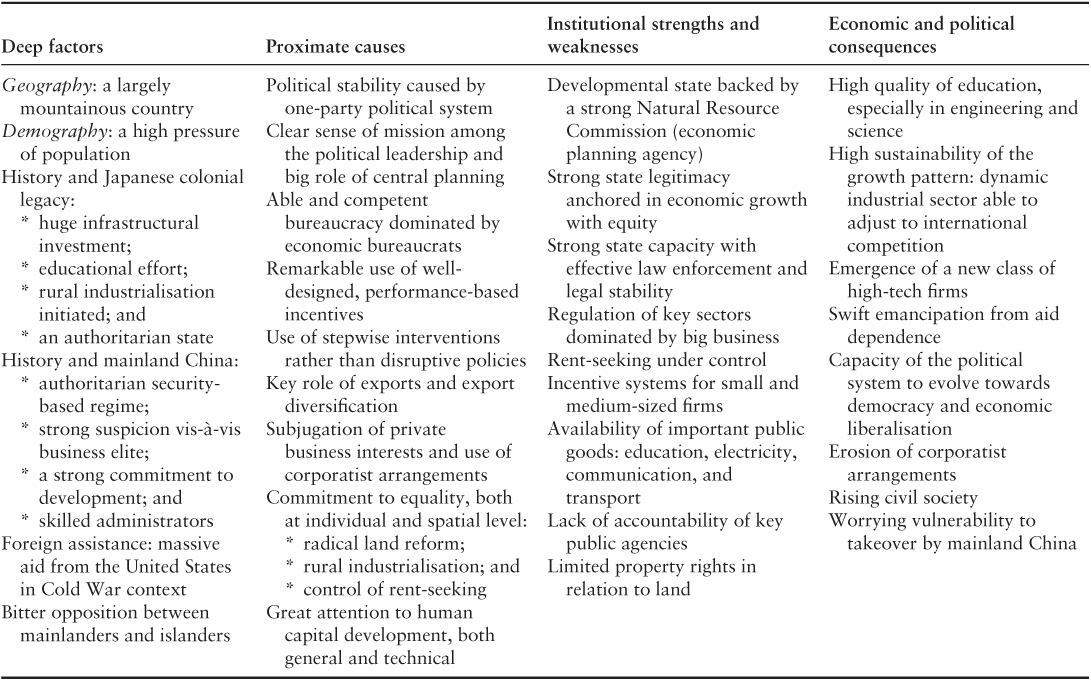
First is the strong influence of historical legacy, coming both from colonial Japan and mainland China. For one thing, the Japanese contribution to Taiwan’s development consisted of laying the basis of a dynamic smallholder agriculture; creating and expanding transportation, irrigation, and electrical power systems; improving education and sanitation; establishing financial institutions, agricultural parastatals, and farmers’ associations; sparking agro-processing industries (centred on rice and sugar); and clarifying property rights so as to facilitate an effective system of tax collection (Cheng, Reference Cheng2001: 20–1).Footnote 24 For another thing, and rather surprisingly, although the Nationalist immigrants to Taiwan were staunch anti-Communists, the regime they established on the island was not only authoritarian but also gave such an important role to central planning and state-led economic guidance that it was considered as inspired by Lenin’s principle of democratic centralism. The replicability of Taiwan’s experience is evidently limited by the deep legacy bequeathed by the Japanese colonial officers and the Kuomintang.
Second, the growth pattern of the Taiwanese economy was anchored in the modernisation and commercialisation of smallholder agriculture and in the development of rural industries tied to the farming sector through numerous supply and demand linkages. These included the supply of labour, capital, and even industrial entrepreneurs, on the one hand, and the demand for intermediate inputs, agricultural equipment, and non-food consumption items, on the other hand. The power of this development model, in which the rural sector was considered as a full-fledged engine of growth from the very beginning, lay not only in its dynamic properties based on manifold interlinkages between sectors, but also in its strongly egalitarian tendencies.
Third, distinctive features of the developmental state of Taiwan proved critical for the country’s successful performance on the economic and social fronts. In the critical stages of its growth and development process, the country (i) was led by a one-party state possessing a unified vision of the national future and endowed with a competent and cohesive bureaucracy; (ii) was able to prevent its capture by private interests; (iii) used a minimum of coercion and a maximum of performance-based incentives to align business interests with the general interest; (iv) proceeded in sequential steps rather than in big jumps; (v) invested large amounts of public money in infrastructure and in human capital; and (vi) gained its legitimacy, especially among the islanders, through its impressive achievements in terms of economic growth, equity, and multidimensional welfare. The resulting development model has turned out to be extraordinarily resilient, as attested by Taiwan’s ability to adapt to the challenges of globalisation, liberalisation, and democratisation, as well as its ability to weather the Asian regional financial crisis of the late 1990s. At the root of this resilience lies the implementation of an incentive scheme based on fiscal incentives, technological support through the sponsoring of research and development activities, participation in the formation of venture capital firms, and the provision of crucial public goods, rather than credit allocation and a loose monetary policy. Also critical has been the gradual emergence of a polymorphous industrial structure dominated by a great variety of SMEs, rather than by national champions susceptible of becoming too big to fail (Cheng, Reference Cheng2001: 32–6).


 Open access