


1 Introduction
Well over 2 billion human adults enjoy the innately negative “burn” of chili pepper in their mouths. This exemplifies a type of hedonic reversal, the conversion of a (usually) innate negative experience into a positive experience. We described these hedonic reversals as examples of benign masochism (Reference Rozin and SchillerRozin & Schiller, 1980; Reference Rozin, Green, Mason and KareRozin 1990, Reference Rozin, Kahneman, Diener and Schwarz1999; see also Reference BloomBloom, 2010). Benign masochism refers to enjoying initially negative experiences that the body (brain) falsely interprets as threatening. This realization that the body has been fooled, and that there is no real danger, leads to pleasure derived from “mind over body.” This can also be framed as a type of mastery. Hedonic reversals have been demonstrated in a number of domains besides irritant spices, including fear (e.g., Reference ApterApter, 1982, Reference Apter1992; Reference McCauley and GoldsteinMcCauley, 1998; Reference Andrade and CohenAndrade & Cohen, 2007) and sadness (Reference de Wied, Zillman and Ordmande Wied, Zillman & Ordman, 1994; Reference HuronHuron, 2011; Reference OliverOliver, 1993; Reference Schramm and WirthSchramm & Wirth, 2010). The oral-irritation, sadness and fear literatures have proceeded quite independently, with all suggesting two basic processes. One is the co-activation of negative and positive inputs (e.g., Reference Hemenover and SchimmackHemenover & Schimmack, 2007; Reference Andrade and CohenAndrade & Cohen, 2007). The existence of simultaneous negative and positive affect in hedonic reversals has been documented for fear (Reference Andrade and CohenAndrade & Cohen, 2007) and sadness (Reference de Wied, Zillman and Ordmande Wied et al., 1994). The second process produces enjoyment of the co-activation “conflict” based on some degree of “distance” from the apparent threat. We propose benign masochism as this second process. Using a similar set of arguments, McGraw and his colleagues (Reference McGraw and WarrenMcGraw & Warren, 2010; Reference McGraw, Caleb, Williams and LeonardMcGraw, Warren, Williams & Leonard, 2012) have independently developed a theory of humor (benign violation) which also builds on mixed emotions and the importance of distance. In their view, humor is principally based on something like “safe threats”.
Individuals differ in the tendency to experience hedonic reversals. There is a relation between the degree of empathic distress at a sad film and the enjoyment of the film, for those who enjoy sad films (Reference de Wied, Zillman and Ordmande Wied et al., 1994; Reference OliverOliver, 1993; Reference Schramm and WirthSchramm & Wirth, 2010), and the same seems to hold true for sad music (Reference HuronHuron, 2011). Individuals who are more successful in taking a third party (observer role) in experiencing sad films are more likely to enjoy them than those who adopt a direct experiencing role (Reference Schramm and WirthSchramm & Wirth, 2010). Reference Mayer and GaschkeMayer & Gaschke’s (1988) ideas about meta-emotions mesh well with the distancing formulation. The importance of “distancing” (or the “protective frame” proposed by Reference ApterApter [1982, 1992]) in hedonic reversals is well summarized by Reference HuronHuron (2011): “In short, while empathy may be essential in order for acoustic cues to evoke sadness in a listener, cognitive assessment of the artificial nature of the stimulus may be essential in order for the sadness to be discounted as inconsequential. Individual differences in response to nominally sad music might therefore arise due to both variability in empathy and also variability in capacity to cognitively discount the stimulus as fictional.” (p. 9)
Benign masochism essentially provides a mechanism for why the “meta-experience” involved in distancing is pleasant. This requires some sort of “cognitive over-ride”, and should be distinctively human. There is no strong evidence for liking for innately negative experiences in animals. The strongest evidence against animal exemplars is that rural Mexican dogs and pigs that eat food with hot peppers regularly (since they eat human leftovers) do not develop a preference, unlike some hundred million human Mexicans who share their diet (Reference Rozin and KennelRozin & Kennel, 1983). On the other hand, Reference Rozin and KennelRozin and Kennel (1983) report a few cases of acquired liking for irritant tastes in American pet animals.
The present paper is the first to describe a wide range of activities that illustrate hedonic reversals and to provide a taxonomy of these activities. The authors nominated candidate hedonic reversals based on their own experience and experiences observing others or reading, including a few studies that documented such activities, especially for oral irritation, fear, and music. Our focus was Americans, and we were not, and perhaps could not be, exhaustive. For example, we did not include truly dangerous activities like rock cliff climbing, or activities that we thought would be rare and/or might render the questionnaire problematic for some subjects (e.g., sado-masochistic activities). Our list, while incomplete, is by far the most exhaustive to date. We link hedonic reversals to enjoyment of “negative” physical body reactions to these same events, and provide some evidence for a benign masochism interpretation. We also explore the degree to which hedonic reversals in different domains are related to one another, as an individual difference variable, and whether such an individual difference is related to sensation seeking (Reference ZuckermanZuckerman, 1979). We are particularly interested in enjoyment of sadness, because a) it occurs with high frequency, and b) it is involved with the appreciation of fiction and music. The popularity of tragedy remains a puzzling aspect of the human experience (Reference NuttallNuttall, 1996).
2 Method
Two groups of subjects responded to our Survey Monkey questionnaire. One was 243 University of Pennsylvania undergraduates (135 females), who received course credit. A separate sample from Mechanical Turk consisted of 48 males (mean age 34.8 years) and 99 females (mean age 36.3 years).
The same 30 items appeared on both questionnaires, in an order randomized for each subject. The instructions were as follows: “Use a scale ranging from 0=not at all to 100=as much as I like anything. You can use any number between 0 and 100. How much do you like the following? (If you are unfamiliar with any of the following, please enter 999 as your answer.)” Thirty items followed. One item, tobacco products, was excluded in data analysis because a large number of subjects were not familiar with them. The items are presented in abbreviated form in Tables 1 and 3, in an order determined by factor analysis (see description under results). The precise description of each item is provided along with the presentation of each factor in the text below.

The questionnaire also included, for student subjects, the Sensation Seeking Scale (version V; Reference ZuckermanZuckerman, 1979), and for about half of the MTurk sample, seven items (described in results) to directly assess a major prediction of benign masochism.
3 Results
We analyzed the results from 29 hedonically rated items (tobacco products excluded). Unfamiliarity, which was uncommon, was scored as 0.
3.1 Confirmatory factor analyses
We conducted confirmatory factor analyses on 26 of the 29 variables for which we had a priori predictions of factor-loadings (Reference Bryant, Yarnold, Grimm and YarnoldBryant & Yarnold, 1995; Reference KlineKline, 2005). Three items were excluded because they either were predicted to load on more than one factor (“Gory movies” might load on fear and disgust factors; “stinky cheese” might load on strong tastes and disgust) or no other factor (“anger directed at a fictional character in a novel or movie”). In other words, items were excluded a priori if we predicted that they would load on two of the factors (conceptual categories) that we came up with independent of the results, or if we felt that they did not directly relate to any of the conceptual categories. Items were allowed to load freely on their predicted factor (see Table 1), the factor loadings with other factors were set to zero, and the covariances among the factors were freely estimated. We used full information maximum likelihood (FIML) to include subjects with missing data (about 17% of the subjects were missing data on at least one variable). FIML is less biased and more efficient than traditional missing data techniques (Reference Enders and BandalosEnders & Bandalos, 2001; Reference Peters and EndersPeters & Enders, 2002).
A multiple-group confirmatory factor model revealed that allowing the factor loadings to differ by group (student or MTurk) did not improve model fit, χ2(26) = 23.99, p = .58. Because the factor loadings did not differ significantly by group, we combined the two samples and report a single model. The model fit the data well (see Kline, 2005 for a discussion of SEM [structural equation modeling] fit statistics), χ2(271)=528.07, p <.001; Comparative Fit Index (CFI) = .93; Root Mean Square Error of Approximation (RMSEA) = .05 (90% CI=.04-.06). See Table 1 for factor loadings, corrected item-total correlations, and subscale alphas. Subscale summary statistics are in Table 2.
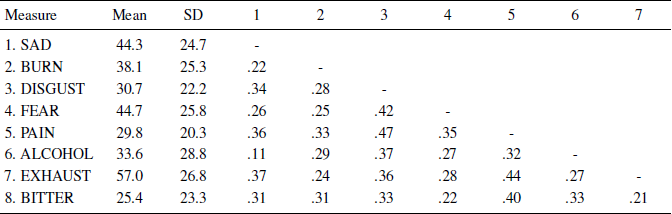
Subscales are designated by a short descriptive term. The first subscale (SAD) includes enjoyment of: “sad paintings, sad music, sad movies, sad novels, crying in response to sad movies or novels”. Enjoying sad things is to some degree domain general, along with enjoying the body’s response (crying) to sad inputs. The second subscale (BURN), also has five exemplars (“spicy foods, tacos with hot sauce, the burn you feel in your mouth while you are eating spicy foods, sweating when you eat spicy foods, your eyes tearing when you eat a lot of spicy food”). This subscale involves enjoying oral irritation. Note that this factor includes two of five items that involve enjoying the physiological response (sweating, eye tearing) to irritants A third subscale (DISGUST) includes “disgusting jokes”, “disgusting experiences (like a medical exhibit about body fluids and products with real specimens)”, “pinching pimples” and “picking your nose”. This factor differs from the others in that, although it clearly involves an hedonic reversal, it is not a reversal of an innately negative response. Rather, disgust is a negative emotion that is acquired beginning after the first few years of life, and continues into adulthood. The fourth subscale (FEAR) involves enjoyment of fear (“thrill rides” and “frightening movies”, and one defensive response, “pounding heart in response to frightening experiences or movies”). An enjoyment of pain subscale (PAIN) includes “massages which produce some pain”, “flashes of cold pain (like the first few seconds when entering a too cold shower or the ocean)”, and “flashes of hot pain (like the first few seconds when entering a too hot bath)”. The remaining three subscales have only two exemplars each. A sixth subscale (STRONG/ALCOHOL) is enjoyment of strong, innately negative alcoholic tastes, specifically “beer” and “scotch”. The seventh subscale (EXHAUST) encompasses “the feeling of being physically active (for example starting to sweat, your heart pounding, etc.) during exertion” and “the feeling of being physically exhausted, after extended effort”. The final subscale (BITTER) includes enjoying “bitter foods” and “unsweetened coffee”. All eight subscales correlated positively with each other (see Table 2). The lowest correlation is .11 for SAD and STRONG/ALCOHOL and the highest is .47 for DISGUST and PAIN, with EXHAUST and PAIN next at .44.
3.2 Response to specific items
In Table 3, the results from each sample are listed by individual items, organized by subscales. The table reports mean, standard deviation, and median for each item and each subscale, along with the percent of subjects who reported liking greater than 50, and the percent who reported 0. The highest mean subscale scores are active/exhaustion (EXHAUST: 55.2, 62%>50) and sad (SAD: 42.6, 41.4%>50).
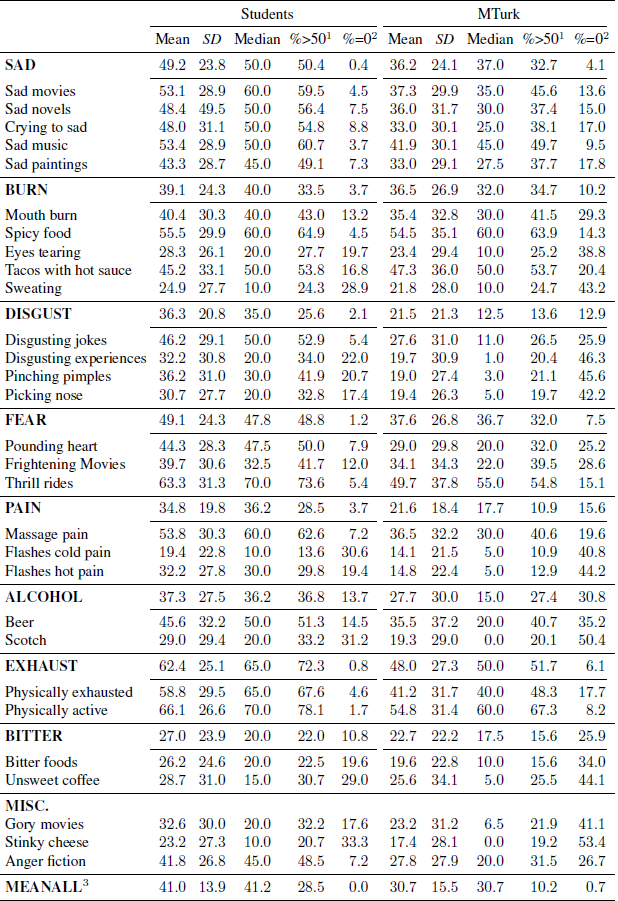
1 Percent of subjects scoring above 50.
2 Percent of subjects scoring 0.
3 Mean of all 29 variables.
In general, the liking scores are not normally distributed. There was considerable over-representation of subjects in both extremes (strong like, above 70, and strong dislike, below 30). For individual items, the highest level of liking (mean score, averaged across the two samples), is for feeling physically active (mean 60.4, with 62% scoring over 50), followed by thrill rides (56.5, 64%), feeling exhausted after physical activity (55.2, 58%), spicy food (55.0, 64%), and sad music (47.6, 55%). Lowest scores are flashes of cold pain (16.8, 12%) and stinky cheese (20.2, 18%). Stinky cheese shows the highest level of 0 scores (43%).
Overall, scores are about ten points lower for the MTurk sample, the main exception being BURN, where the scores are about equal. The pattern of responses is similar for the two groups: the 29 mean scores for the student sample correlate .90 (p<.001) with the corresponding 29 means for the MTurk sample.
3.3 Sex differences
Females were not significantly different from males for most subscales (Table 4). However, liking for SAD was much higher in females in the student sample (p<.001), and higher (p<.05) in the MTurk sample. For all five manifestations of liking sad (novels, movies, paintings, music, enjoying crying), females scored higher than males, often significantly so, for both samples. In both samples, preferences for STRONG/ALCOHOL was higher (p<.001) in males. There was no overall sex difference in liking for the mean for the 29 initially negative activities.

1 n for specific subscales (n for MEANALL): Female students n=132-135 (126); male students n=107 (98); female MTurk n=99 (97); Male MTurk n=48 (46)
2 Mean of all 29 activities
* p<.05
*** p<.001
3.4 Link to sensation seeking
We divided our sensation seeking results (only available from students) into the four factors described by Reference ZuckermanZuckerman (1979): thrill seeking, experience seeking, disinhibition, and boredom susceptibility. The correlation between these four subscales and our eight subscales is displayed in Table 5. The mean score for all 29 items correlated .44 (p<.001) with the full sensation seeking scale score, while the highest correlation between our mean scale score and the sensation seeking subscales was .40 (p<.001) for thrill seeking. Of our eight benign masochism factors, it was FEAR that showed the strongest link to sensation seeking (r = .40 with total sensation seeking score), with the highest subscale link also for thrill seeking (r = .38 with thrill seeking subscale). The single highest correlation between our eight factors and the four sensation seeking subscales was .50 for ALCOHOL and disinhibition. Of 24 correlations between our eight factors and the three most relevant sensation seeking subscales (excluding boredom susceptibility), all were positive and 18 were significant at p<.01 or better (Table 5). Boredom susceptibility is the only subscale of Sensation Seeking that does not correlate substantially with any of our eight hedonic reversal subscales, and the correlation between the mean of the 29 hedonic reversal items and the boredom susceptibility subscale is only r = .08. Notably, sadness, disgust and mouth burn, the three factors that might be considered “dearousing”, showed the lowest correlations with thrill seeking (Table 5).
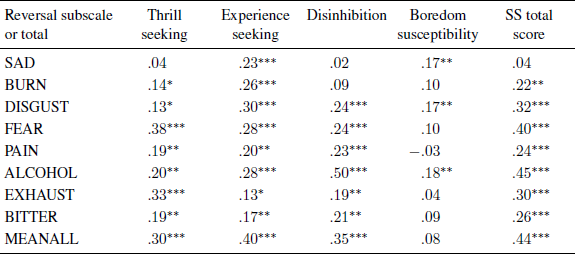
* p<.05
** p<.01
*** p<.001 (2 tailed)
3.5 Direct probing of benign masochism
In a study in which chili likers in Mexico and the USA rated their liking for successively more irritating crackers, with irritation titrated by levels of Capsicum oleoresin (Reference Rozin and SchillerRozin & Schiller, 1980), we found that for many individuals, the most preferred level of irritation was just below the level that they found unpleasant (or refused to sample) This was one of the findings that led us to postulate benign masochism. In the present study, we ask directly whether the favorite level of enjoyment of an hedonic reversal is just below the level of unacceptable discomfort. We asked this question about seven activities in about half (n = 66) of the MTurk sample, after completion of the liking ratings of 30 activities. Subjects received the following instructions:
“Indicate how much you+ agree with each of the following questions. 0 = disagree strongly, 5 = neither agree nor disagree, 10= agree strongly. You can use any number between 0 and 10. If you do not like the item at all, place an X in the answer space.” Each item had the same form, as illustrated by: “My favorite roller coaster is the scariest I can put up with.” Equivalent statements (listed in full in Table 6) probed mouth burn, painful massage, stinky cheese, disgusting cartoon, sad music, and sad story/novel (seven situations).
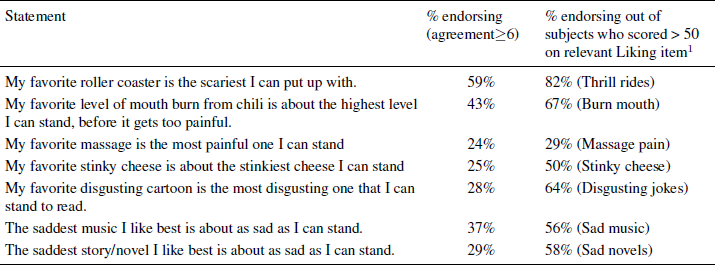
1 Relevant item given in parentheses.
We eliminated a response from analysis if any subject placed an “X” in the answer space, resulting in 48–58 subjects per question, depending on the question. In Table 6, we report the percent of responding subjects who endorsed each of the seven statements followed by the percent of endorsement for those who indicated strong liking (mean score >50) on the relevant question from the 29 hedonic reversal exemplars. We count endorsement as some level of agreement, a score greater than or equal to six. The results that most strongly support the benign masochism prediction occur for roller coaster rides, with 59% agreeing that their favorite roller coaster was the scariest that they could put up with, and 82% who rated the activity itself as 50 or greater (Table 6). The lowest level of agreement was for painful massage, with 24% agreement (29% of those scoring 50 or more on the pleasure question; Table 6). The results for all seven questions are displayed in Table 6. For the strong likers (>50 score), all but painful massage were endorsed by 50% or more of subjects.
Discussion
There are many exemplars of hedonic reversals (and our list makes no claim to be complete). Our findings suggest a number of features of hedonic reversals.
1. There are patterns of liking, most particularly a coherent set of likings across domains for sadness, and liking for the experiences of oral irritation disgust, fear, and pain. Oral irritation (pain) does not seem strongly related to liking for other forms of pain. It seems local to the mouth.
2. People tend to like their physiological reactions to innately negative experiences. These reactions are presumably part of the body’s defensive responses to reduce the negative experience (and the bodily harm it presumably portends). Examples are eye tearing and sweating in response to chili pepper, and pounding heart associated with fear. Enjoying crying in response to sad experiences is probably another example.
3. Males are more likely to enjoy strong/alcoholic tastes, while females are more likely to enjoy sadness. The greater female preference for sad films or sad music has been reported previously (Reference HuronHuron, 2011; Reference OliverOliver, 1993; Reference Schramm and WirthSchramm & Wirth, 2010).
4. Sensation seeking is related to enjoying negative experiences, most strikingly enjoying fear. It is notable that there is evidence that both SAD and BURN involve principally parasympathetic arousal, and hence show a less obvious linkage to sensation seeking.
5. A substantial proportion of individuals, in accord with a benign masochism prediction, report that their favorite level of an originally negative activity is just below, in intensity, a level that is not tolerable. The distribution of liking for initially negative activities is often bimodal. Although many individuals did not endorse the claim that their favorite level of experience was just below an intolerable or extremely unpleasant level, the fact that many did is itself, remarkable. It is extremely rare, in plotting preference ratings as a function of stimulus intensity, to report a very sharp drop from the peak preferred level to a level of actual unpleasantness.
Our idea of benign masochism is supported as one of perhaps multiple mechanisms of hedonic reversals by our pattern of findings. Accounts based on desensitization are not viable, since the negative experience seems to be essential for hedonic reversals, and there is evidence that desensitization does not accompany the acquisition of liking for the burn of chili peppers (Reference Rozin, Mark and SchillerRozin, Mark & Schiller, 1981). Furthermore, likers of sad music report the same auditory properties of the music (e.g., slow, soft) as do dislikers (Guillot, Rozin & Rozin, unpublished observations). Since individuals enjoy the actual experience of these negative events, cathartic or hedonic opponent process accounts are inadequate to explain hedonic reversals (Reference Rozin, Ebert and SchullRozin, Ebert & Schull, 1982).
Accounts based on arousal also are not sufficient, because both sadness and disgust are associated with a reduction in arousal. The absence of robust animal examples of reversed aversions supports our more cognitive account. Co-activation is central to benign masochism, and is supported here by the enjoyment of body defensive responses to oral irritation and fear, and perhaps sadness. But co-activation does not explain the source of the net positive affect. It is the “protective frame” (Reference ApterApter, 1982, 1992), or distancing from a potential threat (Reference de Wied, Zillman and Ordmande Wied et al., 1994; Reference HuronHuron, 2011; Reference OliverOliver, 1993; Reference Schramm and WirthSchramm & Wirth, 2010) that is critical, and it is this process that sets the stage for the activation of benign masochism. Distancing has been clearly documented as playing a role in many exemplars of threat-related humor (Reference McGraw, Caleb, Williams and LeonardMcGraw et al., 2012). Distancing and benign masochism serve to explain the attraction to much fiction and to sad music.
We note that at least one of our subscales, enjoying disgust, does not qualify as reversing an innate aversion, because disgust is itself acquired. For convenience in presentation, we have subsumed it generally under innate aversions. It is, of course, definitely a hedonic reversal, and a reversal based on a rather strong aversion. The aversion is probably universally or almost universally acquired in early-middle childhood.
Our results raise some difficult questions when the frequency of different activities are compared. Why is the degree of liking for sad movies or music, or physical exhaustion, or thrill rides much higher than the scores for liking stinky cheese, bitter foods, or flashes of cold pain? We do not know; in part this may be due to both exposure to the relevant experiences and cultural norms. For example, we are confident that enjoyment of the burn of chili pepper is more common and more extreme in Mexico than in the United States. Perhaps more puzzling is the fact that some negative sensations never seem to be liked by anyone: nausea is a salient example, and perhaps this is true for any visceral pain (as distinguished from muscle pain). Visceral pain or other discomfort (e.g., nausea) is essentially a signal that something is not working properly, and this strong link to pathology may interfere with a “benign” interpretation. In addition, it is very difficult to be certain that visceral discomfort is actually “safe”, thus making it difficult to create the distance that allows for a protective frame or “benign” interpretation. It is in fact the case that almost all of our benign masochism activities are actually harmless, though the body responds to them as though they are harmful. Perhaps recreational parachuting or scaling of cliffs do not qualify, but these activities seem more exceptional than those we study in this paper. It is also notable that we have no experience of people claiming to enjoy boredom, though its opposite, overstimulation, may be quite popular (e.g., amongst teenagers).
Our measures of benign masochism show consistently higher values (by approximately 10 points) for students in comparison to the MTurk sample, with the exception of the items about oral irritation. This could be an effect of the age difference in the samples, and/or it could result from cohort or sociocultural differences. The fact that the groups do not differ on liking of oral irritation makes it unlikely that the difference has to do with interpretation of the scales. For the present, we do not have a good account of this difference.
One limitation of our study is that our survey of negative experiences is far from complete, though it is the most thorough listing, to date. In particular, we did not include an important category of negative experiences: those that really do signal danger, that is, those without a fully established “protective frame” (Reference ApterApter, 1982, 1992). Dangerous activities like recreational parachute jumping, or climbing cliffs are sources of enjoyment, presumably for the same reason as the activities we discuss here. Reference LoewensteinLoewenstein (1999) has discussed the motives for mountain climbing, and one of the four he cites, mastery, probably relates to benign masochism. Mastery might be expanded to include overcoming or rising above bodily signals of danger. Another domain that our 29 items do not include is “dark tourism,” the “attraction” of travel to locations where horrific events have occurred, such as Auschwitz (Reference Lennon and FoleyLennon & Foley, 2000).
A second limitation is that all of our respondents were Americans. Both the actual activities that comprise our benign masochism category, and certainly, the relative frequency of these, will surely vary by culture.
This study is an early step in our understanding of hedonic reversals. Perhaps our most interesting finding is that there is a tendency for some people to enjoy a wide variety of sad experiences and crying at them, and that this tendency is more common in females. More than any other hedonic reversal, the liking for sadness is engaged by works of art; it has an aesthetic quality. If we had a better understanding of the function of sadness, we would no doubt be able to make more sense of this.


 Open access

