


Introduction
Sociologists have long documented the residential patterns of the Black middle class (e.g., Drake and Cayton Reference Schneider and Phelan1993, Reference Saint Clair, Cayton, Drake and Cayton1945; Lacy Reference Lacy2007; Pattillo Reference Pattillo2013, Reference Pattillo2010). Like other groups, middle-class African Americans seek to convert socioeconomic gains into residential mobility, better schools, higher-quality housing, and neighborhoods with stronger amenities. Yet Black families have faced unusually persistent barriers in pursuing these aspirations. Legal exclusion, discriminatory lending, and entrenched segregation have made residential mobility far more constrained for African Americans than for other marginalized populations (e.g., Harris Reference Harris1999; Krysan et al. Reference Krysan, Couper, Farley and Forman2009; Massey and Denton Reference Massey and Denton1985).
Even upwardly mobile Black households often find their options shaped and limited by the structure of the segregated housing market. Despite rising rates of Black suburbanization (Gay Reference Gay2004; Haynes Reference Haynes2001; Lacy Reference Lacy2007), scholars consistently note that African Americans, across income levels, remain disproportionately concentrated in urban, majority-Black neighborhoods (Pattillo Reference Pattillo2013, Reference Pattillo2010; Perry and Romer Reference Perry and Romer2020). Data from the Rockefeller Institute of Government show that in major metropolitan areas such as Atlanta, Chicago, Houston, and Washington, D.C., roughly 68% of African Americans live in predominantly Black neighborhoods, regardless of class. This reflects a durable reality: racial segregation continues to limit the residential choices of even middle-class Black families in ways not experienced by their White counterparts.
Meanwhile, a smaller but important strand of scholarship examines Black suburbanization as another pathway pursued by the Black middle class (Frey Reference Frey2001; O’Hare and Frey Reference O’Hare and Frey1992; Schneider and Phelan Reference Schneider and Phelan1993). Still, across both cities and suburbs, the inability to fully realize residential aspirations remains a defining feature of the Black middle-class housing experience (Wilson Reference Wilson1987; Pattillo Reference Pattillo2010, Reference Pattillo2013).
This paper examines the tension between economic self-interest and racial group solidarity among middle-class African Americans. Prior research shows that African Americans exhibit strong group consciousness and a persistent sense of linked fate (Dawson 1994). Empirical work also finds that higher-income and higher-educated Black Americans remain deeply racially identified (Gay 2004). Tate (Reference Tate1993) further argues that increased educational attainment heightens awareness of racial inequality, thereby strengthening racial consciousness. Building on this foundation, this project investigates how middle-class Black Americans balance their strong sense of group belonging with their distinct economic preferences, and assesses the extent to which they are willing to forgo economic or residential advantages for the benefit of the broader racial community.
This inquiry uses an experimental survey design to test whether middle-class African Americans will sacrifice their direct economic self-interest—specifically, their property values—for the benefit of the racial group. Although middle-class African Americans have long pursued economic mobility within the constraints of structural barriers, the question remains: how much are they willing to forgo when group interests and personal economic concerns are in competition? Is there a threshold at which economic self-interest overrides racial solidarity, and do local housing policy decisions reveal that boundary?
This paper investigates political decision-making among middle-class African Americans when racial group interests and class-based economic interests are in tension. Do middle-class Black Americans prioritize their own economic advantages, or does racial group consciousness ultimately guide their preferences?
This study takes a specific interest in Black homeowners, a privilege that is often associated with middle-class socioeconomic status. Homeownership not only reflects some sense of economic stability but also ties directly to personal concerns about property values and neighborhood composition. Black homeowners and middle-class Blacks are used somewhat interchangeably in this paper because homeownership is often a marker of economic stability and class status within the Black community (e.g., Patillo Reference Pattillo2010). While the empirical focus is on Black homeowners, it follows that the trends observed may also apply more broadly to middle-class Blacks, as homeownership serves as a key indicator of class-based differences. Focusing on Black homeowners is theoretically consequential because this group is uniquely positioned at the intersection of racial solidarity and material self-interest, allowing for a more direct test of whether class-based incorporation into asset-holding status attenuates or reshapes the political effects of linked fate.
Your home’s value is closely linked to your net worth and often represents an individual’s most important asset. Changes in your housing value impact your overall financial position, and your home’s equity is a necessary factor in determining decisions for obtaining credit or refinancing (Walsh and Hyun Choi Reference Walsh and Hyun Choi2025). Currently, the housing market reflects the largest Black–White homeownership gap in a decade. Approximately 44% of African Americans are homeowners, while about 72.7% of White Americans own homes (Cook et al. Reference Cook, Shepard and Martinez-White2024).Footnote 1 Therefore, with the significance of property values being universal amongst all Americans, paired with disproportionate home ownership rates among racial groups, logic follows that African Americans who have worked for the right to own a home will closely guard the privilege, recognizing its unusualness and its power as a financial asset.
Homeownership could also be symbolic of a vehicle to build generational wealth and mobility (Fischel Reference Fischel2016; Patillo Reference Pattillo2013, Reference Pattillo2010). Due to the infrequency and significance of Black homeownership, Black homeowners could be logically assumed to especially safeguard their property value. The direct intimate nature of property values to economic self-interest is exactly why I define the concept as such. If economic self-interest does matter to African Americans in any way, property values are a reasonable measure to empirically test such claims.
Some scholars argue that economic self-interest should increasingly shape African American political behavior. Wilson (Reference Wilson2012) contends that class, not race, has become the primary determinant of life chances for Black Americans, as the modern labor market has expanded opportunities for the middle class while constraining those with fewer skills. Others note similar tensions: middle-class African Americans may welcome rising property values associated with gentrification (Pattillo Reference Pattillo2010) or resist subsidized housing to preserve neighborhood “middle-class” character (Haynes Reference Haynes2001).
Conversely, a substantial literature shows that higher-status Black Americans remain strongly group-conscious, with class exerting limited influence on political preferences (Gay Reference Gay2004; Hochschild Reference Hochschild1995; Tate Reference Tate1993). In many contexts, middle-class African Americans are willing to subordinate personal economic interests when the implications for the racial group are made clear (White Reference White2007; White et al. Reference White, Laird and Allen2014).
Despite these debates, we still lack empirical evidence about the specific conditions under which class interests outweigh racial solidarity in Black political decision-making. This paper addresses that gap by directly pitting economic self-interest against in-group favoritism in a scenario involving a clear economic threat. I test whether middle-class Black Americans prioritize their class-based interests or the needs and interests of the racial group, arguing that racial solidarity will continue to guide political preferences even when individual economic stakes are high.
I employ a novel survey experiment using an all-Black Qualtrics sample (n = 553), with an oversample of higher-income and homeowning respondents. In the vignettes, participants are informed that a government-subsidized housing complex will be created in their neighborhood for low-income tenants, with potential impacts on nearby property values, while only the racial identity of the tenants is manipulated. The findings support my hypothesis: middle-class Blacks with stronger feelings of linked fate show the highest levels of support for the redistributive policy when the low-income tenants are explicitly described as Black, compared to when tenants are described as White or left unspecified (control). However, among respondents with higher levels of linked fate, being in the White treatment condition decreases their support for the proposed move compared to those not in the White treatment condition. In other words, as perceptions of linked fate increase, participants are less likely to support the influx of low-income White tenants as compared to the Black treatment condition and control.
These findings point to the effects and non-effects of Black economic self-interest depending on the racialized context. This inquiry points to the resilience of Black group racial solidarity and its role in the formation of Black policy preferences. Middle-class Blacks are willing to sacrifice their current property values if that means that other members of their racial group will benefit. But they are more likely to be hesitant in extending such benefits to racial outgroup members. Thus, this research helps us to better visualize the extent and the conditions of Black group consciousness, along with its behavioral implications, as I show its influence on local housing policy preferences. Ultimately, this study reaffirms Dawson’s Black Utility Heuristic and the centrality of racial group solidarity in Black political decision-making among middle-class Blacks. At the same time, it demonstrates the continued empirical relevance of this framework under contemporary conditions of increasing Black economic stratification (e.g., Pew Research Center 2007), conditions that Dawson himself anticipated might weaken the effects of linked fate (Reference Dawson2001). In doing so, these findings not only confirm the durability of racial solidarity but also raise new questions about the limits of its persistence as class divisions within the Black population continue to widen.
The Empirical Limitations of Linked Fate
Micheal Dawson’s (1994) theory of linked fate can be used to explain much of what we know about racial group consideration’s link to Black political behavior. Linked fate could be described as the extent to which African Americans perceive their individual life circumstances as being connected to the fate of others within their racial group. Within his framework, African Americans perceive group interests as maximizing an in-group member’s own self-interest. The foregoing of one’s self-interest for the good of the racial group was coined as the “Black Utility Heuristic.” This unique political strategy is argued to be derived from African Americans’ shared history of subjugation and group evaluation (Dawson 1994). In the broadest sense, Dawson’s model is an effort to capture the intermingled instrumental value and emotional ties that are implicit in the idea of racial group solidarity (Gay et al. Reference Gay, Hochschild and White2016). Individual socioeconomic status is known to affect Blacks’ racial attitudes, with higher socioeconomic status African Americans believing more strongly that race remains the defining interest in African Americans’ lives (Dawson 1994; Dillingham Reference Dillingham1981; Gay Reference Gay2004; Hoschild Reference Hochschild1995).
Early theorists (Frazier Reference Frazier1955) have painted middle-class Blacks as distant from the overall racial group, lacking group consciousness and more concerned with obtaining middle-class White sensibilities. However, empirical studies have found that higher socioeconomic status Blacks, measured via income and education, remain strongly identified with their race (Gay Reference Gay2014, p. 547; Tate and Foundation.Tate Reference Tate1993). Other scholars have suggested that with socioeconomic mobility comes greater interaction with Whites, which in turn exposes individuals to more experiences with racial discrimination. Thus, negative racial experiences may sustain high racial identification among higher socioeconomic status Blacks (Cose Reference Cose1995; Gay Reference Gay2004; Hoschild Reference Hochschild1995; Landry and Lau Reference Landry1987).
Also building from Patillo’s work Pattillo (Reference Pattillo2013), for those higher socioeconomic status Blacks that are located in or near Black neighborhoods, they still have access to the social and institutional settings that facilitate group consciousness via interpersonal contact. Thus, within Black communities that are economically heterogeneous, higher socioeconomic status Blacks might share churches (Higginbotham Reference Higginbotham1993), grocery stores, and family reunions with lower income Blacks, which draw attention to the collective aspects of Black life and allow for transmission of collective ideals, increasing the likelihood that shared values and shared fate will be perceived (Dawson 1994; Gay Reference Gay2004).
Residential mobility further complicates Black middle-class life. Gay (Reference Gay2004) describes what journalists have called “the rage of a privileged class,” in which middle-class Black families experience the costs of upward mobility more acutely because they cannot easily convert economic gains into the neighborhood quality typically associated with middle-class status. Logan (Reference Logan2002) shows that the “neighborhood gap,” the mismatch between income and residential amenities, is largest for higher socioeconomic Blacks. The inability to achieve expected middle-class surroundings (e.g., well-maintained infrastructure, high-quality retail, safe streets, consistent city services) stems from structural barriers, not personal failure (Basolo and Strong Reference Basolo and Strong2002). Gay (Reference Gay2004) argues that this thwarted mobility intensifies racial group consciousness by reminding middle-class Blacks that structural racism, not individual shortcomings, constrains their life outcomes. Taken together, these dynamics suggest that while middle-class Black Americans hold distinct class-based concerns, affective and structural forces continue to reinforce strong norms of racial group solidarity. Prior work shows that the influence of racial considerations is highly context-dependent and often strongest when political choices clearly implicate the racial group (White Reference White2007). Yet it remains unclear which consideration takes priority when these forces are in direct tension—particularly in local policy contexts where material stakes, such as property values, are immediate and concrete. This study intervenes in this debate by asking whether linked fate continues to structure political decision-making among middle-class Black homeowners when their economic self-interest is directly threatened. In doing so, it tests whether racial solidarity or class-based interests ultimately take precedence in shaping policy preferences in the local context.
Self-Interest and Political Decision-Making
Self-interest’s role in political decision-making remains contested. Classic work frames self-interest as a key driver of ideology (Campbell et al. Reference Campbell, Converse, Miller and Stokes1960), and recent research argues that its influence has been underestimated. Weeden and Kurzban (Reference Weeden and Kurzban2017), for example, show that individuals facing direct economic stakes, such as unemployment or declining economic security, consistently support policies that materially benefit people like themselves. Erikson and Stoker (Reference Erikson and Stoker2011) similarly find that men vulnerable to the Vietnam draft adopted more anti-war, liberal, and Democratic positions than those insulated from the draft.
Yet, a substantial body of scholarship finds that self-interest is often weak or inconsistent in shaping political attitudes (Chong et al. Reference Chong, Citrin and Conley2001; Huddy Reference Huddy2013; Kinder Reference Kinder1998; Sears and Funk Reference Sears, Funk and Mansbridge.1990). The point of consensus is narrow but important: strong self-interest effects are most likely when the stakes are visible, tangible, large, and certain (Citrin and Green Reference Citrin and Green1990; Erikson and Stoker Reference Erikson and Stoker2011; Green and Gerkin Reference Green and Gerkin1989; Sears Reference Sears, Funk and Mansbridge.1990). When government action directly affects a person’s material well-being, self-interest should activate.
Middle-class Black homeowners facing potential declines in property values satisfy all of these conditions. The vignettes explicitly cue a clear, immediate threat to an asset that is central to higher-income Black households’ economic security. Under standard self-interest expectations, African American homeowners should oppose the construction of a government-subsidized housing complex across all treatment conditions. Moreover, self-interest would be most evident if they show especially low support when potential tenants are described as low-income Black residents, who, in their view, pose the greatest perceived risk to nearby property values (Fields et al. Reference Fields, Perry and Donoghoe2023).
These effects should be amplified by the fact that losses typically loom larger than gains (Cacioppo et al. Reference Cacioppo and Gardner1999; Mercer Reference Mercer2005). A clear, immediate financial loss is precisely the scenario where self-interest theories predict strong behavioral responses. However, Black political behavior does not consistently conform to those expectations. Norms of racial group solidarity, and the social pressures that enforce them, often constrain self-interested actions (White et al. Reference White, Laird and Allen2014). NIMBY reactions to affordable housing developments typically reflect White homeowners’ desire to exclude displaced people of color (Dear and Taylor Reference Dear and Taylor1982; Hackinson 2018; McNee and Pojani Reference McNee and Pojani2022).Footnote 2 Whether NIMBY responses emerge within the Black community remains an open question.
White et al. (Reference White, Laird and Allen2014) offer a mechanism for understanding the conflict between economic self-interest and racial solidarity: racialized social pressure. Within Black communities, social sanctioning enforces expectations that individuals support the collective interests of the racial group, even when doing so conflicts with personal economic considerations. These pressures limit the political expression of self-interest and reinforce norms of group loyalty.
This study builds on their framework by focusing specifically on economic self-interest, a domain with concrete, measurable stakes. Property ownership is a quintessential case: a home is the largest financial asset most families hold, shaping net worth, credit access, and intergenerational wealth (Burke 2024). In the context of the largest Black–White homeownership gap in over a decade (Cook et al. Reference Cook, Shepard and Martinez-White2024), Black homeownership carries heightened symbolic and material weight (Fischel Reference Fischel2016; Pattillo Reference Pattillo2013). Protecting property values is therefore a particularly salient form of economic self-interest among middle-class Black households.
From this perspective, providing middle-class Black homeowners with an explicit cue that an influx of displaced low-income residents will reduce property values “within the next year” creates a strong test of whether economic self-interest drives policy preferences. The key question is whether the pull of racial group solidarity is powerful enough to override those material stakes. Put simply: when faced with a direct economic threat, do Black homeowners still choose policies that benefit lower-income Black residents?
Data and Methods
To test the effects of economic self-interest’s relation to Black Americans’ local redistributive attitudes, I utilized a novel survey experiment that directly pits economic self-interest against racial group interests to assess affluent Blacks’ prioritized political consideration and political preferences on local redistribution and housing welfare policies. In April of 2023, a nationally representative all-Black sample of individual-level data were gathered from Qualtrics (n = 553). The data had an oversample of higher-income Blacks (n = 293) and Black homeowners (n = 283). Although my focus is on Black homeowners, I include renters in the sample as a comparison group. Renters occupy a different structural position in housing markets; they have more mobility and less direct financial exposure to property value fluctuations, which makes them a useful baseline against which to assess whether homeowners’ views and behaviors are distinct (Hackinson 2018).
Class is a multidimensional construct encompassing not only income and wealth but also education, occupation, and forms of cultural and social capital (e.g., Bourdieu Reference Bourdieu1984; Haynes Reference Haynes2001; Lacy Reference Lacy2007). Within Black communities, scholars have shown that these dimensions interact in distinctive ways given the constraints of racial stratification (Landry Reference Landry2018). Because of data limitations, I focus here on two widely recognized economic indicators, household income, and homeownership, as proxies for middle-class status. While this approach cannot capture the full multifaceted nature of class stratification in the Black community, it provides a conservative measure aligned with central dimensions of material class position.
For income, I rely on American Community Survey estimates of the Black median household income, and I align these values with the Tax Policy Center’s household income quintiles to more accurately capture African Americans’ position within the national income distribution, which is substantially lower than the overall U.S. median (Perry and Romer Reference Perry and Romer2020; White and Laird Reference White and Laird2021). This threshold reflects not only earnings but also access to markers of middle-class standing such as stable housing, neighborhood quality, and discretionary resources that shape political behavior. Importantly, these respondents at or above the $58,000 household income threshold could be defined as middle-class or above because this group may include a small number of higher-income households, but the available data does not permit reliable separation of a distinct “upper class.” This is consistent with prior work that treats Black class location conservatively, given the persistent racial wealth gap and compressed income distribution relative to White households (Lacy Reference Lacy2007; Landry Reference Landry2018; Patillo Reference Pattillo2010).
Homeownership is combined with income because of its centrality to wealth accumulation and intergenerational stability in Black communities. Although Blacks are less likely than Whites to own homes at comparable income levels, ownership remains a crucial indicator of class position and long-term economic security. Together, income and homeownership capture core economic dimensions of Black class location, while also reflecting the persistent racial wealth gap that differentiates Black middle-class experiences from their White counterparts.
The dependent variable is support for the proposed government-subsidized housing complex. It is measured on a 1–5 Likert scale, where 1 indicates “strongly do not support” and 5 indicates “strongly support.” Participants were asked: “To what extent do you support the Displacement Initiative and welcome the arrival of the new low-income tenants?”
The key independent variable is the race of the incoming tenants, randomly assigned through experimental vignettes that described the new residents as either Black, White, or left unspecified (control). While government housing policy cannot legally designate recipients by race, subsidized housing is often perceived in racialized terms. The manipulation is designed to capture these perceptions and test whether Black respondents’ support is shaped by the presumed racial composition of beneficiaries.
All analyses include controls for ideology and linked fate to account for political predispositions and the salience of racial group consciousness. In addition, homeownership is incorporated as a proxy for economic self-interest, given that homeowners are more directly exposed to potential property value changes than renters. To assess this, I disaggregate the sample to examine whether Black homeowners, who overlap with the middle-class, exhibit lower levels of support for the housing policy compared to renters. I present the primary variables and their coding in Appendix A.
Building on prior work (Enos 2019), participants were provided with a fictitious government referendum describing a government-subsidized housing solution placed within their neighborhoods for low-income residents displaced from near metropolitan cities due to gentrification. The referendum explains that recently, the local government announced plans for the Displacement Initiative. Survey participants were told that “This initiative provides 200 million dollars in state-issued funding to build government subsidized housing complexes for low-income (Black/White/no race) residents that have been displaced from near metropolitan areas due to gentrification.” The referendum also tells survey respondents that, based on prior research and history, the construction of new government-subsidized housing complexes will decrease nearby property values within the next year, due to the influx of new low-income residents. The experiment had three conditions that manipulated the explicit racial cues offered in each frame: future low-income tenants’ race was not disclosed (control group), prospective low-income tenants were disclosed as White, or future low-income tenants were disclosed as Black. Participants were randomized into conditions based on socioeconomic status (SES). I interacted the binary homeownership variable with the treatment indicator to analyze homeowner and non-homeowner differences in referendum support across conditions. A manipulation check was given to participants after the conditions to verify that participants received the right condition. The manipulation check also served as an attentiveness check, as participants were asked the questions: “What was the race described of the incoming tenants?,” “What was the class described of the incoming tenants?,” “What was the main concern due to the arrival of these new tenants?.” These questions are designed not just to verify correct condition placement, but also to verify that participants experienced and understood the conditions in which they were exposed to. A post-treatment survey was provided to measure participant’s support for the government referendum and different redistributive and housing welfare policies. To measure support for the policy, participants were asked: “To what extent do you support the Displacement Initiative and welcome the arrival of the new low-income tenants?” I hypothesize that due to the strength of racial group solidarity, all respondents, regardless of homeownership status and class, will show the most support for the creation of the government-subsidized housing complex when low-income tenants are explicitly described as Black as compared to the control and White condition (H1). Second, I hypothesize that Black homeowners higher in linked fate, will show the most support for the creation of the housing complex when low-income tenants are explicitly described as Black as compared to the White treatment and control (H2). While survey experiments are particularly susceptible to social desirability bias (Huddy and Feldman Reference Huddy and Feldman2009), homeowners’ support for this housing policy is less likely to be driven solely by altruism, given the potential impact on their property values. Instead, policy support would more accurately reflect their genuine policy preferences and concern for the racial group. However, the risk of social desirability bias remains.
I employ an ordered probit model followed by marginal effects to assess the impact of the treatment conditions, homeownership, income, linked fate, and ideology on the ordered response variable measuring support for the proposed housing solution. The marginal effects of the treatments are listed in the appendix. Interaction terms are included to examine how the relationship between policy support is moderated by varying levels of linked fate. Homeownership is a key asset for wealth accumulation, particularly among higher-income Blacks, making it a relevant proxy for economic self-interest. In contrast, low-income Blacks, who have lower homeownership rates, are less likely to experience the same financial concerns regarding property values. As such, their economic self-interest is less activated in the context of local housing policy decisions. The study aims to understand how middle-class Blacks reconcile the conflict between economic self-interest and racial solidarity. This theoretical distinction justifies the exclusion of low-income Blacks from the interaction tests, as they are less directly impacted by homeownership-related policy changes.
While the oversamples are useful for this study, I understand that a small subsetted sample of 283 respondents does not lend itself to the most generalizable findings. The sample is nationally representative, and participants are randomly assigned to conditions, which should give us some faith that the results could be applied to Black homeowners more generally. However, future research should employ larger Black samples to test the robustness of the results presented.
Racial Group Solidarity
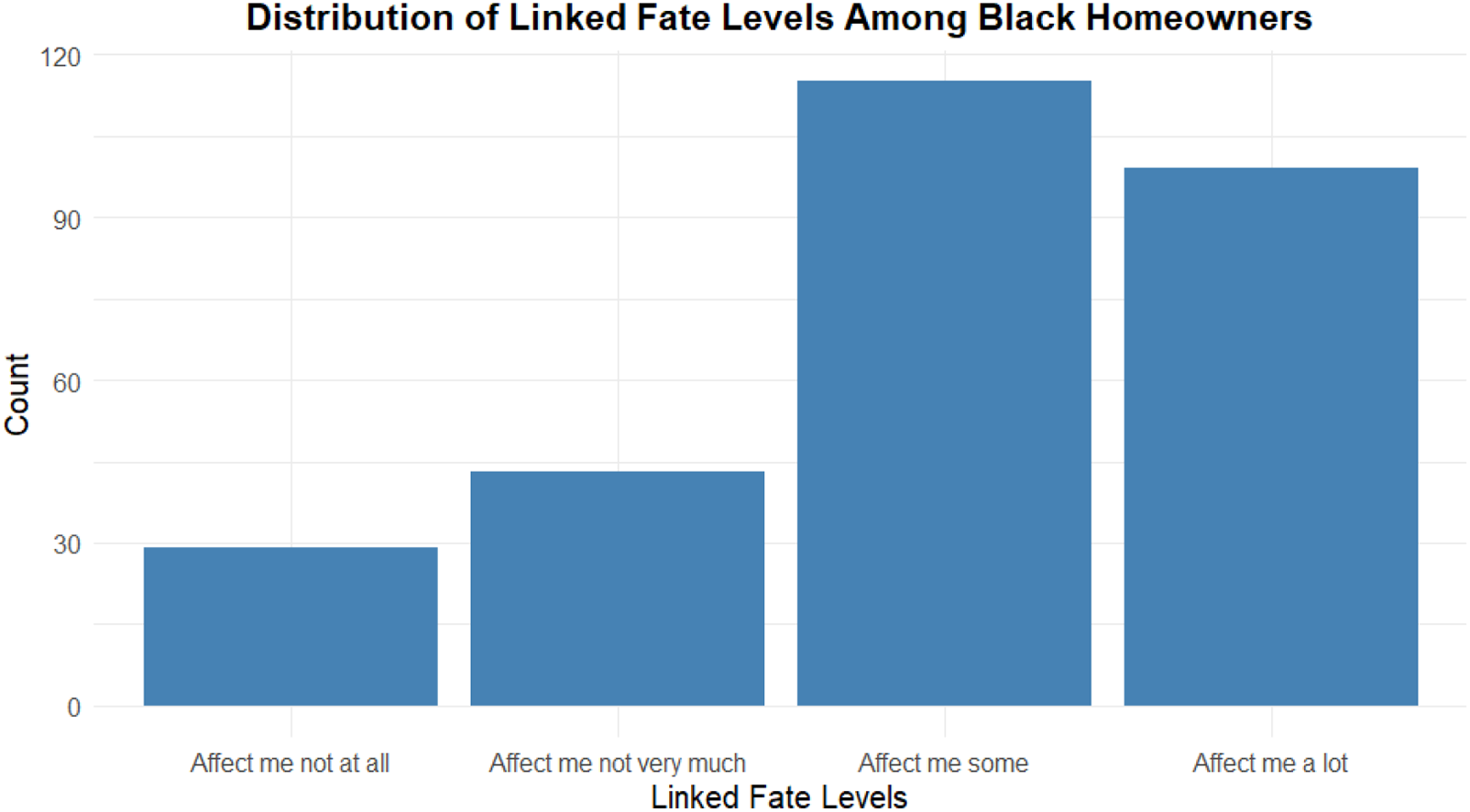
This survey includes questions on linked fate or Black racial group solidarity (Dawson 1994). The power of racial group solidarity is a key part of my argument. I argue that the well-developed norm of racial group solidarity and its association with African Americans’ preference for policies that are to the benefit of the overall racial group (Dawson 1994; White and Laird Reference White and Laird2021), will drive decision-making for the proposed low-income housing solution. Thus, overriding economic self-interest concerns for Black homeowners. I measure linked fate with a single two-part question: “Do you think what happens to Black people in this country will have something to do with what happens in your life? Will it affect you a lot, some, or not very much?” Responses were summarized on a four-point scale, ranging from 1 (low fate) to 4 (high fate). According to the dataset, the mean of linked fate was 2.98, suggesting that, on average, participants exhibited medium levels of linked fate. When examining levels among Black homeowners, most participants exhibited some sense of linked fate. Specifically, 40.6% of participants reported moderate linked fate levels and 34.6% reported high linked fate, while fewer reported weaker levels of linked fate, 14.1% at “Affect me not very much,” and 10.6% “Affect me not at all.”
Individual Level Traits
Finally, this survey includes data on the respondents’ demographic characteristics, including ideology, family income, and homeownership. These variables are included as control variables. Black conservative ideologies are common within the racial group (ANES 2024). They often are proponents of self-help programs and traditional family values. Notable neoconservatives are composed of ex-Black Power advocates and the Nation of Islam (Lewis Reference Lewis2005). Given the substantial variation of liberal-conservative ideology, I control for such. Family income is a marker for middle-class African Americans, namely household incomes that are at or above $58,000 annually (Perry and Romer Reference Perry and Romer2020; White and Laird Reference White and Laird2021). I control for income because it is often a marker of homeownership, capturing broader class-based economic resources that may independently influence support for the low-income housing referendum.
Results
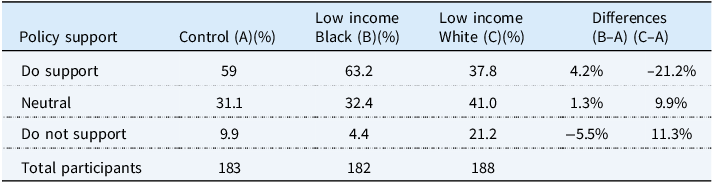
The core argument of this paper is that due to the strength of racial group solidarity, Black homeowners will forego what is best for their economic self-interest and show the most support for the creation of the government-subsidized housing complex when low-income tenants are explicitly described as Black as compared to the control and White conditions. This section provides initial evidence that confirms this hypothesis by employing an ordered probit model with interaction terms between the two treatments and linked fate. But first, when analyzing descriptive statistics without controls, Table 1 shows that African Americans (without homeownership or income controls) display the most support for the housing complex when tenants are explicitly described as low-income and Black as compared to the low-income White condition and the control group. Specifically, 63.2% of respondents supported the Displacement Initiative when placed in the Black treatment, as compared to 37.8% and 59% in the White and control group conditions, respectively. Respondents randomly assigned to the Black treatment show slightly higher levels of support (4.2% more) and lower opposition compared to the control group. Those randomly assigned to the White treatment exhibit substantially lower support (21.2% less) and higher opposition compared to the control group.
Policy support among aggregate sample treatment type

Table 1. Long description
The table presents data on policy support for a government-subsidized housing complex among different groups. It includes three main columns: Control, Low Income Black, and Low Income White, each showing the percentage of respondents who support, are neutral, or do not support the policy. The table has four rows: Do support, Neutral, Do not support, and Total participants. In the Control group, 59% support, 31.1% are neutral, and 9.9% do not support the policy. In the Low Income Black group, 63.2% support, 32.4% are neutral, and 4.4% do not support the policy. In the Low Income White group, 37.8% support, 41% are neutral, and 21.2% do not support the policy. The differences section shows that support is 4.2% higher and opposition is 5.5% lower in the Low Income Black group compared to the Control group. Support is 21.2% lower and opposition is 11.3% higher in the Low Income White group compared to the Control group. The total number of participants in each group is also provided: 183 for Control, 182 for Low Income Black, and 188 for Low Income White.
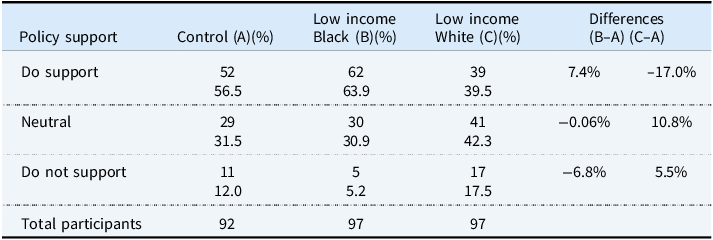
As Table 2 shows, sub setting the data to control for homeownership, African American homeowners still show the most support for the creation of the housing complex when low-income tenants are explicitly discussed as Black as compared to the White condition or the control group. 63.9% of homeowning respondents support the housing policy when incoming tenants are specifically described as Black, as compared to 39.5% in the White condition, and 56.5% in the control group. Like the difference in support between treatments for the aggregate sample, homeowners randomly assigned to the Black treatment show slightly higher levels of support (7.4% more) and lower opposition compared to the control group. Homeowning respondents randomly assigned to the White treatment exhibit substantially lower support (17.0% less) and higher opposition compared to the control group. Thus, the cross tabulations suggest that framing of the policy matters for both the aggregate sample and Black homeowners. Providing explicit cues to participants describing low-income tenants as Black increases support, while explicitly describing low-income tenants as White decreases support, relative to the control group.
Policy support among Black homeowners treatment type

Table 2. Long description
The table presents data on policy support among Black homeowners, divided into three groups: Control, Low Income Black, and Low Income White. It includes percentages of respondents who do support, are neutral, and do not support the policy, along with the total number of participants in each group. The Control group has 92 participants, with 52 percentage supporting, 29 percentage neutral, and 11 percentage not supporting. The Low Income Black group has 97 participants, with 62 percentage supporting, 30 percentage neutral, and 5 percentage not supporting. The Low Income White group also has 97 participants, with 39 percentage supporting, 41 percentage neutral, and 17 percentage not supporting. The differences in support between the Low Income Black and Control groups, and the Low Income White and Control groups are also provided.
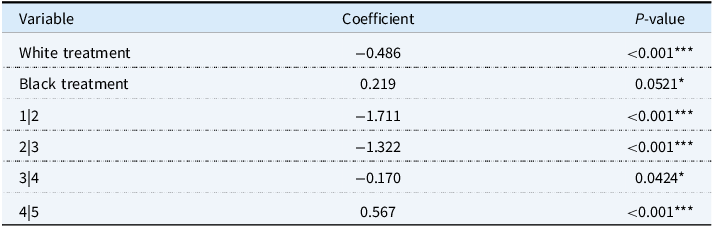
Table 3 shows the main effects of the treatments on policy support without controls. The negative coefficient of −0.4856 for the White Treatment shows that respondents in the White condition are less likely to support the policy compared to those in the control group. There is a negative relationship between support for the housing policy and when low-income tenants are explicitly described as White (p < 0.01). The positive coefficient of 0.219 for the Black Treatment indicates that respondents in the Black condition are more likely to support the policy compared to those in the control group. There is a positive relationship between support for the
Main effects of treatments

Table 3. Long description
The table presents the main effects of treatments on policy support without controls, featuring two columns for coefficients and P-values. The first row shows a coefficient of negative 0.486 for the White treatment with a P-value of less than 0.001, indicating a significant negative effect. The second row displays a coefficient of 0.219 for the Black treatment with a P-value of 0.0521, suggesting a positive but not significant effect. The subsequent rows compare different conditions, with coefficients ranging from negative 1.711 to positive 0.567 and varying levels of significance.
Note: *p < 0.05, ***p < 0.001.
Policy Support: 1–5 (1- “Strongly do not Support,” 2- “Somewhat do not Support,” 3- “Neutral,” 4-“Somewhat do Support,” 5- “Strongly do Support”).
housing policy and when low-income tenants are explicitly described as Black; this effect is marginally significant (p ≤ .05). I will return to explaining the marginal significance of the Black treatment when analyzing the interaction terms.
The intercepts from the ordered probit model indicate how respondents shift between different levels of policy support in response to the treatment conditions. Policy support is an ordered variable with a five-point scale moving from “strongly do not support” to “strongly do support,” with the inclusion of neutral. The largest threshold exists between “Strongly do not Support” and “Somewhat do not Support,” suggesting that respondents, regardless of treatment, are unlikely to move from strong opposition to any form of support. However, the smaller thresholds between “Somewhat do not Support” and “Neutral,” and between “Neutral” and “Somewhat do Support,” suggest that treatments are more effective in moving respondents toward moderate support. The treatments are less likely to shift participants from strong opposition (“strongly do not support”) to strong support (“strongly do support”). Overall, the treatments are more effective in shifting respondents from opposition or neutrality to moderate levels of support, but they are less likely to move respondents from strong opposition to strong support.
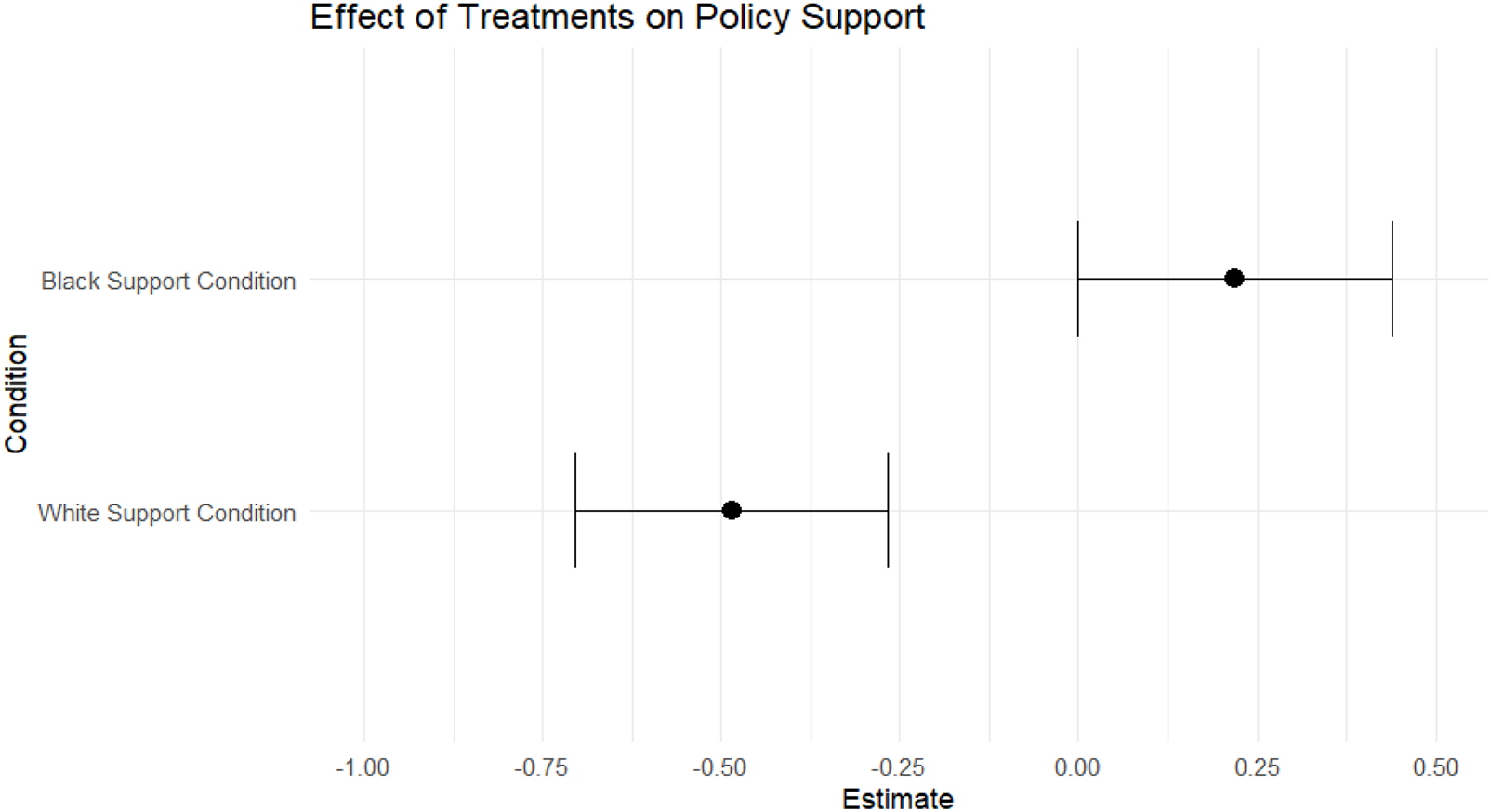
To assess the magnitude of the bivariate patterns observed in the main effects test, I plot the variation in support for the Black and White treatments, without any controls, in Figure 2. For the policy support, respondents placed in the Black condition show a positive relationship relative to the control, but zero is within the plausible range of values for the coefficient. The effect of being exposed to the White treatment condition is negative and clearly distinguishable from the center point of 0, meaning that it is substantially related to decreasing support for the housing policy. To reframe these findings, the low-income Black treatment appears to significantly increase support for the housing initiative, and the White treatment leads to less support for the policy. To compare the effect sizes of the Black and White treatments, I utilized a z-test. The Z-value is 4.45, which is well beyond the typical critical value of ±1.96 for a 95% confidence level. This indicates a strong difference between the coefficients of the Black and White treatments. The p-value is also statistically significant at 8.64 × 10 −6, well below the conventional significance threshold level of 0.05. The effect size of the Black treatment is significantly different from the White treatment. This suggests that the Black treatment has a distinctly positive impact on the level of policy support as compared to the White treatment.
Distribution of linked fate levels among Black homeowners.

The effects of treatments on policy support among aggregate sample.

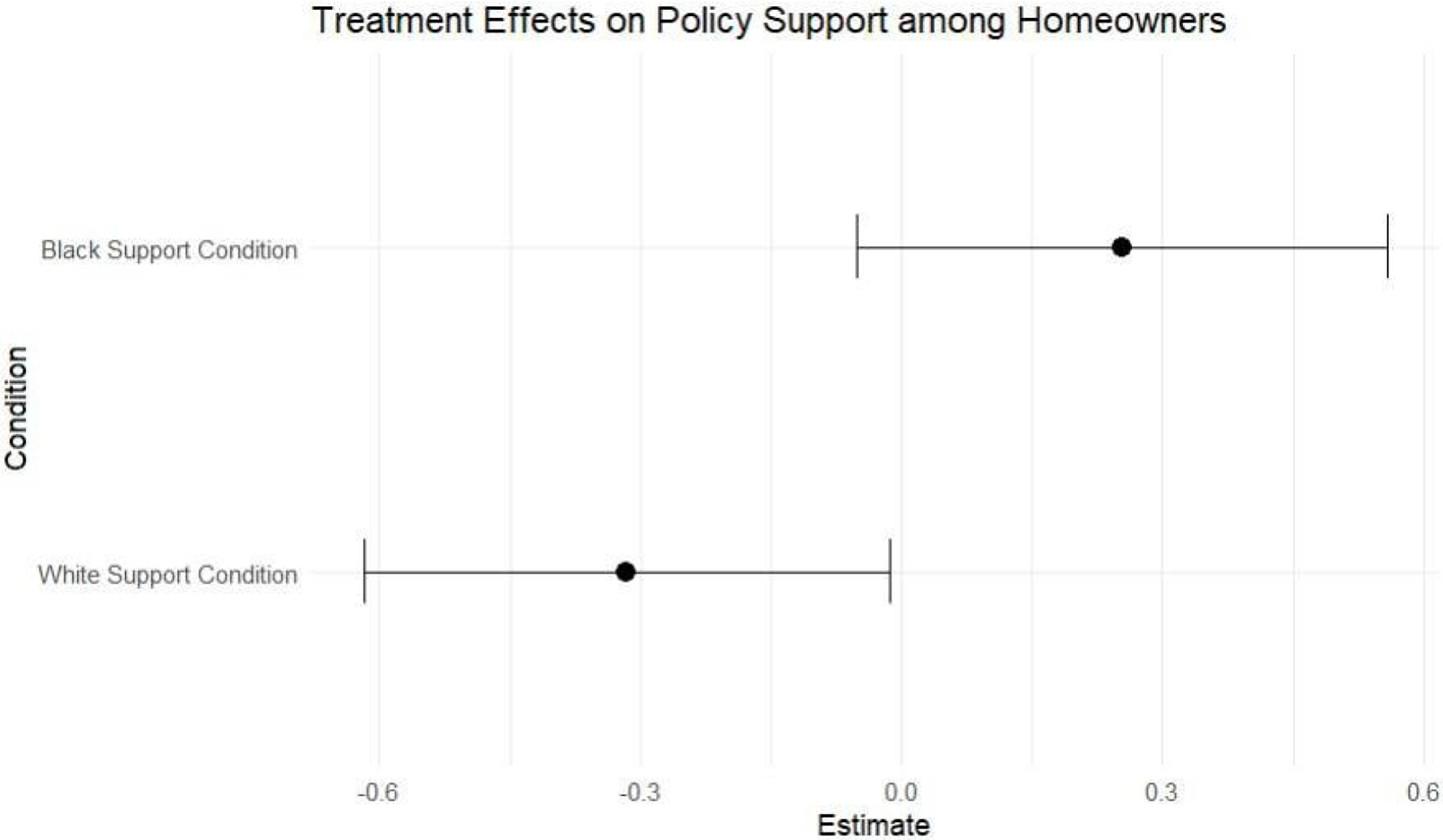
Figure 3 subsets the data to better analyze whether these trends are consistent among African American homeowners. Similar trends appear, but to a lesser extent. Homeowning Blacks placed in the Black treatment showed greater support for the housing policy. However, because the confidence interval for the Black treatment crosses zero, this effect is not statistically distinguishable from zero when restricting the sample to homeowners. By contrast, the White treatment effect is negative, and its confidence interval remains far from zero, indicating a statistically significant decrease in support for the housing policy among homeowners.
The effects of treatments on policy support among Black homeowners.

To compare the effect sizes of the Black and White treatments, I utilized a z- test. A z-test comparing the effect sizes of the treatments yields a z-value of −2.60, which exceeds the critical threshold of ±1.96 for a 95% confidence level, indicating a statistically significant difference between the Black and White treatment effects. The corresponding p-value of 0.009 further confirms this finding, demonstrating that the differences in treatment are statistically significant at any common significance level (p < 0.01 or p < 0.05). These statistical tests show that for African American homeowners, the effect of the Black treatment is significantly different from the White treatment and is distinctly associated with higher support levels for the creation of the low-income housing complex.
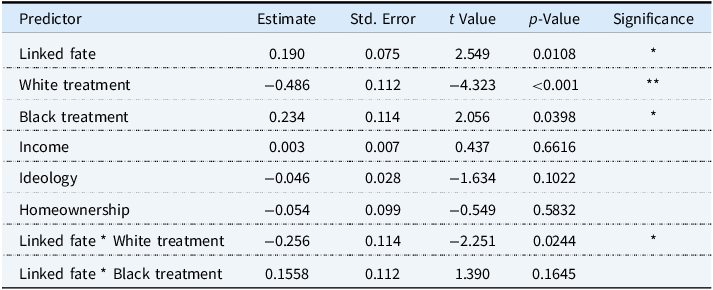
Table 3 presents coefficients from the ordered probit models predicting the level of support for the move. The relationships depicted in the first two columns of numbers in the table are consistent with the bivariate patterns observed in the initial cross tabulations. The effect of the Black treatment is substantial and statistically significant, with a coefficient of 0.234 and a t- value of 2.056. This suggests that being in the Black condition increases the likelihood of supporting the move, relative to the control group. The Black treatment p-value (p = 0.0398) is statistically significant at common significance levels (p < 0.05), confirming this effect. The White treatment shows a negative coefficient of -0.486 with a significant t-value of –4.323, indicating that being in the White condition decreases the likelihood of supporting the move compared to both the control group and the Black condition. The White treatment p-value (p = 1.75e–05) is statistically significant at common significance levels (p < 0.01 and p < 0.05), confirming this negative relationship. Concerning the variables that are most related to my hypotheses, homeownership has a coefficient of −-0.054 and a p-value of 0.5832. This indicates that homeownership does not have a statistically significant effect on support for the move. The large p-value suggests that homeownership is not statistically associated with changes in the likelihood of supporting the housing referendum. Income’s coefficient is 0.003 with a p-value of 0.6616, suggesting that family income has a negligible and statistically insignificant direct effect on support for the move. Linked fate’s positive coefficient of 0.190 suggests that higher perceptions of linked fate are associated with increased support for the move. This effect is statistically significant, with a p-value of 0.0108, which is below the conventional threshold of p < 0.05. This indicates that, as linked fate increases, individuals are more likely to support the move. The negligible effects of income and homeownership, but the statistically significant effect of linked fate, align with my expectations. Specifically, that class or homeownership status does not significantly affect respondents’ willingness to support the low-income housing solution.
Ordered probit results with significance levels

Table 4. Long description
The table presents coefficients from ordered probit models predicting the level of support for a move. It includes predictors such as linked fate, white treatment, black treatment, income, ideology, and homeownership. The table has 10 rows and 6 columns. The columns are labeled Predictor, Estimate, Standard Error, t Value, p-Value, and Significance. Notable trends include the substantial and statistically significant effect of the Black treatment with a coefficient of 0.234 and a t-value of 2.056, indicating an increased likelihood of supporting the move. The White treatment shows a negative coefficient of -0.486 with a significant t-value of 4.323, indicating a decreased likelihood of supporting the move. Linked fate has a positive coefficient of 0.190, suggesting that higher perceptions of linked fate are associated with increased support for the move. Homeownership and income do not have statistically significant effects on support for the move.
Note: *p < 0.05, **p < 0.01.
The interaction between linked fate and White treatment is statistically significant and negative (Estimate = –.486, p = 0.0244). This indicates that for individuals with higher levels of linked fate, being in the White treatment condition decreases their support for the move compared to those not in the White treatment condition. Thus, as perceptions of linked fate increase, the negative effect of the White treatment on support for the move becomes more pronounced. The AIC value for this model is 1508.652, and the model without controls had an AIC of 15,28.652. Given the difference between these two AIC scores, the model appears to have a good fit.
Notably, the interaction between linked fate and the Black treatment, while positive, is not statistically significant (estimate = .1558, p = 0.1645). The positive coefficient suggests that individuals higher in linked fate may be somewhat more supportive of the housing initiative when tenants are explicitly described as Black, but this effect does not reach conventional levels of statistical significance. One possible explanation lies in the interpretation of the control condition. Even though the tenants were not racially specified, respondents may have implicitly assumed they were Black, given the strong associations between race and poverty in the United States (e.g., Gilens Reference Gilens1996; Hancock Reference Hancock2007; Valentino et al. Reference Valentino, Hutchings and White2002).
Political scientists have long shown that images of poverty and welfare are racialized, such that the “typical” poor individual is implicitly understood to be Black (Gilens Reference Gilens1996; Hancock Reference Hancock2007; Valentino et al. Reference Valentino, Neuner and Vandenbroek2018). If respondents in the control condition made this racialized assumption, then the baseline condition was not truly race-neutral but already primed a Black association. This would help explain why the explicit Black treatment does not yield significantly higher support relative to the control. This interpretation aligns with prior research showing that explicit racial cues are more effective than implicit ones in activating Black in-group identification on non-racial issues (White Reference White2007), but that in policy domains like social welfare and redistribution, where race is chronically salient, implicit cues can also trigger racial considerations (Dawson 1994; Lau et al. Reference Lau, Sigelman and Rovner2007; Tate Reference Tate1993). Thus, while the control condition lacked explicit racial language, it likely carried implicit racial meaning, which shaped how respondents constructed their opinions.
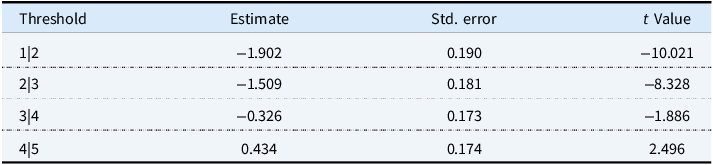
Table 5 presents the threshold estimates from the ordered probit model, which indicate the points at which respondents transition between different levels of support for the proposed policy, ranging from “strongly do not support” to “strongly do support.” The first threshold represents the transition from “strongly do not support” to “somewhat do not support,” with a negative estimate (−1.902), which indicates strong resistance to leaving the most negative category. Similarly, the second threshold (−1.509) marks the shift from “somewhat do not support” to “neutral,” also indicating resistance to moving toward more positive attitudes. The third threshold (−0.326) represents the move from “neutral” to “somewhat do support,” with a value closer to zero and marginal significance, suggesting reduced resistance at this stage. Finally, the fourth threshold (0.434) captures the transition from “somewhat do support” to “strongly do support,” with a positive estimate indicating an increased likelihood of expressing strong support among those already favorable. These thresholds reveal substantial resistance to move in policy support among those who are opponents and stronger support among those already inclined to be favorable.
Threshold estimates

Table 5. Long description
The table presents threshold estimates derived from an ordered probit model, illustrating the points at which respondents transition between different levels of support for a proposed policy. The table includes four thresholds, each with corresponding estimates, standard errors, and t values. The first threshold shows a negative estimate of negative 1.902, indicating strong resistance to moving from strongly do not support to somewhat do not support. The second threshold, with an estimate of negative 1.509, marks the transition from somewhat do not support to neutral, also showing resistance. The third threshold, with an estimate of negative 0.326, represents the move from neutral to somewhat do support, with marginal significance. The fourth threshold, with a positive estimate of 0.434, captures the transition from somewhat do support to strongly do support, indicating an increased likelihood of strong support among those already favorable.
Taken together, the empirical evidence demonstrates that all participants, regardless of income and homeownership, are more likely to show the most support for the housing referendum when low-income tenants are explicitly described as Black. The same trend appears among Black homeowners, and linked fate acts as a mediating variable (due to its statistical significance in the ordered probit model). Namely, Black homeowners higher in linked fate are most likely to show the highest levels of support for the redistributive policy when low-income tenants are explicitly described as Black, as compared to the White condition or the control. Among homeowning respondents with higher levels of linked fate, being in the White treatment condition decreases their support for the proposed move compared to those not in the White treatment condition. As discussed, Black homeowners are a theoretically significant group because their dual status as property-owning and racialized actors allows us to see how economic interests intersect with, and potentially shape, the operation of linked fate. As such, the effects and non-effects of economic self-interest are dependent on the racial context.
Specifically, racial framing of who the recipients of the policy benefit are is important for affluent Black political decision-making. Contrary to the camp of scholars who argue that self-interest does not matter in political decision-making (Chong et al. Reference Chong, Citrin and Conley2001; Huddy Reference Huddy2013; Kinder Reference Kinder1998; Sears Reference Sears, Funk and Mansbridge.1990), this inquiry shows evidence that when operationalizing self-interest as economic self-interest, it does significantly matter for African American political behavior. Higher socioeconomic status African Americans are aware of their option to utilize a self-interested framework when making political decisions and are more willing to do so when the norms of racial group solidarity are not applicable. Importantly, these findings extend Dawson’s theory of linked fate by showing that Black respondents, particularly homeowners, prioritize the well-being of the racial group even when doing so comes at the expense of their own economic self-interest. However, the effect of linked fate is bounded, as solidarity applies when the beneficiaries are other Black people but diminishes when racial in-group cues are absent. Thus, linked fate in this context is not an all-encompassing political determinant but a conditional one, activated by racial framing. Lastly, in line with my argument, the ordered probit model points to the limited effects of the family income variable and homeownership, suggesting behavioral cohesion amongst African Americans regardless of class-based differences.
Conclusion
This inquiry showcases the strength of Black group solidarity even when it is to the detriment of an individual’s economic self-interest. This paper examines the relationship between middle-class Blacks’ strong sense of group consciousness and their unique economic desires and analyzes the extent to which they will forgo their economic and residential desires for the good of the racial group. This inquiry tests whether African American homeowners will sacrifice their direct economic self-interest—their property values—for the benefit of the racial group. Findings support my hypotheses and provide empirical evidence that Black participants, regardless of income and homeownership, are more likely to show the most support for the housing referendum when low-income tenants are explicitly described as Black. The same trend appears for Black homeowners, and linked fate acts as a mediating variable. Namely, Black homeowners higher in linked fate are most likely to show the highest levels of support for the redistributive policy when low-income tenants are explicitly described as Black, as compared to the White condition or the control, even when the vignettes explicitly describe the likely decrease to their property values within the next year, In addition, among Black homeowners with higher levels of linked fate, being in the White treatment condition decreases their support for the proposed move compared to those not in the White treatment condition. Thus, when low-income tenants are explicitly described as White, homeowning Blacks are more susceptible to heightened considerations of economic self-interest.
While scholars understand that racial group solidarity among African Americans is unique relative to other racial groups, there is still more to examine regarding the extent of the strength of racial group solidarity to predict Black political decision-making. While Black homeowners are aware that their property values will decrease if the low-income housing solution is enacted, this concern takes a back seat to supporting low-income members of their racial group.
However, the majority of Black homeowners do not support the same redistributive policy in the explicitly White condition in an effort to protect their economic well-being. These findings point to the effects and non-effects of Black economic self-interest depending on racialized context. Importantly, these findings reaffirm Dawson’s Black Utility Heuristic and the centrality of racial group solidarity in Black political decision-making. Black homeowners show the strongest support for the low-income housing proposal when the prospective tenants are described as Black, indicating a willingness to absorb potential losses in property value when those losses advance the well-being of their racial group. This pattern highlights the reach and force of Black group consciousness, demonstrating its capacity to shape Black political behavior even in local redistributive contexts where material self-interest is threatened. Because the experiment closely mirrors the dynamics of gentrification, the findings speak directly to how Black communities navigate housing development pressures in real-world settings. The results suggest that middle-class Black homeowners may be pivotal allies in supporting affordable housing initiatives and countering NIMBY resistance in local politics. This has clear implications for zoning debates, where middle-class Black support can shape whether affordability mandates or mixed-income developments advance. Support for affordable housing policies among middle-class Blacks creates openings for broader coalition building, irrespective of class. In short, the findings suggest that Black middle-class political behavior is directly implicated in the trajectory of local development policy and the racialized geography of opportunity. See the appendix for empirical patterns specifically among middle-class Blacks (defined via income and homeownership).
This study also teaches us that class works differently for African Americans than it does for White Americans. “Not in my backyard” (NIMBY) behavior emerges in local communities due to the close proximity of affordable housing developments (Dear and Taylor Reference Dear and Taylor1982; Hackinson 2018; McNee and Pojaini Reference McNee and Pojani2022). This behavior has been largely representative of White people. The opposite trend emerges among Black people at a local level, where class concerns do not prevail, and middle-class African Americans openly support redistributive policies that are to the benefit of the overall racial group.
A methodological limitation of this research is drawing generalizations from a subset of the data (n = 283). While the sample is nationally representative, larger sample sizes, with more controls, may be employed to test the validity of the findings presented. Also, operationalizing the Black middle-class via the two-item measure of income and homeownership is a limitation of this study. Future work will heed sociologists’ composite measures of the middle class, which consider education, homeownership, occupation, and income (e.g., Lacy Reference Lacy2007; Patillo Reference Pattillo2013, Reference Pattillo2010). Furthermore, the dynamics of economic self-interest in predominantly Black communities, such as Bowie, Maryland, or Ladera Heights, Los Angeles, may differ due to the unique socioeconomic environments in these areas. In such communities, where there is a stronger concentration of middle-class Black homeowners, economic self-interest might be more closely tied to preserving neighborhood stability and property values. It is worth empirical testing to examine whether racial solidarity still prevails among these residents and leads to policy support that favors the broader Black community, even at the cost of their individual economic interests.
Lastly, while other individual-level factors, such as moral considerations, general prosocial dispositions, or peer influence, could shape support for the policy, the evidence is not consistent with a social connectedness mechanism. Social connectedness centers on interpersonal closeness and the need to feel valued within one’s immediate networks (Lee and Robbins Reference Lee and Robbins1995). Linked fate, by contrast, reflects the belief that one’s own well-being is tied to the collective fortunes of the racial group (Dawson 1994). The pattern observed here, that Black homeowners show greater support for affordable housing when prospective low-income tenants are described as Black rather than White or unspecified, points squarely to racial group solidarity and perceptions of linked fate, rather than to general feelings of interpersonal closeness. Although, in addition to moral considerations, prosocial dispositions, and peer influence, the patterns observed could also reflect dynamics of group conflict, in which resistance to White tenants reflects perceived intergroup competition rather than in-group solidarity (Blalock Reference Blalock1967; Bobo Reference Bobo2004; Jackson Reference Jackson1993). Future research could explore these mechanisms to assess the relative contribution of linked fate compared to these alternative explanations.
In conclusion, one of the overarching themes of this inquiry is exploring the nexus between Blackness and class and the local policy consequences. While this paper highlights the cohesion of Black public opinion across class lines, future extensions of this research could examine how class influences divisions within Black politics. In which opinion and preference domains do Black interests diverge based on class? Intersectionality urges us to further explore these relationships to uncover the complexities of Black political behavior. Future research should also investigate whether similar trends of economic self-interest exist among other racial minority groups, such as Latinx or Asian Americans. Nevertheless, this inquiry demonstrates the political power of racial group solidarity in Black political decision-making, irrespective of class-based differences.
Supplementary material
The supplementary material for this article can be found at https://doi.org/10.1017/rep.2026.10077.
Acknowledgements
I gratefully acknowledge support from the National Science Foundation Graduate Research Fellowship. I also thank Dr. Chryl Laird and the members of my dissertation committee, Dr. Antoine Banks, Dr. Janelle Wong, and Dr. Kris Marsh for their guidance. Feedback from colleagues at the Department of Government of Politics at the University of Maryland and NCOBPS 2025 helped improve earlier drafts of this manuscript. All remaining errors are my own.
Funding statement
This material is based upon work supported by the National Science Foundation Graduate Research Fellowship under Grant No. [your grant number if required/available]. Any opinions, findings, and conclusions or recommendations expressed in this material are those of the author and do not necessarily reflect the views of the National Science Foundation.
Competing interests
None.


 Open access

