

6 Pacifist veterans and the politics of military history
In their symbolism and architectural design, and with all accompanying rituals, war memorials were ‘realms of memory’.1 At these sites, the impulse to mourn the fallen, to honour their sacrifice and to sketch out political consequences for the living were inseparably entwined. Ultimately, any commemoration of the dead around war memorials dealt with the sublime, and it was expected that all participants express their reverence towards the fallen. Political differences were not entirely suspended in the memorial cult, but they were much less pronounced than in other figurations of memory. Even though no ultimate consensus on a national symbol of commemoration could be reached, this was not due to political cleavages. Veterans from the left and right, as well as modernist and conservative architects, agreed that German national identity could be symbolised best through recourse to the Wald, and thus to the primordial power of nature.
Yet memories of the First World War were also expressed and elaborated in a more systematic engagement with the past – through history proper, so to speak, understood as the examination of sources that could shed light on perceptions and decisions that had shaped the course of events. To be sure, the Great War was only one of many periods and aspects of the more recent past that came under intensive scrutiny during the Weimar years.2 But it was certainly a rather important one, as it was inextricably connected to the crucial question of the legitimacy of the republican system. Here, legitimacy was not understood in the legalese of constitutional deliberations, but rather in terms of a morality and necessity of certain actions. Had the war plans of the general staff offered a realistic basis for German success, taking all military and political factors into account? Had the Army Supreme Command with its hyperbolic war aims caused the defeat, or the revolutionary agitation of socialist labour? These were some of the big questions that agitated a broad public throughout the 1920s. Seen in conjunction, they constituted what in German parlance is called Geschichtspolitik, the politics of history. It is best defined as a contested field in which ‘competing interpretive elites’ use the past as an instrument for the pursuit of political aims.3
One crucial element of this field was its relative openness. Professional academic historians were only one, and most often not the decisive, stakeholder in this arena.4 Other interest groups included the Reichswehr as the official curator of the estate of the former wartime army; more generally former wartime officers; and, in a time when the mass media already shaped public opinion, all those who could mass-market popular genres of history writing. Again, these different forms of intervention in the politics of history were often closely related. Many former department heads in the Army Supreme Command, and heads of staff in the army groups and armies, for instance, were quick to publicise their version of events in memoirs. Most of these books were widely reviewed, not only in the specialist military press, but also in newspapers and other media outlets. Obviously, they were not simply literary works, but mainly driven by the ‘strategic’ interest to exonerate those who had been in charge of the German military machine from any responsibility for the defeat.5 Generals and staff officers were not the only members of the military elite who publicised their own reading of the historical trajectory that had led to November 1918. Many other members of the old officer corps, most of whom were of aristocratic descent, contemplated the reasons for the German collapse in autobiographical accounts.6
But not all former members of the imperial officer corps were in some form of denial about the causes of German defeat, or even actively attempted to assign blame to the democratic politicians who had governed since October 1918. Either under the direct impact of the war experience, or upon closer reflection at some point in its aftermath, a small group of officers formally abandoned their allegiance to the esprit de corps of the Wilhelmine military elite. They said farewell to active military service, if they had not already been discharged by the end of the war, and turned towards an active promotion of pacifist policies. The reasons for this decisive step were as diverse as the former military assignment and biographical trajectory of these pacifist officers. Abandoning the esprit de corps of the officer caste had made them homeless in a social and political sense, and leaning towards pacifism, with its highly disparate and divisive set of various small associations and factions, did not really change this situation. These pacifists remained, to be sure, a tiny minority among the approximately 24,000 wartime officers in the Prussian army and the 3,000 officers in the Imperial Navy.7 The first more systematic effort to analyse the biographies of these individuals contains information on 15 officers who abandoned their career during or after the Great War, and henceforth actively engaged in pacifist circles.8
The significance of pacifist officers
Given the huge disparity between this figure and the overall number of officers in the German army, one might be tempted to discount pacifist officers as an entirely irrelevant phenomenon. That, however, would be wrong for at least three reasons. There was no common thread that characterised the decisive break of these men with the German military tradition; yet it is, firstly, significant that many of them joined the ranks of the Reichsbanner Black–Red–Gold and thus fused their tireless efforts to promote the democratic state and its colours with a mostly moderate pacifism. In contrast to the more radical versions of pacifism in the 1920s, these pacifist officers did not reject the notion of national defence outright, and accepted the existence of the Reichswehr in principle, while vehemently criticising the lack of democratic oversight and many other particular aspects of its policies. As a republican veterans’ association, the Reichsbanner was in many respects the ideal political platform for these men, as it allowed them to work in an environment in which most members were familiar with the military. Moreover, secondly, some of these pacifist officers were not simply Reichsbanner members, but Reichsbanner luminaries. On the one hand, they took a leading position in the republican league, and had a high profile as contributors to the Reichsbanner journal and as speakers at its mass rallies and branch meetings. On the other hand, the league systematically exploited the symbolic capital that their former service as officers brought to those political and historical topics in which military experience provided a particular competence.9 As high-profile members and military experts of a mass organisation, this group of pacifist officers gained political significance way beyond their tiny numerical strength.
In addition it should, thirdly, be stressed that the Reichsbanner membership of many other former officers is a still largely unexplored phenomenon. Judging only from scattered evidence, it seems that a significant number of former officers in the wartime army, both from the reserve and from the active professional corps, joined the ranks of the republican league. One of them was the former major general Günther von Bresler (1867–1945), who served in 1929 on the non-executive board of the Reichsbanner, but who had also been the head of the Saxonian branch of the Deutsche Friedensgesellschaft (German Peace Society; DFG) since 1927.10 In the same year, he reviewed the mass spectacle of up to 100,000 Reichsbanner members who had gathered in Leipzig for the celebration of Constitution Day on 11 August. On this and other occasions, von Bresler had met ‘hundreds of former officers’ who understood that the Republic provided the proper platform for the ‘reconstruction’ of the nation. Yet fears about a possible ‘boycott’ by their Standesgenossen – literally ‘fellows in the officer estate’, according to the feudal terminology still prevailing in the military – hindered many from openly declaring their support for the Republic.11
Certainly those who joined the league did not always bring the amount of publicity and controversy to the Reichsbanner as some of the former high-ranking professional officers. Nonetheless, they also contributed to the politics of military history from a leftist perspective. One example was Ludwig von Rudolph. During the war, he had served as a reserve lieutenant in various Bavarian regiments. Back at home in Nuremberg he worked as an elementary school teacher. As a Reichsbanner activist, he occasionally gave talks on the history and significance of the Great War, such as a lecture on ‘Ypern 1914 and 1926’ at the local branch in the neighbouring town of Kronach.12 Yet von Rudolph also publicly engaged with the politics of military history, for instance in the context of the Dolchstoßprozeß.
This trial, which took place in the autumn of 1925 in Munich, was in many respects a widely publicised version of the parallel proceedings of the parliamentary subcommittee on the ‘causes of the German collapse’ in 1918. Nicolaus Cossmann, national-conservative editor of the Süddeutsche Monatshefte, had published a special issue in 1924 that tried to underpin the allegation that the Social Democrats had systematically prepared a ‘stab in the back’ since the beginning of the war. When the Social Democrat newspaper Münchener Post heavily criticised this smear campaign, Cossmann sued the editor, Martin Gruber. Formally a libel process – which ended with Gruber being sentenced to a 3,000 mark fine – it was in fact another public controversy on the reasons for Germany’s defeat. Both sides marshalled written evidence and presented expert witnesses to support their case.13 Following extensive press coverage, von Rudolph volunteered to stand in the witness box for the Münchener Post. In a letter to Max Hirschberg, lawyer for the defendant, and himself a Reichsbanner member, von Rudolph explained his readiness to testify publicly about his experiences at the front. For him it was ‘hard to bear’ that ‘the remembrance of the war and its final months deviate more and more from the reality’ of these events.14 As a highly decorated front-line officer, von Rudolph was ready to testify in public, something Fritz Einert for instance had not dared to do at about the same time. It was not only in the sense that the Dolchstoßprozeß became a success for the pacifist left, even though it was defeated in judicial terms. It was also a success for the majority wing of the Social Democratic Party (SPD), as, even before the sentence was announced, the legal representative for Cossmann declared that he had never intended to blame moderate Social Democrats for the defeat, but only the radical wing of the Independent Social Democratic Party (USPD).15 By and large, the Reichsbanner had always justified the politics of the majority wing of the SPD during the war, and was thus both relieved and exonerated by the outcome of this trial.
Before we analyse the republican politics of military history in more systematic fashion, it seems worthwhile to chart the biographical trajectory of some of these pacifist officers. They were in many ways significant actors on the political stage of imperial and Weimar Germany, and they certainly all had both turbulent and dissonant lives that are significant in their own right. From the small group of more prominent officers in the Reichsbanner – which also comprises the former captains-at-sea Lothar Persius and Heinz Kraschutzki, and the cavalry officer and playwright Fritz von Unruh – four individual biographies shall be scrutinised in some detail. The first is that of former general Paul Freiherr von Schoenaich (1866–1954).16 When Schoenaich was sent into early retirement at the rank of major general on 1 April 1920, he looked back on thirty-seven years of distinguished service in the Prussian army. Even as late as 1949, he described these years as ‘the best period of my life’.17 After service in the navy and in a cavalry regiment, he worked in the Prussian War Ministry from 1907 before returning to the troops as a regimental commander in 1913. During the war, he first led a cavalry regiment, before serving as department head for railways and logistics in the War Ministry in Berlin.
Paul Freiherr von Schoenaich and Berthold von Deimling
By 1919, Schoenaich had joined the left-liberal German Democratic Party (DDP), presumably the main reason why he was sent into early retirement. During the revolution, he had worked well with the soldier’s council for the War Ministry, which had sacked inefficient officers in cooperation with him. This gave Schoenaich the impression that the Republic would be based on principles of performance and duty, which he considered to be the authentic Prussian ethos. Support for the DDP had the immediate effect of his formal exclusion from the Deutscher Offiziersbund and the regimental association of the 2nd Guard Dragoon Regiment. Schoenaich also faced social ostracism from the affluent middle-class circles around the landed estate in Holstein where he and his wife lived. In 1922, Schoenaich contacted the West German branch of the DFG and its head, the radical pacifist Fritz Küster. Soon after, the former general joined the DFG and promoted, among other pacifist ideas, disarmament and democratic reforms of the officer recruitment for the Reichswehr. From the mid 1920s, Schoenaich followed Küster in promoting more radical measures such as draft resistance. Thus, he also supported the so-called Ponsonby action in 1927/8. This transnational campaign adopted the call of Arthur Ponsonby MP to collect signatures in favour of draft resistance and the refusal to serve the country in case of a military conflict. While the radicals in the DFG around Küster adopted the call and collected signatures, moderates in the DFG remained sceptical, doubting the value of such a campaign at a time when the German military did not even have the draft.18 Schoenaich’s growing radicalism culminated in a clash with Otto Hörsing over ‘Battle Cruiser A’ in 1928. It was only in 1932, though, that Schoenaich was finally forced to leave the non-executive board of the Reichsbanner, much to the satisfaction of former general and Reichswehr minister Wilhelm Groener.19
Schoenaich had joined the Reichsbanner in 1924, and soon advanced to become one of the most active speakers of the league. When congratulating him on his sixtieth birthday in 1926, Ludwig Quidde, then head of the DFG and the prominent figurehead of liberal pacifism, described Schoenaich more generally as the ‘most successful public speaker [Versammlungs-Apostel] of German pacifism’.20 And that accolade was entirely justified. Schoenaich himself reckoned that he had spoken at about 1,000 public gatherings and rallies from the early 1920s to 1933.21 Yet the increasingly bitter dispute between radical pacifists such as Schoenaich and the Reichsbanner leadership not only put a strain on relations at the top of the republican league; local Reichsbanner functionaries also felt increasingly uneasy about Schoenaich’s appearances. Their reasons are illuminated in a letter by Willy Dehnkamp, then the head of the Reichsbanner branch in the Bremen suburb of Vegesack. In April 1929, Dehnkamp discussed his reasons for rejecting a planned event with another speaker from the DFG, just a few months after Schoenaich had railed against SPD support for Battle Cruiser A in front of a crowd of 1,800 people, in a gathering that was guarded by local Reichsbanner men. At the age of twenty-six, Dehnkamp (1903–85), a post-war mayor of Bremen and already a battle-hardened SPD functionary, simply could not understand, let alone condone, such undisciplined behaviour. Reflecting ‘radical’ discontent in his local Reichsbanner branch, Dehnkamp qualified Schoenaich’s speech, which had immediately been exploited by the local Communisty Party (KPD) newspaper, as a ‘great tactical imprudence’, and explained the rationale for this hard judgement in the following:
You might argue that I look at this issue far too much through the glasses of the organisational man, of the party secretary. Maybe. But precisely this is in my opinion the strength of our party, that in consideration of the movement or of a given target, criticism sometimes disappears or at least recedes in the background, in fact must recede if discipline and solidarity should not be empty words … The existing external façade of party unity and unanimity despite inner antagonisms is exactly what no bourgeois party can emulate, and what provides the strength and the very foundation of our party. And because of this unanimity people such as Schoenaich can never work in the SPD, precisely because they are too much individualists.22
What is revealing about Dehnkamp’s statement is not only the extent of open resentment towards an outspoken and utterly committed republican politician such as Schoenaich – who indeed was, as all pacifist officers, a highly idiosyncratic individualist, and necessarily all the more so as his former circles of sociability had turned their back on him – but that, furthermore, Dehnkamp did not hesitate to apply the same rather rigid organisational principles that governed the SPD to the Reichsbanner, without even noticing any possible difference between the two. Schoenaich himself, however, remained dedicated to the pacifist cause. From 1928 to its forced dissolution in 1933, he served as chairman of the DFG, and lived a reclusive life during the years of the Nazi dictatorship. After 1945, he again served as chairman of the newly founded DFG, but was forced out of this office in 1951 when he supported a referendum against West German rearmament that the Communists had initiated.
Another high-profile pacifist officer was the former general Berthold von Deimling (1853–1944).23 During his military career, Deimling had been no stranger to controversy. Coming from a family of civil servants in liberal Baden, he joined the military in 1871 and advanced quickly as an officer in the Prussian army. His first controversial assignment came in 1904/5, when he was appointed as a regimental commander in the Schutztruppe for the German colony of South-West Africa. In that capacity, he took a leading role in the genocidal warfare against the Herero and Nama tribes, and commanded troops in the infamous battle at the Waterberg in August 1904, which initiated the genocide. During the campaign, Deimling alienated the civilian governor, Theodor Leutwein; sidelined his superior, General Lothar von Trotha; and pushed his inferiors around amid often frantic outbursts. Yet upon his return to Berlin in 1905, he was ennobled by Wilhelm II for his services. In May 1906, Deimling was appointed as commander of the Schutztruppe. Back in South-West Africa, he immediately halved the number of German troops and managed to settle the war with the Herero and Nama peoples. Yet before his departure Deimling presented himself on 26 May 1906, in a heated exchange with Matthias Erzberger and other critical deputies in the Reichstag, as a military hardliner full of contempt for the parliament as a legislature.24
From 1907, Deimling served in Alsace, first as a brigade commander, and then from 1 April 1913 as commanding general of the XV Army Corps in Strasbourg. When the Zabern Affair broke in November 1913, he had already made a name for himself as a ruthless supporter of German military superiority in the Reichsland, which was centrally controlled from Berlin. Following the verbal abuse of Alsatian civilians by a Lieutenant Günter von Forstner in the small garrison town of Zabern, the press and almost all parties in the Reichstag condemned this blatant abuse of military power. Deimling, however, covered Forstner’s action up, and ordered a regimental commander to detain some civilians in Zabern, with full awareness of the illegality of his action. While the Zabern Affair evolved into the major constitutional crisis in late Wilhelmine Germany, Deimling’s position was rather strengthened, despite widespread criticism in the media and in parliament, as he had the full support of the Kaiser.25 During the war his fortunes eventually changed. Early on, other high-ranking officers criticised Deimling for acting alone and taking irrational decisions without proper strategic value. His reputation as a dare-devil commander who recklessly sacrificed the lives of his troops reached a first climax when Deimling ordered an attack against superior British forces at Ypres on 17 November 1914. It led to tremendous casualties among the German regiments.26 Fifteen years later, as a highly popular Reichsbanner leader, Deimling still tried to counter the enduring negative reputation his actions on this day had engendered.27
Subsequent assignments at Verdun and the Somme in 1916 did not improve Deimling’s fortunes as a military commander. In November 1916, he was sent to command troops on a very quiet stretch of the Vosges front and was thus informally demoted. In September 1917, he was finally forced to tender his resignation, and spent the remainder of the war as a pensioner in Baden-Baden. It is safe to assume that disappointment with this sudden end to a distinguished military career was one key factor in Deimling’s incremental switch from a sabre-rattling arch-militarist to a devoted republican and moderate pacifist. At least equally important was the fundamentally altered political context after the departure of the Kaiser into his Dutch exile and the proclamation of the Republic, which spurred Deimling to work for the nation on the basis of the new political system.28 Deimling himself described the recalibration of his political compass as a continuous process, turning him first into a Vernunftrepublikaner (‘republican of convenience’) who accepted the Republic on the grounds of reason, only gradually becoming a full-fledged ‘democrat, heart and soul’.29 At any rate, he also retained crucial elements of his soldierly worldview, for instance the tendency to obfuscate human agency through recourse to the contingency of greater powers. Writing his autobiography in 1928, he commented on the decision in 1917 that had forced him to resign with the words: ‘Everything is fate. The soldier has not to ask for reasons, but has to obey.’30
Following German defeat, Deimling made a rapid career, first in the left-liberal DDP, and then in the Reichsbanner, which he joined immediately upon its foundation in 1924 as a member of the non-executive board. In both organisations, he advanced to become one of the most popular speakers. When the eighth anniversary of the Reichsbanner was celebrated on 22 February 1932, an enthusiastic crowd of 9,000 people squeezed into the hall in Magdeburg, eager to see the famous Reichsbanner luminary. In a 1924 DDP rally in the Sportpalast in Berlin, Deimling spoke in favour of international reconciliation in front of a crowd of 20,000.31 Nothing in Deimling’s agenda for a patriotic pacifism deviated from the most common features of this current: he was in favour of coordinated disarmament and conflict resolution in the framework of the League of Nations, and strongly against conscription without supporting the more radical measure of draft resistance, but he insisted that nations had the right to maintain an army for self-defence.32 The appeal of Deimling’s pacifism and pro-republican commitment did not rest on the policies he suggested. Rather, it relied on the performative power of someone who could lend credibility to these policies as a highly decorated former officer – on 3 September 1916, Deimling had received the Pour le Mérite, the highest military distinction the Prussian king could award. Ludwig Quidde acknowledged this in 1924 when he wrote to Deimling that he had ‘an authority that we as lay-people are lacking’ when it came to convincing a larger public about the ‘unimaginable horror of future wars’.33 Deimling himself explicitly referred to the reasons for the persuasiveness of his convictions. Speaking in Paris on 3 October 1931 at a rally organised by the veterans of the ‘Amitiés internationales’, he expressed his ‘pride’ about being the ‘first German general’ who could condone peace in France ‘in the aftermath of the war’.34 Even political opponents grudgingly admitted the peculiar legitimacy of Deimling’s engagement for a ‘no more war’ pacifism. Like articles by other pacifist officers, his statements were ‘especially dangerous’ as they were likely to ‘confuse the minds of the readers’.35
Former police colonel Hermann Schützinger
Schoenaich and Deimling were high-ranking career officers who, with their flamboyant personalities, supported the struggle for international reconciliation, and the dignity of all individuals and democracy, and further increased their already high profile through relentless campaigning for DDP and Reichsbanner. The other two pacifist officers introduced here had a somewhat different profile. They were less well known among contemporaries, and their careers after the switch to republican pacifism are best described as those of two utterly loyal SPD soldiers. The first, Hermann Schützinger (1888–1962), came from a respected middle-class family in Bavarian Swabia. After leaving the Gymnasium(grammar school) with a high-school diploma, which was required for a career as an officer in the Bavarian army, he commenced service with the 11th Infantry Regiment in Regensburg in 1908, advancing to the rank of lieutenant in 1910.36 Shortly before the outbreak of the war, Schützinger published a short novel with the title Die Waffen hoch! (To arms!) under a pseudonym. Already the title suggests the gist of the plot. It was a pun on Die Waffen nieder! (Down with the Arms!, 1889), the famous anti-war novel by Austrian pacifist Bertha von Suttner, who was the first woman to receive the Nobel Peace Prize in 1905. In his diatribe against organised pacifism, Schützinger reaffirmed the view that war is a law of nature, furthering the Social Darwinist principle of natural selection.37
During the war, Schützinger mostly served as a troop officer, first as a company commander, then a battalion commander in the 11th Bavarian Infantry Regiment. Unlike Deimling, he thus had first-hand experience of the destructive nature of machine warfare, and there can be no doubt that his impressions of the slaughter at the Ban de Sapt in 1915 were one particular turning point that fostered his critical attitude towards war, and instigated his post-war engagement in the peace movement.38 Yet this was never a straightforward ‘conversion’ to pacifism, as war letters to his parents reveal. As early as August 1914, he noted with disappointment that the Iron Cross was mostly awarded to military staff in the rear area, but not to those who were actually ‘smelling gunpowder’.39 In October 1914, he observed, with critical undertones, the gruesome impression of swollen corpses in a ‘field of death’ at the front. But in the same letter, he also developed the paternalistic notion of his company as a ‘family’. Schützinger conjured up the image of himself as the ‘father’ who would celebrate All Souls and later Christmas with his utterly pious Catholic Bavarian soldiers according to ‘traditional German custom’.40
The turning point came in 1915, when his regiment prepared to storm a French position on the Ban de Sapt height in the Vosges. ‘Do not publicise’ – these words at the beginning of a letter to his parents in April 1915 indicate Schützinger’s awareness that his impressions no longer fitted into the patterns of a patriotic discourse. Very often, excerpts from war letters were published in newspapers to foster an allegedly authentic image of the front.41 A couple of weeks later, he ‘openly’ concluded that this ‘brutal and beastly murdering’ was no longer bearable.42 And that was before the events on 22/3 June 1915, when his regiment attacked the Ban de Sapt and was almost wiped out. Among the most harrowing experiences of this day was an old friend’s decision to have a photograph taken, in anticipation of his own death. When the news of his death came later that day, Schützinger assumed that his own ‘foreboding of death’ would ‘have to be fulfilled for sure’, as that of his friend had been. On top of that came the experience of face-to-face combat using hand grenades, bayonets and ‘Bavarian knives’. Towards the end of the battle, three of the most reliable members of his company staff, a sergeant, an orderly and a hand-grenade thrower, died standing right next to him under artillery fire, leaving Schützinger with the ‘uncanny’ feeling of having survived among the dead.43
These two days were surely a turning point in Schützinger’s life, but their significance was only realised later.44 In another novel, published in 1918, he tried to express his feelings of despair about the deaths of his comrades and the underlying guilt about being a survivor, in a narrative that made explicit references to his own experiences at the Ban de Sapt.45 But Schützinger continued to revel and excel in his army service. In October 1918, he was overjoyed to be promoted to the rank of captain, serving as a machine-gun officer in the ‘Oberbau Stab’ of the 5th Army. In that position, he was responsible for the development and fortification of machine-gun positions on a 45 km-long stretch of the western front, and he was proud to develop new procedures for machine-gun target finding and to get proper ‘recognition’ for it.46 Only the revolution completed his switch to the SPD. Upon return to his garrison in Regensburg, he founded and commanded a ‘Volkswehr’ company in January 1919 – one of those units that served the Majority Social Democrat (MSPD) government. But Schützinger struggled to advance his unit against the Communist Council Republic in Munich in April, a disappointment that convinced him that Democratic troops also needed a strict chain of command.47 From 1919 to 1921, Schützinger studied in Munich and completed a doctorate in economics, while also running a small pro-republican press agency, and publishing articles on – among other political topics – the strategic failures of the Army Supreme Command.48
An active member of the MSPD, he was involved in developing ideas for the safe-guarding of the Republic against the combat leagues of the völkisch right. On 28 June 1922, the Vaterländische Verbände (Nationalist Combat Leagues) had demonstrated their strength in a massive rally against the ‘war guilt lie’ on the Königsplatz. About 2,000 men of the ‘Auer Guard’, the SPD defence organisation, had tried to show strength and presence on the Odeonsplatz, but had been easily pushed aside by police units.49 Just the next day, Schützinger submitted a detailed memorandum to the executive board of the local SPD, in which he suggested that much tighter administrative oversight and regular training in marching in closed columns for the republican self-defence formations were needed. Only such intensive efforts, he argued, would achieve the main aim of acting as a ‘deterrent’ against ‘recklessness’ from the right.50 Written more than a year before the Hitler putsch, this was already an outline of the framework for republican defence work Schützinger later tried to implement as a Reichsbanner leader.51 Soon after, Schützinger had the opportunity to put some of his ideas on policing public order into practice. In September 1922, he joined the Prussian police in Hamburg-Altona, advancing to the rank of a major. In May 1923, he was appointed as a police colonel in Dresden, serving the Saxonian government of Minister-President Erich Zeigner, who was elected by the combined vote of the SPD and KPD. In that function, Schützinger intended to use the so-called ‘Proletarian Hundreds’ – joint working-class self-defence units that in Saxony were the precursors of the Reichsbanner – as a tightly controlled auxiliary police in the case of a state of emergency.52
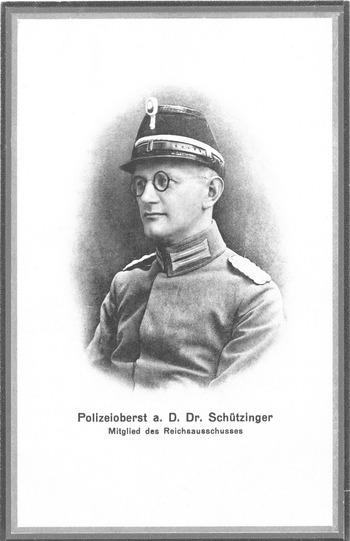
Figure 10 Polizeioberst a.D. Dr. Schützinger, Mitglied des Reichsausschusses, picture postcard, n.d. Schützinger is introduced as a member of the non-executive board of the Reichsbanner, but depicted in his uniform as police colonel.
When a Reich execution led by Reichswehr troops forced the Zeigner government out of office on 30 October 1923, Schützinger was sent into temporary retirement, and formally discharged in April 1925. At that time, he had already embarked on a very busy life as a public speaker and writer for the Reichsbanner, in which he was a leading member of the non-executive committee. Schützinger was also active in the pacifist Deutsche Liga für Menschenrechte (German League for Human Rights), successor of the Bund Neues Vaterland (1914–22), which had directly opposed the war from the start, and participated in the ‘no more war’ movement during the early 1920s.53 Another platform for his relentless activism was the Republikanischer Reichsbund, which had absorbed many former members of the Republikanischer Führerbund, a short-lived association of pro-republican Reichswehr officers. The funds for all political activities came from running a press agency that was accredited in Berlin at the Reichstag. During the years of the Nazi dictatorship, Schützinger first worked for a publisher and, from 1942 to 1945, for one of the state agencies that controlled the production of technical goods and iron materials. In the Federal Republic, he returned to work in journalism, covering debates in the Bundestag in Bonn for various media outlets until his death in 1962.54
It is impossible to do justice to the full range of topics and political issues that the pacifist officer Hermann Schützinger covered in his many writings and speeches during the Weimar Republic. He actively contributed to the politics of military history through his many articles in the Sozialistische Monatshefte, in which he rebutted the Dolchstoß myth, analysed the strategic shortcomings of the Army Supreme Command – and of Ludendorff and Hindenburg in particular – and openly criticised the fateful glorification of these generals among a bourgeois public.55 One particular aspect of Schützinger’s activism ought to be highlighted: his clear awareness of some of the ambivalences in the imposing edifice of the Reichsbanner organisation, ambivalences that in his view were necessary side-effects of the attempt to mobilise on a grand scale for the Republic. When the Reichsbanner – which was based, as we have seen, on his ideas at least with regard to the regular training and orderly discipline of its members – was founded in 1924, Schützinger travelled across Saxony and spoke during the founding meetings of various local branches. On one such occasion, in the town of Plauen, he justified the need for uniforms by arguing that they were needed to ensure popularity, but had to be balanced against the ‘decidedly pacifist tendencies’ of the league. The bottom line was, he insisted, that the Reichsbanner members reject any ‘military humbug’.56 In a similar vein, he insisted that the Reichsbanner try to tap into the pacifist idea of the ‘Unknown Soldier’ in its commemoration of the fallen. As such, they would only ever pay tribute to the ‘soldiers’, not to the ‘war itself’: would conduct Kriegerehrung, but not Kriegsehrung.57
Schützinger was also adamant in defending the Reichsbanner against aggressive criticism from the radical left. In 1926, for instance, Kurt Tucholsky launched another of his sweeping attacks on the mere Realpolitik of the republican league. Directly addressing one of Schützinger’s articles, Tucholsky claimed that such an approach had so far yielded ‘nothing, nothing and once again nothing’. He accused the Reichsbanner and the SPD more generally of not taking ownership of the revolution in 1918, and identified a ‘misunderstood notion of discipline’ as the root cause for the ‘ruin of German Social Democracy’.58 In his rebuttal, Schützinger acknowledged that ‘revolutionary élan’ was indeed often missing, and thanked Tucholsky for that reminder. He used the opportunity to illuminate the peculiar situation of the small bunch of officers who had come out in favour of pacifism and the left. In the past months, Schützinger explained, he had spent most of his time on paperwork for several court cases in which he had tried to restore his own personal integrity against hostile or libellous newspaper coverage. Meanwhile, the few republican ex-military had hardly any ‘breathing space in their own camp’. Former captain-at-sea Lothar Persius had just telephoned, relaying the news that many people wondered why Persius and Schützinger endured such bad treatment by Otto Hörsing. Hans E. Lange had also been in touch with Schützinger. Lange (1871–1961) – lieutenant-colonel and commander of an infantry regiment during the war, and from 1919 to 1924 police colonel and head of the security force in Mecklenburg-Schwerin – was another pacifist officer and progressive multifunctionary: as an executive board member of the Deutsche Liga für Menschenrechte and – until 1929 – of the DFG, and as Reichsbanner leader in the Berlin-BrandenburgGau. Temporarily frustrated by the internal workings of the Reichsbanner machine, Lange had told Schützinger that he wanted to retire to the countryside, and that Schoenaich said he wanted to move to Palestine.59 He and other pacifist officers, Schützinger concluded, had ‘sacrificed simply everything’ for the pursuit of their ideas: ‘family, former comrades, our whole existence’. And yet they were not only facing the ‘roaring tide of nationalism’ but also ‘envy’ within their own camp.60
Only a couple of months later, Schützinger had to refute yet another sweep by Tucholsky against the shallow ‘Sunday republicans’ of the Reichsbanner, who lacked any ‘positive ideas’.61 In his response, Schützinger admitted how hard it often was to slog on with the routine displays of Reichsbanner republicanism: just another Sunday spent at a local flag consecration, with the obligatory greetings by the branch leader and the mayor, the commemorative bit to the tune of ‘I Had a Comrade’ – ‘often the most humanly touching scene of the whole theatre’ – right up to the moment when the honorary maid forgot her few words as she handed over the black–red–gold banner, even though they were scribbled down in her ‘shivering hands’. All that was a drudgery and an often tedious routine. But it was, Schützinger insisted, something he readily did again and again, simply because the question ‘Republic or monarchy?’ was not at all of secondary relevance as long as reactionary circles indulged in nostalgia for the past. And the left, he demanded, should pay respect to the ‘endlessly devoted Reichsbanner Muschkoten [“humble foot-soldiers”]’, who took to the streets in order to defend the Republic.62 At any rate, Schützinger was a versatile and highly respected Social Democrat functionary and committed pacifist, who used the Reichsbanner as a platform for his many ideas on policing and other policy issues. Open-minded and reflexive, he also engaged in a meaningful dialogue with radical pacifists and critics on the left.
Karl Mayr: political maverick and Reichsbanner leader
These qualities were certainly not the strength of the final pacifist officer introduced here, former major Karl Mayr (1883–1945).63 Throughout his lifetime, Mayr remained a political maverick, whose activities were often clouded in secrecy, and who alienated not only opponents but also his political friends. Communist historians in the German Democratic Republic alleged that he had joined the Reichsbanner only on behalf of the Reichswehr, in order to report on details of Social Democrat military policy.64 In repeated libel trials, the radical pacifist Fritz Küster, who had gained influence in the DFG from the mid 1920s, tried to dig up dirt against Mayr. Küster accused Mayr, among other things, of having channelled French money into the hands of völkisch Bavarian separatists in the spring of 1923.65 Social Democrats who knew him closely through long-term collaboration confirmed that Mayr retained the ‘habit of a professional soldier’, and even more so that of an ‘intelligence officer’; that he was ‘very close, very reticent’; and kept up close communication with personal contacts and acquaintances in the right-wing camp. Indeed, Mayr even had informants in the ‘Braunes Haus’ in Munich, the Nazi Party headquarters. Yet Franz Osterroth insisted that Mayr’s activism in the SPD and the Reichsbanner was based on ‘inner conviction’, and that his fight against National Socialism was genuinely ‘passionate’.66 Walter Hammer, who knew Mayr from the Reichsbanner non-executive board, encountered him in the infamous prison cells in the basement of the Reich Main Security Office in Berlin in September 1940, and again in the Sachsenhausen concentration camp a year later. In post-war exchanges, Hammer also testified to Mayr’s personal integrity.67 Nevertheless, the trajectory of Mayr’s biography is full of tragedy and ironical twists. From April 1943 until his death on 9 February 1945, Mayr worked in the Gustloff works in Weimar, a factory run by the SS that exploited his and other inmates’ labour in the nearby Buchenwald concentration camp. When some Wehrmacht generals visited the factory, they clicked their heels in front of Mayr, whom they instantly recognised as their former superior in the wartime army.68
Coming from a respectable Catholic middle-class family in Mindelheim (Bavarian Swabia), Mayr commenced his career as an officer in 1901. Promoted to captain in June 1915, he served during the war at various fronts, becoming a general staff officer with the Bavarian Alpenkorps from September 1916 to January 1918. As head of the proganda office in the intelligence department of the Reichswehr Group Command 4 in Munich from May 1919, he employed Adolf Hitler as a ‘V-man’, or snitch. In early July 1920, Mayr left the Reichswehr at his own request having attained the rank of major and a pension entitlement. The most probable reason was his resentment of separatist plans formed in circles of the Catholic-conservative Bavarian People’s Party (BVP), which governed Bavaria at the time.69 In the following months, Mayr tried to gain influence in the Nazi Party, which he himself had helped to nurture. He had hoped that it could function as an equivalent to the short-lived party Nationalsozialer Verein (1896–1903), in which Friedrich Naumann, one of the most prominent liberals of late imperial Germany, had tried to reconcile national liberalism and attempts to better the condition of the working class.70 But these hopes were disappointed, and Mayr left the Nazi Party in March 1921. Shortly afterwards, Mayr established contact with Erhard Auer, head of the SPD in Munich, whom he supplied with documents about the separatist ideas of Georg Heim and other leading BVP politicians. Auer used this information for articles in the Münchener Post.71
Starting with these contacts, Mayr subsequently moved closer to the republican camp. In a gradual process, he tried to ‘accustom himself to the Social Democrat movement’, and formally joined the party in 1924.72 But the switch from active opponent of the democratic state – Mayr had supported the Kapp putsch in March 1920 while still a Reichswehr officer – to devoted supporter of the Republic took time. In a 1923 letter to Hans Delbrück, professor in Berlin and the liberal doyen of German military history, Mayr still described himself as a Vernunftrepublikaner, accepting the Republic merely out of reason, as a lesser evil.73 Delbrück supported the plan to find a position in the Reichsarchiv for the former staff officer, but to no avail. Meanwhile, Mayr continued to study German strategy during the war in private, and published his first findings in article form.74 It was only when he joined the Reichsbanner in 1924 that Mayr became fully committed to the republican cause. During the first years of his engagement with the veterans’ association, Mayr’s sphere of activities was basically in and around Munich, giving speeches in local branches and at festivities, and writing articles for the Münchener Post and the Reichsbanner journal.75 But soon his purview broadened, and he came into contact with Karl Höltermann, the deputy head of the Reichsbanner, who trusted him personally and was keen to employ his military expertise for the league. For a long time, it was planned that Mayr should be the deputy to Höltermann as editor-in-chief of the weekly Reichsbanner journal. It was only after a long delay, though, that he commenced working in this position in late 1928, and rented a flat in Magdeburg. Mayr soon clashed with Franz Osterroth, who had worked as acting deputy editor of the journal for a couple of months. Coming from the Jungsozialisten, the youth organisation of the SPD, Osterroth simply could not bear Mayr’s ‘glowing hatred against Soviet Russia’.76

Figure 11 Reichsbanner functionaries review a marching column on Prinzregentenstrasse in Munich, 26 May 1929. Standing in the front of the car is Karl Mayr, in the rear of the car Otto Hörsing. Adolf Dichtl, head of the Reichsbanner in Munich, is standing on the footboard.
And anti-Bolshevism had indeed been one of the most persistent elements in Mayr’s political worldview since his days as a counter-revolutionary army officer in post-war Munich. The ability to express these views was certainly one of the reasons why Mayr felt comfortable as a Social Democrat.77 He was not a supporter of radical pacifism either. In 1922 he opined in a letter to Hans Delbrück that ‘for the pacifist mentality, any fact-based critique of military affairs must already logically appear to be a sin against the spirit; from this mindset it is only those homicidal maniacs [Amokläufer], who have devastated the German army and who have lost the war, who profit’.78 No love was lost between Mayr and Schoenaich once the latter started to support, in line with Fritz Küster, a more radical pacifist approach.79
Mayr was also critical with regard to the slogan ‘No more war!’, which, as we have seen, continued to be widely popular in the Reichsbanner even after the demise of the original ‘no more war’ movement of the early 1920s. Mayr fully respected and shared this emotional rejection of war, and agreed that only fascists like Mussolini would be unable to call the First World War a ‘terrible disaster’. But he insisted that cultivating popular anti-war sentiment would not suffice, as the focus had to be on political decision-making that could lead to a renewed European conflict. The first pacifist demand thus had to be the call for total ‘democratic openness’ in international and defence politics, and armament politics in particular. The situation in 1914 provided a crucial historical example for Mayr’s argument. Had the Reichstag known that the Schlieffen Plan necessarily involved a breach of Belgian neutrality, it should and would have turned against the war plans of the general staff, he was sure.80 During the final years of the Republic, Mayr intensified his agitation against the Nazi Party. Immediately after the Nazi electoral breakthrough on 14 September 1930, he tried to uplift the mood in the republican camp. In a series of public appearances under the motto ‘Adolf Hitler lying in prone position’ (‘Adolf Hitler auf dem Bauch’), peppered with revealing anecdotes about his former military subordinate, Mayr ridiculed the self-proclaimed Führer. This was a performance that clearly energised the depressed Reichsbanner members.81 Shortly after the Nazi seizure of power, Mayr fled to France, where he settled in a suburb of Paris, earning money with language tuition. In the wake of the German invasion, he was interned in southern France, and brought back to Germany in July 1940. Via Berlin and Sachsenhausen, Mayr arrived at Buchenwald in 1943, where he died in early 1945.82
Clearly, these high-profile pacifist officers in the Reichsbanner attracted the ire of the nationalist camp, and some aspects of their military track record came back to haunt them, as was particularly the case with Berthold von Deimling. Yet the right-wing press and patriotic associations had good reasons to attack this small group, as each of them brought invaluable symbolic capital to the republican camp. They had broken with the esprit de corps of the Imperial Army and were hence a vivid example that the elites of the defunct monarchy could indeed support the republican system. And as former military professionals, they could speak authoritatively about the German conduct of war in 1914 to 1918 and could thus address the most pertinent issues in the politics of military history. Their interventions in this field were as diverse as their former rank and military career. In 1921 and 1922, for instance, Deimling delivered a couple of public talks in Stuttgart, Tübingen and other cities, in which he presented the ‘stab-in-the-back’ myth as a smokescreen to divert attention from the real reasons for German defeat. During the Dolchstoßprozeß in Munich in 1925, he repeated this effort at a public gathering in Frankfurt, where he appeared together with Philipp Scheidemann.83
Meanwhile, Karl Mayr was directly involved in the trial. He offered his expertise to the defence counsel for the Münchener Post, Max Hirschberg, and made sure that the renowned military historian Hans Delbrück appeared as an expert witness for the Social Democrat newspaper. After the trial, he published articles that interpreted the trial as a clear-cut victory over the smear campaign of the nationalist right, and presented this reading in a series of extremely well attended Reichsbanner gatherings in various Bavarian cities.84 As a former captain-at-sea, Lothar Persius focused on naval politics, on which he published, in addition to his many articles in the Weltbühne and various left-liberal newspapers, a number of short booklets. The thrust of Persius’ argument was directed against the pre-war naval policies Admiral Alfred von Tirpitz had pursued and orchestrated since 1897 as head of the Reich Marine Office. Despite the best efforts of British diplomacy, Persius argued, the unmitigated Pan-German ambitions behind these armaments had driven Germany into a conflict it simply could not win. These pre-war policy mistakes had led to the catastrophic under-performance of the German navy during the war, and had forced it to watch idle in the harbours while the Royal Navy controlled the seas. No wonder, Persius insisted, that the revolution began in the high-sea fleet when the commanders ordered their troops to put out to sea in a last-ditch attempt in early November 1918. As the sailors knew for sure, at this point it would have been nothing but a ‘useless sacrifice’.85
The Reichsarchiv and its popular war narratives
With their contributions to the politics of military history, Reichsbanner members covered a number of highly disputed topics. Yet wherever they intervened, they faced the substantial institutional and publicity-related firepower of the Reichsarchiv in Potsdam. Officially founded on 1 October 1919, the Reichsarchiv had the designated task of cataloguing and scrutinising the files of the wartime army and, on this basis, conducting research in preparation of an official history of the German military effort from 1914 to 1918. Behind this official façade, however, lurked two unofficial aims of this institution. First, that it should continue the work of the Kriegsgeschichtliche Abteilung (war history department) of the Prussian general staff, as the Western Allies had forced Germany in the Treaty of Versailles to disband the general staff altogether. Formally under the control of the Reich Minister of the Interior, the new civilian institution allowed the employment of most of the former officers in the war history department as civil servants, including the first president of the Reichsarchiv, former major general Hermann Ritter Mertz von Quirnheim.86 Closely connected to the provision of institutional continuity was the second aim: a concerted effort to use military history to restore public recognition of the wartime army and its deeds.
The most ambitious, aggressive and manipulative formulation of this second aim was presented by Captain George Soldan in a lengthy memorandum. Colonel Theodor Jochim presented the work of his subordinate Soldan in May 1919 to Mertz von Quirnheim. Jochim, then the head of the Kriegsgeschichtliche Abteilung 4 in the general staff – nucleus of the subsequent archival department in the Reichsarchiv – described the memorandum as highly pertinent for the ‘future’ of the war history department.87 On no fewer than forty-one typewritten pages, Soldan developed a detailed agenda for popular writings on the military history of the war. In its current state of mind the German people, he reasoned, suffering from the ‘shivers’ of revolutionary fever, were not susceptible to any form of systematic influence. Yet this momentary confusion would pass, Soldan was sure, and a time would come ‘in which the recollections of the great experience in the field would resurface all by themselves’. Soon, the ‘drawbacks’ of the war would ‘disappear from memory’, and thoughts would turn to focus on the ‘beautiful and edifying’ moments that the war had provided ‘in abundance’.88 With a resurgence of such rose-tinted memories, Soldan reckoned, an increasing interest in readings that would ‘refresh the memory’ had to be satisfied. Different strata of society would respond to different forms of presentation, though: from objective, ‘purely academic’ works for the ‘educated’ people, to battlefield stories in ‘dramatised’ fashion and ‘entertaining’ delivery for the lower classes.89 Hence, Soldan posited three major tasks for a ‘historiography of the war’:
To encourage a devastated people; to reinject them with belief in themselves; to make sure that German nationalist sentiment can re-emerge from the shared experience of fortune and calamity, a sentiment that can guide the way to new ascent, beaming through the darkest present; and to utilise the great educational value of history, in order to bring a people who are apolitical to maturity in their thinking and feeling.90
In 1919, a large section of public opinion turned against the military and its conduct of war, as in the many booklets and newspaper articles analysed in Chapter 1. Against this backdrop, Soldan’s strategy promised that the military could regain some degree of control over the interpretation of its own recent past. For Mertz von Quirnheim this was reason enough to promote Soldan to head of a department for ‘popular writings’ (volkstümliche Schriften). Almost exclusively staffed with former officers who lacked any academic qualifications or training as professional historians, Soldan’s department was responsible for two popular book series. Soon, they proved to be crucial outlets for his strategy to inundate the public with conveniently dramatised yet apolitical war memories. The first were the ‘Schlachten des Weltkrieges’, published in thirty-six volumes up to 1931. In a stark contrast to the dry presentation and top-down strategic perspective of the official history of the Great War, these books presented key battles in a popular narrative that was centred around the experiences of the front-line troops. They eschewed any overt political perspective or propaganda, and depicted death and defeat invariably as an inevitable ‘tragedy’. On top of these activities, Soldan’s department also coordinated the publication of regimental histories. By 1928, more than 250 of these had appeared for regiments of the former Prussian army alone.91
With their comprehensive coverage of events, the writings of the Reichsarchiv clearly had a hegemonic position in the popular historiography of the war, at least from the late 1920s. While regimental histories could foster personal attachment to one’s former unit, the series of battlefield descriptions offered spotlights on the determination of the German soldier. It might be surprising that these books contained hardly any outright glorification of war. But that was part of their success, and a deliberate attempt to diffuse any remaining bitterness about the war experience, particularly among veterans. It was also an explicit recognition of their resentment against the embellishment of wartime propaganda.92 There was not a lot the republican camp could do to counter the impact of this wave of popular history writings. In May 1924, Soldan still had reason to complain that even right-wing newspapers would not publish short ‘notices’ about a new instalment of Schlachten des Weltkrieges.93 But as the output of publications gathered pace – by 1923, only seven books had been published in that series – Soldan had no reason to worry any longer. With increasing distance from the actual events, public demand for this kind of unassuming yet entertaining form of narrative turned out to be almost insatiable. In 1928, new volumes in the series regularly sold between 40,000 and 50,000 copies.94 This trend stood in stark contrast to the situation in the UK, where the public of the late 1920s had a big appetite for books that exposed the ‘mortal consequences of military blunders’.95
Originally, one particular area of concern was the lack of former military personnel who had the ‘literary’ capability to present their own impressions in an ‘appealing form’, as the Reichswehr ministry complained in 1924.96 But Soldan found an ingenious way to solve even this problem. Only a few volumes were solely authored by staff in his department. Most were written or at least co-authored by professional writers. In Werner Beumelburg, Soldan even secured the services of the author of some of the best-selling nationalist war novels of the late 1920s.97 In a rare intervention, Karl Mayr attacked the popular historiography of the Reichsarchiv head-on. He took issue with the way in which ‘nationalist authors’ such as Beumelberg had been employed to produce heavily ‘stylised’ accounts. But all Mayr had to offer by way of criticism was that the volumes of Schlachten des Weltkrieges lacked ‘factual reliability’.98 That was certainly true, but also off the mark. Mayr failed to recognise that this genre was not claiming to offer accurate accounts at all, and was not concerned with the ‘truth’ – as the title of his piece claimed – but rather with entertainment. Ultimately, Schlachten des Weltkrieges simply encouraged the readers to situate their own war memories in the complex dynamics of the major battles. Instead of pinpointing this form of emplotment, Mayr preferred to focus on his own personal interest in strategic issues. He offered a lengthy account of his – unsuccessful – attempts to obtain a copy of the revised attack plan for the German army in 1914 from the Reichsarchiv: the famous Aufmarschplan. As such he remained in his comfort zone, with a retrospective strategic critique of the Schlieffen Plan and its implementation.99
In the arena of popular military history, the republican camp suffered its first major setback in the contestation over the memory of the Great War. Against the tremendous publicity firepower and persuasive narratives of the popular history accounts published by the Reichsarchiv, a much more concerted critical effort would have been necessary. Or devoted republicans could have published military history accounts of their own, mixing an engaging narrative of individual units with pacifist statements. One such example had been published by Walter Hammer in 1919; the name was a pseudonym for Walter Hösterey (1888–1966). Hammer had been active in the pre-war youth movement, and was present in the famous gathering on the Hohen Meissner in 1913. His front-line experience had turned him into a pacifist, and he was appointed as an honorary member to the board of the Friedensbund der Kriegsteilnehmer in 1922. From 1925 onwards he served on the non-executive board of the Reichsbanner, by his own admission on the ‘irksome radical-pacifist’ wing of the league, and as an avid supporter of an Einheitsfront, i.e. joint working-class action with the KPD.100 From 1922 to 1933, Hammer was also the owner and editor of the Fackelreiter Verlag in Hamburg. Pamphlets by renowned radical pacifists such as Hans Paasche – whom he had met at the Hohen Meissner – and Otto Lehmann-Rußbüldt figured on his list, along with pacifist anti-war novels by Ernst Johannsen and Peter Riss, and books by Reichsbanner luminaries such as the former general and pacifist Paul von Schoenaich.101 In some respects, Fackelreiter served as the publishing house for books that expressed, in one way or another, Reichsbanner ideas.
In 1919, Hammer published a history of the 236th Infantry Division, in which he had served. It combined a chronological itinerary of the unit’s wartime service with expressions of empathy with the fate of the Flemish people under German occupation. In his preface, Hammer stated his own pacifism outright as one possible consequence of the war experience. He combined it with a recognition of the ‘pride’ every member of the division could feel for his commitment to duty.102 Yet this promising attempt to tap into sentimental attachments to regiment or division for pacifist purposes remained a rare exception that was not emulated by other republicans.
Investigating the ‘causes of the inner collapse’ in 1918
The republican camp intervened in the politics of military history with slightly more success in another arena, that of parliamentary scrutiny. In October 1919, the National Assembly set up a subcommittee on the ‘causes of the inner collapse’ of the German war effort in 1918. It was part of a broader parliamentary inquiry into the most controversial political aspects of the war, that also included subcommittees on the causes of war, on possible chances for peace and on breaches of international law by the German military. Of all subcommittees, the fourth attracted by far the largest public interest and newspaper coverage, not least because the controversial Dolchstoß issue was, by implication, part of its remit. The progress of its proceedings, which gathered pace only from 1924 onwards, was marred with obstacles, not the least of which was the collusion of the Reichswehr and Reichsmarine. Both were keen to slow down the work of the subcommittee, fearful that it would undermine the reverence of a bourgeois public for the Third Army Supreme Command under Hindenburg and Ludendorff. And both successfully lobbied the deputies to solicit expert reports from former military top brass. And so it transpired that of all people, Hermann von Kuhl, former chief of staff in the Heeresgruppe ‘Kronprinz Rupprecht’ (‘Army Group “Crown Prince Rupprecht”’) and avid proponent of the Dolchstoß myth, was called upon to report on the German spring offensive in 1918.103 Quizzed by Deputy Joseph Joos as to whether he had failed to notice in 1918 how the troops had resented the hyper-nationalist agitation of the Fatherland Party, von Kuhl could only resort to recommending the books of Ernst Jünger. Jünger, Kuhl insisted, had been one of the lieutenants who really ‘knew his men’.104
Yet not all deputies on the committee were as eager to unmask the blatant disregard of the Wilhelmine military for private soldiers as Joos (Centre Party), Ludwig Bergsträsser (DDP), and Simon Katzenstein and Wilhelm Dittmann (both SPD) were. Dittmann was himself a target of Dolchstoß agitation, as in 1917, then a leading USPD member, he had liaised with the navy mutineers. On the subcommittee, Dittmann was also one of the few champions of Martin Hobohm, the only expert witness with undoubted republican credentials. Hobohm (1883–1942) is one of the nowadays largely forgotten and unsung heroes – and this term is not used lightly here – of republican activism in Weimar Germany; it is thus necessary to detail at least some key aspects of his biography.105 If Hobohm was a hero, he was certainly a troubled one. He was troubled, first of all, by his position as an extreme outsider in the German historical profession in the 1920s, as one of the very few dedicated supporters of the republican system. He was troubled, secondly, by the unfortunate psychological dynamics of his master–disciple relationship with Hans Delbrück, his Ph.D. supervisor. Delbrück, to be sure, was extremely supportive of Hobohm during the long delay of his dissertation – which he finally defended only in 1910 – as well as during subsequent years. Yet Hobohm was at the same time inextricably bound and utterly confused by the deferential terms of his relationship to his teacher, which were so typical of German academia in late imperial Germany – and beyond! A revealing document of this confusion is a letter to Delbrück from October 1920. On no fewer than thirty-five pages, Hobohm poured out his heart regarding their relationship, without asking himself whether it even mattered for the renowned professor at Berlin University. Hobohm explained how he, since first coming to Delbrück’s seminar in 1905, had eagerly pounced on the professor’s every word as revelatory, and how Delbrück appeared to be a teacher who would guide ‘his disciples towards the great, eternal goal’ in their intellectual development.106 These were hopelessly idealistic terms for a historian who excelled in critical analysis much more than anyone else in his profession, and who was at the same time devastated whenever his admired teacher criticised him.
Hobohm was, thirdly, troubled by his extremely difficult professional situation. His academic career stalled. As an outspoken republican, he was not deemed to be acceptable for a full chair, and was only appointed as an adjunct professor without salary at Berlin University in 1923. Hence, he had to rely on his position in the Reichsarchiv, where he worked from 1920 as an Archivrat who conducted research with the available in-house files. As such, he belonged to a small group of only thirteen civilian historians, also including Veit Valentin and Ludwig Bergsträsser, who were confronted by a hostile majority of fifty-two former officers in the various research departments. The underlying tensions were both personal and institutional; they erupted in 1922/3. First, the Reichswehr ministry claimed the Reichsarchiv in quite drastic terms as its own domain, and described its work in the most traditional terms. Shortly afterwards, when hyper-inflation forced the government to implement staff reductions in the civil service, Reich Minister of the Interior Rudolf Oeser used the opportunity slightly to rebalance the proportion between former officers and civilians. In February 1923, he decreed that at least three of the latter should work in each research department.107
In a direct response, five nationalist associations mounted pressure on the Reichsarchiv and demanded that military history should be left to former military persons as the ‘only qualified’ individuals for that role. Mertz von Quirnheim, as head of the Reichsarchiv, tried to defuse the situation, but to no avail. On 9 March 1923, four of his department heads, three of whom were former officers, drafted a protest letter against the involvement of any civilian historians in further research, which they sent to the Reich cabinet. Hobohm felt extremely pressurised when his own department head, former major general Hans von Haeften, presented him with the letter in order to obtain his signature – a request that he obviously refused.108 From that point, Hobohm’s position at the Reichsarchiv was totally untenable.109 When von Haeften was promoted to president of the archive in October 1931, he tacitly approved another sweep against Hobohm, which this time came from historian Hans Rothfels, a member of the archive’s academic advisory board. In June 1933, Hobohm was forced to take leave of absence, and in 1935 he was ultimately dismissed as a civil servant.110
All three factors clearly clouded Hobohm’s life. Yet there were occasions when he was really content, and could forget about the dreadful encounters in the long corridors of the Reichsarchiv building on the Brauhausberg in Potsdam. This came once he had joined the Reichsbanner Black–Red–Gold. With hindsight, he described his involvement in the founding of the Potsdam branch in 1924 as ‘the most enthusiastic period in my life’. At that time, he and his comrades had been sure ‘to experience and to accomplish the most tremendous thing, the forging of a faithful fellowship between bourgeois and workers [daß Bürger und Arbeiter treue Kameradschaft schlössen], to overcome the unpleasant memories, each giving to the other what he had available.’ As such, he and the other Reichsbanner members thought ‘to put the national idea in Germany into practice, we believed that we could win the war belatedly in terms of our inner mental attitudes, by paying off the old social debt’ of mutual class prejudice between bourgeois and workers.111 In a similar manner to Schützinger, Hobohm had only the deepest, heartfelt respect for the inexhaustible ‘enthusiasm’ of the proletarian Reichsbanner members for the Republic and its colours. He admired their relentless sacrifice for the work of the league. Hobohm understood the tremendous amount of ‘self-constraint’ that working-class Reichsbanner members needed in daily confrontations with the political ‘fanaticism’ of the Communists and the extreme right.112 Usually stifled by a lack of self-esteem in relation to his academic teacher, he confidently criticised Delbrück, who had claimed that the Republic was not popular among the masses. Delbrück simply knew ‘nothing about the black–red–gold people’s movement’, he wrote, partly disappointed, partly in disdain for the dated political worldview of his teacher.113 Delbrück, although no die-hard ultra-conservative, certainly had little enthusiasm for the Republic, and had signed a petition in May 1919, jointly with other high-profile academics, that basically exonerated imperial Germany from any war guilt. Thus, it was all the more remarkable that Karl Mayr had managed to get his support for the SPD in the Dolchstoß trial in 1925.
Martin Hobohm and the fight against the Dolchstoß myth
Hobohm’s Reichsbanner activism and his academic work on the history of the wartime army had one core element in common. For him, part and parcel of republican ‘citizenship’ in Weimar had to be the full recognition of the corruption and ultimate ‘bankruptcy’ of a system that had relied on the exclusion of the proletarian masses from the state: a state that had been built on the deep ‘social gulf between the propertied and the non-propertied classes, between the educated and those who were – through no fault of their own – uneducated’.114 Politically, this insight impelled him actively to seek out the company of his proletarian Reichsbanner comrades, many of whom he knew very well. He also argued that the few bourgeois members of the league had an obligation to use their more advantageous background in an active, non-patronising contribution to the cultural enlightenment of their peers.115 Both in political and in historical terms, Hobohm was adamant that the Dolchstoßlegende amounted to much more than a simple falsification of the historical record. It was, he insisted, a grave ‘moral crime’ when the former elites aimed to shift their own responsibility for the ‘calamity of the nation’ onto the masses. He could only marvel at the ‘proletarians’ who, even though they had been gravely ‘insulted’ by the Dolchstoß allegation, had not ‘smashed everything into pieces’ in the immediate post-war period, but had continued to work tirelessly for the country.116
As a professional historian, Hobohm turned his ire against the Dolchstoß into one of the most important historical accounts of the German wartime army. It was produced as an expert report to the parliamentary subcommittee and published in the subcomittee’s proceedings in 1929.117 As early as 1920, when the fourth subcommittee had just begun its work, Hobohm was called to deliver an expert opinion. But he resigned from this assignment only a year later, citing both professional and political reasons.118 Perhaps surprisingly, the political reasons were not related to the hostility he faced in the Reichsarchiv. Hobohm was rather deeply disappointed by those who represented the ‘coalition of November ’18’. Various deputies from pro-republican parties, presumably the SPD and perhaps the DDP, had told him they would ‘expect simply nothing’ from the parliamentary investigation. Such lack of ‘energy’ in the pursuit of the truth was all the more disappointing, as Hobohm knew that the radicals on the left and right would exploit these matters. And he was obviously convinced that much more was at stake than just insights into ‘Ludendorff’s fiasco’. It was no less than a battle over the ‘inner legitimacy’ of the new state, fought out through a historical investigation of the events that had led to the armistice in 1918.119
In February 1926, Hobohm was again called to provide an expert opinion for the subcommittee, following a proposal by Wilhelm Dittmann. He was asked to investigate the role of annexationist propaganda by the Pan-German League in the events of 1918, an issue he had already dealt with during the war when he had gathered material on behalf of the Zentralstelle für Auslandsdienst, a government agency for propaganda in foreign countries. At the same time, Erich Otto Volkmann was asked to report on the USPD and its position in national defence, thus tapping into the Dolchstoß theme. The appointment of Volkmann, a former major and Reichsarchiv staff member, clearly reflected the wish of the deputies for a somehow measured, proportional investigation of the extremes at both ends of the political spectrum.120 Yet shortly afterwards, the committee also called upon Volkmann to write another report on annexationist propaganda. Hobohm immediately sensed that the main aim of this move was to undermine his position, and publicised the – in his view – scandalous developments in a brochure.121 As an occasional leader writer for the Vossische Zeitung, Hobohm had already been in the public limelight for quite some time. In 1924, an article in the Hugenberg-owned daily Der Tag had criticised him as a ‘new German über-republican’ (neudeutschen Überrepublikaner).122 A year later, a minor incident in a bar in Potsdam triggered even further hostile coverage in the Deutsche Allgemeine Zeitung.123 Yet the climax was only reached when Hobohm publicised his critique of the parliamentary subcommittee. An article in the Deutsche Zeitung painted him in negative terms, as a ‘professional pursuer of Pan-Germans and an excuser of Marxists’, and alleged that Hobohm, like everyone who incited a vendetta against the imperial army, was connected to those of ‘alien race’, i.e. the Jews.124
Yet despite all this controversy, the subcommittee eventually accepted Hobohm’s suggestion that he write another expert report, on ‘social army grievances as a partial cause of the German collapse in 1918’. Soziale Heeresmißstände was the heading for a long list of complaints about the gross inequality in the wartime army, in terms of promotion, pay, food provision and the granting of leave. But Hobohm did more than just outline the nature and the extent of these grievances, something that many of the critical booklets published during the immediate post-war period had already done. In an extended chapter, he argued that these grievances were much more than the result of the ‘egotism’ and ‘meanness’ that were bound to flourish in a ‘seven-million-strong army’.125 This was the position of his critics, in this case Alexander Graf Brockdorff. They were eager to play down the extent of these grievances, and explained them as the unavoidable side-effects of a lengthy war, and the result of flaws in the characters of individuals. But in a meticulously researched argument, Hobohm demonstrated that the enduring nature and widespread extent of these grievances had been known to the highest military authorities early on, and that repeated warnings from high-ranking command units had pointed out how they undermined the cohesion of the army as whole. No serious action was ever taken, though, to remedy these problems, as such action would have compromised the privileged position of the officer caste.126
Hobohm was eager to acknowledge that not all officers had been complicit in the abuse and exploitation of the private soldiers, and that these differences had been very much appreciated by the troops.127 Nevertheless, the social army grievances had been endemic, and were of a systematic nature. As the root cause of most of these problems lay in the separation of the different strata in the army (privates, NCOs, officers), ‘the class army’ was in fact ‘a travesty [Zerrbild] of the class state’.128 There was, to be sure, an inherent weakness in Hobohm’s argument: if systematic and gross inequality had provided so many reasons for the troops to revolt, why on earth had the German army been capable of withstanding such powerful adversaries for four years, and why had it been capable of launching a major offensive in spring 1918?129 Hobohm’s report should thus not be misunderstood as a comprehensive history of the German wartime army. But it is, to this date, one of the most compelling analyses of the crucial underlying problems of the German war effort. One of the characteristic elements of his account was Hobohm’s refusal to rely on personal testimony to corroborate his argument.
In the introduction to his report, he briefly mentioned the fact that he had served as a gunner from 1915 to 1917, before being discharged for medical reasons.130 And indeed, critics seized upon the fact that he was not an officer, describing him as a ‘shirker’ (Drückeberger).131 Ernst Müsebeck, head of the archive department in the Reichsarchiv, commended the use of Feldpostbriefe for a cultural history of the Great War. But Hobohm mainly relied on documentary evidence from the internal workings of the military machine itself, i.e. dispatches and reports to high-level commanders. Using these types of documentation, he could underline his main point: how the cohesion of the German army had unravelled under the very eyes of the Army Supreme Command, which had nothing to offer as an antidote other than even more ideological indoctrination in the ‘Patriotic Instruction Programme’, started in 1917.132
Hobohm also chose this particular point – the fact that the Army Supreme Command had received repeated warnings about the deleterious impact of the army grievances but not acted upon them – when he publicised his findings in the Reichsbanner journal.133 Yet while the pro-republican camp could employ Hobohm’s report in its fight against the stab-in-the-back myth, it had to accept the fact that the subcommittee had chosen to mitigate its impact by soliciting another report on the same matter, again written by Erich Otto Volkmann.134 In a confidential letter to a colleague at the Bavarian War Archive, the former major and Reichsarchiv staff member explicitly stated that the main purpose of his report would be to diffuse the criticism raised by ‘circles that are hostile to the army’. Instead of denying the grievances, which was impossible, Volkmann tried to ‘reduce’ their significance by a distinction between ‘inevitable’ side-effects of the war, ‘weaknesses’ of the army organisation and the few ‘outright mistakes’.135 The result was a highly sanitised portrayal of the wartime army, in which the many tensions and conflicts within it did not feature at all.136
The pro-republican forces knew that the Reichsarchiv was a key player in the politics of military history, and that its version of events during the war had a tremendous impact. Speaking in 1925 during a Reichsbanner flag consecration in Munich, Erhard Auer made scathing remarks about Colonel Theodor Jochim, leading staff member of the Reichsarchiv. Called as a witness during the Dolchstoß trial, Jochim had publicly accused the German private soldiers of greed and mass theft. Amidst angry heckling from the clearly agitated audience, who insisted that ‘the officers were the real thieves, sending home stuff in box-load quantities’, Auer explained why such remarks were utterly detrimental, not least for the German image abroad.137 Yet the Reichsbanner and its political allies, including the Reichstag deputies of the SPD, never developed a coherent strategy to counter the portrayal of the wartime army by the former officers of the Reichsarchiv, and by the right-wing authors who contributed to its more popular publications. To be sure, the Reichsbanner had attracted a number of mostly high-ranking former officers in the Wilhelmine army. Now dedicated supporters of the Republic, they brought their expertise and their symbolic capital as professional military personnel to the fight over the interpretation of the recent past. As such, they raised the profile of the Reichsbanner in its struggle against the instrumental nationalist use of the past, and energised the rank-and-file members of the league. Yet they also brought a more masculine political style and combative tone to moderate pacifism, which was perhaps a mixed blessing. In that respect, Schützinger for instance, had not really moved far away from his pre-war criticism of Bertha von Suttner and her sentimental pacifism.138 Some of these officers, Hermann Schützinger and Karl Mayr in particular, were also keen to publicise their interpretation of responsibilities for the German defeat. But they were at best amateur historians, and could never match the publicity firepower of the Reichsarchiv with its many media outlets. In the field of academic military history, republican defence against the Dolchstoß myth and other distortions of the historical record was basically left to one individual, Martin Hobohm. Yet Hobohm was isolated at his workplace, lacked the prestige of a full university professor and was not a former officer either. His work was also hampered and often delayed by bouts of ill health and self-doubt.139 Despite his best, and indeed heroic, efforts, Hobohm surely could not shoulder the burden of defending the legitimacy of the Republic in the field of military history on his own.
1 Pierre Nora, ‘General Introduction: Between Memory and History’, in Pierre Nora (ed.), Realms of Memory: Rethinking the French Past, 3 vols., Vol. I (New York: Columbia University Press, Reference Nora1996), pp. 1–20.
2 As a general reflection, see Robert Gerwart, ‘The Past in Weimar History’, CEH 15 (Reference Gerwarth2006), 1–22.
3 For this definition see Markus Pöhlmann, Kriegsgeschichte und Geschichtspolitik: Der Erste Weltkrieg. Die amtliche deutsche Militärgeschichtsschreibung 1914–1956 (Paderborn: Schöningh, Reference Pöhlmann2002), p. 22.
4 Ibid., p. 23.
5 See Markus Pöhlmann, ‘“Daß sich ein Sargdeckel über mir schlösse”: Typen und Funktionen von Weltkriegserinnerungen militärischer Entscheidungsträger’, in Dülffer and Krumeich, Der verlorene Frieden, pp. 149–70 (p. 170).
6 Wencke Meteling, ‘Der deutsche Zusammenbruch 1918 in den Selbstzeugnissen adeliger preußischer Offiziere’, in Eckart Conze and Monika Wienfort (eds.), Adel und Moderne: Deutschland im europäischen Vergleich im 19. und 20. Jahrhundert (Cologne: Böhlau, Reference Meteling, Conze and Wienfort2004), pp. 289–321.
7 Figures in Wolfram Wette, ‘Befreiung vom Schwertglauben: Pazifistische Offiziere in Deutschland 1871–1933’, in Wette and Donat, Pazifistische Offiziere, pp. 9–39 (p. 11).
8 See Wette and Donat, Pazifistische Offiziere.
9 The significance of these efforts is missed by Wette, ‘Befreiung vom Schwertglauben’, p. 33.
10 Friedrich-Karl Scheer, Die Deutsche Friedensgesellschaft (1892–1933): Organisation, Ideologie, politische Ziele. Ein Beitrag zur Geschichte des Pazifismus in Deutschland (Frankfurt am Main: Haag und Herchen, Reference Scheer1981), p. 421; ‘Der Reichsausschuß des Reichsbanners SRG: Anlage zu Pol. Dir. Nürnberg’, 24 October 1929: StA Bremen, 4, 65, 1034; Generalmajor a.D. von Bresler, ‘Wie ich Republikaner wurde’, RB no. 8, 15 April 1927; see also his foreword to Schützinger, Kampf um die Republik, pp. 3f.
11 Generalmajor a.D. von Bresler, ‘Der Geist im Reichsbanner’, Berliner Tageblatt, 14 August 1927: StA Bremen, 4, 65, 1032, fo. 242.
12 ‘Lagebericht der Polizei-Direktion Nürnberg Nr. 110/27’, 13 June 1927: StAM, Pol. Dir. 6890.
13 See Barth, Dolchstoßlegenden, pp. 510–15.
14 See Der Dolchstoß-Prozeß in München Oktober–November 1925: Eine Ehrenrettung des deutschen Volkes (Munich: G. Birk, 1925), quote on p. 444, and his testimony on pp. 445–54. On Hirschberg see his memoirs: Max Hirschberg, Jude und Demokrat: Erinnerungen eines Münchener Rechtsanwalts 1883 bis 1939 (Munich: Oldenbourg, Reference Hirschberg1998).
15 See Der Dolchstoß-Prozeß, pp. 127f.
16 For the following, see Friederike Gräper, ‘Die Deutsche Friedensgesellschaft und ihr General: Generalmajor a.D. Paul Freiherr von Schoenaich (1866–1954)’, in Wette and Donat, Pazifistische Offiziere, pp. 201–17; , ‘Der Friedensgeneral Paul Freiherr von Schoenaich: Demokrat und Pazifist in der Weimarer Republik’, Demokratische Geschichte7 (1992), 165–180.
17 Quoted in Gräper, ‘Schoenaich’, p. 201.
18 Scheer, Friedensgesellschaft, p. 513.
19 See Gräper, ‘Schoenaich’, p. 211.
20 Quoted in Thomas Lowry, ‘Symbolische Gesten: Paul Freiherr von Schoenaich und die französischen Friedensgeneräle Martial-Justin Verraux (1855–1939) und Alexandre Percin (1846–1928)’, in Wette and Donat, Pazifistische Offiziere, pp. 218–29 (p. 222).
21 Ibid.
22 Willy Dehnkamp to Paul Günzel, 4 April 1929: StA Bremen, 7, 88, 50/3.
23 On Deimling, see Kirsten Zirkel, General Berthold von Deimling: Eine politische Biographie (Essen: Klartext, Reference Zirkel2008).
24 Ibid., pp. 47–72.
25 Ibid., pp. 74–91.
26 Ibid., pp. 98f.
27 Berthold von Deimling, ‘Wie war es bei Ypern? Eine Abwehr’, RB no. 44, 2 November 1929.
28 Zirkel, Berthold von Deimling, pp. 102–10, 120–6.
29 Berthold von Deimling, ‘Lebenserinnerungen’: BA/MA, N 559, 5, fo. 493.
30 Ibid., fo. 452.
31 Zirkel, Berthold von Deimling, pp. 181f.
32 Ibid., pp. 197–210.
33 Quidde to Deimling, 10 September 1924, cited in ibid., p. 211.
34 ‘Ansprache des Generals v. Deimling bei der Kundgebung der “les Amitiés internationales” und “la ligue des Anciens Combattants Pacifistes”, 3 October 1931: BA/MA, N 559, 5.
35 Werner von Heimburg, ‘Nie wieder Krieg!’, Deutsche Tageszeitung no. 153, 30 March 1924: BA/MA, N 559, 35.
36 For a first sketch see Dieter Riesenberger, ‘“Soldat der Republik”: Polizeioberst Hermann Schützinger (1888–ca. 1960)’, in Wette and Donat, Pazifistische Offiziere, pp. 287–301. A more reliable, comprehensive outline of his biography is Heinrich Schützinger, ‘Biographie von Dr. Hermann Schützinger’, 13 August 2003: AdK, Kempowski-BIO, 6865/1; see also the scattered evidence in Gerstenberg, Freiheit, Vol. I, pp. 44f., 90, 112f., 249f.
37 Riesenberger, ‘Soldat’, p. 289.
38 See also the letter by his son, Heinrich Schützinger, to Walter Kempowski, 15 May 2003: AdK, Kempowski-BIO, 6865/1.
39 Hermann Schützinger to his parents, 24 August 1914: ibid.
40 Hermann Schützinger to his parents, 31 October 1914: ibid.
41 Hermann Schützinger to his parents, 14 April 1915: ibid.
42 Hermann Schützinger to his parents, 5 May 1915: ibid.
43 See the very detailed letter to his parents, 28 June 1915: ibid.
44 Schoenaich had had a similar experience, but drowned his sorrows in alcohol, and acquired no pacifist feelings from it. See , ‘Soldat und Pazifist’ (1924), in Zehn Jahre, p. 96.
45 , Das Lied vom jungen Sterben: Kriegsroman aus dem Ban-de-Sapt (Dresden; Leipzig: Pierson, 1918).
46 Hermann Schützinger to his parents, 22 February (quote), 15 and 20 October 1918: AdK, Kempowski-BIO, 6865/1.
47 Riesenberger, ‘Soldat’, p. 290.
48 Heinrich Schützinger, ‘Biographie von Dr. Hermann Schützinger’.
49 Gerstenberg, Freiheit, Vol. I, p. 89.
50 Hermann Schützinger, ‘Denkschrift über die Organisation zum Schutz der Republik in München’, 29 June 1922: StAM, Pol. Dir. 6878.
51 See the outline in Schützinger, Kampf um die Republik.
52 See Voigt, Kampfbünde, pp. 90f.
53 See ‘Sonderbericht Pol. Dir. Nürnberg’, 25 May 1925: StA Bremen, 4, 65, 1027.
54 Heinrich Schützinger, ‘Biographie von Dr. Hermann Schützinger’; on the Republikanischer Reichsbund see Geyer, Verkehrte Welt, pp. 119f.
55 See for instance , ‘Die erdolchte Front’, Sozialistische Monatshefte27 (1921), 121–5; ‘Feldherrnkult und militärische Kritik’, ibid. 28 (1922), 88–96; ‘Die neudeutsche Strategie im Weltkrieg’, ibid. 28 (1922), 214–24; and ‘Hindenburg und Ludendorff’, ibid. 28 (1922), 726–35.
56 Cited in Voigt, Kampfbünde, p. 268.
57 Cited in ibid., p. 344; on the Unknown Soldier, see also Schützinger, Kampf um die Republik, p. 87.
58 , ‘Was brauchen wir – ?’, Weltbühne22.I (1926), 239–42.
59 Hermann Schützinger, ‘Kameraden’, ibid., 283f. These personal contacts suggest by the way that the pacifist officers in the Reichsbanner, while undoubtedly idiosyncratic individuals, kept close ties as an informal group. For a different view, see Zirkel, Berthold von Deimling, p. 137. On Lange, see ‘Der Reichsausschuß des Reichsbanners SRG’, and his few remaining personal papers in AdsD, NL Hans Emil Lange.
60 Schützinger, ‘Kameraden’, 283.
61 Kurt Tucholsky, ‘Der Sieg des republikanischen Gedankens’, Weltbühne 22.I (1926/II), 412–15 (quotes on pp. 412f.).
62 , ‘Reichsbanner und republikanischer Gedanke’, Weltbühne22.II (1926), 494f.
63 Aspects of Mayr’s biography are often mentioned in studies on Hitler and the early Nazi Party. The account in Gerstenberg, Freiheit, Vol. I, pp. 283–97 is polemical; see my ‘Wanderer zwischen den Welten: Der Militärkritiker und Gegner des entschiedenen Pazifismus Major a.D. Karl Mayr (1883–1945)’, in Wette and Donat, Pazifistische Offiziere, pp. 273–85. Indispensable for the period from 1933 to 1945 is Olaf Schwede, Karl Mayr: Frontsoldat, Förderer Hitlers, Kämpfer gegen den Nationalsozialismus, M.A. dissertation (University of Hamburg, Reference Schwede2006).
64 Gotschlich, Kampf, p. 139.
65 ‘Vom “Völkischen Beobachter” zur Reichsbannerzeitung’, Das andere Deutschland no. 3, 18 January 1930; ‘Die Wahrheit über Major a.D. Mayr’, ibid. no. 32, 9 August 1930.
66 Franz Osterroth to R. Vogel, 6 May 1969: AdsD, NL Franz Osterroth, 1/FOAC00000138.
67 Walter Hammer to Rudolf Rothe, 11 November 1951: IfZ, ED 106, 54; see also the testimony in Viktor Korb von Koerber to Walter Hammer, 7 March 1954: ibid.
68 Franz Osterroth, ‘Erinnerungen 1900–1934’, p. 198.
69 See his letter to Hans Delbrück, 24 March 1923, in which he also declared his principled opposition to Ludendorff’s political ambitions: SBPK, NL Hans Delbrück, Mappe Karl Mayr, fos. 15f.
70 According to conversations with Franz Osterroth. See Franz Osterroth, ‘Erinnerungen 1900–1934’, p. 197.
71 For an example of such correspondence see Karl Mayr to Erhard Auer, 19 May 1922 (transcription): StAM, Pol. Dir. 6878.
72 ‘“Wer ist Major Mayr?” Eine systematische Hetze’, RB no. 9, 2 March 1929.
73 Mayr to Delbrück, 6 April 1923: SBPK, NL Hans Delbrück, Mappe Karl Mayr, fos. 17f.
74 Mayr to Delbrück, 26 April 1923: ibid., fo. 19; see , ‘Die Deutsche Kriegs-Theorie und der Weltkrieg’, Die deutsche Nation: Eine Zeitschrift für Politik5 (1923), 193–210, 274–84.
75 See Wolfgang Grammel, ‘Das Reichsbanner Schwarz–Rot–Gold in Freising’, Amperland 30 (Reference Grammel1994), 325–31; PND report no. 560, 23 January 1927: StAM, Pol. Dir. 6888.
76 Franz Osterroth, ‘Erinnerungen 1900–1934’, pp. 188, 195 (quote).
77 Rohe, Reichsbanner, p. 150.
78 Mayr to Delbrück, 23 November 1922: SBPK, NL Hans Delbrück, Mappe Karl Mayr, fos. 4f.
79 Karl Mayr, ‘Aussprache unter Frontsoldaten’, RB no. 2, 11 January 1930.
80 , ‘“Nie wieder Krieg”?’, in Republikanischer Volkskalender 1927 (Dillingen: Lange, 1927), pp. 63–6 (quotes on pp. 63, 66).
81 Franz Osterroth, ‘Erinnerungen 1900–1934’, p. 198. See the report on a meeting in the Bürgerbräukeller on 22 February 1931: StAM, Pol. Dir. 6886.
82 Schwede, Karl Mayr, pp. 59–75.
83 Von Deimling, ‘Lebenserinnerungen’, fos. 528, 555.
84 Karl Mayr to Delbrück, 10 and 29 November 1925, 2 January 1926: SBPK, NL Hans Delbrück, Mappe Karl Mayr, fos. 56, 59, 64; Karl Mayr, ‘Die Dolchstoßlüge vor Gericht: Bemerkungen zum Münchener Dolchstoßprozeß’, RB no. 24, 15 December 1925; ‘Die Lehren des Dolchstoßprozesses: Protest des Münchener Reichsbanners’, Münchener Post no. 274, 26 November 1925.
85 , Wie es kam daß der Anstoß zur Revolution von der Flotte ausging (Berlin: Arbeitsgemeinschaft für staatsbürgerliche und wirtschaftliche Bildung, 1919), pp. 5f. (quote on p. 14); Die Tirpitz-Legende (Berlin: Engelmann, 1918).
86 Pöhlmann, Kriegsgeschichte, pp. 79–104.
87 Theodor Jochim to Oberquartiermeister Kriegsgeschichte, 22 May 1919: BArch, R 1506, 41, fo. 44.
88 George Soldan, ‘Die deutsche Geschichtsschreibung des Weltkrieges: Eine nationale Aufgabe’, n.d. [1919]: BArch, R 1506, 41, fos. 49–90 (quotes on pp. 64f.).
89 Ibid.
90 Ibid., fo. 64. For a similar memorandum by Max Leyh, head of the Bavarian Kriegsarchiv, from January 1919, see Hermann Rumschöttel, ‘Kriegsgeschichtsschreibung als militärische Geschichtspolitik? Zur publizistischen Arbeit des Bayerischen Kriegsarchivs nach 1918’, Zeitschrift für Bayerische Landesgeschichte 61 (Reference Rumschöttel1998), 233–54 (pp. 236f.).
91 Pöhlmann, Kriegsgeschichte, pp. 194–216.
92 See Rumschöttel, ‘Kriegsgeschichtsschreibung’, 238, 254.
93 George Soldan to Hans von Haeften, 18 May 1924: BArch, R 1506, 326, fo. 219.
94 , Militärgeschichte und Kriegspolitik: Zur Militärgeschichtsschreibung des preußisch–deutschen Generalstabes 1816–1945 (Berlin: Militärverlag der DDR, 1973), pp. 278f.
95 George Robb, British Culture and the First World War (Basingstoke: Palgrave, Reference Robb2002), p. 220.
96 Nachrichtenstelle im Reichswehrministerium to Hans von Haeften, 3 May 1924: BArch, R 1506, 326, fos. 221f.
97 Pöhlmann, Kriegsgeschichte, pp. 197, 214f.
98 Karl Mayr, ‘Reichsarchiv und Wahrheit’, RB no. 12, 15 June 1927.
99 Ibid.; see , ‘Der deutsche Einmarsch in Belgien’, Sozialistische Monatshefte34 (1928), 210–14; ‘Kriegsplan und staatsmännische Voraussicht’, Zeitschrift für Politik14 (1925), 385–411.
100 Details and quotes are from his own CV in ‘Zwecks Legitimation als “Opfer des Faschismus”’, December 1949: IfZ, ED 106, 1.
101 See the materials in ibid., 11.
102 Walter Hammer, Das Buch der 236. I. D. (Elberfeld: Baedecker, Reference Hammer1919), p. 10 (quote), pp. 209f., 217.
103 Heinemann, Die verdrängte Niederlage, pp. 177–9.
104 At the meeting on 4 February 1926: Entschließung und Verhandlungsbericht: Die allgemeinen Ursachen und Hergänge des deutschen Zusammenbruches, 1. Teil, WUA 4 (Berlin: Deutsche Verlagsgesellschaft für Politik und Geschichte, 1928), p. 174.
105 For an outline, see Schleier, Die bürgerliche deutsche Geschichtsschreibung, pp. 531–74.
106 Martin Hobohm to Delbrück, 27 October 1920: SBPK, NL Hans Delbrück, Briefe Martin Hobohm Mappe IV, fos. 26–61 (quote on fo. 27).
107 Pöhlmann, Kriegsgeschichte, pp. 103f., 115–19.
108 See ‘Wachsende Krisis im Reichsarchiv: Vertrauliche Denkschrift von Archivrat Professor Martin Hobohm’, 11 March 1923: BArch Koblenz, N 1017, 50, fos. 110–14 (quote on fo. 110).
109 See his letter to Delbrück, 12 December 1923: SBPK, NL Hans Delbrück, Briefe Martin Hobohm Mappe V, fo. 11.
110 Pöhlmann, Kriegsgeschichte, pp. 145–8.
111 ‘Wir dachten in Deutschland den nationalen Gedanken zu verwirklichen, wir glaubten den Krieg nachträglich seelisch zu gewinnen, indem wir die alte soziale Schuld tilgten.’ Martin Hobohm to Dr Molinski, 23 August 1928: SBPK, NL Hans Delbrück, Briefe Martin Hobohm Mappe V, fos. 53–6 (fo. 55); see also Hobohm’s chapter in Ortsgruppe Potsdam des Reichsbanners Schwarz–Rot–Gold (ed.), Das Reichsbanner und Potsdam (Berlin:Dr Hiehold,1924), pp. 7–12.
112 Martin Hobohm to Dr Molinski, 23 August 1928, fo. 55.
113 Martin Hobohm to Dr Molinski, 21 August 1928: SBPK, NL Delbrück, Briefe Martin Hobohm Mappe V, fos. 50–2 (quote on fo. 51).
114 Martin Hobohm to Dr Molinski, 23 August 1928, fos. 54f.
115 Ibid.; see Martin Hobohm, ‘Kulturarbeit im Reichsbanner’, RB no. 23, Beilage, 1 December 1925.
116 Martin Hobohm to Dr Molinski, 23 August 1928, fo. 53.
117 Gutachten des Sachverständigen Dr. Hobohm, WUA 11.1.
118 Pöhlmann, Kriegsgeschichte, p. 275.
119 Martin Hobohm to Delbrück, n.d. [1920]: SBPK, NL Hans Delbrück, Briefe Martin Hobohm Mappe IV, fo. 65.
120 Pöhlmann, Kriegsgeschichte, p. 275.
121 Martin Hobohm, Untersuchungsausschuß und Dolchstoßlegende (Charlottenburg: Weltbühne, Reference Hobohm1926), pp. 7–16; ‘Reichsbanner und Dolchstoßlegende’, RB no. 9, 1 May 1926.
122 ‘Schwarz–Rot–Gelbe Geschichtsphilosophie’, Der Tag no. 257, 25 October 1924: BArch, R 8034 III, 201, fo. 27.
123 Martin Hobohm to Delbrück, 27 October 1925: SBPK, NL Hans Delbrück, Briefe Martin Hobohm Mappe V, fos. 28f.
124 Alexander Graf Brockdorff, ‘Die Flucht des Martin Hobohm’, Deutsche Zeitung no. 143, 22 June 1927. See Hobohm’s ironical response in his ‘Aus-, Durch- und Maulhalten!’, Weltbühne 23.II (1927), 47–50.
125 Brockdorff, ‘Die Flucht des Martin Hobohm’.
126 WUA 11.1, pp. 195–255, 273–85.
127 Ibid., pp. 219–25.
128 Ibid., p. 264.
129 These were issues Ludwig Bergsträsser tried to address by taking the expectations among the troops into account. See Bergsträsser, ‘Front und Frieden’. For brief and unconvincing remarks on the continuing battlefield performance of the troops, see WUA 11.1, pp. 297–9.
130 Ibid., p. 11.
131 Martin Hobohm to Delbrück, 1 June 1926: SBPK, NL Hans Delbrück, Briefe Martin Hobohm, Mappe V, fo. 37.
132 WUA 11.1, pp. 72–79, 377–420. For a similar use of official documents in the post-1918 booklets on the Etappe, see for example Der Etappensumpf, pp. 19–21. See Müsebeck, ‘Vorwort’.
133 Martin Hobohm, ‘Warnrufe an die Oberste Heeresleitung’, RB no. 30, 27 July 1929.
134 WUA 11.2; see Pöhlmann, Kriegsgeschichte, p. 276.
135 Erich Otto Volkmann to former lieutenant-colonel Schad at the Bayerisches Kriegsarchiv, 2 February 1928: Bayerisches Haupstaatsarchiv München, Abt. IV, Kriegsarchiv, HS 2348.
136 WUA 11.2; for a critique, see K. Kuhn, ‘Soziale Mißstände im Weltkriegsheer’, RB no. 18, 4 May 1929.
137 PND report no. 522, 14 November 1925: StAM, Pol. Dir. 6887.
138 See also Jennifer A. Davy ‘“Manly” and “Feminine” Antimilitarism: Perceptions of Gender in the Antimilitarist Wing of the Weimar Peace Movement’, in Jennifer A. Davy, Karen Hagemann and Ute Kätzel (eds.), Frieden, Gewalt, Geschlecht: Friedens- und Konfliktforschung als Geschlechterforschung (Essen: Klartext, Reference Davy, Davy, Hagemann and Kätzel2005), pp. 144–65.
139 See the self-loathing remark on his own report on the Heeresmißstände as an ‘average piece of work’ in his letter to Delbrück of 26 September 1928, in which he insisted he had mainly drawn up the report out of a sense of ‘duty’: SBPK, NL Hans Delbrück, Briefe Martin Hobohm, Mappe V, fos. 57f.
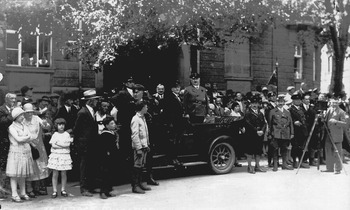

 Open access