


Introduction
Monetary regimes determine national policy space and shape governments’ economic policies. The institution of central bank independence, which takes stimulating growth via demand-side policies largely off the table, has been shown to be associated with supply-side measures such as financial and labor market deregulation (Aklin and Kern Reference Aklin and Kern2021). Similarly, the fixed exchange-rate regime established by Europe’s Economic and Monetary Union (EMU) has put pressure on member-states to liberalize labor policies, contain the power of organized labor, and decentralize their wage bargaining systems (Baccaro and Howell Reference Baccaro and Howell2017; Bulfone and Afonso Reference Bulfone and Afonso2020; Rathgeb and Tassinari Reference Rathgeb and Tassinari2022). While these regime effects have long been debated, little is known about central banks’ own agency in translating and enforcing monetary regime pressures.
We examine this agency via a case study of the European Central Bank’s (ECB) role as a champion of “structural reforms.” This role is surprising: the ECB does not have a mandate, nor the legal authority, to shape social and labor market policies at the member-state level. Explaining its structural reform activism therefore requires a theory that takes central banks’ autonomous agency seriously. One candidate is constructivism, which has shown the power of ideas—notably of the “Brussels–Frankfurt consensus”—in shaping European macroeconomic policy (Matthijs and Blyth Reference Matthijs and Blyth2018; Matthijs and McNamara Reference Matthijs and McNamara2015). Another candidate builds on organizational and reputational theories to suggest that central banks in general, and the ECB in particular, have become increasingly concerned about their legitimacy (Moschella and Pinto Reference Moschella and Pinto2019; Moschella, Pinto, and Martocchia Diodati Reference Moschella, Pinto and Diodati2020). While both approaches capture important elements, the nature of the ECB is peculiar in that its autonomy is extraordinary, yet is, at the same time, heavily circumscribed by the functional pressures of the monetary regime of the euro, which in turn the ECB has the power to shape over time.
In order to understand the ECB’s agency in this multilayered, dynamic setting, we combine insights from historical institutionalism with a pragmatist theory of technocratic agency (Hall Reference Hall2010; Jabko Reference Jabko2019; Jabko and Schmidt Reference Jabko and Schmidt2021). We explain the ECB’s structural reform activism as a strategic response to being charged with a mandate that was extremely difficult to fulfill. The ECB’s priority was to establish and maintain governability in a heterogeneous, incomplete, monetary union. In pursuit of this goal, it was willing to push the boundaries of its authority, even at the cost of damaging its legitimacy—in line with the idea that the independence of central bankers empowers them to disregard political demands on monetary policy (Goodman Reference Goodman1992; McNamara Reference McNamara2002). Our empirical analysis shows that from its inception in 1999 through 2014, the ECB tested this power by consistently advocating for—and at times even helping to enforce—structural reforms in the areas of social and labor market policy. Despite its treaty-guaranteed independence, however, the secondary goal of maintaining legitimacy with its political principals and the broader public imposed a constraint on how far the ECB could go in pushing for structural reforms. We document that the ECB fell silent on the topic from 2015 onward, and that, besides a shift in the macroeconomic environment, legitimacy concerns played a critical role. By the end of Mario Draghi’s presidency, structural reforms had completely disappeared from the ECB’s public discourse, despite the central bank’s continued belief in their necessity.
Covering a two-decade period allows our case study to leverage a key insight of historical institutionalism—namely, that structures that impose constraints on actors in the short term can be reshaped by those same actors in the long term (Streeck Reference Streeck2009). Central banks operate under infrastructural constraints imposed by their currency area’s fiscal, financial, and labor market institutions. At the same time, these constraints on monetary governance are subject to institutional engineering by central banks themselves, as has been amply documented for financial market infrastructures (Braun Reference Braun2020; Wansleben Reference Wansleben2023). We show that the ECB sought to reshape labor market institutions, too, despite lacking formal authority in that policy area. In doing so, we shed light on the dynamic relationship between (technocratic) agency and (monetary) structure.
We also contribute to the wider literature on the diffusion of contested liberalizing reforms under conditions of economic globalization (Dobbin, Simmons, and Garrett Reference Dobbin, Simmons and Garrett2007). Here, recent scholarship has shown that the International Monetary Fund (IMF) carved out a new role for itself in the 1980s by making its emergency lending conditional on governments implementing specific structural reforms, many of which were aimed at labor market deregulation (Kaya and Reay Reference Kaya and Reay2019; Kentikelenis and Babb Reference Kentikelenis and Babb2019; Reinsberg et al. Reference Reinsberg, Stubbs, Kentikelenis and King2019). While the IMF thus evolved into an enforcer of structural reforms in the Global South, the Organisation for Economic Co-operation and Development (OECD) emerged as a translator of structural adjustment pressures in the Global North (Baccaro and Rei Reference Baccaro and Rei2007). The EU, in turn, discovered conditionality as a tool to encourage structural reforms in the context of its eastern enlargement in the early 2000s (Jacoby and Hopkin Reference Jacoby and Hopkin2020, 1162). Our analysis shows that central banks, too, can act as translators of monetary regime pressures and as enforcers of structural reforms.Footnote 1
The paper proceeds as follows. Section 2 provides a brief historical overview of European monetary integration with regard to the money–labor nexus. Section 3 introduces our theory of why (“motivation”) and how (“instruments”) the ECB took such an active approach to a policy area outside its formal mandate. Section 4 elaborates on the data and methodology that underpin the empirical analysis carried out in section 5, which traces the ECB’s thinking about, and advocacy for, structural reforms from 1999 through 2019. We conclude by discussing the broader implications of our analysis.
Monetary Integration and Labor in Europe
The euro area was preceded by a series of monetary regimes. Following the demise of the interwar gold standard, the postwar Bretton Woods system of fixed but flexible exchange rates prioritized national policy autonomy over international capital mobility (Goodman Reference Goodman1992; Ruggie Reference Ruggie1982). After the collapse of that system in the early 1970s, governments reinstated international capital mobility, thereby reducing national autonomy in social and macroeconomic policy (Scharpf Reference Scharpf1991). The European Monetary System (EMS)—in which national currencies were fixed but adjustable via politically negotiated realignments—had been devised to reconcile the structural differences between Northern hard currency regimes and Southern soft currency regimes (Höpner and Spielau Reference Höpner and Spielau2018). The EMS sought to combine moderate exchange rate stability, moderate capital mobility, and moderate national policy autonomy—a tenuous midpoint in Robert Mundell’s trilemma (Bordo and James Reference Bordo and James2019, 250).Footnote 2
The political economy of monetary integration changed radically with the Maastricht Treaty. The decision to create the euro removed the option of exchange rate devaluation for soft currency countries (Hall and Franzese Reference Hall and Franzese1998; Pérez Reference Pérez2002). At the same time, and unlike the EMS, the novel EMU regime contained no adjustment mechanism to reconcile the structural heterogeneity of its member-states, which differed greatly in terms of national and subnational institutions governing welfare, fiscal, and wage policy (Copelovitch, Frieden, and Walter Reference Copelovitch, Frieden and Walter2016; Hancké Reference Hancké2013; Höpner and Lutter Reference Höpner and Lutter2018; Nölke Reference Nölke2016; Regan Reference Regan2017). This heterogeneity risked undermining the effectiveness of the ECB’s one-size-fits-all monetary policy from the very beginning (Vermeiren Reference Vermeiren2017).
How, then, could monetary governability be fostered in the run-up to the euro? There were two functionally equivalent solutions to the problem of coordinating prices across national labor markets. The first approach was to adapt the existing corporatist infrastructure for nonmarket coordination to the new requirements of EMU (Klein Reference Klein2020). This would have required new institutions to coordinate monetary with fiscal, wage, and social policies at the European level (Höpner and Seeliger Reference Höpner and Seeliger2021; Marginson and Sisson Reference Marginson and Sisson1998). The alternative solution was to unleash the coordinating power of market competition among firms, sectors, and member-states. This required the dismantling of national wage-setting institutions and the liberalization of labor markets (Scharpf Reference Scharpf2010).
These two solutions were firmly grounded in economic theory and institutional experience. Theoretically, they reflected the well-known U-shaped model by Calmfors and Driffill (Reference Calmfors and Driffill1988), according to which fully centralized or fully decentralized systems of wage bargaining were best at achieving noninflationary outcomes.Footnote 3 Institutionally, they reflected the experience that nonmarket coordination in labor markets, rather than having been obliterated by the monetarist experiments of the 1970s and 1980s, had proved highly congenial to disinflationary monetary policy: “[C]orporatism and unionism … assumed a strategic role in central bank-led policy coordination” (Wansleben Reference Wansleben2023, 105). This was amply documented in the “mixed signals” literature on the successful coordination between increasingly independent central banks and corporatist wage-setting institutions (Hall and Franzese Reference Hall and Franzese1998).Footnote 4
The value of coordination through nonmarket wage-setting institutions was clear to monetary policy makers throughout the long process of European monetary integration. The Werner Report had insisted that “in order to avoid the emergence of excessive divergencies, the trend of incomes in the various member countries will be studied and discussed at the Community level with the participation of the social partners” (Werner Reference Werner1970, 12). Two decades and one macroeconomic policy paradigm shift later, the issue was still on the minds of the central bank governors who formed the Delors Committee, which deliberated on the possible paths toward monetary union during 1988 and 1989 (Verdun Reference Verdun1999; Vianelli Reference Vianelli2023). In an early, agenda-setting paper, Karl Otto Pöhl (Reference Pöhl1988, 15), the Bundesbank president, noted that wage setting largely remained “in the hands of the European trade unions and trade associations” and therefore could not “be discharged by public authorities alone in the future.” It was precisely because Pöhl thought it necessary that wage increases in high-cost countries “lag behind the increase in the Community average” that he considered the “principle of autonomous wage bargaining by management and labor and voluntary willingness to cooperate on the part of the trade unions” a key condition for monetary integration (17, 24). The experience of convergence toward the Maastricht criteria reinforced this view, as close coordination between central banks and trade unions, notably in the form of social pacts, helped to achieve disinflationary goals (Hancké Reference Hancké2013, 25–34). In short, the choice between nonmarket coordination and labor market liberalization was not a foregone conclusion in the run-up to EMU. As we show in section 5.1, it was still on the table in 1999.
Eventually, in 1999, a lack of consensus among member-states, combined with the opposition of the ECB, prevented the construction of institutions for the nonmarket coordination of monetary and wage policies at the European level. This amounted to a critical juncture that narrowed the options for macroeconomic governance dramatically. From that point onward, the structure of the euro area’s monetary regime did, in fact, “come with an instruction sheet” (Blyth Reference Blyth2003; Schelkle Reference Schelkle2021, 50): in the absence of other coordination mechanisms, the only way for the ECB to manage the governability problem arising from the euro area’s heterogeneity was to foster market-based coordination across national labor markets. What requires explanation, however, is just how far the ECB was willing to go in pushing for structural reforms at the national level, given the reputational and political risks of this strategy.
Theorizing Central Bank Agency
Political scientists have long studied central banks through the lens of principal–agent theory. The post-2008 empowerment of central banks, however, has arguably put them beyond the scope of the logic of agency drift, and instead requires us to theorize them as actors in their own right (Verdun Reference Verdun2017). The case of the ECB’s advocacy for structural reforms confronts us with two challenging questions in this regard: Why—given the limits of its mandate—and how—given its lack of formal authority—did the ECB push for market-enhancing structural reforms? And why did it stop after 2015?
Why? Navigating the Governability–Legitimacy Dilemma
The political economy literature offers two main theories of central bank behavior. A constructivist strand has focused on economic ideas to explain central bank action. Central bankers form a tight-knit “epistemic community” in which ideas diffuse globally and shape policy making (Verdun Reference Verdun1999). Indeed, economic ideas about the virtues of austerity (Blyth Reference Blyth2013; Dellepiane-Avellaneda Reference Dellepiane-Avellaneda2015; Helgadóttir Reference Helgadóttir2016) and of a specific macroeconomic policy mix known as the Brussels–Frankfurt consensus (Matthijs and Blyth Reference Matthijs and Blyth2018; Matthijs and McNamara Reference Matthijs and McNamara2015) go a long way toward explaining the preeminence and persistence of austerity and structural reforms in the policy response to the sovereign debt crisis. Our reasons for departing from constructivism are twofold—to emphasize how ideas coevolve with institutional structure, and to better understand the conditions under which technocrats set their ideas aside to achieve their goals as prescribed by their institutional mandate. Our analysis of the historical path to EMU in section 2 and of the critical juncture of 1999 in section 5.1 suggests that central bankers’ ideas about labor market governance were heavily dependent on the institutional context of their quest for monetary governability. While the institutional infrastructure for coordination was in place, considerable support existed among central bankers for nonmarket coordination with collective wage setters. Only when the launch of EMU changed the “inflation game” did European central bankers, now at the helm of the supranational ECB, become committed structural reformers (Best Reference Best2019). For the purpose of theory building, the implication is that the structure of labor markets matters to central bankers for the same reason the structure of financial markets matters to them: both are part of the institutional infrastructure through which monetary policy is implemented and transmitted, and thus are key to maintaining governability (Braun Reference Braun2020; Wansleben Reference Wansleben2023). Moreover, as we show in section 5.5, ECB policy makers’ sudden silence on structural reforms after 2015 was not because they had suddenly stopped believing in the long-term desirability of structural reforms in a still-heterogeneous monetary union, but because they became increasingly concerned about the reputational costs of continued structural reform advocacy in breach of their mandate.
The second theory of central bank behavior emphasizes that despite their statutory—and, in the case of the ECB, quasi-constitutional—independence, central banks do, in fact, depend on maintaining their organizational legitimacy. It is well established that non-majoritarian organizations depend on both output and throughput legitimacy (Scharpf Reference Scharpf1999; Schmidt Reference Schmidt2013). However, legitimacy is inherently relational, context dependent, and contested (Imerman Reference Imerman2018). In our case, whereas central banking had been thoroughly depoliticized under the inflation targeting regime, the massive scale of central bank interventions following the global financial crisis of 2008 has led to a repoliticization. Central banks became exposed to a much higher level of public scrutiny—from their political principals but also, and especially, from the broader public (Macchiarelli et al. Reference Macchiarelli, Monti, Wiesner and Diessner2020; Riles Reference Riles2018; Tortola Reference Tortola2020). It is therefore not surprising that, although on paper their independence has remained intact, central banks—including the ECB—have become much more sensitive to reputational concerns (Moschella and Pinto Reference Moschella and Pinto2019; Moschella, Pinto, and Martocchia Diodati Reference Moschella, Pinto and Diodati2020). This perspective goes a long way toward explaining why the ECB stopped advocating for structural reforms in response to the backlash it faced during the mid-2010s, as documented in section 5.5. However, a purely organizational theory would have trouble to explain why, even as it was already under much greater public scrutiny, the ECB continued—and indeed escalated—its campaign for structural reforms during the period 2010–14.
In sum, what is missing from both constructivist and organizational theories of central bank agency is a systematic engagement with the peculiar mix of institutional autonomy and structural constraints under which central banks in general, and the ECB in particular, form ideas and make decisions. As much as by its political mandate, the ECB’s room for maneuver is circumscribed by the underlying structure of EMU. Imposing constraints that are obscure to many but perfectly clear to central bankers, international monetary regimes do, in fact, come with an “instruction sheet” (Blyth Reference Blyth2003). At the same time, central banks can be powerful enough for their actions to change the monetary regime, and thus the conditions for monetary governability.
Our theory of ECB agency incorporates constructivist and organizational elements but is firmly rooted in historical institutionalism. In line with what Hall and Taylor (Reference Hall and Rosemary1996, 939) have labeled the “calculus approach” to historical institutionalism, we posit that central bank agency is underpinned by a pragmatic calculus to maintain both monetary governability and organizational legitimacy. From this perspective, organizational actors seek to maximize the attainment of their mandated objectives within the constraints imposed by the institutional structure in which they operate (Hall Reference Hall2010; Tallberg Reference Tallberg2000). The ECB, then, needs to be analyzed in the context of the historically contingent structure of the monetary union it was tasked to govern. Specifically, we theorize that the ECB’s actions are guided by a defensive strategic calculus, namely a trade-off between the risk of policy ineffectiveness and the risk of political contestation. This dilemma stems from the very structures of the monetary union: the extent to which the central bank can achieve its mandated objective of price stability hinges on institutions not only at the supranational level of the union but also, and especially, at the national level. Diverse welfare-state and wage-setting institutions generate heterogeneous inflation and unemployment outcomes, which threaten monetary governability. Therefore, we expect the ECB to seek to reshape these institutions in ways that render its monetary policy more effective.
However, seeking to influence national policies is not without costs. The expected benefits of structural reforms for monetary governability are counteracted by the costs of the pushback against perceived ECB meddling (Tortola Reference Tortola2020). While its statutory independence protects the ECB against political backlash in the realm of monetary policy proper, its engagement in social and labor market policies in member-states does not fall under this protection. On the contrary, weighing in on domestic reform debates and prescribing specific structural adjustment paths can be expected to expose the ECB to political contestation and challenges to its legitimacy (Macchiarelli et al. Reference Macchiarelli, Monti, Wiesner and Diessner2020; Schmidt Reference Schmidt2020). We thus submit that while the ECB is empowered, and willing, to push the boundaries of its mandate to maintain monetary governability, it will seek to avoid levels of political contestation that would prove detrimental to its legitimacy. An observable implication is that the ECB is more likely to take radical steps in either direction when it perceives the policy ineffectiveness constraint or the political contestation constraint to have become binding.
Two caveats are in order. First, saying that the central bank maximizes its objectives does not imply that it is a unitary actor with a self-evident set of preferences. Recent research has documented significant disagreements within the ECB during the post-2010 period (Ferrara Reference Ferrara2020). Second, rather than denying that its actions are underpinned by ideas, we posit that the ECB deploys these ideas strategically in the pursuit of its interests (Carstensen and Schmidt Reference Carstensen and Schmidt2016). Our understanding of ideas thus builds on the pragmatist approach developed by Jabko (Reference Jabko2019) and Jabko and Schmidt (Reference Jabko and Schmidt2021), which emphasizes that economic policy makers operate in constantly changing environments that require them to adjust—often in innovative ways—their “discursive repertoires.”
How? The ECB’s Power Resources and Instruments
In the ECB’s own words, structural reforms are policies that “change the fabric of an economy, the institutional and regulatory framework in which businesses and people operate” (speech 40, appendix C).Footnote 5 On the face of it, structural reforms in member-states would seem to lie beyond both the ECB’s mandate and its formal powers. While the supremacy of EU law allows the European Court of Justice to use treaty law on individual rights to advance liberalization in areas such as labor law and social policy, the ECB lacks the authority to issue binding regulations to override national legislation. The question, therefore, is what power resources and instruments the ECB has at its disposal to push for structural reforms at the national level.
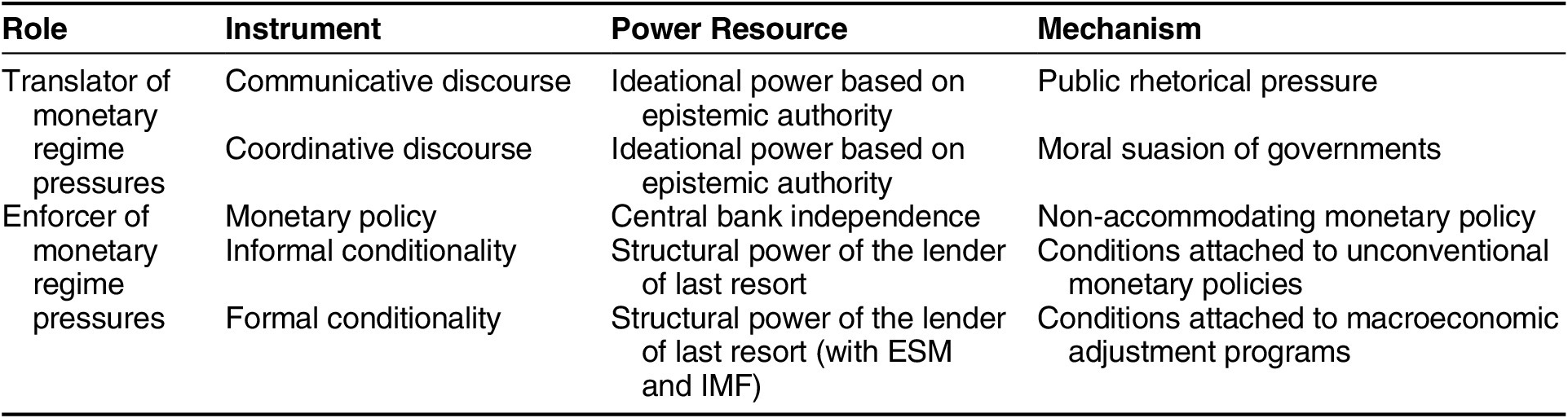
We distinguish five instruments, associated with three distinct power resources, summarized in table 1.Footnote 6 Acting as a translator of the functional pressures of the monetary regime, the central bank can leverage its epistemic authority to persuade other actors that structural reforms are necessary. The ECB carefully cultivates its epistemic authority through continuous “investment in scientific prestige and scholarly research” (Mudge and Vauchez Reference Mudge and Vauchez2016, 148). The payoff to investments in epistemic authority comes in the form of an enhanced “power through ideas” for the ECB—that is, the ability to convince “other actors of the cognitive validity and/or normative value” of its economic policy views (Carstensen and Schmidt Reference Carstensen and Schmidt2016, 323).
The ECB’s Agency Disaggregated

Source: Authors’ elaboration.
The ECB exercises this ideational power via two discursive instruments, namely its “communicative” and its “coordinative” discourse (Schmidt Reference Schmidt2008, 304–5). Through speeches and publications, it provides economic justifications for structural reforms, which other policy makers can resort to in order to bolster their own epistemic authority. Members of the ECB’s executive board can also directly engage national governments in a coordinative discourse, especially in the meetings of national finance ministers, be it in an EU configuration (“ECOFIN council”) or a euro area configuration (“Eurogroup”).
Although member-states’ structural policies exceed its formal authority, the ECB has learned to leverage its power resources to act as an enforcer of structural reforms as well.Footnote 7 The first coercive instrument—a hard monetary policy stance in the face of what the central bank deems inflationary wage demands or government spending—is available at any time and is not unique to the ECB (Rieth and Wittich Reference Rieth and Wittich2020).
In addition to this conventional instrument, however, the ECB gained further, unconventional powers during the financial and sovereign debt crises, which provided an “unprecedented window of opportunity for the ECB to extend its influence on Eurozone governance” (Fontan Reference Fontan2018, 170). The peculiar architecture of EMU put the ECB in a position—unique among central banks—as the discretionary of lender of last resort and the monetary backstop to its own political principals, the EMU member-states. The dependence of member-states and their domestic banking systems on central bank liquidity empowers the ECB to attach informal conditions to its lending and asset purchase programs. Eventually, the ECB’s powers to enforce structural reforms became institutionalized through its participation in the Troika, enabling the central bank to codesign formal conditions attached to financial assistance programs (Jacoby and Hopkin Reference Jacoby and Hopkin2020; Moury et al. Reference Moury, Ladi, Cardoso and Gago2021; Woodruff Reference Woodruff2016).
Data and Method
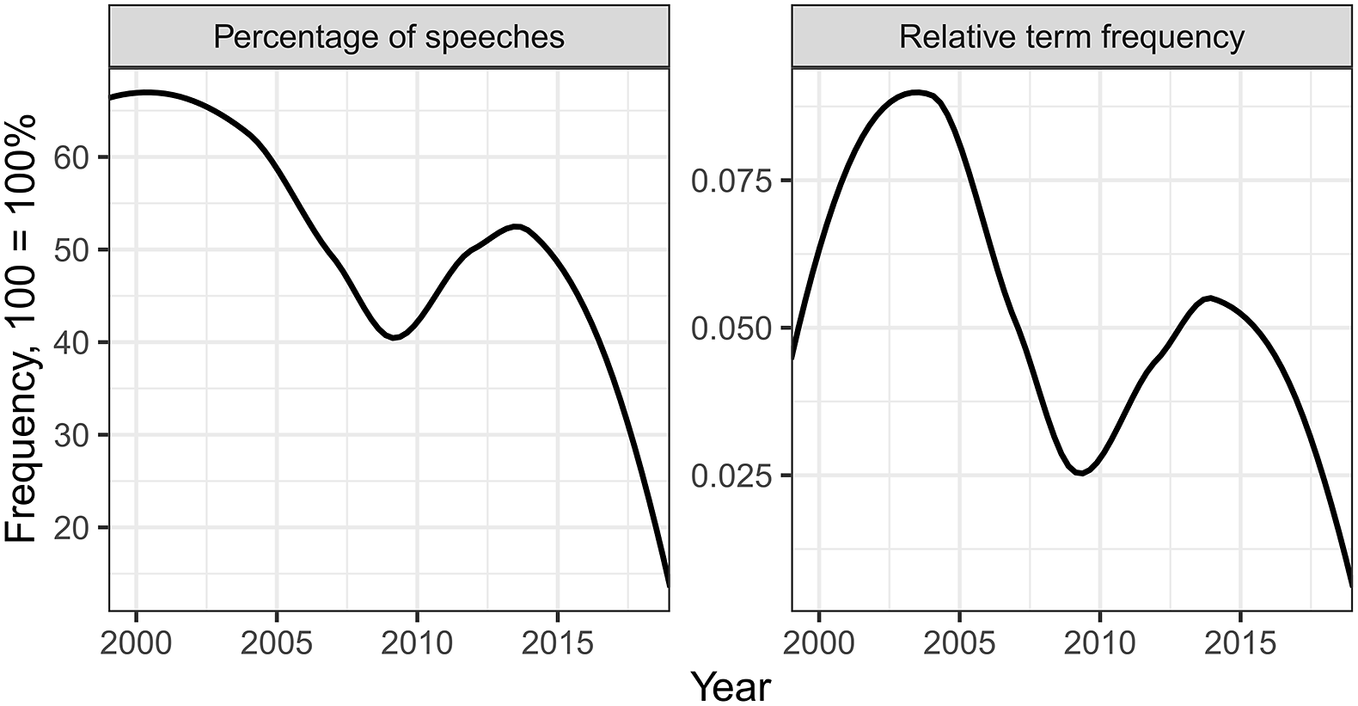
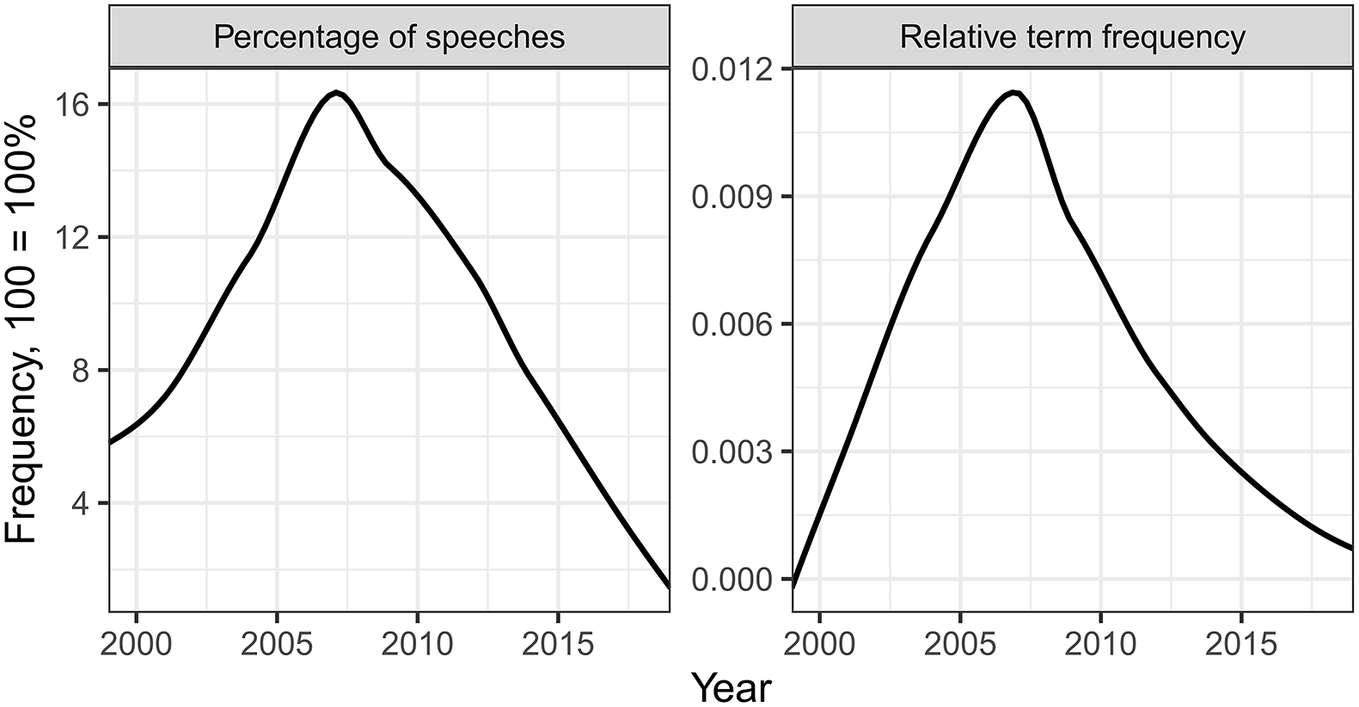
The ECB is hard to study. The deliberations of its governing council are confidential; archival documents are released only after 30 years. To overcome these obstacles, we deploy a mixed-methods research strategy that draws on as wide a range of sources as possible (Braun et al. Reference Braun, Di Carlo, Diessner and Düsterhöft2023). The main data source from which we reconstruct the ECB’s communicative discourse are the 1,922 public speeches the central bank’s executive board members delivered between 1999 and 2019. We exclude press conference statements because the structural reform prescriptions contained therein are brief and repetitive. Analyzing this corpus, we first use basic quantitative text analysis methods to chart the frequency with which the ECB mentions certain key concepts, most notably “structural reform” (figure 1).
“Structural Reforms” and “Structural Policies” in ECB Speeches, 1999–2019
Note: The solid line (left side) represents the proportion of speeches containing at least one reference to structural reforms/policies; the solid line (right side) shows the relative term frequency.

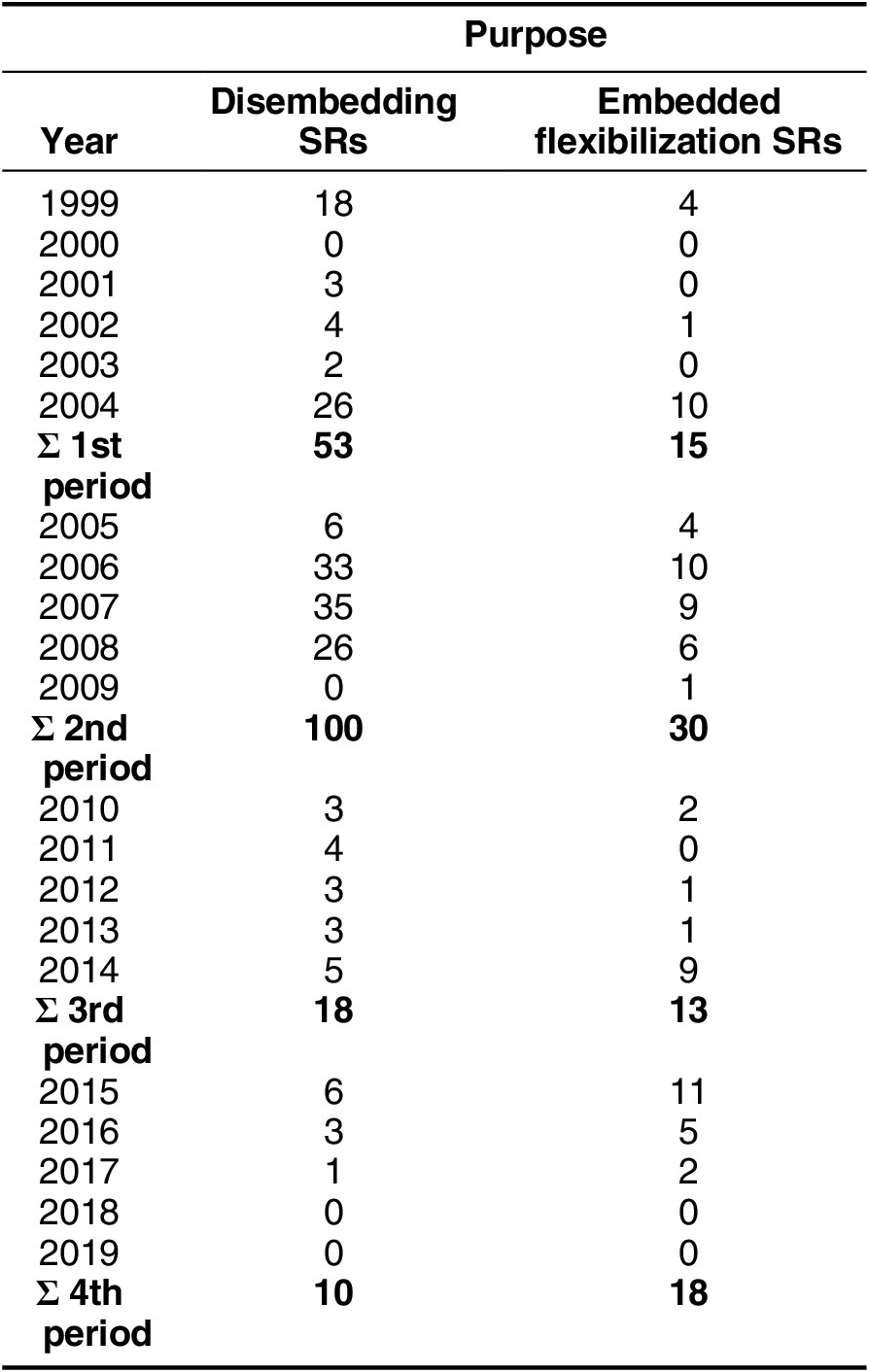
Second, we manually coded the 10 speeches per calendar year that contained the most references to structural reforms. Our coding scheme distinguishes 12 policy goals the ECB associates with structural reforms (for instance, lowering minimum wages or loosening employment protection legislation). This coding scheme was created iteratively, by comparing what we found mentioned in the speeches with common classifications in the literature on structural reforms. The code book, with a detailed description of the coding procedure, can be found in appendix A. We then grouped reform proposals aimed at strengthening the market mode of coordination into the category “disembedding reforms,” and those aimed at increasing social investment (Hemerijck Reference Hemerijck2017) into the category “embedded flexibilization” (Thelen Reference Thelen2014). The results of this coding exercise are presented in table 4.
Third, we devised a ranking of the top five structural reform advocates within the ECB’s executive board based on the share of speeches mentioning the term “structural reform” (see figure B.5 in appendix B). Appendix C provides an extensive selection of relevant quotes from the ECB’s speeches over the full 20-year period, including hyperlinks to the full speeches’ online transcripts.
Fourth, we conducted interviews with four former members of the ECB’s executive board and one former finance minister, as shown in table 2. Interviews with central bankers about their own former institutions need to be taken with a grain of salt, and our analysis does not depend on them. However, the interviews allow us to triangulate our findings, in particular regarding the closed-door interactions (coordinative discourse) between monetary policy makers and national government officials, and to get a sense of how central bankers perceived and rationalized the challenges they faced.
List of Interviews

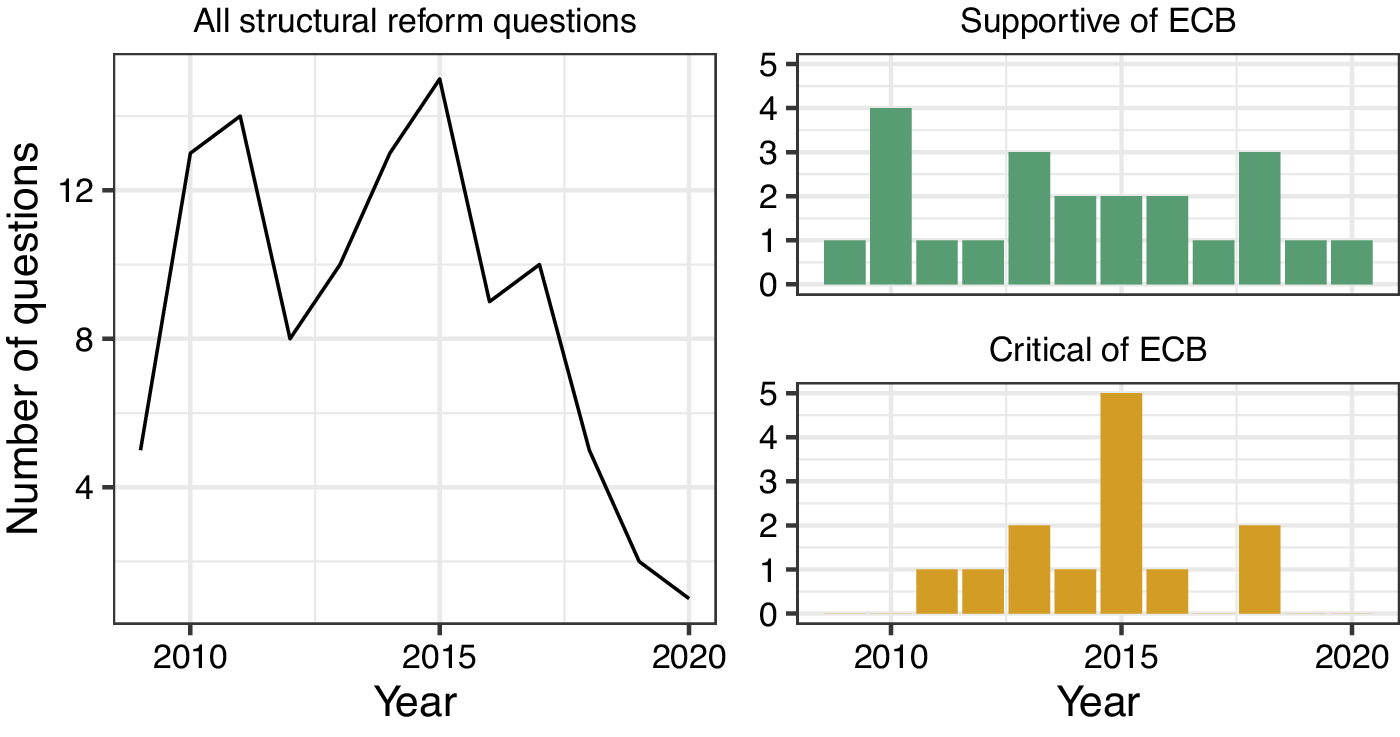
Finally, to measure political contestation surrounding the ECB’s structural reform advocacy during the postcrisis period, we collected and analyzed the questions put to the ECB president during the quarterly “Monetary Dialogue” hearings at the European Parliament. We coded all 1,240 questions asked between 2009 and 2019, of which 47 specifically addressed structural reforms (figure 4).
Another Tale of Two Decades: The ECB and Structural Reforms, 1999–2019
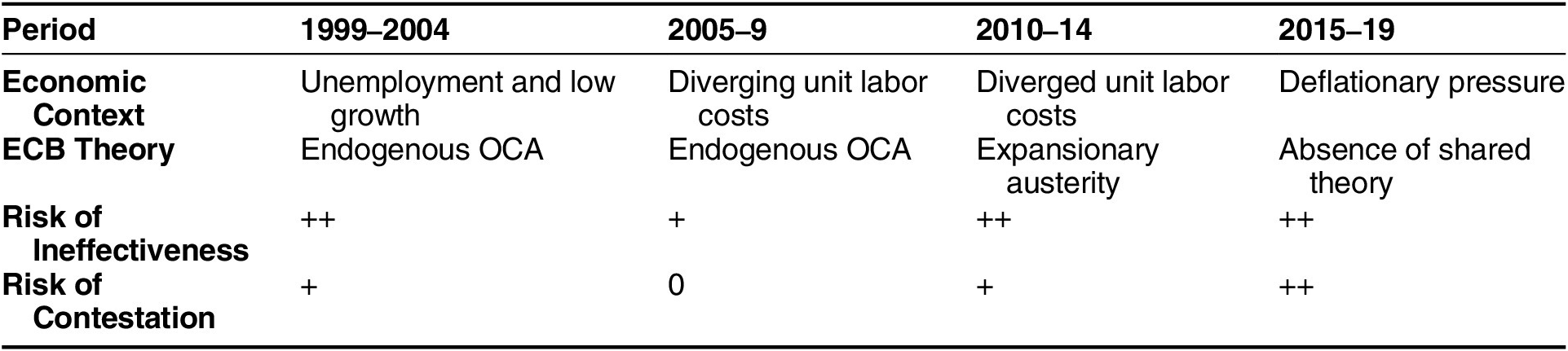
We begin by zooming in on the critical juncture at the start of EMU, when the ECB intervened in the choice between nonmarket and market-based coordination. We then divide the first two decades of ECB reform advocacy into four periods, each marked by a distinct combination of macroeconomic problems, ECB strategies, and ideational resources (see table 3). Contrasting the dominant view of the ECB’s role in this area, the first two periods establish that the central bank’s discursive advocacy for structural reforms was most intense before the euro crisis. The third period demonstrates how the ECB shifted its role from merely translating the functional pressures of the monetary regime to enforcing structural reforms in national labor markets. The final period recounts the ECB’s eventual abandonment of structural reforms in the mid-2010s, amid deflationary pressures and mounting political contestation.
Four Periods of Structural Reform Advocacy by the ECB

Note: + medium risk; ++ high risk.
Source: Authors’ elaboration.
Duisenberg Shuts the Door: 1999 as a Critical Juncture
As soon as it came into existence in June 1998, the ECB was confronted with the question of how to resolve the coordination problem between transnational monetary policy and national wage setting. With public opinion becoming “increasingly pessimistic about the implications of EMU for employment” (Goetschy Reference Goetschy1999, 124), trade unions advocated forcefully for ex ante coordination with the ECB and the ECOFIN/Eurogroup to achieve a more employment-friendly macroeconomic policy mix (Jacobi Reference Jacobi1998). This preference received Germany’s support under the auspices of finance minister Oskar Lafontaine, who proposed a European Employment Pact centered on a “Macroeconomic Dialogue” “to get social partners to agree and coordinate their wage settlements with monetary and fiscal policy” (Collignon Reference Collignon2009, 463). However, following resistance from the United Kingdom and Lafontaine’s ousting from the German government led by Gerhard Schröder, a watered-down version was ultimately signed by member-state governments at the Cologne Council in June 1999. Convening representatives of the Council, the Commission, the ECB, and the social partners, the biannual Macroeconomic Dialogue was designed only to “improve the conditions for a cooperative macroeconomic policy mix geared to growth and employment while maintaining price stability” (European Council 1999, 1).
Our interviews reveal that the ECB was internally divided on the question of its involvement in the Macroeconomic Dialogue. Several members of the executive board had “much sympathy” for ex ante, nonmarket coordination (interview 4). Others were deeply concerned about the ECB’s independence (Collignon Reference Collignon2009, 463). During his first official appearance before the European Parliament, ECB President Wim Duisenberg announced that the dialogue “should be clearly distinguished from any attempts to coordinate policies ex ante, so as to achieve a certain ‘policy mix,’” as this would “decrease accountability, reduce the transparency of the policy framework for the public, and increase uncertainty about policy actions, potentially threatening to destabilize the economy” (speech 7, appendix C). Thus, when prompted to position itself on the question of nonmarket versus market-based coordination, the ECB chose the latter.
The ECB’s choice was overdetermined, with both organizational interests and ideational leanings pointing in the same direction. The ECB was keen to establish a reputation as an independent and credible central bank, and extricating itself from the Macroeconomic Dialogue was its first opportunity to set a precedent. At the same time, the ECB’s preference for market-based coordination was firmly grounded in the New Keynesian consensus in macroeconomics that was at the core of the Brussels–Frankfurt consensus, according to which economic growth lay beyond the reach of macroeconomic policy (De Grauwe Reference De Grauwe2006; Fitoussi and Saraceno Reference Fitoussi and Saraceno2013; Jones Reference Jones, Schmidt and Thatcher2013). This allowed the ECB to argue, in direct response to the Macroeconomic Dialogue proposal, that “the best contribution monetary policy can make to fostering employment growth and reducing unemployment … is to maintain price stability” (ECB 1999, 31). According to this logic, the growth potential in the EMU could only be increased through supply-side oriented structural reforms aimed at removing labor market rigidities (speeches 3, 4, and 9, appendix C).Footnote 8 Another powerful idea at the time was that of endogenous “optimum currency areas” (OCA)(Mundell Reference Mundell1961). By 1999 it was clear that EMU did not meet Mundell’s original criteria for an OCA.Footnote 9 In the meantime, however, Frankel and Rose (Reference Frankel and Rose1998) had formulated a variant of OCA that proved strategically expedient to monetary policy makers. According to Frankel and Rose’s “endogeneity hypothesis,” the very establishment of monetary union would create an optimum currency area by forcing firms—and wage setters—to adjust to the competitive conditions of the single market. Our interviews suggest that ECB policy makers concurred with the view that “the criteria of OCA are endogenous” but worried that the theory underestimated the staying power of heterogeneous national institutions (interview 4).
It is beyond the scope of this paper to determine whether these economic ideas caused Duisenberg’s 1999 veto. What matters for the present argument, however, is that it permanently changed the “inflation game” in the euro area (Best Reference Best2019). EMU henceforth came with a clear “instruction sheet” for monetary governance. The ECB came to view the euro as a “strong catalyst for structural reforms” (speeches 10 and 11, appendix C) and deemed it necessary to “cajole governments into implementing” those reforms itself (speech 6, appendix C).
Structural Reforms for Monetary Governability (1999–2004)
During the first years of EMU, and throughout the presidency of Wim Duisenberg (1999–2003), the ECB used its communicative discourse to promote structural reforms at every occasion. Figure 1 shows that 70% of ECB speeches from that period mentioned structural reforms or structural policies (left panel), while the relative frequency of both terms (as a share of total words) nearly doubled between 1999 and 2004 (right panel). Jean-Claude Trichet, Christian Noyer, and Duisenberg were the most active reform advocates on the executive board (figure B.5, appendix B). Our manual coding of the instruments advocated by executive board members suggests that, to the ECB, market-enhancing integration meant to (1) decentralize wage setting to the firm level (WS), (2) decrease the generosity and availability of unemployment benefits (UB), and (3) decrease payroll taxes (LT). With slightly less emphasis, the ECB also advocated increasing spending on education, as well as on research and development (ER) (table 4).
Structural Reforms Aimed at “Disembedding” versus “Embedded Flexibilization” in ECB Speeches

Why did the ECB go out of its way to promote structural adjustment right from the beginning? A closer reading of its speeches suggests that the central bank was concerned, first and foremost, with the negative consequences that asymmetric shocks to the monetary union would have for the effectiveness of its monetary policy (speeches 11, 14, 15, and 17, appendix C). By so doing, the ECB justified its push for structural reforms by latching onto endogenous OCA theory (speeches 9, 10, and 23, appendix C, and interviews 2, 3, and 4). Discursively, it also championed structural reforms through “naming and praising,” as opposed to openly naming and shaming the nonreforming governments (interview 4). This included suggestions that member-states “with more flexible labor markets, more moderate wage increases, and less discouraging tax and social security policies have managed to avoid the trend of ever rising unemployment” (speech 4, appendix C).Footnote 10
Soon, however, the ECB came under pressure by national governments for its persistent refusal to cut interest rates (Barber Reference Barber2001). The German chancellor, Gerhard Schröder, openly attacked the ECB for failing to mitigate the euro’s appreciation: “I assume the intelligent people in the leadership of the ECB discuss the question every day whether they have done enough in the context of the dollar–euro exchange rate to maintain the competitiveness of exports from Europe” (Major and Williamson Reference Major and Williamson2003). It is important to note that this backlash from member-state governments targeted the ECB’s tight monetary policy stance rather than its structural reforms advocacy, at a time when national governments—not least in Germany and Italy—sought to liberalize their labor markets (Simoni and Vlandas Reference Simoni and Vlandas2021). The ECB’s statutory independence insulated it against this type of political pressure, which was directed at the central bank’s core competency to independently set the monetary policy stance. President Duisenberg pointed out that the ECB did not concern itself with exchange rate policy, defended interest rates as appropriate, and encouraged governments to press ahead with social policy and labor market reforms (Financial Times 2003). Asked whether the ECB cared about member-states’ increasingly vocal opposition to his hard monetary policy stance, Duisenberg (Reference Duisenberg2001) could afford to retort: “I hear but I do not listen.”
Wage Restraint against Divergence (2005–9)
The year 2005 marked the high point in the ECB’s discourse on structural reforms (figure 1). What is more, the ECB also started to advocate for wage restraint across member-states. It observed that in Southern Europe and Ireland, weakly developed collective bargaining institutions put upward pressure on labor costs in the private sector (Hancké Reference Hancké2013; Johnston and Regan Reference Johnston and Regan2016). This was reinforced by permissive government wage setting in the public sector, at a time when an austerity drive by state-level finance ministers imposed severe wage restraint on the German public sector (Di Carlo Reference Di Carlo2023). The ECB worried that the resulting divergence in national wage and price levels would undermine monetary policy effectiveness and eventually pose an existential threat for EMU (interview 2).
That the ECB frequently voiced these concerns publicly is illustrated by the skyrocketing mentions of “unit labor costs” during the mid-2000s (figure 2). Going further still, the ECB also urged governments to bring about internal devaluation through public sector wage restraint and through the abolition of wage indexation clauses. Jean-Claude Trichet was the most active carrier of this message (figure B.5, appendix B). Among others, Trichet called for an “[a]ppropriate handling of the unit labour costs in the civil service and public sector” and suggested that the latter “should be a role model in terms of wage setting and should not contribute to strong overall labour cost growth.” (speeches 29 and 30, appendix C).Footnote 11
“Unit Labor Costs” in ECB Speeches, 1999–2019
Note: The solid line (left side) represents the proportion of speeches containing at least one reference to unit labor costs; the solid line (right side) shows the relative term frequency.

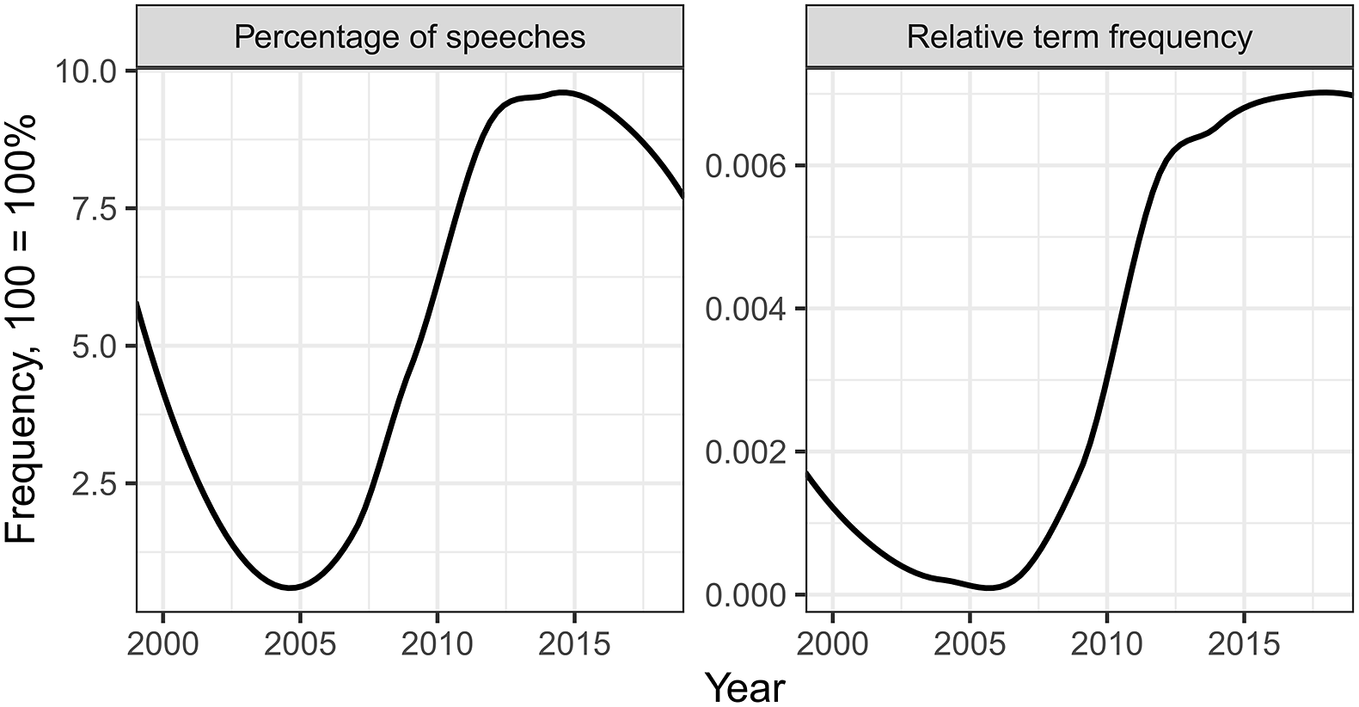
Given the delicacy of calling for internal devaluation, it is perhaps surprising that this period was among the calmest for the ECB in terms of political contestation. In contrast to the postcrisis years, there was virtually no public talk by ECB officials about legitimacy (figure 3). This can partly be explained by the central bank shifting some of its advocacy to the backstage arena of ECOFIN and Eurogroup meetings, where it routinely presented detailed competitiveness indicators and lectured finance ministers about the need for wage restraint in their domestic public sectors.Footnote 12 Another part of the explanation, however, is that in the absence of enforcement powers, the ECB’s translation of monetary regime pressures lacked bite. Member-states, too, could “hear but not listen.” This would change with the onset of Europe’s sovereign debt crisis.
“Legitimacy” in ECB Speeches, 1999–2019
Note: The solid line (left side) represents the proportion of speeches containing at least one reference to legitimacy; the solid line (right side) shows the relative term frequency.

Structural Reforms to Save the Currency (2010–14)
In the wake of the global financial crisis, social and labor market policy briefly receded from view as the ECB was preoccupied with financial stability and crisis management. However, calls for structural reforms soon reemerged, in line with the broader EU discourse on enhancing member-states’ competitiveness (Crespy and Vanheuverzwijn Reference Crespy and Vanheuverzwijn2019; E. Jones Reference Jones, Caporaso and Rhodes2016). Although authorship of the “competitiveness” interpretation of the crisis is commonly attributed to the European Commission and to the German government, our analysis suggests that that interpretation took hold on ground that the ECB had been cultivating since at least 2005. Consistent with its precrisis stance, the ECB’s communicative discourse from 2010 onward emphasized wage-setting decentralization and, to a lesser extent, active labor market policies (table 4). In addition, frequent European Council meetings brought ample opportunity for the ECB to leverage its coordinative discourse with member-state governments (interviews 2 and 5).
The ECB’s strategic deployment of economic ideas was on full display in its adoption of a new theoretical justification for its reform advocacy, based on the notion of “expansionary austerity” (Giavazzi and Pagano Reference Giavazzi and Pagano1990). The theory reversed the Keynesian logic by arguing that fiscal austerity, when combined with market-enhancing structural reforms, could have growth-increasing effects (Dellepiane-Avellaneda Reference Dellepiane-Avellaneda2015; Theodoropoulou Reference Theodoropoulou2018). In the words of its most influential proponents, “[s]upply-side policies … are critical” because the “expansionary effects of [contractionary] fiscal adjustments work via the labor market” (Alesina et al. Reference Alesina, Perotti, Tavares, Obstfeld and Eichengreen1998, 206; Alesina and Ardagna Reference Alesina and Ardagna2010, 4).
The Greek debt crisis of 2010 ushered in a period of “governing by panic” (Woodruff Reference Woodruff2016), during which the ECB took the leap from merely translating structural adjustment pressures via discursive advocacy to also enforcing them via coercive instruments. As it had done during the first years of EMU, the ECB flanked its advocacy for structural reforms with a restrictive monetary policy stance. In response to the escalating Greek crisis, the central bank pondered toughening its collateral rules for sovereign bonds to “force the Greeks to get serious about fiscal discipline and economic reform” (Tooze Reference Tooze2018, 334). A year later, in April and July 2011, the ECB hiked interest rates twice, despite a deteriorating economic outlook and against the view among economists that the situation in the euro area warranted continued monetary easing (Mody Reference Mody2018, 293–96). The defining feature of the ECB’s strategic agency during this period, however, was its newly acquired capacity to impose formal and informal conditionality on member-state governments. Formal conditionality was first applied in the IMF–EU lending programs to three non-EMU countries before 2010 (Hungary, Latvia, and Romania), in which the ECB toed a more hawkish line than even the IMF (Ban Reference Ban2016; Fitoussi and Saraceno Reference Fitoussi and Saraceno2013; Lütz and Kranke Reference Lütz and Kranke2014). The experiment of those early lending programs was later institutionalized in the so-called Troika, as a member of which the ECB monitored the implementation of macroeconomic adjustment programs in EMU countries alongside the Commission and the IMF (Henning Reference Henning2017; Jacoby and Hopkin Reference Jacoby and Hopkin2020; Lütz and Hilgers Reference Lütz and Hilgers2019; Moury et al. Reference Moury, Ladi, Cardoso and Gago2021).
The most striking case of ECB-imposed informal conditionality occurred in August 2011, when Jean-Claude Trichet sent two—initially secret—letters to the prime ministers of Italy and Spain. The letters effectively made the continuation of the ECB’s bond buying under the Securities Markets Programme conditional on the implementation of structural reforms and fiscal consolidation. Although the ECB avoided any direct mention of bond purchases, the message was clearly understood, and the ECB followed up with direct phone calls (interview 2).Footnote 13 Within days of receiving the letters, Spain’s finance minister Elena Salgado held a press conference pledging swift progress on labor market reforms, while the Italian government announced it would enshrine the “liberalization of all economic activities” in the country’s constitution (Rostagno et al. Reference Rostagno, Altavilla, Carboni, Lemke, Motto, Guilhem and Yiangou2019, 195). The Italian letter, cosigned by Trichet’s successor Mario Draghi, was instantly leaked to the press, triggering a public outcry (Draghi and Trichet Reference Draghi and Trichet2011).Footnote 14
The backlash against the letters and the ECB’s role in the Troika was directed against actions that clearly lay outside the ECB’s mandate. Given that it was predictable, one might be tempted to conclude that the ECB simply did not care about the consequences for its reputation and legitimacy. There is little doubt, however, that its sensitivity toward the risks of political contestation increased throughout this period (Macchiarelli et al. Reference Macchiarelli, Monti, Wiesner and Diessner2020; Moschella, Pinto, and Martocchia Diodati Reference Moschella, Pinto and Diodati2020; Schmidt Reference Schmidt2020). As shown in figure 3, the frequency with which executive board members mentioned “legitimacy” in their public speeches peaked between 2011 and 2015. In terms of the ECB’s strategic calculus, however, the doomsday risk of a disorderly disintegration of the euro area clearly outweighed the risks from political contestation. This is illustrated by Mario Draghi’s game-changing promise to “do whatever it takes to preserve the euro” via unlimited asset purchases (Draghi Reference Draghi2012), which he made despite fierce resistance from the German Bundesbank and public resignations by two German members of the ECB’s governing council.
Deflation, Contestation, and Silence (2015–19)
From 2015 onward, the ECB’s communicative discourse contained ever fewer references to structural reforms, until the central bank stopped talking about them altogether (figure 1). After almost two decades using every available means to push for reform, why did the ECB reverse course so dramatically? The evidence points to changes in the institutional structure and economic environment which together altered the ECB’s governability–legitimacy calculus. First, monetary policy makers realized—and publicly acknowledged—that by advocating for labor market structural reforms in a context of increased contestation, they incurred significant reputational costs. The ECB’s public legitimacy was at risk. Second, the ECB no longer needed to advocate for “one-size-fits-none” structural reforms to safeguard governability. Structural reform advocacy had become both macroeconomically counterproductive in the new deflationary environment and institutionally superfluous given the introduction of the European Semester.
With regard to legitimacy, the ECB’s prominent role during the EMU sovereign debt crisis had ushered in a period of intense public contestation, both from the left and from the right (Macchiarelli et al. Reference Macchiarelli, Monti, Wiesner and Diessner2020). This contestation manifested itself in a variety of ways across the euro area—in the courts, in the street, and, most importantly, in parliaments. As part of what Saurugger and Fontan (Reference Saurugger and Fontan2019) have called the “judicialisation of EMU politics,” the European response to the sovereign debt crisis spawned a flurry of lawsuits, brought by diverse groups across the euro area. The most serious of those were constitutional complaints brought by German citizens, notably against the ECB’s asset purchase programs. At least as relevant for the question of the ECB’s structural reform advocacy, however, was public contestation targeting EU-led austerity policies in general, and the ECB’s involvement in macroeconomic adjustment programs in particular. In a rare case of street-level protests against a central bank, the so-called Blockupy movement staged mass demonstrations in front of the ECB’s new headquarters in 2015. While the protests were directed against austerity policies generally, Blockupy had deliberately chosen the ECB headquarters as the “heart of neoliberal Europe” (Della Porta Reference della Porta2020, 383). In the words of two Blockupy spokespersons, the protests were directed “against the ECB, as a member of the Troika” (Weaver Reference Weaver2015) and against its “active role in politics” (Jones Reference Jones2015).
More than the courts and the streets, however, the primary forum of institutional accountability for the ECB is the European Parliament, and especially the quarterly Monetary Dialogue hearings during which the ECB president responds to questions from members of the European Parliament (MEPs) (Akbik Reference Akbik2022). In the years 2009–15, structural adjustment and fiscal consolidation had featured prominently in MEPs’ remarks during those hearings—out of 11 topics identified in a topic model analysis, macroeconomic adjustment programs were the most discussed (Ferrara et al. Reference Ferrara, Masciandaro, Moschella and Romelli2022). At a more granular level, our manual coding of all Monetary Dialogue hearings between 2009 and 2019 reveals that structural reforms were the primary concern of 47 questions raised by MEPs. Figure 4 shows that the number of questions about structural reforms increased steadily during the crisis years, and that questions that were critical of the ECB’s role in promoting reforms spiked in 2015.
MEP Questions Concerning Structural Reforms in the Monetary Dialogue, 2009–19

Although these 47 questions only account for a small fraction of the total, the Monetary Dialogue transcripts provide evidence of their importance for the ECB’s shifting stance. In July 2014, a Spanish MEP (Greens) confronted Mario Draghi, saying that it was “high time” for the ECB to “refrain from linking its monetary policy decisions to individual reforms in its public statements” (ECON 2014). In June 2015, when pressed on whether the ECB intended to keep up its structural reform advocacy in the future, Draghi, referring to that earlier question, acknowledged that “I have already been told I should not talk too much about structural reforms” (ECON 2015).
Unlike the contestation by the German and other national governments in the early 2000s, which was directed against the ECB’s core competence of monetary policy, the contestation during this period was directed explicitly against the ECB’s structural reform advocacy, which was not covered and protected by its mandate. The street protests and, more importantly, the backlash in the European Parliament, thus posed a more serious threat to the ECB’s legitimacy. The minutes of the ECB governing council meeting of 20–21 April, 2016, provide a firsthand account of the effects that this backlash had on the central bank and its reform advocacy. The minutes note that “it was agreed that giving structural reform recommendations might prove challenging” and that establishing a country-specific agenda for reforms was “in the realm of national governments and other European institutions” instead (ECB 2016). Here, ECB policy makers were referring to the European Commission, which—since the launch of the European Semester in 2011—had acquired the capacity to propose and monitor structural reforms in member-states through country-specific recommendations (Haas et al. Reference Haas, D’Erman, Schulz and Verdun2020).
This links directly to the governability dimension of the ECB’s strategic calculus. As indicated by the above quote from the ECB minutes, the consolidation of the European Semester, combined with the European Commission’s commitment to structural reforms (Miró Reference Miró2021) and wage moderation (Cova Reference Cova2022, 648), rendered ECB advocacy for structural reforms institutionally redundant. Moreover, and crucially, the euro area economy underwent a major structural shift throughout this period, as recounted in the ECB’s own telling of the “tale of two decades” (Rostagno et al. Reference Rostagno, Altavilla, Carboni, Lemke, Motto, Guilhem and Yiangou2019). Toward the end of 2014, a “long slide in inflation” persuaded the central bank that monetary policy ineffectiveness now manifested itself in the form of an undershooting of its inflation target (Rostagno et al. Reference Rostagno, Altavilla, Carboni, Lemke, Motto, Guilhem and Yiangou2019, 205). In the event, the structure of EMU ceased to provide a clear instruction sheet for monetary policy makers: when the ECB launched its quantitative easing (QE) program to counter deflation in early 2015, it was not guided by a unified theoretical framework (Rostagno et al. Reference Rostagno, Altavilla, Carboni, Lemke, Motto, Guilhem and Yiangou2019, 241).
In the same vein, mainstream economists had begun to raise questions about the wisdom of structural reforms and fiscal consolidation in a zero-interest environment (Ban and Patenaude Reference Ban and Patenaude2019; Eggertsson, Ferrero, and Raffo Reference Eggertsson, Ferrero and Raffo2014). Echoing these concerns, the ECB acknowledged the possibility that the policies it had promoted for so long were counterproductive, not least due to their short-term deflationary effects.Footnote 15 Executive board members Benoît Cœuré and Vitor Constâncio were among the first to concede that “in the short-term” reforms were “contractionary” and that there was thus “a need today … to focus less on achieving internal devaluation, and more on raising productivity” (speeches 37 and 43, appendix C). Likewise, the ECB’s research department began to grapple with the distributional consequences of structural reforms. In October 2017, at an ECB conference on structural reforms in the euro area, Draghi called for “reforms with positive distributional effects,” such as “active labor market policies that allow people to reskill” (speech 45, appendix C). The following year, the ECB dedicated its flagship annual forum in Sintra to the topic of “[p]rice and wage setting in advanced economies.” There, Draghi applauded recent “growth in negotiated wages” and public sector wages, notably in Germany, France, and Spain (speech 47, appendix C). The shift in emphasis between these two events—from structural reforms to the study of wage setting—encapsulates the ECB’s turnabout. To the extent that the ECB talked about structural reforms in the following years at all, it did so in a way congruent with the new European discourse on “social investment” (Crespy and Vanheuverzwijn Reference Crespy and Vanheuverzwijn2019). Our qualitative analysis confirms this broader shift in the ECB’s advocacy away from liberalizing structural reforms and toward active labor market policies and investment in research and education (table B.5, appendix B).
In sum, over the course of 2015–19, the ECB’s governability–legitimacy calculus tilted firmly toward abandoning public advocacy for structural reforms. It is important to note, however, that structural reforms becoming temporarily dispensable from a governability perspective is not the same as wholesale ideational change. In fact, the ECB had not fundamentally changed its ideas about the economic desirability of structural reforms. At the meeting of the governing council on 20–21 April, 2016, ECB officials still reaffirmed that “there was no doubt that the structural policies set by governments ultimately had a key role to play in determining growth in the long run” (ECB 2016). What had changed, however, was the intensity of the political backlash against the ECB’s participation in the campaign for structural reforms. In September 2016, speaking before the European Parliament, President Draghi conceded that it was “certainly not in the ECB’s mandate to suggest specific structural policies and agendas to different countries and different governments” (ECON 2016). The concession marked a turning point—for the first time, a sitting ECB president distanced himself from the Duisenberg doctrine of “cajoling” member-states into implementing structural reforms. By the end of the decade, the concepts of structural reform and structural adjustment had disappeared from the ECB’s discursive repertoire altogether.
Conclusion
The ECB’s stance toward structural reforms has evolved as a function of its uncomfortable position between the rock of monetary governability and the hard place of political legitimacy. Throughout the first 15 years of EMU, political contestation was present to varying degrees, but the binding constraint on the ECB’s ability to achieve its mandate remained monetary policy effectiveness. Under conditions of undisputed monetary dominance, the supranational central bank regarded it as its mission to “cajole” member-state governments into submitting to the monetary logic of European integration. After 2008, the ECB, now the “only game in EMU,” wielded formal and informal power resources to not only translate but also enforce market-enhancing reforms. During the mid-2010s, however, a political backlash gained momentum, with contestation both in the European Parliament and in the broader public sphere. At the same time, the euro area experienced a shift from an inflationary to a deflationary macroeconomic environment, and the ECB concluded that structural reforms were no longer serving the goal of monetary governability. As a result, the ECB abandoned its long-standing campaign for structural reforms.
Our analysis carries deeper insights into the relationship between structure and agency. On one hand, we show that some structures are more constraining than others, leaving little room to maneuver. The “institutional structure of macroeconomic governance” (Mandelkern Reference Mandelkern2016, 211) in general, and the monetary regime in particular, are powerful cases in point. Creating functional pressures that are, for all practical purposes, inescapable, monetary regime structures do “come with an instruction sheet” in the short run (Schelkle Reference Schelkle2021, 50; Blyth Reference Blyth2003). At the same time, those structures are not beyond agents’ reach in the long run. A highly independent agent with the ability to focus on the medium to long run, such as the ECB, has both the incentives and the ability to reshape the institutional structure of the monetary regime to better fit is own policy toolkit. Notwithstanding the question of the precise causal impact of the ECB’s structural reform advocacy on reform implementation at the member-state level, the ECB contributed to altering the balance of power between capital and labor, and thus the structure of the monetary regime it has been tasked to govern.
Why the ECB’s focus on reshaping labor market institutions, rather than other structural elements of the monetary regime, such as the financial system? Some would argue that this thrust of the ECB’s reform activism reflected its ideological priors. It is at least as plausible, however, to argue that the ECB strategically went for the weakest link in the chain of structural constraints. Pushing for restrictions on certain types of cross-border capital movements could, in theory, have done the trick for monetary governability. However, the freedom of movement of capital is enshrined in the European treaties, whereas collective wage-bargaining institutions and unemployment protections are not.
Acknowledgments
This paper has benefited greatly from comments by Lucio Baccaro, Cyril Benoît, Clement Fontan, Martin Höpner, Evelyne Hübscher, Edin Ibrocevic, Erik Jones, Steven Klein, Mattia Lupi, Benedicta Marzinotto, Jean Pisani-Ferry, Fritz Scharpf, Marco Simoni, Sotiria Theodoropoulou, Matthias Thiemann, Antoine Vauchez, and Leon Wansleben. Yannick Harksen, Marie Hillebrand, and Tu Nguyen provided excellent research assistance. We also thank Positive Money Europe for cooperating on data on the Monetary Dialogue.
Supplementary Material
To view supplementary material for this article, please visit http://doi.org/10.1017/S1537592723002992.



 Open access

