




Jean-Pierre, or JP, Footnote 1 was a big man in the border trade between Kinshasa and Brazzaville. He told his life story as one indexed and facilitated by changes in the simple technology he used to get around. He had one disfigured leg from childhood polio, and he was nicknamed after the thick stick he previously used to get around: ‘JP Nzete’ or ‘JP Stick’. His childhood in rural Congo had been turbulent. He had grown up at his grandparents’ and uncle’s houses after his parents split up, as they each accused the other of responsibility for JP’s illness and resulting disability. He was laughed at in school and ended up in many fights, eventually rebelling against his uncle – who wanted him to stay in school – by getting a start in small-scale border trade during the early 1980s.
Not unlike the situation in other African border zones (Whyte and Muyinda Reference Whyte, Muyinda, Ingstad and Whyte2007; Doevenspeck and Mwanabiningo Reference Doevenspeck, Mwanabiningo, Bruns and Miggelbrink2012; Monfort Reference Monfort2006), people with disabilities formed a visible population at the border thanks to informal discounts they were rumoured to have received since the 1970s: a reduction on the import tax for goods at customs, the benefit of taking the ferry for free, and the privilege of travelling with one ‘helper’ (aide or aide-handicapé) at a discounted rate. They engaged in small-scale trade themselves, or worked as intermediaries for others – transporting and declaring other traders’ goods as their own as ‘déclarants’, or transporting people as their aides (Devlieger Reference Devlieger2018b).
It could be a rough world. After another fight resulted in a spell in hospital, JP started using a stick to get around. Previously he had moved around without any technological assistance, dragging his impaired leg on the ground. In hospital he was told to care for his good leg, and getting around with the stick helped him improve his posture and get clean, he said – when he was on the ground he was always dirty and embarrassed.
In the 1990s, JP became increasingly involved in border politics. With rising numbers and because of the sometimes controversial nature of their activities, disabled people who exploited opportunities on the border had started a union to protect their interests and defend their reputation. By 2006, JP had built enough political capital to run for union president. It was the next step in a moral career of personhood and subjectivity and required another change.
It was at this point that JP tried to consciously shed negative parts of his identity by adopting an alternative form of technology. ‘When I became president, I had to be respectable,’ he said. ‘I got crutches because I decided it was time to grow up and get civilized.’ Notably, JP bought the crutches himself. Given the expense, and the fact that most of my interlocutors had received their mobility aids via charitable donation, this was a symbol of his personal growth. But he considered his technological shift more than a display of means: while the stick associated JP with violence, exchanging it for crutches was a visual sign that he was putting his youthful turbulence behind him. It further consolidated his progression from his rural background; now a significant man in Kinshasa, exchanging the rude technology of the stick for crutches showed people that he had transformed into a ‘modern’ and ‘urban’ man.
Crutches facilitated JP’s trajectory to president, in terms of both his own subjectivity and how he was perceived by others. Despite the change, however, JP’s nickname followed him. Referring to him as ‘JP Stick’ was not only a way of differentiating himself from other people called JP, which is a common name, but it remained a pars pro toto for his character and his public persona. People who praised JP commented that he was as straight and reliable as his stick; he would do anything to defend his friends and members of the union – he was even prepared to use force if necessary. Those who criticized him, by contrast, viewed him as hot-tempered, stubborn and dangerous, unwilling to negotiate and easily inflammable. Where the stick represented his strength for his supporters, it was a brute weapon for his opponents.
In this article, I situate moral careers of disability alongside trajectories of mobility aids and changing socio-technical environments to highlight the influence of technology in moral careers of personhood and subjectivity. Considering the entanglement of lives with technology and socio-technical environments nuances analyses of personhood as attributed by others. It is through the rise and decline of the institution of border activities reserved for people with disabilities, and local discussions of ‘losing complexes’ within and around these activities, that we can see the ways in which moral careers of personhood and subjectivity are intertwined with and facilitated by technology and sociality.
Moral careers of disability, technology and mobility
Personhood and subjectivity are often described as a moral career (Goffman Reference Goffman1961; Mauss Reference Mauss1979; Fortes Reference Fortes and Dieterlen1973; Harris Reference Harris1989; La Fontaine Reference La Fontaine, Carrithers, Collins and Lukes1985; Poole Reference Poole and Ingold1994): of personhood as a process through which an individual is recognized by their environment as a social being, enabling them to become an actor in community life; of subjectivity as an experience of the self, shaped by processes of societal and personal transformation (Biehl et al. Reference Biehl, Good, Kleinman, Biehl, Good and Kleinman2007). In many African settings, a moral career entails a transition from childhood to adulthood that is far from fixed and stable (Christiansen et al. Reference Christiansen, Utas and Vigh2006: 11). For Vigh (Reference Vigh2009: 425), social navigation thus ‘designates the practice of moving within a moving environment’. Cultural practices of adult personhood in many African settings consider successful authority figures as ‘big (wo)men’ (Bayart Reference Bayart1993), but this model is elusive in unpredictable environments.
For people with disabilities, technologies designed to improve the quality of life for people who are mobility impaired are intertwined with such teleologies of personal progress and can change wider perceptions of disability in complex ways (Kohrman Reference Kohrman1999). Relationships to mobility aids are often ‘far more intimate than implied by the term “user” or by the related term, “wearer”’ (Mills Reference Mills, Adams, Reiss and Serlin2015: 179). People use different aids at different times in their lives and in the context of a changing local infrastructure. Appropriating several at once to be used in tandem and exchanging one for another are not only done out of convenience or need but are often considered to be significant moments in one’s moral career. This is not only because of the intimacy of this relationship or because of the visibility of the aids, but also because the technology itself is often instrumental in bringing them into contact with others with disabilities. The ‘career’ of attaining ‘disabled’ personhood within one’s environment and ‘disabled’ subjectivity in oneself, however, is not a straightforward process. Considering the different uses of mobility aids demonstrates that trajectories of subjectivity and personhood are not as uncomplicated as the term ‘career’ may suggest. In Kinshasa, increased mobility had contradictory effects: it was identified with economic opportunities, decreased associations with ‘uselessness’, and valuable disability socialities. But it also increased the visibility of disabled people as a ‘group’ in negative ways, particularly with regard to stereotypes of destructive personality traits associated with disabled personhood.
Disabled people in Kinshasa had a reputation for being angry, frustrated or sad about being disabled, which was often described as ‘having complexes’. ‘Having complexes’ was described to me as a bundle of negative emotions including personal frustrations, preoccupations, jealousy and shame. Saying that someone had ‘complexes’ was a put-down, a way to express mock compassion with someone who had not come to terms with their limitations. I was often told, in disparaging tones, that these mental ‘complexes’ were the ‘real’ disability. The confluence of disabilities and technologies at the border created a social space where charges of having ‘complexes’ were often made. While many described the opportunities of border work as a way of reducing ‘complexes’, others considered the environment as conducive to increasing ‘complexes’. It was an environment where disability could be an advantage, thus reducing shame or embarrassment and reframing the ‘normal’; but, for many, this was seen as being replaced by a misplaced sense of entitlement that manifested in aggressive behaviour.Footnote 2
Indeed, shedding the negative emotions of ‘complexes’ was considered part of a moral career of accepting impairment. ‘Complexes’ were viewed as a personal, psychological problem for an individual to overcome. Frustrations about disabilities were seen as an impediment to social life; having ‘complexes’ – or not having them – was taken as a measure of successful adult personhood. A ‘mature’ or ‘serious’ person was without ‘complexes’, not frustrated or angry but at peace with their condition and able to ‘reason’ and engage constructively with others. Personhood, in this case, was thus based partly on others’ judgement of one’s moral career of subjectivity. ‘Losing complexes’ was central in this process, a key part of the disability expertise needed to navigate environments and expectations (Hartblay Reference Hartblay2020) and an important sign of integration. Critically, acquiring a mobility aid was often described by disabled people as a crucial first step towards losing such ‘complexes’. The technology of mobility aids enabled this personal liberation, and, by extension, created persons.
If ‘complexes’ were particular to disabled people in Kinshasa, the wider context of their moral careers had much in common with other social situations in Africa that are disrupted by ongoing uncertainty. Cooper and Pratten (Reference Cooper, Pratten, Cooper and Pratten2015: 1) describe contemporary uncertainty in African contexts as a ‘structure of feeling’ that is a dominant trope in subjective experiences of life in Africa today. For Johnson-Hanks (Reference Johnson-Hanks2005), this makes it necessary to uncouple action from the fulfilment of intention, because the conditions of uncertainty make it difficult for people to go through life making a series of choices aimed at fulfilling intentions. Instead, we must consider the way in which effective social action is a combination of intentional strategy and ‘judicious opportunism’: an ability and readiness to recognize and seize opportunities.
Such uncertainty demands highly mobile attitudes and strategies; thus, volatile socio-political environments have led Africanist scholars to take the ‘new mobilities paradigm’ (Sheller and Urry Reference Sheller and Urry2006) in particular directions. Researchers of mobility have considered how the politics of (im)mobility requires attention to ‘constellations of mobility’: ‘a way of accounting for historical senses of movement that is attentive to movement, represented meaning, and practice and the ways in which these are interrelated’ (Cresswell Reference Cresswell2010: 27). In African and other environments, Vigh (Reference Vigh2009: 425) finds that examining the ways in which young people manoeuvre requires us to go beyond conceptualizing how agents navigate difficult situations in terms of fixed ‘landscapes’, to consider the experience of change and movement in terms of fluid social environments.
For disabled border workers, the unpredictability of border work underlined this need for initiative and flexibility. With frequent changes to their socio-technical environment, innovative mobility aids that work well in one situation can become obsolete when the infrastructure they are made to be paired with changes. Mobility aids are often intended to be used by one individual at a time, with the aim of making individuals more independent. But in Kinshasa, unexpected circumstances dictated which aids were available, and many aids could suddenly break down or gradually wear out. The means for repairs are not always available, so dependence on material goods can make one vulnerable (De Boeck and Plissart Reference De Boeck and Plissart2004; Simone Reference Simone2004). For people with disabilities, the best strategy was thus often to draw on a range of options for mobility aids and human assistants. Ultimately, technology for people with disabilities was most effective when supported by sociality (Muyinda Reference Muyinda2020: S126).
Disability and uncertainty do not make people passive, therefore, but call into question assumptions about normative personhood, leading to ‘[u]nexpected sites of innovation, inclusion, and the reframing of the “normal”’ (Ginsburg and Rapp Reference Ginsburg and Rapp2020: S5). In recent discussions of what it means to decolonize knowledge, scholars have noted that both people with disabilities and Africans in general are often considered as users and receivers of technology rather than designers or innovators, despite the expertise they may have in navigating environments and negotiating expectations (Mavhunga Reference Mavhunga and Mavhunga2017; Hartblay Reference Hartblay2020). Examining mobility in Africa, in this respect, must also go beyond taken-for-granted Western techno-logics (Mavhunga et al. Reference Mavhunga, Cuvelier and Pype2016). Instead of assumptions of passive reception, the starting place adopted here lies in the initiatives taken by people with disabilities to strategically create, appropriate and adapt technology to their needs within a mobile socio-technical environment.
Such an approach aims to draw more attention to the role of agency and the socio-technical environment in processes of acquiring adult personhood. The power of a big man or big woman can be associated with immobility, as over the life course, a ‘big person’ can become increasingly immobile in both a literal and a figurative sense: impediments of age and/or obesity combine with the grandeur and authority of someone who commands a following (Pype Reference Pype, Willems and Mano2017). For my interlocutors, however, this social value of immobility can come only after one has accumulated enough social capital through mobility. Initiatives taken by people with disabilities challenge us to reconsider configurations of agency in interaction with the norms of society. ‘Complexes’ were taken as a problem that one had personal agency to change. Where much of the anthropological discussion of personhood has focused on its quality as ascribed by social others, Wolf-Meyer (Reference Wolf-Meyer2020) has recently drawn attention to the ways in which ‘personhood is facilitated and produced through engagements with people, technologies and institutions’. He describes how both the labour of other humans and technologies are often obscured in producing persons, arguing that personhood and subjectivity are distributed not just among people, but also in the socio-technical environment. In Kinshasa, technologies similarly ‘have logics of their own, are embedded in particular sociotechnical networks and histories, and thereby render certain kinds of relationality possible and disable others’ (ibid.: 169).
Crucially, considering personhood and subjectivity as facilitated by technology and over the long-term highlights their processual and temporal dimension. People follow trajectories that align with local expectations, ultimately becoming or failing to become recognized as a ‘full person’, even if that personhood may be rescinded later (Harris Reference Harris1989; Goffman Reference Goffman1961). People in Kinshasa adopt, discard, translate and create technologies for instrumental use in the present, but they are also part of broader personal changes in the ways in which they experience and relate to their disability over their lifetime and their aspirations for the future. Considering how people use a variety of aids in tandem and over their lifetimes gives a more complex picture than focusing on how someone may use one mobility aid at a given time (such as JP’s simple, archetypal story with which we began), highlighting the long-term effects of technologies on public and personal subjectivities beyond their instrumental use. This reveals that aids can be associated with sociality as much as individuality, and with regression as much as progress. Technologies have differing effects on the public (in)visibility of people with disabilities, creating assemblages of people that can disaggregate. While mobility aids help some to come to terms with an identity as ‘disabled’, they push others to explicitly reject such a social identity. Mobility aids may come, go, break down suddenly or wear out gradually, and thus play a role in long-term life projects (Whyte Reference Whyte2020). While mobility aids affect subjectivities and personhood as ‘disabled’, no one is ever ‘only’ a disabled person: people enact roles as parents, partners, children, employees and so forth. Aids are designed to help an individual, but they bring different groups of people together and they affect moral careers differently. Considering mobility aid trajectories in terms of moral careers highlights the long-term effects of technology on personal subjectivities and public personas beyond their short-term instrumental use.
In the following, I first consider the creation and instrumental use of mobility aids in the border context. Mobility aids were made to fit with city and border infrastructures, creating attractive opportunities for people with disabilities. Disabled personhood in the city was shaped in the intersection of technology, sociality and economic opportunity, until political pressure broke the complementary chains of technology on which these opportunities depended. I then shift to examine how border activities enabled by technologies shaped socialities and subjectivities over the long term; beyond their short-term instrumental use, trajectories of mobility aids highlight their significance in creating new public ‘groups’ of disabled people as well as in shaping personal subjectivities aimed at ‘losing complexes’.
Innovation, opportunity and (in)visibility
The border niche had arisen following the socio-legal compromises of discounted import tax rates and transport fees on the river that were consolidated in the 1970s. But it was the technological combination, my interlocutors told me, of one great river ferry named the Bac Matadi (referred to as the Grand Bac) and many cargo tricycles (grand vélos) that made these activities flourish. The Grand Bac was a large, horseshoe-shaped ferry that crossed the Congo River several times a day carrying people and cargo, departing from the border zone Beach Ngobila (commonly referred to as the Beach). The hollowed-out shape of the boat made it possible to load almost anything with wheels, making it a rare example of accessible design. Cargo tricycles, which were able to carry large amounts of goods, were a key mobility aid in this system. They illustrated the ambiguities of technology that seemed to offer greater independence to disabled people. Providing unparalleled capacity for individual disabled workers in the border trade, they were also designed to be pushed by able-bodied helpers, and therefore became the focus of a network of social and technological dependencies. They came in a wide range of shapes and sizes, and were compatible with the infrastructure of the ferry. With the Grand Bac and the ramp that led to the ferry, interlocutors estimated, up to 400 hand-cranked tricycles (vélos) and larger grand vélos could be fitted in. The estimated capacity of the Grand Bac was 120 tonnes; it was able to carry over a thousand people as well as several large vehicles.
The grand vélos were custom-made to order by local blacksmiths; costing around US$300 in 2010, they were considered a valuable investment, both to buy and to sell. As Mavhunga (Reference Mavhunga and Mavhunga2017: 4) argues: ‘We are made to believe that engineers design for, not with, society.’ We often assume, he continues, that technology is ‘“transferred” [from the West] to the technology-poor Global South’, but Africans are makers as much as recipients of technology, and cargo tricycles are a case in point.
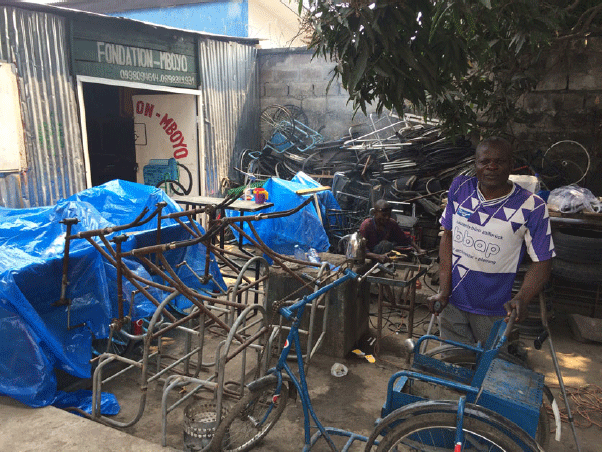
One person who had become particularly successful in making and selling cargo tricycles was Robert Mboyo. He started his business in mobility aids in 1996 and became successful when he was able to tap into a market need (see Figure 1). When I visited his workshop in 2015, he had a container with heaps of wheelchair parts, scrap metal and tricycle carcasses. It served as an atelier where he experimented with new designs, working with a blacksmith and a few disabled friends, making, selling and repairing mobility aids. Before he started his business, he said, mobility aids were imported from Europe and were too expensive for most people to access. Seeing an opportunity, he started to build wheelchairs and vélos himself by (dis)assembling bicycle parts imported from China and selling his devices at cheaper prices. Even at Mboyo’s cheaper rate, however, he acknowledged that they were expensive, both as an initial purchase and in maintenance. In 2015, crutches could go for as little as US$15 but tricycles started at around US$200, while a custom-made three-wheeled motorcycle could cost over US$1,000. Most disabled people had thus received their aids as gifts, either as charitable donations from Christian organizations, NGOs or philanthropists, or thanks to family members who had pooled money together.
One of Robert Mboyo’s employees shows a new model of tricycle they have created at their atelier in Kinshasa. It includes a metal trunk at the back, making it possible to store small items. In the background, a blacksmith is creating another tricycle.
Many disabled people considered the expense of such technology a valuable investment, and the creative confluence of technologies and infrastructure at the border created opportunities that attracted people from far and wide. Mobility-disabled people came to Kinshasa to access the border trade, having heard about it when living in rural provinces. Most of my disabled interlocutors had tried their hand at border trade at one point or another; hearing about it had been one reason for Mboyo and his friends, for example, to move to Kinshasa in the first place. The socio-technical space of the border became the catalyst for significant growth in the group identity of the handicapé, within and outside organizations such as JP’s disabled border workers’ union. Disabled people’s physical condition became a vector for success through the judicious combination of technological aids, individual and collective innovation, and socio-legal compromise.
The combination of the Grand Bac and the vélos created a vibrant social space, but the socio-technical environment of the border was equally risky and insecure. Individuals were vulnerable to tricycle breakdowns, but everyone was affected by wider issues: the Bac was prone to break down, sometimes even mid-river, and the border was sometimes closed due to diplomatic tensions between the Congos. What was considered contraband, furthermore, was liable to change. Over the years, some had gone bankrupt when authorities in Brazzaville enacted protectionist policies and destroyed goods that had become illegal to import, such as sugar or soft drinks made in Kinshasa. Such issues required people to reorient their activities for unpredictable periods of time, transporting goods in smaller quantities on a smaller Brazzaville-owned ferry when the Grand Bac was out of circulation, or finding another livelihood altogether when the border was closed. People often said that border work was a temporary solution and they would leave if they found other work, even if they had been going to the border for most of their working lives.
Border workers mitigated uncertainty by juggling the visibility of their disability and the invisibility of their cargo. Disabled people were prominently seated on top of the goods, steering tricycles that were pushed by able-bodied men. Dependent on their human aides to move, from their highly visible perch the disabled drivers of the tricycles were the ones who claimed and negotiated informal discounts. In the years when this niche was prominent, the spectacular scene of this socio-technological complex attracted documentary makers and journalists.Footnote 3 At the same time, the large tricycles made it possible to conceal goods and people. ‘Specialists’ could make a vélo look as if it were transporting biscuits, for example, while secretly concealing more valuable cargo such as a person, illegal goods, or precious items such as diamonds. Loaded with kilos of merchandise, furthermore, they were difficult for customs officers to check thoroughly.
The complementarity of technology, sociality and (in)visibility at the border was ultimately exposed by the transformations that brought the heyday of the trade to a close. The use of cargo tricycles became increasingly controversial for their association with smuggled goods, and the spectacular bustle of the Beach was frequently viewed by the government as a nuisance. When Kinshasa hosted the fourteenth summit of the Francophonie in 2012, Beach Ngobila was renovated to accommodate the top layer of society with speedboat transportation, while cheaper ferry transport was moved to a dilapidated site called the Gare Fluviale. The shift broke the technical complementarity of mobility aids, and so disrupted the dynamics of (in)visibility. The Grand Bac had previously been replaced by a smaller ferry, the Ikanda. In contrast to the Grand Bac’s hollowed-out shape, the Ikanda had a central engine tower, leaving an outside space that was too narrow for cargo tricycles (see Figure 2). To get onto the ferry, Ngobila had boasted a large metal ramp; the Gare, by contrast, had stairs, making it necessary to carry anything with wheels. Finally, Ngobila had been a wide-open site, while at the Gare all traffic was funnelled into a long, walled street. Officers thus had more control over the space, making it harder for traders to evade them.
Mobility aids are temporarily put to one side as border workers wait for the Ikanda to dock on the Brazzaville side of the border.
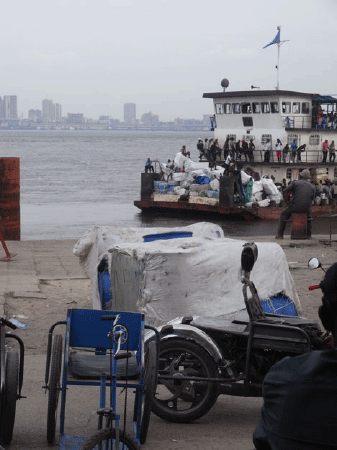
With these changes, my interlocutors told me, loading the ferry was more exposed, changing the nature of border work entirely. From having all goods preloaded onto cargo tricycles to be wheeled onto the Grand Bac by a trusted team of pushers, goods now needed to be transported from pousse-pousses (wheeled metal constructions with raised ends for pushing) on the dock to be stacked on the Ikanda (see Figure 3). Because of the short time to load the ferry before departure, it was necessary to hire not only trusted collaborators but also unknown day labourers, who received a fee per package they loaded. This was not without risks, because ‘everything has become visible’, as Anique, a polio survivor in her thirties, deplored. From a system where people could monitor their goods at all times, those goods now needed to be moved piece by piece, becoming more vulnerable to theft and customs checks, and resulting in more regular losses.
One disabled broker guards his goods while waiting for them to be taken to the central market.

Changes in the socio-technical environment thus prompted changes in mobility aids, social relationships and the status of the disabled people themselves. At the more accessible Ngobila site, I was told, people felt better valued than at the run-down Gare. Instead of riding high on their tricycles into the Grand Bac, disabled people now had to be carried. For Anique, as soon as it became apparent that the Grand Bac was not coming back, there was no point in having a grand vélo; cargo tricycles were sold, stolen or neglected (see Figure 4). Travellers were now better served with crutches or a foldable wheelchair, as these items could be carried down the stairs and stowed away on the boat. The new visibility of goods heightened interactions with customs officers and required new relationships with porters. A grand vélo had been pushed by a small, trusted team, creating a positive interdependent relationship; in the new socio-technical environment, disabled traders had less choice about whom to entrust with their goods. Many changed increasingly to working as intermediaries or formed new ‘teams’ with other disabled brokers. Many others simply left the trade entirely.
This cargo tricycle has had some useful parts removed and serves as a drying rack at a disability centre while border workers wait for the Bac Matadi to be brought back into circulation.

Technological needs shifted to different forms of mobility. From Mboyo’s perspective, demand for cargo tricycles had dropped entirely since the Grand Bac had been removed from circulation, and people now had a greater desire for moto-tricycles. This was a prized possession that some of my interlocutors had owned in the past but had sold due to various setbacks. In recent years, the influx of cheap Chinese motorcycles had made motorcycles more accessible, but for most people they remained a luxury. Having a car with a driver, paired with a foldable wheelchair or crutches, however, was still often considered the best way to get around, and this was even less accessible than motorcycles.
Technological adaptability kept limited economic opportunities open and shifted social relationships around them. But the loss of the prestige, profit and power associated with the height of the trade was profoundly felt by the border workers. ‘Beach ebebi,’ I was frequently told in 2013: ‘The Beach is ruined.’ Whereas the union of people with disabilities at the Kinshasa border estimated that up to 500 disabled people came daily in 2010, in 2013 that number had dropped to around 150. And in April 2014, a final nail in the coffin seemed to come with a diplomatic row between the Congos. A tense atmosphere in Brazzaville prompted thousands of people to travel to Kinshasa either by force, expelled by the government, or by choice (De Solère Stintzy Reference De Solère Stintzy2014; Kibangula Reference Kibangula2014); the ferries that usually transported goods and people were put to work non-stop to transport people from Brazzaville to Kinshasa. A small group of disabled déclarants were able to continue transporting goods that were in Brazzaville in transit, renting a private barge a couple of times a month. Most disabled border workers, however, dispersed.
‘Losing complexes’ in changing socio-technical environments
Technological innovation at the border had its limits. But even during the fading days of the border trade, such technological flexibility was central to the multiplicity of moral careers through which individuals involved in the trade navigated their senses of personhood and subjectivity. Key to both the social judgement of personhood and the experience of the self were the recurrent clichés of ‘complexes’ attached to disabled people, whether intensified or relieved by the use of technology.
During interviews, interlocutors often expressed that disabled people were not valued in society: it was harder for them to pursue life projects such as work, marriage or having children, making it difficult for them to acquire adult personhood and respect. While there was acknowledgement of such challenges, criticisms arose when frustrations or embarrassment about difference appeared to manifest in their behaviour: their ‘complexes’, as people quietly told me, when they perceived a disabled person to be ‘acting out’ in an antisocial manner or demanding special treatment.
In this regard, a mobility aid was not only a worthy business investment, but it was also considered crucial in moral careers aimed at changing such ‘complexes’. In personal narratives of acquiring a mobility aid, disabled people described new environments becoming available to them where they could become actors within their own narratives of change and adaptation (cf. Mattingly Reference Mattingly1994). ‘A person gets legs,’ Mboyo said, drawing on his experience of seeing people receive mobility aids: ‘The difference from before is huge, they become clean, they’re no longer dirty from crawling on the ground, it helps them go to the toilet … it gives people value.’ Crawling, he said, made ‘one feel like an animal, while actually they’re a person who thinks.’ The vélo literally elevated one’s vantage point while making it possible to move around with friends. ‘You get breakdowns, but [a vélo] gives incredible joy, you become véhiculé [vehicled], your spirits are high, it gives you intelligence [ebakiseli maele] because your complexes stop. When you’re crawling you feel ashamed, but when you get a vélo you become proud [okomi fier].’ The correspondence with JP Nzete’s moral career of becoming a respectable union president was readily apparent. Whereas having ‘complexes’ was often associated with impulsive behaviour without thought, ‘losing complexes’ was associated with cleanliness, rationality, sociality and humanity, and the form of technology employed could facilitate this transition in pragmatic and symbolic terms.
However, while mobility technologies might be seen to offer one way out of generic disabled ‘complexes’, the uses to which they were put, and specifically the dynamics of (in)visibility with which they were associated at the border, complicated the discourse of ‘complexes’ further. The economic opportunities at the border via such technologies made it easier for disabled people to pursue life projects and so facilitated the projects of personhood that might ‘give people value’. But ‘losing complexes’ in this manner for individuals at the Beach came partly at the cost of reputation damage on a wider scale. A heated moral debate about the defensibility of the practices and the behaviour of disabled border workers existed within and beyond the Beach (see also Devlieger Reference Devlieger2018b). Western observers frequently emphasized the positive effects of emancipation for disabled people, praising the border niche as a creative and innovative space where marginalized Congolese people could flourish (Wrong Reference Wrong2001).Footnote 4 The analysis of locals, by contrast, was more divided: disabled people acquired a reputation for initiative, but also for criminality and aggressiveness. Apart from their reputation for smuggling, disabled border workers were often accused of theft, violence and other morally reprehensible acts. From this perspective, the discourse of ‘complexes’ shifted from considering disabled people as harmless victims to seeing them as potentially dangerous criminals. When disabled border workers ‘empowered’ by their tricycles to practise their debated border work were criticized for their ‘complexes’, the emphasis was less on embarrassment or shame of disability and more on the antisocial behaviour that this was seen to provoke, a misplaced belief that disability gave one a ‘right’ to engage in such behaviour. Disability was still seen as the source of ‘complexes’, but antisocial behaviour was considered an escalation of personal frustrations and disability an illegitimate excuse to justify such behaviour.
Moral careers of ‘losing complexes’, therefore, were far from straightforward, nor were they about the ‘liberation’ of mobility technology alone. Rather, they were navigated, adjusted, facilitated and pursued through variable, intertwined relationships with both technology and the collective social identity of the handicapé to which the dual discourse of ‘complexes’ was attached. Footnote 5 The roles that technology played in one’s moral career depended in part on the form of ‘complex’ one wished to (be seen to) leave behind.
Mboyo’s observations on the innate joy of becoming véhiculé as freedom from the complexes of frustration reflected Anique’s experience. In contrast to those who had moved to Kinshasa especially for border work, Anique had been introduced to border work via friends. She had received her first vélo in 1997 when she moved to live in a disability ‘centre’, one of the informal settlements in Kinshasa where people with disabilities lived together. The vélo had been a gift. For people who lived in centres, she said, it was easier to get a mobility aid than when living with family, as centres attracted the attention of philanthropists. Unlike many others, she was not living there because she lacked somewhere else to live. She had been living with her family in a township (cité) before moving to the centre to live with her boyfriend, a disabled man who begged for a living.
‘It was a huge change,’ she told me, ‘my whole life opened up.’ Here she referred not only to her newfound mobility, but also to how it integrated her into worlds of disabled people. Living in the township, ‘I was embarrassed, I had complexes.’ All her friends had been able-bodied, and she had felt ashamed to be associated with other disabled people. Newfound mobility and living with other disabled people led to a change in her morale: ‘I came to realize I was a person, and a woman, and that the government had obligations towards me.’ Anique connected the revelation that she had ‘rights’ (Devlieger Reference Devlieger2018a) directly to her new socio-technical environment. Living and working together in disability centres can bring about processes of transformation within people and relationships, as disabled people exchange advice, discuss concerns, and build a sense of community (De Coster et al. Reference De Coster, Metho Nkayilu and Devlieger2016). Anique’s friends gave her information and opportunities, and associating with them made her stop feeling embarrassed. Before having the vélo, she had crawled everywhere, but the tricycle made it possible for her to cover great distances.
Her new friends introduced her to begging and, later, border work, for which she regularly exchanged her small tricycle for a foldable wheelchair. A wheelchair required someone to push it, but it could be folded into the boot of a taxi, making it possible to cover greater distances and transport more goods than on a tricycle. She then started working with a friend’s grand vélo to trade goods between Kinshasa and Brazzaville, travelling to the border with a shared taxi to meet a friend at a parking where the grand vélo was stored and loaded up. These changes in mobility aids facilitated further changes in her moral career: she transformed from someone who begged into a businesswoman, creating a new social network of contacts that included customs and migration officers, policemen, and other disabled brokers.
The mobility aids and the lucrative space of the border brought together disabled people from completely different backgrounds – such as Mboyo, Anique and union president JP. Innovation created new social relations where disability was not a disadvantage, and where Anique was introduced to an environment with an alternative framing of the ‘normal’ and the ‘person’. In a rather short time, Anique’s personal moral career changed entirely from embarrassment about her disability to engaging with disabled people as friends, neighbours and colleagues.
As Anique and Mboyo explained, increased mobility and access to lucrative activities and contacts helped tackle personal ‘complexes’ and change wider perceptions of disabled people as ‘unproductive’ or ‘useless’. Not having ‘complexes’ was a common goal, but whether success was to be found in embracing or rejecting disability was often a topic of discussion. Both Anique and JP claimed to ‘lose complexes’ by using mobility aids to access economic opportunities, but they progressed in their moral careers specifically by using these technological means to engage with groups of other disabled people. Technology was both a tool to facilitate such contact and a form of display, making visible the change in character each felt they had achieved.
Both childhood polio survivors, ‘losing complexes’ for Anique and JP involved embracing their social identity as handicapé. The further ‘complexes’ of antisocial behaviour connected to the Beach rendition of this public personhood played a lesser role in Anique’s narrative. For her, such questions were a matter for quiet, humorous reflection (see Devlieger Reference Devlieger2018b) rather than a blockage to be overcome in her moral career. For JP, the compounding ‘complexes’ associated with Beach work might be somewhat ameliorated by his progression to the ‘modern’ technology of the crutch, but traits such as a quick temper that could be dismissed as indicative of ‘complexes’ were also embraced to some extent as positive qualities of strength in defence of his community. Yet, for those for whom the antisocial ‘complexes’ of the Beach stereotype presented a greater challenge to their ‘disabled’ personhood, technology had to facilitate a rather different navigation of subjectivity and sociality.
Moving away: tools to navigate (out of) disabled personhood
Vincent was a man in his forties who had become disabled in 2011 due to a motorcycle accident. The accident had taken place in a rural part of the Democratic Republic of the Congo, where he worked buying and selling diamonds. With no suitable medical facilities in the area, his leg was amputated upon arrival in Kinshasa after a delay of several days. The accident also cost him his livelihood and marriage: he spent his savings to pay for medical care, and his partner left because she considered him no longer able to care for her and their daughter. When I met Vincent, he was a newcomer to border work. Although he had been working there for only just under a year, he was able to find an accommodating environment thanks to his connections with JP’s successor as union president, whom he had known before his accident. But he had no intention of staying as a border worker for long.
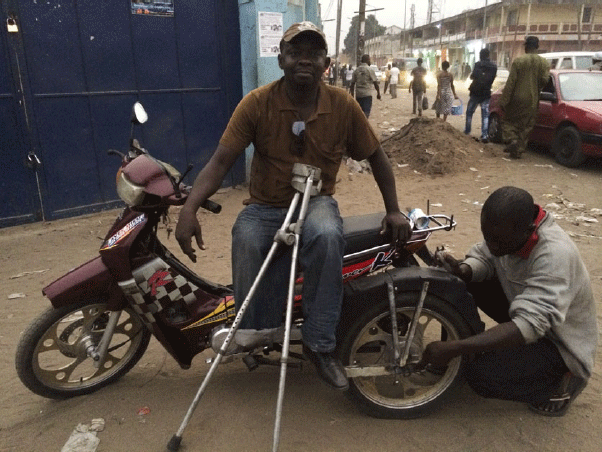
With one fit leg, Vincent moved around on crutches, often hiring motorbike drivers to help him get around. He was quick and agile on the crutches, but he invested in two further mobility aids intended to facilitate his departure from Beach life. First, he used earnings from border work to order a prosthetic leg. He kept the leg at home and practised with it, he told me, but it was too painful to use consistently. He wanted to learn to use the leg because crutches were exhausting, and for aesthetic purposes; the leg would conceal his disability and help him blend in. Later, he bought a second-hand Chinese motorcycle and started having it converted into a motorized tricycle by a local blacksmith, another expensive project. The motorcycle cost around US$250, and he expected to pay another US$250 to have it converted. He still used his crutches and kept his prosthetic leg, but the motorized tricycle made him far more mobile (see Figure 5).
Vincent waits while a mechanic does a quick fix of his three-wheeled motorcycle.
Learning to walk with a prosthesis and being able to drive a motorcycle again were part of his long-term plans to get out of border work, but they were also instrumental in heightening his interactions with other disabled people and grounding him in Kinshasa. The motorcycle enabled him to move around the centre of town for business. He could arrive at the border within twenty minutes, and he planned to use the motorcycle to go to the central market and look for clients of his own, freeing him to work for himself rather than for others. With the motorcycle as a sign of success, merchants would ask him to declare their goods at customs. The variety of mobility aids helped mitigate risks while giving him options, helping him invest in his desire to return to the diamond business while keeping open the possibility of working in Kinshasa: the crutches could go anywhere, the motorcycle helped him get around the city, and the prosthetic leg would make it easier to blend in when he so desired – another face of (in)visibility that he sought to navigate via technology.
Vincent intentionally remained an outsider in relation to groups of disabled people, many of whom had survived childhood polio. Brokering at the border as part of the new union president’s ‘team’ helped him make ends meet, but he considered it as a helpful, albeit unreliable, stopgap rather than a long-term source of income. He had no intention of truly integrating himself in circles of people with disabilities or staying in the border business; as soon as he had rebuilt his capital, he often told me, he wanted to return to the diamond business. His new colleagues frequently criticized Vincent for keeping at a distance from them, and they had a jokey relationship that included accusing each other of still being bound by the ‘complexes’ of disability frustrations.
Such exchanges over disability ‘complexes’ among disabled people hinged on their perceived source: whether bound to the lifelong condition of physical disability, or a psychological trap in which the newly disabled Vincent was still caught, unable to come to terms with his new condition. Border work and mobility aids increased Vincent’s interactions with other disabled people and he accepted that he now had a disability. But that did not mean that he came to see himself as a true handicapé, an identity largely reserved for those who had survived polio. Vincent often told me that he had a different ‘mentality’ compared with people who had grown up disabled. He frequently jokingly provoked his disabled colleagues, who teased him in return. The jokes sometimes turned to direct rejections of disability.
Waiting for a pay-out in a bar after a day of border work one day, Vincent was reminiscing about the diamond business. He was telling me about his place of origin in the interior of the country when he became confrontational towards a couple of the disabled colleagues we sat with. He emphatically exclaimed: ‘I’m not an handicapé, it was an accident.’ He turned to me and told me that he continuously had to debase himself to communicate with handicapés, because ‘handicapés don’t reason! … When I have money and I pass a handicapé, I give,’ he said, gesturing giving money to a beggar. One disabled man reacted to the put-down by showing his crutches, threatening to beat Vincent if he continued insulting them. Vincent had just drawn on two common stereotypes of disabled people: that they ‘don’t reason’ and that they beg – both considered negative manifestations of having ‘complexes’. Vincent waved it away and turned to me later to tell me that the man was ‘crazy, he doesn’t reason, he gets aggressive very quickly and drinks too much alcohol’. The menace was not serious, and nobody expected a fight, but the frustrations were mutual. People reacted to Vincent’s provocations by telling me that it was he in fact who still had ‘complexes’. He was ‘behind’ them in moral careers because he was unable to accept his limitations.
Vincent’s array of mobility technologies gave him the choice of disguising (with the prosthetic leg) or displaying (with the crutches and motorcycle) his amputated leg, making it possible for him to reject or engage with a disabled personhood and subjectivity as the situation, and his long-term projects, required. At once an outsider and an insider to border work, the idea that disabled people liberated themselves from their innate ‘complexes’ through their technologically facilitated labour was inimical to him; it was neither a ‘problem’ he believed himself to have, nor something he saw ‘true’ handicapés genuinely leaving behind. Technology facilitated a moral career of subjectivity that entailed a future return to his prior, non-disabled life, yet when he utilized the technologies of display to valorize a public disabled personhood, he was judged according to the stereotypes of ‘complexes’ that he denied in himself.
Beyond the origin and duration of their disability, the difference between Anique’s and Vincent’s attitudes towards their varied moral careers perhaps hinged more on their presentation of the temporality of their life narratives. Anique chose to talk of how mobility technology transformed her subjectivity as a disabled person through her personal history. She had many future plans and projects, but talk of ‘complexes’ and mobility aids meant considering her progression to today: a proud disabled woman who knew herself through her relations to other disabled people. Vincent, by contrast, spoke emphatically of the future. His technological aids and social contacts were a strategy to deal with today’s uncertainty, his moral career a planned return to a personhood that would not be defined by his disability.
As people often do with motorized vehicles, Vincent personalized his motorcycle with stickers. He chose two stickers: one with a Lingala warning that ‘we know [people’s] faces but not [their] hearts’ (toyebani bilongi kasi mitema te), the other with a French statement of faith that ‘With God we will do great things’ (Avec Dieu, nous ferons des exploits) (see Figure 5). While the first reminded readers to be vigilant of the hidden intentions of others, the other expressed a hope for the future that was partly invested in his motorcycle. Ultimately, his business plans were aimed at providing for his family – his estranged partner and daughter, but also a niece who had recently become pregnant. The stickers were a reminder that personal circumstances were not entirely within his control – affected by potentially devious others and in the hands of the divine – but technological aids were instrumental in navigating uncertainty, providing options for working towards his life projects. They were tools to provide opportunity, and a means of display to facilitate the career of personhood and subjectivity he saw ahead of him.
Mobility aids and moral careers
The creation, utilization and exchange of technology can be an integral aspect of one’s moral career. Amid the uncertainties that affect many African social settings, technologies that facilitate mobility may be among the most indispensable tools of such social navigation (cf. Schapendonk Reference Schapendonk2018). In this regard, the negotiation of mobility aids by disabled people in Kinshasa is part of a much wider mediation of technology, mobility and personhood in Africa today – their disability an intensification, not a differentiation, of shared experiences of uncertainty. The compatible mobility aids and socio-technical infrastructure that made border activities thrive were an innovative institution that brought people with disabilities from far and wide into contact with each other, facilitating moral careers of subjectivity and personhood. Innovation created new social relations where disability was not a disadvantage, where there was a reframing of the ‘normal’ and the ‘person’.
For most disabled workers, this border work is no longer a viable livelihood, and most have reoriented their activities and mobility aids to adapt to these changes. ‘Wheels and new legs are necessary but not sufficient prerequisites for economic and political mobilization,’ Whyte and Muyinda (Reference Whyte, Muyinda, Ingstad and Whyte2007: 306) point out, describing the rise and decline of a similar border niche in Uganda. Mobility needs change along with changing socio-economic and political circumstances. Considering disabled people as makers as well as consumers of technology in Kinshasa, however, nuances assumptions about agency, technology and personhood in this setting: personhood may be attributed by others, but it is entangled with a socio-technical environment that can offer opportunities for personal agency.
Mobility aids and infrastructure are designed as materials of support, but they also carry meaning. For many disabled people in Kinshasa, different mobility aids were indexes of phases in moral careers from embarrassment to respectability, enabling them to pursue life goals such as work and marriage. As much as the decreasing mobility over the life course can be an outcome of social becoming (Pype Reference Pype, Willems and Mano2017), my interlocutors first sought to accumulate social capital through mobility. As this article has argued, however, this process was in no sense straightforward. Not having ‘complexes’ was a common goal on the road to acquiring full personhood, but how it could be achieved was variable. Considering the long-term life course is key to understanding the fluctuating usefulness and meaning of mobility aids in moral careers of subjectivity and personhood, while the perspective from which this life course is narrated – as past memories or future plans – may shift the terms through which technology, sociality, mobility, subjectivity and personhood are seen to relate. How people use a variety of aids in tandem and over their lifetimes gives a more nuanced and complex picture than focusing on how someone may use one mobility aid at a given time, highlighting the long-term effects of technology on public and personal subjectivities beyond their instrumental use.
When border work collapsed, Vincent put his desire to return to diamond work into action. The moto-tricycle allowed him to zip around the city to meet contacts, and he started travelling back to the province for short trips during which he bought diamonds for a Kinshasa contact. Back from one of his trips, he told me that he had changed his mind about using the prosthetic leg on business trips; a visible disability was surprisingly advantageous. In the province, authorities thought that he looked like a harmless war victim, and he had less trouble with police officers than in the past. Gesturing towards his crutch, he joked that if he had the chance to go to Europe, he would hide diamonds in the bottom. When back in Kinshasa, however, the moto-tricycle made it possible for him to keep up with other disabled border workers. Occasionally, he still worked for the new union president when a barge was due to arrive in Kinshasa, and he remained friends with another man who was also an amputee. The decline in border business did affect him, however. He had a new motor on his motorbike, but he had sold half his plot of land to cover living expenses. Vincent made strategic choices within his possibilities, using the mobility aids available to him to engage or reject a visible disability, presenting himself as a disabled person or not.
The value of mobility technologies that made border work possible thus outlast the work itself. Many years after the border niche ended, former disabled border workers still often send and display photographs of cargo tricycles and the Bac Matadi on social messaging apps. In recent years, the Kinshasa government has invested in accessible design; wheelchair-accessible flyovers have been built over major roads, chairs reserved for disabled people have appeared at the airport, and the entrance to the City Hall has been renovated with a ramp. None of this, however, is treated with as much affection as memories of the Grand Bac and its compatibility with cargo tricycles. Asked why he had chosen the Grand Bac as his WhatsApp profile photo, one former border worker expressed how much it had meant to him:
[I chose the photo] to remind us where we come from. Let’s look at the place where we got a little manioc bread [kwanga] to feed our children. The place that gave many of us the opportunity to marry, to build families. The Grand Bac really represents a lot for me … [It is] dear to us disabled people, because it permitted us to live.
Acknowledgements
I would like to thank my interlocutors for including me in their lives and sharing their experiences with me. I am grateful also to those who read and listened to previous drafts of this article and provided helpful suggestions: Susan Reynolds Whyte, Herbert Muyinda, Aidan Russell, the participants and organizers of the 2017 African Studies Association Disability and Technology panel, and the anonymous reviewers of Africa.
Clara Devlieger is an assistant professor of anthropology at the London School of Economics and Political Science. Her research interests include disability, moral economies of distribution and welfare, urban livelihoods, socio-economic rights, personhood, mobility and care.


 Open access

