

Introduction
Different cultural, functional, and chronological interpretations have been proposed for the Middle Palaeolithic (MP) cultures defined in Europe by Bordes (Reference Bordes1961a), such as the Ferrassie Mousterian, Quina Mousterian, Typical Mousterian, Denticulate Mousterian, and Mousterian of Acheulean Tradition (MTA), and for the MP technological variants defined later by various scholars, such as Levallois, including laminar (blade), discoidal, Quina, and bifacial technologies (Monnier & Missal, Reference Monnier and Missal2014). The Micoquian (termed also the Eastern Micoquian or Keilmesser group, KMG) is the most widespread and longest-lasting techno-complex produced by Neanderthals in Europe and spread as far as the Altai in the east (Kolobova et al., Reference Kolobova, Roberts, Chabai, Jacobs, Krajcarz and Shalagina2020) and the Caucasus in the south (Golovanova, Reference Golovanova2015).
In this article, we offer a synthesis of data on the Zagros Mousterian. It was defined a meaningful archaeological unit by Skinner (Reference Skinner1965) and, since that time, has been part of discussions related to cultural diversity of Neanderthals in Western Asia. The Caucasian archaeological record contributes important data to our understanding of the Zagros Mousterian and its so far undervalued significance for the evolution of archaic humans. Our study is based on published data. The lithic assemblages analysed come from both old and recent excavations, and this has affected the assemblage composition (Supplementary Material Table S1). For comparison between the MP assemblages in the Zagros and Caucasus, we employ the typological and technological indices developed by Bordes (Reference Bordes1961b; Tables 1 and 2), because most MP sites in the regions were characterized by various researchers using Bordes’ method.
Technological and typological indices defined for the Zagros Mousterian assemblages in the Zagros. For definition of the indices, see Debénath & Dibble (Reference Debénath and Dibble1994).

Notes: Indices for Warwasi after Dibble & Holdaway (Reference Dibble, Holdaway, Olszewski and Dibble1993, tab. 2.2); indices for Houmian, Shanidar D, Kunji, Hazar Merd, and Bisitun after Dibble & Holdaway (Reference Dibble, Holdaway, Olszewski and Dibble1993, tab. 2.9), recomputed by Dibble & Holdaway (Reference Dibble, Holdaway, Olszewski and Dibble1993) on the basis of published type counts (after Skinner, Reference Skinner1965; Akazawa, Reference Akazawa1975; Bewley, Reference Bewley1984), but some differ markedly from published indices (in parentheses). Indices for Mar Tarik and Qaleh Kurd were recomputed by the authors on the basis of published type counts (after Jaubert et al., Reference Jaubert, Biglari, Bruxelles, Bordes, Shidrang, Naderi, Otte, Biglari and Jaubert2009; Kamrani et al., Reference Kamrani, Nasab, Bonilauri, Sarvandi, Jayez and Kharrazian2022).
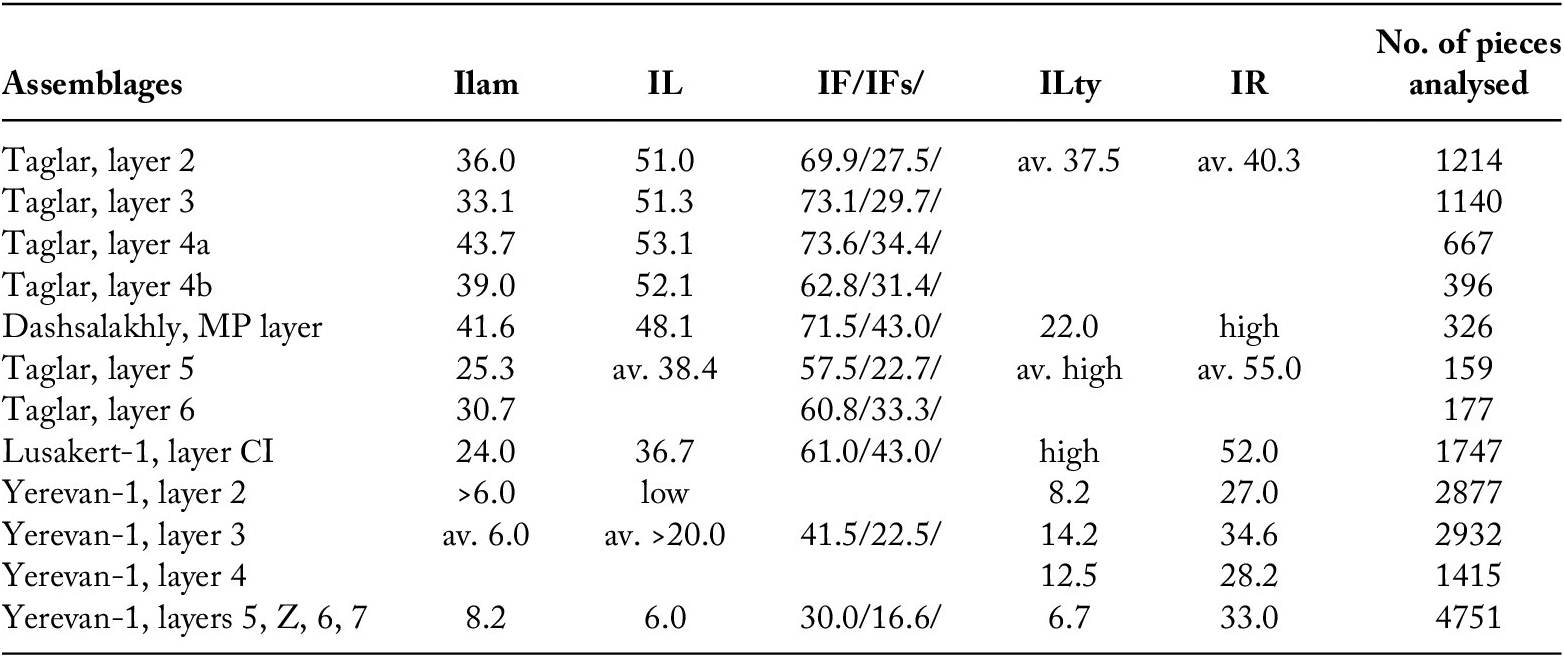
Technological and typological indices defined for the Zagros Mousterian assemblages in the Lesser Caucasus and Armenian highlands (after Yeritsyan, Reference Yeritsyan1970, Reference Yeritsyan1975; Jafarov, Reference Jafarov1983, Reference Jafarov1999).

Note: av. means average for two or more layers.
The Zagros Mousterian in the Zagros
Definition
The initial definition of the Zagros Mousterian originates in research of the MP assemblages that were recovered in several cave sites in the Zagros, i.e. the mountain ridge extending over 1600 km from the eastern Taurus and Armenian highlands in Turkey in the north-west to the Persian Gulf in Iran in the south-east, and reaching an altitude of 4400 m asl. Dorothy Garrod excavated the first MP site in the Zagros in 1928: Hazar Merd cave in Iraq. Garrod and Bate (Reference Garrod and Bate1937) defined the most salient features of the assemblage, characterized by a high proportion of narrow blades and tools made on blades, especially points and side-scrapers.
Skinner (Reference Skinner1965), using Bordes’ (Reference Bordes1961b) method, identified all MP assemblages known from caves in the Zagros (layer D at Shanidar and layer C at Hazar Merd in Iraq, and the caves of Bisitun and Kunji in Iran) as a specific Mousterian industry (his ‘Group A’) and introduced the term ‘Zagros Mousterian’ to define this industry. He listed a set of techno-typological characteristics, such as a high proportion of narrow blades and tools made on blades, especially elongated retouched points and side-scrapers, an absence of Levallois technique, a high proportion of blanks with faceted platforms, the use of the discoid technique, moderate proportions of tools with Quina retouch, a low proportion of denticulated and Upper Palaeolithic tools, and an absence of bifacial tools, as specific features of the Zagros Mousterian (Table 1). By that time, the discovery of Neanderthal fossils in Shanidar cave (Solecki, Reference Solecki1963) showed that the Zagros Mousterian was produced by Neanderthals.
Akazawa (Reference Akazawa1975) examined a different sample of artefacts from layer D at Shanidar. He confirmed that the assemblage shared previously defined characteristics of the Zagros Mousterian: a predominance (more than half) of points and side-scrapers, a low percentage of Upper Palaeolithic tool types, and denticulated and Levallois tools.
Since then, and using Bordes’ (Reference Bordes1961b) method, greater technological and typological heterogeneity has been identified among the MP assemblages in the Zagros. Bewley (Reference Bewley1984) showed that the MP assemblage from the Houmian rockshelter in Iran indicated a higher range of variability in the percentage of Levallois tools (ILty), faceting platforms, and side-scrapers than previously thought typical for the Zagros Mousterian. Based on the reduction sequence approach proposed by Frison (Reference Frison1968), now called allometry or the allometric approach (Knell, Reference Knell2022), Dibble (Reference Dibble1984) re-analysed the Bisitun assemblage. He suggested that the main tool types in the assemblage, such as single and double side-scraper and convergent scrapers and points, represent a continuum of reduction of the tools through resharpening. Baumler and Speth (Reference Baumler, Speth, Olszewski and Dibble1993) restudied the assemblage from Kunji and confirmed Skinner’s (Reference Skinner1965) definition.
Dibble and Holdaway (Reference Dibble, Holdaway, Olszewski and Dibble1993) summarized the then available data for MP assemblages in the Zagros and summed up the definition of features typical of the Zagros Mousterian (Table 1). They confirmed that the Zagros MP assemblages are distinct from those in the Levant and from the features defined by Skinner (Reference Skinner1965), excluding the low percentage of Levallois products that they believed was underestimated by previous researchers. Dibble and Holdaway (Reference Dibble, Holdaway, Olszewski and Dibble1993) concluded that the Zagros Mousterian is characterized by a knapping technology combining laminar (though real blades are rare) and Levallois recurrent flaking from uni- and bidirectional prepared cores (though radial flaking is also represented). They defined the typical Zagros Mousterian tool set dominated by simple and double side-scrapers and convergent pieces (defined as convergent scrapers or Mousterian points by various scholars), a low percentage of transverse and angled (déjeté) scrapers, tools worked with stepped (Quina) retouch, and the presence of truncated-faceted pieces. They also argued that the model of tool reduction through resharpening (Dibble, Reference Dibble1984) explains the most striking typological peculiarity of the Zagros Mousterian, such as the predominance of single and double scrapers and convergent pieces.
The importance of Dibble and Holdaway’s (Reference Dibble, Holdaway, Olszewski and Dibble1993) study resides in the identification, using principal component analysis, of a clear dichotomy in the Zagros Mousterian assemblages: Bisitun and Warwasi in one group and Houmian, Shanidar D, Kunji, and Hazar Merd in the other (Dibble & Holdaway, Reference Dibble, Holdaway, Olszewski and Dibble1993: tab. 2.11:B). They suggested that this reflects a varying intensity of tool reduction, separating the assemblages where the ILty index is low—indicating that more Levallois blanks were transformed (through resharpening) into scrapers and points—from the assemblages where the ILty is high—indicating that the reduction of tools was not intense and more Levallois blanks were left unworked.
These two groups are also distinguished by the blade index (Ilam), which is much higher in the Bisitun-Warwasi group (Table 1). Furthermore, most of the Zagros Mousterian assemblages in the Zagros show a lack of truncated-faceted pieces. They were not identified at Shanidar, Hazar Merd, and Houmian (Dibble & Holdaway, Reference Dibble, Holdaway, Olszewski and Dibble1993: 79), and in most MP assemblages studied in the region in more recent times (Kamrani et al., Reference Kamrani, Nasab, Bonilauri, Sarvandi, Jayez and Kharrazian2022: tab. 9). A large number of truncated-faceted pieces was reported from three sites only: 115 at Bisitun (Dibble, Reference Dibble1984), twenty-three at Warwasi (Dibble & Holdaway, Reference Dibble, Holdaway, Olszewski and Dibble1993), and twenty-five at Kunji (Baumler & Speth, Reference Baumler, Speth, Olszewski and Dibble1993).
At the end of 1990s, Lindly (Reference Lindly2005) presented an attribute analysis of some MP assemblages in the Zagros. He concluded that the Zagros Mousterian assemblages are specific (based on comparison between MP assemblages in the Zagros and the Levant) in several aspects: 1) tools are heavily resharpened, dominated by side-scrapers and points, and a statistical test confirmed Dibble’s (Reference Dibble1984, Reference Dibble1995) resharpening trajectory (through single, double, convergent, and déjeté scrapers); 2) larger flakes and tools that were transformed into cores are scarce, and the cores are small and exhausted, in the form of truncated-faceted or centripetal cores produced at the end of the reduction sequence; 3) the density of lithic artefacts is low, intimating that the length of occupation these artefacts document was relatively short.
Lindly (Reference Lindly2005: 95) proposed that the Zagros Mousterian sites, which range in elevation from 740 to over 2000 m asl, represent camps occupied during the summer and thus present only one aspect of a larger settlement subsistence strategy of the Neanderthals in the region. However, in 2005, chronological and palaeoenvironmental data were virtually non-existent for the MP of the Zagros, and subsistence patterns of MP hominins in this region were unknown.
Current research on the Zagros Mousterian in the Zagros
In the 1990s and early 2000s, a major change in the methodology of lithic analysis in European prehistoric archaeology resulted in the shift from ‘morphological typology’, including the method of Bordes (Reference Bordes1961b), to the concept of chaîne opératoire invented by Leroi-Gourhan (Reference Leroi-Gourhan1964) but not applied in Palaeolithic archaeology until the 1990s (Bar-Yosef & Van Peer, Reference Bar-Yosef and Van Peer2009). This methodological shift greatly affected the definition of the Zagros Mousterian.
Since the 2000s, fieldwork in Iran has led to discoveries of MP assemblages in new cave sites in the Zagros, including the caves of Do-Ashkaft, Mar Tarik, Gilvaran, Kaldar, Ghamari, and Qaleh Kurd (Biglari & Heydari Reference Biglari and Heydari2001; Jaubert et al., Reference Jaubert, Biglari, Bordes, Bruxelles, Mourre and Shidrang2005, Reference Jaubert, Biglari, Bruxelles, Bordes, Shidrang, Naderi, Otte, Biglari and Jaubert2009, Reference Jaubert, Biglari, Crassard, Mashkour, Rendu and Shidrang2010; Bazgir et al., Reference Bazgir, Ollé, Tumung, Becerra-Valdivia, Douka and Higham2017; Reynolds et al., Reference Reynolds, Hunt, Hill, Tlby, Pomeroy and Burke2022; Kamrani et al., Reference Kamrani, Nasab, Bonilauri, Sarvandi, Jayez and Kharrazian2022) and the Bawa Yawan rockshelter (Heydari-Guran et al., Reference Heydari-Guran, Benazzi, Talamo, Ghasidian, Hariri and Oxilia2021; Heydari et al., Reference Heydari, Guérin and Heydari-Guran2024) (Figure 1). Researchers concluded that most belong to the Zagros Mousterian. A novel research focus in this region is related to the discovery of MP sites (Qaleh Bozi 2 and Qaleh Bozi 3) with bifacial leaf points and a virtual lack of Levallois elements in the Iranian Central Plateau (Biglari et al., Reference Biglari, Javeri, Mashkour, Yazdi, Shidrang, Tengberg, Otte, Biglari and Jaubert2009; Jaubert et al., Reference Jaubert, Biglari, Crassard, Mashkour, Rendu and Shidrang2010). The issue of possible interaction in the Zagros between the Zagros Mousterian Neanderthals and other, culturally different groups of MP hominins that produced bifacial leaf points deserves attention.
Relief map of the Caucasus and Zagros mountains showing location of the MP sites discussed in the text.

The Mar Tarik cave (Jaubert et al., Reference Jaubert, Biglari, Bruxelles, Bordes, Shidrang, Naderi, Otte, Biglari and Jaubert2009) is of great interest for our topic. Using a new definition of Levallois technology developed by Boëda (Reference Boëda1994, Reference Boëda, Dibble and Bar-Yosef1995) following the chaîne opératoire approach, Jaubert and colleagues concluded that Mar Tarik contained a Zagros Mousterian assemblage (360 pieces in total), dominated by Levallois recurrent flaking, including blades and side flakes (débordants) that are compatible with Levallois recurrent technology, with some use of volumetric flaking. The number of identified blades (twenty-seven pieces) is low (Ilam = 8.6) in comparison to other Zagros Mousterian sites, while the assemblage’s typological indices are within the range typical for the Zagros Mousterian (Table 1). The 158 tools are dominated by single and double side-scrapers, and convergent tools that include Mousterian points, convergent and déjeté scrapers, and one limace. One truncated-faceted piece was also identified.
A technological analysis by Beshkani (Reference Beshkani2018) following the Levallois concept of Boëda (Reference Boëda1994, Reference Boëda, Dibble and Bar-Yosef1995) indicates the predominance of Levallois technology in previously studied Zagros Mousterian assemblages, including Bisitun, Shanidar D, and Warwasi. The Levallois technology is combined with discoid, volumetric, and Kombewa flaking in Warwasi, volumetric flaking in Bisitun, and Kombewa flaking at Shanidar D. This new understanding of the Levallois technology does not correspond at all to the definitions of Levallois technology and Levallois products that were used by researchers to define the Zagros Mousterian in the twentieth century.
The subsistence of the Zagros Mousterian Neanderthals received more attention. In particular, the study of the distribution of hunted species from MP sites in the Zagros (Yousefi et al., Reference Yousefi, Heydari-Guran, Kafash and Ghasidian2020) indicates that the mammals most frequently hunted by the Zagros Mousterian Neanderthals were wild goat (Capra aegagrus) and wild sheep (Ovis gmelini and O. vignei), and less frequently Persian gazelle (Gazella subgutturosa).
As of 2024, chronometric dates for the Zagros Mousterian in the Zagros are available from new excavations for the upper levels of layer D at Shanidar, indicating a late MP age between 55 and 45 kya (Pomeroy et al., Reference Pomeroy, Lahr, Crivellaro, Farr, Reynolds and Hunt2017, Reference Pomeroy, Bennett, Hunt, Reynolds, Farr and Frouin2020). An optically stimulated luminescence (OSL) date of 75–73 kya, and microfauna and palaeosols indicate that the lower part of layer D at Shanidar correlates to the late MIS 5 (Marine Isotope Stage 5) (Reynolds et al., Reference Reynolds, Hunt, Hill, Tlby, Pomeroy and Burke2022). A thorium-uranium date of 148±35 kya obtained for the MP layer 2a at the Houmian rockshelter (Bewley, Reference Bewley1984) indicates the MIS 5e age.
The radiocarbon and thermoluminescence (TL) results from Kaldar cave indicate that the Zagros Mousterian assemblage from layer 5 has a TL age of 63±6 kya, whereas the overlying layer 4 yielded radiocarbon dates from 54–46 to 44–42 ka cal bp (Bazgir et al., Reference Bazgir, Ollé, Tumung, Becerra-Valdivia, Douka and Higham2017). The MP layers at the Bawa Yawan rockshelter were dated to 43.6–41.5 ka cal bp and 40.3–39.4 ka cal bp (Heydari-Guran et al., Reference Heydari-Guran, Benazzi, Talamo, Ghasidian, Hariri and Oxilia2021). However, OSL dates indicate that the 14C dates underestimate the age of MP occupation, which falls in the 58–80 kya time frame (Heydari et al., Reference Heydari, Guérin and Heydari-Guran2024).
Summarizing the current state of research in the Zagros, Reynolds et al. (Reference Reynolds, Hunt, Hill, Tlby, Pomeroy and Burke2022) conclude that the Zagros Mousterian represents a distinct MP techno-complex that spread in Iraq and Iran along the Zagros mountain range. Its chronology is still problematic, but available chronometric ages suggest that this lithic industry was present in the region from the beginning of the Last Interglacial (MIS 5e, about 130–120 kya) to about 40 kya.
The Zagros Mousterian in the Lesser Caucasus and Armenian Highlands
In the southern Caucasus, a group of MP sites is known, located mostly in the eastern part of the Lesser Caucasus in Azerbaijan, between the river Kura in the north and the river Araks in the south, and in the Armenian volcanic highlands in Armenia. In the 1970s–1990s, using Bordes’ (Reference Bordes1961b) method, researchers noted the similarity between the region’s MP assemblages and the Zagros Mousterian in the Zagros (Jafarov, Reference Jafarov1983, Reference Jafarov1999; Liubin, Reference Liubin, Boriskovskiĭ and Okladnikov1984; Beliaeva & Lioubine, Reference Beliaeva, Lioubine and Otte1998), while none of these authors applied the term ‘Zagros Mousterian’ to the assemblages. Doronichev and Golovanova (Reference Doronichev, Golovanova, Dibble and Soressi2003) applied for the first time the definition ‘Zagros Mousterian’ to the MP assemblages in the Lesser Caucasus and Armenian highlands.
More than ten sites with Zagros Mousterian assemblages are known in the regions (Figure 1). Half were excavated in the 1960s–1980s (Yeritsyan, Reference Yeritsyan1970, Reference Yeritsyan1972, Reference Yeritsyan1975; Jafarov, Reference Jafarov1983, Reference Jafarov1999; Liubin, Reference Liubin, Boriskovskiĭ and Okladnikov1984, Reference Liubin and Boriskovski1989; Huseynov, Reference Huseynov2010) (see Figures 2 and 3; Supplementary Material text and Figures S1–S6), with more recent excavations in some of these sites being published since (Fernández-Jalvo et al., Reference Fernández-Jalvo, King, Andrews, Yepiskoposyan, Moloney and Murray2010; Jafarov et al., Reference Jafarov, Zeynalov, Avsharova and Rɘhimova2010; Asryan et al., Reference Asryan, Olle, Moloney and King2014; Gasparyan et al., Reference Gasparyan, Egeland, Adler, Pinhasi, Glauberman, Haydosyan, Gasparyan and Arimura2014; Frahm et al., Reference Frahm, Feinberg, Monnier, Tostevin, Gasparyan and Adler2016a, Reference Frahm, Feinberg, Schmidt-Magee, Wilkinson, Gasparyan and Yeritsyan2016b; Gasparyan & Glauberman, Reference Gasparyan, Glauberman, Romagnoli, Rivals and Benazzi2022; Zeynalov et al., Reference Zeynalov, Anoykin, Kulakov, Otcherednoy and Kurbanov2023).
Typical Zagros Mousterian tools from Taglar cave. 1–3) points with truncated-faceted bases; 4) convergent scraper with a truncated-faceted base; 5, 7) Mousterian points with thinned bases; 6, 8) retouched Levallois points; 9, 10) Mousterian points.

Typical Zagros Mousterian tools from the caves of Yerevan-1 (1–13, 18) and layer CI at Lusakert-1 (14–17, 19). 1–10, 15, 16) points with truncated-faceted bases; 13) elongated Mousterian point; 14) elongated point in the form of a willow leaf with a broken tip; 17) retouched Levallois point; 11, 12, 18, 19) truncated-faceted scrapers.

Among the recently discovered MP sites in the Armenian highlands, a small Zagros Mousterian assemblage of eighty-four artefacts was found on the surface at the Angeghakot-1 rockshelter in Armenia (Liagre et al., Reference Liagre, Gasparyan, Ollivier and Nahapetyan2006). The assemblage includes twenty-one points, ten of which are ‘Yerevan points’ with a truncated-faceted base (Gasparyan et al., Reference Gasparyan, Egeland, Adler, Pinhasi, Glauberman, Haydosyan, Gasparyan and Arimura2014) typical to the Zagros Mousterian in the Lesser Caucasus and Armenian highlands.
The open-air site of Barozh-12 yielded a total of 12,549 obsidian artefacts (Glauberman et al., Reference Glauberman, Gasparyan, Wilkinson, Frahm, Raczynski-Henk and Haydosyan2015). The assemblage shows a predominance of the Levallois recurrent technique. Tools include retouched Levallois and Mousterian points, and convergent scrapers (Gasparyan & Glauberman, Reference Gasparyan, Glauberman, Romagnoli, Rivals and Benazzi2022: fig. 15.3: B), including one point with a truncated-faceted base (Glauberman et al., Reference Glauberman, Gasparyan, Wilkinson, Frahm, Raczynski-Henk and Haydosyan2015: tab. VIII-3; Reference Glauberman, Gasparyan, Wilkinson, Frahm, Nahapetyan and Arakelyan2020).
The open-air site of Bagratashen-1 yielded a MP assemblage comprising 500 lithic artefacts. It includes cores with Levallois recurrent and laminar flaking, Levallois, retouched Levallois and elongated Mousterian points (Gasparyan & Glauberman, Reference Gasparyan, Glauberman, Romagnoli, Rivals and Benazzi2022: fig. 15.4: B), side-scrapers, and eleven truncated-faceted pieces (Egeland et al., Reference Egeland, Gasparian, Fadem, Nahapetyan, Arakelyan and Nicholson2016).
The open-air site of Kalavan-2 yielded a total of 2661 MP lithic artefacts (Supplementary Material Table S1) from more than ten layers (Ghukasyan et al., Reference Ghukasyan, Colonge, Nahapetyan, Ollivier, Gasparyan, Monchot and Chataigner2011) or units (Malinsky-Buller et al., Reference Malinsky-Buller, Glauberman, Ollivier, Lauer, Timms and Frahm2021). In the overall assemblage, the predominance of recurrent Levallois and laminar flaking, the combination of Levallois and blade production, a high frequency of convergent pieces (retouched points and convergent side-scrapers), and the presence of truncated-faceted pieces are characteristic of the Zagros Mousterian.
The MP assemblages from the caves of Taglar and Azykh (Azokh 1) in the Lesser Caucasus (Azerbaijan) and the caves of Yerevan-1 and Lusakert-1 in the Armenian highlands (Armenia) provide the most representative data about the Zagros Mousterian in these regions (Supplementary Material text; Table S3; Figure S7). This allows us to define the southern Caucasian variant of the Zagros Mousterian, characterized by the following features:
-
(1) A combination of laminar (blade) and Levallois recurrent flaking from unipolar and bipolar cores (radial flaking is represented on exhausted cores), and a high faceting index. As opposed to the Zagros Mousterian in the Zagros, the Levallois index is higher than the blade index in the southern Caucasian variant (Table 3).
-
(2) The tool set is dominated by single and double side-scrapers and convergent pieces (defined as convergent scrapers or points by various scholars); elongated Mousterian points made on blades are characteristic (Figures 2 and 3; Supplementary Material Figures S1, S3–S6). The percentage of déjeté scrapers is higher than in the Zagros Mousterian in the Zagros.
-
(3) Truncated-faceted pieces are more diverse and include tool types that are rare in the Zagros Mousterian in the Zagros, such as Mousterian points with a truncated-faceted base and scrapers with the dorsal surface truncated-faceted from two or more sides (Figures 2 and 3; Supplementary Material Figures S2–S4).
Comparison of technological indices (after Bordes, Reference Bordes1961b) defined for the main Zagros Mousterian assemblages in the Lesser Caucasus and Armenian highlands, the Zagros, and the northern Caucasus. For definition of the indices, see Debénath & Dibble (Reference Debénath and Dibble1994).

Notes: Indices for Warwasi after Dibble & Holdaway (Reference Dibble, Holdaway, Olszewski and Dibble1993, tab. 2.2); indices for Houmian, Kunji, Hazar Merd, and Bisitun are recomputed by Dibble & Holdaway (Reference Dibble, Holdaway, Olszewski and Dibble1993, tab. 2.9) on the basis of published type counts (after Skinner, Reference Skinner1965; Akazawa, Reference Akazawa1975; Bewley, Reference Bewley1984), but some differ markedly from published indices (in parentheses). Indices for Qaleh Kurd were recomputed by the authors on the basis of published type counts (after Kamrani et al., Reference Kamrani, Nasab, Bonilauri, Sarvandi, Jayez and Kharrazian2022). Indices for Yerevan-1, Lusakert-1, and Taglar after Yeritsyan (Reference Yeritsyan1970, Reference Yeritsyan1975) and Jafarov (Reference Jafarov1983, Reference Jafarov1999). Indices for Saradj-Chuko and Tinit-1 after Anoykin et al. (Reference Anoykin, Slavinski, Rudaya and Rybalko2013) and Doronicheva et al. (Reference Doronicheva, Golovanova, Doronichev, Nedomolkin, Nesmeyanov and Voeykova2020).
Golovanova and Doronichev (Reference Golovanova and Doronichev2003, Reference Golovanova and Doronichev2005) posited that the long MP sequences from the caves of Yerevan-1, Lusakert-1, and Taglar provide a general succession (called the ‘Yerevan–Taglar tradition’) of cultural development of the southern Caucasian variant of the Zagros Mousterian from late MIS 5 to MIS 3. They also assumed that the first manifestations of the Zagros Mousterian in the Caucasus and Armenian highlands may have the earlier age.
Layer III at Azykh (Azokh-1) cave has yielded the oldest dated assemblage representing the Zagros Mousterian in the region (Supplementary Material). The fauna found in Layer III is similar to the fauna from the Binagady locality in Azerbaijan dated to the Last Interglacial (Jafarov, Reference Jafarov1999), about 130–120 kya. Electron spin resonance (ESR) dates obtained for units II–IV at Azokh-1 (Fernández-Jalvo et al., Reference Fernández-Jalvo, King, Andrews, Yepiskoposyan, Moloney and Murray2010; Asryan et al., Reference Asryan, Olle, Moloney and King2014) indicate an age within MIS 5–MIS 6 of the MP assemblage recovered in old excavations of Layer III (~ Unit II) and a Final Acheulian age (late MIS 7) of a few handaxes found in the lower part of Layer III (~ Unit III).
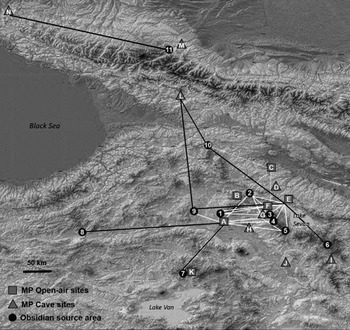
Data about long-distance obsidian transport indicate how far MP groups ranged and suggest potential interactions among various groups in the Caucasus and the Armenian highlands (Figure 4). Long-distance mobility patterns of MP hominins indicated by obsidian artefact sourcing suggest disconnection between MP populations in the northern and southern Caucasus, whose contacts were restrained by the Greater Caucasus mountain range, and limited contacts between the MP populations of the south-western Caucasus and Armenian highlands (Gasparyan & Glauberman, Reference Gasparyan, Glauberman, Romagnoli, Rivals and Benazzi2022: 289). Furthermore, obsidian artefact sourcing (Doronicheva et al., Reference Doronicheva, Golovanova, Doronichev and Kurbanov2023) indicates limited interconnectivity between different MP populations in the north-western Caucasus (Eastern Micoquian) and north-central Caucasus (Zagros Mousterian).
Relief map of the Caucasus showing locations of MP sites, obsidian sources, and the movement of obsidian artefacts. MP sites: A) Barozh-12; B) Ria-Taza-1 and Aparan Depression sites; C) Bagratashen-1; D) Hovk-1; E) Kalavan-2; F) Alapars-1; G) Lusakert-1; H) Yerevan-1; I) Angeghakot-1; J) Gazma; K) Gurgurbaba Tepesi; L) Ortvale Klde; M) Saradj-Chuko; N) Mezmaiskaya. Obsidian source areas: 1) Arteni; 2) Tsaghkunyats; 3) Gutansar; 4) Hatis; 5) Gegham; 6) Syunik; 7) Meydan Dağ; 8) Pasinler; 9) Kars (Digor); 10) Chikiani; 11) Zayukovo (Baksan). Solid lines = XRF data; dotted lines = estimates; white solid lines = movement of obsidian indicating regular raw material procurement; black solid lines = obsidian movement indicating contacts. Modified from Gasparyan & Glauberman (Reference Gasparyan, Glauberman, Romagnoli, Rivals and Benazzi2022, fig 15.5B).

The Zagros Mousterian in the Northern Caucasus
Weasel Cave in the North Ossetia-Alania Republic (Russia) (Figure 1) was until recently the only stratified MP site known in the Terek river basin in the northern Caucasus (Hidjrati et al., Reference Hidjrati, Kimball, Koetje, Cleghorn, Coffey, Kanukova, Bzarov, Hidjrati, Dzitzzoity, Salbiev and Fidarov2010). In the cave, the upper MP layers 5–11 are dated to MIS 3. Layers 12 and 13 are tentatively dated to 50–90 kya (MIS 4–MIS 5c; Faulks et al., Reference Faulks, Kimball, Hidjraty and Coffey2011); MP layer 14 may be also dated to MIS 5, based on a similar pollen spectrum. Golovanova (Reference Golovanova2015) noted the similarity of the MP assemblages from layers 12–14 (Supplementary Material text and Figure S8) with the Zagros Mousterian in the Lesser Caucasus and Armenian highlands.
The recently discovered Saradj-Chuko cave is a benchmark Zagros Mousterian site in the northern Caucasus (Doronicheva et al., Reference Doronicheva, Golovanova, Doronichev, Nedomolkin, Korzinova and Tselmovitch2019, Reference Doronicheva, Golovanova, Doronichev, Nedomolkin, Nesmeyanov and Voeykova2020, Reference Doronicheva, Golovanova, Doronichev and Kurbanov2023, Reference Doronicheva, Golovanova, Doronichev, Tregub, Tselmovitch and Korzinova2024), with three MP layers (3, 6A, and 6B) identified (Figure 5; Supplementary Material). OSL dating indicates that the lower MP layer 6B can be dated to the late MIS 5, between c. 90/80 and 70 kya. Layer 6A is dated to the early MIS 3, c. 60–50 kya, and layer 3 is dated to c. 45–40 kya.
Levallois blanks (1–4) and typical Zagros Mousterian tools (5–13) from Layer 6B at Saradj-Chiko cave. 1–3) Levallois triangular flakes (points); 4) Levallois blade; 5, 6, 10) elongated Mousterian points; 7) truncated-faceted scraper; 8, 9, 11) Mousterian points; 12, 13) angled (déjeté) scrapers.

Figure 6A and Table 3 show that the assemblages from Saradj-Chuko have low Levallois and blade indices and a high faceting index, features that are most similar to the Zagros Mousterian assemblage from Shanidar D and Qaleh Kurd in the Zagros and Yerevan-1 in the Armenian highlands. A high faceting index (IF) and strict faceting index (IFs) differentiates the assemblages from Saradj-Chuko from the Eastern Micoquian assemblages in the north-western Caucasus (Figure 6B). The predominance of side-scrapers and points, and the presence of truncated-faceted scrapers, which are typical of the Zagros Mousterian but absent in the Eastern Micoquian, also indicate the similarity between the MP assemblages from Saradj-Chuko and the Zagros Mousterian.
A) Histograms showing the variability of the Levallois index (IL), blade index (Ilam), and faceting index (IF) in the Zagros Mousterian assemblages in the Zagros, Lesser Caucasus, and Armenian highlands in comparison to the Zagros Mousterian assemblages from layers 6B and 6A at Saradj-Chuko cave. B) Histograms showing variability of Ilam, IF, and strict faceting index (IFs) in the Eastern Micoquian assemblages in the north-western Caucasus in comparison to the Zagros Mousterian assemblages from layers 6B and 6A at Saradj-Chuko.

In the north-eastern Caucasus, the open-air site of Tinit-1 produced a stratified succession of eight or eleven MP horizons radiocarbon-dated from 43 to 51 ka cal bp (Anoykin et al., Reference Anoykin, Slavinski, Rudaya and Rybalko2013). The assemblages show similarities with the assemblages from the Saradj-Chuko and Weasel caves, in the combination of laminar volumetric and Levallois recurrent flaking from prepared platforms and the tool set typical of the Zagros Mousterian (Table 3; Supplementary Material text and Figure S9).
Discussion and Conclusions
Common technological features and tool types discussed in this article differentiate the Zagros Mousterian from other MP industries in neighbouring regions. A techno-typological heterogeneity found among the Zagros Mousterian assemblages in the Zagros (Bewley, Reference Bewley1984; Dibble, Reference Dibble1984; Dibble & Holdaway, Reference Dibble, Holdaway, Olszewski and Dibble1993) and Caucasus (Golovanova & Doronichev, Reference Golovanova and Doronichev2003) suggests that this industry can be subdivided into chronological stages and geographical variants. Here, we propose to define three geographical variants of the Zagros Mousterian, namely in the Zagros, Lesser Caucasus and Armenian highlands, and the northern Caucasus.
Table 3 shows that in each of these regions there are notable technological differences between the earlier and later assemblages, indicating the advance of blade technology. In the Lesser Caucasus, Armenian highlands, and Zagros, the increase in the faceting indices also indicates the advance of platform preparation. Only in the Lesser Caucasus and Armenian highlands does the increase in the Levallois index indicate the advance in Levallois flaking.
Despite significant geographical differences in natural environments and elevation, studies of the subsistence, and specifically the lithic raw material strategies, suggest that the Zagros Mousterian Neanderthals targeted local raw material sources and established their habitation sites close to these sources and their workshop sites directly at the sources (Anoykin et al., Reference Anoykin, Slavinski, Rudaya and Rybalko2013; Gasparyan et al., Reference Gasparyan, Egeland, Adler, Pinhasi, Glauberman, Haydosyan, Gasparyan and Arimura2014; Frahm et al., Reference Frahm, Feinberg, Schmidt-Magee, Wilkinson, Gasparyan and Yeritsyan2016b; Glauberman et al., Reference Glauberman, Gasparyan, Wilkinson, Frahm, Raczynski-Henk and Haydosyan2015, Reference Glauberman, Gasparyan, Wilkinson, Frahm, Nahapetyan and Arakelyan2020; Gasparyan & Glauberman, Reference Gasparyan, Glauberman, Romagnoli, Rivals and Benazzi2022; Kamrani et al., Reference Kamrani, Nasab, Bonilauri, Sarvandi, Jayez and Kharrazian2022; Doronicheva et al., Reference Doronicheva, Golovanova, Doronichev, Nedomolkin, Nesmeyanov and Voeykova2020, Reference Doronicheva, Golovanova, Doronichev, Tregub, Tselmovitch and Korzinova2024).
In each of the three regions there are artefacts suggesting contacts between the Zagros Mousterian hominins and other culturally different hominins. In the Caucasus, these contacts are also indicated by the presence of obsidian from distant sources (Gasparyan & Glauberman, Reference Gasparyan, Glauberman, Romagnoli, Rivals and Benazzi2022; Doronicheva et al., Reference Doronicheva, Golovanova, Doronichev and Kurbanov2023) (see Figure 4).
Currently, the oldest chronometric estimates (from c. 100 to 180 kya) in Azykh (Azokh-1) cave (Fernández-Jalvo et al., Reference Fernández-Jalvo, King, Andrews, Yepiskoposyan, Moloney and Murray2010) suggest that the Zagros Mousterian originated in the southern Lesser Caucasus during a time ranging from MIS 6 to early MIS 5. It evolved locally in the region (as indicated by the MP sequence of Taglar cave, presumed to date to MIS 3) and spread during MIS 5–MIS 3 to the Armenian highlands in the west, the Zagros mountains in the south, and the eastern North Caucasus in the north (Figure 7).
Relief map showing the distribution of the Zagros Mousterian in the Zagros, Lesser Caucasus, Armenian highlands, northern Caucasus, and the Eastern Micoquian in Eastern Europe and northern Caucasus. Squares indicate open-air sites and triangles indicate cave sites. Yellow = Eastern Micoquian sites in the northern Caucasus; red = Zagros Mousterian sites in the northern Caucasus; pink = Zagros Mousterian sites in the Lesser Caucasus and Armenian highlands; blue = Zagros Mousterian sites in the Zagros. Modified from Doronicheva et al. (Reference Doronicheva, Golovanova, Doronichev and Kurbanov2023: fig. 1).

The archaeological evidence from the Caucasus suggests that the spread of the Zagros Mousterian within the region was restricted by juxtaposition with other culturally different groups of MP hominins who settled in the north-western (Golovanova, Reference Golovanova2015; Doronicheva et al., Reference Doronicheva, Golovanova, Doronichev and Kurbanov2023) and south-western Caucasus (Golovanova & Doronichev, Reference Golovanova and Doronichev2003, Reference Golovanova and Doronichev2005). Moreover, the Zagros Mousterian can be related with the spread of MP hominins from the Lesser Caucasus via the southern coast of the Caspian Sea to Central Asia and Altai (Ghasidian et al., Reference Ghasidian, Kafash, Kehl, Yousefi and Heydari-Guran2023). Kolesnik (Reference Kolesnik2023) also proposed affinity with the Zagros Mousterian for the Belokuzminovka-Shlyakh group of MP sites in the Russian plain.
Neanderthal fossils associated with the Zagros Mousterian in the Zagros, including the remains of ten Neanderthal individuals discovered at Shanidar cave (Solecki, Reference Solecki1963; Pomeroy et al., Reference Pomeroy, Lahr, Crivellaro, Farr, Reynolds and Hunt2017, Reference Pomeroy, Bennett, Hunt, Reynolds, Farr and Frouin2020), and the Neanderthal remains found in the Bisitun cave (Trinkaus & Biglari, Reference Trinkaus and Biglari2006) and the Bawa Yawan rockshelter (Heydari-Guran et al., Reference Heydari-Guran, Benazzi, Talamo, Ghasidian, Hariri and Oxilia2021), clearly indicate that Neanderthals were makers of this industry. In the Caucasus, Neanderthal fossils associated with the Zagros Mousterian have been reported from two caves: Azokh-1 (King et al., Reference King, Compton, Rosas, Andrews, Yepiskoposyan, Asryan, Fernández-Jalvo, King, Yepiskoposyan and Andrews2016) and Yerevan-1 (Yeritsyan, Reference Yeritsyan1970).
The data summarized in this article allow us to conclude that a culturally specific Zagros Mousterian Neanderthal population, not related to the European Neanderthals (associated in the Caucasus with the Eastern Micoquian; see Supplementary Material), occupied the eastern part of the Caucasus mountains, from the river Terek in the north to the river Araks in the south, and the Zagros mountains south of the Caucasus. The evidence suggests contacts between the Zagros Mousterian Neanderthals and other culturally different Neanderthal populations.
Supplementary Material
The supplementary material for this article can be found at http://doi.org/10.1017/eaa.2025.11.
Acknowledgements
We are grateful to Prof. Nazim Hidjrati for his permission to use illustrative materials from Weasel Cave published online. We thank Prof. Anna Belfer-Cohen, Prof. Naama Goren-Inbar, Prof. Asad Djafarov, Prof. Henry de Lumley, Prof. Medea Nioradze, Prof. Nikoloz Tushabramishvili, late Prof. Abraham Ronen, late Prof. Ofer Bar-Yosef, and late Prof. Harold Dibble for the opportunity to study Middle Palaeolithic collections from the Zagros, Levant, and Caucasus that are stored in museums in USA, Israel, Georgia, and Azerbaijan, and their useful discussions and support.
Competing Interests
The authors declare that the manuscript has not been published before and is not under consideration for publication anywhere else. Its publication has been approved by all co-authors. Authors have no conflicts of financial or non-financial interests that are directly or indirectly related to the work submitted for publication.





 Open access

