Introduction
Red-crowned Amazons Amazona viridigenalis (hereafter RCAM) are a range-restricted species inhabiting north-eastern Mexico and extreme southern Texas (BirdLife International 2020). Throughout the 20th century, the species was eliminated from 50–85% of its already limited native range largely due to habitat conversion for agriculture and harvest for the pet trade (Enkerlin-Hoeflich and Hogan Reference Enkerlin-Hoeflich, Hogan, Poole and Gill1997, Enkerlin-Hoeflich Reference Enkerlin-Hoeflich, Gonzalez and Valdelamar2000, Ríos-Muñoz and Navarro-Sigüenza Reference Ríos-Muñoz and Navarro-Sigüenza2009, Monterrubio-Rico et al. Reference Monterrubio-Rico, Charre-Medellín, Pacheco-Figueroa, Arriaga-Weiss, Valdez-Leal, Cancino-Murillo, Escalona-Segura, Bonilla-Ruz and Rubio-Rocha2016). Since the early 1900s, the population is estimated to have decreased by c.95%, from over 100,000 to a currently estimated 3,000–6,500 (Enkerlin-Hoeflich Reference Enkerlin-Hoeflich, Gonzalez and Valdelamar2000, BirdLife International 2020). Because of this large and rapid decline in population and habitat, Red-crowned Amazons are currently designated as ‘Endangered’ by IUCN and by the Mexican government (BirdLife International 2020).
Since the 1960s in the United States, the legal and illegal pet trade has helped Red-crowned Amazons establish naturalized populations in urban areas of California, Florida, Puerto Rico, and Hawaii (Uehling et al. Reference Uehling, Tallant and Pruett-Jones2019). However, the origin of the population in the Lower Rio Grande Valley (LRGV) of south Texas has been a topic of debate among ornithologists for decades (Webster Reference Webster1974, Reference Webster1977). Some authors maintain that the birds arrived naturally during hard winters of the mid-1980s, as the LRGV is roughly 175 km north of the historically described range for Red-crowned Amazons and the species regularly undergoes long-range dispersal during the winter season in search of food (Webster Reference Webster1982, Enkerlin-Hoeflich and Hogan Reference Enkerlin-Hoeflich, Hogan, Poole and Gill1997). This scenario is supported by habitat maps which suggest the LRGV is at the northern edge of the species’ range and that parrots were reported in south Texas sporadically from the late 1800s throughout the mid-20th century (Casto Reference Casto2010, Monterrubio-Rico et al. Reference Monterrubio-Rico, Charre-Medellín, Pacheco-Figueroa, Arriaga-Weiss, Valdez-Leal, Cancino-Murillo, Escalona-Segura, Bonilla-Ruz and Rubio-Rocha2016). However, other authors (Enkerlin-Hoeflich and Hogan Reference Enkerlin-Hoeflich, Hogan, Poole and Gill1997) maintain that the population is likely not native, as Red-crowned Amazons were commonly traded across the Rio Grande into Texas during the 1970s and early 1980s (Iñigo-Elias and Ramos Reference Iñigo-Elias, Ramos, Robinson and Redford1991). Some authors believe that the current LRGV population of Red-crowned Amazons consists of both naturally dispersed birds and those released from the pet trade (Neck Reference Neck1986). Regardless of how the birds arrived, the State of Texas and United States Fish and Wildlife Service (USFWS) consider, for legal purposes, that the LRGV population of Red-crowned Amazon is native to the USA (U.S. Fish and Wildlife Service 2019).
Although the Mexican population of RCAM has declined precipitously since the 1970s, the LRGV population and the introduced populations in the U.S.A. have been stable or growing over the past five decades and together may currently outnumber the native populations in Mexico (Uehling et al. Reference Uehling, Tallant and Pruett-Jones2019). As a result, these populations are an important reservoir for this endangered species, but a lack of protection and management of these populations mean that poaching, habitat change, and hybridization could prove detrimental to their future existence.
The RCAM is protected by city ordinances throughout its range in the LRGV (Harlingen §90.03, Brownsville Ordinance No. 92-1249). These laws protect nest sites and the birds against poaching and harassment. At the state level they are considered a native species, but their protection is ambiguous due to conflicting state laws (Parks and Wildlife Code §§ 67.001(1985), 64.002(d)(2009)). Recently, the species was listed as threatened by the State of Texas (Parks and Wildlife Code §65.175). At the federal level, the USFWS had considered the species for listing under the Endangered Species Act (ESA) but it was denied listing and removed from consideration in 2019. The species is also not listed on the Migratory Bird Treaty Act (see 50 CFR § 10.13 for a complete list of protected species) and as a result, it receives no protection at the federal level.
The likely native origin of some birds, and close proximity to the native population in Mexico, make the south Texas population of the globally ‘Endangered’ Red-crowned Amazon a valuable conservation resource. Its presence outside Mexico is also valuable, as parrot species occurring in more than one country have a lower risk of extinction (Olah et al. Reference Olah, Butchart, Symes, Guzmán, Cunningham, Brightsmith and Heinsohn2016). Usually, residential and commercial development are a threat to parrots globally (Olah et al. Reference Olah, Butchart, Symes, Guzmán, Cunningham, Brightsmith and Heinsohn2016). However, Red-crowned Amazons in the United States seem to be dependent on human-modified habitats (Mabb Reference Mabb2003, Meseck Reference Meseck2013, Garrett Reference Garrett, Shuford, Gill and Handel2018, Uehling et al. Reference Uehling, Tallant and Pruett-Jones2019). Besides those considered to be invasive (Monk Parakeet Myiopsitta monachus and Rose-ringed Parakeet Psittacula krameri)) there has been little research on urbanized parrots, and those in south Texas are no exception, with only one detailed study taking place over three decades ago (Neck Reference Neck1986).
In this study, we review the history of the species in the LRGV to look for new insights into the origins of the population. We also use online databases of bird sightings (CBC and eBird) to document the establishment and growth of the population in south Texas. We use three years of fieldwork on RCAM in the LRGV to estimate the current population status and the proportion of young in the population. Our results help us understand the history surrounding the species in the LRGV and provide a baseline that gives managers important information on how to conserve this valuable population of Red-crowned Amazons.
Methods
Study area
This study focuses on historical and current records of RCAM in the LRGV in Cameron and Hidalgo counties, Texas, USA. This is the northern extent of the RCAM’s native range, which is centred on the Atlantic slope of Tamaulipas and San Luis Potosi in north-eastern Mexico (Enkerlin-Hoeflich and Hogan Reference Enkerlin-Hoeflich, Hogan, Poole and Gill1997, Ríos-Muñoz and Navarro-Sigüenza Reference Ríos-Muñoz and Navarro-Sigüenza2009, Monterrubio-Rico et al. Reference Monterrubio-Rico, Charre-Medellín, Pacheco-Figueroa, Arriaga-Weiss, Valdez-Leal, Cancino-Murillo, Escalona-Segura, Bonilla-Ruz and Rubio-Rocha2016). The LRGV population is thought to have little to no current exchange with populations in Mexico, so no records in Mexico were taken into consideration for this study. There are also a few records of RCAM from Texas north of the LRGV, but these are likely from released or escaped pets and were not included in our analyses with the exception of mentions in historical narratives.
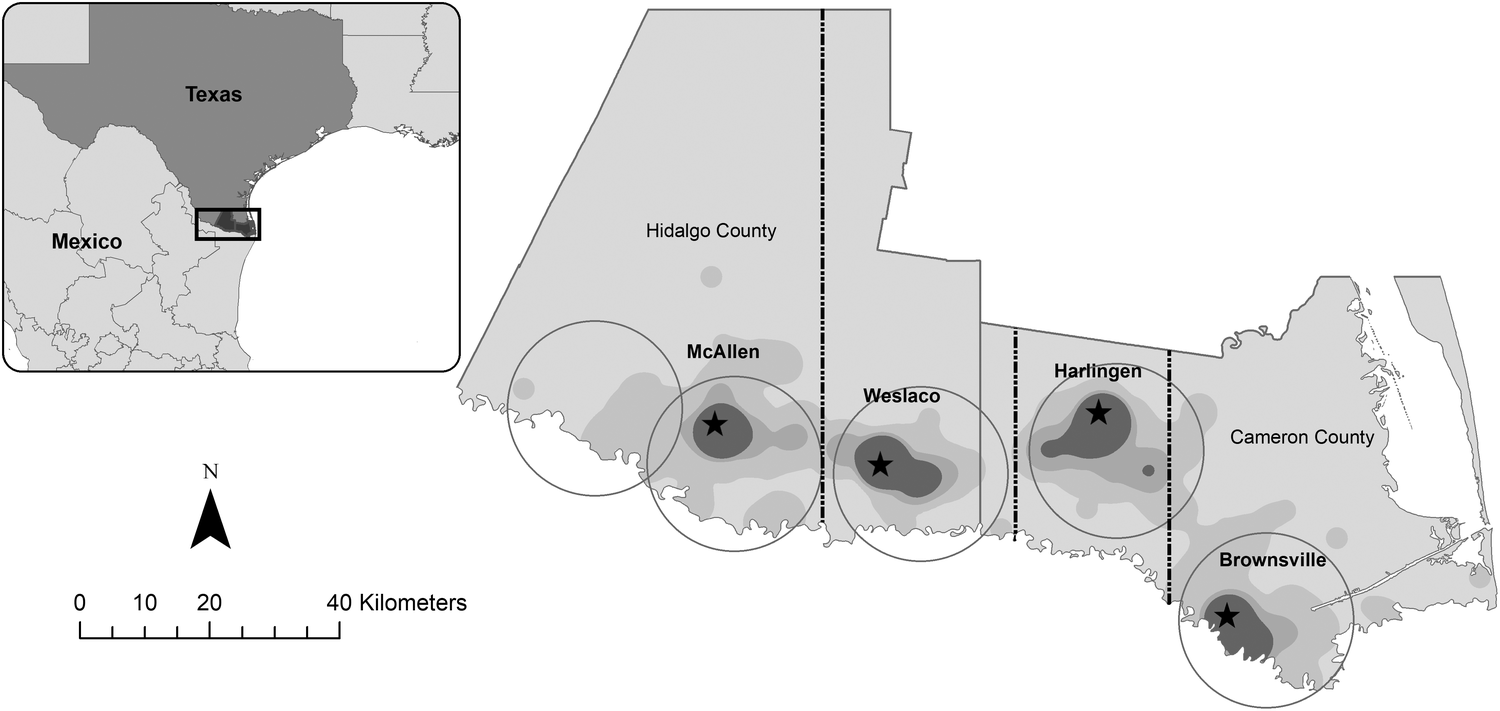
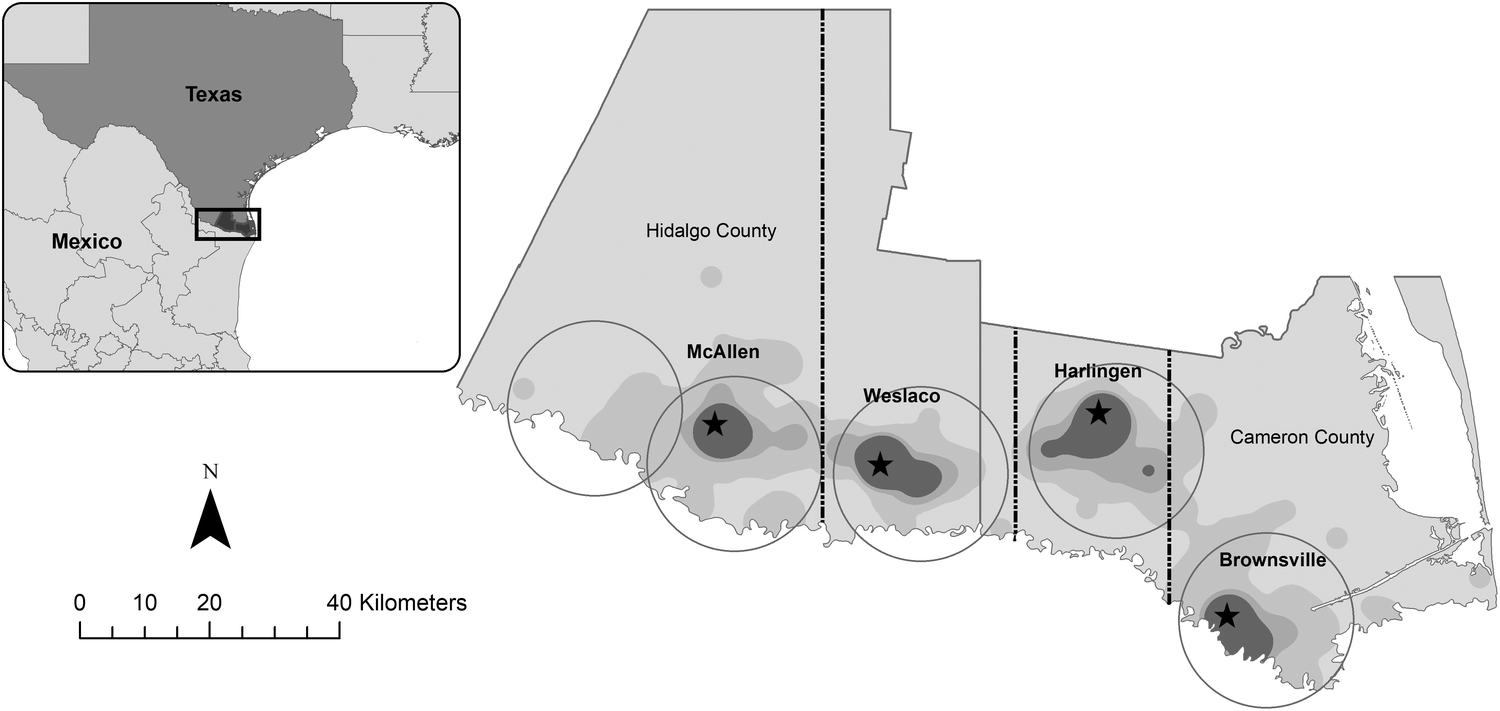
The LRGV contains four known RCAM roosts – one each in the cities of Brownsville, Harlingen, Weslaco, and McAllen. These roosts are separated by an average of about 30 km. Roosts were found in suburban neighborhoods in all cities except Brownsville, where the roost was always in a 24-acre (9.7 ha) city park. In Harlingen, Weslaco, and McAllen the exact roost locations varied within a radius of about 1.5 km but were always located in the same type of suburban neighbourhood. For our data collection and analyses we divided the LRGV into four sections with each section containing one of the four roosts (Figure 1).
Red-crowned Amazon range map throughout the Lower Rio Grande Valley of Texas. Dotted lines separate eBird, iNaturalist, and Christmas Bird Count locations used in this study by longitude to coincide with their respective roosting areas. Shaded areas represent where Red-crowned Amazons were seen most often from June 2016 through May 2019 and were created in ArcMap 10.6.1. Roosts occurred in the areas marked by stars. The five circles represent the 24-km diameter Christmas Bird Count circles that recorded Red-crowned Amazons at least once in their history.
The Lower Rio Grande Valley is generally flat, with the main habitats including coastal wetlands, remnant riparian forests along the Rio Grande and its oxbow lakes, and Tamaulipan thorn scrub (Brush Reference Brush2005, Monterrubio-Rico et al. Reference Monterrubio-Rico, Charre-Medellín, Pacheco-Figueroa, Arriaga-Weiss, Valdez-Leal, Cancino-Murillo, Escalona-Segura, Bonilla-Ruz and Rubio-Rocha2016). Although some natural habitat does exist, RCAM inhabit urban and suburban areas almost exclusively. The neighbourhoods containing RCAM roosts and nests generally consist of small (0.1 to 0.5 ha) properties. These plots usually contain a home and moderately landscaped yards. Yards contain turf and a wide variety of native and non-native shrubs and small citrus trees. Larger trees were usually mesquite Prosopis sp., live oak Quercus virginiana), Washingtonia spp. palms, ash Fraxinus sp., and other native and non-native trees to a lesser extent. The LRGV consists of a humid subtropical climate in the east which transitions to a hot semiarid climate in the west and annual rainfall averages 697 mm in Brownsville to the east and 564 mm in McAllen in the west (NOAA 2018). Much of the LRGV has been converted to agriculture and the metro areas are urbanizing rapidly (U.S. Census Bureau 2011).
Historical presence in South Texas
To determine when RCAM first appeared in Texas we reviewed the published literature by searching Google Scholar for the terms “Red-crowned Amazon AND Texas”, and “Amazon viridigenalis AND Texas” while replacing the term “Red-crowned Amazon” with other common names such as “Red-crowned Parrot” and “Green-cheeked Amazon”. All resulting publications mentioning parrots in Texas were reviewed. Many of the earliest records mention “parrots” or “green parrots” and provide no scientific or common names. Green Parakeets Psittacara holochlorus, Yellow-headed Amazons Amazona oratrix, and Red-lored Amazons Amazona autumnalis share similar color and characteristics with Red-crowned Amazons and occur naturally in northern Tamaulipas, Mexico. The possibility that these early accounts were of these other species cannot be discounted. However, owing to the large population of RCAM in the late 1800s, their propensity to wander during the non-breeding season, and their close proximity to the Rio Grande (Enkerlin-Hoeflich Reference Enkerlin-Hoeflich, Gonzalez and Valdelamar2000), it is reasonable to presume that at least some of the birds mentioned were Red-crowned Amazons.
To analyse trends of Red-crowned Amazons in the LRGV, we downloaded the eBird Basic Dataset through April 2019 and filtered sightings using the auk R package (Strimas-Mackey et al. Reference Strimas-Mackey, Miller and Hochachka2017, eBird Basic Dataset 2019). Sightings were confined to only Cameron and Hidalgo counties. All bird checklists submitted to eBird containing sightings of Red-crowned Amazons were analysed and duplicate sightings and checklists were removed. To avoid data duplication, the first author’s (S. Kiacz) personal eBird submissions were removed from the analyses since many of the checklists contain the same counts used in the “Roost Counts” section of our study. After data filtering, 8,362 eBird reports of RCAM were left for analysis. In order to establish the geographic origins and spread of RCAM across the LRGV, we report the earliest eBird records for each major LRGV city. To determine whether RCAM were being reported more often over time, we analysed the percentage of checklists (complete and incomplete) which registered RCAM presence each year. In order to illustrate overall population trends, the 10 highest eBird counts per year since RCAM arrival in the LRGV are reported as a three-year moving average.
To provide another independent view of the arrivals and trends of RCAM, we used Christmas Bird Count (CBC) data, which includes wintering (December–January) bird count data from 24-km diameter count circles (National Audubon Society 2010). Counts are conducted by local volunteers and the number of participating volunteers and execution of different counts is variable among years. To analyse overall trends, we combined and graphed the total number of RCAMs from all LRGV count circles reporting them through time as a three-year moving average. Six count circles have reported RCAM in the LRGV, including counts centered near Brownsville, Harlingen, Weslaco, and McAllen (Figure 1). These counts encompass the main areas in which RCAM roost and nest. One count circle, centered on Brownsville, was discontinued in the 1980s but started anew from the same location during the same time although it used a different count code, so only five count circles are shown in Figure 1.
Roost counts
To quantify current LRGV population size, we collected roost attendance data from each of the four known roosts from June 2016 to May 2019 (n = 412). Counts were conducted during the spring (March–May; n = 104), summer (June–August; n = 137), fall (September–November; n = 50), and winter (December–February; n = 121).
Here we report results from two different, but similar, types of counts. The Tejano Parrot Project (TPP), a group consisting of the lead author and local volunteers trained by the lead author, conducted most counts (n = 356). One or two TPP members conducted a single roost count per night, covering all four roosts over a one-week period. To calculate weekly aggregates of the total roosting population across the LRGV, counts from each roost within a seven-day span were added together (these will be referred to as “TPP” counts hereafter). Weekly aggregates during which RCAM were likely double counted because birds moved from their home roost to a neighbouring roost (roost switching) were omitted from our analyses. Roost switching was evident when one roost would have limited or no RCAM attendance while a neighbouring roost had an unusually high number of RCAM within a one-week span. Additionally, we report results from quarterly counts organized by the Texas Parks and Wildlife Department conducted in January, April, July, and October (n = 56). TPWD counts were conducted at all four roosts simultaneously by an average of 42 volunteers per count (range = 28–71; these counts will be referred to as “TPWD” counts hereafter). The TPWD counts gave LRGV minimums without the chance of roost switching biases but required a large contingent of volunteers. Both TPP and TPWD counts used the methodology explained in the following paragraph.
Surveyors arrived in the general roost areas an average of 60 minutes before sunset to count the parrots as they arrived at the roosts. Roosts were not surveyed during thunderstorms or other severe weather because sighting birds became difficult and parrots may not attend roosts during such weather (Cougill and Marsden Reference Cougill and Marsden2004). Surveys were not done in the morning because parrots left the roosts quickly and in large flocks making counting difficult and inaccurate. Additionally, parrots at three of the four sites did not consistently roost at the same location so surveyors were unlikely to find the roosts before the parrots left in the morning. In Brownsville, Red-crowned Amazons roosted in the same park every night during this study, so all observers waited in the park and counted parrots as they arrived. At the other three sites, RCAM regularly roosted within the same neighbourhoods, but not in the same location. For TPP counts, observers drove through these neighbourhoods until they found the parrots and once found, parrots were followed, counted, and photographed. For TPWD counts, observers were stationed at different points around the city and reported groups as they flew in, then followed the main group once it was located. Final counts were usually obtained just before sunset when the majority of the birds flew as a single flock or perched as a group on power lines. If photos were obtained, exact counts were acquired by counting individual RCAM on the photos, otherwise counts were determined by counting flock size by groups of 5–10 individuals.
Historical and current nesting in South Texas
Nesting data were gathered from previous RCAM accounts reported in various outlets as well as from online databases such as the Texas Breeding Bird Atlas (Benson and Arnold Reference Benson and Arnold2001) and iNaturalist. Additional nesting data were collected by our team during the breeding seasons (March–May) of 2017 and 2018. We found nests by surveying suburban areas throughout the LRGV by car and searching for duetting pairs of RCAM and locating trees with potential cavities. Some RCAM pairs were followed until nesting locations were found. Locations of trees with cavities were noted and revisited multiple times throughout the breeding season to determine whether cavities had active nests. Nesting activities were considered “likely” if a cavity was large enough for a parrot and RCAM were heard/seen duetting nearby (<50 m). Nests were considered active if RCAMs were seen emerging from the cavity when the base of the tree was gently knocked on, RCAM were seen entering the cavity, or RCAM were seen in the nest cavity using a camera probe on a telescoping pole.
Productivity
Juvenile attendance at roosts was estimated by counting the number of adults and juveniles while conducting TPP roost counts. During our roost counts, we detected juveniles as early as mid-June and as late as February. However, we report productivity from July and August when the majority of fledglings that were attending roosts still had obvious physical features separating them from adults (eye colour, overall size, tail length) in addition to begging behaviour and poorer flight skills. During each TPP roost count, we checked as many RCAM as possible for adult/juvenile status. To avoid double-counting individuals during roost counts we only counted groups of birds as they flew into the roost and landed, and avoided as much as possible any individuals moving within the roost. When possible, we would count adults and juveniles when large groups lined up on power lines. To avoid biased estimates due to small sample sizes in our estimates of overall juvenile percentages, we excluded from our analyses counts when we checked <10% of the total roost or <20 individuals for adult/juvenile status. Fifty-two counts met our threshold and on average we were able to check 38% (60 ± 32) of parrots attending the roosts for adult/juvenile status.
Data analysis
Individual roost counts (n = 412) and aggregated roost counts (n = 80) were tested for normality using Shapiro-Wilk goodness-of-fit tests; both were non-normal (P < 0.0001, P < 0.0075 respectively). We therefore conducted Kruskal-Wallis tests and Dunn’s post-hoc tests to examine the effect of season on attendance for aggregated roost counts, and season, year, and city on attendance at individual roost counts. To determine if productivity varied among cities, we tested the effects of year, city, and city by year on juvenile percentage (juvenile/adult ratio) using a two-way ANOVA. Productivity data were tested for normality (P < 0.05) using a Shapiro-Wilk goodness-of-fit test (P = 0.7509). All statistical analyses were calculated using JMP Pro 14. Alpha level for all tests was 0.05 and data are presented as mean ± standard deviation unless otherwise noted.
Results
Historical presence in the Lower Rio Grande Valley
Narrative accounts:
Reports of parrots in south Texas start during the late 19th century when drought and severe winter weather were affecting northeast Mexico and south Texas (Stahle et al. Reference Stahle, Cook, Burnette, Villanueva, Cerano, Burns, Griffin, Cook, Acuna and Torbenson2016). In 1885, the Galveston Daily News reported that travellers were seeing flocks of parrots as close as 34 km south of Brownsville, Texas (Anonymous 1885a, Casto Reference Casto2010). Also in 1885, a south Texas newspaper reported flocks of parrots north of Brownsville and noted this as the first instance of these birds being seen in Texas (Anonymous 1885b, Casto Reference Casto2010). In March 1899, during another severe cold front, “100s” of parrots were reported just south of Corpus Christi, Texas, roughly 190 km north of Brownsville (Anonymous 1899, Casto Reference Casto2010). Skins of “Mexican parrots” taken near Corpus Christi (likely from the same flock witnessed in 1899) were noted by Florence Merriam Bailey in 1900 at a ranch just south of Corpus Christi (Bailey Reference Bailey1916, Casto Reference Casto2010), approximately 175 km north of the Texas-Mexico border.
Few reports exist during the early and mid-1900s; it was reported that Red-crowned Amazons roosted in a pump house in La Feria during the 1920s and a home movie taken in 1956 was described by Walker and Chapman (Reference Walker and Chapman1992) as showing four RCAM feeding in a pecan tree somewhere in south Texas. It is not until the 1970s that Red-crowned Amazons were identified with regularity and accuracy in south Texas with field notes from reliable observers (Webster Reference Webster1977, Walker and Chapman Reference Walker and Chapman1992). John Arvin reported RCAM at Anzalduas Park on the Rio Grande, near McAllen, during September 1973 and 10 RCAM were seen continuously during the winter (December–February) of 1976 in Brownsville (Webster Reference Webster1974, Neck Reference Neck1986). RCAM were then seen regularly only during winter months (December–March) until 1985 when they started being noted year-round in the LRGV (Walker and Chapman Reference Walker and Chapman1992, Burgess Reference Burgess2006, eBird Basic Dataset 2019, U.S. Fish and Wildlife Service 2019).
eBird:
As of April 2019, 193,816 eBird checklists (complete and incomplete) had been entered for the LRGV, with 8,483 (4.3%) of those reporting sightings of RCAM. The first eBird record of RCAM in Texas is of an individual in Hidalgo County at Santa Ana National Wildlife Refuge (Santa Ana NWR) in March of 1973. The next record is from Brownsville in May 1976 and then an almost six-year gap occurs until the next record of a pair flying along the Rio Grande at Santa Ana NWR in April of 1982. From 1982 on, yearly records of RCAM occur in the LRGV, with annual occurrences reported in Brownsville starting in 1984, McAllen in 1985, Harlingen in 1995, and Weslaco in 1999.
RCAM are reported in all LRGV roost areas during the 1981-1985 timespan except Weslaco, where reports began during 1991-1995. In the LRGV area, the number of checklists entered increases greatly since the 1980s but the percentage of checklists containing RCAM stays relatively consistent since the 1986–1990 period. The total number of entered checklists and the number of checklists including RCAM were not dispersed uniformly through the LRGV. Overall, the McAllen area had 71,817 checklists with 2% reporting RCAM, Brownsville 70,275 (3.4%), Weslaco 36,869 (7.7%), and Harlingen 14,755 (12%). In Brownsville and McAllen, checklists including RCAM hover around 2–6% of all checklists entered from 1981 until present. However, in Harlingen and Weslaco, large increases of checklists including RCAM occur from 1991-2000 and drop to about 11% and 6% respectively in the last five years.
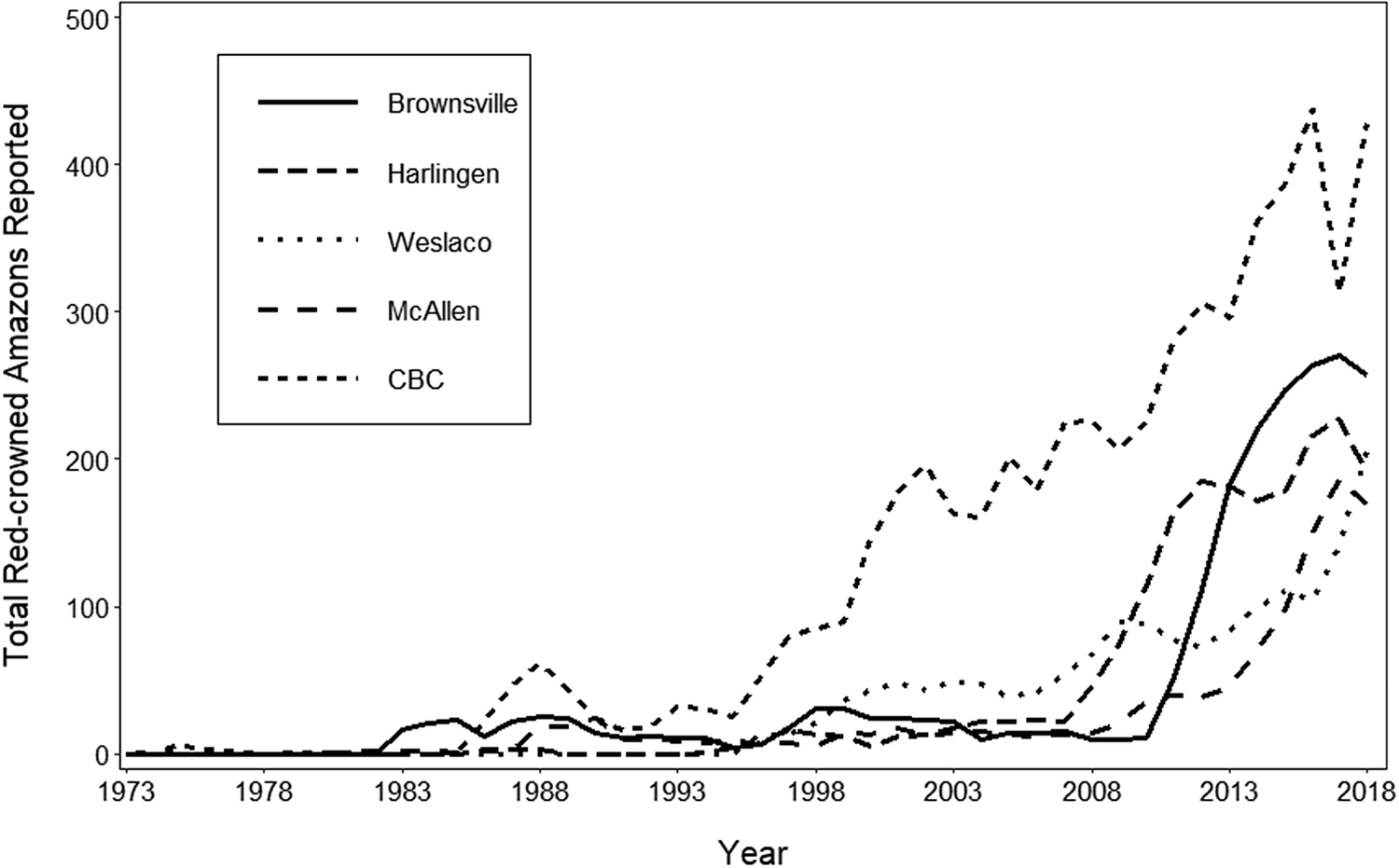
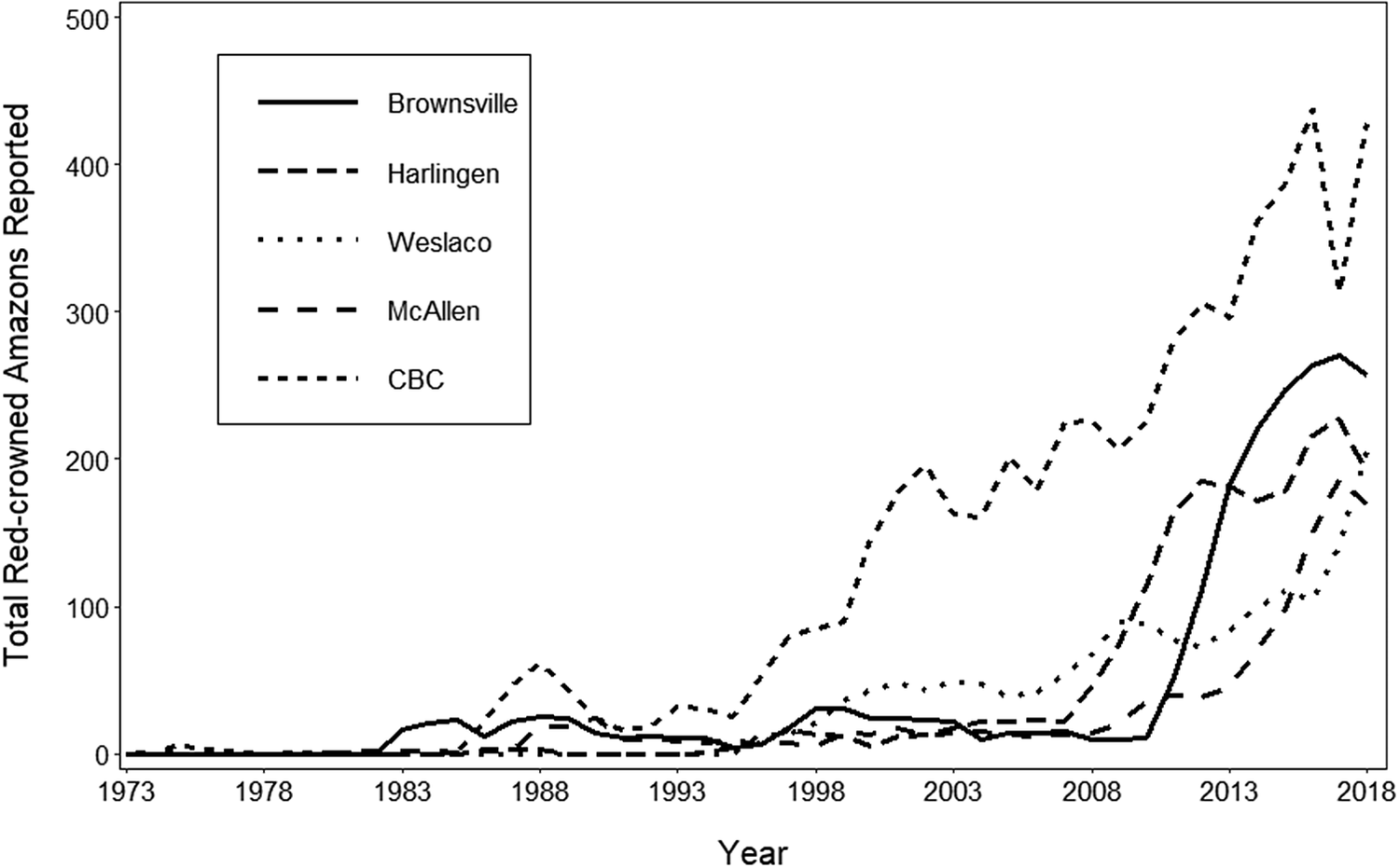
Throughout the four roost cities of the LRGV, eBird data suggest that the populations of RCAM show little or no growth from the 1970s through the late 1990s (Figure 2). Very small increases occur in Brownsville and McAllen during the 1980s into the 1990s. Starting in 1998, the number of birds in Weslaco and Brownsville increases but it is not until 2008 to 2011 that the numbers in all four cities begin to show major and sustained growth. Over the past five years, RCAM in all four cities have continued to increase, but there is some indication that this growth is starting to level off in all cities except Weslaco.
Moving three-year averages of the top-ten (if available) highest reported numbers of Red-crowned Amazons on eBird checklists in the Lower Rio Grande Valley of Texas. Data are reported as coinciding with the four main roosting areas of Brownsville, Harlingen, Weslaco, and McAllen. Also included is the three-year moving average of the total number of Red-crowned Amazons counted yearly throughout all five Christmas Bird Count circles in the LRGV, labeled as ‘CBC’. Data are from January 1973 through December 2018.
Christmas bird counts:
Six Christmas Bird Count circles within the LRGV area have reported RCAMs at least once throughout the history of the count. The earliest CBC record of RCAM in the LRGV was in 1976 in Brownsville’s TX10 circle when six birds were reported. At least one but fewer than six RCAM were reported yearly from 1976 through 1986 in the LRGV (Figure 2). Since 1986, the annual numbers of birds reported has been highly variable but increasing overall. The CBC counts over the last five years have been too variable to determine if the population is continuing to increase or if it has levelled off.
Current populations
Roost Counts:
The three largest TPP aggregate counts were 680, 670, and 665 occurring during January 2017, July 2018, and Dec 2016, respectively. The largest TPWD counts were similar with 659, 650, and 648 RCAM counted in October 2018, January 2016, and October 2016, respectively. TPP counts at individual roosts ranged from 0 to 435 RCAM (mean = 112 ± 78.6, n = 356), while TPP aggregated counts ranged from 151 to 680 (mean = 447.5 ± 139.3, n = 66). TPWD counts at individual roosts ranged from 0 to 350 RCAM (mean = 132 ± 85.8, n = 56), while aggregates ranged from 251 to 659 (mean = 527 ± 138.8, n = 14). In total, 91% of all roost count attempts registered at least one RCAM, whereas in Brownsville roosts had 100% site fidelity and RCAM were registered on 100% of count attempts.
Roost switching at a large scale, when at least one of the four roosts was roughly twice its normal size and another roost has little or no attendance, only occurred during the winter months (December–February). From December 2016 through January 2017, Brownsville and McAllen had extremely high attendance (counts of 300 and 380, respectively) while no parrots were located in Weslaco and Harlingen during this time. A similar pattern occurred the following year during January 2018, and then from December 2018 through early February 2019 high counts in Weslaco (350) and Brownsville (250) coincided with an absence of parrots being found in Harlingen and McAllen.
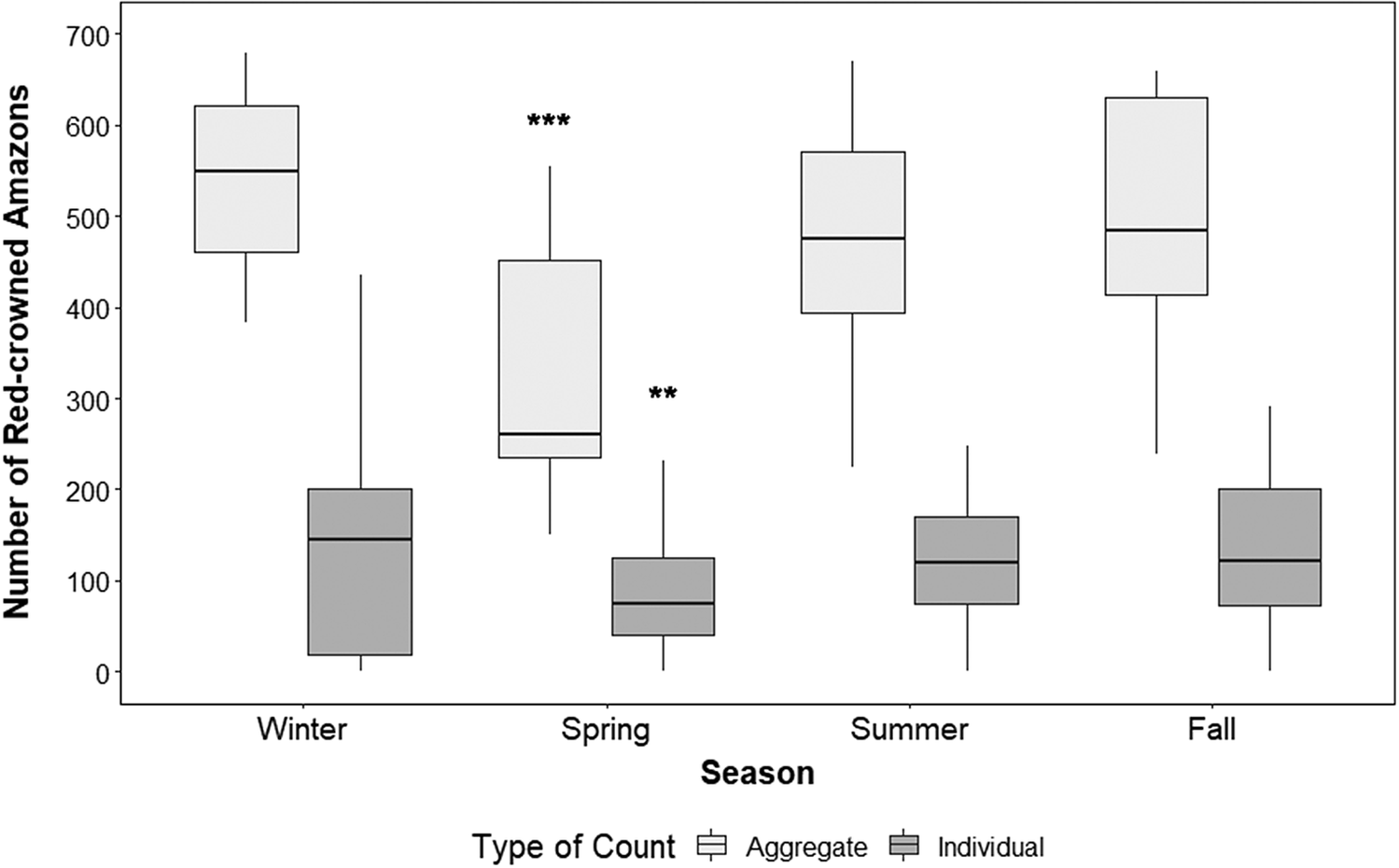
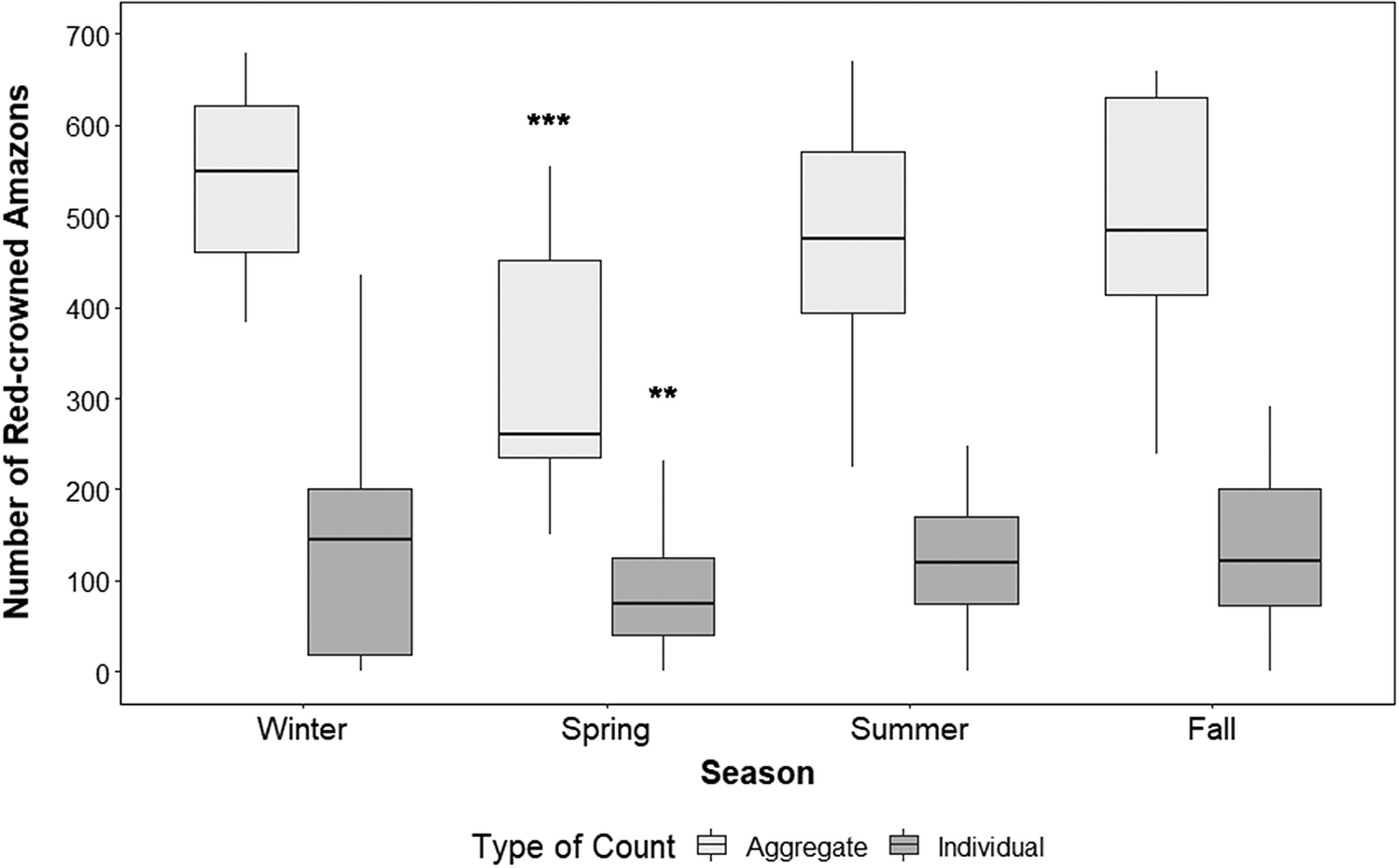
Seasonal fluctuations in roost attendance (TPP and TPWD counts) were apparent with fewer birds attending individual roosts during the spring (March–May) versus summer (June–August), fall (September–November), and winter (December–February; Kruskal-Wallis; χ2= 19.0, P = 0.0003; Figure 3). Aggregate LRGV-wide count totals (TPP and TPWD counts) were also significantly less during the spring (mean = 327 ± 143.6) compared to summer (mean= 473 ± 113.2), fall (mean= 502.9 ± 133.8), or winter (mean= 539 ± 94.9; χ2 = 20.3, P <0.0001; Figure 3). Roosts were significantly smaller in McAllen (mean = 66) than at all other sites, while Brownsville averaged the largest (mean= 173; χ2 = 109.6, P <0.0001). There was no significant difference in average roost size by year (χ2 = 5.9, P = 0.1156). Overall, roost counts averaged 128 birds in 2018, slightly more than the average of 111 birds during 2016, and 109 birds in both 2017 and 2019. The increase in 2018 was likely due to fewer counts in McAllen (the smallest roost) relative to other years rather than a real difference in roost attendance.
Average roost count size by season for both individual counts (dark gray) and total aggregate counts (light grey) from both Tejano Parrot Project and Texas Parks and Wildlife Department roost counts. Individual roost counts (n = 412) were significantly less during spring (March–May) compared to all other seasons, while summer, fall, and winter did not differ statistically (**; Kruskal-Wallis; χ2= 19.0, P = 0.0003). Aggregate counts (n = 80) were also significantly less during spring compared to all other seasons, while summer, fall, and winter did not differ statistically (***; Kruskal-Wallis; χ2 = 20.3, P < 0.0001). Data are from January 2016 through April 2019.
Nesting:
Before 1980, most records of RCAM in the LRGV were during the non-breeding season, suggesting that the birds did not breed in Texas at this time. The first substantiated LRGV records of RCAM during the breeding season consisted of a flock of six reported throughout the year in 1976 in Brownsville (Webster Reference Webster1977) and one RCAM at Bensten-Rio Grande Valley State Park in June of 1978 (Webster Reference Webster1978). These records may indicate either escaped pets or natural wanderers, but no breeding activity was reported for these birds. The first known nesting in Texas was observed in Harlingen in 1985 when a pair successfully fledged one young (Lasley and Sexton Reference Lasley and Sexton1985). The Texas Breeding Bird Atlas reports the earliest nests in Brownsville, Weslaco, and McAllen from the early 1990s (Burgess Reference Burgess2006). Reports of RCAM nesting in San Marcos, Texas (~425 km north of the Texas-Mexico border) from 1990–1993 and in Victoria, Texas (~315 km north of the border) in 1989 are presumably of escaped pets. A nesting parrot survey by B. McKinney in 1995 found 10 nests in Brownsville, three in Harlingen, and three in McAllen (Burgess Reference Burgess2006).
iNaturalist’s earliest nesting records are from 1995 in San Benito (near Harlingen) and a 2010 record in the McAllen area (iNaturalist.org 2019). Additional breeding records are posted from Brownsville (20 since 2016), Harlingen (one in 2016), and McAllen (one in 2015).
During our study, we found 72 likely nest cavities (defined as a cavity of the correct size and shape with RCAM duetting within earshot) throughout the LRGV, excluding Brownsville. Twenty (28%) of these cavities were on commercial properties in urban or suburban areas, while the majority (51; 72%) were on residential properties in neighborhoods. Of these, at least 34 were active for one or more years over the three-year study (i.e. RCAMs were seen spending at least 10 minutes inside the cavity). Most active nests were found in the Harlingen area, including neighbouring San Benito (21 of 34; 62%), seven (21%) were found in Weslaco and the surrounding areas, and six (18%) in the McAllen region. Twenty-one (62%) nests were in dead non-native palm trees, with the majority of those (86%) in Washingtonia sp. palms. Six (18%) were in living Fraxinus sp., while three (9%) were found in living Populus sp.
Productivity:
The number of parrots checked for adults/juvenile status averaged 60 ± 32 (range = 20–165), and the number of juveniles detected averaged 12 ± 6.8 (range = 0–34) per roost. The number of RCAM attending these roosts averaged 159 ± 49 (range = 45–225) per roost count (n = 52). The maximum of 34 juveniles was seen in Harlingen in July 2018.
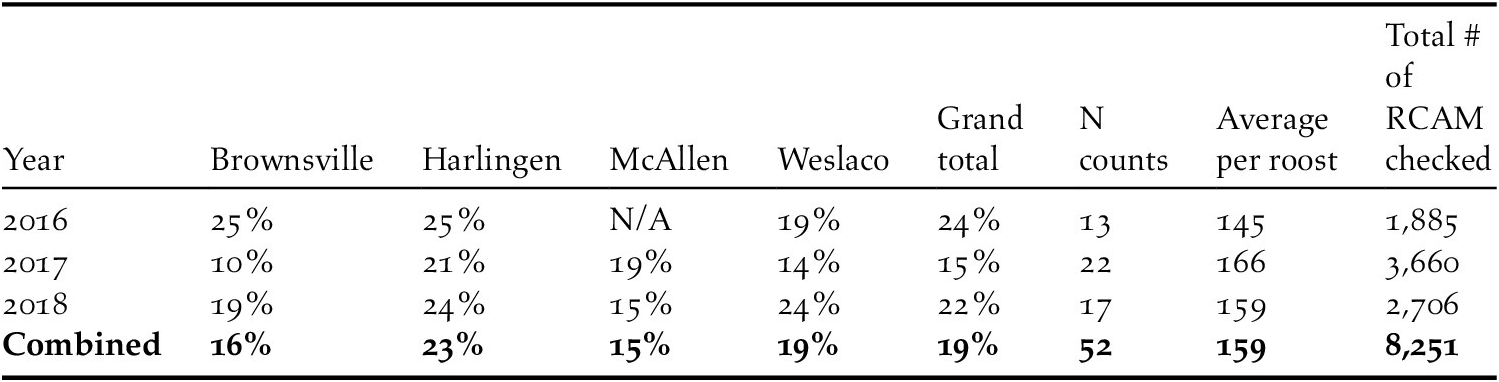
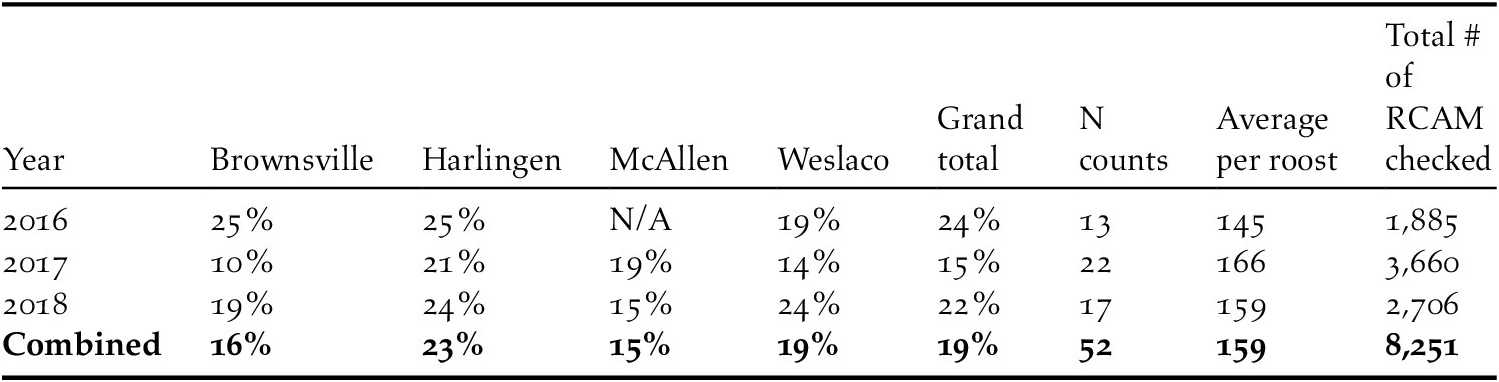
The average percent of juveniles at roosts throughout the LRGV was 19% across the three years of the study (2016–2018; Table 1). Overall, productivity by city ranged from 10% in Brownsville in 2017 to 25% in Harlingen in 2016. However, these differences in juvenile percentage did not vary significantly among cities, years, or city by year (two-way ANOVA; r2 = 0.21, F(10,41) = 1.12, MSE = 0.01, P = 0.37).
Overall juvenile percentages for Red-crowned Amazons recorded at roosts during July and August from 2016 through 2018 in the Lower Rio Grande Valley of Texas. Data are reported for the four regions shown in Figure 1. “N counts” is total number of roost counts per year combined across all cities. “Total # of RCAMs checked” is the sum of all juvenile and adults checked for adult juvenile status per year. “Average per roost” is the “Total number of RCAMs checked” divided by the “N counts” conducted that year.
Discussion
Origins
RCAM have likely been entering south Texas from northern Mexico since at least the late 1800s. Most early records (<1980s) occur during the non-breeding season from September to March, which coincides with previously reported large-scale movements in Mexico and California (Enkerlin-Hoeflich and Hogan Reference Enkerlin-Hoeflich, Hogan, Poole and Gill1997). Many of the early records also coincide with major winter weather events when food supplies were likely disrupted in their normal range, forcing large movements in search of food (Casto Reference Casto2010).
By the 1970s, RCAM were being regularly reported, mostly during the winter months, throughout the LRGV. eBird and CBC data confirm the occasional reports during the 1970s, with an increase of sightings during the 1980s. By the mid-1980s, the population was established in the LRGV seemingly through multiple points of entry, from Anzalduas Park in the west to Brownsville in the east (roughly 87 km apart).
It is uncertain if the currently established population of RCAM in the LRGV was founded by birds brought to the area as part of the pet trade or through natural dispersal events. Given the historical 1800s records, close proximity of their Mexico range, habitat destruction in Mexico, and the time of year of the earliest records it is likely that at least some of the founding birds dispersed naturally from Mexico into the United States (Webster Reference Webster1974, Reference Webster1977, Reference Webster1978, Reference Webster1982, Neck Reference Neck1986, Walker and Chapman Reference Walker and Chapman1992, Casto Reference Casto2010). However, during the 1970s and 80s, RCAM were being harvested in large numbers in Mexico and exported to the USA en masse (Enkerlin-Hoeflich and Hogan Reference Enkerlin-Hoeflich, Hogan, Poole and Gill1997, Cantu et al. Reference Cantu, Saldana, Grosselet and Gamez2007). In addition, other parrot species with established populations in the LRGV (Lilac-crowned Amazon Amazona finschi, White-fronted Amazon Amazona albifrons and Red-lored Amazon most likely originated from escaped pets given the large distance to their native ranges. Both lines of evidence suggest that at least some of the LRGV RCAM population came from captive origins (Neck Reference Neck1986, Walker and Chapman Reference Walker and Chapman1992, Enkerlin-Hoeflich and Hogan Reference Enkerlin-Hoeflich, Hogan, Poole and Gill1997). Our review of RCAM in the LRGV has provided no evidence that shows conclusively where the founders of the LRGV population originated, but it is likely that both birds from the pet trade and natural dispersal played a role in the establishment of the species in south Texas.
Both eBird and CBC datasets show the population grew little from 1973 to 1983 and again from ~1985 to 1995. These lags follow a well-known pattern seen during species establishment (Crooks and Soulé Reference Crooks, Soulé, Viken, Schei and Sandlund1999, Sakai et al. Reference Sakai, Allendorf, Holt, Lodge, Molofsky, With, Baughman, Cabin, Cohen and Ellstrand2001, Crooks Reference Crooks2005, Runde et al. Reference Runde, Pitt and Foster2007, Valéry et al. Reference Valéry, Fritz, Lefeuvre and Simberloff2009). Although populations with few founders have inherently low rates of increase during the immediate years following establishment (Crooks and Soulé Reference Crooks, Soulé, Viken, Schei and Sandlund1999), an additional factor likely playing a role in these lags is the allee effect which correlates small population sizes with low or negative population growth rates (Stephens et al. Reference Stephens, Sutherland and Freckleton1999, Wang et al. Reference Wang, Liang and Wang1999, Collazo et al. Reference Collazo, Fackler, Pacifici, White, Llerandi-Roman and and Dinsmore2013). Small population sizes can negatively affect predator avoidance, mate choice, and information exchange and may limit population growth especially in gregarious species (Stephens and Sutherland Reference Stephens and Sutherland1999, Beissinger et al. Reference Beissinger, Wunderle, Meyers, Sæther and Engen2008, Buhrman-Deever et al. Reference Buhrman-Deever, Hobson and Hobson2008, Courchamp et al. Reference Courchamp, Berec and Gascoigne2008, Wright et al. Reference Wright, Lewis, Lezama-Lopez, Smith-Vidaurre and Dahlin2019). Additionally, poaching in the LRGV during this establishment period certainly could have hampered potential growth.
To negate allee effects or other population suppressors, population size must reach a certain threshold. The small increase in the population during the mid-1980s, shown in both eBird and CBC datasets, may have provided the boost in numbers needed to break the cycle. There are two possibilities that may have caused the increase. A natural dispersal event from Mexico is possible, as there was an unprecedented freeze during the winter of 1983–1984 which may have driven RCAMs to disperse north from Mexico (Walker and Chapman Reference Walker and Chapman1992). Additionally, this freeze killed many non-native Washingtonia palm trees in the LRGV which became suitable nesting habitat for RCAM (see Lasley and Sexton Reference Lasley and Sexton1985) perhaps leading the way to the rapid increase in population during the mid-1990s. The second possibility is that the population increase in the mid-1980s was driven by increased releases or escapes from the pet trade. Throughout the 1970s and early 1980s, 16,490 Red-crowned Amazons were legally imported to the United States, and roughly the same number was estimated to have been imported illegally (Iñigo-Elias and Ramos Reference Iñigo-Elias, Ramos, Robinson and Redford1991, Enkerlin-Hoeflich and Hogan Reference Enkerlin-Hoeflich, Hogan, Poole and Gill1997). Although not all these imports entered the U.S. through Texas, it is likely the majority did because of the close proximity to where the birds were harvested. It seems very possible that a combination of natural dispersal and escaped individuals led to the initial increase that allowed the population to escape the allee effect and begin the growth documented during the mid-1990s.
Current status
Using two separate but similar roost count methodologies, we found a minimum of 659–680 RCAM across the roosts in the LRGV. The actual population could be slightly higher if we missed roosts during our counts or if our assumption that all RCAM attend roosts nightly during the non-breeding seasons does not hold. It seems unlikely we would miss large roosts since RCAM roost in residential areas and are loud and conspicuous, even to non-birdwatchers. In addition, the LRGV is one of the most heavily birded areas in the entire U.S. (Mathis and Matisoff Reference Mathis and Matisoff2004), leading us to believe that over the course of multiple years it is unlikely that a decent sized roost could persist undetected. We have occasionally found “mini-roosts” of 10–15 RCAM separated from the main roosts by over 8 km, but these events were confined to the breeding season and were not known to take place during the post-fledging season when our high counts occurred. Roost attendance by Amazona parrots is known to be variable from day to day (Cougill and Marsden Reference Cougill and Marsden2004) but our large number of roost counts (n = 412) over all four seasons likely negates any effect that small daily fluctuations would have. Recent VHF radio-tracking in this population has shown that birds do switch roosts occasionally (Kiacz and Brightsmith unpubl. data) but since our counts are LRGV-wide and we surveyed all suspected roosts, when roost switching did occur, we were still able to detect all tracked birds and likely negate any effect from roost switching on our estimated minimum population size.
Our counts suggest that the population has apparently remained stable from 2016 through 2019, which may signal that the rapid population growth of the past two decades is slowing. This is somewhat surprising; although the population appears healthy overall, it could be reaching carrying capacity in the LRGV. Cavity availability is often a limiting factor for secondary-cavity nesters like RCAM, especially in human-modified habitats (Cornelius et al. Reference Cornelius, Cockle, Politi, Berkunsky, Sandoval, Ojeda, Rivera, Hunter and Martin2008, Cockle et al. Reference Cockle, Martin and Drever2010). Although we did not specifically collect cavity availability data, we did notice that residential and commercial landscaping commonly removes nest structures across the LRGV (S. Kiacz pers. obs.). Homeowners regularly remove dead palm trees on their properties because they are not visually appealing and may be hazardous. The same is true for any large tree (Fraxinus sp., Populus sp., Carya sp.) that is weak or dying and presents a hazard to homes, roads, or walkways. This is unfortunate since most nests found during this study were in dead non-native Washingtonia sp. palm trees, and all were located on private commercial or residential property. Because these birds are rarely utilizing protected state and federal lands, initiatives which only affect these types of property will have a reduced impact. Poaching can also destroy cavities for future use by felling nest trees or enlarging the cavity entrances to reach the chicks inside (Cantu et al. Reference Cantu, Saldana, Grosselet and Gamez2007). Nest cavities destroyed by poachers were regularly seen over the course of our study. Although urbanization and ornamental planting may increase the amount of nesting structures desirable to RCAM, poachers, property owners, and commercial landscapers may well be destroying these structures at a similar rate. Further studies are warranted to determine whether nesting cavities are a limiting factor for this RCAM population.
Productivity (19% LRGV-wide over the course of our study) seems to be at levels comparable to other studies of Amazona parrots. Red-tailed Amazons Amazona brasiliensis were found to have 31.6% and 4.6% juveniles in protected and non-protected populations, respectively (Martuscelli Reference Martuscelli1995). During another Red-tailed Amazon study, researchers found that 18% of groups flying to a roost consisted of three or more birds (Cougill and Marsden Reference Cougill and Marsden2004). Similarly, two studies of Yellow-naped Amazon showed a 24% (Wright et al. Reference Wright, Lewis, Lezama-Lopez, Smith-Vidaurre and Dahlin2019) and 18% (Matuzak and Brightsmith Reference Matuzak and Brightsmith2007) rate of groups of three or more attending roosts. If we assumed these groups of three or more were successfully fledgling two young apiece (as RCAM average; Enkerlin-Hoeflich Reference Enkerlin-Hoeflich1995), these three populations would be averaging about 19% (Red-tailed Amazon), 15%, and 15% (Yellow-naped Amazon) juveniles, respectively. Clearly, this analysis is crude at best, but it offers a comparative glimpse of Amazona populations. Our LRGV population of Red-crowned Amazons was stable over the course of our study, the Red-tailed Amazon populations were likely stable or declining, and the Yellow-naped Amazon population was likely declining. If valid, this comparison suggests that there may be a fine line between stable and declining populations. Productivity rates should continue to be monitored in the LRGV population on a yearly basis and compared to the current trend. If rates continue to drop, more active conservation measures should be considered.
Acknowledgements
Thanks to the Tejano Parrot Project volunteers: Sue Griffin, Tamie Bulow, Matthew Torres, Alicia Cavazos, and Corina Giron. We thank Texas Parks and Wildlife for use of their facilities and for organizing quarterly roost counts. Thanks also to Thomas H. White Jr. and Robin Bjork for help in the field and to the property owners throughout the LRGV who allowed us access to their land. Christmas Bird Count (CBC) Data are provided by National Audubon Society and through the generous efforts of Bird Studies Canada and volunteers across the western hemisphere (National Audubon Society 2010). Thanks also to Janice Boyd and the members of the Brightsmith Lab for input and support. Funding was provided through the Texas Parks and Wildlife Department and the State Wildlife Grant Program (grant F15AF01189). Additional support was provided by the Ecology and Evolutionary Biology Program and Department of Veterinary Pathobiology at Texas A&M University, The Parrot Fund USA, the Rio Grande Valley Birding Festival, and the Bay Area Birders of Laguna Vista Texas.