


Small businesses are of central importance in every advanced economy. In the USA, for example, there are over 33 million small businesses, defined as independent businesses that have fewer than 500 employees. These small businesses employ almost half (46 per cent) of all American workers, and are the source of about two-thirds of the growth in employment over the past quarter century.Footnote 1
Perhaps in recognition of this fact, politicians of all ideological stripes routinely lionize the contribution of small businesses and try to court their owners’ political support. In the most recent US presidential race, Kamala Harris announced her ‘love’ for small businesses, describing them as ‘part of the backbone of America’s economy’. Indeed, the first economic policy plan she laid out in the presidential debate was a $50,000 tax deduction to start-up small businesses.Footnote 2 While serving as the President, her Republican opponent, Donald Trump, had used similar language, describing small businesses as ‘the engine of American prosperity’.Footnote 3 Such statements by politicians are common in other OECD countries as well. In the UK, for example, the 2019 election manifesto of the Conservative Party described small and family businesses as ‘the backbone of the economy’ and noted that ‘Britain is immeasurably stronger for their contribution’.Footnote 4 Similarly, Labour’s platform under Kier Starmer describes small businesses as ‘the beating heart of our economy’,Footnote 5 and Ed Miliband, the former leader of the party, went as far as pronouncing New Labour ‘the party of small business’.
Despite the sheer number of small business owners and the prominence they receive in mainstream parties’ political appeals, strikingly little is known about the politics of this constituency. What characterizes the political views of small business owners? What explains their voting preferences? And what implications do the answers to these questions have for our understanding of the role of occupational class in politics?
In recent decades, a voluminous literature has examined the impact of labour market conditions on policy preferences and voting, yet the overwhelming focus has been on workers. For example, much has been written about the impact of the malaise of the manufacturing sector on its workers’ voting allegiance and on the impact of globalization-induced changes in employment on union members’ political attitudes (Baccini and Weymouth Reference Baccini and Weymouth2021; Jensen et al. Reference Jensen, Quinn and Weymouth2017; Kim and Margalit Reference Kim and Margalit2017). Broadly, the rise of populism in the twenty-first century is often traced to the effects of globalization and technological change on workers (Colantone and Stanig Reference Colantone and Stanig2018; Rodrik Reference Rodrik2021). This focus on workers has perhaps led scholars and analysts to overlook another major political constituency that in terms of sheer size is greater than any of the previously widely-discussed segments of voters, such as manufacturing workers and union members (14.4 and 14.1 million, respectively).
The lack of attention to small businesses in contemporary political economy research is surprising also for another reason: this has not always been the case. In fact, the ‘bourgeoisie’, and particularly the petit bourgeoisie – labels often pertaining to middle-class small business owners – have been central to classic theories of political economy and social conflict, from Marx through Weber to Habermas.Footnote 6
Earlier on, the bourgeoisie were seen as a prominent actor whose interests were neither represented by the nobility nor by the proletariat. In the nineteenth century, Marxism posited that while the bourgeoisie was central to modernizing the economy, their pursuit of profit through exploitation of the proletariat (that is, the working class) meant that a struggle between the two classes was intrinsic to a capitalist society.Footnote 7 Nowadays, as technology and the economy have co-evolved, and starting a business has become significantly easier,Footnote 8 it is jarring how absent small business owners are from discussions involving the political repercussions of the changing labour market.
Our study seeks to provide the most comprehensive and rigorous analysis to date of small business owners (hereafter, SBOs) as a political constituency. We argue that this constituency is systematically right-leaning, a pattern we show holds both over time (across several decades in the US) and over space (among a large majority of advanced economies around the world). Notably, this ideological affiliation remains robust even when controlling for an array of covariates at the individual level, including but not limited to income and education.Footnote 9
After establishing this empirical regularity, we explore the underpinnings of this political preference: Why do small business owners disproportionately vote for the political right? In answering this question, we distinguish between two types of explanations: treatment and selection. Treatment-based explanations centre on the causal impact of the experience of being an SBO: the day-to-day features of the job, the type of interactions the job requires, and the issues that SBOs confront. All of these factors may shape SBOs’ worldviews and make them more amenable to the policy offerings of the political right. As we discuss below, the everyday lives of SBOs are unique in the modern economy compared to other occupational classes, including low-skilled employees, high-skilled employees (the professional-managerial class), and freelancers. In contrast, selection-based explanations recognize the distinct challenges that being an SBO entails, and hence focus on the personality traits that characterize people who choose to become SBOs in the first place. In turn, if these personality traits and predispositions are associated with political conservatism, then they may be what accounts for the outsized tendency of SBOs to vote for the right.
Using a range of data sources – an original bespoke survey of SBOs based on a unique administrative sampling frame of the recipients of the Paycheck Protection Program (PPP); a comparable survey of a general sample of the US adult population; cross-national survey data; data on the partisan registration and donations of a targeted set of occupations – our analysis indicates that a selection-based explanation cannot fully account for SBOs’ right-wing lean. In fact, none of the suspected individual characteristics (such as risk tolerance, individualism, and belief in the Protestant work ethic) accounts for both who chooses to become an SBO and for their inclination to vote for the right.
Instead, our analysis indicates that this preference of voting for the right is to an important degree the result of being a small business owner. Specifically, we show that the electoral effect is concentrated among small business owners who hire and manage employees (that is, not just the self-employed). Our evidence suggests that the heightened regulatory burden that these SBOs face is a prominent factor in their disproportionate vote for the political right.
Our study contributes to the political economy literature, providing the first comprehensive and systematic account of the political preferences of small business owners. The fact that so little is known about the politics of this large, growing segment of the economy is a major lacuna that this study begins to fill.
Our findings also contribute to the literature on labour market experiences and political preferences. Substantial work has shown how employment characteristics related to workers’ job security and earning prospects, such as asset specificity (Iversen and Soskice Reference Iversen and Soskice2001) or employment risk and job loss (Margalit Reference Margalit2011; Moene and Wallerstein Reference Moene and Wallerstein2001; Rehm Reference Rehm2009), help account for voters’ policy views and voting behaviour. Recent work has gone further and argued that the characteristics of the work environment itself, such as the degree of operating under hierarchical settings and the autonomy and structure in people’s work tasks, influence and shape the way they think about political matters (Oesch Reference Oesch2008; Kitschelt and Rehm Reference Kitschelt and Rehm2014). Our study broadens this line of argument, demonstrating that the experiences of business owners are consequential for the way they vote. Specifically, our findings suggest that the need to deal with regulatory burdens helps explain SBOs’ tendency to vote for the political right. These results are consistent with a recent longitudinal analysis showing that the experiences associated with people’s occupational class – including small business owners – affect the development of their political attitudes (Helgason and Rehm Reference Helgason and Rehm2025).
In our conclusion, we tie our findings to recent trends in American politics and implications for policymaking. Two of the major pieces of legislation that the first Trump Administration passed – the 2017 Tax Cuts and Jobs Act and the 2020 Paycheck Protection Program – specifically benefited SBOs via the special tax treatment of pass-through income and the bailout of SBOs during the COVID-19 pandemic, respectively. As small business ownership (v. wage-earning employees) emerges as a potential fault line in American politics, we may see it increasingly shape economic policymaking going forward.
Before proceeding, we emphasize that this paper is primarily engaged in descriptive research. Our aim is not to cleanly identify the causal effects of small business ownership. Indeed, it seems implausible that there would be a credible and ecologically valid design that would allow us to randomly assign people to become SBOs. Instead, our main goal is to offer a rich descriptive and analytical account of an important and understudied population about which we know very little. In interpreting these descriptive data, we attempt to provide the best explanation for the patterns we observe and their theoretical implications.
The remainder of the article proceeds as follows. We begin with an empirical investigation that consists of three parts. In the first, we analyze the ideological affiliation, voting patterns, and political behaviour (party registration, donations) of SBOs and demonstrate that they are systematically more right-leaning than other members of society. Further, we show that this pattern is predominantly driven by SBOs who manage employees in their businesses. In the second part, we examine whether SBOs’ ideological affinity is best explained by selection-oriented accounts or treatment-oriented accounts, as explained above. After showing that the key predictors of selection cannot account for the observed empirical patterns, the third part seeks to uncover what aspects of the experience (that is, ‘treatment’) of being an SBO best explain their political attitudes. The final section of the paper discusses the implications of these empirical patterns for a better understanding of the role of class and occupation in the American political economy.
The Political Leanings of Small Business Owners
Politicians from both sides of the ideological divide laud the contributions of small business owners to the economy and society, and frequently describe their own party as the one most concerned with the SBOs’ needs. Indeed, when Americans are asked who they think SBOs vote for, both Democrats and Republicans believe their party is the more popular one among SBOs.Footnote 10
Yet, in fact, as this section will show, SBOs are systematically more right-leaning than other citizens. Below, we will present three analyses that utilize different data sources and outcome variables to demonstrate this empirical regularity.
Patterns in Large US Population Surveys
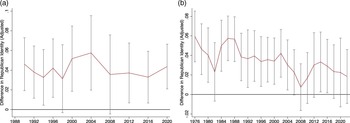
We first present some basic descriptive statistics documenting that SBOs in the USA are more right-leaning than the population at large, even when controlling for a host of potentially relevant factors. Specifically, we examine historical patterns in two prominent surveys of the US population: the American National Election Studies (ANES) and the General Social Survey (GSS). Both datasets include a question about employment status that has been asked repeatedly over time. We compare respondents who indicate that they are self-employed to the rest of the respondents.Footnote 11 Our outcome variable of interest is the standard seven-point party identification scale, recoded to lie between 0 (strong Democrat) and 1 (strong Republican). To increase precision, we smooth the data by reporting rolling averages over consecutive surveys.Footnote 12
As shown in Figure 1, self-employed individuals are more likely to identify with the Republican Party. Self-employed individuals are about 5 to 7 percentage points more likely to identify as Republicans in the ANES and about 4 to 6 percentage points more likely to identify as Republicans in the GSS. These differences are all statistically significant at the $p \lt 0.05$
level. The overall trend is fairly stable over time, with no consistent pattern of increasing or decreasing differences.
$p \lt 0.05$
level. The overall trend is fairly stable over time, with no consistent pattern of increasing or decreasing differences.
Self-Employment and Republican Partisanship (Unadjusted) - ANES (left) and GSS (right).
Notes: 95 per cent confidence intervals are plotted along with the point estimates.

In Figure 2, we present similar graphs but now control for a series of demographic variables: age, race, gender, education, income, and region.Footnote 13 Although the differences are a bit smaller (3 to 4 percentage points in the ANES; 2 to 3 percentage points in the GSS), this general pattern remains even after incorporating demographic controls. Hence, it is not simply the case that self-employment status is a proxy for other factors. Furthermore, as we show below, SBO’s rightward lean is significantly more pronounced once we are able to differentiate those who employ workers.
Self-Employment and Republican Partisanship (Adjusted) - ANES (left) and GSS (right).
Notes: 95 per cent confidence intervals are plotted along with the point estimates.

SBOs’ Political Leanings Across Developed Economies
Next, we examine whether the pattern of SBOs disproportionately voting for the political right replicates across other advanced industrial democracies. To this end, we leverage data from the 2022 International Social Survey Programme (ISSP), which – similar to the ANES and GSS – asked about employment status across eighteen countries. As before, we examine the gap between self-employed individuals and other respondents with respect to right-wing voting.Footnote 14 In addition to employment status, we control for gender, age, education, and economic standing.Footnote 15
As shown in Figure 3, for the overwhelming share of the countries, we see a clear positive relationship between self-employment status and right-wing voting. For two countries, the effect size is negative but statistically indistinguishable from zero.Footnote
16
Across all countries, the average difference in the outcome variable between self-employed individuals and others is 16.3 percentage points ( $p = .001$
). For the US survey, the ISSP data reveals a gap of 11.3 percentage points (
$p = .001$
). For the US survey, the ISSP data reveals a gap of 11.3 percentage points ( $p = .04$
), which is larger than the estimates from the ANES and GSS. In summary, there is robust, systematic evidence across a wide array of surveys conducted around the world that people who are self-employed lean more toward the right compared to other individuals.
$p = .04$
), which is larger than the estimates from the ANES and GSS. In summary, there is robust, systematic evidence across a wide array of surveys conducted around the world that people who are self-employed lean more toward the right compared to other individuals.
Self-Employment and Right-Wing Party Identification Across the World.
Notes: 95 per cent confidence intervals are plotted in a lighter shade, 90 per cent confidence intervals are plotted in a darker shade.

SBOs’ Political Leanings: Behavioural Data
So far, we have shown that SBOs report voting more for the right than other people and identify more with right-leaning parties. The analysis of the USA and other advanced economies, centred on voting preferences and party identification. In the final analysis in this section, we examine other aspects of SBO’s political behaviour: party registration and campaign contributions. To do so, we focus on medical doctors who have similar characteristics in terms of educational background and work experiences, but who differ in terms of their status as SBOs (in this case, owners of medical practices). Thus, in addition to allowing us to examine behavioural (rather than survey) outcomes, narrowing in on physicians reduces potential unobserved heterogeneity. As before, we find that SBOs tend to back parties on the right more than those in the same profession who do not own small businesses.
We do so by re-analyzing data from two previous studies on the political characteristics of medical doctors – Hersh and Goldenberg’s (Reference Hersh and Goldenberg2016) study of party registration of primary care physicians using voter files and Bonica et al.’s (Reference Bonica, Rosenthal and Rothman2014) study of medical doctors’ campaign contribution records. Both datasets utilize national directories of physicians, such that it is possible to count the number of medical doctors per address of hospitals/clinics or business entities in a given year. Hersh and Goldenberg (Reference Hersh and Goldenberg2016) matched a sample of primary care physicians from National Provider Identifier (NPI) files to voter files maintained by Catalist LLC as of March 2015. Similarly, Bonica et al. (Reference Bonica, Rosenthal and Rothman2014) matched the NPI list to the Database on Ideology, Money in Politics, and Elections (DIME), an archive of campaign finance records. Importantly, both datasets are helpful for our purposes because they allow us to match individuals’ status as business owners with behavioural measures of their political leanings (voter registration records or political donations to candidates).
Using these data, we construct a binary variable that indicates whether the physician is a registered Republican as the outcome variable from the Hersh and Goldenberg (Reference Hersh and Goldenberg2016) study. For the analysis of campaign contributions, we use the percentage of a doctor’s campaign contributions that go toward Republican candidates as the outcome variable; though this outcome is continuous, the vast majority of doctors (like most donors) only give to a single party. We predict these political outcomes with a binary variable (‘Single Practice’) that indicates whether the doctor is the only medical doctor linked to their corresponding medical entity per the NPI registry. We consider ‘Single Practices’ as a proxy for owning their practices (that is, categorized as an SBO).Footnote 17
As shown in column (1) of Table 1, doctors who own practices (that is, ‘Single Practice’) are 5.2 percentage points more likely to register with the Republican Party compared to other doctors ( $p \lt 0.001$
). In column (2), we include controls available in the voter file and physician registries, including indicator variables representing medical specialities. Similar to the analyses of the ANES and GSS, including control variables reduces the estimate by about a half, with physicians who own single-person practices being 2.5 percentage points more likely to register as Republicans than other physicians (
$p \lt 0.001$
). In column (2), we include controls available in the voter file and physician registries, including indicator variables representing medical specialities. Similar to the analyses of the ANES and GSS, including control variables reduces the estimate by about a half, with physicians who own single-person practices being 2.5 percentage points more likely to register as Republicans than other physicians ( $p = 0.004$
).
$p = 0.004$
).
Within a Narrow Occupation (Physicians), SBOs are More Republican

Notes: Single Practice, a proxy for SBO, is a dummy variable indicating doctors who are the only medical doctor registered at the medical entity per the NPI registry. Controls include speciality FE, age, gender, and median household income of the physician’s census block group for columns (1) and (2); speciality FE, gender, state, and years since graduation from medical school for columns (3) and (4). Robust standard errors in parentheses.
In columns (3) and (4) of Table 1, we estimate analogous regressions for contribution behaviour.Footnote
18
We find that single practice physicians allocate 6.1 percentage points more of their donation dollars to Republican candidates ( $p \lt 0.001$
). After including controls available in the physician and DIME datasets, this estimate decreases to about 3.6 percentage points, but is still statistically significant and substantively meaningful.
$p \lt 0.001$
). After including controls available in the physician and DIME datasets, this estimate decreases to about 3.6 percentage points, but is still statistically significant and substantively meaningful.
These results are very much consistent with our earlier findings: whether examining electoral behaviour or voting intentions, or whether turning to political donations or party registration, SBOs are systemically more right-leaning.
Selection or Treatment?
Next, we examine whether SBOs’ leaning to the right has to do with the experience of being a business owner (that is, ‘treatment’) or whether, instead, people who choose to become SBOs have characteristics that are associated with right-wing support (‘selection’). Since business ownership cannot be randomly assigned, any evidence is necessarily less than definitive, as differences observed in the political leanings of small business owners may be capturing unobserved heterogeneity between SBOs and other people.
One set of findings that goes against this possibility is, of course, the data we presented on physicians. Specifically, in this analysis, we focus on a comparison of political behaviour within a very specific occupation. By focusing on physicians, we are analyzing a group of people with very similar levels of education, income, and life and work experiences, and are able to assess if self-employment status explains variation in political beliefs within a narrow occupational subset. As reported in Table 1, we find clear evidence that doctors who own practices are between 2.5 and 5.2 percentage points more likely to register with the Republican Party, depending on the controls included in the model. Doctors who own their own practice also contributed 3.6 to 6.1 percentage points more to Republicans than doctors who work for others.
Thus, even when looking within members of a specific, highly-specialized occupation which requires extensive education, certification, and training, we observe meaningful differences in political attitudes between those who own their own businesses (practices) and those who do not. Clearly, this finding does not jive well with a selection-centred explanation.
However, this finding pertains only to one occupation and leaves open the question of treatment vs. selection effects of business ownership in other parts of the economy. To offer insight into this broader question, we next present evidence from an original survey of SBOs that operate in a wide array of occupations and industries, which we designed and carried out for this study. We begin by describing this bespoke survey and the measures we designed in some detail, followed by results that pertain to our question of interest.
Evidence from an Original Survey of Small Business Owners
The datasets we have utilized so far have imperfect measures of whether someone is a small business owner. For example, the ANES and GSS only ask whether someone is self-employed and do not ask whether a respondent employs others. Moreover, those surveys were not designed to shed light on the drivers underlying SBOs’ political leanings. Hence, we designed and fielded a bespoke survey which aimed to interview a significant number of Americans who own their business – many of whom employ other people. Moreover, by carrying out an original survey, we were able to include a comprehensive battery of items that allows us to assess empirically an array of ex ante plausible explanations. Our survey was administered between January and February of 2024.
As there is no national repository of small business owners, we constructed our survey sampling frame based on the list of individuals who applied for the Paycheck Protection Program (PPP) as of September 30, 2023. According to the US Small Business Administration (SBA), PPP was part of a COVID-19 relief program that aimed to help qualifying business entities keep their workforce employed through uncollateralized, low-interest, and forgivable loans. PPP loans were available to any US-based small business, sole proprietor, independent contractor, self-employed person, 501(c)(3) nonprofit organization, 501(c)(19) veterans organization, or tribal business that was in operation on February 15, 2020 and satisfied at least one of the following conditions:
• had 500 or fewer employees;
• met the industry size standards set by the SBA;
• had a tangible net worth not exceeding $15 million on March 27, 2020, and an average net income not exceeding $5 million for the two full fiscal years prior.
By the time of its conclusion in 2021, PPP provided $793 billion in loans to close to one million organizations.
We use PPP as the foundation of our survey sample for two reasons. First, instead of relying on respondents’ self-reporting, using a government-verified list of small business owners helps us more accurately target the population of interest. Second, unlike many other government grants for small business entities, PPP is not set up to target any specific subsample of businesses. In order to avoid double-counting the same entity applying for multiple rounds of loans, we rely on the first-draw loan list, which contains in total 557,859 entities that applied for PPP.
In order to make sure our sample is balanced and representative of the distribution of PPP loans, we took the following steps:
1. A random sample of entities is selected from the foundational PPP pool.
2. Business owners of these entities, as well as their contact information, are identified through various sources, including utilizing the PPP application records, internet searches, and LinkedIn data.
3. Among the matched list, a stratified recruitment sample that is balanced on entity characteristics is invited to take the survey through a link. Each of these business owners received at least one text and one email.
Respondents were first screened and disqualified from the survey if they self-identified as non-small business owners or said that they had never owned a small business in the past. We also excluded responses based on various data quality checks (see Online Appendix A for additional details).
To reach our target sample size while still keeping the final sample balanced, we launched the survey in four waves, repeating the steps as detailed above. Respondents were provided an incentive of $20 for participating. Overall, our matched business owner sample, containing personal contact information, consists of 262,347 individuals. Of these, 221,142 individuals were invited to our survey. The final sample size is 701, which makes the final qualified response rate 0.32 percent. Although this seems low, it is comparable to survey efforts using probability samples that attempt to reach individuals using digital methods. For example, the SMS portion of the Cornell Midterm Election Survey has a final response rate of 0.8 percent. Recent phone surveys conducted by the New York Times have response rates of 0.4 percent. Table 2 presents characteristics of the sample as compared to the sampling frame. As shown in the table, despite the low response rate, the sample is fairly representative of the PPP recipients who were invited to take the survey, as well as the larger PPP dataset.
Descriptive Statistics of Paycheck Protection Program (PPP) Recipients

Notes: PPP data as of September 30, 2023. Data was obtained through FOIA request.
Nonetheless, to address potential issues with non-response, we apply post-stratification weights to the data. Because we employ methods of probability sampling, we can reweight the data to make it representative based on the plethora of sampling frame characteristics to which we have access. The final sample is weighted based on mostly business entity characteristics, along with some business owner characteristicsFootnote 19 to match the PPP distribution list. The specific list of variables that are used to construct the weights is reported in Online Appendix A. The design effect is 1.63, and the margin of sampling error is +/− 4.7 per cent. The survey process, including the construction of the sampling frame, was administered by Verasight.
To provide a baseline sample of Americans for comparison to the sample of small business owners, we administered a similar survey to panel members of the survey firm Prolific. Using quota sampling, we constructed a sample that is representative of the US adult population in terms of geographical region, gender, race, age, and political party identification.Footnote 20 We collected a total of 2,472 valid responses; we only include 1,586 responses from individuals who do not currently own small businesses and have never owned a small business.Footnote 21 Altogether, our final data contains in total 2,287 respondents, of which 701 are SBOs from the bespoke survey of PPP recipients and 1,586 are non-SBOs from the Prolific panel.
Table 4 shows descriptive statistics of the baseline survey sample that combines the SBOs from the PPP sample and non-SBOs from the Prolific sample. Overall, we observe that the SBO population is older, less white, and wealthier than the non-SBOs. SBOs also tend to be more male and more likely to hold higher education degrees. We draw samples that are representative of SBOs and the general population separately, such that the sample weight adjusted raw gap between the two groups would still be informative.Footnote 22
Summaries of Survey Questions

Descriptive Statistics of Survey Samples

Notes: SBO sample are respondents to a Verasight survey; non-SBO sample are respondents to a Prolific survey, excluding those indicating they own a small business.
We do not intend to treat PPP recipients as a random sample of small business owners in America. Indeed, no registry of small business owners even exists with which to make claims about representativeness. Nonetheless, the PPP database allows for a promising sample with which to study this important part of the economy. Further, because it did not target any specific industries, the PPP covered business sectors in a comprehensive way.Footnote 23 Given the interactions of PPP recipients with the US government, they represent an important population in their own right with which to understand their political leanings and allegiances.
Survey measures
In this section, we describe our primary dependent and independent variables of interest. For ease of interpretation, we recode all survey measures to lie between 0 and 1. Table 3 displays summaries of the survey items. Full question wordings and response options can be found in Online Appendix C. Prior to administering the survey, we filed a pre-analysis plan (see Online Appendix H). The purpose of this plan was not to pre-specify all possible analyses, as we view our research as mainly descriptive and exploratory in nature. However, we wanted to pre-register our theoretical priors of the key selection-related and treatment-related variables, and which survey items would be used to construct the indices that proxy for these variables.
Outcome Measures
We employ two main measures to assess right-leaning political attitudes:Footnote 24
Party Identification. We measure party identification by first asking respondents ‘Generally speaking, do you usually think of yourself as a Republican, Democrat, Independent, or what?’ Partisans were asked, ‘Do you consider yourself a strong Democrat/Republican or a not strong Democrat/Republican?’ Independents and those not selecting a party identification were asked, ‘Do you think of yourself as closer to the Democratic Party or to the Republican Party?’ with the two parties as the two options. This produced a six-point scale ranging from strong Democrats (0) to strong Republicans (1).
Vote Choice. Respondents were asked, ‘Suppose the 2024 presidential election was between Joe Biden and Donald Trump. Who would you vote for?’ We recode responses to this variable to lie on a three-point scale: 0 (Joe Biden), .5 (Neither/someone else/don’t plan on voting), and 1 (Donald Trump).
Primary independent variable
We employ several measures to ascertain respondent employment status. First, we separately classify SBOs that employ workers and those that do not. This classification is pertinent for our purposes, since having workers means one has to deal with the greater regulatory burden resulting from being an employer.Footnote 25 We code responses as ‘employer SBOs’ if they are from the PPP dataset and have more than one employee (that is, not just themselves).Footnote 26 We code responses as ‘non-employer SBOs’ if they are from the PPP dataset and the business has only one employee (that is, themselves).
Our baseline category is respondents in the Prolific sample of American adults, excluding those who self-reported as small business owners.Footnote 27 We ascertained their employment status by asking them ‘What best describes your current employment status?’ with response options: ‘working’, ‘not working (retired, student, unemployed, disability etc.)’, and then asked workers ‘Which of the following best describes your current employment situation?’ (response options: ‘I am a wage and salary employee, and my main job accounts for most of my earnings’, ‘I am a wage and salary employee who also earns substantial extra income from side jobs’, ‘I am self-employed and the business I own accounts for most of my earnings’, ‘I earn most of my income as an independent contractor, freelancer, or gig worker’. We exclude respondents who indicate they own a small business. In addition, we asked them, ‘Have you ever owned a business in your life?’ and excluded respondents who had owned a business in the past. We also asked these questions to PPP recipients. This allowed us to distinguish individuals who are currently operating a small business from former SBOs who received PPP funds.
Policy-related variables
We examine whether SBOs and non-SBOs differ with respect to the following four sets of policy attitudes/experiences. We view these variables as downstream from experience with owning a small business, rather than factors that cause people to select into starting small businesses. All indices are between 0 (most liberal response) and 1 (most conservative response). Marginal distributions can be found in Online Appendix B.
Regulation Index. We construct an index based on six questions related to people’s experiences with regulation and views toward regulatory policies.Footnote 28
Taxation and Redistribution: Policy Views. We construct an index based on four questions related to people’s views on tax policy, government spending, and redistribution.
Taxation: Experience. We construct an index based on seven questions related to people’s experiences with the process of filing taxes. We focus on the fact that SBOs generally do not withhold income and often do not get refunds at the end of the year. They also have to file taxes quarterly and are often incentivized to minimize their tax burden. In contrast, W-2 employees often cannot control how much income is reported by their employer. Generally, managing tax payments is much more complicated and onerous for SBOs, and there is a greater risk of audit. At the same time, taxes are often more salient for SBOs as they have opportunities to use the tax code to reduce their tax burden.
Social Conservatism. To make sure that the above policy items are not simply reflecting general conservative political preferences among SBOs, but rather conservative views on specific economic issues, we also ask about respondents’ policy views on five social issues that are theoretically orthogonal to economic issues: abortion rights, the death penalty, gay marriage, gun rights, and transgender rights.
Personality variables
We also asked a series of items to assess personality traits that may cause people to select into being SBOs. We view these traits as predispositions that exist prior to people’s occupational choices. Marginal distributions can be found in Online Appendix B.
Risk Acceptance. We include two items gauging people’s willingness to take risks. These items have been validated and used in previous research (Kam Reference Kam2012; Vance et al. Reference Vance, Anderson, Kirwan and Eargle2014).
Belief in the Protestant Work Ethic. We include two items to ascertain people’s belief in the Weberian concept of the Protestant work ethic and the value of hard work in determining moral rightness. We use three items originally developed by psychologists (McHoskey Reference McHoskey1994; Mirels and Garrett Reference Mirels and Garrett1971).
Individualism. We ask two items related to people’s disposition toward individualism (rather than collectivism). We predict that people who prefer to depend on themselves are more likely to want to go alone to start organizations rather than join larger, existing organizations. These items have been validated and used in prior research (Triandis and Gelfand Reference Triandis and Gelfand1998; Broockman et al. Reference Broockman, Ferenstein and Malhotra2019).
Demographic controls
Finally, we control for a set of demographic variables including age, income, race, gender, and region. See Online Appendix D for details.
Key Patterns
Consistent with the large-scale samples, our survey of PPP recipients shows that SBOs are more right-leaning than other Americans. As shown in column (1) of Table 5,Footnote
29
SBOs with employees are 17.7 percentage points higher on the six-point party identification scale than non-SBOs ( $p \lt 0.001$
). Interestingly, there is no difference between non-SBOs and SBOs that own companies where the business owner is the only employee. The point estimate is close to zero. As shown in column (2), this gap between SBOs with employees and non-SBOs persists even when controlling for the demographic characteristics mentioned above. Similar to the findings above, the point estimate is halved to about 10.2 percentage points, but is still substantively meaningful and statistically significant (
$p \lt 0.001$
). Interestingly, there is no difference between non-SBOs and SBOs that own companies where the business owner is the only employee. The point estimate is close to zero. As shown in column (2), this gap between SBOs with employees and non-SBOs persists even when controlling for the demographic characteristics mentioned above. Similar to the findings above, the point estimate is halved to about 10.2 percentage points, but is still substantively meaningful and statistically significant ( $p = 0.002$
). In column (3) of Table 5, we predict the intended 2024 presidential vote choice on a three-point scale. Employer SBOs are 14.7 percentage points more Trump leaning than non-SBOs (
$p = 0.002$
). In column (3) of Table 5, we predict the intended 2024 presidential vote choice on a three-point scale. Employer SBOs are 14.7 percentage points more Trump leaning than non-SBOs ( $p \lt 0.001$
), and this estimate decreases only slightly to 12.5 percentage points when including control variables (
$p \lt 0.001$
), and this estimate decreases only slightly to 12.5 percentage points when including control variables ( $p = 0.003$
). Again, we observe no statistically significant differences between SBOs without employees and the non-SBO population.
$p = 0.003$
). Again, we observe no statistically significant differences between SBOs without employees and the non-SBO population.
SBOs with Employees Are More Right-Leaning

Notes: An SBO is categorized as an employer if they report more than one job on their PPP application. All regressions are weighted. ‘PID: Republican’ is measured on a six-point scale ranging from 0 (strong Democrat) to 1 (strong Republican). ‘Trump over Biden’ is coded as intended voting for Biden (0), other/neither (.5), and Trump (1). Controls include age, gender, race and ethnicity, income, education, and geographical region.
Why are SBOs with employees distinct from those without employees? Trebbi and Zhang (Reference Trebbi and Zhang2022) document a reverse-U shape between establishment size and regulatory burden. They show that the cost of regulatory compliance increases as the number of employees goes up until the establishment size reaches around 500 employees, then goes down again. Recall that only small businesses with under 500 employees were eligible for PPP. Therefore, in our sample of SBOs, only the first half of the curve – the upward sloping relationship – is relevant. We return to regulation-based explanations later on.
Interestingly, the point estimates reported from our bespoke survey are greater than the large-scale survey estimates. This is mainly due to the reduction in measurement error and the better encapsulation of small business ownership. For example, the ANES and GSS only ask whether people are self-employed and not how many employees they manage. These national surveys also cannot verify the SBO status of those who have self-reported being self-employed. As we found in our survey, SBOs with employees are much more right-leaning than SBOs without employees. By pooling these groups together, it is therefore unsurprising that we observe smaller point estimates in the large, general population surveys.
Table 6 presents the most frequently listed small business categories in our data and the partisan lean of each of these groups. The results generally conform to conventional wisdom, with more Democratic small business categories being in creative and white-collar categories, with more Republican small business categories being in manufacturing/construction and blue-collar sectors.
US Industries by the Party Lean of SBOs

Notes: Respondents were asked to identify as Republican, Democrat, Independent Leaning Republican (ILR), or Independent Leaning Democrat (ILD). For the purposes of this table, we group Republicans and ILRs, and we group Democrats and ILDs. Industries are paired with a proportion (R/N) where R is the total number of Republican SBOs and N is the total number of SBOs in that industry. Industries with fewer than five respondents or that could not be placed into a discrete category were excluded.
Another interesting pattern in the data is that SBOs are significantly over-represented among individuals without college degrees but earn higher-than-median incomes (hereafter, we refer to this group as ‘High Income Low Education’ or HILEs). Indeed, one of the main ways a person can make a high income without a college degree is by running a successful small business. HILEs comprise around 20.2 per cent of the non-SBO population. This figure, however, is substantially higher among SBOs: 33.1 per cent of employer SBOs and 26.6 per cent of non-employer SBOs fall into this category. At the same time, we also see that the HILE group is more right-leaning, compared to the other groups based on the intersection of income and education levels. In our original survey, 59.2 per cent of HILEs identify with the Republican Party, and 50.3 per cent would vote for Trump. Among other respondents, these figures are 47.6 per cent and 36.2 per cent, respectively. We return to discuss the broader context and significance of these findings in the concluding section.
Selection Cannot Account for the Observed Patterns
We next seek to explain why small business ownership may be associated with right-leaning political preferences. An initial explanation would simply be that the kinds of people who select into starting small businesses are different from the kinds of people who want to work for others, and that these characteristics might be correlated with conservatism. In this section, we present a series of empirical tests that suggest that this is, at best, only a very partial explanation.
We first examine whether people who started businesses are distinct from those who inherited their businesses or took it over from others. A key distinction between these two groups is that the former made a conscious decision to select into being an SBO whereas the latter group became SBOs mainly through happenstance of birth or circumstance. As shown in columns (1) and (2) of Table 7, if anything people who took over businesses from someone else are more likely to identify with the Republican Party ( $p \lt 0.001$
for the model without controls;
$p \lt 0.001$
for the model without controls; $p = 0.016$
for the model with controls). With respect to vote choice, the point estimates between those who started vs. took over a business are substantively and statistically similar, indicating there is no clear evidence in favor of the selection hypothesis (
$p = 0.016$
for the model with controls). With respect to vote choice, the point estimates between those who started vs. took over a business are substantively and statistically similar, indicating there is no clear evidence in favor of the selection hypothesis ( $p = 0.190$
for the model without controls;
$p = 0.190$
for the model without controls; $p = 0.316$
for the model with controls).
$p = 0.316$
for the model with controls).
The Experience of Business Ownership Predicts Support for the Right

Notes: All regressions are weighted. ‘PID: Republican’ is measured on a 6-point scale ranging from 0 (strong Democrat) to 1 (strong Republican). ‘Trump over Biden’ is coded as intended voting for Biden (0), other/neither (0.5), and Trump (1). The dependent variable in columns (1)-(4) is ‘PID: Republican’. Dependent variable in columns (5)–(8) ‘Trump over Biden’. Controls include age, gender, race and ethnicity, income, education, and geographical region.
Further, we compare individuals who are currently operating a small business to ones who no longer do so.Footnote 30 If selection was the primary explanation for the political differences between SBOs and non-SBOs, then we should observe that these groups appear similar (that is, more ‘dosage’ of the treatment should not matter). Conversely, if it is the actual experiences of being a small business owner that matter, then current SBOs should exhibit higher point estimates as they have been treated for longer, and the experiences of being an SBO are more salient in 2024 when they completed the survey.
As shown in Table 7, we generally see that current SBOs are more right-leaning than former SBOs. With respect to party identification, we observe an 11.7 percentage point gap without controls ( $p \lt 0.001$
), although this difference narrows to 4.9 percentage points when including a full set of demographic controls (
$p \lt 0.001$
), although this difference narrows to 4.9 percentage points when including a full set of demographic controls ( $p = 0.058$
). As shown in columns (7) and (8), for the outcome variable of vote choice, we more clearly see that current SBOs lean more toward Trump than non-SBOs. Current SBOs are 11.1 percentage points more likely to vote for Trump (
$p = 0.058$
). As shown in columns (7) and (8), for the outcome variable of vote choice, we more clearly see that current SBOs lean more toward Trump than non-SBOs. Current SBOs are 11.1 percentage points more likely to vote for Trump ( $p \lt 0.001$
) and this gap narrows to 9.3 percentage points when including control variables (
$p \lt 0.001$
) and this gap narrows to 9.3 percentage points when including control variables ( $p = 0.005$
).Footnote
31
$p = 0.005$
).Footnote
31
Our next empirical strategy is to correlate the six factors described above with employment status, party identification, and vote choice. As described above, we measured four variables related to public policy (regulation attitudes, tax attitudes, tax experience, and social attitudes) and three variables related to personality predispositions that may lead people to start small businesses (risk taking, individualism, and belief in the Protestant work ethic). We estimate regressions predicting the outcome variables with these seven factors as well as a set of demographic controls. We conduct this exercise separately for employer SBOs and non-employer SBOs. For a variable to explain why SBOs are right-leaning, it must fulfil two criteria: (1) it must be more prevalent among SBOs than non-SBOs, and (2) it must explain party identification and vote choice.
We report the results of these tests in Tables 8 and 9 for employer SBOs and non-employer SBOs, respectively, where the baseline category is always the non-SBOs. As shown in the tables, none of the three personality dispositions that may lead people to select into running small businesses meet both criteria. We discuss the results for employer SBOs in detail, but the patterns are similar for non-employer SBOs.
Experience of Government Regulations Key to Explaining Employer SBOs’ Right Lean

Notes: An SBO is categorized as an employer if they report more than one job on their PPP application. ‘PID: Republican’ is measured on a six-point scale ranging from 0 (strong Democrat) to 1 (strong Republican). ‘Trump over Biden’ is coded as intended voting for Biden (0), other/neither (0.5), and Trump (1). All regressions are weighted. Controls include age, gender, race and ethnicity, income, education, and geographical region.
Experience of Government Regulations Key to Explaining Non-Employer SBOs’ Right Lean

Notes: A SBO is categorized as an employer if they report more than one job on their PPP application. ‘PID: Republican’ is measured on a six-point scale ranging from 0 (strong Democrat) to 1 (strong Republican). ‘Trump over Biden’ is coded as intended voting for Biden (0), other/neither (.5), and Trump (1). All regressions are weighted. Controls include age, gender, race and ethnicity, income, education, and geographical region.
For instance, it is true that SBOs are more risk-taking and individualistic compared to the rest of the population ( $p \lt 0.001$
and
$p \lt 0.001$
and $p = 0.019$
, respectively); however, these two personality traits are not associated with either party identification or vote choice (
$p = 0.019$
, respectively); however, these two personality traits are not associated with either party identification or vote choice ( $p = 0.10 - 0.17$
and
$p = 0.10 - 0.17$
and $p = 0.24 - 0.74$
, respectively). On the other hand, belief in the Protestant work ethic strongly predicts both party identification (
$p = 0.24 - 0.74$
, respectively). On the other hand, belief in the Protestant work ethic strongly predicts both party identification ( $p \le 0.001$
) and vote choice (
$p \le 0.001$
) and vote choice ( $p = 0.018$
), with those ascribing to this philosophy more likely to identify as Republicans and vote for Trump. However, SBOs and non-SBOs do not significantly differ with respect to their belief in the Protestant work ethic (
$p = 0.018$
), with those ascribing to this philosophy more likely to identify as Republicans and vote for Trump. However, SBOs and non-SBOs do not significantly differ with respect to their belief in the Protestant work ethic ( $p = 0.106$
). If anything, SBOs are less likely to ascribe to this worldview.
$p = 0.106$
). If anything, SBOs are less likely to ascribe to this worldview.
Hence, it is unlikely that selection factors explain why SBOs lean to the right. It is true that SBOs and non-SBOs are distinct with respect to some personality factors, but these factors are weakly predictive of political attitudes.
The Treatment Effect: Views on Regulation as a Key Channel
Why are small business owners more right-leaning? When asked to offer their conjectures, Americans were divided in their explanations. The most commonly cited explanations were that SBOs are more socially conservative (50.4 percent), more antithetical to government regulation (43.3 percent), or more risk accepting (31.1 percent).Footnote 32 Other, less often cited explanations were that SBOs tend to be older or wealthier, factors perceived to account for their rightward bent. Republicans were substantially more likely to attribute SBOs’ right-leaning bent to selection-based personality predispositions (for example, risk taking, belief in work ethic, individualism) than Democrats (40 percent to 61 percent v. 14 percent to 34 percent).
To assess which of the plausible explanations is empirically most valid, we next conduct an empirical test similar to the one we carried out before. However, this time we do so for policy attitudes, which we view as more likely to reflect treatment effects of being an SBO (compared to personality predispositions). As shown in Tables 8 and 9, issues related to taxation are unlikely to be a key explanation for why SBOs lean right.Footnote
33
Unsurprisingly, we find that people’s attitudes on tax policies strongly predict both party identification ( $p \lt 0.001$
) and vote choice (
$p \lt 0.001$
) and vote choice ( $p \lt 0.001$
). However, interestingly, SBOs and non-SBOs do not differ in their views on tax policy (
$p \lt 0.001$
). However, interestingly, SBOs and non-SBOs do not differ in their views on tax policy ( $p = 0.454$
). However, SBOs and non-SBOs have very different experiences dealing with taxation (
$p = 0.454$
). However, SBOs and non-SBOs have very different experiences dealing with taxation ( $p \lt 0.001$
), which is unsurprising given that self-employed individuals pay taxes in a completely different manner than those receiving W-2s (as explained above). However, experience with taxes is unrelated to both party identification (
$p \lt 0.001$
), which is unsurprising given that self-employed individuals pay taxes in a completely different manner than those receiving W-2s (as explained above). However, experience with taxes is unrelated to both party identification ( $p = 0.360$
) and vote choice (
$p = 0.360$
) and vote choice ( $p = 0.546$
). These patterns are generally in line with scholarly work in business taxes. Although SBOs make up a significant share of the top 1 percent of income earners, SBOs pay a substantially lower average federal income tax rate on their pass-through business incomes, as compared to traditional corporations (Cooper et al. Reference Cooper, McClelland, Pearce, Prisinzano, Sullivan, Yagan, Zidar and Zwick2016), while the level of tax evasion remains high (Alstadsæter et al. Reference Alstadsæter, Johannesen and Zucman2019; Fernandez-Bastidas Reference Fernandez-Bastidas2023). Hence, the ability to shield income from taxation may mean that tax rates are a less important driver of SBOs’ political views. One might think that small business ownership is simply a proxy for more socially conservative attitudes. As shown in Table 8, conservative social attitudes are positively related to both party identification (
$p = 0.546$
). These patterns are generally in line with scholarly work in business taxes. Although SBOs make up a significant share of the top 1 percent of income earners, SBOs pay a substantially lower average federal income tax rate on their pass-through business incomes, as compared to traditional corporations (Cooper et al. Reference Cooper, McClelland, Pearce, Prisinzano, Sullivan, Yagan, Zidar and Zwick2016), while the level of tax evasion remains high (Alstadsæter et al. Reference Alstadsæter, Johannesen and Zucman2019; Fernandez-Bastidas Reference Fernandez-Bastidas2023). Hence, the ability to shield income from taxation may mean that tax rates are a less important driver of SBOs’ political views. One might think that small business ownership is simply a proxy for more socially conservative attitudes. As shown in Table 8, conservative social attitudes are positively related to both party identification ( $p \lt 0.001$
) and vote choice (
$p \lt 0.001$
) and vote choice ( $p \lt 0.001$
), which is expected. However, SBOs are – if anything – less socially conservative than the rest of the population, accounting for their views on other issues (
$p \lt 0.001$
), which is expected. However, SBOs are – if anything – less socially conservative than the rest of the population, accounting for their views on other issues ( $p = 0.056$
).
$p = 0.056$
).
The only variable that remains is regulation attitudes, which both strongly predict political attitudes and distinguish SBOs from non-SBOS. Employer SBOs score 46 percentage points higher on the anti-regulation index ( $p \lt 0.001$
). At the same time, the more conservative regulation attitudes are associated with a 12.3 to 20.2 percentage point increase in Republican party identification (
$p \lt 0.001$
). At the same time, the more conservative regulation attitudes are associated with a 12.3 to 20.2 percentage point increase in Republican party identification ( $p = 0.010$
) and vote choice (
$p = 0.010$
) and vote choice ( $p \lt 0.001$
), respectively.
$p \lt 0.001$
), respectively.
We find further evidence of regulation attitudes as a key mediating variable between small business ownership and right-leaning attitudes. In Table 10, we replicate our previous regressions examining the relationship between SBO status and political attitudes, except now we add one additional variable: attitudes toward regulation. After including this single control, there is no longer a positive and significant relationship between being an employer SBO and conservative political attitudes. In fact, once accounting for regulation attitudes, the sign flips ( $p = 0.051$
for party identification and
$p = 0.051$
for party identification and $p = 0.022$
for vote choice). In other words, we show that at each given level of regulation attitudes, SBOs are now not more likely to identify with the Republican Party or to vote for Trump, as compared to non-SBOs. The adjusted positive gap of 10 to 13 percentage points in Table 5 is explained away by regulation policy views and more interactions with regulations. In sum, a likely interpretation of these findings is that the experience of running a small business – especially when other employees are involved – increases the likelihood of having to deal with onerous government regulations, which in turn influences one’s political views rightward.
$p = 0.022$
for vote choice). In other words, we show that at each given level of regulation attitudes, SBOs are now not more likely to identify with the Republican Party or to vote for Trump, as compared to non-SBOs. The adjusted positive gap of 10 to 13 percentage points in Table 5 is explained away by regulation policy views and more interactions with regulations. In sum, a likely interpretation of these findings is that the experience of running a small business – especially when other employees are involved – increases the likelihood of having to deal with onerous government regulations, which in turn influences one’s political views rightward.
Attitude on Government Regulation Helps Account for SBOs’ Right Lean

Notes: An SBO is categorized as an employer if they report more than one job on their PPP application. ‘PID: Republican’ is measured on a six-point scale ranging from 0 (strong Democrat) to 1 (strong Republican). ‘Trump over Biden’ is coded as intended voting for Biden (0), other/neither (.5), and Trump (1). All regressions are weighted. Controls include age, gender, race and ethnicity, income, education, and geographical region.
In addition to asking closed-ended items, we also asked respondents to independently explain their political affiliations to see if issues related to regulation organically emerged in their responses. We manually classified respondents’ open-ended answers to a question that elicits explanations for their reported partisan labels: ‘In your own words, explain why you consider yourself to be a Democrat/Republican?’Footnote 34 We report the results in Table 11. Consistent with our previous results, we find that Republican respondents overall are more likely to cite regulation as the reason they identify as Republicans or lean toward the Republican Party. In particular, 31.1 percent of Republican employer SBOs mentioned reasons related to regulatory policies or the size of government. This is much higher than the 12–13 percent among Republican non-employer SBOs and non-SBOs. As a stark contrast, only 2–4 percent of all Democratic respondents mentioned reasons related to regulation to explain why they are Democrats. Hence, even when Republican employer SBOs independently explain their political views, regulation emerges as the most important consideration.
Republican SBOs are Much More Likely to Cite Regulation Policies as the Reason for Their Partisan Identification

Notes: An SBO is categorized as an employer if they report more than one job on their PPP application. All SBO-related counts are weighted.
Although speculative, our data can speak to aspects of the regulatory environment that potentially affect political attitudes. As shown in Figure OA1, we see particularly strong differences between SBOs and non-SBOs on issues related to compliance and labour market protections. As shown in Table 6, many of the SBO occupation types that are Democratic-leaning are creative functions done mainly by sole proprietors (for example, therapy, massage, graphic design); on the other hand, Republican-leaning SBOs are more involved in complex industries (for example, construction, healthcare, manufacturing) that have more of an interface with regulations involving labour laws, health and safety, and compliance.Footnote 35 This is also consistent with our previously reported finding that employer SBOs are much more conservative than non-employer SBOs.
Conclusion
This article provides the first systematic account of the political leanings of small business owners. We show that this sizable constituency of SBOs, which is responsible for a substantial share of economic growth and overall employment, systematically leans to the right. This is most notable among business owners who employ other workers. Our findings indicate that this political affiliation is not merely a result of background characteristics that lead people to open or run a business.
Rather, the evidence suggests that experiences associated with running a business – particularly the heightened need to deal with the regulatory state – underlie the greater appeal of parties on the right. Specifically, we find that that current business owners, but not past owners of businesses, vote more to the right than people who never owned a business; that people who inherited a business, more than those who started a new business, are even more right-leaning; and that even within a narrow professional subset (physicians), business ownership is associated with a disproportionate right lean.
Our analysis of the business owners’ constituency is also closely related to the broader study of class and politics. In the traditional class divide between labour and capital, small business owners are, of course, a central component of capital. As owners of the factors of production and as employers, the interests and organization of business owners have long been a preoccupation of political economists (Swenson Reference Swenson1991; Hacker and Pierson Reference Hacker and Pierson2002; Schneider Reference Schneider2004). Yet the politics of the SBO constituency also speak to a related phenomenon that has recently garnered substantial attention; namely, the change in the relationship between social class and voting behaviour.
Up until the 1970s, income and education used to be highly correlated empirically, with a clear pattern whereby high-income, educated elites were supportive of the right while the lower-income, lesser-educated classes were the core constituency of the left (Gethin et al. Reference Gethin, Martnez-Toledano and Piketty2022). Yet structural changes to the economy, in particular, globalization and the transition to a knowledge economy, have brought about substantial divergence in the political leanings of the educated and the high earners. In what the authors describe as ‘multi-elite politics’, the vote of the highly educated and that of the high earners have diverged, with the former leaning politically to the left and the latter to the right.
However, this divergence captures only part of the observed change. As Kitschelt and Rehm (Reference Kitschelt and Rehm2023) show, the interaction of education and income has become a key signifier of voting behaviour. Specifically, the high-income-low-educated constituency (HILEs) has become the most reliable right-wing constituency. Importantly, this subset of citizens is grossly over-represented among small business owners, an unsurprising fact given that entrepreneurship is a key avenue for the lesser educated to reach high-earning status. Indeed, the data clearly bears this out: whereas only 20.2 per cent of the non-SBO public are high-income low-educated individuals, among employer SBOs this figure stands at 33.1 per cent. In other words, part of the right lean of HILE voters can be attributed to the experiences and concerns of SBOs.
Our findings regarding the political leanings of SBOs, and the clear indication that their experience on the job is a driver of this political preference, are particularly pertinent given that the labour market is changing in fundamental ways, and with it the daily experiences people have at work: from an economy in which manufacturing and agriculture were prominent to an economy dominated by jobs in services; from conducting daily work in the office under a standard employer-employee contract to carrying out work remotely, and doing so with non-traditional employment arrangements. Put differently, people are now spending their work time in different settings than in the past, carrying out very different tasks on the job, and engaging with their bosses or subordinates in new and changing working arrangements. If experiences on the job are shaping people’s outlook on issues outside of work itself, as our study indicates, then understanding the political ramifications of occupational characteristics is warranted and merits more of our attention.
While this study focused on SBOs and the link between their experiences on the job and their political outlook, it is also important to recognize that the features of business ownership may themselves be changing in consequential ways. In particular, as the labour market veers toward gig platforms and gig jobs, more people will become, in many ways, a new form of small business owners: they will have no boss and enjoy more flexibility in their work schedules, while also experiencing the burden of heightened responsibility for key aspects of work as compared to waged staff (for example, finding work and getting new business inflow; complying with regulation; dealing with more complexity in filing taxes). Our findings suggest that these changes could have significant implications that go beyond the functioning of the labour market: as a growing number of people have daily experiences akin to those of a business owner, parties and candidates on the right are likely to benefit. Whether that is the case remains to be seen, but it points to the importance of further research that will focus on the rapidly growing gig sector and the political views of its members.
Supplementary material
To view supplementary material for this article, please visit https://doi.org/10.1017/S0007123425000274
Data Availability Statement
Replication data for this article can be found in Harvard Dataverse at: https://doi.org/10.7910/DVN/T1BR1S (Malhotra et al. Reference Malhotra, Margalit and Shi2025).
Acknowledgements
We thank Peter Enns, Ben Leff, and Jake Rothschild for their assistance with data collection. We thank Philipp Rehm, Hye Young You, Alexander Hertel-Fernandez, and Zhao Li for valuable feedback on the paper. We thank Liam Custer, Grant Moore, Shirley Cheng, and Gabriel Bo for helpful research assistance. A previous version of this paper was presented at the Annual Meeting of the American Political Science Association.
Financial support
This research received no specific grant from any funding agency, commercial, or not-for-profit sectors.
Competing interests
None.
Ethical standards
This research was approved by the institutional review boards at Stanford University and Tel Aviv University.




 Open access

