





Introduction
Antimicrobial resistance (AMR) is a global health threat that warrants a One Health approach (WHO et al., 2023). It is now well understood that exposure to any antimicrobial substance will exert a selective pressure for resistant microbes in the exposed environment. This insight has been the main driver of global, regional, and national action plans against AMR (European Commission, 2017) as well as the ban on antimicrobial feed additives in the European Union (2003).
Historically, the growth-promoting effect of antimicrobial feed additives was regarded as separate from their antimicrobial activity and their low concentrations in feed assumed ‘harmless’ as regards the risk of promoting AMR. The scientific evidence against this assumption was compelling already in the 1990s (Swedish Government, 1997) and has been further supported (Aarestrup et al., Reference Aarestrup, Kruse, Tast, Hammerum and Jensen2000; Chauvin et al., Reference Chauvin, Gicquel-bruneau, Perrin-guyomard, Humbert, Salvat, Guillemot and Sanders2005). It was also argued that as long as the antimicrobials used in animals were not identical to the pharmaceuticals used to treat human infections, AMR would not matter. However, the current search for new options to treat drug-resistant infections may prompt the revival of some such substances (Bergen et al., Reference Bergen, Landersdorfer, Lee, Li and Nation2012). In addition, most substances used to treat animal infections are already used in human medicine. Hence, a responsible antimicrobial use (AMU) in animals is necessary to mitigate further emergence and spread of AMR. This is reflected in the European legislation on veterinary pharmaceuticals (European Union, 2019).
However, over the years, it has also become clear that the development of AMR is complex and that numerous factors contribute to the emergence and spread of AMR in livestock production (Lambraki et al., Reference Lambraki, Cousins, Graells, Léger, Henriksson, Harbarth, Troell, Wernli, Jørgensen and Desbois2022). On farm level, a multitude of factors are expected to influence the levels and types of AMR in different bacterial species (Murphy et al., Reference Murphy, Carson, Smith, Chapman, Marrotte, McCann, Primeau, Sharma and Parmley2018).
In order to effectively mitigate AMR in livestock production, the contribution of all factors, including AMU, needs to be understood. Existing evidence should be used to identify knowledge gaps and inform study design. Therefore, a scoping review was undertaken, with the aim to describe the association between AMR, AMU and other risk factors in European livestock production.
The review was limited to European studies, as the legislation on AMU (including feed additives) was well-known and clear, and the risk of misunderstanding any underlying AMU could be minimised. The more specific review questions were as follows: (1) How do the abundance, diversity, and variation in the resistome differ between individual livestock farms with known AMU? (2) How do different antibiotic treatment schemes affect the prevalence of resistance genes/resistant bacteria in livestock environments? and (3) Which herd-level risk factors (in addition to AMU) have been associated with the development and spread of AMR in livestock production?
Methods
Protocol and eligibility criteria
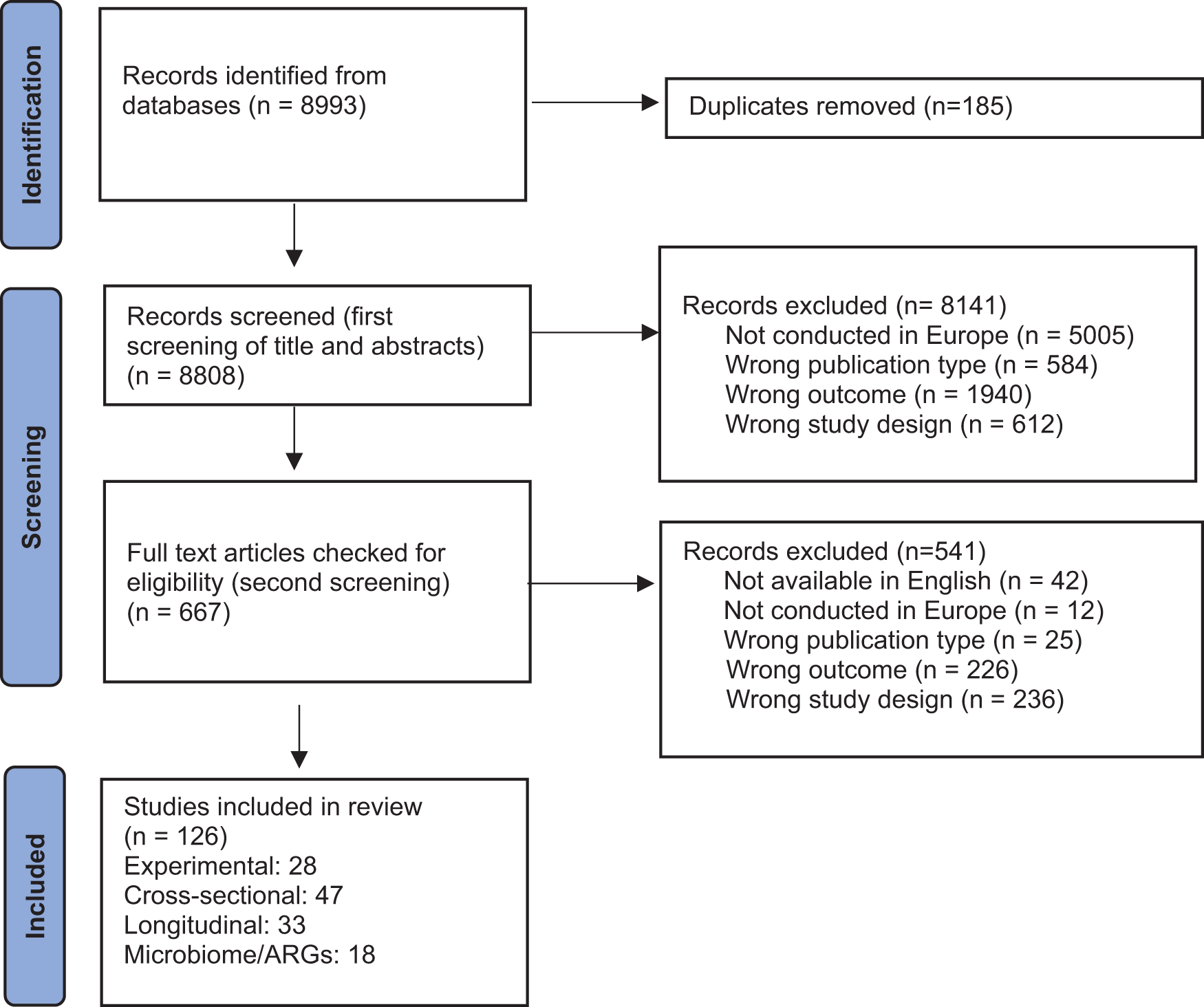
A protocol based on the PRISMA guidelines (Page et al., Reference Page, McKenzie, Bossuyt, Boutron, Hoffmann, Mulrow, Shamseer, Tetzlaff, Akl and Brennan2021) was developed for the search and evaluation of the articles including the study objectives, data sources, and inclusion and exclusion criteria (summarised in Table 1). The search strategy was developed in collaboration with an experienced librarian and performed by the library of the Swedish University of Agricultural Sciences. In a first screening, using the open-source tool Rayyan (https://www.rayyan.ai/), the titles and abstracts were checked to see if they corresponded to the objective of the scoping review. The data from eligible publications were extracted into a Google spreadsheet for further review. The second screening evaluated the quality of the full article based on the inclusion and exclusion criteria (Table 1). All screening procedures in this round were performed independently by at least two of the three authors, and each article was classified into ‘Yes’ or ‘No’ for inclusion. If there was a disagreement between the two reviewers, the final decision was made after discussion among the three authors. Figure 1 shows the schematic flow diagram of the literature selection.
Schematic flow diagram of the literature selection for the scoping review on factors affecting antimicrobial resistance among bacteria in livestock. Wrong publication type includes conference proceedings, theses, reviews, background or position papers. Wrong outcome includes articles not dealing with antibacterial resistance or focusing on clonal spread of certain resistant bacteria. Wrong study design includes articles not dealing with livestock on farm level and studies on lab methodology or theoretical modelling.

Figure 1 Long description
The flowchart outlines the process of literature selection for a review on antimicrobial resistance in livestock. It begins with the identification of records from databases, totaling 8993 entries. After removing 185 duplicates, 8808 records proceed to the first screening of titles and abstracts. During this screening, 8141 records are excluded for reasons such as not being conducted in Europe (5005), wrong publication type (584), wrong outcome (1940) and wrong study design (612). The second screening involves checking the eligibility of 667 full-text articles, resulting in the exclusion of 541 records due to reasons like not available in English (42), not conducted in Europe (12), wrong publication type (25), wrong outcome (226) and wrong study design (236). Finally, 126 studies are included in the review, categorized as experimental (28), cross-sectional (47), longitudinal (33) and microbiome/ARGs (18).
Inclusion and exclusion criteria for the first and second screening

Table 1 Long description
The table lists inclusion and exclusion rules used in two screening rounds for selecting studies about antibacterial resistance in livestock production. In the first screening, studies were included if they were peer-reviewed original research and reported data on antibacterial resistance at the farm level in livestock production. First-screen exclusions removed studies done outside Europe, non-original research, studies not focused on livestock, studies without farm-level data, studies not focused on antibacterial resistance, studies limited to clonal spread of a single bacterial strain such as methicillin-resistant Staphylococcus aureus, papers without an English abstract, and papers with no or unclear information on antimicrobial use. In the second screening, inclusion required clear descriptions of methods and results. Second-screen exclusions repeated all first-screen exclusions and additionally removed studies whose full text was not available in English. The criteria progressively narrow the evidence base toward European, farm-level, antimicrobial-resistance studies with usable antimicrobial-use information and accessible reporting.
MRSA, methicillin-resistant Staphylococcus aureus.
Search strategy
Articles were searched for in Web of Science Core Collection databases, Medline, and CAB Abstracts. The key search words were divided into four topics:
1. (‘anti-microbial resistance’ OR ‘antimicrobial resistance’ OR ‘antibiotic resistance’ OR ‘drug resistance’ OR ‘multidrug resistance’ OR ‘multi-drug resistance’ OR ‘bacterial resistance’)
and
2. (livestock OR cattle OR cow OR cows OR calf OR pig OR pigs OR swine OR piglets OR hog OR hogs OR sheep OR goat OR goats OR poultry OR hen OR chicken OR duck OR ducks OR goose OR geese OR turkey OR turkeys OR heifer OR heifers OR calf OR calves)
and
3. (((antimicrobial OR antibiotic* OR antibacterial*) near/1 (use OR misuse OR exposure OR dosage OR frequency OR duration)) OR risk factor OR epidemiology* OR prevalence* OR incidence* OR acquisition* OR (AMR near/1 dynamic*))
and
4. (farm OR farms OR farming OR ranch OR ranches OR farmstead* OR herd OR flock)
The full lists of titles and abstracts were imported into Endnote, and duplicates were identified and removed. The final list of titles and abstracts was then imported into Rayyan for the first screening. The search included articles published between 1st of January 2000 and 31st of January 2025.
Data collection process
The data from eligible publications were summarised in the spreadsheet, including authors, year of publication, title, journal, country, animal species, name of pathogen(s), study set-up, risk factors investigated, outcome investigated, main results, and treatment scheme for the experimental studies. Lastly, the extracted data were crosschecked against each original article by the authors.
Synthesis of results
The articles were grouped into different categories based on the study design. Studies with a non-experimental set-up and using the abundance or variety of antimicrobial resistance genes (ARGs), or a range of ARGs, as outcome were classified as resistome studies. Studies applying an experimental set-up were classified as experimental studies. Studies assessing AMR at one time-point were classified as cross-sectional studies, and those assessing AMR over a time period were classified as longitudinal studies). The results of each article were summarised descriptively.
Results
A total of 8993 articles were retrieved from Web of Science Core Collection databases, Medline, and CAB Abstracts, and 185 duplicates removed. In the first screening, 6986 publications were excluded (Fig. 1). Thus, a total of 667 full-text articles were assessed in the second screening, where 541 articles were excluded, resulting in 126 publications included in the final qualitative synthesis.
The farm resistome
Eighteen of the included articles presented the effect of AMU and other factors on the prevalence, abundance or diversity of ARGs in livestock farms. These are summarised in Table 2. Twelve studies were conducted on pig farms, with three also including poultry farms, four other studies were done in poultry farms only, and one study was conducted on veal farms. In addition, one study involved cattle, sheep, and pig farms and assessed the associations between ARGs (identified by whole-genome sequencing (WGS) of isolated Escherichia spp., Citrobacter spp., and Klebsiella spp.) and AMU as well as management and seasonal factors (Smith et al., Reference Smith, May, AbuOun, Stubberfield, Gilson, Chau, Crook, Shaw, Read, Stoesser, Vilar and Anjum2023). They concluded that AMU was associated with on-farm AMR but could not explain the observed patterns on its own, as only the number of unique antibiotic classes used in the 3 months before sampling was significantly associated with AMR, and explained only 15% of the variation. Some larger studies identified links between AMU and some AMR aspects (Andersen et al., Reference Andersen, De Knegt, Munk, Stengaard Jensen, Agersø, Aarestrup and Vigre2017; Birkegård et al., Reference Birkegård, Halasa, Græsbøll, Clasen, Folkesson and Toft2017; Horie et al., Reference Horie, Yang, Joosten, Munk, Wadepohl, Chauvin, Moyano, Skarżyńska, Dewulf and Aarestrup2021; Luiken et al., Reference Luiken, Heederik, Scherpenisse, Van Gompel, van Heijnsbergen, Greve, Jongerius-gortemaker, Tersteeg-zijderveld, Fischer and Juraschek2022; Mencía-Ares et al., Reference Mencía-Ares, Cabrera-Rubio, Cobo-díaz, Álvarez-Ordóñez, Gómez-García, Puente, Cotter, Crispie, Carvajal and Rubio2020; Munk et al., Reference Munk, Elkær Knudsen, Lukjancenko, Ribeiro Duarte, Van Gompel, Luiken, Smit, Schmitt, Dorado Garcia, Borup Hansen, Nordahl Petersen, Bossers, Lund, Hald, Pamp, Vigre, Heederik, Wagenaar, Mevius and Aarestrup2018; Van Gompel et al., Reference Van Gompel, Luiken, Sarrazin, Munk, Knudsen, Hansen, Bossers, Aarestrup, Dewulf and Wagenaar2019; Yang et al., Reference Yang, Heederik, Mevius, Scherpenisse, Luiken, Van Gompel, Skarżyńska, Wadepohl, Chauvin and Van Heijnsbergen2022, Reference Yang, Van Gompel, Luiken, Sanders, Joosten, van Heijnsbergen, Wouters, Scherpenisse, Chauvin and Wadepohl2020), but these were variable and complex. Munk et al. (Reference Munk, Elkær Knudsen, Lukjancenko, Ribeiro Duarte, Van Gompel, Luiken, Smit, Schmitt, Dorado Garcia, Borup Hansen, Nordahl Petersen, Bossers, Lund, Hald, Pamp, Vigre, Heederik, Wagenaar, Mevius and Aarestrup2018) reported significant associations between AMU and ARG abundance in pig farms but not in poultry farms. Luiken et al. (Reference Luiken, Van Gompel, Munk, Sarrazin, Joosten, Dorado-garcía, Hansen, Knudsen, Bossers and Wagenaar2019) reported associations between AMU and ARGs, but after compensating for multiple comparisons these associations were not statistically significant. Similarly, Van Gompel et al. (Reference Van Gompel, Luiken, Sarrazin, Munk, Knudsen, Hansen, Bossers, Aarestrup, Dewulf and Wagenaar2019) reported only 18 out of 122 associations remaining statistically significant after compensating for multiple comparisons and Horie et al. (Reference Horie, Yang, Joosten, Munk, Wadepohl, Chauvin, Moyano, Skarżyńska, Dewulf and Aarestrup2021) could not detect any robust association between AMU and ARGs when accounting for multiple comparisons. Mencia-Ares et al. (Reference Mencía-Ares, Cabrera-Rubio, Cobo-díaz, Álvarez-Ordóñez, Gómez-García, Puente, Cotter, Crispie, Carvajal and Rubio2020) also accounted for multiple comparisons and found a higher abundance of ARGs on intensive pig farms, linked to abundance of mobile genetic elements (integrons and plasmids) than on extensive pig farms. Bassitta et al. (Reference Bassitta, Nottensteiner, Bauer, Straubinger and Hölzel2022) found a higher relative abundance of some ARGs conveying tetracycline resistance and sulphonamide resistance in farms using the corresponding substances, as well as variable associations between organic/conventional production in German pig farms. Andersen et al. (Reference Andersen, Møller, Jensen, Aarestrup and Vigre2023) found associations between lifetime AMU and the abundance of ARGs, both within the same antimicrobial class and other classes, albeit with some variations and modelling challenges. Ekhlas et al. (Reference Ekhlas, Díaz, Cabrera-Rubio, Alexa, Sanjuán, Manzanilla, Crispie, Cotter, Leonard and Argüello2023a) found a higher abundance of ARGs in pig farms with regular post-weaning treatment with antimicrobials and zinc oxide. Lührmann et al. (Reference Lührmann, Palmini, Hellmich, Belik, Zentek and Vahjen2023) reported that direct effects of a specific antibiotic on its associated resistance gene were rare, when investigating the effect of AMU and the prevalence of ARGs in German pig farms. Tams et al. (Reference Tams, Larsen, Hansen, Spiegelhauer, Strøm-hansen, Rasmussen, Ingham, Kalmar, Kean and Angen2023) investigated the microbiome and resistome of pigs in farms under the Danish Raised Without Antibiotics (RWA) scheme, comparing RWA-tagged pigs with pigs who had their tags removed due to antibiotic treatment. They found that the difference between farms was larger than the difference between RWA and non-RWA pigs on the same farm. Luiken et al. (Reference Luiken, Heederik, Scherpenisse, Van Gompel, van Heijnsbergen, Greve, Jongerius-gortemaker, Tersteeg-zijderveld, Fischer and Juraschek2022) found that higher biosecurity standards were associated with lower relative ARG abundances in poultry farms but with higher relative ARG abundances in pig farms. In the same study, lower absolute ARG levels in dust were associated with factors related to dust levels, such as summer season and certain bedding materials for poultry, and lower animal density and summer season for pigs. Van Gompel et al. (Reference Van Gompel, Luiken, Sarrazin, Munk, Knudsen, Hansen, Bossers, Aarestrup, Dewulf and Wagenaar2019) found a link between higher internal farm biosecurity and some ARGs, but not all. In a small study involving eight Italian poultry farms, Farooq et al. (Reference Farooq, Smoglica, Ruffini, Soldati, Marsilio and Di Francesco2022) detected more ARGs in litter from antibiotic-free farms than in litter from conventional farms; however, these results were contradicted in a subsequent study involving 13 poultry farms (Smoglica et al., Reference Smoglica, Muhammad, Ruffini, Marsilio and Di Francesco2023).
Studies investigating the resistome

Table 2 Long description
The table summarizes multiple farm-based studies that link antimicrobial use and related practices to antimicrobial resistance outcomes measured in animal or environmental samples. Study designs include cross-sectional and longitudinal sampling on pig, broiler, turkey, veal calf, and mixed-species farms, using metagenomic sequencing, qPCR, PCR, culture, and whole genome sequencing to quantify resistance genes or phenotypic resistance. Many studies report positive associations between antimicrobial use and resistance outcomes, including Danish pig farm studies showing links between lifetime use and resistance in E. coli or higher resistance gene abundance, and a multi-country pig study finding total use positively associated with total resistance gene abundance. Several studies highlight modifiers beyond antimicrobial use, such as biosecurity, season, feed system, farm type, animal age group, and country, with some analyses finding country and farm effects larger than antimicrobial use. Poultry results are more mixed: one multi-country analysis found associations in pigs but not poultry, while other broiler studies comparing conventional and antibiotic-free systems reported either higher resistance gene abundance in conventional flocks or no overall difference, sometimes with specific tetracycline genes more common in antibiotic-free samples. Targeted findings include sulfonamide use linked to higher sul2 abundance in pigs and veal calves, and short-term increases in resistance gene abundance after treatment that diminished over time in repeatedly sampled pigs. Some studies note discordance between gene abundance and phenotypic resistance, and several report resistance genes detected even without current antimicrobial use, indicating persistence and multiple contributing factors.
ARGs. antimicrobial resistance genes; AMU, antimicrobial use; ADD, animal daily dose; AMR, antimicrobial resistance; TI, treatment incidence; DDD, defined daily dose; PCU; population corrected unit; WGS, whole-genome sequencing.
Horie et al. (Reference Horie, Yang, Joosten, Munk, Wadepohl, Chauvin, Moyano, Skarżyńska, Dewulf and Aarestrup2021) compared the use of phenotypic AMR and genotypic AMR measures as outcome. As the study focused on ARGs, it was grouped with the resistome studies. It found that AMR genes encoding for some antimicrobial classes were abundant despite the low prevalence of phenotypic resistance in Escherichia coli isolates.
Experimental studies
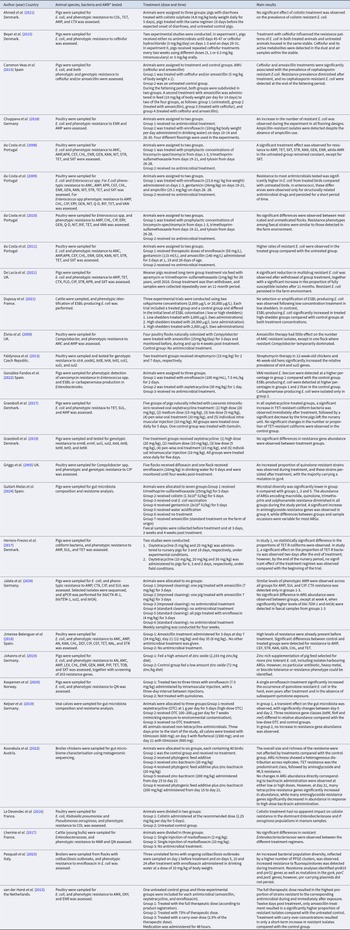
Twenty-eight of the articles had an experimental study design. These studies were conducted in 11 different European countries (Table 3). All of the articles studied how AMU affects the development of AMR. Eighteen studies used only phenotypic methods, five only genotypic methods, and four used both phenotypic and genotypic methods to investigate AMR (Table 3). Thirteen studies used quantitative methods to assess the total number of specific resistant bacteria or ARGs (Ahmed et al., Reference Ahmed, Hansen, Dahlkilde, Herrero-Fresno, Pedersen, Nielsen and Olsen2021; De Lucia et al., Reference De Lucia, Card, Duggett, Smith, Davies, Cawthraw, Anjum, Rambaldi, Ostanello and Martelli2021; van der Horst et al., Reference Van der Horst, Fabri, Schuurmans, Koenders, Brul and Kuile2013; Dupouy et al., Reference Dupouy, Madec, Wucher, Arpaillange, Métayer, Roques, Bousquet-Mélou and Haenni2021; Faldynova et al., Reference Faldynova, Videnska, Havlickova, Sisak, Juricova, Babak, Steinhauser and Rychlik2013; Graesboll et al., Reference Græsbøll, Damborg, Mellerup, Herrero-Fresno, Larsen, Holm, Nielsen, Christiansen, Angen and Ahmed2017, Reference Græsbøll, Larsen, Clasen, Birkegård, Nielsen, Christiansen, Elmerdahl Olsen, Angen and Folkesson2019; Guitart-Matas et al., Reference Guitart-Matas, Ballester, Fraile, Darwich, Giler Baquerizo, Tarres, Lopez-soria, Ramayo-caldas and Migura-Garcia2024; Herrero-Fresno et al., Reference Herrero-Fresno, Zachariasen, Nørholm, Holm, Christiansen and Olsen2017; Jaleta et al., Reference Jaleta, Junker, Kolte, Börger, Werner, Dolsdorf, Schwenker, Hölzel, Zentek, Amon, Nübel and Kabelitz2024; Kaspersen et al., Reference Kaspersen, Urdahl, Grøntvedt, Gulliksen, Tesfamichael, Slettemeås, Norström and Sekse2020; Le Devendec et al., Reference Le Devendec, Mourand, Bougeard, Léaustic, Jouy, Keita, Couet, Rousset and Kempf2016; Lhermie et al., Reference Lhermie, Dupouy, El Garch, Ravinet, Toutain, Bousquet-Mélou, Seegers and Assié2017), while 15 used only qualitative measures to investigate if resistant bacteria were present or not (Table 3).
Studies with an experimental study design

Table 3 Long description
The table summarizes experimental studies by author and country, listing the animal species, bacteria assessed, the antimicrobial treatment regimen, and the main antimicrobial resistance outcomes. Most studies focus on E. coli in pigs or poultry, with additional work on Enterococcus, Campylobacter, and ESBL-producing E. coli in cattle. Several trials report selection or increases in resistance during or shortly after treatment, such as ceftiofur or amoxicillin being linked to cephalosporin-resistant E. coli, oxytetracycline increasing tetracycline-resistant coliforms, and fluoroquinolone use increasing quinolone-resistant strains that sometimes persisted. Some interventions showed limited or no detectable impact, including multiple colistin studies in pigs or poultry and marbofloxacin regimens in cattle, and one oxytetracycline gene-abundance study reporting no clear differences between dosing groups. A recurring pattern is that resistance prevalence can diminish after treatment ends, and withdrawal of long-term group medication was associated with fewer multidrug-resistant E. coli and more fully susceptible isolates, although resistant bacteria could persist in the environment. The table also notes indirect effects, such as resistance changes in untreated animals housed with treated pigs and detection of drug residues in stable dust and air.
AN, amikacin; Amgs, aminoglycosides; AMC, amoxicillin/clavulanic acid; AMP, ampicillin; APR, apramycin; CTX, cefotaxime; LEX, cephalexin; CEF, cephalothin; CHL, chloramphenicol; CIP, ciprofloxacin; COL, colistin; ENR, enrofloxacin; ERY, erythromycin; FLO, florfenicol; GEN, gentamicin; KAN, kanamycin; MAR, marbofloxacin; MEM, meropenem; NAL, nalidixic acid; NIT, nitrofurantoin; OXY, oxytetracycline; PIP, piperacillin; QN, quinolone; Q-D, quinupristin–dalfopristin; RIF, rifampicin; TET, tetracycline; TOB, tobramycin; VAN, vancomycin; STR, streptomycin; SMZ, sulfamethoxazole; SUL, sulphonamide; TMP, trimethoprim; SXT, trimethoprim/sulfamethoxazole; ESBL, extended-spectrum beta–lactamase.
Twelve of the articles focused on pigs, 13 on poultry, and 3 on cattle or calves. The bacteria used as AMR indicators included E. coli (n = 15), Enterococci (n = 3), Enterobacteriales (n = 3), Campylobacter (n = 2), Klebsiella pneumoniae, and Pseudomonas aeruginosa (n = 1). There were also six articles investigating specific ARGs in faeces or isolated bacteria and three characterising the gut resistome. A majority (n = 18) presented some associations between AMU and AMR, although these were not always clear-cut.
Pigs
Most of the articles in pigs assessed either how treatment with oxytetracycline (n = 4) and/or enrofloxacin (n = 1), or ceftiofur (n = 2) influenced development of AMR. There were also single studies investigating treatments with amoxicillin, colistin, and apramycin or trimethoprim–sulphonamide. One of the studies where pigs were treated with oxytetracycline reported a significant increase of tetracycline-resistant (TET-R) coliform bacteria right after treatment, followed by a significant drop by the time that the pigs left the nursery unit (Græsbøll et al. Reference Græsbøll, Damborg, Mellerup, Herrero-Fresno, Larsen, Holm, Nielsen, Christiansen, Angen and Ahmed2017). Herrero-Fresno et al. (Reference Herrero-Fresno, Zachariasen, Nørholm, Holm, Christiansen and Olsen2017) studied the effect of different oxytetracycline treatments, with different concentrations and treatment periods, in pigs of different ages. They concluded that, in the end, the proportions of TET-R E. coli were similar regardless of the oral dose-–duration combination. Two days after the last treatment, ‘low dose-6 days’ yielded the highest proportions of TET-R E. coli and ‘medium dose-3 days’ yielded the lowest. Still, there was no significant difference between treatments at the end of the trials. González-Fandos et al. (Reference González-Fandos, Martínez-laorden, Abad-fau, Sevilla, Bolea, Serrano, Mitjana, Bonastre, Laborda and Falceto2022) examined the effect of oxytetracycline or enrofloxacin treatment on the presence of vancomycin-resistant enterococci (VRE), and Enterobacteriales producing extended-spectrum beta-lactamase (ESBL) or carbapenemase in samples from piglets. They found a higher proportion of animals with ESBL in the oxytetracycline-treated group and in the enrofloxacin-treated group than in the untreated control group, while VRE were found in a higher proportion of pigs treated with enrofloxacin than in the control group. Carbapenemase-producing E. coli were only detected in samples from animals treated with oxytetracycline. Cameron-Veas et al. (Reference Cameron-Veas, Solà-ginés, Moreno, Fraile and Migura-Garcia2015) investigated AMR after ceftiofur and amoxicillin use and found significant associations between both treatments and the prevalence of cephalosporin-resistant E. coli. The prevalence diminished after treatment and no cephalosporin-resistant E. coli were detected by the time of finishing (Cameron-Veas et al., Reference Cameron-Veas, Solà-ginés, Moreno, Fraile and Migura-Garcia2015). Johanns et al. (Reference Johanns, Ghazisaeedi, Epping, Semmler, Lübke-becker, Pfeifer, Bethe, Eichhorn, Merle and Walther2019) investigated how zinc oxide influences the development of AMR as a feed additive and found that zinc supplementation of pig feed selects for more zinc-tolerant E. coli, including isolates harbouring genes conveying resistance to aminoglycosides, tetracycline, and trimethoprim–sulfamethoxazole. Jaleta et al. (Reference Jaleta, Junker, Kolte, Börger, Werner, Dolsdorf, Schwenker, Hölzel, Zentek, Amon, Nübel and Kabelitz2024) investigated the effect of improved cleaning on the presence of resistant E. coli while treating some of the experimental animals with either amoxicillin or enrofloxacin and found some associations between amoxicillin treatment and phenotypic resistance to cefotaxime and the prevalence of bla-TEM-1 and tet(A) ARGs. Guitart-Matas et al. (Reference Guitart-Matas, Ballester, Fraile, Darwich, Giler Baquerizo, Tarres, Lopez-soria, Ramayo-caldas and Migura-Garcia2024) investigated the gut resistome after treatment with trimethoprim–sulfamethoxazole, colistin, gentamicin, or amoxicillin in comparison with non-antibiotic treatments or no treatment and found a significant increase in aminoglycoside ARGs in the group treated with gentamicin, but variable differences between groups and sample occasions for most ARGs.
Poultry
The most commonly investigated antimicrobial drugs in poultry were enrofloxacin (n = 6), amoxicillin (n = 3), and gentamicin (n = 2). Single studies assessed treatments with colistin, difloxacin, oxytetracycline, streptomycin, and ampicillin, while two studies used lincomycin–spectinomycin and trimethoprim–sulfamethoxazole and tylosin. Chuppava et al. (Reference Chuppava, Keller, El-Wahab, Meißner, Kietzmann and Visscher2018) investigated the effect of enrofloxacin treatment and different housing (floor) and showed significantly reduced proportions of susceptible E. coli in all treated groups. Another study investigating resistance in E. coli and enterococci from broilers treated with enrofloxacin, gentamicin, and ampicillin found that resistance to most antimicrobials tested was significantly higher in E. coli isolated from the treated group compared to the untreated group, while in enterococci the effects were less clear (da Costa et al., Reference da Costa, Belo, Gonçalves and Bernardo2009). In another study by the same authors, poultry treated with therapeutic doses of enrofloxacin, gentamicin, and amoxicillin for 3 days at different ages yielded higher rates of resistant E. coli than the poultry in the untreated group (da Costa et al., Reference da Costa, Oliveira, Ramos and Bernardo2011). Furthermore, multiresistant strains were more transient in the untreated group but more prevalent and persisting in the treated group. Griggs et al. (Reference Griggs, Johnson, Frost, Humphrey, Jørgensen and Piddock2005) monitored quinolone resistance in Campylobacter until 4 weeks after treatment with enrofloxacin and difloxacin. They found an increased proportion of quinolone-resistant strains during treatment, persisting post-treatment, the majority with a mutation in gyrA. Pasquali et al. (Reference Pasquali, Crippa, Parisi, Lucchi, Gambi, Merlotti, Remondini, Stonfer and Manfreda2023) assessed quinolone resistance in E. coli after enrofloxacin treatment of broiler flocks with colibacillosis and found increasing resistance to fluoroquinolones during treatment. van der Horst et al. (Reference Van der Horst, Fabri, Schuurmans, Koenders, Brul and Kuile2013) used a study design with one untreated control group and three experimental groups given different doses (100%, 75%, and 2.5% of the therapeutic dose) of amoxicillin, oxytetracycline, or enrofloxacin, respectively. The full therapeutic dose yielded the highest percentage of resistant strains during, and immediately after, exposure. Twelve days post-treatment, only the group treated with amoxicillin yielded significantly higher proportions of samples with resistant E. coli than the untreated control. Another study looked at four poultry flocks naturally colonised with Campylobacter and treated with amoxicillin for 3 days (Elviss et al., Reference Elviss, Williams, Jørgensen, Chisholm, Lawson, Swift, Owen, Griggs, Johnson and Humphrey2009). The flocks were monitored before, during and up to 4 weeks post-treatment, and compared to an untreated control group. Amoxicillin therapy had little effect on the proportions of ampicillin-resistant Campylobacter in the samples, except for one flock where such strains temporarily dominated. Another experimental study treated poultry with amoxicillin and investigated resistance to various antibiotics in selected E. coli (Jiménez-Belenguer et al., Reference Jiménez-Belenguer, Doménech, Villagrá, Fenollar and Ferrús2016). They found that resistance to amoxicillin/clavulanic acid was higher compared to the other substances analysed, with significant differences in resistance between control and treated groups detected for beta-lactams, aminoglycosides, chloramphenicol, and tetracycline. Koorakula et al. (Reference Koorakula, Schiavinato, Ghanbari, Wegl, Grabner, Koestelbauer, Klose, Dohm and Domig2022) investigated the gut microbiome of broilers after treatment with zinc bacitracin and found no direct association between dosage and ARG abundance.
Cattle
One of the three studies on bovine animals investigated selection/amplification of ESBL-producing E. coli (ESBL-EC) in calf faeces after feeding milk with two different concentrations of cefquinome (Dupouy et al., Reference Dupouy, Madec, Wucher, Arpaillange, Métayer, Roques, Bousquet-Mélou and Haenni2021). The lower dose was set to mimic expected concentration in waste milk and the higher dose reflected expected concentration in milk from treated udder quarters. There was no ESBL-EC selection/amplification in calves with initially low proportions of ESBL-EC after the low-dose treatment. In contrast, in the two groups of calves already shedding high proportions of ESBL-EC, both the low-dose and the high-dose treatment led to a nearly 100% presence of ESBL-EC in the faecal samples. Another study (Keijser et al., Reference Keijser, Agamennone, van den Broek, Caspers, van de Braak, Bomers, Havekes, Schoen, van Baak and Mioch2019) used shotgun metagenomics to investigate gut microbiota composition and resistome in veal calves after oral treatment with oxytetracycline. One group received a therapeutic concentration while one group received a lower concentration, mimicking exposure to environmental contamination, and the last group was a non-treated control group. However, non-tetracycline antibiotics (tilmicosin and florfenicol) were given to all animals due to respiratory disease in some of them. Seven antibiotic resistance genes showed a significant difference in their relative abundance, two had lower and five higher abundance levels in one of the intervention groups compared to the control group. The genes with higher abundance conveyed resistance to florfenicol (2 ARGs), macrolides (2 ARGs), and tetracycline (1 ARG). The last study treated young bulls and veal calves with different concentrations of marbofloxacin and checked for marbofloxacin-resistant Enterobacteriales (Lhermie et al., Reference Lhermie, Dupouy, El Garch, Ravinet, Toutain, Bousquet-Mélou, Seegers and Assié2017). The young bulls demonstrated signs of respiratory disease while the calves were challenged with Mannheimia haemolytica at the beginning of the experiment, at 3 weeks of age. The bulls were given eprinomectin before the experiment began while the calves were given a daily intramuscular dose of 1 mg/kg cefquinome from birth to 7 days of age. At the beginning of the experiment, both bulls and calves were divided into a high-dose group (a single dose of 10 mg/kg marbofloxacin) and a low-dose group (a single dose of 2 mg/kg marbofloxacin). Before treatment, quinolone-resistant E. coli were detected in one bull and all calves. There was a significant increase in the proportion of quinolone-resistant E. coli in faecal samples from the treated calves, with a similar effect for the two doses, while in the young bulls the treatment effect was not obvious.
Herd-level risk factors in addition to AMU
A large number of studies examined the prevalence of resistance in indicator bacteria, or animal pathogens, in different livestock herds. Some studies also examined the occurrence of specific resistance genes or specific resistant bacteria, either as the sole outcome or in addition to phenotypic resistance. Herd demographic factors such as animal species, herd size, animal age, and production category were usually reported and mostly included in the analyses. AMU data were reported on different levels of detail. In some studies, the only information provided was a dichotomous variable of treated/not treated, whereas in others full calculations of treatment incidence were included. The time period for measuring AMU also varied, from the preceding month or year to the lifetime of the animals.
Cross-sectional studies
Forty-seven of the included studies were cross-sectional or only collected data/samples twice during a limited time period. They were conducted in 11 different European countries. Twenty of these studies only reported AMU (AbuOun et al., Reference AbuOun, Jones, Stubberfield, Gilson, Shaw, Hubbard, Chau, Sebra, Peto and Crook2021; Bacci et al., Reference Bacci, Barilli, Frascolla, Rega, Torreggiani and Vismarra2020; Becker et al., Reference Becker, Perreten, Schüpbach-Regula, Stucki, Steiner and Meylan2022b; Byrne et al., Reference Byrne, Garvan, Bolton, Naranjo‐lucena, Madigan, McElroy and Slowey2024; De Koster et al., Reference De Koster, Ringenier, Lammens, Stegeman, Tobias, Velkers, Vernooij, van den Bergh, Kluytmans and Dewulf2021; Ekhlas et al., Reference Ekhlas, Sanjuán, Manzanilla, Leonard, Argüello and Burgess2023b; Hammerum et al., Reference Hammerum, Larsen, Andersen, Lester, Skovgaard Skytte, Hansen, Olsen, Mordhorst, Skov and Aarestrup2014; Jensen et al., Reference Jensen, Jakobsen, Emborg, Seyfarth and Hammerum2006; Kovacevic et al., Reference Kovačević, Samardžija, Horvat, Tomanić, Radinović, Bijelić, Vukomanović and Kladar2023; Majewski et al., Reference Majewski, Łukomska, Wilczyński, Wystalska, Racewicz, Nowacka-woszuk, Pszczola and Anusz2020; Nordhoff et al., Reference Nordhoff, Scharlach, Effelsberg, Knorr, Rocker, Claussen, Egelkamp, Mellmann, Moss, Müller, Roth, Werckenthin, Wöhlke, Ehlers and Köck2023; Sali et al., Reference Sali, Nykäsenoja, Heikinheimo, Hälli, Tirkkonen and Heinonen2021; Stevens et al., Reference Stevens, Piepers, Supré and De Vliegher2018; Tetens et al., Reference Tetens, Billerbeck, Schwenker and Hölzel2019) and, sometimes, herd demographics (Dolejska et al., Reference Dolejska, Šenk, Čížek, Rybaříková, Sychra and Literak2008; Gibbons et al., Reference Gibbons, Boland, Egan, Fanning, Markey and Leonard2016; Kaspersen et al., Reference Kaspersen, Urdahl, Grøntvedt, Gulliksen, Tesfamichael, Slettemeås, Norström and Sekse2020; Sjöström et al., Reference Sjöström, Hickman, Tepper, Antillón, JDt, Emanuelson, Fall and Sternberg Lewerin2020; Tsekouras et al., Reference Tsekouras, Athanasakopoulou, Diezel, Kostoulas, Braun, Sofia, Monecke, Ehricht, Chatzopoulos and Gary2022; Vieira et al., Reference Vieira, Houe, Wegener, Lo Fo Wong and Emborg2009) as risk factors.
A positive association between AMU and AMR was detected by Jensen et al. (Reference Jensen, Jakobsen, Emborg, Seyfarth and Hammerum2006), Hammerum et al. (Reference Hammerum, Larsen, Andersen, Lester, Skovgaard Skytte, Hansen, Olsen, Mordhorst, Skov and Aarestrup2014), Kaspersen et al. (Reference Kaspersen, Urdahl, Grøntvedt, Gulliksen, Tesfamichael, Slettemeås, Norström and Sekse2020), AbuOun et al. (Reference AbuOun, Jones, Stubberfield, Gilson, Shaw, Hubbard, Chau, Sebra, Peto and Crook2021), Merle et al. (Reference Merle, Weise, Gorisek, Baer, Robé, Friese and Jensen2023), and Nordhoff et al. (Reference Nordhoff, Scharlach, Effelsberg, Knorr, Rocker, Claussen, Egelkamp, Mellmann, Moss, Müller, Roth, Werckenthin, Wöhlke, Ehlers and Köck2023). Less clear results, with positive, negative, and/or no associations were reported by Stevens et al. (Reference Stevens, Piepers, Supré and De Vliegher2018), Tetens et al. (Reference Tetens, Billerbeck, Schwenker and Hölzel2019), Bacci et al. (Reference Bacci, Barilli, Frascolla, Rega, Torreggiani and Vismarra2020), Majewski et al. (Reference Majewski, Łukomska, Wilczyński, Wystalska, Racewicz, Nowacka-woszuk, Pszczola and Anusz2020), De Koster et al. (Reference De Koster, Ringenier, Lammens, Stegeman, Tobias, Velkers, Vernooij, van den Bergh, Kluytmans and Dewulf2021), Sali et al. (Reference Sali, Nykäsenoja, Heikinheimo, Hälli, Tirkkonen and Heinonen2021), and Becker et al. (Reference Becker, Perreten, Schüpbach-Regula, Stucki, Steiner and Meylan2022b). Dolejska et al. (Reference Dolejska, Šenk, Čížek, Rybaříková, Sychra and Literak2008) found some associations between AMU and AMR and a higher prevalence of resistant bacteria in calves than in cows in two Czech dairy farms. Gibbons et al. (Reference Gibbons, Boland, Egan, Fanning, Markey and Leonard2016) detected some associations between AMU, production stage and AMR in 39 Irish pig farms. In a retrospective case–control study investigating the effect of treatment with enrofloxacin (Kaspersen et al., Reference Kaspersen, Urdahl, Grøntvedt, Gulliksen, Tesfamichael, Slettemeås, Norström and Sekse2020), a significant difference in overall occurrence and relative quantity of quinolone-resistant E. coli was identified between the case and control herds as well as between age groups. This effect was seen after several years with no subsequent exposure to quinolones. Sjöström et al. (Reference Sjöström, Hickman, Tepper, Antillón, JDt, Emanuelson, Fall and Sternberg Lewerin2020) found variable associations between AMU and AMR and no association with production type (organic vs conventional) in 60 Swedish dairy herds. Tsekouras et al. (Reference Tsekouras, Athanasakopoulou, Diezel, Kostoulas, Braun, Sofia, Monecke, Ehricht, Chatzopoulos and Gary2022) found varied associations between herd size, AMU, and AMR in 34 Greek pig farms with high use of antibiotics. Vieira et al. (Reference Vieira, Houe, Wegener, Lo Fo Wong and Emborg2009) found associations between tetracycline use, tetracycline resistance, and herd size in a database study including 558 Danish slaughter pig herds.
Twenty-seven studies reported on additional risk factors for AMR, these are summarised in Table 4. The associations between AMU, AMR, and the different additional risk factors were variable, but some studies identified associations between AMR and factors linked to farm hygiene and/or biosecurity in multivariable modelling including AMU.
Studies with a cross-sectional study design

Table 4 Long description
The table summarizes cross-sectional farm studies from multiple European countries that sampled livestock or farm environments and tested bacteria for antimicrobial resistance, then examined farm-level risk factors. Most studies assessed antimicrobial use using measures such as treatment incidence, defined daily dose, animal daily dose, cost categories, or yes-or-no use, alongside management and biosecurity factors like housing, cleaning and disinfection, feeding waste milk, animal purchasing, and herd size. Outcomes included multidrug resistance, presence of extended-spectrum cephalosporinase-producing Escherichia coli, specific resistance phenotypes such as tetracycline or quinolone resistance, resistance gene detection, or proportions of resistant isolates. Several studies reported positive associations between higher antimicrobial use and resistance, including increased multidrug resistance in pigs, strong links between cephalosporin use and extended-spectrum cephalosporinase-producing E. coli, and an almost linear relationship between treatment frequency and resistance score in calves. Other studies found no statistically significant association between antimicrobial use and extended-spectrum cephalosporinase-producing E. coli, or reported complex patterns with both positive and negative associations depending on the antimicrobial and analysis approach. Non-antimicrobial factors were sometimes associated with resistance, such as waste milk feeding, calf age, soil copper, clothing-change frequency, housing changes, and certain disinfection practices.
RF, risk factor; AMU, antimicrobial use; AMR, antimicrobial resistance; MDR, multidrug resistance; WGS, whole-genome sequencing; ESC-EC, extended-spectrum cephalosporinase-producing Escherichia coli; OR, odds ratio; TI, treatment incidence; DDD, defined daily dose; ADD, animal daily dose; PCU, population-corrected unit; C&D, cleaning and disinfection.
Bosman et al. (Reference Bosman, Wagenaar, Stegeman, Vernooij and Mevius2014) found a higher proportion of resistant isolates in veal calf farms where worker clothes were not changed daily. Dewulf et al. (Reference Dewulf, Catry, Timmerman, Opsomer, de Kruif and Maes2007) found a higher proportion TET-R isolates in pig farms with clean pens and a higher mean AMR in the nursery stage. Duse et al. (Reference Duse, Persson Waller, Emanuelson, Ericsson Unnerstad, Persson and Bengtsson2015a) reported that waste milk feeding was associated with resistance to streptomycin and nalidixic acid in E. coli. In another study by the same authors (Duse et al., Reference Duse, Waller, Emanuelson, Unnerstad, Persson and Bengtsson2015b), the occurrence of quinolone-resistant E. coli was associated with waste milk feeding, calving in group pens, lower than average hygiene score, bought-in cattle, and shared animal transport vehicles. Gunn et al. (Reference Gunn, Hall and Low2003) found more resistant E. coli on farms with calf diarrhoea and an association between apramycin resistance and farms with bought animals.
Doidge et al. (Reference Doidge, West and Kaler2021) detected associations between tetracycline resistance, tetracycline use, and local content of copper in soil in British sheep and cattle farms.
Longitudinal studies
Thirty-three articles that were included had a longitudinal study design, of which 30 examined the association between AMU and AMR and 15 also investigated other risk factors while three investigated risk factors in non-treated animals (Table 5). The studies were conducted in 16 different European countries.
Studies with a longitudinal study design

Table 5 Long description
The table summarizes longitudinal livestock studies by author and country, describing study design, risk factors, antimicrobial resistance outcomes, and main findings. Across pigs, cattle, poultry, sheep, and geese, antimicrobial use was frequently associated with higher resistance or higher odds of carrying resistant bacteria or resistance genes, including tetracycline resistance, ESBL or AmpC producing E. coli, and multidrug resistance. Several studies also identified non-drug drivers such as pig trading or purchasing weaners, herd infection status, housing type, farm size, season, and production system as important correlates of resistance. Intervention-style comparisons suggest management changes can reduce resistance, for example a new veal calf management concept increased pan-susceptible isolates and reduced resistance indices, and stopping colistin use was followed by declining detection of mcr-positive isolates. Some studies reported no clear associations, or effects limited to specific bacteria or drugs, highlighting that results vary by antimicrobial class, species, and sampling period. A recurring pattern is that resistance can be present early in life and may persist after treatment, as seen with fluoroquinolone-treated poultry and with high resistance levels in very young birds. Findings should be interpreted with caution because study sizes, sampling schedules, and outcome definitions differ, and several results are based on univariable analyses or show substantial between-farm variability.
AMU, antimicrobial use; AMR, antimicrobial resistance; TI, treatment incidence; ADD, animal daily dose; DDDvet, defined daily dose for veterinary drug; DCDvet, defined course dose for veterinary drug; MDR, multidrug resistance; ESC-EC, extended-spectrum cephalosporinase-producing E. coli; MIC, minimum inhibitory concentration.
Thirteen studies focused on pigs, 5 on poultry, 14 on cattle, and 1 on sheep. The most common bacteria used as indicators for AMR were E. coli (n = 23), followed by Campylobacter spp. (n = 5), Pasteurellaceae (n = 4), Salmonella (n = 2), and staphylococci (n = 1). Three articles investigated the prevalence of genes coding resistance to one single antibiotic class (Bansgaard et al., Reference Bangsgaard, Græsbøll, Andersen, Clasen, Jasinskytė, Hansen, Folkesson and Christiansen2021; Kyselková et al., Reference Kyselková, Jirout, Vrchotová, Schmitt and Elhottová2015; Randall et al., Reference Randall, Horton, Lemma, Martelli, Duggett, Smith, Kirchner, Ellis, Rogers and Williamson2018).
In general, the levels of AMR varied during the production cycle with an increase in AMR levels observed after antibiotic administration. One study showed that piglets were more likely to carry E. coli resistant to ampicillin or azithromycin if their dams did so as well (Burow et al., Reference Burow, Rostalski, Harlizius, Gangl, Simoneit, Grobbel, Kollas, Tenhagen and Käsbohrer2019). Another study presented a significant association with cefquinome-resistant E. coli in calves fed waste milk compared to a control group, and shedding decreased at a slower rate in the treated group (Brunton et al., Reference Brunton, Reeves, Snow and Jones2014). Kyselkova et al. (Reference Kyselková, Jirout, Vrchotová, Schmitt and Elhottová2015) found that the relative abundance of tetracycline resistance genes in samples from calves was about 1–2 orders of magnitude higher compared to heifers and dairy cows, possibly due to the presence of antibiotic residues in milk fed to calves. Another study investigating AMR dynamics over a longer period of time presented a positive association between historical AMU and current levels of AMR while the association between current AMU and AMR was stronger (Mughini-Gras et al., Reference Mughini-Gras, Pasqualin, Tarakdjian, Santini, Cunial, Tonellato, Schiavon and Di Martino2022). Gonzalez et al., (Reference Gonzalez, Marcato, Costa, Brand, Hoorweg, Wolthuis-fillerup, Engel, Schnabel, van Reenen and Brouwer2022) found no association with farm manegement factors or farm characteristics but concluded that the cumulative effect of individual antibiotic treatmentslikely contributed to the prevalence of extended-spectrum beta lactam-resistant E. coli.
A majority of the studies presented some associations between AMU and AMR (n = 19). Other factors that were associated with AMR were infection with bovine respiratory syncytial virus in cattle herds (Duse et al., Reference Duse, Ohlson, Stengärde, Tråvén, Alenius and Bengtsson2021), trade with pigs (Bangsgaard et al., Reference Bangsgaard, Græsbøll, Andersen, Clasen, Jasinskytė, Hansen, Folkesson and Christiansen2021; Meissner et al., Reference Meissner, Sauter-louis, Heiden, Schaufler, Tomaso, Conraths and Homeier-bachmann2022) and early weaning of lambs (Michael et al., Reference Michael, Lianou, Tsilipounidaki, Florouv, Vasileiou, Mavrogianni, Petinaki and Fthenakis2023). One study concluded that the presence of cephalosporin-resistant E. coli in sows and a young age of the animals were more important risk factors for the occurrence of these bacteria in the piglets than AMU (Cameron-Veas et al., Reference Cameron-Veas, Moreno, Fraile and Migura-Garcia2016). Another study in poultry found that elevated platforms was a significant risk factor for AMR in E. coli compared to birds housed on litter-covered floor, indicating that animal-to-animal contact was more important than contact with the litter–excreta mixture, as the birds preferred the elevated areas resulting in high population density (Chuppava et al., Reference Chuppava, Keller, El-Wahab, Sürie and Visscher2019). Schubert et al. (Reference Schubert, Morley, Puddy, Arbon, Findlay, Mounsey, Gould, Vass, Evans and Rees2021) found that an average monthly outdoor temperature below 10°C was associated with lower presence of resistant E. coli in faecal samples. This was partly linked to a lower total number of E. coli in the samples taken during colder months but also independently associated with these months. The authors suggest that a temperature dependent fitness burden might explain this result. Kyselková et al. (Reference Kyselková, Jirout, Vrchotová, Schmitt and Elhottová2015) found no correlation between use of chlortetracycline and tetracycline resistance in a dairy herd, but detected genes conveying tetracycline resistance in the soil close to the farm and found a significant correlation between the relative abundance of these genes and heavy metal content in the soil.
Discussion
From the results, it is clear that the resistome differs between individual livestock farms and that AMU affects the prevalence of resistance genes/resistant bacteria in livestock environments. When it comes to additional risk factors at herd level and in the livestock environment, factors linked to infection pressure (such as biosecurity, production system, and herd management) and AMU have mainly been studied and also mainly associated with AMR. Only a few environmental factors such as temperature (Schubert et al., Reference Schubert, Morley, Puddy, Arbon, Findlay, Mounsey, Gould, Vass, Evans and Rees2021) and prevalence of metals (Ekhlas et al., Reference Ekhlas, Díaz, Cabrera-Rubio, Alexa, Sanjuán, Manzanilla, Crispie, Cotter, Leonard and Argüello2023a) or disinfectants (Maertens et al., Reference Maertens, Van Coillie, Millet, Van Weyenberg, Sleeckx, Meyer, Zoons, Dewulf and De Reu2020) were studied in the reviewed articles and found to be associated with AMR prevalence.
Measuring AMR
The choice of AMR measure is crucial but depends on the purpose of the study. Resistance profiles in clinical isolates provide information for treatment guidelines while indicator bacteria are more useful for monitoring trends. Resistome data provide an overview of all ARGs. The choice of method for characterisation also depends on resources in the form of laboratory equipment and funding for consumables, with genotypic methods generally being more resource demanding.
The use of phenotypic resistance profiles of indicator E. coli was most common in the reviewed studies and in line with the European Food Safety Authority’s recommendations for AMR monitoring in food producing animals (EFSA, 2019). Most of the articles studied AMR in commensal E. coli, but even these studies varied in methodology, by the number of isolates selected per sample and the type of resistance testing (broth microdilution, disc diffusion, breakpoint plates, or identification of specific ARGs). Some studies used other indicator bacteria, in addition to or instead of E. coli or coliform bacteria, such as Pasteurellaceae, Campylobacter, Enterococci, or Salmonella.
While seemingly more robust, phenotypic resistance profiling relies on the expression of resistance detected by the laboratory method used, while silent or inducible resistance traits may be overlooked. Moreover, the breakpoints used have a high influence on whether isolates are classified as resistant or susceptible and even if international standards are used, these may differ (Cusack et al., Reference Cusack, Ashley, Ling, Rattanavong, Roberts, Turner, Wangrangsimakul and Dance2019).
A gradual switch from phenotypic resistance characterisation to WGS of selected indicator bacteria has been predicted (EFSA, 2019). Not all ARGs are expressed, as reflected in Mencía-Ares et al. (Reference Mencía-Ares, Borowiak, Argüello, Cobo-Díaz, Malorny, Álvarez-Ordóñez, Carvajal and Deneke2022) who found that some ARGs were common in indicator bacteria despite phenotypic susceptibility, with a variable correlation between phenotypic AMR and genotypic AMR in different bacterial species. Hence, phenotypic and genotypic resistance profiles in indicator bacteria may be challenging to compare.
Moreover, as demonstrated by Horie et al. (Reference Horie, Yang, Joosten, Munk, Wadepohl, Chauvin, Moyano, Skarżyńska, Dewulf and Aarestrup2021), some ARGs may be abundant in faecal samples despite a low prevalence of phenotypic resistance in E. coli isolates and this is not necessarily addressed by WGS of selected bacterial isolates. In addition, not all resistance genes have been identified, as demonstrated by Romanò et al. (Reference Romanò, Ivanovic, Segessemann, Rojo, Widmer, Egger, Dreier, Sesso, Vaccani and Schuler2023), who detected phenotypic resistance in intramammary bacteria that could not be explained by WGS and ARG identification.
In the last decade, more investigations using the entire resistome as a basis for measuring AMR have been published (e.g. Guitart-Matas et al., Reference Guitart-Matas, Ballester, Fraile, Darwich, Giler Baquerizo, Tarres, Lopez-soria, Ramayo-caldas and Migura-Garcia2024; Munk et al., Reference Munk, Elkær Knudsen, Lukjancenko, Ribeiro Duarte, Van Gompel, Luiken, Smit, Schmitt, Dorado Garcia, Borup Hansen, Nordahl Petersen, Bossers, Lund, Hald, Pamp, Vigre, Heederik, Wagenaar, Mevius and Aarestrup2018). This brings new challenges as regards optimising analytic pipeline and finding the best summary measure (Ladyhina et al., Reference Ladyhina, Rajala, Sternberg-Lewerin, Nasirzadeh, Bongcam-rudloff and Dicksved2025). As the knowledge and understanding in this field is rapidly evolving, previously collected data can be reanalysed which may bring new insights (Munk et al., Reference Munk, Yang, Röder, Maier, Nordahl Petersen, Rbeiro Duarte, Clausen, Brinch, Van Gompel, Luiken, Wagenaar, Schmitt, Heederik, Mevius, Smit, Bossers and Aarestrup2024). Nevertheless, despite the deeper insight that can be gained by characterisation of the resistome, phenotypic characterisation of clinical isolates as well as commensal indicator bacteria will most likely remain an important indicator of AMR in livestock farms.
Measuring AMU
Many studies report on associations between AMU and different aspects of AMR, but these associations appear variable and complex on farm level.
Although AMU is the main driver of AMR, there were studies that did not include AMU, or where AMU data were not of sufficient quality or detail to use as more than a simple yes/no variable. Reliable and detailed AMU data are needed for risk factor analyses, but different data collection methods may give different results, even when validated databases and on-farm collection methods are compared (Olmos Antillón et al., Reference Olmos Antillón, Sjöström, Fall, Sternberg Lewerin and Emanuelson2020).
The European Medicines Agency (EMA) has established standardised units of measurement for reporting antimicrobial consumption in specific animal species, called the ‘defined daily dose’ and ‘defined course dose’ for animals (EMA, 2016), and many of the reviewed studies calculated treatment incidences (Andersen et al., Reference Andersen, Frøkjær Jensen, Vigre, Andreasen and Agersø2015; Bangsgaard et al., Reference Bangsgaard, Græsbøll, Andersen, Clasen, Jasinskytė, Hansen, Folkesson and Christiansen2021; Becker et al., Reference Becker, Perreten, Schüpbach-Regula, Stucki, Steiner and Meylan2022b; Callens et al., Reference Callens, Faes, Maes, Catry, Boyen, Francoys, de Jong, Haesebrouck and Dewulf2015; Catry et al., Reference Catry, Dewulf, Maes, Pardon, Callens, Vanrobaeys, Opsomer, de Kruif and Haesebrouck2016; De Koster et al., Reference De Koster, Ringenier, Lammens, Stegeman, Tobias, Velkers, Vernooij, van den Bergh, Kluytmans and Dewulf2021; Dewulf et al., Reference Dewulf, Catry, Timmerman, Opsomer, de Kruif and Maes2007; Firth et al., Reference Firth, Käsbohrer, Pless, Koeberl-jelovcan and Obritzhauser2022; Horie et al., Reference Horie, Yang, Joosten, Munk, Wadepohl, Chauvin, Moyano, Skarżyńska, Dewulf and Aarestrup2021; Luiken et al., Reference Luiken, Heederik, Scherpenisse, Van Gompel, van Heijnsbergen, Greve, Jongerius-gortemaker, Tersteeg-zijderveld, Fischer and Juraschek2022; Maertens et al., Reference Maertens, De Reu, Meyer, Van Coillie and Dewulf2019, Reference Maertens, Van Coillie, Millet, Van Weyenberg, Sleeckx, Meyer, Zoons, Dewulf and De Reu2020; Sali et al., Reference Sali, Nykäsenoja, Heikinheimo, Hälli, Tirkkonen and Heinonen2021; Schönecker et al., Reference Schönecker, Schnyder, Overesch, Schüpbach-Regula and Meylan2019; Sjöström et al., Reference Sjöström, Hickman, Tepper, Antillón, JDt, Emanuelson, Fall and Sternberg Lewerin2020; Stevens et al., Reference Stevens, Piepers, Supré and De Vliegher2018; Van Gompel et al., Reference Van Gompel, Luiken, Sarrazin, Munk, Knudsen, Hansen, Bossers, Aarestrup, Dewulf and Wagenaar2019; Yang et al., Reference Yang, Van Gompel, Luiken, Sanders, Joosten, van Heijnsbergen, Wouters, Scherpenisse, Chauvin and Wadepohl2020) or lifetime exposure (Andersen et al., Reference Andersen, De Knegt, Munk, Stengaard Jensen, Agersø, Aarestrup and Vigre2017; Birkegård et al., Reference Birkegård, Halasa, Græsbøll, Clasen, Folkesson and Toft2017) based on these standardised measures.
Although the animal group or farm was the most common unit, some studies used AMU for individual animals as a risk factor. From a biological point of view, the group-level exposure would be more relevant, as resistant bacteria as well as excreted antimicrobial residues from treated animals are expected to be shared between animals in close contact with each other. This is reflected in the study by Tams et al. (Reference Tams, Larsen, Hansen, Spiegelhauer, Strøm-hansen, Rasmussen, Ingham, Kalmar, Kean and Angen2023) who found that the resistome variation was larger between farms than between animals on the same farm, despite different individual treatments.
Most studies only included AMU as a risk factor in multivariable models if a significant association could be found in univariable analyses. While this is reasonable from a statistics point of view, keeping AMU in the multivariable models is justified from a biological point of view, as was done in some studies (AbuOun et al., Reference AbuOun, O’connor, Stubberfield, Nunez-garcia, Sayers, Crook, Smith and Anjum2020; Harisberger et al., Reference Harisberger, Gobeli, Hoop, Dewulf, Perreten and Regula2010; Maertens et al., Reference Maertens, De Reu, Meyer, Van Coillie and Dewulf2019).
Statistical analyses
In order to assess the effect of multiple risk factors, multivariable statistical models are needed. Due to the complexity of outcome variables, where different AMR aspects and traits can either be assessed separately or in various summary measures, even multivariable analyses are often run in several models. While an explorative approach using different modelling strategies is justified for the discovery of complicated associations, repeated statistical modelling will invariably provide some significant results. Hence, correction for multiple comparisons is needed, but this was only done in some of the studies (Horie et al., Reference Horie, Yang, Joosten, Munk, Wadepohl, Chauvin, Moyano, Skarżyńska, Dewulf and Aarestrup2021; Luiken et al., Reference Luiken, Van Gompel, Munk, Sarrazin, Joosten, Dorado-garcía, Hansen, Knudsen, Bossers and Wagenaar2019; Maertens et al., Reference Maertens, De Reu, Meyer, Van Coillie and Dewulf2019; Mencía-Ares et al., Reference Mencía-Ares, Cabrera-Rubio, Cobo-díaz, Álvarez-Ordóñez, Gómez-García, Puente, Cotter, Crispie, Carvajal and Rubio2020; Van Gompel et al., Reference Van Gompel, Luiken, Sarrazin, Munk, Knudsen, Hansen, Bossers, Aarestrup, Dewulf and Wagenaar2019; Vieira et al., Reference Vieira, Houe, Wegener, Lo Fo Wong and Emborg2009).
The selection of study farms is expected to affect the results. Some studies used a random selection method, but most studies, for practical reasons, applied some sort of purposive selection. A third of the longitudinal studies were small and only covered one or two farms (see Table 5). This prevents generalisation of the study results. In addition, sampling methods varied among all reviewed studies, ranging from individual to pooled and consisted of faecal material, dust samples, swabs from the environment or the upper airways of individual animals.
Even in larger studies, the need for multiple variables to explain both outcome and risk factors presents statistical challenges. As outcome variables reflect different aspects of AMR, and on different levels (overall resistome or resistance to individual antibiotic classes), it may be justifiable to explore several outcomes but this invariably leads to the risk of over-reliance of individual significant associations, simply due to a large number of models. For resistome studies, outcomes reflecting the relative abundance of ARGs and the variety of ARGs appear to be the best option (Munk et al., Reference Munk, Yang, Röder, Maier, Nordahl Petersen, Rbeiro Duarte, Clausen, Brinch, Van Gompel, Luiken, Wagenaar, Schmitt, Heederik, Mevius, Smit, Bossers and Aarestrup2024), while for phenotypic resistance in indicator bacteria, a summary ‘resistance score’ reflecting the overall pattern of minimum inhibitory concentrations has been suggested as a way to avoid numerous outcome variables (Merle et al., Reference Merle, Weise, Gorisek, Baer, Robé, Friese and Jensen2023). In addition, the normalised abundance of genes such as the class 1 integron gene int1 has been suggested as a proxy for transferable resistance genes (Di Cesare et al., Reference Di Cesare, Frangipani, Citterio, Sabatino, Corno, Fontaneto, Mangiaterra, Bencardino, Zoppi and Di blasio2022).
To draw conclusions about risk factors, a sufficient number of representative samples are needed. In addition, adherence to basic statistical rules with a reasonable ratio between variables and correcting for multiple comparisons is required, particularly if several outcome variables are assessed.
Future prospects
Standardised methods are important for AMR monitoring but, as the purpose of different research studies varies, the variety of methods used may be justified. Standardised methods for, at least, the outcome variable(s) would allow comparison between studies and facilitate meta-analyses. For some research purposes, it may be preferable to continue applying a multitude of methods so as not to miss anything, but validation of the methods used remains crucial.
The outcome variable is probably the most important for comparisons, but it is not clear what measure provides the best reflection of AMR on a livestock farm. Standards for monitoring based on indicator bacteria already exist, but studies assessing what measure is most useful for risk factor exploration are needed. For on-farm risk factor analyses, the outcome variable would preferably be in the form of a single measure but, regardless of the method for AMR characterisation, several aspects would need to be combined in some kind of index that must also provide a meaningful reflection of herd-level AMR.
The choice and collection of risk factor data is also challenging. Similarly to the AMR outcome variable, the input variables usually reflect various aspects of farm management. To avoid overfitting the statistical models, these can be combined in an index or by selecting a few variables as proxies for, e.g. biosecurity and production system aspects. In recent years, biosecurity scores have been commonly applied, based on published standards such as the Biocheck.UGent system (https://biocheckgent.com/en). This avoids the statistical challenges with multiple comparisons and overfitting as the numerous details that contribute to herd biosecurity are summarised into one variable. Similarly, the creation of scores to reflect other different risk factors should be explored.
The sampling strategy is essential in epidemiological studies. Knowledge on the variation between different age groups and production stages is included in recommendations on AMR monitoring and should also be applied in risk factor studies. In addition, the type of sample and sample material should be validated for the method used to measure AMR, and chosen to reflect the unit of interest (individual animal, animal group, herd, or farm).
Surveillance may provide large datasets that can be used for risk factor studies. Machine learning and other mathematical tools to analyse large datasets provide opportunities to investigate the different aspects of AMR on livestock farms. However, the need for a well-founded sampling strategy and appropriate laboratory methodologies remains.
Conclusions
This review confirms that the prevalence of AMR varies between European livestock farms. Although some associations were found with AMU and also other risk factors, the associations appear complex. Different study methodologies hamper the comparison of studies, and there was an insufficient amount of data to support interventions on specific risk factors. The optimal indicator for AMR in risk factor studies remains to be determined. Risk factor studies including AMU and using validated methods, sufficient sample sizes, and sound statistical analyses are still needed.
Acknowledgements
The authors would like to thank the SLU Library for support with the literature search.
Author contributions
All authors took part in developing the study objectives and the search strategy, the entire publication selection process, and the final review of the manuscript. VL had main responsibility for communicating with the library and organising the publications, ELR and SSL wrote the first draft, and SSL finalised the writing of the manuscript.
Funding statement
No financial support was received for this work.
Competing interests
The authors declare that there are no competing interests.




 Open access

