





1 Introduction
A finiteness condition for a class of algebraic structures is a property that is satisfied by at least all finite members of that class. The study of finiteness conditions has been instrumental in understanding the structure and behaviour of algebras. A classic example is that of residual finiteness. An algebraic structure A is said to be residually finite if for any two distinct points $x,y \in A$
there exist a finite algebra U and a homomorphism
$x,y \in A$
there exist a finite algebra U and a homomorphism $f: A \to U$
such that
$f: A \to U$
such that $f(x) \neq f(y)$
. The property of residual finiteness is well studied and has proved to be a powerful tool. For example, it is known that if an algebra is finitely presented and residually finite then its word problem is solvable, as shown by Evans [Reference Evans5] who attributes this to Mal’cev. Another important example where this property arises is in the context of Zelmanov’s positive solution [Reference Zelmanov30, Reference Zelmanov31] of the restricted Burnside problem, which can be interpreted as saying that a finitely generated, residually finite group of finite exponent is necessarily finite.
$f(x) \neq f(y)$
. The property of residual finiteness is well studied and has proved to be a powerful tool. For example, it is known that if an algebra is finitely presented and residually finite then its word problem is solvable, as shown by Evans [Reference Evans5] who attributes this to Mal’cev. Another important example where this property arises is in the context of Zelmanov’s positive solution [Reference Zelmanov30, Reference Zelmanov31] of the restricted Burnside problem, which can be interpreted as saying that a finitely generated, residually finite group of finite exponent is necessarily finite.
Residual finiteness is an instance of what we call a separability finiteness condition. The notion of separability concerns separating an element from a subset in a finite quotient. Formally, given a class of algebras $\mathcal {C}$
, an algebra
$\mathcal {C}$
, an algebra $A\in \mathcal {C}$
, an element
$A\in \mathcal {C}$
, an element $x \in A$
and a subset
$x \in A$
and a subset $S \subseteq A\!\setminus \! \{x\}$
, we say that x can be separated from S if there exist a finite algebra
$S \subseteq A\!\setminus \! \{x\}$
, we say that x can be separated from S if there exist a finite algebra $U\in \mathcal {C}$
and a homomorphism
$U\in \mathcal {C}$
and a homomorphism $f:A \to U$
such that
$f:A \to U$
such that $f(x) \notin f(S)$
. In this case we say that f separates x from S. Considering collections of subsets of a certain type (finite subsets, subalgebras, etc.) gives rise to various separability finiteness conditions. More precisely, let
$f(x) \notin f(S)$
. In this case we say that f separates x from S. Considering collections of subsets of a certain type (finite subsets, subalgebras, etc.) gives rise to various separability finiteness conditions. More precisely, let $\mathcal {C}$
be a class of algebras, let
$\mathcal {C}$
be a class of algebras, let $A \in \mathcal {C}$
and let
$A \in \mathcal {C}$
and let $\mathcal {S}$
be a collection of subsets of A. We say that the algebra A has the separability property with respect to
$\mathcal {S}$
be a collection of subsets of A. We say that the algebra A has the separability property with respect to $\mathcal {S}$
if for any
$\mathcal {S}$
if for any $x \in A$
and any
$x \in A$
and any $\mathcal {S}$
-subset
$\mathcal {S}$
-subset $Y \subseteq A\!\setminus \!\{x\}$
, the element x can be separated from Y. We note that when
$Y \subseteq A\!\setminus \!\{x\}$
, the element x can be separated from Y. We note that when $\mathcal {S}$
is the collection of singleton subsets, this is equivalent to residual finiteness. If the class
$\mathcal {S}$
is the collection of singleton subsets, this is equivalent to residual finiteness. If the class $\mathcal {C}$
of algebras is closed under direct products, then residual finiteness is equivalent to an algebra having the separability property with respect to the collection of finite subsets. By varying
$\mathcal {C}$
of algebras is closed under direct products, then residual finiteness is equivalent to an algebra having the separability property with respect to the collection of finite subsets. By varying $\mathcal {S}$
, we consider several properties, many of which have already been studied in different contexts and under various names.
$\mathcal {S}$
, we consider several properties, many of which have already been studied in different contexts and under various names.
When $\mathcal {S}$
is the collection of all finitely generated subalgebras of A, we say that the algebra is weakly subalgebra separable. Weak subalgebra separability can play a similar role to residual finiteness, in that if an algebra is finitely presented and weakly subalgebra separable, then the generalised word problem is solvable [Reference Evans5]. Evans referred to weak subalgebra separability as finite divisibility. In group theory, this property is known simply as subgroup separability or locally extended residual finiteness, and has received considerable attention. Many classes of groups have been shown to be weakly subgroup separable, including free groups [Reference Hall15], fundamental groups of geometric 3-manifolds [Reference Agol, Agol, Groves and Manning1], and finitely generated nilpotent groups (which includes finitely generated abelian groups) [Reference Mal’cev24]. Within semigroup theory this property has received less attention, but Golubov did briefly consider it and other separability properties in [Reference Golubov6].
$\mathcal {S}$
is the collection of all finitely generated subalgebras of A, we say that the algebra is weakly subalgebra separable. Weak subalgebra separability can play a similar role to residual finiteness, in that if an algebra is finitely presented and weakly subalgebra separable, then the generalised word problem is solvable [Reference Evans5]. Evans referred to weak subalgebra separability as finite divisibility. In group theory, this property is known simply as subgroup separability or locally extended residual finiteness, and has received considerable attention. Many classes of groups have been shown to be weakly subgroup separable, including free groups [Reference Hall15], fundamental groups of geometric 3-manifolds [Reference Agol, Agol, Groves and Manning1], and finitely generated nilpotent groups (which includes finitely generated abelian groups) [Reference Mal’cev24]. Within semigroup theory this property has received less attention, but Golubov did briefly consider it and other separability properties in [Reference Golubov6].
If $\mathcal {S}$
is the collection of all subalgebras of A, we say that the algebra is strongly subalgebra separable. In group theory this is known as extended residual finiteness. Although strongly subgroup separable groups have not received as much attention as weakly subgroup separable groups, they have been studied to some extent, for example in [Reference Robinson, Russo and Vincenzi26]. In semigroup theory, this property is sometimes called finite divisibility or finite separability. Strongly subsemigroup separable semigroups were considered by Lesohin in [Reference Lesohin21, Reference Lesohin22] and were then intensively studied by Golubov in [Reference Golubov7–Reference Golubov10]. In [Reference Golubov7] Golubov characterised when commutative semigroups are strongly subsemigroup separable.
$\mathcal {S}$
is the collection of all subalgebras of A, we say that the algebra is strongly subalgebra separable. In group theory this is known as extended residual finiteness. Although strongly subgroup separable groups have not received as much attention as weakly subgroup separable groups, they have been studied to some extent, for example in [Reference Robinson, Russo and Vincenzi26]. In semigroup theory, this property is sometimes called finite divisibility or finite separability. Strongly subsemigroup separable semigroups were considered by Lesohin in [Reference Lesohin21, Reference Lesohin22] and were then intensively studied by Golubov in [Reference Golubov7–Reference Golubov10]. In [Reference Golubov7] Golubov characterised when commutative semigroups are strongly subsemigroup separable.
Finally, we consider the case where $\mathcal {S}$
is the collection of all subsets of
$\mathcal {S}$
is the collection of all subsets of $A$
. In this case, we are able to separate any point in an algebra from any subset of its complement. We call algebras satisfying this condition completely separable. Completely separable semigroups are also known as semigroups with finitely divisible subsets. In [Reference Golubov7], Golubov showed that free semigroups and free commutative semigroups are completely separable, and also that complete separability and strong subsemigroup separability coincide for semigroups without idempotents.
$A$
. In this case, we are able to separate any point in an algebra from any subset of its complement. We call algebras satisfying this condition completely separable. Completely separable semigroups are also known as semigroups with finitely divisible subsets. In [Reference Golubov7], Golubov showed that free semigroups and free commutative semigroups are completely separable, and also that complete separability and strong subsemigroup separability coincide for semigroups without idempotents.
As many different, and sometimes inconsistent, names have been used for these properties, we introduce our own terms: weak subalgebra separability, strong subalgebra separability and complete separability. These names are designed to describe the properties and highlight the relationships between them. Under this system of names, it might be more appropriate to call residual finiteness point separability. However, as the term ‘residually finite’ is now universally used in literature, we have decided to maintain its use.
The purpose of this paper is to discuss the properties of weak subalgebra separability, strong subalgebra separability and complete separability for semigroups, and to explore the relationships between them. In Section 2 we outline the necessary preliminary definitions and results. In Section 3 we investigate how Schützenberger groups are affected by these properties. This builds upon observations of when groups have the different separability properties within the class of groups and when they have them within the class of semigroups. Somewhat surprisingly, given that Schützenberger groups can be seen as a generalisation of maximal subgroups, we discover that Schützenberger groups of nonregular $\mathcal {H}$
-classes exhibit different behaviour from maximal subgroups. (We recall the definition of an
$\mathcal {H}$
-classes exhibit different behaviour from maximal subgroups. (We recall the definition of an $\mathcal {H}$
-class in Section 2 below.)
$\mathcal {H}$
-class in Section 2 below.)
Section 4 begins with a brief summary of work by Kublanovskiĭ and Lesohin [Reference Kublanovskiĭ and Lesohin18]. These authors showed that, in finitely generated commutative semigroups, the properties of complete separability and strong subsemigroup separability coincide. We strengthen their result by showing that, in finitely generated commutative semigroups, complete separability also coincides with weak subsemigroup separability, and they are all equivalent to every $\mathcal {H}$
-class of S being finite.
$\mathcal {H}$
-class of S being finite.
The question arises whether these three properties coincide in more general classes of semigroups. Section 5 is dedicated to providing examples to show that the three properties differ for general semigroups, and, in particular, for (infinitely generated) commutative semigroups and finitely generated (noncommutative) semigroups.
Finally, in Section 6, we consider the special case of a semigroup with only finitely many $\mathcal {H}$
-classes, and investigate whether it has one of our separability conditions if and only if all of its Schützenberger groups do. We solve this question for complete separability and strong subsemigroup separability. For weak subsemigroup separability this remains an open question, but we provide a partial solution.
$\mathcal {H}$
-classes, and investigate whether it has one of our separability conditions if and only if all of its Schützenberger groups do. We solve this question for complete separability and strong subsemigroup separability. For weak subsemigroup separability this remains an open question, but we provide a partial solution.
2 Preliminaries
We begin by establishing some notation. For a semigroup S and a nonempty subset $X \subseteq S$
, we use
$X \subseteq S$
, we use $\langle X \rangle $
to denote the subsemigroup generated by the set X. For a congruence
$\langle X \rangle $
to denote the subsemigroup generated by the set X. For a congruence $\sim $
on S, we denote the congruence class of the element x by
$\sim $
on S, we denote the congruence class of the element x by $[x]_\sim $
. A congruence that has only finitely many congruence classes shall be known as a finite index congruence. Given an ideal I of a semigroup S, the Rees congruence
$[x]_\sim $
. A congruence that has only finitely many congruence classes shall be known as a finite index congruence. Given an ideal I of a semigroup S, the Rees congruence $\sim _I$
on S is given by
$\sim _I$
on S is given by
 $$ \begin{align*}a\,\sim_I\,b\iff a, b\in I\text{ or }a=b.\end{align*} $$
The quotient $S/\sim _I$
is called the Rees quotient of S by I, and is denoted by
$S/\sim _I$
is called the Rees quotient of S by I, and is denoted by $S/I$
. We denote the Rees congruence class of an element
$S/I$
. We denote the Rees congruence class of an element $x\in S$
by
$x\in S$
by $[x]_I$
.
$[x]_I$
.
In the introduction we framed separability in the language of general algebra. From now on we focus on separability for semigroups. For clarity we now formally restate our separability conditions in the semigroup setting, and also reformulate them in terms of congruences.
-
• A semigroup S is said to be residually finite if for any two distinct elements $s,t \in S$
there exist a finite semigroup U and homomorphism
$f: S \to U$
such that
$f(s) \neq f(t)$
. This is equivalent to saying there exists a congruence
$\sim $
of finite index such that
$[s]_{\sim }\neq [t]_{\sim }$
.
$s,t \in S$
there exist a finite semigroup U and homomorphism
$f: S \to U$
such that
$f(s) \neq f(t)$
. This is equivalent to saying there exists a congruence
$\sim $
of finite index such that
$[s]_{\sim }\neq [t]_{\sim }$
. -
• A semigroup S is weakly subsemigroup separable if for any finitely generated subsemigroup T and any
$s \in S\!\setminus \!T$
there exist a finite semigroup U and homomorphism
$f: S \to U$
such that
$f(s) \notin f(T)$
. This is equivalent to saying there exists a congruence
$\sim $
of finite index such that, for all
$ t \in T$
,
$[s]_{\sim } \neq [t]_ {\sim }$
. -
• A semigroup S is strongly subsemigroup separable if for any subsemigroup T and any
$s \in S \!\setminus \! T$
there exist a finite semigroup U and homomorphism
$f: S \to U$
such that
$f(s) \notin f(T)$
. Again, this is equivalent to saying there exists a congruence
$\sim $
of finite index such that, for all
$ t \in T$
,
$[s]_{\sim } \neq [t]_ {\sim }$
. -
• A semigroup S is completely separable if for any
$s \in S$
there exist a finite semigroup U and homomorphism
$f:S \to U$
such that
$f(s) \notin f(S\!\setminus \! \{s\})$
. This is equivalent to saying there exists a congruence
$\sim $
of finite index such that
$[s]_{\sim }=\{s\}$
.





For a semigroup S, the profinite topology on S is defined as the topology on S with a basis consisting of all congruence classes of finite index congruences on S. Any semigroup equipped with the profinite topology is a topological semigroup. We can now express the above properties in topological terms.
-
• A semigroup is residually finite if and only if every singleton is closed in the profinite topology. This is equivalent to saying that the intersection of all finite index congruences is the equality relation.
-
• A semigroup is weakly subsemigroup separable if and only if all finitely generated subsemigroups are closed in the profinite topology.
-
• A semigroup is strongly subsemigroup separable if and only if all subsemigroups are closed in the profinite topology.
-
• A semigroup is completely separable if and only if the profinite topology is discrete.
We state how these properties relate to one another in the following result.
Proposition 2.1. For a semigroup S the following properties hold.
-
(1) If S is completely separable then it is strongly subsemigroup separable.
-
(2) If S is strongly subsemigroup separable then it is weakly subsemigroup separable.
-
(3) If S is weakly subsemigroup separable then it is residually finite.
Proof. It is clear from the definitions that the first two claims are true. For (3), assume that S is weakly subsemigroup separable and let $a,b$
be distinct elements of S. Let
$a,b$
be distinct elements of S. Let $A=\langle a \rangle $
and
$A=\langle a \rangle $
and $B=\langle b \rangle $
. We consider two cases. In the first case we assume that one of
$B=\langle b \rangle $
. We consider two cases. In the first case we assume that one of $a,b$
is not contained in the monogenic subsemigroup generated by the other. Without loss of generality, assume that
$a,b$
is not contained in the monogenic subsemigroup generated by the other. Without loss of generality, assume that $a \notin B$
. Then, as S is subsemigroup separable, there exist a finite semigroup U and homomorphism
$a \notin B$
. Then, as S is subsemigroup separable, there exist a finite semigroup U and homomorphism $f:S \to U$
such that
$f:S \to U$
such that $f(a) \notin f(B)$
. As
$f(a) \notin f(B)$
. As $f(b) \in f(B)$
it follows that
$f(b) \in f(B)$
it follows that $f(a) \neq f(b)$
.
$f(a) \neq f(b)$
.
The second case is that $a \in B$
and
$a \in B$
and $b \in A$
. Then
$b \in A$
. Then $a=b^i$
for some
$a=b^i$
for some $i \in \mathbb {N}$
and
$i \in \mathbb {N}$
and $b=a^j$
for some
$b=a^j$
for some $j \in \mathbb {N}$
. Then it must be that
$j \in \mathbb {N}$
. Then it must be that $A=B$
and that A is a finite cyclic group. Let e denote the identity of A and let c be the inverse of b. Then
$A=B$
and that A is a finite cyclic group. Let e denote the identity of A and let c be the inverse of b. Then $\langle e \rangle =\{e\}$
. We note that neither a nor b is equal to e, as in either case this would imply that
$\langle e \rangle =\{e\}$
. We note that neither a nor b is equal to e, as in either case this would imply that $a=b=e$
. As
$a=b=e$
. As $a \neq b$
it follows that
$a \neq b$
it follows that $ac \neq e$
. Then, as S is weakly subsemigroup separable, there exist a finite semigroup U and homomorphism
$ac \neq e$
. Then, as S is weakly subsemigroup separable, there exist a finite semigroup U and homomorphism $f: S \to U$
such that
$f: S \to U$
such that $f(ac) \neq f(e)$
. It follows that
$f(ac) \neq f(e)$
. It follows that $f(a) \neq f(b)$
. Hence S is residually finite.
$f(a) \neq f(b)$
. Hence S is residually finite.
Remark 2.2. It is clear that the first two statements of Proposition 2.1 hold in any class of algebras. However, it is not true in general that weak subalgebra separability implies residual finiteness. One example is the class of fields. Since $\mathbb {Q}$
has no proper subfields, it is weakly subfield separable. However,
$\mathbb {Q}$
has no proper subfields, it is weakly subfield separable. However, $\mathbb {Q}$
has no finite quotients, and so it is not residually finite.
$\mathbb {Q}$
has no finite quotients, and so it is not residually finite.
In general, the converse of each implication from Proposition 2.1 is not true. This is demonstrated in Examples 2.5, 5.10 and 5.11. For every finite semigroup the profinite topology is discrete, so we can immediately observe that every finite semigroup is completely separable and hence that all four separability properties are finiteness conditions. The following proposition shows that subsemigroups inherit each of these separability properties.
Proposition 2.3. Let S be a semigroup and T a subsemigroup of S. Let $\mathscr {P}$
be any of the following properties: complete separability, strong subsemigroup separability, weak subsemigroup separability, and residual finiteness. If S has property
$\mathscr {P}$
be any of the following properties: complete separability, strong subsemigroup separability, weak subsemigroup separability, and residual finiteness. If S has property $\mathscr {P}$
then T also has property
$\mathscr {P}$
then T also has property $\mathscr {P}$
.
$\mathscr {P}$
.
Proof. As S has property $\mathscr {P}$
, it has the separability property with respect to
$\mathscr {P}$
, it has the separability property with respect to $\mathcal {C}$
, where
$\mathcal {C}$
, where $\mathcal {C}$
is the collection of subsets of the type associated with
$\mathcal {C}$
is the collection of subsets of the type associated with $\mathscr {P}$
. Let
$\mathscr {P}$
. Let $X \subseteq T$
be a subset of the relevant type and let
$X \subseteq T$
be a subset of the relevant type and let $t \in T \! \setminus \! X$
. Then X is also a subset of the relevant type in S and
$t \in T \! \setminus \! X$
. Then X is also a subset of the relevant type in S and $ t \in S \! \setminus \! X$
. Then as S has property
$ t \in S \! \setminus \! X$
. Then as S has property $\mathscr {P}$
, there exist a finite semigroup U and homomorphism
$\mathscr {P}$
, there exist a finite semigroup U and homomorphism $f:S \to U$
such that
$f:S \to U$
such that $f(t) \notin f(S \!\setminus \! X)$
. Let
$f(t) \notin f(S \!\setminus \! X)$
. Let $f|_T: T \to U$
be the restriction of f to T. Then
$f|_T: T \to U$
be the restriction of f to T. Then $f|_T(t) \notin f|_T(T \!\setminus \! X)$
and T has property
$f|_T(t) \notin f|_T(T \!\setminus \! X)$
and T has property $\mathscr {P}$
.
$\mathscr {P}$
.
In Section 3 we consider the conditions under which certain groups have our separability properties. We consider these groups as semigroups, so it is worth noting how the separability conditions vary between the class of groups and the class of semigroups.
A group G is residually finite within the class of groups if and only if it is residually finite within the class of semigroups. This is because every homomorphic image of a group is itself a group. Similarly, we can see that a group G is completely separable within the class of groups if and only if it is completely separable within the class of semigroups. Furthermore, we can fully classify completely separable groups.
Lemma 2.4. A group G is completely separable if and only if it is finite.
Proof. We have already observed that all finite groups are completely separable. Now suppose that G is completely separable. Then there exists a finite index congruence on G such that $\{e\}$
is a congruence class, where e is the identity element. Then
$\{e\}$
is a congruence class, where e is the identity element. Then $[G:\{e\}]$
is finite, implying that G is finite.
$[G:\{e\}]$
is finite, implying that G is finite.
We note that there exist infinite groups that are strongly subsemigroup separable (and hence weakly subsemigroup separable), as Theorem 2.8 demonstrates.
It is also easy to see that if a group G is strongly subsemigroup separable, then it must also be strongly subgroup separable. This is because every subgroup is also a subsemigroup. However, if a group is strongly subgroup separable, then it need not be strongly subsemigroup separable (or even weakly subsemigroup separable), as the following example demonstrates.
Example 2.5. Let $\mathbb {Z}$
denote the group of integers under addition. As every nontrivial subgroup of
$\mathbb {Z}$
denote the group of integers under addition. As every nontrivial subgroup of $\mathbb {Z}$
is a normal subgroup of finite index and their intersection is
$\mathbb {Z}$
is a normal subgroup of finite index and their intersection is $\{0\}$
, it follows that
$\{0\}$
, it follows that $\mathbb {Z}$
is strongly subgroup separable. Now consider the subsemigroup
$\mathbb {Z}$
is strongly subgroup separable. Now consider the subsemigroup $\mathbb {N}=\langle 1 \rangle \leq \mathbb {Z}$
and the element
$\mathbb {N}=\langle 1 \rangle \leq \mathbb {Z}$
and the element $-1 \notin \mathbb {N}$
. Let U be a finite semigroup and
$-1 \notin \mathbb {N}$
. Let U be a finite semigroup and $\phi : \mathbb {Z} \to U$
be a homomorphism. Then
$\phi : \mathbb {Z} \to U$
be a homomorphism. Then $\phi (\mathbb {Z})$
is a finite cyclic group, generated by
$\phi (\mathbb {Z})$
is a finite cyclic group, generated by $\phi (1)$
. Hence
$\phi (1)$
. Hence $\phi (-1) \in \langle \phi (1) \rangle = \phi (\mathbb {N})$
. Therefore
$\phi (-1) \in \langle \phi (1) \rangle = \phi (\mathbb {N})$
. Therefore $\mathbb {Z}$
is not even weakly subsemigroup separable. Since
$\mathbb {Z}$
is not even weakly subsemigroup separable. Since $\mathbb {Z}$
is residually finite, this shows that the properties of residual finiteness and weak subsemigroup separability are distinct in semigroups, and in particular in finitely generated commutative semigroups.
$\mathbb {Z}$
is residually finite, this shows that the properties of residual finiteness and weak subsemigroup separability are distinct in semigroups, and in particular in finitely generated commutative semigroups.
As a consequence of Proposition 2.3 and Example 2.5, we see that if a group G is weakly subsemigroup separable then it cannot contain a copy of $\mathbb {Z}$
. In other words, for G to be weakly subsemigroup separable it is necessary for it to be torsion. As every subsemigroup of a torsion group is in fact a subgroup, we observe the following result.
$\mathbb {Z}$
. In other words, for G to be weakly subsemigroup separable it is necessary for it to be torsion. As every subsemigroup of a torsion group is in fact a subgroup, we observe the following result.
Proposition 2.6.
-
(1) A group G is weakly subsemigroup separable if and only if G is torsion and weakly subgroup separable.
-
(2) A group G is strongly subsemigroup separable if and only if G is torsion and strongly subgroup separable.
We will now briefly discuss the situation for abelian groups. It is known that a group is residually finite if and only if it is isomorphic to a subdirect product of finite groups; see [Reference Cohn4, Corollary 7.2]. It follows that an abelian group is residually finite if and only if it is isomorphic to a subdirect product of finite cyclic groups.
In order to discuss weak subsemigroup separability in abelian groups, we first give the following lemma. A semigroup $A$
is called locally finite if every finitely generated subsemigroup of
$A$
is called locally finite if every finitely generated subsemigroup of $A$
is finite.
$A$
is finite.
Lemma 2.7. Let S be a semigroup that is both residually finite and locally finite. Then S is weakly subsemigroup separable.
Proof. Let $T \leq S$
be finitely generated and
$T \leq S$
be finitely generated and $x \notin T$
. Then as S is locally finite, T is finite; say
$x \notin T$
. Then as S is locally finite, T is finite; say $T=\{t_1, t_2, \ldots , t_n\}$
. For each i, there exist a finite semigroup
$T=\{t_1, t_2, \ldots , t_n\}$
. For each i, there exist a finite semigroup $P_i$
and a homomorphism
$P_i$
and a homomorphism $\phi _i: S \to P_i$
such that
$\phi _i: S \to P_i$
such that $\phi _i(x) \neq \phi _i(t_i)$
. Then
$\phi _i(x) \neq \phi _i(t_i)$
. Then $\phi : S \to P_1 \times P_2 \times \cdots \times P_n$
given by
$\phi : S \to P_1 \times P_2 \times \cdots \times P_n$
given by $s \mapsto (\phi _1(s), \phi _2(s), \ldots , \phi _n(s))$
is a homomorphism that separates x from T.
$s \mapsto (\phi _1(s), \phi _2(s), \ldots , \phi _n(s))$
is a homomorphism that separates x from T.
For an abelian group to be weakly subsemigroup separable, it is necessary for it to be residually finite. It is also necessary for it to be torsion, as noted above. Since torsion abelian groups are locally finite, being residually finite and torsion are sufficient conditions for an abelian group to be weakly subsemigroup separable by Lemma 2.7.
In [Reference Golubov7] Golubov was able to characterise when commutative semigroups are strongly subsemigroup separable. We can apply his result to abelian groups. For an abelian group A and a prime p, recall that the p-primary component of A is the set
 $$ \begin{align*}A_p=\{a \in A \mid o(a)=p^n \text{ for some } n \in \mathbb{N}_0\},\end{align*} $$
where $o(a)$
is the order of the element a. We say that
$o(a)$
is the order of the element a. We say that $A_p$
has finite exponent if there exists
$A_p$
has finite exponent if there exists $n \in \mathbb {N}$
such that
$n \in \mathbb {N}$
such that $o(a) \leq p^n$
for all
$o(a) \leq p^n$
for all $a \in A_p$
. Then Golubov’s result [Reference Golubov7, Theorem 2] tells us that an abelian group A is strongly subsemigroup separable if and only if A is torsion and, for each prime p, the primary p-component has finite exponent.
$a \in A_p$
. Then Golubov’s result [Reference Golubov7, Theorem 2] tells us that an abelian group A is strongly subsemigroup separable if and only if A is torsion and, for each prime p, the primary p-component has finite exponent.
Finally, Lemma 2.4 tells us that a group is completely separable if and only if it is finite. We summarise these observations.
Theorem 2.8. Let A be an abelian group.
-
(1) A is residually finite if and only if it is isomorphic to a subdirect product of finite cyclic groups.
-
(2) A is weakly subsemigroup separable if and only if it is torsion and residually finite.
-
(3) A is strongly subsemigroup separable if and only if it is torsion and, for each prime p, the primary p-component has finite exponent.
-
(4) A is completely separable if and only if it is finite.
In the remainder of this section we record some structural results for semigroups that aid us in our investigations. For a semigroup S, let $S^1$
denote S with an identity adjoined if necessary. Green’s relation
$S^1$
denote S with an identity adjoined if necessary. Green’s relation $\mathcal {H}$
on S is defined by
$\mathcal {H}$
on S is defined by
 $$ \begin{align*}\mathcal{H}=\{(x,y) \mid xS^1=yS^1 \text{ and } S^1x=S^1y\}.\end{align*} $$
The $\mathcal {H}$
relation is an equivalence relation, and in commutative semigroups it is also a congruence. For an element
$\mathcal {H}$
relation is an equivalence relation, and in commutative semigroups it is also a congruence. For an element $x \in S$
, we denote the
$x \in S$
, we denote the $\mathcal {H}$
-class of x by
$\mathcal {H}$
-class of x by $H_x$
. For an
$H_x$
. For an $\mathcal {H}$
-class H, the following are equivalent: H is a maximal subgroup; H contains an idempotent; and the intersection
$\mathcal {H}$
-class H, the following are equivalent: H is a maximal subgroup; H contains an idempotent; and the intersection $H \cap H^2$
is nonempty [Reference Howie16, Corollary 2.2.6]. (If
$H \cap H^2$
is nonempty [Reference Howie16, Corollary 2.2.6]. (If $n \geq 2$
, we write
$n \geq 2$
, we write $H^n$
for the set of products
$H^n$
for the set of products $h_1 h_2 \cdots h_n$
with each
$h_1 h_2 \cdots h_n$
with each $h_i \in H$
.)
$h_i \in H$
.)
In fact, for an $\mathcal {H}$
-class H, if, for some
$\mathcal {H}$
-class H, if, for some $n \geq 2$
,
$n \geq 2$
, $H \cap H^n \neq \emptyset $
then H is a maximal subgroup. This is folklore but we provide a proof for completeness. Suppose
$H \cap H^n \neq \emptyset $
then H is a maximal subgroup. This is folklore but we provide a proof for completeness. Suppose $h_1,h_2,\ldots ,h_n,h \in H$
satisfy
$h_1,h_2,\ldots ,h_n,h \in H$
satisfy $h_1h_2 \cdots h_n=h.$
Since
$h_1h_2 \cdots h_n=h.$
Since $h_1, h_2, h_{n-1}, h_{n}$
and h are pairwise
$h_1, h_2, h_{n-1}, h_{n}$
and h are pairwise $\mathcal {H}$
-related, there exist
$\mathcal {H}$
-related, there exist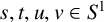 $s, t, u, v \in S^1$
such that
$s, t, u, v \in S^1$
such that
 $$ \begin{align*} hs=h_1,h_nt=h_2,uh=h_n,vh_1=h_{n-1}.\end{align*} $$
Then
 $$ \begin{align*}h\cdot sh_n=h_1h_n, \: h_1h_n \cdot th_3h_4 \cdots h_n=h,\end{align*} $$
 $$ \begin{align*} h_1u \cdot h=h_1h_n, \: h_1h_2\cdots h_{n-2}v \cdot h_1h_n=h.\end{align*} $$
Hence $(h,h_1h_n) \in \mathcal {H}$
. Then
$(h,h_1h_n) \in \mathcal {H}$
. Then $H \cap H^2 \neq \emptyset $
and it follows that H is a group.
$H \cap H^2 \neq \emptyset $
and it follows that H is a group.
It is possible to associate a group to an arbitrary $\mathcal {H}$
-class H as follows. The right stabiliser of H in S is
$\mathcal {H}$
-class H as follows. The right stabiliser of H in S is
 $$ \begin{align*}\operatorname{\mathrm{Stab}}(H)=\{s \in S^1 \mid Hs=H\}.\end{align*} $$
Clearly $\operatorname {\mathrm {Stab}}(H)$
is a submonoid of
$\operatorname {\mathrm {Stab}}(H)$
is a submonoid of $S^1$
. We define a congruence
$S^1$
. We define a congruence $\sigma _H$
on
$\sigma _H$
on $\operatorname {\mathrm {Stab}}(H)$
, called the Schützenberger congruence of H, by
$\operatorname {\mathrm {Stab}}(H)$
, called the Schützenberger congruence of H, by
 $$ \begin{align*}(x,y) \in \sigma_H \iff hx=hy\quad \text{for all }h \in H.\end{align*} $$
Then $\Gamma (H)=\operatorname {\mathrm {Stab}}(H)/\sigma _H$
is a group, known as the Schützenberger group of H. It is known that:
$\Gamma (H)=\operatorname {\mathrm {Stab}}(H)/\sigma _H$
is a group, known as the Schützenberger group of H. It is known that:
-
•
$\Gamma (H)$
acts regularly (that is, transitively and freely) on H; -
•
$|\Gamma (H)|=|H|$
; -
• if H is a group then
$\Gamma (H) \cong H$
.


One could similarly define a group $\Gamma _l(H)$
by considering the left stabiliser of H, but it turns out that
$\Gamma _l(H)$
by considering the left stabiliser of H, but it turns out that $\Gamma _l(H) \cong \Gamma (H)$
. For more on Schützenberger groups and proofs of the above claims, see [Reference Lallement20, Section 2.3].
$\Gamma _l(H) \cong \Gamma (H)$
. For more on Schützenberger groups and proofs of the above claims, see [Reference Lallement20, Section 2.3].
In a commutative semigroup S, inclusion among principal ideals induces a partial ordering on $\mathcal {H}$
classes:
$\mathcal {H}$
classes: $H_x \leq H_y \text { if } xS^1 \subseteq yS^1.$
It is easy to see that for any
$H_x \leq H_y \text { if } xS^1 \subseteq yS^1.$
It is easy to see that for any $a,x \in S$
we have
$a,x \in S$
we have $H_{xa} \leq H_x.$
From this it follows that there can be at most one minimal
$H_{xa} \leq H_x.$
From this it follows that there can be at most one minimal $\mathcal {H}$
-class and therefore if such an
$\mathcal {H}$
-class and therefore if such an $\mathcal {H}$
-class exists, it is the least
$\mathcal {H}$
-class exists, it is the least $\mathcal {H}$
-class under this partial ordering. We refer to such an
$\mathcal {H}$
-class under this partial ordering. We refer to such an $\mathcal {H}$
-class as the minimum
$\mathcal {H}$
-class as the minimum $\mathcal {H}$
-class.
$\mathcal {H}$
-class.
For Section 4 it will be important to be familiar with the basic structure theory of commutative semigroups. An archimedean semigroup is a commutative semigroup S such that for each $a,b \in S$
there exists
$a,b \in S$
there exists $n>0$
for which
$n>0$
for which $H_{a^n} \leq H_b$
. We say that a semigroup S is a semilattice of semigroups if, for some semilattice Y, we can write S as a disjoint union of subsemigroups
$H_{a^n} \leq H_b$
. We say that a semigroup S is a semilattice of semigroups if, for some semilattice Y, we can write S as a disjoint union of subsemigroups $S =\bigcup _{\alpha \in Y}S_\alpha $
such that
$S =\bigcup _{\alpha \in Y}S_\alpha $
such that $S_{\alpha }S_{\beta } \subseteq S_{\alpha \beta }$
for all
$S_{\alpha }S_{\beta } \subseteq S_{\alpha \beta }$
for all $\alpha ,\beta \in Y$
. In this case we write
$\alpha ,\beta \in Y$
. In this case we write $S=\mathcal {S}(Y,\{S_{\alpha }\}_{\alpha \in Y})$
. This leads us to the following structural theorem for commutative semigroups.
$S=\mathcal {S}(Y,\{S_{\alpha }\}_{\alpha \in Y})$
. This leads us to the following structural theorem for commutative semigroups.
Proposition 2.9 [Reference Grillet14, Theorem 4.2.2]
A commutative semigroup S is a semilattice of archimedean semigroups $\mathcal {S}(Y,\{S_{\alpha }\}_{\alpha \in Y})$
. Furthermore, if S is finitely generated then Y is finite.
$\mathcal {S}(Y,\{S_{\alpha }\}_{\alpha \in Y})$
. Furthermore, if S is finitely generated then Y is finite.
It follows from the definition that an archimedean semigroup can contain at most one idempotent. Hence a finitely generated commutative semigroup contains only finitely many idempotents.
We call a semigroup with a zero nilpotent if every element has a power equal to 0. An ideal extension of a semigroup S by a semigroup Q is a semigroup E such that S is an ideal of E and the Rees quotient $E/S$
is isomorphic to Q.
$E/S$
is isomorphic to Q.
The following result provides a characterisation of archimedean semigroups with idempotents.
Proposition 2.10 [Reference Grillet14, Proposition 4.2.3]
A commutative semigroup S is archimedean with idempotents if and only if S is either a group or an ideal extension of a group by a nilpotent semigroup.
In general, the structure of archimedean semigroups is complex. For more about the decomposition of commutative semigroups into archimedean subsemigroups, see [Reference Grillet14, Ch. 4].
3 Schützenberger groups
It is a natural question to ask, for each of the three generalisations of residual finiteness, whether that property is inherited by Schützenberger groups. This is motivated by the following result.
Proposition 3.1 [Reference Gray and Ruškuc12, Theorem 3.1]
Every Schützenberger group of a residually finite semigroup is residually finite.
In this section we show that the properties of complete separability and strong subsemigroup separability are inherited by Schützenberger groups. By way of contrast, it is not true that every Schützenberger group of a weakly subsemigroup separable semigroup is weakly subsemigroup separable. However, we are able to give a sufficient condition on the stabiliser of an $\mathcal {H}$
-class of a weakly subsemigroup separable semigroup to ensure that the corresponding Schützenberger group is also weakly subsemigroup separable. We begin by showing that the nongroup
$\mathcal {H}$
-class of a weakly subsemigroup separable semigroup to ensure that the corresponding Schützenberger group is also weakly subsemigroup separable. We begin by showing that the nongroup $\mathcal {H}$
-classes of a strongly subsemigroup separable semigroup are finite.
$\mathcal {H}$
-classes of a strongly subsemigroup separable semigroup are finite.
Proposition 3.2. Every nongroup $\mathcal {H}$
-class of a strongly subsemigroup separable semigroup is finite.
$\mathcal {H}$
-class of a strongly subsemigroup separable semigroup is finite.
Proof. For a contradiction, suppose that S is a strongly subsemigroup separable semigroup with an infinite nongroup $\mathcal {H}$
-class H. Fix some
$\mathcal {H}$
-class H. Fix some $h \in H$
and let
$h \in H$
and let $T=\langle H\!\setminus \! \{h\}\rangle $
. If
$T=\langle H\!\setminus \! \{h\}\rangle $
. If $h \in T$
, then
$h \in T$
, then $h \in H^n$
for some
$h \in H^n$
for some $n \geq 2$
, which contradicts that H is not a group. Therefore
$n \geq 2$
, which contradicts that H is not a group. Therefore $h \notin T$
. Let
$h \notin T$
. Let $\sim $
be any finite index congruence on S that separates h from T. Then there exist distinct elements
$\sim $
be any finite index congruence on S that separates h from T. Then there exist distinct elements $x,y \in H\!\setminus \! \{h\}$
such that
$x,y \in H\!\setminus \! \{h\}$
such that $x \sim y$
. As
$x \sim y$
. As $(x, h) \in \mathcal {H}$
, there exists some
$(x, h) \in \mathcal {H}$
, there exists some $s \in S$
such that
$s \in S$
such that $xs=h$
. Now
$xs=h$
. Now $h \sim ys.$
By Green’s lemma [Reference Howie16, Lemma 2.2.4], multiplication on the right by s permutes H, so
$h \sim ys.$
By Green’s lemma [Reference Howie16, Lemma 2.2.4], multiplication on the right by s permutes H, so $ys \in H\!\setminus \!\{h\} \subseteq T$
. Hence
$ys \in H\!\setminus \!\{h\} \subseteq T$
. Hence $\sim $
does not separate h from T, contradicting the strong subsemigroup separability of S.
$\sim $
does not separate h from T, contradicting the strong subsemigroup separability of S.
Corollary 3.3. Every Schützenberger group of a strongly subsemigroup separable semigroup is itself strongly subsemigroup separable.
Proof. By Proposition 3.2 every Schützenberger group of a nongroup $\mathcal {H}$
-class is finite, so is certainly strongly subsemigroup separable. The Schützenberger group of a group
$\mathcal {H}$
-class is finite, so is certainly strongly subsemigroup separable. The Schützenberger group of a group $\mathcal {H}$
-class H is isomorphic to H, so is strongly subsemigroup separable by Proposition 2.3.
$\mathcal {H}$
-class H is isomorphic to H, so is strongly subsemigroup separable by Proposition 2.3.
Corollary 3.4. Every $\mathcal {H}$
-class of a completely separable semigroup is finite (and hence each of its Schützenberger groups is completely separable).
$\mathcal {H}$
-class of a completely separable semigroup is finite (and hence each of its Schützenberger groups is completely separable).
Proof. As a completely separable semigroup is also strongly subsemigroup separable, every nongroup $\mathcal {H}$
-class is finite by Proposition 3.2. By Lemma 2.4 a group is completely separable if and only if it is finite, and so it follows from Proposition 2.3 that all the group
$\mathcal {H}$
-class is finite by Proposition 3.2. By Lemma 2.4 a group is completely separable if and only if it is finite, and so it follows from Proposition 2.3 that all the group $\mathcal {H}$
-classes are finite.
$\mathcal {H}$
-classes are finite.
The analogue of Corollary 3.3 for weak subsemigroup separability does not hold in general, as demonstrated in Example 5.10. However, it does hold for commutative semigroups. We deduce this from the following result.
Lemma 3.5. Let S be a weakly subsemigroup separable semigroup and let H be an $\mathcal {H}$
-class of
$\mathcal {H}$
-class of $S.$
If there exists an element
$S.$
If there exists an element $h \in H$
such that
$h \in H$
such that $ah=ha$
for all
$ah=ha$
for all $a \in \operatorname {\mathrm {Stab}}(H)$
, then the Schützenberger group
$a \in \operatorname {\mathrm {Stab}}(H)$
, then the Schützenberger group $\Gamma (H)$
is weakly subsemigroup separable.
$\Gamma (H)$
is weakly subsemigroup separable.
Proof. If H is a group then $\Gamma (H) \cong H$
. Hence,
$\Gamma (H) \cong H$
. Hence, $\Gamma (H)$
is weakly subsemigroup separable by Proposition 2.3.
$\Gamma (H)$
is weakly subsemigroup separable by Proposition 2.3.
Now assume that H is not a group. For $x \in \operatorname {\mathrm {Stab}}(H)$
, we denote
$x \in \operatorname {\mathrm {Stab}}(H)$
, we denote $[x]_{\sigma _H}$
by
$[x]_{\sigma _H}$
by $[x]$
. Let
$[x]$
. Let $T=\langle [x_1],[x_2],\ldots ,[x_n] \rangle \leq \Gamma (H)$
and let
$T=\langle [x_1],[x_2],\ldots ,[x_n] \rangle \leq \Gamma (H)$
and let $[u] \in \Gamma (H) \!\setminus \! T$
. Let h be as in the statement of the lemma. Let
$[u] \in \Gamma (H) \!\setminus \! T$
. Let h be as in the statement of the lemma. Let $\overline {T}=\langle h,x_1,x_2,\ldots ,x_n \rangle \leq S$
.
$\overline {T}=\langle h,x_1,x_2,\ldots ,x_n \rangle \leq S$
.
First we show that $hu \notin \overline {T}$
. For a contradiction, assume that
$hu \notin \overline {T}$
. For a contradiction, assume that $hu \in \overline {T}$
. Then, as
$hu \in \overline {T}$
. Then, as $hx_j=x_jh$
for
$hx_j=x_jh$
for $1 \leq j \leq n$
, we have
$1 \leq j \leq n$
, we have $hu=h^it$
for some
$hu=h^it$
for some $t \in \langle x_1,x_2,\ldots ,x_n \rangle $
and
$t \in \langle x_1,x_2,\ldots ,x_n \rangle $
and $i \geq 0$
. We consider three cases:
$i \geq 0$
. We consider three cases: $i=0$
,
$i=0$
, $i=1$
, and
$i=1$
, and $i>1$
.
$i>1$
.
-
(i) If
$i=0$
we have
$hu=t \in \operatorname {\mathrm {Stab}}(H)$
; so
$h^2u \in H \cap H^2$
, which contradicts that H is not a group. -
(ii) If
$i=1$
we have
$hu=ht$
but
$[t] \neq [u]$
, contradicting
$\Gamma (H)$
acting freely on H. -
(iii) Finally, assume
$i> 1$
. As
$u, t \in \operatorname {\mathrm {Stab}}(H)$
, it follows that
$h^it \in H \cap H^i$
, contradicting that H is not a group.






As S is weakly subsemigroup separable, there exist a finite semigroup U and homomorphism $\phi :S \to U$
such that
$\phi :S \to U$
such that $\phi (hu) \notin \phi (\overline {T})$
. Let
$\phi (hu) \notin \phi (\overline {T})$
. Let $H_{\phi (h)} \subseteq U$
be the
$H_{\phi (h)} \subseteq U$
be the $\mathcal {H}$
-class of
$\mathcal {H}$
-class of $\phi (h)$
. Now
$\phi (h)$
. Now $\phi (\operatorname {\mathrm {Stab}}(H))\subseteq \operatorname {\mathrm {Stab}}(H_{\phi (h)})$
. Consider the Schützenberger group
$\phi (\operatorname {\mathrm {Stab}}(H))\subseteq \operatorname {\mathrm {Stab}}(H_{\phi (h)})$
. Consider the Schützenberger group $\Gamma (H_{\phi (h)})$
. Then the map
$\Gamma (H_{\phi (h)})$
. Then the map $\theta : \Gamma (H) \to \Gamma (H_{\phi (h)})$
given by
$\theta : \Gamma (H) \to \Gamma (H_{\phi (h)})$
given by $\theta ([v])=[\phi (v)]$
is a homomorphism. If
$\theta ([v])=[\phi (v)]$
is a homomorphism. If $\theta ([u]) \in \theta (T)$
, then
$\theta ([u]) \in \theta (T)$
, then $\phi (h)\phi (u)=\phi (h)\phi (t)$
for some
$\phi (h)\phi (u)=\phi (h)\phi (t)$
for some $t \in \langle x_1, x_2, \ldots , x_n \rangle $
, contradicting
$t \in \langle x_1, x_2, \ldots , x_n \rangle $
, contradicting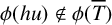 $\phi (hu) \notin \phi (\overline {T})$
. Hence
$\phi (hu) \notin \phi (\overline {T})$
. Hence $\theta ([u]) \notin \theta (T)$
. We conclude that
$\theta ([u]) \notin \theta (T)$
. We conclude that $\Gamma (H)$
is weakly subsemigroup separable.
$\Gamma (H)$
is weakly subsemigroup separable.
Corollary 3.6. Every Schützenberger group of a weakly subsemigroup separable commutative semigroup is itself weakly subsemigroup separable.
Although Schützenberger groups of weakly subsemigroup separable semigroups need not in general be weakly subsemigroup separable, it is an intriguing open question whether they must be weakly subgroup separable.
Open Problem 3.7. Let S be a semigroup and let H be an $\mathcal {H}$
-class of S. If S is weakly subsemigroup separable, is
$\mathcal {H}$
-class of S. If S is weakly subsemigroup separable, is $\Gamma (H)$
weakly subgroup separable?
$\Gamma (H)$
weakly subgroup separable?
In the final part of this section we provide some partial solutions to this problem, one of which is utilised in the proof of Proposition 5.8.
Proposition 3.8. Let S be a semigroup and let H be an $\mathcal {H}$
-class of
$\mathcal {H}$
-class of $S.$
If S is weakly subsemigroup separable, then
$S.$
If S is weakly subsemigroup separable, then $\Gamma (H)$
satisfies the separability property with respect to the collection of all finitely generated abelian subgroups.
$\Gamma (H)$
satisfies the separability property with respect to the collection of all finitely generated abelian subgroups.
Proof. If H is a group, then $\Gamma (H)\cong H$
is a subgroup of S and hence weakly subsemigroup separable by Proposition 2.3. It then certainly satisfies the separability property with respect to the collection of all finitely generated abelian subgroups.
$\Gamma (H)\cong H$
is a subgroup of S and hence weakly subsemigroup separable by Proposition 2.3. It then certainly satisfies the separability property with respect to the collection of all finitely generated abelian subgroups.
Suppose that H is not a group. Let G be a finitely generated abelian subgroup of $\Gamma (H)$
and let
$\Gamma (H)$
and let $b\in \Gamma (H)\!\setminus \!G.$
Now, G is generated (as a group) by some set
$b\in \Gamma (H)\!\setminus \!G.$
Now, G is generated (as a group) by some set $\{a_1, \ldots , a_n\}\cup G_0,$
where each
$\{a_1, \ldots , a_n\}\cup G_0,$
where each $a_i$
is nontorsion and
$a_i$
is nontorsion and $G_0$
is the finite torsion subgroup of G. For
$G_0$
is the finite torsion subgroup of G. For $s \in \operatorname {\mathrm {Stab}}(H)$
, we just write
$s \in \operatorname {\mathrm {Stab}}(H)$
, we just write $[s]$
for
$[s]$
for $[s]_{\sigma _H}.$
Let U denote the subsemigroup
$[s]_{\sigma _H}.$
Let U denote the subsemigroup
 $$ \begin{align*}\{u\in\text{Stab}(H) \mid [u]\in G\}\end{align*} $$
of $\text {Stab}(H).$
For each
$\text {Stab}(H).$
For each $i\in \{1, \ldots , n\},$
select
$i\in \{1, \ldots , n\},$
select $x_i, y_i\in U$
such that
$x_i, y_i\in U$
such that $[x_i]=a_i$
and
$[x_i]=a_i$
and $[y_i]=a_i^{-1}.$
Also, fix an element
$[y_i]=a_i^{-1}.$
Also, fix an element $h\in H.$
The remainder of this proof is organised as follows.
-
(1) We show that for each
$i\in \{1, \ldots , n\},$
there exist
$\alpha (i), \beta (i)\in \mathbb {N}$
such that
$x_i^{\alpha (i)}h=hy_i^{\beta (i)}.$
-
(2) We build a finitely generated subsemigroup T of S such that
$T\cap H=$
$\{hu \mid u\in U\}.$
-
(3) We find a finite group K and a homomorphism
$\theta : \Gamma (H)\to K$
such that
$\theta (b)\notin \theta (G).$




(1) Let $i\in \{1, \ldots , n\},$
and write
$i\in \{1, \ldots , n\},$
and write $x=x_i$
,
$x=x_i$
, $y=y_i.$
We claim that
$y=y_i.$
We claim that $hy\in \langle h, x\rangle .$
Since S is weakly subsemigroup separable, it suffices to show that
$hy\in \langle h, x\rangle .$
Since S is weakly subsemigroup separable, it suffices to show that $hy$
cannot be separated from
$hy$
cannot be separated from $\langle h, x\rangle $
by a finite index congruence. Suppose that
$\langle h, x\rangle $
by a finite index congruence. Suppose that $\sim $
is a finite index congruence on S. Then there exist
$\sim $
is a finite index congruence on S. Then there exist $k, \ell \in \mathbb {N}$
with
$k, \ell \in \mathbb {N}$
with $k<\ell $
such that
$k<\ell $
such that $hx^k \sim hx^{\ell }.$
The elements
$hx^k \sim hx^{\ell }.$
The elements $[x]$
and
$[x]$
and $[y]$
are inverses of each other in the group
$[y]$
are inverses of each other in the group $\Gamma (H)$
and so, by the definition of
$\Gamma (H)$
and so, by the definition of $\sigma _H$
,
$\sigma _H$
,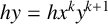 $hy=hx^ky^{k+1}$
. Hence,
$hy=hx^ky^{k+1}$
. Hence,
 $$ \begin{align*}hy=hx^ky^{k+1}\sim hx^{\ell}y^{k+1}=hx^{\ell-k-1}\in\langle h, x\rangle,\end{align*} $$
which completes the proof of the claim. Since $x\in \text {Stab}(H)$
and H is not a group, we cannot have
$x\in \text {Stab}(H)$
and H is not a group, we cannot have $hy\in \langle x\rangle .$
Post-multiplying
$hy\in \langle x\rangle .$
Post-multiplying $hy$
by an appropriate power of
$hy$
by an appropriate power of $y,$
we deduce that
$y,$
we deduce that $hy^j=uh$
for some
$hy^j=uh$
for some $j\in \mathbb {N}$
and
$j\in \mathbb {N}$
and $u\in \langle h, x\rangle .$
Now we claim that $hx^j\in \langle h, u\rangle $
. Again, it suffices to show that
$hx^j\in \langle h, u\rangle $
. Again, it suffices to show that $hx^j$
cannot be separated from
$hx^j$
cannot be separated from $\langle h, u \rangle $
in a finite index congruence. Suppose that
$\langle h, u \rangle $
in a finite index congruence. Suppose that $\sim $
is a finite index congruence on
$\sim $
is a finite index congruence on $S.$
Then there exist
$S.$
Then there exist $k, \ell \in \mathbb {N}$
with
$k, \ell \in \mathbb {N}$
with $k<\ell $
such that
$k<\ell $
such that $hy^{jk} \sim hy^{j\ell }.$
Recalling that
$hy^{jk} \sim hy^{j\ell }.$
Recalling that $[x]$
and
$[x]$
and $[y]$
are mutually inverse and that
$[y]$
are mutually inverse and that $hy^j=uh$
, we deduce
$hy^j=uh$
, we deduce
 $$ \begin{align*}hx^j=hy^{jk}x^{j(k+1)} \sim hy^{j\ell}x^{j(k+1)}=hy^{j(\ell-k-1)}=u^{\ell-k-1}h\in\langle h, u\rangle,\end{align*} $$
establishing the claim. Since $uh\in H,$
we cannot have
$uh\in H,$
we cannot have $hx^j\in \langle u\rangle ,$
for then
$hx^j\in \langle u\rangle ,$
for then $(hx^j)h\in H\cap H^2,$
contradicting that H is not a group. It follows that
$(hx^j)h\in H\cap H^2,$
contradicting that H is not a group. It follows that $hx^j=w_1hw_2$
for some
$hx^j=w_1hw_2$
for some $w_1\in \langle u\rangle ^1$
and
$w_1\in \langle u\rangle ^1$
and $w_2\in \langle h, u\rangle ^1\subseteq \langle h, x\rangle ^1.$
Now
$w_2\in \langle h, u\rangle ^1\subseteq \langle h, x\rangle ^1.$
Now $w_1h=hy^{jk}$
for some
$w_1h=hy^{jk}$
for some $k\in \mathbb {N}_0$
; so
$k\in \mathbb {N}_0$
; so $hx^j\neq w_1h$
as
$hx^j\neq w_1h$
as $[x]$
has infinite order in
$[x]$
has infinite order in $\Gamma (H),$
and hence
$\Gamma (H),$
and hence $w_2\neq 1.$
We claim we cannot write
$w_2\neq 1.$
We claim we cannot write $w_2$
as
$w_2$
as $sht$
for some
$sht$
for some $s\in \langle x\rangle ^1$
and
$s\in \langle x\rangle ^1$
and $t\in \langle h, x\rangle ^1.$
Indeed, if we could, then since
$t\in \langle h, x\rangle ^1.$
Indeed, if we could, then since $w_1h\in H$
and
$w_1h\in H$
and $x\in \text {Stab}(H),$
we would have
$x\in \text {Stab}(H),$
we would have $hx^j\in H\cap H^n$
for some
$hx^j\in H\cap H^n$
for some $n\geq 2,$
contradicting that H is not a group. Hence the claim holds. We must then have
$n\geq 2,$
contradicting that H is not a group. Hence the claim holds. We must then have $w_2\in \langle u\rangle .$
But
$w_2\in \langle u\rangle .$
But $u\in \langle h, x\rangle ,$
so we conclude that
$u\in \langle h, x\rangle ,$
so we conclude that $u=x^m$
for some
$u=x^m$
for some $m\in \mathbb {N}.$
Now set
$m\in \mathbb {N}.$
Now set $\alpha (i)=m$
and
$\alpha (i)=m$
and $\beta (i)=j.$
We fix
$\beta (i)=j.$
We fix $\alpha (i)$
and
$\alpha (i)$
and $\beta (i)$
for the remainder of this proof.
$\beta (i)$
for the remainder of this proof.
(2) For each $i\in \{1, \ldots , n\}$
let
$i\in \{1, \ldots , n\}$
let $m_i=\max (\alpha (i), \beta (i)).$
For each
$m_i=\max (\alpha (i), \beta (i)).$
For each $g\in G_0,$
select
$g\in G_0,$
select $u_g\in U$
such that
$u_g\in U$
such that $[u_g]=g.$
We define a finite set
$[u_g]=g.$
We define a finite set
 $$ \begin{align*}W=\{x_1^{j_1}\cdots x_n^{j_n} \mid 0\leq j_i\leq m_i-1\text{ for }1\leq i\leq n\}\cup\{u_g \mid g\in G_0\} \subseteq U.\end{align*} $$
Let $X=\{x_i^{\alpha (i)} \mid 1\leq i\leq n\},$
and let T be the subsemigroup of S generated by
$X=\{x_i^{\alpha (i)} \mid 1\leq i\leq n\},$
and let T be the subsemigroup of S generated by
 $$ \begin{align*}Z=X\cup\{hw \mid w\in W\}.\end{align*} $$
Note that $U \cap Z =X$
and
$U \cap Z =X$
and $H \cap Z=\{hw \mid w\in W\}$
. We prove that
$H \cap Z=\{hw \mid w\in W\}$
. We prove that $T\cap H=\{hu \mid u\in U\}.$
First, let $h^{\prime }\in T\cap H.$
Then
$h^{\prime }\in T\cap H.$
Then $h^{\prime }=z_1\cdots z_k$
for some
$h^{\prime }=z_1\cdots z_k$
for some $z_j\in Z.$
If every
$z_j\in Z.$
If every $z_j\in X,$
then
$z_j\in X,$
then $h^{\prime }\in \text {Stab}(H),$
contradicting that H is not a group. Therefore, there exists the minimal j such that
$h^{\prime }\in \text {Stab}(H),$
contradicting that H is not a group. Therefore, there exists the minimal j such that $z_j=hw$
for some
$z_j=hw$
for some $w\in W.$
Then for each
$w\in W.$
Then for each $i<j$
we have
$i<j$
we have $z_i\in X$
; and hence
$z_i\in X$
; and hence $z_ih\in hU$
, as
$z_ih\in hU$
, as $xh \in hU$
for all
$xh \in hU$
for all $x \in X$
by (1). So, we deduce that
$x \in X$
by (1). So, we deduce that $h^{\prime }=hw^{\prime }z_{j+1}\cdots z_k$
for some
$h^{\prime }=hw^{\prime }z_{j+1}\cdots z_k$
for some $w^{\prime }\in U.$
Let
$w^{\prime }\in U.$
Let $u=w^{\prime }z_{j+1}\cdots z_k.$
We show that
$u=w^{\prime }z_{j+1}\cdots z_k.$
We show that $u \in U$
. Suppose that
$u \in U$
. Suppose that $H \cap \{z_{j+1}, z_{j+2}, \ldots , z_k\}=\{z_{i_1}, \ldots , z_{i_m}\}$
where
$H \cap \{z_{j+1}, z_{j+2}, \ldots , z_k\}=\{z_{i_1}, \ldots , z_{i_m}\}$
where $j+1\leq i_1<\cdots <i_m\leq k.$
For each
$j+1\leq i_1<\cdots <i_m\leq k.$
For each $\ell \in \{1, \ldots, m-1\}$
let us set
$\ell \in \{1, \ldots, m-1\}$
let us set $h_{\ell} = z_{i_\ell} \cdots z_{i_{\ell+1}-1}$
, and also
$h_{\ell} = z_{i_\ell} \cdots z_{i_{\ell+1}-1}$
, and also $h_m = z_{i_m} \cdots z_k$.
Then
$h_m = z_{i_m} \cdots z_k$.
Then $h_{\ell }\in H$
for each
$h_{\ell }\in H$
for each $\ell \in \{1, \ldots , m\}.$
But then
$\ell \in \{1, \ldots , m\}.$
But then
 $$ \begin{align*}h^{\prime}=(hw^{\prime}z_{j+1}\cdots z_{i_1-1})h_1\cdots h_m\in H\cap H^{m+1},\end{align*} $$
which contradicts that H is not a group. Therefore, we must have $z_i\in X$
for every
$z_i\in X$
for every $i\in \{j+1, \ldots , k\}.$
It follows that
$i\in \{j+1, \ldots , k\}.$
It follows that $u\in U$
and hence
$u\in U$
and hence $h^{\prime }\in \{hu \mid u\in U\}.$
For the reverse containment, let $u\in U.$
Since G is abelian, we have
$u\in U.$
Since G is abelian, we have $[u]=a_1^{k_1}\cdots a_n^{k_n}c$
for some
$[u]=a_1^{k_1}\cdots a_n^{k_n}c$
for some $k_i\in \mathbb {Z}$
and
$k_i\in \mathbb {Z}$
and $c\in G_0.$
Consider
$c\in G_0.$
Consider $i\in \{1, \ldots , n\}.$
If
$i\in \{1, \ldots , n\}.$
If $k_i\geq 0,$
let
$k_i\geq 0,$
let $p_i\in \mathbb {N}_0$
and
$p_i\in \mathbb {N}_0$
and $r_i\in \{0, \ldots , \alpha (i)-1\}$
be such that
$r_i\in \{0, \ldots , \alpha (i)-1\}$
be such that $k_i=p_i\alpha (i)+r_i,$
and let
$k_i=p_i\alpha (i)+r_i,$
and let $q_i=s_i=0.$
If
$q_i=s_i=0.$
If $k_i<0,$
let
$k_i<0,$
let $q_i\in \mathbb {N}$
and
$q_i\in \mathbb {N}$
and $s_i\in \{0, \ldots , \beta (i)-1\}$
be such that
$s_i\in \{0, \ldots , \beta (i)-1\}$
be such that $k_i=-q_i\beta (i)+s_i,$
and let
$k_i=-q_i\beta (i)+s_i,$
and let $p_i=r_i=0.$
Now let
$p_i=r_i=0.$
Now let $t_i=\max (r_i, s_i).$
It follows that
$t_i=\max (r_i, s_i).$
It follows that
 $$ \begin{align*}hu=\bigl(x_1^{\alpha(1)}\bigr)^{q_1}\cdots\bigl(x_n^{\alpha(n)}\bigr)^{q_n}\bigl(hx_1^{t_1}\cdots x_n^{t_n}u_c\bigr)\bigl(x_1^{\alpha(1)}\bigr)^{p_1}\cdots\bigl(x_n^{\alpha(n)}\bigr)^{p_n};\end{align*} $$
so $hu\in T\cap H,$
and hence
$hu\in T\cap H,$
and hence $T\cap H=\{hu \mid u\in U\}.$
(3) Choose $v\in \text {Stab}(H)$
such that
$v\in \text {Stab}(H)$
such that $[v]=b.$
Then
$[v]=b.$
Then $hv\notin T$
by (2). Since S is weakly subsemigroup separable, there exist a finite semigroup P and a homomorphism
$hv\notin T$
by (2). Since S is weakly subsemigroup separable, there exist a finite semigroup P and a homomorphism $\phi : S\to P$
such that
$\phi : S\to P$
such that $\phi (hv)\notin \phi (T).$
Let
$\phi (hv)\notin \phi (T).$
Let $H_{\phi (h)}$
denote the
$H_{\phi (h)}$
denote the $\mathcal {H}$
-class of
$\mathcal {H}$
-class of $\phi (h),$
and let K be the finite group
$\phi (h),$
and let K be the finite group $\Gamma (H_{\phi (H)})$
. As in the proof of Lemma 3.5, the map
$\Gamma (H_{\phi (H)})$
. As in the proof of Lemma 3.5, the map $\theta : \Gamma (H)\to K,$
given by
$\theta : \Gamma (H)\to K,$
given by $\theta ([t])=[\phi (t)],$
is a homomorphism such that
$\theta ([t])=[\phi (t)],$
is a homomorphism such that $\theta (b)\notin \theta (G),$
as required.
$\theta (b)\notin \theta (G),$
as required.
Corollary 3.9. Let S be a semigroup and let H be an $\mathcal {H}$
-class of
$\mathcal {H}$
-class of $S.$
If S is weakly subsemigroup separable and
$S.$
If S is weakly subsemigroup separable and $\Gamma (H)$
is abelian, then
$\Gamma (H)$
is abelian, then $\Gamma (H)$
is weakly subgroup separable.
$\Gamma (H)$
is weakly subgroup separable.
Groups satisfying the separability property with respect to the collection of all cyclic subgroups are known in the literature as cyclic subgroup separable groups or $\Pi _c$
groups. Such groups have received considerable attention: see, for instance, [Reference Burillo and Martino2, Reference Kim17, Reference Sokolov28, Reference Wong and Wong29].
$\Pi _c$
groups. Such groups have received considerable attention: see, for instance, [Reference Burillo and Martino2, Reference Kim17, Reference Sokolov28, Reference Wong and Wong29].
From Proposition 3.8 we immediately deduce the following corollary.
Corollary 3.10. Let S be a semigroup and let H be an $\mathcal {H}$
-class of S. If S is weakly subsemigroup separable, then
$\mathcal {H}$
-class of S. If S is weakly subsemigroup separable, then $\Gamma (H)$
is cyclic subgroup separable.
$\Gamma (H)$
is cyclic subgroup separable.
In Section 6 we return to Schützenberger groups and consider the following question: if all the Schützenberger groups of a semigroup have a separability property, does the semigroup itself have that property?
4 Finitely generated commutative semigroups
In this section we give a characterisation of our separability properties in finitely generated commutative semigroups. We first note that finitely generated abelian groups are strongly subgroup separable. In fact, Mal’cev proved, more generally, that every polycyclic-by-finite group is strongly subgroup separable [Reference Mal’cev24]. However, when it comes to finitely generated commutative semigroups, Example 2.5 shows that there exist finitely generated commutative semigroups that are not even weakly subsemigroup separable. The question of when a finitely generated commutative semigroup is completely separable or strongly subsemigroup separable was considered by Kublanovskiĭ and Lesohin in [Reference Kublanovskiĭ and Lesohin18]. We briefly outline their set-up and results, without giving proofs.
Let S be a finitely generated commutative semigroup with finite generating set A. For $s \in S$
, let
$s \in S$
, let $C_s=A \cap \operatorname {\mathrm {Stab}}(H_s)$
. Then
$C_s=A \cap \operatorname {\mathrm {Stab}}(H_s)$
. Then $C_s$
is finite and can be empty. We denote
$C_s$
is finite and can be empty. We denote $|C_s|$
by
$|C_s|$
by $k_s$
. Then
$k_s$
. Then $\langle C_s \rangle ^1=\operatorname {\mathrm {Stab}}(H_s)$
. Consider the free commutative monoid
$\langle C_s \rangle ^1=\operatorname {\mathrm {Stab}}(H_s)$
. Consider the free commutative monoid $\mathbb {N}_0^{k_s}$
on
$\mathbb {N}_0^{k_s}$
on $k_s$
generators. There is a canonical homomorphism
$k_s$
generators. There is a canonical homomorphism $\phi : \mathbb {N}_0^{k_s} \to \operatorname {\mathrm {Stab}}(H_s).$
We note that
$\phi : \mathbb {N}_0^{k_s} \to \operatorname {\mathrm {Stab}}(H_s).$
We note that $\operatorname {\mathrm {Stab}}(s)$
, the point stabiliser of s, is a submonoid of
$\operatorname {\mathrm {Stab}}(s)$
, the point stabiliser of s, is a submonoid of $\operatorname {\mathrm {Stab}}(H_s)$
. Let
$\operatorname {\mathrm {Stab}}(H_s)$
. Let $W_s=\phi ^{-1}(\operatorname {\mathrm {Stab}}(s)) \leq \mathbb {N}_0^{k_s}$
be the pre-image of
$W_s=\phi ^{-1}(\operatorname {\mathrm {Stab}}(s)) \leq \mathbb {N}_0^{k_s}$
be the pre-image of $\operatorname {\mathrm {Stab}}(s)$
. We can view
$\operatorname {\mathrm {Stab}}(s)$
. We can view $\mathbb {N}_0^{k_s}$
as a submonoid of the free abelian group
$\mathbb {N}_0^{k_s}$
as a submonoid of the free abelian group $\mathbb {Z}^{k_s}$
. Consider the subgroup
$\mathbb {Z}^{k_s}$
. Consider the subgroup $G_s\leq \mathbb {Z}^{k_s} $
generated by
$G_s\leq \mathbb {Z}^{k_s} $
generated by $W_s$
. As
$W_s$
. As $G_s$
is a subgroup of
$G_s$
is a subgroup of $\mathbb {Z}^{k_s}$
, we have
$\mathbb {Z}^{k_s}$
, we have $G_s \cong \mathbb {Z}^{m_s}$
for some
$G_s \cong \mathbb {Z}^{m_s}$
for some $m_s \leq k_s$
. Using these parameters, Kublanovskiĭ and Lesohin were able to characterise when S is strongly subsemigroup separable as follows.
$m_s \leq k_s$
. Using these parameters, Kublanovskiĭ and Lesohin were able to characterise when S is strongly subsemigroup separable as follows.
Theorem 4.1 [Reference Kublanovskiĭ and Lesohin18, Theorem 1]
A finitely generated commutative semigroup S is strongly subsemigroup separable if and only if $m_s=k_s$
for all
$m_s=k_s$
for all $s \in S$
.
$s \in S$
.
From the proof of this result they obtained two corollaries, summarised as follows.
Corollary 4.2 [Reference Kublanovskiĭ and Lesohin18, Corollaries 2 and 3]
For a finitely generated commutative semigroup S the following are equivalent:
-
(1) S is completely separable;
-
(2) S is strongly subsemigroup separable;
-
(3) if
$a,b \in S$
satisfy
$a \in b^nS$
for all
$n \in \mathbb {N}$
, then there exists
$m \in \mathbb {N}$
such that
$a=b^ma$
.


We enhance the result of Corollary 4.2 by showing that for a finitely generated commutative semigroup, weak subsemigroup separability is also equivalent to complete separability. We also provide a new characterisation in terms of $\mathcal {H}$
-classes. This characterisation removes the need for the parameters
$\mathcal {H}$
-classes. This characterisation removes the need for the parameters $k_s$
and
$k_s$
and $m_s$
of Theorem 4.1. The proof we provide is independent of the work of Kublanovskiĭ and Lesohin, although the reader may note parallels between the methods used.
$m_s$
of Theorem 4.1. The proof we provide is independent of the work of Kublanovskiĭ and Lesohin, although the reader may note parallels between the methods used.
We now state the main result of this paper.
Theorem 4.3. Let S be a finitely generated commutative semigroup. Then the following are equivalent:
-
(1) S is completely separable;
-
(2) S is strongly subsemigroup separable;
-
(3) S is weakly subsemigroup separable;
-
(4) every
$\mathcal {H}$
-class of S is finite.

In order to prove Theorem 4.3, we first establish some notation and prove some preliminary results.
For an $\mathcal {H}$
-class H of a finitely generated commutative semigroup S define
$\mathcal {H}$
-class H of a finitely generated commutative semigroup S define
 $$ \begin{align*}I(H)=\bigcup\{H_s \mid s \in S, H_s \ngeq H\}.\end{align*} $$
Note that $I(H)$
is nonempty if and only if H is not the minimum
$I(H)$
is nonempty if and only if H is not the minimum $\mathcal {H}$
-class, in which case
$\mathcal {H}$
-class, in which case $I(H)$
is an ideal. In the proofs of the results of this section, when dealing with a nonminimal
$I(H)$
is an ideal. In the proofs of the results of this section, when dealing with a nonminimal $\mathcal {H}$
-class H we shall often pass to the Rees quotient
$\mathcal {H}$
-class H we shall often pass to the Rees quotient $S/I(H)$
. The following observations are needed to justify this strategy.
$S/I(H)$
. The following observations are needed to justify this strategy.
Let H be a nonminimal $\mathcal {H}$
-class, and denote
$\mathcal {H}$
-class, and denote $I(H)$
by I. Recall that
$I(H)$
by I. Recall that $S/I$
consists of a zero element, namely I, and singleton sets
$S/I$
consists of a zero element, namely I, and singleton sets $\{s\}$
where
$\{s\}$
where $s\in S\!\setminus \!I$
. For an
$s\in S\!\setminus \!I$
. For an $\mathcal {H}$
-class
$\mathcal {H}$
-class $H^{\prime }$
of S, let
$H^{\prime }$
of S, let $H^{\prime }_I=\{[h]_I \mid h \in H^{\prime }\}$
denote the image of
$H^{\prime }_I=\{[h]_I \mid h \in H^{\prime }\}$
denote the image of $H^{\prime }$
in
$H^{\prime }$
in $S/I$
. The following statements can easily be verified.
$S/I$
. The following statements can easily be verified.
-
• For an
$\mathcal {H}$
-class
$H^{\prime }$
of S, the set
$H^{\prime }_I$
is an
$\mathcal {H}$
-class of
$S/I$
. -
• For an
$\mathcal {H}$
-class
$H^{\prime }$
of S, we have that
$H^{\prime } \geq H$
if and only if
$H^{\prime }_I \geq H_I$
. -
• The set
$H_I$
is the minimum nonzero
$\mathcal {H}$
-class in
$S/I$
. -
• For
$x \in S$
, we have that
$x \in \operatorname {\mathrm {Stab}}(H)$
if and only
$[x]_{I} \in \operatorname {\mathrm {Stab}}(H_{I})$
.




Lemma 4.4. Let S be a finitely generated commutative semigroup and let H be an $\mathcal {H}$
-class. Fix
$\mathcal {H}$
-class. Fix $s \in S$
with
$s \in S$
with $H_s \geq H$
. Then
$H_s \geq H$
. Then
 $$ \begin{align*}\operatorname{\mathrm{Stab}}(H)=\{x \in S^1 \mid H_{sx^n} \geq H \text{ for all } n \in \mathbb{N}\}.\end{align*} $$
Proof. First we assume that H is the minimum $\mathcal {H}$
-class in S. In this case
$\mathcal {H}$
-class in S. In this case $S^1=\operatorname {\mathrm {Stab}}(H)$
and
$S^1=\operatorname {\mathrm {Stab}}(H)$
and $H_{sx^n} \geq H$
for all
$H_{sx^n} \geq H$
for all $s \in S$
,
$s \in S$
, $x \in S^1$
and
$x \in S^1$
and $n \in \mathbb {N}$
. The result follows.
$n \in \mathbb {N}$
. The result follows.
Now assume that H is a nonminimal $\mathcal {H}$
-class. By noticing that
$\mathcal {H}$
-class. By noticing that $I(H)\cap \operatorname {\mathrm {Stab}}(H)=\emptyset $
and
$I(H)\cap \operatorname {\mathrm {Stab}}(H)=\emptyset $
and
 $$ \begin{align*}I(H) \cap \{x \in S^1 \mid H_{sx^n} \geq H \text{ for all } n \in \mathbb{N}\} =\emptyset,\end{align*} $$
and factoring out by $I(H)$
, we may assume that H is the minimum nonzero
$I(H)$
, we may assume that H is the minimum nonzero $\mathcal {H}$
-class.
$\mathcal {H}$
-class.
Let $x \in \operatorname {\mathrm {Stab}}(H)$
. For a contradiction assume that some
$x \in \operatorname {\mathrm {Stab}}(H)$
. For a contradiction assume that some $n \in \mathbb {N}$
has
$n \in \mathbb {N}$
has $H_{sx^n}\ngeq H$
. Then, as H is the minimum nonzero
$H_{sx^n}\ngeq H$
. Then, as H is the minimum nonzero $\mathcal {H}$
-class, we have
$\mathcal {H}$
-class, we have $sx^n=0$
. As
$sx^n=0$
. As $H_s \geq H$
, there exists
$H_s \geq H$
, there exists $t \in S^1$
such that
$t \in S^1$
such that $st \in H$
. Then
$st \in H$
. Then
 $$ \begin{align*}0=sx^nt=stx^n \in Hx^n=H,\end{align*} $$
which is a contradiction.
Now assume that $H_{sx^n} \geq H$
for all
$H_{sx^n} \geq H$
for all $n \in \mathbb {N}$
. Fix
$n \in \mathbb {N}$
. Fix $h \in H$
. Assume for a contradiction that
$h \in H$
. Assume for a contradiction that $x \notin \operatorname {\mathrm {Stab}}(H)$
. Then
$x \notin \operatorname {\mathrm {Stab}}(H)$
. Then $hx=0$
. As S is finitely generated and commutative, it is residually finite; see [Reference Lallement19, Theorem 3]. Let
$hx=0$
. As S is finitely generated and commutative, it is residually finite; see [Reference Lallement19, Theorem 3]. Let $\sim $
be an arbitrary finite index congruence on S. Then there exist
$\sim $
be an arbitrary finite index congruence on S. Then there exist $m,n \in \mathbb {N}$
, with
$m,n \in \mathbb {N}$
, with $m < n$
, such that
$m < n$
, such that $sx^m \sim sx^n$
. As
$sx^m \sim sx^n$
. As $H_{sx^m} \geq H$
, there exists
$H_{sx^m} \geq H$
, there exists $t \in S^1$
such that
$t \in S^1$
such that $sx^mt=h$
. Then
$sx^mt=h$
. Then
 $$ \begin{align*}h=sx^mt \sim sx^nt=sx^mtx^{n-m}=hx^{n-m}=0.\end{align*} $$
As $\sim $
is arbitrary, we have shown we cannot separate h and 0 in a finite quotient. This contradicts S being residually finite.
$\sim $
is arbitrary, we have shown we cannot separate h and 0 in a finite quotient. This contradicts S being residually finite.
Corollary 4.5. Let S be a finitely generated commutative semigroup and let H be a nonminimal $\mathcal {H}$
-class. Let
$\mathcal {H}$
-class. Let $I=I(H)$
. If A is an archimedean component in
$I=I(H)$
. If A is an archimedean component in $S/I$
not containing the zero element, then
$S/I$
not containing the zero element, then $A \subseteq \operatorname {\mathrm {Stab}}(H_{I})$
.
$A \subseteq \operatorname {\mathrm {Stab}}(H_{I})$
.
Proof. Let $a \in A$
. As A is a subsemigroup we have
$a \in A$
. As A is a subsemigroup we have $a^n \in A$
for all
$a^n \in A$
for all $n \in \mathbb {N}$
. So
$n \in \mathbb {N}$
. So $H_{a \cdot a^n} \geq H_{I}$
for all
$H_{a \cdot a^n} \geq H_{I}$
for all $n \in \mathbb {N}$
. Hence
$n \in \mathbb {N}$
. Hence $a \in \operatorname {\mathrm {Stab}}(H_{I})$
by Lemma 4.4.
$a \in \operatorname {\mathrm {Stab}}(H_{I})$
by Lemma 4.4.
Now we are ready to prove Theorem 4.3.
Proof of Theorem 4.3. From Proposition 2.1 we know that (1) implies (2) and (2) implies (3). We only need to show that (3) implies (4) and that (4) implies (1).
(3) $\Rightarrow $
(4) For a contradiction assume that S is weakly subsemigroup separable but has an infinite
$\Rightarrow $
(4) For a contradiction assume that S is weakly subsemigroup separable but has an infinite $\mathcal {H}$
-class H. Then the Schützenberger group
$\mathcal {H}$
-class H. Then the Schützenberger group $\Gamma (H)$
must also be infinite. As
$\Gamma (H)$
must also be infinite. As $H_{xa} \leq H_x$
for all
$H_{xa} \leq H_x$
for all $x,a \in S$
, the complement of
$x,a \in S$
, the complement of $\operatorname {\mathrm {Stab}}(H)$
is an ideal of S. It follows that if X is a finite generating set for S, then
$\operatorname {\mathrm {Stab}}(H)$
is an ideal of S. It follows that if X is a finite generating set for S, then $\operatorname {\mathrm {Stab}}(H)$
is generated by
$\operatorname {\mathrm {Stab}}(H)$
is generated by $\operatorname {\mathrm {Stab}}(H) \cap X$
and so is also finitely generated. As
$\operatorname {\mathrm {Stab}}(H) \cap X$
and so is also finitely generated. As $\Gamma (H)$
is a quotient of a finitely generated commutative monoid, it is a finitely generated abelian group. As
$\Gamma (H)$
is a quotient of a finitely generated commutative monoid, it is a finitely generated abelian group. As $\Gamma (H)$
is infinite, it must contain a subgroup isomorphic to
$\Gamma (H)$
is infinite, it must contain a subgroup isomorphic to $\mathbb {Z}$
. So
$\mathbb {Z}$
. So $\Gamma (H)$
is not weakly subsemigroup separable by Example 2.5 and Proposition 2.3. However, this contradicts Corollary 3.6, so there cannot be an infinite
$\Gamma (H)$
is not weakly subsemigroup separable by Example 2.5 and Proposition 2.3. However, this contradicts Corollary 3.6, so there cannot be an infinite $\mathcal {H}$
-class.
$\mathcal {H}$
-class.
(4) $\Rightarrow $
(1) Let
$\Rightarrow $
(1) Let $h \in S$
. We show that there exists a finite index congruence on S such that the congruence class of h is a singleton. For
$h \in S$
. We show that there exists a finite index congruence on S such that the congruence class of h is a singleton. For $s \in S$
, let
$s \in S$
, let $A_s$
denote the archimedean component of s. Further, let
$A_s$
denote the archimedean component of s. Further, let $H$
denote the
$H$
denote the $\mathcal{H}$
-class of
$\mathcal{H}$
-class of $h$
, let
$h$
, let $\sigma$
denote the Schützenberger congruence
$\sigma$
denote the Schützenberger congruence $\sigma_H$
, and let
$\sigma_H$
, and let $I=I(H)$
.
$I=I(H)$
.
We consider two cases.
Case 1.
The first case is that H is not a group. In particular, H is not the minimum $\mathcal {H}$
-class. Factoring out I, we may assume that H is the minimum nonzero
$\mathcal {H}$
-class. Factoring out I, we may assume that H is the minimum nonzero $\mathcal {H}$
-class in S. As H is not a group,
$\mathcal {H}$
-class in S. As H is not a group, $H^2=\{0\}$
. So
$H^2=\{0\}$
. So $A_h=A_0$
and
$A_h=A_0$
and $A_h$
is a nilpotent semigroup. It follows from Corollary 4.5 that
$A_h$
is a nilpotent semigroup. It follows from Corollary 4.5 that $S^1$
is the disjoint union of
$S^1$
is the disjoint union of $\operatorname {\mathrm {Stab}}(H)$
and
$\operatorname {\mathrm {Stab}}(H)$
and $A_h$
. Consider any finite generating set for S, and write it as
$A_h$
. Consider any finite generating set for S, and write it as $X\cup Y$
, where
$X\cup Y$
, where $X\subseteq \operatorname {\mathrm {Stab}}(H)$
and
$X\subseteq \operatorname {\mathrm {Stab}}(H)$
and $Y\subseteq A_h$
. Then
$Y\subseteq A_h$
. Then $\langle X \rangle \subseteq \operatorname {\mathrm {Stab}}(H)$
and, as
$\langle X \rangle \subseteq \operatorname {\mathrm {Stab}}(H)$
and, as $A_h$
is nonempty, Y must also be nonempty. Note that
$A_h$
is nonempty, Y must also be nonempty. Note that $U= \langle Y \rangle $
is finite as
$U= \langle Y \rangle $
is finite as $A_h$
is nilpotent. We may assume that X is nonempty, for otherwise
$A_h$
is nilpotent. We may assume that X is nonempty, for otherwise $S=U$
is a finite semigroup and hence certainly completely separable.
$S=U$
is a finite semigroup and hence certainly completely separable.
Let $X=\{x_1, x_2, \ldots , x_m\}$
and let
$X=\{x_1, x_2, \ldots , x_m\}$
and let $\overline {X}=\{\overline {x}_1, \overline {x}_2, \ldots , \overline {x}_m\}$
be disjoint from X. Let
$\overline {X}=\{\overline {x}_1, \overline {x}_2, \ldots , \overline {x}_m\}$
be disjoint from X. Let $\operatorname {\mathrm {FC}}_{\overline {X}}$
denote the free commutative monoid on
$\operatorname {\mathrm {FC}}_{\overline {X}}$
denote the free commutative monoid on $\overline {X}$
. Let
$\overline {X}$
. Let $\phi : \operatorname {\mathrm {FC}}_{\overline {X}} \to \operatorname {\mathrm {Stab}}(H)$
be the unique extension to a homomorphism of the map given by
$\phi : \operatorname {\mathrm {FC}}_{\overline {X}} \to \operatorname {\mathrm {Stab}}(H)$
be the unique extension to a homomorphism of the map given by $\overline {x_i} \to x_i$
. For
$\overline {x_i} \to x_i$
. For $u \in U$
define
$u \in U$
define
 $$ \begin{align*}I_u=\{w \in \operatorname{\mathrm{FC}}_{\overline{X}} \mid u\phi(w)\in H\}.\end{align*} $$
Suppose that $w\in I_u$
and
$w\in I_u$
and $z\in \operatorname {\mathrm {FC}}_{\overline {X}}$
. Then since
$z\in \operatorname {\mathrm {FC}}_{\overline {X}}$
. Then since $u\phi (w)\in H$
and
$u\phi (w)\in H$
and $\phi (z)\in \text {Stab}(H)$
, we deduce that
$\phi (z)\in \text {Stab}(H)$
, we deduce that $u\phi (wz)=(u\phi (w))\phi (z)\in H$
. Thus, if
$u\phi (wz)=(u\phi (w))\phi (z)\in H$
. Thus, if $I_u$
is nonempty, then it is an ideal of
$I_u$
is nonempty, then it is an ideal of $\operatorname {\mathrm {FC}}_{\overline {X}}$
.
$\operatorname {\mathrm {FC}}_{\overline {X}}$
.
The monoid $\operatorname {\mathrm {FC}}_{\overline {X}}$
is isomorphic to
$\operatorname {\mathrm {FC}}_{\overline {X}}$
is isomorphic to $\mathbb {N}_0^{|X|}$
. Ideals of
$\mathbb {N}_0^{|X|}$
. Ideals of $\mathbb {N}_0^{|X|}$
are upward closed sets under the componentwise ordering on tuples. It is well known that this partially ordered set has no infinite antichains (Dickson’s lemma). From this follows the well-known fact that every ideal of
$\mathbb {N}_0^{|X|}$
are upward closed sets under the componentwise ordering on tuples. It is well known that this partially ordered set has no infinite antichains (Dickson’s lemma). From this follows the well-known fact that every ideal of $\operatorname {\mathrm {FC}}_{\overline {X}}$
is finitely generated as an ideal.
$\operatorname {\mathrm {FC}}_{\overline {X}}$
is finitely generated as an ideal.
Let $U^{\prime }=\{u\in U \mid I_u\neq \emptyset \}$
. For each
$U^{\prime }=\{u\in U \mid I_u\neq \emptyset \}$
. For each $u\in U^{\prime }$
let
$u\in U^{\prime }$
let $Z_u$
be a finite generating set for
$Z_u$
be a finite generating set for $I_u$
, and let
$I_u$
, and let
 $$ \begin{align*}Z=\bigcup_{u \in U^{\prime}}Z_u.\end{align*} $$
As U is finite, we have that Z is finite. For each $z\in Z$
, we have
$z\in Z$
, we have
 $$ \begin{align*}z={\overline{x}_1}^{\alpha_1(z)}{\overline{x}_2}^{\alpha_2(z)}\cdots {\overline{x}_m}^{\alpha_m(z)}\end{align*} $$
for some $\alpha _i(z)\in \mathbb {N}_0$
. Define
$\alpha _i(z)\in \mathbb {N}_0$
. Define
 $$ \begin{align*}n=\text{max}\{\alpha_i(z) \mid z\in Z, 1\leq i\leq m\}.\end{align*} $$
Now let $\sim $
be the congruence on S generated by the set
$\sim $
be the congruence on S generated by the set $\{(x_i^n,x_i^{n+|H|}) \mid 1 \leq i \leq m \}.$
Each of the finitely many generators of
$\{(x_i^n,x_i^{n+|H|}) \mid 1 \leq i \leq m \}.$
Each of the finitely many generators of $S/{\sim}$
is periodic and
$S/{\sim}$
is periodic and $S/{\sim}$
is commutative, so
$S/{\sim}$
is commutative, so $S/{\sim}$
is finite. We now show that
$S/{\sim}$
is finite. We now show that $[h]_{\sim }=\{h\}$
.
$[h]_{\sim }=\{h\}$
.
Let $t \sim h$
. We need to show that
$t \sim h$
. We need to show that $t=h$
. Clearly it is sufficient to assume that t is obtained from h by a single application of a pair from the generating set of
$t=h$
. Clearly it is sufficient to assume that t is obtained from h by a single application of a pair from the generating set of $\sim $
. So, let
$\sim $
. So, let $h=sx_i^p$
and
$h=sx_i^p$
and $t=sx_i^q$
where
$t=sx_i^q$
where $1 \leq i \leq m$
,
$1 \leq i \leq m$
, $s \in S$
and
$s \in S$
and $\{p,q\} = \{n,n+|H|\}$
.
$\{p,q\} = \{n,n+|H|\}$
.
If $(p,q)=(n,n+|H|)$
then
$(p,q)=(n,n+|H|)$
then $t=hx_i^{|H|}$
. Since
$t=hx_i^{|H|}$
. Since $x_i \in \operatorname {\mathrm {Stab}}(H)$
,
$x_i \in \operatorname {\mathrm {Stab}}(H)$
, $[x_i]_{\sigma }$
is an element of the Schützenberger group
$[x_i]_{\sigma }$
is an element of the Schützenberger group $\Gamma (H)$
. As
$\Gamma (H)$
. As $|\Gamma (H)|=|H|$
, it follows that
$|\Gamma (H)|=|H|$
, it follows that $[x_i^{|H|}]_{\sigma }=[x_i]^{|H|}_{\sigma }=[1]_{\sigma }$
. Hence,
$[x_i^{|H|}]_{\sigma }=[x_i]^{|H|}_{\sigma }=[1]_{\sigma }$
. Hence,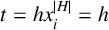 $t=hx_i^{|H|}=h$
.
$t=hx_i^{|H|}=h$
.
Now we consider the case when $(p,\ q)=(n+|H|, n)$
. As
$(p,\ q)=(n+|H|, n)$
. As $h \notin \operatorname {\mathrm {Stab}}(H)$
, we have
$h \notin \operatorname {\mathrm {Stab}}(H)$
, we have $s\in A_h\!\setminus \!\{0\}$
. Any decomposition of s into generators must contain at least one element from Y. Therefore, we have that
$s\in A_h\!\setminus \!\{0\}$
. Any decomposition of s into generators must contain at least one element from Y. Therefore, we have that $s=us'$
, where
$s=us'$
, where $u \in U'$
and
$u \in U'$
and $s' \in \operatorname {\mathrm {Stab}}(H)$
. Fix some
$s' \in \operatorname {\mathrm {Stab}}(H)$
. Fix some
 $$ \begin{align*}w={\overline{x}_1}^{\beta_1}{\overline{x}_2}^{\beta_2}\cdots {\overline{x}_m}^{\beta_m} \in \operatorname{\mathrm{FC}}_{\overline{X}}\end{align*} $$
such that $\phi (w)=s'$
. As
$\phi (w)=s'$
. As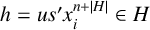 $h=us'x_i^{n+|H|} \in H$
, we have that
$h=us'x_i^{n+|H|} \in H$
, we have that
 $$ \begin{align*}w{\overline{x}_i}^{n+|H|}={\overline{x}_1}^{\beta_1}{\overline{x}_2}^{\beta_2}\cdots {\overline{x}_i}^{\beta_i+n+|H|} \cdots {\overline{x}_m}^{\beta_m} \in I_u.\end{align*} $$
Then there exist $z \in Z$
and
$z \in Z$
and $w'={\overline {x}_1}^{\gamma _1} \cdots {\overline {x}_m}^{\gamma _m} \in \operatorname {\mathrm {FC}}_{\overline {x}}$
such that
$w'={\overline {x}_1}^{\gamma _1} \cdots {\overline {x}_m}^{\gamma _m} \in \operatorname {\mathrm {FC}}_{\overline {x}}$
such that
 $$ \begin{align*}zw'=w{\overline{x}_i}^{n +|H|}.\end{align*} $$
For $1 \leq j \leq m$
, we have that
$1 \leq j \leq m$
, we have that
 $$ \begin{align*} \alpha_j(z)+\gamma_j=\begin{cases} \beta_{j} &\text{if } j \neq i, \\ \beta_i+n+|H| &\text{if } j=i. \end{cases} \end{align*} $$
As $\alpha _i(z) \leq n$
by definition, it must be the case that
$\alpha _i(z) \leq n$
by definition, it must be the case that $\gamma _i \geq |H|$
. Then
$\gamma _i \geq |H|$
. Then
 $$ \begin{align*}w{\overline{x}_i}^n=z{\overline{x}_1}^{\gamma_1}\cdots {\overline{x}_i}^{\delta} \cdots {\overline{x}_m}^{\gamma_m}\end{align*} $$
where $\delta =\gamma _i-|H| \geq 0$
. Hence
$\delta =\gamma _i-|H| \geq 0$
. Hence $w{\overline {x}_i}^n \in I_u$
and so
$w{\overline {x}_i}^n \in I_u$
and so $sx_i^n=t \in H$
. As
$sx_i^n=t \in H$
. As $h=tx_i^{|H|}$
, an argument similar to that above proves that
$h=tx_i^{|H|}$
, an argument similar to that above proves that $h=t$
, as required.
$h=t$
, as required.
Case 2.
Now we assume that H is a group. By Proposition 2.10, $A_h$
is either a group or the ideal extension of H by a nilpotent semigroup. Hence,
$A_h$
is either a group or the ideal extension of H by a nilpotent semigroup. Hence, $A_h \subseteq \operatorname {\mathrm {Stab}}(H)$
. If H is the minimum
$A_h \subseteq \operatorname {\mathrm {Stab}}(H)$
. If H is the minimum $\mathcal {H}$
-class of S, then
$\mathcal {H}$
-class of S, then $S^1=\text {Stab}(H).$
If H is not minimal, we may assume that it is the minimum nonzero
$S^1=\text {Stab}(H).$
If H is not minimal, we may assume that it is the minimum nonzero $\mathcal {H}$
-class of S (by taking the Rees quotient by I), in which case we have
$\mathcal {H}$
-class of S (by taking the Rees quotient by I), in which case we have $S^1\!\setminus \!\{0\}=\text {Stab}(H)$
by Corollary 4.5 and the fact that
$S^1\!\setminus \!\{0\}=\text {Stab}(H)$
by Corollary 4.5 and the fact that $A_h \subseteq \operatorname {\mathrm {Stab}}(H)$
.
$A_h \subseteq \operatorname {\mathrm {Stab}}(H)$
.
In either case, let X be a finite generating set for $\operatorname {\mathrm {Stab}}(H)$
. As in Case 1, let
$\operatorname {\mathrm {Stab}}(H)$
. As in Case 1, let $\overline {X}$
be a set in bijection with X, let
$\overline {X}$
be a set in bijection with X, let $\operatorname {\mathrm {FC}}_{\overline {X}}$
denote the free commutative monoid on
$\operatorname {\mathrm {FC}}_{\overline {X}}$
denote the free commutative monoid on $\overline {X}$
, and let
$\overline {X}$
, and let $\phi : \operatorname {\mathrm {FC}}_{\overline {X}} \to \operatorname {\mathrm {Stab}}(H)$
be the unique extension to a homomorphism of a bijection
$\phi : \operatorname {\mathrm {FC}}_{\overline {X}} \to \operatorname {\mathrm {Stab}}(H)$
be the unique extension to a homomorphism of a bijection $\overline {X} \to X$
. Define
$\overline {X} \to X$
. Define
 $$ \begin{align*}J=\{w \in \operatorname{\mathrm{FC}}_{\overline{X}} \mid \phi(w) \in H\}.\end{align*} $$
Then J is an ideal of $\operatorname {\mathrm {FC}}_{\overline {X}}$
. Let Z be a finite generating set for J (as an ideal), and let n be the maximal exponent of a generator appearing in any word
$\operatorname {\mathrm {FC}}_{\overline {X}}$
. Let Z be a finite generating set for J (as an ideal), and let n be the maximal exponent of a generator appearing in any word $z \in Z$
.
$z \in Z$
.
Let $\sim $
be the congruence on S with generating set
$\sim $
be the congruence on S with generating set $\{(x^n,x^{n+|H|}) \mid x \in X\}.$
An argument essentially the same as that for Case 1 shows that
$\{(x^n,x^{n+|H|}) \mid x \in X\}.$
An argument essentially the same as that for Case 1 shows that $S/{\sim}$
is finite and
$S/{\sim}$
is finite and $[h]_\sim =\{h\}$
, completing the proof of this direction and of the theorem.
$[h]_\sim =\{h\}$
, completing the proof of this direction and of the theorem.
5 Beyond finitely generated commutative semigroups
Given that the three properties of complete separability, strong subsemigroup separability and weak subsemigroup separability coincide for finitely generated commutative semigroups, the following questions naturally arise.
-
• For commutative semigroups in general (not necessarily finitely generated), do the properties of complete separability and strong subsemigroup separability coincide?
-
• For commutative semigroups in general, do the properties of strong subsemigroup separability and weak subsemigroup separability coincide?
-
• For finitely generated semigroups in general (not necessarily commutative), do the properties of complete separability and strong subsemigroup separability coincide?
-
• For finitely generated semigroups in general, do the properties of strong subsemigroup separability and weak subsemigroup separability coincide?
In this section we answer all of these questions in the negative. We first deal with the commutative case and then the finitely generated case.
5.1 Nonfinitely generated commutative semigroups
We give an example of a commutative semigroup that is weakly subsemigroup separable but not strongly subsemigroup separable. In order to do this, we first establish the following result.
Proposition 5.1. If a residually finite semigroup S has $\mathbb {N}$
as a homomorphic image then it is weakly subsemigroup separable.
$\mathbb {N}$
as a homomorphic image then it is weakly subsemigroup separable.
Proof. Let $T \leq S$
be finitely generated and let
$T \leq S$
be finitely generated and let $x \in S \! \setminus \! T$
. By assumption there exists a homomorphism
$x \in S \! \setminus \! T$
. By assumption there exists a homomorphism $f: S \to \mathbb {N}$
. Let
$f: S \to \mathbb {N}$
. Let $n=f(x)$
. The set
$n=f(x)$
. The set $I=\{m \mid m> n\} \subseteq \mathbb {N}$
is an ideal of
$I=\{m \mid m> n\} \subseteq \mathbb {N}$
is an ideal of $\mathbb {N}$
. Let
$\mathbb {N}$
. Let $g: \mathbb {N} \to \mathbb {N}/I$
be the canonical homomorphism.
$g: \mathbb {N} \to \mathbb {N}/I$
be the canonical homomorphism.
Since T is finitely generated and $f(st)>f(s)$
for any
$f(st)>f(s)$
for any $s,t \in S$
, it follows that the set
$s,t \in S$
, it follows that the set
 $$ \begin{align*}Y=\{t \in T \mid f(t)=n\}\end{align*} $$
is finite. Since S is residually finite, there exist a finite semigroup P and homomorphism $h: S \to P$
such that
$h: S \to P$
such that $h(x) \notin h(Y)$
. Then
$h(x) \notin h(Y)$
. Then $(g \circ f) \times h: S \to \mathbb {N}/I \times P$
separates x from T.
$(g \circ f) \times h: S \to \mathbb {N}/I \times P$
separates x from T.
Example 5.2. Consider $S=\mathbb {N} \times \mathbb {Z}$
. Now, S is residually finite since it is the direct product of two residually finite semigroups. As the projection map onto the first factor gives a homomorphic image which is
$S=\mathbb {N} \times \mathbb {Z}$
. Now, S is residually finite since it is the direct product of two residually finite semigroups. As the projection map onto the first factor gives a homomorphic image which is $\mathbb {N}$
, we conclude that S is weakly subsemigroup separable by Proposition 5.1.
$\mathbb {N}$
, we conclude that S is weakly subsemigroup separable by Proposition 5.1.
We now show that S is not strongly subsemigroup separable. Consider $\mathbb {N} \times \mathbb {N} \leq S$
and the element
$\mathbb {N} \times \mathbb {N} \leq S$
and the element $(2,0) \notin \mathbb {N} \times \mathbb {N}$
. Let
$(2,0) \notin \mathbb {N} \times \mathbb {N}$
. Let $\sim $
be a finite index congruence on S. Then there exist
$\sim $
be a finite index congruence on S. Then there exist $i, j \in \mathbb {Z}$
with
$i, j \in \mathbb {Z}$
with $i<j$
such that
$i<j$
such that $(1, i) \sim (1, j)$
. Then
$(1, i) \sim (1, j)$
. Then
 $$ \begin{align*}(2, 0)=(1, i)(1, -i) \sim (1,j)(1, -i)=(2, j-i) \in \mathbb{N} \times \mathbb{N}.\end{align*} $$
Hence, S is a commutative semigroup which is weakly subsemigroup separable but not strongly subsemigroup separable.
Remark 5.3. The semigroup $\mathbb {N} \times \mathbb {Z}$
is also an example of a weakly subsemigroup separable semigroup that is a direct product of two semigroups one of which is not weakly subsemigroup separable. This is in contrast to the situation for residual finiteness: the direct product of two semigroups is residually finite if and only if both factors are residually finite [Reference Gray and Ruškuc11, Theorem 2].
$\mathbb {N} \times \mathbb {Z}$
is also an example of a weakly subsemigroup separable semigroup that is a direct product of two semigroups one of which is not weakly subsemigroup separable. This is in contrast to the situation for residual finiteness: the direct product of two semigroups is residually finite if and only if both factors are residually finite [Reference Gray and Ruškuc11, Theorem 2].
We are left to find an example of a strongly subsemigroup separable commutative semigroup that is not completely separable. Our example is a group.
Example 5.4. Let $C_2$
denote the cyclic group of order 2. Let
$C_2$
denote the cyclic group of order 2. Let $G=C_2^{\mathbb {N}}$
be the Cartesian product of countably many copies of
$G=C_2^{\mathbb {N}}$
be the Cartesian product of countably many copies of $C_2$
. By Lemma 2.4, G is not completely separable. But from Theorem 2.8, an abelian group is strongly subsemigroup separable if and only if it is torsion and, for each prime p, the primary p-component is bounded in the exponent. As every nonidentity element in G has order 2, G certainly satisfies these conditions. Hence G is strongly subsemigroup separable.
$C_2$
. By Lemma 2.4, G is not completely separable. But from Theorem 2.8, an abelian group is strongly subsemigroup separable if and only if it is torsion and, for each prime p, the primary p-component is bounded in the exponent. As every nonidentity element in G has order 2, G certainly satisfies these conditions. Hence G is strongly subsemigroup separable.
5.2 Finitely generated semigroups
In the previous section we showed that, in the statement of Theorem 4.3, being commutative is not on its own a sufficient condition. In this section we show that being finitely generated is also not on its own a sufficient condition. That is, we provide two examples of finitely generated semigroups, one of which is weakly subsemigroup separable but not strongly subsemigroup separable, and the other strongly subsemigroup separable but not completely separable.
First we give an example of a finitely generated semigroup that is weakly subsemigroup separable but not strongly subsemigroup separable. We do this by introducing a construction of semigroups and establishing necessary and sufficient conditions for this construction to be weakly subsemigroup separable and finitely generated. For the construction and proof, we will use the following notation. For a subset $Z \subseteq G$
of an abelian group G, let
$Z \subseteq G$
of an abelian group G, let $X_Z=\{x_z \mid z \in Z\}$
be a a copy of
$X_Z=\{x_z \mid z \in Z\}$
be a a copy of $Z$
disjoint from G.
$Z$
disjoint from G.
Construction 5.5. Let T be a semigroup, and let G be an abelian group such that there exists a surjective homomorphism $\phi : T \to G$
. Let
$\phi : T \to G$
. Let $N=X_G \cup \{0\}$
be a null semigroup disjoint from T. Let
$N=X_G \cup \{0\}$
be a null semigroup disjoint from T. Let $\mathcal {S}(T,G,\phi )=T \cup N$
, with multiplication inherited from T and N, and for
$\mathcal {S}(T,G,\phi )=T \cup N$
, with multiplication inherited from T and N, and for $t \in T$
and
$t \in T$
and $x_g \in X_G$
define the following multiplication:
$x_g \in X_G$
define the following multiplication:
 $$ \begin{align*} \begin{split} & x_g\cdot t=x_{g \phi(t)}, \\ & t \cdot x_g=x_{g (\phi(t))^{-1}}, \\ & t \cdot 0=0 \cdot t =0. \\ \end{split} \end{align*} $$
An exhaustive check confirms this multiplication is associative; and therefore $\mathcal {S}(T,G,\phi )$
is a semigroup.
$\mathcal {S}(T,G,\phi )$
is a semigroup.
Remark 5.6. In Construction 5.5, the set $X_G$
forms a nongroup
$X_G$
forms a nongroup $\mathcal {H}$
-class and the Schützenberger group of this
$\mathcal {H}$
-class and the Schützenberger group of this $\mathcal {H}$
-class is isomorphic to G.
$\mathcal {H}$
-class is isomorphic to G.
To give necessary and sufficient conditions for $\mathcal {S}(T,G, \phi )$
to be weakly subsemigroup separable we use the following lemma.
$\mathcal {S}(T,G, \phi )$
to be weakly subsemigroup separable we use the following lemma.
Lemma 5.7. Let G be a weakly subgroup separable group. Let H be a finitely generated subgroup of G, let
 $$ \begin{align*}U=\bigcup_{i=1}^n{Hg_i}\end{align*} $$
be a finite union of cosets of H, and let $x \in G \! \setminus \! U$
. Then x can be separated from U.
$x \in G \! \setminus \! U$
. Then x can be separated from U.
Proof. Let $i \in \{1,\ldots ,n\}$
. First we show that x can be separated from
$i \in \{1,\ldots ,n\}$
. First we show that x can be separated from $Hg_i$
. As
$Hg_i$
. As $x \notin Hg_i$
, we have
$x \notin Hg_i$
, we have $xg_i^{-1} \notin H$
. As G is weakly subgroup separable, there exist a finite group
$xg_i^{-1} \notin H$
. As G is weakly subgroup separable, there exist a finite group $K_i$
and homomorphism
$K_i$
and homomorphism $\phi _i: G \to K_i$
such that
$\phi _i: G \to K_i$
such that $\phi _i(xg_i^{-1}) \notin \phi _i(H)$
. It follows that
$\phi _i(xg_i^{-1}) \notin \phi _i(H)$
. It follows that $\phi _i(x) \notin \phi _i(Hg_i)$
. Then
$\phi _i(x) \notin \phi _i(Hg_i)$
. Then
 $$ \begin{align*}\phi_1 \times \phi_2 \times \cdots \times \phi_n : G \to K_1 \times K_2 \times \cdots \times K_n\end{align*} $$
is a homomorphism into a finite group that separates x from U.
Proposition 5.8. Let T be a semigroup, let G be an abelian group such that there exists a surjective homomorphism $\phi : T \to G$
, and let
$\phi : T \to G$
, and let $S=\mathcal {S}(T,G,\phi )$
. Then S is weakly subsemigroup separable if and only if T is weakly subsemigroup separable and G is weakly subgroup separable.
$S=\mathcal {S}(T,G,\phi )$
. Then S is weakly subsemigroup separable if and only if T is weakly subsemigroup separable and G is weakly subgroup separable.
Proof. ( $\Rightarrow $
) First assume that S is weakly subsemigroup separable. Since T is a subsemigroup of S, it must be weakly subsemigroup separable by Proposition 2.3. Since G is abelian and isomorphic to a Schützenberger group of S, it follows from Corollary 3.9 that G is weakly subgroup separable.
$\Rightarrow $
) First assume that S is weakly subsemigroup separable. Since T is a subsemigroup of S, it must be weakly subsemigroup separable by Proposition 2.3. Since G is abelian and isomorphic to a Schützenberger group of S, it follows from Corollary 3.9 that G is weakly subgroup separable.
( $\Leftarrow $
) Now assume that T is weakly subsemigroup separable and G is weakly subgroup separable. Let
$\Leftarrow $
) Now assume that T is weakly subsemigroup separable and G is weakly subgroup separable. Let $Y \subseteq S$
be a finite set,
$Y \subseteq S$
be a finite set, $U=\langle Y \rangle \leq S$
and
$U=\langle Y \rangle \leq S$
and $v \in S \! \setminus \! U$
. Let
$v \in S \! \setminus \! U$
. Let $N\subseteq S$
be as in Construction 5.5. Let
$N\subseteq S$
be as in Construction 5.5. Let $Y_1=Y \cap T$
and
$Y_1=Y \cap T$
and $Y_2=Y \cap N$
. We consider three cases.
$Y_2=Y \cap N$
. We consider three cases.
Case 1.
Assume that $v \in T$
. Note that
$v \in T$
. Note that $T \cap U=\langle Y_1 \rangle $
. As T is weakly subsemigroup separable and
$T \cap U=\langle Y_1 \rangle $
. As T is weakly subsemigroup separable and $v \notin \langle Y_1 \rangle $
, there exist a finite semigroup P and homomorphism
$v \notin \langle Y_1 \rangle $
, there exist a finite semigroup P and homomorphism $f: T \to P$
such that
$f: T \to P$
such that $f(v) \notin f(T \! \setminus \! \langle Y_1 \rangle )$
. Define
$f(v) \notin f(T \! \setminus \! \langle Y_1 \rangle )$
. Define $\overline {f}: S \to P^0$
by
$\overline {f}: S \to P^0$
by
 $$ \begin{align*} s \mapsto \begin{cases} f(s) & \text{if } s \in T, \\ 0 &\text{otherwise.} \end{cases} \end{align*} $$
Then $\overline {f}$
is a homomorphism and
$\overline {f}$
is a homomorphism and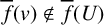 $\overline {f}(v) \notin \overline {f} (U)$
.
$\overline {f}(v) \notin \overline {f} (U)$
.
Case 2.
Now assume that $v\in N$
and
$v\in N$
and $Y_2 = \emptyset $
. Then
$Y_2 = \emptyset $
. Then $U \subseteq T$
. Let
$U \subseteq T$
. Let $\sim $
be the congruence on S with classes T and N. Then
$\sim $
be the congruence on S with classes T and N. Then $[v]_{\sim } \neq [u]_{\sim }$
for all
$[v]_{\sim } \neq [u]_{\sim }$
for all $u \in U$
.
$u \in U$
.
Case 3.
Finally, assume that $v \in N $
and
$v \in N $
and $Y_2 \neq \emptyset $
. Note that
$Y_2 \neq \emptyset $
. Note that $0\in Y_2^2\subseteq N$
, and hence
$0\in Y_2^2\subseteq N$
, and hence $v\neq 0$
. Let
$v\neq 0$
. Let $v=x_g$
and
$v=x_g$
and $Y_2=\{x_{g_1},\ldots ,x_{g_n}\}$
. Let
$Y_2=\{x_{g_1},\ldots ,x_{g_n}\}$
. Let $H \leq G$
be the subgroup generated by the set
$H \leq G$
be the subgroup generated by the set $\phi (Y_1)$
. Then
$\phi (Y_1)$
. Then
 $$ \begin{align*}U \cap N =X_Z \cup \{0\},\end{align*} $$
where $Z=\bigcup _{i=1}^n{Hg_i}.$
As
$Z=\bigcup _{i=1}^n{Hg_i}.$
As $v \notin U$
, it follows that
$v \notin U$
, it follows that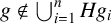 $g \notin \bigcup _{i=1}^n{Hg_i}$
. As G is weakly subgroup separable there exist a finite group K and homomorphism
$g \notin \bigcup _{i=1}^n{Hg_i}$
. As G is weakly subgroup separable there exist a finite group K and homomorphism $f: G \to K$
such that
$f: G \to K$
such that $f(g) \notin \bigcup _{i=1}^n{f(Hg_i)}$
by Lemma 5.7. Let
$f(g) \notin \bigcup _{i=1}^n{f(Hg_i)}$
by Lemma 5.7. Let $P=\mathcal {S}(K,K,\text {id})=K\cup X_K\cup \{0\}$
. Let
$P=\mathcal {S}(K,K,\text {id})=K\cup X_K\cup \{0\}$
. Let $\overline {f}: S \to P$
be given by
$\overline {f}: S \to P$
be given by
 $$ \begin{align*} s \mapsto \begin{cases} (f \circ \phi)(s) & \text{if } s \in T, \\ x_{f(g)} & \text{if } s=x_g \text{ for some } g \in G, \\ 0 & \text{if } s=0. \end{cases} \end{align*} $$
Then it is straightforward to check that $\overline {f}$
is a homomorphism with
$\overline {f}$
is a homomorphism with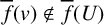 $\overline {f}(v) \notin \overline {f}(U)$
.
$\overline {f}(v) \notin \overline {f}(U)$
.
The next lemma provides necessary and sufficient conditions for $\mathcal {S}(T,G,\phi )$
to be finitely generated.
$\mathcal {S}(T,G,\phi )$
to be finitely generated.
Lemma 5.9. Let T be a semigroup, let G be an abelian group such that there exists a surjective homomorphism $\phi : T \to G$
, and let
$\phi : T \to G$
, and let $S=\mathcal {S}(T,G,\phi )$
. Then S is finitely generated if and only if T is finitely generated.
$S=\mathcal {S}(T,G,\phi )$
. Then S is finitely generated if and only if T is finitely generated.
Proof. If S is finitely generated, then, as T is the complement of an ideal, it must also be finitely generated. Conversely, if T is generated by a finite set Y, then it is easy to see that S is generated by $Y\cup \{x_{1_G}\}$
.
$Y\cup \{x_{1_G}\}$
.
We provide an example of a weakly subsemigroup separable semigroup S that has the following properties:
-
• S is finitely generated, noncommutative, but not strongly subsemigroup separable;
-
• S has a Schützenberger group that is not weakly subsemigroup separable.
Example 5.10. Let $F_2=\{a,b\}^+$
be the free semigroup on
$F_2=\{a,b\}^+$
be the free semigroup on $\{a, b\}$
. Let
$\{a, b\}$
. Let $\phi : F_2 \to \mathbb {Z}$
be given by
$\phi : F_2 \to \mathbb {Z}$
be given by $a \mapsto 1$
and
$a \mapsto 1$
and $b \mapsto -1$
. As
$b \mapsto -1$
. As $F_2$
is completely separable [Reference Golubov7, Corollary 1] and
$F_2$
is completely separable [Reference Golubov7, Corollary 1] and $\mathbb {Z}$
is weakly subgroup separable, it follows that
$\mathbb {Z}$
is weakly subgroup separable, it follows that $\mathcal {S}(F_2,\mathbb {Z},\phi )$
is weakly subsemigroup separable by Lemma 5.8. Since
$\mathcal {S}(F_2,\mathbb {Z},\phi )$
is weakly subsemigroup separable by Lemma 5.8. Since $F_2$
is finitely generated,
$F_2$
is finitely generated, $\mathcal {S}(F_2,\mathbb {Z},\phi )$
is finitely generated by Lemma 5.9. It is clear that
$\mathcal {S}(F_2,\mathbb {Z},\phi )$
is finitely generated by Lemma 5.9. It is clear that $\mathcal {S}(F_2,\mathbb {Z},\phi )$
is not commutative.
$\mathcal {S}(F_2,\mathbb {Z},\phi )$
is not commutative.
By Remark 5.6 we have that $X_{\mathbb {Z}}$
is an infinite nongroup
$X_{\mathbb {Z}}$
is an infinite nongroup $\mathcal {H}$
-class. Hence
$\mathcal {H}$
-class. Hence $\mathcal {S}(F_2,\mathbb {Z},\phi )$
is not strongly subsemigroup separable by Proposition 3.2. Also, the Schützenberger group of
$\mathcal {S}(F_2,\mathbb {Z},\phi )$
is not strongly subsemigroup separable by Proposition 3.2. Also, the Schützenberger group of $X_{\mathbb {Z}}$
is isomorphic to
$X_{\mathbb {Z}}$
is isomorphic to $\mathbb {Z}$
and therefore is not weakly subsemigroup separable. Notice that, due to the way the right and left actions of
$\mathbb {Z}$
and therefore is not weakly subsemigroup separable. Notice that, due to the way the right and left actions of $F_2$
on
$F_2$
on $X_{\mathbb {Z}}$
are defined, the
$X_{\mathbb {Z}}$
are defined, the $\mathcal {H}$
-class
$\mathcal {H}$
-class $X_{\mathbb {Z}}$
does not satisfy the condition of Lemma 3.5.
$X_{\mathbb {Z}}$
does not satisfy the condition of Lemma 3.5.
We conclude this section by exhibiting an example of a finitely generated semigroup which is strongly subsemigroup separable but not completely separable.
Example 5.11. Let $F_3=\{a,b,c\}^+$
be the free semigroup on the set
$F_3=\{a,b,c\}^+$
be the free semigroup on the set $\{a, b,c\}$
. Let
$\{a, b,c\}$
. Let $I \leq F_3$
be the ideal generated by the set
$I \leq F_3$
be the ideal generated by the set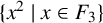 $\{x^2 \mid x \in F_3\}$
. Let
$\{x^2 \mid x \in F_3\}$
. Let $S=F_3/I$
be the Rees quotient of
$S=F_3/I$
be the Rees quotient of $F_3$
by I. We can view S as the set of all square-free words over the alphabet
$F_3$
by I. We can view S as the set of all square-free words over the alphabet $\{a,b,c\}$
with a zero adjoined. Multiplication in S is concatenation, unless concatenation creates a word containing a subword that is a square, in which case the product is zero. Certainly, S is finitely generated by
$\{a,b,c\}$
with a zero adjoined. Multiplication in S is concatenation, unless concatenation creates a word containing a subword that is a square, in which case the product is zero. Certainly, S is finitely generated by $\{a,b, c\}$
.
$\{a,b, c\}$
.
First we show that S is not completely separable. It is known that there exists an infinite square-free sequence $w=x_1x_2x_3\cdots $
over
$w=x_1x_2x_3\cdots $
over $\{a,b,c\}$
; see [Reference Lothaire23, Ch. 2]. Then every finite prefix of w is a nonzero element of S. Let
$\{a,b,c\}$
; see [Reference Lothaire23, Ch. 2]. Then every finite prefix of w is a nonzero element of S. Let $w_i=x_1x_2\cdots x_i \in S$
. For
$w_i=x_1x_2\cdots x_i \in S$
. For $i < j$
, let
$i < j$
, let $v_{i,j}=x_{i+1}x_{i+2}\cdots x_j \in S$
. Let
$v_{i,j}=x_{i+1}x_{i+2}\cdots x_j \in S$
. Let $\sim $
be a finite index congruence class on S. Then there exist
$\sim $
be a finite index congruence class on S. Then there exist $i, j \in \mathbb {N}$
, with
$i, j \in \mathbb {N}$
, with $i < j$
, such that
$i < j$
, such that $w_i \sim w_j$
. Then
$w_i \sim w_j$
. Then
 $$ \begin{align*}w_j=w_iv_{i,j}\sim w_jv_{i,j}=w_iv_{i,j}v_{i,j}=0.\end{align*} $$
So we have shown that it is not possible for $0$
to be separated from
$0$
to be separated from $S \!\setminus \!\{0\}$
in a finite quotient. Hence, S is not completely separable.
$S \!\setminus \!\{0\}$
in a finite quotient. Hence, S is not completely separable.
Now let $T \leq S$
. Then
$T \leq S$
. Then $0 \in T$
. For
$0 \in T$
. For $x \in S\!\setminus \! \{0\}$
let
$x \in S\!\setminus \! \{0\}$
let $|x|$
denote the length of x in terms of the generators
$|x|$
denote the length of x in terms of the generators $\{a,b,c\}$
. Now let
$\{a,b,c\}$
. Now let $v \notin T$
and set
$v \notin T$
and set $n = |v|$
. Let
$n = |v|$
. Let
 $$ \begin{align*}I=\{x \in S \mid |x|> n\} \cup \{0\}.\end{align*} $$
Then I is an ideal. Clearly the Rees quotient $S/I$
is finite. Furthermore,
$S/I$
is finite. Furthermore, $[v]_{I}=\{v\}$
. Hence, S is strongly subsemigroup separable.
$[v]_{I}=\{v\}$
. Hence, S is strongly subsemigroup separable.
6 Semigroups with finitely many
$\mathcal {H}$
-classes

In Section 3 we asked which of our separability properties are inherited by Schützenberger groups. We showed in Corollaries 3.3 and 3.4 that the properties of complete separability and strong subsemigroup separability are inherited by Schützenberger groups. Although it is not true that every Schützenberger group of a weakly subsemigroup separable semigroup is itself weakly subsemigroup separable, we showed in Corollary 3.6 that weak subsemigroup separability is inherited by Schützenberger groups of commutative semigroups.
One may ask whether the properties are inherited in the opposite direction, that is, if every Schützenberger group of a semigroup S has a separability property must S itself satisfy the same property? This, however, turns out not to be true. Let $\mathscr {P}$
be any of the properties of complete separability, strong subsemigroup separability, weak separability or residual finiteness. A semigroup whose Schützenberger groups all have property
$\mathscr {P}$
be any of the properties of complete separability, strong subsemigroup separability, weak separability or residual finiteness. A semigroup whose Schützenberger groups all have property $\mathscr {P}$
need not itself have property
$\mathscr {P}$
need not itself have property $\mathscr {P}$
. One example is the bicyclic monoid, given by the monoid presentation
$\mathscr {P}$
. One example is the bicyclic monoid, given by the monoid presentation $\langle b,c \mid bc=1 \rangle $
. The bicyclic monoid is
$\langle b,c \mid bc=1 \rangle $
. The bicyclic monoid is $\mathcal {H}$
-trivial, meaning that every
$\mathcal {H}$
-trivial, meaning that every $\mathcal {H}$
-class is a singleton, so every Schützenberger group is the trivial group and certainly completely separable. However, the bicyclic monoid is not even residually finite [Reference Clifford and Preston3, Corollary 1.12]. In fact this direction fails comprehensively even for commutative semigroups, as the next example shows.
$\mathcal {H}$
-class is a singleton, so every Schützenberger group is the trivial group and certainly completely separable. However, the bicyclic monoid is not even residually finite [Reference Clifford and Preston3, Corollary 1.12]. In fact this direction fails comprehensively even for commutative semigroups, as the next example shows.
Example 6.1. Let $A=\langle a \rangle \cong \mathbb {N}$
. Let
$A=\langle a \rangle \cong \mathbb {N}$
. Let $B=\{b_i \mid i \in \mathbb {N}\}\cup \{0\}$
be the countable null semigroup. Let
$B=\{b_i \mid i \in \mathbb {N}\}\cup \{0\}$
be the countable null semigroup. Let $S=A \cup B$
with multiplication between A and B as follows:
$S=A \cup B$
with multiplication between A and B as follows:
 $$ \begin{align*}a^ib_j=b_ja^i=\begin{cases} b_{j-i} & \text{for } j> i, \\ 0 & \text{otherwise}, \end{cases}\end{align*} $$
 $$ \begin{align*}a^i0=0a^i=0.\end{align*} $$
An exhaustive case analysis shows that this evidently commutative multiplication is associative. It is straightforward to check that S is $\mathcal {H}$
-trivial. However, S is not residually finite. Suppose that
$\mathcal {H}$
-trivial. However, S is not residually finite. Suppose that $\sim $
is a finite index congruence on S. Then there exist
$\sim $
is a finite index congruence on S. Then there exist $i, j \in \mathbb {N}$
, with
$i, j \in \mathbb {N}$
, with $i < j$
, such that
$i < j$
, such that $b_i \sim b_j$
. Then
$b_i \sim b_j$
. Then
 $$ \begin{align*}0=b_ia^{j-1} \sim b_ja^{j-1}=b_1.\end{align*} $$
So we cannot separate $0$
and
$0$
and $b_1$
in a finite quotient; and hence S is not residually finite.
$b_1$
in a finite quotient; and hence S is not residually finite.
Remark 6.2. In the semigroup S of Example 6.1, both the ideal B and the Rees quotient $S/B\cong \mathbb {N}_0$
are completely separable. However, this is not enough to guarantee that S is completely separable.
$S/B\cong \mathbb {N}_0$
are completely separable. However, this is not enough to guarantee that S is completely separable.
In the remainder of this section we restrict our attention to the class of semigroups that have only finitely many $\mathcal {H}$
-classes, or, equivalently, semigroups that have only finitely many left and right ideals. This is motivated by the following result.
$\mathcal {H}$
-classes, or, equivalently, semigroups that have only finitely many left and right ideals. This is motivated by the following result.
Theorem 6.3 [Reference Gray and Ruškuc12, Theorem 7.2]
Let S be a semigroup with finitely many $\mathcal {H}$
-classes. Then S is residually finite if and only if all its Schützenberger groups are residually finite.
$\mathcal {H}$
-classes. Then S is residually finite if and only if all its Schützenberger groups are residually finite.
We investigate whether there are analogous results for the properties of complete separability, strong subsemigroup separability and weak subsemigroup separability.
For complete separability, the analogous result holds.
Proposition 6.4. Let S be a semigroup with only finitely many $\mathcal {H}$
-classes. Then the following are equivalent:
$\mathcal {H}$
-classes. Then the following are equivalent:
-
(1) S is completely separable;
-
(2) all the Schützenberger groups of S are completely separable;
-
(3) S is finite.
Proof. (1) $\Rightarrow $
(2) If S is completely separable, then all of its Schützenberger groups are completely separable by Corollary 3.4.
$\Rightarrow $
(2) If S is completely separable, then all of its Schützenberger groups are completely separable by Corollary 3.4.
(2) $\Rightarrow $
(3) If a Schützenberger group is completely separable, it is finite by Lemma 2.4. As a Schützenberger group is in bijection with the corresponding
$\Rightarrow $
(3) If a Schützenberger group is completely separable, it is finite by Lemma 2.4. As a Schützenberger group is in bijection with the corresponding $\mathcal {H}$
-class, and S has only finitely many
$\mathcal {H}$
-class, and S has only finitely many $\mathcal {H}$
-classes, we conclude that S is finite.
$\mathcal {H}$
-classes, we conclude that S is finite.
(3) $\Rightarrow $
(1) Clear.
$\Rightarrow $
(1) Clear.
From Corollary 3.3, we know that every Schützenberger group of a strongly subsemigroup separable semigroup is itself strongly subsemigroup separable. However, even when a semigroup has only finitely many $\mathcal {H}$
-classes, every Schützenberger group being strongly subsemigroup separable does not guarantee that the semigroup is strongly subsemigroup separable, as the following example demonstrates.
$\mathcal {H}$
-classes, every Schützenberger group being strongly subsemigroup separable does not guarantee that the semigroup is strongly subsemigroup separable, as the following example demonstrates.
Example 6.5. Let G be an infinite strongly subsemigroup separable abelian group. The existence of such a group is established by Theorem 2.8. Then, recalling Construction 5.5, $S=\mathcal {S}(G,G,\text {id})$
has three
$S=\mathcal {S}(G,G,\text {id})$
has three $\mathcal {H}$
-classes: G,
$\mathcal {H}$
-classes: G, $X_G$
and
$X_G$
and $\{0\}$
. The Schützenberger groups of the
$\{0\}$
. The Schützenberger groups of the $\mathcal {H}$
-classes are isomorphic to G, G and the trivial group, respectively. Then certainly every Schützenberger group is strongly subsemigroup separable. However, since
$\mathcal {H}$
-classes are isomorphic to G, G and the trivial group, respectively. Then certainly every Schützenberger group is strongly subsemigroup separable. However, since $X_G$
is an infinite nongroup
$X_G$
is an infinite nongroup $\mathcal {H}$
-class, S is not strongly subsemigroup separable by Proposition 3.2.
$\mathcal {H}$
-class, S is not strongly subsemigroup separable by Proposition 3.2.
The final property to consider is that of weak subsemigroup separability. Of all the separability properties considered in this paper, this is the only one that is not necessarily inherited by Schützenberger groups, as demonstrated by Example 5.10. However, when we restrict to a semigroup with only finitely many $\mathcal {H}$
-classes, the following problem remains open.
$\mathcal {H}$
-classes, the following problem remains open.
Open Problem 6.6. Is it true that a semigroup with only finitely many $\mathcal {H}$
-classes is weakly subsemigroup separable if and only if all its Schützenberger groups are weakly subsemigroup separable?
$\mathcal {H}$
-classes is weakly subsemigroup separable if and only if all its Schützenberger groups are weakly subsemigroup separable?
Indeed, we do not even know if either direction of the above statement holds. In the rest of this section, we restrict our attention to locally finite semigroups with only finitely many $\mathcal {H}$
-classes. By concentrating on this smaller class of semigroups we are be able to invoke Lemma 2.7, which says that a semigroup that is both residually finite and locally finite is weakly subsemigroup separable. This line of investigation allows us to give the following partial answer to Open Problem 6.6.
$\mathcal {H}$
-classes. By concentrating on this smaller class of semigroups we are be able to invoke Lemma 2.7, which says that a semigroup that is both residually finite and locally finite is weakly subsemigroup separable. This line of investigation allows us to give the following partial answer to Open Problem 6.6.
Theorem 6.7. Let S be a semigroup with only finitely many $\mathcal {H}$
-classes whose maximal subgroups are all solvable. Then S is weakly subsemigroup separable if and only if all its Schützenberger groups are weakly subsemigroup separable.
$\mathcal {H}$
-classes whose maximal subgroups are all solvable. Then S is weakly subsemigroup separable if and only if all its Schützenberger groups are weakly subsemigroup separable.
In particular, we note that a commutative semigroup with finitely many $\mathcal {H}$
-classes is weakly subsemigroup separable if and only if all its Schützenberger groups are weakly subsemigroup separable. To prove Theorem 6.7 we make use of several lemmas.
$\mathcal {H}$
-classes is weakly subsemigroup separable if and only if all its Schützenberger groups are weakly subsemigroup separable. To prove Theorem 6.7 we make use of several lemmas.
A semigroup S is called an epigroup if every element of S has a power which lies in a subgroup of S.
Lemma 6.8. A semigroup S with finitely many $\mathcal {H}$
-classes is an epigroup.
$\mathcal {H}$
-classes is an epigroup.
Proof. Let $s \in S$
. As S has finitely many
$s \in S$
. As S has finitely many $\mathcal {H}$
-classes there exist
$\mathcal {H}$
-classes there exist $i, \, j \in \mathbb {N}$
with
$i, \, j \in \mathbb {N}$
with $i < j$
such that
$i < j$
such that $s^i \mathcal {H} s^j$
. Let H be the
$s^i \mathcal {H} s^j$
. Let H be the $\mathcal {H}$
-class of
$\mathcal {H}$
-class of $s^i$
. Then
$s^i$
. Then $s^{j-i} \in \operatorname {\mathrm {Stab}}(H)$
. Hence
$s^{j-i} \in \operatorname {\mathrm {Stab}}(H)$
. Hence $(s^i)^{j-i}=(s^{j-i})^i \in \operatorname {\mathrm {Stab}}(H)$
, so
$(s^i)^{j-i}=(s^{j-i})^i \in \operatorname {\mathrm {Stab}}(H)$
, so $(s^i)^{j-i+1}=s^i(s^i)^{j-i}\in H$
. Therefore
$(s^i)^{j-i+1}=s^i(s^i)^{j-i}\in H$
. Therefore $H^{j-i+1}\cap H\neq \emptyset $
, and so H is a group.
$H^{j-i+1}\cap H\neq \emptyset $
, and so H is a group.
Lemma 6.9. Let S be a semigroup with finitely many $\mathcal {H}$
-classes. If every maximal subgroup of S is torsion then S is periodic.
$\mathcal {H}$
-classes. If every maximal subgroup of S is torsion then S is periodic.
Proof. By Lemma 6.8, S is an epigroup. Let $s \in S$
. Then there is a power of s in a torsion subgroup of S; in particular, there exists
$s \in S$
. Then there is a power of s in a torsion subgroup of S; in particular, there exists $i \in \mathbb {N}$
such that
$i \in \mathbb {N}$
such that $s^i=e$
, where e is idempotent. Hence
$s^i=e$
, where e is idempotent. Hence $s^{2i}=e^2=e=s^i$
and S is periodic.
$s^{2i}=e^2=e=s^i$
and S is periodic.
Corollary 6.10. Let S be a semigroup with finitely many $\mathcal {H}$
-classes. If S is weakly subsemigroup separable then S is periodic.
$\mathcal {H}$
-classes. If S is weakly subsemigroup separable then S is periodic.
Proof. As S is weakly subsemigroup separable, then so are all of its maximal subgroups by Proposition 2.3. Now if a group is not torsion then it contains a subgroup isomorphic to $\mathbb {Z}$
, and therefore is not weakly subsemigroup separable by Proposition 2.3 and Example 2.5. Thus all the maximal subgroups of S are torsion and the result follows by Lemma 6.9.
$\mathbb {Z}$
, and therefore is not weakly subsemigroup separable by Proposition 2.3 and Example 2.5. Thus all the maximal subgroups of S are torsion and the result follows by Lemma 6.9.
Corollary 6.11. Let S be a semigroup with finitely many $\mathcal {H}$
-classes. If every Schützenberger group of S is weakly subsemigroup separable then S is periodic.
$\mathcal {H}$
-classes. If every Schützenberger group of S is weakly subsemigroup separable then S is periodic.
Proof. If every Schützenberger group is weakly subsemigroup separable, then every maximal subgroup of S is weakly subsemigroup separable and hence torsion; so S is periodic by Lemma 6.9.
At this point on our path to prove Theorem 6.7, we introduce Green’s relation $\mathcal {J}$
on a semigroup S:
$\mathcal {J}$
on a semigroup S:
 $$ \begin{align*}\mathcal{J}=\{(x,y) \mid S^1xS^1=S^1yS^1\}.\end{align*} $$
This is an equivalence relation and $\mathcal {H} \subseteq \mathcal {J}$
. It is also true that any ideal is a union of
$\mathcal {H} \subseteq \mathcal {J}$
. It is also true that any ideal is a union of $\mathcal {J}$
-classes. For more on Green’s
$\mathcal {J}$
-classes. For more on Green’s $\mathcal {J}$
relation see [Reference Howie16, Ch. 2].
$\mathcal {J}$
relation see [Reference Howie16, Ch. 2].
We show that an epigroup with finitely many $\mathcal {J}$
-classes is locally finite if and only if all its maximal subgroups are locally finite. We first consider the case when a semigroup with a zero only has two
$\mathcal {J}$
-classes is locally finite if and only if all its maximal subgroups are locally finite. We first consider the case when a semigroup with a zero only has two $\mathcal {J}$
-classes.
$\mathcal {J}$
-classes.
A semigroup S with a zero is called 0-simple if $S^2 \neq \{0\}$
and the only ideals of S are
$S^2 \neq \{0\}$
and the only ideals of S are $\{0\}$
and S. A 0-simple semigroup is called completely 0-simple if it is both 0-simple and an epigroup. For equivalent definitions of completely 0-simple semigroups see [Reference Howie16, Theorem 3.2.11]. Rees showed that the class of completely 0-simple semigroups coincides with the class of Rees matrix semigroups over zero-groups [Reference Howie16, Theorem 3.2.3]. For a group G, let the zero-group
$\{0\}$
and S. A 0-simple semigroup is called completely 0-simple if it is both 0-simple and an epigroup. For equivalent definitions of completely 0-simple semigroups see [Reference Howie16, Theorem 3.2.11]. Rees showed that the class of completely 0-simple semigroups coincides with the class of Rees matrix semigroups over zero-groups [Reference Howie16, Theorem 3.2.3]. For a group G, let the zero-group $G^0$
be G with a zero adjoined. Let
$G^0$
be G with a zero adjoined. Let $I,\Lambda $
be nonempty sets and
$I,\Lambda $
be nonempty sets and $P=(p_{\lambda i})$
be a
$P=(p_{\lambda i})$
be a $\Lambda \times I$
matrix with entries from
$\Lambda \times I$
matrix with entries from $G^0$
such that no row or column of P consists entirely of zeros. The Rees matrix semigroup over the zero-group
$G^0$
such that no row or column of P consists entirely of zeros. The Rees matrix semigroup over the zero-group $G^{0}$
is
$G^{0}$
is $S=M^0[G;I,\Lambda ;P]=(I \times G \times \Lambda ) \cup \{0\}$
with multiplication given as follows:
$S=M^0[G;I,\Lambda ;P]=(I \times G \times \Lambda ) \cup \{0\}$
with multiplication given as follows:
 $$ \begin{align*} \begin{split} (i,a,\lambda)(j,b,\mu)&=\begin{cases} (i,ap_{\lambda j},\mu) &\text{if } p_{\lambda i} \neq 0, \\ 0 &\text{if } p_{\lambda i} =0, \end{cases} \\ (i,a,\lambda)0&=0(i,a,\lambda)=0\cdot0=0. \end{split} \end{align*} $$
In a completely 0-simple semigroup $M^0[G;I, \Lambda; P]$
, the
$M^0[G;I, \Lambda; P]$
, the $\mathcal {H}$
-class of the element
$\mathcal {H}$
-class of the element $(i,a ,\lambda )$
is
$(i,a ,\lambda )$
is $\{i\} \times G \times \{\lambda \}$
. This is a maximal subgroup if and only if
$\{i\} \times G \times \{\lambda \}$
. This is a maximal subgroup if and only if $p_{\lambda i} \neq 0$
, in which case it is isomorphic to G.
$p_{\lambda i} \neq 0$
, in which case it is isomorphic to G.
Lemma 6.12. A completely 0-simple semigroup $S=M^0[G;I, \Lambda; P]$
is locally finite if and only if G is locally finite.
$S=M^0[G;I, \Lambda; P]$
is locally finite if and only if G is locally finite.
Proof. Suppose that S is locally finite. As S has a subsemigroup isomorphic to G, and local finiteness is inherited by subsemigroups, it follows that G is locally finite.
Now suppose that G is locally finite. Let $T=\langle (i_1,g_1,\lambda _1),\, \ldots , \, (i_n,g_n,\lambda _n) \rangle $
. We show that the intersection of T with a nonzero
$T=\langle (i_1,g_1,\lambda _1),\, \ldots , \, (i_n,g_n,\lambda _n) \rangle $
. We show that the intersection of T with a nonzero $\mathcal {H}$
-class is finite. Let K be the subgroup of G generated by the set
$\mathcal {H}$
-class is finite. Let K be the subgroup of G generated by the set
 $$ \begin{align*}\{g_i \mid 1 \leq i \leq n\} \cup \{p_{\lambda_k i_l} \mid p_{\lambda_k i_l}\neq0, \, 1 \leq k, \, l\leq n\}.\end{align*} $$
As K is finitely generated, it is finite. Let $H=\{i\}\times G \times \{\lambda \}$
be a nonzero
$H=\{i\}\times G \times \{\lambda \}$
be a nonzero $\mathcal {H}$
-class. Then
$\mathcal {H}$
-class. Then $H \cap T \subseteq \{i\} \times K \times \{\lambda \}$
and hence
$H \cap T \subseteq \{i\} \times K \times \{\lambda \}$
and hence $H \cap T$
is finite. As T can only intersect finitely many nonzero
$H \cap T$
is finite. As T can only intersect finitely many nonzero $\mathcal {H}$
-classes, it follows that T is finite.
$\mathcal {H}$
-classes, it follows that T is finite.
Lemma 6.13. Let S be an epigroup with finitely many $\mathcal {J}$
-classes. Then S is locally finite if and only if all its maximal subgroups are locally finite.
$\mathcal {J}$
-classes. Then S is locally finite if and only if all its maximal subgroups are locally finite.
Proof. The forward direction follows as subsemigroups inherit local finiteness.
Now assume that all the subgroups of S are locally finite. We proceed by induction on the number of $\mathcal {J}$
-classes.
$\mathcal {J}$
-classes.
We may assume that S has a zero. If not, then simply adjoin a zero. Let I be a 0-minimal ideal of S. Then I is either a null semigroup or it is $0$
-simple by [Reference Grillet14, Proposition 2.4.9]. It is clear that any null semigroup is locally finite. Suppose then that I is 0-simple. Clearly I is an epigroup since S is, so I is completely
$0$
-simple by [Reference Grillet14, Proposition 2.4.9]. It is clear that any null semigroup is locally finite. Suppose then that I is 0-simple. Clearly I is an epigroup since S is, so I is completely $0$
-simple. The maximal subgroups of I are the maximal subgroups of S contained in I by [Reference Howie16, Proposition 2.4.2]. Therefore, by Lemma 6.12 I is locally finite. If
$0$
-simple. The maximal subgroups of I are the maximal subgroups of S contained in I by [Reference Howie16, Proposition 2.4.2]. Therefore, by Lemma 6.12 I is locally finite. If $I=S$
then we are done, so suppose that
$I=S$
then we are done, so suppose that $I\neq S$
.
$I\neq S$
.
Since the Rees quotient $S/I$
has one fewer
$S/I$
has one fewer $\mathcal {J}$
-class than S, it is locally finite by the inductive hypothesis. Let T be a finitely generated subsemigroup of S. As
$\mathcal {J}$
-class than S, it is locally finite by the inductive hypothesis. Let T be a finitely generated subsemigroup of S. As $S/I$
is locally finite, it follows that the Rees quotient
$S/I$
is locally finite, it follows that the Rees quotient $T/(T\cap I)$
is finite. Hence,
$T/(T\cap I)$
is finite. Hence, $T \cap I$
is a subsemigroup with finite complement in T. Therefore, as T is finitely generated,
$T \cap I$
is a subsemigroup with finite complement in T. Therefore, as T is finitely generated, $T \cap I$
is also finitely generated by [Reference Ruškuc27, Theorem 1.1]. Then
$T \cap I$
is also finitely generated by [Reference Ruškuc27, Theorem 1.1]. Then $T \cap I$
is finite as I is locally finite. Then
$T \cap I$
is finite as I is locally finite. Then $T=(T\!\setminus \!I) \cup (T \cap I)$
is finite, and hence S is locally finite.
$T=(T\!\setminus \!I) \cup (T \cap I)$
is finite, and hence S is locally finite.
Lemmas 6.8 and 6.13 together yield the following result.
Corollary 6.14. Let S be a semigroup with finitely many $\mathcal {H}$
-classes. Then S is locally finite if and only if all its maximal subgroups are locally finite.
$\mathcal {H}$
-classes. Then S is locally finite if and only if all its maximal subgroups are locally finite.
We are now in a position to prove Theorem 6.7.
Proof of Theorem 6.7. Let S be a semigroup with finitely many $\mathcal {H}$
-classes whose maximal subgroups are all solvable.
$\mathcal {H}$
-classes whose maximal subgroups are all solvable.
If S is weakly subsemigroup separable then all its maximal subgroups are weakly subsemigroup separable by Proposition 2.3, and hence they are torsion by Proposition 2.6. Torsion solvable groups are locally finite; see [Reference Robinson25, 5.4.11]. It follows from Corollary 6.14 that S is locally finite. Then certainly $S^1$
is locally finite. It is well known that the property of being locally finite is closed under subsemigroups and quotients. Therefore, each Schützenberger group, being a quotient of a subsemigroup of
$S^1$
is locally finite. It is well known that the property of being locally finite is closed under subsemigroups and quotients. Therefore, each Schützenberger group, being a quotient of a subsemigroup of $S^1$
, is locally finite. Since S is residually finite, so are all its Schützenberger groups by Theorem 6.3. Hence, all the Schützenberger groups are weakly subsemigroup separable by Lemma 2.7.
$S^1$
, is locally finite. Since S is residually finite, so are all its Schützenberger groups by Theorem 6.3. Hence, all the Schützenberger groups are weakly subsemigroup separable by Lemma 2.7.
Now assume that all the Schützenberger groups of S are weakly subsemigroup separable. Then they are certainly residually finite and it follows that S is residually finite by Theorem 6.3. Furthermore, as S only has finitely many $\mathcal {H}$
-classes and all its Schützenberger groups are weakly subsemigroup separable, S is periodic by Corollary 6.11. Then all its maximal subgroups are torsion and solvable; so it follows that they are locally finite. Hence, S is locally finite by Corollary 6.14 and therefore weakly subsemigroup separable by Lemma 2.7.
$\mathcal {H}$
-classes and all its Schützenberger groups are weakly subsemigroup separable, S is periodic by Corollary 6.11. Then all its maximal subgroups are torsion and solvable; so it follows that they are locally finite. Hence, S is locally finite by Corollary 6.14 and therefore weakly subsemigroup separable by Lemma 2.7.
If there is any hope of solving Open Problem 6.6, we must consider cases where an infinite Schützenberger group is weakly subsemigroup separable but not solvable. The authors are aware of only a limited number of such groups. One such example is the Grigorchuk group, which is a finitely generated infinite torsion group that is weakly subgroup separable (and hence weakly subsemigroup separable); see [Reference Grigorchuk and Wilson13]. In particular, the following problem remains open.
Open Problem 6.15. Let G be the Grigorchuk group, let I and $\Lambda $
be finite sets, and let
$\Lambda $
be finite sets, and let $P=(p_{\lambda i})$
be a
$P=(p_{\lambda i})$
be a $\Lambda \times I$
matrix with entries from
$\Lambda \times I$
matrix with entries from $G^0$
such that no row or column consists entirely of zeros. Is the semigroup
$G^0$
such that no row or column consists entirely of zeros. Is the semigroup $M^0[G;I,\Lambda; P]$
weakly subsemigroup separable?
$M^0[G;I,\Lambda; P]$
weakly subsemigroup separable?
Acknowledgements
The authors would like to thank the referee for their helpful comments and care with the paper. The first author is grateful to EPSRC for financial support. The second author is grateful to the School of Mathematics and Statistics of the University of St Andrews for financial support.

 Open access

