

1 Introduction
Collaborative event ethnography (CEE) builds on a series of paradoxes. It is a collective research practice in a field that values individualism and autonomy; it uses a mode of inquiry designed to highlight local situatedness to study world events organised by international bureaucrats in anonymous conference halls; it relies on focused short-term observation missions in highly complex, multicultural environments instead of long-term immersion in a given cultural context. And yet, as we hope to show in this Element, collaborative event ethnography has a unique potential to critically analyse global governance.
Its origins can be traced back to two parallel developments. On the one hand, throughout the 1980s, ethnographers developed new methodological approaches attempting to respond to an increasingly globalised world. Ethnography went global, crafting tools to study transnational elites and circulations. This ‘methodological turn’ (Reference Hammersley and AtkinsonHammersley & Atkinson, 2019) also reflected broader developments in political, social and anthropological theory that crystallised around the analysis of networks or the study of governmentalities, and that aimed at uncovering the complex socio-material relations and assemblages that compose world society. On the other hand, the same decades also saw the creation of international organisations and regimes to tackle cross-boundary environmental problems like acid rain, the destruction of the ozone layer, or climate change. Following the ‘Earth Summit’ in Rio de Janeiro in 1992, environmental mega-conferences became the format of choice in environmental governance. Global climate conferences in particular attracted an ever-growing number of increasingly diverse actors, including scholars of global environmental politics and other social science fields.
CEE as a research methodology emerged at the confluence of these developments. This Element retraces its genealogy, explains its conceptual and methodological foundations and presents insights into its practice. It is meant as an introduction for students, an overview for curious newcomers to the field, and an invitation for experienced researchers wishing to experiment with a new method. A word on terminology: the label collaborative event ethnography (coined by Brosius & Campbell in 2010) is today broadly used by scholars who collaborate as a team in order to investigate large but not necessarily ‘global’ events. However, as we explain in the following chapter, the realm of global governance has emerged as a key site for conducting collaborative event ethnography.
Global environmental conferences bring together a diversity of actors to perform different policy tasks. They are a ‘facilitative practice’ that holds international regimes together (Reference Lövbrand, Hjerpe and LinnérLövbrand et al., 2017), as well as temporary interfaces that constitute and represent world society and thus may act as spaces for the co-production of futures (Reference Ibrahim, Rödder and SchneggIbrahim et al., 2024). Observers characterise them as an ‘archipelago of meetings’ and as ‘fuzzy objects’ (Reference Dumoulin Kervran and de OliveiraDumoulin Kervran, 2021, pp. 82–83). During a climate or biodiversity COP,Footnote 1 for instance, no single person can possibly take in all topics and spaces. This makes these events particularly challenging, but also exceptionally interesting sites for ethnographic fieldwork. Of course, these remarks do not apply to all global environmental conferences. Meetings under the umbrella of the Vienna Convention for the Protection of the Ozone Layer and similar treaties are much smaller than climate COPs. Until recently, even biodiversity COPs were much more manageable in terms of participants, side events and accompanying civil society activities. However, climate COPs have come to constitute a focal point of broader environmental debates. To some extent, they provide a model for other global conferences. Throughout the book, we therefore chose to use examples from our fieldwork on climate conferences, especially the COP26 in Glasgow in 2021, to illustrate the practice of ethnographic research on global environmental governance.
Following this introduction, the second section focuses on debates in anthropology and sociology that have informed the emergence of an interest in ethnographic observations of global environmental conferences. This history starts with a diversification of ethnographic approaches. The adoption of some of these new approaches in global governance studies and international relations (IR) expanded the methodological discussion in these communities. Collaborative event ethnography then evolved into an adaptive but recognizable, fully fledged research methodology. Alongside specific practices for data generation and analysis – such as ethnographic observations and qualitative interviews – its research posture aligns with ethnography’s traditional self-understanding in terms of a broad and holistic epistemological perspective, grounded in traditions of phenomenology and constructivism.
Section 3 addresses a number of recurring and interconnected conceptual problems and illustrates them using examples from ethnographic fieldwork. UN environmental conferences are global events, and they are also shaped by the culture of a specific host city. They are characterised by mingling and continuous face-to-face interactions, while also constituting mediated ‘world events’ that synchronise political, science, business and public spheres across the world. They have clear temporal and spatial boundaries, but also constitute condensations of wider developments, and moments in a larger governance process with intersessional meetings and preparatory activities. Finally, they represent events with a certain unity, including a well-defined group of accredited attendees, an overarching internal dramaturgy and a corporate design, while also consisting of highly differentiated collections of social spaces with distinct activities and social practices.
In Section 4 we show that, mirroring the complexity of its object of inquiry, collaborative event ethnography is neither an inflexible, monolithic method nor a simple toolbox. It is ‘shaped by iterative refinement’, through constant exchange among team members (Reference Dumoulin Kervran and de OliveiraDumoulin Kervran, 2021, p. 95; see also Reference Corson, Campbell, Wilshusen and GrayCorson et al., 2019). In this process, researchers can draw on a set of methodological building blocks, which are each used to a different extent, and with varying accentuations, by different research teams. We identify four key building blocks that adapt traditional ethnography to the specific circumstances and problems associated with studying world events. Focused ethnography is used to conduct observations in a short period of time in the field. Team ethnography adapts the ethnographic method to larger research collectives, to capture the scale and density of activity of the event. Digital ethnography accounts for the fact that events have expanded in physical space and number of attendees, but also into digital spaces. Consequently, it is no longer possible to think about, talk about, and investigate conferences without paying attention to what goes on in the digital sphere. A dramaturgical perspective is often used to unearth theatrical elements and performative dimensions of climate conferences and UN summitry.
Section 5 introduces the practice of collaborative event ethnography. Many authors writing on collaborative or team-based approaches in ethnography have emphasised that realising the potential of these approaches is no easy task, and that there is no simple, step-by-step recipe. Collective research stands and falls with the quality of collaborations, and the ability to create a team spirit. It also requires a productive and trusting atmosphere within the collective, in order to enable team members to share experiences and reflect on their emotions while observing. We propose to capture this feature of collaborative event ethnography by identifying a series of collective research practices. Beyond the simple sharing of data and observation notes, these aim at developing capacities for preparing, working, thinking, experiencing and writing together. Based on a literature review and our own ethnographic experiences, we derive a list of Dos and Don’ts to enable readers to start their own collaborative ethnographic practice.
In Section 6, we illustrate the benefits of collaborative event ethnography with two examples in the form of vignettes, which focus respectively on movement-media interactions at the Glasgow COP conference and the evolution of the Climate Action Zone over several climate COPs. The vignettes were chosen to illustrate two core elements of collaborative event ethnography. The first is the principle of many eyes – many minds, as the presence of many observers and the discussions among them allow researchers to arrive at a richer and more complex picture of a world event. The second is the principle of repeated observations within a given global forum, used to identify changes in governance practices that would be invisible to a one-time observer. Both cases also illustrate the capacity of ethnography to capture the emotional and embodied dimensions of global politics, which other approaches struggle to identify and engage with analytically.
In conclusion, we highlight the integrative potential of collaborative event ethnography. Research on global environmental negotiations tends to be separated from studies on transnational governance networks or social movements. Collaborative event ethnography as a methodological approach and collaborative research practice has the unique potential to integrate these fields in observing and writing on environmental world events. It is our hope that this Element inspires its readers to try out and further develop this approach, and in so doing to contribute to a better understanding of the practice of global environmental governance, from its local embeddedness to its overarching social, spatial and temporal dynamics.
2 Ethnography Meets Global Environmental Governance: History and Theory
2.1 Ethnography Goes Global
Historically, ethnography has been associated with qualitative approaches that focus on understanding the meanings and contexts of human behaviour and social interactions. Hallmarks of ethnographic methodology include ‘being there’ to do first-hand observations (Reference WatsonWatson, 1999), ‘thick description’ of events and situations to add context and meaning (Reference Geertz and GeertzGeertz, 1973), and reflexivity in terms of disclosing subjectivity and working with the positionality of the researcher (Reference BurawoyBurawoy, 2003). But there has been significant change in what is to be observed, where, in what context, by whom, and how ethnographic work can and should take place, as ethnographic approaches have travelled through disciplinary, geographical and conceptual spaces (Reference Muecke and MorseMuecke, 1994). These developments have been connected to changes in both the types of social worlds that ethnographers study and changes within those social worlds themselves. At the basic level, ethnography rests on participant observation. By immersing themselves in a specific cultural and social context and spending time with people, ethnographers get an ‘insider’s perspective’ on what is happening there. In their seminal introduction to the field, Reference Hammersley and AtkinsonHammersley and Atkinson (2019, p. 3) write that ethnographers study ‘[p]eople’s actions and accounts [ … ] in everyday contexts’. Ethnography is a field approach, as opposed to a laboratory approach, or to an approach that rests on studying in the office or the library. Often a variety of data sources is used, ranging from fieldnotes on observations and reflections to interviews and documents, as well as audio and video recordings. Traditionally, data gathering is weakly structured at first, meaning that often the research plan is not fully fixed beforehand, but adjusted progressively, in the course of the research. Data analysis is generally inductive and interpretative, while quantification is not commonly used. Typically, ethnographers look at a small number of cases in depth. As a qualitative social science methodology, ethnography is not a fixed or rigid method, but is most commonly described as an analytic sensibility.
Interestingly, early ethnographic accounts rarely foregrounded methodology or contained explicit discussion of research methods. Rather, good research rested on implicit craftsmanship and embodied skill (Reference GoffmanGoffman, 1989). Accordingly, in recent decades, the embodied and sensual aspects of fieldwork have come into view as part of ethnography’s reflexive repertoire. Ethnographers in both anthropology and sociology have respectively argued for ‘thick participation’ (Reference SpittlerSpittler, 2001) and ‘observant participation’ (Reference Honer and HitzlerHoner & Hitzler, 2015, p. 552), emphasising the need to include an observation of one’s own participation in accounts of fieldwork. Moreover, ethnographers writing about their field often refer to an ethnographic tradition. This vague outline of features of ethnography, either as something to identify with, continue and develop, or as something to distance oneself from and break free of, comes out of the origins of ethnography as a methodology in early twentieth century anthropology and sociology (Reference WolcottWolcott, 1999, Chapter 5). Defining features of this tradition include that the work is done by a lone researcher, takes place in a specific, locally bounded space, including an extended stay in this field, usually of a year or more (see Reference Fine and HancockFine & Hancock, 2017, for an appraisal of the status of this tradition). This approach has at times been tied to a positivist project of capturing the essence of people who are very different from the observer, either because of cultural and spatial distance, or because they belong to another social class or cultural milieu. One way of understanding the evolution of ethnography is to explore how conceptions of the field, participant observation and ethnographic writing have changed over time (see Reference Atkinson, Coffey, Delamont, Lofland and LoflandAtkinson et al., 2011; Reference Emerson, Fretz and ShawEmerson et al., 2011; Reference MarkhamMarkham, 2013; Reference Van MaanenVan Maanen, 2011). We will not explore these developments in depth here, but we do want to highlight three intellectual movements in the history of ethnography that contributed to the emergence of collaborative event ethnography: (1) the call to study up towards elites ‘at home’ in the West; (2) the adaptation of ethnographic work to a globalised world through multi-sited ethnography; and (3) the use of nonlocal ethnography to bring socio-material constellations and political formations into focus as apparatuses.
Studying up
While the origins of ethnographic methodology lie in anthropological research, other social sciences, notably sociology, soon followed suit. Participant observation within rapidly growing and increasingly diverse urban societies was first practiced by members of the Chicago School of sociology in the early decades of the twentieth century. After the Second World War, sociologists like Erving Goffman, Howard Becker, Harold Garfinkel and Anselm Strauss contributed to refining these approaches, giving shape to symbolic interactionism, ethnomethodology and grounded theory as ethnographically inspired sociological approaches to studying Western societies (Reference FineFine, 1995). But these early approaches were criticised for their focus on studying groups at the margins of Western society, such as criminals, drug addicts, racial minorities or jazz musicians (Reference GouldnerGouldner, 1968). These debates echoed discussions happening in anthropology around the same period. Social anthropologists had begun to criticise the discipline’s tradition and practices in colonial and postcolonial societies in Africa (Reference Evens and HandelmanEvens & Handelman, 2006). Members of the Manchester School, for instance, challenged the focus on isolated ‘traditional’ societies and pointed to the importance of larger political contexts, historical legacies of imperialism, and global interconnections. Within this dynamic of real-world developments and academic debate, Reference Nader and HymesLaura Nader’s (1972) constructive critique of the ethnographic tradition stands out. Instead of focusing on places far removed from the researcher’s experience, located either on the confines of Western imperial geographies or at the inner margins of Western societies, she makes the case for an ethnography of elites. Nader calls for ‘studying up’ rather than ‘down’, in order to examine the core institutions of modernity such as police forces, state administrations, insurance companies and commercial practices. In her view, these institutions should be approached with an ethnographic sensibility, combining participant observation with critical examination of the ethnographer’s own role. However, Nader also notes the challenges of this endeavour – most notably the problem of field access, for instance in cases where elite communities are closed and unwelcoming to researchers, or reluctant to be the object of investigation.
Sociologists have carried out such ethnographic studies, starting with Reference GarfinkelGarfinkel’s (1967) studies on US legal and psychiatric systems, to Reference Becker, Geer, Hughes and StraussBecker and colleagues’ (1977) work on medical education, Strauss’s (1985) writings on hospitals and the medical profession, and Hertz and Imber’s inquiries into corporate, professional and political elites (Reference Hertz and ImberHertz & Imber, 1995). Influential examples of studying up also include anthropological studies of transnational elites (Reference MarcusMarcus, 1983) and so-called laboratory studies, which ushered in the formation of the new research field of science and technology studies (STS): Reference Collins and PinchCollins & Pinch, (1982), Reference Knorr-CetinaKnorr-Cetina (1981) and Reference Latour and WoolgarLatour & Woolgar (1986). But two decades after Nader’s call, anthropologist Reference GustersonHugh Gusterson (1997) noted that ethnographic studies of Western elites and institutions still constituted more of a niche within sociology and anthropology, rather than a broad movement transforming these disciplines. To overcome obstacles to accessing certain fields and popularise studying-up approaches, Gusterson suggested de-emphasising participant observation in favour of ‘polymorphous engagement’, which for him ‘means interacting with informants across a number of dispersed sites, not just in local communities, and sometimes in virtual form’, ‘collecting data eclectically from a disparate array of sources in many different ways’ (Reference GustersonGusterson, 1997, p. 117). Gusterson’s re-appraisal of Nader is symptomatic of a turn in sociological and anthropological ethnography in the 1990s towards finding new ways of approaching a globalised and rapidly changing world. Other disciplines also took up Nader’s call. Following pioneering work by Reference FennoFenno (1990) ‘watching politicians’ in US Congress, ethnographic observation of political elites became a recognised approach in political science, although it continues to sit uneasily within the wider discipline (Reference SchatzSchatz, 2009).
Multi-sited Ethnography
Ethnography has traditionally been seen as a methodology to study spatially confined communities and distant cultures. Growing global interconnections, facilitated by waves of economic and political globalisation in the second half of the twentieth century, challenged this focus, which for many constituted the methodological core of ethnography. But globalisation also represented an opportunity to renew ethnographic methods and reaffirm their relevance. As Burawoy points out, ‘globalization as the recomposition of time and space – displacement, compression, distanciation, and even dissolution’ presents an obvious ‘connection to the ethnographer, whose occupation is, after all, to study others in their “space and time”’ (Reference Burawoy, Burawoy, Blum and GeorgeBurawoy, 2000, p. 4). Multi-sited ethnography emerged as a means to take up the challenge of globalisation and adapt the ethnographic approach to a rapidly changing world (Reference MarcusMarcus, 1995). This happened against the backdrop of debates in anthropology about the discipline’s historical relation to colonialism, reflexivity, and about textuality, narrative and rhetoric of and in ethnographic knowledge production. George E. Marcus, a key protagonist in these debates (Reference Clifford and MarcusClifford & Marcus, 1986), points to the need to broaden our understanding of what ethnographic research can and should be, adapting it to what is framed in contemporary discourse as globalisation. Multi-sited ethnography ‘importantly [ … ] arises in response to empirical changes in the world and therefore to transformed locations of cultural production’ (Reference MarcusMarcus, 1995, p. 97). Contrary to conventional wisdom, Marcus argued that within the very core of the ethnographic tradition, there had already been numerous instances where ethnographers went beyond the local, as they discovered that the communities and cultures they were studying were not as sedentary as they had assumed. Outside of more obvious examples such as migration and diaspora studies, he points to work at the very beginnings of contemporary ethnography, when Reference MalinowskiMalinowski (1922/2004), in a seminal study, accompanied the Trobriand Island ‘Argonauts’ on their cyclical voyages. Building on this tradition, Marcus argues that following the people, the thing, the metaphor, the conflict, etc., across multiple sites within a connected world is an imperative for ethnography. Crucially, however, this does not necessarily mean constant mobility on the side of the ethnographer. Multi-sited ethnography is not the polar opposite of ‘strategically situated (single-site) ethnography’ (Reference MarcusMarcus, 1995, p. 110). Instead, it involves identifying nodal points in networks, ‘system-awareness in the everyday consciousness and actions of subjects’ lives’ (Reference MarcusMarcus, 1995, p. 111), and overcoming distinctions between the local site and the global system, or the ethnographer’s ‘field’ and its political and social ‘context’.
Nonlocal Ethnography
Marcus’ proposal to adapt ethnography to a world of increasingly complex sociospatial constellations has been exceptionally influential (Reference Coleman and von HellermanColeman & von Hellerman, 2011; Reference FalzonFalzon, 2009; Reference HannerzHannerz, 2003). Reference FeldmanGregory Feldman (2011) takes some of its core ideas one step further in his plea for a nonlocal ethnography. A scholar of Foucauldian governmentality studies, Feldman argues that it is not enough to follow the movements of actors, ideas or artefacts across different physical sites. Some of the phenomena worthy of ethnographic attention, he points out, are held together not by direct material connections between different localities, but by less tangible ties: symbolic, organisational or social relations that are much harder to observe or follow. To characterise these ties, Feldman uses the notion of the apparatus, a term widely used to translate Foucault’s concept of dispositif (Reference RabinowRabinow, 2003, pp. 49–55). The term denotes ‘a thoroughly heterogeneous ensemble consisting of discourses, institutions, architectural forms, regulatory decisions, laws, administrative measures, scientific statements, philosophical, moral and philanthropic propositions [ … ]. The apparatus itself is the system of relations that can be established between these elements’ (Reference FoucaultFoucault, 1980, p. 194). Feldman proposes the use of the concept of apparatus to grasp ‘how unconnected actors are nevertheless related in social constellations’ (Reference Feldman2011, p. 380). Nonlocal ethnography then becomes a means to study decentralised or polycentric forms of governance by combining ethnographic methods with analyses of documents and discourses. Feldman operationalises the method and demonstrates its usefulness by examining the EU border and migration regime. In this case, as in other governance fields or complex social constellations, relying solely on participant observation is difficult. The involvement of multiple and diverse actors requires researchers to rely on different types of data and combine different methods of analysis.
2.2 The Rise of Global Environmental Summitry
Global environmental governance can be seen as a prime example of an apparatus in Feldman’s terms (Reference WilshusenWilshusen, 2019). Composed of a multitude of legal frameworks, agreements, actors at different scales, conventions and organisations, touching on all spheres of political, economic, and cultural life, it is notoriously difficult to grasp. Its origins can be traced back to the creation of international regimes for environmental protection in the 1970s and 1980s, starting with treaties on the protection of endangered species (1973), long-range transboundary air pollution (1979) and the protection of the ozone layer (1985). From the outset, the adoption of environmental treaties and the creation of international organisations has been closely linked to the format of large international conferences. Key early examples include the UN Conference on the Human Environment in Stockholm in 1972 and the UN Conference on Environment and Development (or ‘Earth Summit’) in Rio de Janeiro 20 years later. These meetings have progressively taken centre stage in negotiations over the shape of global environmental governance, today most prominently in the form of the climate and biodiversity COPs (which were adopted at the Rio Conference). They became the ‘place to be’ for both practitioners and scholars from different disciplinary backgrounds who are interested in some aspect of global environmental governance.
The increasing importance of international conferences in post-WWII governance has been called ‘summitry’ (Reference Dunn and DunnDunn, 1996). More broadly, it has been argued that historically, the development, formalisation, refinement and general proliferation of the social form of the meeting is a central characteristic of many aspects of modern organisational and political life (Reference Brown, Reed and YarrowBrown et al., 2017; Reference van Vreevan Vree, 2011). Transnational ‘mega-events’ themselves date back to the nineteenth-century World’s Fairs, which in turn constitute a revival of the ancient tradition of Olympic Games. Addressed to a multinational audience, such events have played a key role in the emergent construction of a ‘world society’ (Reference MeyerMeyer, 2010) or ‘world polity’ (Reference Dumoulin Kervran and de OliveiraDumoulin Kervran, 2021, p. 81) through logistical and communicational efforts aimed at constructing ‘greatness’ (Reference Dumoulin Kervran and FoyerDumoulin Kervran, 2015). Roche identifies them as core elements of modernity, in which transnational elites celebrate ‘civilisation’ and ‘progress’ while simultaneously relying heavily on ritualised elements, dramaturgy and spectacle before a global public (Reference RocheRoche, 2000, p. 89; see also Reference MerryMerry, 2006, pp. 981–2). Similarly, UN environmental conferences have been described as circus (Reference Aykut, Aykut, Foyer and MorenaAykut, 2017), theatre (Reference DeathDeath, 2011), or ritual (Reference LittleLittle, 1995). As highly mediatised ‘world events’, they ‘provide an arena where states are kept under pressure through the self-binding nature of publicly stated declarations (Reference HeintzHeintz, 2014), through informal sanctions of blame games, through the competition for ‘soft’ global goods such as legitimacy, attention and prestige (cf. Reference Werron, Holzer, Kastner and WerronWerron, 2015) and through the mobilisation of scientific evidence (Reference SchenuitSchenuit, 2023, p. 171)’ (Reference Ibrahim, Rödder and SchneggIbrahim et al., 2024, p. 7).
At the beginning of the millennium, Reference SeyfangSeyfang (2003) surveyed the history and functions of mega-conferences. He noted that it is not the all-encompassing conferences of the 1990s, but rather the ‘single-issue’ (p. 225) formats that came out of Rio 1992 – most notably the United Nations Framework Convention on Climate Change (UNFCCC) and the Convention on Biological Diversity (CBD) and their respective Conferences of the Parties (COPs) – that have proven most consequential in shaping global governance. What makes these conferences stand out is the diversity of actors who attend and the different kinds of activities they involve. This is particularly true in the global climate arena, where changes in the governance architecture following the breakdown of climate negotiations at COP15 in Copenhagen in 2009 actually increased the importance of UN conferences. The adoption of the Paris Agreement at COP21 in Paris in 2015 was widely celebrated as a sea change in global environmental governance. It set up a framework that replaces the previous emphasis on top-down targets with a system of self-determined pledges, regular reporting cycles and public review mechanisms for states and private actors. This foregrounds ‘summitry’ and theatrical aspects of global climate governance (Reference DeathDeath, 2011), as the success of the Paris approach rests not only on institutional frameworks and procedures but also on soft coordination through dramaturgical and performative strategies (Reference Aykut, Pavenstädt and Datchoua-TirvaudeyAykut, Schenuit, et al., 2022). In climate conferences, side events have been growing in importance over recent years. To be sure, more public attention does not automatically translate into greater public scrutiny or accountability. For example, rather than providing occasions to ‘blame and shame’ governments and firms for their lack of ambition, side events at COP25 in Madrid have been used by diplomats and business representatives to ‘claim and shine’, emphasising punctual successes and isolated ‘best practices’ in front of a global audience (Reference Aykut, Pavenstädt and Datchoua-TirvaudeyAykut, Schenuit, et al., 2022).
Despite these and similar critiques, climate COPs, with their massive attendance, multiplicity of stakeholders and large civil society spaces, have come to provide a model for other global environmental conferences. In this model, the traditional goal of UN conferences – negotiating international agreements – is sidelined to some extent, while accompanying activities take centre stage. Ever more numerous and inclusive meetings of an increasing number of NGO representatives and other non-state actors that surround environmental summits have become a major attraction in their own right (Reference Lövbrand, Hjerpe and LinnérLövbrand et al., 2017). Participants view these events as chances to network and facilitate contacts. Civil society spaces have cropped up around the official negotiations, in addition to the (more or less) grassroots initiatives that spring up around mega-conferences. Besides meetings of government officials and diplomats, business, and activists, environmental summitry is also animated by UN administration and the interplay of administrators and bureaucrats with other actors in the ‘global’ arena (Reference Saerbeck, Well, Jörgens, Goritz and KolleckSaerbeck et al., 2020; Reference Well, Saerbeck, Jörgens and KolleckWell et al., 2020).
The distinctive contribution of ethnographic studies of environmental governance with respect to studies using other approaches is their attention to empirical nuance (Reference BüscherBüscher, 2014), and their way of taking these sites seriously as objects of investigation in their own right. Transnational mega-events in earth system governance have been met with criticisms since their very beginnings (Reference BlühdornBlühdorn, 2007). But collaborative event ethnography as an academic project brackets the question of the efficacy of these conferences, at least temporarily and for analytical purposes, examining them not only as a locus for negotiations and agreement-making, but also as arenas for spectacle, ritual, and social interaction. Contributing to the opening of this investigative space, Reference DeathDeath (2011) positions ‘summit theatre’ as a phenomenon in its own right – one that is ripe for empirical investigation. In his view, ‘the theatrical summit becomes a tool of government in this regard, an attempt to inspire and conduct the self-optimisation of the watching global audience’ (p. 7), and an ‘exemplary form of government [that] has particular effects in terms of the construction of sustainable subjects and the disciplining of participation and engagement. The focus upon inspirational examples prioritises highly visible and hierarchically situated actors’ (p. 15). This feature of environmental mega-conferences makes them highly relevant for researchers who are interested in studying up. Although early conferences did not explicitly give accreditation to researchers, the progressive inclusion of civil society observers provided access for ethnographic participant observation.
2.3 The Main Approaches to Collaborative Event Ethnography
Ethnographic observations of global environmental conferences have formed part of a larger ‘ethnographic turn’ in the discipline of IR, which has been based on importing data collection methods, writing styles and theoretical sensibilities (Reference VrastiVrasti, 2008), including practice-focused research, autoethnography and multi-sited studies, from other disciplines (Reference MontsionMontsion, 2018). The ethnographic turn was driven by IR scholars in search of methods to investigate the ‘microphysics of power’ (Reference NeumannNeumann, 2007, p. 192) and track transnational phenomena across multiple sites (Reference MacKay and LevinMacKay & Levin, 2015; Reference NeumannNeumann, 2007). Conversely, anthropologists had become increasingly interested in the international as a field of research, because their local terrains were affected by the activities of international organisations, or because their informants or objects of research became entangled in international arenas (Reference BellierBellier, 2012; Reference MüllerMüller, 2012; Reference Müller and CloiseauMüller & Cloiseau, 2015). Ethnography also helped to foster interpretative orientations to knowledge production beyond causal models (Reference JacksonJackson, 2008), and opened up new avenues for the development and expression of critical and emancipatory perspectives (Reference VrastiVrasti, 2008).
A common starting point of ethnographic approaches to multilateral negotiations is a view of these processes as far more complex than is allowed for by the simplified models of ‘negotiation games’ between rational actors that feature prominently in dominant accounts of global governance in economics and political science (Reference MüllerMüller, 2013). Instead of negotiations between governments, and governance outcomes such as treaties or decisions, they expand the focus to a multiplicity of actors, embodied practice and emotional experience. This approach strongly resonates with process-oriented perspectives that have been on the rise in IR (Reference Bueger, Gadinger, Bröchler and GrundenBueger & Gadinger, 2014). Scholars working in this line have turned to analysing governance as social practice that unfolds in time and space, functions according to specific logics and norms, produces meaning, and creates artefacts that circulate and are taken up, but also reinterpreted and readapted, in local contexts. Such accounts shift attention towards the question of how international negotiations and global summits make global problems ‘governable’ in multilateral settings (Reference MüllerMüller, 2012). Seen from this perspective governance appears to be not so much about solving problems as about managing them (Reference HoppeHoppe, 2011) by framing new issues in the terms of dominant institutional orders, cultural norms and organisational routines (Reference GusfieldGusfield, 1984; Reference LascoumesLascoumes, 1994). It also resonates with a growing attention to emotions in IR. Of course, practices of international affairs and world politics are rich in individual and collective emotions, such as anger, anxiety and hatred, but also pride, joy and hope (Reference Ariffin, Coicaud and PopovskiAriffin et al., 2016; Reference Clément and SangarClément & Sangar, 2018; Reference KoschutKoschut, 2020). Scholars attempting to theorise emotions in world politics (Reference Hutchison and BleikerHutchison & Bleiker, 2014) have found patterns of ‘institutionalized passions’ (Reference CrawfordCrawford, 2014) and ‘feeling structures’ (Reference KoschutKoschut, 2020), which reflect underlying normative and power structures. But approaches in IR centring on statistics, document analysis or interviews can only indirectly capture this layer of international affairs, through emotional discourse analysis (Reference KoschutKoschut, 2018) for example. Ethnographers of global conferences can go further by directly observing and experiencing the emotional dimension of such conferences, and by reflecting on their own feelings around such events in the context of accelerating climate and environmental destruction.
These debates and lines of thought have been taken up by different groups of scholars studying global environmental conferences. A review of the genealogy of collaborative event ethnography (Reference Dumoulin Kervran and de OliveiraDumoulin Kervran, 2021) identifies two broad lines of scholarship, in which researchers – often from multiple disciplinary backgrounds – go into the field as a group, collaborate in data gathering and analysis, and publish together while also pursuing their own research and publication interests.
The ‘Duke School’ of Collaborative Event Ethnography
A first group formed in the early 2000s at Duke University in the U.S. State of North Carolina. It is this group that coined the term collaborative event ethnography. The group includes researchers from geography, political science, anthropology and other fields with a shared interest in the global environmental politics of conservation. The Duke University group has focused mainly on conservation and biodiversity, performing fieldwork at various relevant conferences. According to Reference Brosius and CampbellBrosius and Campbell (2010, p. 248), the idea behind the decision to take a collaborative approach to the study of large environmental meetings was to mirror and mimic the strategy of national delegations and larger NGO observer groups at such meetings: arriving at the event in teams, visiting various events, exchanging ideas and comparing notes about their impressions at informal debriefing sessions. The group formed at the occasion of fieldwork at the 4th World Conservation Congress in Barcelona in 2008. Its approach and experiences are related in a special issue of Conservation & Society (Reference Brosius and CampbellBrosius & Campbell, 2010) and in a subsequent special issue of Global Environmental Politics dedicated to reports on the 10th biodiversity COP (Campbell, Reference Corson, Campbell and MacDonaldCorson, et al., 2014; Reference Corson, Campbell and MacDonaldCorson et al., 2014). They have also conducted fieldwork at the Rio+20 conference in 2012, the 2014 World Parks Congress, and the 2016 World Conservation Congress (Reference Corson, Campbell, Wilshusen and GrayCorson et al., 2019). The starting point of the group’s approach is the intuition that studying meetings is a useful way to understand global environmental governance beyond its written conventions (Campbell, Reference Corson, Campbell and MacDonaldCorson, et al., 2014). Their ethnographic approach was an innovation in this context of governance processes that involve entanglements of private and public actors, NGOs, transnational networks and international organisations. Underlying these processes, we find a shift in global environmental politics towards ‘advanced liberal governmentality’, in which regulatory functions are stripped away from states and moved to international arenas, which become producers of soft rules and guidelines (Reference DeathDeath, 2011, p. 2). Collaborative event ethnography is positioned as a methodological answer to these transformations. Its main assets are empirical nuance (Reference BüscherBüscher, 2014) and a focus on contingency, historicity and the multiplicity of actors populating complex multi-level governance arrangements (Reference GrayGray, 2010; Reference HitchnerHitchner, 2010). Ethnographic observations at global environmental conferences serve to bridge the gap between paying attention to ‘structural forces’ and focusing on contingency as ‘particular actors use political space in pursuit of outcomes at certain moments in time’ (Reference Corson, Campbell and MacDonaldCorson et al., 2014, p. 27). They allow the ‘black box’ of decision-making at international fora to be opened up, shedding light on the circulation of ideas, the formation of alliances and the making of compromises (Reference DuffyDuffy, 2014, p. 127).
This group of scholars has brought its empirical focus to bear on a wide range of contexts, such as discussions around biofuels (Reference Maclin and BelloMaclin & Bello, 2010; Reference Scott, Hitchner, Maclin and DammertScott et al., 2014), relations between conservation and climate change concerns (Reference Hagerman, Satterfield and DowlatabadiHagerman et al., 2010), ocean governance (Reference Gray, Gruby and CampbellGray et al., 2014; Reference Silver, Gray, Campbell, Fairbanks and GrubySilver et al., 2015), development concerns in conservation policy (Reference PeñaPeña, 2010), and the role of Indigenous groups and Indigenous knowledge in conservation discourses (Reference Campbell, Corson, Gray, MacDonald and BrosiusCampbell, Hagerman, et al., 2014; Reference DoolittleDoolittle, 2010; Reference MonfredaMonfreda, 2010). Questions on the negotiation of the event ethnographer’s role as social scientist vis-à-vis the professional community are central in each case (Reference Welch-Devine and CampbellWelch-Devine & Campbell, 2010). This work also draws systematically on concepts from STS such as boundary work, boundary objects, and the co-production of scientific and political orders (Reference Gray, Gruby and CampbellGray et al., 2014; Reference MacDonald and CorsonMacDonald & Corson, 2012).
Over fifty researchers from political ecology, geography, anthropology and political science have been involved over time in the Duke project of collaborative event ethnography. Their research has yielded a vast number of case studies and theoretical contributions. In a survey article that reflects on common threads and characteristic challenges running through this body of work, Reference Gray, Corson and CampbellGray et al. (2019) highlight long-term engagement, collective research and writing, and mentoring opportunities as key benefits of the approach. The challenges they identify include the difficulty of finding common publication outlets while accommodating different publication strategies, as well as the need to overcome disciplinary and personal differences. In another piece reflecting on the approach, Reference Corson, Campbell, Wilshusen and GrayCorson et al. (2019) identify institutional ethnography and multi-sited ethnography as common methodological inspirations. They further emphasise the importance of a shared conceptual framework that loosely binds together the different interests and theoretical sensitivities that researchers bring to collaborative work. As an example of such a concept, the authors give the notion of assemblage, which, they argue, serves the aim of composing a bigger picture of conservation governance out of individual case studies.
A French Tradition of Global Event Ethnography
The second group identified by Reference Dumoulin Kervran and de OliveiraDumoulin Kevran (2021) is a more heterogenous set of scholars, largely based in France and including social movement researchers and scholars of global environmental governance. In 2007, Marie-Emmanuelle Pommerolle and Johanna Siméant led a group of over twenty-five researchers to study the Seventh World Social Forum in Nairobi (Reference Pommerolle, Siméant, Smith, Reese, Byrd and SmythePommerolle & Siméant, 2011). The team used a common observation guide and relied on binational French and Kenyan observation duos to sensitise researchers to cultural nuance and discussions among international activists from the Global North and Global South. While this study continued to rely heavily on quantitative methods, the next iteration of the method at the Tenth World Social Forum in Dakar in 2011 more explicitly employed qualitative ethnographic methods (Reference Siméant, Pommerolle and SommierSiméant et al., 2015b). Conceptualising World Social Forums as ‘knots’ or ‘coral reefs’ (Reference TarrowTarrow, 2011, p. 246) of transnational activism, where social movement actors coalesce, the authors conducted ‘a methodological reflection on how to conduct a sociological survey in an international context’, and how to think about ‘the division of activist labor in this specific context’ (Reference Siméant, Pommerolle, Sommier, Siméant, Pommerolle and SommierSiméant et al., 2015a, p. 11). Quantitative methods such as large-scale surveys and multiple correspondence analysis were complemented by qualitative approaches aimed at examining performative aspects of transnational activist summits, symbolic processes of exclusion and inclusion, and the distribution of social roles among activists (Reference Baillot, Bergamaschi, Iori, Siméant, Sommier and PommerolleBaillot et al., 2015; Reference Herrera, Judell, Paule, Siméant, Pommerolle and SommierHerrera et al., 2015). The authors stress the importance of constant exchanges among the team as a means to overcome challenges associated with short-term observations, and foreground the collective research process as a genuinely productive research method (Reference Siméant, Pommerolle, Sommier, Siméant, Pommerolle and SommierSiméant et al., 2015a, p. 13).
In parallel to these social movement researchers, a Paris-based team of climate governance and science studies scholars conducted observations at climate conferences COP14 in Poznan in 2008 and COP15 in Copenhagen in 2009. The stated objective was to render a ‘thick description’ of the conference ‘to convince the reader that climate arenas offer an interesting window for understanding how the contemporary world operates in the face of this [i.e., the climate] problem’ (Reference Dahan, Aykut, Guillemot and KorczakDahan et al., 2009, p. 2, our translation). This perspective enriched analyses of climate negotiations themselves with a focus on the activities of NGOs, business actors and experts, and by tracing the co-production of scientific and political orders in climate arenas (Reference Aykut and DahanAykut & Dahan, 2011; Reference Dahan-DalmedicoDahan-Dalmedico, 2008). In a metaphor borrowed from the Avignon theatre festival, the authors describe the social and spatial configuration of UN climate conferences as composed of an inner circle of negotiations (‘in’), an official accompanying program me of country pavilions and side events (‘off’) and an outer circle of events organised in hotels and event locations near the convention centre (‘off du off’) (Reference Dahan, Aykut, Guillemot and KorczakDahan et al., 2009, pp. 6–7; Reference Dahan, Aykut, Buffet and Viard-CrétatDahan et al., 2010). To capture the increasing importance of activist happenings and social movements, this outer circle has been renamed ‘the fringe’ in a more recent study on the Glasgow climate conference COP26 (Reference Aykut, Pavenstädt and Datchoua-TirvaudeyAykut, Pavenstädt, et al., 2022).
On the occasion of COP21 in Paris in 2015, the team joined forces with a third group of researchers, also mostly based in France, who were working on biodiversity and agriculture governance. This group had used ethnographic methods to observe and analyse the involvement of Indigenous peoples, NGOs, trade unions and business groups at the Rio+20 Summit on Sustainable Development in 2012 (Reference FoyerFoyer, 2015c). They viewed the Rio+20 conference as a ‘moment of crystallisation’ and an ‘entry point for examining a series of global issues, including the governability of the planet, the links between capitalism and the environment and the constitution of a global civil society’ (Reference Foyer and FoyerFoyer, 2015a, p. 4, our translation). The group built its work together around a view of the Rio summit as a testing ground for ecological modernisation. The encounter between the Rio+20 and climate governance teams at climate COP21 demonstrated another virtue of collaborative work: the potential for new insights to emerge out of encounters between different conceptual and empirical perspectives. While members of the Rio+20 team ‘specialising in areas not directly related to climate change observed the climate regime’s growing influence on their objects of study, the second group witnessed how the climate regime increasingly took on new issues’ (Reference Foyer, Dumoulin Kervran, Aykut, Foyer and MorenaFoyer et al., 2017, p. 12). This led them to formulate the hypothesis that the Paris conference formed part of a broader two-fold trend of ‘climatisation of the world’ and ‘globalisation of the climate’ (Reference Aykut, Foyer and MorenaAykut et al., 2017). This broad hypothesis accommodated a diversity of methodological and conceptual approaches, and different empirical foci. For instance, the analysis of climate negotiations showed how the inclusion of new issues led to an extension of climate governance networks (Reference Aykut, Aykut, Foyer and MorenaAykut, 2017). And analyses of side events uncovered a process of symbolic exchange between Indigenous leaders and UN bureaucrats, resulting in a ‘re-enchantment’ of climate conferences by Indigenous cosmologies (Reference Foyer, Aykut, Morena, Aykut, Foyer and MorenaFoyer & Dumoulin Kervran, 2017). Researchers from this group also examined economic actors’ attempts to form a united ‘business voice’ at COP21 (Reference Benabou, Moussu, Müller, Aykut, Foyer and MorenaBenabou et al., 2017), social movements’ struggles to construct alternative globalities within a decentralised climate governance landscape (Reference de Moorde Moor, 2021), and the role of philanthropic foundations in shaping the discursive context of climate governance (Reference MorenaMorena, 2021).
In 2015, an international methodological seminar on mega-events in Paris saw a consolidation of global event ethnography as an emerging research field, facilitating connections and the formation of a research network tied together by a shared interest in the ethnographic study of mega-events (Reference Dumoulin Kervran and de OliveiraDumoulin Kervran, 2021). This loose network is characterised by very different foci and research interests, but united by a shared methodological interest in observing the practice of global environmental governance and its diversity of actors through an ethnographic lens.
3 Common Conceptual Problems
3.1 Situated Globality
Environmental problems often have transboundary aspects, and some have come to be viewed as quintessentially global in nature. Anthropogenic climate change, for instance, has been scientifically framed as a global problem by way of global climate models and by the assessment reports of the Intergovernmental Panel on Climate Change (IPCC). Accordingly, a common assumption that has driven the creation of an international governance regime for climate change under the umbrella of the United Nations holds that any political response to it must also be global (Reference Aykut, Neveu and SurdezAykut, 2020). But what is ‘the global’? ‘Globality’ stands in a peculiar tension with the local; as Michael Burawoy notes, ‘what we understand to be “global” is itself constituted within the local; it emanates from very specific agencies, institutions and organizations whose processes can be observed first-hand’ (Reference BurawoyBurawoy, 2001, p. 150). This characterisation fits with global environmental conferences, and especially climate COPs, which are exemplary sites for the ‘making of globality’ (Reference Foyer, Dumoulin Kervran, Aykut, Foyer and MorenaFoyer et al., 2017, p. 2). Akin to a travelling circus, they are built from scratch in a new city every year, then unmade only to be reassembled in a new location the following year. As Reference Foyer, Dumoulin Kervran, Aykut, Foyer and MorenaFoyer et al. (2017) note, the UN globality enacted at climate conferences shares some characteristics with Reference AugéAugé’s (1995) ‘non-places’ of globalisation, whose extension relies in large part on the global spread of functional localities devoid of local specificity and meaning. ‘Like shopping malls, successive climate conferences reproduce the same delocalised spatial and organisational arrangements. Like airports, they are detached from their surroundings through physical barriers and security checks. Like hotels, they are spaces of transit that are essentially defined by the functions that they accomplish. The venues of climate conferences are the infrastructure of what is commonly referred to as “global governance”’ (Reference Foyer, Dumoulin Kervran, Aykut, Foyer and MorenaFoyer et al., 2017, p. 3). However, COPs are also part of a history of meetings with a dramaturgical arc made up of disappointments, transitions and historic breakthroughs. They attract a similar group of people every year, creating repeated interactions and forming part of personal biographies. Although they function according to UN rules, norms and procedures, they are also situated, imprinted by local political agendas and cultural specificities of the host city and country. They are thus sites where the global is produced and enacted, and where local and national concerns are brought into the context of UN governance agendas. One way this has been captured is through the notion of climatisation, which denotes a specific form of synchronisation of discourses, agendas and practices that occurs at COPs, but also extends beyond the conference spaces (Reference Aykut and MaertensAykut & Maertens, 2021). The global nonetheless takes on a specific shape and appearance at each UN summit, climate COP or biodiversity meeting. Enacted at a specific site, ‘global’ UN culture is coloured by the ‘local’ host city and country (Reference Aubertin and FoyerAubertin, 2015; Reference Dumoulin Kervran and FoyerDumoulin Kervran, 2015). The result of this superimposition can be illustrated using observations made at the climate COP26.
Turning Glasgow into a Stage for Global Climate Governance
The conference temporarily transformed its host city of Glasgow (Reference Aykut, Pavenstädt and Datchoua-TirvaudeyAykut, Pavenstädt, et al., 2022). Not only were the UN insignia, flags and COP logos visible throughout the city’s streets and squares; the whole city was set up as a stage for global climate governance. The area surrounding the conference centre had been intensively cleaned and tidied up. Advertisements throughout the city, from street posters and billboards to the windows of individual stores and shopping malls, all related to the COP and climate themes. This included a series of messages of urgency in public transport and billboards, as well as ScotRail’s omnipresent self-depiction as a ‘Net Zero Hero’ (Figure 1a,b). Those registered at COP26 were given transport cards that allowed free travel throughout Glasgow’s public transport network.
ScotRail’s self-depiction as a Net Zero Hero during COP26 in Glasgow (a, b)

As with other COPs, all climate references disappeared from Glasgow overnight as soon as the negotiations ended, making space for the usual Christmas advertisements. The temporary superposition of global and local agendas produced tensions, but residents were also able to use it to their advantage. On the one hand, strict security measures made life difficult for locals. The conference area was located in lively Finnieston, an area not far from the University of Glasgow and a popular residential area for students. As access to the Blue Zone was highly controlled, conference activity and security measures spilled out into the neighbourhood, blocking some residents’ access to their homes and forcing them to take long detours around police barriers when protest occasioned increased police presence. Residents’ attention was further drawn to the presence of a world event in their neighbourhood by an exclusive ‘world leader’s dinner’ held at the beginning of the conference in nearby Kelvingrove Art Gallery. Again, tight security measures entailed closing down residential streets in the vicinity, forcing residents to cross Kelvingrove Park at night, with no lighting provided. On the other hand, ScotRail staff seized the window of opportunity before the conference and threatened strike action during COP26. As some locals (and hotel chains) were able to jack up the prices they charged for rented accommodation exorbitantly, this was especially concerning for delegates, observers and activists who had decided to stay in less overbooked Edinburgh, an hour’s train ride away from the conference. Action affecting this commuting line would have been disastrous for the conference organisers, and at the last minute, a deal for significantly higher pay was concluded between ScotRail and the RMT union. Another strike hit Glasgow’s waste disposal services, as the GMB union launched industrial action during the summit, forcing the city to hire many private waste disposal companies to keep the city’s bins from overflowing while the world event was in progress.
3.2 Co-presence in a Media Age
As argued earlier, global environmental conferences are about more than negotiations (Reference LittleLittle, 1995). Regular interactions and ‘meetingness’ (Reference Boden, Molotch, Friedland and BodenBoden & Molotch, 1994; Reference UrryUrry, 2003) give rise to a unique milieu of social actors, a governance community with its own culture, rules, rites and practices. The co-presence of otherwise geographically dispersed communities is a key motivator for conference attendance more generally – there is no real replacement for bringing people together in one place for a certain amount of time (Reference Collins, Leonard-Clarke and Mason-WilkesCollins et al., 2023; Reference González-Santos and DimondGonzález-Santos & Dimond, 2015). This makes UN conferences ideal field sites for ethnographic observation. ‘Being there’ is inescapable for those seeking to understand ‘what’s going on’. Networking and informal contacts are important features of such meetings, which have come to encompass a variety of spaces that resemble trade fairs, business exhibitions or popular happenings (Reference Obergassel, Bauer and HermwilleObergassel et al., 2022). Meetingness is also captured in the importance of catering, as lunches, dinners and cocktails are important facilitators for informal networking. But this interaction infrastructure is highly mediated. At the conference site, digital screens display the day’s tightly packed negotiation agenda and side event schedule, and indicate the location of each event (Reference Dahan, Aykut, Guillemot and KorczakDahan et al., 2009). Moreover, as ‘world events’, COPs are watched, analysed, interrogated and commented on by global media (Figure 2a,b,c); they attract the attention of different actors across the globe, and align agendas and discourses across distinct social worlds (Reference DeathDeath, 2011; Reference Ibrahim, Rödder and SchneggIbrahim et al., 2024).
The slogan ‘The World is Looking to You COP26’ in Glasgow’s streets (a, b) and subway stations (c)

Each UN conference has its own milieu of international diplomats, business representatives, reporters, bureaucrats, scientists and activists, grouped under the broad labels of ‘parties’, ‘media’ and ‘observers’. Those who have been socialised at climate COPs, for instance, form ‘a small world of sort of “COP-junkies”, a social world of global climate change experts [ … ] [with] a strong professional illusio [ … ]. They made COPs and COPs made them’ (Reference Dumoulin Kervran and de OliveiraDumoulin Kervran, 2021, p. 91). Although heterogeneous, this milieu has become deeply familiar with the topics, language, actor constellations and procedures of global climate conferences. This capacity to bring together social worlds and create a space of intense interactional activity is a core feature of global environmental conferences. Their potential to ‘synchronise’ agendas and practices has also been identified as a key factor for their success (Reference Laux, Henkel, Laux and AnickerLaux, 2017). In his account of COP21 in Paris, Laux points out that the conference succeeded in synchronising the activities and interests of key actors from political, scientific, corporate and media fields, who otherwise have conflicting interests and operate under asynchronous temporalities. This temporary alignment made possible the adoption of the Paris Agreement, which in turn aims at further aligning sectoral interests and timescales through decarbonisation pathways compatible with the agreement’s temperature goals. The adoption of the ‘aspirational’ 1.5°C goal provides an interesting example of tensions that can arise while synchronising typically asynchronous domains, in this case politics and science. Reference Guillemot, Aykut, Foyer and MorenaGuillemot (2017, p. 52) argues that the adoption of the ‘policy-driven’ 1.5°C target, as opposed to the more ‘science-driven’ 2.0°C target, was the result of a decades-long process of political negotiations and science–policy interactions, culminating in the Paris approach’s emphasis on bottom-up pledges, long-term goals and scientific assessments, instead of binding emissions reduction commitments and timetables for implementation.
Cycles of Hope, Expectations and Media Attention
But despite these aspects of meetingness, co-presence and synchronicity, media are also key actors in climate governance. Reporters and cameras present at conferences shape the ways in which attendees act and present themselves, creating a peculiar dramaturgy for public events that is aimed at ‘producing good pictures’. International media also shape public discourse and contribute to the transnational visibility of climate COPs and UN summits. Media coverage of climate summits has been shown to constitute a key driver of public interest in climate change (Reference Schäfer, Ivanova and SchmidtSchäfer et al., 2014). Reference DeathDeath (2011) presents a portrait of the media’s specific COP attention cycle. During the first days, which usually include the so-called ‘world leader’s summit’, media reports conjure the ‘last chance to save the world’ and contribute to a build-up of expectations of the ‘most important COP ever’. After the conference opening, hopes and expectations are gradually dampened, with criticism becoming louder as the first week goes on. Demonstrations and civil society events midway through a conference, such as the Global Day of Action at climate COPs, regularly feature opposing views among participants, with negotiators expressing hope and praising advances in the negotiations, and activists denying any sign of progress or dismissing negotiations as inconsequential talking shops. Subsequently, as the end of the conference approaches, a new form of expectation management sets in. Possible landing grounds for an agreement are identified, and all attention is focused on negotiators’ last-minute struggles to come to an agreement, which is often only achieved in ‘extra time’, after repeated deadline extensions. Finally, a typically sobering review of what happened makes the news, including assessments that not only cite some progress, but also stress the expectations that were not met. As a result, what happens at a conference cannot be interpreted solely by ‘being there’. It must be situated in a larger context of media framings and interpretations that give it significance and meaning and determine its effects. And yet being at a conference does expose the observer to the emotional layer of a COP, from environmental activists’ expressions of anger and hope (Reference González-Hidalgo and ZografosGonzález-Hidalgo & Zografos, 2020; Reference Ransan-Cooper, A. Ercan and DuusRansan-Cooper et al., 2018), to emotional communication by diplomats (Reference HallHall, 2015) and NGOs (Reference SalgadoSalgado, 2018). Experiencing these emotions and reflecting on one’s own feelings is an integral part of the ethnographic journey. It complements document- or interview-centred approaches with an additional dimension of sensorial, emotional and bodily experience.
3.3 Spatiotemporal Boundaries and Overflows
Not included in this recurring dramaturgy is the fact that individual conferences usually only punctuate more extended governance processes, acting as the point of culmination of year-long preparations. Preliminary negotiations and intersessional meetings shape the agenda of each conference, determine draft outcomes and decide which topics will be included and which will not. After the conference, its outcomes in the form of decisions, declarations, protocols or media frames are brought into circulation in different national and local contexts, commented on by activists and academics, interpreted by legal scholars, and ratified and implemented by national governments. Hence, while every global environmental conference is a singular event with clear temporal and interactional boundaries, it is also shaped by continual temporal and spatial overflows (Reference Schüssler, Rüling and WittnebenSchüssler et al., 2014). Global environmental conferences have a predetermined beginning and end. But negotiations at one COP are also part of a longer history, and are connected to processes outside the conference halls. Temporal boundedness is regularly contested and reaffirmed, for example when the scheduled end of a conference is used to evoke a sense of urgency and put pressure on negotiators.
‘It is always 5 minutes to midnight!’
At COP21 in Paris for example, the co-chairs of the main negotiation bodies, UN officials and French COP president Laurent Fabius,
tirelessly repeated that the conference would not be prolonged beyond Saturday night. This created a sense of urgency that was amplified because the crucial importance of COP21 had been almost ritually highlighted by the UNFCCC secretariat and French officials in the run-up to the conference. For example, UNFCCC Executive Secretary Christina Figueres travelled the globe to remind that Paris was the ‘last chance’ to strike a deal, while media outlets stylised the Paris talks as ‘twelve days that will decide Earth’s future’. Backed by results from modelling exercises that indicated a rapidly closing window for climate action, alarmism also dominated opening statements.
Hence, temporal boundedness is constructed through scheduling, framing and media coverage. UN conferences are also notoriously prone to last-minute drama, prolongations, and the adjournment of controversial issues to follow-up meetings (see also: Reference GalbraithGalbraith, 2015; Reference ReychlerReychler, 2015). Interactional boundedness is the tendency of UN conferences to segregate social spaces into different meeting zones and to stabilise communication networks among similar kinds of people. Discussion within these circles is often limited to non-controversial topics. The designed spatiality of a conference usually reflect these separations. Scholars of organisation studies (Reference Schüssler, Rüling and WittnebenSchüssler et al., 2014) have pointed to the importance of temporal and interactional boundedness in reproducing social order; but they have also highlighted the capacity of conferences to sometimes act as ‘field-configuring events’ that transform a governance domain. The latter is enabled by interactional openness, where participants are able to mingle and freely interact with a diversity of other interlocutors in informal settings. Interactional openness is crucial to breaking out of the routine functioning of UN conferences and facilitating path departure. It is seriously limited, however, by strict rules of accreditation and social stratification of access, and by budgetary and travel restrictions (Reference Siméant, Pommerolle, Sommier, Siméant, Pommerolle and SommierSiméant et al., 2015a, p. 16).
The spatial boundaries of a COP or UN summit are marked by the confines of the conference building, complete with security checks and badge controls. But here too we find overflows. Important conferences are usually accompanied by a groundswell of civil society activities within and outside the conference building, as well as happenings in the streets of the host city. Already the 1972 UN Conference on the Human Environment in Stockholm was accompanied by an ‘Environmental Forum’ and a ‘People’s Forum’ (Reference HawkesHawkes, 1972). At recent UN summits, too, there have been protest event and cultural activities organised by social movement coalitions spread throughout each host city (Reference Chartier, Le Crosnier and FoyerChartier & Le Crosnier, 2015). Transnationally coordinated protest actions have also become a common feature of climate COPs, substantiating their character as world events (Reference de Moor, Morena, Comby, Aykut, Foyer and Morenade Moor et al., 2017). In Glasgow, activists from the COP26 Coalition intended a central space near to the Blue Zone to act as a centralised civil society hub (Reference Aykut, Pavenstädt and Datchoua-TirvaudeyAykut, Pavenstädt, et al., 2022). But these plans were thwarted due to delayed construction work just over a month before the start of COP26, resulting in the last-minute rental of various venues. Civil society was thus distributed across Glasgow, with no single place large enough for everyone to gather. Instead, multiple sites acted as key venues, notably Adelaide Place Baptist Church (with a maximum capacity of 220) and the Landing Hub, which was located in the vicinity of the Blue Zone.
The negotiations, too, are not restricted to formal gatherings in the meeting rooms of the conference venue, but regularly continue in informal backroom spaces, the offices of national delegations and the hotels of the host city. Spatial overflow has also increasingly been extending into digital spaces, as UN bodies and summit organisers offer online streams and options for virtual participation. At climate COPs, all plenary meetings as well as increasing numbers of negotiation sessions and side events are streamed on the UNFCCC’s digital platform. Social movement assemblies, counter-summit meetings and protest events are also frequently live-streamed, in addition to virtual broadcasts.
3.4 One Event, Many Social Spaces
As nodes in a continuous governance process, global environmental conferences are both diverse ensembles of different meetings and singular events that form a unity (Campbell, Reference Corson, Campbell and MacDonaldCorson, et al., 2014, p. 3). Climate COPs, for instance, are composed of different activities (negotiations, talks and discussions, expert meetings), social spaces (political space, corporate space, activist space, media space), and material locations (dedicated zones and rooms with access restrictions), which partly overlap. Despite differences from one COP to the other, they share common organisational features. As mentioned earlier, these have been described in terms of an internal differentiation into an ‘In’ of international negotiations, an ‘Off’ comprising official side events, and a ‘Fringe’ of separately organised civil society events (Reference Aykut, Pavenstädt and Datchoua-TirvaudeyAykut, Pavenstädt, et al., 2022; Reference Dahan, Aykut, Guillemot and KorczakDahan et al., 2009).
Three Circles of Global Climate Governance
Every UN conference has a so-called ‘Blue Zone’, access to which is restricted by a system of badges. Only registered attendees, state delegates or observers affiliated with an accredited organisation are allowed to enter. Registration usually takes place well in advance and places are limited. Badges denote which organisation or country a participant is affiliated with. Within the Blue Zone, there are specific rooms or areas that are only accessible for country representatives, providing them with a protected space for negotiations. Other areas are specifically reserved for UN personnel or media representatives, and some meetings or briefings reserved for specific categories of observers. This system of differentiated access restrictions creates an insider/outsider dynamic regarding flows of people and communications, which greatly contributes to the complexity of the event.
As they do not have such differentiated restrictions of access, events within the large plenary rooms are usually the most ‘public’ events within the Blue Zone. Seating outside the delegate rows is usually attributed on a first-come-first-serve basis. Adjacent to these ceremonial plenary halls are more sober and informal negotiation spaces, which host the public and non-public sessions of different UN bodies. At larger conferences such as climate COPs, a large part of the Blue Zone is usually made up of country pavilions and observer stands. In this space, which is similar to a trade fair, countries, corporations and international organisations showcase their ideas, publications and best practices, advertise technologies and solutions, and host side events, debates and talks. The pavilions also provide occasions for networking and spontaneous interactions with passers-by. During a conference day, most of these stalls change their social character from information-booth-style PR platforms and miniature conference sessions complete with whiteboards and panel discussions to informal networking hubs facilitated by complementary refreshments and drinks. Other than the pavilions and negotiation space, the Blue Zone generally includes working and meeting spaces for government and non-government representatives. The corridors connecting different parts of the Blue Zone form a distinctive social space in their own right, which may be used by COP Presidencies for messaging, by social movements for protest activities and by reporters as backgrounds for video broadcasting. More informal areas such as cafeterias, cafés, restaurants and sometimes smoking areas provide further networking opportunities. A testimony to increasing media attention, recent climate COPs have also included a ‘media hub’, used for interviews, live broadcasts and moderated panel discussions. While much of the Blue Zone allows for free passage through its composite spaces, it also acts as a bubble that separates an insider space from the outside. ‘The walls here are very thick’, said one activist at COP26 in Glasgow, describing a situation where the inside becomes an almost mythical place of projection and curiosity (‘What are they doing in there?’).
In-between the Blue Zone and the larger city space, COPs and other UN summits sometimes feature a semi-official Green Zone, an ‘Off’ to the ‘In’, designated as a space for civil society to hold side events. Generally open to the public, preregistration is nonetheless often required to enter this space. In the climate arena, the Green Zone has in recent years become an increasingly corporate space, to the detriment of environmental NGOs and social movements. The Glasgow Green Zone at COP26, for instance, hosted in the city’s Science Centre, boasted a car park filled with hydrogen-powered cars, including a race car, as well as a whole floor dedicated exclusively to corporations presenting their green efforts in modular presentation stalls, like a miniature version of the Blue Zone’s pavilion area (Reference Aykut, Pavenstädt and Datchoua-TirvaudeyAykut, Pavenstädt, et al., 2022).
As only a small number of participants and activists can gain access to the UN spaces of climate conferences, the streets of the host city are often transformed into ‘Fringe’ stages for the COP. At more important conferences, this Fringe space may include a more institutionalised civil society space – such as the Cúpula dos Povos at Rio+20 in 2012 (Reference Chartier, Le Crosnier and FoyerChartier & Le Crosnier, 2015), or the People’s Summit for Climate Justice in Glasgow. These are organised as counter-summits (Reference MeekMeek, 2015). The Glasgow People’s Summit was headquartered in a church where events, talks and panels were held throughout the period of COP26. Daily demonstrations in the streets by social movements like Extinction Rebellion and Fridays for Future aimed to create pressure and a sense of urgency, culminating in the Global Day of Action/People’s March for Climate Justice on the weekend in the middle of COP26, with over 100,000 attendees. The Fringe spaces throughout the city set up by the Coalition also were heterogeneous both physically and socially, from the more conference-like panel discussions and presentations of the counter-summit to more intimate meetings in the Coalition headquarters, where strategy and networking events took place. However, there also were constant overlaps and spillovers between the In, Off and Fringe, with some actors present in two or more spaces, and some activities repeated with slight variations throughout the larger space of the conference.
The ‘Off’ and the ‘Fringe’ beyond Climate COPs
While this structure was first described for climate COPs, biodiversity COPs are structurally similar. With total attendance generally lower, the Fringe in particular is decidedly smaller (Campbell, Reference Corson, Campbell and MacDonaldCorson, et al., 2014). World Conservation Congresses, by contrast, are organised differently, with a temporal rather than spatial separation between different social spheres. Held by the International Union for Conservation of Nature (IUCN), they also include states, government bodies, national and international NGOs and ‘affiliates’ such as scientists forming ‘the world’s largest and oldest network of environmentalists, in which the private sector, nongovernmental organisations, governments, and civil society work together to define the conservation agenda’ (Reference DoolittleDoolittle, 2010, p. 288). The Congress begins with a ‘Forum’ in the first week: this event, which loosely corresponds to the Off of a COP, is a time for different actors to meet and exchange. It has been characterised as ‘part conference, part convention trade show’ (Reference GrayGray, 2010, p. 332; see also Reference Brosius and CampbellBrosius & Campbell, 2010). This is followed by a ‘Members’ Assembly’ in the second week, where accredited members vote on motions and negotiate in an atmosphere that has been described as more contentious than the Forum (Reference MacDonaldMacDonald, 2010). Here, the workshop is a characteristic meeting format (Reference Hagerman, Satterfield and DowlatabadiHagerman et al., 2010). Overall, as a non-UN event, there appears to be a lower bar for entry, especially to the Forum, which is intended as a space for public debate, while the Members’ Assembly, as a decision-making body, akin to the In of a UN COP, counts state and government representatives among its attendees. The aspect of theatricality and spectacle is also very prominent throughout the different spaces of each WCC (Reference MacDonaldMacDonald, 2010). And even the surrounding civil society activities have been on the rise as of late. A counter-summit was organised two days in advance of the official World Conservation Congress in Marseille in 2021, in accordance with the temporal logic of the main event.
4 Methodological Building Blocks
4.1 Focused Ethnography
Ethnography is traditionally characterised by extensive stays in the field, a practice that has shaped the common picture of ethnographic methods. But global environmental conferences typically last no longer than two weeks (plus the almost customary one or two extra days of negotiations extended into the weekend). This poses a problem for event ethnographers, as their field of study is mobile and short-lived rather than geographically bounded, becoming observable only within short temporal intervals in different locations, for the time of a conference, congress or summit. This problem can be addressed by applying methods from focused ethnography. This term was brought into common usage in its current meaning by Reference KnoblauchKnoblauch (2005), who presents it as an extension and adaptation of traditional ethnographic methods. Rather than being in opposition to more traditional long-term fieldwork, he frames it as a research strategy that is ‘complementary to conventional ethnography, particularly in fields which are characteristic of socially and functionally differentiated contemporary society’ (p. 1). Focused ethnography is first and foremost a pragmatic approach: in research settings where extensive stays in the field are not possible, intensive short-term fieldwork is done instead. This does not mean that focused ethnography is a ‘quick and dirty’ or ‘mini’ version of ethnography (Reference WallWall, 2015, p. 4). Quite to the contrary, large chunks of research are done outside the field, in preparation for the fieldwork and in subsequent analyses of supplementary data sources, for instance to understand how coalitions are forged and shared meanings are established even before formal negotiations start (Reference Müller and CloiseauMüller & Cloiseau, 2015). Table 1 offers a comparative presentation of key differences between ‘conventional’ and focused ethnography.
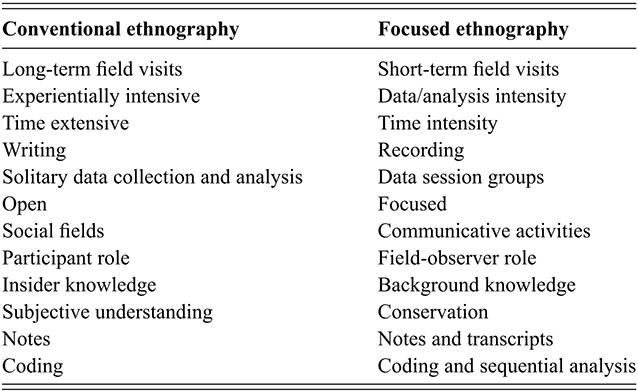
Focused ethnographies have been heavily employed in practice-oriented disciplines such as engineering and healthcare, mostly to analyse work routines and propose improvements (Reference Higginbottom, Pillay and BoaduHigginbottom et al., 2013; Reference MillenMillen, 2000; Reference WallWall, 2015). These applications of focused ethnography have been criticised for losing core qualities of ethnographic work, such as the deep experience and immersion that only long-term fieldwork can offer, and the ability to capture complex processes of meaning-making by members of a community (Reference Breidenstein and HirschauerBreidenstein & Hirschauer, 2002). As a response to such critiques, Wall stresses the pragmatic aspects of focused ethnography: ‘Rather than being a threat to the ethnographic endeavour, focused ethnography preserves the essential nature of ethnography and allows researchers to explore cultural contexts that cannot be studied using conventional ethnographic methods.’ (Reference WallWall, 2015, p. 5). The key strength of focused ethnography, she adds, is that it enables the ethnographer to study more geographically dispersed and temporally ephemeral communities. When studying a group one is not a member of, important amounts of background knowledge are required. For researchers in a specific domain of global environmental governance, this involves specialist knowledge of the domain’s history, its main institutions, actor constellations and norms, as well as formal and informal rules. It is impossible to pick up such elements in a short field stay. Studying environmental conferences thus requires going into the field well prepared, and possibly returning to it in an iterative succession of short, focused field stays. Focused ethnography is well suited for such an approach: ‘[F]ocused ethnographies are studies of highly differentiated divisions of labour and a highly fragmented culture. The more diverse and short-term the fields and activities to be observed become, the more flexible, short-term and focused should be the instruments of our research’ (Reference KnoblauchKnoblauch, 2005, p. 11).
Some properties of global environmental conferences can even be used to the ethnographer’s advantage. As outlined in the previous section, over time UN governance spaces produce a small-world effect, where repeated interactions create in-groups of ‘COP-junkies’ (Reference Dumoulin Kervran and de OliveiraDumoulin Kervran, 2021, p. 91). Such worlds can be successfully observed and analysed only by joining them through a series of repeated short-term observations. As Reference Campbell, Corson, Gray, MacDonald and BrosiusCampbell and colleagues (2014, p. 16) note, their ‘familiarity with the policy negotiations at stake (their histories, the various interests groups involved, etc.) rivals that of more traditional ethnographers who understand land tenure or household division of labor in particular places’. COPs’ repetitive temporal structure enables ethnographers to go beyond a single well-prepared period of data collection in a given field, engaging instead in a longer-term, iterative research process, and thus in longer-term and more in-depth research projects. This fits with the ethnographic insight that fieldworkers who engage in longer-term field stays not only get to know the field well, but to an extent become part of the field that they study (Reference HyndmanHyndman, 2001). The preparation time needed to understand the overall technical complexities of a given field in global environmental governance decreases as it becomes increasingly familiar, and more preparation time can be spent on specific research questions. In the process, conference ethnography can be iteratively refined. This partly makes up for certain shortcomings of focused ethnography, and has been stressed by many researchers (Reference Corson, Campbell, Wilshusen and GrayCorson et al., 2019; Reference Gray, Corson and CampbellGray et al., 2019). It is also an example of a more general practice in ethnographic research in which researchers regularly return to a given field, in order to investigate changes in it over time, and to observe change in the researchers’ own perspective on it (Reference SchneggSchnegg, 2023, 2021). Repeated research on recurring events like the climate and biodiversity COPs can not only help avoid some of the pitfalls of short-term ethnographic observation, but also respond to some of the questions and problems that arise when ethnographers return to a field in which they previously studied (Reference EllisEllis, 1995). The aspect of gaining perspective through what O’Reilly has called ethnographic returning (Reference O’ReillyO’Reilly, 2012) can be strengthened by returning to the field in a team, and productively extended to a studying up context. It may be possible to better answer questions on the attribution of observed changes – has the field changed? have I as a researcher changed? – when returning to the field with either the same or different team members.
4.2 Team Ethnography
Collaboration is a key aspect of scientific life, and is often understood to have an advantage over working alone, especially when dealing with complex and fragmentary events (Reference Brosius and CampbellBrosius & Campbell, 2010, p. 248). And yet the stereotypical ethnographer works alone. Especially in the anthropological tradition, where extensive fieldwork is the cornerstone of disciplinary training, a paradigmatic view came into currency that was described, perhaps over-pointedly, by the anthropologist Robert Hackenberg as the ‘1:1:1 ratio – one man [sic], one village, one year’ (quoted in Reference Erickson and StullErickson & Stull, 1998, p. 2). However, the ‘lone ranger’ ethnographer is largely a myth. In their guide to what they term team ethnography, the anthropologists Ken Erickson and Donald Stull show how from the very beginning, ‘It was the expedition, not the independent investigator, that the first ethnographers chose as their research model when they got up out of their armchairs and went to the field’ (Reference Erickson and StullErickson & Stull, 1998, p. 3). Moreover, collaboration frequently extends to informants and research subjects. In recent years, the term ‘collaborative ethnography’ has thus also been used to encapsulate the ethnographer’s collaboration with the people and communities they study (Reference LassiterLassiter, 2005). This approach emerged partly in response to what is known as the ‘crisis of representation’ in anthropology, which was driven by the realisation that the voices and viewpoints of the people who were the focus of anthropological studies had been excluded from the practice of ethnographic research (Reference Clifford and MarcusClifford & Marcus, 1986). Rather than telling stories about communities and cultures, collaborative ethnography attempts to work with those who are studied, in an approach that shares some features of action research or transdisciplinary research. The journal Collaborative Anthropologies embodies this quest for new and more ethical research methods (Reference RappaportRappaport, 2008). Reference Clerke and HopwoodClerke and Hopwood (2014, pp. 14–15) choose instead to refer to ethnographic endeavours that involve large groups of researchers as ‘doing ethnography together’, doing ethnography ‘in teams’ and ‘co-ethnography’. This multiplicity of terminologies stems partly from the multiple types of arrangements that working in a team can involve, ranging also form one-time observations to longitudinal studies. These can include collaboration in ethnographic data gathering and interpretation over an extended period within a sedentary community (Reference Buford May and Pattillo-McCoyBuford May & Pattillo-McCoy, 2000; Reference Gerstl-Pepin and GunzenhauserGerstl-Pepin & Gunzenhauser, 2002; Reference Low, Taplin and LambLow et al., 2005), common observations of a single complex and crowded event site (Reference Mazie and WoodsMazie & Woods, 2003; Reference PaulsenPaulsen, 2009), longer-term collaboration involving division of labour to observe a sequence of events (Reference Gray, Corson and CampbellGray et al., 2019), and parallel work by observation teams at parallel field sites (Reference Jarzabkowski, Bednarek and CabantousJarzabkowski et al., 2015). It is these collective or team-based approaches that inspired early global event ethnographers, as they promise to remediate some of the most significant problems with short-term observation. As Siméant and colleagues note, ‘Given the limited time available to researchers and their lack of familiarity with the local context, [observing such events] presupposes engaging in collective observation [ … ] whenever possible by multinational teams to prevent ethnocentric interpretation’ (Reference Siméant, Pommerolle, Sommier, Siméant, Pommerolle and SommierSiméant et al., 2015a, p. 13). If practised effectively, collaboration among larger teams of researchers can help avoiding ‘the pitfalls of “airport” or “parachute” ethnography’ such as ‘minimal first-hand observation or over-reliance on institutional records, media accounts, or memories’ (Reference PaulsenPaulsen, 2009, p. 510).
But teamwork is always a balancing act. According to Erickson and Stull, there are no easy recipes for team ethnography, as ‘research goals and contexts will largely dictate whose company the ethnographer keeps’ (Reference Erickson and StullErickson & Stull, 1998, p. 5). They go on to argue that ‘if we really think about it, if we are really honest with ourselves about what it is we do, the question for the ethnographer becomes not whether to team or not to team; ethnography is by its very nature a team enterprise. The question becomes, What do we want our ethnographic team to look like? Whose understandings shall we include?’ (Reference Erickson and StullErickson & Stull, 1998, p. 59). However, many pieces on team ethnography contain sections on disadvantages and difficulties, or end with ‘warnings’ of how and when not to practice the method. Some authors have cautioned, for example, that rigid and inegalitarian division of labour in the research process can deprive ethnography of its main advantages and strengths, namely immersion, a holistic approach to the research process, and an in-depth understanding of local meaning-making (Reference Mauthner and DoucetMauthner & Doucet, 2008). Citing Reference PlattPlatt’s (1976) dictum that ‘knowledge once divided can be hard to put together again’, Reference Mauthner and DoucetMauthner and Doucet (2008, p. 976) plead against the assignment of fieldwork and data analysis, or of research management and implementation, to separate team members, stressing that the embodied and immersive aspect of fieldwork is an essential part of the ethnographic method. Theirs is not a dismissal of team-based ethnography as such, but a warning against hierarchical and unequal forms of division of labour in neoliberal, production-oriented research (re)organisation that have been criticised in the name of ‘slow scholarship’ (Reference Mountz, Bonds and MansfieldMountz et al., 2015).
Various groups of researchers have used team-based approaches in varying configurations to conduct ethnographic observations at environmental conferences. One key aspect of team research on recurring events like climate and biodiversity COPs is the benefits of iterative refinement with either the same or different team members. We discuss some practical aspects, benefits and challenges of this research strategy in greater detail in Section 5.
4.3 Digital Ethnography
Before the COVID-19 pandemic, the United Nations General Assembly had scheduled the final negotiations for the ratification of an intergovernmental treaty aimed at establishing binding rules for marine conservation to take place in the summer of 2020. Negotiations and preparations for this treaty had been over a decade in the making (Reference Vadrot, Langlet and Tessnow-von WysockiVadrot et al., 2021). The pandemic forced the postponement of the summit, but negotiation spaces were opened in the digital sphere to avoid losing the momentum that had been built within the process. This forced the observing researchers to shift their focus to these digital spaces. While the shockwaves sent by the COVID-19 pandemic through the world of international conferences and meetings appear to be incrementally subsiding, the foregrounding of digital spaces that they catalysed continues, and researchers working ethnographically at international conferences must adapt.
This is not entirely new. Since its inception in nineteenth-century anthropology, ethnography has continuously adapted its main approaches and central concepts, including those of the field and fieldwork, to social changes and new developments. This remains the case today, in a time when one of the most dramatic transformations in life-worlds has been the emergence and continuous spread of the digital sphere. This has not been lost on ethnographers (Reference MarkhamMarkham, 2013). The question of how to do ethnography in an increasingly digital age has been answered in various ways. Early studies with an ‘ethnographic approach to the internet’ and the use of information and communication media (ICM) made use of media ethnography, studying the offline communities that have emerged around social platforms and online sites (Reference Miller and SlaterMiller & Slater, 2001). In a similar vein, virtual ethnography (Reference HineHine, 2000) has emerged as a means to study new communities and forms of interaction in online communities. But the approach closest to the concerns of scholars interested in studying global environmental conferences is that of digital ethnography (Reference Abidin and de SetaAbidin & de Seta, 2020; Reference HsuHsu, 2014; Reference Pink, Horst and PostillPink et al., 2016). Such research has been described as moving from studying the Internet as a medium in its own right towards using the Internet to study culture and society (Reference RogersRogers, 2009, p. 29). Digital ethnography takes as its starting point the observation that the distinction between online and offline is not straightforwardly marked, digital communication, for example through social media, is part of people’s everyday life and activities. Reference Postill and PinkPostill and Pink (2012) call this the ‘messy web’. Starting from a critical media studies perspective, digital ethnography takes a non-media-centric and non-digital-centric approach to the digital. For example, it does not assume Twitter is any more perfect a representation of contemporary societal structures and trends than newspapers, television, or any other popular medium is, or has been. But using Twitter to study society can highlight novel aspects of contemporary life. It is the aggregate and productively contradictory picture that emerges from a combination of observing developments in all of these different media which is ultimately of the greatest value.
A key challenge in the online world is the lack of face-to-face, physically co-present interaction. As interpersonal skills and interactions are not the centre of attention, digital ethnography typically focuses on textual or video analysis. The forms of data gathered, including screenshots and recordings, also differ from those that feature in offline ethnography. The role of recordings highlights an affinity to focused ethnography. While working with recorded material poses problems of temporality and context, a benefit is that digital methods may span multiple scales, making it possible to zoom in and out (Reference HsuHsu, 2014).
With ‘lurking’ as a common practice in digital ethnography (Reference FergusonFerguson, 2017), practical, theoretical and ethical issues arise around the question of ‘What is participation?’ What is it that is observed, what does participant observation mean, what is the field, what kind of data are we able to work with, and what kind of data is it acceptable to work with? Reference MarkhamMarkham (2013) pointedly notes that all of these questions are already present in traditional ethnography – and that far from having been conclusively answered, they remain part of ongoing debates and reflection, keeping pace with new contexts of ethnographic study, just as in ethnography’s early days. The question of what the field is cannot be conclusively answered, and is not subject to abstract, universal delimitation, but instead depends on the research topic (Reference Garcia, Standlee, Bechkoff and CuiGarcia et al., 2009). Overall, and despite the obvious existence of differences, many of the same rules apply in digital as in non-digital ethnography, including the value of mixed methods approaches and a role for autoethnographies.
Like other social scientists keeping pace with the expansion of digital spaces in their respective fields, ethnographically oriented researchers of global environmental governance have added digital methods to their repertoire of approaches in recent years. Although digital spaces have been steadily attracting more activity within environmental summitry – official negotiations, media, observers and protesters – the COVID-19 pandemic propelled virtual meeting spaces and online communication to the centre of attention (Reference ChasekChasek, 2021). Already before the pandemic, websites, social media and virtual discussion platforms were increasingly becoming sites of contestation. Reference Marion Suiseeya and ZanottiMarion Suiseeya and Zanotti (2019), for example, note the charge that the COPs were inaccessible for representatives from the Global South and Indigenous activists and representatives, with both physical attendance and the structures of participation described as exclusionary. This had spurred activists’ participation in online events, such as at COP21. Although activities in virtual fora might be thought of as a sideshow to the main, physical COP events, Marion Suiseeya and Zanotti show that online activism played a crucial part in the push to include some of the proposals and demands of Indigenous peoples’ groups.
Since COVID-19, digital spaces have become even more important, and are coming increasingly into view as sites not just of communication and contestation but of negotiation. Reference Vadrot and Ruiz RodríguezVadrot and Ruiz Rodríguez (2022) point out that online platforms are increasingly being used for diplomatic negotiations, and that what is happening there is not yet well understood. Their digital ethnography of international online negotiations on marine biodiversity highlights the emergence of what they call ‘digital multilateralism’. While many of the traditional diplomatic practices are also present online, the face-to-face interactions and informal ‘coffee talks’ characteristic of traditional diplomatic negotiations – which, some argue, are of fundamental importance – are not. But some new practices have also emerged that are exclusive to (partially) digital negotiations processes, and that in the future will perhaps become more widespread. Reference Vadrot and Ruiz RodríguezVadrot and Ruiz Rodríguez (2022, p. 11) point to the intertwining of online and offline negotiations as a case in point. While some have welcomed the expanding role of online fora as an opportunity for increased inclusivity as more actors are able to participate in events, decisions are still made at in-person negotiations by quite a small number of actors. In the process, both online and offline negotiations become increasingly difficult to follow for observing ethnographers and participants alike, without the information and background that are discussed in complementary in-person and virtual spaces.
4.4 Dramaturgical Perspectives
Ethnographic accounts of global environmental conferences have traditionally placed a strong focus on performative aspects of these events (Reference DeathDeath, 2011; Reference LittleLittle, 1995). A dramaturgical perspective is a common thread running through many team ethnographies of global environmental governance, although not always in an explicit form. Dramaturgy was not the focus of the Duke CEE project at its beginnings. But the politics of performance and the staging of the conservation congress itself soon emerged as strong and salient features of the process that they were observing (Reference Brosius and CampbellBrosius & Campbell, 2010, pp. 249–250). The performative dimension of global environmental conferences also figures as a central theme in the French tradition of global event ethnography (Reference Foyer, Dumoulin Kervran, Aykut, Foyer and MorenaFoyer et al., 2017, p. 5). Subsequently, it became a conceptual anchor for understanding global climate politics (Reference Aykut, Morena and FoyerAykut et al., 2021), and has been positioned as a theoretical alternative to the notion of orchestration in attempts to understand soft coordination in global climate governance (Reference Aykut, Pavenstädt and Datchoua-TirvaudeyAykut, Schenuit, et al., 2022). Various studies on negotiations and official conference activities, or investigating the ways in which social movement actors approach environmental meetings, have focused on symbolic action, role taking, dramaturgy, performance and other theatrical metaphors.
Perhaps in equal parts a methodological building block (Figure 3) and a conceptual framework, a dramaturgical perspective looks at various aspects of performances on the stages of climate conferences. Dramaturgy, with its theatrical metaphors, lends itself especially well to ethnographic observation at these sites. Although talk of performance in relation to people’s behaviour in everyday contexts has a mostly negative connotation, for sociologist Reference GoffmanErving Goffman (1959, Reference Goffman1963) it is a constitutive – and thus unavoidable – aspect of social interactions. Goffman defines performance as ‘all the activity of an individual which occurs during a period marked by his continuous presence before a particular set of observers and which has some influence on the observers’ (Reference GoffmanGoffman, 1959, p. 32). When there is an impression to be made, that is, whenever there is an observer present, self-presentation is necessarily managed. Goffman further speaks of social interactions in terms of a front and a backstage. The front stage is the place of impression management, where a ‘mask’ is put on for an audience, which is often aware of the performance and the public character of a situation. Backstage, performers are hidden from the audience. This is a place of retreat and preparation for future public performances. Front and backstage need not necessarily be physically separated spaces: they are first and foremost social spaces and analytical categories.
Methodological building blocks of collaborative event ethnography

A key aspect of the dramaturgical perspective are the various pointers, conventions and guides that shape the way performances take place. In a dramaturgical vocabulary, these are scripts, repertoires and roles. There has been considerable scholarly debate around how they come about, how fixed they are, how they can change, and how people choose between them. Political sociologist Maarten Reference HajerHajer (1997, Reference Hajer2009) has applied a dramaturgical perspective to public policy discourses in environmental and climate governance. He shows that, particularly in a highly mediatised world, public policy discussions feature role taking and the deployment of repertoires and scripts. He explores issues such as settings and staging within policy and governance processes, roles that claims-makers take in debates, and how repertoires travel. This approach thus aims to analyse the symbolic and discursive aspect of politics (Reference EdelmanEdelman, 1985).
One approach to social movements and contentious politics that has been widely influential is Charles Tilly’s conceptualisation of scripts and repertoires (Reference TillyTilly, 2006, Reference Tilly2008). It is part of a wider body of work showing that a dramaturgical focus can be fruitfully applied in the context of longer-term observation of the emergence of traditions and ritualisations in national protest cultures (Reference ChaffeeChaffee, 1993). This has included conferences and large events, and especially the World Social Forum, as an event held by and for social movements (Reference Herrera, Judell, Paule, Siméant, Pommerolle and SommierHerrera et al., 2015; Reference Rucht, Smith, Reese, Byrd and SmytheRucht, 2011; Reference Siméant, Pommerolle and SommierSiméant et al., 2015b). The presence of movements at global summits has produced repertoires of counter-summit protest tactics, with a strong emphasis on dramaturgy directed towards the media, making such protests useful mobilising tools for social movements (Reference JurisJuris, 2008). However, presence and protest at summits puts movements at risk of themselves getting caught up in the logic of ‘summitry’ and ‘summit theatre’ (Reference DeathDeath, 2010, Reference Death2011), and even giving rise to a ‘counter-summitry’ (Reference MeekMeek, 2015). Tensions between varying and potentially contradictory models for action structure a range of roles that protesters may take on at environmental summits.
In ethnographic observation at COPs, dramaturgical analysis provides a useful reference frame, although to date it has rarely been explicitly deployed. The arena of high diplomacy and summitry presents itself as a prime example of staging and self-presentation in action, as shown in the case of the negotiations for the extension of the European Union (Reference SchimmelfennigSchimmelfennig, 2002). A number of studies have brought a dramaturgical perspective to bear on climate and other conferences, drawing on ethnographic observation and influenced by the ‘ethnographic turn’ in IR (see Section 2). A central concern here is to analyse practices of soft coordination and orchestration, which occur despite sometimes heated opposition and conflict between different actors, and their interests and views. Reference MacDonaldMacDonald (2010), drawing on observations at World Conservation Congresses, argues that, over the course of many of these events, the concept of conservation itself has been resignified in ways that are beneficial to the business participants in the negotiations, through repeated practices of script development and re-scripting. Speaking of the WCC as a spectacle, he argues that the meeting format employed there has been essential in enabling corporations to subtly shift and reconfigure the topic at hand. ‘Events like the WCC constitute the political sites where much of that reconfiguration is rendered legible; where the political future of conservation is negotiated; and where struggles over deciding what binds “us” all together are acted out’ (p. 271). Dramaturgical perspectives drawing on Goffmann, Hajer and others remain an underlying focus in many collaborative event ethnographies.
5 Practising Collective Research
Practising collaborative event ethnography is ‘easier said than done’ (Reference Brosius and CampbellBrosius & Campbell, 2010, p. 247) and sometimes ‘more hands do not make light work’ (Reference Gray, Corson and CampbellGray et al., 2019, p. 15). Erickson and Stull’s Doing Team Ethnography: Warnings and Advice (Reference Erickson and Stull1998) is a valuable survey of some of the recurring issues in collective research, its advantages, and things to look out for before embarking on this complex and challenging endeavour. The authors identify a series of overarching factors that make team-based work in ethnography difficult. These include the cult of individualism in academia and the professional competition built into the academic reward system, the risk of teams splitting into different factions along disciplinary lines or forming subgroups that reflect professional hierarchies, or work being distributed along gendered lines. Considerate and thoughtful organisation is thus at the core of collaborative research. On the other hand, collaborative research also requires a willingness to experiment (Reference Brosius and CampbellBrosius & Campbell, 2010, p. 248), and an approach that is not rigid but ‘dynamic and relational’ (Reference Corson, Campbell, Wilshusen and GrayCorson et al., 2019, p. 59). A broad but fragmented literature on ethnographic methodology provides tips on how such collaboration can be made successful (for an overview, see Reference Clerke and HopwoodClerke & Hopwood, 2014). In addition to that literature, this section draws on our own experience and on the methodological sections of publications on collective ethnographies of global environmental conferences (see especially Reference Brosius and CampbellBrosius & Campbell, 2010, pp. 247–249; Campbell, Reference Corson, Campbell and MacDonaldCorson, et al., 2014, pp. 9–12; Reference Corson, Campbell, Wilshusen and GrayCorson et al., 2019, pp. 59–63; Reference Dumoulin Kervran and de OliveiraDumoulin Kervran, 2021, pp. 87–91; Reference Foyer and FoyerFoyer, 2015b; Reference Foyer, Dumoulin Kervran, Aykut, Foyer and MorenaFoyer et al., 2017, pp. 11–14; Reference Foyer and MorenaFoyer & Morena, 2015; Reference Gray, Corson and CampbellGray et al., 2019, pp. 9–16). The key themes that emerge roughly follow the arc of an ethnographic project, from preparing together before the fieldwork begins, to organising collective observations and data gathering, cooperating on data analysis and interpretation, and finally collaborative writing and publication strategies. Some of the themes raised are specific to short-term ethnographies at complex multifocal events like global environmental conferences, and thus differ from issues that can arise in longer-term field stays. Others, relating for instance to preparing fieldwork or writing a joint publication, are common issues in ethnographic team research. The following sections aim to synthesise advice and warnings found in these literatures, selecting what we have found most useful in our own work on climate COPs. Each section ends with a summary list of ‘Dos’ and ‘Don’ts’ which are brought together in Table 2. To preserve the ethnographic core of the research practice, the Don’t of avoiding rigidity in preparing, working, thinking, being and writing together consistently stands out as a key caveat.
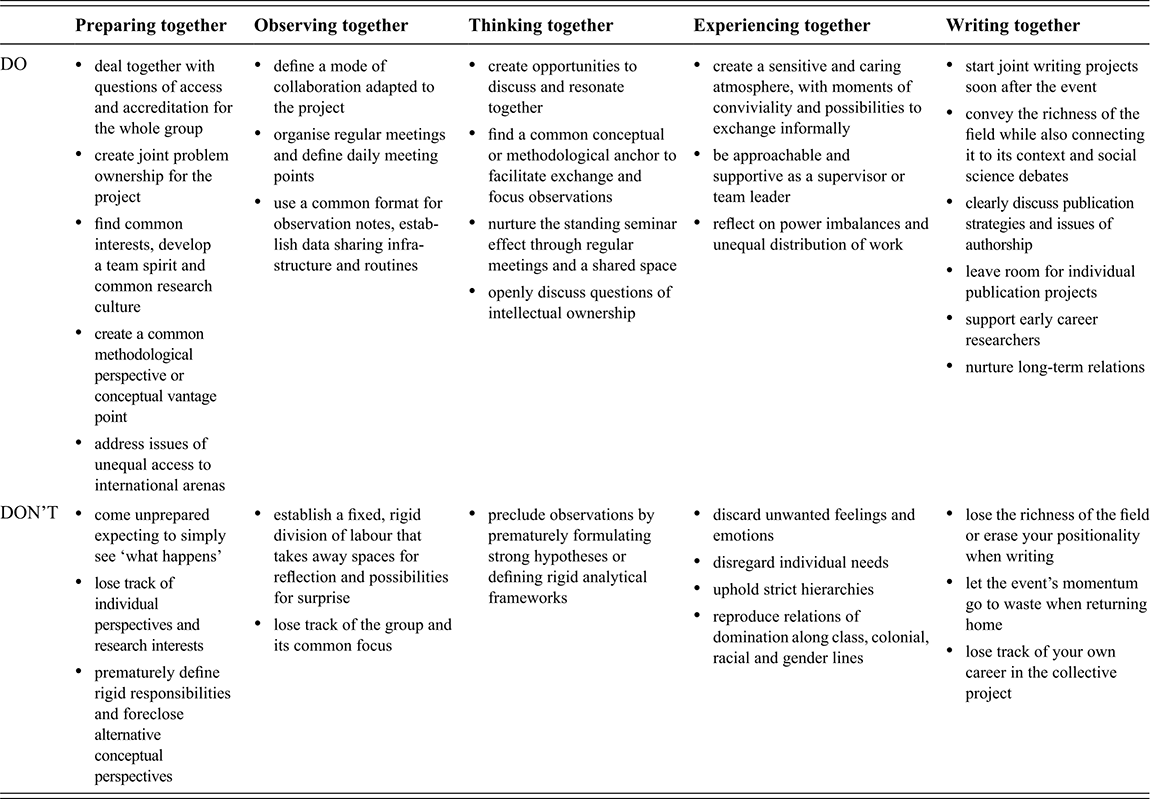
5.1 Preparing Together: Creating Ownership
A key element of focused ethnography is preparation. The fact that observation time is necessarily limited does not mean a shorter research project. Much to the contrary: the lion’s share of work shifts to the preparatory phase and to subsequent analyses. Global environmental meetings use highly specialised language and involve complex entanglements of actors and institutional arrangements that act as hurdles to participation. Accordingly, research usually does not start when one arrives in the host city or enters the conference centre, but weeks and months before. It is essential to come to the event prepared, considering that global environmental conferences usually are not singular events, but part of longer cycles with a history and context, with which researchers need to familiarise themselves well before the event starts. Preliminary workshops, seminars and meetings can be used to this end, as can the study of preparatory reports and documents, conducting scoping interviews and contacting informants. Important preparations may also include securing accommodation, getting to know commuting times, public transport timetables and routes in order to minimise the amount of scarce, valuable time in the field that is spent on logistic coordination. Preparatory workshops are also instrumental for attracting interested researchers, putting together a diverse research group with complementary skills and backgrounds, and developing a shared conceptual focus or anchoring concept for use in coordinating work within the team.
Most accounts of collaborative event ethnography stress the importance of the preparatory phase, which includes activities as diverse as setting up a website and a research infrastructure, discussing ethical protocols, inviting external researchers (Reference Brosius and CampbellBrosius & Campbell, 2010, p. 249), holding monthly project meetings and research seminars, and creating a mailing list and file hosting system to share relevant information (Reference Foyer, Dumoulin Kervran, Aykut, Foyer and MorenaFoyer et al., 2017, p. 13). Ultimately, a core aim of these preparatory activities is to build joint problem ownership (Reference Schuck-Zöller, Brinkmann, Rödder, Serrao-Neumann, Coudrain and L. CoulterSchuck-Zöller et al., 2018, p. 114) and a shared research culture (Reference Foyer, Dumoulin Kervran, Aykut, Foyer and MorenaFoyer et al., 2017, p. 13), rather than prematurely defining rigid responsibilities and strict work routines. Importantly, participants need to find and nurture their own motivation to participate in the collective research endeavour, rather than being assigned to a task through their hierarchical superior.
For our observations at COP26 in Glasgow, for example, the team included a group of social movement scholars as well as a heterogeneous group of climate governance scholars with different thematic foci. Preparatory workshops were instrumental in bringing the two groups together by defining the contours of a dramaturgical perspective as a joint analytical framework for all sub-projects. We conceptualised Glasgow as composed of a range of stages for public performances, including front- and backstages, and featuring a variety of dramaturgical practices. We also agreed on a schedule for travel and observations, which included distributing accreditations and rooms in shared rented flats in Glasgow, to guarantee individual researchers’ access to their particular field, but also adequate coverage of the conference’s different physical and social spaces for the project as a whole.
Throughout these preparatory activities, it is important to keep in mind that collaborative event ethnography is a highly unequal research practice. Hurdles to participation are not evenly distributed along lines of gender, class, race or geographic origin. The location of meetings in different countries around the world, their timing in the middle of the academic semester and the fact that intermediary meetings are sometimes held at short notice, represent challenges for all researchers, but especially for early career scholars without adequate funding, scholars in the Global South who may have difficulty obtaining visas, and scholars with responsibilities in care work. Keeping these inequalities in mind and attempting to resolve them as a group is an important part of creating a diverse research group, a good working atmosphere and team spirit. Accreditation to UN conferences is another equity issue. At climate COPs, observers have to be nominated by accredited organisations, and getting such accreditation itself takes time. Accreditations fall into one of nine ‘constituencies’ officially recognised by the UN system. For academics, this is usually the Research and Independent Non-Governmental Organizations, or RINGO, constituency. It is not unusual for researchers whose organisation is not accredited to mobilise personal and professional networks to obtain a nomination through another accredited organisation. The inequalities created by this system can be somewhat attenuated by showing solidarity with less fortunate colleagues, either by reserving a nomination for someone who would otherwise not have access to one, or by participating in broader pooling systems that allow for broader and more diverse participation in UN conferences.
…
DO: Deal together with questions of access and accreditation for the whole group; create joint problem ownership for the project; find common interests, develop a team spirit and common research culture; create a common methodological perspective or conceptual vantage point; address issues of unequal access to international arenas.
DON’T: Come unprepared expecting to simply see ‘what happens’; lose track of individual perspectives and research interests; prematurely define rigid responsibilities and foreclose alternative conceptual perspectives.
5.2 Observing Together: Many Eyes
To maximise observation time during a global environmental conference, it is advisable to arrive at the event site before the event starts, to get acquainted with the various spaces and settle in. Once in the field, the process of defining modalities of collaboration and developing working routines takes centre stage. Shared observation is very advantageous for transnational mega-events like UN climate conferences, but ethnographers practicing participant team observation in other contexts have also highlighted its advantages (Reference PaulsenPaulsen, 2009). ‘Many eyes’ see more than two, and people from different backgrounds and with different disciplinary training and research experiences will notice different things and likely complement each other (Reference Mazie and WoodsMazie & Woods, 2003, p. 30). To realise this potential, team ethnography has to allow for some degree of freedom, accommodating and nurturing individual motivations to participate in collective work while also keeping individual researchers from simply doing their own thing – a problem that has been fittingly likened to ‘herding cats’ (Reference Erickson and StullErickson & Stull, 1998). Informal hierarchies often emerge in the course of collective work, and have to be dealt with, especially when they challenge formal roles or work routines, or reproduce problematic power structures. Problems of authority are commonplace, as formal leaders may be reluctant to lead, while others may be unwilling to be led.
To avoid some of these problems, clarifying modalities of collaboration can be useful. Reference Gray, Corson and CampbellGray and colleagues (2019, p. 2) juxtapose two ideal-typical modes: one that is based on a division of labour among individual researchers, and a mode of strong collaboration that emphasises the co-production of research as a team. Both have their advantages and pitfalls. On the one hand, a certain division of roles is practical for analysing complex events like global environmental conferences. With a division of labour, management and leadership aspects come to the fore: ‘For a team leader, project management draws effort away from research in the field. Time spent by the team leader in solo fieldwork amounts to time not spent on preliminary comparisons among team-collected data, team meetings, and getting to know the team itself.’ (Reference Erickson and StullErickson & Stull, 1998, p. 17). However, while it is difficult to avoid having a certain hierarchy in collective research, collaboration does not have to involve strong central direction. Too strict a division of labour can even be counterproductive given the mode of knowledge production in qualitative research, where data is always embedded in tacit and embodied knowledge about social situations and cultural context, and cannot be easily separated from the researcher who gathered it (Reference Mauthner and DoucetMauthner & Doucet, 2008). Our experiences indicate that cooperating on the basis of individual autonomy, although it is more complex to implement, can be very rewarding in terms of research results.
Whatever the mode of collaboration, it is necessary to establish work routines, including frequent meetings of team members who are working closer together and regular meetings of the whole group. Ideally, these meetings serve to compare notes, share observations and enable the circulation of information about past and upcoming events. Most teams also develop a common observation matrix or form, that reflects common research interests and sometimes a shared conceptual focus, to facilitate data sharing among team members (Campbell, Reference Corson, Campbell and MacDonaldCorson, et al., 2014, p. 11; Reference Foyer, Dumoulin Kervran, Aykut, Foyer and MorenaFoyer et al., 2017, p. 14). Finally, the spatiality of research collaboration matters. In larger, more complex settings, individual researchers may ‘get lost’ in the event, and the busy schedule may prevent regular meetings. A technique that has proven useful in this context is to work in pairs for observations and interviews. Observation pairs can allow for more complete coverage of very ‘thick’ events such as protests. In some cases, there can be a safety element to working in pairs and sharing information with the group (Reference MaclinMaclin, 2010). If composed with a view to diversity, they can also add cultural sensitivity and reflexivity to the research (Reference Siméant, Pommerolle, Sommier, Siméant, Pommerolle and SommierSiméant et al., 2015a). Another technique that can be used is to create subgroups that cover different social spaces at a conference (Reference Foyer, Dumoulin Kervran, Aykut, Foyer and MorenaFoyer et al., 2017). This allocation can broadly follow the inside/outside divide, with one group focusing on social movements and activists, the other on the corporate and political spaces within the conference (Reference Aykut, Pavenstädt and Datchoua-TirvaudeyAykut, Pavenstädt, et al., 2022). Subgroups can also be formed according to shared thematic interests, such as an ocean team (Reference Campbell, Gray, Fairbanks, Silver and GrubyCampbell et al., 2013) an agriculture team (Reference Demeulenaere, Castro and FoyerDemeulenaere & Castro, 2015) or a business team (Reference Benabou, Moussu, Müller, Aykut, Foyer and MorenaBenabou et al., 2017). To ensure communication between subgroups, creating shared research data infrastructure is crucial. This includes cloud services for sharing pictures, fieldnotes and documents. Actors at most conferences produce a steady flow of documents, and attempting to follow it can quickly become overwhelming. It is therefore helpful to distribute and rotate the tasks of reading and summarising newsletters, daily bulletins, briefings and the like. To some extent, this work can be supported and facilitated by members of the team who stay at home, follow events online and summarise media coverage and social media.
…
DO: Define a mode of collaboration adapted to the project; organise regular meetings and define daily meeting points; use a common format for observation notes, establish data sharing infrastructure and routines.
DON’T: Establish a fixed, rigid division of labour that takes away spaces for reflection and possibilities for surprise; lose track of the group and its common focus.
5.3 Thinking Together: Many Minds
Another key advantage of collaborative work that many practitioners highlight is that ‘many minds’ have more ideas than one (Reference Brosius and CampbellBrosius & Campbell, 2010, p. 248; see also Reference Crow, Levine and NagerCrow et al., 1992). The founders of collaborative event ethnography, for instance, point out that they started out with an individualistic and pragmatic approach of combining ‘many eyes’ to more fully capture a complex event, but quickly realised during the research process that regular discussions among team members also brought out insights that would not have emerged in individual research (Campbell, Reference Corson, Campbell and MacDonaldCorson, et al., 2014, p. 10). ‘22 Heads (and Bodies, and Digital Records) are Better than One’, they note (Reference Brosius and CampbellBrosius & Campbell, 2010, p. 248). Each individual researcher brings their own experience and prior knowledge, especially when they come from multiple disciplinary and/or cultural backgrounds (Reference Foyer, Dumoulin Kervran, Aykut, Foyer and MorenaFoyer et al., 2017). However, achieving intersubjective understanding can also be difficult and time-consuming (Reference Gray, Corson and CampbellGray et al., 2019, p. 12). Sharing data and discussing observations takes time and creates opportunity costs, especially in the context of limited time capacities during fieldwork. In other words, there are trade-offs when moving from loose collaboration among individual researchers to strong collaboration aimed at embarking on a shared intellectual journey.
Among the key factors that make team ethnography difficult, Reference Erickson and StullErickson and Stull (1998, Chapter 3) cite the cult of individualism prevalent in academia – perhaps especially in ethnography (see also Reference Corson, Campbell, Wilshusen and GrayCorson et al., 2019, p. 59) – and professional competition, which is connected to the academic reward system. Instead of harnessing the advantages of interdisciplinary complementarity, ill-conceived collaboration can therefore lead to a scattering of team members, or the loss of team focus through the pursuit of individual projects. One way to navigate these trade-offs is to find a common conceptual or methodological anchor that keeps the team focused while allowing for sufficient individual autonomy. Examples cited in the literature include the concepts of scalar differences (Campbell, Reference Corson, Campbell and MacDonaldCorson, et al., 2014), assemblage (Reference Corson, Campbell, Wilshusen and GrayCorson et al., 2019) and climatisation (Reference Aykut, Foyer and MorenaAykut et al., 2017). In our observation at COP26 in Glasgow, we used a dramaturgical understanding as a shared analytical and methodological frame, which allowed us to conceptualise Glasgow as a series of stages for multiple actors to perform upon, from government representatives, businesses and think tanks at the official conference negotiations, side events and high-level events, to dramatic activist performances in the streets of Glasgow. This dramaturgical approach served both as a broad lens that accommodated different theoretical perspectives (Goffman, Hajer) and thematic interests, as well as a methodological common ground for conducting observations and orienting interview questions.
On a more pragmatic note, the creation of a common discursive space is greatly facilitated by the existence of shared physical spaces that allow for regular and sometimes unplanned discussions, such as a shared flat or daily commutes and train rides. Additionally, regular meetings should be organised on-site in the form of brief follow-up discussions after an event, in shared coffee breaks or meals, and after the event, at the restaurant or over drinks. Continuous exchange and discussions create a ‘permanent’ or ‘standing seminar effect’ (Reference Dumoulin Kervran and de OliveiraDumoulin Kervran, 2021, p. 89; Reference Foyer and FoyerFoyer, 2015a, p. 19) that facilitates the emergence of novel ideas and creative associations. Developing new ideas during a collective observation also means that they can be put into practice or tested immediately or the next day. One caveat should be mentioned, however. Collective work and discussions also mean that it can sometimes be challenging to clearly attribute an idea or a concept to a particular researcher. Collective work to some degree implies collective ownership of ideas (Reference Gray, Corson and CampbellGray et al., 2019, p. 14). It is therefore important to create an atmosphere in which questions of intellectual ownership and ways of citing concepts can be addressed and clarified before publication. Partly for that reason, but also to facilitate work, it can sometimes be preferable to disperse parts of the research collective into smaller, more cohesive units with some degree of autonomy.
…
DO: Create opportunities to discuss and resonate together; find a common conceptual or methodological anchor to facilitate exchange and focus observations; nurture the standing seminar effect through regular meetings and a shared space; openly discuss questions of intellectual ownership.
DON’T: Preclude observations by prematurely formulating strong hypotheses or defining rigid analytical frameworks.
5.4 Experiencing Together: Reflexivity and Conviviality
While this is true of other qualitative research approaches, ethnographic observation in particular involves the ‘whole’ researcher – participating and observing, seeing and listening, but also sensing and being there in the situation. Recent rounds of reflexive discussion on the approach have centred on this aspect of ethnographic fieldwork (Reference Honer and HitzlerHoner & Hitzler, 2015; Reference SpittlerSpittler, 2001), which sometimes remains in the background in studies of collaborative event ethnography. This may be in part due to the difficulties of treading the path between representing the different field experiences of many researchers while still emphasising the collaborative character of the research. While aiming to avoid the pitfalls of ‘confessional tales’ (Reference Van MaanenVan Maanen, 2011), here we will discuss some aspects of ‘being there’ that are particularly relevant to the field sites of collaborative event ethnography.
The importance of bodily, sensory experience in the field relates, first of all, to observations. For example, moments of unanticipated crisis may erupt in a negotiation and manifest in representatives’ body language and expression (Reference Hughes and VadrotHughes & Vadrot, 2019). Such moments provide ethnographic researchers with important insights, which would be impossible to harness without ‘being there’ (Reference O’Neill and HaasO’Neill & Haas, 2019, p. 8). But bodily experience is not only about observing and sensing the signs of others’ states and (re)actions; it includes the ethnographer’s own lived experience. Global environmental conferences can estrange, astonish or overwhelm when experienced for the first time. Such emotions can be a powerful resource for analysis, as they open new angles for reflection. However, they can also be an emotional burden for the individual researcher, for example as they realise how hard it is to get access to people in a busy conference setting, or when fear of missing out kicks in, as it becomes clear how little of such an event it is possible to attend. In both cases, working in a team can be beneficial. Seeing the field through the eyes of a newcomer can sensitise the seasoned event ethnographer to the strangeness and peculiarities of a place they have come to think they know all too well. And when anxiety, anger or frustration become overwhelming, experienced team members can help navigate these emotions and put them in perspective. Collaborative event ethnography can also be difficult on a more personal, or intimate, level. We all have our political and ethical convictions, and more often than not, researchers working on global environmental governance will also have sympathy for the causes of stopping environmental destruction and protecting basic human rights. They may find it hard to accept failure or stalemate in negotiations, or feel appalled by displays of cynicism and greenwashing. While observing activists or hearing dramatic speeches, some will be confronted with their own climate anxiety (Reference ClaytonClayton, 2020). Here, collaborative work also means being attentive to oneself, and respecting boundaries while being supportive of one another. Functioning teams are not only work units but also networks of support, which offer team members the opportunity to share concerns, doubts and uncertainties.
This is especially true when an essential ingredient is added to the collective experience: conviviality (Reference Foyer, Dumoulin Kervran, Aykut, Foyer and MorenaFoyer et al., 2017). Accounts of successful collaborative event ethnography often highlight the importance of sharing informal moments to create interpersonal ties and even friendships, be it through the sharing of significant research moments, intellectual excitement and camaraderie (Reference Gray, Corson and CampbellGray et al., 2019, pp. 10–11), or late-night dinner and tapas in a lively Barcelona district (Reference Brosius and CampbellBrosius & Campbell, 2010, p. 248). That being said, we should avoid painting too rosy a picture of academic collaborations. Hierarchies in academia frequently reflect broader societal inequalities, power imbalances and forms of discrimination, and it is important to institute safeguards against discriminatory and abusive behaviour. Thus, collaborative event ethnographers have noted gender imbalances in the team, as ‘women have tended to share more, and richer, data; women have been more willing to perform team tasks vs. individual tasks (for example, collect data for collective projects vs. individual projects); and women have performed more tedious, logistical tasks associated with conducting fieldwork (completing ethical applications, arranging access, booking tickets, finding accommodations, coordinating fieldwork activities)’ (Reference Gray, Corson and CampbellGray et al., 2019, p. 13). It is thus important to reflect, discuss and manage gendered divisions of labour and imbalances in collective research practices. This also applies to research collaborations in the field. When working with activists or Indigenous communities, for instance, it is crucial not to reproduce extractive systems of knowledge production. This entails reflecting on gendered and racialised power dynamics and colonial legacies, and attempting to be relevant to those we collaborate with in our research (Reference Wilkens and Datchoua-TirvaudeyWilkens & Datchoua-Tirvaudey, 2022).
…
DO: Create a sensitive and caring atmosphere, with moments of conviviality and possibilities to exchange informally; be approachable and supportive as a supervisor or team leader; reflect on power imbalances and unequal distribution of work.
DON’T: Discard unwanted feelings and emotions; disregard individual needs; uphold strict hierarchies; reproduce relations of domination along class, colonial, racial and gender lines.
5.5 Writing Together … and Alone!
Ethnography’s core strength lies in the in-depth study and thick description of meaning-making at a specific site. This allows attention to be drawn to seemingly mundane things such as waste-management (Reference Herrera, Judell, Paule, Siméant, Pommerolle and SommierHerrera et al., 2015), the material setting of a conference (Reference Dumoulin Kervran and FoyerDumoulin Kervran, 2015) or the design of its civil society spaces (Reference Aykut, Pavenstädt and Datchoua-TirvaudeyAykut, Schenuit, et al., 2022). When writing up your ethnographic account, it is important to render this richness and thickness of description. Moreover, the ethnographers should weave their positionality in the meaning-making, by alternating intersubjective and subjective perspectives, and infusing their positionality throughout the written account, not only as an add-on at the end. The description should not be sanitised, and fieldnotes can be used throughout to describe not only what was said and what things looked like, but also what it felt like to being there. Finally, it is also important to situate what has been observed in the field into its broader social and political context, and to embed the insights within the broader social science literature. To make the meaning-making at a site relevant to broader social and political questions, it can be useful to go back-and-forth between ethnographic fieldnotes and broader academic debates.
While these are general traits of all kinds of ethnographic research, the writing phase in collective ethnographies poses a series of supplementary issues and questions. First, while individual ethnographers can take their time to digest after an event and slowly work through their fieldwork notes, this is more difficult in a group, as the momentum of being and working together quickly vanishes after the event. People might return home to different places and reconnect with their personal and professional environments, where they are confronted with other priorities. It therefore appears crucial to reconvene as soon as possible after the event for a coordination of writing and publication strategies. Besides punctual seminars and webinars, longer retreats can be particularly helpful in the collective writing process (Campbell, Reference Corson, Campbell and MacDonaldCorson, et al., 2014). As Reference Dumoulin Kervran and de OliveiraDumoulin Kervran (2021, p. 90) writes, ‘intensive writing seminars in the countryside proved to be very productive for the re-elaboration of our common framework and fueled the enthusiastic spirit of the team’. Working towards a common publication in the form of an edited volume, a special issue or a report helps drawing things together and making sense of the event as a whole, beyond individual accounts. However, collaboration should not preclude individual publication projects. Especially early career researchers should not ‘burn’ all their ideas in a common publication, but should be encouraged instead to use parts of their observations for individual purposes. Collective publication projects may also be a difficult sell to funding agencies and publishers. Writing in the 1990s, when collaborative research projects were even less common, Reference Erickson and StullErickson and Stull (1998, p. 49) warn, ‘agencies are not interested in polyvocality [ … ]. Book publishers are not much different. Most are not interested in edited volumes, and even fewer want ethnographies that look like them’.
While these latter circumstances might have changed somewhat, negotiating and choosing among different publication strategies is still a crucial aspect of the post-fieldwork part of collaborative event ethnography. Reference Gray, Corson and CampbellGray and colleagues (2019, p. 14) also point to problems of authorship. For example, being part of a multi-authored publication is not valued in the same way in different disciplines. Departmental expectations about sole authorship might vary and place additional burden on some researchers (Campbell, Reference Corson, Campbell and MacDonaldCorson, et al., 2014, p. 17). Authors might also be disappointed with their position in the author list of a publication. To successfully navigate these issues, it appears crucial to clearly discuss publication outlets and authorship strategies. Innovative formats such as collective authorship might seem appealing, but are not always feasible, especially for non-tenured members of a team (Reference Gray, Corson and CampbellGray et al., 2019, p. 14). It is equally important to acknowledge those who were involved in broader conceptual conversations either through co-authorship or within the text, and to leave room for individual publications, especially for early career researchers. More broadly, collective ethnographies also make it necessary to define rules for the use of data and acknowledge when observations by a team member are used.
Even more than in the field, pursuing collaboration after the event needs a fair deal of personal commitment. There will always be tensions between individual and collective research interests, and accordingly, as Reference Dumoulin Kervran and de OliveiraDumoulin Kervran (2021, p. 91) writes, ‘long-term commitment is not easy to reach, beyond the excitement of being part of an “historic high-level conference”, as two years is a minimum for this kind of project’. Moreover, he suggests, this means that it is ‘risky to give important roles in the project to students and other scholars with very weak positions’. Successful collaboration after the event therefore also depends on success in acquiring research funding, to fund in-person meetings, proofreading and administrative work (Reference Gray, Corson and CampbellGray et al., 2019, p. 15). Finally and importantly, collaboration after the event means continuing to support each other, providing career guidance to younger members of the team, and nurturing mentoring relations and friendships.
DO: Convey the richness and thickness of the field, while also reconnecting it to its broader context and social science debates; start joint writing projects soon after the event; leave room for individual publication projects; clearly discuss publication strategies and issues of authorship; support early career researchers; nurture long-term relations.
DON’T: Lose the richness of the field or erase your positionality when writing; let the event’s momentum go to waste when returning home; lose track of your own career in the collective project.
6 Collaborative Event Ethnography in Action at COP26
As field sites, COPs can be ethnographically observed as circles which extend from the negotiations to the UN Blue Zone, and from there to the wider COP environment within the host city and beyond (Reference Dahan, Aykut, Guillemot and KorczakDahan et al., 2009). This metaphor of circles includes both a spatial-physical and a social dimension (Reference Aykut, Pavenstädt and Datchoua-TirvaudeyAykut, Pavenstädt, et al., 2022). In spatial terms, movement across the different zones is regulated by material barriers, concrete walls and strict rules of accreditation and access. In social terms, each circle includes different sets of actors and practices and enables different forms of climate politics. Looking at these circles in conjunction allows to develop a fuller picture of the state of global climate politics than focusing exclusively on the negotiations. It also allows to give voice to different sets of actors and discourses. But this shift in focus also necessitates a shift in observation methods. To follow actors, practices and political dynamics across all three spaces in Glasgow, we had to be there and engage in ethnographic observations with a team. Over the two weeks of the Twenty-sixth United Nations Climate Change Conference of the Parties (COP26) in November 2021, eight researchers were physically in Glasgow, the host city. One additional researcher observed remotely, looking at the daily online documentation and watching webcasts of events. We shared information through regular meetings and a common observation matrix. We also adopted a common focus on performances and dramaturgical practices at the conference, and shared an interest in what we understood to be an ongoing transformation of UN Climate Conferences as a political arena. The two-week-long observation across all three circles yielded rich ethnographic material, including countless pictures, fifty-two interviews and hundreds of pages of fieldnotes which we cannot comprehensively cover or synthesise here. Instead, we chose to illustrate the two points on performance and transformation, as well as two core elements of collaborative event ethnography by presenting two carefully chosen vignettes (a more comprehensive account can be found in Reference Aykut, Pavenstädt and Datchoua-TirvaudeyAykut, Pavenstädt, et al., 2022). The first is the principle of many eyes – many minds, as the presence of many observers and the discussions among them allow researchers to arrive at a richer and more complex picture of a world event. In a first vignette, we thus aim to understand fundamental moments of movement-media interaction at the Glasgow climate conference through observations made with many eyes (Section 6.1). The second is the principle of repeated observations within a given global forum, used to identify changes in governance practices that would be invisible to a one-time observer. In our second vignette, we thus look at Glasgow as an event in a sequence of similar events, focusing on transformations over time (Section 6.2).
6.1 Many Eyes on Moments of Movement-Media Interactions
Among our team of ethnographers observing COP26 in Glasgow in November 2021, we had agreed on a common conceptual anchor, namely, conceptualising Glasgow as a stage for a wide range of actors within the three circles of the conference. Two of our team, Max and Simone, had been residents in Glasgow in the past, and neither of them had ever seen the city this neat and tidy (see also Section 3.1). Walking down Buchanan Street from Queen Street Station, Simone remembered hearing the phrase “bright-eyed and bushy-tailed” for the first time when she was a student at Glasgow university many years ago. That a bright-eyed and bushy-tailed city stage was being prepared was reflected in the words of a Glasgow resident our observer Stefan met in a local pub. This resident explained that while they ‘care about Glasgow, care about climate’, in their view ‘this is just bringing PR people and big business into Glasgow. Glasgow has never been so clean. They hired supplementary staff to collect the trash just two weeks before the COP. But we know that everything will go back to normal when the people leave’. This sense that a shiny, but ephemeral frontstage was being set up at the negotiations was shared by the COP26 Coalition, the overarching group that was preparing to mobilise activists of all kinds to accompany the conference with their protest action. Inspired by Goffmanian sociology, the social movement group within our team – Simone, Christopher, Ella and Max – set out to study how individual activists would present themselves in the spotlight provided by the Glasgow stage, and how these presentations drew on various scripts, including scripts in relation to the news media. Applying the principle of many eyes – many minds, we worked in both Edinburgh and Glasgow, and had observers in the Blue and Green UN zones as well as in various activist venues and on the streets. We were commuting from Edinburgh every day to avoid the overpriced Glasgow rates, and adopted the ScotRail service between Glasgow and Edinburgh as our daily meeting space. We had diligently dug through the COP26 Coalition’s announcement of protest events prior to our arrival in Scotland, and decided to make a pre-conference Sunday morning march in Edinburgh our first field site. On this Sunday preceding the official opening of COP26, a coalition of protest movements gathered in Glasgow and Edinburgh, announcing their role as monitoring the official process: ‘WE ARE WATCHING YOU’, read the banner at the front of the march in Edinburgh. Similar banners appeared later at other protest events, for example at the climate march on the Global Day of Action for Climate Justice on Saturday 6 November, midway through the conference (Figure 4).
Demonstrations with the slogan WE ARE WATCHING YOU in Glasgow

This ‘we’ was intended as an inclusive one. ‘Do you want a flag?’ was the welcoming question from the organising Extinction Rebellion stewards to incoming participants, including observers Simone and Ella. On the eve of the arrival of world leaders to a climate COP, protestors know that they will attract media coverage, so the ‘We are watching you’ implied that the media and thus the world was watching. Balanced reporting is a central norm of journalism and part of a journalistic understanding of objectivity (Reference WesterståhlWesterståhl, 1983), and in the media script for climate conferences, it is social movements that are used to balance coverage of official actors. Simone observed an illustrative example of what Luhmann has called ‘a secret alliance between protest movements and the mass media’ Reference Luhmann(1997, p. 855) before the march set off on this crisp autumn morning. Some photojournalists were instrumental in arranging banners and activists and instructed seemingly inexperienced protestors to simultaneously wave their flags for the best possible ensemble presentation (Figure 5a,b).
Media-movement co-production of an ensemble presentation (a, b)

While the Sunday march was a rather harmonious event with some older ladies among the protestors even blethering away with police officers, Greta Thunberg had set the tone of critical movement rhetoric at a pre-conference a few weeks earlier by dismissing the climate negotiations as ‘Blah Blah Blah’. While Stefan, a repeat observer of COPs, remembered a picture that he had taken a dozen years ago at the COP15 conference in Copenhagen protest featuring precisely the same dismissive statement (Figure 6a), this time Greta’s soundbite seemed to resonate with everyone. It was readily incorporated into the discourse surrounding COP26, and was picked up by demonstrators, representatives, journalists and negotiators as well as on posters throughout Glasgow (Figure 6b).
A protest banner at COP15 in Copenhagen (a), posters during COP26 in Glasgow (b)

At the two preceding COPs, Thunberg had spoken prominently inside the conference space. At the Glasgow COP, although she was present in the halls of the official conference, as a speaker she appeared only on the Fring, at protest events. On the first official conference day, Fridays for Future (FfF) held a press conference by the river Clyde with a view of the COP conference area lying across the water, physically illustrating the separation between the two groups. Greta was in attendance but with no visible role. Despite the organisers’ reiterated desire to focus the event on the ‘most affected people and areas’ (termed MAPA) – one organiser explained to the about 200 attendees, including observer Max: ‘Just to be clear, Greta won’t be speaking’ – the attending journalists did not ask questions, but waited for Thunberg to act, to the visible frustration of the other activists. The media’s fixation on Thunberg also bothered activists inside the conference venue, as Christopher noted from his Blue Zone observations. One of his interviewees there referred to Thunberg’s appearance at this press conference: ‘Because it’s Greta, there’s so much media. Wherever she’ll be, there’s media, so her message will always matter. I think what’s really important is to see what’s outside and what’s not reported by the media’. Thunberg’s iconic status and her consistent attraction of media attention would thus prove a mixed blessing, leaving other groups less able to compete.
The middle weekend of any COP is the time of major protest mobilisation. Halfway through the conference, world leaders have departed, media attention wanes, and a breakthrough in the negotiations is often a distant prospect. And so it was in Glasgow. In the run-up to the Youth Climate Strike, organised by Fridays for Future Scotland with participation from the other national Fridays for Future groups, on the mid-conference Friday, the media communicated an expected number of 25,000 participants, and about that many showed up.
The hilly topography of the Scottish harbour city offered our team a good view of the sea of protesters. Facing in the opposite direction to the march and looking down the street, waves of people swept through after each other: the MAPA bloc, children in school uniforms, a lot of trade unions. Most groupings were rather unorganised, lacking visible signs of connection to each other other than groups of students, children with their parents and grandparents, many with hand-painted posters. Among those marching we spotted a couple of polar bears. The bears’ message was written on their icy bellies: ‘I ♥ nuclear’. From a previous day inside the conference venue, Simone recalled the multiple booths among the country pavilions and in the corporate zone advertising the merits of nuclear power: ‘Let the rivers be rivers, and the forests be forests – count on nuclear.’ In a spillover from the UN political and corporate spaces, nuclear activists now showed their presence at the Fringe, highly visible in their costumes, yet unchallenged by other protestors. From our German perspective, it was rather surprising that none of the other activists seemed to be bothered by this preference. When we had observed school strikes in Hamburg, anti-nuclear stickers were frequently seen, especially among older demonstrators who had apparently been protesting nuclear energy for many years.
Yet one focus was to be on journalists’ perspective, so what self-presentations were the media interested in among the crowd? At the beginning of the rally, Simone noticed a crowd of journalists elevated on a truck at the roadside and watching the march starting and passing by (Figure 7a). She climbed up there as well to observe the march from their angle. At the very front marched a group of Indigenous people or MAPA in their traditional costume, followed by mainly white participants of varied ages. A few minutes passed, during which activists marched and chanted, when suddenly a journalist yelled: ‘It’s her! There she is!’, and there was a sudden burst of clicking cameras. Thunberg was unobtrusively marching among the general crowd of demonstrators, surrounded by a circle of intimates. When she had passed, the clicking and filming abruptly stopped, as the journalists rushed to send the pictures out to the world (Figure 7b). Simone was the last to leave the truck platform, even as many activists continued to pass by.
Journalists waiting for (a) and covering (b) Greta Thunberg during the Youth Strike at COP26

‘Climate justice’ was the central slogan of the protests in Glasgow, and the movements used all their stages to bring the representatives of the MAPA to the fore. They were situated at the front of the protest march, and members of Indigenous communities spoke for over half of the two-hour rally at its end. At the very end, Greta spoke for about five minutes. News coverage focused predominantly on Greta. The video of Thunberg’s speech at the rally in Glasgow, which she uploaded to her Twitter account, had been viewed more than 1.5 million times as of mid-November 2021. Also on Twitter, fellow activists expressed their displeasure with the traditional news media’s obsession with Greta.
Overall, our findings indicate that in the COP situation of high issue attention and overall sympathetic reporting, traditional media selected according to their general news values, and did not transport movement messages unfiltered. In our example, the representatives of the Indigenous MAPA communities were simply ignored. In contrast, social media platforms like Twitter offered activists opportunities to communicate directly with their audiences and, of course, provided spaces for media criticism. The COP26 Coalition also streamed a daily recap on YouTube for those not able to be in Glasgow in person, pointedly called ‘Inside Outside’. In-person sessions typically acknowledged who was not there, with many references to this being ‘the most exclusionary COP ever’. In conclusion, our many eyes were able to observe a range of movement-media spaces and interactions therein. The experiences we documented among actors on the COP Fringe ranged from co-producing ensemble presentations with journalists and being cast as the favourite critic of the official negotiations to frustration with traditional media gatekeeping and the use of social media to criticise them.
6.2 Tracking the Emergence of the Climate Action Zone
Much like the ‘traditional’ ethnographer returning regularly to a specific place or people after a period of absence, repeated observations at subsequent conferences within a field of global environmental governance can be a useful strategy to detect changes that would not be perceptible to a first-time observer. These can include more or less gradual shifts in the ways in which these conferences are organised, in governance practices, and the material design of the venue. To illustrate this point, the following vignette draws together snippets of fieldwork conducted with three different teams between 2018 and 2021 at COP24 in Katowice, Poland, COP25 in Madrid, Spain, and COP26 in Glasgow, Scotland, to document the evolution of the climate action space. Although each of these observations followed a much larger research agenda, the vignette focuses exclusively on observations relevant to this subject.
The COP24 in Katowice was the first to feature a so-called Climate Action Hub. When our team first discovered this space in the form of a small, half-open amphitheatre (Figure 8a,b) situated immediately after the entrance and before the plenary rooms, we did not immediately understand its function, nor think much of its relevance. In the words of the Polish COP Presidency, the area was to ‘provide a central scene that is inclusive, participatory and transparent’ and ‘a dynamic events-space – suitable for staging digital events, talk-shows, launch and announcement events, film screenings, competition winners, on-the-sofa style discussions’. This appeared to be an intriguing concept for an official space within a global climate conference. However, occupied with other themes, we only sporadically attended events within the hub. These included film screenings, a panel discussion with so-called ‘climate leaders’ and displays of climate action by businesses, cities and bottom-up initiatives.
The Climate Action Hub at COP24 (a, b)

The idea of a Climate Action Hub was taken up a year later at COP25 in Madrid. There it drew our attention considerably more. Its repeated presence suggested that rather than being a one-off initiative, this was liable to be a new and lasting feature of the UNFCCC governance space. The space was again designed as a half-open amphitheatre, and was used to provide a stage for presenting transnational initiatives and non-state climate action (Figure 9a,b). In our COP observation report, we noted:
The tone and style of events at the Action Hub stood in stark contrast not only to the negotiations, but also to other side events. City mayors, investors, and foundations took it in turns to present their climate actions; startups and businesses introduced their latest technological solutions; young activists shared success stories of youth mobilization; and media channels committed to enhancing their coverage of climate issues. The agenda combined TED talk-style and talk show-like formats, as well as interactive events, movie projections, and artistic performances.
The Global Climate Action Awards Ceremony on the Tuesday of the second week of COP25 exemplified the spirit of the space. Announced as ‘a moment of celebration … with inspiring speakers, videos, photography, and a musical performance’, it presented the fifteen winners of the 2019 UN Global Climate Action Awards. Awards were given, for instance, to a company that invented a technology to generate energy from ocean waves, an initiative for women’s empowerment in agriculture, and the Swedish fast food chain MAX Burgers for proposing a ‘climate-positive’ menu. The event supported and illustrated the narrative of a ‘groundswell’ of climate action driven by pioneering individuals, local governments and companies. UNFCCC Deputy Executive Secretary Ovais Sarmad stated in his introduction, ‘agreements are needed, but these actions give them the meaning, give them the momentum they need’. Adventurer and entrepreneur Bertrand Piccard, who moderated the event, concluded with a similar optimism: ‘If we look here, I think we can be optimistic. The whole first row is full with innovators that act now.’
The Climate Action Hub at COP25 in Madrid (a, b)

At COP26 in Glasgow, the UK Presidency took this idea of a dedicated climate action space to a completely new level, in terms of size and spatiality, but also media presence and communication efforts. Rechristened Climate Action Zone, the venue was conceived as a huge open space, with several stages and a massive illuminated globe representing the planet Earth hanging in the middle. Several members of our team noted that the latter proved a very popular spot for selfies. It was equally popular as a visual background for international media outlets’ live broadcasting from within the COP venue (Figure 10). Overlooking this space on all sides was a sports arena-like architecture, composed of rows of seats stretching high above ground level, from which spectators could attain a synoptic view of events within the Action Zone. The UK COP Presidency described the area as ‘a dynamic events-space, where non-Party stakeholders can stage a variety of events, such as talk-shows, special launch events, competition winners announcements, games, interactive activities or digital demonstrations, all of which focus on concrete climate action and provide a voice to the audience’. In our observation notes and team meetings, we repeatedly noted that the corporate presence in the climate action space appeared greater than in previous years. It manifested in the type of events taking place in the Climate Action Zone, in the ways in which speakers and audiences were dressed and in the very ‘corporate’ language used in panel discussions, but also in the continuous displays of the logos of COP26 sponsors on the arena walls (Bloomberg, Microsoft, Google). Events provided ample room for firms and start-ups, city leaders and young entrepreneurs to put their activities on display in multimedia presentations, TED-style talks, and award ceremonies. Finally, despite or because of this corporate presence, the Zone was also a popular stage for protests by Fridays for Future and other climate activists.
The Climate Action Zone in Glasgow

Overall our observations show how the spirit of the Paris Agreement, with its focus on momentum building, emotional communication strategies, and a steady stream of pledges and promises (Reference Aykut, Morena and FoyerAykut et al., 2021), gradually found a material embodiment at climate conferences in the form of a newly created climate action space. The growing size and centrality of this space within the COP symbolises a broader reorientation of climate governance. Climate action by ‘non-Party stakeholders’ forms a core pillar of the architecture of the Paris Agreement, and various processes have been created to reach beyond governments and directly address wider society. But the aim of showcasing private initiatives and positive storytelling sits rather uneasily with the traditional diplomatic language and formalised procedures of international negotiations. The creation of a dedicated climate action space that is situated within the UNFCCC process, but outside the negotiations, represents an attempt to resolve this problem. The Climate Action Zone supports the narrative of a global ‘groundswell’ of climate action through events like the annual Climate Action Awards Ceremony. The Secretariat facilitated these and other activities by providing specific Global Climate Action badges for representatives of civil society, start-ups, businesses and cities, and by setting up a dedicated Climate Action Unit. New actors are thus encouraged to populate climate governance arenas and exhibit their ideas in public and with media scrutiny.
This demonstrates the value of using ethnographic methods and repeated COP observations to understand changes in global environmental governance. Indeed, neither the Paris Agreement nor subsequent COP decisions are very specific about non-state action (Reference van Asselt, Huitema, Jordan, Turnheim, Berkhout and Kivimaavan Asselt et al., 2018, pp. 30–31). COP Presidencies and the Secretariat creatively navigate this area of legal uncertainty by using their organisational prerogatives to organise public events that shed light on specific actors or agenda items, and by designing the material venue and the stage set for public performances. Using emotional communication frames such as alarmist messaging and positive storytelling, they significantly shape the narrative arc of COPs. This attracts media attention and positions the UN process as a necessary part of the solution.
However, as academic observers from European universities, the enthusiastic language, uplifting tone and showy character of many interventions in climate action spaces was also bewildering to us, standing as it did in stark and uncomfortable contrast to the ongoing climate destruction mentioned in other areas of the conference. This dissonance was the subject of regular discussions among members of the group, in which some expressed a view of these events as cynical displays of greenwashing, whereas others mostly stressed the increasing pervasiveness of management language and business culture at UN events. These discussions made it clear to us that the specific dramaturgy and choreography at COPs should not be seen as merely apolitical means to reform the COP process or ‘orchestrate’ global climate action, but that it was important to recognise its tendency to stabilise the dominant paradigm of liberal environmentalism in climate debates. In a context of growing critiques of capitalism and extractivism within activist spaces, but also well beyond them, the public arena provided by global climate conferences continues to foreground decontextualised ‘best practices’ and technofixes, and to dissociate spaces for systemic critique and discussions about causes from seemingly pragmatic spaces for and discussions on solutions.
7 Concluding Remarks
Transnational mega-events such as climate and biodiversity COPs appear likely to constitute a lasting feature of earth system governance well into the future. Collaborative event ethnography is thus here to stay. But observing global environmental conferences requires substantial personal, financial and time resources as well as institutional access to the field. Access is gradually improving as more civil society observers are progressively included in UN processes, a development that also provides access for ethnographic participant observation by way of a formal observer status. Still, researchers need to obtain formal accreditation through an eligible institution. Given its resource-intensive and complex nature, the question of when and why this research approach should be chosen is an important one. When does it make sense to ‘be there’ as a team? And when, to the contrary, are document analyses, online observations and interviews after the event enough?
These questions cannot be answered once and for all. As with any methodology, the pros and cons of collaborative event ethnography are context-dependent. However, when the approach fits the research object and is well implemented, collaborative event ethnography has clear benefits. As far as we can see, broad research questions with some degree of abstraction and that are difficult to study empirically as an individual researcher, lend themselves particularly well to being studied through collaborative event ethnography. With its many eyes, many minds approach, it provides a unique vantage point to understand meaning-making processes in global governance spaces. These processes involve the plurality of actors within these spaces, as well as the researcher, who co-constitute this meaning. Being there, then, facilitates access to potential interviewees and otherwise inaccessible informants, and thus helps to circumvent some of the common obstacles to ‘studying up’. It provides insights into the bodily experience of attending a global environmental conference, and of being exposed to its emotional impact and dramaturgical arc, occasions to observe stage-setting practices, and glimpses into the backstage of the shiny world of global governance. Perhaps most importantly, good ethnography can give the reader a sense of why the site in itself is puzzling, its peculiarities, and how it affects the practice and the politics of global governance. The ultimate benefit of this approach is its contribution to broader research on IR and global environmental politics by going beyond document analysis and interviews. Collaborative event ethnography allows for experiencing and reflecting, as well as analysing, the temporal and spatial dynamics of world events which run for several weeks and span a multiplicity of spaces, venues and arenas. The dramaturgical focus allows for studying front stage as well as backstage dynamics as they constitute one another as well as the interconnections between scripts, stages and settings, all taking place within complex temporal dynamics. It makes a difference whether one reads about 40,000 participants or whether one experiences them flocking in and out of the conference hall, being dispersed throughout multiple conference spaces and fluctuating between the circles.
Going on trips into the field with a social science team – a practice that is more common in the natural sciences – is also a highly enriching and rewarding experience. The formation of a caring and supportive team, in both intellectual and social terms, provides mentoring opportunities and important avenues for professional development. The flexibility and adaptability of the methodology to different field sites enable the development of wide-ranging and nuanced understandings of what is going on. Still, team dynamics should be closely monitored with empathy and sensitivity, and questions of authorship and ownership of intellectual property should be discussed transparently beforehand, throughout and following the fieldwork. After all, with its colonial legacy and due to its time-consuming nature, ethnography is known to be a highly unequal research practice. Ethnographers of global environmental governance need to reflect on inequalities along gender, class, racial and colonial lines, and handle power asymmetries reflexively. This includes building non-extractive research collaborations with informants and showing solidarity with colleagues from the Global South as well as younger scholars without adequate research funding.
To close, let us emphasise the integrative potential of collaborative event ethnography. While the integration and negotiation of different unique field experiences can be challenging – especially across different theoretical and methodological orientations – preparatory seminars, regular exchanges during the field trip and writing retreats after the event can help to forge a common perspective or develop a shared set of ideas around an anchoring concept. Collaborative event ethnography thus brings innovative angles to research on IR, social movements and earth system governance. For example, research on international organisations and environmental regimes still tends to be done separately from research on transnational governance networks involving NGOs, firms, science advisers and city governments, or research on protest movements and transnational mobilisations. Collaborative event ethnography, as a methodological approach and collaborative research practice, has the potential to integrate these fields to more comprehensively study the dynamics of earth system governance. It allows us to assemble a bigger picture through collaboration and collective research, bringing together many eyes and many minds, not only at and around a single event such as COP26, but also through repeated observations of the same kind of events that track their changes through time, and through comparison with other global events that aim to tackle comparable problems of planetary concern.
Acknowledgements
The research was funded by the Deutsche Forschungsgemeinschaft (DFG, German Research Foundation) under Germany’s Excellence Strategy (EXC 2037 ‘CLICCS—Climate, Climatic Change, and Society’, Project 390683824).
We would like to thank the members of our research team at COP26 in Glasgow, Emilie d’Amico, Alvine Datchoua-Tirvauday, Christopher Pavenstädt, Ella Karnik Hinks, Felix Schenuit and Jan Wilkens, and our colleagues at the Research Seminar on Social Science Climate Research at the University of Hamburg for their friendly support and constructive criticism, as well as Jean Foyer, Michael Schnegg and two anonymous reviewers for helpful comments on earlier versions of this manuscript. Paul Reeve’s careful proofreading has greatly improved the Element.
Stefan Cihan Aykut is Mercator Professor of Sociology, in particular Social Dynamics of Ecological Transformation, and Director at the Center for sustainable society research at Universität Hamburg. His research focuses on societal responses to global ecological crises. He was awarded the Heinz Maier-Leibnitz-Prize by the German Research Foundation in 2017.
Max Braun is a research associate at Universität Hamburg where he works in a project funded by the German Research Foundation investigating academic travel and conferences from a sociological perspective. His research currently focuses on science studies, the sociology of interaction, qualitative methods and ethnography.
Simone Rödder is Assistant Professor of Sociology, with a focus on Science Studies, and Principal Investigator in the DFG Cluster of Excellence “Climate, Climatic Change and Society” at Universität Hamburg. Her current research focuses on climate futures, climate movements and the medialisation and politicisation of expertise.
Frank Biermann
Utrecht University
Frank Biermann is Research Professor of Global Sustainability Governance with the Copernicus Institute of Sustainable Development, Utrecht University, the Netherlands. He is the founding Chair of the Earth System Governance Project, a global transdisciplinary research network launched in 2009; and Editor-in-Chief of the new peer-reviewed journal Earth System Governance (Elsevier). In April 2018, he won a European Research Council Advanced Grant for a research program on the steering effects of the Sustainable Development Goals.
Aarti Gupta
Wageningen University
Aarti Gupta is Professor of Global Environmental Governance at Wageningen University, The Netherlands. She is Lead Faculty and a member of the Scientific Steering Committee of the Earth System Governance (ESG) Project and a Coordinating Lead Author of its 2018 Science and Implementation Plan. She is also principal investigator of the Dutch Research Council-funded TRANSGOV project on the Transformative Potential of Transparency in Climate Governance. She holds a PhD from Yale University in environmental studies.
Michael Mason
London School of Economics and Political Science
Michael Mason is a full professor in the Department of Geography and Environment at the London School of Economics and Political Science. At LSE he is also Director of the Middle East Centre and an Associate of the Grantham Institute on Climate Change and the Environment. Alongside his academic research on environmental politics and governance, he has advised various governments and international organisations on environmental policy issues, including the European Commission, ICRC, NATO, the UK Government (FCDO), and UNDP.
About the Series
Linked with the Earth System Governance Project, this exciting new series will provide concise but authoritative studies of the governance of complex socio-ecological systems, written by world-leading scholars. Highly interdisciplinary in scope, the series will address governance processes and institutions at all levels of decision-making, from local to global, within a planetary perspective that seeks to align current institutions and governance systems with the fundamental 21st Century challenges of global environmental change and earth system transformations.
Elements in this series will present cutting edge scientific research, while also seeking to contribute innovative transformative ideas towards better governance. A key aim of the series is to present policy-relevant research that is of interest to both academics and policy-makers working on earth system governance.
More information about the Earth System Governance project can be found at: www.earthsystemgovernance.org.


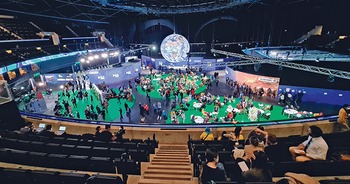

 Open access