


During the last quarter of the 20th century recreational use of cannabis increased greatly across the world. 1 Cannabis consumption came to be seen as a normal leisure activity, and was regarded as safe even by the medical establishment. 2 However, in recent years there has been considerable controversy over the use of cannabis, with, for example, the UK government repeatedly reviewing its safety. 3 This concern has arisen from large prospective epidemiological studies which have reported that use of cannabis increases the risk of schizophrenia-like psychosis. Reference Henquet, Murray, Linszen and van Os4,Reference Moore, Zammit, Lingford-Hughes, Barnes, Jones and Burke5 However, these studies have not collected detailed data on the patterns of use or potency of the cannabis used, which may be important factors moderating the associated risk. Reference Murray, Morrison, Henquet and Di Forti6
The principal constituents of cannabis are Δ9-tetrahydrocannabinol (Δ9-THC) and cannabidiol. The former is the main psychoactive ingredient and in experimental studies it produces transient psychotic symptoms and impaired memory in a dose-dependent manner. Reference Murray, Morrison, Henquet and Di Forti6,Reference D'Souza, Perry, MacDougall, Ammerman, Cooper and Wu7 In contrast, cannabidiol does not induce hallucinations or delusions, and it seems to antagonise the cognitive impairment and psychotogenic effects caused by Δ9-THC. Reference Murray, Morrison, Henquet and Di Forti6
Until the early 2000s the most freely available type of cannabis in the UK was cannabis resin (‘hash’), which had approximately 70% of the ‘street’ market, followed by traditional imported herbal cannabis and then sinsemilla (‘skunk’). Cannabis resin contains 2–4% Δ9-THC and a similar proportion of cannabidiol, whereas herbal cannabis contains a similar percentage of Δ9-THC but no cannabidiol. Reference Hardwick and King8,Reference Potter, Clark and Brown9 However, sinsemilla (skunk) has increasingly taken over the UK market and its THC concentration, and to a lesser extent that of imported herbal cannabis, has been consistently rising. For example, seizures of cannabis on the streets of England in 2008 by the police showed that sinsemilla had a market share of more than 70%, and had reached a Δ9-THC concentration of 12–18% with virtually no cannabidiol. Reference Hardwick and King8,Reference Potter, Clark and Brown9
Smith has suggested that such high-potency cannabis might be especially harmful to mental health. Reference Smith10 We therefore compared patterns and types of cannabis use in people experiencing their first episode of psychosis and in a healthy control sample. Specifically, we sought to test the hypothesis that daily use of high-potency cannabis is associated with a particularly high risk of psychosis.
Method
Sample
We approached all patients aged 18–65 years who presented with a first episode of psychosis to the Lambeth, Southwark and Croydon adult in-patient units of the South London & Maudsley Mental Health National Health Service (NHS) Foundation Trust between December 2005 and October 2008. We validated clinical diagnosis by administering the Schedules for Clinical Assessment in Neuropsychiatry (SCAN). 11 Patients who met ICD–10 criteria for a diagnosis of psychosis (codes F20–F29 and F30–F33) 12 were invited to participate in the study; cases with a diagnosis of organic psychosis were excluded. During the same period we recruited a healthy control group (n = 174) from the local population living in the area served by the Trust, by means of internet and newspaper advertisements, and distribution of leaflets at train stations, shops and job centres. Cannabis was not mentioned in these advertisements. Particular attention was directed to attempting to obtain a control sample similar to the patient sample in age, gender, ethnicity, educational qualifications and employment status. Those who agreed to participate were administered the Psychosis Screening Questionnaire, Reference Bebbington and Nayani13 and excluded if they met criteria for a psychotic disorder or reported a previous diagnosis of psychotic illness.
Ethical permission was obtained from the Trust and the Institute of Psychiatry research ethics committee. All study participants signed a consent form allowing publication of data originating from the study.
Assessment
We collected sociodemographic data (age, gender, self-rated ethnicity, level of education achieved and employment status) on both cases and controls. All participants were asked about their use of illicit drugs and those who reported ever using cannabis were interviewed using the Cannabis Experience Questionnaire. Reference Barkus, Stirling, Hopkins and Lewis14 This allows a detailed assessment of lifetime patterns of cannabis and stimulant use, including age at first use, frequency and duration of use, and the specific type of cannabis used.
Statistical analysis
Logistic regression was used to analyse the relationships between various aspects of cannabis use (lifetime use, age at first use, duration and frequency of use, and cannabis potency) and case–control status, and to test for interaction effects while controlling for potential confounders. Associations are expressed as odds ratios.
Results
We found 340 patients with first-episode psychosis who met our inclusion criteria. Of these patients 60 (17.6%) refused to participate, leaving 280 cases to be included in our analyses. Most common reasons for refusal included lack of interest in research and the length of our study assessment. If patients initially refused because they were too ill, we approached them again later in case their refusal was simply due to the severity of their symptoms. During the same period we recruited 174 individuals to the control group. There was no significant difference between the cases and control groups in age, gender, ethnicity, educational qualifications or employment status at time of assessment (Table 1).
Sample characteristics

| Cases (n = 280) | Controls (n = 174) | |
|---|---|---|
| Age, years: mean (s.d.) | 25 (6.9) | 27 (5.6) |
| Gender, n (%) | ||
| Male | 202 (72.0) | 113 (65.0) |
| Female | 78 (28.0) | 61 (35.0) |
| Ethnicity, n (%) | ||
| White | 118 (42.0) | 77 (44.5) |
| Black Caribbean | 60 (21.5) | 34 (19.2) |
| Black African | 62 (22.3) | 29 (16.8) |
| Other | 40 (14.2) | 34 (19.5) |
| Employment, n (%) | ||
| Unemployed | 164 (58.4) | 75 (43.2) |
| Employed | 116 (41.6) | 99 (56.8) |
| Education, n (%) | ||
| No qualification | 41 (14.6) | 19 (10.9) |
| Any qualification | 239 (85.4) | 155 (88.1) |
Lifetime cannabis use
More than half of the cases group (57%, n = 159) had used cannabis at least once in their life (Table 2), compared with 109 controls (63%) (OR = 0.8, 95% CI 0.6–1.5). Among those who had ever used cannabis, 65% (n = 183) of the cases group had first tried cannabis before the age of 17 years, compared with 52% (n = 91) of the control group (adjusted OR = 1.1, 95% CI 0.8–3.4).
Lifetime cannabis use

| Cases, n = 280 n (%) | Controls, n = 174 n (%) | Odds ratio (95% CI) | ||
|---|---|---|---|---|
| Unadjusted | Adjusteda | |||
| Ever used | ||||
| No | 121 (43.1) | 65 (37.5) | 1.0 | |
| Yes | 159 (56.9) | 109 (62.5) | 0.8 (0.6-1.5) | |
| Age at first useb | ||||
| Under 17 years | 103 (65.3) | 57 (52.2) | 1.7 (1.0-4.7)* | 1.1 (0.8-3.4) |
| 17 years and over | 56 (34.7) | 52 (47.8) | 1.0 | |
Patterns of cannabis use
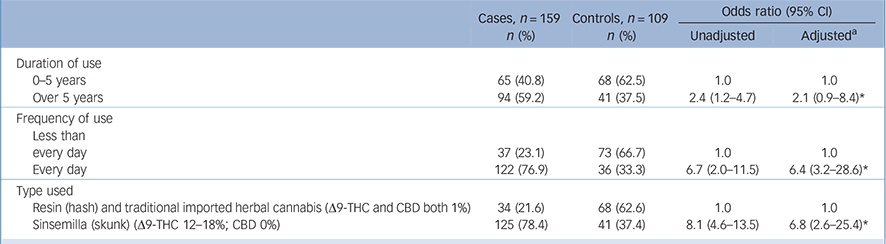
Among those who used cannabis, 59% (n = 94) of the cases group had used it for more than 5 years compared with 38% (n = 41) of controls (unadjusted OR = 2.4, 95% CI 1.2–4.7). When potential confounders (age, gender, ethnicity, level of education achieved and employment status) were adjusted for, this difference was attenuated slightly (adjusted OR = 2.1, 95% CI 0.9–8.4) and no longer reached statistical significance. However, those in the cases group were around six times more likely than the control group to use cannabis every day, even after adjusting for the above potential confounders (cases 77% v. controls 33%; unadjusted OR = 6.7, 95% CI 2.0–11.5, adjusted OR = 6.4, 95% CI 3.2–28.6).
Type of cannabis used
Again considering only those who used cannabis, 78% (n = 125) of the cases group preferentially used sinsemilla (skunk) compared with only 31% (n = 41) of the control group (unadjusted OR = 8.1, 95% CI 4.6–13.5). This association was only slightly attenuated after controlling for potential confounders (adjusted OR = 6.8, 95% CI 2.6–25.4).
Combined effects of frequency and type of cannabis use
There was some evidence of an interaction between frequency and type of cannabis use: among those who used cannabis, those who used sinsemilla (skunk) less frequently (not every day) were around 5 times more likely to be in the cases group (OR = 5.7, 95% CI 2.5–12.6), whereas those who used it daily were around 12 times more likely to be in the cases group (OR = 12.1, 95% CI 3.7–37.3; Mantel–Haenszel test for homogeneity of odds ratios: χ2 = 1.2, P = 0.5). The variation in odds ratios was non-significant, and we consequently did not fit an interaction term to our final logistic regression model. However, this lack of significance may be due to limited statistical power, and given that the difference is in the expected direction (i.e. highest odds in those who used sinsemilla/skunk daily), the finding remains noteworthy and certainly merits further investigation.
Discussion
Patients experiencing a first episode of psychosis were not more likely to have ever taken cannabis or to have started doing so earlier than the control group. This is not surprising because cannabis consumption is very common among adolescents in the UK: 40% of British children aged 15–16 years have used cannabis. 1 However, psychosis was associated with more frequent and longer use of cannabis. This confirms previous suggestions that the risks of both transient psychotic symptoms and schizophrenia in those who use cannabis are dose-related. Reference Murray, Morrison, Henquet and Di Forti6
Patterns of cannabis use
| Odds ratio (95% CI) | ||||
|---|---|---|---|---|
| Cases, n = 159 n (%) | Controls, n = 109 n (%) | Unadjusted | Adjusteda | |
| Duration of use | ||||
| 0-5 years | 65 (40.8) | 68 (62.5) | 1.0 | 1.0 |
| Over 5 years | 94 (59.2) | 41 (37.5) | 2.4 (1.2-4.7) | 2.1 (0.9-8.4)* |
| Frequency of use | ||||
| Less than | ||||
| every day | 37 (23.1) | 73 (66.7) | 1.0 | 1.0 |
| Every day | 122 (76.9) | 36 (33.3) | 6.7 (2.0-11.5) | 6.4 (3.2-28.6)* |
| Type used | ||||
| Resin (hash) and traditional imported herbal cannabis (Δ9-THC and CBD both 1%) | 34 (21.6) | 68 (62.6) | 1.0 | 1.0 |
| Sinsemilla (skunk) (Δ9-THC 12-18%; CBD 0%) | 125 (78.4) | 41 (37.4) | 8.1 (4.6-13.5) | 6.8 (2.6-25.4)* |
Our most striking finding is that patients with a first episode of psychosis preferentially used high-potency cannabis preparations of the sinsemilla (skunk) variety. In south-east London this form of cannabis is estimated to contain between 12% and 18% Δ9-THC and less than 1.5% cannabidiol. In contrast, those in the control group who used cannabis were more likely to consume resin (hash), with an average Δ9-THC concentration of 3.4% and a similar proportion of cannabidiol. Reference Potter, Clark and Brown9
It is not surprising that the higher concentration of Δ9-THC in sinsemilla (skunk) is more likely to have detrimental effects on mental health. An experimental study in normal humans of the acute effects of intravenous administration of Δ9-THC found that the resulting psychotic symptoms were dose-dependent. Reference D'Souza, Perry, MacDougall, Ammerman, Cooper and Wu7 Furthermore, a positron emission tomographic study has shown that inhalation of Δ9-THC acutely increases striatal dopamine, Reference Bossong, van Berckel, Boellaard, Zuurman, Schuit and Windhorst15 which is thought to underlie psychotic symptoms. Reference Kapur, Mizrahi and Li16
The relative lack of cannabidiol in sinsemilla (skunk) may also be relevant, as there is some evidence that cannabidiol has antipsychotic properties. Reference Leweke, Schneider, Radwan, Schmidt and Emrich17 Furthermore, Curran et al measured cannabinoid traces in the hair of three groups of normal volunteers, and found that those with Δ9-THC only had higher levels of schizophrenia-like symptoms than the ‘Δ9-THC plus cannabidiol’ and ‘no cannabinoid’ groups. Reference Morgan and Curran18
The availability of skunk on the UK market has steadily increased over the past 6 years. Reference Hardwick and King8 Our estimate of preferred type of cannabis used refers not to current use but lifetime use. In fact, we did ask our participants to indicate among a list of types of cannabis the one they preferentially smoked at any time during their period of use. Most of those in the cases group (65%) and control group (52%) had started using cannabis before age 17, on average 6 years ago, and had continued to use it for 5 years. Given that participants in the control group who used cannabis had been exposed to the same changes in the cannabis market as those from the cases group, the increased availability of skunk cannot alone explain why our control group members are less likely to prefer higher-potency types than the cases group across time.
Finally, our results suggest that the potency and frequency of cannabis use may interact in further increasing the risk of psychosis.
Limitations and strengths
Our findings need to be considered in the light of potential limitations. In theory, it is possible that our use of non-random strategies of control recruitment could have biased our findings. However, the cases and control groups were similar on a number of sociodemographic factors that are associated with cannabis use (e.g. education) and there was no evidence that our approach undersampled those who used cannabis. Indeed, the proportion of controls who had ever used cannabis (62%) was higher than the national average (47%) for similar age groups, 19 reflecting the fact that cannabis use is more common in south-east London than in the UK as a whole. Alternatively, if our sampling strategy resulted in oversampling those who used cannabis, this would have had the effect of reducing the strength of the associations we observed – that is, our findings would underestimate the effects of different patterns of cannabis use on the risk of schizophrenia.
Is it possible that our control recruitment strategy biased our sample towards one of mild cannabis users, excluding heavy users perhaps more likely to use skunk? Our advertising strategy included internet and local newspapers advertisements as well as distribution of leaflets at local shops, job centres and community centres. There is no evidence that such methods of advertising are more likely to bias towards better-functioning and socially adjusted individuals; indeed, the opposite might be the case. It therefore seems unlikely that the striking difference in type of cannabis used between the cases and control groups is driven by a recruitment bias. Moreover, there was no reported evidence of skunk dependence in the clinical record of cases recruited.
We cannot totally exclude the possibility that patients in a prodromal phase might need higher concentrations of Δ9-THC. However, a recent population study has shown that cannabis use in adolescence is associated with a twofold increase in prodromal symptoms even when controlling for several confounders, including behavioural symptoms. Reference Miettunen, Tormanen, Murray, Jones, Maki and Ebeling20 We also know from experimental studies that Δ9-THC is the active ingredient in inducing psychotic symptoms and that cannabidiol produces beneficial effects, including possible amelioration of psychotic symptoms and reduced anxiety. Reference D'Souza, Perry, MacDougall, Ammerman, Cooper and Wu7,Reference Leweke, Schneider, Radwan, Schmidt and Emrich17 Therefore, it remains unclear why those already experiencing prodomal and/or psychotic symptoms should choose to use a cannabis type (sinsemilla) with high levels of Δ9-THC which is likely to exacerbate their symptoms, rather than one that contains as much cannabidiol as Δ9-THC (resin).
Finally, we did not have a biological measure of the type of cannabis used, such as urine, blood or hair samples. These methods allow one to test only for recent use, and would not have helped to confirm the type of cannabis used over past years. Moreover, participants in our first-episode psychosis group were in-patients at time of recruitment, and such biological tests could have produced false results for those tested more than 4 weeks after admission to hospital. A biological measure would therefore not have helped to enhance our findings.
Study implications
It is generally accepted that drinking a glass of light wine every day is less likely to be associated with serious health consequences than drinking a daily bottle of whisky or vodka. Unfortunately, previous studies of the association between cannabis use and psychosis have not collected detailed information on the patterns of use, or potency, of the cannabis smoked. Our findings are the first to suggest that the risk of psychosis is much greater among people who are frequent cannabis users, and among those using sinsemilla (skunk) rather than occasional users of traditional hash. It is not surprising that those who use skunk daily seem to be the group with the highest risk of all.
Unfortunately, sinsemilla (skunk) is displacing traditional cannabis preparations in many countries. Public education about the risks of heavy use of high-potency cannabis is vital.
Funding
The study was funded by the Maudsley Charitable Fund and a UK National Institute of Health Research Biomedical Research Centre grant (BRC–SLAM).
Acknowledgements
The authors gratefully acknowledge the help of the Genetic and Psychosis study team, South London & Maudsley Mental Health NHS Trust, Dr Paddy Power, consultant psychiatrist, Lambeth Early Onset Psychosis team, the UK National Institute of Health Research Biomedical Research Centre and the Institute of Psychiatry, King's College London.




eLetters
No eLetters have been published for this article.