


Although Salmonella enterica serovar Typhimurium (S. Typhimurium) is the second most common serovar identified in human cases in England and Wales, with 1850 infections reported in 2009, only 3·6% (n=66) were definitive phage type 8 (DT8). Salmonella Typhimurium is widely distributed in food-producing animals [1] but only a small number of foodborne outbreaks of S. Typhimurium DT8 (0·1%, 3/2521) have been reported in England and Wales from 1992 to 2009. These were linked to consumption of undercooked duck and chicken meat (Health Protection Agency, unpublished data).
Routine surveillance of Salmonella in England, Wales and Northern Ireland is based on laboratory reporting. Laboratories refer strains of Salmonella for confirmation and subtyping to the Salmonella Reference Unit (SRU) in the Health Protection Agency (HPA) Laboratory of Gastrointestinal Pathogens. In July 2010, SRU identified an increase in reports of pan-susceptible S. Typhimurium DT8 in England and Northern Ireland. Cases were distributed throughout England but were concentrated in the South East and North West. No cases were associated with travel. Preceding this, a nationwide outbreak of pan-susceptible S. Typhimurium DT8 had been reported in Ireland in May 2010 [Reference Garvey2]. The descriptive epidemiological investigation in Ireland demonstrated a link with duck eggs, with all seven cases reporting consumption or contact with duck eggs. An outbreak investigation was started by the HPA Department of Gastrointestinal, Emerging and Zoonotic Infections (GEZI) in July 2010 with the aim of describing the outbreak and identifying a common food exposure in order to guide control measures.
In the descriptive epidemiological investigation, a case was defined as any person resident in England or Northern Ireland from whom a pan-susceptible S. Typhimurium DT8 had been isolated since 5 July 2010. Local public health practitioners based in HPA Health Protection Units or Local Authority Environmental Health Departments had already investigated some of the cases as sporadic food poisoning; case-records of their investigations were also reviewed. Further cases were investigated by GEZI to ascertain their demographic information and a wide range of potential exposures, including food and travel history, to elucidate the possible exposures of the cases.
Pooled samples of six eggs were examined for Salmonella as described previously [Reference Little3, Reference Little4]. Salmonella isolates were serotyped, phage-typed and screened for antimicrobial resistance by SRU as described previously [Reference Little3, Reference Little4]. Pulsed-field gel electrophoresis (PFGE) and variable number tandem repeat (VNTR) fragment analysis were also performed [Reference Gatto5, Reference Larsson6].
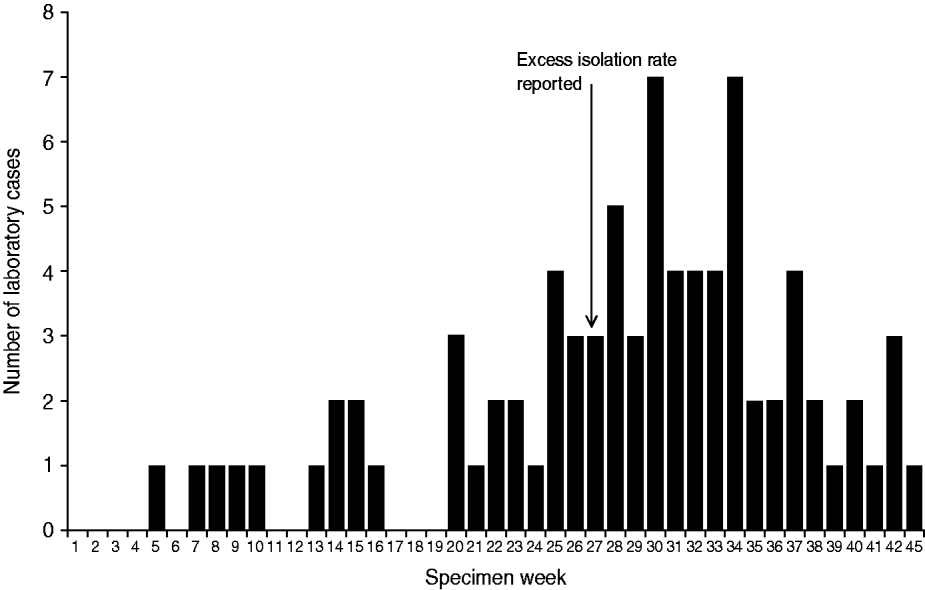
Between 5 July and 31 October 2010, 54 human isolates of pan-susceptible S. Typhimurium DT8 were confirmed by SRU, 83% (45) and 17% (9) were identified from England and Northern Ireland, respectively. No cases were identified from Wales or Scotland. Figure 1 shows the number of laboratory-confirmed cases of S. Typhimurium DT8 by week of confirmation by SRU. For 2010, this amounted to 81 confirmed human cases for all regions of England and Northern Ireland by the end of October, an increase of 26% (60) and 41% (48) on 2009 and 2008, respectively. Sixty-one per cent (50/81) of cases were male. Ages ranged from <1 to 80 years (median 47, inter-quartile range 33–61 years). Five of the cases were hospitalized and one death was reported.
Number of laboratory-confirmed cases of pan-susceptible Salmonella Typhimurium DT8 by week of isolation. England and Northern Ireland, January–October 2010 (n=81).
Of 31 cases contacted and consenting to be interviewed after July, 16 (51%) ate duck eggs with a further three reporting eating duck meat or duck liver pâté. Eleven of the cases recalled purchasing duck eggs from local small retailers (4), farm shops (4), market places (2) and from a national supermarket chain (1). A further two cases consumed duck eggs at restaurants. There is no legislation requiring the marking of duck eggshells with ‘use by’ dates and origin, as there is for hen eggs [7]. Thus rapid traceback down the supply chain was more difficult and, as a result, a direct linkage of individual cases in certain instances to the duck-egg production premises could not be made. However, duck eggs consumed by five S. Typhimurium DT8 cases could be linked with several layer duck premises and the breeding flock supplying the commercial stock on these premises. Furthermore, S. Typhimurium DT8 was detected in both shells and contents from seven pooled eggs collected from a patient's home as well as three pooled samples collected from two farms [two (10%) of 20 pooled samples of six eggs, one (8·3%) of 12 pooled samples of 10 eggs] linked back via supply of eggs to cases. Additionally S. Enteritidis PT9b was detected in duck eggs [one (5·0%) of 20 pooled samples of six eggs] from another farm linked to supply of eggs to another case. While it is recognized that the number of eggs tested in this investigation is relatively small, the Salmonella contamination rate of duck eggs found in this investigation is significantly higher than that found in UK-produced hen eggs (0·3%) (P<0·0001) [Reference Little3].
Targeted disease control measures were taken at the duck producers by the Department for Environment, Food and Rural Affairs that included inspection and provision of advice on effective disease control measures, voluntary movement restrictions and enhanced cleansing and disinfection. The Food Standards Agency issued advice to consumers and caterers of the importance of good hygiene practice when cooking with and consuming duck eggs in order to reduce the risk of infection [8].
By utilizing molecular microbiological techniques, the same strain of S. Typhimurium DT8, characterized by VNTR and PFGE, was identified in human isolates and in duck eggs. PFGE analysis of selected strains including human isolates, isolates from duck eggs and from voluntary surveillance of embryonic mortalities in a UK breeding flock were indistinguishable from each other (designated profile STXMXB.0217). Isolates from patients in England and Northern Ireland were also compared to those in Ireland, who had reported a resurgence of cases of S. Typhimurium DT8 in August, again associated with duck eggs [Reference McKeown9]. VNTR fragment analysis indicated that they were indistinguishable (designated profile 2-10-NA-12-212) and supported the PFGE results.
S. Typhimurium DT8 has been associated with farmed ducks in the UK for many years, accounting for ~50% of all S. Typhimurium incidents in ducks (an incident is defined as a report of the same serovar or phage type from a holding within a 30-day period). Serovars other than S. Typhimurium have also become predominant in recent years [10]. Ducks are often housed in earth-floored, straw-bedded, naturally ventilated buildings with access to open water troughs or to outdoor range areas. This, plus the naturally moist nature of duck faeces and moisture levels in bedding may be conducive to the survival and spread of Salmonella to the outside of the egg if it is present in the flock. Surface contamination can be drawn into the egg as it cools, particularly if the protective cuticle is damaged or the surface of the egg is not dry [Reference Schwarz and Neurand11]. The cuticle is sometimes removed from hatching eggs or table eggs during a chemical washing stage to enhance hatchability of eggs or to make table eggs look cleaner [Reference Deeming12], but if the hatching equipment is contaminated this may increase the risk of infection of day-old ducklings [Reference Tenk, Kostyak and Matray13].
The tendency of ducks to be housed on multi-age sites, sometimes with different age groups within one building, also makes control of Salmonella more difficult since there is no time when the whole site is empty and available for effective decontamination and pest control. Duck breeding at elite/pedigree, grandparent and parent level is often integrated within a single company, so if Salmonella is present in breeding stock within that company it may be perpetuated, since future breeding birds are selected from the progeny of existing breeding stock, rather than buying in replacements from a specialist Salmonella-free primary breeding company, as is usual with replacement chicken parent flocks. Biosecurity, farm hygiene management and vaccination are the main means of control, but all of these can be more difficult to successfully apply in the absence of all-in/all-out production.
European legislation provides a framework for harmonized risk management of zoonotic agents at primary production and requires the implementation of Salmonella National Control Programmes in specific industry sectors in all Member States [14]. The overall aim of this legislation is to reduce the level of Salmonella infection of public health significance at primary production and in turn reduce the level of human infection caused by Salmonella across the EU. Currently the specified sectors, considered of the highest priority in terms of the impact on public health, include the chicken, turkey and pig sectors. There is, however, no statutory requirement for the control of Salmonella in ducks.
Although there has been a long-term association of ducks with Salmonella, this is the first reported outbreak of salmonellosis linked to consumption of duck eggs since the current surveillance system for general outbreaks of gastrointestinal infection in the UK began in 1992. The last known outbreak in the UK occurred in 1949 [Reference Garrod and McIlroy15]. Consumption of duck eggs in the UK plummeted in the 1950s when large-scale hen egg production methods took control of the market. However, promotion on use of duck eggs in recent years has seen sales significantly increase. Outbreaks like the one described may therefore occur again and highlight the impact of changing food sources and/or markets on the emergence/re-emergence of food pathogens such as Salmonella from a relatively more highly contaminated foodstuff and the subsequent public health threat. The commercial hen egg sector, unlike the duck sector, has had industry assurance schemes in place and has used vaccination of layer hen flocks against Salmonella for over a decade [Reference Little3]. To improve public health, i.e. by reducing the number of infections from eggborne Salmonella, the duck industry is planning to implement a similar assurance scheme, including mandatory vaccination of flocks.
ACKNOWLEDGEMENTS
The authors gratefully acknowledge the contribution of colleagues from the Salmonella Reference Unit, local Health Protection Units, Environmental Health Departments, Public Health Agency, Northern Ireland, and the Food Standards Agency who helped with this investigation. We also thank Patricia Garvey and Paul McKeown from the Health Protection Surveillance Centre, Ireland for information they provided on the concurrent outbreak investigation in Ireland.
DECLARATION OF INTEREST
None.



