


Introduction
Illite is a type of 2:1 layer phyllosilicate mineral that is structurally and compositionally similar to muscovite except that it contains more Si, Mg, and H2O but less Al and K (Reference Grim, Bray and BradleyGrim et al., 1937; Reference Guggenheim, Adams, Bain, Bergaya, Brigatti, Drits, Formoso, Galán, Kogure and StanjekGuggenheim et al., 2006, Reference Guggenheim, Adams, Bain, Bergaya, Brigatti, Drits, Formoso, Galán, Kogure and Stanjek2007; Reference Moore and ReynoldsMoore & Reynolds, 1997; Reference Rieder, Cavazzini, D’yakonov, Frank-Kamenetskii, Gottardi, Guggenheim, Koval’, Müller, Neiva, Radoslovich, Robert, Sassi, Takeda, Weiss and WonesRieder et al., 1998). Illite may be a discrete phase or it may exist in the form of an interstratified phase such as illite-smectite (I-S), where the latter may contain variable abundances of topotactically stacked illite and smectite layers. Smectite can be transformed into I-S, where smectite is dehydrated, octahedral Al3+ substitutes for some of the Si4+ in the tetrahedral sheet, Fe2+ and Mg2+ replace some of the Al3+ originally in the octahedral sheet, and anhydrous K+ is preferentially fixed in the interlayer space over other exchangeable cations (Reference Boles and FranksBoles & Franks, 1979; Reference Hower, Eslinger, Hower and PerryHower et al., 1976). Beginning with studies in the USA Gulf Coast, smectite illitization was thought to occur predominantly due to increased temperatures, high water:rock ratios, abundant aqueous K, and time associated with burial diagenesis (Reference Boles and FranksBoles & Franks, 1979; Reference Hower, Eslinger, Hower and PerryHower et al., 1976; Reference McCarty, Sakharov and DritsMcCarty et al., 2008; Reference Perry and HowerPerry & Hower, 1970; Reference ŚrodońŚrodoń, 1999b). On the other hand, smectite illitization may also be advanced under low-temperature surface conditions with cyclical wetting and drying (Reference Eberl, Środoń, Northrop, Davis and HayesEberl et al., 1986). It may also occur during iron redox cycling (Reference Shen, Stucki, Havlin, Jacobsen, Leikam, Fixen and HergertShen & Stucki, 1994), when structural iron is reduced chemically (Reference Eslinger, Highsmith, Albers and deMayoEslinger et al., 1979) or biologically (Reference Dong, Jaisi, Kim and ZhangDong et al., 2009). Lastly, I-S and illite may be detrital components of a clastic sedimentary rock (Reference EberlEberl, 1984). Because no singular process produces I-S, methods beyond mineralogical characterization must be considered to ascertain the origins of I-S and illite in sedimentary rocks.
Phyllosilicate formation in soils occurs on the earth’s surface under the influence of water-dominated weathering systems, such that the geochemical compositions of rocks interpreted to be fossilized soils, hereinafter referred to as paleosols, can be used to reconstruct ancient environments and climates (e.g. Reference Savin and HsiehSavin & Hsieh, 1998; Reference Sheldon and TaborSheldon & Tabor, 2009; Reference Tabor and MyersTabor & Myers, 2015). To be used as terrestrial paleoclimate proxies, phyllosilicates must have formed during episodes of pedogenesis in the past. There are two alternatives for the origins of phyllosilicates in paleosols: (1) inheritance as detritus before and/or during soil formation; and (2) formation during diagenetic or hydrothermal processes after soil formation (Reference CurtisCurtis, 1985; Reference EberlEberl, 1984; Reference Nesbitt, Martini and ChesworthNesbitt, 1992). Thus, if the geochemical and mineralogical signatures from phyllosilicates in paleosols are not characterized extensively, then geochemical effects spurred by sedimentary basin subsidence or uplift and/or hydrothermal alteration may be interpreted erroneously as signatures of ancient climate conditions.
The measurement of K and radiogenic 40Ar are useful means of dating crystallization of muscovite, illite, and I-S (Reference Bailey, Hurley, Fairbairn and PinsonBailey et al., 1962; Reference ClauerClauer, 2013). When detrital illite, or 2M 1 muscovite, is present in the clay fraction, the K-Ar age of authigenic illitic material cannot be obtained directly. The measured amounts of the polytypes may be used to estimate the relative amounts of detrital and authigenic material in different size fractions, allowing age estimates for the two components to be derived from K-Ar age values of those fractions (Reference Elliott, Basu, Wampler, Elmore and GrathoffElliott et al., 2006; Reference Grathoff and MooreGrathoff & Moore, 1996; Reference Grathoff, Moore, Hay and WemmerGrathoff et al., 2001; Reference PevearPevear, 1999; Reference Środoń, Clauer and EberlŚrodoń et al., 2002). K-Ar age values of multiple size fractions of paleosol matrices are a function of the distribution of detrital (older than the paleosol), pedogenic, and diagenetic (younger than the paleosol) minerals. As a singular paleosol is probably a mixture of detrital, pedogenic, and/or diagenetic minerals, the K-Ar age value is not indicative of a specific event at that calculated time. Such a value reflects the ratio of the total radiogenic Ar to total K in a mixture, which may not be equal to the ratio of radiogenic Ar to K of any mineral component of the mixture. Much like K-Ar age values from clastic sedimentary rocks that have been diagenetically influenced (e.g. Reference Bechtel, Elliott, Wampler and OszczepalskiBechtel et al., 1999; Reference Elliott, Basu, Wampler, Elmore and GrathoffElliott et al., 2006; Reference Grathoff and MooreGrathoff & Moore, 1996), K-Ar age values from paleosols should be viewed as averages, approximately (Reference ŚrodońŚrodoń, 1999a), of the ages of diagenetic, pedogenic, and detrital minerals. The K-Ar technique has been used in studies of illite in paleosols, used more to discover information about the diagenetic history than for paleoclimate purposes (Reference Lander, Bloch, Mehta and AtkinsonLander et al., 1991; Reference Mora, Sheldon, Elliott and DrieseMora et al., 1998).
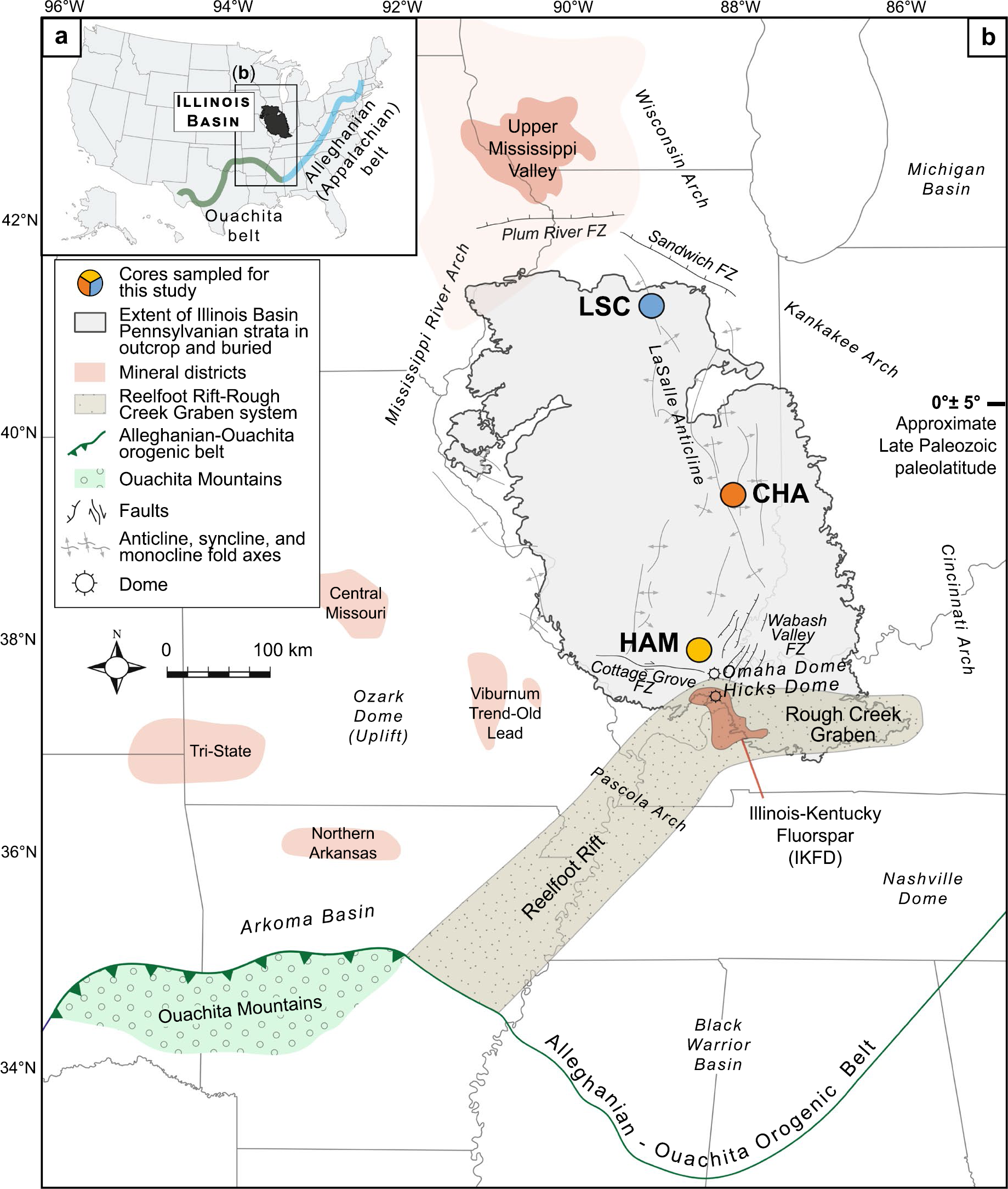
The Illinois Basin (IB) is a tectonically stable cratonic basin which originated through rifting of the early Paleozoic Reelfoot rift system (Fig. 1; Reference Buschbach, Kolata, Leighton, Kolata, Oltz and EidelBuschbach & Kolata, 1990; Reference Kolata, Nelson, Leighton, Kolata, Oltz and EidelKolata & Nelson, 1990a,Reference Kolata, Nelson, Leighton, Kolata, Oltz and Eidelb). The IB contains a thick stratigraphic sequence of Carboniferous cyclothems the strata of which include marine units of shale and limestone, followed by non-marine units of quartz-rich sandstones, shale, limestone, coal, and underclays (Reference FieldingFielding, 2021; Reference WanlessWanless, 1931; Reference WellerWeller, 1930, Reference Weller1931; Reference Willman, Atherton, Buschbach, Collinson, Frye, Hopkins, Lineback and SimonWillman et al., 1975). Cyclothems are interpreted to have formed from cycles of transgression and regression triggered by glacio-eustatic fluctuations (Reference Cecil, DiMichele and ElrickCecil et al., 2014; Reference Crowell and FrakesCrowell & Frakes, 1970; Reference HeckelHeckel, 1994, Reference Heckel2008; Reference MontañezMontañez, 2022; Reference Veevers and PowellVeevers & Powell, 1987; Reference Wanless and ShepardWanless & Shepard, 1936). IB coals have been used for understanding ancient flora and thus reconstructions of Pennsylvanian paleoenvironments (e.g. Reference DiMichele and PhillipsDiMichele & Phillips, 1996; Reference DiMichele, Tabor, Chaney, Nelson, Greb and DiMicheleDiMichele et al., 2006; Reference Phillips, Peppers, Avcin and LaughnanPhillips et al., 1974). More important to the present work, these coal beds are frequently underlain by an underclay. Due to the IB underclay’s hackly and argillaceous matrices, lack of bedding, common rooting structures, and morphologic structure and horizonization akin to modern soils, these underclays have been interpreted as paleosols (Reference Grim and AllenGrim & Allen, 1938; Reference McIntosh, Tabor and RosenauMcIntosh et al., 2021; Reference Rosenau, Tabor, Elrick and NelsonRosenau et al., 2013a, Reference Rosenau, Tabor, Elrick and Nelsonb; Reference SchultzSchultz, 1958).
Map of the Illinois Basin: a inset map of the Illinois Basin located in the midcontinent region of North America; the Alleghenian-Ouachita orogenies are noted in blue and green, respectively. b The extent of Pennsylvanian strata (both exposed in outcrop and buried) in the Illinois Basin (Reference Rosenau, Tabor, Elrick and NelsonRosenau et al., 2013a), surrounding arches and domes, a series of faults, fault zones (F.Z.), and minor folds (Nelson, 1995), and the Reelfoot Rift–Rough Creek Graben (Reference Kolata, Nelson, Leighton, Kolata, Oltz and EidelKolata & Nelson, 1990a) are shown. Mining or mineral districts of economic significance are shown in light red (Reference Denny, Goldstein, Devera, Williams, Lasemi and NelsonDenny et al., 2008; Reference Rowan and de MarsilyRowan & de Marsily, 2001). The cores sampled in the present study are the Lone Star Cement Company #TH-1 (LSC), the Illinois State Geological Survey #1 City of Charleston (CHA), and the American Coal Company Borehole 7510-20 (HAM). Paleolatitude information from Reference Domeier, Van der Voo and TorsvikDomeier et al. (2012)

Paleosols in Pennsylvanian strata of the IB have been identified as Vertisols, Calcisols, and Protosols with gleyed and/or calcic modifiers (Reference Rosenau, Tabor, Elrick and NelsonRosenau et al., 2013a), using the Reference Mack, James and MongerMack et al. (1993) paleosol classification system. The characteristic clay-sized fraction of IB paleosols include the minerals I-S, illite, kaolinite, and chlorite (Reference Elsass, Środoń and RobertElsass et al., 1997; Reference Grim and AllenGrim & Allen, 1938; Reference Huddle and PattersonHuddle & Patterson, 1961; Reference McIntosh, Tabor and RosenauMcIntosh et al., 2021; Reference ParhamParham, 1963; Reference Rimmer and EberlRimmer & Eberl, 1982; Reference Rosenau, Tabor, Elrick and NelsonRosenau et al., 2013a; Reference SchultzSchultz, 1958). These paleosols contain evidence of pedogenic minerals (Reference Hughes, De Maris, White, Cowin, Schultz, van Olphen and MumptonHughes et al., 1985; Reference Grim and AllenGrim & Allen, 1938; Reference ParhamParham, 1963; Reference Rosenau and TaborRosenau & Tabor, 2013; Reference Rosenau, Tabor, Elrick and NelsonRosenau et al., 2013a,Reference Rosenau, Tabor, Elrick and Nelsonb; Reference SchultzSchultz, 1958; Reference WellerWeller, 1930; Reference WorthenWorthen, 1866), that should be syn-formational with the paleosols and thus Middle–Late Pennsylvanian in age (315–299 Ma; Reference Cohen, Finney, Gibbard and FanCohen et al., 2013; Reference Davydov, Crowley, Schmitz and PoletaevDavydov et al., 2010; Reference HeckelHeckel, 2008; Reference Schmitz and DavydovSchmitz & Davydov, 2012). IB paleosols also contain evidence for detrital minerals (Reference Hughes, De Maris, White, Cowin, Schultz, van Olphen and MumptonHughes et al., 1985; Reference McIntosh, Tabor and RosenauMcIntosh et al., 2021; Reference O’BrienO’Brien, 1964; Reference ParhamParham, 1963), that may be from the Grenville (980–1300 Ma) and Appalachian (490–350 Ma) basement terranes (Reference Kissock, Finzel, Malone and CraddockKissock et al., 2018; Reference Thomas, Gehrels, Sundell, Greb, Finzel, Clark, Malone, Hampton and RomeroThomas et al., 2020) and possibly from reworked sediments of the Mississippian–Lower Pennsylvanian strata (359–315 Ma; Reference Kissock, Finzel, Malone and CraddockKissock et al., 2018; Reference Lawton, Blakey, Stockli and LiuLawton et al., 2021; Reference PotterPotter, 1963; Reference Potter and GlassPotter & Glass, 1958; Reference Potter and PryorPotter & Pryor, 1961; Reference Thomas, Gehrels, Sundell, Greb, Finzel, Clark, Malone, Hampton and RomeroThomas et al., 2020; Reference Willman, Atherton, Buschbach, Collinson, Frye, Hopkins, Lineback and SimonWillman et al., 1975). Evidence of diagenesis in other Pennsylvanian units of the IB includes vitrinite reflectance of Pennsylvanian coal organic matter (Reference Altschaeffl and HarrisonAltschaeffl & Harrison, 1959; Reference BarrowsBarrows, 1985; Reference Cluff, Byrnes, Leighton, Kolata, Oltz and EidelCluff & Byrnes, 1990; Reference DambergerDamberger, 1971; Reference Gharrabi and VeldeGharrabi & Velde, 1995; Reference Schimmelmann, Mastalerz, Gao, Sauer and TopalovSchimmelmann et al., 2009), hydrothermal minerals in some Pennsylvanian coals (Reference CobbCobb, 1981; Reference Whelan, Cobb and RyeWhelan et al., 1988), crystallization temperatures for some paleosol phyllosilicates that are too high to be Pennsylvanian paleotemperatures (Reference Rosenau and TaborRosenau & Tabor, 2013), and highly illitic I-S in some Pennsylvanian paleosols (Reference Elsass, Środoń and RobertElsass et al., 1997; Reference McIntosh, Tabor and RosenauMcIntosh et al., 2021; Reference Rimmer and EberlRimmer & Eberl, 1982) and clastic rocks (Reference MooreMoore, 2000, Reference Moore2003). These studies are often spatially and stratigraphically finite and thus the influence of diagenetic alteration across the IB remains unclear.
The diagenetic alteration products in Pennsylvanian rocks of the IB may be attributed to basin-wide changes following the Pennsylvanian. During the formation and breakup of Pangea from late in the Permian until the Jurassic, tectonic activity in Laurentia led to reactivated faulting and rifting (Reference Kolata, Nelson, Leighton, Kolata, Oltz and EidelKolata & Nelson, 1990a). High vitrinite reflectance values from the Pennsylvanian coals and fluid inclusions from sphalerites in these coals have led to an estimated maximum burial depth of the IB by 1–3 km of sediment in and after the Permian that was later uplifted and eroded (Reference CobbCobb, 1981; Reference DambergerDamberger, 1971). Lamprophyric, or ultrapotassic, igneous intrusions in the Illinois Kentucky Fluorspar District (IKFD; Fig. 1) are thought to have formed from alkaline ultramafic magma sourced from the lower crust (Reference Bradbury and BaxterBradbury & Baxter, 1992; Reference Kolata, Nelson, Leighton, Kolata, Oltz and EidelKolata & Nelson, 1990a) or upper mantle (Reference Fifarek, Denny, Snee and MigginsFifarek et al., 2001). Geochronologic data of minerals from these intrusions in the IKFD indicate crystallization of igneous minerals in the Middle Permian (~270 Ma; Reference DennyDenny, 2005; Reference Fifarek, Denny, Snee and MigginsFifarek et al., 2001; Reference Reynolds, Goldhaber and SneeReynolds et al., 1997; Reference Snee, Hays, Goldhaber and EidelSnee & Hays, 1992). Moreover, there is later evidence for hydrothermal fluid migration events in the IB following the Permian magmatism, and hypothesized mixing between magmatic fluids and basin brines (Reference Plumlee, Goldhaber and RowanPlumlee et al., 1995), that may have triggered critical mineral formation and mineral alteration in the IKFD in the Permian (Reference Chesley, Halliday, Kyser and SpryChesley et al., 1994; Reference Lu, Marshak and KentLu et al., 1990) and possibly the Jurassic (Reference Brannon, Leach, Goldhaber, Taylor and LivingstoneBrannon et al., 1997; Reference Ruiz, Richardson and PatchettRuiz et al., 1988; Reference SymonsSymons, 1994).
The aim of the present investigation was to identify the K-bearing minerals, mica polytypes, and K-Ar age values of clay-size fractions of IB paleosols sampled from three cores of middle and upper Pennsylvanian strata. This study builds upon the findings of Reference McIntosh, Tabor and RosenauMcIntosh et al. (2021) by providing insights into the different generations of minerals in IB paleosols in order to assess the influence of non-pedogenically formed minerals on the bulk geochemistry of paleosol matrices. This work highlights the necessity of performing a comprehensive geochemical characterization of phyllosilicates from deep time paleosols combined with an examination of the sedimentary basin’s history prior to utilizing paleosol minerals for reconstructions of ancient climates and environments.
Materials and Methods
Sampling Core
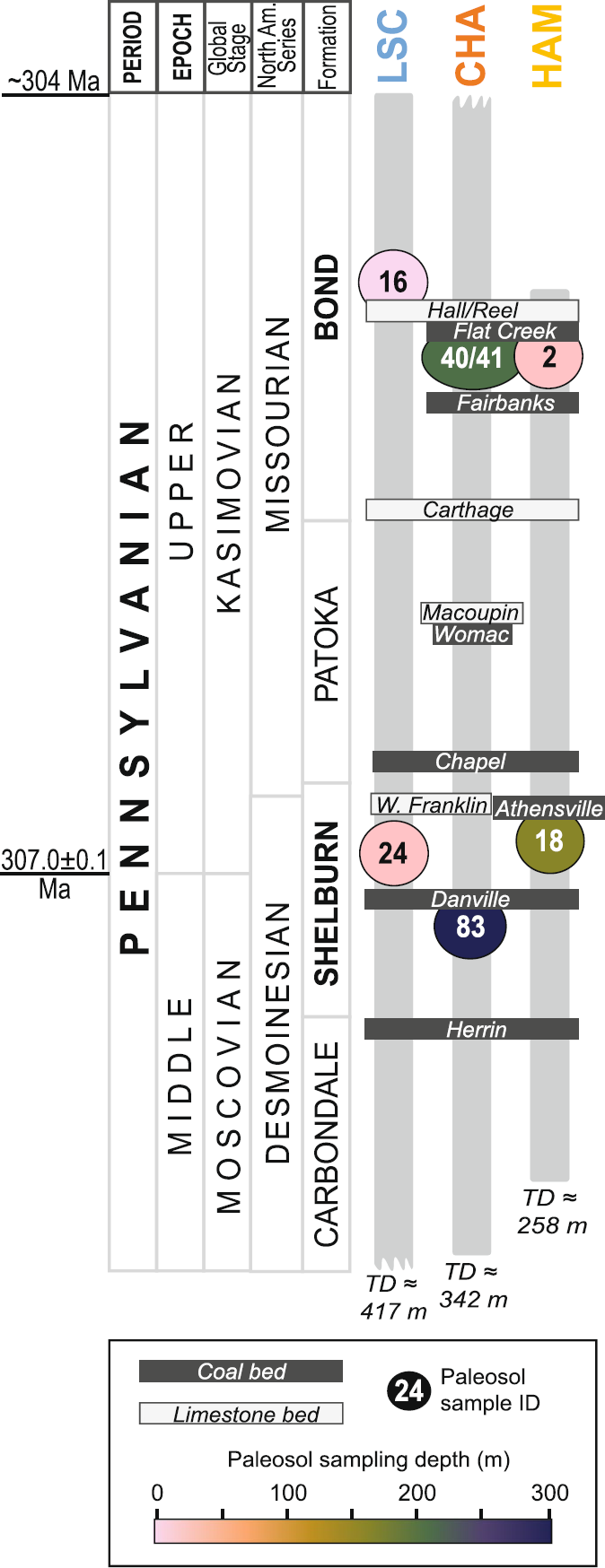
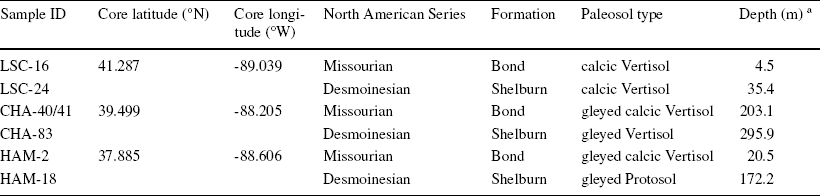
Paleosol samples from strata near the Desmoinesian–Missourian (North American Series) boundary were collected from cores stored at the Illinois State Geological Survey Core Repository in Champaign, Illinois, USA. Three cores examined for this study are the Lone Star Cement Company #TH-1 (LSC), the Illinois State Geological Survey #1 City of Charleston (CHA), and the American Coal Company Borehole 7510-20 (HAM; Figs 1, 2; Table 1). One paleosol from each core was collected from the middle and upper Pennsylvanian (Desmoinesian) Shelburn Formation, near the Danville coal, Athensville coal, and Exline and West Franklin limestone members (Fig. 2). Also, one paleosol was collected from each core from the upper Pennsylvanian (Missourian) Bond Formation, near the Fairbanks coal, the Flat Creek coal, and the Reel and Hall limestone members (Fig. 2). Paleosols were retrieved from depths from 4.5 to 295.6 m (Table 1). Paleosols were separated into horizons, described using established criteria (Reference Retallack, Reinhardt and SigleoRetallack, 1988; Reference Tabor, Myers, Michel, Zeigler and ParkerTabor et al., 2017), and classified into one of nine orders (Reference Mack, James and MongerMack et al. 1993). The samples were collected from paleosols identified by Reference Rosenau, Tabor, Elrick and NelsonRosenau et al. (2013a) and Reference McIntoshMcIntosh (2018) as having calcic, vertic, and gleyed features, where five are Vertisols and one is a gleyed Protosol (Table 1). Approximately 50 g of the classified paleosols were sampled for mineralogical and geochemical characterization.
Pennsylvanian stratigraphy of the Illinois Basin and points of sampling. Sample numbers for each core are denoted in ovals that are color coded to represent sampling depth. Important reference coals and limestones are noted. Numerical ages are from Reference Cohen, Finney, Gibbard and FanCohen et al. (2013). TD = total depth. See Fig. 1 and Table 1 for more information on sample identifiers

Sample details

aDepth of sample from the surface
Laboratory Preparation
Each paleosol was partially disaggregated by lightly crushing in a mortar and pestle, suspending in deionized water, and further disaggregated using an ultrasonic agitation bath. Each of the six crushed paleosols was treated to remove non-clay cementing minerals from the mixture. The removal of cements was achieved by treatment with: (1) 10% acetic acid to remove calcite; (2) sodium citrate-bicarbonate-dithionite solution to remove secondary iron (oxyhydr)oxides; and (3) 30% H2O2 solution to remove organic matter (Reference JacksonJackson, 2005; Reference Sheppard and GilgSheppard & Gilg, 1996). Using centrifugation, the <2.0, <0.2, and <0.1 μm equivalent spherical diameter clay-size fractions were isolated from each treated paleosol sample (Reference JacksonJackson, 2005) for a total of 18 subsamples. Each fraction was then divided into two portions for mineralogical and K-Ar geochronological analyses. All chemicals used for pretreatment were purchased from the supplier VWR (Radnor, Pennsylvania, USA).
Mineral Characterization using XRD
For each of the three size fractions prepared from each sample, the first portion was allocated to X-ray diffraction (XRD) analysis by preparing: (1) oriented smear slides; and (2) standard powder mounts. Oriented slides were prepared by adding suspended clay fractions to filter membranes (Reference Kinter and DiamondKinter & Diamond, 1956); then the clay fractions were transferred to glass slides. Standard powder mounts were prepared by drying the suspended sample at 25°C, sieving the sample into a sample holder to distribute the powder randomly, and using a glass slide to pack the sample (or flatten the upper surface). All XRD analyses were performed using an Ultima III X-ray Diffractometer (Rigaku, Tokyo, Japan) at Southern Methodist University, using Cu-Kα radiation. Operating conditions included a tube voltage of 40 kV, a tube current of 44 mA, a divergence slit of 2/3°, a receiving slit of 2/3°, and a fixed sample holder.
Three sets of oriented aggregates were prepared by: (1) air drying, (2) ethylene glycol solvation in a bell jar overnight at 60°C; and (3) heating to 500°C for 2 h. Oriented-aggregate slides were scanned over a range of 2 to 30°2θ with a step size of 0.01°2θ and a 1 s count time per step. The standard powder mounts were first heated to 550°C to prevent kaolinite from interfering in the mica diffraction patterns, specifically with the band at ~2.558 Å (Reference Brindley and BrownBrindley, 1961), and then scanned over a range of 16 to 38°2θ with a step size of 0.025°2θ and a 30 s count time per step (similar to methods in Reference Elliott, Basu, Wampler, Elmore and GrathoffElliott et al., 2006; Reference Grathoff and MooreGrathoff & Moore, 1996). Though mineralogy is generally interpreted from XRD scans between 2 and 70°2θ, we instead acknowledge the work of previous mineral characterizations of IB paleosols (e.g. Reference Rosenau, Tabor, Elrick and NelsonRosenau et al., 2013a) and focus on characterizing K-bearing mineral phases to inform our K-Ar age values. Minerals were identified using the XRD pattern processing software JADE and ClaySIM (MDI, Livermore, California, USA).
Stacking orders of I-S were determined using the results from the XRD analyses of ethylene glycol-solvated oriented-aggregate slides. Ordering in the mineralogical sense is dependent on the number of interactions between neighboring layers in a phyllosilicate and the existence of an XRD-identifiable repetitive relationship(s), or interaction, of crystallographic form across the (001) axis (Reference Reynolds, Brindley and BrownReynolds, 1980). Reichweite (R) is a term used to describe ordering types (Reference JagodzinskiJagodzinski, 1949), where R0 describes random interstratification and R1 and R3 correspond to ordered short-range and ordered long-range interstratification, respectively. The R0 stacking order was identified based on the presence of a peak at ~17 Å on the glycol-solvated oriented mounts. The R1 stacking order was identified based on the presence of the peak at ~13.5 Å on the glycol-solvated oriented mounts, wherein the superlattice peak was not observed at ~27 Å. The R3 stacking order was identified based on the peak being between 10 and 12 Å on the glycol-solvated oriented mounts (Reference Hower and LongstaffeHower, 1981).
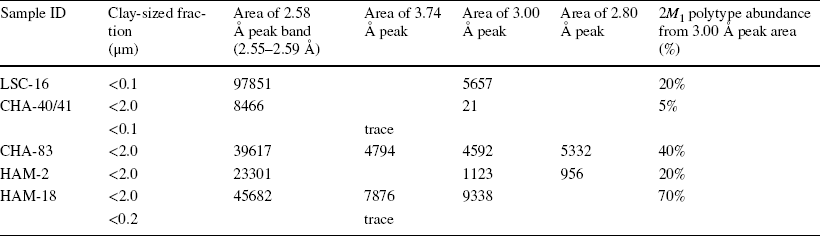
Discrete muscovite and illite polytypes were identified from observed diffraction peaks and their d values of the standard powder mounts. Peak areas were determined using JADE. The percentage of the 2M 1 polytype was determined from the area of the 2M 1-specific reflection at 3.00 Å divided by the area of the 2.58 Å band (from ~2.55 to 2.59 Å), in a formula from Table 3 of Reference Grathoff and MooreGrathoff and Moore (1996). No 1M specific reflections at 3.66 and 3.07 Å were observed, so the remaining abundance is understood to be of the 1M d polytype, the disordered form of the 1M polytype.
K-Ar Apparent Age Measurements
The second portion of each separated size fraction was used for the K-Ar work performed at the K-Ar Geochronology Laboratory at Georgia State University (GSU). The K-Ar age values of three size fractions were determined for each of six paleosol samples. Four size fractions, LSC-16 <0.2 μm, LSC-24 <0.2 μm, CHA-83 <0.1 μm, and HAM-2 <2.0 μm were analyzed twice while CHA-40/41 <2.0 μm was analyzed three times to assess reproducibility and error. This resulted in a total of 23 analyses for K and Ar isotopic characterization.
To determine an age value, the potassium and radiogenic argon-40 contents of a single test portion of air-dried clay were measured by procedures very similar to those used for K-Ar measurements of glauconite concentrates and described by Reference De Man, Van Simaeys, Vandenberghe, Harris and WamplerDe Man et al. (2010). Briefly, ~30 mg of each pretreated and dried clay fraction was encapsulated in copper foil. The entire set of capsules was placed in the argon-extraction line and held under vacuum overnight. Then, each capsule was heated, in sequence, by an external wire-wound resistance heater for 10 min at ~1000°C. The extracted argon was diluted isotopically with a known amount of virtually pure 38Ar (Universität Bern, Switzerland) added when the heating began. The mixture of Ar isotopes was purified by cold-trapping and reaction with hot titanium to remove condensable and reactive gases, and its isotopic composition was measured using a MS-10 mass spectrometer (Associated Electrical Industries, Manchester, England) at GSU. Pellets of the interlaboratory reference glauconite, GL-O (Reference Odin and OdinOdin et al., 1982), were also analyzed via the procedures used for the clay-sized fractions. The amount of 38Ar added was determined by calibration with the interlaboratory reference biotite LP-6 Bio (Reference Engels and IngamellsEngels & Ingamells, 1977).
After retrieval from the Ar-extraction line, each copper capsule, with the enclosed solid, was digested in a closed fluorocarbon container by a 10:3 mixture (by mass) of concentrated HF and HNO3 heated at ≤100°C. After digestion, the liquid was evaporated and the remaining solid was then dissolved in a carrying solution composed of 0.01 mol/kg CsCl and 0.1 mol/kg HNO3. K concentrations in test solutions of dissolved digestate were measured with a Perkin Elmer Model 3110 atomic absorption spectrophotometer (Norwalk, Connecticut, USA) against reference solutions prepared from standard KCl (SRM-999, National Institute of Standards and Technology, Gaithersburg, Maryland, USA) and confirmed as accurate by measurement of K in a solution prepared from LP-6 Bio at GSU. K-Ar apparent ages were calculated using the 40K decay constants and the isotopic abundances for K-Ar geochronology listed by Reference Steiger and JägerSteiger and Jäger (1977). The uncertainties of the K-Ar apparent ages were calculated for the 95% confidence level, or 2σ. See Supplementary Material 1 for a workbook with K-Ar data and calculations. Reagents used at GSU were purchased from Fisher Scientific (Waltham, Massachusetts, USA).
Results
Paleosol Minerals and Mica Polytypes
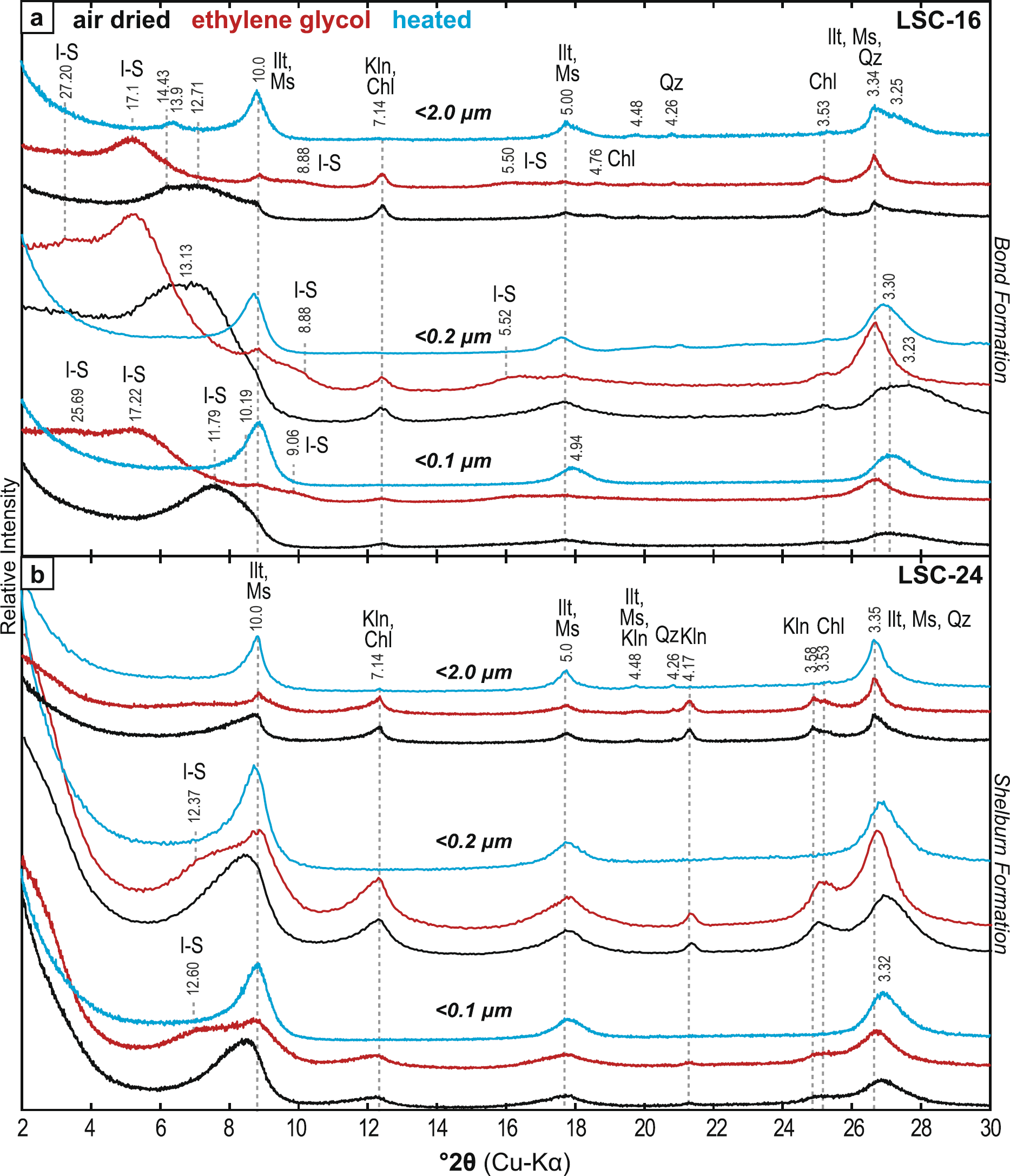
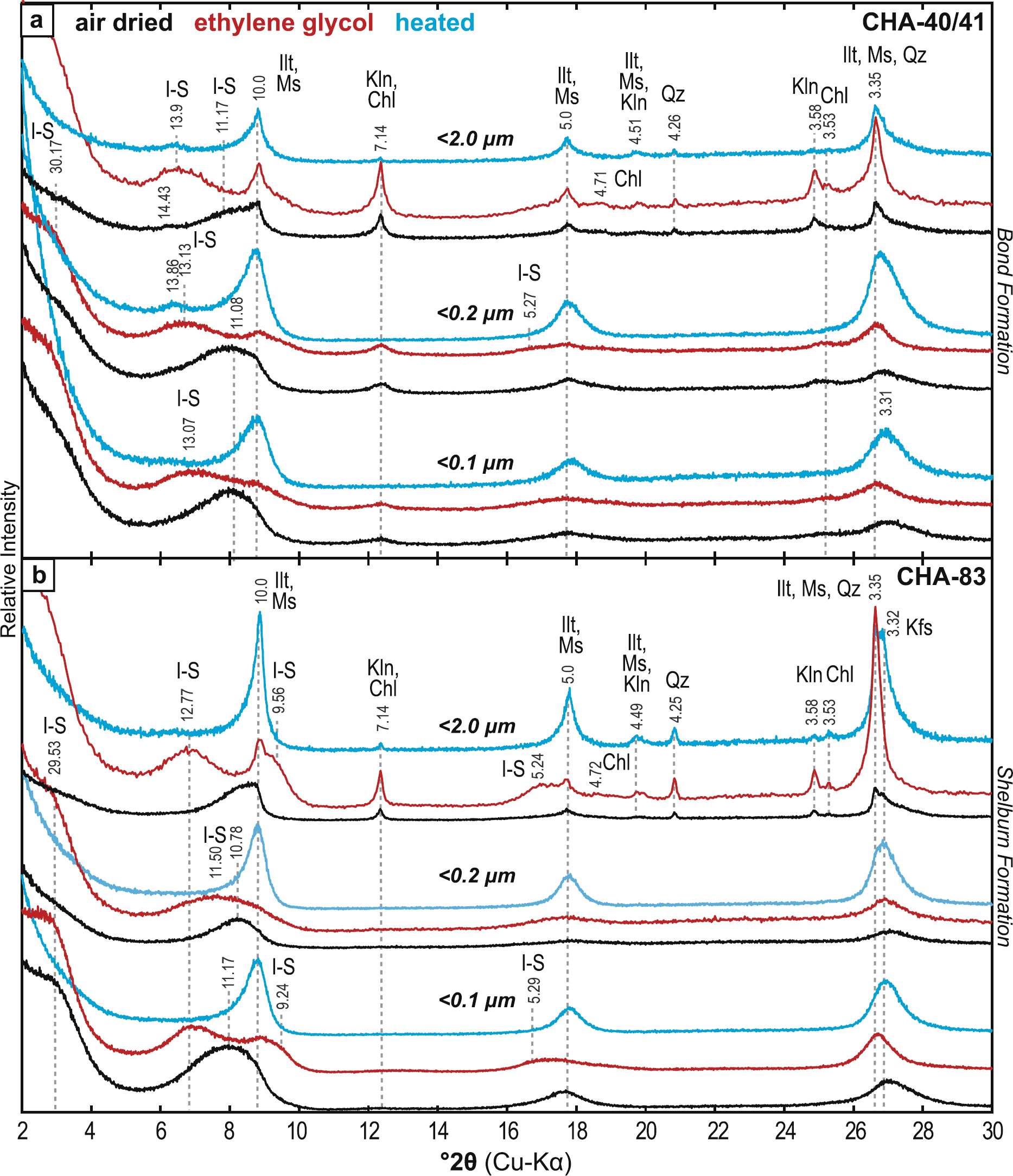
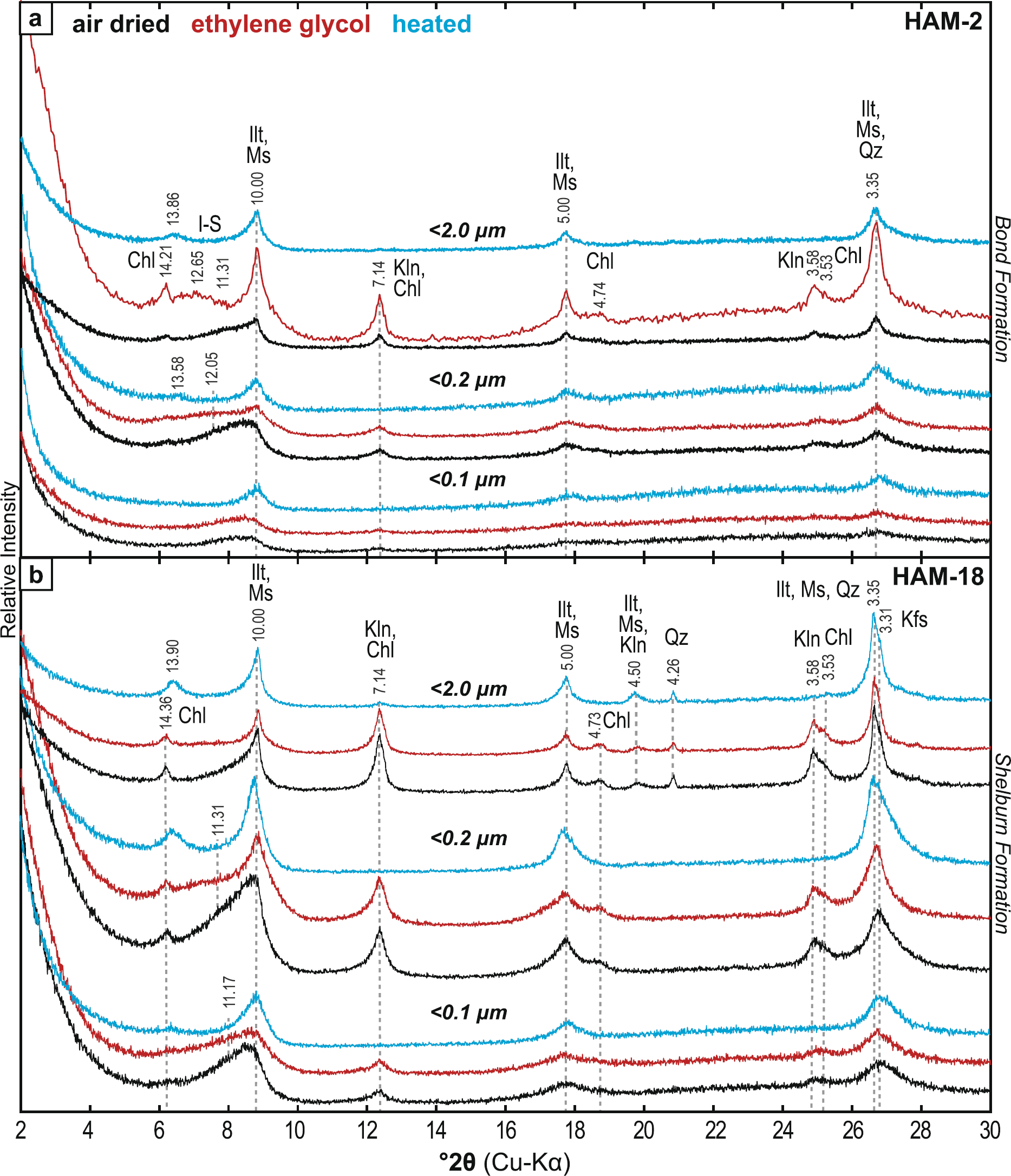
X-ray diffraction patterns collected from air-dried, oriented aggregates (Figs 3, 4, and 5) indicated significant peaks at ~12.71 and 12.00–10.50 Å corresponding to I-S. XRD patterns of oriented aggregates solvated with ethylene glycol yielded peaks at ~30, 13.13–11.50, ~9.56, and ~5.24 Å (Figs 3, 4, and 5) associated with the expansion of I-S. Peaks at ~10.00, 5.00, and 3.35 Å correspond to discrete illite or muscovite. Peaks at ~7.14 and 3.58 Å correspond to kaolinite. Peaks at ~14.36, 7.14, 4.72, and 3.53 Å correspond to chlorite. Peaks at ~4.26 and 3.35 Å correspond to quartz. Peaks at ~4.22, 3.31, and 3.25 Å correspond to K-feldspar. Finally, XRD patterns from heated oriented aggregates yielded collapsed peaks at 7.14 and 3.58 Å associated with kaolinite and shifts of I-S peaks to 10 and 5 Å (Figs 3, 4, and 5). Peaks at ~4.50 Å are associated with mica, illite, and kaolinite, though not their basal spacings (Reference Brindley and BrownBrindley & Brown, 1980), and thus can be a sign of improper preparation of oriented slides. The peak ~4.50 Å exists primarily in the coarsest size fraction rather than finer fractions (Figs 3, 4, and 5) and does not, therefore, interfere with I-S characterization.
XRD patterns of oriented aggregates of clay-sized fractions from LSC paleosol matrices for identification of minerals. Patterns for air-dried, ethylene glycol-solvated, and heated (to 500°C) samples are shown for each size fraction. Interplanar spacing values, d hkl (Å), are noted vertically. Abbreviations of minerals are noted near d values and follow Reference WarrWarr (2020), such that Ilt = illite, Ms = muscovite, I-S = mixed-layer illite-smectite, Kln = kaolinite, Chl = chlorite, Qz = quartz, Kfs = K-feldspar

XRD patterns of oriented aggregates of clay-sized fractions from CHA paleosol matrices. Explanations as in Fig. 3

XRD patterns of oriented aggregates of clay-sized fractions from HAM paleosol matrices. Explanations as in Fig. 3

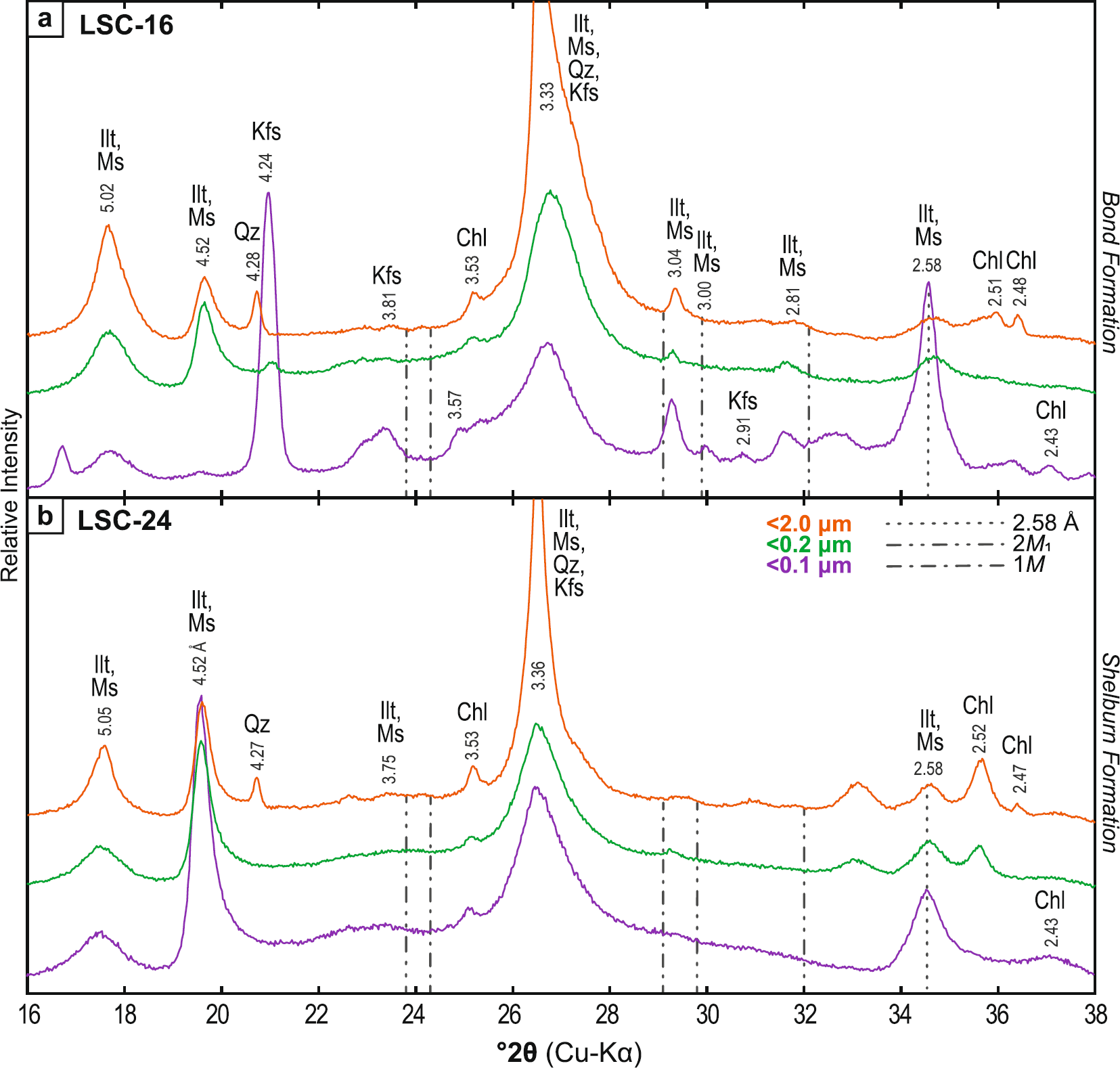
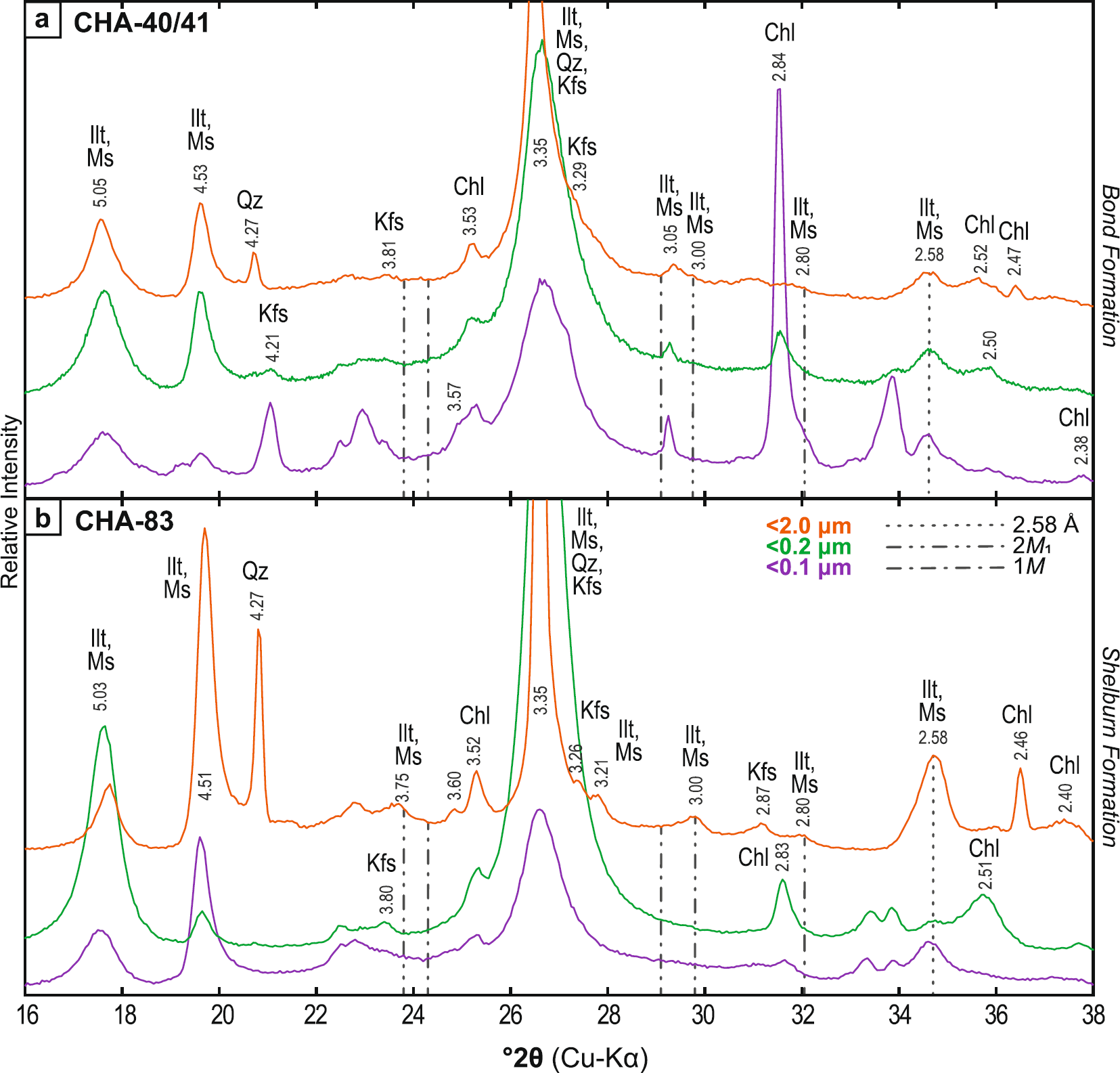
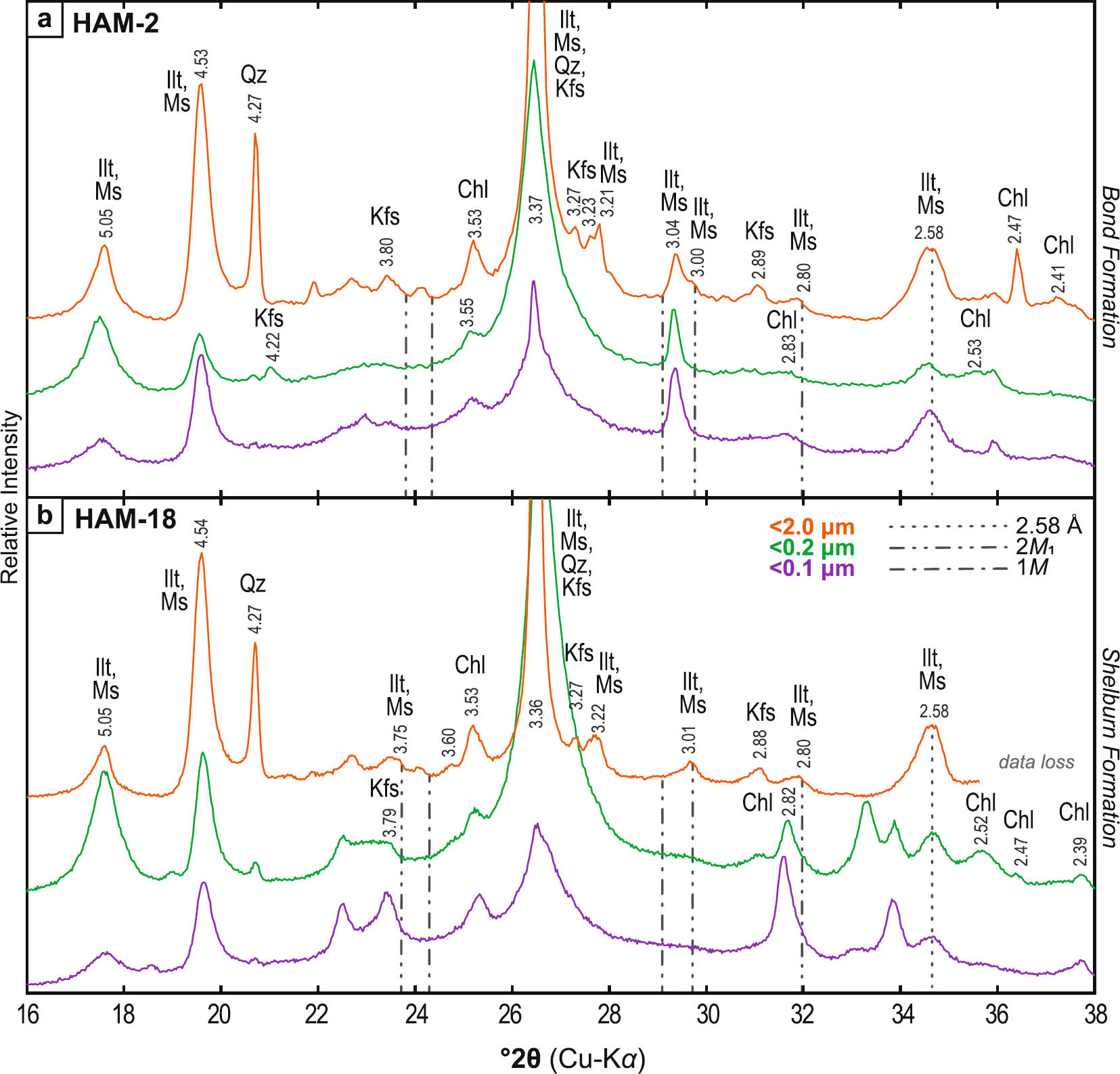
On XRD patterns collected from slowly scanned, standard powder mounts heated to 550°C and scanned from 16 to 38°2θ, significant peaks occur at ~5.00, 4.52, 3.74, 3.50, 3.35, 3.21, 3.04, 3.00, 2.80, and 2.58 Å (Figs 6, 7 and 8). These diffraction peaks correspond to discrete illite or muscovite. Peaks at ~3.53, 2.83, 2.54, 2.48, 2.44, and 2.39 Å correspond to chlorite. Peaks at ~4.26 and 3.34 Å correspond to quartz. Peaks at ~4.22, 3.77, 3.31, 3.28, 3.24, and 2.90 Å correspond to K-feldspars. Peaks at ~3.58 and 2.49 Å may correspond to kaolinite, though these are rare to non-existent as they are expected to have collapsed following heating.
Stacked XRD patterns of standard powder mounts for illite and mica polytype characterization in the LSC core, that have been heated to 550°C. Interplanar spacings, d hkl (Å) are noted vertically. Light gray dash-dot-dot lines and dash-dot lines denote where 2M 1 and M 1 illite polytype peaks should be, respectively. Abbreviations of minerals are noted near d values

Stacked XRD patterns of standard powder mounts for illite and mica polytype characterization in the CHA core. Explanations as in Fig. 6

Stacked XRD patterns of standard powder mounts for illite and mica polytype characterization in the HAM core. Explanations as in Fig. 6

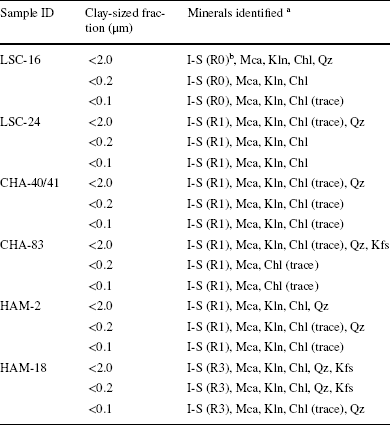
I-S and discrete illite or muscovite were the predominant phyllosilicate minerals in most size fractions of all the samples (Table 2). The stacking orders of I-S revealed by XRD analyses of ethylene glycol-solvated oriented aggregates were R0, R1, or R3. Three of 18 size fractions contained I-S with R0 and 12 contained I-S with R1 stacking orders (Figs 3, 4, and 5; Table 2). I-S with R0 occurred only in the northernmost LSC core, in the shallowest sample LSC-16. I-S with R3 was the observed stacking order in all clay subfractions of HAM-18 (Table 2).
Minerals in IB paleosols

aMinerals identified from XRD analyses of oriented aggregates. I-S = interstratified illite-smectite, Mca = mica group (muscovite or illite), Kln = kaolinite, Chl = chlorite, Qz = quartz, Kfs = K-feldspar group
bStacking order of I-S. R0: random interstratification, R1: short-range ordered, and R3: long-range ordered
The mica polytypes were identified by comparing the observed diffraction peaks to the diffraction peaks associated with specific mica polytypes (Figs 6, 7 and 8). The 1M and 2M 1 mica polytype information was not collected from every size fraction of each sample due to lack of significant peaks at the expected positions corresponding to the specific mica polytypes (Figs 6, 7 and 8). Of 18 XRD patterns, five contained peaks associated with the 2M 1 polytype. The amount of 2M 1 polytype, calculated from the areas of the 3.00 Å peak and the 2.58 Å band for those five patterns, varied from 4 to 72% relative to the total amount of all polytypes (Figs 6, 7 and 8; Table 3). There were trace amounts of the 2M 1 polytype in CHA-40/41 <0.1 μm and HAM-18 <0.2 μm (Table 3). As the areas of the 2M 1 polytype peaks are very small, the accuracy of those quantitative values is questionable. Small peaks may be due to partial dehydroxylation during preheating of the sample prior to XRD analysis of the size fractions of the standard powder mount. Nevertheless, the existence of 2M 1 polytype peaks in the clay-sized fractions still has interpretative value and will be discussed simply as an occurrence, not relative abundance, hereafter. None of the XRD patterns showed a peak associated with the 1M polytype (Figs 6, 7 and 8). The remaining mica (not tabulated) belongs to the 1M d polytype (sensu Reference Grathoff and MooreGrathoff & Moore (1996); Reference PevearPevear (1999)). These data indicate that the 1M d polytype is the most common polytype in the studied clay-size fractions of these paleosols.
Results of polytype calculations

The polytype analyses of these illitic clays were probably of poor accuracy and, thus, are not definitive for understanding the genetic origins of assemblages of illitic minerals in these paleosols. This is because most of the illitic minerals here are I-S and not discrete and overlap with other minerals in key reflection positions (Figs 3, 4, and 5; Table 2). Because polytype analyses are typically determined for discrete and not interstratified clay mineral phases, most of these paleosol samples are probably not good candidates for mica-polytype analysis. Future analyses by other methods, such as transmission electron microscopy, may provide more information on the existence and structure of mica polytypes.
The d 001 reflection of chlorite was best seen in the heat-treated patterns, as interference from I-S was reduced (Figs 3, 4, and 5). Chlorite maintains a small peak width and is most common in the HAM core (Fig. 5). Kaolinite was identified based on the collapse of the d 001 peak after heating and occurred in most samples, except the CHA-83 <0.2 μm and <0.1 μm (Figs 3, 4, and 5; blue XRD pattern). Finer size fractions tend to have smaller or absent peaks corresponding to quartz, kaolinite, and chlorite (Figs 3, 4, 5, 6, 7 and 8). Because chlorite, kaolinite, and quartz do not possess K, they did not impact the K-Ar results.
K-feldspars have been identified in non-clay-size fractions of IB paleosols (e.g. Reference Grim and AllenGrim & Allen, 1938; Reference SchultzSchultz, 1958). XRD d values for orthoclase, sanidine, and microcline have intense peaks at ~4.22, 3.77, 3.31, 3.26 Å (Reference Brown, Brindley and BrownBrown, 1980). The XRD patterns presented here of standard powder mount clay-sized fractions (Figs 6, 7 and 8) revealed some minor peaks in positions for those feldspar minerals. In all cases, e.g. CHA-83 (Fig. 7b), these K-feldspar peaks were more prominent in the <2.0 μm fraction and smaller or absent in the finer fractions (Table 2). This indicates that though finer clay-sized fractions may have some authigenic K-feldspar phases, their K-Ar age values reflect a greater influence by authigenic K-bearing mica minerals.
K-Ar Geochronologic Data
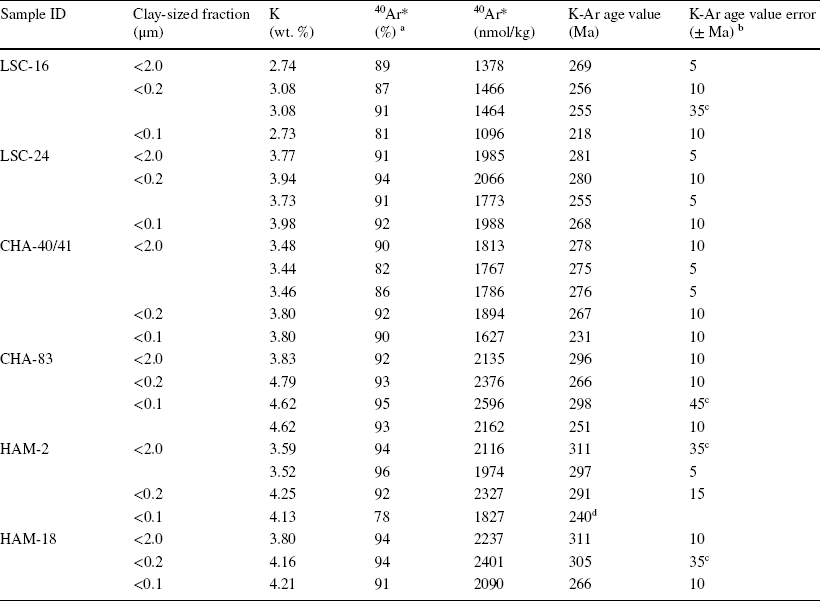
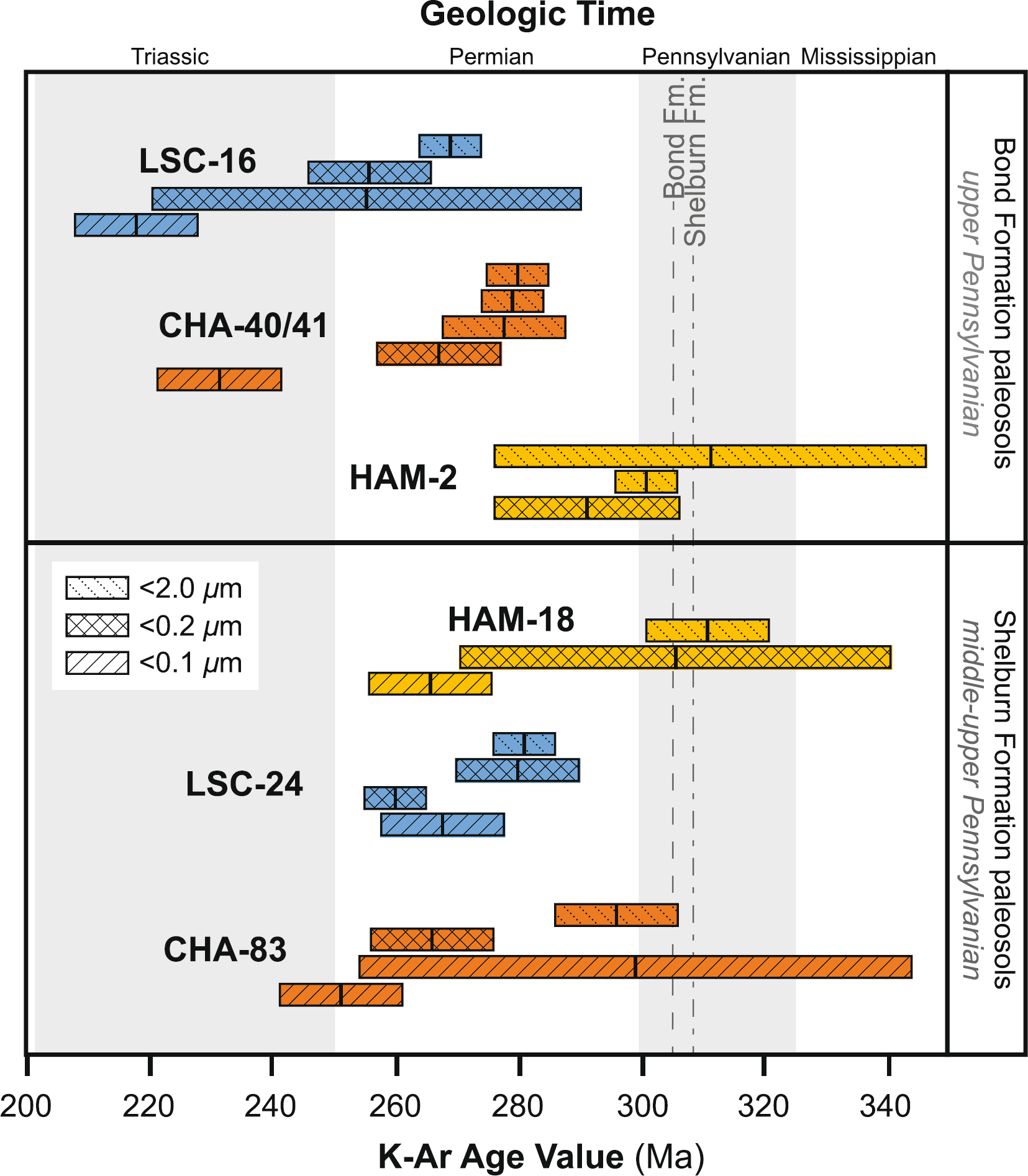
The concentration of potassium varied among the 18 clay-size fractions from 2.73 to 4.79 wt.% K. The K-Ar age values vary from 311 to 218 Ma (Table 4, Fig. 9). Generally, finer fractions have smaller age values than the coarser fractions of the same samples. In most cases, the age value for the <0.1 µm fraction is less by ~50 million years than that for the <2.0 µm fraction. No overall correlation was found between the age values for a paleosol and its sampling depth (Tables 1, 4). Moreover, age values for specific size fractions from the southernmost core, HAM, were generally larger than those for corresponding fractions from the central CHA core and northernmost LSC core.
K-Ar results for clay-sized fractions in IB paleosols

a40Ar* = radiogenic argon. Remaining percentage is atmospheric 40Ar
bUncertainties in apparent ages were calculated from the effect of analytical errors at the 95% confidence level (2σ)
cDuring argon-isotope analysis, uncontrolled large changes in electron emission by the mass spectrometer's filament caused unusually large variability in the measured isotope ratios in this case
dThe uncertainty of this age value is unknown. See text
K-Ar age values from clay-sized fractions of Illinois Basin paleosols on a background depicting the corresponding time periods and the chronostratigraphic positions of the paleosols. Horizontal bars show the ranges of 2σ error associated with the age values

The uncertainties of the K-Ar apparent ages were calculated for the 95% confidence level, or 2σ, and varied from ±5 to ±45 Ma (Table 4). The larger error values, specifically those above ±10 Ma, were due to intermittent failure of the electron-current controller of the ion source of the mass spectrometer during measurement of argon from the first three of the 20 test portions originally prepared for this study. During some of the isotopic analyses after that controller failed, abrupt and relatively large changes occurred in the electron current which caused the ion currents to be inconsistent, leading to irremediable, large variability in calculated isotope ratios. New age values from later, much more precise duplicate analyses were obtained for two of the three fractions for which the original analyses were highly imprecise, but not for the HAM-18 <0.2 µm fraction (Table 4).
A special case is the age value for the <0.1 μm size fraction of sample HAM-2. The mass of that fraction was the smallest of those used for the present K-Ar work, so an attempt was made to dilute its argon with a reduced amount of 38Ar. The result was an age value (of ~450 Ma) inconsistent with the clear pattern of K-Ar age values exhibited by all the other clay-size fractions of the present study. The inconsistency was attributed to an unexplained loss of some of the 38Ar tracer, owing perhaps to a valve not fully closed. Because the amount of 38Ar lost is unknown, the 40Ar content and age value for the HAM-2 <0.1 um fraction was obtained by treating its isotopic analysis as an ’unspiked run,’ disregarding the 38Ar signal and assuming that the operational sensitivity for the two other Ar isotopes was the same as in the immediately preceding isotopic analysis. The K-Ar age value obtained in this way was 240 Ma, which is smaller than those for all other fine fractions for the HAM paleosols, but no value has been estimated for its uncertainty (Table 4). Detailed support for the chosen treatment of this special case is available as Supplementary I 2.
Discussion
Diagenetic Components of IB Paleosols
K-Ar age values of clay-sized material from middle and upper Pennsylvanian paleosols in this study range from 311 Ma to 218 Ma (Table 3; Fig. 9). Without other information, the K-Ar age values with error considered (but disregarding that an actual age value could be outside the 95% confidence interval of the analytical result) show that there is diagenetic K-bearing material in all LSC and CHA sample fractions and the finest HAM-18 fraction.
The K-Ar age values presented here showed that paleosol samples contain some diagenetic K-bearing material that formed after the ~270 Ma magmatism in the IKFD (e.g. Reference Reynolds, Goldhaber and SneeReynolds et al., 1997) and during the onset of estimated maximum burial of the IB (e.g. Reference Rowan, Goldhaber and HatchRowan et al., 2002). These results contrast the findings of the stable isotope study of the same phyllosilicates from IB paleosols by Reference Rosenau and TaborRosenau and Tabor (2013) analyzed in this study. LSC-16 and LSC-24 of mature, calcic Vertisols (Table 1) yielded phyllosilicate crystallization temperatures of 33 and 39°C ± 3°C, respectively, suggesting that the LSC core was mostly void of diagenetic overprinting (Reference Rosenau and TaborRosenau & Tabor, 2013). Though they attributed LSC trends to a small maximum depth of burial (<1 km) and being distal from any heat sources in the IKFD, they tentatively suggested that LSC-24 temperature is high and may not represent an ancient soil temperature. Despite the occurrence of R0 stacking orders found herein and by Reference Rosenau, Tabor, Elrick and NelsonRosenau et al. (2013a) for LSC-16, K-Ar age values from these samples are some of the lowest from all the cores (Fig. 9; Table 4). Thus, K-Ar ages of the LSC core highlight that paleosol morphology, the stacking order of I-S, and the reconstructed burial depth are not indicative of preservation of original pedogenic minerals or of diagenetic overprinting.
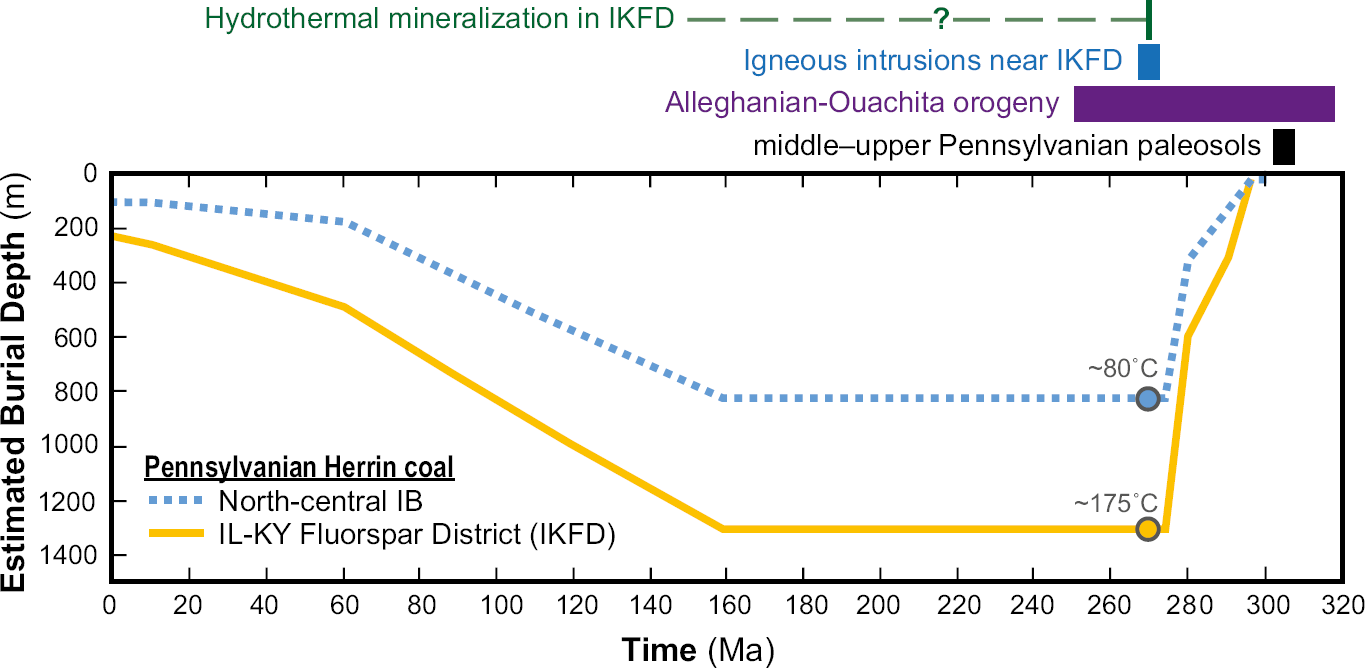
Increased temperatures, high water:rock ratios, abundant aqueous K, and time required to trigger illitization during burial in the IB may have been achieved after the Pennsylvanian. Using a series of numerical models, Reference Rowan, Goldhaber and HatchRowan et al. (2002) found that combined burial and hydrothermal fluids are both necessary to cause the high coal maturities throughout the IB, though hydrothermal temperatures were probably lower in the north (Fig. 10). Similarly, Reference Mariño, Marshak and MastalerzMariño et al. (2015) found that the units in the south and central IB near the sub-Absaroka unconformity (Mississippian–Pennsylvanian boundary) and the cleat system of coals may support fluid migration, where the latter is supported by studies of fluid inclusions of minerals in some coals (Reference CobbCobb, 1981; Reference Whelan, Cobb and RyeWhelan et al., 1988). Also, Reference Mariño, Marshak and MastalerzMariño et al. (2015) suggested that faults in southern regions of the IB that extend from the Precambrian basement into the Paleozoic sediments may provide vertical conduits for fluid flow, albeit only regionally. The findings of these models suggests that heat flow at low temperatures (~100±30°C), if sustained over enough time, may be adequate and available to trigger mineral alteration in Paleozoic formations of the IB in the south and central IB. Yet, it is unclear how these hydrothermal fluids may have migrated vertically and horizontally across the entire IB to geochemically alter the shallow Pennsylvanian paleosols. Particularly for the northernmost LSC core samples, whose maximum burial depth was ~800 m and spatial distance was ~500 km north from the suspected heat source in the IKFD (Figs 1, 9).
Estimated burial curves for the Herrin Coal (middle Pennsylvanian, Carbondale Formation; Fig. 2) from the hybrid burial plus hydrothermal fluid flow model of Reference Rowan, Goldhaber and HatchRowan et al. (2002). Burial curves are coded to locations in the basin (Fig. 1), including the southern Illinois-Kentucky Fluorspar district and a north-central IB location near the Lone Star Cement Company #TH-1 (LSC) core. The modeled temperature of the Herrin Coal at 270 Ma is ~80°C in the north central IB and ~175°C in the Illinois Kentucky Fluorspar district

Support for low-temperature, time-dependent, or protracted diagenesis to drive illitization processes (sensu Reference Velde and VasseurVelde & Vasseur, 1992) has also been suggested to explain diagenetic illitization in the Devonian-Mississippian New Albany Shale (Reference Gharrabi and VeldeGharrabi & Velde, 1995) and the Pennsylvanian Browning Sandstone and Purington Shale (Reference MooreMoore, 2000, Reference Moore2003). The K-Ar age-value evidence for diagenetic minerals in Pennsylvanian paleosols provides further evidence for protracted diagenesis. This is because K-Ar age values of fine clay-size fractions presented in this study are <270 Ma, but non-equal. The low K-Ar age values of the finest fractions indicate that such illitization would have proceeded most slowly in the LSC-16 paleosol, which is consistent with it having the smallest K content, I-S with R0 stacking order, and being the shallowest sample from the northernmost location. The larger K-Ar age values from the paleosols of the CHA and finest fraction of the HAM cores indicate that illitization may have proceeded more rapidly or ceased earlier than in the LSC core. It should be noted that K-Ar age values cannot resolve whether illitization occurred during one or multiple event(s) (Reference Środoń, Clauer, Huff, Dudek and BanaśŚrodoń et al., 2009).
Detrital Components of IB Paleosols
K-Ar age values alone cannot diagnose the presence of either detrital or pedogenic K-bearing material in any of the clay fractions studied. Yet, K-Ar age values do not rule out the presence of either detrital or pedogenic K-bearing material in any of the clay fractions studied.
K-Ar age values are generally largest in size fractions from the HAM core in the southern IB and smallest in the northern LSC core (Figs 1, 9). This may indicate that the HAM core has more detrital minerals in the clay-sized fractions than the other cores. HAM-18 was from a paleosol that was classified as a gleyed Protosol (Table 1), which means that it is an immature paleosol with some gleyed properties such as grey matrix color (G14-15/N; Munsell Color, 1975), sulfide mineralization, and other redoximorphic features (Reference McIntoshMcIntosh, 2018). The HAM-18 sample possesses more of the 2M 1 polytype (relative to all micas) than all the other samples (Fig. 8; Table 3). This mineral is probably muscovite rather than an illite, which is supported by the presence of the sharp and tall 10 Å peaks from XRD of oriented aggregates from the HAM core (Fig. 5). Particularly in the patterns of heated HAM-18 clay-size fractions (Fig. 5b) in which smectitic interlayers would have collapsed due to dehydration, these 10 Å peaks are sharper than in XRD patterns of oriented aggregates that were air dried and glycolated. The immaturity indicated by the morphology of the HAM-18 Protosol is consistent with its coarsest fraction probably having an actual age value greater than that of any other studied fraction, because less smectite would have been available therein for illitization during diagenesis.
Conversely, all the other paleosols sampled from the central CHA and northern LSC cores for this work are more mature paleosols identified as Vertisols, with calcic and gleyed features. The LSC core contains the only I-S with R0 stacking order, of sample LSC-16 (Fig. 3; Table 2), while LSC-24 and both CHA samples exhibit I-S with R1 stacking order, except for CHA-83 <0.2 μm which has I-S with R3 (Fig. 3, Table 2). Moreover, the clay-size fractions from the more morphologically developed paleosols (e.g. CHA) have a greater relative abundance of 1M d illite polytypes than does HAM-18 <2.0 μm (Table 3).
The greater presence of quartz in <2.0 μm clay-size fractions, notable by the d value at ~4.26 Å, which decreases or is absent from finer clay-size fractions of all paleosol samples supports the notion that there are more detectable detrital minerals in larger clay-size fractions. The additional presence of both 2M 1 mica and K-feldspar in HAM and CHA <2.0 μm suggests that these minerals are detrital. The presence of more detrital material in these fractions than in all other fractions studied is consistent with K-Ar age values for three out of four of these <2.0 μm fractions being considerably greater than in nearly all finer fractions. Previous studies of IB paleosols found evidence for potassic feldspars in non-clay-size fractions, finding no clear vertical variation in K-feldspar abundances within a particular paleosol profile (e.g. Reference Grim and AllenGrim & Allen, 1938; Reference SchultzSchultz, 1958). Reference SchultzSchultz (1958) interpreted this to mean that the K-feldspars have not been weathered significantly since their inheritance, indicating that K-feldspars in these units are mostly detrital and not authigenic.
A greater quantity of detrital minerals in paleosols from the southern and central IB is consistent with the understanding of the burial of the IB and paleosol occurrence. Reference Gharrabi and VeldeGharrabi and Velde (1995) suggested that burial of at least 1.5 km began in the Mesozoic and continued into the Paleogene, until erosion began at ~50 Ma. The southern IB had greater accommodation as it was probably buried to depths of ~3 km, while the northern IB was buried to depths of ~1 km (Reference Rowan, Goldhaber and HatchRowan et al., 2002). Protosols in the IB are probably weakly developed due to formation on an unstable landscape, where there was intermittent and rapid sediment supply. The southern HAM core contains more Protosols than the CHA (see table 1 in Reference McIntosh, Tabor and RosenauMcIntosh et al., 2021) or LSC cores (see Pedotype B in table 3 of Reference Rosenau, Tabor, Elrick and NelsonRosenau et al., 2013a) in Pennsylvanian strata of the IB. As a result, combined K-Ar age values; mineralogic, petrologic, and basin analysis; and depositional environment considerations provide support for the presence of more detrital minerals in clay-size fractions of IB paleosols from the HAM core in the southern IB, compared to the other more northern, shallowly buried cores.
Conclusions
The mineralogical and geochronometric results of the present study provide robust support for the hypothesis that Pennsylvanian paleosols of the Illinois Basin are not exclusively comprised of pedogenic I-S, but also have both detrital muscovite and diagenetic illitic minerals. Despite shallow maximum burial depths, this work found that increased abundances of detritus are correlated to increased burial depth, highlighting the importance of understanding a basin’s evolution before and after soil and paleosol formation. Because this work cannot precisely resolve how diagenetic illitization conditions were favorable across the entire IB at any particular period in the geological past, and the effects of hydrothermal fluids may only be localized rather than basin-wide, illitization in Illinois Basin paleosols was more likely initiated during protracted diagenesis. This work demonstrates that shallowly buried paleosols and the sedimentary basin in which they form should be characterized extensively before minerals from those paleosols are used to reconstruct ancient climates and environments.
Acknowledgments
JAM thanks the Illinois Geological Survey scientists, specifically Scott Elrick and John Nelson, for their insights on Illinois Basin stratigraphy and structural geology, and Bob Mumm for access to cores. JAM also acknowledges Nicholas Rosenau for access to samples and Bukola Ogungbe and Roy Beavers for their assistance in the laboratory. This work benefited from discussions with Robert Gregory, Crayton Yapp, Nicholas Rosenau, and Stephen Franks. This manuscript was improved by comments by the editor Joseph Stucki, the Associate Editor Katarzyna Górniak, and by four anonymous reviewers.
Funding
Open access funding provided by SCELC, Statewide California Electronic Library Consortium JAM was supported by a Student Research Grant from The Clay Minerals Society and a Graduate Research Award from the Institute for Earth and Man at Southern Methodist University. NJT acknowledges support from NSF-EAR 171497 and 1337569.
Data Availability
All data generated or analyzed during this study are included in this published article and its supplementary information files.
Declarations
Conflicts of Interest
The authors declare that they have no conflict of interest.
Supplementary Information
The online version contains supplementary material available at https://doi.org/10.1007/s42860-023-00267-z.


 Open access

