

Introduction
The cheese industry generates a large amount of whey which is a by-product with high biological oxygen demand. Since whey contains biologically valuable proteins, minerals and lactose, it is upcycled to new food ingredients such as whey powder, whey protein concentrate, whey protein isolate, and lactose (Figueroa Pires et al., Reference Figueroa Pires, Garcia Marnotes, Díaz Rubio, Cobos Garcia and Dias Pereira2021). There are two types of whey, acid and sweet, depending on the cheesemaking process. Acid whey is the solution remaining after acid coagulation while sweet whey is obtained from rennet coagulation of milk. The composition of whey depends on the milk source, cheese type, and processing conditions (Karimidastjerd and Gulsunoglu-Konuskan, Reference Karimidastjerd and Gulsunoglu-Konuskan2023).
Caseinomacropeptide (CMP) is a heat-stable bioactive peptide composed of 64 C-terminal amino acids of κ-casein released after rennet cleavage during cheese manufacture or digestion in the gastrointestinal system (Qu et al., Reference Qu, Kim, Koh and Dallas2021). CMP has two structural forms including glycosylated (gCMP) with sugar residues (sialic acid), and a non-glycosylated (aCMP) forms. Sialic acid is especially important for biological and pharmacological activities (Martinez et al., Reference Martinez, Farías and Pilosof2011). CMP has garnered attention because of its prebiotic properties and nutritional applications, making it a significant component of dietary proteins (Figueroa Pires et al., Reference Figueroa Pires, Garcia Marnotes, Díaz Rubio, Cobos Garcia and Dias Pereira2021). Furthermore, CMP is associated with appetite regulation, indicating its potential role in dietary modulation and weight management (Korhonen, Reference Korhonen2013). CMP has also been studied for its potential to inhibit bacterial adhesion, regulate blood circulation, and modulate immune responses, highlighting its diverse physiological functions (Karimidastjerd and Gulsunoglu-Konuskan, Reference Karimidastjerd and Gulsunoglu-Konuskan2023; Volstatova et al., Reference Volstatova, Havlik, Potuckova and Geigerova2016). The isolation and characterization of CMP are of interest for its potential applications in the development of functional foods and beverages for specific nutritional needs. The levels of phenylalanine (Phe) and tyrosine (Tyr) are used to evaluate the purity of CMP isolates, because there is no Phe and Tyr in the CMP structure. Pure CMP is used as a protein source for phenylketonuria (PKU) individuals in various foods (Karimidastjerd and Kilic-Akyilmaz, Reference Karimidastjerd and Kilic-Akyilmaz2021; Zaki et al., Reference Zaki, El-Wakeel, Ebeid, Ez Elarab, Moustafa, Abdulazim and Elghawaby2016).
Several approaches have been employed to isolate CMP from milk and whey, including ethanol precipitation, trichloroacetic acid precipitation, dialysis, ultrafiltration (UF) and microfiltration. The purity of CMP can further be increased using selective adsorption techniques, such as ion-exchange chromatography, gel permeation chromatography, hydrophobic interaction chromatography, size-exclusion chromatography, and affinity chromatography (Kawakami et al., Reference Kawakami, Kawasaki, Dosako, Tanimoto and Nakajima1992; Kawasaki et al., Reference Kawasaki, Kawakami, Tanimoto, Dosako, Tomizawa, Kotake and Nakajima1993; Holst and Chatterton, Reference Holst and Chatterton2002; Kreuß et al., Reference Kreuß, Krause and Kulozik2008; Arunkumar and Etzel, Reference Arunkumar and Etzel2015; Nakano and Betti, Reference Nakano and Betti2022; Chen et al., Reference Chen, Lai, Dong, Liu, Pan, Wu, Wu, Zhou, Ren, Zhang, Liu and Liu2024). Among these methods, UF offers several advantages for CMP isolation. Firstly, UF allows selective separation of CMP from other components in complex mixtures, such as whey protein isolates, by exploiting differences in membrane material, pore size or molecular weight cut-off (MWCO) (Figueroa Pires et al., Reference Figueroa Pires, Garcia Marnotes, Díaz Rubio, Cobos Garcia and Dias Pereira2021). Moreover, UF provides a gentle and efficient method, enhances safety by removing impurities, and offers scalability, making it suitable for industrial-scale CMP production (Bonnaillie et al., Reference Bonnaillie, Zhang, Akkurt, Yam and Tomasula2014). However, UF has a major limitation which is membrane fouling that limits the flux, reduces recovery and separation efficiency and extends process time. UF membranes can be clogged by several possible mechanisms, such as adsorption to membrane pores, cake formation, pore blocking, and depth fouling, which result in a decline in the flux and poor separation (Baldasso et al., Reference Baldasso, Barros and Tessaro2011; Barukčić et al., Reference Barukčić, Božanić and Kulozik2015).
CMP can be separated by UF treatment of sweet whey and concentrated through passing more lactose to permeate by diafiltration (DF). Membrane fouling occurs during UF treatment of whey depending on the feed properties (pH and composition), membrane characteristics, and process parameters, such as temperature and pressure (Khaire and Gogate, Reference Khaire and Gogate2020). To reduce fouling of a UF membrane, pre-treatments for alteration of the chemical properties of the feed can be applied, and the process parameters can also be optimized. In the literature, changing the UF process parameters (membrane pore size and temperature) and pre-treatment of whey such as heat treatment and cross-flow microfiltration were explored to reduce fouling and increase the recovery of CMP from sweet whey (Bonnaillie et al., Reference Bonnaillie, Zhang, Akkurt, Yam and Tomasula2014; Barukčić et al., Reference Barukčić, Božanić and Kulozik2015; Guedes and Cândido, Reference Guedes and Cândido2020). In previous studies, pre-treatment of sweet whey by heating at 90°C for 1 h and acidification to pH 5 were found to precipitate most of the whey proteins without major loss of CMP (Martín-Diana et al., Reference Martín-Diana, Fraga and Fontecha2002; Ergül and Karakaya, Reference Ergül and Karakaya2013; Kilic-Akyilmaz and Karimidastjerd, Reference Kilic-Akyilmaz and Karimidastjerd2018). In this study, isolation of CMP from pre-treated sweet whey by UF was investigated. Firstly, effects of pH of pre-treated sweet whey feed and MWCO of PES membrane on permeate flux were investigated. Secondly, two combinations of feed pH and membrane MWCO providing sufficient flux were applied to produce a CMP concentrate where recovery and purity were evaluated.
Materials and methods
Materials
Non-fat milk powder was purchased from Pinar Inc. (Izmir, Türkiye) which contained 31–36% protein, 2.7% ash, 2.1% moisture and 52–56% lactose and was used for obtaining sweet whey. Microbial rennet (MYS Fermente, 180 IMCU/mL) was obtained from Maysa Gida (Istanbul, Türkiye). The CMP isolate (Lacprodan®CGMP-10) with 64% CMP, 80% protein, 5% ash, and 2% lactose was kindly supplied by Arla Foods (Viby, Denmark) and used as a standard in analyses. Bovine whey proteins, α-lactalbumin (α-La) and β-lactoglobulin (β-Lg) were supplied from Sigma-Aldrich (Steinheim, Germany) and used as standards.
Membrane unit
A UF unit (FT18, Armfield Ltd. Ringwood, Hampshire, England) with a capacity of 15 L was used for separation. The membrane system consisted of a tubular module which accepts two membrane tubes with 1.25 cm diameter and 30 cm length providing a total membrane area of 0.024 m2 encased in a stainless steel housing (MICRO-240, PCI Membrane System Ltd., UK). Two polyethersulfone (PES) membranes with MWCO of 9 kDa (ES209) and 25 kDa (ES625) were used.
Preparation of sweet whey
Non-fat milk powder was reconstituted at 40°C for 30 min by agitation to obtain milk with 10% (w/w) dry matter content and then cooled to 32°C. Rennet was added at a level of 0.02% (v/v). Coagulum was obtained by holding the milk in a water bath at 32°C for 2 h. After coagulation, the gel was cut into 2 cm cubes, and the coagulum was heated to 38°C for release of whey. Whey was separated from the coagulum by filtration through cheesecloth. Sweet whey was pre-treated before UF to increase the CMP purity, according to the method of Kilic-Akyilmaz and Karimidastjerd (Reference Kilic-Akyilmaz and Karimidastjerd2018).
UF of pre-treated whey
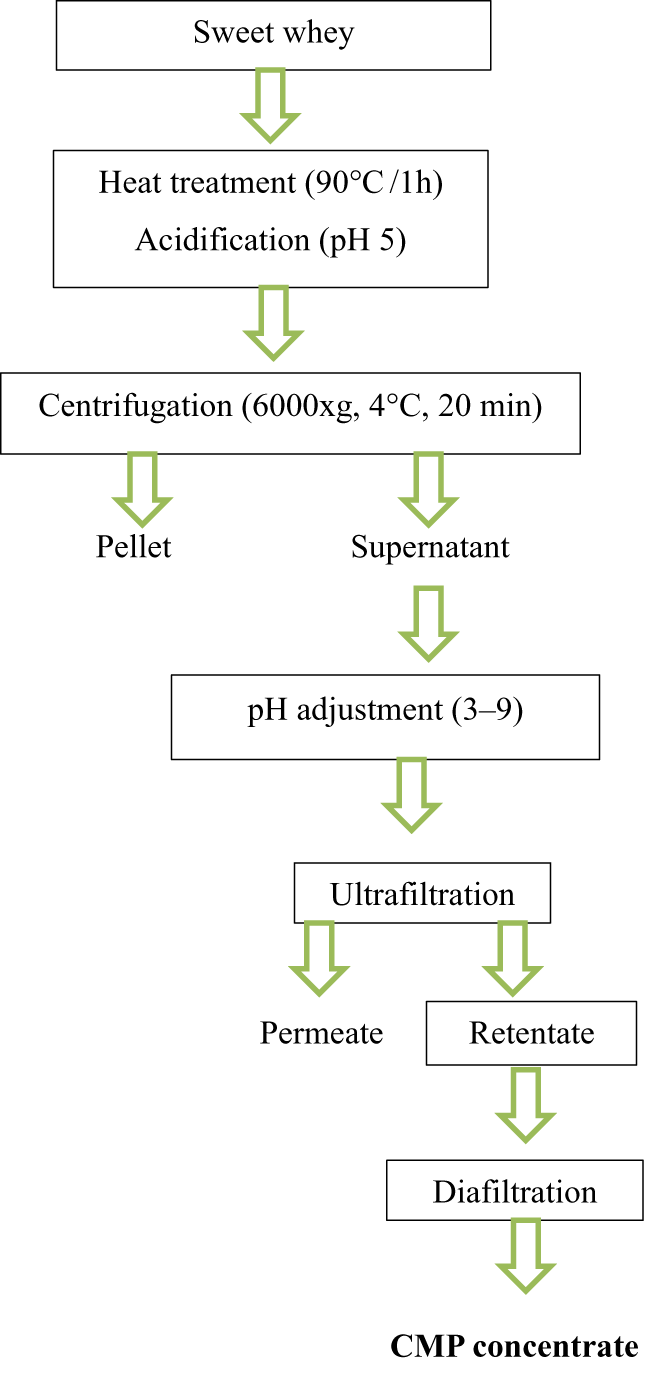
A scheme of the CMP isolation procedure by UF is shown in Fig. 1 based on Martín-Diana et al. (Reference Martín-Diana, Fraga and Fontecha2002) and Ergül and Karakaya (Reference Ergül and Karakaya2013) with modifications. In the first step, the whey was heat treated at 90°C for 1 h and then cooled to room temperature. Then, the pH of the whey was adjusted to 5.0 by gradual addition of 6 N HCl. The whey was then centrifuged at 6000 × g for 20 min at 4°C to remove precipitated proteins. The supernatant was collected and its pH was adjusted to 3, 4, and 5 with 6 N HCl and 7 and 9 with 8 N NaOH.
Scheme for the isolation of CMP from sweet whey.

Deionized water at room temperature was fed into UF unit at the beginning of each run for 30 min to determine the relative flux. After removal of water from the unit, pre-treated whey at a volume of 9 L and temperature of 50ºC was placed into the feed tank. The transmembrane pressure was adjusted to 3 bar for the membrane with a MWCO of 25 kDa and 5 bar for the membrane with a MWCO of 9 kDa. The feed was maintained at 50°C by a circulating water bath. The flow rate of the permeate was measured after the system was equilibrated for 5 min, and then recorded every 30 min until the end of the run. UF was continued until 1.8 L of the retentate remained in the feed tank. The retentate was removed from the feed tank and kept at 4°C until diafiltration (DF) was applied the next day. The unit was cleaned daily with the following chemicals for 10 min each; tap water, 0.25 N HCl, tap water, 0.25 N NaOH, tap water, 100 ppm active chlorine in water and tap water.
To apply DF, the retentate was heated to 50°C and mixed with deionized water at 50°C at a volumetric ratio of 1:1. The DF of the diluted retentate was carried out using the same UF process conditions. Each DF run was continued until the initial retentate volume was obtained in the feed tank. The same volume of deionized water at 50°C was added and DF was repeated. The permeate flow rate was measured during the runs. A sample of retentate was taken from the feed tank after UF and each DF cycle and stored at 4°C for chemical composition analysis.
Determination of flux, rejection, recovery and purity
The permeate flux was calculated from the measured flow rate ( ${\dot V_p}$:L/h) and using the membrane area expressed as L/m2h according to the Equation 1. The relative flux was calculated by dividing the flux value of whey feed by that of water at 20°C under the same pressure. The mean flux was calculated by taking the average of flux values during the UF or DF runs. The volumetric concentration factor (VCF) was calculated as the ratio of volume of pre-treated whey to that of retentate.
The recovery of CMP and sialic acid from the sweet whey by the isolation process was calculated as mass percentage of the component in the final concentrate according to the formula in Equation 2. The purity of CMP was determined as the concentration of CMP in total dry matter. The purity of CMP was also evaluated based on the amount of Phe and Tyr as these amino acids are not present in pure CMP.
 \begin{equation}Flux{\text{ }} = \frac{{{{\dot V}_p}}}{A}\end{equation}
 \begin{equation}Recovery{\text{ }}\left( {\text{\% }} \right) = \frac{{{m_{i,retentate}}}}{{{m_{i,{\text{ }}feed}}}} \times 100\end{equation}
Compositional analysis
Dry matter content of the samples was analyzed in a vacuum oven at 70°C (AOAC, Reference Cunniff2005). The ash content was determined gravimetrically (AOAC, Reference Helrich1990). The crude protein content of whey samples was determined using the Kjeldahl method (AOAC, Reference Horwitz2002a, Reference Horwitz2002b). The crude protein was calculated using a factor of 6.38. Lactose content was calculated by subtracting protein and ash contents from total dry matter.
Determination of CMP, α-la and β-lg
The CMP content of whey and CMP concentrate was analyzed using a method described by Kilic-Akyilmaz and Karimidastjerd (Reference Kilic-Akyilmaz and Karimidastjerd2018). CMP was quantified by Reverse Phase High Performance Liquid Chromatography (RP-HPLC) (Waters Separation Module 2695, MA, USA) using a PLRP-S column (300 Å 8 mm) (Agilent Technologies, CL, USA) and Waters 2996 photo diode array (PDA) detector (Waters, Milford, MA, USA). Gradient elution was performed using solvents A [0.1%, trichloroacetic acid in water, v/v] and B [0.055%, v/v, trichloroacetic acid in acetonitrile water (80:20)]. The gradient started with 10% of solvent B and increased to 49% over 17 min, 50% in 3 min, 70% in 3 min, 100% in 1 min and then kept at 100% for 3 min before returning to the initial conditions. The flow rate was 1 mL/min. The peaks were detected at 226 nm. The column temperature was maintained at 40°C. The injection volume was 20 μL. Two major whey proteins, α-La and β-Lg, were quantified by the same method. Standard stock solutions of β-Lg (5 mg/mL), α-La (2 mg/mL) and CMP (2.5 mg/mL) were used to prepare calibration curves.
Determination of sialic acid content
Sialic acid was isolated from whey or retentate samples (2 mL) by dialysis against deionized water at 4°C for 24 h using a dialysis membrane (MWCO 3.5 kDa), and then analyzed using a spectrophotometric method (Nakano and Ozimek, Reference Nakano and Ozimek1999). The total amount of sialic acid was determined after the release of bound sialic acid by heating an acidified solution of the samples at 80°C for 1 h (Nakano and Ozimek, Reference Nakano and Ozimek1999). The amounts of free and total sialic acid were analyzed according to the method described by Aminoff (Reference Aminoff1961). The bound sialic acid content in the samples was determined by subtracting the amount of free sialic acid from the total amount of sialic acid.
Determination of phe and tyr content
To analyze of Phe and Tyr contents, proteins in whey or retentate samples were hydrolyzed in 6 N HCl at 110°C for 24 h. The solvent was evaporated using a rotary vacuum evaporator at 65°C (Andrensek et al., Reference Andrensek, Golc-Wondra and Prosek2003). To prevent the oxidation of amino acids during hydrolysis, 50 μL phenol was added to the samples. Two milliliters of mobile phase were added to the hydrolysates. Phe and Tyr contents of hydrolysates were determined by RP-HPLC method described by Prodolliet and Bruelhart (Reference Prodolliet and Bruelhart1993).
Statistical analysis
The experiments and measurements were repeated twice. The effects of examined factors on measured properties were evaluated using an analysis of variance (ANOVA). Means were compared using Tukey's test at a level of significance of 0.05 (IBM® SPSS® Statistics 24, Armonk, NY, USA).
Results and discussion
Effect of pH of feed on the flux in UF process
A pre-treatment involving heat and acidification was applied to precipitate whey proteins, mainly α-La and β-Lg, from sweet whey before UF. This pre-treatment was reported to preserve CMP and bound sialic acid from whey (Kilic-Akyilmaz and Karimidastjerd, Reference Kilic-Akyilmaz and Karimidastjerd2018). The pH of pre-treated whey was adjusted to values between 3 and 9 and then ultrafiltered with two PES membranes with 9 and 25 kDa MWCO (Table 1). Temperature of UF feed was maintained at 50oC during UF treatment in order to reduce viscosity, prevent microbial growth and avoid calcium phosphate precipitation which occurs at around 55oC (Akoum et al., Reference Akoum, Jaffrin and Ding2005). The relative mean flux was enhanced by the increase in pH with both membranes (Table 1). At pH 7 with the 25 MWCO membrane and at pH 9 with the 9 MWCO membrane, the highest relative mean flux of 0.8 was obtained. It can be concluded that the pH adjustment of pre-treated whey was effective in increasing the flux, enabling the UF process to be completed in a feasible time.
Relative mean permeate flux during UF of pre-treated whey feed at different pH values through PES membranes with different MWCO

* Relative mean flux = Flux of pre-treated whey/Flux of water.
The flux and separation efficiency by PES membrane were affected by surface interactions and various fouling events (Cheryan, Reference Cheryan1986; Zhu et al., Reference Zhu, Zhang, Xu, Du, Zhu and Xu2007; Barukčić et al., Reference Barukčić, Božanić and Kulozik2015). Interactions can occur between the surface layer of the membrane and charged proteins and ions like Ca and P in whey depending on pH that can lead to the formation of fouling layer (Cheryan, Reference Cheryan1986; Tarapata et al., Reference Tarapata, Dybowska and Zulewska2022). PES membranes have a negative surface charge at the pH range of 5 to 8 (Mahdi et al., Reference Mahdi, Kumar, Goswami, Perdicakis, Shankar and Sadrzadeh2019). Isoelectric point (pI) for glyco and non-glyco factions of CMP are 4.15 and 3.15 (Karimidastjerd and Gulsunoglu-Konuskan, Reference Karimidastjerd and Gulsunoglu-Konuskan2023). The low pKa (2.6) of sialic acid of glyco fraction making the backebone of CMP highly negatively-charged at neutral pH (Gaspard et al., Reference Gaspard, Sharma, Fitzgerald, Tobin, O’Mahony, Kelly and Brodkorb2021). CMP molecules and other whey proteins have an isoelectric point in the range of 3–5; therefore, they are positively charged at pH values below 5 (Kreuß et al., Reference Kreuß, Strixner and Kulozik2009). To induce a negative charge on the surface of CMP and whey protein residues, higher pH values must be applied. Consequently, at pH ≥ 7, where CMP is predominantly negatively charged, it can be effectively rejected by the membrane (Tarapata et al., Reference Tarapata, Dybowska and Zulewska2022). On the other hand, when the pH is lowered below 7, interactions between proteins and the membrane surface become significant (Majidinia et al., Reference Majidinia, Kalbasi-Ashtari and Mirsaeedghazi2022).Furthermore, molar mass of whey proteins, their shapes and flexibility with respect to size and geometry of the pores of membrane were reported as factors that help the proteins to pass through the deposit layer and membrane (Akoum et al., Reference Akoum, Jaffrin and Ding2005; Blais et al., Reference Blais, Schroën and Tobin2022). In this line, molar mass of CMP was reported as 6.8–11 kDa at pH 7, while it can polymerize and reach upto 33 kDa at pH 3 (Siegert et al., Reference Siegert, Tolkach and Kulozik2012). Based on these facts, negatively charged CMP and whey proteins can be rejected efficiently by the membrane at pH 7 and 9 and held in the retentate. On the other hand, calcium can interact with negatively charged proteins, cause their aggregation and become part of the fouling layer at these pH values. Pore blocking by calcium phosphate in whey is also possible as its solubility is reduced as the pH is increased above neutral (Cheryan, Reference Cheryan1986). However, fouling by calcium apparently had a lesser effect on flux compared to whey proteins in this study. Martín-Diana et al. (Reference Martín-Diana, Fraga and Fontecha2002) and Ergül and Karakaya (Reference Ergül and Karakaya2013) applied UF process at pH 7 and 5, respectively, similarly pre-treated whey to isolate CMP by using PES membrane with a MWCO of 10 kDa. The reason for not obtaining a sufficient flux in this study could be discrepancy in the composition of whey and/or performance of equipments.
Process parameters for UF and DF of pre-treated whey with PES membranes

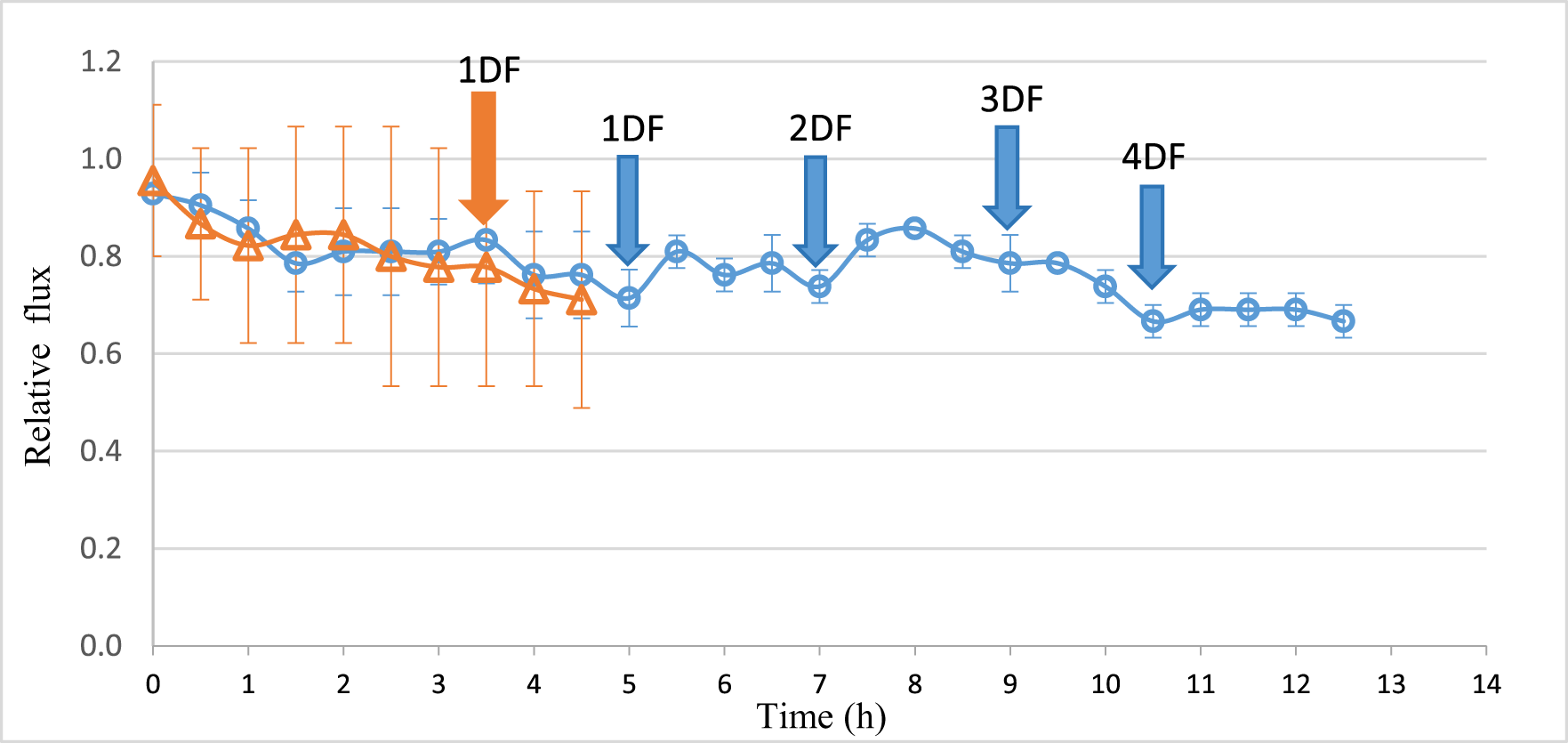
There was a continuous decline in flux during UF with both membranes (Fig. 2). Generally, the permeate flux declines with time and increase in VCF. The increase in flux by pressure is limited by concentration-polarization of solids on the membrane surface especially at the beginning of filtration (Bacchin et al., Reference Bacchin, Aimar and Field2006). A UF membrane can be further blocked in two ways including surface blocking and pore blocking as explained above. Tarapata et al. (Reference Tarapata, Dybowska and Zulewska2022) elucidated that the primary reason for pore blocking in 20 nm ceramic membrane was the presence of α-La and β-Lg in the sweet whey. Besides caseins retention at a level of 7.5 ± 1.7% of total protein in sweet whey which consisted of proteins with MW from 21.5 to 31 kDa (κ-casein, β-casein, αS1 and αS2) were reported as external foulants (Tarapata et al., Reference Tarapata, Dybowska and Zulewska2022).
Relative flux of pre-treated whey during UF and DF at pH 9 and 5 bar with the 9 kDa MWCO membrane (Δ) and pH 7 and 3 bar with 25 kDa MWCO membrane (○) at 50°C.

UF and DF of pre-treated whey
The retentates obtained from the UF trials with both membranes were diafiltered under the same conditions. DF allows more concentration of the retentate from UF by diluting the feed with added water that results in an increase in flux. DF was continued until a VCF of 4 was attained with both membranes (Table 2). Mean flux of permeate was 46.4 L/m2h at pH 7 with 25 kDa-membrane and 29.2 L/m2h at pH 9 with 9 kDa-membrane. Four DF cycles were possible with 9 kDa-membrane to reach the targeted VCF. On the other hand, DF was carried out only once in the case of 25 kDa-membrane, since the flux was very high and there was a significant loss of protein to the permeate. As the flux was higher through 25 kDa-membrane, process time was considerably shorter than that with the 9 kDa-membrane.
The chemical composition of whey during the UF and DF processes is presented in Fig. 3. The protein content in the retentate of both membranes increased (Fig. 3e), while the lactose content decreased due to the DF process (Fig. 3b). The primary purpose of the DF cycles was to further reduce lactose in the retentate by allowing it to pass into the permeate. With the 25 kDa-membrane, only one DF cycle could be applied to prevent excessive loss of CMP. In contrast, with the 9 kDa-membrane, a gradual removal of lactose was observed up to the 4th DF cycle (Fig. 3b). Additionally, in the retentate, the ash content increased with repeated DF cycles when using the 9 kDa-membrane. The accumulation of minerals during DF cycles was likely due to their interaction with proteins, CMP, and the membrane surface (Fig. 3c).
Variation of concentrations (on dry basis) of components of pre-treated whey during UF and DF: (a) dry matter, (b) lactose, (c) ash, (d) α-la, (e) crude protein, (f) β-lg and (g) CMP during UF/DF process at ph 9 with the 9 kDa MWCO membrane (○) and ph 7 with 25 kDa MWCO (∆) at 50°C. W: whey, PW: pre-treated whey.

The major decrease in α-La and β-Lg was observed after pre-treating sweet whey, regardless of the UF/DF process and membrane MWCO (Fig. 3d and f). The UF and DF processes concentrated whey proteins along with CMP. The decline observed after the first DF cycle with the 25 kDa-membrane indicated protein loss, although the final protein content was not significantly different from that obtained after four DF cycles with the 9 kDa-membrane. This protein loss was the main reason for stopping DF with the 25 MWCO membrane. CMP forms aggregates by self-association and also interactions with whey proteins at pH values above 4.5 (Kreuß et al., Reference Kreuß, Strixner and Kulozik2009; Gaspard et al., 2020). Based on our results, it was believed that CMP, which is a stable peptide at 90oC at pH 7 (Siegert et al., Reference Siegert, Tolkach and Kulozik2012; Martinez et al., Reference Martinez, Farías and Pilosof2010), aggregated to large particles after sweet whey pre-treatment at pH 5 (Kilic-Akyilmaz and Karimidastjerd, Reference Kilic-Akyilmaz and Karimidastjerd2018). Therefore, during UF at pH 7 and 9 values CMP can be rejected. The total protein graph shows a continuous concentration increase in both cases.
At pH 7 with 25 kDa-membrane, we observed a small amount of loss in α-La, β-Lg and CMP after 1DF, whereas both CMP and other whey proteins were concentrated in the retentate by DF runs at pH 9 with 9 kDa-membrane. Theoretical molar mass of CMP was reported to be 6–7 for aCMP and 9–11 kDa for gCMP forms at pH 6 (Minkiewicz et al., Reference Minkiewicz, Slangen, Lagerwerf, Haverkamp, Rollema and Visser1996; Mollé and Léonil, Reference Mollé and Léonil2005; Kreuß et al., Reference Kreuß, Strixner and Kulozik2009) which can be rejected by these two membranes. As molar masses of whey proteins (14.2 kDa α-La, 18.3 kDa β-Lg) are larger than MWCO, PES membranes also rejected these proteins. Aggregation of whey proteins and CMP depending on pH can also affect efficiency of separation process by UF/DF (Gaspard et al., 2020). β-Lg typically forms non-covalent dimers with a MW of 36 between pH 5.3 and 8.0 (Bonnaillie et al., Reference Bonnaillie, Zhang, Akkurt, Yam and Tomasula2014). CMP can also polymerize depending on pH, it can form aggregates of 20–50 kDa at pH 7 and 35 kDa at pH 8 (Mikkelsen et al., Reference Mikkelsen, Frøkiær, Topp, Bonomi, Iametti, Picariello, Ferranti and Barkholt2005) that could lead to more rejection of it by the membrane.
Composition of CMP concentrate
PES membrane with MWCO of 25 kDa yielded higher protein and lactose and lower ash contents in the concentrate than 9 kDa-membrane (Table 3). Theoretically, most of lactose and ash could be removed by application of more than one DF step (Baldasso et al., Reference Baldasso, Barros and Tessaro2011). However, the efficiency of DF was limited by the loss of target protein and fouling of the membranes in this study.
Composition of CMP concentrate obtained by UF and DF*

* Values are means ± SD (n = 3). Means marked by different letters in the same column are significantly different (P < 0.05).
CMP content of the concentrate from 9 kDa-membrane was higher compared to that obtained by 25 kDa-membrane (Table 4). Even though the CMP contents of concentrates from two membranes were not similar, their sialic acid contents were similar. This shows that more of CMP isolated with 25 kDa-membrane was gCMP compared to that obtained with 9 kDa-membrane. Part of the gCMP was possibly entrapped by the fouling layer during UF by 9 kDa-membrane. The amount of sialic acid in crude protein (4%) in this study was close to that (4.3%) reported by Martín-Diana et al. (Reference Martín-Diana, Fraga and Fontecha2002).
Protein composition and sialic acid content of isolated CMP concentrate on dry basis obtained by UF and DF*

* Values are means ± SD (n = 3). Different letters in the same column show significant difference (P < 0.05).
Other whey proteins were at similar concentrations in both CMP concentrates. Levels of Phe and Tyr in two concentrates were also similar. The main step that seemed to affect the purity of CMP concentrate was removal of α-La and β-Lg by the pre-treatment of sweet whey before UF. In addition, the concentration of Phe was found as 1.4% in protein. The concentrate contained less Phe in protein than the isolate (2.8%) produced by Martín-Diana et al. (Reference Martín-Diana, Fraga and Fontecha2002).
Recovery of dry matter shows the amount dry matter of sweet whey present in the final concentrate. Most of this dry matter is lactose along with concentrated CMP, whey proteins and minerals. Recovery of CMP from sweet whey was higher with 9 kDa-membrane compared to that by the other membrane (Table 5). Martín-Diana et al. (Reference Martín-Diana, Fraga and Fontecha2002) and Ergül and Karakaya (Reference Ergül and Karakaya2013) reported recoveries of 69–71% by a similar process. The efficiency of UF unit could result in lower recovery of CMP in this study. Nevertheless, the concentrate has high enough purity to be utilized as a dietary and functional food ingredient.
Recovery of CMP and sialic acid from sweet whey by the isolation process

Conclusion
An isolation process for production of a CMP concentrate was developed by UF. The permeate flux in UF was improved by an increase in pH of pre-treated whey from 3 to 9. The highest relative mean flux was obtained at pH 9 with PES membrane with MWCO of 9 kDa and at pH of 7.0 with the 25 kDa-membrane. A volumetric concentration factor of 4 was possible with both membranes by the UF process. The permeate flux from 25 kDa-membrane was higher than that from 9 kDa-membrane, as a result, the process took shorter time. Higher recovery and purity of CMP were obtained with 9 kDa-membrane compared to those with 25 kDa-membrane. Although CMP content of the concentrate obtained by using 25 kDa-membrane was lower, it could be preferred because of lower ash content and shorter process time. Two processes yielded two products with varying amounts of CMP with acceptable purity. The concentrates can be used in suitable dietary and functional food formulations as they contained lower amounts of Phe compared to those present in commercial protein containing powders. The process can be improved by using other UF systems along with membranes made of different materials.
Acknowledgements
This research was supported by the Turkish Scientific and Technological Research Council (TUBITAK) with a project number of 114O172.







 Open access

