

1 Introduction
Taking over the prosecutor’s office is highly ranked in the populist playbook. There is a structural reason: prosecutors command significant investigative powers and operate within hierarchical institutions that, once captured, become effective instruments of political control. Under autocratic direction, they shift from impartial law enforcement to serving as the ruler’s intelligence network – gathering compromising material on opponents, enabling selective prosecution and co-opting potential threats through the credible threat of legal action. The effectiveness of this arrangement depends on having compliant courts to validate whatever cases prosecutors bring; conversely, prosecutors who resist can disrupt the entire logic of lawfare (Boulianne Lagacé and Gandhi Reference Boulianne Lagacé and Gandhi2015; Ríos-Figueroa and Aguilar Reference Ríos-Figueroa and Aguilar2018; Tonry Reference Tonry2012).
While extensive empirical research has examined attacks on judicial systems (Bojarski Reference Bojarski2021, Reference Bojarski2023; Łętowska Reference Łętowska2022; Matthes Reference Matthes2022; Mrowicki Reference Mrowicki2024; Šipulová and Kosař Reference Šipulová and Kosař2023) and strategic judicial behaviour (Brinks et al. Reference Brinks, Levitsky and Murillo2020; Popova Reference Popova2012; Posner Reference Posner2005; Puleo and Coman Reference Puleo and Coman2023; Tew Reference Tew2024; Trochev Reference Trochev2018; Trochev and Ellett Reference Trochev and Ellett2014), understanding of how prosecutors respond strategically to institutional pressure remains considerably underdeveloped. This gap is analytically important because prosecutors face fundamentally different structural constraints than judges: unlike judges who enjoy constitutional guarantees of independence and security of tenure, prosecutors operate within rigid hierarchical structures characterised by immediate subordination to superiors, direct exposure to executive retaliation and substantially weaker formal independence protections. Our knowledge remains particularly limited regarding both individual and collective prosecutorial agency and how these forms of resistance relate to professional culture and psychological independence within prosecutorial institutions (Beers Reference Beers2010; Bobek Reference Bobek2008; Cohen Reference Cohen1990; Čuroš Reference Čuroš2022). Although Trochev and Ellett have emphasised the importance of examining judges’ off-bench activities and coalition-building (Trochev and Ellett Reference Trochev and Ellett2014), no comparable investigation has been undertaken regarding prosecutors. Crucially, we also lack understanding of how to measure the ‘effectiveness’ of prosecutorial resistance. Should success be evaluated by immediate political impact, by preservation of institutional norms and professional standards or by creating foundations for future democratic reconstruction? This conceptual gap represents a significant limitation in understanding how prosecutorial offices function during periods of institutional stress and what role prosecutors can play in defending democratic institutions.
The comparative literature on prosecutorial behaviour under political pressure remains thin and geographically fragmented, which itself underscores the need for systematic analysis. The most developed body of work comes from Latin America, where scholars have examined how prosecutors have leveraged constitutional autonomy provisions and strategic litigation to resist executive encroachment in Argentina and Brazil (Brinks et al. Reference Brinks, Levitsky and Murillo2020; Langer Reference Langer2007; Taylor Reference Taylor2020). In these cases, prosecutorial independence was contested through high-profile corruption investigations, and prosecutors’ capacity to resist depended heavily on public visibility and coalition-building with civil society – patterns that, as this study will show, recur in the Polish case despite very different institutional configurations. Historical cases offer a further reference point: in Northern Ireland during the Troubles, the Director of Public Prosecutions operated under sustained political pressure from both state and paramilitary actors, developing strategies to preserve at least a formal appearance of institutional independence while navigating acute threats to personal safety (Ni Aoláin Reference Ní Aoláin2002). What these cases share – and what distinguishes them from the judicial resistance literature – is that prosecutorial resistance tends to be less visible, more individually exposed and more dependent on informal networks than judicial resistance, precisely because prosecutors lack the constitutional protections and public legitimacy that courts command.
This study examines the strategic approaches that prosecutors use to resist threats to rule of law in Poland (Sadurski Reference Sadurski2019), applying Katarina Šipulová’s three-dimensional analytical framework (Šipulová Reference Šipulová2024). The Polish case offers particularly valuable insights because prosecutors faced systematic institutional capture beginning in 2016, yet developed sophisticated resistance strategies despite their structural vulnerabilities – revealing a paradoxical pattern of limited immediate political effectiveness coupled with significant long-term institutional and cultural achievements.
This study hypothesises that, despite greater structural vulnerabilities than judges, prosecutors can develop sophisticated multidimensional resistance strategies whose effectiveness is better measured through institutional memory preservation, professional solidarity and democratic reconstruction foundations than through immediate political impact. Applying Šipulová’s three-dimensional analytical framework (ŠipulováReference Šipulová2024) to eleven semi-structured interviews with Polish prosecutors, the paper asks: what resistance techniques did prosecutors deploy, and how do these differ from judicial resistance given distinct institutional constraints? What motivated prosecutors to resist despite severe personal risks? And what were the effects of their resistance when measured across both immediate and long-term dimensions?
The analysis is structured as follows. Section 2 establishes fundamental theoretical frameworks and methodological approaches. Section 3 analyses autocratic takeover of the Public Prosecutor’s Office in Poland in 2016. Section 4 examines empirical instances of prosecutorial resistance and categorises them into distinct techniques based on their intended goals, whether prosecutors implemented them through individual or collective action and whether on- or off-bench action. Section 5 explores motivation behind prosecutors’ decisions to engage in resistance activities (or abstain from them) despite career risks. Section 6 shows effectiveness of prosecutors’ resistance, examining both immediate political impact and longer-term institutional preservation. Section 7 presents concluding observations about prosecutorial resistance as democratic preservation and its implications for future democratic reconstruction.
2 Theoretical framework and methodological approach
Šipulová (Reference Šipulová2024) proposed a new way of approaching judicial resistance, dividing it into three dimensions (on- and off-bench mobilisation, motives behind resistance and finally effectiveness of resistance). I argue that this method has a more general character and could be used to understand prosecutors’ resistance against democratic backsliding. Therefore, all three dimensions can be applied to the analysis of prosecutors’ mobilisation.
The first dimension (vertical line) examines whether prosecutors utilise their formal prosecutorial authority and decision-making capabilities for self-protection (so-called on-bench mobilisation – operating within their official capacity, strategically selecting or dismissing cases of governmental significance, timing prosecutorial actions), or employ non-prosecutorial (off-bench) methods: public demonstrations, speeches, media communications, political leverage or indirect influence (Šipulová Reference Šipulová2024) (Figure 1).
Axes of judicial resistance that divide the field in separate but interacting dimensions (Šipulova Reference Šipulová2024) (after second paragraph of Section II).
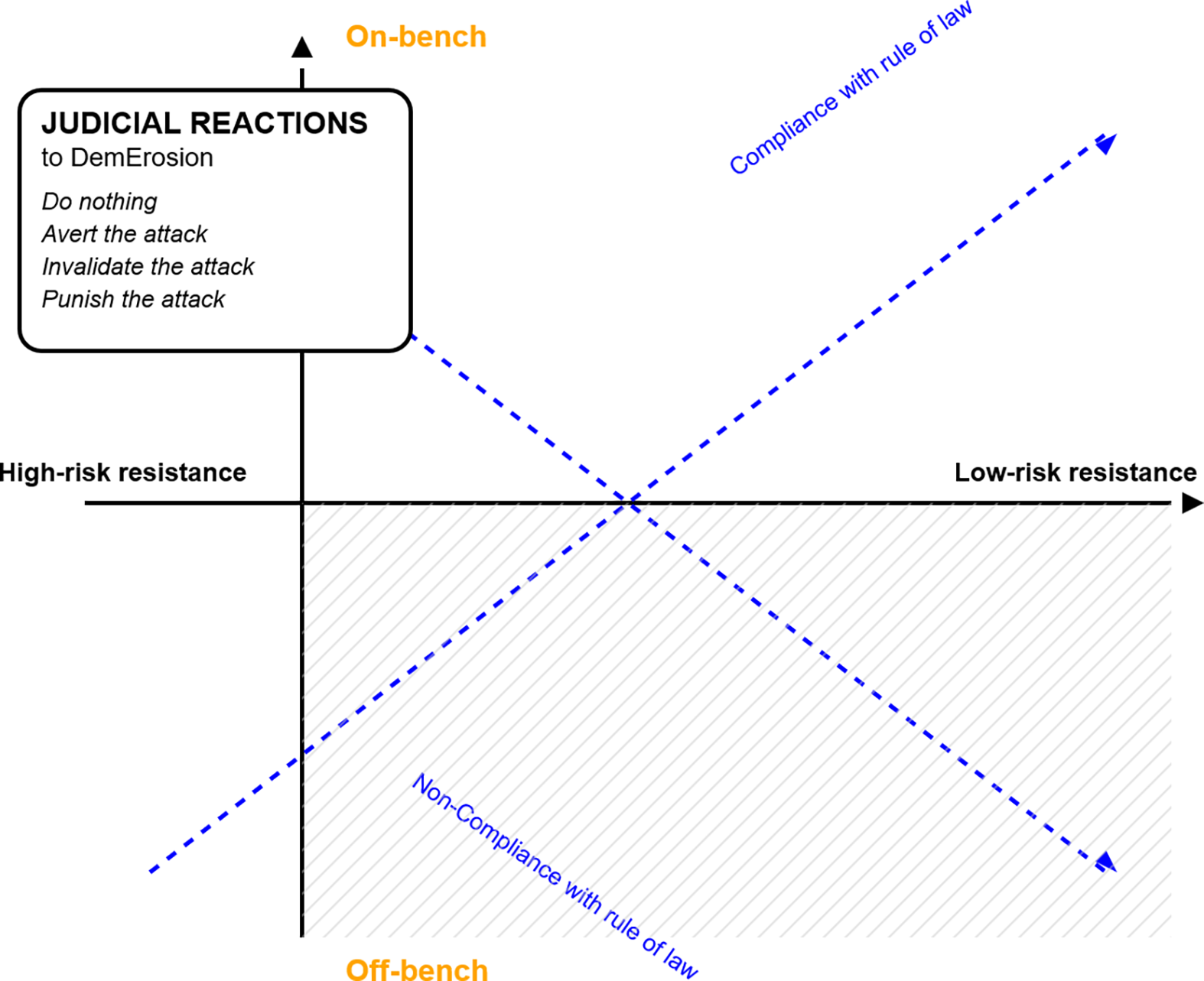
Figure 1. Long description
The diagram illustrates judicial reactions to democratic erosion, featuring a two-dimensional graph with axes labeled ‘High-risk resistance’ to ‘Low-risk resistance’ horizontally and ‘On-bench’ to ‘Off-bench’ vertically. The graph is divided into four quadrants by dashed blue lines, indicating ‘Compliance with rule of law’ in the top right and ‘Non-Compliance with rule of law’ in the bottom left. A box in the top left quadrant lists judicial reactions: ‘Do nothing,’ ‘Avert the attack,’ ‘Invalidate the attack,’ and ‘Punish the attack.’ The diagram suggests that prosecutors’ effectiveness in political control depends on compliant courts and that resistant prosecutors can disrupt the logic of lawfare.
The second dimension (horizontal line) focuses on the individual and collective motivations driving prosecutorial resistance and the associated risks. It contests the notion that resistance represents an inherent democratic virtue of ‘opposition-minded’ prosecutors, proposing instead that it emerges across different political systems and prosecutorial traditions through strategic risk-reward calculations. Rather than representing absolute positions, resistance and compliance with political authorities exist on a spectrum. To comprehend how prosecutorial resistance motivations develop and agency evolves, four elements should be examined: (1) prosecutors’ capacity to identify emerging threats, (2) institutional resources for resistance, (3) personal determination to resist pressure and (4) ability to cultivate supportive coalitions inside or outside prosecutor offices. These alliances may form within various domestic or international legal frameworks, especially regional human rights tribunals like the European Court of Human Rights, and Court of Justice of the European Union (intra-legal networks). Alternatively, prosecutors may forge partnerships with civic actors, political figures, media outlets and civil society organisations, other legal professions (extra-prosecutorial alliances) (Šipulová Reference Šipulová2024).
The third dimension (blue line) evaluates how resistance strategies impact prosecutorial autonomy and rule of law principles, examining whether prosecutorial approaches align with or contravene rule of law standards (Graver Reference Graver2018; Jakab Reference Jakab2022). This analysis considers immediate consequences of resistance methods, intermediate effects on prosecutorial systems’ capacity to counter democratic decline and long-term impacts on institutional durability within democratic prosecutorial frameworks. This dimension investigates connections between resistance activities, public legitimacy of prosecutorial institutions and citizen confidence in prosecutorial systems. It encourages future research to address nuanced questions about prosecutorial roles in democratic governance and expected behaviours as democratic institutional guardians (Šipulová Reference Šipulová2024).
Šipulová’s methodology allows us to analyse ‘prosecutorial resistance as opposition to illegitimate interference with prosecutorial independence and autonomy’ (Šipulová Reference Šipulová2024).
3 Takeover of the prosecutor’s office in Poland
Since 1989, Poland’s prosecutor’s office has remained vulnerable to political manipulation despite democratic transition. During the collapse of communism in 1989–90 across Poland and Central-Eastern Europe, transforming the criminal justice apparatus – particularly the prosecution service – ranked among the new administration’s top reform priorities. Through a compromise agreement between anti-communist forces and the Communist Party in 1989, the authorities decided to restore the pre-war arrangement whereby the justice minister simultaneously served as chief prosecutor. The opposition believed this structure would eliminate Communist Party control over prosecutorial functions (Krajewski Reference Krajewski2012).
However, the prosecution service essentially remained intact in all other respects: maintaining its inflexible, top-down organisational framework based on strict adherence to hierarchical authority. Crucially, nearly all prosecutors from the communist period kept their posts, with minimal exceptions. While this continuity may have been unavoidable, it meant the reformed prosecution service continued operating under personnel thoroughly indoctrinated in the previous system’s culture of institutional compliance (Krajewski Reference Krajewski2012).
These structural flaws created lasting problems. Operating as a hierarchical institution answerable to the minister of justice, the prosecution service became vulnerable to political interference and control. This vulnerability encountered minimal internal opposition from staff. Poland’s recent two-decade history demonstrates numerous instances in which politicians swayed prosecutorial decisions for partisan reasons, reaching its worst extremes during 2005–07 and 2015–23 under Law and Justice Party rule. Such interference significantly undermined public confidence in the prosecution service’s credibility and autonomy (Krajewski Reference Krajewski2012).
On 4 March 2016 the 2016 Law on the Public Prosecutor’s Office of 28 January 2016 entered into force. The major change consisted of the merger of the office of the Public Prosecutor General and that of the Minister of Justice. At the same time the prerogatives of the Prosecutor General were enhanced in an unprecedented manner, including, among others, giving orders concerning the content of individual cases (Art. 7 § 1–3), changing or revoking a decision of a subordinate public prosecutor (Art. 8), handling of the case by the superior public prosecutor (Art. 9 § 2), relations with the media and communication of information to ‘other persons’ (Art. 12), appointment of provincial, regional and district public prosecutors (Art. 74), appointment to vacant positions without conducting a competition (Art. 80), delegation of a public prosecutor of a universal prosecutorial body to the Ministry of Justice or any other prosecutorial body subordinate to the Minister of Justice (Art. 106 § 1).
According to Sadurski, the 2016 law ‘put an end to the principle of the independence of public prosecutors’ by following ‘3D principle: degradation, delegation and disciplining’ (Mistygacz Reference Mistygacz, Mistygacz, Onyszczuk and Szeroczyńska2023, p. 20), which was the declared aim of the earlier law of 2009. From this time, as Michał Mistygacz put it, we are witnessing the ‘hyper politicization’ of the prosecutor’s office (the prosecutor’s office performing a quasi-political role) (Mistygacz Reference Mistygacz, Mistygacz, Onyszczuk and Szeroczyńska2023). The new law strengthened ‘centralized subordination’ of the prosecutor’s office, giving the Prosecutor General the possibility to intervene in every investigation by giving orders, transferring cases to another prosecutor, amending decisions of other prosecutors and showing the files to anybody. The Prosecutor General may also delegate a prosecutor to another office at any hierarchical level notwithstanding the distance from the current place of residence for up to twelve months a year (Sadurski Reference Sadurski2019, p. 125).
Such a centralised structure required new people, new submissive prosecutors who would consolidate the new system. Old prosecutors at the same time had to be verified. ‘The main goal was to carry out a large-scale personnel purge’, says Prosecutor 1. Therefore, the cosmetic reorganisation of prosecutors’ offices – renaming them while keeping the same structure – allowed the authorities to exchange prosecutors within the system by rewarding those submissive and demoting the most critical ones. In this way, twenty-two prosecutors from the Prosecutor General’s office and ninety-one prosecutors from the Appellate Prosecutor’s Office were demoted to the district or regional prosecutor’s office (Sadurski Reference Sadurski2019, p. 126). In this way, the organisation and operation of the prosecutor’s office was ‘Putinized’ and the related oligarchising occured with elements of discretion (awarding awards, housing allowances, allowances for top-level prosecutors, delegations, promotions to higher offices without any competition) (Mistygacz Reference Mistygacz, Mistygacz, Onyszczuk and Szeroczyńska2023, p. 20). According to Jarosław Onyszczuk, centralisation and one-person management became the guiding values, which, using hierarchy, were ‘to ensure the possibility of appropriate control of the work of prosecutors and the use of their tasks for specific political purposes’ (Onyszczuk Reference Onyszczuk, Mistygacz, Onyszczuk and Szeroczyńska2023, pp. 93–94). It turned out that from the media perspective, the activities of the prosecutor’s office are much more important than the court’s ruling issued after a few years. As Onyszczuk put it, ‘The measurable benefits of presenting a political opponent in a bad light, the use of PR information about the operation of the body or ensuring a certain degree of protection for colleagues from a political party were decisive in including the prosecutor’s office in the structures of the executive power’ (Onyszczuk Reference Onyszczuk, Mistygacz, Onyszczuk and Szeroczyńska2023, p. 163).
The result was also easy to predict – immobility combined with passivity of prosecutors – which ‘make up the lack of thinking remaining in the background of the banality of evil in the prosecutor’s office, leaving its negative mark on the education of the modern criminal process. The current model of the prosecutor’s office will be a palimpsest of the Leninist system, and in terms of the guardians of the prosecutor’s authority, the DNA of the «Soviet prosecutor»’ (Mistygacz Reference Mistygacz, Mistygacz, Onyszczuk and Szeroczyńska2023, p. 19). The prosecutor’s office was dying in silence and peace and no other legal association supported prosecutors. ‘We were like orphans that no one cared about. Professional solidarity appeared only after the judges were attacked. The first president of the Supreme Court apologized to us afterwards, saying that if she had been able to do so, she would have approached the case differently’, says Prosecutor 1.
4 Techniques applied in prosecutors’ resistance
4.1 On-bench resistance
The phenomenon of prosecutorial resistance in Poland can be understood through the lens of ‘on-bench mobilization’ – actions taken by prosecutors within their official capacity to resist political interference and protect prosecutors’ independence. This form of professional resistance is systematically organised into two distinct but complementary categories: individual actions and collective actions, each employing different mechanisms and leverage points within the prosecutorial system.
4.1.1 On-bench individual resistance
Individual actions represent the most immediate and personal forms of resistance available to prosecutors facing political pressure. These encompass a broad spectrum of strategies, ranging from formal legal challenges and procedural resistance to conscience-based decisions in daily prosecutorial work. Individual prosecutors utilise their professional autonomy and legal knowledge to challenge inappropriate orders, demand written justifications, file lawsuits against their employers and provide mutual support through informal networks and formal defence representation. This category also includes public positioning where individual prosecutors articulate critical stances in their professional communications and disciplinary proceedings.
Legal challenges and complaints represent the most formal avenue of resistance available to prosecutors operating within the judicial system. These actions involve prosecutors using established legal mechanisms to challenge institutional decisions that they view as compromising their professional independence or violating their statutory rights. As one prosecutor explained: ‘I have taken cases to the labor court twice. The first case concerned the discriminatory application of a regulation to me and my being posted outside my place of residence without my consent, and the second case I took to the labor court concerns incorrect calculation of remuneration, contrary to applicable regulations’ (Prosecutor 10). These cases have addressed discriminatory postings, incorrect salary calculations and violations of fundamental prosecutorial rights, demonstrating prosecutors’ willingness to use external judicial review to protect their professional autonomy. Another prosecutor noted: ‘As a citizen, I filed a lawsuit against the district prosecutor in the labor court because my demotion had caused certain financial consequences’ (Prosecutor 3). Similarly, when prosecutors take disciplinary cases to court or file motions against the State Treasury, they are essentially forcing the system to justify its actions through transparent legal processes, creating a paper trail and public record that can expose potential abuses of authority.
When facing disciplinary proceedings themselves, some prosecutors adopt an aggressive defence strategy that transforms potential punishment into platforms for broader critique. As one prosecutor states: ‘each of my disciplinary cases contains an element of opposition and criticism. I don’t apologize, I attack. I justify the views I expressed in the media, expanding on and supplementing them with the critical state of democracy in Poland and the role of the prosecutor’s office, which fails to promote the rule of law’ (Prosecutor 9). This approach demonstrates how individual resistance can serve broader democratic and institutional purposes, turning personal defence into systemic critique.
Procedural resistance focuses on leveraging bureaucratic requirements and formal procedures as tools of opposition. This approach recognises that modern legal systems depend heavily on documentation and proper procedure, making these requirements potential pressure points for resistance. As one prosecutor emphasised: ‘According to the law governing the prosecutor’s office, I have the right to demand justification for various orders given or formulated regarding me, as well as a legal basis’ (Prosecutor 10). When prosecutors demand written justifications for orders, submit mass exclusion applications or refuse to comply with verbal orders lacking proper documentation, they force supervisors to formalise their instructions and create accountability mechanisms. One prosecutor described this strategy: ‘Under the current regulations, these include demands for written justifications for decisions and the mass submission of applications for exclusion, because I can do that. Throughout the entire procedure, I demand written instructions, I demand instructions with justification, and I submit applications for exclusion from specific activities’ (Prosecutor 10). Another prosecutor explained how refusing verbal orders works in practice: ‘I never received a written order. So I had nothing to object to in writing, and nothing to demand justification for. No one ever gave me a written order. Therefore, whenever I heard someone say something on the phone, or someone pressed something, I simply told them what I thought about it’ (Prosecutor 8). This form of resistance is particularly effective because it operates within existing rules and procedures, making it difficult for authorities to characterise such actions as insubordination while simultaneously slowing down or complicating the implementation of potentially problematic directives.
Conscience-based resistance represents the most principled form of on-bench opposition, where prosecutors invoke higher legal authorities and ethical standards to justify their refusal to comply with specific orders. This approach involves prosecutors positioning themselves as defenders of fundamental legal principles by refusing orders that they believe violate prosecutorial independence, citing Supreme Court resolutions even when instructed otherwise, or applying European directives that have not yet been implemented in Polish domestic law. One prosecutor explained: ‘Such an example would be the instructions issued by the National Prosecutor regarding the omission of Supreme Court resolutions in our current practice, which the National Prosecutor considers inappropriate. However, I am bound by Supreme Court resolutions and cannot omit them’ (Prosecutor 10). Another prosecutor described working with European directives: ‘There’s a directive that says a suspect should have a defence attorney from the very beginning … I have done so practically since I learned that this Polish directive is in force, even though it hasn’t been implemented, which is 2017’ (Prosecutor 7). One prosecutor describes this approach: ‘I try to conduct proceedings, even those where there is pressure, as if there were no pressure. I try to file motions, write decisions, request penalties, and avoid applying this pressure, even the punitive pressure that has been introduced’ (Prosecutor 8). This form of quiet resistance allows prosecutors to maintain professional integrity while technically complying with their duties. This resistance demonstrates prosecutors’ commitment to what they perceive as the true rule of law, with one prosecutor emphasising: ‘Not consulting decisions with superiors, making them in accordance with one’s beliefs, the law, in one’s own name’ (Prosecutor 9). Some prosecutors demonstrate remarkable legal creativity by invoking higher legal standards, including European directives not yet implemented in Polish law. One prosecutor describes applying EU standards in practice: ‘I have done so since I learned that this Polish directive is in force, even though it hasn’t been implemented, which is 2017. At every opportunity, if I dealt with a detainee who later became a suspect and did not have one … I utilized this directive’ (Prosecutor 7). This approach illustrates how prosecutors can draw on supranational legal frameworks to maintain higher professional standards.
Professional support activities illustrate how individual prosecutors extend their resistance beyond their own cases to create networks of mutual aid and shared knowledge within the profession. When prosecutors serve as defence attorneys for colleagues facing disciplinary action or provide informal advice on resisting institutional pressure, they build a supportive infrastructure that strengthens the collective capacity for resistance. As one prosecutor explains: ‘I serve as a voluntary defence attorney in disciplinary proceedings and in this way provide legal assistance to my fellow prosecutors’ (Prosecutor 10). This solidarity network extends beyond formal representation to encompass informal advice and support for colleagues facing pressure or unclear directives. The importance of quality legal representation is emphasised by another prosecutor who described: ‘What I did with my disciplinary proceedings was hire the best lawyer I could find’ (Prosecutor 8). Beyond formal legal assistance, prosecutors provide informal support and strategic advice: ‘However, even in matters of perhaps informal nature, yes, exactly, when there’s a problem and people don’t know how to solve it, how to deal with it, how to circumvent this pressure, how to resist, what to do, yes, they can always count on my support’ (Prosecutor 8). This form of solidarity is particularly important because it helps isolated prosecutors understand that they are not alone in facing pressure and provides them with practical strategies and moral support for maintaining their independence. Such peer-to-peer assistance creates an informal but vital support system that enables sustained resistance efforts across the prosecutorial corps.
4.1.2 On-bench collective resistance
Collective actions, by contrast, leverage the institutional structures of prosecutorial self-governance to create systemic resistance and establish broader protections for prosecutorial independence. These efforts focus on professional associations, regional assemblies and formal resolution-passing bodies that can articulate collective positions on prosecutorial autonomy. Through coordinated participation in self-government forums and institutional policy initiatives, prosecutors work to establish ‘internal law instruments’ that provide structural safeguards against political interference.
The interplay between individual and collective resistance strategies demonstrates a sophisticated understanding of institutional dynamics, where personal professional integrity is supported by broader structural reforms, and where individual acts of conscience contribute to collective efforts to maintain the rule of law. Together, these on-bench mobilisation strategies represent a comprehensive approach to defending prosecutorial independence within an increasingly politicised judicial environment.
Professional self-government serves as the primary institutional framework through which prosecutors engage in collective resistance within their official capacity. Through active participation in prosecutors’ associations and self-government structures, individual prosecutors can amplify their voices and coordinate their opposition to problematic policies or practices concerning their independence. This participation extends beyond mere membership to active engagement in formal deliberative processes where prosecutors can collectively articulate their professional concerns and challenge institutional directions. The self-government forum provides a legitimate space for prosecutors to express dissent while remaining within established professional structures, as another prosecutor noted: ‘I take a position on the prosecutors’ self-government forum’ (Prosecutor 10). These venues allow prosecutors to transform individual grievances into collective professional positions, lending greater weight and legitimacy to their resistance efforts.
Institutional resolutions represent one of the most formal mechanisms through which prosecutors can collectively challenge policies they view as threatening their independence or violating legal principles. These resolutions serve as ‘internal law instruments’ that create formal records of professional opposition and establish shared standards among the prosecutorial corps. One prosecutor described this process: ‘I initiate the adoption of resolutions in this regard. For example, in 2019, such a resolution was adopted and passed at my initiative in the Krakow professional self-government, at the Krakow region prosecutors’ assembly. It concerned, among other things, ensuring prosecutorial independence, which was being violated. It is a kind of internal law instrument, one might say, a resolution of the prosecutors’ self-government’ (Prosecutor 10). These resolutions function as collective statements of principle that can guide individual prosecutors’ actions while providing them with institutional backing for their resistance. By using self-government forums to address systemic issues, prosecutors create formal documentation of their professional concerns and establish precedents that can influence future decisions and policies within the prosecutorial system.
Coordinated professional stance remains the most challenging aspect of collective on-bench resistance, as it requires widespread participation to achieve meaningful impact. The effectiveness of procedural resistance tools depends heavily on their collective application, yet achieving such coordination proves difficult within the hierarchical structure of the prosecutor’s office. Building mutual support networks among like-minded prosecutors remains crucial for sustaining resistance efforts and providing both practical assistance and moral support to those who choose to challenge problematic orders or policies. The success of coordinated resistance depends on overcoming the individualistic culture within the prosecutorial system and fostering greater solidarity among prosecutors committed to defending their professional independence.
4.2 Off-bench resistance
Off-bench mobilisation encompasses prosecutors’ resistance activities conducted outside their formal prosecutorial duties, including public engagement, advocacy and civic participation. Unlike on-bench resistance, which operates within the official prosecutorial framework, off-bench mobilisation allows prosecutors to leverage their professional expertise and public credibility in civilian contexts to defend democratic institutions and the rule of law. This form of activism demonstrates how legal professionals can transcend their institutional roles to become public intellectuals and civic leaders.
The taxonomy of prosecutors’ off-bench mobilisation activities reveals a sophisticated and comprehensive resistance framework that extends far beyond their formal institutional roles. This taxonomy demonstrates how legal professionals have systematically developed multilayered strategies to defend judicial independence and democratic principles through civilian engagement, public advocacy and professional solidarity. The breadth of these activities – spanning from individual media engagement to coordinated international co-operation – illustrates the transformation of prosecutors from institutional actors into public intellectuals and civic leaders committed to preserving the rule of law.
Together, these individual and collective off-bench mobilisation strategies create a multidimensional resistance ecosystem that operates simultaneously on local, national and international levels. This comprehensive approach allows prosecutors to maintain pressure for judicial independence through diverse channels, ensuring that setbacks in one area can be compensated for by progress in others. The integration of personal professional expertise with collective organisational capacity demonstrates how legal professionals can effectively challenge authoritarian tendencies while maintaining their commitment to democratic institutions and constitutional principles, creating a model for professional resistance that extends beyond the prosecutorial context to encompass broader democratic defence strategies.
4.2.1 Off-bench individual resistance
Individual off-bench actions encompass eight distinct categories of resistance, ranging from media and public communication strategies to legislative policy work and information gathering initiatives. These individual activities allow prosecutors to leverage their professional expertise and public credibility to educate citizens, influence public discourse and offer mutual support within their professional community. Through academic scholarship, public speaking and strategic media engagement, individual prosecutors create intellectual foundations for resistance while building networks of support that transcend traditional institutional boundaries.
Media and communication represent a crucial avenue through which prosecutors engage with the broader public to challenge legislative changes and defend rule of law principles. Prosecutors have embraced multiple communication channels to amplify their voices beyond the courtroom, recognising the power of media engagement in building public support for their cause. As one prosecutor explained: ‘I publicly express my views, whether on social media, on Facebook, or on Twitter. These also include longer texts in the press, as well as statements for visual media, television, and radio. I do not shy away from these types of statements, and they are available there. I have no problem with taking a public position, also through various media, and presenting my position on these matters’ (Prosecutor 10).
Social media platforms, particularly Twitter, have become essential tools for rapid information dissemination and network building. One prosecutor noted: ‘I quickly discovered the charms of Twitter, not even in an individual sense, but in terms of what a great source of quick information it is’ (Prosecutor 7). The strategic importance of media engagement extends beyond mere communication, as prosecutors have discovered that ‘the media also becomes the only defence for such a harassed prosecutor at a certain point’ (Prosecutor 7). This comprehensive approach to media engagement includes everything from national television appearances to local radio interviews, with prosecutors deliberately casting a wide net: ‘I think I have undertaken everything. Interviews, not just for television, national media, or local media, but all kinds of radio stations, online media’ (Prosecutor 7).
Information sharing operates through both formal and informal networks, utilising digital communications and personal relationships to ensure that critical information reaches colleagues and citizens. One prosecutor described this comprehensive approach: ‘Yes, I’m present on social media. What is happening within the broader fight to restore the rule of law, if I have access to positions, press articles, or information regarding individual events, I obviously try to share it as widely as possible. Whether on my social media profiles or in direct conversations, I also sent information via instant messaging, even electronic ones, or by printing out messages, articles, and positions and simply distributing them to colleagues at work’ (Prosecutor 10). This information sharing extends to providing direct assistance to colleagues facing similar challenges, as illustrated by one prosecutor’s account: ‘After reading that article, I spontaneously wrote – I have emails like that, so we can all write to each other throughout the prosecutor’s office. I wrote to this person … And he asked if he could use it in my own proceedings or show these emails about my experiences in the comments. I said, sure, you can show it, you can use me as a witness’ (Prosecutor 8).
Academic and scholarly work provides prosecutors with a platform to develop sophisticated critiques of legal reforms while maintaining their professional credibility through scholarly discourse. This approach allows prosecutors to contribute substantive analysis that goes beyond political commentary, offering detailed legal arguments and constitutional analysis. One prosecutor described his scholarly contributions: ‘Not on social media, but on the Lex Super Omnia (“LSO”) website, there are a few of my texts like that … But I also published, for example, one of the first texts I published on the LSO website, about assessors. It was a very scholarly text … Then, my first big text, which was a commentary on the changes in general, appeared in this Krakow-based journal of criminal law and penal sciences’ (Prosecutor 8). The strategic value of scholarly work extends to providing practical tools for fellow prosecutors, as the same prosecutor explained: ‘I tried to give prosecutors a tool too, I said scientific, right? Because that is a position they can use’ (Prosecutor 8).
Educational activities with students represent another important dimension of this academic engagement, with prosecutors actively participating in university programmes. As one prosecutor detailed: ‘I work on the education team we established at the University of Warsaw. They are implementing two projects at universities: “From Trainee to Independent Prosecutor”, a project aimed at students – discussions about independent prosecutors and judges, and compliance with constitutional standards’ (Prosecutor 4). These academic activities serve both immediate educational purposes and longer-term goals of cultivating future legal professionals who understand the importance of prosecutorial independence.
4.2.2 Off-bench collective resistance
Collective off-bench mobilisation represents an even more extensive and coordinated approach, incorporating nine major categories of joint action that demonstrate the power of organised professional resistance. These collective strategies include formal protests and public demonstrations, interprofessional solidarity networks, international co-operation initiatives and comprehensive civic education campaigns. The systematic nature of these collective efforts – from WhatsApp forums for information sharing to coordinated legal strategy development – reveals how prosecutor associations have evolved into sophisticated advocacy organisations capable of mounting sustained resistance to political interference. To facilitate this collective resistance, the prosecutors’ association was established.
In response to the growing centralisation of the prosecutor’s office in Poland, a group of prosecutors – mostly demoted after the structural changes in 2016 – decided to establish an association of prosecutors. The initiative to establish an independent association of prosecutors was born in the spring of 2016. The primary goal of such an association was to make the prosecutor’s office a constitutional body.
Already in 2016, the prosecutors started the registration process of their association LSO. It comprised fifty founding members from across Poland. The first and second attempts to register the association were, however, unsuccessful. The Warsaw Regional Prosecutor in Warsaw demanded from the court a copy of the association’s founding documents and a list of founding members. Finally, on 4 January 2017, ten founding members formally established the Association of Prosecutors LSO and held the inaugural election of the Association’s governing body. Today it has 270 members – relatively few given the total of some 6,000 prosecutors in Poland. Prosecutor Krzysztof Parchimowicz became the first president of the board.
Among the objectives of the association there are: supporting activities undertaken to implement the rule of law, ensuring the subjectivity, independence and autonomy of prosecutors in decision-making and counteracting any unlawful violation of their independence; actions to create conditions for prosecutors to perform their tasks reliably, objectively and impartially, with respect for the rights and freedoms of the individual and the public interest; shaping ethical attitudes of prosecutors, with particular emphasis on care for the honour and dignity of the profession; reliable presentation of its activities in the mass media, promoting the rule of law and publicising the importance of the independence of the prosecutor and the position of a strong and objective prosecutor’s office in a democratic state ruled by law; and popularising the law.
The Association pursues its goals by representing the prosecutorial community before state authorities and presenting in the public forum, including the mass media, problems related to its functioning; reporting legislative needs and giving opinions on legal acts on matters relating to the prosecutor’s office; conducting non-profit publishing, educational and training activities by organising conferences, seminars and training for prosecutors and organising cultural events corresponding to the objectives of the Association; co-operation with national and international organisations of lawyers, including associations of judges and prosecutors; and organising, in justified cases, material and legal assistance for members of the Association.
Members of the association faced repressions. In January 2021, seven prosecutors from LSO were relegated far away from their previous posting and place of residence. They were given two days to pack up their life and move to cities located about 300 km away from their homes, where they were about to spend the next six months separated from their families. ‘Repression does not leave a negative impression on us. The volume of harassment motivates me more to fight. I will fight to the end to eliminate lawlessness. The National Public Prosecutor’s Office shows helplessness, weakness, high emotionality, and does not know how to deal with resisting prosecutors. I am ready to be discharged from my profession’ says Prosecutor 1.
The association documents and archives the repressions faced by the prosecutors. The association co-operated with the media: Oko Press, Onet, Gazeta Wyborcza to spread information to the public. The prosecutors meet with the citizens and inform them about the current situation of the prosecutor’s office, the jeopardised independence.
Prosecutors also receive support from the civic organisations such as Wolna Prokuratura (Free Prosecutor’s Office).
According to Prosecutor 2, there is too little activity within the prosecution community as the association focuses primarily on citizens, on opposing the violation of the rule of law. ‘We are not working enough in our own environment, and this is a thing to change in order not to be perceived as elite – the palace prosecutors who come to work and finally see what work in the prosecutor’s office is all about. However, we proved that we are the same, but the association should concentrate more on activities towards prosecutors to open their eyes. Annual reports published by the association (now 4th edition) – “The Prosecutor’s Office of Good Change” – could be sent to every prosecutor’s office. In my office in Warsaw, I noticed that people were asking when the next report would be. We are just learning our professional identity, solidarity, and public prosecutor’s self-governance in the prosecutor’s office, although prosecutor’s offices have existed since the dawn of history.’
Collective off-bench mobilisation through professional associations represents the most organised form of external resistance, with prosecutors coordinating comprehensive public advocacy campaigns. The Association of Prosecutors LSO has developed extensive networks with other legal professional organisations: ‘Such cooperation, of course, is being undertaken between the Association of Prosecutors and the Judges’ Associations, Iustitia and Themis, and the Defensor Iuris Bar Association’ (Prosecutor 10). These interprofessional alliances amplify prosecutors’ voices and create unified fronts for defending judicial independence.
Legislative work demonstrates how prosecutors actively participate in policy development to counter problematic reforms. This participation represents a more formal dimension of resistance, with prosecutors actively participating in drafting alternative legislation and reviewing proposed bills. As one prosecutor explained: ‘Well, the bill … And I was part of the team that prepared this bill … And the idea was how to build this prosecutor’s office so that it’s independent but also efficient’ (Prosecutor 8). Another prosecutor described formal legislative review responsibilities: ‘Today, I lead a 10-person team of legislative prosecutors and review almost all bills submitted to the Senate concerning access to justice. Our opinions are published on the Senate website. I also participated in the public hearing on March 5, 2020, of the Senate’s draft bill on the National Council of the Judiciary’ (Prosecutor 4).
International engagement reflects prosecutors’ efforts to leverage European institutions and international law to challenge domestic restrictions on prosecutorial independence, though with mixed results. This strategy includes both formal complaints to international bodies and efforts to build transnational professional networks. However, prosecutors have discovered limitations in the effectiveness of international mechanisms, as one prosecutor noted curtly: ‘Complaints to the ECtHR – no effect yet’ (Prosecutor 4). Despite these limitations, prosecutors continue to pursue international channels, including participation in European forums where one prosecutor mentioned: ‘I’m giving speeches, or at a European forum’ (Prosecutor 7).
The use of transparency mechanisms represents another dimension of international engagement, though prosecutors face increasing restrictions in accessing information. As one prosecutor explained: ‘We strive to be reliable because we collected all information under the Access to Public Information Act. Unfortunately, we are increasingly being deprived of this right… Currently, the association has filed numerous complaints with various administrative courts in Poland regarding the refusal to provide us with information about financial awards’ (Prosecutor 1). This international dimension of resistance demonstrates prosecutors’ understanding that threats to rule of law require responses that transcend national boundaries, even as they encounter the practical limitations of international institutions in providing immediate relief from domestic repression.
Organised public events and educational campaigns demonstrate the collective capacity of prosecutor associations to reach broad public audiences. These initiatives include festivals, conferences and community meetings: ‘These meetings are also part of educational activities we conduct with students at Polish universities … As an association, we also conduct meetings with seniors as part of our dialogue with universities of the third age’ (Prosecutor 10). Such systematic outreach builds public understanding of prosecutorial roles and democratic principles.
Collective solidarity and mutual support networks provide crucial emotional and practical assistance for prosecutors facing political persecution. This solidarity extends beyond professional boundaries: ‘all harassment and repression against prosecutors is documented by the association. We track these cases, and in our latest report, titled “The Stick Method”, there’s a list of names and charges against prosecutors’ (Prosecutor 1). This documentation and publicity strategy transforms individual persecution into collective resistance narratives.
The integration of individual and collective off-bench mobilisation strategies creates a comprehensive resistance ecosystem that leverages both personal expertise and institutional resources. As one prosecutor reflects on the evolution of this movement: ‘Changing attitudes is also a matter of integrating the legal community with civic communities. Most judges and prosecutors, expressing constructive criticism of the justice reforms, face various professional and disciplinary proceedings. Who supports us? Engaged citizens’ (Prosecutor 4). This symbiotic relationship between legal professionals and civil society demonstrates how off-bench mobilisation can transcend professional boundaries to create broader democratic movements, ultimately strengthening both prosecutorial independence and civic engagement in defence of the rule of law (Table 1).
Taxonomy of prosecutors’ resistance actions (on- or off-bench, individual or collective). Author: Marcin Mrowicki (in the end of the Section IV)
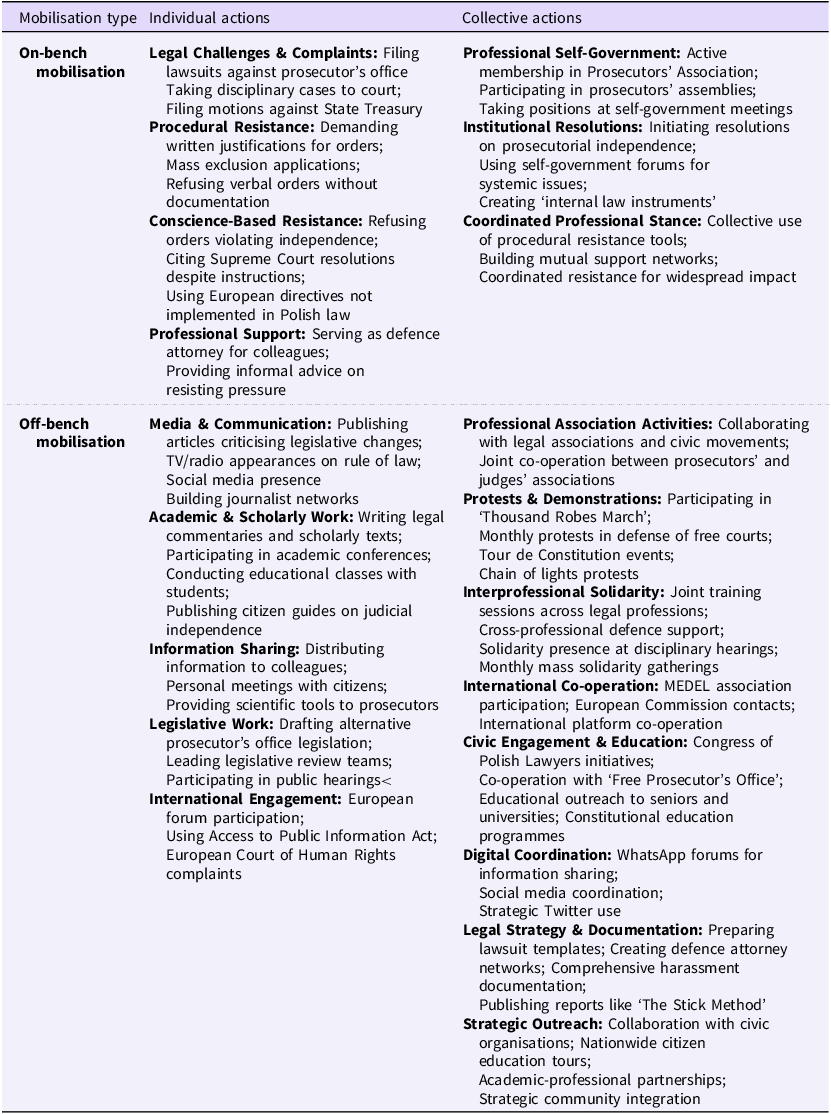
Table 1 Long description
A table categorizing prosecutors’ resistance actions by type and mobilization strategy. The table is divided into four quadrants based on on-bench or off-bench mobilization and individual or collective actions. On-bench mobilization includes legal challenges and complaints, procedural resistance, conscience-based resistance, and professional support. Off-bench mobilization includes media and communication, academic and scholarly work, information sharing, legislative work, international engagement, professional association activities, protests and demonstrations, interprofessional solidarity, international cooperation, civic engagement and education, digital coordination, legal strategy and documentation, and strategic outreach. Each quadrant lists specific actions taken by prosecutors.
Polish prosecutors developed a sophisticated repertoire combining on-bench strategies – filing motions challenging illegitimate superiors, refusing transfers, documenting systematic abuse – with off-bench mobilisation through professional associations, media engagement, public demonstrations and coalition-building with judges and civil society. Unlike judicial resistance, which primarily operates through formal adjudication, prosecutorial resistance required greater reliance on civilian advocacy precisely because hierarchical subordination limited institutional resistance capacity. This dual-track approach leveraged institutional knowledge while building broader democratic coalitions.
This pattern resonates with what Trochev and Ellett (Reference Trochev and Ellett2014) identified in their analysis of judicial off-bench resistance: when formal institutional channels are closed or captured, legal professionals displace resistance toward external arenas – building coalitions, cultivating public legitimacy and leveraging international networks. For prosecutors, structural constraints accelerated this displacement further than for judges. Where judges could invoke their constitutional independence as a legal shield when refusing to apply politicised norms, prosecutors’ hierarchical subordination meant that on-bench resistance exposed them immediately to disciplinary sanction or forced transfer. The result was a resistance repertoire that is paradoxically more publicly engaged and socially embedded than judicial resistance, precisely because internal institutional space was so constrained. This echoes the observation by Brinks et al. (Reference Brinks, Levitsky and Murillo2020) that actors in institutionally weak positions often compensate through informal network-building and external legitimation – turning structural disadvantage into a driver of broader coalition formation. The cross-professional solidarity documented here – unprecedented by prosecutors’ own accounts – illustrates this dynamic: unable to resist alone through institutional channels, prosecutors forged alliances with judges, civil society and international bodies that amplified their reach well beyond what their numbers would suggest.
5 Motives behind the prosecutors’ resistance
Based on the research, prosecutors’ motivations for resistance and mobilisation stem from multiple interconnected concerns about the justice system and their professional roles. Here, as mentioned before, we will examine four elements, according to Šipulová’s typology: (1) prosecutors’ capacity to identify emerging threats, (2) institutional resources for resistance, (3) personal determination to resist pressure and (4) ability to cultivate supportive coalitions inside or outside prosecutor office.
The research shows that the resisting prosecutors did not have any problems with identifying emerging threats. They centred their resistance on defending democratic principles. As one prosecutor explained, ‘I consider myself more of a member of the group of people who disagree with the violation of the rule of law in a broader sense than just the unconstitutionality of the proposed changes’ (Prosecutor 10). This extends beyond partisan politics to core democratic values, with prosecutors believing that ‘the rule of law, the foundations of a democratic state governed by the rule of law as enshrined in the Constitution, and the founding principles of the European Union should be applied’ (Prosecutor 3). Civic duty as public officials compels prosecutors who feel a particular responsibility to defend democratic institutions. One prosecutor explained: ‘The fundamental point was that I disagreed not only as an ordinary citizen, but also as a public official, with what was happening in the judiciary, the proposed changes, and the treatment of judges … it’s not only in my interest as a citizen to have independent courts and independent judges, but also as a public official, as a prosecutor’ (Prosecutor 10).
Regarding the institutional resources for resistance, it must be noted that what distinguishes the prosecutor’s office from the judiciary are the principles of hierarchical subordination and uniformity. In accordance with the principle of uniformity, each prosecutor is a representative of the entire prosecutor’s office, and their action is treated as the action of the entire prosecutor’s office. Unlike judges, who are subject only to the Constitution and statutes, and who are forbidden to be issued instructions or guidelines regarding the proceedings, the prosecutors’ independence is limited precisely by the powers of superiors to interfere in the cases they conduct. Moreover, there is no institution equivalent to a Judicial Council for the Judiciary, constitutionally guaranteed, that could protect prosecutors’ independence – they can only rely on themselves. Unlike judges, prosecutors cannot submit a preliminary reference to the Court of Justice of the European Union, their cases could be taken by their superiors, or they could not be given some sensitive cases in order to avoid the decisions that could be taken contrary to the superiors’ political agenda.
These structural deficits map on to what Šipulová and Spáč (Reference Šipulová and Spač2023) identify as the problem of ‘values internalization’ in judicial empowerment: formal institutional protections matter less than whether legal professionals have sufficiently internalised professional norms to resist without them. For Polish prosecutors, the absence of a constitutionally guaranteed council, the inability to make CJEU references and exposure to case removal meant that resistance capacity depended almost entirely on what Cohen (Reference Cohen1990) calls ‘extralegal’ resources – professional culture, personal ethics and informal solidarity networks. This has a counter-intuitive implication: prosecutors who resisted were, in a sense, more reliant on internalised professional identity than judges, precisely because they lacked the formal scaffolding judges could lean on. The finding that personal experience of repression often strengthened rather than deterred resolve – noted by multiple interviewees – is consistent with this reading. It suggests that once prosecutors’ professional identity became the primary resource for resistance, attacks on that identity through demotion and persecution paradoxically reinforced it, producing what Graver (Reference Graver2018) describes as the ‘sunk cost’ dynamic of principled resistance: the more one has already sacrificed, the more costly compliance becomes relative to further defiance.
Assessing personal determination to resist pressure, prosecutors underlined that fear of authoritarian drift motivates them. Prosecutors expressed deep concern about the trajectory of the justice system and its implications for Polish democracy. One prosecutor explained their motivation: ‘I began to fear that I would come to court and a judge, subservient and politically subservient, would issue verdicts similar to those seen in Russia or Belarus’ (Prosecutor 11). This fear of authoritarian drift drives their commitment to resistance. Moral obligation to speak out compels prosecutors who feel duty-bound to voice concerns when they possess insider knowledge of institutional problems. As one prosecutor explained: ‘unfortunately, this happens because I know that if I, or people like me, don’t say certain things, knowing how this prosecutor’s office works, no one will say them in public, so the message will be purely one-sided, just the way prosecutor Ziobro wants it to be’ (Prosecutor 7). This sense of moral duty compels them to accept personal risks for the broader public good. Moreover, a sense of educational mission to society motivates many prosecutors who feel compelled to inform citizens about constitutional issues and the importance of judicial independence. This includes ‘conducting educational classes with students’, ‘publishing citizen guides on judicial independence’ and participating in events like ‘Picnic with the Constitution’ where they ‘talk to them not only about the constitution and its violations, but also about their current problems’ (Prosecutor 10).
It is professional independence and integrity that motivate prosecutors who are concerned about maintaining their autonomy within the justice system. A good prosecutor must be a person of high substantive and ethical professionalism, objective and reliable (Mistygacz Reference Mistygacz, Sulowski and Szymanek2013, Konstytucjonalizacja, p. 227; Zaleśny Reference Zaleśny2020, p. 62, Szeroczyńska Reference Szeroczyńska, Mistygacz, Onyszczuk and Szeroczyńska2023, pp. 227–28), but also autonomously thinking, assertive, capable and willing to make independent decisions also in difficult and ambiguous matters (Kmieciak and Staszak Reference Kmieciak and Staszak2020, p. 36). According to Józef Gurgul, ‘independence is possessed by people of steadfast character, behaving with dignity, having reliable knowledge, who do not give anyone reasons to, for example, blackmail. In the event of a conflict of conscience, they become voluntary slaves of the situation’ (Gurgul Reference Gurgul2005, p. 16).
One prosecutor emphasised that ‘as a prosecutor, a party to proceedings, even criminal ones, I would very much like the case to be heard by an independent judge. Not a judge who has been appointed and has the verdict in mind before considering the evidence’ (Prosecutor 10). This professional concern extends to their own work, as they resist ‘cases being taken away from me just because someone doesn’t like how I want to conclude the case or that I want to explain it at all’ (Prosecutor 5). Opposition to politicisation drives prosecutors who consistently express resistance to political interference in their work. As one prosecutor stated, ‘I oppose two things above all. First, politicization, meaning any influence from politicians … I always oppose it, and regardless of who’s in power, I believe it shouldn’t be this way’ (Prosecutor 8). This includes resistance to having ‘a politician serving as the prosecutor general and having such broad powers to interfere in pre-trial proceedings, including changing decisions, including the ability to access anyone, all case files, and overturn any prosecutor’s decision’ (Prosecutor 5). Resistance to excessive hierarchy and oversight motivates prosecutors who oppose authoritarian management styles within the prosecutor’s office. One prosecutor explained: ‘I oppose the pressure of oversight. I oppose oversight altogether. For me, prosecutorial independence should be very close to judicial independence, and the only way superiors should be able to intervene is in the event of factual errors, and only and exclusively’ (Prosecutor 8). This includes frustration with colleagues who are ‘so submissive to their superiors that they try to stay within their mandate’ (Prosecutor 10).
Personal experience of institutional changes (the third element) motivates prosecutors directly affected by the 2016 reforms, creating personal stakes in resistance. One prosecutor described being ‘one of 124 prosecutors who were demoted’ and how this experience led to organising: ‘seven of my colleagues and I met … we were a bit shocked by it all. How could this be possible … And our first common thought was: let’s create an association to express our protest against what was happening in the Polish prosecutor’s office’ (Prosecutor 3). Witnessing colleagues’ mistreatment serves as a powerful motivating factor, particularly observing the harsh treatment during institutional changes. The emotional impact of these experiences is evident: ‘I saw my colleagues demoted overnight, and even my superiors couldn’t speak to them… the sight of them carrying their belongings, carrying them across the street to another building, their personal belongings, their office belongings. I was not only deeply moved, but shocked that people could be treated this way, especially people who had worked at this institution for twenty years or more’ (Prosecutor 10).
As a fourth element (ability to cultivate supportive coalitions) prosecutors indicated that solidarity with the broader justice system drove those prosecutors who feel connected to judges and other legal professionals facing similar pressures. This interprofessional solidarity manifests in ‘joint cooperation between prosecutors’ and judges’ associations’, ‘cross-professional defence support’ and ‘solidarity presence at disciplinary hearings’. As one prosecutor noted, they joined ‘that community’ of legal professionals defending democratic institutions (Prosecutor 3). Furthermore, European standards and international obligations provide motivation for prosecutors who draw upon international legal frameworks to justify their actions. They invoke ‘European case law and recommendations from the European Commission – that prosecutors, like judges in cases involving the justice system, not only can but should speak out when they believe the rule of law is being violated or there is a significant risk of it being threatened’ (Prosecutor 10).
These motives show prosecutors’ resistance as multi-faceted, combining principled constitutional commitment, professional autonomy concerns, personal experiences of persecution, systemic threat recognition, professional obligation and collective action necessity. The resistance emerges from both idealistic commitments to democratic principles and pragmatic responses to direct institutional pressure, creating a complex movement that bridges personal, professional and political dimensions.
Prosecutors’ resistance motivations emerged from complex interactions between professional identity, personal values and threat perception. Despite facing immediate retaliation risks – forced transfers, disciplinary proceedings, career destruction – committed prosecutors identified threats to institutional independence as fundamental challenges to rule of law rather than merely personal setbacks. Professional socialisation, particularly among those entering the profession before 2016, created normative commitments to impartial law enforcement that conflicted with political subordination. Personal experiences of repression often strengthened rather than deterred resolve. The formation of professional associations created collective identities that transformed individual grievances into shared struggles, while unprecedented solidarity with judges provided mutual reinforcement sustaining resistance even when success appeared minimal.
6 Effectiveness of prosecutors’ resistance
This section examines the effectiveness of prosecutors’ resistance, demonstrating the immediate consequences of resistance methods, the intermediate effects on prosecutorial systems’ capacity to counter democratic decline and long-term impacts on institutional durability within democratic prosecutorial frameworks (Bourbeau 2018; Šipulová Reference Šipulová2024). This dimension investigates connections between resistance activities, public legitimacy of prosecutorial institutions and citizen confidence in prosecutorial systems.
First, considering the immediate consequences of resistance methods, prosecutors are considerably more vulnerable than judges as they risk immediate repression, the organisation is more hierarchical and they cannot contest the decisions of their superiors. It is also much more difficult to convince a prosecutor to resist – the chilling effect is significant. Therefore, most of the prosecutors do not engage in resistance. Those who did, faced immediate repressions like preliminary inquiries. These proceedings concern both publications on legal topics and statements made in the media (for criticising the reforms, commenting on the actions of the National Prosecutor’s Office, posts on Twitter commenting on promotions of certain prosecutors or other comments on public media or on Internet media platforms), or for example failure to notify superiors about filing an application with the European Court of Human Rights. Some of the prosecutors faced disciplinary proceedings on account of critical statements concerning the introduced organisational and legal changes in the media, participation in a session of the Sejm’s legislative committee on the draft Constitutional Tribunal Act (reprimand sanction), delivering a speech at a rally before the Supreme Court in defence of independent courts, criticising a prosecutor who violated the law and publishing articles on legal matters. Against some of the prosecutors leading the association, criminal proceedings were instituted. One of the repressions was instances of forced transfers of prosecutors, effected from one day to the next, to other prosecution offices located approximately 300 kilometers from their places of residence, in small towns at the country’s periphery (Kościerzyński Reference Kościerzyński2024).
Other repressions concern lack of promotions (Prosecutor 5), removal of cases, objection to a prosecutor’s additional employment at a university, lack of a bonus/award in a situation when the entire department receives them (Prosecutor 11).
Individual effectiveness contrasts with collective impact, with some prosecutors demonstrating remarkable resilience in the face of persecution. The paradoxical effect of repression is that it often strengthens rather than weakens resolve: ‘There is a level of suffering after which nothing works. All that is left is empty laughter. What more can they do to me?’ (Prosecutor 8). This individual defiance, while symbolically powerful, highlights the limitations of isolated resistance against systematic institutional pressure. However, structural constraints within the prosecutor’s office severely limit the effectiveness of resistance efforts, as the hierarchical nature of the institution provides superiors with extensive tools for retaliation. One prosecutor explained: ‘As I said earlier, and the pragmatics of the Public Prosecutor’s Office Act allows for various actions to be taken against prosecutors, much more far-reaching than those taken against judges … it’s more difficult to maintain such a stance of resistance within the prosecutor’s office itself’ (Prosecutor 10).
The effectiveness of prosecutorial resistance reveals a complex pattern of limited political impact combined with significant professional and social recognition. Prosecutors acknowledge their minimal influence on the broader political situation, with one noting bluntly: ‘I don’t think we, as prosecutors, had any influence on the political situation through our actions, but we did have some influence on the situation within the prosecutor’s office’ (Prosecutor 10). This candid assessment reflects the reality that while their resistance has not fundamentally altered Poland’s political trajectory, it has generated meaningful changes within their immediate professional sphere and public perception.
While individual actions provide immediate protection and allow for case-by-case resistance, their effectiveness is inherently limited by their isolated nature. As one prosecutor observes, ‘If such actions by prosecutors were widespread, they would have a chance of success. However, all of this is done within individual proceedings, so it’s difficult to assume such a widespread occurrence’ (Prosecutor 10). This limitation underscores the crucial importance of collective action in creating sustainable, institution-wide protection for prosecutorial independence.
Professional recognition and cross-professional solidarity represent one of the most tangible achievements of the resistance movement. The emergence of prosecutorial voices has transformed how other legal professionals view prosecutors, as one explained: ‘The prosecutor was always treated as a third-rate lawyer … It turned out they weren’t third-rate lawyers at all, that they actually knew their job, and suddenly we turned out to be partners, and the distances shortened’ (Prosecutor 7). This professional elevation has created new networks of co-operation and mutual respect that extend beyond traditional hierarchical boundaries within the legal system. Solidarity between prosecutors and judges has proven to be one of the most significant achievements, creating a broader coalition for institutional independence. As one prosecutor observed: ‘solidarity between judges and prosecutors has been developing and has taken on a new quality since the changes in 2017, when the courts and judges were first attacked so forcefully’ (Prosecutor 10). This cross-professional alliance has amplified the voice of both groups and created a more formidable opposition to institutional capture. Moreover, a significant outcome was the legitimisation and recognition of the LSO prosecutors’ association as an important stakeholder in reviewing and commenting on draft legislation prepared by the Ministry of Justice within the governmental legislative process (Prosecutor 11).
Societal awareness and public perception have shifted significantly because of prosecutorial resistance activities. The movement has succeeded in humanising prosecutors and connecting them with broader rule of law concerns: ‘I have the impression that the prosecutor has become more well-known in the public. Previously, he was some kind of angry black crow in a red collar, and no one associated him with being a human being, and especially not with respect for human rights and the rule of law’ (Prosecutor 11). This transformation in public understanding represents a crucial foundation for future institutional reforms.
Limited internal institutional changes within the prosecutor’s office demonstrate both the potential and constraints of resistance efforts. While prosecutors note that ‘speaking out about certain irregularities led to changes in internal regulations within the prosecutor’s office’, these modifications are often superficial: ‘It may sound ridiculous, but the National Prosecutor’s Office has devised a change to the system for calculating the duration of these proceedings, changing it so that on paper it appears there are fewer of them’ (Prosecutor 10). Such responses indicate awareness of criticism while avoiding substantive reform.
European recognition has provided external validation but limited practical protection for resisting prosecutors. While ‘The Venice Commission has taken note of the situation at the prosecutor’s office and issued a report on the regulations introduced by the Law and Justice party’, this international attention has not translated into meaningful domestic reforms (Prosecutor 9). The disconnect between European standards and local implementation illustrates the limitations of international pressure in domestic institutional conflicts. Furthermore, the European Court of Human Rights did not respond to any of the complaints submitted by prosecutors, giving judgments only in judges’ cases. This institutional double standard approach revealed how weakened prosecutors’ situation is in comparison with judges. As explained by Prosecutor 6: ‘I don’t know why there is such a delay in the examination of these complaints by the ECtHR, but I wouldn’t look for any particular political calculation here. I think it stems from the fact that the Court is completely overwhelmed with cases. It can’t be prompt. However, all of this revolves around legal and political culture and the perception of the prosecution service. And society also perceives the prosecution service as one of the enforcement agencies. A prosecutor is not a court. I have the impression that they are nonetheless perceived as the embodiment of power’ (Prosecutor 6).
This institutional double standard warrants analytical attention beyond its immediate practical implications. Šipulová (Reference Šipulová2024) identifies international legal networks – particularly regional human rights courts – as a key resource for resistance actors. The European Court of Human Rights’ inaction on prosecutors’ complaints, while ruling favourably in judges’ cases, effectively removed one of the primary external legitimation resources available to resisting legal professionals. This finding has implications beyond Poland: it suggests that the architecture of European human rights protection, which has evolved primarily in response to threats to judicial independence, may systematically undervalue prosecutorial independence as a rule-of-law interest. Graver’s (Reference Graver2018) work on judges under authoritarian pressure emphasises that effective resistance depends partly on external validation – the sense that one’s professional standards are recognised and protected by institutions beyond the immediate political context. When that external validation is withdrawn, or simply absent, the chilling effect on potential resisters is compounded. Polish prosecutors’ experience thus reveals a structural gap in the European human rights framework that the backsliding literature has not yet adequately addressed.
Think tank reputation and expertise recognition have emerged as unexpected benefits of the resistance movement, providing prosecutors with alternative platforms for influence through the prosecutors’ association. As one noted: ‘We have a think tank reputation, so we can count on our ideas on what an independent prosecutor should look like to be heard’ (Prosecutor 4). This intellectual credibility offers a different form of effectiveness, positioning prosecutors as authoritative voices in institutional design discussions.
Educational and civic engagement activities have proven effective in building broader social support for prosecutorial independence. Through conferences, university visits and public forums, prosecutors have successfully ‘made everyone aware that without an independent prosecutor’s office, there will be no justice, because the judicial authority will not be able to adjudicate such cases at the intersection of power and citizens without a prosecutor’s office free from political pressure’ (Prosecutor 9). This educational mission creates a foundation for future political support. The resistance has achieved symbolic significance that extends beyond immediate practical outcomes, demonstrating that institutional capture is not complete or unopposed. Public reception has been overwhelmingly positive: ‘I think our actions are very warmly received by citizens. I receive nothing but expressions of appreciation and sympathy, whether in court, at the Tour de Constitution, at universities, or at festivals’ (Prosecutor 11). This symbolic power maintains the ideal of prosecutorial independence even when practical implementation remains constrained.
Long-term effectiveness may prove more significant than immediate political impact, as resistance has preserved institutional memory and professional standards during a period of systematic degradation. The movement has created networks, documented abuses and maintained alternative visions of prosecutorial independence that could prove crucial during future democratic transitions. While current political influence remains minimal, the foundation laid by prosecutorial resistance may prove instrumental in eventual institutional reconstruction – making these efforts a form of democratic preservation rather than immediate political change.
The effectiveness reveals a profound paradox: minimal immediate political impact coupled with significant long-term institutional and cultural achievements. While prosecutors could not prevent or delay the 2016 capture and faced severe repression, their resistance generated meaningful transformations. The movement elevated prosecutors from ‘third-rate lawyers’ to respected rule of law defenders, fostered unprecedented co-operation with judges creating broader coalitions and substantially raised societal awareness about prosecutorial independence.
However, structural vulnerabilities limited effectiveness in ways judicial resistance did not face. The European Court of Human Rights’ failure to address prosecutors’ complaints while ruling favourably on judges’ cases exposed a troubling double standard reflecting prosecutors’ weaker institutional position. Despite these constraints, the movement’s most enduring effectiveness lies in dimensions often overlooked: preserving institutional memory, maintaining professional networks, documenting abuses and keeping alive alternative visions of prosecutorial independence. This preservation function positions prosecutorial resistance as democratic maintenance rather than immediate political transformation – a crucial reconceptualisation of resistance effectiveness in authoritarian contexts.
7 Concluding observations
This paper reveals that prosecutorial resistance to democratic backsliding in Poland represents a sophisticated, multidimensional phenomenon that fundamentally challenges traditional assumptions about prosecutorial compliance with political authority. Through Šipulová’s three-dimensional analytical framework, the research demonstrates that Polish prosecutors developed comprehensive resistance strategies operating simultaneously within severely limited formal institutional channels (on-bench mobilisation) and through unprecedented civilian advocacy (off-bench mobilisation).
8 Theoretical contributions
This study makes several theoretical contributions. First, it demonstrates that structural vulnerabilities channel resistance forms toward more publicly engaged and collectively organised action rather than preventing resistance entirely. Prosecutors’ weaker institutional position paradoxically drove them toward civilian advocacy and cross-professional coalitions creating broader democratic impact than purely institutional resistance might achieve.
Second, the research reveals symbiotic relationships between prosecutorial resistance and civilian democracy movements. Professional prosecutors provided expertise, legitimacy and institutional knowledge to democracy movements, while civic activism offered prosecutors public platforms, moral support and protection through visibility. This demonstrates that sustainable resistance requires integration between professional expertise and civic engagement.
Third, unprecedented prosecutor-judge solidarity suggests democratic backsliding can catalyse cross-professional alliances transcending traditional sectoral competition. This interprofessional coalition amplified resistance voices and created models for coordinated professional defence of democratic institutions.
Fourth, the study reconceptualises ‘effectiveness’ by demonstrating immediate political impact represents only one dimension of outcomes. When measured through institutional memory preservation, professional standards maintenance, coalition-building capacity and democratic reconstruction foundations, seemingly ‘unsuccessful’ resistance gains greater significance. This reframing suggests resistance during authoritarian periods may be better understood as democratic preservation rather than immediate political opposition.
9 Structural constraints and limits of resistance
The Polish case confirms capture of the prosecutor’s office represents a priority autocratic target given prosecutors’ intelligence-gathering capabilities and law enforcement powers. The speed of the 2016 takeover demonstrates how quickly prosecutorial independence can be dismantled given prosecutors’ structural vulnerabilities compared with those of judges.
However, the research also demonstrates that professional legal communities can develop sophisticated counter-strategies complicating authoritarian control. Polish prosecutors’ resistance shows hierarchical subordination does not guarantee compliance, career risks do not prevent collective action where professional identities are strong and systematic repression can strengthen rather than weaken resolve among committed resisters.
Yet we must not romanticise resistance or overlook its costs. Individual prosecutors suffered career destruction, psychological trauma and professional marginalisation. Many chose silence or compliance – rational calculations about asymmetric resistance costs rather than moral failures. The movement’s inability to prevent institutional capture demonstrates structural limits of professional resistance against determined political actors controlling state power.
The European Court’s differential treatment of prosecutors versus judges represents a particularly troubling finding. If international human rights institutions fail to recognise prosecutorial independence as worthy of protection equivalent to judicial independence, prosecutors lose crucial external support available to judges. This institutional double standard both reflects and reinforces prosecutors’ structural vulnerability.
10 Long-term democratic value and future research
The resistance movement’s preservation of institutional memory, professional networks and alternative governance visions creates foundations for future democratic reconstruction extending beyond immediate political effectiveness. Prosecutors who maintained professional standards, documented abuses and kept alive alternative visions have provided both human capital and institutional knowledge essential for reconstruction following Poland’s transition after the 2023 elections.
This preservation function suggests resistance should be evaluated not only by immediate political impact but by contribution to democratic resilience and reconstruction capacity. However, the ultimate effectiveness cannot be fully evaluated until democratic transition progresses further. Longitudinal research tracking how resistance networks and preserved institutional memory contribute to post-authoritarian reconstruction would provide crucial insights, examining whether prosecutors who resisted play leadership roles in rebuilding, whether resistance networks facilitate faster recovery and whether preserved institutional memory enables better-designed reforms.
Comparative research examining prosecutorial resistance in Hungary, Turkey, Venezuela, and other backsliding democracies would enhance understanding of which strategies prove most effective under different institutional and political conditions, examining how varying prosecutorial structures affect resistance capacity, what role international actors play, and under what conditions prosecutorial resistance generates meaningful democratic preservation.
11 Final reflections
The Polish case demonstrates prosecutors’ resilience depends not on formal institutional protections – which proved inadequate against political capture – but on professional communities’ capacity to recognise threats, mobilise collective action, build alliances across institutional and civic boundaries and maintain alternative visions of institutional independence under systematic pressure.
The Polish prosecutors’ resistance movement, despite limitations and minimal immediate political effectiveness, preserved crucial elements of democratic institutional culture that may prove essential for reconstruction. By maintaining that institutional independence remains worth defending, that professional standards matter under authoritarian pressure and that legal professionals have responsibilities to constitutional democracy beyond career interests, prosecutors kept alive democratic visions that authoritarian capture could not fully extinguish.
Ultimately, prosecutorial resistance to democratic backsliding represents democratic preservation whose full value cannot be measured by immediate political metrics but must be understood through longer timeframes encompassing both authoritarian periods and subsequent reconstruction. When prosecutors resist despite being aware of their minimal immediate impact, they engage in acts of democratic faith – maintaining institutions, networks, standards and visions for futures they may never see but help make possible. This temporal dimension of resistance may represent its most profound contribution to democratic resilience and renewal.
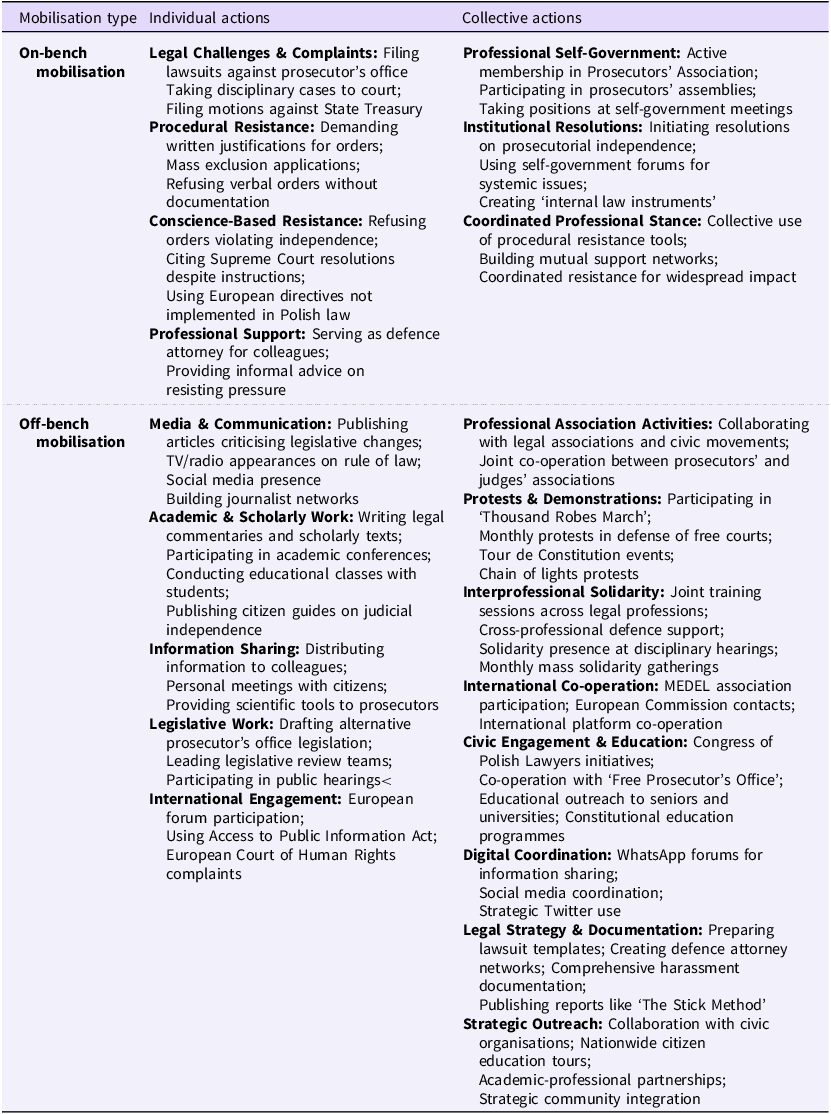

 Open access

