

Introduction
The Arctic has been widely considered as a holistic geopolitical region since the collapse of the Soviet Union and end of the Cold War resolved the immediate hostilities among the eight polar neighbours in that it is a space treated by actors as a coherent area of policy coordination, rather than merely a geographical label. In the aftermath, the Arctic Council emerged as the centrepiece of a dense regional order comprised of inter-, trans-, and sub-national governance institutions that linked the Arctic states (Canada, Denmark, Finland, Iceland, Norway, Russia, Sweden, and USA) with representatives of Arctic Indigenous peoples, non-Arctic states, and environmental NGOs. This new ‘One Arctic’ order was conceived as a rules-based region where the Arctic 8 shared commitments to peaceful dispute resolution, multilateral cooperation, and their own regional supremacy (Burke, Reference Burke2019; Lackenbauer, Nicol, & Greaves, Reference Lackenbauer, Nicol and Greaves2017). In that context, conventional security concerns were limited during the One Arctic period, with regional politics principally concerned instead with issues of environmental governance, Indigenous devolution, and economic and human development. Despite extensive work on Arctic security institutions and elite discourse, we lack a comparative account of how Arctic publics perceive these core Arctic security issues and ask whether these attitudes align with the region’s fragmentation. We ask: (1) How do Arctic publics assess climate change as a security issue over time, (2) How do Arctic publics perceive geopolitical competition, and (3) Do these patterns suggest an emerging cohesion amongst the Arctic seven nations consistent with a pluralistic security community (PSC)?
We argue that Arctic politics has undergone a major transformation due to two external forces altering regional security: climate change and increasing great power competition, notably due to the Russian war against Ukraine. The One Arctic era has ended, underscored by the de facto suspension of pan-regional cooperation through the Arctic Council after Russia’s expanded invasion of Ukraine in February 2022. The circumpolar Arctic has fragmented into two distinct blocs: the Russian Federation and the A7 group of allied Arctic democracies. These blocs are characterised not just by different security policies between Russia and its neighbours but by differing security public opinion among their populations.
Thus far, sub-regional variation in Arctic security public opinion is under-studied, including basic questions such as: How do different Arctic publics perceive security threats in and to the region? How does Arctic security public opinion vary across recent history and sub-regional groupings? And what do patterns of security public opinion suggest for the future of Arctic politics? To answer these questions, this article analyses an original dataset of 164 cross-national polls and surveys from all eight Arctic states between 2007 and 2024. We first outline what (anonymised) has termed the new Arctic geopolitics, then discuss our methodology for collection and analysis of data on Arctic security public opinion. We then outline key patterns in Arctic security public opinion and identify significant variation between attitudes in Russia and the A7 with respect to two defining regional issues: climate change and great power competition between Russia, China, and USA. In doing so, we identify clear and deepening geopolitical fragmentation between Russia and the A7 democracies in response to Russia’s invasion of Ukraine – illustrating the potential formation of a PSC as originally formulated by Karl Deutsch in the 1950s, defined as a region in which inter-state war has become unthinkable, characterised by “mutual sympathy and loyalties; of ‘we feeling’, trust, and mutual consideration; of partial identification in terms of self-images and interests; of mutually successful predictions of behavior” (Deutsch et al., Reference Deutsch, Burrell, Kann, Lee, Lichtenau, Lindgren, Lowenheim and Van Wagenen1957, p.36). Our work helps to fill an important gap in International Relations (IR) scholarship by highlighting how both environmental and geopolitical pressures shape public perceptions of security in the Arctic.
While climate change and great power competition are both certainly global phenomenon, their manifestations in the Arctic are analytically distinct and regionally significant. The strategic geopolitics of the Arctic has made it a focal point for discursive framings of renewed great power competition between Russia, China, and the USA all the while the region is warming at more than four times the pace of the global average. By exploring these dynamics in an Arctic context, we can better understand how the particular contours of the Arctic shape how global forces shape specific local security perceptions and practices.
Our findings support the claim that the One Arctic regional order has fragmented into two conflicting sub-regions, and that Arctic security issues are better analysed within these sub-regions rather than at the pan-regional level of the last 35 years. Given the consequences of Russia’s aggression towards Ukraine, we suggest that – at least prior to the onset of the second Trump presidency – the conditions existed for a new PSC to emerge among the A7 defined in opposition to Russia.
The new Arctic geopolitics
The Arctic has undergone two fundamental changes in its regional security dynamics in the last 35 years. The first was the end of the Cold War and shift from hostility towards dynamic interstate cooperation. The Arctic has always been characterised by states pursuing their national interests, but the dominant political discourse and practice since Mikhail Gorbachev’s Murmansk Speech in 1987 has emphasised cooperation, common interests, and interconnectedness, exemplified by the vision of “One Arctic” region (Lackenbauer et al., Reference Lackenbauer, Nicol and Greaves2017). Exemplified by the establishment of the Arctic Council as a pan-regional body based on inter-state cooperation, inclusion of Indigenous peoples, and a commitment to international law and peaceful resolution of disputes, the creation of the One Arctic order was a notable geopolitical achievement of the post-Cold War era (Greaves, Reference Greaves2022, Reference Greaves2019).
Unfortunately, the second fundamental change has been the end of the One Arctic order and the fragmentation of the region into distinct sub-regions that “possess a degree of security interdependence sufficient both to establish them as a linked set and to differentiate them from surrounding security regions” (Buzan & Wæver, Reference Buzan and Wæver2003: 47–48). The primary causes of the Arctic’s fragmentation are climate change and increased great power competition. Climate change undermined the common ecological foundations that placed shared environmental challenges at the centre of One Arctic regional cooperation and its impacts are also unfolding differently across the Arctic (Exner-Pirot, Reference Exner-Pirot2013). This was particularly clear in the Intergovernmental Panel on Climate Change’s 2008 report. The second source of Arctic fragmentation is linked to the first. Despite the cooperative intentions of the One Arctic order, climate change catalysed renewed great power competition by increasing the economic and military value of the Arctic region. Conditions of security are no longer determined at the pan-Arctic level, but by distinct, though overlapping, sets of actors, processes, and institutions in the Euro-American and Eurasian Arctic regions. Fragmentation does not make these sub-regions are entirely separate, but that the practices which produce regions as cooperative or conflictual spaces will principally occur at the subregional level and involve subregional actors, marking the end of the Arctic as a single holistic security region.
The return of great power competition in the Arctic can be traced to the deterioration in relations between Russia and the A7 that began in 2007, when a small, privately owned submarine planted a Russian flag on the Arctic Ocean floor at the geographic North Pole. Though legally irrelevant, other states protested the flag planting and Russian claims to an extended continental shelf under the UN Convention on the Law of the Sea as part of a strategy of post-Cold War revanchism (Dodds, Reference Dodds2010). This move by Russia in tandem with the 2008 IPCC report and the beginning of an ‘Arctic scramble’ narrative all enabled the post-Cold War fragmentation in the Arctic. Outside actors like China became interested in the region and existing actors began to shore up their authority through claims to legitimacy and sovereignty. Russia also began reinvesting in Arctic infrastructure across the region and helped inform a popular – though problematic – narrative of a militarised race for territory and resources in a region whose climate was changing faster than many actors could keep up (Åtland, Reference Åtland2014; Chater, Greaves, & Sarson, Reference Chater, Greaves, Sarson, Hoogensen Gjørv and Sam-Aggrey2020). We understand Russia’s post-2007 Arctic posture as an overall push to modernise infrastructure in the Arctic that has had both military and non-military implications (Konyshev & Sergunin, Reference Konyshev and Sergunin2014). In short, this reflects strategic signalling and civilian requirements. Russia’s Arctic coastline constitutes over half (53%) of the circumpolar north and hosts the region’s largest population. Thus, expanded activity along its northern frontier may not be inherently aggressive, but has been largely perceived in the West as such (Sergunin, Reference Sergunin, Hoogensen Gjørv, Lanteigne and Sam-Aggrey2020).
Fragmentation accelerated in 2014 when Russia began its invasion of Ukraine in its annexation of Crimea, which was later expanded to a full-scale invasion in 2022. Following Russia’s invasion, Finland and Sweden immediately sought to join the NATO alliance from which they had refrained throughout the entire post-WWII period. They were admitted in 2023 and 2024, respectively, marking a stunning strategic blow to Russia and a formal realignment of the Arctic as comprising seven NATO allies and Russia. In this context, the A7 announced a pause on Arctic Council meetings involving Russia, limiting pan-regional working-level cooperation until the end of Russia’s chairmanship in 2023, although Russia continued to express support for collaboration (Gricius & Fitz, Reference Gricius and Fitz2022; Kornhuber et al., Reference Kornhuber, Vinke, Bloom, Campbell, Rachold, Olsvig and Schirwon2023). All told, Russia’s aggression has produced a deep crisis of Arctic politics, undoing decades of cooperative institution-building and effectively partitioning the region into roughly equal Russian and Western halves by area, coastline, and population. In the context of the ongoing war in Ukraine and heightened regional tension, the pillars of Arctic geopolitics are undergoing significant revision (Østhagen & Rottem, Reference Østhagen, Rottem and Osthagen2023). Cut-off from Western capital and technology, Russia has become even more reliant on China. Meanwhile, NATO has strengthened its strategic posture to better defend its seven Arctic members, institutionalising the regional realignment of the A7 versus Russia.
This is the new Arctic geopolitics: a fragmented, increasingly militarised Arctic with weak regional institutions bifurcated between the allied, democratic, and capitalist A7 and a strategically isolated, belligerent, and Sino-dependent Russia. Fragmentation does not make armed conflict in the region inevitable, as all Arctic states and important non-Arctic states like China have repeatedly affirmed their commitments to a peaceful and rules-based order (Marten, Reference Marten, Clark, Meral and Selisny2023). While conflict in the Arctic is possible, conflict over the Arctic is unlikely. Most Arctic resources continue to lie in undisputed sovereign territory onshore or close to it, and many doubt the viability of large-scale extraction despite government enthusiasm (Keil, Reference Keil2014). Given that Arctic resource development is particularly important for the Russian economy – comprising approximately 20% of GDP – Russia has been unlikely to pursue conflict that would disrupt its capacity to export commodities to the global market (Sergunin, Reference Sergunin, Greaves and Lackenbauer2021; Sergunin & Konyshev, Reference Sergunin, Konyshev and Studin2018). Some observers have expressed worries over an emerging Arctic security dilemma (Åtland, Reference Åtland2014), but many analyses still conflate “threats through, to, and in the Arctic” that must be differentiated in order to assess regional security (Hilde, Ohnishi, & Petersson, Reference Hilde, Ohnishi and Petersson2024; Lackenbauer, Reference Lackenbauer2021).
These new Arctic geopolitics point to the potential for the conditions needed for the formation of a PSC. The concept of security communities is generally divided between amalgamated and pluralistic. States within a PSC share common values that come from shared institutions, a sense of we-ness, and are integrated so much so that they have shared expectations for peaceful change (Adler & Barnett, Reference Adler and Barnett1998). While original scholars of this concept measured a sense of community through transaction flows, we focus on public opinion polls as a separate – no less valuable – way of understanding shared threat perceptions.
Measuring Arctic security public opinion
Notwithstanding the volume of recent scholarship on Arctic security, there are substantial gaps in our state of knowledge (Greaves & Lackenbauer, Reference Greaves and Lackenbauer2021; Heininen, Exner-Pirot, & Barnes, Reference Heininen, Exner-Pirot and Barnes2019; Hoogensen Gjørv, Bazely, Goloviznina, & Tanentzap, Reference Hoogensen Gjørv, Bazely, Goloviznina and Tanentzap2014; Hoogensen Gjørv & Sam-Aggrey, Reference Hoogensen Gjørv and Sam-Aggrey2020). Among these is little systematic analysis of how people in Arctic states feel about Arctic security issues, and by extension whether Arctic security public opinion supports or resists the recent shifts in Arctic policies and practices by Russia and the A7. Public opinion on foreign and security policy issues has long been seen as politically salient and identifiable using polling and survey instruments (Almond, Reference Almond1956). The mechanisms that connect social attitudes to political institutions and policy-makers are varied and indirect, but decision-making in most democracies is broadly responsive to public opinion (Burstein, Reference Burstein2003; Nossal, Roussel, & Paquin, Reference Nossal, Roussel and Paquin2015; Petry & Mendelsohn, Reference Petry and Mendelsohn2004). When they do not correspond, it is often due to decision points that are susceptible to minoritarian views, constitutional constraints, or the preferences of individual decision-makers who can be changed through the electoral process (Kinnunen, Reference Kinnunen2021; Park & Ham, Reference Park and Ham2022). Public opinion may not determine policy outcomes, but can limit the range of policy choices available to political actors. Even Russia, the only non-democratic Arctic state, has demonstrated through its need to manage public opinion over its aggressive policy toward Ukraine that “in the international policy domain, public attitudes are best viewed as parameter-setting” (Berdahl & Raney, Reference Berdahl and Raney2010, p. 996). Deepening comparative analysis of security public opinion across the Arctic states helps clarify the likely parameters of security policy in the region, identify public support for existing threat constructions within states and sub-regional blocs, and map where common perceptions of security threats are shared across all Arctic states and where they are limited to the A7 or Russia.
Public opinion offers a distinct and theoretically significant lens to understand Arctic security. While elite discourse and institutional output may explain part of regional dynamics, public opinion reflects how broader populations interpret and potentially constrain security narratives advanced by states. It provides a clear contribution to our understanding of legitimacy, consent, and contestation in security policy – particularly in democratic political contexts. Moreover, public opinion also allows us to map the diffusion – of lack thereof – of securitising moves across different populations, revealing whether shared security imaginaries support cooperative urges or where diverging perceptions could lead to fragmentation. Our work with public opinion is also complementary to elite-level analyses by exploring the political foundations on which state actions rest.
This section analyses an original dataset of 164 cross-national polls and surveys on Arctic security public opinion from all eight Arctic states conducted between 2007 and 2024. We began in 2007 because it was a watershed year for circumpolar politics. First, the Intergovernmental Panel on Climate Change 4 th Assessment Report (IPCC, 2007) provided a sobering assessment of climate change impacts and their specific impacts for the Arctic. Second, the Russian flag-planting at the geographic North Pole sparked protest over the perceived effort to claim territory outside the international legal framework afforded by the UN Convention on the Law of the Sea. Third, Russia resumed Cold War military activities, including long range bomber flights into the North American Arctic (Chater et al., Reference Chater, Greaves, Sarson, Hoogensen Gjørv and Sam-Aggrey2020). Soon after, in 2008, the US Geological Survey spurred a so-called ‘Scramble for the Arctic’ when it published a report estimating the Arctic’s undeveloped hydrocarbon resources at 90 billion barrels of oil (13% of undiscovered global reserves) and 46 trillion cubic meters of natural gas (30% of undiscovered global reserves) (Borgerson, Reference Borgerson2008; USGS, 2008). In response to these intersecting factors, all Arctic states released updated Arctic foreign and security strategies over the following three years. These official documents reaffirmed the Arctic as a cooperative, non-violent region while increasing investments in Arctic military capabilities and acknowledging the transformative implications of climate change for regional security (Heininen, Reference Heininen2012).
We collected data by searching through online search engines, national polling and survey databases, government ministries, think tanks, and universities for public opinion polling and surveys from the Arctic 8 that asked questions on foreign and security policy, broadly, and circumpolar issues, specifically. Included surveys typically represented opinion within one state at a time, though we collected several cross-national surveys. All surveys were conducted in their respective national language. Our focus encompasses two scales. First, we consider the populations of each of the Arctic states to comprise a national ‘Arctic public’. Given that many decisions over Arctic policy are determined at the state level, national public opinion on Arctic issues is important even if the populations residing in the southern regions of Arctic states have limited experience of, or do not consider themselves to be in, ‘the Arctic’. Second, when possible, we highlight a more constrained ‘Arctic public’ comprising only residents of the northern regions of the Arctic 8 (e.g. the three Canadian territories, Alaska, Greenland, North Norway, or Sápmi/Lapland). However, surveys of only Arctic residents are limited, making analysis of this narrower Arctic public limited by the available data.
This search produced a dataset of 164 polls that we inductively coded for 11 specific themes (see Appendix Table 11). These were: (1) European Union, (2) Russia, (3) Global Power and Relationships, (4) Environment and Climate, (5) Terrorism and Conflict, (6) International Organisations, (7) Trade, Globalisation and Democracy, (8) China, (9) Security and Foreign Policy, (10) Arctic, and (11) Perceptions of Leaders and Countries. Coding originally began with a series of four codes reflecting the major issues outlined in research on Arctic security: Russia, China, Environment and Climate, and the Arctic. We expanded these initial codes to include topics such as International Organisations to capture questions related to NATO, and Terrorism and Conflict to capture specific questions on security issues that we had not anticipated. We then added a separate category on Security and Foreign Policy and European Union to encompass questions on specific foreign and security policy issues and specifically European topics that were omitted from the other categories. The Global Power and Relationships category was added after we observed that many questions asked participants about relationships with other countries. Larger polls such as the Pew Global Attitudes Survey and the Chicago Council Survey had a vast number of questions that also asked questions on Trade, Globalisation, and Democracy, and Perceptions of Leaders and Countries. We coded survey questions into these eleven categories based on the primary focus of the question. Some questions and surveys, such as the Trip Faculty Polls, did not fit into these categories, or are part of our wider dataset but did not directly inform this analysis (anonymised). Importantly, while most of the polls analysed asked about climate change or geopolitical competition in general, rather than in the Arctic, we were interested in the extent to which Arctic publics had shared threat perceptions in general about possible security concerns.
Of the 164 polls and surveys, 34 were cross-national, 63 were from the United States, 28 from Norway, 18 from Finland, 10 from Russia, 6 from Canada, 3 from Greenland, and 1 each from Iceland and Sweden (see Appendix Table 10 for a full table of the difference sources of opinion polls as organised by country). Many polls were aggregated, meaning the variation in numbers of polls is not as drastic as it seems. Data are more available for North America, reflecting the predominance of English-language cross-national series. Drawing on our 11 coded themes, we have organised our analysis around the two major drivers of contemporary security policy in the Arctic: climate change and great power competition. While other factors might also be linked to security policy, these two issue areas are regarded by experts and governments as critical to contemporary security in the Arctic region.Footnote 1 We note that the majority of data collection was initially conducted in 2022, with additional polls added to the dataset to account for further developments from 2022 to 2024.
There are two principal methodological limitations to this study. First, to avoid errors of linguistic interpretation, we relied primarily on polls and surveys originally published in English or easily translated from English. Polling was conducted in the native/official language of each Arctic state, and their final reports were either published in English or the authors translated the results using open-access online translation software. This means not all Arctic states are equally represented in each aspect of the analysis, though we have included as much relevant data as possible for all eight states. The dataset more heavily reflects opinion in Canada and the USA, with more limited data from the Nordic countries and Russia. Given uneven coverage, cross-country contrasts involving those cases should be interpreted cautiously.
We considered survey questions to be relevant if they explicitly included security-related language or sought to assess public concern about security issues that are central to this analysis. For instance, some questions about climate change explicitly ask whether respondents consider it to be a great or small “threat”, while others ask how ‘worried’ or ‘concerned’ the respondent is about it. We consider both types of question as relevant since both inquire into the levels of concern that individuals have towards an issue widely understood as relevant to global, national, and human security (see Egan & Mullin, Reference Egan and Mullin2017). Questions on great power competition tended not to use that term, but rather explored social attitudes towards the three states – China, Russia, and the United States – generally perceived as participating in global strategic competition, status-seeking, and national security (see DiCicco & Onea, Reference DiCicco and Onea2023; Nexon, Jackson, Wyne, Goddard, & DiCicco, Reference Nexon, Jackson, Wyne, Goddard and DiCicco2023). Questions addressed different aspects of how they are perceived, including: (1) Likert favourability scales; (2) whether they were considered a partner, competitor, or enemy; (3) a least preferred state partner; (4) whether a state had a positive or negative impact on another state’s security; (5) whether a state was a minor, major, or no threat; and (6) whether a state should “be tough on” another or have international cooperation suspended. We understand such questions as complementary for a nuanced interrogation of public attitudes towards three contemporary great powers and contend that such questions provide evidence of security public opinion.
The second methodological challenge for the study of Arctic public opinion is that small population sizes, technological limitations, and physical inaccessibility across the Arctic make data collection a challenge. As this analysis relies on polling and surveys conducted by others, we are constrained by their methods, sample sizes, and organisation of data. Typically, this means national-level data rather than distinguishing the northern populations of Arctic states, with some exceptions for differentiated data for Northern and Southern Canada and Alaska and the continental United States, respectively. Where possible, we eschew Danish public opinion in favour of Greenland-specific data, though Denmark is typically represented within cross-national surveys. Small sample sizes further complicate assessing differing opinions according to sociological and identity variables such as indigeneity, though qualitative research on Arctic Indigenous peoples and security has been done elsewhere (Greaves, Reference Greaves2016a, Reference Greaves, Hossain and Petrétei2016b; Hossain, Reference Hossain2016). While Indigenous peoples are distinct and normatively important populations to consider in the context of Arctic politics and security, our analysis is unable to differentiate views between Indigenous and non-Indigenous residents of the Arctic.
A related methodological limitation of this study is the distribution of polls across the Arctic region. The analysis is weighted towards data from major Arctic states such as the US and Canada while smaller states like Iceland and Greenland are underrepresented, simply due to data availability. However, even with this data bias, that there are public opinion polls from smaller states in a smaller capacity does still indicate the broader trends that we find. Our analysis of public opinion polls should also be understood as parameter setting for feasible policy rather than as a proxy for decision-maker beliefs. In short, we see public attitudes as being co-produced with elite discourse and media coverage. To reduce concerns about validity, we have reported distinct differences in question wording and field dates, triangulated across different series, and emphasised cross-national contrast rather than absolute levels.
Climate change
Climate change is ubiquitous in analysis of Arctic security, generally acknowledged to be transforming the nature, severity, and likelihood of conventional and unconventional security threats in, to, and through the region (Goodman et al. Reference Goodman2021; Heininen & Exner-Pirot, Reference Heininen and Exner-Pirot2020; Lackenbauer, Reference Lackenbauer2021). Our analysis asked how Arctic publics assess climate change as a security issue over time. We found that the significance of climate change was evident in public opinion across the Arctic 8, but there is significant variation and – counterintuitively, given climate change’s worsening physical impacts – no clear trend over time. Polling from Canada, Russia, and the USA asking respondents to assess how serious a problem climate change is (Appendix Table 1) and how worried/concerned they are about “global warming” (Appendix Table 2) indicate no linear increase in concern about climate change as scientific understanding has improved or lived experience of climate impacts has increased. However, between 2007 and 2015, more than 50% of respondents from each Canada, Russia, and the USA were somewhat or very worried about climate change (Appendix Table 2). Canada had the highest level of popular concern, ranging from 80 to 90% of respondents, but in all three countries far more people consider climate change to be serious than not.
However, the number saying climate change is “very serious” or expressing “serious worry/concern” declined between 2007 and 2015. Between 2007 and 2015, the share of Canadians who saw climate change as a very serious problem declined from 58 to 51%, while in Russia very serious responses declined from 40 to 33%, and in the USA 47–45% (Appendix Table 1). The net percentage of Russians worried/concerned about climate change declined from 73 to 64% between 2007 and 2015, but this remained significantly higher than in the United States, which has more consistently divided opinion on the issue of climate change. Between 2008 and 2015, net worry/concern about climate change among Americans dropped from 62 to 52%, but the share of Americans not worried was nearly twice that of Russians and 2–4x that of Canadians (Appendix Table 2). More recent data from 2015 to 2022 show that net percentage of Americans worried/concerned about climate change did increase from 52 to 64%. Yet decreasing concern about climate change was observed in the Nordic countries; the net percentage of Finns somewhat/very concerned declined from 85 to 69% between 2007 and 2024 (Appendix Table 3), while that for Swedes declined from 88 to 87% (Appendix Table 4).
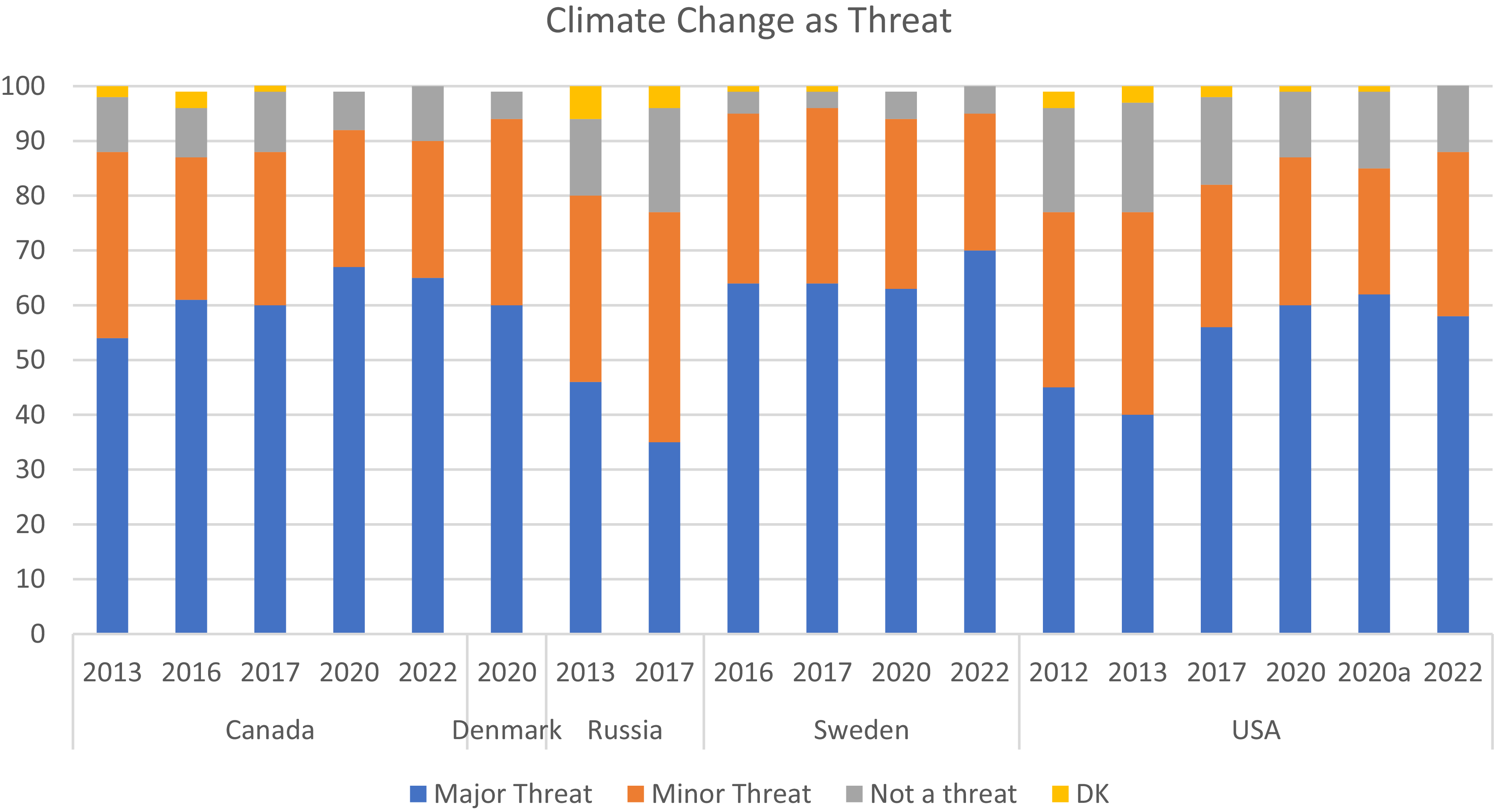
Some polls asked specifically whether climate change poses a major, minor, or no threat to their countries (Figure 1). When climate change was framed as a security threat, the proportion in Canada seeing it as a major threat increased from 54 to 65% between 2013 and 2022, and in the USA, a plurality in agreement became a majority over the same period, growing from 45 to 58%. In contrast, nearly two thirds of Swedes consistently saw climate change as a major threat between 2016 and 2022, slightly more than the 60% of Danes in 2020. A 2019 poll of Greenlanders did not explicitly identify climate change as a security threat, but 79% indicated that local sea ice was becoming more dangerous to travel across in recent years, linking their views on climate change at least partially to considerations of personal safety and physical security (Minor et al., Reference Minor, Agneman, Davidsen, Kleemann, Markussen, Lassen and Rosing2019). Russians, however, expressed a lower and declining level of concern over climate as a major threat, going from 46 to 35% between 2013 and 2017. However, Russia and the USA had far higher rates of people who saw climate change as no threat at all than other Arctic countries, ranging from 12 to 20%.
Do you think climate change is a major threat, minor threat, or no threat to our countries? Source: Pew Global Attitudes (Pew Global Attitudes data question framed as “I’d like your opinion about some possible international concerns. Do you think that global climate change is a major threat, a minor threat or not a threat to (survey country)? Trip Expert polls framed question as “Do you think that global climate change poses a major threat, a minor threat, or no threat to the United States?”).

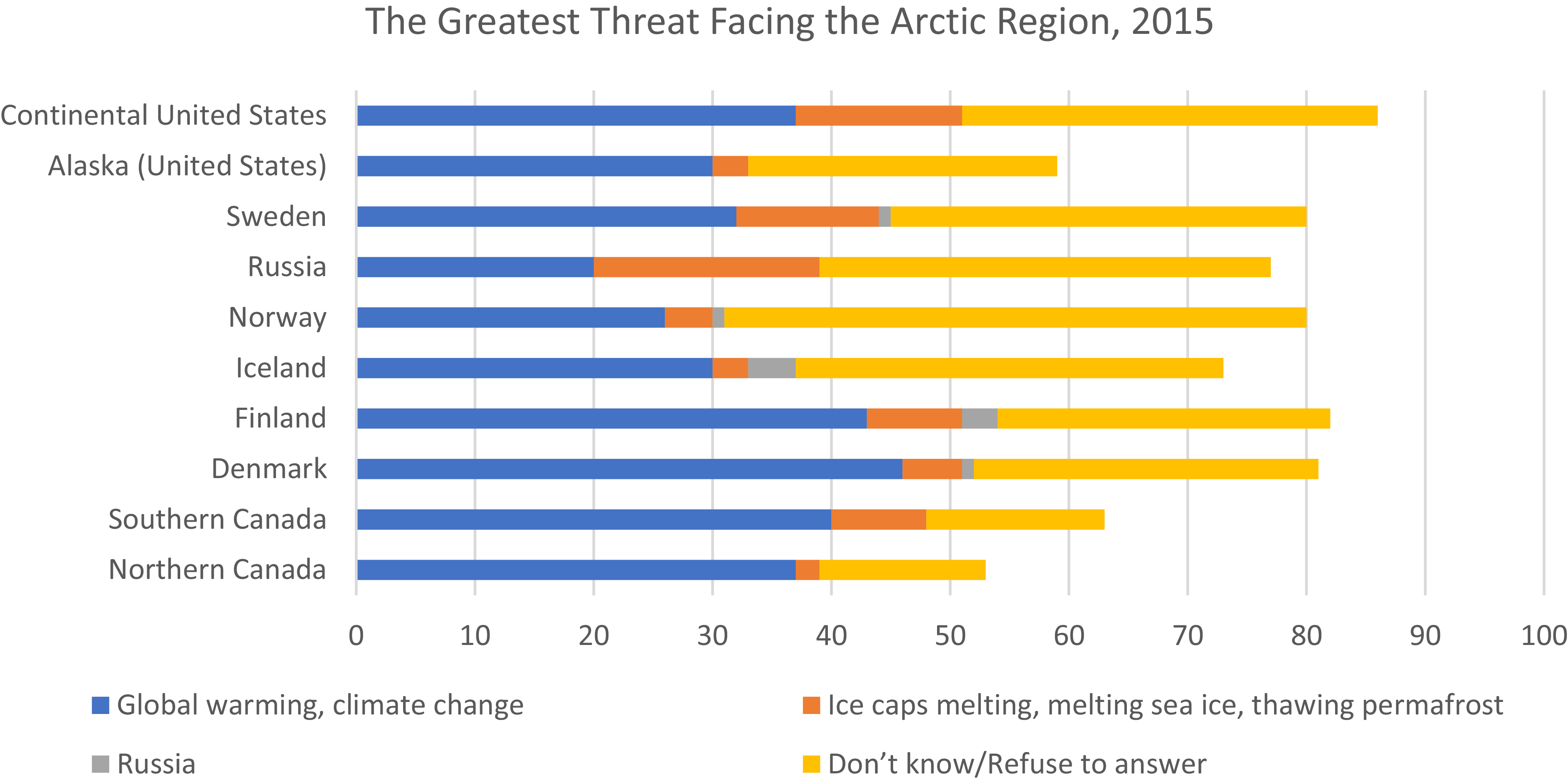
A 2015 cross-national survey offers related insights into the comparative securitisation of climate change among Arctic publics (Figure 2). Global warming/climate change was overwhelmingly named as the greatest threat facing the Arctic, ranging from 20% in Russia to 46% in Denmark. This exceeded the next most common responses by 4–6x and does not include specific climate impacts some respondents listed separately. Including these significantly increases the identification of climate change as the greatest regional threat; only 20% of Russians listed global warming or climate change, but 19% mentioned specific impacts, with comparable results in Sweden (32% and 12%) and the continental United States (37% and 14%).
What do you think is the greatest threat facing the Arctic region today [2015]? Source: Ekos, Rethinking the Top of the World: Arctic Public Opinion Survey, Vol. 2 (Toronto: Munk-Gordon), 27–28.

There also appears to be sub-national variation on questions of climate change and security, with respondents living further north least likely to identify specific climate impacts as the greatest threat. Residents of Northern Canada and Alaska were less likely to name global warming or climate change impacts as the greatest Arctic threat than their southern counterparts (Figure 2). A survey of Greenlanders conducted in 2021 found “climate changes” cited fourth most frequently as the greatest challenge facing Greenlandic society, after economic and cost of living concerns (Ackrén & Leander Nielsen, Reference Ackrén and Leander Nielsen2021, p. 5). This dropped to fifth place in a 2024 update of this poll. Views of climate change in the USA as a serious threat have increased overall but are unevenly distributed according to partisan identification. While the number of Americans who see climate change as a “critical threat” rose from 34% in 2010 to 49% in 2024, the increase was driven by large increases among self-identified Democrats and Independents, while Republicans have increased by less and from a lower baseline (Appendix Table 5). Canada and Norway also experience partisan polarisation on climate change public opinion, with conservative men the greatest outliers from the mean in both contexts (Greaves, Reference Greaves2021; Krange, Kaltenborn, & Hultman, Reference Krange, Kaltenborn and Hultman2019). This illustrates the salience of partisanship and cautions against over-reliance on national data in divided or polarised political contexts (Groenendyk, Sances, & Zhirkov, Reference Groenendyk, Sances and Zhirkov2020).
It also raises questions about the sources of divergence in security public opinion that are outlined in our concluding discussion. There appears to be little significant change in the assessment of climate change following the 4th IPCC assessment report in 2007 or 5th report in 2014, illustrating that while most Arctic publics show high levels of concern about climate change, this has not grown linearly in response to increasingly dire reports on present and future impacts of climate change. In fact, Arctic countries experienced different trends of how seriously climate change was considered a problem in 2007, 2009, and 2015, with Canada, Sweden, and Finland oscillating, Russia declining, and the USA increasing slightly. This suggests that even as climate change worsens, the conditions for its securitisation may not follow suit.
Great power competition
Great power competition was a defining feature of the Cold War Arctic and has re-emerged as one of the ordering principles of Arctic security since 2014. This section examines Arctic public opinion towards three great power competitors for international leadership: Russia, China, and USA – and asked how Arctic publics perceive geopolitical competition, with an eye towards the cohesion of the seven Western Arctic states. We find that Russia is widely seen as a threat to other Arctic states but that China is not seen as a major threat or particularly relevant to Arctic security. With the exception of Russia, the US was not seen as a threat by other peoples in the region – although this may be changing given deteriorating relations between the United States under the second Trump administration with its NATO allies (Everts, Spataora, & Ekman, Reference Everts, Spataora and Ekman2025).
Russia
Given the differences in proximity, strategic vulnerability, and political orientations towards Russia among the other Arctic states, there was considerable variation across countries and over time over whether Russia poses a security threat, but this changed over time. Figure 2 shows the very low levels of concern over Russia in 2015, when it was identified by so few people it was within the survey’s margin of error. While not definitive, coming in the aftermath of the 2014 Russian annexation of Crimea but early in the current deterioration in relations with the West, it is noteworthy that only 1–4% of Nordic respondents saw Russia as a threat. Respondents in Canada and the United States did not sufficiently identify Russia as a threat for it to even be coded and listed “national security-protection from threats posed by other countries and individuals” as the least important of five dimensions of Arctic security they were asked to rank (Ekos, 2015, pp. 27, 37).
Though not widely perceived as a threat prior to 2022, there was considerable yet uneven public skepticism about cooperation with Russia given the conflict in Ukraine. In 2015, Sweden had the highest level of support for suspending cooperation with Russia at 44%, followed by Iceland at 43%. The two states bordering Russia – Norway and Finland – had the lowest support for suspending cooperation at 19% and 22%, respectively, with Canada, Denmark, and USA between 31 and 38%. A 2016 survey in Sweden found 71% supported “being tough on Russia in foreign policy disputes”, though in 2020, only 16.5% of Icelanders agreed.Footnote 2 Even in the wake of Donald Trump’s surprise offer in 2018 to purchase Greenland from Denmark, 69% of Greenlanders supported closer cooperation with the United States and 58% supported less cooperation with Russia (Ackrén & Leander Nielsen, Reference Ackrén and Leander Nielsen2021, p. 3). Yet in the 2024 version of the poll, only 59% supported closer cooperation with the United States, and 69.3% supported less cooperation with Russia (Ackrén & Leander Nielsen, Reference Ackrén and Leander Nielsen2024, p. 8). Although one year out of our 2007–2024 range of polls, a new poll recently released by the Observatoire de la politique et la securite de l’Arctique (OPSA) found that in 2025, 35% of northern Canadians saw Russia as the second most serious state threat to the Canadian Arctic (Landriault & Salminen, Reference Landriault and Salminen2025).
From 2017 to 2019, the number of Americans opposing cooperation with Russia increased from 44 to 52%, with those supporting it declining from 43 to 35%.Footnote 3 However, the relative antipathy of the other Arctic publics towards dealing with Russia was clear. When asked in 2015 which countries they would be least comfortable dealing with, Russia was the most common response in eight out of ten Arctic regions: 31% of all respondents identified Russia, compared to 16% for China, and 9% for the United States (Ekos, 2015, p. 61).
Views of Russia continued to decline. In 2021, 56% of Canadians identified Russia as a serious or moderate threat to Canada, a sharp increase from 2015 (Canada’s Role in the World, 2022, pp. 48–49). In 2023, 37% of Canadians identified Russia “as an enemy of Canada” and 35% “a potential threat to Canadian interests” (Angus Reid, 2023). Finnish opinion on whether Russia had a negative impact on their security also increased dramatically between 2007 and 2024 from 32 to 86%, surging upward from 49% in 2021 (Appendix Table 7). In the USA, the percentage of Americans who saw Russia as an enemy increased from 41 to 70% in the first quarter of 2022 (Gramlich, Reference Gramlich2023). Globally, public opinion of Russia has become polarised between democratic and non-democratic states, but universally declined following the 2022 invasion of Ukraine (Foa et al., Reference Foa, Mollat, Isha, Romero-Vidal, Evans and Klassen2022, p. 15). A separate 2022 survey found three Arctic states – Canada, Sweden, and USA – had “overwhelmingly negative views toward Russia” of between 88 and 94% unfavourable, and our analysis confirms that views of Russia among the A7 are among the most negative in the world (Wike, Fetterolf, Fagan, & Gubbala, Reference Wike, Fetterolf, Fagan and Gubbala2022). In 2024, 74% of Norwegians found that Norway should reduce its cooperation with Russia and consider tensions between Norway–Russia the greatest threat to Norway, although the public largely do not see overall a growing security threat to Norway per se. Moreover, 80% of Norwegians see adopting a hard-line foreign policy to Russia is important (Svendsen, Reference Svendsen2024). In short, Russia was clearly a threat to other Arctic states, particularly after 2022.
Russians, meanwhile, perceived themselves differently than their neighbours. In 2015, only 5% of Russians believed they should withdraw from Arctic cooperation agreements due to their invasion of Ukraine, and between 2012 and 2017, the number who believed Russia was now “respected around the world as it should be” more than doubled from 16 to 34%, though 54% said that it should be even more respected (Ekos, 2015, p. 52; Pew Research Center, 2017).Footnote 4 Even more dramatically, between 2011 and 2019, the number of Russians who perceived their country as a great power increased from 47 to 71%, while the number doubting it collapsed from 56 to 26% (Appendix Table 8). In 2017, 59% reported their country played a more important role in the world than a decade prior (Pew Global Attitudes, 2017). Since 2022, numerous surveys have found high levels of support among Russians for their government’s actions and low levels of public opposition, though support has declined as doubts about the war have grown as it has persisted longer much than anticipated (Koneva, Chilingaryan, & Rogov, Reference Koneva, Chilingaryan and Rogov2023). Regardless, Russia was the clear outlier among the Arctic 8 in terms of its self-perception and its popular view of the war in Ukraine. This was not particularly surprising given overall attitudes in Russia towards the war but, nonetheless, still important to acknowledge.
China
China’s Arctic aspirations have attracted significant scholarly and policymaking attention as it has established itself as the foremost non-Arctic state in the circumpolar region, with potential significance for US–China competition globally (Koivurova et al., Reference Koivurova, Kauppila, Kopra, Lanteigne, Shi, Smieszek and Stepien2019; Kopra, Reference Kopra2013; Lackenbauer, Lajeunesse, Manicom, & Lackenbauer,, Reference Lackenbauer, Lajeunesse, Manicom and Lasserre2018; Lunde, Yang, & Stensdal, Reference Lunde, Yang and Stensdal2015). Less clear was where China features among the security concerns of Arctic publics and whether China’s global economic rise and aggressive actions in east Asia translated into heightened threat assessments of China within Arctic public opinion.
China has demonstrated sustained interest in the region since the release of its Arctic white paper in 2018 calling for a “Polar Silk Road” (People’s Republic of China, 2018). Chinese investments in science and research, ice breaking vessels, resource extraction, tourism, and infrastructure are reflected its self-identification as a “near Arctic state”. China is one of several Asian states to receive Observer status at the Arctic Council since 2013, but its global prominence means its interest has provoked unique anxieties from the Arctic states. Concerns over Chinese influence in the region have led to heightened scrutiny and ultimately rejection of efforts by Chinese state-owned companies to acquire strategic infrastructure in northern Canada, Finland, and Greenland (Chater et al., Reference Chater, Greaves, Sarson, Hoogensen Gjørv and Sam-Aggrey2020).
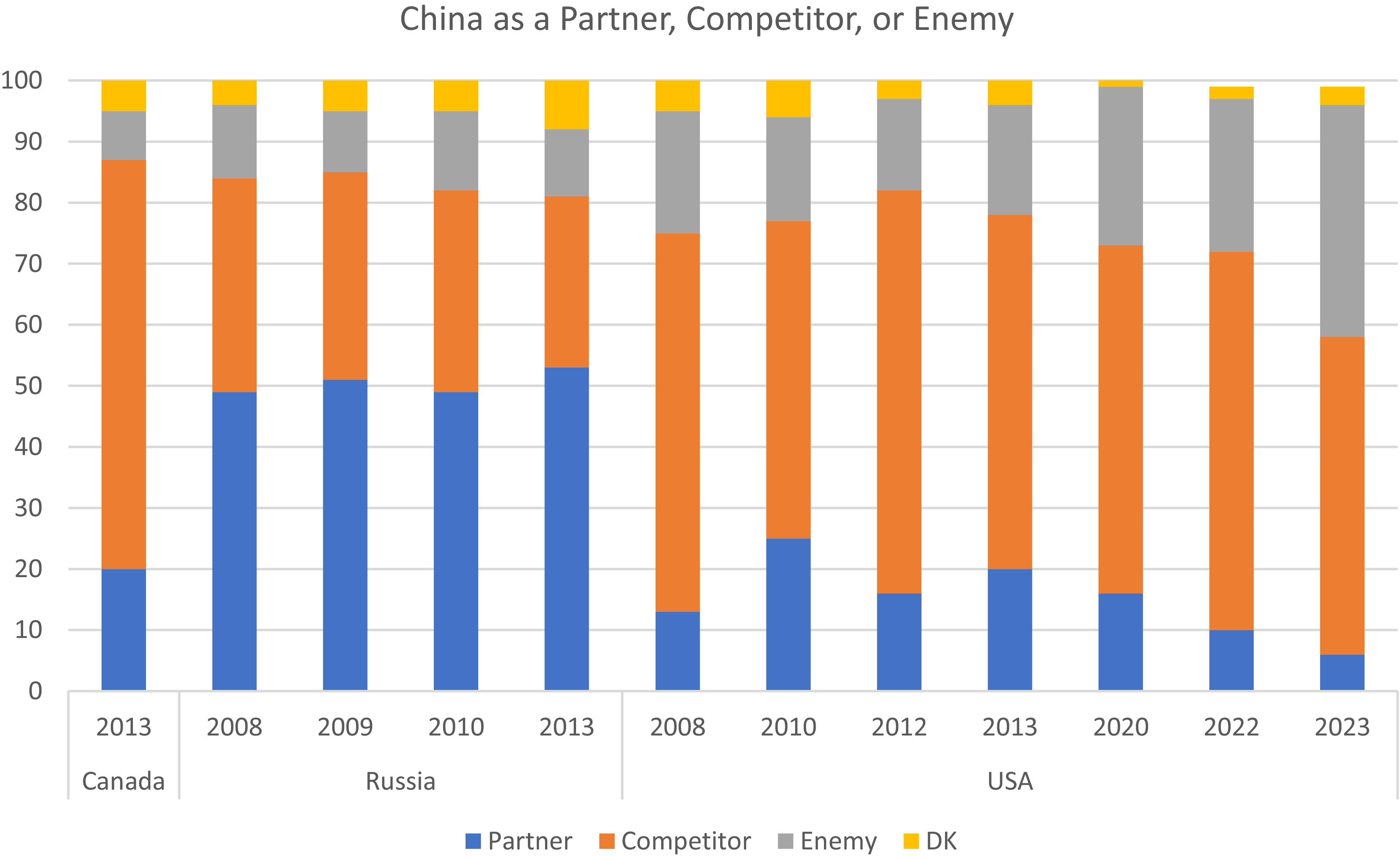
Across the region, there was considerable, though uneven, popular suspicion towards China and resistance to an expanded Chinese role in circumpolar affairs seen through popular media articles on China’s role in the region and in academic literature, but only a minor perception of China as a threat writ large in the polls under consideration. A 2011 cross-national survey found China was the “least preferred partner for dealing with Arctic issues” of each of the A7, though Russians preferred China over “Scandinavia” or the USA (Ekos, 2011, p. 37). Figure 3 shows that majorities in Canada and USA perceived China as a competitor rather than a partner or enemy. From 2020 to 2024, American total favourable views of China only slightly from 19 to 16% while total unfavourable views dropped from 79 to 81%, while Canadian total favourable views largely remained steady from 22 to 21% and total unfavourable views 73–71%. Swedish favourability on China also remained relatively static between 2020 and 2024 from 14 to 11% and unfavourability actually dropped from 84 to 82% (Pew Research Center, 2024).
Do you think of China as a partner, neither, competitor, or enemy of your country? Source: Pew Global Attitudes (Question framed as “Overall, do you think of China as more of a partner of (survey country), more of an enemy of (survey country), or neither?”; Note: in 2012/2020, the question replaced the word ‘neither’ with the word ‘competitor’).

In 2020, 64% of Norwegians said their economy should be protected from Chinese investments, and 74% that Norway should “more strongly defend our own political attitudes in our relationship with China” (Svendsen & Weltzien, Reference Svendsen and Weltzien2020). By 2024, 78% of Norwegians also saw China’s increased influence in the world as negative and specifically 71% see Chinese influence in international organisations as negative as well. 76% of Norwegians also said the Norwegian economy should be protected from Chinese investments (Svendsen, Reference Svendsen2024).
In contrast, between 2008 and 2013 approximately half of Russians consistently saw China as a partner. Though cautious, Russians preferred Sino-Russian engagement as an alternative to cooperation with the West, particularly in the context of international sanctions imposed on Russia (Sergunin, Reference Sergunin, Greaves and Lackenbauer2021). This was clear with 85% of Russians in February 2023 having a good attitude towards China, in contrast to 14% feeling the same towards the USA (Levada, 2023). This number has remained steady across 2024, with positive feelings towards China ranking at 92% in May 2024 and 81% in September 2024 and only 19% towards the USA in May 2024 and 16% by September (Levada, 2025).
However, like Russia, polls in the A7 reflected a greater perception of China as dangerous when respondents were asked directly whether they saw it as a major, minor, or no threat (Figure 4). In 2016/2017, majorities of Swedes saw China as a minor threat, and more thought it was no threat than a major one. Between 2013 and 2017, pluralities of Canadians also saw China as a minor threat, though more saw it as a major threat than as none. In 2020, a notable shift occurred when 51% of Canadians called China a minor threat, but the proportion calling it a major threat surged to 40%, with only 6% calling China no threat, down from 21% in 2017.Footnote 5 Similarly in 2025, only 17% of northern Canadians ranked China as a serious threat to the Canadian North (Landriault & Salminen, Reference Landriault and Salminen2025). On China, Americans are the outlier among all Arctic states, with most respondents calling China a major threat in most years polled, with this response surging to 67% in 2022. Interestingly, while a plurality of Russians also saw China as a minor threat in 2013 and 2017, more saw it as a major threat than in Sweden.
Do you think China’s power and influence is a major threat, minor threat, or no threat? Source: Pew Global Attitudes; Canada’s Role in the World 2022 (Question framed as “I’d like your opinion about some possible international concerns for (survey country). Do you think that China’s power and influence is a major threat, a minor threat, or not a threat to (survey country)?” Canada 2020 question framed as: “How much of a threat is China to Canada?” [serious threat, moderate threat, small threat, no threat at all]. Small threat and not a threat were combined to produce the “minor threat” threat figures for Canada 2020).

Overall, these data suggest a difference in North American and European opinion towards China, but consensus across the A8 that China posed at least a minor threat. Opinions shifted somewhat when surveys differentiate between China’s economic and military power (Appendix Table 6). Canadians in 2019 saw Chinese economic growth as somewhat more of a good thing, while Americans were somewhat more likely to see it as a bad thing between 2007 and 2011 and a good thing in 2014 and 2019. Russian opinion between 2007 and 2014 oscillated between 53 and 37% who agreed that China’s growing economy was good. Unsurprisingly, large majorities of between 68 and 82% in Canada, Russia, and the USA between 2007 and 2019 felt China’s military growth was a bad thing. Finnish opinion that China negatively affected their security increased from 13 to 51% between 2007 and 2024 (Appendix Table 7), and the percentage of Swedes with an unfavourable view of China rose to 83% in 2022, similar to the 82% of Americans and 74% of Canadians who agreed (Silver, Huang, & Clancy, Reference Silver, Huang and Clancy2022). China had become less popular amongst the Arctic publics, and its growing military power is generally regarded as a bad thing, though not all Arctic publics were convinced that it poses a security threat.
Public opinion in smaller Arctic countries reflected mixed assessments of great power competition between China and the USA. In Iceland in 2020, only 28% believed their country should follow American policy towards China, barely more than the 27% who said they should not and fewer than the 32% who said Iceland should remain neutral (University of Iceland, 2020). From 2021 to 2021, Greenlanders overwhelmingly rejected aligning with the USA in a tougher stance towards China, with 82% opposed in 2021 and 79% opposed in 2024. Indeed, 53% of Greenlanders characterised China’s growing international role as positive in 2021, although only 42% maintained that belief in 2024. From 2021, a decreasing number of Greenlanders understood their economic relations with China to be positive, falling from 53 to 38% (Ackrén & Leander Nielsen, Reference Ackrén and Leander Nielsen2024). In 2021, 58% said China’s influence on international organisations was positive, but only 39% wanted more cooperation between Greenland and China, compared to 47% who wanted less (Ackrén & Leander Nielsen, Reference Ackrén and Leander Nielsen2021, pp. 3, 9–11). In 2024, only 24.7% wanted more cooperation with Greenland, compared to the 55.4% who wanted less (Ackrén & Leander Nielsen, Reference Ackrén and Leander Nielsen2024).
These ambivalent views are noteworthy in the context of increased Chinese involvement in the Arctic Council and other regional fora. The data suggested smaller Arctic publics employ a less binary lens of great power competition in assessing China’s role in the Arctic, contributing to greater ambivalence among European Arctic states than their North American partners. Some saw China as a threat, but views are mixed, and China was not seen as a major threat by a plurality or majority of the public anywhere in the Arctic outside the USA. Thus, China was not seen as a major threat by the majority of Arctic publics.
USA
The USA was not considered a regional security threat by Arctic publics outside Russia. From 2007 to 2015, Canadians were largely positive towards the USA, with 55–68% holding a favourable view. By 2020, that number had fallen to 35%, in line with the decline in the USA’s international favourability during the Trump presidency but rebounded after the election of Joe Biden. This may be changing in the second Trump administration, with 37% of Northern Canadians calling the US the most serious threat to the Canadian North (Landriault & Salminen, Reference Landriault and Salminen2025). Patterns of support for the USA were similar among other Western democracies in the transitions from the Obama–Trump–Biden presidencies, and the European Arctic states showed the same pattern (Appendix Table 11: (Pew Research Center, 2016, 2020, 2022). When asked in 2013 whether the USA was a major, minor, or no threat, 23% of Canadians answered major threat and 39% answered minor threat; in 2017, 38% said major threat and 36% said minor, suggesting an increased perception of the Trump administration as a threat to Canada’s interests (Greaves, Reference Greaves2020). Between 2016 and 2017, the percentage of Swedes who said the USA was a major threat increased from 12 to 22% and those who said minor threat increased from 49 to 54% (Appendix Table 11: (Pew Research Center, 2013, 2016, 2017)). Although also concerned following Donald Trump’s election, Finns have seen the USA’s impact on their security as increasingly positive over time, rising from nearly 12% in 2007 to 21% in 2016, and 45% in 2022, possibly due to rising Finnish concern over their border with Russia (Appendix Table 11: Advisory Board for Defence Information (ABDI)). For some Arctic residents, relations with the USA were about as good as they should be; in 2020, only 17% of Icelanders wanted to increase cooperation with the United States, with nearly half wanting to maintain existing levels (University of Iceland, 2020, p.20). Yet it remains to be seen whether the trend found in northern Canada will emerge across the rest of the Arctic. Overall, public opinion in all Arctic states except Russia strongly favoured the USA, aligning the A7 firmly with American international leadership to the detriment of its great power competitors (Foa et al., Reference Foa, Mollat, Isha, Romero-Vidal, Evans and Klassen2022, p. 8).
Russian opinion towards the USA, while relatively stable during the early 2000s, declined after the annexation of Crimea in 2014. In 2009, 27% of Russians saw the USA as a partner and 21% as an enemy (Pew Research Center, 2009), but between 2007 and 2018, the share who saw the USA as the country most hostile to Russia increased from 35 to 78%. Negativity persisted towards the USA, with 70% of Russians ranking it as their most serious enemy in 2018, but there remained some expectation of a return to normal relations with the West. The share of Russians expecting an increase in tension with the USA declined from 40% in 2014 to 34% in 2018, having reached 27% in 2016 (Appendix Table 9). Between 2016 and 2020, the number of Russians who said their country should partner with the West increased from 55 to 67%, those calling the West a rival dropped from 24 to 16%, and the number who saw it as an enemy from 7 to 3% (Levada, 2020). Nonetheless, in 2019, 75% of Russians understood their relationship with the USA to be either very or somewhat bad, and whereas most Russians viewed the USA positively in 2012, by 2022, it was just 19% (Foa et al., Reference Foa, Mollat, Isha, Romero-Vidal, Evans and Klassen2022; Pew Global Attitudes, 2019). The share of Russians with a negative attitude towards the USA increased from 55 to 72% between February 2022 and 2024 (Levada, 2025). In this respect, Russia was the clear outlier regarding popular attitudes towards the USA among the Arctic 8, underscoring the ideological divide between the A7 and Russian publics with respect to security issues in the Arctic.
Discussion
We draw three conclusions about Arctic security public opinion between 2007 and 2024 based on the dataset presented here. Our key findings are (1) climate change is overwhelmingly considered the most serious security issue in the Arctic, but less so in Russia than in the A7; (2) with respect to great power competition, Russia is widely seen as a threat to other Arctic states and China is not seen as a major threat nor as particularly relevant to Arctic security; and (3) Arctic security public opinion is better understood at the sub-regional, rather than pan-Arctic, levels of analysis. Below, we outline each in turn.
First, climate change was widely seen as the most serious security issue by Arctic publics, though the pattern in public opinion is non-linear and unevenly distributed across the A8. Variation exists across time and across different Arctic publics, with the highest levels of concern expressed among the Nordic countries, followed by Canadians, Americans, and Russians (see Figures 1 and 2; Appendix Tables 1–5). Among the A7, even the USA consistently had 80–90% of respondents who describe climate as a major or minor threat. Arctic publics were aware of and concerned over the existential implications of climate change.
Second, public opinion regarding great power competition in all Arctic states except Russia shares similar patterns. There was considerable variation over time among A7 public attitudes towards Russia, but Russia is now widely seen as a threat by people in the other Arctic states. This high threat perception was relatively recent and appears correlated to Russia’s intensified aggression towards Ukraine in 2022 (Figure 2; Appendix Table 7). Even after the annexation of Crimea in 2014, there were low levels of popular concern among other Arctic publics about Russia’s role in the Arctic, and most thought cooperation with Russia should not be suspended due the conflict. There was also no clear relationship between geographical proximity and perception of a Russian threat. Some states located closer to Russia, such as Finland and Sweden, were more likely to perceive it as a security threat but not necessarily support being tough on Russia in foreign policy disputes, while states located further away like Canada and Iceland were more ambivalent. In the USA, public views shifted dramatically following the expanded invasion of Ukraine, with the share of Americans calling Russia a threat surging from 41 to 70%. Overall, there was no clear pattern correlating to membership in NATO or shared borders with Russia in terms of viewing Russia as more of a threat. Though Russia was not widely seen as threatening by other Arctic publics until after 2022, views among the A7 today are among the most negative towards Russia in the world.
Conversely, Arctic publics generally do not perceive China to be a significant threat within or outside the polar region. Arctic publics were ambivalent towards China’s rising power and pursuit of a greater role in the Arctic and in foreign affairs generally speaking, except for the USA. Americans were the most likely to see China as a major threat to their security, followed by Canadians, but most Swedes and Finns also identified China as a threat to their security. However, only Americans were more likely to see China as a major threat than a minor one. By contrast, majorities in small states such as Greenland and Iceland initially perceived China as playing a positive role, but from 2021 to 2024, we observe increasing reluctance to support deeper cooperation or increased Chinese participation in Arctic regional cooperation. Russians were more likely to call China a partner than a competitor, and somewhat less likely to see China as a major threat, but a large plurality still perceived it as a minor threat to their security. Overall, opinion among the A8 left the United States as the hostile outlier with respect to China, with most other Arctic countries seeing China as a potential investment partner and only a moderate or minor security threat (Figures 3 and 4; Appendix Tables 6 and 7). Moreover, as of 2024, Russia was the only member of the A8 with strong negative views towards the USA. Most Arctic publics continued to express support for American leadership and low levels of concern about the USA posing a threat to their countries, notwithstanding a notable increase in concern during the presidency of Donald Trump.
Third, based on the preceding analysis, we suggest that Arctic security public opinion is better understood at the sub-regional, rather than pan-Arctic, levels of analysis. We find significant empirical support in our dataset for (anonymised) argument that climate change and geopolitical tensions among the Arctic 8 have eroded the analytical value of examining the region as ‘One Arctic’ with a shared set of institutions, priorities, and values. These dynamics have produced a three-way division between a European Arctic characterised by relative population density, social prosperity, and dense networks of regional institutions; a North American Arctic defined by its political marginalisation within Canada and USA, chronic socio-economic and environmental challenges, and the central role of sub-national and Indigenous political actors; and a Eurasian Arctic distinguished by Russian dominance yet coloured by its economic reliance on China.
This sub-regionalisation is reflected in patterns of Arctic security public opinion. Our analysis of attitudes towards climate change and great power competition shows distinct opinions between the five European Arctic states (most concerned over climate change, moderately concerned about Russia, and less concerned about China), Canada and USA (moderately concerned over climate change, quite hostile to both China and Russia), and Russia (low concern over climate change, limited concern for China, unique hostility towards the USA). As such, we suggest that Arctic security analysis may be more fruitfully undertaken by analysing these sub-regions rather than ‘the Arctic’ as a single security region.
Conclusion: public opinion and the future of Arctic security
In this article, we have presented a cross-national dataset and analysis of security public opinion in the eight Arctic states between 2007 and 2024. By examining public opinion on climate change and great power competition between Russia, China, and USA, we identified points of cross-national similarity and difference on perceived Arctic security threats. We found strong evidence that climate change was perceived as the greatest security issue by Arctic publics, though levels of concern do vary. Russia was clearly seen as a threat by most other Arctic publics, but little evidence that China is perceived as a significant threat to Arctic security outside the USA. In this respect, the two greatest outliers on regional security issues are the USA and Russia (Gricius, Reference Gricius2021). The USA identified China as a greater security concern than the rest of the A7, and Russia was the regional outlier on public attitudes towards climate change, China, the USA, and itself. Overall, we identified broad similarities in public views on Arctic security among the A7 and a substantial divide between Russians and all others in the region. Attitudes towards the USA varied and suffered during the Trump presidency, but there was no comparison between the regional leadership roles of the USA and any great power rival.
At least two theoretical implications of this analysis provide potential avenues for future research. First, our analysis indicates that there were only contingent relationships between materiality and public perceptions of security issues. Arctic security public opinion responded in limited ways to real-world events that caused important geopolitical inflection points in 2007 – both the Russian flag-planting incident and the release of the fourth IPCC report – and in 2014 with the annexation of Crimea. These events had limited effect on security public opinion in the region. However, following the expanded Russian invasion of Ukraine in 2022, other Arctic publics reacted dramatically by (re)framing Russia as a security threat. Material conditions can and do thus affect the social construction of issues as security-relevant, but under variable conditions. Pre-existing norms and culture, political institutions, government and media representations, and key threshold events and experiences all mediate public understanding of (potential) security issues, and it can take time and reiteration for public understandings of security issues to accumulate, sediment, or change.
The second implication of our analysis is the potential emergence of a new structure for regional security in the Arctic, namely a PSC among the A7 states. Security communities differ from security regions in that the latter organise security dynamics geographically, whereas PSCs are normative regions of “non-war” characterised by “dependable expectations of peaceful change” among their members (Buzan & Wæver, Reference Buzan and Wæver2003, pp. 47–48; Deutsch et al., Reference Deutsch, Burrell, Kann, Lee, Lichtenau, Lindgren, Lowenheim and Van Wagenen1957, p. 5). Our analysis illustrates the conditions for a PSC empirically through public opinion polls and shared threat perceptions that underpin the strategic vision of different states. While we argue the Arctic security region has fragmented into three distinct sub-regions, Russia’s invasion of Ukraine renewed a common sense of strategic purpose and threat perception among the A7 in both North America and Europe. In the face of ongoing Russian aggression in Europe and the consequences for Arctic politics, we identify the necessary, though insufficient, conditions for the emergence of a new A7 security community based on shared identity and high levels of mutual trust among allied Arctic democracies. This A7 security community would be nested within NATO but builds on the two oldest and most durable security communities in the world: the North American PSC between Canada and USA, and that among the Nordic states (Greaves, Reference Greaves2020; Wæver, Reference Wæver, Adler and Barnett1998). However, our analysis suggests that such an A7 security community must focus on threats associated with climate change and Russia, as sub-regional variation in attitudes towards China means that it lacks sufficient consensus to inform common security policies across the region. We also note that the scope of this analysis covers the period before the inauguration of the second Trump presidency. Given American foreign policy behaviour since Donald Trump’s re-election that has expressly targeted the United States’ Canadian and European allies, it is highly probable that declining public trust in the USA and lack of sufficient perception of common security threats will impede further development of an Arctic PSC until he is no longer in office and cooperative relations have been restored among the A7.
Security opinion is malleable, but not infinitely so. As a strategic nexus of climate change and geopolitical competition, the stakes of rival discourses in the Arctic are high. Analyzing security public opinion is useful for understanding the present and future possibilities of which issues can be represented as a threat to security in the circumpolar world and beyond. Given the available data, we have focused on the A8 as national units but recognise that disaggregating opinion within Arctic states would offer more nuanced understandings of the range and locations of opinion, particularly for northern regions and Indigenous peoples. Future research on this topic should attend to these sub-national variations and support specific data collection in Alaska, Northern Canada, Greenland, the European High North, and the Russian Far North and Far East. Future research on Arctic security should also attend to the relative strength of the political bonds and shared priorities among the A7 considering the re-election of Donald Trump in the 2024 US presidential election. Given Trump’s contrarian views on climate change, NATO, Russia, and China, it is possible that US public opinion on these issues may shift with changing US policies, just as views of the USA among the other A7 states will likely decline as they did during Trump’s first presidency. Even if the potential for an Arctic security community remains unrealised, the broad contours of an Arctic fragmented between the A7 and Russia appear to be the basis for a new regional order, as expressed not only in the policies of Arctic states but also in the views and opinions of Arctic peoples on issues of regional security.
Supplementary material
The supplementary material for this article can be found at https://doi.org/10.1017/S003224742610028X
Financial support
This research received no specific grant from any funding agency, commercial, or not-for-profit sector.
Competing interests
The authors declare none.


 Open access

