





Introduction
Are women representatives better at estimating their party voters’ preferences on women’s issues? According to Verba (Reference Verba2003: 663), ‘one of the bedrock principles in a democracy is the equal consideration of the preferences and interests of all citizens’. Thus, given that parliamentary democracies channel the preferences of their citizens through elected representatives, parliamentarians must be able to correctly estimate the policy preferences of their electorate (Dahl Reference Dahl1971; Soroka and Wlezien Reference Soroka and Wlezien2008). Yet, personal or structural biases may distort representatives’ perceptions of what citizens want, producing representational inequalities for certain social groups (e.g., Broockman and Skovron Reference Broockman and Skovron2018; Elsässer, Hense and Schäfer Reference Elsässer, Hense and Schäfer2021; Traber, Hänni, Giger et al. Reference Traber, Hänni, Giger and Breunig2022). These tendencies particularly pertain to historically disadvantaged or excluded groups whose interests and preferences are least accurately represented in parliaments. Unequal representation in these cases occurs most often along the lines of income (Bartels Reference Bartels2008; Giger, Rosset and Bernauer Reference Giger, Rosset and Bernauer2012; Gilens Reference Gilens2012), race and ethnicity (Griffin and Newman Reference Griffin and Newman2007), education (Schakel and van der Pas Reference Schakel and van der Pas2020), or gender (e.g., Dovi Reference Dovi2002; Reher Reference Reher2018).
Building on theoretical arguments that women may be better representatives of women-specific policy interests (Mansbridge Reference Mansbridge1999; Phillips Reference Phillips1995), the empirically observed descriptive over-representation of men in nearly all parliaments worldwide may lead to an inaccurate representation of women’s issues in parliament. On the one hand, a large body of the representation literature has established which factors lead to a better representation of women and women’s interests (see e.g. Höhmann Reference Höhmann2020) and has confirmed that women do indeed contribute to more substantive representation of women’s interests: Women legislators see themselves as the representatives of women’s interests (Coffé and Reiser Reference Coffé and Reiser2018), they more frequently engage in plenary and committee debates on gender-related issues (Bäck, Debus and Müller Reference Bäck, Debus and Müller2014), and they introduce more law initiatives on women-specific interests (Bratton and Ray Reference Bratton and Ray2002; Kittilson Reference Kittilson2008). On the other hand, we still know little about the mechanisms underlying this representational function. In particular, we know very little about whether women Members of Parliament (MPs) actually have an accurate perception of their voters’ preferences on women’s interests and, consequently, whether their legislative activities accurately reflect the opinions and viewpoints of their voters with regard to women’s issues. Two studies by Reher (Reference Reher2018) and Dingler, Kroeber and Fortin-Rittberger (Reference Dingler, Kroeber and Fortin-Rittberger2019), for instance, show that women’s preferences are not more accurately represented when the share of women in parliament increases. Similarly, Franceschet, Lucas and Rayment (Reference Franceschet, Lucas and Rayment2024) analyze politicians’ knowledge of their constituents’ policy preferences on the municipal level in Canada. Their results show that, contrary to the theoretical expectations, women politicians are not better at estimating the policy positions of women constituents and that both women and men politicians are more accurate in estimating women’s policy preferences and less accurate when it comes to men’s preferences.
However, MPs’ accurate perceptions of public preferences are preconditions for democratic responsiveness and a successful substantive representation of women’s issues (Mansbridge Reference Mansbridge2003; Miller and Stokes Reference Miller and Stokes1963; Walgrave, Jansen, Sevenans et al. Reference Walgrave, Jansen, Sevenans, Soontjens, Pilet, Brack, Varone, Helfer, Vliegenthart, van der Meer, Breunig, Bailer, Sheffer and Loewen2023). Substantive representation is defined as ‘acting in the interests of the represented, in a manner responsive to them’ (Pitkin Reference Pitkin1967: 209), capturing the extent to which representatives advocate for and advance the policy preferences of specific groups. One of an MP’s central responsibilities is thus to act as agents of their voters and to promote the interests of the represented. Particularly in situations of non-congruent policy preferences of MPs and their voters, an accurate knowledge of voters’ preferences enables representatives to align their policy positions with the desires of their constituents. This alignment fosters democratic accountability, as politicians can be held responsible for their actions and decisions based on how well they represent the interests of the people who elected them. Only MPs with an accurate estimate of their electorates’ opinion on women’s issues guarantee democratic responsiveness and a successful substantive representation of citizens’ expectations and preferences in parliament. By understanding the views and preferences of the public regarding women’s issues, politicians can make informed choices about the issues that require attention and develop policies that align with the needs and desires of the population.Footnote 1
This paper contributes to this debate by analyzing whether and under which conditions women MPs assess the party voters’ opinion on women’s issues more accurately than their men colleagues. This more accurate estimation may lead to a better and more meaningful representation of women’s issues. Building on the notion that representation develops over time as ‘[r]epresentation depends on the continuing relationship between representatives and the represented’ (Phillips Reference Phillips1995: 82), we examine whether women may serve as better experts on women’s interests because they share group-specific experiences with other women in society. Experiencing, for example, workplace discrimination, sexual harassment, or parental-leave challenges, women may develop a deeper understanding of voters’ preferences on these topics because they encounter them more frequently and appreciate how others experience similar situations. We examine this expectation in two related but analytically distinct ways. First, we investigate whether women MPs are more accurate overall in estimating the preferences of their party’s electorate on women’s issues. Second, we explore whether women MPs’ perceptions of their party voters’ preferences are systematically shaped by those views of women within their party electorate, meaning that their estimates may reflect an orientation toward women party voters.
However, based on the findings by Franceschet, Lucas and Rayment (Reference Franceschet, Lucas and Rayment2024) that women politicians are generally not better at predicting women’s policy preferences, we argue that shared experiences alone may be insufficient to improve perceptual accuracy (also see Dingler, Kroeber and Fortin-Rittberger Reference Dingler, Kroeber and Fortin-Rittberger2019). We contend, instead, that women legislators may identify their voters’ preferences on women’s issues more accurately than their male colleagues for strategic reasons – because voters expect them to be experts on these topics. In societies where gendered expectations continue to differ for women and men, women MPs feel compelled to be better informed about women’s issues than their men counterparts. Failing to meet these expectations can entail reputational and electoral costs: media, feminist activists, and (particularly women) voters may criticize women MPs who appear uninformed or disengaged (Bergqvist, Bjarnegård and Zetterberg Reference Bergqvist, Bjarnegård and Zetterberg2018). When re-election is uncertain, women legislators have even stronger incentives to avoid such criticism by responding vigorously to constituency demands. They may therefore monitor opinion polls more closely, listen attentively to discussions of women’s concerns in constituency meetings, and invest greater effort in understanding these issues.
Our study explores which of these mechanisms – shared group experiences or strategic incentives – lead women MPs to estimate public preferences on women’s issues more accurately than their men counterparts. To evaluate these explanations, we rely on a unique pair of parallel surveys of citizens and elected representatives in Germany and Switzerland. These surveys were developed and conducted as part of the cross-national POLPOP project (Walgrave, Jansen, Sevenans, et al. Reference Walgrave, Jansen, Sevenans, Soontjens, Pilet, Brack, Varone, Helfer, Vliegenthart, van der Meer, Breunig, Bailer, Sheffer and Loewen2023).Footnote 2 In both surveys, respondents indicated their positions on a range of policy proposals, including several items specifically addressing women’s issues. The survey of MPs asked legislators to estimate the level of support for these policies among their own party’s electorate. By comparing these estimates to actual opinion data from the citizen survey, we obtain a direct measure of perceptual accuracy – that is, how closely MPs’ perceptions align with their voters’ preferences.
Consistent with Franceschet, Lucas and Rayment (Reference Franceschet, Lucas and Rayment2024), we find no evidence supporting the shared-experience mechanism: Women MPs’ estimation of their voters’ opinion on women’s issues is not more accurate than that of their men colleagues. However, our findings suggest that the process of estimating voters’ public opinion on women’s issues is more complex than previously assumed. Consistent with our strategic logic, the results demonstrate that the accuracy of women representatives increases when their electoral vulnerability is high.
We corroborate the conditional effect of electoral threat through a placebo analysis. The results demonstrate that the gendered assessment of public opinion only holds for women-specific issues and that it is unrelated to all other, that is, non-women-related, policy areas. These findings demonstrate that exploring the mechanisms by which descriptive representation, understood as the extent to which representatives resemble the represented in terms of salient characteristics such as gender, is converted into substantive representation is crucial for explaining the linkages between citizens and elected officials. On the one hand, our results imply that gendered role expectations continue to pressure women MPs to stay attentive about the public opinion on women’s issues. On the other hand, the findings also show that women MPs serve the interests of women best when they are exposed to a competitive electoral environment.
How gender influences the estimation of public opinion
Personal experiences and biases can make representatives more or less accurate in perceiving what citizens want, thereby contributing to representational inequalities among social groups. In the following, we derive different expectations about whether and under which conditions women MPs better estimate their party voters’ positions on women-specific policy issues. We mainly build on theoretical and empirical work on women’s substantive representation to derive our assumptions about women and men MPs’ assessment of public preferences. Following Franceschet, Lucas and Rayment (Reference Franceschet, Lucas and Rayment2024), our first hypothesis posits that women representatives should have a more accurate view of voters’ policy preferences on women’s issues because they share gender-specific experiences with the women population. Our second expectation asks about other motivations and conditions of this relationship: Combining gendered role expectations with a rational choice perspective, we argue that women MPs respond to their electoral situation and develop more accurate estimates when they face high electoral vulnerability.
Shared group experiences
Studies on the gendered formation of political preferences start from the premise that women experience gendered constraints and exclusions that differ from men’s opportunities and that give rise to shared political interests. According to Sapiro (Reference Sapiro1981), women’s interests originate due to the private division of labor between men and women in the household. Since women give birth to children and take on the main burden of childcare, their socio-economic position differs from that of men producing distinct interests and policy preferences. In industrialized societies, childbearing and family obligations have historically limited women’s entry into the paid economy while facilitating men’s acquisition of market-relevant skills (Wood and Eagly Reference Wood and Eagly2012). This difference gave men more resources and power compared to women and led to different roles in the family and society (Diekman and Schneider Reference Diekman and Schneider2010; Siegenthaler Reference Siegenthaler2013). Diamond and Hartsock (Reference Diamond and Hartsock1981) add that it is not only the private division of labor but also the gendered division of productive labor, namely that women stay at home while men work in the public sphere, which contributes to the diverging social and economic positions of women and men. This division gives rise to women-specific interests and different policy priorities of women and men MPs.Footnote 3 This argument is echoed by Phillips (Reference Phillips1994: 71f.), stating that ‘[w]omen occupy a distinct position within society: they are typically concentrated, for example, in lower paid jobs; and they carry the primary responsibility for the unpaid work of caring for others. There are particular needs, interests, and concerns that arise from women’s experience, and these will be inadequately addressed in a politics that is dominated by men’.
These gendered formations of political preferences and the associated group-specific experiences may enable women MPs to form more accurate perceptions of voters’ opinions on women’s issues. More than a century ago, John Stuart Mill (Reference Mill1861: 22) already claimed that ‘in the absence of its natural defenders, the interest of the omitted is always in danger of being overlooked; and when looked at, is seen with very different eyes from those of the persons whom it directly concerns’. In other words, women MPs can draw on their shared experiences to notice aspects of issues that others might miss and therefore are able to conceive what is in the best interest of their constituents (Franceschet, Lucas and Rayment Reference Franceschet, Lucas and Rayment2024).
Thus, as women MPs share gender-specific experiences with the women population, women MPs develop a sense of solidarity and linked fate (Dovi Reference Dovi2002) with women in the general population, which, in turn, positively impacts their motivation to be responsive toward their voters’ preferences regarding women’s issues (Celis Reference Celis2008; Sobolewska, McKee and Campbell Reference Sobolewska, McKee and Campbell2018). This is supported by previous research, showing that women MPs are generally more concerned with women’s issues than their men colleagues and that they more frequently engage with women-specific issues in their political work (e.g., Coffé and Reiser Reference Coffé and Reiser2018; Dovi Reference Dovi2007; Phillips Reference Phillips1995).
Central to our argument, this motivation and sensitivity encourage women legislators to invest in information gathering about women’s issues, as well as an intense engagement with diverse stakeholders. Given their heightened awareness of gendered policy effects, they are more likely to actively seek input from a broad range of sources, including women’s organizations, civil society actors, and direct constituency interactions. This systematic effort to gather and process information allows them to develop a more precise understanding of public attitudes toward women’s issues, including women as well as men voters’ perspectives on gender-related policies. During an interview conducted for this project, a German woman politician illustrated this argument: ‘I personally make this experience to be a woman with kids and to have a time-intensive job as a politician. Other persons with kids identify with this and talk frequently to me about this’.
In sum, direct engagement and shared gendered life experiences equip women MPs with knowledge that improves their assessment of voters’ policy preferences on women-specific matters. By contrast, many men MPs lack some of these experiences (e.g., childbirth, period-related issues) and are less often drawn into conversations about such issues. While men may sometimes encounter analogous situations (e.g., gender-related workplace discrimination in women-dominated occupations or sexual harassment), such experiences are rarer and less frequently politicized and therefore discussed with citizens. A recent study further supports this argument, revealing that both women and men politicians continue to perceive the representation of gender equality as primarily the responsibility of women MPs (Höhmann Reference Höhmann2025). Thus, women representatives should have a more accurate view of voters’ policy positions on women’s issues compared to their men colleagues.
This argument also finds support in Jane Mansbridge’s (Reference Mansbridge1999, Reference Mansbridge2003) seminal work on political representation. For Mansbridge (Reference Mansbridge1999), women-specific concerns are uncrystallized, meaning that they are not clearly delineated and that they can change over time. This attribute implies that new topics affecting these concerns might surface unpredictably on the political agenda. In these situations, Mansbridge (Reference Mansbridge1999) argues that ‘descriptive representatives are, other things equal, more likely than non-descriptive representatives to act as their descriptive constituents would like them to act’ (Mansbridge Reference Mansbridge1999: 646). Women MPs are therefore in a better position to accurately assess their voters’ preferences and opinions on these issues.
In her conceptualization of different forms of representation, Mansbridge (Reference Mansbridge2003) refers to this type of behavior as ‘gyroscopic representation’ where MPs are expected to follow their ‘internal gyroscope’, which is derived from their own social backgrounds and experiences. Regarding the gendered assessment of policy priorities, this ‘gyroscope’ is a virtue that men MPs cannot possess, so they have a harder time knowing when men and women voters differ on certain issues. Therefore, men lack socialization as a mechanism for accurately perceiving voters’ preferences on these issues. These expectations are corroborated by a number of empirical studies showing that women legislators see themselves as representatives of the women electorate and have different priorities than men MPs (Childs Reference Childs2002; Coffé and Reiser Reference Coffé and Reiser2018; Reher Reference Reher2018; Schwindt-Bayer Reference Schwindt-Bayer2010). Taken together, we derive the following expectation from this literature:
H1a (Group Experiences): Women MPs predict party voters’ preferences on women’s policy issues better than their men MP colleagues.
Beyond potentially improving their overall assessment of public opinion on women’s issues, we expect that shared group experiences may bias women MPs’ estimates toward the policy preferences of their women voters. Since socialization postulates that women MPs can rely on their personal experiences to make judgments about public opinion, their assessment of the public preferences regarding women’s issues should be more similar and lean toward the preferences of women voters. Put differently, women MPs may place greater weight on the preferences of women voters when estimating their party’s overall position on women’s issues. As a result, their estimations may systematically reflect the perspectives of women voters within their party electorate:
H1b (Group Experiences of Women): Compared to men MPs, women MPs’ assessments of their party electorate’s preferences on women’s issues are more closely aligned with the opinions of women party voters.
It is important to note that not all women politicians will have a better understanding of women’s issues, just as not all men politicians will lack such understanding. Women’s interests are not homogeneous (Beckwith Reference Beckwith, Escobar-Lemmon and Taylor-Robinson2014), and their perception and understanding vary with individual experience, values, and ideology. We therefore do not assume that women MPs are perfectly accurate in assessing voters’ opinions; rather, we expect that, on average, they will be more accurate than their men colleagues.Footnote 4
Strategic behavior based on gendered role expectations
The shared-experience argument is unconditional: women MPs, by virtue of lived experience, are better able to assess party voters’ preferences on women’s issues. This section advances a conditional argument by building on the strategic considerations of women MPs. In a nutshell, we argue that women MPs must act strategically in a society that imposes gendered constraints and asymmetric expectations on them. As Murray (Reference Murray2018: 4) points out, ‘[women] are faced with expectations which are not raised about men’. For example, previous research has established that voters hold different expectations for women politicians (Sanbonmatsu Reference Sanbonmatsu2002) and that women MPs adapt their behavior – for instance, on social media – to cater to these gendered norms (Fridkin and Kenney Reference Fridkin and Kenney2014). We contend that these expectations extend to policy expertise: voters expect women MPs to be better informed and more knowledgeable about women’s issues than men MPs. In an interview conducted for this study, a woman politician outlined to us that she certainly gets asked more often what her opinion about a women’s quota is. Failing to meet these expectations can entail reputational and electoral costs. Such criticism can be especially damaging under conditions of electoral vulnerability, when even small losses of credibility or support can endanger re-election. Hence, we expect women MPs to be particularly invested in demonstrating that they fulfill these expectations, especially when their re-election is uncertain. We outline this argument in more detail below.
We view MPs as rational actors driven by the intention of advancing their chances of being re-elected and to continue and advance their political careers (Müller and Strøm Reference Müller and Strøm1999). Different levels of electoral vulnerability thereby offer different incentives for women MPs to engage in activities enabling them to accurately assess the policy preferences of their voters regarding women’s issues (e.g., more frequent participation in discussions about women’s issues; reading and talking more about these issues with staff and voters). Although the shared gendered experiences of many women MPs might naturally bring them into a better position to accurately perceive the policy positions on women-specific topics, the difference in perceptual accuracy between women and men MPs might be more pronounced if an accurate knowledge of citizens’ preferences on women’s issues may affect women MPs’ prospects of being re-elected.
Public expectations that women MPs should be concerned about women’s issues can be understood through sociological institutionalism’s ‘logic of appropriateness’ and its feminist extension, the ‘gendered logic of appropriateness’ (Chappel and Waylen Reference Chappel and Waylen2013; Krook and Mackay Reference Krook and Mackay2011). Informal rules about acceptable gendered behavior produce distinct roles for men and women MPs, encouraging or constraining certain types of behaviors (Chappel and Waylen Reference Chappel and Waylen2013; Towns Reference Towns2003). Because women MPs share gender-specific experiences and perspectives with women in the population, the representation of women’s interests is typically seen as a function that should be fulfilled by women MPs (Bäck, Debus and Müller, Reference Bäck, Debus and Müller2014; Bergqvist, Bjarnegård and Zetterberg Reference Bergqvist, Bjarnegård and Zetterberg2018; Höhmann Reference Höhmann2025; Höhmann and Nugent Reference Höhmann and Nugent2022). Women MPs are expected to be more concerned with women’s interests than their men colleagues and to have a better sense of public preferences on issues such as the gender pay gap, protection against domestic violence, or the availability of breast cancer screening. This was also confirmed by one of our interviewed women politicians, who stressed that, in her opinion, voters expect women politicians to be competent in social affairs.
Due to the strong expectation that women MPs are responsible for the representation of women’s issues, they have to fear negative consequences if they do not fulfill this expectation and if they do not have a profound knowledge of women-specific topics. Media, feminist activists, or women’s organizations may criticize perceived shortcomings (Bergqvist, Bjarnegård and Zetterberg Reference Bergqvist, Bjarnegård and Zetterberg2018). When re-election is uncertain, women MPs will seek to avoid such criticism that could cost votes. Instead, they will respond vigorously to constituency demands under high electoral vulnerability, as a small vote gain or loss may be decisive for their re-election (Bernauer and Munzert Reference Bernauer and Munzert2014; Höhmann Reference Höhmann2020; Höhmann and Nugent Reference Höhmann and Nugent2022). We therefore expect that the accuracy of women MPs’ assessment of the public’s opinion on women’s issues increases if their electoral vulnerability is high. In these situations, women MPs are more motivated to gather information (e.g., through direct contact with citizens) about what their constituents want and – due to their ascribed role as the ‘women’s representative’ – women MPs should particularly be interested in learning about voters’ preferences regarding women-specific policy issues.Footnote 5
A psychological mechanism may reinforce this strategic behavior. Women MPs who face the prospect of losing an election are more likely to employ a risk-minimizing strategy by focusing on women’s policy issues. Recent work by Sheffer (Reference Sheffer2021) explores how women and men in office respond differently to being held politically accountable. Under heightened accountability, elected women adhere more strongly to status quo policies, while men become more likely to abandon them. This implicit risk-aversion might lead women MPs to focus on women’s policy issues.
Taking both mechanisms together:
H2 (Electoral vulnerability): The more electorally vulnerable, the better women MPs predict party voters’ preferences on women’s issues.
If our strategic logic holds, women MPs should develop a better sense of the public opinion on their entire electorate on women’s issues, because they seek to persuade both women and men voters. It follows that, unlike the shared-experience logic, we do not expect that electoral vulnerability amplifies any tendency to weight women voters’ preferences more heavily.
All of our hypotheses explicitly focus on MPs’ estimates of their party electorate’s opinion, rather than public opinion in the entire population, for two reasons. First, we aim to avoid any perceptual biases stemming from party ideology (c.f. Helfer, Giger and Breunig Reference Helfer, Giger and Breunig2024; Sevenans, Walgrave, Jansen et al. Reference Sevenans, Walgrave, Jansen, Soontjens, Bailer, Brack, Breunig, Helfer, Loewen, Pilet, Sheffer, Varone and Vliegenthart2023). Potential biases could occur if conservative MPs generally assume that citizens are more critical of policy proposals on women’s issues or, in turn, if MPs from progressive left-wing parties overestimate the general support for these policy proposals in the population. This bias should be less severe if we only use the assessment of the MP’s respective party electorate. In addition, asking politicians for estimates of their partisan electorate implicitly emphasizes each representative’s ideologically delimited target population.
Second, the responsible party model of representation implies that responsive politicians should primarily be concerned about knowing and acting on the preferences of their respective party voters. In the majority of countries with a multi-party system, politicians commonly express a stronger concern for their party’s supporters than for the overall public (see Dudzinska, Poyet, Costa et al. Reference Dudzinska, Poyet, Costa, Weßels, Deschouwer and Depauw2014). In such instances, there might be less necessity for precise assessments of public opinion, as long as politicians accurately gauge the preferences of their own party’s voters. A more accurate estimation of the position of the party voters is additionally supported by the more frequent encounters of MPs with their party supporters and members.Footnote 6
Research design: Surveying citizens and politicians on women’s issues
Obtaining information on legislators’ estimation of voter preferences on public policy is challenging. Typically, one relies on qualitative post-hoc interviews with a small convenience sample. To overcome these limitations, we collaborated on a cross-national project called POLPOP (Walgrave, Jansen, Sevenans et al. Reference Walgrave, Jansen, Sevenans, Soontjens, Pilet, Brack, Varone, Helfer, Vliegenthart, van der Meer, Breunig, Bailer, Sheffer and Loewen2023). The project collected data on the perceptual accuracy of politicians in five countries using a common citizen and elite survey. Across countries, the same survey procedure was employed to collect two types of data. First, a representative population survey measured citizens’ opinions on a number of concrete policy proposals. Second, an elite survey tapped into politicians’ estimates of the public’s preferences regarding each of the policy proposals (see online Appendix A1 for detailed information on the interview and survey protocols).
Because not all policy proposals contained questions on women’s issues, this study utilizes surveys in Switzerland and Germany only. The survey contained eight concrete policy proposals in Germany and nine in Switzerland. Citizens were randomly assigned to one of two sets of similar questions on these policy proposals. The research project decided against using the same questions in all countries, because political contexts and debates differ. Instead, we settled on a number of scope conditions: policy proposals should be (1) non-technical, (2) related to current debates, (3) vary in salience (but not obscure), topic, and partisan support. In the measurement section, we discuss our measurement of women’s issues in detail.
The population surveys were conducted online by survey companies. The companies were asked to provide a citizen sample that was representative of partisanship, age, gender, and education. They did so by drawing a sample from actual census data (Switzerland) or by enforcing quotas (Germany). At least 1000 citizens were surveyed in each country.
For the elite survey, we targeted MPs at the national level in Germany and Switzerland, as well as a selection of Swiss cantons. Politicians completed our questionnaire during a face-to-face meeting on an electronic device. The setup guarantees that politicians themselves, and not their staffers, answered our questions. In both countries, the interview period ran from March 2018 to September 2019 and was usually completed in each setting within six months. Due to the size of the German Bundestag, stratified sampling by party, incumbency, and gender was used. In the Swiss case, all MPs in each locality were contacted. Among Swiss and German legislators, 898 MPs participated in the survey. The response rates differed across locations, but are otherwise comparable to typical elite surveys (for details, see Walgrave, Jansen, Sevenans et al. Reference Walgrave, Jansen, Sevenans, Soontjens, Pilet, Brack, Varone, Helfer, Vliegenthart, van der Meer, Breunig, Bailer, Sheffer and Loewen2023). We did not find any unusual response patterns; compared to all legislators, the sample is representative of age, gender, seniority, and party affiliation.
In the survey, we asked each politician to estimate the policy preferences of their respective party’s electorates for all proposals in the following way. First, legislators had to estimate how many of their party’s voters do not have an opinion on a given proposal using the following question: ‘Think about the current voters of your party. What percentage of them are undecided (neutral or no opinion) about this policy proposal? Please give us your best guess by dragging the bar to the correct percentage’. In a second step, they were asked to assess what proportion of voters agree with a policy using the question: ‘What percentage of the current voters of your party who do have an opinion about this, rather agrees or totally agrees with this policy proposal?’ In the paper, we rely on responses to this question and compare them to actual levels of agreement among their party’s voters.
Given that the majority of MPs in our sample are members of the national parliament, we do not ask MPs to estimate the public opinion within their specific electoral district. Since we argue that perceptual accuracy is a precondition for successful political representation – and national parliaments are responsible for producing legislation that is in line with the opinion of the majority of a country’s citizens – we focus on MPs’ estimation of their party electorates’ opinion on the national level. Moreover, focusing on the party electorate at large reduces the impact of different electoral systems, where MPs elected in more candidate-centered systems (Switzerland) would have stronger incentives to invest in a connection with voters in their local district compared to the more party-centered system in Germany (Walgrave, Jansen, Sevenans et al. Reference Walgrave, Jansen, Sevenans, Soontjens, Pilet, Brack, Varone, Helfer, Vliegenthart, van der Meer, Breunig, Bailer, Sheffer and Loewen2023).
Dependent variable: Perceptual accuracy
The dependent variable of the analysis is MPs’ perceptual accuracy of the respective party voters’ opinion on women’s issues. Defining women’s issues is a contested task (Reingold and Swers Reference Reingold and Swers2011; Yildirim Reference Yildirim2022). We refrain from painting an essentialist image of women and accept that there is no fixed set of interests that are shared by all women across time and space. We nevertheless assume – as already outlined above – that women in society experience gendered constraints and exclusions that differ from men’s opportunities and give rise to women-specific interests. These gendered experiences are diverse, and not all women are faced with the same constraints or disadvantages. According to Beckwith (Reference Beckwith, Escobar-Lemmon and Taylor-Robinson2014: 20), only ‘within specific contexts similar shaping forces exist and have similar consequences for women’. Thus, women’s interests are not homogeneous or uniform, but are instead context-specific, changing over time and often only shared by a subset of women (Reingold and Swers Reference Reingold and Swers2011; Severs Reference Severs, Tanasescu and Dupont2019).
Consequently, we define women’s issues as those topics that explicitly have women, or some subset of women, ‘as their primary subject matter’ (Reingold Reference Reingold2000: 166f.). According to Carroll (Reference Carroll1994), women’s interests are those ‘where policy consequences are likely to have a more immediate and direct impact on significantly larger numbers of women than of men’ (Carroll Reference Carroll1994: 15). Building on Celis (Reference Celis2008), this definition identifies women’s interests as those topics that – for either biological or social reasons – disproportionately affect women more strongly than men, or those that address a social condition in which women are disadvantaged compared to men.
Based on this definition, we selected different policy statements to measure the perceptual accuracy of MPs regarding women’s issues. In Switzerland, MPs were asked to assess their voters’ opinions regarding the following issues:
-
1. Hospitals need to have a baby hatch where parents can leave their infant anonymously.
-
2. Sexual harassment at work needs to be punished more severely.
-
3. Same-sex couples who have registered their partnership should be allowed to adopt children.Footnote 7
-
4. Wedded people need to be assessed separately for taxation.
In Germany, we measured MPs’ perceptual accuracy on the following policy issues:
-
1. If equally qualified women should be privileged in the labor market.
-
2. There should be a right to full-time child care until the end of elementary school.
Based on the questions outlined above, we calculate two different dependent variables to test our theoretical expectations about the gendered perception of voters’ public opinion. Our first dependent variable is the perceptual accuracy score for each MP and each question with regard to the entire partisan electorate’s public opinion. Our measure of the dependent variable draws on extant work (Converse and Pierce Reference Converse and Pierce1986; Erikson, Luttbeg and Holloway Reference Erikson, Luttbeg and Holloway1975; Esaiasson and Holmberg Reference Esaiasson and Holmberg1996; Sigel and Friesema Reference Sigel and Friesema1965) and represents the inverted size of the percentage error in politicians’ estimations of the share of the electorate supporting the policy. It is calculated in two steps: First, we calculate the absolute distance between MPs’ estimation and the actual share of the party’s electorate that is in favor of this policy. Second, we take the complement (100% – X) of the absolute error to get an accuracy score (instead of an inaccuracy score). For example, a perceptual accuracy score of 90% means that a politician’s estimation of the partisan voter’s public opinion is 10 percentage points off. Thus, the higher the value of the perceptual accuracy score, the better the MPs’ assessment of their party voters’ opinion regarding women-specific issues. Thus, the first dependent variable reflects the general quality of representation. It measures how accurately MPs estimate the preferences of their party’s voters as a whole on women’s issues, and thus provides an overall indicator of representational competence and responsiveness.
The second dependent variable addresses a different theoretical mechanism. It captures the idea that women MPs’ socialization and shared group experiences may shape how they form perceptions of public opinion. If women MPs rely more strongly on their own experiences or identify more closely with women in the electorate, their assessments might systematically reflect the perspectives of women party voters rather than the entire party electorate. Our second dependent variable captures this idea as the perceptual accuracy score for women party voters, that is, we just measure the political preferences of eligible women party voters. We essentially apply the same approach as with our first dependent variable, but now only use the preferences of women in the citizen survey as our measure of public opinion. The accuracy of MPs’ assessments of public opinion is then calculated as the absolute distance between MPs’ estimation of the party voters’ opinion and the actual share of the women electorate that is in favor of this policy.Footnote 8 Compared to their men counterparts, we expect that women MPs’ assessment of their party electorate will be more in line with the opinion of the women party voters.
Employing both measures is crucial for disentangling the mechanisms underlying potential gender differences in perceptual accuracy. The first variable captures whether descriptive representation improves the overall accuracy of representation, while the second tests whether women MPs’ perceptions are selectively oriented toward women voters’ preferences, as proposed in Hypothesis 1b. The dual operationalization thus provides empirical leverage to determine whether women MPs’ advantage lies in general perceptual accuracy or in a gendered orientation toward women voters – thereby contributing to a more nuanced understanding of how descriptive representation translates into meaningful substantive representation.
Covariates
The key explanatory concepts are gender and electoral vulnerability. The first two hypotheses (H1a, H1b) focus on the different experiences of politicians between genders. We classify women MPs based on their self-identified gender on each parliament’s record. For our strategic expectation argument (H2), we measure the electoral vulnerability of MPs. Instead of using previous election results to calculate an objective estimate of the re-election probability of individual MPs, we employ MPs’ subjective perceptions of their electoral situation. During the interviews, MPs were asked to assess their individual chances of getting re-elected in the upcoming elections. The subjective re-election probability of MPs is measured on a scale from 0 to 4, where 0 indicates that MPs think that their re-election is very unlikely and 4 stands for a very likely re-election.Footnote 9 To get a measure of MPs’ electoral vulnerability, we reversed this scale so that a value of 0 indicates very low levels of electoral vulnerability and a value of 4 stands for very high levels of electoral vulnerability.
Given that we are interested in how electoral vulnerability affects the behavior of individual MPs, we intentionally refrained from applying an objective measure of re-election probabilities (e.g., André, Depauw and Martin Reference André, Depauw and Martin2015; Stoffel and Sieberer Reference Stoffel and Sieberer2018). A subjective judgment by an MP is more appropriate and conceptually closer in our case. Ultimately, it is not an objective number based on previous election results that affects the behavior of representatives, but the individual perception of MPs as to how likely or unlikely they consider their personal re-election. The advantage of a subjective measure of electoral vulnerability lies in its ability to capture more nuanced, as well as MP- and context-specific factors that may influence the electoral situation in a district. In particular, it takes into account the perceptions of the MPs themselves and thereby allows for a deeper understanding of the specific political and social dynamics within a given constituency or region. Perceptions capture local issues, shifts in public sentiment, or situations in nomination bodies such as local parties, that may not have been accounted for in objective metrics from a past period, but which are noticed by individual MPs and taken into account when assessing their individual re-election prospects at the moment of the interview. Subjective measures are also preferable to objective measures of vulnerability because MPs themselves estimate their joint re-election probability when running as both list and district candidates (as is the case in Germany).Footnote 10 While it is certainly true that MPs also use previous election results to inform themselves about their electoral situation and their chances of being re-elected in an upcoming election, we assume that these objective facts are updated by the individual perceptions of MPs about current political developments as well as MPs’ current political situations and their relationship with voters in their districts and their local party branch, which may influence their renomination chances. As a consequence, MPs’ perceptions and understandings of their electoral vulnerability may differ significantly from what objective measures of re-election probabilities may suggest. And while it is important to acknowledge that our measure is subjective by nature and that it can be influenced by biases, limited perspectives, or inaccurate perceptions, these individual considerations eventually determine MPs’ political behavior and their decision to inform themselves about public opinion regarding women’s issues.
We include several adjustment variables in the analysis. Previous research on the perceptual accuracy of MPs has identified three larger groups of variables that may affect how accurate politicians perceive public opinion: MPs’ political career, their role orientation and representational style, as well as MPs’ information sources that they use to inform themselves about what the public thinks (c.f. Walgrave, Jansen, Sevenans et al. Reference Walgrave, Jansen, Sevenans, Soontjens, Pilet, Brack, Varone, Helfer, Vliegenthart, van der Meer, Breunig, Bailer, Sheffer and Loewen2023).
Therefore, on the individual level, we account for age, seniority (both measured in years), and an MP’s membership in the women’s committee or the committee on social affairs and health. Legislators with more legislative experience, as well as members of committees that frequently deal with women’s issues, are better equipped to develop an accurate sense of what their voters prefer. Moreover, we account for the general style and the focus of MPs’ representational behavior. MPs were asked how important it is for them to represent a specific group in society (measured on a scale from 1 to 5, with higher values indicating less importance), to what extent they follow their own convictions while working in parliament (measured on a 10-point Likert scale with higher values indicating that MPs follow their own convictions), and how useful they find direct contact with citizens to inform themselves about what the public wants (measured on a scale from 1 to 8, with higher values indicating less importance).
Additionally, all models include a country dummy for Switzerland as well as a dummy variable controlling for MPs’ membership in a regional parliament (Kantonsparlament). Lastly, we control for party left-right placements based on RiLe scores from the Manifesto Project (MARPOR). In the sample, the leftmost political party (Swiss Greens) scores −17, and the rightmost (Swiss EDU) is at 73.Footnote 11
Estimation
Since MPs had to assess public opinion on several issues, the unit of analysis is the MP policy statement dyad. We estimate two model specifications for each of the two dependent variables (perceptual accuracy for the whole party’s electorate, and perceptual accuracy for only women party voters’ opinion). The first model specification includes the covariates mentioned above. The second specification additionally includes a multiplicative interaction term between woman and the electoral vulnerability. These four model specifications test all facets of our expectations. After excluding MPs with missing information on one of the variables mentioned above, our analysis is based on 565 observations. The estimation is based on a linear regression with robust standard errors clustered by MP since different assessments from the same MP are not independent of each other.
Results: The gendered assessment of public opinion
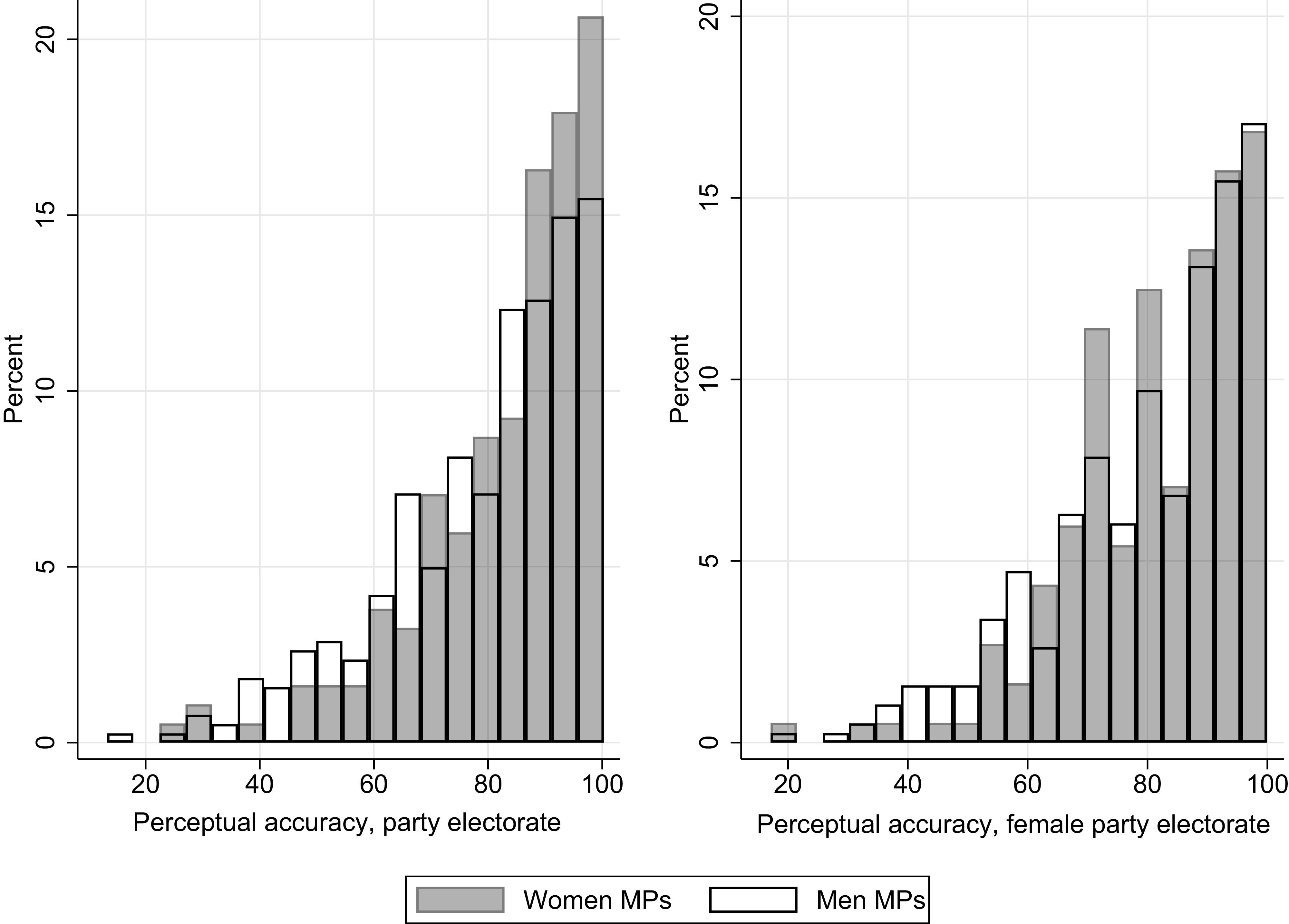
Do women MPs assess their party voters’ opinions on women’s issues more accurately than their men counterparts? Descriptively, Figure 1 presents the perceptual accuracy of men and women MPs’ assessment of their voters’ opinion on women’s issues. The left panel in Figure 1 shows how accurately MPs estimate the overall opinion of their men and women voters; the right panel presents the assessment of public opinion on women’s issues compared to the preferences of women voters only.
Perceptual accuracy of MPs in Switzerland and Germany. Public opinion on women’s issues in the electorate.
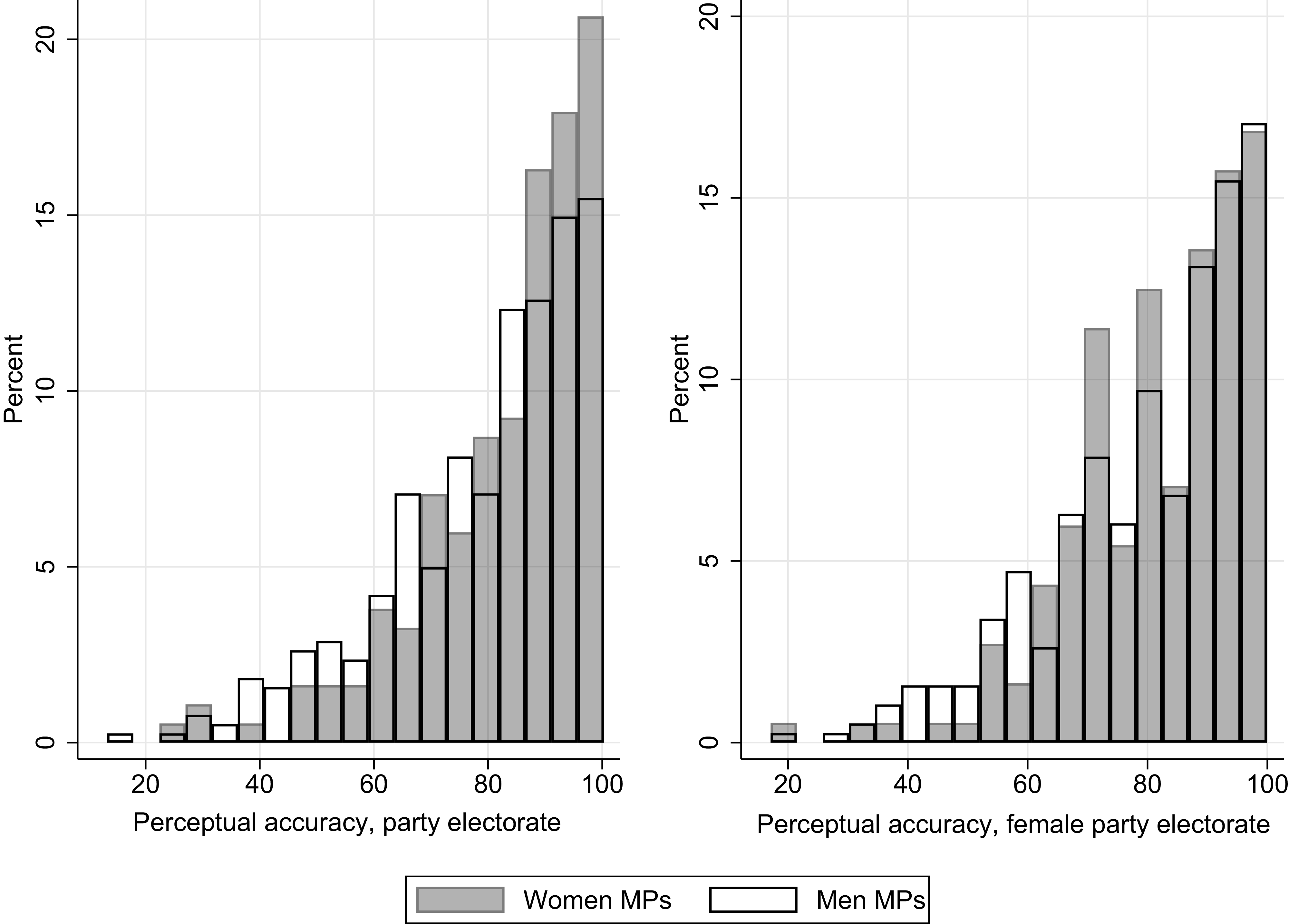
The descriptive evidence illustrates that MPs in Switzerland and Germany generally tend to have a fairly accurate estimate of their electorates’ opinions on women’s issues. The majority of MPs have accuracy scores between 80 and 100, indicating that their estimates of public opinion deviate by less than 20 percentage points from those observed in the citizen survey. The comparison of men and women MPs in Figure 1 indicates that women legislators tend to have a slightly better assessment of their voters’ opinions on women’s issues. In comparison to their men colleagues, a slightly higher share of women MPs has accuracy scores of above 80%. Turning to the evidence of the right panel in Figure 1, MPs (neither men MPs nor women MPs) do not tend to lean toward the opinion of their women voters when they are asked to assess their electorates’ opinion on women’s issues. The distribution of men MPs’ accuracy scores looks almost identical to the left panel, and the accuracy scores of women MPs are even a bit lower here.
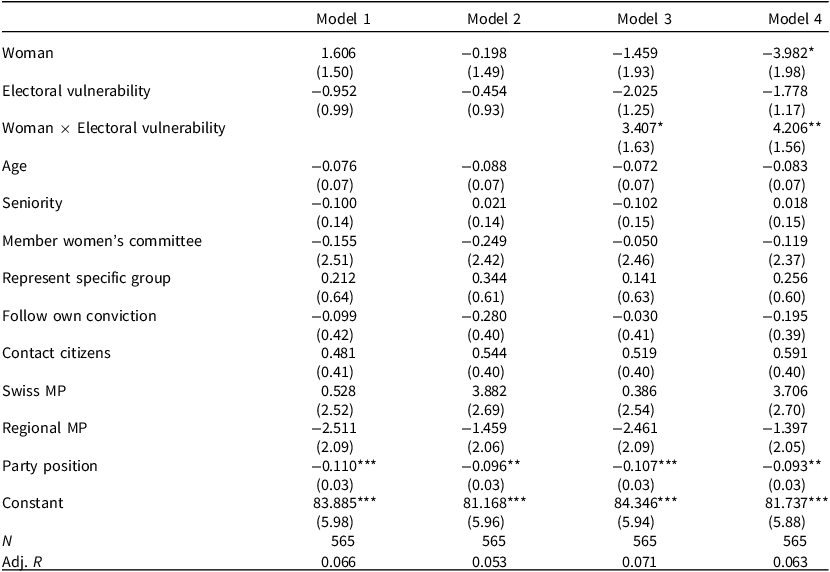
We now turn to the statistical analysis to test whether women MPs indeed have a better sense of their voters’ opinion on women’s issues, and to what extent their electoral vulnerability moderates this relationship. The estimation results for our expectations are reported in Table 1. Model 1 and Model 2 show the findings for our hypotheses on shared group experiences (H1a, H1b). The dependent variable in Model 1 is the perceptual accuracy for the assessment of the entire party electorate’s public opinion on women’s issues. Model 2 uses perceptual accuracy in reference to women voters’ public opinion on women’s issues as the dependent variable. Model 3 and Model 4 provide the results for the electoral vulnerability hypothesis (H2). Analogous to the first two models, the dependent variables in Model 3 and Model 4 are perceptual accuracy with regard to the entire party voters’ opinions on women-specific topics, and the accuracy of the assessment of women party voters’ opinions on these issues, respectively.
The gendered estimation of party voters’ opinion on women’s issues. Ordinary least squares regression. The dependent variable in Model 1 and Model 3 is the perceptual accuracy of the assessment of the public opinion of the entire party electorate on women’s issues. The dependent variable in Model 2 and Model 4 is perceptual accuracy with regard to the public opinion of women in the party electorate. Standard errors (in parentheses) are clustered by MPs
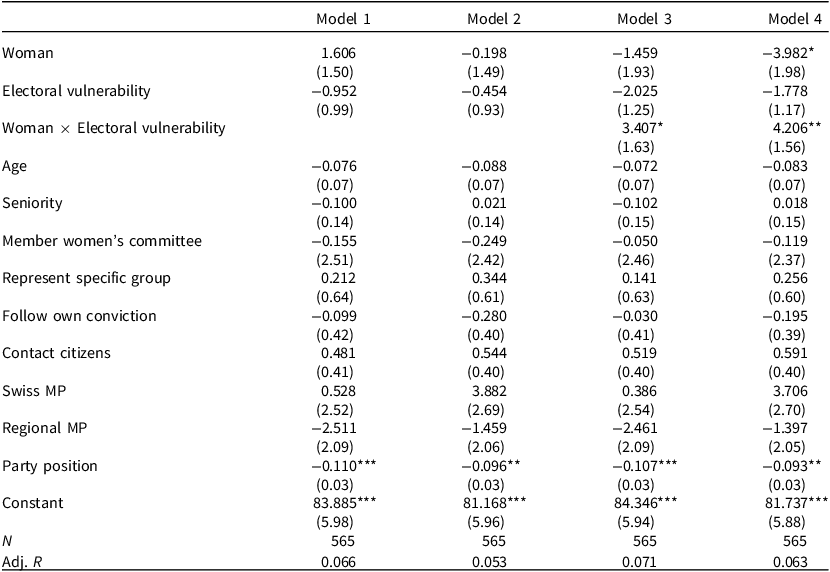
Significance levels: *p < 0.05, **p < 0.01, ***p < 0.001.
Focusing on shared group experiences, Model 1 reports that the estimated effect for woman on the assessment of public opinion regarding women’s issues is indistinguishable from zero. This result indicates that women MPs do not have a more accurate view of their party voters’ preferences on women-specific policy proposals compared to their men colleagues. The estimated effect in Model 2 is also non-significant, showing that there is no difference in the perceptual accuracy of women and men MPs when we only use women’s party voters’ opinions as the reference category. Thus, we have to reject our first hypotheses. We find no evidence that shared gendered experience alone or the feeling of a linked fate with women in the population provides women MPs with the necessary knowledge to better assess the preferences regarding women-specific policies.
Next, we concentrate on how the electoral vulnerability of women MPs, in response to gendered role expectations, affects their capability to accurately estimate the policy positions of their voters. In particular, electoral vulnerability of women MPs incentivizes them to more accurately assess the public opinion on women-specific policies. In line with our expectation (H2), Model 3 and Model 4 show a statistically significant and positive interaction effect of woman and the subjective electoral vulnerability of MPs. Since higher values on the dependent variable indicate better assessments of public opinion, the positive interaction effect conveys that – compared to their men colleagues – women MPs’ perceptual accuracy of their voters’ opinion on women’s issues improves as their electoral vulnerability increases. If the electoral vulnerability of women MPs increases, the effect of woman gets substantially stronger and the difference in the perceptual accuracy of women and men MPs becomes more pronounced. This effect is statistically significant for both dependent variables, which compare the accuracy vis-à-vis all voters, and the women’s electorate only.
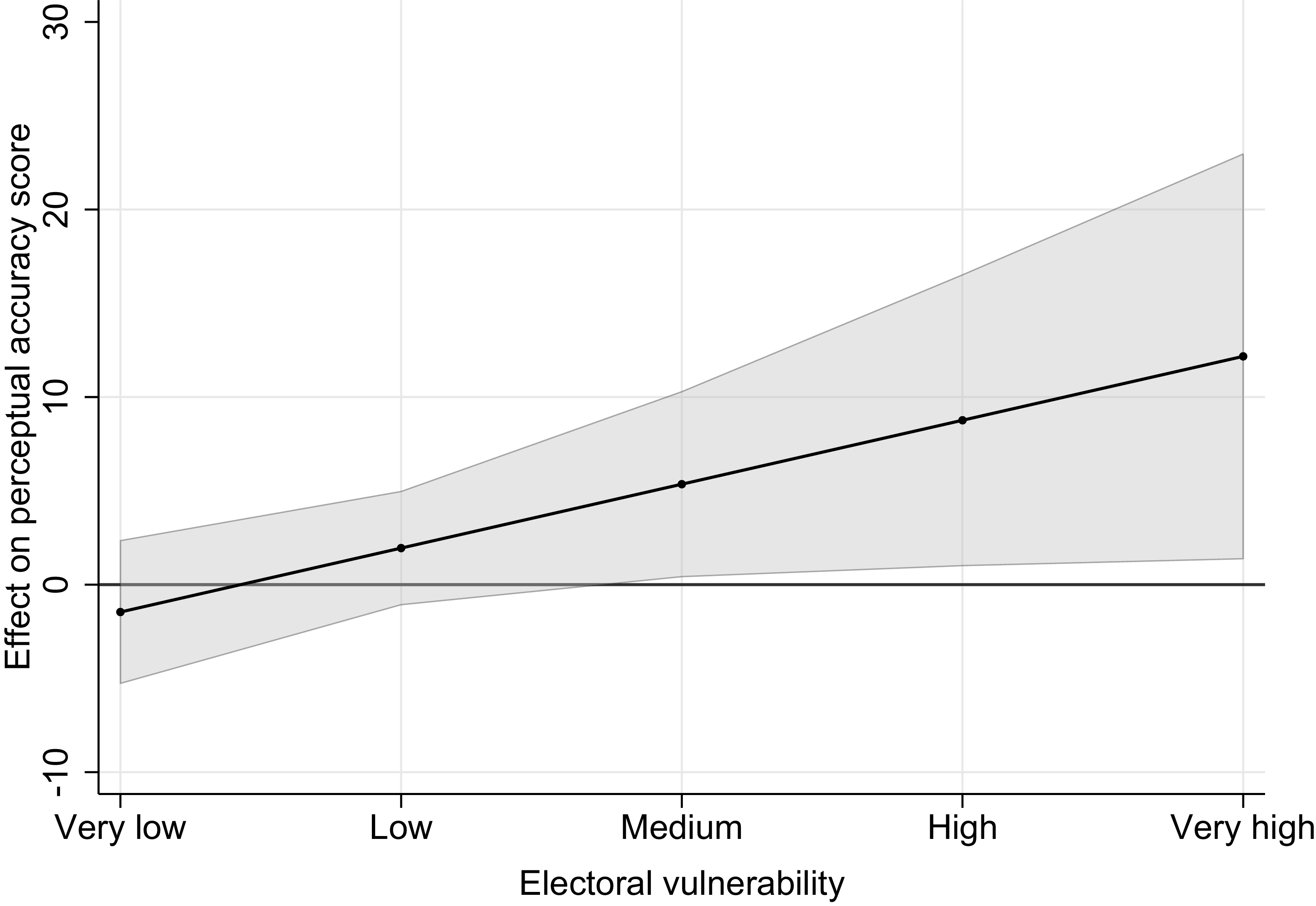
To better assess the substantial effect of the interaction, we calculated the marginal effect of being a woman MP across the range of electoral vulnerability for Model 3.Footnote 12 Figure 2 shows that if women MPs believe that their electoral vulnerability is very high, the assessment of their party voters’ opinion on women’s issues is 12 percentage points better than that of men MPs. The shaded area in the figure shows the 95% confidence interval and indicates that this effect is statistically significant.
Marginal effect of women MPs on perceptual accuracy. 95% confidence band is in gray.
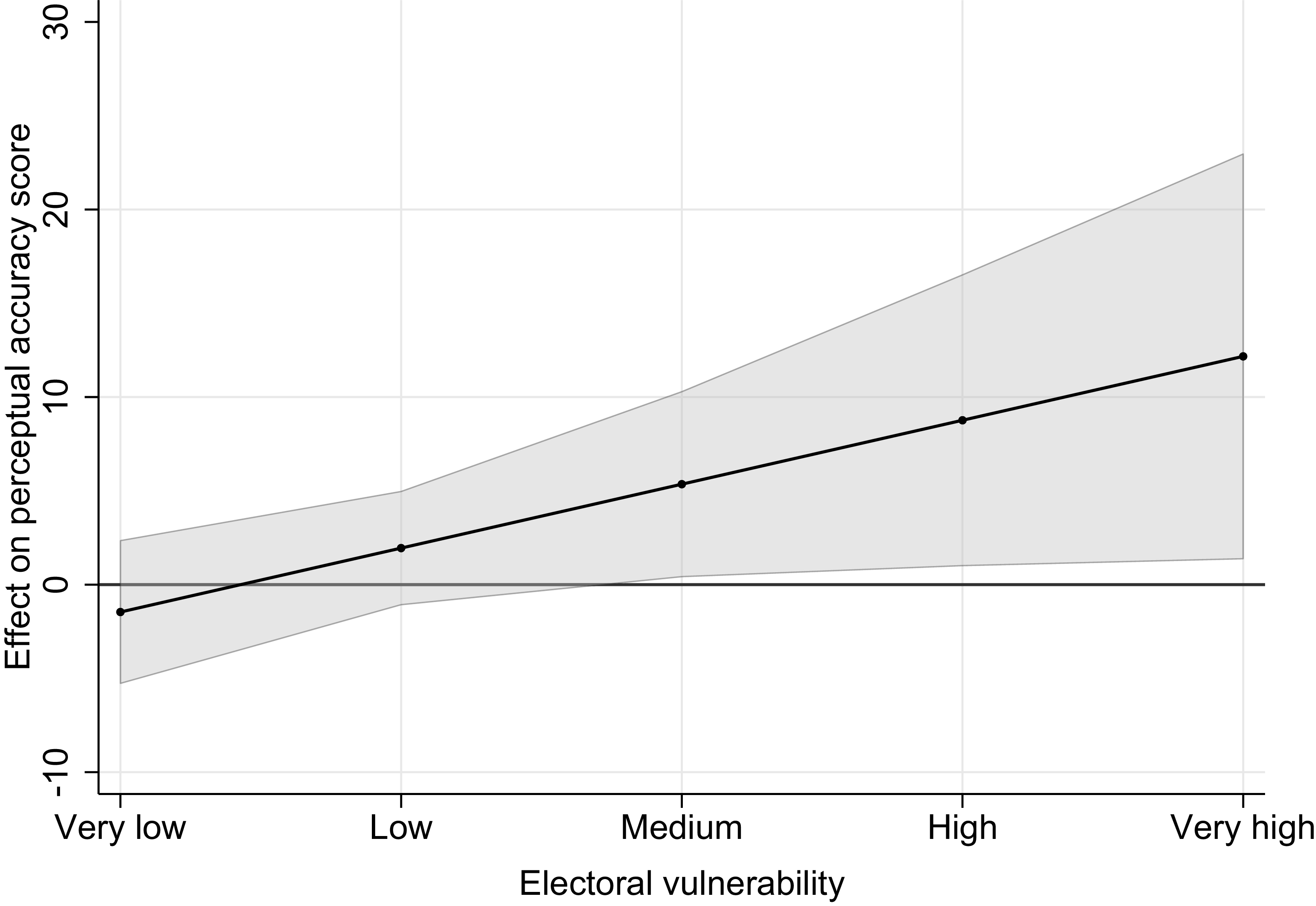
In line with our theoretical expectations, the marginal effect of woman gets smaller and statistically indistinguishable from zero if women MPs’ electoral vulnerability is low or very low. Taken together, the presented evidence suggests that neither shared group experiences nor electoral pressure alone improves MPs’ assessment of public opinion on women’s issues. The cross-pressure of being a woman MP and being electorally vulnerable markedly increases the estimate of public opinion on women’s issues.
Placebo and robustness tests
Placebo analysis
We perform a placebo analysis to strengthen our basic findings.Footnote 13 Following Eggers, Tunon and Dafoe (Reference Eggers, Tunon and Dafoe2024), we run a placebo outcome test that replicates the core analysis with an alternative dependent variable that should be unaffected by the main independent variable if our research design is valid and if our theoretical expectations about the behavior of women MPs are correct.
If our expectation is correct that electorally vulnerable women MPs are particularly interested in learning about voters’ preferences regarding women-specific policy issues because they react to gendered role expectations, we should not find any significant effects for gender and electoral vulnerability in policy areas that are not explicitly women-specific. Thus, we use our original model specification but now estimate the interaction effect of woman and electoral vulnerability on MPs’ perceptual accuracy of the party voters’ opinion on non-women-related policy proposals. The placebo test covers a broad set of issues. For Swiss MPs, these included, for example, proposals on defense procurement (purchase of new fighter jets), immigration control, taxation, internet voting, and pension reform. For German MPs, the items comprised policy statements on EU integration, environmental regulation, redistribution, criminal justice, and asylum policy, among others.Footnote 14 By including such a diverse range of policy domains, the placebo analysis ensures that the gendered effects identified in the main models are not driven by a general tendency of women MPs to be more accurate or attentive across all policy areas, but are instead specific to women-related issues.
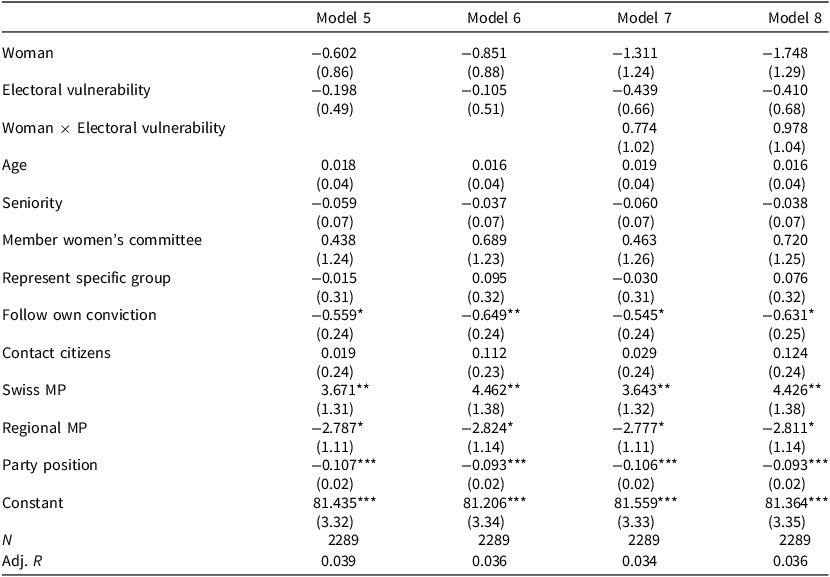
Except for the alternative dependent variable, we estimate exactly the same models as in the core analysis to ensure that potential flaws of the original research design (which might have produced spurious results) also operate in the placebo analysis. The dependent variable in Model 5 and Model 7 is the perceptual accuracy of the assessment of the overall public opinion among the party electorate. The dependent variable in Model 6 and Model 8 is perceptual accuracy with regard to women voters’ opinions.
The estimates in Table 2 for women MPs as well as the interaction effect of women MPs and their electoral vulnerability are statistically non-significant. The results of the placebo test thus indicate that the electoral context of women MPs is irrelevant for estimating public opinion on policies unrelated to women’s issues. The insignificant effects of electoral vulnerability in Table 2 additionally show that we are also not observing a more general pattern where all MPs become more motivated to inform themselves about their voters’ policy preferences if they are electorally vulnerable. The additional evidence implies that the electoral vulnerability of women MPs only induces them to focus on citizens’ preferences regarding women-specific policy issues to fulfill their ascribed role as the ‘women’s representative’ and to avoid negative publicity.
Placebo analysis. Estimation of the public opinion on non-women’s issues. Ordinary least squares regression. Perceptual accuracy of assessment of party voters’ opinion on issues that are not women-specific as the dependent variable. Model 5 and Model 7: Assessment of the public opinion of the entire party electorate. Model 6 and Model 8: Assessment of the public opinion of women in the party electorate. Standard errors (in parentheses) are clustered by MPs
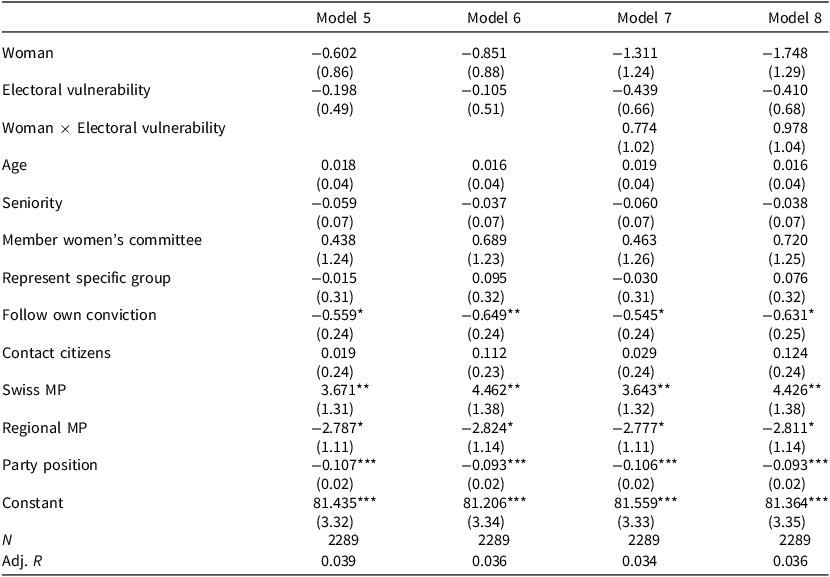
Significance levels: *p < 0.05, **p < 0.01, ***p < 0.001.
Robustness tests
Besides the placebo test, we conduct several analyses to determine the robustness of our main findings. The detailed description and results of these additional analyses can be found in Appendices A4 and A5. In sum, the robustness tests show that our findings are robust toward the inclusion of policy statement fixed effects, that all substantive findings remain unchanged if we re-estimate our core model specification without the control variable for membership in the women’s committee (potential post-treatment bias), and that the results are not sensitive to the inclusion of specific policy statements in the estimation of the perceptual accuracy score. Lastly, we explored whether personality traits that are neither caused by shared group experiences nor by working harder toward understanding women’s issues impact perceptual accuracy. The idea is that women may have certain personality traits that make them better suited to understand women’s interests. However, the results of a mediation analysis in Appendix A5 show that all estimated effects are not statistically distinguishable from zero, meaning that personality plays little role in estimating public opinion.
Discussion and conclusion
Our study shows that women parliamentarians are not inherently better at estimating voters’ preferences on women’s issues in comparison to their men colleagues. While men and women representatives, at least in Germany and Switzerland, hold somewhat different preferences on women-specific policies (see Footnote 2 and Appendix A2), they do not differ substantially in how accurately they assess their voters’ opinions on these matters. As such, shared life experiences among women and their identification and socialization as a group do not automatically provide women MPs with a more accurate estimate of citizens’ policy preferences regarding women-specific policies.
Instead, we advance a conditional argument: women legislators who are electorally vulnerable assess public opinion more accurately than their men colleagues because they must behave strategically in a society that imposes gendered constraints on them. Since voters expect women to be more knowledgeable about women’s issues, women MPs invest more effort in learning about voter preferences on these issues when they are in an electorally vulnerable situation. This expectation was confirmed by one of our interview partners, a Swiss woman parliamentarian: ‘While I make the experience that I am taken seriously in my core topic of finances, I also experience that I am expected to be competent in gender and social affairs topics. There is no expectation that men are competent in those areas. That’s why women have to speak about women’s issues, and hardly ever men’. Our results support this argument: women MPs who perceive themselves as electorally vulnerable are, on average, twelve percentage points closer to the public opinion on women’s issues than those who expect to be easily re-elected. This conditional effect of electoral threat is reinforced by a placebo analysis showing that the pattern is specific to women-related policies.
As one of the first studies to examine MPs’ perceptual accuracy regarding voters’ opinions on women-specific policies, our findings offer new insights into whether and under which conditions women MPs are better able to estimate public preferences in this area. Based on our quantitative evidence, we find support for the hypothesis of women MPs’ strategic behavior, but cannot directly test the underlying mechanisms. Future research – particularly through qualitative interviews – should further explore the motivations that lead women MPs to gather information about voter attitudes on women-specific issues.
Nevertheless, the presented argument and evidence align well with core rational choice assumptions that parliamentarians act as rational vote-seeking actors, and the results of the analysis make important contributions to the literature on political representation. Particularly, the paper adds to previous research on women’s representation and helps to develop a more thorough understanding of the complicated link between women’s descriptive and substantive representation (Dingler, Kroeber and Fortin-Rittberger Reference Dingler, Kroeber and Fortin-Rittberger2019; Dodson Reference Dodson2006; Dovi Reference Dovi2002; Höhmann Reference Höhmann2020; Mansbridge Reference Mansbridge1999; Phillips Reference Phillips1995). By showing that only under specific electoral conditions do women MPs develop a more accurate perception of voters’ preferences on women’s issues, the findings indicate that the quality of democratic responsiveness regarding women’s substantive representation does not automatically increase if more women are present in parliament (c.f. Höhmann Reference Höhmann2020).
Moreover, these results complement and extend the findings of previous studies on women’s substantive representation and the associated gendered role expectations. Particularly, it highlights a double-bind that women MPs face when it comes to the representation of women-specific interests: Looking at the actual representational behavior of women MPs, Höhmann (Reference Höhmann2020) finds that in cases of high electoral vulnerability, women MPs reduce their actual engagement in the substantive representation of women and become less likely to raise women-specific issues in parliament. He shows that actively representing women’s interests in parliament is not a promising strategy for women to win additional votes, since women MPs who substantively represent women fulfill a generally accepted expectation. As a result, they will not receive particular praise or additional votes for it. Instead, electorally vulnerable women MPs are expected to devote a large proportion of their scarce resources to district-related tasks to fight for additional votes from their local voters.
Our results show that, although women MPs who are electorally marginal are not able to focus their actual parliamentary behavior on the representation of women’s interests, they still feel the pressure to be informed about their voters’ policy preferences regarding these issues. Because women MPs are strongly expected to champion women’s issues, they risk negative electoral consequences – such as a loss of votes – if they fail to meet these expectations and if they do not have a profound knowledge of women-specific topics. In short, ‘[f]emale politicians are blamed if they do not pursue ‘women’s issues’ while male politicians get credit if they do’ (Bergqvist, Bjarnegård and Zetterberg Reference Bergqvist, Bjarnegård and Zetterberg2018: 581). Importantly, this pressure extends even to women MPs who do not personally prioritize gender equality policies. Regardless of their individual interests or policy focus, women MPs must remain informed about voters’ opinions on women’s issues if, out of self-interest, they want to sustain their political careers as elaborated in one of our interviews with women politicians: ‘the notion is still widespread that women are competent in social issues but not in technical, financial, and similar areas. […] the reverse is also true – men are not expected to be knowledgeable about women’s policy issues’.
This underscores how gendered expectations structure political behavior, creating unequal constraints and opportunities for men and women MPs. Although previous research demonstrates that men representatives are actually more likely to engage in the substantive representation of women when they are electorally insecure (Höhmann and Nugent Reference Höhmann and Nugent2022), our findings highlight that this engagement does not seem to be based on a more precise knowledge of voters’ preferences on women’s issues. For men MPs, symbolic engagement with gender equality topics may already suffice to signal openness, modernity, or empathy without investing in a detailed understanding of public opinion as elaborated by our interviewed Swiss woman parliamentarian: ‘Men politicians are not expected to know about women’s issues’. In contrast, women MPs face stronger scrutiny and are expected to demonstrate competence and responsiveness in this domain. Consequently, while electoral insecurity can affect both men and women MPs’ opportunities to address gender equality, only women face the pressure to do so in an informed and accurate manner. In other words, men MPs enjoy ‘the privilege of a larger maneuvering room that enables them to speak within the gender equality discourse without being delegitimized when they prioritize other issues’ (Bergqvist, Bjarnegård and Zetterberg Reference Bergqvist, Bjarnegård and Zetterberg2018: 581). Unlike women MPs, men politicians can freely choose whether to focus on – and inform themselves about – women’s issues (Höhmann and Nugent Reference Höhmann and Nugent2022).
Why, then, do we not find support for the unconditional effect of group-specific experiences? Attempts to find a general definition of women’s issues have often been criticized for being essentialist and for assuming that women are a monolithic and homogeneous group. The vast diversity of experiences and identities of women makes it hard to see how there might be a coherent set of interests that could be labeled ‘women’s interests’. Hence, sharing gendered experiences with women in society may allow for one sort of better perspective on women’s issues, but not the diversity of women’s interests. According to Dovi (Reference Dovi2007: 311) ‘women differ when they have children or do not, are divorced or not, have been raped or not, are straight or gay, obese or thin, Muslim or Christian, menopausal or prepubescent’. Moreover, women’s diversity with regard to their social class and their ethnic identities presents a plethora of different perspectives and needs.
These findings also contribute to the more general research on politicians’ perceptual accuracy of citizens’ policy preferences (e.g., Broockman and Skovron Reference Broockman and Skovron2018; Walgrave, Jansen, Sevenans et al. Reference Walgrave, Jansen, Sevenans, Soontjens, Pilet, Brack, Varone, Helfer, Vliegenthart, van der Meer, Breunig, Bailer, Sheffer and Loewen2023). Given that MPs’ accurate perception of public opinion is an important prerequisite for political representation and responsiveness, understanding when and why politicians know what their voters want offers key insights into the conditions under which elected officials can produce policies that truly reflect citizens’ expectations and preferences.
Supplementary material
The supplementary material for this article can be found at https://doi.org/10.1017/S1475676526100991.
Data availability statement
Data and code to replicate the findings of this study are available on the Harvard Dataverse: https://doi.org/10.7910/DVN/38B8HD.
Acknowledgements
Previous versions of this article were presented at the Annual Conference of the Swiss Political Science Association, the MPSA Conference, the EPSA General Conference, the Conference of the ECPR Standing Group on Parliaments, the ECPR General Conference, and at talks at the University of Bern and the University of Basel. We are grateful for all comments by the audiences. In particular, the paper benefited from suggestions by Michael Kellermann, Sven Oliver Proksch, Corinna Kroeber, and Stephen Bates.
Funding statement
The POLPOP project was supported by the Flemish Fund for Scientific Research (FWO, grant number G012517N). The German part of the study (led by Christian Breunig and Stefanie Bailer) received funding from the Ausschuss für Forschungsfragen, University of Konstanz (AFF 2018). The collection of the Swiss data (led by Frederic Varone and Luzia Helfer) was funded by the Swiss National Science Foundation (SNSF, grant 100017_172559).
Competing interests
The authors declare no potential conflicts of interest with respect to the research, authorship, and/or publication of this article.
Ethics standards
In Switzerland, ethical approval for the survey was granted by the Ethics Commission of the Geneva School of Social Sciences (University of Geneva) on 16 April 2018. The German part of the study was deemed exempt from review by the ethical board of the University of Konstanz.


 Open access

