

Ethics are the moral principles that underlie judgments of right and wrong, and ethical standards are the socially constructed operationalizations of these principles, providing criteria by which the behaviors are judged as ‘good’ or ‘bad’ by others (Greve, Palmer, & Pozner, Reference Greve, Palmer and Pozner2010; Svensson & Wood, Reference Svensson and Wood2007; Treviño, den Nieuwenboer, & Kish-Gephart, Reference Treviño, den Nieuwenboer and Kish-Gephart2014). A growing body of research examines why organizations might meet such standards and reap benefits or fail to meet standards and incur significant costs (e.g., Burke & Logsdon, Reference Burke and Logsdon1996; Chun, Shin, Choi, & Kim, Reference Chun, Shin, Choi and Kim2013; Shin, Sung, Choi, & Kim, Reference Shin, Sung, Choi and Kim2015; Sims, Reference Sims2009), including some initial studies on ethical capabilities (e.g., Arend, Reference Arend2013; Buller & McEvoy, Reference Buller and McEvoy1999; Cantrell, Kyriazis, & Noble, Reference Cantrell, Kyriazis and Noble2015). Because this research collectively suggests that stakeholders reward organizations that behave ethically and punish those that do not, it might seem logical to assume that organizations prioritizing ethical concerns would gain competitive advantages enhancing performance. Yet, hoped-for advantages can fail to materialize, and being explicitly unethical may even be profitable (Cornell & Damodaran, Reference Cornell and Damodaran2020). Moreover, ethical dilemmas (Garsten & Hernes, Reference Garsten and Hernes2009) and conflicting stakeholder expectations (Phillips, Reference Phillips2003) embody situations without clear solutions, and social and technological change can create novel concerns that are difficult to anticipate.
Given these complexities, we argue that a firm’s dynamic ethical capabilities, defined as organizational competencies for acquiring, maintaining, and applying knowledge of ethical standards, are important firm-specific resources (Barney, Reference Barney1991; Peteraf, Reference Peteraf1993; Wernerfelt, Reference Wernerfelt1984). Put simply, the advantages of ‘being good’ can only be realized if organizations develop the skills needed to continuously figure out how to ‘do good’ in ways that satisfy the pluralistic social norms of diverse stakeholders over time. This argument proceeds in three steps.
First, we expand on Svensson and Wood’s (Reference Svensson and Wood2003, Reference Svensson and Wood2007) assertion that ethical standards are socially constructed expressions of social norms tied to individual stakeholder groups. We conclude that, even though there may be an easily knowable set of universal ethical principles (Asgary & Mitschow, Reference Asgary and Mitschow2002; Schwartz, Reference Schwartz2005), operationalizing these principles is often difficult when norms are locally situated, tacit, changing, and/or nascent. This section of our paper contributes to the literature by explaining how transitory or emergent interpretations of morality complicate the task of satisfying pluralistic stakeholders.
Second, we review core tenets of resource-based theory (Hereafter referred to as RBT: Barney & Clark, Reference Barney and Clark2007) as they pertain to knowledge (Grant, Reference Grant1996) and firm capabilities (e.g., Eisenhardt & Martin, Reference Eisenhardt and Martin2000; Helfat & Peteraf, Reference Helfat and Peteraf2003; Teece, Reference Teece1998) to explain how dynamic ethical capabilities potentially confer competitive advantages. This section contributes to the literature by describing how actionable knowledge of ethical standards can be acquired and implemented using sets of present-oriented (i.e., deciphering, enacting, monitoring, and reacting) and future-oriented (i.e., predicting, planning, pacing, and influencing) capabilities.
Third, synthesizing the dynamics reviewed in previous sections, we theorize boundary conditions under which dynamic ethical capabilities can function as valuable resources. We argue that competitive advantages are more likely when organizational stakeholders are willing and able to administer rewards and penalties, when stakeholders are diverse, and when ethical standards are tacit. Additionally, we explain why these advantages are most likely sustainable when organizations develop a continued competency across present and future-oriented capabilities.
As an ethical commentary, our work uniquely emphasizes the inherent difficulties of proactive adaptation while also describing pragmatic potential solutions (Godfrey & Lewis, Reference Godfrey, Lewis, Harrison, Barney, Freeman and Phillips2019; Jensen & Sandström, Reference Jensen and Sandström2013). As a strategic theory, our work notably conceptualizes ethical capabilities as critical and sometimes creative functions. This view contrasts previous dynamic capabilities research that primarily views ethical issues as competitive constraints (e.g., Teece, Reference Teece2007) or political activity (e.g., Hillman, Keim, & Schuler, Reference Hillman, Keim and Schuler2004). Our work also reciprocally informs larger-level theory by examining how knowledge assets are strategically renewed (Agarwal & Helfat, Reference Agarwal and Helfat2009; Shin & Pérez-Nordtvedt, Reference Shin and Pérez-Nordtvedt2020) through the interplay of well-organized and coordinated present and future-oriented capabilities. By integrating RBT, organizational capabilities, and stakeholder theory, we underscore the value of understanding localized ethical standards, present dynamic ethical capabilities as essential for long-term strategy, and caution against static, short-term approaches. Together, these insights provide a novel theoretical framework for applying universal ethical principles to complex, context-specific scenarios in pursuit of competitive advantages.
Ethical standards conceptualized as difficult-to-know social norms
Social norms are the traditions, values, and standards that exist within and sometimes define social groups. These norms function as frames of reference for determining appropriate action and carry an injunctive purpose when they carry a strong moral emphasis designating right from wrong (Svensson & Wood, Reference Svensson and Wood2003, Reference Svensson and Wood2007). At times they define normative aspects of contracts (Freeman, Dmytriyev, & Phillips, Reference Freeman, Dmytriyev and Phillips2021) or even specify the sacred and taboo (Tetlock, Reference Tetlock2003). Violators of injunctive norms face disdain, censure, loss of status, and other sanctions (Young, Reference Young2015) doled out by conformists willing to incur irrationally high personal costs to punish those who violate esteemed ideals (Fehr & Fischbacher, Reference Fehr and Fischbacher2004). We contend that the ethical standards that organizations are expected to meet are specialized, socially constructed injunctive norms carrying moral imperatives. These standards frame whether organizational actions are judged positively or negatively by individuals (Becker et al., Reference Becker, Vignoles, Owe, Easterbrook, Brown and Smith2014), social groups (Svensson & Wood, Reference Svensson and Wood2007), and the governmental and nongovernmental ‘social control agents’ who act as standard setters, monitors, and enforcers (Greve et al., Reference Greve, Palmer and Pozner2010).
Accordingly, exhibiting behaviors consistent with ethical standards allows organizations to accrue benefits while avoiding negative consequences. Internally, meeting standards reduces employee misbehavior (Schwartz, Reference Schwartz2001) while also increasing employee cooperation (Ostrom, Walker, & Gardner, Reference Ostrom, Walker and Gardner1992), job satisfaction, and affective commitment (Neubert, Carlson, Kacmar, Roberts, & Chonko, Reference Neubert, Carlson, Kacmar, Roberts and Chonko2009). Externally, adherence minimizes costs associated with regulatory oversight (Henderson & Cudahy, Reference Henderson and Cudahy2005), harmed reputation (Sims, Reference Sims2009), and deterioration of interorganizational relationships within the value chain (Sullivan, Haunschild, & Page, Reference Sullivan, Haunschild and Page2007). Thus, the benefits of meeting and penalties for not meeting standards potentially aggregate to enhance or degrade organizational performance (Chun et al., Reference Chun, Shin, Choi and Kim2013; Shin et al., Reference Shin, Sung, Choi and Kim2015).
Viewing ethical standards as specialized social norms suggests that only organizations capable of consistently understanding and applying these norms can fully realize their benefits. However, this is inherently challenging because each of the parties that hold an interest in, or is affected by, an organization’s activities (i.e., stakeholders: Freeman, Reference Freeman1984) hold diverse and potentially irreconcilable interpretations of morality (Godfrey & Lewis, Reference Godfrey, Lewis, Harrison, Barney, Freeman and Phillips2019). The following sections examine this complexity by exploring how social norms are locally tied to stakeholder groups and why tacit, changing, and nascent social norms further complicate matters.
Localized standards attached to stakeholder groups
Researchers have identified internationally generalizable, and perhaps universal, ethics-related themes that are broadly related to trustworthiness, respect, responsibility, fairness, equity, caring, support, and citizenship (Asgary & Mitschow, Reference Asgary and Mitschow2002; Morales-Sánchez & Cabello-Medina, Reference Morales-Sánchez and Cabello-Medina2013; Schwartz, Reference Schwartz2005). While these principles provide useful general guidelines, organizations still face the challenge of translating them into specific actions and routines that are morally acceptable across diverse stakeholders (Godfrey & Lewis, Reference Godfrey, Lewis, Harrison, Barney, Freeman and Phillips2019; Phillips, Reference Phillips2003) while also supporting competitive advantage (Litz, Reference Litz1996). This task is difficult because there is potential for almost infinite variations among localized ethical preferences that do not always map onto national political boundaries (Atari et al., Reference Atari, Haidt, Graham, Koleva, Stevens and Dehghani2023; Graham, Meindle, Beall, Johnson, & Zhang, Reference Graham, Meindle, Beall, Johnson and Zhang2016; Kaasa, Vadi, & Varblane, Reference Kaasa, Vadi and Varblane2014; Taras, Steel, & Kirkman, Reference Taras, Steel and Kirkman2016) and because what is considered morally repulsive by one group may be considered a moral imperative by another (Fisk & Rai, Reference Fisk and Rai2014).
These dynamics are prevalent in the countless affiliations throughout the world, each having its own highly regarded definitions of what it means to do good or bad, and some of whom assume primacy while actively trying to enforce their perspectives on others. Such situations are aptly illustrated by the ongoing ‘cultural wars’ in the United States that have spilled over into everyday mass-market commerce. For instance, the Anheuser-Busch company placed some of its executives on leave in an attempt to manage backlash from some religious groups and politicians stemming from an inclusive marketing campaign that provided a single customized beer can to a trans woman social media personality (Homans, Reference Homans2023). Subsequently, attempts to manage backlash were perceived by some as backpedaling and validating trans hate (Casey, Reference Casey2023). Clearly, determining what constitutes ‘good’ or ‘bad’ behavior by various stakeholder groups is a complex and high-stakes puzzle.
Tacit standards
The complexity of stakeholder-specific ethical standards is heightened by underlying social norms that are tacit (i.e., difficult to articulate or consciously recognize: Greve et al., Reference Greve, Palmer and Pozner2010; Hadjimichael & Tsoukas, Reference Hadjimichael and Tsoukas2019; Svensson & Wood, Reference Svensson and Wood2007; Treviño et al., Reference Treviño, den Nieuwenboer and Kish-Gephart2014). When ethical norms are highly tacit, they may only be implicitly understood by core members of stakeholder groups (Cialdini & Trost, Reference Cialdini, Trost, Gilbert, Fiske and Lindzey1998) and expressed exclusively through skillful enactment (Hadjimichael, Ribeiro, & Tsoukas, Reference Hadjimichael, Ribeiro and Tsoukas2024), thereby creating situations where the delineation between moral and immoral behavior is imprecise (e.g., Bruhn, Reference Bruhn2009).
A well-known example of confusion related to tacit ethical standards is the cross-cultural misinterpretations between formal corporate ethical codes and informal business practices. For instance, von Weltzien Hoivik (Reference von Weltzien Hoivik2007) documents the cultural misreading of Western ethical codes in Chinese contexts. In such cases, organizations have explicit knowledge of known cultural differences that are widely discussed in the popular press, academic writings, and textbooks. However, the regularity of documented mistakes suggests that essential, unspoken elements of ethical practice remain inaccessible to those without intimate familiarity with local customs.
Changing standards
Even when organizations successfully decode localized ethical standards, they still face the difficulty of remaining current. Injunctive social norms can change within social networks through interaction, observation, and shared history (Acemoglu & Jackson, Reference Acemoglu and Jackson2015; Young, Reference Young2015). As early adopters accept new behaviors, norms shift and eventually reach a tipping point (i.e., a threshold: Granovetter & Soong, Reference Granovetter and Soong1983) where a new convention is adopted by the group as a whole (Centola, Becker, Brackbill, & Baronchelli, Reference Centola, Becker, Brackbill and Baronchelli2018).
An important nuance to this dynamic is that changes do not necessarily happen quickly or even consistently in a particular direction. What was once accepted may slowly become rejected, what was once rejected may quickly become accepted, and similar actions might be judged by seemingly contradictory standards. For example, tobacco use in North America, once normalized, has increasingly become morally questionable (e.g., Goodin, Reference Goodin1989; Kozlowski & Sweanor, Reference Kozlowski and Sweanor2016). However, marijuana use, once strongly stigmatized, has become more accepted (Ferrucci, Painter, & Kalika, Reference Ferrucci, Painter and Kalika2019). Further, changes considered ethical ‘progress’ by some can revert to earlier states favored by others. For example, strict religious cultural ideals decline during periods of secularization but can regain prominence during times of resurgence or revival of more traditional values (Hurd, Reference Hurd2007; Stolz & Voas, Reference Stolz and Voas2023).
When such changes transpire, organizations with static ethical orientations risk mistakenly assuming standards are being met. Conversely, those with proactive strategies risk taking action that must later be reversed. A high-profile example of the latter is currently unfolding in the United States where companies are retreating from diversity, equity, and inclusion initiatives that were once heralded as ethical achievements but have since fallen out of favor. For instance, Walmart has decided to unwind its $100 million Center for Racial Equity, end support for suppliers owned by historically disadvantaged groups, and restrict third-party sellers from offering some LGBTQ-themed items deemed controversial (Nassauer, Reference Nassauer2024a). Similar reversals, prompted by changes in social norms, have been observed at companies like Boeing (Nassauer, Reference Nassauer2024a), Molson Coors (Pisani, Reference Pisani2024), Tractor Supply (Nassauer, Reference Nassauer2024b), Google, Facebook, and various universities (Kessler, Reference Kessler2024).
Nascent standards
Remaining current also becomes challenging when predominate ethical standards are inapplicable to new technologies (Marshall, Reference Marshall1999; McVea, Reference McVea2009), necessitating the emergence of nascent standards. Examples of technological innovation raising novel ethical challenges include the manipulation of evolutionary processes through genetic engineering (e.g., Li, Walker, Nie, & Zhang, Reference Li, Walker, Nie and Zhang2019), monitoring and controlling behavior in hyperrealistic virtual environments (e.g., Spiegel, Reference Spiegel2017), an emergence of publicly available artificial intelligence – which sometimes ironically ‘judges’ its own actions as unethical (e.g., Wilkinson, Reference Wilkinson2023), and direct computer-to-brain interfaces (e.g., Jecker & Ko, Reference Jecker and Ko2024). When these kinds of technological advances are made, there are no established social norms defining good and bad, and organizations can only navigate a state of anomie until stakeholder expectations coalesce.
Dynamic ethical capabilities supporting sustainable competitive advantage
The complexity of understanding and meeting social norms underscores that fulfilling ethical standards is an inherently difficult task grounded in both time and place. Therefore, it is unsurprising when many organizations fall short, and it is vital that methods for overcoming these challenges are identified (Godfrey & Lewis, Reference Godfrey, Lewis, Harrison, Barney, Freeman and Phillips2019; Pouryousefi & Freeman, Reference Pouryousefi and Freeman2021). To begin addressing this concern, we draw on literature examining the role of knowledge within RBT (Barney, Reference Barney1991; Wernerfelt, Reference Wernerfelt1984) and organizational capabilities (Eisenhardt & Martin, Reference Eisenhardt and Martin2000; Helfat & Peteraf, Reference Helfat and Peteraf2003; Teece, Reference Teece2007) to introduce sets of present-oriented and future-oriented dynamic ethical capabilities aimed at doing ‘good’ while also acquiring and maintaining competitive advantage.
Resource-based theory, knowledge, and capabilities
RBT considers heterogeneous firm resources that vary in their potential to create competitive advantage (Barney, Reference Barney1991; Leiblein, Reference Leiblein2011; Peteraf, Reference Peteraf1993; Wernerfelt, Reference Wernerfelt1984). Firms that possess or control resources that are valuable (i.e., contribute to effectiveness and efficiency) and rare (i.e., not widely held) are likely to experience competitive advantage because they are better equipped to create more economic value than their more marginalized competitors (Peteraf & Barney, Reference Peteraf and Barney2003). However, the scarcity of valuable resources tends to be temporary unless isolating mechanisms limit their distribution to other firms (Peteraf, Reference Peteraf1993). Thus, achieving a more sustainable competitive advantage requires that resources be not only valuable and rare but also inimitable (i.e., difficult to replicate or substitute) and organized for exploitation within a firm’s structure and processes (i.e., valuable, rare, inimitable, and organized (VRIO) criteria: Barney, Reference Barney1986; Barney & Clark, Reference Barney and Clark2007).
In RBT research, knowledge is often highlighted as a particularly significant resource (Barney, Reference Barney1991; Conner & Prahalad, Reference Conner and Prahalad1996; Grant, Reference Grant1996; Kogut & Zander, Reference Kogut and Zander1992; Teece, Reference Teece1998), yet it serves the same theoretical purpose as any other potentially valuable resource (Barney & Clark, Reference Barney and Clark2007). That is, knowledge resources only provide sustainable competitive advantages when they contribute to organizational effectiveness are not widely held, are inimitable, and are exploitable through organization. Explicit, easily codified knowledge may offer competitive advantages as long as it is not widely held among competitors. However, this advantage is likely not sustainable because explicit knowledge is easily imitated, shared, or traded in strategic factor markets (Barney, Reference Barney1986; Barley, Treem, & Kuhn, Reference Barley, Treem and Kuhn2018; Barney & Clark, Reference Barney and Clark2007; Teece et al., Reference Teece, Pisano and Shuen1997) in a manner that is similar to commodity-like physical resources. In contrast, tacit knowledge is difficult to articulate and/or codify because it is inconspicuously embedded within organizational systems, routines, and members (Grant, Reference Grant1996), so much so that firms and individuals may not even realize they possess it (Barley et al., Reference Barley, Treem and Kuhn2018). Hence, tacit knowledge can provide a more sustainable competitive advantage because it is difficult, and sometimes impossible, to transfer to other firms.
Reflecting Barney and Clark’s (Reference Barney and Clark2007) observation that organizing resources for effective exploitation is necessary for sustainable competitive advantage, firms also vary differ in their capabilities aimed at task coordination and leveraging resources for goal attainment (Collis, Reference Collis1994; Helfat et al., Reference Helfat, Finkelstein, Mitchell, Peteraf, Singh, Teece and Winger2007; Helfat & Peteraf, Reference Helfat and Peteraf2003; Schilke, Hu, & Helfat, Reference Schilke, Hu and Helfat2017; Winter, Reference Winter2003). These capabilities are difficult (and sometimes impossible) to transfer because they are embedded within the routines of firms. Operational capabilities, sometimes referred to as lower-order capabilities (Collis, Reference Collis1994; Fainschmidt, Pezeshkan, Frazier, Nair, & Markowski, Reference Fainschmidt, Pezeshkan, Frazier, Nair and Markowski2016), are reliable patterns of activity that enable typical organizational functioning. In contrast, dynamic capabilities (Eisenhardt & Martin, Reference Eisenhardt and Martin2000; Helfat et al., Reference Helfat, Finkelstein, Mitchell, Peteraf, Singh, Teece and Winger2007; Teece, Reference Teece2007; Teece et al., Reference Teece, Pisano and Shuen1997), sometimes known as higher-order capabilities (Collis, Reference Collis1994; Fainschmidt et al., Reference Fainschmidt, Pezeshkan, Frazier, Nair and Markowski2016), improve the firm’s resource base continuously and creatively over time, including adjustments to operational capabilities, organizational structure, and governance. Both types of capabilities contribute to firm performance (Karna, Richter, & Riesenkampff, Reference Karna, Richter and Riesenkampff2016; Zhou, Zhou, Feng, & Jiang, Reference Zhou, Zhou, Feng and Jiang2019), albeit to varying degrees depending upon the levels of technological change (Fainschmidt et al., Reference Fainschmidt, Pezeshkan, Frazier, Nair and Markowski2016), environmental dynamism (Wilhelm, Schlömer, & Maurer, Reference Wilhelm, Schlömer and Maurer2015), time horizon and degree of uncertainty (Irwin, Gilstrap, Drnevich, & Sunny, Reference Irwin, Gilstrap, Drnevich and Sunny2022) within an industry.
In capabilities research, knowledge takes a more central theoretical role than other types of resources within the overarching scope of RBT, especially when considering capabilities that are dynamic in nature (Teece et al., Reference Teece, Pisano and Shuen1997; Helfat et al., Reference Helfat, Finkelstein, Mitchell, Peteraf, Singh, Teece and Winger2007; Kaur, Reference Kaur2023). Dynamic capabilities directly reflect a firm’s capacity to learn deliberately (Zollo & Winter, Reference Zollo and Winter2002), including the retention (Spender, Reference Spender1996), creation (Grant, Reference Grant1996), and recombination (Kogut & Zander, Reference Kogut and Zander1992) of the knowledge resources enabling a firm to innovate and adapt to changing internal and external demands (Cohen & Levinthal, Reference Cohen and Levinthal1990; Todorova & Durisin, Reference Todorova and Durisin2007). Dynamic capabilities also enable the improvement of firm systems that determine how resources can be acquired, integrated, recombined, or discarded over time as technology improves and/or societal preferences change (Eisenhardt & Martin, Reference Eisenhardt and Martin2000). These kinds of activities are often discussed in terms of recognizing important environmental changes (i.e., sensing), acting strategically on opportunities or threats (i.e., seizing), adapting organizational structures and strategies (i.e., transforming), and influencing the competitive environment (i.e., shaping).
Dynamic capabilities for navigating ethical complexities
We contend that the complexities of ethical standards – rooted in their localized, tacit, and evolving nature – can be addressed through a synthesis of RBT and dynamic capabilities theory. RBT emphasizes that sustainable competitive advantage arises from leveraging resources, with tacit knowledge playing a pivotal role in navigating nuanced ethical norms. Dynamic capabilities theory provides further insight by suggesting ways that organizations can adapt and reconfigure their resource base to influence or respond to shifting ethical expectations. We explicate this premise below through a discussion of present- and future-oriented dynamic ethical capabilities.
Present-oriented dynamic ethical capabilities
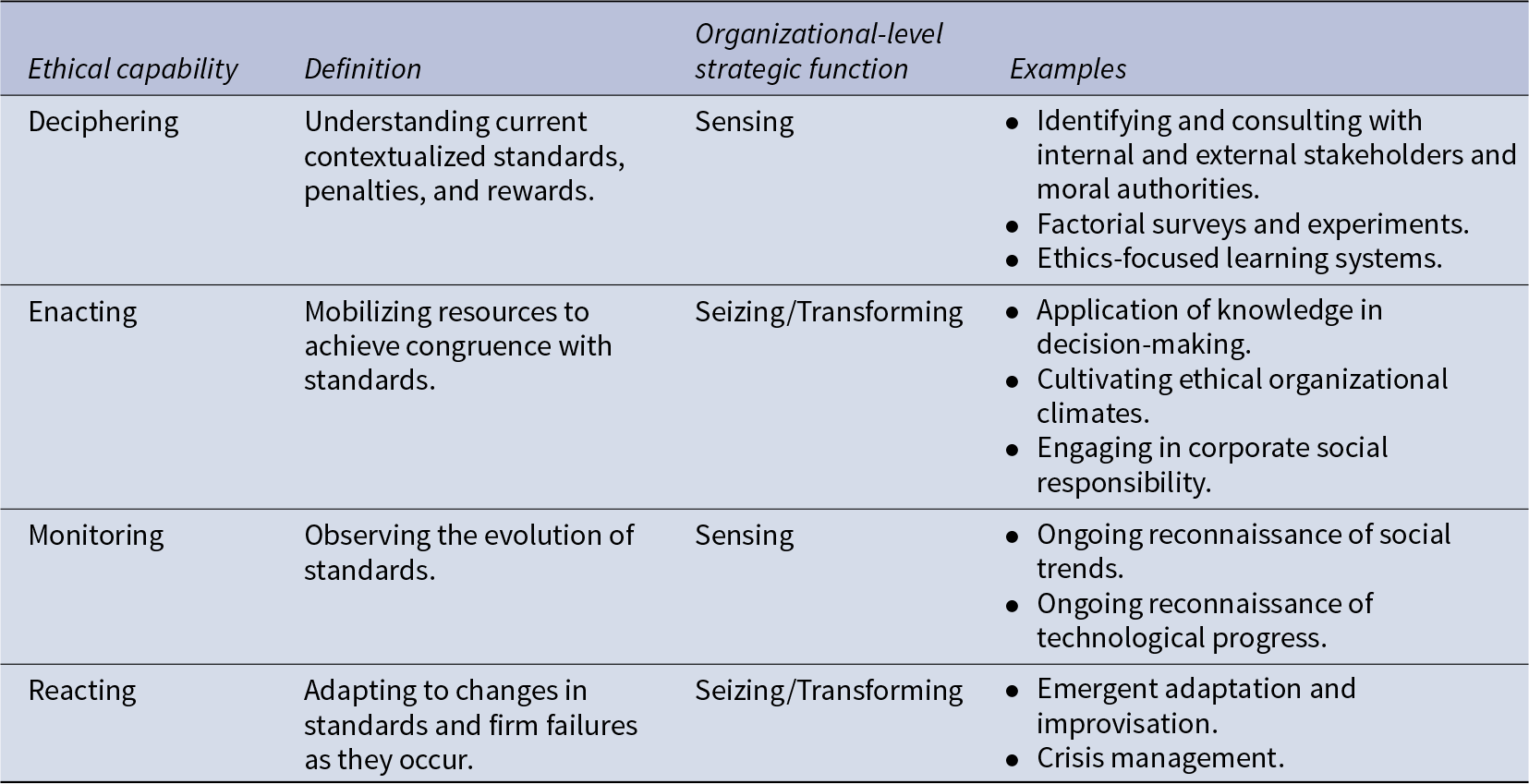
Some dynamic ethical capabilities (i.e., those organizational competencies that enable acquiring, maintaining, and applying knowledge of ethical standards) are present-oriented and empower organizations to comprehend and usefully interact with stakeholders’ standards within the ‘now’. Below, we illustrate these capabilities by describing examples related to deciphering, enacting, monitoring, and reacting (See Table 1).
A typology of present-oriented organizational ethical capabilities
Deciphering capabilities
Organizations possessing dynamic ethical capabilities in deciphering employ high-quality knowledge acquisition systems to capture components of existing ethical standards (i.e., injunctive social norms) employed by stakeholders, along with the associated potential for penalties or rewards. These capabilities support the organizational-level strategic function of sensing (Teece, Reference Teece2007) by recognizing the value of ethics-related knowledge resources and acquiring them (Argote, Lee, & Park, Reference Argote, Lee and Park2021; Cohen & Levinthal, Reference Cohen and Levinthal1990). Such organizations are active learners that identify, prioritize, and engage with stakeholders (Kujala, Sachs, Leinonen, Heikkinen, & Laude, Reference Kujala, Sachs, Leinonen, Heikkinen and Laude2022; Mitchell, Agle, & Wood, Reference Mitchell, Agle and Wood1997) to analyze their respective ethical standards and understand the idiosyncrasies and commonalities among them, including any potential for rewards or penalties. For example, a multinational organization possessing strong deciphering capabilities might qualify geographically situated or socially insular standards by consulting locally recognized moral authorities, such as respected public figures or religious leaders (i.e., social referents: Paluck & Shepherd, Reference Paluck and Shepherd2012). Alternately, the nature of more broadly generalizable standards can be quantified using periodic factorial surveys or attitudinal experiments (Rauhut & Winter, Reference Rauhut and Winter2010).
Enacting capabilities
Organizations possessing enacting capabilities skillfully implement competitive strategies that align with contemporary standards while balancing conflicting stakeholder expectations and prioritizing those deemed most legitimate and salient. These organizations transcend passive knowing to become informed and creative actors (Orlikowski, Reference Orlikowski2002), leveraging deciphered standards to modify organizational decisions, structures, and routines (Zollo & Winter, Reference Zollo and Winter2002). This enables them to seize opportunities through the assimilation of contemporary knowledge so that it can be exploited through organizational transformation (Argote et al., Reference Argote, Lee and Park2021; Cohen & Levinthal, Reference Cohen and Levinthal1990; Teece, Reference Teece2007). For example, organizations can foster climates encouraging moral excellence (Victor & Cullen, Reference Victor and Cullen1988), engage in corporate social responsibility (Burke & Logsdon, Reference Burke and Logsdon1996; Cantrell et al., Reference Cantrell, Kyriazis and Noble2015) to signal benevolence (Fu, Boehe, & Orlitzky, Reference Fu, Boehe and Orlitzky2022), and integrate ethical attributes as value-added features in product design and marketing (Chen, Reference Chen2010).
Monitoring capabilities
Given that ethical standards and their underlying social norms change (Young, Reference Young2015). Organizations possessing present-oriented ethical capabilities related to monitoring stay attuned to shifting standards through ongoing reconnaissance of social and technological trends and through continuous stakeholder outreach. While similar to deciphering in serving the strategic purpose of sensing (Teece, Reference Teece2007), monitoring activities are more perpetual in nature. This distinction is akin to initially defining a problem versus performing real-time surveillance to ensure that the problem’s nature remains stable and solutions remain viable. As such, the core goal of monitoring capabilities is to quickly recognize unanticipated disconnects between organizational action and ethical standards, such as those arising from scandals, regulatory changes, social unrest, and leaps in innovation. Being successful here will likely require long-term, trusting relationships with key stakeholder groups that are characterized by high-quality communication (Greenwood, Reference Greenwood2007; Kujala et al., Reference Kujala, Sachs, Leinonen, Heikkinen and Laude2022).
Reacting capabilities
Monitoring capabilities sometimes reveal real-time disconnects between ethical standards and organizational activities. Organizations possessing present-oriented ethical capabilities related to reacting excel at rapid, post hoc, and improvizational adaptation (Levinthal & Marino, Reference Levinthal and Marino2015) to changes in standards or organizational failures as they arise. These organizations mobilize resources reactively for emergent remediation and crisis management (Gillespie & Dietz, Reference Gillespie and Dietz2009; Starbuck, Greve, & Hedberg, Reference Starbuck, Greve and Hedberg1978). Reacting capabilities share similarities with enacting capabilities in supporting organizational transformation and seizing opportunities (Teece, Reference Teece2007) through the assimilation and exploitation of the current knowledge base (Cohen & Levinthal, Reference Cohen and Levinthal1990; Todorova & Durisin, Reference Todorova and Durisin2007). However, rather than emphasizing the establishment of enduring organizational structures, reacting prioritizes the immediate management of urgent events under high uncertainty (i.e., full-scale improvization: Crossan, Cunha, Vera, & Cunha, Reference Crossan, Cunha, Vera and Cunha2005), sometimes through the rapid displacement of existing practice.
Future-oriented ethical capabilities
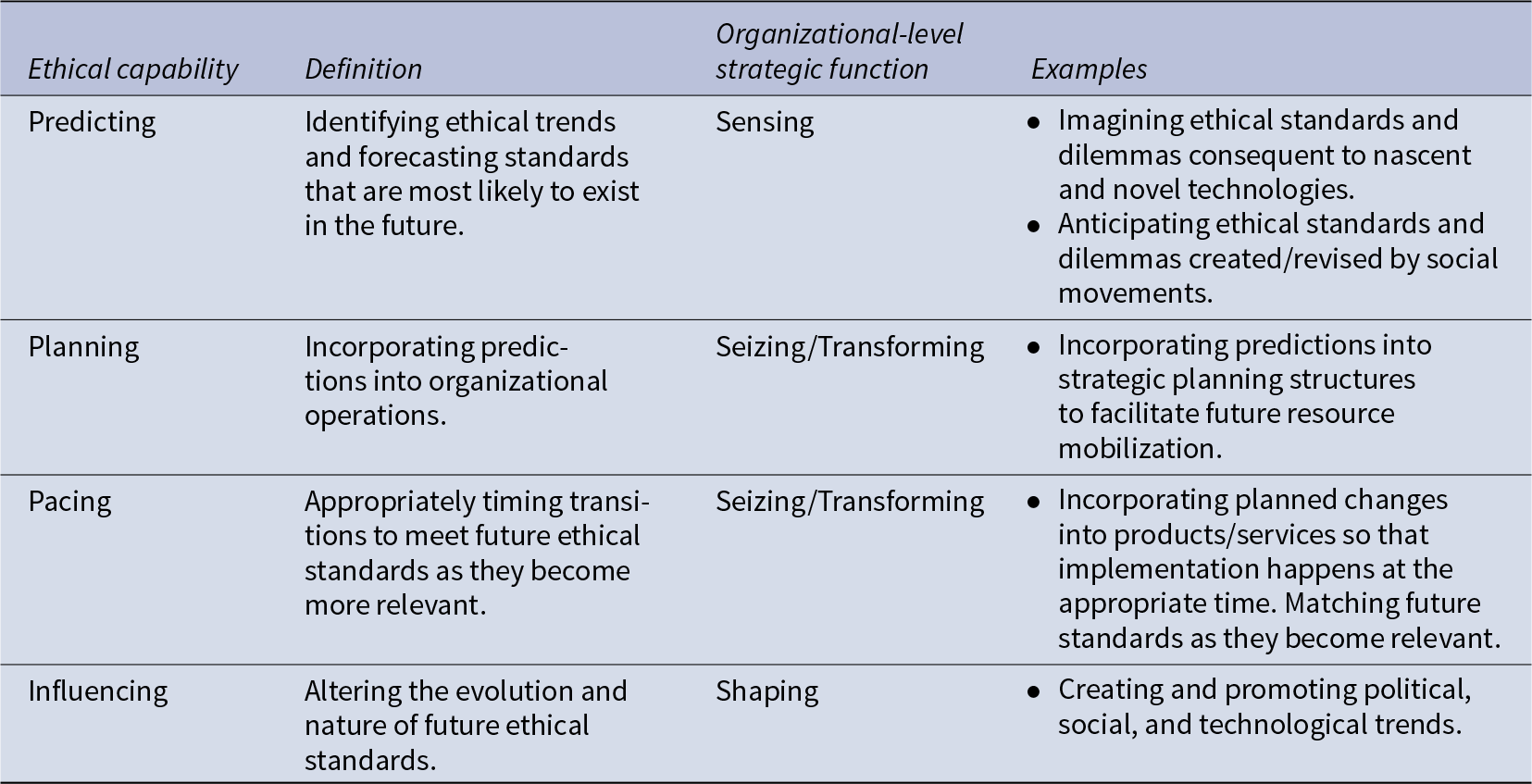
Behaviors considered moral by contemporaneous standards may later be deemed immoral, and vice versa. Thus, organizations adopting a short-term, static approach risk incurring unexpected penalties and missing out on unexpected rewards when they fail to adapt. Conversely, a proactive stance can help organizations avoid costs while appropriating additional benefits. We now focus on future-oriented ethical capabilities, defined as competencies enabling the anticipation and creation of forthcoming ethical standards. These capabilities are exemplified by predicting, planning, pacing, and influencing (See Table 2).
A typology of future-oriented organizational ethical capabilities
Predicting capabilities
Beyond deciphering and staying current through monitoring and adapting, organizations with future-oriented predicting capabilities seek to identify social and technological trends in order to forecast how future standards will interact with existing organizational characteristics, operations, and initiatives. These capabilities support strategic foresight (Haarhaus & Liening, Reference Haarhaus and Liening2020; Iden, Methlie, & Christensen, Reference Iden, Methlie and Christensen2017; Slaughter, Reference Slaughter1997) by combining scenario planning with preemptive moral imagination (McVea, Reference McVea2009) to sense (Teece, Reference Teece2007) opportunities and threats linked to ethical standards that have changed, are emerging, or may soon disappear. Such capabilities also enable organizations to anticipate shifts in their stakeholder array as individual groups gain or lose significance over time (Jawahar & Mclaughlin, Reference Jawahar and McLaughlin2001). A crucial point to remember here is that the trends shaping future ethical standards change at a variety of speeds and can reverse direction. Organizations skilled in predicting recognize this potential and resist assuming that likely futures are mere linear extensions of the past.
Planning capabilities
Organizations with future-oriented ethical capabilities in planning can translate ethics-related predictions into forward-looking organizational operations (Wolf & Floyd, Reference Wolf and Floyd2017). These capabilities enable organizations to systematically identify attributes likely to align with future standards, set clear objectives, and coordinate actions to ensure accountability, while also identifying entrenched beliefs, routines, and processes that will no longer be acceptable and need to be discarded (Akgün, Byrne, Lynn, & Keskin, Reference Akgün, Byrne, Lynn and Keskin2007; Starbuck, Reference Starbuck2017). Consequently, these capabilities facilitate embedding ethics-related knowledge into organizational activities, helping to ensure the moral viability of product development, supply chains, and performance standards. In other words, these capabilities enable the transformation of the firm for the purposes of seizing future opportunities (Araújo, Kato & Del Corso, Reference Araújo, Kato and Del Corso2022; Teece, Reference Teece2007) in ways that capitalize on future opportunities through a blend of predictive knowledge assimilation, modification, and exploitation (Cohen & Levinthal, Reference Cohen and Levinthal1990; Todorova & Durisin, Reference Todorova and Durisin2007).
Pacing capabilities
Similar to how industries experience technological and economic changes of varying magnitudes and in forms (McCarthy, Lawrence, Wixted, & Gordon, Reference McCarthy, Lawrence, Wixted and Gordon2010) that subsequently affect the optimal pace of product introductions and updates (Souza, Bayus, & Wagner, Reference Souza, Bayus and Wagner2004), so too the rate, scale, and scope of change to ethical standards varies contextually. Organizations with pacing capabilities can anticipate and meet ethical standards as they become relevant while also avoiding premature or unnecessary changes. These capabilities leverage predictive knowledge (Cohen & Levinthal, Reference Cohen and Levinthal1990; Todorova & Durisin, Reference Todorova and Durisin2007) to enable organizational transformation and the seizing of opportunities in a timely fashion (Teece, Reference Teece2007).
Ethical standards may sometimes remain stable over long periods, while at other times stability may be punctuated by rapid shifts (cf., discontinuous change: Meyer, Brooks, & Goes, Reference Meyer, Brooks and Goes1990; punctuated equilibrium: Romanellie & Tushman, Reference Romanellie and Tushman1994). Changes may also occur consistently along existing trends (cf., high-velocity environments: Eisenhardt, Reference Eisenhardt1989) or at inconsistent speeds and in divergent directions (cf., divergent velocity regimes: McCarthy et al., Reference McCarthy, Lawrence, Wixted and Gordon2010). By investing in ethical capabilities within an appropriate time horizon (Reilly, Souder, & Ranucci, Reference Reilly, Souder and Ranucci2016) and matching the rhythm of change (Klarner & Raisch, Reference Klarner and Raisch2013), organizations can seize opportunities at the right time. Acting too early, on too grand a scale, or in the wrong direction, risks alienating customers and incurring unnecessary costs. For example, in anticipation of social and regulatory changes, the Australian grocery store chain Coles eliminated single-use plastic bags and began charging a small fee for more robust multiuse bags. However, this proactive move angered much of their customer base, prompting Coles to reinstate the use of free single-use bags in 2018 (Fischer, Reference Fischer2018), only to again remove these bags due to regulatory changes in 2022 (New South Wales EPA, 2022). Notably, Coles initial strategic decision aligned with changing social norms. Unfortunately, their preemptive execution was ill-timed. Conversely, organizations that act too late risk being in a state of perpetual lag and falling prey to the negative consequences of newly restrictive expectations.
Influencing capabilities
Organizations are not passive societal spectators restricted to managing only their internal characteristics and behaviors. Rather, they are forceful social actors (King, Felin, & Whetten, Reference King, Felin and Whetten2010) capable of shaping markets (Gao & McDonald, Reference Gao and McDonald2022; Teece, Reference Teece2007) or even creating new ones (Sarasvathy & Dew, Reference Sarasvathy and Dew2005). Organizations possessing influencing capabilities choose to ‘make’ (Pettit, Balogun, & Bennett, Reference Pettit, Balogun and Bennett2023) and ‘compete on’ (Hamel & Prahalad, Reference Hamel and Prahalad1994) the future of ethical standards by exhibiting intellectual leadership in shaping the industry norms to which entire industries will eventually be held accountable.
These organizations alter the institutional environment through proactive political initiatives (e.g., Doh, Lawton, & Rajwani, Reference Doh, Lawton and Rajwani2012; Mellahi, Frynas, & Sun, Reference Mellahi, Frynas and Sun2015) and create novel ethical trends congruent with strategic interests (cf. Adner & Zemsky, Reference Adner and Zemsky2005). For example, Mosa Meat not only produced the world’s first hamburger using bovine cells grown in a lab (as opposed to harvested from a slaughtered animal), but they also actively promote ethical standards related to sustainability and animal welfare (Mouat, Prince, & Roche, Reference Mouat, Prince and Roche2019). By cofounding and supporting Cellular Agriculture Europe, Mosa Meat engages in political initiatives intended to guide the emerging industry in areas such as labeling requirements, conditions of use, and stakeholder education (Cellular Agriculture Europe, 2024; Mosa Meat, 2024).
Ethical capabilities and competitive advantage
Applying a resource-based lens to ethical standards reveals that accurate and actionable knowledge of ethical standards becomes a valuable resource when it helps organizations avoid penalties and secure rewards for adherence. These knowledge resources are often rare, as ethical standards are localized, sometimes confusing to outsiders, and potentially tacit or ephemeral due to emerging trends or new technologies. Organizations thus face a difficult knowledge problem (Mitchell, Mitchell, Hung, Townsend, & Lee, Reference Mitchell, Mitchell, Hung, Townsend and Lee2022), making competitive advantage possible for those possessing competencies in understanding and meeting ethical standards.
Potential for rewards and penalties
Given that ethical standards vary in the penalties prescribed for violations and rewards granted for compliance (Harting, Harmeling, & Venkataraman, Reference Harting, Harmeling and Venkataraman2006; Jasso & Opp, Reference Jasso and Opp1997). The value of ethical capabilities varies accordingly. When large penalties and rewards are at stake, capabilities can become a key factor in firm survival. For example, the once-iconic auditing firm Arthur Anderson went bankrupt and was dissolved before it was eventually absolved of legal liability (Markham, Reference Markham2015) for its role in the Enron financial scandal. Conversely, when ethical standards prescribe meager penalties and rewards, the value of capabilities decreases, potentially to near irrelevance. Thus, the immediate concerns for firms are the ethical preferences of their most motivated and powerful stakeholders. In the case of disengaged or impotent stakeholders (i.e., fringe stakeholders: Hart & Sharma, Reference Hart and Sharma2004), firms appear free to act how they wish within the boundaries of extant regulation.
However, while firms act in the present, the assessment of their actions is ongoing and extends indefinitely into the future. The gap between an action and its initial stakeholder judgment may be brief – hours or days – but stakeholder evaluations can sometimes persist for years or even decades, during which much can change. The realities of ongoing retrospective moral judgments are exemplified by firms with long histories that must wrestle continuously with their problematic pasts (e.g., The Hudson Bay Company’s abuse of Indigenous peoples: Van Lent & Smith, Reference Van Lent and Smith2019). Additionally, currently disengaged stakeholders may become motivated when issues become more relevant and salient, or presently powerless stakeholders may gain influence as they build alliances and acquire resources. Entirely new configurations of powerful and motivated stakeholders may also emerge. Thus, appropriately evaluating stakeholders’ capacity to reward or punish necessitates a future-oriented perspective.
Proposition 1: The greater the willingness and ability of present and future stakeholders to administer rewards and penalties, the greater the competitive advantages provided by ethical capabilities.
Nature of the stakeholder array
The array of stakeholders that firms must consider varies in diversity and number. Firms competing in markets with homogenous stakeholders face fewer obstacles to deciphering, addressing, and anticipating ethical standards. Decision makers in these settings may even become ‘insiders’ by acquiring substantively accurate knowledge of ethical norms and developing an intuitive understanding of how to anticipate and address them. In such cases, the competitive advantage offered by firm-level ethical capabilities might be relatively modest. However, markets contain increasingly diverse stakeholders due to globalization (Jensen & Sandström, 2011), and the stakeholder array of many firms is inherently diverse due to their choice to compete on an international basis (Buller & McEvoy, Reference Buller and McEvoy1999; Carroll, Reference Carroll2004). These kinds of circumstances make it difficult for firm decision-makers to possess actionable knowledge of all stakeholder groups and make it more likely that stakeholder groups will make competing or contradicting demands. As stakeholder diversity increases, the difficulty of navigating the resulting web of ethical realities intensifies, enhancing the competitive advantage conferred by ethical capabilities.
Proposition 2: The more diverse an organization’s stakeholders, the greater the competitive advantages provided by ethical capabilities.
Tacit standards
The competitive advantage of ethical capabilities also depends on the extent to which ethical standards are tacit and challenging to understand for anyone outside the social group to which they are attached (Cialdini & Trost, Reference Cialdini, Trost, Gilbert, Fiske and Lindzey1998; Young, Reference Young2015). When standards are explicit, the value of capabilities diminishes because such knowledge is readily accessible and easily commoditized. For instance, an abundance of academics and consultants (including ourselves) produce a vast array of academic, professional, and popular press materials outlining what ‘should’ be done to be considered ‘good’. This body of work typically recommends operationalizing ethical principles through ethical codes, leadership commitments, transparent cultures of accountability, and so on. Although meaningful, these prescriptions are well-known which limits their competitive value. Instead of competitive advantage, organizations implementing organizational structures experience a state of competitive parity because common knowledge is generalizable, transferable, and easily replicable by competitors. In other words, it may be valuable, but it is not rare (Barney, Reference Barney1991; Leiblein, Reference Leiblein2011; Peteraf, Reference Peteraf1993; Wernerfelt, Reference Wernerfelt1984).
Alternately, when knowledge of ethical standards is largely tacit, it becomes far less accessible. Core stakeholder group members may possess only an implicit understanding of the underlying social norms (Cialdini & Trost, Reference Cialdini, Trost, Gilbert, Fiske and Lindzey1998) embedded in their relationships and communities. These norms might be exclusively expressed via behavior and learned via intimate social interaction and ongoing practice (Collins, Reference Collins2010; Hadjimichael & Tsoukas, Reference Hadjimichael and Tsoukas2019). Thus, the value of ethical capabilities increases with tacitness because this kind of knowledge is difficult to acquire, codify, and leverage.
Proposition 3: The more that ethical standards are tacit, the greater the competitive advantages provided by dynamic ethical capabilities.
Competency across coordinated capabilities
A fundamental characteristic of the ethical capabilities we have described is their interdependence, where weakness in one can undermine the usefulness of others (See Fig. 1). For instance, among present-oriented capabilities, an inability to identify and understand social and technological trends (i.e., deciphering) undermines an organization’s capacity to select appropriate actions (i.e., enacting), detect unexpected events (i.e., monitoring), and adapt meaningfully (i.e., reacting). Similarly, failing to foresee the state of future standards (i.e., predicting), hinders an organization’s capacity to map out strategic action (i.e., planning), at the appropriate time (i.e., pacing), while exhibiting intellectual leadership (i.e., influencing).
Continued competency and coordination across present and future-oriented ethical capabilities leading to sustainable competitive advantage.
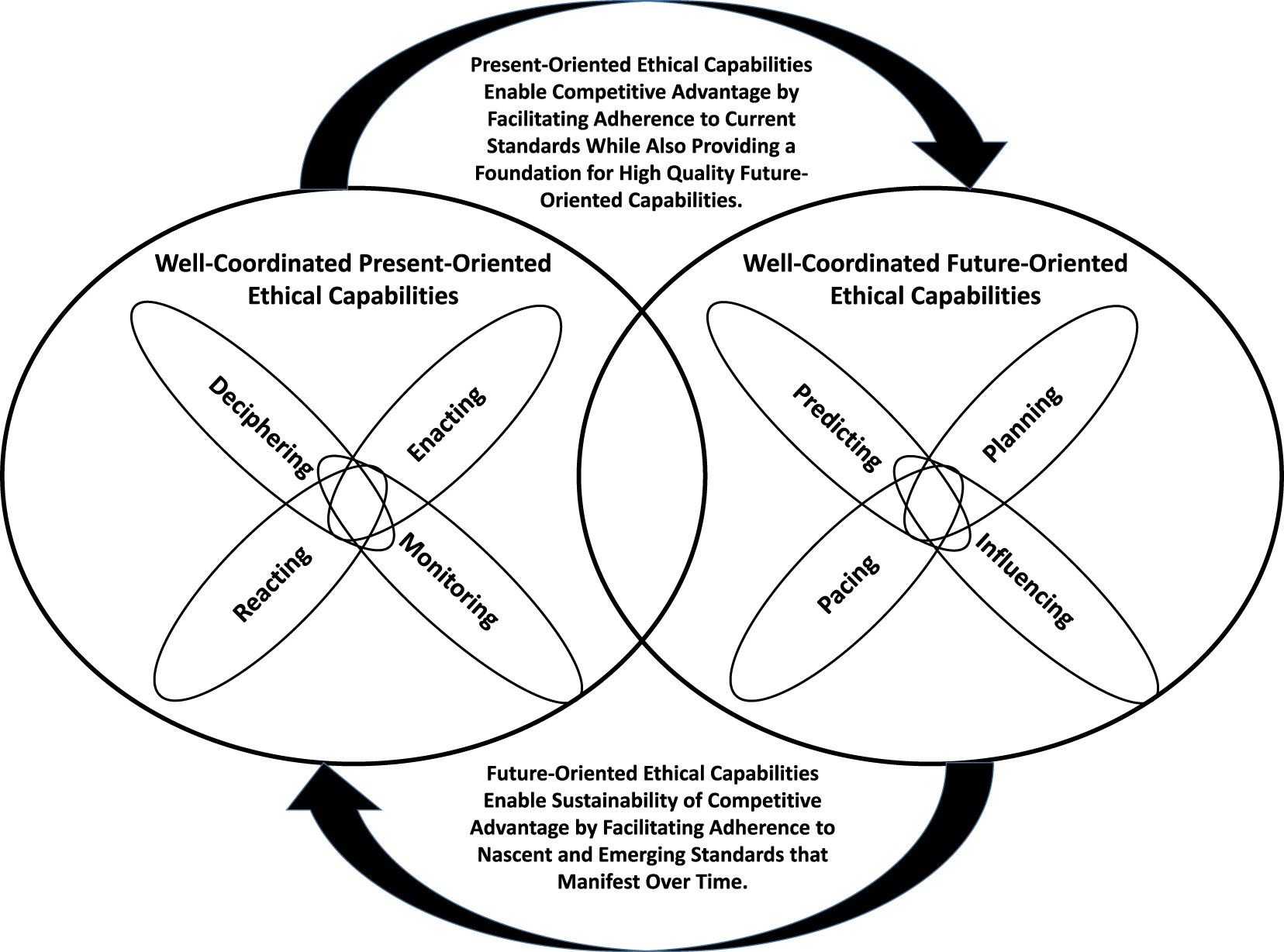
The relationship between present- and future-oriented capabilities further highlights this interdependence. Present-oriented capabilities provide a foundation for building future-oriented capabilities because knowing the current nature of norms is helpful for predicting their future character, and future-oriented capabilities enhance the ability to comprehend emergent or nascent standards as they manifest into the present. This skillful interplay within and between capabilities represents a unique form of strategic renewal (Agarwal, & Helfat, Reference Agarwal and Helfat2009; March, Reference March1991; Schmitt, Raisch & Volberda, Reference Schmitt, Raisch and Volberda2018; Teece, Reference Teece, Teece and Leih2021), enabling organizations to remain relevant and avoid reliance on once-valid, but now outdated understandings (i.e., competency traps: Barnett & Hansen, Reference Barnett and Hansen1996). To explain, as social and technological trends driving ethical standards change, existing knowledge of these standards (i.e., knowledge resources) is in a continuous state of decay (Karadag & Poppo, Reference Karadag and Poppo2023; Mellahi et al., Reference Mellahi, Frynas, Sun and Siegel2016) and must be renewed through continuous learning (Maharani, Sukoco, Usman, & Ahlstrom, Reference Maharani, Sukoco, Usman and Ahlstrom2024) and strategic foresight (Haarhaus & Liening, Reference Haarhaus and Liening2020; Iden et al., Reference Iden, Methlie and Christensen2017; Slaughter, Reference Slaughter1997).
Thus, determining what currently ‘is’ and what ‘will be’ to guide organizational action requires not only proficiency in each ethical capability but also an integrated approach where capabilities of each type inform one another in an ongoing process (Paavola & Cuthberston, Reference Paavola and Cuthberston2022). Such synchronized activity is relatively inimitable and unlikely to be traded in strategic factor markets, as it is deeply embedded in the unique histories and planned futures of well-organized, renewing, expert systems (Eisenhardt & Martin, Reference Eisenhardt and Martin2000; Grant, Reference Grant1996; Helfat & Peteraf, Reference Helfat and Peteraf2003; Lado & Zhang, Reference Lado and Zhang1998; Teece, Reference Teece2007). In other words, RBT’s VRIO (Barney & Clark, Reference Barney and Clark2007) criteria for sustainable competitive advantage are only fully met when organizations exhibit a coordinated competency within and across both present- and future-oriented capabilities.
Proposition 4: The more that a firm can exhibit a continued competency across coordinated present- and future-oriented capabilities, the more sustainable the competitive advantages provided by ethical capabilities.
Potential for diminishing returns
In their early stages of development, a firm’s ethical capabilities are likely to be unsophisticated and focused on standards that are easily understood and whose requirements are relatively straightforward (Jawahar & McLaughlin, Reference Jawahar and McLaughlin2001). At this stage, capabilities may provide little in the way of sustainable competitive advantage because this kind of knowledge is explicit, and the firm systems designed to exploit that knowledge may not be firmly embedded within the firm. As capabilities mature over time through investments in financial, physical, and human resources, the sustainability of competitive advantages grows as knowledge becomes more substantial, tacit, and ingrained within systems, routines, and members. However, these gains are not likely to continue ad infinitum because powerful stakeholders become less motivated to dole out penalties and rewards as expectations are better met.
Proposition 5: The relationship between ethical capabilities and competitive advantage is curvilinear, increasing as capabilities address the core concerns of powerful stakeholders and then diminishing as these concerns are largely satisfied.
Discussion
While a generalizable moral core to ethical principles exists, the standards to which organizations are held are complex, evanescent, and high-stakes puzzles of context-specific constraints that must be accommodated or surmounted. We have provided insight into this conundrum by describing how a combination of present and future-oriented dynamic ethical capabilities increases the likelihood of securing sustainable advantage. This analysis clarifies how social norms, organizational capabilities, stakeholders, and performance outcomes intersect, though several relevant issues deserve further consideration.
Positioning our discussion in ethical capabilities research
Buller and McEvoy (Reference Buller and McEvoy1999) first conceptualized ethical capabilities as a potential source of competitive advantage in cross-cultural contexts, highlighting the challenges of implementing policies and practices that respect local variations across social and political boundaries. Their work emphasized the skills required to apply ethical principles geographically, focusing narrowly on leadership and human resource management. Later, Arend (Reference Arend2013) explored ethical capabilities in small businesses, while Cantrell et al. (Reference Cantrell, Kyriazis and Noble2015) discussed them in the context of corporate social responsibility.
Our efforts substantially extend this previous work because we do not confine ourselves to preliminary comments targeted at specific institutional contexts, markets, or actions. Instead, we explain how variable interpretations of morality complicate the task of satisfying pluralistic stakeholders, and we describe a larger generalizable construct domain while clarifying the linkage to competitive advantage. Our treatment of organizations as powerful social actors capable of creating or modifying ethical standards is also unique.
Positioning our discussion in organizational strategy research
While discussing the relationship between ethical standards and firm capabilities, Teece (Reference Teece2007) briefly describes regulations, professional standards, and business ethics as external forces shaping ‘the rules of the game’ (p. 1323). From this perspective, ethical standards function as institutional constraints, and capabilities designed to understand and leverage these standards fall squarely within the realm of nonmarket strategy (Doh et al., Reference Doh, Lawton and Rajwani2012). Similarly, Mellahi et al.’s (Reference Mellahi, Frynas, Sun and Siegel2016) work frames corporate actions advancing social good as a form of corporate political activity. Our approach diverges from these treatments by remaining conceptually neutral regarding whether strategies aimed at leveraging ethical standards are primarily market- or nonmarket-oriented. This neutrality enables our work to function as a theoretical bridge between the two perspectives, which is important in a time when the boundary between them is increasingly blurred by technological and social change.
The ideas in our manuscript also extend the academic literature on strategic renewal (March, Reference March1991; Schmitt et al., Reference Schmitt, Raisch and Volberda2018) into the realm of ethics. Strategic renewal theory is primarily concerned with balancing an organization’s exploitation of existing resources and capabilities (short-term focus) with exploration of new opportunities (long-term focus) to ensure sustained competitive advantage. We connect this tension to ethical standards by explicitly distinguishing between present- and future-oriented dynamic ethical capabilities while also emphasizing their interdependence within and between types. This suggests that organizations develop path-dependent competencies, not just through continuous learning and action but also through synchronization.
Marginalized stakeholders
Our approach in this manuscript has been unapologetically strategic and pragmatic (Godfrey & Lewis, Reference Godfrey, Lewis, Harrison, Barney, Freeman and Phillips2019; Jensen & Sandström, Reference Jensen and Sandström2013), examining business realities at the organizational level as they relate to sustainable competitive advantage. Consequently, this work emphasizes a harsh reality: addressing ethical concerns tied to marginalized stakeholders, especially those lacking regulatory protection or resources, rarely provides economic incentives for short-term advantage. In more benign circumstances, efforts to accommodate marginalized stakeholders represent investments without clear economic return and may provoke investor or regulatory backlash, particularly in countries like the United States, where shareholder interests often take legal precedence over stakeholder concerns (e.g., legislation limiting environmental, social, and governance considerations: Donefer, Reference Donefer2023). In more tragic scenarios, common throughout history, organizations abuse their power to exploit and extricate value from stakeholder groups, sometimes through force. This distasteful reality must be acknowledged, and the path forward will at times rely primarily, or perhaps exclusively, within the realm of government intervention and regulation (Buchholz & Rosenthal, Reference Buchholz and Rosenthal2004).
However, our framework also warns against short-term approaches and contains an element of forward-looking optimism. What is true today is often not true tomorrow. Previously marginalized stakeholder groups can (and some will) gain power through social activism, alliances with more influential groups, or by becoming significant economic forces in their own right (de Bakker & den Hond, Reference de Bakker and den Hond2008). Regulatory attention of standard setters, monitors, and enforcers can also be drawn toward concerns that were previously ignored.
Thus, while short-sighted strategies that neglect or exploit marginalized stakeholders might capture some initial ‘value’, our theorizing also suggests that this approach carries substantial risk. Today’s unethical actions carry a credible, albeit ambiguous, threat of significant future costs. This suggests that the pursuit of sustainable competitive advantage requires continued competence across dynamic ethical capabilities so that potential threats from future punishment and the potential promises of future rewards are considered whenever strategic decisions are made. This perspective aligns with advocates for a complementary approach where voluntary action and governmental regulation work together (Aragón-Correa, Marcus, & Vogel, Reference Aragón-Correa, Marcus and Vogel2020) and with Gibson’s (Reference Gibson2000: 246) reconciliation thesis: ‘… firms can do good at the same time as they do well, in effect, that there is no necessary discontinuity between self-interest and morality, and that moral behavior is consistent with rational prudence’.
Future research
In this manuscript, we have conceptualized ethical capabilities and the specialized, organization-specific knowledge they create as promising sources of sustainable competitive advantage under specific circumstances. However, this theoretical work serves only as a starting point. We encourage future researchers to empirically examine the validity of our framework, further explore forward-looking capabilities, and investigate the potential for reconceptualizing the role of organizational ethics officers.
Validating our theoretical framework
Empirical studies testing the validity of our theoretical framework can benefit from both qualitative and quantitative methodologies. Qualitative methods are particularly suited for exploring how ethical capabilities exist in practice. Semi-structured interviews (Graebner, Martin, & Roundy, Reference Graebner, Martin and Roundy2012) using a grounded theory approach (Strauss & Corbin, Reference Strauss and Corbin1998) can clarify the perspectives of ethics officers, managers, and key stakeholders. Organization-level case studies (Eisenhardt & Graebner, Reference Eisenhardt and Graebner2007; Gibbert, Ruigrok, & Wicki, Reference Gibbert, Ruigrok and Wicki2008) can reveal the institutional structures underpinning key capabilities. Such research promises not only to uncover additional nuance, and potentially new capabilities but also to address a major challenge for quantitative hypothesis testing: the absence of established measures. Developing valid and reliable measures may require content analysis (Sonpar & Golden-Biddle, Reference Sonpar and Golden-Biddle2008) of annual reports, ethics codes, organizational charts, and similar documents to codify key manifestations. Researchers can then begin testing propositions directly using longitudinal panel studies (Certo & Semadeni, Reference Certo and Semadeni2006; Certo, Withers, & Semadeni, Reference Certo, Withers and Semadeni2017; Laaksonen & Peltoniemi, Reference Laaksonen and Peltoniemi2016) or multicountry event studies (Park, Reference Park2004), accounting for factors such as regulatory scrutiny, stakeholder diversity and engagement, and the degree and direction of social change.
Regardless of the chosen methodology, researchers should consider several key issues. First, ethical capabilities theory is not a defense of idiosyncratic opinion but focuses on managing tacit consensus embedded in patterns of social communication and interaction (Morris & Liu, Reference Morris and Liu2015). Methods should reflect this analytical focus. Second, social desirability bias remains a well-documented challenge in ethics research, as individuals tend to deny undesirable traits while emphasizing desirable ones (e.g., Chung & Monroe, Reference Chung and Monroe2003). Researchers should address this bias through techniques such as indirect questioning, proxy subjects, and careful attention to anonymity. Third, as our work lies at the intersection of anthropology, sociology, and economics, we echo Molloy, Chadwick, Ployhart, and Golden (Reference Molloy, Chadwick, Ployhart and Golden2011) advice to adopt a psychological approach for construct validity and an economic approach for robustness checks and resolving endogeneity issues.
Foreword looking ethical capabilities
Given the rapid pace of social and technological change that defines life in the 21st century, (Rosa, Dörre, & Lessenich, Reference Rosa, Dörre and Lessenich2017) we contend that our initial treatment contributes to advancing the study of anticipatory ethics (cf., Brey, Reference Brey2012), with the potential to evolve into a recognized strategic management discipline. While formalizing the futurist realm of anticipatory ethics might seem inadvisable, it is useful to remember that all strategies are inherently anticipatory (even if not obviously so) and that the standard for competitive advantage is comparative. Competitive advantage exists as long as an organization’s capabilities are more effective than those of its competitors (Barney & Clark, Reference Barney and Clark2007), and the requirements here might only be that organizational systems are marginally less ineffective than rivals. Furthermore, organizations competing on the cutting edge of social movements and technology encounter ethical questions and dilemmas that did not exist prior to their own activities. Decision-makers in these organizations have no choice but to engage in conjecture because collective standards are still developing, and forward-looking ethical capabilities may still yield crucial advantages even if they are flawed.
A crucial element of this research agenda involves examining pacing capabilities that enable organizations to align with emerging ethical standards without lagging or outpacing expectations. The appropriate pace will likely vary widely, depending on factors like rate of change, consensus levels, tolerance for deviation, and the consequences of action or inaction (McCarthy et al., Reference McCarthy, Lawrence, Wixted and Gordon2010; Schilke, Reference Schilke2014). Hence, we caution against assuming linear or unidimensional trajectories because unceasing social acceleration is unsustainable (Rosa et al., Reference Rosa, Dörre and Lessenich2017), the pace of social and technological change is not constant, and tension exists between exploration (i.e., reducing uncertainty through learning) and exploitation (i.e., need to maximize returns) (Posen & Levinthal, Reference Posen and Levinthal2012). As such, rapidly changing competitive environments can produce counterintuitive dynamics. For, example, Stieglitz, Knudsen, and Becker (Reference Stieglitz, Knudsen and Becker2016) found that exploration and learning are rewarded in environments with significant change, but they also discovered that the best-performing organizations in volatile contexts often exhibit more operational stability than expected.
The role of ethics officers
Traditionally, the role of ethics officers has centered on promotion and compliance, with programs under their purview typically emphasizing various ‘soft’ and ‘hard’ controls (Kaptein, Reference Kaptein2010). These programs often arise in response to U.S. sentencing guidelines or ethics-related crises (Joseph, Reference Joseph2002). Unfortunately, this approach assumes that officers and their organizations can reliably acquire and process valid knowledge of ethical standards and possess sufficient understanding to implement effective responses. It is also reactive in nature, focusing primarily on compliance with existing explicit regulations. As a result, it often neglects the challenges posed by pluralistic stakeholders and evolving standards, leaving it ill-equipped to provide competitive advantages.
Our work suggests that the role of ethics officers could be reconceptualized to better accommodate complicated realities, creating many opportunities for novel academic work toward this end. A key issue here will be revealing the individual-level managerial microfoundations (cf., Cristofaro & Lovallo, Reference Cristofaro and Lovallo2022; Durán & Aguado, Reference Durán and Aguado2022; Helfat & Peteraf, Reference Helfat and Peteraf2015) of dynamic ethical capabilities that can enable strategic foresight (Hamel & Prahalad, Reference Hamel and Prahalad1994; Iden et al., Reference Iden, Methlie and Christensen2017) and sequential ambidexterity (Peng, Lockett, Liu, & Qi, Reference Peng, Lockett, Liu and Qi2022).
Performing these functions effectively will likely require an appreciation for the sensemaking (Durán & Aguado, Reference Durán and Aguado2022; Gioia & Chittipedi, Reference Gioia and Chittipedi1991) insights of sociologists, cultural anthropologists, and futurists. Sociologists offer broad societal understandings of patterns, hierarchies, power dynamics, institutions, and issues such as poverty and discrimination (Burrell & Morgan, Reference Burrell and Morgan2019). Anthropologists provide contextually grounded insights into community-level beliefs, values, and customs (van Willigen, Reference van Willigen2002). Futurists identify possible, probable, and preferable futures by utilizing scenario planning, visioning, and systems thinking (Bell, Reference Bell2003, Reference Bell2004; Inayatullah, Reference Inayatullah2008).
However, these insights provide little value unless ethics officers are also able to synthesize them into the implementation of a coherent strategic plan. Hence, future research should also examine whether officers can perform a sensegiving role (Durán & Aguado, Reference Durán and Aguado2022; Gioia & Chittipedi, Reference Gioia and Chittipedi1991) akin to innovation champions (Howell & Higgins, Reference Howell and Higgins1990) or change agents (Ottaway, Reference Ottaway1983), promoting and implementing forward-looking, ethics-based solutions across the organization. Such activities will likely require significant coordination and collaboration across a wide variety of organizational constituencies.
Conclusion
The nature of ethical standards may appear to be matter-of-fact to organizations that are regularly provided with advice that amounts to an exhortation to, ‘Be good’. From this oversimplified standpoint, the essentials of ethical management lie primarily in the realm of enactment with an emphasis on compliance with standards that are inappropriately assumed to be well-known and stable. In stark contrast to this point of view, our work assumes that knowledge of ethical standards is not fully known to organizational decision-makers, because it is often tacit and contextually grounded in diverse stakeholder groups, the enacted present, and numerous potential futures. We also offer a pragmatic way forward by describing an integrated set of organization-specific ethical capabilities. These capabilities aid in navigating complex ethical standards and therefore become a potential source of sustainable competitive advantage when properly structured and coordinated.
Acknowledgements
We would like to acknowledge the support of the Africa Academy of Management’s mentorship program for facilitating the professional relationship between authors.
Conflict(s) of interest
The author(s) declare none.
Joshua R. Knapp, PhD is a Professor of management and human resources at the University of Wisconsin-Whitewater, with a PhD granted from the University of Cincinnati. His primary research interests relate to understanding how people navigate the organizational environment including social cognition and employee–organization relationships. His research has been published in a variety of outlets including, the European Journal of Work and Organizational Psychology, Nonprofit and Voluntary Sector Quarterly, and Research in Higher Education.
Juliana Namada, PhD is an Associate Professor in Strategic Management at United States International University-Africa, School of Business. She holds a PhD in Business Administration specializing in Strategic, MBA and BA from the University of Nairobi. She teaches and supervises students in Business Administration at undergraduate, Masters and Doctoral levels. She serves as a reviewer for the Academy of Management (AOM) and Africa Academy of Management (AFAM). She is an e-learning Champion and has done Masterclass on effective methods of online teaching, a certificate course in Online Instructional Design and Quality Matters (QM), offered by Arizona State University in USA.
William L. Dougan, PhD is currently a Professor of Management at the University of Wisconsin-Whitewater where he teaches in the area of organization studies and new venture initiation. His research interests include small firm technology strategy, venture finance, and behavioral decision making. He has published in the European Journal of Work and Organizational Psychology, Management Decision and Small Group Research.


 Open access

