






1. Introduction
A celebrated theorem of Komlós, Sárközy, and Szemerédi [Reference Komlós, Sárközy and Szemerédi13] states that if $G$
is a graph of order
$G$
is a graph of order $n$
with
$n$
with $\delta (G)\geq n/2+{\mathrm{o}}(n)$
, then
$\delta (G)\geq n/2+{\mathrm{o}}(n)$
, then $G$
contains every tree of order
$G$
contains every tree of order $n$
with bounded maximum degree.
$n$
with bounded maximum degree.
Theorem 1. [Reference Komlós, Sárközy and Szemerédi13] For all $\Delta \in \mathbb{N}$
and
$\Delta \in \mathbb{N}$
and $\alpha \gt 0$
there exists
$\alpha \gt 0$
there exists $n_0$
such that every graph
$n_0$
such that every graph $G$
of order
$G$
of order $n\ge n_0$
with
$n\ge n_0$
with $\delta (G)\ge \bigl (\frac {1}{2}+\alpha \bigr )n$
contains every tree
$\delta (G)\ge \bigl (\frac {1}{2}+\alpha \bigr )n$
contains every tree $T$
of order
$T$
of order $n$
with
$n$
with $\Delta (T)\le \Delta$
.
$\Delta (T)\le \Delta$
.
Komlós, Sárközy, and Szemerédi later strengthened Theorem 1, replacing the constant bound $\Delta$
by
$\Delta$
by $cn/\log n$
, where
$cn/\log n$
, where $c$
is some constant depending on
$c$
is some constant depending on $\alpha$
[Reference Komlós, Sárközy and Szemerédi14]. Many variations and extensions of Theorem 1 have been investigated, e.g., [Reference Balogh, Csaba and Samotij2, Reference Böttcher, Han, Kohayakawa, Montgomery, Parczyk and Person4–Reference Clemens, Ferber, Glebov, Hefetz and Liebenau6, Reference Krivelevich, Kwan and Sudakov15]. We prove the following directed graph (digraph) analogue of Theorem 1, where minimum degree is replaced by minimum semidegree
$\alpha$
[Reference Komlós, Sárközy and Szemerédi14]. Many variations and extensions of Theorem 1 have been investigated, e.g., [Reference Balogh, Csaba and Samotij2, Reference Böttcher, Han, Kohayakawa, Montgomery, Parczyk and Person4–Reference Clemens, Ferber, Glebov, Hefetz and Liebenau6, Reference Krivelevich, Kwan and Sudakov15]. We prove the following directed graph (digraph) analogue of Theorem 1, where minimum degree is replaced by minimum semidegree $\delta ^0(\cdot )$
(the minimum of in- and outdegrees over all vertices) and the maximum degree is replaced by the maximum total degree
$\delta ^0(\cdot )$
(the minimum of in- and outdegrees over all vertices) and the maximum degree is replaced by the maximum total degree $\Delta (\cdot )$
(maximum degree in the underlying tree).
$\Delta (\cdot )$
(maximum degree in the underlying tree).
Theorem 2.
For all $\Delta \in \mathbb{N}$
and
$\Delta \in \mathbb{N}$
and $\alpha \gt 0$
there exists
$\alpha \gt 0$
there exists $n_0$
such that every digraph
$n_0$
such that every digraph $G$
of order
$G$
of order $n\ge n_0$
with
$n\ge n_0$
with $\delta ^0(G)\ge \bigl (\frac {1}{2}+\alpha \bigr )n$
contains every oriented tree
$\delta ^0(G)\ge \bigl (\frac {1}{2}+\alpha \bigr )n$
contains every oriented tree $T$
of order
$T$
of order $n$
with
$n$
with $\Delta (T)\le \Delta$
.
$\Delta (T)\le \Delta$
.
In fact we prove a stronger result (Theorem 4), which allows the embedding of a large class of treelike graphs, and which implies both Theorem 2 and the more general embedding result for trees below. For this we define a bare path $P=p_1p_2\cdots p_n$
in a (di)graph
$P=p_1p_2\cdots p_n$
in a (di)graph $G$
to be a path whose internal vertices
$G$
to be a path whose internal vertices $p_2,\ldots ,p_{n-1}$
each have degree
$p_2,\ldots ,p_{n-1}$
each have degree $2$
in (the underlying graph of)
$2$
in (the underlying graph of) $G$
.
$G$
.
Theorem 3.
Suppose ${\frac {1}{n}}\ll \lambda \ll \alpha$
. If
${\frac {1}{n}}\ll \lambda \ll \alpha$
. If $G$
is a digraph of order
$G$
is a digraph of order $n$
with
$n$
with $\delta ^0(G)\geq (1/2+\alpha )n$
, then
$\delta ^0(G)\geq (1/2+\alpha )n$
, then $G$
contains every oriented tree
$G$
contains every oriented tree $T$
of order
$T$
of order $n$
with
$n$
with $\Delta (T)\leq \exp (\sqrt {\log n})$
such that
$\Delta (T)\leq \exp (\sqrt {\log n})$
such that $T$
contains either
$T$
contains either
-
(i) at least $\lambda n$
pairwise vertex-disjoint bare paths of order
$7$
, or
$\lambda n$
pairwise vertex-disjoint bare paths of order
$7$
, or
-
(ii) at least
$\lambda n$
pairwise disjoint edges incident to leaves.


Note that for all positive $\varepsilon$
we have
$\varepsilon$
we have $\textrm {polylog}(n) \asymp \exp \bigl (\Theta (\log \log n)\bigr ) \lesssim \exp \bigl(\sqrt {\textrm {O}(\log n)}\bigr) \lesssim n^\varepsilon$
. Our main result allows embedding families of sparse graphs which arise from an arbitrary small graph by numerous applications of the following operations:
$\textrm {polylog}(n) \asymp \exp \bigl (\Theta (\log \log n)\bigr ) \lesssim \exp \bigl(\sqrt {\textrm {O}(\log n)}\bigr) \lesssim n^\varepsilon$
. Our main result allows embedding families of sparse graphs which arise from an arbitrary small graph by numerous applications of the following operations:
-
(A) append a leaf (i.e., add a new vertex connected to the graph by a single edge);
-
(B) subdivide an edge (i.e., replace some edge
$uv$
by a path
$uxv$
, where
$x$
is a new vertex).


Throughout the text, vertices of degree one are called leaves (even in graphs other than trees), and $|G|$
denotes the order of the graph
$|G|$
denotes the order of the graph $G$
.
$G$
.
Theorem 4.
Suppose ${\frac {1}{n}}\ll \lambda \ll \alpha$
. Fix a graph
${\frac {1}{n}}\ll \lambda \ll \alpha$
. Fix a graph $Q_{0}$
and let
$Q_{0}$
and let $Q$
be a graph of order
$Q$
be a graph of order $n$
obtained from
$n$
obtained from $Q_{0}$
by a sequence of operations (A) and (B) in which each edge of
$Q_{0}$
by a sequence of operations (A) and (B) in which each edge of $Q_{0}$
is subdivided at least once. Suppose additionally that
$Q_{0}$
is subdivided at least once. Suppose additionally that $|{Q_{0}}| \le n^{0.99}$
and
$|{Q_{0}}| \le n^{0.99}$
and $\Delta (Q) \le \exp (\sqrt {\log n})$
, and let
$\Delta (Q) \le \exp (\sqrt {\log n})$
, and let $G$
be a digraph with
$G$
be a digraph with $\delta ^0(G)\geq (1/2 + \alpha )|G|$
.
$\delta ^0(G)\geq (1/2 + \alpha )|G|$
.
-
(1) If
$|G|\ge (1+\alpha )n$
, then
$G$
contains every orientation of
$Q$
. -
(2) If
$|G|=n$
and
$Q$
contains either
$\lambda n$
pairwise vertex-disjoint bare paths of order
$7$
or
$\lambda n$
pairwise disjoint edges incident to leaves, then
$G$
contains every orientation of
$Q$
.


Theorem 4 can be used to embed a wide range of spanning treelike subdigraphs in a digraph of high minimum semidegree. For example, it implies that every digraph of order $n$
with minimum semidegree at least
$n$
with minimum semidegree at least $n/2+{\mathrm{o}}(n)$
contains every orientation of a Hamilton cycle. This gives an asymptotic version of recent results by DeBiasio and Molla [Reference DeBiasio and Molla8] and by DeBiasio, Kühn, Molla, Osthus, and Taylor [Reference DeBiasio, Kühn, Molla, Osthus and Taylor7], which can be stated jointly as the following theorem (the statement for directed cycles had previously been obtained by Ghouila-Houri [Reference Ghouila-Houri10]).
$n/2+{\mathrm{o}}(n)$
contains every orientation of a Hamilton cycle. This gives an asymptotic version of recent results by DeBiasio and Molla [Reference DeBiasio and Molla8] and by DeBiasio, Kühn, Molla, Osthus, and Taylor [Reference DeBiasio, Kühn, Molla, Osthus and Taylor7], which can be stated jointly as the following theorem (the statement for directed cycles had previously been obtained by Ghouila-Houri [Reference Ghouila-Houri10]).
Theorem 5. [Reference DeBiasio, Kühn, Molla, Osthus and Taylor7, Reference DeBiasio and Molla8] There exists $n_0\in \mathbb{N}$
such that the following holds for every digraph
$n_0\in \mathbb{N}$
such that the following holds for every digraph $G$
of order
$G$
of order $n\ge n_0$
.
$n\ge n_0$
.
-
(i) If
$\delta ^0(G)\ge n/2 +1$
, then
$G$
contains every orientation of a Hamilton cycle.
-
(ii) If
$\delta ^0(G)\ge n/2$
, then
$G$
contains every orientation of a Hamilton cycle, except perhaps for the anti-directed orientation in which each vertex has either no inneighbours or no outneighbours.


In the same way we can embed every orientation of a disjoint union of $O(n^{0.99})$
cycles, a result which may be of independent interest.
$O(n^{0.99})$
cycles, a result which may be of independent interest.
Corollary 6.
For all $\alpha \gt 0$
there exists
$\alpha \gt 0$
there exists $n_0$
such that the following holds for every digraph
$n_0$
such that the following holds for every digraph $G$
of order
$G$
of order $n\ge n_0$
with
$n\ge n_0$
with $\delta ^0(G)\ge (1/2+\alpha )n$
. If
$\delta ^0(G)\ge (1/2+\alpha )n$
. If $H$
is a graph of order at most
$H$
is a graph of order at most $n$
consisting of at most
$n$
consisting of at most $\frac {1}{4}n^{0.99}$
pairwise vertex-disjoint cycles, then
$\frac {1}{4}n^{0.99}$
pairwise vertex-disjoint cycles, then $G$
contains every orientation of
$G$
contains every orientation of $H$
.
$H$
.
Proof. Cycles of length at most $5$
cover at most
$5$
cover at most $5n^{0.99}\lt \alpha n/2$
vertices of
$5n^{0.99}\lt \alpha n/2$
vertices of $H$
, so we may embed all such cycles greedily, whereupon the subdigraph
$H$
, so we may embed all such cycles greedily, whereupon the subdigraph $G'$
induced by the
$G'$
induced by the $n'$
uncovered vertices satisfies
$n'$
uncovered vertices satisfies $\delta ^0(G)\ge (1/2 + \alpha /2)n'$
. The remaining cycles each have length at least
$\delta ^0(G)\ge (1/2 + \alpha /2)n'$
. The remaining cycles each have length at least $6$
and so are subdivisions of triangles where each edge is subdivided at least once. We may therefore apply Theorem 4(2) with
$6$
and so are subdivisions of triangles where each edge is subdivided at least once. We may therefore apply Theorem 4(2) with $\alpha /2$
and
$\alpha /2$
and $n'$
in place of
$n'$
in place of $\alpha$
and
$\alpha$
and $n$
respectively to embed these cycles in
$n$
respectively to embed these cycles in $G'$
, completing the embedding of
$G'$
, completing the embedding of $H$
in
$H$
in $G$
.
$G$
.
We also consider embeddings of random trees. Moon [Reference Moon18] showed that a uniformly-random labelled $n$
-vertex tree
$n$
-vertex tree $T$
has sub-polylogarithmic maximum degree with high probability. It is not difficult to check that with high probability
$T$
has sub-polylogarithmic maximum degree with high probability. It is not difficult to check that with high probability $T$
also satisfies condition (ii) of Theorem 3 (see, e.g., [Reference Mycroft and Naia19]). Together these observations imply the following corollary, for which we denote by
$T$
also satisfies condition (ii) of Theorem 3 (see, e.g., [Reference Mycroft and Naia19]). Together these observations imply the following corollary, for which we denote by ${\mathcal{T}}_n$
the set of oriented trees with vertex set
${\mathcal{T}}_n$
the set of oriented trees with vertex set $[n]$
.
$[n]$
.
Corollary 7.
Fix $\alpha \gt 0$
. If
$\alpha \gt 0$
. If $T$
is chosen uniformly at random from
$T$
is chosen uniformly at random from ${\mathcal{T}}_n$
, then with high probability we have
${\mathcal{T}}_n$
, then with high probability we have $T\subseteq G$
for every digraph
$T\subseteq G$
for every digraph $G$
of order
$G$
of order $n$
with
$n$
with $\delta ^0(G)\ge (1/2 + \alpha )n$
.
$\delta ^0(G)\ge (1/2 + \alpha )n$
.
While this manuscript was under review, Kathapurkar and Montgomery [Reference Kathapurkar and Montgomery12] announced a stronger version of Theorem 2, in which the constant bound on the maximum degree $\Delta (T)$
is replaced by a best-possible bound of
$\Delta (T)$
is replaced by a best-possible bound of $\Delta (T) \leq cn/\log n$
. This impressive breakthrough uses very different methods to those used in this paper, which cannot hope to succeed for trees with maximum degree even close to that size. However, the methods Kathapurkar and Montgomery used appear quite specific to trees, whereas our approach allows a much wider class of ‘treelike graphs’ to be handled similarly, as in Theorem 4 and its applications. For this reason we believe the methods and results of this paper should still be of widespread use and interest even in the light of this new advance.
$\Delta (T) \leq cn/\log n$
. This impressive breakthrough uses very different methods to those used in this paper, which cannot hope to succeed for trees with maximum degree even close to that size. However, the methods Kathapurkar and Montgomery used appear quite specific to trees, whereas our approach allows a much wider class of ‘treelike graphs’ to be handled similarly, as in Theorem 4 and its applications. For this reason we believe the methods and results of this paper should still be of widespread use and interest even in the light of this new advance.
In the next section of this paper we outline the key ideas used to prove our main results. Section 3 then introduces the main definitions and results that we combine to give the full proofs in Section 4.
2. Key proof ideas
Very broadly speaking, we use the following approach to prove Theorem 4, where our aim is to embed a treelike oriented graph $Q$
into a directed graph
$Q$
into a directed graph $G$
with high minimum semidegree. First, we allocate each vertex of
$G$
with high minimum semidegree. First, we allocate each vertex of $Q$
to a cluster of a reduced graph
$Q$
to a cluster of a reduced graph $R$
of
$R$
of $G$
obtained by an application of the Szemerédi regularity lemma for digraphs; this allocation should respect the directions of edges in
$G$
obtained by an application of the Szemerédi regularity lemma for digraphs; this allocation should respect the directions of edges in $G$
and
$G$
and $Q$
by having the property that if
$Q$
by having the property that if $x$
is an outneighbour of
$x$
is an outneighbour of $y$
in
$y$
in $Q$
, then the cluster
$Q$
, then the cluster $V_x$
to which
$V_x$
to which $x$
is allocated should be an outneighbour in
$x$
is allocated should be an outneighbour in $R$
of the cluster
$R$
of the cluster $V_y$
to which
$V_y$
to which $y$
is allocated (in other words, the allocation of vertices to clusters should be a homomorphism from
$y$
is allocated (in other words, the allocation of vertices to clusters should be a homomorphism from $Q$
to
$Q$
to $R$
). Having done this, we then embed each vertex of
$R$
). Having done this, we then embed each vertex of $Q$
within the cluster to which it was allocated so as to form a copy of
$Q$
within the cluster to which it was allocated so as to form a copy of $Q$
in
$Q$
in $G$
. This two-step process of first allocating vertices to clusters of the reduced graph, then embedding within the clusters, was previously used by Kühn, Mycroft, and Osthus [Reference Kühn, Mycroft and Osthus16] and subsequently further developed by Mycroft and Naia [Reference Mycroft and Naia19], in both cases to embed trees within tournaments. For our present application a more significant development of this approach is required, with many new ideas, to reflect the setting of a digraph of high minimum semidegree and the fact that the graph to be embedded may no longer be a tree (in particular, the previous works relied heavily on the fact that each cluster within a tournament induced a subtournament, giving far greater freedom to embed vertices within a cluster; this is no longer possible in our more general setting as each cluster could be an independent set).
$G$
. This two-step process of first allocating vertices to clusters of the reduced graph, then embedding within the clusters, was previously used by Kühn, Mycroft, and Osthus [Reference Kühn, Mycroft and Osthus16] and subsequently further developed by Mycroft and Naia [Reference Mycroft and Naia19], in both cases to embed trees within tournaments. For our present application a more significant development of this approach is required, with many new ideas, to reflect the setting of a digraph of high minimum semidegree and the fact that the graph to be embedded may no longer be a tree (in particular, the previous works relied heavily on the fact that each cluster within a tournament induced a subtournament, giving far greater freedom to embed vertices within a cluster; this is no longer possible in our more general setting as each cluster could be an independent set).
2.1. Sketch proof for non-spanning trees
Consider the case of Theorem 4(1) in which $Q$
is a tree on
$Q$
is a tree on $n$
vertices and
$n$
vertices and $G$
is a directed graph on
$G$
is a directed graph on $(1+\alpha )n$
vertices with
$(1+\alpha )n$
vertices with $\delta ^0(G) \geq (1/2 +\alpha )|G|$
. Let
$\delta ^0(G) \geq (1/2 +\alpha )|G|$
. Let $T$
be an orientation of
$T$
be an orientation of $Q$
; our goal is then to embed
$Q$
; our goal is then to embed $T$
within
$T$
within $G$
. In this case we may proceed as follows.
$G$
. In this case we may proceed as follows.
-
(i) Apply the regularity lemma to partition
$V(G)$
into clusters
$V_1, \ldots , V_k$
of equal size, as well as a small set of exceptional vertices
$V_0$
which can safely be ignored, so that almost all pairs of clusters form regular pairs in each direction. In particular each cluster has size
$|V_i| \geq (1+\alpha /2)n/k$
. Form a reduced graph
$R^\star$
with vertex set
$[k]$
in which
$i \to j$
is an edge if and only if the graph
$G[V_i \to V_j]$
of edges directed from
$V_i$
to
$V_j$
is regular and dense. The reduced graph
$R^\star$
then inherits an analogous minimum semidegree condition from
$G$
, namely that
$\delta ^0(R^\star ) \geq (1/2+\alpha /2)k$
. The full definitions and details for this step are presented in a more general form in Section 3.3. -
(ii) The minimum semidegree of
$R^\star$
is enough to ensure that
$R^\star$
contains a spanning subgraph
$R$
which is a
$d$
-regular expander, meaning that every proper nonempty subset
$S \subseteq V(R)$
has
$|N^+(S)|,\, |N^-(S)| \gt |S|$
and every vertex
$i \in V(R)$
has both indegree and outdegree of precisely
$d$
. A more general version of this statement, along with a key mixing property of expander digraphs, is presented in Section 3.7. -
(iii) Allocation: We now allocate the vertices of
$T$
to clusters using a randomised allocation algorithm, which builds a homomorphism
$\varphi \,:\, T \to R$
one vertex at a time. First, choose a root
$r$
of
$T$
and define
$\varphi (r) \in [k]$
arbitrarily. Next iterate the following step: choose a vertex
$x \in V(T)$
for which
$\varphi (x)$
has been defined, say
$\varphi (x) = u_x$
, but for which
$\varphi (y)$
has not been defined for any child
$y$
of
$x$
. Choose vertices
$u^+_x \in N^+_R(u_x)$
and
$u^-_x \in N^-_R(u_x)$
uniformly at random, and set
$\varphi (y) = u^+_x$
for every child
$y$
of
$x$
which is an outneighbour of
$x$
, and
$\varphi (y) = u^-_x$
for every child
$y$
of
$x$
which is an inneighbour of
$x$
. Proceed in this manner until
$\varphi (x)$
is defined for every vertex of
$T$
, and observe that the resulting map
$\varphi$
is then a homomorphism
$\varphi : T \to R$
. Moreover, and crucially, so long as the maximum degree
$\Delta (T)$
of
$T$
is not too large, the mixing property of expander digraphs ensures that with high probability
$\varphi$
allocates the vertices of
$T$
approximately uniformly to the clusters of
$R$
, with, say, for each
$i \in [k]$
at most
$(1+\alpha /3)n/k$
vertices
$x \in V(T)$
having
$\varphi (x) = i$
. The proof of this statement, for a more general version of this algorithm, is presented in Section 3.8. -
(iv) Embedding: Finally we form a copy of
$T$
in
$G$
by greedily embedding each vertex
$x$
of
$T$
within the cluster
$V_{\varphi (x)}$
of
$G$
to which it was allocated, starting with the root
$r$
. Each time we embed a vertex
$x$
in a cluster
$V_{u_x}$
we reserve sets of size
$\textrm {O}(\sqrt {n})$
in the clusters
$V_{u^-_x}$
and
$V_{u^+_x}$
in which the children of
$x$
which are respectively inneighbours and outneighbours of
$x$
will be embedded; no other vertices may be embedded within these sets until all children of
$x$
have been embedded. In this way we avoid treading on our toes’ by occupying all of the inneighbours or outneighbours of
$x$
whilst they are still required for children of
$x$
; moreover the fact that edges of
$R$
correspond to dense regular pairs in
$G$
is sufficient for us to successfully choose appropriate embeddings within the specified sets. For this process to succeed we need the order in which we proceed through the vertices of
$T$
to have the property that at any time there are not too many vertices which have been embedded but have a child vertex yet to be embedded; the notion of a tidy ancestral order presented in Section 3.1 captures what we need for this, whilst the way in which we choose the reserved sets is explained in Section 3.4.


A bound on $\Delta (T)$
is crucial for this argument to succeed, since we need the randomised allocation algorithm to distribute the vertices of
$\Delta (T)$
is crucial for this argument to succeed, since we need the randomised allocation algorithm to distribute the vertices of $T$
approximately uniformly among the
$T$
approximately uniformly among the $k$
clusters (by contrast, the vertices of a star would be allocated in a highly-unbalanced way). To achieve this, we specifically need the distance between almost all pairs of vertices of
$k$
clusters (by contrast, the vertices of a star would be allocated in a highly-unbalanced way). To achieve this, we specifically need the distance between almost all pairs of vertices of $T$
to be significantly larger than
$T$
to be significantly larger than $k$
, and indeed the bound on
$k$
, and indeed the bound on $\Delta (T)$
given in Theorem 4 is chosen to achieve precisely this property (see Sections 3.7 and 3.8 for more details).
$\Delta (T)$
given in Theorem 4 is chosen to achieve precisely this property (see Sections 3.7 and 3.8 for more details).
2.2. Sketch proof for spanning trees
Let us now consider the case of Theorem 4(2) in which $Q$
is a tree on
$Q$
is a tree on $n$
vertices and
$n$
vertices and $G$
is a directed graph on
$G$
is a directed graph on $n$
vertices with
$n$
vertices with $\delta ^0(G) \geq (1/2 +\alpha )n$
. Again, let
$\delta ^0(G) \geq (1/2 +\alpha )n$
. Again, let $T$
be an orientation of
$T$
be an orientation of $Q$
. The difference with the previous case is that our aim is now a spanning embedding of
$Q$
. The difference with the previous case is that our aim is now a spanning embedding of $T$
in
$T$
in $G$
; there is no ‘room to spare’. However, Theorem 4(2) does provide a linear number of either bare paths on seven vertices or edges incident to leaves; for the sake of this discussion we assume the former (the arguments for the latter are quite similar and somewhat simpler).
$G$
; there is no ‘room to spare’. However, Theorem 4(2) does provide a linear number of either bare paths on seven vertices or edges incident to leaves; for the sake of this discussion we assume the former (the arguments for the latter are quite similar and somewhat simpler).
We begin by splitting $T$
into two not-too-small subtrees
$T$
into two not-too-small subtrees $T_1$
and
$T_1$
and $T_2$
with one vertex
$T_2$
with one vertex $v$
in common, which we take as the root of both trees. Without loss of generality
$v$
in common, which we take as the root of both trees. Without loss of generality $T_1$
contains a set
$T_1$
contains a set $\mathcal{P}$
of bare paths on seven vertices such that
$\mathcal{P}$
of bare paths on seven vertices such that $\mathcal{P}$
has small linear size; and moreover we may insist that all paths in
$\mathcal{P}$
has small linear size; and moreover we may insist that all paths in $\mathcal{P}$
have the same ‘pattern’ (the sequence of directions of edges along the path). As before we apply the regularity lemma to obtain clusters
$\mathcal{P}$
have the same ‘pattern’ (the sequence of directions of edges along the path). As before we apply the regularity lemma to obtain clusters $V_1, \ldots , V_k$
of equal size and a small set
$V_1, \ldots , V_k$
of equal size and a small set $V_0$
of bad vertices, and similarly as there we may define a reduced graph
$V_0$
of bad vertices, and similarly as there we may define a reduced graph $R^\star$
with vertex set
$R^\star$
with vertex set $[k]$
whose vertices correspond to clusters, and also obtain a subgraph
$[k]$
whose vertices correspond to clusters, and also obtain a subgraph $R$
of
$R$
of $R^\star$
on vertex set
$R^\star$
on vertex set $[k]$
which is a
$[k]$
which is a $d$
-regular expander. However, we now additionally insist that
$d$
-regular expander. However, we now additionally insist that $R$
contains a Hamilton cycle
$R$
contains a Hamilton cycle $H$
(this is possible by the minimum degree condition that
$H$
(this is possible by the minimum degree condition that $R$
inherits from
$R$
inherits from $G$
); without loss of generality we assume that
$G$
); without loss of generality we assume that $H$
has edges
$H$
has edges $1 \to 2 \to 3 \to {\cdots} \to 1$
. We also insist that for each edge
$1 \to 2 \to 3 \to {\cdots} \to 1$
. We also insist that for each edge $i \to j$
of
$i \to j$
of $H$
the pair
$H$
the pair $G[i \to j]$
is dense and superregular; this can be achieved by deleting a small number of vertices from each cluster and adding them to
$G[i \to j]$
is dense and superregular; this can be achieved by deleting a small number of vertices from each cluster and adding them to $V_0$
.
$V_0$
.
Next we apply a modified version of the allocation algorithm presented above to $T_1$
: the change is that if
$T_1$
: the change is that if $x$
is a non-initial vertex of a bare path in
$x$
is a non-initial vertex of a bare path in $\mathcal{P}$
, and
$\mathcal{P}$
, and $y$
is the parent of
$y$
is the parent of $x$
, then we instead set
$x$
, then we instead set $\varphi (x)$
to be
$\varphi (x)$
to be $\varphi (y)+1$
if
$\varphi (y)+1$
if $y \in N^+(x)$
and
$y \in N^+(x)$
and $\varphi (y)-1$
if
$\varphi (y)-1$
if $y \in N^-(x)$
. The effect is that internal edges of bare paths in
$y \in N^-(x)$
. The effect is that internal edges of bare paths in $\mathcal{P}$
are allocated deterministically within the cycle
$\mathcal{P}$
are allocated deterministically within the cycle $H$
rather than randomly within the regular expander
$H$
rather than randomly within the regular expander $R$
. Despite this change, the allocation algorithm still allocates the vertices of
$R$
. Despite this change, the allocation algorithm still allocates the vertices of $T_1$
approximately uniformly across
$T_1$
approximately uniformly across $[k]$
with high probability; moreover, the initial vertices of bare paths in
$[k]$
with high probability; moreover, the initial vertices of bare paths in $\mathcal{P}$
are also allocated approximately uniformly across
$\mathcal{P}$
are also allocated approximately uniformly across $[k]$
with high probability.
$[k]$
with high probability.
We now choose pairwise disjoint sets ${\mathcal{P}}^H, {\mathcal{P}}^0, {\mathcal{P}}^\diamond \subseteq {\mathcal{P}}$
such that
${\mathcal{P}}^H, {\mathcal{P}}^0, {\mathcal{P}}^\diamond \subseteq {\mathcal{P}}$
such that $|{\mathcal{P}}^0| = |V^0|$
, whilst
$|{\mathcal{P}}^0| = |V^0|$
, whilst ${\mathcal{P}}^H$
and
${\mathcal{P}}^H$
and ${\mathcal{P}}^\diamond$
each have small linear size. Each of these collections of bare paths will play a distinct role in completing the embedding of
${\mathcal{P}}^\diamond$
each have small linear size. Each of these collections of bare paths will play a distinct role in completing the embedding of $T$
in
$T$
in $G$
, as follows.
$G$
, as follows.
-
(i) We reallocate the internal vertices of paths
$P \in {\mathcal{P}}^0$
in such a way that the middle vertex of each path
$P$
can be embedded to a corresponding vertex of
$V_0$
. Note that, since in the allocation step we are forming a homomorphism
$\varphi : V(T) \to R^\star$
, for notational convenience we actually also include each bad vertex in
$V_0$
as a vertex of
$R^\star$
, so
$V(R^\star ) = [k] \cup V_0$
, and for each vertex
$v \in V_0$
our allocation will have
$\varphi (x) = v$
for precisely one vertex
$x$
, which will then be embedded to
$v$
at the embedding step (
$x$
is the middle vertex of a path
$P \in {\mathcal{P}}^0$
). In this way we ensure that all vertices of
$V_0$
are covered by our embedding of
$T$
. -
(ii) We reallocate the internal vertices of paths
$P \in {\mathcal{P}}^\diamond$
to structures in
$R$
called ‘diamonds’ the purpose of which is that for each such path
$P$
we have two choices for the allocation of the middle vertex
$v_{4}^{P}$
of
$P$
, where each choice is consistent with the allocation of the neighbours
$v_3^P$
and
$v_5^P$
of
$v_{4}^{P}$
in
$P$
. This gives us the flexibility to reallocate the middle vertex
$v_{4}^{P}$
of each path
$P \in {\mathcal{P}}^\diamond$
after all other vertices have been allocated, so as to slightly adjust the number of vertices allocated to each cluster. (Details of diamonds and this reallocation process can be found in Section 3.6.) -
(iii) Finally, we leave the allocation of paths in
${\mathcal{P}}^H$
unchanged; the internal vertices of these paths will be the vertices we embed at the very end to ‘finish off’ our spanning embedding of
$T$
in
$G$
.


Unfortunately, it is unavoidable that the reallocation of vertices in paths in ${\mathcal{P}}^0$
and
${\mathcal{P}}^0$
and ${\mathcal{P}}^\diamond$
may create greater imbalances in the allocation of vertices of
${\mathcal{P}}^\diamond$
may create greater imbalances in the allocation of vertices of $T_1$
to clusters than can be corrected by reallocating the middle vertices of paths in
$T_1$
to clusters than can be corrected by reallocating the middle vertices of paths in ${\mathcal{P}}^\diamond$
. This is the purpose of the tree
${\mathcal{P}}^\diamond$
. This is the purpose of the tree $T_2$
: after we have applied the randomised allocation algorithm to
$T_2$
: after we have applied the randomised allocation algorithm to $T_1$
, and subsequently reallocated vertices of paths in
$T_1$
, and subsequently reallocated vertices of paths in ${\mathcal{P}}^0$
and
${\mathcal{P}}^0$
and ${\mathcal{P}}^\diamond$
, we now apply a biased version of the allocation algorithm to
${\mathcal{P}}^\diamond$
, we now apply a biased version of the allocation algorithm to $T_2$
, which with high probability allocates slightly more vertices to the clusters which were underoccupied by
$T_2$
, which with high probability allocates slightly more vertices to the clusters which were underoccupied by $T_1$
, and slightly fewer vertices to the clusters which were overoccupied by
$T_1$
, and slightly fewer vertices to the clusters which were overoccupied by $T_1$
. The end result is that the overall allocation of vertices of
$T_1$
. The end result is that the overall allocation of vertices of $T$
to clusters is very close to uniform; specifically it is close enough that it can be made uniform by reallocating the middle vertices of paths in
$T$
to clusters is very close to uniform; specifically it is close enough that it can be made uniform by reallocating the middle vertices of paths in ${\mathcal{P}}^\diamond$
. That is, after this reallocation exactly the same number of vertices are allocated to each cluster, meaning that the allocation ‘fits’ perfectly.
${\mathcal{P}}^\diamond$
. That is, after this reallocation exactly the same number of vertices are allocated to each cluster, meaning that the allocation ‘fits’ perfectly.
Finally, we embed the vertices of $T$
in
$T$
in $G$
by the same embedding approach as described previously, with two modifications. Firstly, we take special care with the embeddings of paths
$G$
by the same embedding approach as described previously, with two modifications. Firstly, we take special care with the embeddings of paths $P \in {\mathcal{P}}^0$
, whose middle vertices
$P \in {\mathcal{P}}^0$
, whose middle vertices $v_{4}^{P}$
must be embedded to the vertex
$v_{4}^{P}$
must be embedded to the vertex $v \in V_0$
to which they were allocated; to do this we embed the remaining vertices of
$v \in V_0$
to which they were allocated; to do this we embed the remaining vertices of $P$
so that the neighbours
$P$
so that the neighbours $v_3^P$
and
$v_3^P$
and $v_5^P$
of
$v_5^P$
of $v_{4}^{P}$
are embedded to inneighbours/outneighbours (as appropriate) of the vertices in
$v_{4}^{P}$
are embedded to inneighbours/outneighbours (as appropriate) of the vertices in $V_0$
. Secondly, we do not embed the internal vertices of paths
$V_0$
. Secondly, we do not embed the internal vertices of paths $P \in {\mathcal{P}}^H$
at this stage, but leave these until the very end. This ensures that there is a little ‘room to spare’ when embedding all vertices of
$P \in {\mathcal{P}}^H$
at this stage, but leave these until the very end. This ensures that there is a little ‘room to spare’ when embedding all vertices of $T$
other than those in paths in
$T$
other than those in paths in ${\mathcal{P}}^H$
, so the previous approach of reserving sets for the children of each vertex as it is embedded is still valid. Finally, to complete the embedding we need to embed the internal vertices of the paths in
${\mathcal{P}}^H$
, so the previous approach of reserving sets for the children of each vertex as it is embedded is still valid. Finally, to complete the embedding we need to embed the internal vertices of the paths in ${\mathcal{P}}^H$
to the vertices still unoccupied within each cluster. Since each path in
${\mathcal{P}}^H$
to the vertices still unoccupied within each cluster. Since each path in ${\mathcal{P}}^H$
is allocated along a sequence of superregular pairs (corresponding to edges of
${\mathcal{P}}^H$
is allocated along a sequence of superregular pairs (corresponding to edges of $H$
), this can be done by applying the four-layer theorem of Komlós, Sárközy, and Szemerédi (see Section 3.3).
$H$
), this can be done by applying the four-layer theorem of Komlós, Sárközy, and Szemerédi (see Section 3.3).
2.3. Sketch of the full proof
For the full version of the lemma, the graph $Q$
that we seek to embed may not be a tree. However the conditions on
$Q$
that we seek to embed may not be a tree. However the conditions on $Q$
do ensure that we can find a small ‘ground set’
$Q$
do ensure that we can find a small ‘ground set’ $V_{\mathrm{ground}} \subseteq V(Q)$
so that
$V_{\mathrm{ground}} \subseteq V(Q)$
so that $V_{\mathrm{ground}}$
contains all vertices of
$V_{\mathrm{ground}}$
contains all vertices of $Q_0$
as well as all short paths between vertices of
$Q_0$
as well as all short paths between vertices of $Q_0$
. In particular,
$Q_0$
. In particular, $Q {\smallsetminus } V_{\mathrm{ground}}$
is a forest
$Q {\smallsetminus } V_{\mathrm{ground}}$
is a forest $F$
. We embed the vertices of
$F$
. We embed the vertices of $V_{\mathrm{ground}}$
greedily in
$V_{\mathrm{ground}}$
greedily in $G$
, and then proceed similarly as in the previous case, dividing our forest
$G$
, and then proceed similarly as in the previous case, dividing our forest $F$
into two subforests
$F$
into two subforests $F_1$
and
$F_1$
and $F_2$
and allocating and embedding these similarly as we described for
$F_2$
and allocating and embedding these similarly as we described for $T_1$
and
$T_1$
and $T_2$
. Some additional difficulties arise here in doing this: for example, components of
$T_2$
. Some additional difficulties arise here in doing this: for example, components of $F$
may contain two vertices with neighbours in
$F$
may contain two vertices with neighbours in $V_{\mathrm{ground}}$
, and whilst one can serve as the root of the component, the other (which we call a secondary attachment) must be handled carefully to ensure that it is allocated and embedded appropriately given the embedding of its neighbour in
$V_{\mathrm{ground}}$
, and whilst one can serve as the root of the component, the other (which we call a secondary attachment) must be handled carefully to ensure that it is allocated and embedded appropriately given the embedding of its neighbour in $V_{\mathrm{ground}}$
. However, these difficulties can be overcome through careful modification to the allocation and embedding procedures (in particular, this is the purpose of the set
$V_{\mathrm{ground}}$
. However, these difficulties can be overcome through careful modification to the allocation and embedding procedures (in particular, this is the purpose of the set $Z$
of bad vertices in the general allocation algorithm in Section 3.8).
$Z$
of bad vertices in the general allocation algorithm in Section 3.8).
3. Auxiliary concepts and results
The following concepts and results play an important role in our proofs. We follow standard graph-theoretical notation (see, e.g., [Reference Diestel9]). For clarity, we define some of our notation (mostly related to digraphs) below. More specific terms are defined in later sections.
A directed graph $G$
, or digraph for short, is a pair
$G$
, or digraph for short, is a pair $\bigl (V(G),E(G)\bigr )$
of sets: a vertex set
$\bigl (V(G),E(G)\bigr )$
of sets: a vertex set $V(G)$
and an edge set
$V(G)$
and an edge set $E(G)$
, where each edge
$E(G)$
, where each edge $e\in E(G)$
is an ordered pair of distinct vertices. The order of
$e\in E(G)$
is an ordered pair of distinct vertices. The order of $G$
, denoted
$G$
, denoted $v(G)$
or
$v(G)$
or $|G|$
, is defined to be
$|G|$
, is defined to be $|V(G)|$
and the size of
$|V(G)|$
and the size of $G$
is
$G$
is $e(G)=|E(G)|$
. We think of the edge
$e(G)=|E(G)|$
. We think of the edge $(u, v)$
as being directed from
$(u, v)$
as being directed from $u$
to
$u$
to $v$
, and write
$v$
, and write $x{{}\to {}} y$
or
$x{{}\to {}} y$
or $y{{}\leftarrow {}} x$
to denote the edge
$y{{}\leftarrow {}} x$
to denote the edge $(x, y)$
; if the orientation of the edge does not matter, we write
$(x, y)$
; if the orientation of the edge does not matter, we write $\{u,v\}$
(or
$\{u,v\}$
(or $\{v,u\}$
) instead. In either case,
$\{v,u\}$
) instead. In either case, $u$
and
$u$
and $v$
are said to be the endvertices of
$v$
are said to be the endvertices of $\{u,v\}$
, and we also call
$\{u,v\}$
, and we also call $u$
(respectively
$u$
(respectively $v$
) a neighbour of
$v$
) a neighbour of $v$
(respectively
$v$
(respectively $u$
).
$u$
).
In a digraph $G$
, the outneighbourhood
$G$
, the outneighbourhood $N^+_G(x)$
of a vertex
$N^+_G(x)$
of a vertex $x$
is the set
$x$
is the set $\{\,y\, : \,x{{}\to {}} y\in E(G)\,\}$
; the inneighbourhood
$\{\,y\, : \,x{{}\to {}} y\in E(G)\,\}$
; the inneighbourhood $N^-_G(x)$
of
$N^-_G(x)$
of $x$
is
$x$
is $\{\,y \, : \,x{{}\leftarrow {}} y\in E(G)\,\}$
. The outdegree and indegree of
$\{\,y \, : \,x{{}\leftarrow {}} y\in E(G)\,\}$
. The outdegree and indegree of $x$
in
$x$
in $G$
are respectively
$G$
are respectively $\textrm {deg}^+_G(x) \,:\!=\, \bigl |N^+_G(x)\bigr |$
and
$\textrm {deg}^+_G(x) \,:\!=\, \bigl |N^+_G(x)\bigr |$
and $\textrm {deg}^-_G(x) \,:\!=\, \bigl |N^-_G(x)\bigr |$
, and the semidegree
$\textrm {deg}^-_G(x) \,:\!=\, \bigl |N^-_G(x)\bigr |$
, and the semidegree $\textrm {deg}^0_G(x)$
of
$\textrm {deg}^0_G(x)$
of $x$
is the minimum of the outdegree and indegree of
$x$
is the minimum of the outdegree and indegree of $x$
. We say that
$x$
. We say that $G$
is
$G$
is $r$
-regular if for all
$r$
-regular if for all $x\in V(G)$
we have
$x\in V(G)$
we have $\textrm {deg}^-(x)=\textrm {deg}^+(x)=r$
. The minimum semidegree
$\textrm {deg}^-(x)=\textrm {deg}^+(x)=r$
. The minimum semidegree $\delta ^0(G)$
of
$\delta ^0(G)$
of $G$
is the minimum of
$G$
is the minimum of $\textrm {deg}^0_G(x)$
over all
$\textrm {deg}^0_G(x)$
over all $x\in V(G)$
. For any subset
$x\in V(G)$
. For any subset $Y \subseteq V(G)$
, we write
$Y \subseteq V(G)$
, we write $\textrm {deg}_G^-(x,Y)$
for
$\textrm {deg}_G^-(x,Y)$
for $|N_G^-(x)\cap Y|$
, the indegree of
$|N_G^-(x)\cap Y|$
, the indegree of $x$
in
$x$
in $Y$
; the outdegree of
$Y$
; the outdegree of $x$
in
$x$
in $Y$
, denoted by
$Y$
, denoted by $\textrm {deg}_G^+(x,Y)$
, is defined similarly. The semidegree of
$\textrm {deg}_G^+(x,Y)$
, is defined similarly. The semidegree of $x$
in
$x$
in $Y$
, denoted by
$Y$
, denoted by $\textrm {deg}_G^0(x,Y)$
, is the minimum of those two values. We drop the subscript when there is no danger of confusion, writing
$\textrm {deg}_G^0(x,Y)$
, is the minimum of those two values. We drop the subscript when there is no danger of confusion, writing $N^-(x)$
,
$N^-(x)$
, $\textrm {deg}^0(x)$
, and so forth. We sometimes symbols such as
$\textrm {deg}^0(x)$
, and so forth. We sometimes symbols such as $\bullet$
or
$\bullet$
or $\diamond$
as placeholder for either
$\diamond$
as placeholder for either $-$
or
$-$
or $+$
, as in ‘if
$+$
, as in ‘if $x\in N^\bullet (y)$
and
$x\in N^\bullet (y)$
and $y\in N^\bullet (x)$
, then
$y\in N^\bullet (x)$
, then $x$
and
$x$
and $y$
form a cycle of length
$y$
form a cycle of length $2$
’, in which both occurrences of
$2$
’, in which both occurrences of $\bullet$
are meant to be either
$\bullet$
are meant to be either $-$
or
$-$
or $+$
.
$+$
.
For digraphs $G$
and
$G$
and $H$
, we call
$H$
, we call $H$
a subgraph of
$H$
a subgraph of $G$
if
$G$
if $V(H) \subseteq V(G)$
and
$V(H) \subseteq V(G)$
and $E(H) \subseteq E(G)$
;
$E(H) \subseteq E(G)$
; $H$
is said to be spanning if
$H$
is said to be spanning if $V(H)=V(G)$
. For any set
$V(H)=V(G)$
. For any set $X \subseteq V(G)$
, we write
$X \subseteq V(G)$
, we write $G[X]$
for the subgraph of
$G[X]$
for the subgraph of $G$
induced by
$G$
induced by $X$
, which has vertex set
$X$
, which has vertex set $X$
and whose edges are all edges of
$X$
and whose edges are all edges of $G$
with both endvertices in
$G$
with both endvertices in $X$
. If
$X$
. If $H$
is a subgraph of
$H$
is a subgraph of $G$
then we write
$G$
then we write $G-H$
for
$G-H$
for $G\bigl [V(G){\smallsetminus } V(H)\bigr ]$
. Likewise, for a vertex
$G\bigl [V(G){\smallsetminus } V(H)\bigr ]$
. Likewise, for a vertex $v$
or set of vertices
$v$
or set of vertices $S$
, we write
$S$
, we write $G - v$
or
$G - v$
or $G - S$
for
$G - S$
for $G\bigl [V(G){\smallsetminus } \{v\}\bigr ]$
or
$G\bigl [V(G){\smallsetminus } \{v\}\bigr ]$
or $G\bigl [V(G){\smallsetminus } S\bigr ]$
respectively. For disjoint subsets
$G\bigl [V(G){\smallsetminus } S\bigr ]$
respectively. For disjoint subsets $X, Y \subseteq V(G)$
, where
$X, Y \subseteq V(G)$
, where $G$
is a digraph, we denote by
$G$
is a digraph, we denote by $G[X \rightarrow Y]$
, or equivalently by
$G[X \rightarrow Y]$
, or equivalently by $G[Y\leftarrow X]$
, the subdigraph of
$G[Y\leftarrow X]$
, the subdigraph of $G$
with vertex set
$G$
with vertex set $X \cup Y$
and edge set
$X \cup Y$
and edge set $E\bigl (G[X \rightarrow Y]\bigr ) \,:\!=\, $ $\{\,x\rightarrow y \in E(G) \,:\, x\in X, y\in Y\,\}$
.
$\{\,x\rightarrow y \in E(G) \,:\, x\in X, y\in Y\,\}$
.
An oriented graph is a digraph in which there is at most one edge between each pair of vertices. Equivalently, an oriented graph $G$
can be formed by assigning an orientation to each edge
$G$
can be formed by assigning an orientation to each edge $\{u,v\}$
of some (undirected) graph
$\{u,v\}$
of some (undirected) graph $H$
, i.e. by replacing each
$H$
, i.e. by replacing each $\{u,v\}\in E(H)$
by one of the possible ordered pairs
$\{u,v\}\in E(H)$
by one of the possible ordered pairs $(u,v)$
or
$(u,v)$
or $(v,u)$
. In this case we refer to
$(v,u)$
. In this case we refer to $H$
as the underlying graph of
$H$
as the underlying graph of $G$
, and say that
$G$
, and say that $G$
is an orientation of
$G$
is an orientation of $H$
. We refer to the maximum degree of an oriented graph
$H$
. We refer to the maximum degree of an oriented graph $G$
, denoted
$G$
, denoted $\Delta (G)$
, to mean the maximum degree of the underlying graph
$\Delta (G)$
, to mean the maximum degree of the underlying graph $H$
.
$H$
.
A directed path of length $k$
is an oriented graph with vertices
$k$
is an oriented graph with vertices $v_0,\ldots , v_k$
and edges
$v_0,\ldots , v_k$
and edges $v_{i-1}\rightarrow v_i$
for each
$v_{i-1}\rightarrow v_i$
for each $1 \leq i \leq k$
. Likewise, a directed cycle of length
$1 \leq i \leq k$
. Likewise, a directed cycle of length $k$
is an oriented graph with vertices
$k$
is an oriented graph with vertices $v_1,\ldots ,v_k$
and edges
$v_1,\ldots ,v_k$
and edges $v_i\rightarrow v_{i+1}$
for each
$v_i\rightarrow v_{i+1}$
for each $1 \leq i \leq k$
with addition taken modulo
$1 \leq i \leq k$
with addition taken modulo $k$
.
$k$
.
A tree is an acyclic connected graph, and an oriented tree is an orientation of a tree. Where it is clear from the context that a tree is oriented, we may refer to it simply as a tree. A leaf in a graph or oriented graph $G$
is a vertex
$G$
is a vertex $v\in V(G)$
which is incident to precisely one edge;
$v\in V(G)$
which is incident to precisely one edge; $v$
is an in-leaf if
$v$
is an in-leaf if $\textrm {deg}_T^+(v)=1$
and an out-leaf otherwise (note that these definitions are only standard when
$\textrm {deg}_T^+(v)=1$
and an out-leaf otherwise (note that these definitions are only standard when $G$
is a tree, but we define leaves, in-leaves and out-leaves for general graphs and digraphs as they are helpful concepts for working with treelike structures also). A star is a tree in which at most one vertex (the centre) is not a leaf. A subtree
$G$
is a tree, but we define leaves, in-leaves and out-leaves for general graphs and digraphs as they are helpful concepts for working with treelike structures also). A star is a tree in which at most one vertex (the centre) is not a leaf. A subtree $T'$
of a tree
$T'$
of a tree $T$
is a subgraph of
$T$
is a subgraph of $T$
which is also a tree, and we define subtrees of oriented trees similarly. A forest is a graph in which each component is a tree, and a oriented forest is an orientation of a forest, that is, a digraph in which each component is an oriented tree.
$T$
which is also a tree, and we define subtrees of oriented trees similarly. A forest is a graph in which each component is a tree, and a oriented forest is an orientation of a forest, that is, a digraph in which each component is an oriented tree.
Given an integer $d$
, a graph
$d$
, a graph $G$
is said to be
$G$
is said to be $d$
-degenerate if
$d$
-degenerate if $\delta (H)\le d$
for every subgraph
$\delta (H)\le d$
for every subgraph $H\subseteq G$
. Note that a graph is
$H\subseteq G$
. Note that a graph is $1$
-degenerate if and only if it is a forest.
$1$
-degenerate if and only if it is a forest.
If $H$
is an induced subgraph of a graph
$H$
is an induced subgraph of a graph $G$
, then we call
$G$
, then we call $v\in V(H)$
an attachment of
$v\in V(H)$
an attachment of $H$
if
$H$
if $v$
has a neighbour in
$v$
has a neighbour in $V(G){\smallsetminus } V(H)$
, and call
$V(G){\smallsetminus } V(H)$
, and call $v$
a pendant vertex otherwise. Attachments and pendant vertices in digraphs are defined similarly, considering the underlying graph.
$v$
a pendant vertex otherwise. Attachments and pendant vertices in digraphs are defined similarly, considering the underlying graph.
Let $A_1, A_2, \ldots$
be a sequence of events. We say that
$A_1, A_2, \ldots$
be a sequence of events. We say that $A_n$
holds with high probability if
$A_n$
holds with high probability if $\mathbb{P}(A_n) \to 1$
as
$\mathbb{P}(A_n) \to 1$
as $n \to \infty$
. Likewise, all occurrences of the standard asymptotic notation
$n \to \infty$
. Likewise, all occurrences of the standard asymptotic notation ${\mathrm{o}}(f)$
refer to sequences
${\mathrm{o}}(f)$
refer to sequences $f(n)$
with parameter
$f(n)$
with parameter $n$
as
$n$
as $n \to \infty$
(i.e.,
$n \to \infty$
(i.e., $g={\mathrm{o}}(f)$
if
$g={\mathrm{o}}(f)$
if $g(n)/f(n)\to 0$
as
$g(n)/f(n)\to 0$
as $n\to \infty$
). We will often have sets indexed by
$n\to \infty$
). We will often have sets indexed by $\{1,2,\ldots ,k\}$
, such as
$\{1,2,\ldots ,k\}$
, such as $V_1, \ldots , V_k$
, and addition of indices will always be performed modulo
$V_1, \ldots , V_k$
, and addition of indices will always be performed modulo $k$
. Also, if
$k$
. Also, if $\varphi \colon A\to B$
is a function from
$\varphi \colon A\to B$
is a function from $A$
to
$A$
to $B$
and
$B$
and $A'\subseteq A$
, then we write
$A'\subseteq A$
, then we write $\varphi (A')$
for the image of
$\varphi (A')$
for the image of $A'$
under
$A'$
under $\varphi$
. We omit floors and ceilings whenever they do not affect the argument, write
$\varphi$
. We omit floors and ceilings whenever they do not affect the argument, write $a = b \pm c$
to indicate that
$a = b \pm c$
to indicate that $b-c\leq a\leq b+c$
, and write
$b-c\leq a\leq b+c$
, and write $abc/def$
for the fraction
$abc/def$
for the fraction $(abc)/(def)$
. We write
$(abc)/(def)$
. We write $\mathbb{N}\,:\!=\,\{1,2,\ldots \}$
for the set of natural numbers. For each
$\mathbb{N}\,:\!=\,\{1,2,\ldots \}$
for the set of natural numbers. For each $k \in \mathbb{N}$
we denote by
$k \in \mathbb{N}$
we denote by $[k]$
the set
$[k]$
the set $\{1,2,\ldots ,k\}$
, and write
$\{1,2,\ldots ,k\}$
, and write $\binom {S}{k}$
to denote the set of all
$\binom {S}{k}$
to denote the set of all $k$
-element subsets of a set
$k$
-element subsets of a set $S$
. For any two disjoint sets
$S$
. For any two disjoint sets $A$
and
$A$
and $B$
, we write
$B$
, we write $A\mathbin {\dot {\cup }} B$
for their union. We use the notation
$A\mathbin {\dot {\cup }} B$
for their union. We use the notation $x\ll y$
to indicate that for every positive
$x\ll y$
to indicate that for every positive $y$
there exists a positive number
$y$
there exists a positive number $x_0$
such that for every
$x_0$
such that for every $0\lt x\lt x_0$
the subsequent statements hold. Such statements with more variables are defined similarly. We always write
$0\lt x\lt x_0$
the subsequent statements hold. Such statements with more variables are defined similarly. We always write $\log x$
to mean the natural logarithm of
$\log x$
to mean the natural logarithm of $x$
.
$x$
.
3.1. Trees and forests
Let $T$
be a tree or oriented tree. It is often helpful to nominate a vertex
$T$
be a tree or oriented tree. It is often helpful to nominate a vertex $r$
of
$r$
of $T$
as the root of
$T$
as the root of $T$
; to emphasise this fact we sometimes refer to
$T$
; to emphasise this fact we sometimes refer to $T$
as a rooted tree. If so, then every vertex
$T$
as a rooted tree. If so, then every vertex $x$
other than
$x$
other than $r$
has a unique parent; this is defined to be the (sole) neighbour
$r$
has a unique parent; this is defined to be the (sole) neighbour $p$
of
$p$
of $x$
in the unique path in
$x$
in the unique path in $T$
from
$T$
from $x$
to
$x$
to $r$
, and
$r$
, and $x$
is said to be a child of
$x$
is said to be a child of $p$
. In the same way we call
$p$
. In the same way we call $w$
a descendant of
$w$
a descendant of $v$
, and
$v$
, and $v$
an ancestor of
$v$
an ancestor of $w$
, if the path from
$w$
, if the path from $r$
to
$r$
to $w$
contains
$w$
contains $v$
. We denote the set of children of
$v$
. We denote the set of children of $v$
by
$v$
by $C(v)$
, and similarly write
$C(v)$
, and similarly write $C^-(v)$
for
$C^-(v)$
for $N^-(v)\cap C(v)$
and
$N^-(v)\cap C(v)$
and $C^+(v)$
for
$C^+(v)$
for $N^+(v)\cap C(v)$
.
$N^+(v)\cap C(v)$
.
Now let $F$
be a forest or oriented forest, so each component of
$F$
be a forest or oriented forest, so each component of $F$
is a tree or oriented tree. If we choose a root vertex for each component tree, then the definitions of parent, child, descendant, and ancestor extend naturally to forests: we say that
$F$
is a tree or oriented tree. If we choose a root vertex for each component tree, then the definitions of parent, child, descendant, and ancestor extend naturally to forests: we say that $u$
is a child (respectively parent, descendant or ancestor) of
$u$
is a child (respectively parent, descendant or ancestor) of $v$
in
$v$
in $F$
if
$F$
if $u$
and
$u$
and $v$
are in the same component
$v$
are in the same component $T$
of
$T$
of $F$
and
$F$
and $u$
is a child (respectively parent, descendant or ancestor) of
$u$
is a child (respectively parent, descendant or ancestor) of $v$
in
$v$
in $T$
.
$T$
.
An ancestral order of the vertices of a rooted tree $T$
is an order of
$T$
is an order of $V(T)$
in which every non-root vertex appears later than its parent; observe that this implies that the roof of
$V(T)$
in which every non-root vertex appears later than its parent; observe that this implies that the roof of $T$
appears first in the order, and that each vertex appears prior to each of its descendants and later than each of its ancestors. In exactly the same way, given a forest
$T$
appears first in the order, and that each vertex appears prior to each of its descendants and later than each of its ancestors. In exactly the same way, given a forest $F$
and a root vertex for each component tree in
$F$
and a root vertex for each component tree in $F$
, an ancestral order of the vertices of
$F$
, an ancestral order of the vertices of $F$
is an order of
$F$
is an order of $V(F)$
in which every non-root vertex appears later than its parent. Note that an ancestral order of the vertices of a tree (or forest) specifies the root(s) of the tree (or forest), since the root of each component must appear prior to every other vertex of that component. Consequently, when considering trees or forests equipped with ancestral orders we do not separately specify the roots of the tree or tree components.
$V(F)$
in which every non-root vertex appears later than its parent. Note that an ancestral order of the vertices of a tree (or forest) specifies the root(s) of the tree (or forest), since the root of each component must appear prior to every other vertex of that component. Consequently, when considering trees or forests equipped with ancestral orders we do not separately specify the roots of the tree or tree components.
We say that an ancestral order of a forest $F$
is tidy if for any initial segment
$F$
is tidy if for any initial segment $\mathcal{I}$
of the order, at most
$\mathcal{I}$
of the order, at most $\log _2 |V(F)|$
vertices in
$\log _2 |V(F)|$
vertices in $\mathcal{I}$
have a child not in
$\mathcal{I}$
have a child not in $\mathcal{I}$
. Such orders were considered by Kühn, Mycroft, and Osthus [Reference Kühn, Mycroft and Osthus16] for the purpose of embedding trees in tournaments; in particular they proved the following lemma for trees (the statement for forests follows immediately).
$\mathcal{I}$
. Such orders were considered by Kühn, Mycroft, and Osthus [Reference Kühn, Mycroft and Osthus16] for the purpose of embedding trees in tournaments; in particular they proved the following lemma for trees (the statement for forests follows immediately).
Lemma 8. [Reference Kühn, Mycroft and Osthus16, Lemma 2.11] If $F$
is a forest in which each component tree is rooted, then
$F$
is a forest in which each component tree is rooted, then $F$
admits a tidy ancestral order.
$F$
admits a tidy ancestral order.
Our proof strategy at various stages requires us to divide a tree into subtrees, which we capture by the following notion.
Definition 9.
Let $T$
be a tree or oriented tree. A tree-partition of
$T$
be a tree or oriented tree. A tree-partition of $T$
is a collection
$T$
is a collection $\{T_1,\ldots ,T_s\}$
of pairwise edge-disjoint subtrees of
$\{T_1,\ldots ,T_s\}$
of pairwise edge-disjoint subtrees of $T$
such that
$T$
such that $\bigcup _{i\in [s]}V(T_i) = V(T)$
and
$\bigcup _{i\in [s]}V(T_i) = V(T)$
and $\bigcup _{i\in [s]}E(T_i) = E(T)$
.
$\bigcup _{i\in [s]}E(T_i) = E(T)$
.
Note that distinct trees in a tree-partition $\mathcal{P}$
share at most one vertex; moreover, if
$\mathcal{P}$
share at most one vertex; moreover, if $\mathcal{P}$
contains at least 2 trees, then each tree has at least one vertex in common with some other tree in
$\mathcal{P}$
contains at least 2 trees, then each tree has at least one vertex in common with some other tree in $\mathcal{P}$
. The following lemma shows that any tree admits a tree-partition into two subtrees which splits a given set of vertices somewhat evenly.
$\mathcal{P}$
. The following lemma shows that any tree admits a tree-partition into two subtrees which splits a given set of vertices somewhat evenly.
Lemma 10. [Reference Mycroft and Naia19, Lemma 5.7] If $T$
is a (possibly oriented) tree and
$T$
is a (possibly oriented) tree and $L\subseteq V(T)$
, then
$L\subseteq V(T)$
, then $T$
admits a tree-partition
$T$
admits a tree-partition $\{T_1, T_2\}$
such that
$\{T_1, T_2\}$
such that $T_1$
and
$T_1$
and $T_2$
each contain at least
$T_2$
each contain at least $|L|/3$
vertices of
$|L|/3$
vertices of $L$
.
$L$
.
We will use the following straightforward corollary to obtain a small set of vertices which splits a forest into not-too-large parts.
Corollary 11.
Every forest $F$
on
$F$
on $n$
vertices admits a set
$n$
vertices admits a set $X \subseteq V(F)$
with
$X \subseteq V(F)$
with $|X| \leq 3n^{1/3}$
for which every component of
$|X| \leq 3n^{1/3}$
for which every component of $F - X$
has fewer than
$F - X$
has fewer than $n^{2/3}$
vertices.
$n^{2/3}$
vertices.
Proof. Let ${\mathcal{T}}_0$
be the set of components of
${\mathcal{T}}_0$
be the set of components of $F$
, so each
$F$
, so each $T \in {\mathcal{T}}_0$
is a subtree of
$T \in {\mathcal{T}}_0$
is a subtree of $F$
, and let
$F$
, and let $s \,:\!=\, |{\mathcal{T}}_0|$
. Also let
$s \,:\!=\, |{\mathcal{T}}_0|$
. Also let $X_0 = \emptyset$
. For each
$X_0 = \emptyset$
. For each $i \geq 0$
in turn do the following: if
$i \geq 0$
in turn do the following: if ${\mathcal{T}}_{i}$
contains a tree
${\mathcal{T}}_{i}$
contains a tree $T$
with
$T$
with $|T - X_i| \geq n^{2/3}$
, then apply Lemma 10 to obtain a tree-partition
$|T - X_i| \geq n^{2/3}$
, then apply Lemma 10 to obtain a tree-partition $\{T', T''\}$
of
$\{T', T''\}$
of $T$
for which
$T$
for which $T'$
and
$T'$
and $T''$
each contain at least
$T''$
each contain at least $|T - X_i|/3 \geq n^{2/3}/3$
vertices of
$|T - X_i|/3 \geq n^{2/3}/3$
vertices of $V(T) {\smallsetminus } X_i$
, and let
$V(T) {\smallsetminus } X_i$
, and let $v_i$
be the unique vertex in
$v_i$
be the unique vertex in $V(T') \cap V(T'')$
. Set
$V(T') \cap V(T'')$
. Set ${\mathcal{T}}_{i+1} \,:\!=\, ({\mathcal{T}}_{i} {\smallsetminus } \{T\}) \cup \{T', T''\}$
, set
${\mathcal{T}}_{i+1} \,:\!=\, ({\mathcal{T}}_{i} {\smallsetminus } \{T\}) \cup \{T', T''\}$
, set $X_{i+1} \,:\!=\, X_{i} \cup \{v_i\}$
, and proceed to the next
$X_{i+1} \,:\!=\, X_{i} \cup \{v_i\}$
, and proceed to the next $i$
. If instead
$i$
. If instead ${\mathcal{T}}_i$
does not contain a tree
${\mathcal{T}}_i$
does not contain a tree $T$
with
$T$
with $|T - X_i| \geq n^{2/3}$
then we terminate the process, writing
$|T - X_i| \geq n^{2/3}$
then we terminate the process, writing $t$
for this terminal value of
$t$
for this terminal value of $i$
, and setting
$i$
, and setting $X \,:\!=\, X_t$
. So
$X \,:\!=\, X_t$
. So ${\mathcal{T}}_t$
does not contain a tree
${\mathcal{T}}_t$
does not contain a tree $T$
with
$T$
with $|T - X| \geq n^{2/3}$
; since each component of
$|T - X| \geq n^{2/3}$
; since each component of $F - X$
is a subtree of some tree in
$F - X$
is a subtree of some tree in ${\mathcal{T}}_t$
it follows that each component of
${\mathcal{T}}_t$
it follows that each component of $F - X$
has fewer than
$F - X$
has fewer than $n^{2/3}$
vertices. Observe that our definition of
$n^{2/3}$
vertices. Observe that our definition of ${\mathcal{T}}_{i+1}$
and
${\mathcal{T}}_{i+1}$
and $X_{i+1}$
ensures that
$X_{i+1}$
ensures that $|{\mathcal{T}}_{i+1}| = |{\mathcal{T}}_{i}| + 1$
and
$|{\mathcal{T}}_{i+1}| = |{\mathcal{T}}_{i}| + 1$
and $|X_{i+1}| = |X_i|+1$
for each
$|X_{i+1}| = |X_i|+1$
for each $i \in [t]$
, so by induction we have
$i \in [t]$
, so by induction we have $|{\mathcal{T}}_{t}| = t+s$
and
$|{\mathcal{T}}_{t}| = t+s$
and $|X| = t$
. Now consider a tree
$|X| = t$
. Now consider a tree $T \in {\mathcal{T}}_t$
. Either
$T \in {\mathcal{T}}_t$
. Either $T$
was one of the
$T$
was one of the $s$
trees in
$s$
trees in ${\mathcal{T}}_0$
or
${\mathcal{T}}_0$
or $T \in {\mathcal{T}}_{i+1} {\smallsetminus } {\mathcal{T}}_i$
for some
$T \in {\mathcal{T}}_{i+1} {\smallsetminus } {\mathcal{T}}_i$
for some $i$
. In the latter case, the way we chose
$i$
. In the latter case, the way we chose $T'$
and
$T'$
and $T''$
at each step implies that
$T''$
at each step implies that $|T - X_i| \geq n^{2/3}/3$
. It follows that
$|T - X_i| \geq n^{2/3}/3$
. It follows that $|T - X| \geq n^{2/3}/3 - 1$
, since all vertices of
$|T - X| \geq n^{2/3}/3 - 1$
, since all vertices of $V(T) \cap X_i$
other than
$V(T) \cap X_i$
other than $v_i$
are in
$v_i$
are in $V(T) \cap X$
(this is because trees in
$V(T) \cap X$
(this is because trees in ${\mathcal{T}}_t$
only intersect at vertices in
${\mathcal{T}}_t$
only intersect at vertices in $X$
, and
$X$
, and $T$
was not subsequently split since
$T$
was not subsequently split since $T \in {\mathcal{T}}_{t}$
). We conclude that all but at most
$T \in {\mathcal{T}}_{t}$
). We conclude that all but at most $s$
trees
$s$
trees $T$
in
$T$
in ${\mathcal{T}}_t$
have
${\mathcal{T}}_t$
have $|T - X| \geq n^{2/3}/3 - 1$
, so
$|T - X| \geq n^{2/3}/3 - 1$
, so ${\mathcal{T}}_t$
contains at least
${\mathcal{T}}_t$
contains at least $t = |X|$
trees with this property. Since each vertex of
$t = |X|$
trees with this property. Since each vertex of $V(F) {\smallsetminus } X$
is in exactly one tree in
$V(F) {\smallsetminus } X$
is in exactly one tree in ${\mathcal{T}}_t$
, it follows that
${\mathcal{T}}_t$
, it follows that $|X| (n^{2/3}/3 - 1) \leq |V(F) {\smallsetminus } X| = n - |X|$
, so
$|X| (n^{2/3}/3 - 1) \leq |V(F) {\smallsetminus } X| = n - |X|$
, so $|X| \leq 3n^{1/3}$
, as required.
$|X| \leq 3n^{1/3}$
, as required.
The following proposition will be used at the very start of the proof of Theorem 4 to obtain the set $V_{\mathrm{ground}}$
; the stated properties will simplify the allocation and embedding process for the tree components that remain after this set is deleted. Note that in the proof we use the folklore result that every tree
$V_{\mathrm{ground}}$
; the stated properties will simplify the allocation and embedding process for the tree components that remain after this set is deleted. Note that in the proof we use the folklore result that every tree $T$
contains a vertex
$T$
contains a vertex $x$
such that each component of
$x$
such that each component of $T - x$
has at most
$T - x$
has at most $|T|/2$
vertices; this can be proved by orienting each edge of
$|T|/2$
vertices; this can be proved by orienting each edge of $T$
in the direction that leads to the most vertices (choosing arbitrarily if tied) and taking
$T$
in the direction that leads to the most vertices (choosing arbitrarily if tied) and taking $x$
to be a sink of the resulting orientation (which must exist since
$x$
to be a sink of the resulting orientation (which must exist since $T$
contains no cycle).
$T$
contains no cycle).
Proposition 12.
If $T$
is a tree or oriented tree, and
$T$
is a tree or oriented tree, and $X \subseteq V(T)$
, then there exists a set
$X \subseteq V(T)$
, then there exists a set $Y \subseteq V(T)$
with the following properties.
$Y \subseteq V(T)$
with the following properties.
-
(i)
$X \subseteq Y$
, -
(ii)
$1 \leq |Y| \leq \max (6|X|, 1)$
, -
(iii) each component of
$T- Y$
contains at most
$|T|/2$
vertices, and
-
(iv) each component
$T'$
of
$T - Y$
has either one or two attachments (i.e. vertices with neighbours in
$Y$
), each of which has only one neighbour in
$Y$
. Moreover, if
$T'$
has two attachments then these are not adjacent.


Proof. Choose a vertex $x_0 \in V(T)$
such that every component of
$x_0 \in V(T)$
such that every component of $T - x_0$
has at most
$T - x_0$
has at most $|T|/2$
vertices. If
$|T|/2$
vertices. If $|X| = 0$
then
$|X| = 0$
then $Y \,:\!=\, \{x_0\}$
has the desired properties, so assume that
$Y \,:\!=\, \{x_0\}$
has the desired properties, so assume that $|X| \geq 1$
. Write
$|X| \geq 1$
. Write $X = \{x_1, \ldots , x_t\}$
and for each
$X = \{x_1, \ldots , x_t\}$
and for each $i \in [t]$
let
$i \in [t]$
let $P_i$
be the unique path in
$P_i$
be the unique path in $T$
from
$T$
from $x_0$
to
$x_0$
to $x_i$
. Then
$x_i$
. Then $P^* = \bigcup _{i \in [t]} P_i$
is a subtree of
$P^* = \bigcup _{i \in [t]} P_i$
is a subtree of $T$
. Let
$T$
. Let $A$
be the set of vertices of
$A$
be the set of vertices of $P^*$
with degree at least three in
$P^*$
with degree at least three in $P^*$
; since
$P^*$
; since $P^*$
has at most
$P^*$
has at most $t+1$
leaves we have
$t+1$
leaves we have $|A| \leq t-1$
. Now let
$|A| \leq t-1$
. Now let $\mathcal{P}$
be the set of all paths
$\mathcal{P}$
be the set of all paths $P$
in
$P$
in $P^*$
for which
$P^*$
for which $P$
has length at most three and for which the vertices of
$P$
has length at most three and for which the vertices of $P$
which are in the set
$P$
which are in the set $\{x_0\} \cup X \cup A$
are precisely the endvertices of
$\{x_0\} \cup X \cup A$
are precisely the endvertices of $P$
. So in particular
$P$
. So in particular $|{\mathcal{P}}| \leq \bigl |\{x_0\} \cup X \cup A\bigr |$
. Let
$|{\mathcal{P}}| \leq \bigl |\{x_0\} \cup X \cup A\bigr |$
. Let $B$
be the set of all vertices in paths in
$B$
be the set of all vertices in paths in $\mathcal{P}$
which are not in
$\mathcal{P}$
which are not in $\{x_0\} \cup X \cup A$
, so
$\{x_0\} \cup X \cup A$
, so $|B| \leq 2 |{\mathcal{P}}| \leq 2\bigl |\{x_0\} \cup X \cup A\bigr | \leq 4t$
. Finally, set
$|B| \leq 2 |{\mathcal{P}}| \leq 2\bigl |\{x_0\} \cup X \cup A\bigr | \leq 4t$
. Finally, set $Y = \{x_0\} \cup X \cup A \cup B$
, so
$Y = \{x_0\} \cup X \cup A \cup B$
, so $|Y| \leq 6t = 6 |X|$
and
$|Y| \leq 6t = 6 |X|$
and $X \subseteq Y$
; observe also that
$X \subseteq Y$
; observe also that $Y \subseteq V(P^*)$
.
$Y \subseteq V(P^*)$
.
Since $x_0 \in Y$
each component of
$x_0 \in Y$
each component of $T-Y$
contains at most
$T-Y$
contains at most $|T|/2$
vertices. It therefore remains only to verify (iv), so let
$|T|/2$
vertices. It therefore remains only to verify (iv), so let $T'$
be a component of
$T'$
be a component of $T - Y$
. If
$T - Y$
. If $T'\!$
contains no vertices of
$T'\!$
contains no vertices of $V(P^*)$
, then there is a unique vertex of
$V(P^*)$
, then there is a unique vertex of $T'$
with a neighbour in
$T'$
with a neighbour in $Y$
, and that neighbour is also unique. So we may assume that
$Y$
, and that neighbour is also unique. So we may assume that $T'$
contains a vertex of
$T'$
contains a vertex of $V(P^*)$
, and therefore that
$V(P^*)$
, and therefore that $V(T') \cap V(P^*)$
induces a path
$V(T') \cap V(P^*)$
induces a path $P$
in
$P$
in $P^*$
with at least 3 vertices (since vertices in shorter paths were in
$P^*$
with at least 3 vertices (since vertices in shorter paths were in $B$
so cannot be in
$B$
so cannot be in $T'$
). Note that each vertex of
$T'$
). Note that each vertex of $P$
has degree two in
$P$
has degree two in $P^*$
(since higher degree vertices were in
$P^*$
(since higher degree vertices were in $A$
so cannot be in
$A$
so cannot be in $T'$
). It follows that the two endvertices of
$T'$
). It follows that the two endvertices of $P$
– which are not adjacent – are the only vertices of
$P$
– which are not adjacent – are the only vertices of $T'$
with a neighbour in
$T'$
with a neighbour in $Y$
, and moreover that each of these endvertices has only one neighbour in
$Y$
, and moreover that each of these endvertices has only one neighbour in $Y$
, as required.
$Y$
, as required.
Our final result on trees is a simple proposition which enables us to assume without loss of generality that the oriented graph $Q$
that we wish to embed has at most one component which is a tree.
$Q$
that we wish to embed has at most one component which is a tree.
Proposition 13.
Fix $\Delta \geq 4$
. Let
$\Delta \geq 4$
. Let $F$
be a forest with maximum degree
$F$
be a forest with maximum degree $\Delta (F) \leq \Delta$
which contains either at least
$\Delta (F) \leq \Delta$
which contains either at least $p$
pairwise vertex-disjoint bare paths of order 7 or at least
$p$
pairwise vertex-disjoint bare paths of order 7 or at least $p$
pairwise disjoint edges incident to leaves. Then we may add edges to
$p$
pairwise disjoint edges incident to leaves. Then we may add edges to $F$
so that the resulting graph is a tree
$F$
so that the resulting graph is a tree $T^*$
with the same properties.
$T^*$
with the same properties.
Proof. Let $\mathcal{T}$
be the set of components of
$\mathcal{T}$
be the set of components of $F$
, so each
$F$
, so each $T \in {\mathcal{T}}$
is a tree. We form
$T \in {\mathcal{T}}$
is a tree. We form $T^*$
by adding to
$T^*$
by adding to $F$
the edges of a path which meets each
$F$
the edges of a path which meets each $T \in {\mathcal{T}}$
in a single vertex
$T \in {\mathcal{T}}$
in a single vertex $v_T$
; note that we then have
$v_T$
; note that we then have $\textrm {deg}_{T^*}(v_T) \leq \textrm {deg}_F(v_T) + 2$
for each
$\textrm {deg}_{T^*}(v_T) \leq \textrm {deg}_F(v_T) + 2$
for each $T \in {\mathcal{T}}$
and
$T \in {\mathcal{T}}$
and $\textrm {deg}_{T^*}(v) = \textrm {deg}_F(v)$
for every vertex
$\textrm {deg}_{T^*}(v) = \textrm {deg}_F(v)$
for every vertex $v \notin \{v^T \, :\, T \in {\mathcal{T}}\}$
. Suppose first that
$v \notin \{v^T \, :\, T \in {\mathcal{T}}\}$
. Suppose first that $F$
contains a set
$F$
contains a set $\mathcal{P}$
of at least
$\mathcal{P}$
of at least $p$
pairwise vertex-disjoint bare paths of order 7, and for each
$p$
pairwise vertex-disjoint bare paths of order 7, and for each $T \in {\mathcal{T}}$
choose
$T \in {\mathcal{T}}$
choose $v_T$
to be a leaf of
$v_T$
to be a leaf of $T$
(or the unique vertex of
$T$
(or the unique vertex of $T$
if
$T$
if $|T| = 1$
). So each
$|T| = 1$
). So each $v_T$
has
$v_T$
has $\textrm {deg}_F(v_T) \leq 1$
, so
$\textrm {deg}_F(v_T) \leq 1$
, so $\Delta (T^*) \leq \Delta$
, and
$\Delta (T^*) \leq \Delta$
, and $\mathcal{P}$
is a set of bare paths of order 7 in
$\mathcal{P}$
is a set of bare paths of order 7 in $T^*$
, as required. Now suppose instead that
$T^*$
, as required. Now suppose instead that $F$
contains a set
$F$
contains a set $\mathcal{E}$
of at least
$\mathcal{E}$
of at least $p$
pairwise disjoint edges incident to leaves, and consider each
$p$
pairwise disjoint edges incident to leaves, and consider each $T \in {\mathcal{T}}$
. If
$T \in {\mathcal{T}}$
. If $T$
contains a vertex which is adjacent to at least two leaves of
$T$
contains a vertex which is adjacent to at least two leaves of $T$
, then at least one of these leaves is not in an edge of
$T$
, then at least one of these leaves is not in an edge of $\mathcal{E}$
, and we choose this leaf as
$\mathcal{E}$
, and we choose this leaf as $v_T$
. On the other hand, if every vertex of
$v_T$
. On the other hand, if every vertex of $T$
is adjacent to at most one leaf of
$T$
is adjacent to at most one leaf of $T$
and
$T$
and $|T| \geq 2$
, then let
$|T| \geq 2$
, then let $x_1$
and
$x_1$
and $x_2$
be the first and second vertices respectively of a longest path
$x_2$
be the first and second vertices respectively of a longest path $P$
in
$P$
in $T$
and set
$T$
and set $v_T = x_2$
. Since
$v_T = x_2$
. Since $x_1$
is the only neighbour of
$x_1$
is the only neighbour of $x_2$
which is a leaf, the extremality of
$x_2$
which is a leaf, the extremality of $P$
implies that
$P$
implies that $x_2$
has no neighbours outside
$x_2$
has no neighbours outside $P$
. Finally, if
$P$
. Finally, if $|T| = 1$
then let
$|T| = 1$
then let $v_T$
be the unique vertex of
$v_T$
be the unique vertex of $T$
. In each case we have
$T$
. In each case we have $\textrm {deg}_F(v_T) \leq 2$
and so
$\textrm {deg}_F(v_T) \leq 2$
and so $\Delta (T^*) \leq \Delta$
. Moreover,
$\Delta (T^*) \leq \Delta$
. Moreover, $\mathcal{E}$
is a set of pairwise disjoint edges incident to leaves in
$\mathcal{E}$
is a set of pairwise disjoint edges incident to leaves in $T^*$
, since no leaf in an edge in
$T^*$
, since no leaf in an edge in $\mathcal{E}$
was selected for
$\mathcal{E}$
was selected for $v_T$
.
$v_T$
.
3.2. Estimates and bounds
We write $\mathbb{E}(X)$
for the expectation of a random variable
$\mathbb{E}(X)$
for the expectation of a random variable $X$
, and write
$X$
, and write $\mathbb{P}(A)$
for the probability of an event
$\mathbb{P}(A)$
for the probability of an event $A$
. We use the following well-known Chernoff-type bounds.
$A$
. We use the following well-known Chernoff-type bounds.
Theorem 14 [Reference Janson, Łuczak and Ruciński11, Corollary 2.3 and Theorem 2.10]. If $0\lt a\lt 3/2$
and
$0\lt a\lt 3/2$
and $X$
has binomial or hypergeometric distribution, then
$X$
has binomial or hypergeometric distribution, then $\mathbb{P}\bigl (\,|X-\mathbb{E}(X)|\geq a\mathbb{E}(X)\,\bigr )\leq 2\exp (-a^2\mathbb{E}(X)/3)$
.
$\mathbb{P}\bigl (\,|X-\mathbb{E}(X)|\geq a\mathbb{E}(X)\,\bigr )\leq 2\exp (-a^2\mathbb{E}(X)/3)$
.
We also use a concentration result of McDiarmid [Reference McDiarmid17], in a form stated by Sudakov and Vondrák [Reference Sudakov and Vondrák20].
Lemma 15. [Reference McDiarmid17, Reference Sudakov and Vondrák20] Fix $n\in \mathbb{N}$
and let
$n\in \mathbb{N}$
and let $X_1,\ldots ,X_n$
be random variables taking values in
$X_1,\ldots ,X_n$
be random variables taking values in $[0,1]$
such that
$[0,1]$
such that $\mathbb{E}(\,X_i\mid X_1,\ldots ,X_{i-1}\,)\leq a_i$
for each
$\mathbb{E}(\,X_i\mid X_1,\ldots ,X_{i-1}\,)\leq a_i$
for each $i\in [n]$
. If
$i\in [n]$
. If $\mu \geq \sum _{i=1}^n a_i$
, then for every
$\mu \geq \sum _{i=1}^n a_i$
, then for every $\delta$
with
$\delta$
with $0\lt \delta \lt 1$
we have
$0\lt \delta \lt 1$
we have
 \begin{equation*} \mathbb{P}\Biggl (\,\sum _{i=1}^n X_i \gt (1+\delta )\mu \,\Biggr )\leq \mathrm{e}^{-\delta ^2\mu /3}. \end{equation*}
3.3. Regularity
As well as the strict notion of regularity – that $G$
is
$G$
is $r$
-regular if every vertex in
$r$
-regular if every vertex in $G$
has degree precisely
$G$
has degree precisely $r$
– we will also work with an approximate notion of regularity for bipartite graphs, where a graph is ‘regular’ if its edges are ‘random-like’ in the sense that they are distributed roughly uniformly. More formally, let
$r$
– we will also work with an approximate notion of regularity for bipartite graphs, where a graph is ‘regular’ if its edges are ‘random-like’ in the sense that they are distributed roughly uniformly. More formally, let $G$
be a bipartite graph with vertex classes
$G$
be a bipartite graph with vertex classes $A$
and
$A$
and $B$
. For any sets
$B$
. For any sets $X \subseteq A$
and
$X \subseteq A$
and $Y \subseteq B$
, we write
$Y \subseteq B$
, we write $G[X,Y]$
for the bipartite subgraph of
$G[X,Y]$
for the bipartite subgraph of $G$
with vertex classes
$G$
with vertex classes $X$
and
$X$
and $Y$
whose edges are the edges of
$Y$
whose edges are the edges of $G$
with one endvertex in each of the sets
$G$
with one endvertex in each of the sets $X$
and
$X$
and $Y,$
and define the density
$Y,$
and define the density $d_G(X,Y)$
of edges between
$d_G(X,Y)$
of edges between $X$
and
$X$
and $Y$
to be
$Y$
to be
 \begin{equation*}d_G(X,Y) \,:\!=\, \frac {e\bigl (G[X,Y]\bigr )}{|X||Y|}.\end{equation*}
Let $d, \varepsilon \gt 0$
. We say that
$d, \varepsilon \gt 0$
. We say that $G$
is
$G$
is $(d,\varepsilon )$
-regular if for all
$(d,\varepsilon )$
-regular if for all $X\subseteq A$
and all
$X\subseteq A$
and all $Y\subseteq B$
such that
$Y\subseteq B$
such that $|X|\geq \varepsilon |A|$
and
$|X|\geq \varepsilon |A|$
and $|Y|\geq \varepsilon |B|$
we have
$|Y|\geq \varepsilon |B|$
we have $d_G(X,Y) = d \pm \varepsilon$
. (To avoid confusion, note that the notion of being
$d_G(X,Y) = d \pm \varepsilon$
. (To avoid confusion, note that the notion of being $(d, \varepsilon )$
-regular will always have two parameters, whereas the notion of an
$(d, \varepsilon )$
-regular will always have two parameters, whereas the notion of an $r$
-regular graph or digraph has only one parameter.) The following well-known result is immediate from this definition.
$r$
-regular graph or digraph has only one parameter.) The following well-known result is immediate from this definition.
Lemma 16 (Slicing lemma). Fix $\alpha , \varepsilon , d \gt 0$
and let
$\alpha , \varepsilon , d \gt 0$
and let $G$
be a
$G$
be a $(d,\varepsilon )$
-regular bipartite graph with vertex classes
$(d,\varepsilon )$
-regular bipartite graph with vertex classes $A$
and
$A$
and $B$
. If
$B$
. If $A'\subseteq A$
and
$A'\subseteq A$
and $B'\subseteq B$
have sizes
$B'\subseteq B$
have sizes $|A'| \geq \alpha |A|$
and
$|A'| \geq \alpha |A|$
and $|B'| \geq \alpha |B|$
, then
$|B'| \geq \alpha |B|$
, then $G[A',B']$
is
$G[A',B']$
is $(d, \varepsilon /\alpha )$
-regular.
$(d, \varepsilon /\alpha )$
-regular.
We say that a bipartite graph $G$
with vertex classes
$G$
with vertex classes $A$
and
$A$
and $B$
is
$B$
is $({{d_\geq }}, \varepsilon )$
-regular if
$({{d_\geq }}, \varepsilon )$
-regular if $G$
is
$G$
is $(d'\!, \varepsilon )$
-regular for some
$(d'\!, \varepsilon )$
-regular for some $d' \geq d$
. For small
$d' \geq d$
. For small $\varepsilon$
, if
$\varepsilon$
, if $G$
is
$G$
is $(d, \varepsilon )$
-regular then almost all vertices of
$(d, \varepsilon )$
-regular then almost all vertices of $A$
have degree close to
$A$
have degree close to $d|B|$
in
$d|B|$
in $B$
and vice-versa. We say that
$B$
and vice-versa. We say that $G$
is ‘superregular’ if no vertex has degree much lower than this. More precisely,
$G$
is ‘superregular’ if no vertex has degree much lower than this. More precisely, $G$
is
$G$
is $(d,\varepsilon )$
-superregular if
$(d,\varepsilon )$
-superregular if $G$
is
$G$
is $({{d_\geq }},\varepsilon )$
-regular and also for every
$({{d_\geq }},\varepsilon )$
-regular and also for every $a\in A$
and
$a\in A$
and $b\in B$
we have
$b\in B$
we have $\textrm {deg}(a,B) \geq (d-\varepsilon )|B|$
and
$\textrm {deg}(a,B) \geq (d-\varepsilon )|B|$
and $\textrm {deg}(b,A) \geq (d-\varepsilon )|A|$
. The analogous statement to Lemma 16 for superregular graphs does not hold in general, since a subset of one vertex class may entirely avoid the neighbourhood of a vertex in the other vertex class. However, we can give a similar statement for uniformly-random subsets of each vertex class.
$\textrm {deg}(b,A) \geq (d-\varepsilon )|A|$
. The analogous statement to Lemma 16 for superregular graphs does not hold in general, since a subset of one vertex class may entirely avoid the neighbourhood of a vertex in the other vertex class. However, we can give a similar statement for uniformly-random subsets of each vertex class.
Lemma 17.
Suppose that $1/n \ll \varepsilon \ll d, \beta$
and that
$1/n \ll \varepsilon \ll d, \beta$
and that $a,b,x,y$
are integers with
$a,b,x,y$
are integers with $\beta n \lt x \leq a \leq n$
and
$\beta n \lt x \leq a \leq n$
and $\beta n \lt y \leq b \leq n$
. Let
$\beta n \lt y \leq b \leq n$
. Let $G$
be a
$G$
be a $(d, \varepsilon )$
-superregular bipartite graph with vertex sets
$(d, \varepsilon )$
-superregular bipartite graph with vertex sets $A$
and
$A$
and $B$
of size
$B$
of size $a$
and
$a$
and $b$
. If we choose
$b$
. If we choose $X \subseteq A$
with
$X \subseteq A$
with $|X| = x$
and
$|X| = x$
and $Y \subseteq B$
with
$Y \subseteq B$
with $|Y| = y$
uniformly at random among all subsets of these sizes, then
$|Y| = y$
uniformly at random among all subsets of these sizes, then $G[X, Y]$
is
$G[X, Y]$
is $(d, \varepsilon /\beta )$
-superregular with high probability.
$(d, \varepsilon /\beta )$
-superregular with high probability.
Proof. For each $a \in A$
the random variable
$a \in A$
the random variable $\textrm {deg}(a, Y)$
has hypergeometric distribution with expectation
$\textrm {deg}(a, Y)$
has hypergeometric distribution with expectation $\textrm {deg}(a) |Y|/|B| \geq (d-\varepsilon ) |Y|$
, so by Theorem 14 the probability that
$\textrm {deg}(a) |Y|/|B| \geq (d-\varepsilon ) |Y|$
, so by Theorem 14 the probability that $\textrm {deg}(a, Y) \lt (d-\varepsilon /\beta ) |Y|$
declines exponentially with
$\textrm {deg}(a, Y) \lt (d-\varepsilon /\beta ) |Y|$
declines exponentially with $n$
. A similar argument shows that for each
$n$
. A similar argument shows that for each $b \in B$
the probability that
$b \in B$
the probability that $\textrm {deg}(b, X) \lt (d-\varepsilon /\beta ) |X|$
also declines exponentially with
$\textrm {deg}(b, X) \lt (d-\varepsilon /\beta ) |X|$
also declines exponentially with $n$
. Taking a union bound over these events for each of the at most
$n$
. Taking a union bound over these events for each of the at most $2n$
vertices of
$2n$
vertices of $G$
we find that, with high probability, none of these events hold. Since
$G$
we find that, with high probability, none of these events hold. Since $G[X, Y]$
is
$G[X, Y]$
is $({{d_\geq }}, \varepsilon /\beta )$
-regular by Lemma 16, we then have that
$({{d_\geq }}, \varepsilon /\beta )$
-regular by Lemma 16, we then have that $G[X, Y]$
is
$G[X, Y]$
is $(d, \varepsilon /\beta )$
-superregular.
$(d, \varepsilon /\beta )$
-superregular.
The final step in the proof of Theorem 4 is to embed the last few vertices of $Q$
into the equally-few remaining unused vertices of the host graph
$Q$
into the equally-few remaining unused vertices of the host graph $G$
. In the case where
$G$
. In the case where $Q$
has many pairwise disjoint edges incident to leaves, we will achieve this by using the following well-known corollary of Hall’s marriage theorem, that every balanced superregular bipartite graph contains a perfect matching.
$Q$
has many pairwise disjoint edges incident to leaves, we will achieve this by using the following well-known corollary of Hall’s marriage theorem, that every balanced superregular bipartite graph contains a perfect matching.
Lemma 18.
If $d\geq 2\varepsilon$
and
$d\geq 2\varepsilon$
and $G$
is a
$G$
is a $(d, \varepsilon )$
-superregular bipartite graph with equally many vertices in each vertex class, then
$(d, \varepsilon )$
-superregular bipartite graph with equally many vertices in each vertex class, then $G$
contains a perfect matching.
$G$
contains a perfect matching.
In the case where $Q$
has many pairwise vertex-disjoint edges incident to leaves, we instead use the following lemma of Komlós, Sárközy, and Szemerédi [Reference Komlós, Sárközy and Szemerédi13] (they actually stated the lemma only for
$Q$
has many pairwise vertex-disjoint edges incident to leaves, we instead use the following lemma of Komlós, Sárközy, and Szemerédi [Reference Komlós, Sárközy and Szemerédi13] (they actually stated the lemma only for $\ell =4$
, but the statement for larger
$\ell =4$
, but the statement for larger $\ell$
follows immediately by combining this with Lemma 18). For this, say that a graph
$\ell$
follows immediately by combining this with Lemma 18). For this, say that a graph $G$
is an
$G$
is an $\ell$
-layer
$\ell$
-layer $(d,\varepsilon )$
-superregular graph if
$(d,\varepsilon )$
-superregular graph if $V(G)=\bigcup _{i\in [\ell ]} V_i$
, where
$V(G)=\bigcup _{i\in [\ell ]} V_i$
, where $V_1, \ldots , V_\ell$
are pairwise disjoint sets of equal size
$V_1, \ldots , V_\ell$
are pairwise disjoint sets of equal size $\ell$
and
$\ell$
and $G[V_i,V_{i+1}]$
is
$G[V_i,V_{i+1}]$
is $(d,\varepsilon )$
-superregular for each
$(d,\varepsilon )$
-superregular for each $i\in [\ell -1]$
.
$i\in [\ell -1]$
.
Lemma 19 ([Reference Komlós, Sárközy and Szemerédi13], Theorem 2.1). For every integer $\ell \ge 4$
and every
$\ell \ge 4$
and every $d \gt 0$
there exist
$d \gt 0$
there exist $\varepsilon$
and
$\varepsilon$
and $m_0$
such that the following holds for all
$m_0$
such that the following holds for all $m\ge m_0$
. Let
$m\ge m_0$
. Let $G$
be an
$G$
be an $\ell$
-layer
$\ell$
-layer $(d,\varepsilon )$
-superregular graph on
$(d,\varepsilon )$
-superregular graph on $\ell m$
vertices, and let
$\ell m$
vertices, and let $\pi : V_1 \to V_\ell$
be a bijection. There then exists a set
$\pi : V_1 \to V_\ell$
be a bijection. There then exists a set $\mathcal{P}$
of
$\mathcal{P}$
of $m$
pairwise vertex-disjoint paths of order
$m$
pairwise vertex-disjoint paths of order $\ell$
in
$\ell$
in $G$
, such that for each
$G$
, such that for each $v \in V_1$
there is a path in
$v \in V_1$
there is a path in $\mathcal{P}$
with ends
$\mathcal{P}$
with ends $v$
and
$v$
and $\pi (v)$
.
$\pi (v)$
.
Let $X$
and
$X$
and $Y$
be disjoint sets of vertices in a digraph
$Y$
be disjoint sets of vertices in a digraph $G$
. Observe that the underlying graph of
$G$
. Observe that the underlying graph of $G[X \rightarrow Y]$
is then a bipartite graph with vertex classes
$G[X \rightarrow Y]$
is then a bipartite graph with vertex classes $X$
and
$X$
and $Y$
. We say that
$Y$
. We say that $G[X \rightarrow Y]$
is
$G[X \rightarrow Y]$
is $(d, \varepsilon )$
-regular (respectively
$(d, \varepsilon )$
-regular (respectively $({{d_\geq }}, \varepsilon )$
-regular or
$({{d_\geq }}, \varepsilon )$
-regular or $(d, \varepsilon )$
-superregular) to mean that this underlying graph is
$(d, \varepsilon )$
-superregular) to mean that this underlying graph is $(d, \varepsilon )$
-regular (respectively
$(d, \varepsilon )$
-regular (respectively $({{d_\geq }}, \varepsilon )$
-regular or
$({{d_\geq }}, \varepsilon )$
-regular or $(d, \varepsilon )$
-superregular). In this way we may apply the previous results of this subsection to digraphs.
$(d, \varepsilon )$
-superregular). In this way we may apply the previous results of this subsection to digraphs.
The celebrated Regularity Lemma of Szemerédi [Reference Szemerédi21, Reference Szemerédi22] states that every sufficiently large graph admits a partition such that almost all pairs of parts are regular in the sense we discuss here. Alon and Shapira [Reference Alon, Duke, Lefmann, Rödl and Yuster1] gave the following analogous result for directed graphs.
Lemma 20 (Regularity Lemma for digraphs [Reference Alon, Duke, Lefmann, Rödl and Yuster1]). For all positive $\varepsilon , K'$
there exist
$\varepsilon , K'$
there exist $K,\,n_0$
such that if
$K,\,n_0$
such that if $G$
is a digraph of order
$G$
is a digraph of order $n\geq n_0$
and
$n\geq n_0$
and $d\in [0,1]$
, then there exist a partition
$d\in [0,1]$
, then there exist a partition $V_0,\ldots ,V_k$
of
$V_0,\ldots ,V_k$
of $V(G)$
and a spanning subgraph
$V(G)$
and a spanning subgraph $G'$
of
$G'$
of $G$
such that
$G$
such that
-
(i)
$K'\leq k\leq K$
; -
(ii)
$|V_1|=\cdots =|V_k|$
and
$|V_0|\lt \varepsilon n$
; -
(iii)
$\textrm {deg}_{G'}^+(x)\geq \textrm {deg}_G^+(x)-(d+\varepsilon )n$
for all
$x\in V(G)$
; -
(iv)
$\textrm {deg}_{G'}^-(x)\geq \textrm {deg}_G^-(x)-(d+\varepsilon )n$
for all
$x\in V(G)$
; -
(v) for all
$i\in [k]$
the digraph
$G'[V_i]$
has no edges ;
-
(vi) for all distinct
$i,j$
with
$1\leq i,j\leq k$
, either
$G'[V_i {{}\to {}} V_j]$
is empty or
$G'[V_i {{}\to {}} V_j]$
is
$({{d_\geq }}, \varepsilon )$
-regular.


We refer to the sets $V_1,\ldots ,V_k$
as the clusters of
$V_1,\ldots ,V_k$
as the clusters of $G$
. For
$G$
. For $d\in [0,1]$
, the reduced graph
$d\in [0,1]$
, the reduced graph $R$
with parameters
$R$
with parameters $\varepsilon ,\,d$
and
$\varepsilon ,\,d$
and $K'$
of
$K'$
of $G$
is a digraph we obtain by applying Lemma 20 to
$G$
is a digraph we obtain by applying Lemma 20 to $G$
with parameters
$G$
with parameters $\varepsilon , d$
and
$\varepsilon , d$
and $K'$
; the digraph
$K'$
; the digraph $R$
has vertex set
$R$
has vertex set $[k]$
and edges
$[k]$
and edges $i{{}\to {}} j$
precisely when
$i{{}\to {}} j$
precisely when $G'[V_i{{}\to {}} V_j]$
has density at least
$G'[V_i{{}\to {}} V_j]$
has density at least $d$
. The following lemma will be used to obtain the reduced graph required in the allocation stage of the proof of Theorem 4.
$d$
. The following lemma will be used to obtain the reduced graph required in the allocation stage of the proof of Theorem 4.
Lemma 21.
Suppose that ${\frac {1}{n}}\ll {\frac {1}{K}} \ll {\frac {1}{K'}} \ll \varepsilon \ll d\ll \eta \ll \alpha$
. If
${\frac {1}{n}}\ll {\frac {1}{K}} \ll {\frac {1}{K'}} \ll \varepsilon \ll d\ll \eta \ll \alpha$
. If $G$
is a digraph of order
$G$
is a digraph of order $n$
with
$n$
with $\delta ^0(G)\geq \bigl (\frac {1}{2}+\alpha \bigr )n$
, then there exist an integer
$\delta ^0(G)\geq \bigl (\frac {1}{2}+\alpha \bigr )n$
, then there exist an integer $k$
with
$k$
with $K' \leq k \leq K$
, a partition
$K' \leq k \leq K$
, a partition $V_0, V_1, \cdots , V_k$
of
$V_0, V_1, \cdots , V_k$
of $V(G)$
and a digraph
$V(G)$
and a digraph $R^\star$
with
$R^\star$
with $V({{R^\star }})=V_0\mathbin {\dot {\cup }} [k]$
with the following properties.
$V({{R^\star }})=V_0\mathbin {\dot {\cup }} [k]$
with the following properties.
-
(a)
$|V_0|\lt \varepsilon n$
and
$m\,:\!=\,|V_1|=\cdots =|V_k|$
. -
(b) The pairs
$G[V_1\rightarrow V_{2}],G[V_2\rightarrow V_{3}],\ldots , G[V_{k-1}\rightarrow V_{k}],G[V_k\rightarrow V_1],$
are
$(d,\varepsilon )$
-superregular.
-
(c) For all
$i,j\in [k]$
we have
$i{{}\to {}} j\in E({{R^\star }})$
precisely when
$G[V_i\rightarrow V_j]$
is
$({{d_\geq }},\varepsilon )$
-regular.
-
(d) For all
$v\in V_0$
and all
$i\in [k]$
we have
$v{{}\leftarrow {}} i\in E({{R^\star }})$
precisely when
$\textrm {deg}^-(v,V_i)\geq (1/2+\eta )m$
, and
$v{{}\to {}} i\in E({{R^\star }})$
precisely when
$\textrm {deg}^+(v,V_i)\geq (1/2+\eta )m$
. -
(e) For all
$i\in [k]$
we have
$\textrm {deg}_{{R^\star }}^0(i,[k])\geq (1/2+\eta )k$
. -
(f) For all
$v\in V_0$
we have
$\textrm {deg}_{{R^\star }}^0(v,[k])\gt \alpha k/2$
.





Proof. Introduce constants $\varepsilon ',d'$
with
$\varepsilon ',d'$
with ${\frac {1}{K'}} \ll \varepsilon '\ll \varepsilon \ll d\ll d'\ll \eta$
and apply the digraph version of the Regularity Lemma (Lemma 20) to
${\frac {1}{K'}} \ll \varepsilon '\ll \varepsilon \ll d\ll d'\ll \eta$
and apply the digraph version of the Regularity Lemma (Lemma 20) to $G$
with
$G$
with $\varepsilon '$
and
$\varepsilon '$
and $d'$
in place of
$d'$
in place of $\varepsilon '$
and
$\varepsilon '$
and $d$
. This yields an integer
$d$
. This yields an integer $k$
with
$k$
with $K' \leq k \leq K$
, a partition
$K' \leq k \leq K$
, a partition $V(G) = V_0'\mathbin {\dot {\cup }} V_1'\mathbin {\dot {\cup }}\cdots \mathbin {\dot {\cup }} V_k'$
and a spanning subgraph
$V(G) = V_0'\mathbin {\dot {\cup }} V_1'\mathbin {\dot {\cup }}\cdots \mathbin {\dot {\cup }} V_k'$
and a spanning subgraph $G'$
of
$G'$
of $G$
satisfying properties (i)–(vi) of Lemma 20. Define a graph
$G$
satisfying properties (i)–(vi) of Lemma 20. Define a graph $R$
with vertex set
$R$
with vertex set $[k]$
in which
$[k]$
in which $i \to j$
is an edge of
$i \to j$
is an edge of $R$
precisely if
$R$
precisely if $G'[V'_i \to V'_j]$
is
$G'[V'_i \to V'_j]$
is $(d'_\geq , \varepsilon ')$
-regular. For each
$(d'_\geq , \varepsilon ')$
-regular. For each $i \in [k]$
, if we choose a vertex
$i \in [k]$
, if we choose a vertex $x \in V'_i$
then
$x \in V'_i$
then $x$
has at least one outneighbour in each of at least
$x$
has at least one outneighbour in each of at least $(\textrm {deg}^+_{G'}(x) - |V_0'|)/|V'_1| \geq ((1/2 + \alpha )n - (d+\varepsilon )n - \varepsilon n)/(n/k) \geq (1/2 + \alpha /2)k$
clusters
$(\textrm {deg}^+_{G'}(x) - |V_0'|)/|V'_1| \geq ((1/2 + \alpha )n - (d+\varepsilon )n - \varepsilon n)/(n/k) \geq (1/2 + \alpha /2)k$
clusters $V'_j$
with
$V'_j$
with $j \in [k] {\smallsetminus } \{i\}$
. It follows that
$j \in [k] {\smallsetminus } \{i\}$
. It follows that $\delta ^+(R) \geq (1/2 + \alpha /2)k$
, and the same argument for inneighbours shows that
$\delta ^+(R) \geq (1/2 + \alpha /2)k$
, and the same argument for inneighbours shows that $\delta ^-(R) \geq (1/2 + \alpha /2)k$
, so
$\delta ^-(R) \geq (1/2 + \alpha /2)k$
, so $\delta ^0(R) \geq (1/2 + \alpha /2)k$
. By Theorem 5 (specifically the case of a directed cycle due to Ghouila-Houri [Reference Ghouila-Houri10]) we find that
$\delta ^0(R) \geq (1/2 + \alpha /2)k$
. By Theorem 5 (specifically the case of a directed cycle due to Ghouila-Houri [Reference Ghouila-Houri10]) we find that $R$
contains a directed Hamilton cycle. By relabelling the clusters if necessary, we assume without loss of generality that the edges of this cycle are
$R$
contains a directed Hamilton cycle. By relabelling the clusters if necessary, we assume without loss of generality that the edges of this cycle are $1 \to 2$
,
$1 \to 2$
, $2 \to 3$
, …,
$2 \to 3$
, …, $k \to 1$
.
$k \to 1$
.
By definition of $({{d_\geq }}',\varepsilon ')$
-regularity, for each
$({{d_\geq }}',\varepsilon ')$
-regularity, for each $i\in [k]$
the set
$i\in [k]$
the set $V'_i$
contains at most
$V'_i$
contains at most $\varepsilon ' n/k$
vertices which have fewer than
$\varepsilon ' n/k$
vertices which have fewer than $(d'-\varepsilon ')|V_{i+1}'|$
outneighbours in
$(d'-\varepsilon ')|V_{i+1}'|$
outneighbours in $V_{i+1}'$
and at most
$V_{i+1}'$
and at most $\varepsilon ' n/k$
vertices which have fewer than
$\varepsilon ' n/k$
vertices which have fewer than $(d'-\varepsilon ')|V_{i-1}'|$
inneighbours in
$(d'-\varepsilon ')|V_{i-1}'|$
inneighbours in $V_{i-1}'$
. By moving
$V_{i-1}'$
. By moving $2\varepsilon ' n/k$
vertices (including all vertices with atypical degrees) from each
$2\varepsilon ' n/k$
vertices (including all vertices with atypical degrees) from each $V_i'$
to
$V_i'$
to $V_0'$
to obtain new sets
$V_0'$
to obtain new sets $V_0, V_1, \ldots , V_k$
, we obtain a partition
$V_0, V_1, \ldots , V_k$
, we obtain a partition $V_0, V_1, \cdots , V_k$
of
$V_0, V_1, \cdots , V_k$
of $V(G)$
for which (a) and (b) hold.
$V(G)$
for which (a) and (b) hold.
Let $R^\star$
be the digraph with vertex set
$R^\star$
be the digraph with vertex set $V_0\mathbin {\dot {\cup }} [k]$
and with edges defined as follows. For each distinct
$V_0\mathbin {\dot {\cup }} [k]$
and with edges defined as follows. For each distinct $i, j\in [k]$
we have
$i, j\in [k]$
we have $i{{}\to {}} j\in E({{R^\star }})$
if
$i{{}\to {}} j\in E({{R^\star }})$
if $G[V_i\rightarrow V_j]$
is
$G[V_i\rightarrow V_j]$
is $({{d_\geq }},\varepsilon )$
-regular, and for each
$({{d_\geq }},\varepsilon )$
-regular, and for each $v\in V_0$
and each
$v\in V_0$
and each $i\in [k]$
we have
$i\in [k]$
we have $v{{}\to {}} i\in E({{R^\star }})$
if
$v{{}\to {}} i\in E({{R^\star }})$
if $\textrm {deg}_G^+(v,V_i) \geq (1/2+\eta )m$
and
$\textrm {deg}_G^+(v,V_i) \geq (1/2+\eta )m$
and $v{{}\leftarrow {}} i\in E({{R^\star }})$
if
$v{{}\leftarrow {}} i\in E({{R^\star }})$
if $\textrm {deg}_G^-(v,V_i) \geq (1/2+\eta )m$
. This definition ensures Properties (c) and (d). Observe also that if
$\textrm {deg}_G^-(v,V_i) \geq (1/2+\eta )m$
. This definition ensures Properties (c) and (d). Observe also that if $G[V'_i\rightarrow V'_{j}]$
is
$G[V'_i\rightarrow V'_{j}]$
is $(d'_\geq , \varepsilon ')$
-regular then
$(d'_\geq , \varepsilon ')$
-regular then $G[V_i\rightarrow V_{j}]$
is
$G[V_i\rightarrow V_{j}]$
is $({{d_\geq }}, \varepsilon )$
-regular, and so for each
$({{d_\geq }}, \varepsilon )$
-regular, and so for each $i \in [k]$
we have
$i \in [k]$
we have $\textrm {deg}^0_{R^\star }(i, [k]) \geq \textrm {deg}^0_{R}(i) \geq (1/2 + \eta )k$
, giving (e). Finally, consider any
$\textrm {deg}^0_{R^\star }(i, [k]) \geq \textrm {deg}^0_{R}(i) \geq (1/2 + \eta )k$
, giving (e). Finally, consider any $v \in V_0$
, and let
$v \in V_0$
, and let $X \subseteq [k]$
be the set of all
$X \subseteq [k]$
be the set of all $i \in [k]$
for which
$i \in [k]$
for which $\textrm {deg}_G^+(v,V_i) \geq (1/2+\eta )m$
. Then
$\textrm {deg}_G^+(v,V_i) \geq (1/2+\eta )m$
. Then $v$
has at most
$v$
has at most $|V_0| \lt \varepsilon n$
outneighbours in
$|V_0| \lt \varepsilon n$
outneighbours in $V_0$
, and at most
$V_0$
, and at most $(1/2+\eta )mk$
outneighbours in clusters
$(1/2+\eta )mk$
outneighbours in clusters $V_i$
with
$V_i$
with $i \notin X$
, so
$i \notin X$
, so $v$
has at least
$v$
has at least $\delta ^0(G) - \varepsilon n - (1/2+\eta )mk \geq \alpha n/2$
outneighbours in clusters
$\delta ^0(G) - \varepsilon n - (1/2+\eta )mk \geq \alpha n/2$
outneighbours in clusters $V_i$
with
$V_i$
with $i \in X$
; since each cluster contains
$i \in X$
; since each cluster contains $m$
vertices it follows that
$m$
vertices it follows that $|X| \geq \alpha n/2m \geq \alpha k/2$
, and so we have
$|X| \geq \alpha n/2m \geq \alpha k/2$
, and so we have $\textrm {deg}_{{R^\star }}^+(v,[k])\gt \alpha k/2$
. An identical argument for inneighbours shows that
$\textrm {deg}_{{R^\star }}^+(v,[k])\gt \alpha k/2$
. An identical argument for inneighbours shows that $\textrm {deg}_{{R^\star }}^-(v,[k])\gt \alpha k/2$
, giving (f).
$\textrm {deg}_{{R^\star }}^-(v,[k])\gt \alpha k/2$
, giving (f).
3.4. Homomorphisms
As described in Section 2, a key idea for the proof of Theorem 4 is to find an allocation of the vertices of a subforest $F$
of
$F$
of $Q$
to the clusters of a reduced graph
$Q$
to the clusters of a reduced graph $R$
of the host graph
$R$
of the host graph $G$
. This allocation is a homomorphism from
$G$
. This allocation is a homomorphism from $F \to R$
with properties that will enable us to later embed each vertex of
$F \to R$
with properties that will enable us to later embed each vertex of $F$
into the cluster to which it is embedded. In preparation for this, we make the following definitions.
$F$
into the cluster to which it is embedded. In preparation for this, we make the following definitions.
Let $H$
and
$H$
and $G$
be digraphs. A homomorphism
$G$
be digraphs. A homomorphism $\varphi \,:\, H\to G$
is an edge-preserving map from
$\varphi \,:\, H\to G$
is an edge-preserving map from $V(H)$
to
$V(H)$
to $V(G)$
, meaning that every edge
$V(G)$
, meaning that every edge $u{{}\to {}} v\in E(H)$
is mapped to an edge
$u{{}\to {}} v\in E(H)$
is mapped to an edge $\varphi (u){{}\to {}} \varphi (v)\in E(G)$
. The
$\varphi (u){{}\to {}} \varphi (v)\in E(G)$
. The $\varphi$
-indegree
$\varphi$
-indegree $\textrm {deg}_\varphi ^-(v)$
of
$\textrm {deg}_\varphi ^-(v)$
of $v\in V(H)$
in
$v\in V(H)$
in $G$
is
$G$
is $\bigl |\varphi \bigl (N_H^-(v)\bigr )\bigr |$
; the
$\bigl |\varphi \bigl (N_H^-(v)\bigr )\bigr |$
; the $\varphi$
-outdegree
$\varphi$
-outdegree $\textrm {deg}_\varphi ^+(v)$
of
$\textrm {deg}_\varphi ^+(v)$
of $v$
is defined similarly, and the
$v$
is defined similarly, and the $\varphi$
-degree of
$\varphi$
-degree of $v$
is
$v$
is $\textrm {deg}_\varphi (v)\,:\!=\, \textrm {deg}_\varphi ^-(v) + \textrm {deg}_\varphi ^+(v)$
. Note that vertices in
$\textrm {deg}_\varphi (v)\,:\!=\, \textrm {deg}_\varphi ^-(v) + \textrm {deg}_\varphi ^+(v)$
. Note that vertices in $\varphi \bigl (N_H^-(v)\bigr )\cap \varphi (N_H^+(v)\bigr )$
are counted twice towards
$\varphi \bigl (N_H^-(v)\bigr )\cap \varphi (N_H^+(v)\bigr )$
are counted twice towards $\textrm {deg}_\varphi (v)$
. The maximum degree of
$\textrm {deg}_\varphi (v)$
. The maximum degree of $\varphi$
is
$\varphi$
is $\Delta (\varphi )\,:\!=\,\max _{v\in V(H)} \textrm {deg}_\varphi (v)$
.
$\Delta (\varphi )\,:\!=\,\max _{v\in V(H)} \textrm {deg}_\varphi (v)$
.
The embedding algorithm used in the proof of Theorem 4 relies on a property of large dense digraphs stated in Lemma 23. The form in which it is stated here is a generalisation of that used by Kühn, Mycroft, and Osthus [Reference Kühn, Mycroft and Osthus16, Lemma 2.5]. We begin with a definition.
Definition 22.
Let $\beta ,\gamma ,m\gt 0$
, let
$\beta ,\gamma ,m\gt 0$
, let $G$
and
$G$
and $R$
be digraphs and let
$R$
be digraphs and let $S$
be an oriented star with centre
$S$
be an oriented star with centre $c$
. Also let
$c$
. Also let $\varphi$
be a homomorphism from
$\varphi$
be a homomorphism from $S$
to
$S$
to $R$
, and let
$R$
, and let $J^-\,:\!=\, \varphi \bigl (N_S^-(c)\bigr )$
and
$J^-\,:\!=\, \varphi \bigl (N_S^-(c)\bigr )$
and $J^+\,:\!=\,\varphi \bigl (N_S^+(c)\bigr )$
, so
$J^+\,:\!=\,\varphi \bigl (N_S^+(c)\bigr )$
, so $|J^-|+|J^+|=\Delta (\varphi )$
. Let
$|J^-|+|J^+|=\Delta (\varphi )$
. Let ${\mathcal{V}}=\{\,V_i\,:\,i\in V(R)\,\}$
be a partition of
${\mathcal{V}}=\{\,V_i\,:\,i\in V(R)\,\}$
be a partition of $V(G)$
such that
$V(G)$
such that $\beta m\le |V|\le m$
for each
$\beta m\le |V|\le m$
for each $V\in {\mathcal{V}}$
, fix a subset
$V\in {\mathcal{V}}$
, fix a subset $U_j^\circ \subseteq V_j$
for each
$U_j^\circ \subseteq V_j$
for each $\circ \in \{-,+\}$
and
$\circ \in \{-,+\}$
and $j\in J^\circ$
, and write
$j\in J^\circ$
, and write ${\mathcal{U}}^\circ =\{\,U_j^\circ \subseteq V_j\,:\, j\in J^\circ \,\}$
for each
${\mathcal{U}}^\circ =\{\,U_j^\circ \subseteq V_j\,:\, j\in J^\circ \,\}$
for each $\circ \in \{-,+\}$
. A subset
$\circ \in \{-,+\}$
. A subset $X\subseteq V_{\varphi (c)}$
is
$X\subseteq V_{\varphi (c)}$
is $({\mathcal{U}}^+, {\mathcal{U}}^-,\beta ,\gamma ,\varphi ,m)$
-good for
$({\mathcal{U}}^+, {\mathcal{U}}^-,\beta ,\gamma ,\varphi ,m)$
-good for $S$
if for every possible choice of subsets
$S$
if for every possible choice of subsets $W_j^\circ \subseteq U_j^\circ$
of size
$W_j^\circ \subseteq U_j^\circ$
of size $|W_j^\circ | \geq \beta m$
for each
$|W_j^\circ | \geq \beta m$
for each $\circ \in \{-,+\}$
and
$\circ \in \{-,+\}$
and $j\in J^\circ$
, there are at least
$j\in J^\circ$
, there are at least $\gamma \sqrt {m}$
vertices
$\gamma \sqrt {m}$
vertices $v\in X$
such that
$v\in X$
such that
-
• for all
$j\in J^-$
we have
$\textrm {deg}^-(v,W_j^-)\geq \gamma m$
, and
-
• for all
$j\in J^+$
we have
$\textrm {deg}^+(v,W_j^+)\geq \gamma m$
.


Here is some motivation for Definition 22. We will embed the vertices of the tree one by one, and, after embedding a vertex $x\in V(T)$
, we reserve sets of vertices for the children of
$x\in V(T)$
, we reserve sets of vertices for the children of $x$
. If the reserved sets are always good, then this greedy embedding strategy will succeed. The next lemma states one sufficient condition for this to occur.
$x$
. If the reserved sets are always good, then this greedy embedding strategy will succeed. The next lemma states one sufficient condition for this to occur.
Lemma 23.
Suppose that ${\frac {1}{m}}\ll \varepsilon \ll \gamma \ll {\frac {1}{q}},\, \beta ,\,d$
. Let
${\frac {1}{m}}\ll \varepsilon \ll \gamma \ll {\frac {1}{q}},\, \beta ,\,d$
. Let $G$
and
$G$
and $R$
be digraphs and let
$R$
be digraphs and let $S$
be an oriented star with centre
$S$
be an oriented star with centre $c$
. Let
$c$
. Let $\varphi$
be a homomorphism from
$\varphi$
be a homomorphism from $S$
to
$S$
to $R$
with
$R$
with $\Delta (\varphi ) \leq q$
and let
$\Delta (\varphi ) \leq q$
and let $J^\circ \,:\!=\, \varphi \bigl (N_S^\circ (c)\bigr )$
for each
$J^\circ \,:\!=\, \varphi \bigl (N_S^\circ (c)\bigr )$
for each $\circ \in \{-,+\}$
. Let
$\circ \in \{-,+\}$
. Let ${\mathcal{V}}=\{\,V_i\,:\,i\in V(R)\,\}$
be a partition of
${\mathcal{V}}=\{\,V_i\,:\,i\in V(R)\,\}$
be a partition of $V(G)$
such that
$V(G)$
such that $\beta m\le |V|\le m$
for all
$\beta m\le |V|\le m$
for all $V\in {\mathcal{V}}$
, and for each
$V\in {\mathcal{V}}$
, and for each $\circ \in \{-,+\}$
and
$\circ \in \{-,+\}$
and $j\in J^\circ$
let
$j\in J^\circ$
let $U_j^\circ \subseteq V_j$
be such that
$U_j^\circ \subseteq V_j$
be such that $G[V_{\varphi (c)}\leftarrow U_{\varphi (j^-)}^-]$
and
$G[V_{\varphi (c)}\leftarrow U_{\varphi (j^-)}^-]$
and $G[V_{\varphi (c)}\to U_{\varphi (j^+)}^+]$
are
$G[V_{\varphi (c)}\to U_{\varphi (j^+)}^+]$
are $({{d_\geq }},\varepsilon )$
-regular for all
$({{d_\geq }},\varepsilon )$
-regular for all $j^-\in J^-$
and
$j^-\in J^-$
and $j^+\in J^+$
. Finally, write
$j^+\in J^+$
. Finally, write ${\mathcal{U}}^\circ =\{\,U_j^\circ \subseteq V_j\,:\, j\in J^\circ \,\}$
for each
${\mathcal{U}}^\circ =\{\,U_j^\circ \subseteq V_j\,:\, j\in J^\circ \,\}$
for each $\circ \in \{-,+\}$
. Then every subset
$\circ \in \{-,+\}$
. Then every subset $Y\subseteq V_{\varphi (c)}$
of size
$Y\subseteq V_{\varphi (c)}$
of size $|Y| \geq \gamma m/2$
contains a subset
$|Y| \geq \gamma m/2$
contains a subset $V$
with
$V$
with $|V| = \sqrt {m}$
which is
$|V| = \sqrt {m}$
which is $({\mathcal{U}}^+, {\mathcal{U}}^-,\beta ,\gamma ,\varphi ,m)$
-good for
$({\mathcal{U}}^+, {\mathcal{U}}^-,\beta ,\gamma ,\varphi ,m)$
-good for $S$
.
$S$
.
Proof. Introduce new constants $\varepsilon '$
and
$\varepsilon '$
and $d'$
with
$d'$
with $\varepsilon \ll \varepsilon ' \ll \gamma \ll d' \ll {\frac {1}{q}},\, \beta ,\,d$
. By removing leaves if necessary, we may assume that
$\varepsilon \ll \varepsilon ' \ll \gamma \ll d' \ll {\frac {1}{q}},\, \beta ,\,d$
. By removing leaves if necessary, we may assume that $\varphi (x)\neq \varphi (y)$
whenever
$\varphi (x)\neq \varphi (y)$
whenever $x,y$
are both inleaves or both outleaves of
$x,y$
are both inleaves or both outleaves of $S$
. Indeed, this does not change the statement we are trying to prove, since the definition of
$S$
. Indeed, this does not change the statement we are trying to prove, since the definition of $({\mathcal{U}}^+, {\mathcal{U}}^-,\beta ,\gamma ,\varphi ,m)$
-good is not affected by whether the number of in-leaves (respectively out-leaves) of
$({\mathcal{U}}^+, {\mathcal{U}}^-,\beta ,\gamma ,\varphi ,m)$
-good is not affected by whether the number of in-leaves (respectively out-leaves) of $S$
mapped to a fixed
$S$
mapped to a fixed $x\in V(R)$
is precisely one or another positive integer. So we may proceed assuming that
$x\in V(R)$
is precisely one or another positive integer. So we may proceed assuming that $S$
has precisely
$S$
has precisely $q$
leaves
$q$
leaves $x_1,\ldots ,x_q$
. For each
$x_1,\ldots ,x_q$
. For each $i \in [q]$
let
$i \in [q]$
let $U_i \,:\!=\, U_{\varphi (x_i)}^\bullet$
, where
$U_i \,:\!=\, U_{\varphi (x_i)}^\bullet$
, where $\bullet \in \{+, -\}$
is such that
$\bullet \in \{+, -\}$
is such that $x_i \in N_S^\bullet (c)$
. For each
$x_i \in N_S^\bullet (c)$
. For each $i\in [q]$
, let
$i\in [q]$
, let $S_i\,:\!=\, S\bigl [\{c,x_1,\ldots ,x_i\}\bigr ]$
, so
$S_i\,:\!=\, S\bigl [\{c,x_1,\ldots ,x_i\}\bigr ]$
, so $S_q=S$
.
$S_q=S$
.
Fix $Y\subseteq V_{\varphi (c)}$
with
$Y\subseteq V_{\varphi (c)}$
with $|Y| \geq \gamma m/2$
. For each
$|Y| \geq \gamma m/2$
. For each $t\in [q]$
, each
$t\in [q]$
, each $t$
-tuple
$t$
-tuple ${\mathbf{t}}=(v_1,\ldots ,v_t)$
of distinct vertices with
${\mathbf{t}}=(v_1,\ldots ,v_t)$
of distinct vertices with $v_j\in U_j$
for each
$v_j\in U_j$
for each $j\in [t]$
, and each subset
$j\in [t]$
, and each subset $Z \subseteq Y$
, we write
$Z \subseteq Y$
, we write $N^{S_t}({\mathbf{t}},Z)$
for the set of vertices
$N^{S_t}({\mathbf{t}},Z)$
for the set of vertices $v\in Z$
such that mapping
$v\in Z$
such that mapping $c \mapsto v$
and
$c \mapsto v$
and $x_j\mapsto v_j$
for each
$x_j\mapsto v_j$
for each $j\in [t]$
gives a homomorphism from
$j\in [t]$
gives a homomorphism from $S_t$
to
$S_t$
to $G$
. Also let
$G$
. Also let $T$
be the set of tuples
$T$
be the set of tuples $(v_1,\ldots ,v_q)$
of distinct vertices with
$(v_1,\ldots ,v_q)$
of distinct vertices with $v_i\in U_i$
for each
$v_i\in U_i$
for each $i\in [q]$
; call
$i\in [q]$
; call ${\mathbf{t}}\in T$
bad if
${\mathbf{t}}\in T$
bad if $\bigl |N^S({\mathbf{t}},Y)\bigr |\lt d'|Y|$
and good otherwise.
$\bigl |N^S({\mathbf{t}},Y)\bigr |\lt d'|Y|$
and good otherwise.
Let $B$
be the set of all bad tuples in
$B$
be the set of all bad tuples in $T$
; our first goal is to show that
$T$
; our first goal is to show that $B$
is small. To do this, set
$B$
is small. To do this, set $V^0 \,:\!=\, Y$
, and suppose that we choose
$V^0 \,:\!=\, Y$
, and suppose that we choose $v_i \in U_i$
for each
$v_i \in U_i$
for each $i \in [q]$
in turn, at each step setting
$i \in [q]$
in turn, at each step setting $V^i\,:\!=\, N^{S_i} \bigl ((v_1,\ldots ,v_i),V^{i-1}\bigr )$
. This yields a tuple
$V^i\,:\!=\, N^{S_i} \bigl ((v_1,\ldots ,v_i),V^{i-1}\bigr )$
. This yields a tuple ${{\mathbf{t}}} = (v_1,\ldots ,v_q) \in T$
. For each
${{\mathbf{t}}} = (v_1,\ldots ,v_q) \in T$
. For each $i \in [q]$
say that the choice of
$i \in [q]$
say that the choice of $v_i$
is bad if
$v_i$
is bad if $|V^i| \lt (d/2)|V^{i-1}|$
. So if we do not make any bad choices, then for each
$|V^i| \lt (d/2)|V^{i-1}|$
. So if we do not make any bad choices, then for each $i \in [q]$
we have
$i \in [q]$
we have $|V^i| \geq (d/2)|V^{i-1}|$
, and in particular
$|V^i| \geq (d/2)|V^{i-1}|$
, and in particular $|V^q| \geq (d/2)^q|V^0| \geq d'|Y|$
, so
$|V^q| \geq (d/2)^q|V^0| \geq d'|Y|$
, so ${\mathbf{t}}$
is good. It follows that if the outcome
${\mathbf{t}}$
is good. It follows that if the outcome $\mathbf{t}$
is not good, then for some
$\mathbf{t}$
is not good, then for some $i \in [q]$
we must have made a bad choice. By definition of
$i \in [q]$
we must have made a bad choice. By definition of $V^i$
this implies that
$V^i$
this implies that $\textrm {deg}^\circ (v_i,V^{i-1}) \lt |V^{i-1}|d/2$
, where
$\textrm {deg}^\circ (v_i,V^{i-1}) \lt |V^{i-1}|d/2$
, where $\circ \in \{+, -\}$
is such that
$\circ \in \{+, -\}$
is such that $c\in N_S^\circ (x_i)$
. Now consider the smallest
$c\in N_S^\circ (x_i)$
. Now consider the smallest $i$
for which we made a bad choice of
$i$
for which we made a bad choice of $v_i$
; this minimality property implies that
$v_i$
; this minimality property implies that $|V^{i-1}| \geq (d/2)^{i-1}|V^{0}| \geq (\gamma d^{i-1}/2^{i}) |V_{\varphi (c)}|$
, and so
$|V^{i-1}| \geq (d/2)^{i-1}|V^{0}| \geq (\gamma d^{i-1}/2^{i}) |V_{\varphi (c)}|$
, and so $G[U_i \rightarrow V^{i-1}]$
(if
$G[U_i \rightarrow V^{i-1}]$
(if $\circ = +$
) or
$\circ = +$
) or $G[V^{i-1} \rightarrow U_i]$
(if
$G[V^{i-1} \rightarrow U_i]$
(if $\circ = -$
) is
$\circ = -$
) is $(d_\geq , \varepsilon ')$
-regular by Lemma 16. However, since
$(d_\geq , \varepsilon ')$
-regular by Lemma 16. However, since $d/2 \lt d-\varepsilon '$
, it follows that at most
$d/2 \lt d-\varepsilon '$
, it follows that at most $\varepsilon '|U_i| \leq \varepsilon ' m$
vertices
$\varepsilon '|U_i| \leq \varepsilon ' m$
vertices $b_i\in U_i$
have
$b_i\in U_i$
have $\textrm {deg}^\circ (b_i,V^{i-1}) \lt |V^{i-1}|d/2$
, so there are at most
$\textrm {deg}^\circ (b_i,V^{i-1}) \lt |V^{i-1}|d/2$
, so there are at most $\varepsilon ' m$
bad choices for
$\varepsilon ' m$
bad choices for $v_i$
. We conclude that if
$v_i$
. We conclude that if ${\mathbf{t}}$
is bad then we must have made the first bad choice when choosing
${\mathbf{t}}$
is bad then we must have made the first bad choice when choosing $v_i$
for some
$v_i$
for some $i \in [k]$
, at which point there were at most
$i \in [k]$
, at which point there were at most $\varepsilon ' m$
options for the bad choice, so in total we have
$\varepsilon ' m$
options for the bad choice, so in total we have $|B| \leq k\varepsilon ' m^q$
(since we have
$|B| \leq k\varepsilon ' m^q$
(since we have $m$
options for each other choice).
$m$
options for each other choice).
Now choose a set $X\subseteq Y$
of size
$X\subseteq Y$
of size $|X|= \sqrt {m}$
uniformly at random. For each
$|X|= \sqrt {m}$
uniformly at random. For each ${\mathbf{t}}\in T$
which is good,
${\mathbf{t}}\in T$
which is good, $\bigl |{N^{S}({\mathbf{t}},X)}\bigr |$
has hypergeometric distribution with expectation
$\bigl |{N^{S}({\mathbf{t}},X)}\bigr |$
has hypergeometric distribution with expectation $\bigl |{N^{S}({\mathbf{t}},Y)}\bigr | (|X|/|Y|) \geq d'|X| = d' \sqrt {m}$
. So by Theorem 14 the probability that
$\bigl |{N^{S}({\mathbf{t}},Y)}\bigr | (|X|/|Y|) \geq d'|X| = d' \sqrt {m}$
. So by Theorem 14 the probability that $\bigl |{N^{S}({\mathbf{t}},X)}\bigr | \lt d'\sqrt {m}/2$
decreases exponentially with
$\bigl |{N^{S}({\mathbf{t}},X)}\bigr | \lt d'\sqrt {m}/2$
decreases exponentially with $m$
. Since
$m$
. Since $|T{\smallsetminus } B| \leq |T| \leq (\beta m)^q$
, by taking a union bound we conclude that with high probability every
$|T{\smallsetminus } B| \leq |T| \leq (\beta m)^q$
, by taking a union bound we conclude that with high probability every ${\mathbf{t}}\in T{\smallsetminus } B$
has
${\mathbf{t}}\in T{\smallsetminus } B$
has $\bigl |{N^{S}({\mathbf{t}},X)}\bigr |\ge d' \sqrt {m}/2$
. Fix a choice of
$\bigl |{N^{S}({\mathbf{t}},X)}\bigr |\ge d' \sqrt {m}/2$
. Fix a choice of $X$
for which this event occurs.
$X$
for which this event occurs.
It remains to show that $X$
is
$X$
is $({\mathcal{U}}^+, {\mathcal{U}}^-,\beta ,\gamma ,\varphi ,m)$
-good for
$({\mathcal{U}}^+, {\mathcal{U}}^-,\beta ,\gamma ,\varphi ,m)$
-good for $S$
. So fix subsets
$S$
. So fix subsets $W_j^\circ \subseteq U_j^\circ$
of size
$W_j^\circ \subseteq U_j^\circ$
of size $|W_j^\circ | \geq \beta m$
for each
$|W_j^\circ | \geq \beta m$
for each $\circ \in \{+, -\}$
and each
$\circ \in \{+, -\}$
and each $j \in J^\circ$
. Let
$j \in J^\circ$
. Let $T'$
be the set of tuples
$T'$
be the set of tuples $(v_1,\ldots ,v_q)$
of distinct vertices with
$(v_1,\ldots ,v_q)$
of distinct vertices with $v_i\in W_{\varphi (x_i)}^-$
for each
$v_i\in W_{\varphi (x_i)}^-$
for each $i\in [q]$
with
$i\in [q]$
with $x_i \in N^-_S(c)$
and
$x_i \in N^-_S(c)$
and $v_i\in W_{\varphi (x_i)}^+$
for each
$v_i\in W_{\varphi (x_i)}^+$
for each $i\in [q]$
with
$i\in [q]$
with $x_i \in N^-_S(c)$
. So
$x_i \in N^-_S(c)$
. So $|T'|\ge (\beta m)^q - qm^{q-1}$
, and therefore at least
$|T'|\ge (\beta m)^q - qm^{q-1}$
, and therefore at least $|T'| - |B| \geq (\beta m)^q - q^2m^{q-1} - k\varepsilon ' m^q \geq \beta ^q m^q/2$
tuples
$|T'| - |B| \geq (\beta m)^q - q^2m^{q-1} - k\varepsilon ' m^q \geq \beta ^q m^q/2$
tuples ${\mathbf{t}}\in T'$
are good and so have
${\mathbf{t}}\in T'$
are good and so have $\bigl |{N^{S}({\mathbf{t}},X)}\bigr |\geq d'\sqrt {m}/2$
. Let
$\bigl |{N^{S}({\mathbf{t}},X)}\bigr |\geq d'\sqrt {m}/2$
. Let ${\mathcal{P}}\,:\!=\, \bigl \{\, (v,{\mathbf{t}}) : {\mathbf{t}}\in T',\, v\in {N^{S}({\mathbf{t}},X)}\,\bigr \}$
, so
${\mathcal{P}}\,:\!=\, \bigl \{\, (v,{\mathbf{t}}) : {\mathbf{t}}\in T',\, v\in {N^{S}({\mathbf{t}},X)}\,\bigr \}$
, so
 \begin{equation} |{\mathcal{P}}| \ge \frac {\beta ^q m^q}{2} \cdot \frac {d' \sqrt {m}}{2} \ge \frac {d'\beta ^q}{4} m^{q+1/2}. \end{equation}
In particular, at least $\gamma \sqrt {m}$
vertices
$\gamma \sqrt {m}$
vertices $v^\star \in X$
must have
$v^\star \in X$
must have $v^* \in {N^{S}({\mathbf{t}},X)}$
for at least
$v^* \in {N^{S}({\mathbf{t}},X)}$
for at least $\gamma m^q$
tuples
$\gamma m^q$
tuples ${\mathbf{t}}\in T'$
. Indeed, we would otherwise contradict (1), since we would then have
${\mathbf{t}}\in T'$
. Indeed, we would otherwise contradict (1), since we would then have
 \begin{equation*} |{\mathcal{P}}| \lt |T'| \cdot \gamma \sqrt {m} + |X| \cdot \gamma m^q \leq m^q \cdot \gamma \sqrt {m} + \sqrt {m} \cdot \gamma m^q \leq 2\gamma m^{q+1/2}. \end{equation*}
Each such $v^\star \in X$
must then have at least
$v^\star \in X$
must then have at least $\gamma m^q/m^{q-1} = \gamma m$
inneighbours in
$\gamma m^q/m^{q-1} = \gamma m$
inneighbours in $W_j^-$
for each
$W_j^-$
for each $j \in J^-$
and at least
$j \in J^-$
and at least $\gamma m$
outneighbours in
$\gamma m$
outneighbours in $W_j^+$
for each
$W_j^+$
for each $j \in J^+$
, as required.
$j \in J^+$
, as required.
3.5. Matching vertices
We use two simple results about matchings, whose straightforward proofs we omit.
Lemma 24.
Let $G$
be a bipartite graph with vertex classes
$G$
be a bipartite graph with vertex classes $V$
and
$V$
and $W,$
and suppose every vertex in
$W,$
and suppose every vertex in $V$
has degree at least
$V$
has degree at least $\varepsilon |W|$
. Then there exists a subgraph
$\varepsilon |W|$
. Then there exists a subgraph $H\subseteq G$
such that
$H\subseteq G$
such that
-
(i)
$\textrm {deg}_H(v)=1$
for each
$v\in V$
, -
(ii)
$\textrm {deg}_H(w)\leq 1+\frac {|V|}{\varepsilon |W|}$
for each
$w\in W$
.


Fact 25 (Reference Bondy and Murty3, Exercise 16.1.6). Let $M$
and
$M$
and $N$
be edge-disjoint matchings in a graph
$N$
be edge-disjoint matchings in a graph $G$
. If
$G$
. If $|M|\gt |N|$
, then there exist edge-disjoint matchings
$|M|\gt |N|$
, then there exist edge-disjoint matchings $M'$
and
$M'$
and $N'$
in
$N'$
in $G$
such that
$G$
such that $|M'|=|M|-1$
,
$|M'|=|M|-1$
, $|N'|=|N|+1$
and
$|N'|=|N|+1$
and $M'\cup N'=M\cup N$
.
$M'\cup N'=M\cup N$
.
3.6. Patterns and diamonds
We define a pattern $\hat P$
to be a rooted oriented path whose root is a leaf; this means that for a fixed path of length
$\hat P$
to be a rooted oriented path whose root is a leaf; this means that for a fixed path of length $\ell$
, a pattern is determined by whether each edge along the path is directed towards the root (‘ascending’) or away from it (‘descending’), so there are
$\ell$
, a pattern is determined by whether each edge along the path is directed towards the root (‘ascending’) or away from it (‘descending’), so there are $2^\ell$
distinct patterns with path length
$2^\ell$
distinct patterns with path length $\ell$
. Now let
$\ell$
. Now let $T$
be an oriented tree with a fixed root
$T$
be an oriented tree with a fixed root $r$
. Then we can consistently define the pattern of each bare path
$r$
. Then we can consistently define the pattern of each bare path $P$
in
$P$
in $T$
which does not contain
$T$
which does not contain $r$
. Indeed, let
$r$
. Indeed, let $r'$
be the unique vertex of
$r'$
be the unique vertex of $P$
which is closest in
$P$
which is closest in $T$
to
$T$
to $r$
. Because
$r$
. Because $P$
is a bare path,
$P$
is a bare path, $r'$
must be an endvertex of
$r'$
must be an endvertex of $P$
, and then the pattern of
$P$
, and then the pattern of $P$
is simply
$P$
is simply $P$
(with the orientation inherited from
$P$
(with the orientation inherited from $T$
) with root
$T$
) with root $r'$
.
$r'$
.
Let $P$
be a pattern with three vertices
$P$
be a pattern with three vertices $a, b$
and
$a, b$
and $c$
, where
$c$
, where $a$
is the root and
$a$
is the root and $b$
is adjacent to both
$b$
is adjacent to both $a$
and
$a$
and $c$
. A
$c$
. A $P$
-diamond is an orientation of a cycle on four vertices
$P$
-diamond is an orientation of a cycle on four vertices $u, v, v'\!, w$
in which both
$u, v, v'\!, w$
in which both $\{u, v,w\}$
and
$\{u, v,w\}$
and $\{u, v'\!, w\}$
induce patterns which are isomorphic to
$\{u, v'\!, w\}$
induce patterns which are isomorphic to $P$
(with root
$P$
(with root $u$
in each case). For example, if
$u$
in each case). For example, if $P$
is
$P$
is $a{{}\to {}} b{{}\to {}} c$
then the digraph
$a{{}\to {}} b{{}\to {}} c$
then the digraph $H$
with
$H$
with $V(H)=\{u,v,v'\!,w\}$
and
$V(H)=\{u,v,v'\!,w\}$
and $E(H)=\{u{{}\to {}} v,\, u{{}\to {}} v'\!,\, v{{}\to {}} w,\, v'{{}\to {}} w\}$
is a
$E(H)=\{u{{}\to {}} v,\, u{{}\to {}} v'\!,\, v{{}\to {}} w,\, v'{{}\to {}} w\}$
is a $P$
-diamond (see Figure 1). We call the paths
$P$
-diamond (see Figure 1). We call the paths $uvw$
and
$uvw$
and $uv'w$
the branches of the diamond, and say that the
$uv'w$
the branches of the diamond, and say that the $P$
-diamond
$P$
-diamond $H$
has prefix
$H$
has prefix $u$
, middle
$u$
, middle $\{v,v'\}$
and suffix
$\{v,v'\}$
and suffix $w$
; we denote the
$w$
; we denote the $P$
-diamond with this prefix, middle, and suffix by
$P$
-diamond with this prefix, middle, and suffix by  . If
. If $P$
is clear from the context, we write diamond instead of
$P$
is clear from the context, we write diamond instead of $P$
-diamond. A
$P$
-diamond. A $P$
-diamond path in a digraph
$P$
-diamond path in a digraph $D$
is a sequence of
$D$
is a sequence of $P$
-diamonds
$P$
-diamonds  such that $v_i=v_{i-1}'$
for each
$v_i=v_{i-1}'$
for each $i\in [t]$
; we say that this path connects
$i\in [t]$
; we say that this path connects $v_0$
and
$v_0$
and $v_t'$
. Finally, let
$v_t'$
. Finally, let $\mathcal{D}$
be a set of
$\mathcal{D}$
be a set of $P$
-diamonds in a graph
$P$
-diamonds in a graph $G$
. We say that
$G$
. We say that $\mathcal{D}$
is connecting in
$\mathcal{D}$
is connecting in $G$
if for each pair
$G$
if for each pair $u, v \in V(G)$
there exists a
$u, v \in V(G)$
there exists a $P$
-diamond path, only using diamonds in
$P$
-diamond path, only using diamonds in $\mathcal{D}$
, which connects
$\mathcal{D}$
, which connects $u$
and
$u$
and $v$
.
$v$
.
Due to the nature of Theorem 4, most patterns in our proof will have order two or seven. For notational convenience we make the following definitions, which allows us to usefully speak of $P$
-diamond graphs for these patterns also. For a pattern
$P$
-diamond graphs for these patterns also. For a pattern $P$
of order seven, let
$P$
of order seven, let $v_1, \ldots , v_7$
be the vertices of
$v_1, \ldots , v_7$
be the vertices of $P$
in order as they appear in the path, with
$P$
in order as they appear in the path, with $v_1$
being the root, and let
$v_1$
being the root, and let $P'$
be the pattern induced in
$P'$
be the pattern induced in $P$
by
$P$
by $\{v_3, v_4, v_5\}$
, with
$\{v_3, v_4, v_5\}$
, with $v_3$
being the root of
$v_3$
being the root of $P'$
. Then we write
$P'$
. Then we write $P$
-diamond to mean
$P$
-diamond to mean $P'$
-diamond. Similarly, for a pattern
$P'$
-diamond. Similarly, for a pattern $P$
of order two, let
$P$
of order two, let $u$
be the root and
$u$
be the root and $v$
the other vertex of
$v$
the other vertex of $P$
. Form a pattern
$P$
. Form a pattern $P'$
by adding a third vertex
$P'$
by adding a third vertex $w$
as an outneighbour of
$w$
as an outneighbour of $v$
(we keep
$v$
(we keep $u$
as the root of
$u$
as the root of $P'$
). Again we then write
$P'$
). Again we then write $P$
-diamond to mean
$P$
-diamond to mean $P'$
-diamond.
$P'$
-diamond.
Left: a $(\circ {{}\to {}} \bullet {{}\leftarrow {}} \bullet )$
-diamond. Right: a
$(\circ {{}\to {}} \bullet {{}\leftarrow {}} \bullet )$
-diamond. Right: a $(\circ {{}\leftarrow {}} \bullet {{}\leftarrow {}} \bullet )$
-diamond (
$(\circ {{}\leftarrow {}} \bullet {{}\leftarrow {}} \bullet )$
-diamond ( $\circ$
is the root of the path).
$\circ$
is the root of the path).

Remapping paths to the other branch of each diamond reduces the number of vertices mapped to $u$
by one and increases the number of vertices mapped to
$u$
by one and increases the number of vertices mapped to $v$
by one, with the number for each other vertex unchanged.
$v$
by one, with the number for each other vertex unchanged.

Lemma 26 ( $P$
-connected subgraphs). Let
$P$
-connected subgraphs). Let $G$
be a digraph of order
$G$
be a digraph of order $n$
with
$n$
with $\delta ^0(G) \geq \bigl (\frac 12 + \alpha \bigr ) n$
for some positive
$\delta ^0(G) \geq \bigl (\frac 12 + \alpha \bigr ) n$
for some positive $\alpha \leq {\frac {1}{2}}$
. If
$\alpha \leq {\frac {1}{2}}$
. If $P$
is a pattern of order two, three or seven, then there exists a connecting set
$P$
is a pattern of order two, three or seven, then there exists a connecting set $\mathcal{D}$
of
$\mathcal{D}$
of $P$
-diamonds in
$P$
-diamonds in $G$
with
$G$
with $|{\mathcal{D}}| = n-1$
and so that no vertex of
$|{\mathcal{D}}| = n-1$
and so that no vertex of $G$
appears in more than
$G$
appears in more than $4/\alpha$
diamonds in
$4/\alpha$
diamonds in $\mathcal{D}$
.
$\mathcal{D}$
.
Proof. By the definition of $P$
-diamond for patterns of order two or seven, it suffices to prove the lemma in the case when
$P$
-diamond for patterns of order two or seven, it suffices to prove the lemma in the case when $P$
is a pattern of order three. Also, we may take
$P$
is a pattern of order three. Also, we may take $V(G)=[n]$
. For each
$V(G)=[n]$
. For each $i\in [n-1]$
, let
$i\in [n-1]$
, let $\Diamond _i$
be the set of all
$\Diamond _i$
be the set of all $P$
-diamonds with middle
$P$
-diamonds with middle $\{i,i+1\}$
. Let
$\{i,i+1\}$
. Let $B_{\mathrm{pref}}$
be a bipartite graph with vertex classes
$B_{\mathrm{pref}}$
be a bipartite graph with vertex classes $\Diamond \,:\!=\,\{\Diamond _1,\ldots \Diamond _{n-1}\}$
and
$\Diamond \,:\!=\,\{\Diamond _1,\ldots \Diamond _{n-1}\}$
and $[n]$
, with an edge between
$[n]$
, with an edge between $\Diamond _i$
and
$\Diamond _i$
and $x\in [n]$
if
$x\in [n]$
if $x$
is a prefix of a
$x$
is a prefix of a $P$
-diamond in
$P$
-diamond in $\Diamond _i$
. Since
$\Diamond _i$
. Since $i$
and
$i$
and $i+1$
each have at least
$i+1$
each have at least $n/2 + \alpha n$
in- and out-neighbours, we have
$n/2 + \alpha n$
in- and out-neighbours, we have $\textrm {deg}_{B_{\mathrm{pref}}}\bigl (\Diamond _i\bigr )\geq 2\alpha n$
. Therefore, by Lemma 24, there exists
$\textrm {deg}_{B_{\mathrm{pref}}}\bigl (\Diamond _i\bigr )\geq 2\alpha n$
. Therefore, by Lemma 24, there exists $H_{\mathrm{pref}}\subseteq B_{\mathrm{pref}}$
such that each vertex of
$H_{\mathrm{pref}}\subseteq B_{\mathrm{pref}}$
such that each vertex of $\Diamond$
is covered by precisely one edge of
$\Diamond$
is covered by precisely one edge of $H_{\mathrm{pref}}$
and each vertex of
$H_{\mathrm{pref}}$
and each vertex of $[n]$
is covered by at most
$[n]$
is covered by at most $1+(n-1)/2\alpha n \leq 2/\alpha$
edges of
$1+(n-1)/2\alpha n \leq 2/\alpha$
edges of $H_{\mathrm{pref}}$
. We define
$H_{\mathrm{pref}}$
. We define $B_{\mathrm{suff}}$
similarly for suffixes and obtain the corresponding graph
$B_{\mathrm{suff}}$
similarly for suffixes and obtain the corresponding graph $H_{\mathrm{suff}}$
. For each
$H_{\mathrm{suff}}$
. For each $i\in [n-1]$
, let
$i\in [n-1]$
, let $p_i$
be the neighbour of
$p_i$
be the neighbour of $\Diamond _i$
in
$\Diamond _i$
in $H_{\mathrm{pref}}$
and let
$H_{\mathrm{pref}}$
and let $s_i$
be the neighbour of
$s_i$
be the neighbour of $\Diamond _i$
in
$\Diamond _i$
in $H_{\mathrm{suff}}$
, so that the set
$H_{\mathrm{suff}}$
, so that the set  is a connecting set of $P$
-diamonds in
$P$
-diamonds in $G$
with
$G$
with $|{\mathcal{D}}| = n-1$
. Moreover, each vertex of
$|{\mathcal{D}}| = n-1$
. Moreover, each vertex of $G$
appears in at most
$G$
appears in at most $2/\alpha + 2 \leq 4/\alpha$
diamonds in
$2/\alpha + 2 \leq 4/\alpha$
diamonds in $\mathcal{D}$
: at most
$\mathcal{D}$
: at most $1/\alpha$
times as a prefix,
$1/\alpha$
times as a prefix, $1/\alpha$
times as a suffix, and twice in the middle.
$1/\alpha$
times as a suffix, and twice in the middle.
The next lemma is our main tool for adjusting vertex allocations (see Figure 2).
Lemma 27.
Let $m, k \in \mathbb{N}$
, let
$m, k \in \mathbb{N}$
, let $R$
be a digraph of order
$R$
be a digraph of order $k$
, let
$k$
, let $P$
be a pattern of order two, three or seven, and let
$P$
be a pattern of order two, three or seven, and let $\mathcal{D}$
be a connecting set of
$\mathcal{D}$
be a connecting set of $P$
-diamonds in
$P$
-diamonds in $R$
. Also fix integers
$R$
. Also fix integers $\delta _v$
with
$\delta _v$
with $|\delta _v| \lt m$
for each
$|\delta _v| \lt m$
for each $v\in V(R)$
such that
$v\in V(R)$
such that $\sum _{v\in V(R)} \delta _v = 0$
. Let
$\sum _{v\in V(R)} \delta _v = 0$
. Let $\mathcal{P}$
be a collection of pairwise vertex-disjoint oriented paths with pattern
$\mathcal{P}$
be a collection of pairwise vertex-disjoint oriented paths with pattern $P$
, and let
$P$
, and let $Q$
be the oriented graph which is the disjoint union of the paths in
$Q$
be the oriented graph which is the disjoint union of the paths in $\mathcal{P}$
. If
$\mathcal{P}$
. If $P$
has order two or three, then let
$P$
has order two or three, then let $M$
be the set consisting of the second vertex of each path in
$M$
be the set consisting of the second vertex of each path in $\mathcal{P}$
; if instead
$\mathcal{P}$
; if instead $P$
has order seven, then let
$P$
has order seven, then let $M$
be the set consisting of the fourth vertex of each path in
$M$
be the set consisting of the fourth vertex of each path in $\mathcal{P}$
. If there exists a homomorphism
$\mathcal{P}$
. If there exists a homomorphism $\varphi : Q \to R$
such that for each diamond
$\varphi : Q \to R$
such that for each diamond  in
in $\mathcal{D}$
at least
$\mathcal{D}$
at least $km$
paths in
$km$
paths in $\mathcal{P}$
are mapped to
$\mathcal{P}$
are mapped to $x_iy_iz_i$
and at least
$x_iy_iz_i$
and at least $km$
paths are mapped to
$km$
paths are mapped to $x_iw_iz_i$
, then there exists a homomorphism
$x_iw_iz_i$
, then there exists a homomorphism $\varrho :Q\to R$
such that
$\varrho :Q\to R$
such that $|\varrho ^{-1}(v)|=|\varphi ^{-1}(v)|+\delta _v$
for all
$|\varrho ^{-1}(v)|=|\varphi ^{-1}(v)|+\delta _v$
for all $v\in V(R)$
, and with the property that
$v\in V(R)$
, and with the property that $\varrho (v) = \varphi (v)$
for every
$\varrho (v) = \varphi (v)$
for every $v \in V(Q) {\smallsetminus } M$
.
$v \in V(Q) {\smallsetminus } M$
.
Proof. As in the previous lemma, it suffices to prove the lemma in the case when $P$
is a pattern of order three. We proceed iteratively as follows. Let
$P$
is a pattern of order three. We proceed iteratively as follows. Let $u,\,v\in V(R)$
be such that
$u,\,v\in V(R)$
be such that $\delta _v\lt 0\lt \delta _u$
, and consider the
$\delta _v\lt 0\lt \delta _u$
, and consider the $P$
-diamond path from
$P$
-diamond path from $u$
to
$u$
to $v$
. Let
$v$
. Let  be the sequence of diamonds in this path, so $u=y_1$
and
$u=y_1$
and $v=w_t$
. For each
$v=w_t$
. For each $i\in [t]$
, select a path in
$i\in [t]$
, select a path in $Q$
which is mapped to
$Q$
which is mapped to $x_iy_iw_i$
, and modify the mapping so that it is now mapped to
$x_iy_iw_i$
, and modify the mapping so that it is now mapped to $x_iw_iz_i$
(see Figure 2). These changes result in a homomorphism
$x_iw_iz_i$
(see Figure 2). These changes result in a homomorphism $\xi : Q \to R$
such that
$\xi : Q \to R$
such that $|\xi ^{-1}(u)|=|\varphi ^{-1}(u)|-1$
and
$|\xi ^{-1}(u)|=|\varphi ^{-1}(u)|-1$
and $|\xi ^{-1}(v)|=|\varphi ^{-1}(v)|+1$
, whereas
$|\xi ^{-1}(v)|=|\varphi ^{-1}(v)|+1$
, whereas $|\xi ^{-1}(x)|=|\varphi ^{-1}(x)|$
for all
$|\xi ^{-1}(x)|=|\varphi ^{-1}(x)|$
for all $x\in V(R){\smallsetminus } \{u,v\}$
. So the number of paths mapped to any diamond branch is reduced by at most one; moreover we have
$x\in V(R){\smallsetminus } \{u,v\}$
. So the number of paths mapped to any diamond branch is reduced by at most one; moreover we have $\xi (v) = \varphi (v)$
for every
$\xi (v) = \varphi (v)$
for every $v \in V(Q) {\smallsetminus } M$
. By iterating this procedure at most
$v \in V(Q) {\smallsetminus } M$
. By iterating this procedure at most $\sum _v |\delta _v|\leq km$
times we achieve the desired mapping
$\sum _v |\delta _v|\leq km$
times we achieve the desired mapping $\varrho$
; since each diamond initially had at least
$\varrho$
; since each diamond initially had at least $km$
paths mapped to each branch, we never run out of paths to edit.
$km$
paths mapped to each branch, we never run out of paths to edit.
3.7. Regular expander subdigraphs
We call a digraph $D$
an expander if
$D$
an expander if $\bigl |N^-(S)\bigr | \gt |S|$
and
$\bigl |N^-(S)\bigr | \gt |S|$
and $\bigr |N^+(S)\bigr |\gt |S|$
for all nonempty proper subsets
$\bigr |N^+(S)\bigr |\gt |S|$
for all nonempty proper subsets $S\subsetneq V(D)$
. The next lemma shows that every digraph
$S\subsetneq V(D)$
. The next lemma shows that every digraph $G$
which satisfies our minimum degree condition contains a spanning subgraph
$G$
which satisfies our minimum degree condition contains a spanning subgraph $H$
which is a regular expander and which is not too dense. Moreover we may insist that
$H$
which is a regular expander and which is not too dense. Moreover we may insist that $H$
contains a given subgraph of
$H$
contains a given subgraph of $G$
of bounded maximum degree.
$G$
of bounded maximum degree.
Lemma 28.
Suppose that ${\frac {1}{n}}\ll {\frac {1}{f}},\alpha \leq 1$
. Let
${\frac {1}{n}}\ll {\frac {1}{f}},\alpha \leq 1$
. Let $G$
be a digraph of order
$G$
be a digraph of order $n$
with
$n$
with $\delta ^0(G)\geq (\frac 12 + \alpha ) n$
. If
$\delta ^0(G)\geq (\frac 12 + \alpha ) n$
. If $F\subseteq G$
and
$F\subseteq G$
and $\Delta ^0(F)\leq f$
, then
$\Delta ^0(F)\leq f$
, then $G$
contains a spanning
$G$
contains a spanning $d$
-regular subdigraph
$d$
-regular subdigraph $H$
such that
$H$
such that
-
(i)
$F \subseteq H$
, -
(ii)
$d\leq 25n^{2/3}/\alpha$
, and
-
(iii)
$H$
is an expander.


Proof. Form a subgraph $H_p \subseteq G$
with
$H_p \subseteq G$
with $V(H_p) = V(G)$
by selecting each edge of
$V(H_p) = V(G)$
by selecting each edge of $G$
for inclusion in
$G$
for inclusion in $H_p$
with probability
$H_p$
with probability $p\,:\!=\, n^{-1/3}$
, with the choices for each edge being independent of all other choices.
$p\,:\!=\, n^{-1/3}$
, with the choices for each edge being independent of all other choices.
Claim 29. With high probability,
-
(a) every vertex of
$H_p$
has in- and outdegree at most
$2n^{2/3}$
, and
-
(b) if
$S$
is a nonempty proper subset of
$V(G)$
, then
$\bigl |N_{H_p}^-(S)\bigr |,\bigl |N_{H_p}^+(S)\bigr |\gt |S|$
.


Proof of claim. Let $x\in V(H_p)$
. Note that
$x\in V(H_p)$
. Note that $\textrm {deg}_{H_p}^-(x)$
and
$\textrm {deg}_{H_p}^-(x)$
and $\textrm {deg}_{H_p}^+(x)$
are binomial random variables with expectation between
$\textrm {deg}_{H_p}^+(x)$
are binomial random variables with expectation between $(\frac 12 + \alpha )n^{2/3}$
and
$(\frac 12 + \alpha )n^{2/3}$
and $n^{2/3}$
. By Theorem 14 (applied with
$n^{2/3}$
. By Theorem 14 (applied with $a=1$
) we have
$a=1$
) we have
 \begin{equation} \begin{split} \mathbb{P}\bigl (\textrm {deg}_{H_p}^-(x) \gt 2n^{2/3}\bigr ) &\leq 2\exp \bigl (-n^{2/3}/6\bigr )\quad \text{ and }\\ \mathbb{P}\bigl (\textrm {deg}_{H_p}^+(x) \gt 2n^{2/3}\bigr ) &\leq 2\exp \bigl (-n^{2/3}/6\bigr ). \end{split} \end{equation}
Taking a union bound over all $n$
vertices we find that (a) holds with high probability. To prove (b), we will show that with high probability each nonempty proper subset
$n$
vertices we find that (a) holds with high probability. To prove (b), we will show that with high probability each nonempty proper subset $S\subseteq V(G)$
has
$S\subseteq V(G)$
has $|N_{H_p}^+(S)| \gt |S|$
; the same argument with directions reversed shows that with high probability each nonempty proper subset
$|N_{H_p}^+(S)| \gt |S|$
; the same argument with directions reversed shows that with high probability each nonempty proper subset $S\subseteq V(G)$
has
$S\subseteq V(G)$
has $|N_{H_p}^-(S)| \gt |S|$
, giving the desired conclusion. So fix a nonempty proper subset
$|N_{H_p}^-(S)| \gt |S|$
, giving the desired conclusion. So fix a nonempty proper subset $S\subseteq H_p$
, and let
$S\subseteq H_p$
, and let $Z_S$
denote the event that
$Z_S$
denote the event that $|N_{H_p}^+(S)|\leq |S|$
. We consider four cases.
$|N_{H_p}^+(S)|\leq |S|$
. We consider four cases.
If $|S|\lt n^{1/2}$
, then choose any
$|S|\lt n^{1/2}$
, then choose any $x \in S$
and recall that
$x \in S$
and recall that $\textrm {deg}^+_{H_p}(x)$
is a binomial random variable with expectation at least
$\textrm {deg}^+_{H_p}(x)$
is a binomial random variable with expectation at least $(\frac 12 +\alpha )n^{2/3}$
. Applying Theorem 14 with
$(\frac 12 +\alpha )n^{2/3}$
. Applying Theorem 14 with $a=1/2$
we find that
$a=1/2$
we find that
 \begin{equation} \mathbb{P}(Z_S) \leq \mathbb{P}\left (\textrm {deg}_{H_p}^+(x) \lt n^{1/2}\right ) \leq 2\exp \Bigl (-\frac {n^{2/3}}{24}\Bigr ) \leq \exp \Bigl (-\frac {n^{2/3}}{25}\Bigr ). \end{equation}
If $n^{1/2}\leq |S|\lt n/2$
, then for
$n^{1/2}\leq |S|\lt n/2$
, then for $Z_S$
to occur there must exist a set
$Z_S$
to occur there must exist a set $T \subseteq V(G)$
with
$T \subseteq V(G)$
with $|T| \geq n/2$
such that
$|T| \geq n/2$
such that $H_p[S {{}\to {}} T]$
is empty. So fix
$H_p[S {{}\to {}} T]$
is empty. So fix $T \subseteq V(G)$
with
$T \subseteq V(G)$
with $|T| \geq n/2$
, and observe that each
$|T| \geq n/2$
, and observe that each $x \in S$
has
$x \in S$
has $\textrm {deg}_G^+(x, T) \geq \alpha n$
. It follows that
$\textrm {deg}_G^+(x, T) \geq \alpha n$
. It follows that $e(G[S {{}\to {}} T]) \geq |S| \alpha n/2 \geq \alpha n^{3/2}/2$
, and so
$e(G[S {{}\to {}} T]) \geq |S| \alpha n/2 \geq \alpha n^{3/2}/2$
, and so $e(H_p[S {{}\to {}} T])$
has a binomial distribution with expectation at least
$e(H_p[S {{}\to {}} T])$
has a binomial distribution with expectation at least $\alpha n^{7/6}/2$
; by Theorem 14 applied with
$\alpha n^{7/6}/2$
; by Theorem 14 applied with $a=1$
we find the probability that
$a=1$
we find the probability that $H_p[S {{}\to {}} T]$
is empty to be at most
$H_p[S {{}\to {}} T]$
is empty to be at most $2\exp (-\alpha n^{7/6}/6)$
. Taking a union bound over all
$2\exp (-\alpha n^{7/6}/6)$
. Taking a union bound over all $T$
we obtain
$T$
we obtain
 \begin{equation} \mathbb{P}(Z_S) \leq 2^{n+1} \exp \Bigl (-\frac {\alpha n^{7/6}}{6}\Bigr ) \leq \exp \Bigl (-\frac {\alpha n^{7/6}}{10}\Bigr ). \end{equation}
Similarly, if $n/2\leq |S| \leq n - n^{1/2}$
, then for
$n/2\leq |S| \leq n - n^{1/2}$
, then for $Z_S$
to occur there must exist a set
$Z_S$
to occur there must exist a set $T \subseteq V(G)$
with
$T \subseteq V(G)$
with $|T| \geq n^{1/2}$
such that
$|T| \geq n^{1/2}$
such that $H_p[S {{}\to {}} T]$
is empty. So fix
$H_p[S {{}\to {}} T]$
is empty. So fix $T \subseteq V(G)$
with
$T \subseteq V(G)$
with $T \geq n^{1/2}$
, and observe that each
$T \geq n^{1/2}$
, and observe that each $x \in T$
has
$x \in T$
has $\textrm {deg}_G^-(x, S) \geq \alpha n$
. So
$\textrm {deg}_G^-(x, S) \geq \alpha n$
. So $e(G[S {{}\to {}} T]) \geq |T| \alpha n/2 \geq \alpha n^{3/2}/2$
, and so we obtain (4) exactly as in the previous case.
$e(G[S {{}\to {}} T]) \geq |T| \alpha n/2 \geq \alpha n^{3/2}/2$
, and so we obtain (4) exactly as in the previous case.
Finally, if $|S| \gt n-n^{1/2}$
, then for each
$|S| \gt n-n^{1/2}$
, then for each $x \in V(G)$
we have
$x \in V(G)$
we have $\textrm {deg}_G^-(x,S)\geq \textrm {deg}_G^-(x) - n^{1/2} \geq n/2$
, so
$\textrm {deg}_G^-(x,S)\geq \textrm {deg}_G^-(x) - n^{1/2} \geq n/2$
, so $\textrm {deg}_{H_p}^-(x,S)$
is a binomial random variable with expectation at least
$\textrm {deg}_{H_p}^-(x,S)$
is a binomial random variable with expectation at least $n^{2/3}/2$
. Applying Theorem 14 with
$n^{2/3}/2$
. Applying Theorem 14 with $a=1$
we deduce that
$a=1$
we deduce that $\mathbb{P}(\textrm {deg}_{H_p}^-(x,S) = 0) \leq 2\exp (\!-n^{2/3}/6)$
, and so taking a union bound over all vertices we obtain
$\mathbb{P}(\textrm {deg}_{H_p}^-(x,S) = 0) \leq 2\exp (\!-n^{2/3}/6)$
, and so taking a union bound over all vertices we obtain
 \begin{equation} \mathbb{P}(Z_S) \leq \sum _{x\in V(G)} \mathbb{P}\Bigl (\textrm {deg}_{H_p}^-(x, S) = 0 \Bigr ) \leq 2n \exp \Bigl (-\frac {n^{2/3}}{6}\Bigr ) \leq \exp \Bigl (-\frac {n^{2/3}}{25}\Bigr ). \end{equation}
Taking a union bound, we obtain the desired bound of

where the sums and union each range over all proper nonempty subsets $S\subseteq V(G)$
with the specified sizes, and we use the bounds
$S\subseteq V(G)$
with the specified sizes, and we use the bounds $\binom {n}{\sqrt {n}}\leq (\sqrt {n}\,e)^{\sqrt {n}}\leq \exp \bigl (\sqrt {n}\,\ln n\bigr )$
.
$\binom {n}{\sqrt {n}}\leq (\sqrt {n}\,e)^{\sqrt {n}}\leq \exp \bigl (\sqrt {n}\,\ln n\bigr )$
. $\qquad\qquad\qquad\qquad\qquad\quad\diamondsuit$
Returning to the proof of the lemma, fix an outcome of $H_p$
such that (a) and (b) hold and let
$H_p$
such that (a) and (b) hold and let $H'\,:\!=\, H_p\cup F$
. Clearly each
$H'\,:\!=\, H_p\cup F$
. Clearly each $H$
with
$H$
with $H'\subseteq H \subseteq G$
satisfies both (i) and (iii). So to conclude the proof it suffices to find such an
$H'\subseteq H \subseteq G$
satisfies both (i) and (iii). So to conclude the proof it suffices to find such an $H$
satisfying (ii). By (a), we have
$H$
satisfying (ii). By (a), we have $\Delta ^0(H')\leq 2n^{2/3}+f\leq 3n^{2/3}-1$
. Hence, by Vizing’s theorem, the edges of
$\Delta ^0(H')\leq 2n^{2/3}+f\leq 3n^{2/3}-1$
. Hence, by Vizing’s theorem, the edges of $H'$
can be partitioned into at most
$H'$
can be partitioned into at most $3n^{2/3}$
matchings. It follows by repeatedly applying Fact 25 that
$3n^{2/3}$
matchings. It follows by repeatedly applying Fact 25 that $E(H')$
admits a partition
$E(H')$
admits a partition $\mathcal{M}$
into matchings such that
$\mathcal{M}$
into matchings such that $|{\mathcal{M}}|\leq 3n^{2/3}$
and
$|{\mathcal{M}}|\leq 3n^{2/3}$
and $|M| - |N| \leq 1$
for all
$|M| - |N| \leq 1$
for all $M,\,N\in {\mathcal{M}}$
(more precisely, one may repeatedly apply Fact 25 to the largest and smallest matching in the partition, until all pairs of matchings have sizes differing by at most 1). By partitioning each matching in
$M,\,N\in {\mathcal{M}}$
(more precisely, one may repeatedly apply Fact 25 to the largest and smallest matching in the partition, until all pairs of matchings have sizes differing by at most 1). By partitioning each matching in $\mathcal{M}$
into
$\mathcal{M}$
into $\lceil \frac {7}{\alpha }\rceil$
pairwise disjoint submatchings with sizes as close as possible, we obtain a partition
$\lceil \frac {7}{\alpha }\rceil$
pairwise disjoint submatchings with sizes as close as possible, we obtain a partition $M_1,\ldots ,M_d$
of
$M_1,\ldots ,M_d$
of $E(H')$
into matchings with
$E(H')$
into matchings with $d \leq 3n^{2/3}\lceil \frac {7}{\alpha }\rceil \leq 25n^{2/3}/\alpha$
, such that
$d \leq 3n^{2/3}\lceil \frac {7}{\alpha }\rceil \leq 25n^{2/3}/\alpha$
, such that $|M_i|\le \alpha n/7 + 1 \leq \alpha n/6$
for each
$|M_i|\le \alpha n/7 + 1 \leq \alpha n/6$
for each $i\in [d]$
, and
$i\in [d]$
, and $\bigl ||M_i|-|M_j|\bigr |\le 1$
for all
$\bigl ||M_i|-|M_j|\bigr |\le 1$
for all $i,\,j\in [d]$
. The following procedure builds the desired
$i,\,j\in [d]$
. The following procedure builds the desired $H$
.
$H$
.
-
Procedure: Let
$G_0\,:\!=\, G - E(H')$
. For each
$i\in [d]$
, in order, greedily choose a directed cycle
$C_i$
in
$G_{i-1}\cup M_i$
, such that
$C_i$
has length
$3|M_i|$
and covers all edges in
$M_i$
; let
$C_i'$
be a directed Hamilton cycle in
$G_{i-1}{\smallsetminus } V(C_i)$
and let
$G_i\,:\!=\, G_{i-1}{\smallsetminus } \bigl (E(C_i)\cup E(C_i')\bigr )$
. We set
$H\,:\!=\, \bigcup _{i\in [d]} (C_i \cup C_i')$
.


Let us check that these steps may be carried out. Fix $i\in [d]$
; it suffices to show that
$i\in [d]$
; it suffices to show that $C_i$
and
$C_i$
and $C_i'$
exist. Let
$C_i'$
exist. Let $M_i=\{u_1{{}\to {}} v_1,\ldots ,u_r{{}\to {}} v_r\}$
. Since
$M_i=\{u_1{{}\to {}} v_1,\ldots ,u_r{{}\to {}} v_r\}$
. Since $\delta ^0(G_i)\geq \delta ^0(G_0)-d\geq (1/2+3\alpha /4)n$
, for each pair of vertices
$\delta ^0(G_i)\geq \delta ^0(G_0)-d\geq (1/2+3\alpha /4)n$
, for each pair of vertices $x,y\in V(G_i)$
there exists at least
$x,y\in V(G_i)$
there exists at least $3\alpha n/4 - 2|M_i| \geq |M_i|$
vertices
$3\alpha n/4 - 2|M_i| \geq |M_i|$
vertices $z$
such that
$z$
such that $z\in (N_{G_i}^+(x)\cap N_{G_i}^-(y)){\smallsetminus } V(M_i)$
. We may therefore choose distinct vertices
$z\in (N_{G_i}^+(x)\cap N_{G_i}^-(y)){\smallsetminus } V(M_i)$
. We may therefore choose distinct vertices $z_1, \ldots , z_{|M_i|}$
with
$z_1, \ldots , z_{|M_i|}$
with $z_j\in (N_{G_i}^+(v_j)\cap N_{G_i}^-(u_{j+1})){\smallsetminus } V(M_i)$
for each
$z_j\in (N_{G_i}^+(v_j)\cap N_{G_i}^-(u_{j+1})){\smallsetminus } V(M_i)$
for each $j\in [r]$
(with addition taken modulo
$j\in [r]$
(with addition taken modulo $r$
). Let
$r$
). Let $C_i$
be the cycle
$C_i$
be the cycle $u_1{{}\to {}} v_1{{}\to {}} z_1{{}\to {}} u_2{{}\to {}}\cdots {{}\to {}} u_r{{}\to {}} v_r{{}\to {}} z_r{{}\to {}} u_1$
. Since
$u_1{{}\to {}} v_1{{}\to {}} z_1{{}\to {}} u_2{{}\to {}}\cdots {{}\to {}} u_r{{}\to {}} v_r{{}\to {}} z_r{{}\to {}} u_1$
. Since $|C_i|= 3|M_i| \leq \alpha n/2$
, it follows that
$|C_i|= 3|M_i| \leq \alpha n/2$
, it follows that $\delta ^0\bigl (G_i{\smallsetminus } V(C_i)\bigr )\geq (1/2+\alpha /4)n$
, so
$\delta ^0\bigl (G_i{\smallsetminus } V(C_i)\bigr )\geq (1/2+\alpha /4)n$
, so $G_i{\smallsetminus } V(C_i)$
contains a directed Hamilton cycle
$G_i{\smallsetminus } V(C_i)$
contains a directed Hamilton cycle $C_i'$
.
$C_i'$
.
To complete the proof, observe that $H'\subseteq H \subseteq G$
and that
$H'\subseteq H \subseteq G$
and that $H$
is the edge-disjoint union of spanning subdigraphs
$H$
is the edge-disjoint union of spanning subdigraphs $C_i\cup C_i'$
of
$C_i\cup C_i'$
of $G$
. Since each vertex of
$G$
. Since each vertex of $G$
has precisely one inneighbour and one outneighbour in
$G$
has precisely one inneighbour and one outneighbour in $C_i\cup C_i'$
for each
$C_i\cup C_i'$
for each $i \in [d]$
, we conclude that
$i \in [d]$
, we conclude that $H$
is a spanning subgraph of
$H$
is a spanning subgraph of $G$
with
$G$
with $\textrm {deg}_H^-(x)=\textrm {deg}_H^+(x)=d\leq 25n^{2/3}/\alpha$
for each
$\textrm {deg}_H^-(x)=\textrm {deg}_H^+(x)=d\leq 25n^{2/3}/\alpha$
for each $x\in V(H)$
, so (ii) holds.
$x\in V(H)$
, so (ii) holds.
We next establish a property of regular expander digraphs $D$
which is crucial for our random allocation strategy, namely that if
$D$
which is crucial for our random allocation strategy, namely that if $X$
is a random vertex of
$X$
is a random vertex of $D$
(with some unspecified probability distribution on the vertices of
$D$
(with some unspecified probability distribution on the vertices of $D$
), and
$D$
), and $Y$
is a uniformly random outneighbour (or inneighbour) of
$Y$
is a uniformly random outneighbour (or inneighbour) of $X$
, then the distribution of
$X$
, then the distribution of $Y$
is more uniform than the distribution of
$Y$
is more uniform than the distribution of $X$
, except in the case where
$X$
, except in the case where $X$
is uniformly-distributed, in which case the same is true of
$X$
is uniformly-distributed, in which case the same is true of $Y$
. This property is established in Lemma 31, using the notation we now introduce.
$Y$
. This property is established in Lemma 31, using the notation we now introduce.
Let $D$
be a digraph of order
$D$
be a digraph of order $k$
, and let
$k$
, and let $X$
be a random vertex of
$X$
be a random vertex of $D$
. Formally speaking this means that
$D$
. Formally speaking this means that $X$
is a random variable with codomain
$X$
is a random variable with codomain $V(D)$
in some suitable probability space, so, writing
$V(D)$
in some suitable probability space, so, writing $V(D) = \{x_1, \ldots , x_k\}$
we have a probability distribution
$V(D) = \{x_1, \ldots , x_k\}$
we have a probability distribution $\mathbb{P}(X = x_i) = p_i$
on the vertices of
$\mathbb{P}(X = x_i) = p_i$
on the vertices of $D$
. We then define the variation of
$D$
. We then define the variation of $X$
by
$X$
by
 \begin{equation*} {\textrm {Var}}(X) \,:\!=\, \sum _{x\in V(D)} \left (\mathbb{P}(X=x)-\frac {1}{k}\right )^{\!2}. \end{equation*}
So ${\textrm {Var}}(X)$
is a measure of how uniform the distribution of
${\textrm {Var}}(X)$
is a measure of how uniform the distribution of $X$
is, and in particular
$X$
is, and in particular ${\textrm {Var}}(X) = 0$
if and only if
${\textrm {Var}}(X) = 0$
if and only if $X$
is a uniformly-random vertex of
$X$
is a uniformly-random vertex of $D$
.
$D$
.
Consider the set $S \subseteq \mathbb{R}^k$
defined by
$S \subseteq \mathbb{R}^k$
defined by $S = \{(p_1, \ldots , p_k) \,:\, p_i \geq 0, \sum _{i=1}^k p_i = 1\}$
, so
$S = \{(p_1, \ldots , p_k) \,:\, p_i \geq 0, \sum _{i=1}^k p_i = 1\}$
, so $S$
is the set of all possible probability distributions for a random vertex
$S$
is the set of all possible probability distributions for a random vertex $X$
of
$X$
of $D$
. Observe that
$D$
. Observe that $S$
is a convex polytope whose vertices are the unit vectors along each axis of the coordinate system. Moreover, the function
$S$
is a convex polytope whose vertices are the unit vectors along each axis of the coordinate system. Moreover, the function ${\textrm {Var}}\,:\, \mathbb{R}^k \to \mathbb{R}$
given by
${\textrm {Var}}\,:\, \mathbb{R}^k \to \mathbb{R}$
given by ${\textrm {Var}}((p_1, \ldots , p_k)) = \sum _{i=1}^k (p_i-1/k)^2$
is convex, since it is a constant translation of the function which squares each coordinate. It follows that
${\textrm {Var}}((p_1, \ldots , p_k)) = \sum _{i=1}^k (p_i-1/k)^2$
is convex, since it is a constant translation of the function which squares each coordinate. It follows that ${\textrm {Var}}(\cdot )$
obtains its maximum value on
${\textrm {Var}}(\cdot )$
obtains its maximum value on $S$
at a vertex of
$S$
at a vertex of $S$
, and therefore that for any distribution of a random vertex
$S$
, and therefore that for any distribution of a random vertex $X$
in
$X$
in $D$
we have
$D$
we have
 \begin{equation} 0 \leq {\textrm {Var}}(X) \leq \left (1-\frac {1}{k}\right )^2 + \frac {k-1}{k^2} = 1 - \frac {1}{k} \lt 1. \end{equation}
Our next lemma states that for every expander digraph and every assignment of weights to vertices, there exist vertices with somewhat distinct weights which share a common inneighbour (and the same is true for outneighbours).
Lemma 30.
Let $D$
be an expander digraph of order
$D$
be an expander digraph of order $n$
, let
$n$
, let $f\,:\,V(D)\to \mathbb{R}$
and let
$f\,:\,V(D)\to \mathbb{R}$
and let $M \,:\!=\, \max _{x,\,y\in V(D)} f(x)-f(y)$
. If
$M \,:\!=\, \max _{x,\,y\in V(D)} f(x)-f(y)$
. If $n\,:\!=\, |D|\ge 3$
and
$n\,:\!=\, |D|\ge 3$
and $M\gt 0$
, then there exist
$M\gt 0$
, then there exist $u,\,x,\,y\in V(D)$
such that
$u,\,x,\,y\in V(D)$
such that $x,\,y\in N^-(u)$
and
$x,\,y\in N^-(u)$
and $f(y)-f(x)\geq M/(n-1)$
and, similarly, there exist
$f(y)-f(x)\geq M/(n-1)$
and, similarly, there exist $v,\,w,\,z\in V(D)$
such that
$v,\,w,\,z\in V(D)$
such that $w,\,z\in N^+(v)$
and
$w,\,z\in N^+(v)$
and $f(w)-f(z)\geq M/(n-1)$
.
$f(w)-f(z)\geq M/(n-1)$
.
Proof. It suffices to prove the existence of $u,x,y$
; the statement for
$u,x,y$
; the statement for $v,w,z$
follows by an identical argument with the roles of inneighbours and outneighbours switched. Let
$v,w,z$
follows by an identical argument with the roles of inneighbours and outneighbours switched. Let $S_1,\ldots ,S_r$
be a partition of
$S_1,\ldots ,S_r$
be a partition of $V(D)$
such that for all
$V(D)$
such that for all $x,\,y\in V(D)$
we have
$x,\,y\in V(D)$
we have $f(x)=f(y)$
if and only if
$f(x)=f(y)$
if and only if $x,\,y\in S_i$
for some
$x,\,y\in S_i$
for some $i\in [r]$
. Clearly,
$i\in [r]$
. Clearly, $1\lt r\leq n$
. Since
$1\lt r\leq n$
. Since $f$
is constant in each set of this partition, we write
$f$
is constant in each set of this partition, we write $f(i)$
for the common value of
$f(i)$
for the common value of $f$
over all
$f$
over all $x\in S_i$
. We can assume that the sets are labelled so that
$x\in S_i$
. We can assume that the sets are labelled so that $f(i)\lt f(j)$
whenever
$f(i)\lt f(j)$
whenever $i\lt j$
. Note that
$i\lt j$
. Note that $M=f(r)-f(1)$
, and therefore
$M=f(r)-f(1)$
, and therefore $f(j+1)-f(j)\geq M/(r-1)\geq M/(n-1)$
for some
$f(j+1)-f(j)\geq M/(r-1)\geq M/(n-1)$
for some $j\in [r-1]$
. Let
$j\in [r-1]$
. Let $X\,:\!=\, S_1\cup \cdots \cup S_j$
and
$X\,:\!=\, S_1\cup \cdots \cup S_j$
and $Y\,:\!=\, S_{j+1}\cup \cdots \cup S_n$
. Since
$Y\,:\!=\, S_{j+1}\cup \cdots \cup S_n$
. Since $D$
is an expander,
$D$
is an expander, $\bigl |N^+(X)\bigr | \gt |X|$
and
$\bigl |N^+(X)\bigr | \gt |X|$
and $\bigl |N^+(Y)\bigr |\gt |Y|$
. Because
$\bigl |N^+(Y)\bigr |\gt |Y|$
. Because $|X|+|Y|=n$
there must be a vertex
$|X|+|Y|=n$
there must be a vertex $u\in N^+(X)\cap N^+(Y)$
. Let
$u\in N^+(X)\cap N^+(Y)$
. Let $x\in X$
and
$x\in X$
and $y\in Y$
be inneighbours of
$y\in Y$
be inneighbours of $u$
. Then
$u$
. Then $f(y)-f(x)\geq f(j+1)-f(j)\geq M/(n-1)$
as desired.
$f(y)-f(x)\geq f(j+1)-f(j)\geq M/(n-1)$
as desired.
We are now ready to establish the key property of regular expanders we need for our allocation strategy. Note here that when we say that $Y$
is a uniformly-random outneighbour of
$Y$
is a uniformly-random outneighbour of $X$
, we mean that the distribution of the random vertex
$X$
, we mean that the distribution of the random vertex $Y$
can be obtained by first choosing a vertex according to the distribution of
$Y$
can be obtained by first choosing a vertex according to the distribution of $X$
, then selecting a uniformly-random outneighbour of the chosen vertex.
$X$
, then selecting a uniformly-random outneighbour of the chosen vertex.
Lemma 31.
Let $D$
be an
$D$
be an $d$
-regular expander digraph of order
$d$
-regular expander digraph of order $k$
. Let
$k$
. Let $X$
be a random vertex of
$X$
be a random vertex of $D$
, and let
$D$
, and let $Y$
be a uniformly-random outneighbour of
$Y$
be a uniformly-random outneighbour of $X$
. Then
$X$
. Then
 \begin{equation} {\textrm {Var}}(Y) \leq \left (1-\frac {1}{2k^5}\right ) {\textrm {Var}}(X). \end{equation}
The same bound holds if $y$
is a uniformly-random inneighbour of
$y$
is a uniformly-random inneighbour of $x$
.
$x$
.
Proof. For each $x \in V=V(D)$
write
$x \in V=V(D)$
write $f(x)\,:\!=\,\tfrac {1}{d} \bigl (\mathbb{P}(X = x) - \tfrac {1}{k}\bigr )$
. We then have
$f(x)\,:\!=\,\tfrac {1}{d} \bigl (\mathbb{P}(X = x) - \tfrac {1}{k}\bigr )$
. We then have
 \begin{equation*} {\textrm {Var}}(X) = \sum _{x\in V} \left (\mathbb{P}(X=x)-\frac {1}{k}\right )^{\!2} = \sum _{x\in V} (df(x))^2 = \sum _{y\in V}\, \sum _{x\in N_D^-(y)} \!\! df(x)^2, \end{equation*}
where the final equality holds since $D$
is
$D$
is $d$
-regular so each vertex
$d$
-regular so each vertex $x$
appears in
$x$
appears in $N_D^-(y)$
for precisely
$N_D^-(y)$
for precisely $d$
vertices
$d$
vertices $y$
. Similarly, since each
$y$
. Similarly, since each $x \in V$
has precisely
$x \in V$
has precisely $d$
outneighbours, for each
$d$
outneighbours, for each $y \in V$
we have
$y \in V$
we have $\mathbb{P}(Y=y) = \sum _{x\in N_D^-(y)} \tfrac {1}{d} \cdot \mathbb{P}(X=x)$
, so
$\mathbb{P}(Y=y) = \sum _{x\in N_D^-(y)} \tfrac {1}{d} \cdot \mathbb{P}(X=x)$
, so
 \begin{equation*} {\textrm {Var}}(Y) = \sum _{y\in V} \left (\mathbb{P}(Y=y)-\frac {1}{k}\right )^{\!2} = \sum _{y\in V} \left (\sum _{x\in N_D^-(y)}\frac {1}{d} \biggl (\mathbb{P}(X=x)-\frac {1}{k}\biggr )\right )^{\!2} = \sum _{y\in V} \left (\sum _{x\in N_D^-(y)} \!\!\!\!f(x)\right )^{\!2}. \end{equation*}
Combining these expressions we obtain
 \begin{align} {\textrm {Var}}(X) - {\textrm {Var}}(Y) & = \sum _{y\in V} \left (\, \sum _{x\in N_D^-(y)} \!\! df(x)^2 - \left (\sum _{x\in N_D^-(y)} f(x)\right )^{\!2}\, \right ) \nonumber \\ & = \sum _{y\in V} \left ( \left ( \sum _{z, w \in N_D^-(y)} \frac {1}{2}f(z)^2 + \frac {1}{2}f(w)^2\right ) - \left (\sum _{z, w \in N_D^-(y)} f(z)f(w)\right) \right ),\nonumber \\ & = \sum _{y\in V} \left ( \sum _{z, w \in N_D^-(y)} \frac {1}{2}\bigl (f(z)-f(w)\bigr )^2 \right ) \geq \frac {1}{2}\, \max _{{\substack {y\in V\\z,w\in N_D^-(y)}}}\, \bigl (\,f(z) - f(w)\bigr )^2, \end{align}
where the second equality holds since $|N^-_D(y)| = d$
for each
$|N^-_D(y)| = d$
for each $y \in V$
, meaning that the term
$y \in V$
, meaning that the term $\tfrac {1}{2} f(x)^2$
is counted precisely
$\tfrac {1}{2} f(x)^2$
is counted precisely $2d$
times in the latter expression, whilst the final inequality holds simply because a sum of non-negative terms is at least as large as its maximum term. Write
$2d$
times in the latter expression, whilst the final inequality holds simply because a sum of non-negative terms is at least as large as its maximum term. Write $L \,:\!=\, \max _{x \in V} \bigl |f(x)\bigr |$
. We then have
$L \,:\!=\, \max _{x \in V} \bigl |f(x)\bigr |$
. We then have
 \begin{eqnarray*} {\textrm {Var}}(X) &-& {\textrm {Var}}(Y) \geq \frac {1}{2} \max _{{\substack {y\in V\\z,w\in N_D^-(y)}}} \bigl (f(z) - f(w)\bigr )^2 \\&\geq& \frac {\max _{u, v \in V} \bigl (f(u) - f(v)\bigr )^2}{2(k-1)^2} \geq \frac {L^2}{2(k-1)^2} \geq \frac {{\textrm {Var}}(X)}{2k(k-1)^2d^2} \geq \frac {{\textrm {Var}}(X)}{2k^5}.\end{eqnarray*}
Indeed, the first inequality is (8), whilst the second holds by Lemma 30. The third holds since $\sum _{x\in V} f(x) = 0$
and so
$\sum _{x\in V} f(x) = 0$
and so $\max _{u, v \in V} (f(u) - f(v)) \geq L$
, whilst the fourth holds since
$\max _{u, v \in V} (f(u) - f(v)) \geq L$
, whilst the fourth holds since ${\textrm {Var}}(X) = \sum _{x \in X} \bigl (df(x)\bigr )^2 \leq k d^2L^2$
.
${\textrm {Var}}(X) = \sum _{x \in X} \bigl (df(x)\bigr )^2 \leq k d^2L^2$
.
(Vertex Allocation Algorithm)

This completes the proof in the case where $Y$
is a uniformly-random outneighbour of
$Y$
is a uniformly-random outneighbour of $X$
; the argument for
$X$
; the argument for $Y$
being a uniformly-random inneighbour of
$Y$
being a uniformly-random inneighbour of $X$
is identical with the roles of inneighbours and outneighbours switched.
$X$
is identical with the roles of inneighbours and outneighbours switched.
3.8. General allocation algorithm
For the following algorithm, recall that if a tree $T$
is a component of a forest
$T$
is a component of a forest $F$
, then the root of
$F$
, then the root of $T$
appears prior to each other vertex of
$T$
appears prior to each other vertex of $T$
in any ancestral order on the vertices of
$T$
in any ancestral order on the vertices of $F$
; together with the stipulation that the root of each component of
$F$
; together with the stipulation that the root of each component of $F$
lies in
$F$
lies in $Z$
, this ensures that we may always take
$Z$
, this ensures that we may always take $t_\sigma$
to be the parent of
$t_\sigma$
to be the parent of $t_\tau$
when required to do so. Note also that the algorithm makes arbitrary choices of
$t_\tau$
when required to do so. Note also that the algorithm makes arbitrary choices of $\varphi ({t_\tau })$
for vertices
$\varphi ({t_\tau })$
for vertices $t_\tau$
in
$t_\tau$
in $Z$
. When we apply the algorithm later we will specify how these arbitrary choices should be made; the point of not specifying this here is that the results we prove in this section about Algorithm 32 hold no matter how we subsequently do this.
$Z$
. When we apply the algorithm later we will specify how these arbitrary choices should be made; the point of not specifying this here is that the results we prove in this section about Algorithm 32 hold no matter how we subsequently do this.
Recall the proof outline of Theorem 4 in Section 2: we aim to allocate the vertices of a forest $F$
to the vertices of a reduced graph
$F$
to the vertices of a reduced graph $R$
so that vertices in
$R$
so that vertices in $F$
are allocated to a uniformly-random in- or out-neighbour of their parent (according to the direction of the corresponding edge), whilst some edges (those in chosen bare paths) should be allocated along a Hamilton cycle
$F$
are allocated to a uniformly-random in- or out-neighbour of their parent (according to the direction of the corresponding edge), whilst some edges (those in chosen bare paths) should be allocated along a Hamilton cycle $1 {{}\to {}} 2 {{}\to {}} \cdots {{}\to {}} k {{}\to {}} 1$
in
$1 {{}\to {}} 2 {{}\to {}} \cdots {{}\to {}} k {{}\to {}} 1$
in $R$
. These edges will be contained in the set
$R$
. These edges will be contained in the set $\mathcal{E}$
given as input to Algorithm 32, and indeed moving one step on the Hamilton cycle is a permutation on the vertex set, as required. Also, the allocation of some vertices of
$\mathcal{E}$
given as input to Algorithm 32, and indeed moving one step on the Hamilton cycle is a permutation on the vertex set, as required. Also, the allocation of some vertices of $F$
will be constrained by the existence of neighbours outside
$F$
will be constrained by the existence of neighbours outside $F$
which have already been allocated; these vertices form the set
$F$
which have already been allocated; these vertices form the set $Z$
given as input to Algorithm 32, and can be allocated appropriately at the point the algorithm arrives at them. Our aim at this point, then, is to show that so long as
$Z$
given as input to Algorithm 32, and can be allocated appropriately at the point the algorithm arrives at them. Our aim at this point, then, is to show that so long as $Z$
is not too large, and there are no long paths entirely in
$Z$
is not too large, and there are no long paths entirely in $\mathcal{E}$
, Algorithm 32 will yield an approximately-uniform allocation of vertices of
$\mathcal{E}$
, Algorithm 32 will yield an approximately-uniform allocation of vertices of $F$
among the vertices of
$F$
among the vertices of $R$
(corresponding to clusters of
$R$
(corresponding to clusters of $G$
). This is asserted by the main result of this section, Lemma 34. Before that, we give a preliminary result describing how, for a long path
$G$
). This is asserted by the main result of this section, Lemma 34. Before that, we give a preliminary result describing how, for a long path $P$
in
$P$
in $F$
with no vertex from
$F$
with no vertex from $Z$
(except possibly the initial vertex of
$Z$
(except possibly the initial vertex of $P$
) which contains many edges not in
$P$
) which contains many edges not in $\mathcal{E}$
, the allocation of the final vertex in
$\mathcal{E}$
, the allocation of the final vertex in $P$
by Algorithm 32 is essentially independent of the allocation of the initial vertex of
$P$
by Algorithm 32 is essentially independent of the allocation of the initial vertex of $P$
.
$P$
.
Let $F$
be a forest and let
$F$
be a forest and let $\mathcal{E}$
be a set of edges of
$\mathcal{E}$
be a set of edges of $F$
. For vertices
$F$
. For vertices $u, v$
in the same component of
$u, v$
in the same component of $F$
, we define the
$F$
, we define the $\mathcal{E}$
-distance from
$\mathcal{E}$
-distance from $u$
to
$u$
to $v$
, denoted
$v$
, denoted $\textrm {dist}_{\mathcal{E}}(u, v)$
, to be the number of edges of
$\textrm {dist}_{\mathcal{E}}(u, v)$
, to be the number of edges of $\mathcal{E}$
in the (unique) path in
$\mathcal{E}$
in the (unique) path in $F$
from
$F$
from $u$
to
$u$
to $v$
(actually we will mainly work with
$v$
(actually we will mainly work with $\textrm {dist}_{\overline {{\mathcal{E}}}}(u,v)$
where
$\textrm {dist}_{\overline {{\mathcal{E}}}}(u,v)$
where $\overline {{\mathcal{E}}}$
denotes the complement
$\overline {{\mathcal{E}}}$
denotes the complement $E(F) {\smallsetminus } {\mathcal{E}}$
).
$E(F) {\smallsetminus } {\mathcal{E}}$
).
Proposition 33.
Let $R$
be a digraph with vertex set
$R$
be a digraph with vertex set $[k]$
which is a
$[k]$
which is a $d$
-regular expander. Let
$d$
-regular expander. Let $F$
be an oriented forest with a fixed ancestral order, let
$F$
be an oriented forest with a fixed ancestral order, let $Z \subseteq V(F)$
be a set which contains the root of each component of
$Z \subseteq V(F)$
be a set which contains the root of each component of $F$
, let
$F$
, let $\mathcal{E}$
be a set of edges of
$\mathcal{E}$
be a set of edges of $F$
, and for each edge
$F$
, and for each edge $e \in {\mathcal{E}}$
let
$e \in {\mathcal{E}}$
let $\pi _e\,:\, [k] \to [k]$
be a permutation. Let
$\pi _e\,:\, [k] \to [k]$
be a permutation. Let $u_0, u_1, \ldots , u_\ell$
be the vertices of a path in
$u_0, u_1, \ldots , u_\ell$
be the vertices of a path in $F$
for which
$F$
for which $u_0$
is an ancestor of
$u_0$
is an ancestor of $u_\ell$
,
$u_\ell$
, $\textrm {dist}_{\overline {{\mathcal{E}}}}(u_0, u_\ell ) \geq 4k^5\log m$
, and
$\textrm {dist}_{\overline {{\mathcal{E}}}}(u_0, u_\ell ) \geq 4k^5\log m$
, and $u_i \notin Z$
for each
$u_i \notin Z$
for each $1 \leq i \leq \ell$
. If we apply Algorithm 32 to obtain a map
$1 \leq i \leq \ell$
. If we apply Algorithm 32 to obtain a map $\varphi \,:\, V(F) \to V(R)$
then for all
$\varphi \,:\, V(F) \to V(R)$
then for all $x,y\in V(D)$
,
$x,y\in V(D)$
,
 \begin{equation*} \mathbb{P}\left (\,\varphi (u_\ell ) = y \,\mid \, \varphi (u_0) = x\,\right ) =\frac {1}{k}\pm \frac {1}{m}. \end{equation*}
Proof. For each $0 \leq i \leq \ell$
let
$0 \leq i \leq \ell$
let $X_i$
be the value of
$X_i$
be the value of $\varphi (u_i)$
conditioned on the event that
$\varphi (u_i)$
conditioned on the event that $\varphi (u_0) = x$
, so
$\varphi (u_0) = x$
, so $X_i$
is a random vertex of
$X_i$
is a random vertex of $D$
. In particular,
$D$
. In particular, $X_0$
then takes value
$X_0$
then takes value $x$
with probability
$x$
with probability $1$
, so
$1$
, so ${\textrm {Var}}(X_0) = 1-1/k \lt 1$
. Now consider some
${\textrm {Var}}(X_0) = 1-1/k \lt 1$
. Now consider some $i \in [\ell ]$
. If the edge
$i \in [\ell ]$
. If the edge $e$
of
$e$
of $F$
between
$F$
between $u_{i-1}$
and
$u_{i-1}$
and $u_i$
is in
$u_i$
is in $\mathcal{E}$
, then
$\mathcal{E}$
, then $X_i = \pi _e(X_{i-1})$
or
$X_i = \pi _e(X_{i-1})$
or $X_i = \pi ^{-1}_e(X_{i-1})$
according to the direction of this edge; in either case we have
$X_i = \pi ^{-1}_e(X_{i-1})$
according to the direction of this edge; in either case we have ${\textrm {Var}}(X_i) = {\textrm {Var}}(X_{i-1})$
. On the other hand, if the edge of
${\textrm {Var}}(X_i) = {\textrm {Var}}(X_{i-1})$
. On the other hand, if the edge of $F$
between
$F$
between $u_{i-1}$
and
$u_{i-1}$
and $u_i$
is not in
$u_i$
is not in $\mathcal{E}$
, then
$\mathcal{E}$
, then $X_i$
is a uniformly-random outneighbour or inneighbour of
$X_i$
is a uniformly-random outneighbour or inneighbour of $X_{i-1}$
, again according to the direction of this edge. In either case we have
$X_{i-1}$
, again according to the direction of this edge. In either case we have ${\textrm {Var}}(X_i) \leq (1-1/2k^5){\textrm {Var}}(X_{i-1})$
by Lemma 31. We conclude that
${\textrm {Var}}(X_i) \leq (1-1/2k^5){\textrm {Var}}(X_{i-1})$
by Lemma 31. We conclude that
 \begin{equation*} {\textrm {Var}}(X_\ell ) \leq \left (1-\frac {1}{2k^5}\right )^{\textrm {dist}_{\overline {{\mathcal{E}}}}(u_0, u_\ell )} {\textrm {Var}}(X_0) \lt \left (1-\frac {1}{2k^5}\right )^{\textrm {dist}_{\overline {{\mathcal{E}}}}(u_0, u_\ell )}. \end{equation*}
By definition of $\textrm {Var}$
we have
$\textrm {Var}$
we have $\mathbb{P}(X_\ell = y \mid \varphi (u_0) = x) = \tfrac {1}{k} \pm \sqrt {{\textrm {Var}}(X_\ell )}$
for each
$\mathbb{P}(X_\ell = y \mid \varphi (u_0) = x) = \tfrac {1}{k} \pm \sqrt {{\textrm {Var}}(X_\ell )}$
for each $y \in V(D)$
, so
$y \in V(D)$
, so
 \begin{align*} \mathbb{P} \left ( \,\varphi (u_\ell ) = y \, \mid \, \varphi (u_0) = x \, \right ) &= \frac {1}{k} \pm \left (1-\frac {1}{2k^5}\right )^{\textrm {dist}_{\overline {{\mathcal{E}}}}(u_0, u_\ell )/2} = \frac 1k \pm \left (1-\frac {1}{2k^5}\right )^{2k^5 \log m} = \frac 1k \pm \frac 1{m}, \end{align*}
where the final inequality holds by the standard inequality $(1-x) \leq \mathrm{e}^{-x}$
.
$(1-x) \leq \mathrm{e}^{-x}$
.
Lemma 34.
Suppose that ${\frac {1}{n}} \ll {\frac {1}{k}}$
. Let
${\frac {1}{n}} \ll {\frac {1}{k}}$
. Let $R$
be a digraph with vertex set
$R$
be a digraph with vertex set $[k]$
which is a
$[k]$
which is a $d$
-regular expander. Let
$d$
-regular expander. Let $F$
be an oriented forest on
$F$
be an oriented forest on $n$
vertices with a fixed ancestral order and let
$n$
vertices with a fixed ancestral order and let $Z \subseteq V(F)$
be a set which contains the root of each component of
$Z \subseteq V(F)$
be a set which contains the root of each component of $F$
. Let
$F$
. Let $\mathcal{E}$
be a set of edges of
$\mathcal{E}$
be a set of edges of $F$
which does not contain a path of length 7, and for each edge
$F$
which does not contain a path of length 7, and for each edge $e \in {\mathcal{E}}$
let
$e \in {\mathcal{E}}$
let $\pi _e: [k] \to [k]$
be a permutation. If we apply Algorithm 32 to obtain a map
$\pi _e: [k] \to [k]$
be a permutation. If we apply Algorithm 32 to obtain a map $\varphi : V(F) \to V(R)$
, then for each set
$\varphi : V(F) \to V(R)$
, then for each set $S \subseteq V(F)$
, with high probability we have for each
$S \subseteq V(F)$
, with high probability we have for each $i \in [k]$
that
$i \in [k]$
that
 \begin{equation*} |\varphi ^{-1}(i) \cap S| = \frac {|S|}{k} \pm \left (\frac {n}{\log n} + (|Z|+3n^{1/3})\Delta (F)^{56k^5\log \log n}\right ). \end{equation*}
Proof. We may assume that $|S| \geq n/\log n$
as otherwise there is nothing to prove.
$|S| \geq n/\log n$
as otherwise there is nothing to prove.
By Corollary 11 we may choose a set $Y \subseteq V(F)$
with
$Y \subseteq V(F)$
with $|Y| \leq 3n^{1/3}$
such that every component of
$|Y| \leq 3n^{1/3}$
such that every component of $F - Y$
has size at most
$F - Y$
has size at most $n^{2/3}$
. Write
$n^{2/3}$
. Write $Z^* \,:\!=\, Y \cup Z$
, so
$Z^* \,:\!=\, Y \cup Z$
, so $|Z^*| \leq |Z| + 3n^{1/3}$
. Also let
$|Z^*| \leq |Z| + 3n^{1/3}$
. Also let $T_1, \ldots , T_s$
be the components of
$T_1, \ldots , T_s$
be the components of $F - Z^*$
, so
$F - Z^*$
, so $|T_i| \leq n^{2/3}$
for each
$|T_i| \leq n^{2/3}$
for each $i \in [s]$
, and for each
$i \in [s]$
, and for each $i \in [s]$
let
$i \in [s]$
let $z_i$
be the nearest ancestor in
$z_i$
be the nearest ancestor in $Z^*$
of vertices in
$Z^*$
of vertices in $T_i$
; note that
$T_i$
; note that $z_i$
exists since the root of each component of
$z_i$
exists since the root of each component of $F$
is in
$F$
is in $Z$
, and
$Z$
, and $z_i$
is well-defined since each vertex in
$z_i$
is well-defined since each vertex in $T_i$
has the same nearest ancestor in
$T_i$
has the same nearest ancestor in $Z^*$
. Moreover, choose the indices of the
$Z^*$
. Moreover, choose the indices of the $T_i$
and
$T_i$
and $z_i$
so that if
$z_i$
so that if $z_i$
is an ancestor of
$z_i$
is an ancestor of $z_j$
then
$z_j$
then $i \lt j$
(this can be achieved by having the order
$i \lt j$
(this can be achieved by having the order $z_1, z_2, \ldots , z_s$
be the restriction of the ancestral order on
$z_1, z_2, \ldots , z_s$
be the restriction of the ancestral order on $F$
to the vertices
$F$
to the vertices $z_i$
). Let
$z_i$
). Let $B$
be the set of all vertices
$B$
be the set of all vertices $z \in V(F)$
for which there exists
$z \in V(F)$
for which there exists $x \in Z^*$
which is an ancestor of
$x \in Z^*$
which is an ancestor of $z$
with
$z$
with $\textrm {dist}_F(x, z) \leq 56k^5 \log \log n$
, so
$\textrm {dist}_F(x, z) \leq 56k^5 \log \log n$
, so $|B| \leq |Z^*|\Delta (F)^{56k^5 \log \log n}$
. For each
$|B| \leq |Z^*|\Delta (F)^{56k^5 \log \log n}$
. For each $i \in [s]$
set
$i \in [s]$
set $F_i \,:\!=\, V(T_i) {\smallsetminus } B$
for each
$F_i \,:\!=\, V(T_i) {\smallsetminus } B$
for each $i \in [s]$
. So the sets
$i \in [s]$
. So the sets $F_1, \ldots , F_s$
are pairwise disjoint subsets of
$F_1, \ldots , F_s$
are pairwise disjoint subsets of $V(F)$
with the following properties.
$V(F)$
with the following properties.
-
(i)
$\bigl |\bigcup _{i\in [s]} F_i\bigr |\geq n-(|Z|+3n^{1/3})\Delta (F)^{56k^5\log \log n}$
, since every vertex of
$F$
is in some
$F_i$
except for the vertices in
$B$
. -
(ii)
$|F_i| \leq |T_i| \leq n^{2/3}$
for each
$i\in [s]$
. -
(iii) For each
$i\in [s]$
, each
$x \in \bigcup _{j\lt i}V(F_j)$
, and each
$y\in F_i$
, either there is no path from
$x$
to
$y$
in
$F$
, or the path from
$x$
to
$y$
in
$F$
includes
$z_i$
. -
(iv) For any
$i \in [s]$
and
$y\in F_i$
we have
$\textrm {dist}_F(z_i,y)\geq 56k^5\log \log n$
.


Define random variables $X_i^j$
for each
$X_i^j$
for each $i\in [s]$
and
$i\in [s]$
and $j\in [k]$
by
$j\in [k]$
by
 \begin{equation*} X_i^j \,:\!=\, \frac {|\varphi ^{-1}(j) \cap F_i \cap S|}{n^{2/3}} \end{equation*}
so $X_i^j$
is the number of vertices of
$X_i^j$
is the number of vertices of $F_i \cap S$
allocated to cluster
$F_i \cap S$
allocated to cluster $j$
, normalised by
$j$
, normalised by $n^{2/3}$
so that, by (ii), each
$n^{2/3}$
so that, by (ii), each $X_i^j$
lies in the range
$X_i^j$
lies in the range $[0,1]$
. Observe, crucially, that (iii) implies that for each
$[0,1]$
. Observe, crucially, that (iii) implies that for each $i \in [s]$
the allocation of vertices in
$i \in [s]$
the allocation of vertices in $F_i$
conditioned on the value of
$F_i$
conditioned on the value of $\varphi (z_i)$
is independent of
$\varphi (z_i)$
is independent of $\{\varphi (w) : w \in \bigcup _{j\lt i}F_j\}$
. Indeed, for any fixed value of
$\{\varphi (w) : w \in \bigcup _{j\lt i}F_j\}$
. Indeed, for any fixed value of $\varphi (z_i)$
the value of
$\varphi (z_i)$
the value of $\varphi (x)$
for
$\varphi (x)$
for $x \in F_i$
depends only on the random choices made by Algorithm 32 for descendants of
$x \in F_i$
depends only on the random choices made by Algorithm 32 for descendants of $z_i$
on the path between
$z_i$
on the path between $z_i$
and
$z_i$
and $x$
, none of which are in
$x$
, none of which are in $Z^*$
by choice of
$Z^*$
by choice of $z_i$
, and each of these choices are independent of all other choices made by the algorithm. Hence, for each
$z_i$
, and each of these choices are independent of all other choices made by the algorithm. Hence, for each $q \in [k]$
, we have
$q \in [k]$
, we have $\mathbb{E}(\,X_i^j \mid X_{i-1}^j,\ldots ,X_1^j, \varphi (z_i) = q\,) = \mathbb{E}(\,X_i^j\mid \varphi (z_i) = q\,)$
. It follows that for every
$\mathbb{E}(\,X_i^j \mid X_{i-1}^j,\ldots ,X_1^j, \varphi (z_i) = q\,) = \mathbb{E}(\,X_i^j\mid \varphi (z_i) = q\,)$
. It follows that for every $i \in [s]$
and
$i \in [s]$
and ${j\in [k]}$
we have
${j\in [k]}$
we have
 \begin{align*} \mathbb{E}(X_i^j \mid X_{i-1}^j,\ldots ,X_1^j\,) &\leq \max _{q\in [k]} \,\mathbb{E}(\,X_i^j \mid X_{i-1}^j,\ldots ,X_1^j, \varphi (z_i) = q\,) = \max _{q\in [k]} \,\mathbb{E}(\,X_i^j \mid \varphi (z_i) = q\,)\\ &= \max _{q\in [k]} \frac {\sum _{x\in F_i \cap S} \mathbb{P}(\,x\in V_j\mid \varphi (z_i) = q\,)}{n^{2/3}} \leq \frac {1}{k} \left (1 +\frac {1}{2 \log n}\right )\frac {|F_i\cap S|}{n^{2/3}}. \end{align*}
To see that the final inequality holds, note that by (iv) we have $\textrm {dist}_F(z_i, y) \geq 56k^5 \log \log n$
; since
$\textrm {dist}_F(z_i, y) \geq 56k^5 \log \log n$
; since $\mathcal{E}$
does not contain a path of length seven, at least a seventh of the edges on the path between
$\mathcal{E}$
does not contain a path of length seven, at least a seventh of the edges on the path between $z_i$
and
$z_i$
and $y$
are not in
$y$
are not in $\mathcal{E}$
, and it follows that
$\mathcal{E}$
, and it follows that $\textrm {dist}_{\overline {{\mathcal{E}}}}(z_i, y) \geq 8k^5 \log \log n \geq 4k^5 \log (2k \log n)$
. So we may apply Proposition 33 with
$\textrm {dist}_{\overline {{\mathcal{E}}}}(z_i, y) \geq 8k^5 \log \log n \geq 4k^5 \log (2k \log n)$
. So we may apply Proposition 33 with $2k \log n$
in place of
$2k \log n$
in place of $m$
, giving the desired inequality.
$m$
, giving the desired inequality.
We apply Lemma 15 with
 \begin{align*} \mu \,:\!=\, \frac {1}{k} \left (1+\frac {1}{2 \log n}\right ) \frac {|S|}{n^{2/3}} & \geq \frac {1}{k} \left (1+\frac {1}{2 \log n}\right ) \sum _{i\in [s]} \frac {|F_i\cap S|}{n^{2/3}}, \end{align*}
which (since ${\frac {1}{n}}\ll {\frac {1}{k}}$
) yields
${\frac {1}{n}}\ll {\frac {1}{k}}$
) yields
 \begin{align*} \mathbb{P}\Bigl (\sum _{i\in [s]} X_i^j \gt \Bigl (1+\frac {1}{3\log n}\Bigr )\mu \Bigr ) & \leq \exp \Big (\frac {-\mu }{27 (\log n)^2}\Big ) \leq \exp \Big (\!-\frac {|S|}{27kn^{2/3}(\log n)^2}\Big) \leq \exp \bigl (-n^{1/4}\bigr ). \end{align*}
Taking a union bound we find that with high probability, for every $i \in [s]$
and
$i \in [s]$
and $j \in [k]$
the event described does not occur, implying that for every
$j \in [k]$
the event described does not occur, implying that for every $j \in [k]$
we have
$j \in [k]$
we have
 \begin{align*} n^{2/3}\sum _{i\in [s]} X_i^j \leq n^{2/3}\left (1+\frac {1}{3 \log n}\right )\mu \leq \frac {|S|}{k} \left (1 + \frac {1}{\log n}\right ). \end{align*}
In other words, for each $j \in [k]$
we have
$j \in [k]$
we have $\bigl |\varphi ^{-1}(j) \cap S \cap \bigcup _{i \in [s]} F_i\bigr | \leq \frac {|S|}{k} \left (1 + \frac {1}{\log n}\right )$
. Since every vertex is in
$\bigl |\varphi ^{-1}(j) \cap S \cap \bigcup _{i \in [s]} F_i\bigr | \leq \frac {|S|}{k} \left (1 + \frac {1}{\log n}\right )$
. Since every vertex is in $\varphi ^{-1}(j)$
for precisely one
$\varphi ^{-1}(j)$
for precisely one $j \in [k]$
, it follows that for each
$j \in [k]$
, it follows that for each $j \in [k]$
we have
$j \in [k]$
we have
 \begin{align*} \frac {|S|}{k} \left (1 + \frac {1}{\log n}\right ) + \Bigl |S {\smallsetminus } \bigcup _{i \in [s]} F_i\Bigr | \geq \bigl |\varphi ^{-1}(j) \cap S\bigr | & \geq \Bigl |S \cap \bigcup _{i \in [s]} F_i\Bigr | - \frac {(k-1)|S|}{k} \left (1 + \frac {1}{\log n}\right )\\ & \geq \frac {|S|}{k} - \frac {|S|}{\log n} - \left |S {\smallsetminus } \bigcup _{i \in [s]} F_i\right |, \end{align*}
and together with (i) this gives the desired conclusion.
4. Proof of Theorem 4
Note that Theorem 4(1) follows from Theorem 4(2) by appending to $Q$
a directed path of order
$Q$
a directed path of order $|G| - n \geq \alpha n$
joined to
$|G| - n \geq \alpha n$
joined to $Q$
by a single edge (yielding a graph
$Q$
by a single edge (yielding a graph $Q'$
of order
$Q'$
of order $|V(G)|$
), and adjusting the remaining constants accordingly. Hence, it suffices to prove Theorem 4(2). We do this by establishing the following more general result (to see that this implies Theorem 4(2), observe that the fact that every edge of
$|V(G)|$
), and adjusting the remaining constants accordingly. Hence, it suffices to prove Theorem 4(2). We do this by establishing the following more general result (to see that this implies Theorem 4(2), observe that the fact that every edge of $Q_0$
is subdivided at least once implies that
$Q_0$
is subdivided at least once implies that $Q$
is 2-degenerate, and deleting the vertices of
$Q$
is 2-degenerate, and deleting the vertices of $Q_0$
from
$Q_0$
from $Q$
yields a
$Q$
yields a $1$
-degenerate subgraph).
$1$
-degenerate subgraph).
Theorem 35.
Suppose ${\frac {1}{n}}\ll \lambda \ll \alpha$
. Let
${\frac {1}{n}}\ll \lambda \ll \alpha$
. Let $Q$
be a
$Q$
be a $2$
-degenerate graph of order
$2$
-degenerate graph of order $n$
with maximum degree
$n$
with maximum degree $\Delta (Q)\le \exp (\sqrt {\log n})$
, and suppose that
$\Delta (Q)\le \exp (\sqrt {\log n})$
, and suppose that $Q$
can be made
$Q$
can be made $1$
-degenerate by deleting from it at most
$1$
-degenerate by deleting from it at most $n^{0.99}$
vertices. If
$n^{0.99}$
vertices. If $Q$
contains either
$Q$
contains either $\lambda n$
pairwise vertex-disjoint bare paths of order 7 or
$\lambda n$
pairwise vertex-disjoint bare paths of order 7 or $\lambda n$
pairwise disjoint edges incident to leaves, then every orientation of
$\lambda n$
pairwise disjoint edges incident to leaves, then every orientation of $Q$
is contained in every directed graph
$Q$
is contained in every directed graph $G$
of order
$G$
of order $n$
with
$n$
with $\delta ^0(G)\ge (1/2+\alpha )n$
.
$\delta ^0(G)\ge (1/2+\alpha )n$
.
To prove Theorem 35, introduce new constants $K, K', \varepsilon ,\varepsilon ',\gamma ,\beta ,d,\eta$
with
$K, K', \varepsilon ,\varepsilon ',\gamma ,\beta ,d,\eta$
with
 \begin{equation*} \frac {1}{n} \ll \frac {1}{K} \ll \frac {1}{K'} \ll \varepsilon \ll \varepsilon ' \ll \gamma \ll \beta \ll d \ll \lambda \ll \eta \ll \alpha . \end{equation*}
Let ${\mathcal{P}}_{\mathrm{undir}}$
be a collection of
${\mathcal{P}}_{\mathrm{undir}}$
be a collection of $\lambda n$
pairwise vertex-disjoint paths in
$\lambda n$
pairwise vertex-disjoint paths in $Q$
, where either each
$Q$
, where either each $P \in {\mathcal{P}}_{\mathrm{undir}}$
is a bare path of order 7, or each
$P \in {\mathcal{P}}_{\mathrm{undir}}$
is a bare path of order 7, or each $P \in {\mathcal{P}}_{\mathrm{undir}}$
is a single edge (i.e., a path of length 1) one of whose endvertices is a leaf. Fix an arbitrary orientation of
$P \in {\mathcal{P}}_{\mathrm{undir}}$
is a single edge (i.e., a path of length 1) one of whose endvertices is a leaf. Fix an arbitrary orientation of $Q$
; our goal is then to construct an embedding
$Q$
; our goal is then to construct an embedding $\varrho$
of
$\varrho$
of $Q$
into
$Q$
into $G$
.
$G$
.
4.1. Anatomy of the treelike structure
We assume without loss of generality that at most one component of $Q$
is a tree. We may do this because if more than one component of
$Q$
is a tree. We may do this because if more than one component of $Q$
is a tree, then by Proposition 13 we may add edges to
$Q$
is a tree, then by Proposition 13 we may add edges to $Q$
to connect all these trees into a single tree without affecting the conditions on
$Q$
to connect all these trees into a single tree without affecting the conditions on $Q$
in the statement of the theorem.
$Q$
in the statement of the theorem.
Let $Q_0$
be a set of at most
$Q_0$
be a set of at most $n^{0.99}$
vertices of
$n^{0.99}$
vertices of $Q$
whose deletion turns
$Q$
whose deletion turns $Q$
into a
$Q$
into a $1$
-degenerate graph. In other words, every component of
$1$
-degenerate graph. In other words, every component of $Q-Q_0$
is a tree; for each such tree
$Q-Q_0$
is a tree; for each such tree $T$
, let
$T$
, let $A_T$
be the set of attachments of
$A_T$
be the set of attachments of $T$
in
$T$
in $Q$
(these are vertices of
$Q$
(these are vertices of $T$
with neighbours in
$T$
with neighbours in $Q_0$
). Observe that the total number of attachments, over all components, is then
$Q_0$
). Observe that the total number of attachments, over all components, is then $|\bigcup _T A_T| \leq |Q_0| \Delta (Q)$
, where the union is taken over all components
$|\bigcup _T A_T| \leq |Q_0| \Delta (Q)$
, where the union is taken over all components $T$
of
$T$
of $Q-Q_0$
. Also, our previous assumption implies that at most one tree has no attachments.
$Q-Q_0$
. Also, our previous assumption implies that at most one tree has no attachments.
We apply Proposition 12 to each component $T$
of
$T$
of $Q-Q_0$
, with
$Q-Q_0$
, with $A_T$
in place of
$A_T$
in place of $X$
; this yields a set
$X$
; this yields a set $Y_T \subseteq V(T)$
with
$Y_T \subseteq V(T)$
with $|Y_T|\le \max (6\bigl |A_T\bigr |, 1)$
such that
$|Y_T|\le \max (6\bigl |A_T\bigr |, 1)$
such that $A_T \subseteq Y_T$
, so that each component of
$A_T \subseteq Y_T$
, so that each component of $T - Y_T$
contains at most
$T - Y_T$
contains at most $|T|/2 \leq n/2$
vertices, and such that each component
$|T|/2 \leq n/2$
vertices, and such that each component $T'$
of
$T'$
of $T - Y_T$
has either one or two attachments in
$T - Y_T$
has either one or two attachments in $T$
(these are vertices with neighbours in
$T$
(these are vertices with neighbours in $Y_T$
), each of which has only one neighbour in
$Y_T$
), each of which has only one neighbour in $Y_T$
(and hence in
$Y_T$
(and hence in $V(Q){\smallsetminus } V(T)$
), with the additional property that if
$V(Q){\smallsetminus } V(T)$
), with the additional property that if $T'$
has two attachments in
$T'$
has two attachments in $T$
then these are not adjacent.
$T$
then these are not adjacent.
We set $V_{\mathrm{ground}} \,:\!=\, Q_0 \cup \bigcup _{T} Y_T$
, where the union is taken over all components
$V_{\mathrm{ground}} \,:\!=\, Q_0 \cup \bigcup _{T} Y_T$
, where the union is taken over all components $T$
of
$T$
of $Q-Q_0$
. So
$Q-Q_0$
. So
 \begin{eqnarray} |V_{\mathrm{ground}}| &\le& |Q_0| + \Bigl |\bigcup _T Y_T\Bigr | \leq |Q_0| + 6\Bigl |\bigcup _T A_T\Bigr | + 1 \leq |Q_0| (1 + 6\Delta (Q)) \nonumber\\&+& 1 \lt 7 n^{0.99}\exp \left(\sqrt {\log n}\right) \leq n^{0.995}. \end{eqnarray}
We also set $F = Q - V_{\mathrm{ground}}$
, so
$F = Q - V_{\mathrm{ground}}$
, so $F$
is a forest, and let
$F$
is a forest, and let $\mathcal{T}$
be the set of components of
$\mathcal{T}$
be the set of components of $F$
. So each
$F$
. So each $T \in {\mathcal{T}}$
is an oriented tree with
$T \in {\mathcal{T}}$
is an oriented tree with $|T| \leq n/2$
, and our choice of
$|T| \leq n/2$
, and our choice of $V_{\mathrm{ground}}$
ensures that each
$V_{\mathrm{ground}}$
ensures that each $T \in {\mathcal{T}}$
has either one or two attachments in
$T \in {\mathcal{T}}$
has either one or two attachments in $Q$
(these are vertices with a neighbour in
$Q$
(these are vertices with a neighbour in $V_{\mathrm{ground}}$
), that each attachment has at most one neighbour in
$V_{\mathrm{ground}}$
), that each attachment has at most one neighbour in $V_{\mathrm{ground}}$
, and that if
$V_{\mathrm{ground}}$
, and that if $T$
has two attachments, then these vertices are not adjacent in
$T$
has two attachments, then these vertices are not adjacent in $T$
. Moreover, by (9) we have
$T$
. Moreover, by (9) we have
 \begin{equation} |{\mathcal{T}}| \le |V_{\mathrm{ground}}|\Delta (Q) \lt n^{0.995}\exp (\sqrt {\log n}) \leq n^{0.999}. \end{equation}
For each $T \in {\mathcal{T}}$
fix
$T \in {\mathcal{T}}$
fix $r^T$
as the root of
$r^T$
as the root of $T$
. We may then fix a tidy ancestral order
$T$
. We may then fix a tidy ancestral order $\prec$
of the forest
$\prec$
of the forest $F$
by Lemma 8. So in particular,
$F$
by Lemma 8. So in particular, $r^T$
appears before any other vertex of
$r^T$
appears before any other vertex of $T$
in the order
$T$
in the order $\prec$
. If
$\prec$
. If $T$
has two attachments in
$T$
has two attachments in $Q$
then we refer to the other attachment as the secondary attachment
$Q$
then we refer to the other attachment as the secondary attachment $s^T$
of
$s^T$
of $T$
. Let
$T$
. Let ${\hat r}^T$
(respectively,
${\hat r}^T$
(respectively, ${\hat s}^T$
) denote the sole neighbour of
${\hat s}^T$
) denote the sole neighbour of $r^T$
(respectively,
$r^T$
(respectively, $s^T$
) which lies outside of
$s^T$
) which lies outside of $T$
, and let
$T$
, and let $p^T$
denote the parent of
$p^T$
denote the parent of $s^T$
in
$s^T$
in $T$
(where we consider
$T$
(where we consider $T$
rooted at
$T$
rooted at $r^T$
). So the vertices
$r^T$
). So the vertices $r^T, p^T, s^T, {\hat r}^T$
and
$r^T, p^T, s^T, {\hat r}^T$
and ${\hat s}^T$
are all distinct. We partition
${\hat s}^T$
are all distinct. We partition $\mathcal{T}$
into sets
$\mathcal{T}$
into sets ${\mathcal{T}}_1$
and
${\mathcal{T}}_1$
and ${\mathcal{T}}_2$
such that
${\mathcal{T}}_2$
such that
 \begin{equation*}n/3 \leq \Bigl |\bigcup _{T \in {\mathcal{T}}_1} V(T)\Bigr |, \Bigl |\bigcup _{T \in {\mathcal{T}}_2} V(T)\Bigr | \leq 2n/3,\end{equation*}
which is possible since $|T| \leq n/2$
for every
$|T| \leq n/2$
for every $T \in {\mathcal{T}}$
. Call a path
$T \in {\mathcal{T}}$
. Call a path $P\in {\mathcal{P}}_{\mathrm{undir}}$
unfit if
$P\in {\mathcal{P}}_{\mathrm{undir}}$
unfit if $P$
either
$P$
either
-
(i) contains a vertex of
$V_{\mathrm{ground}}$
, or -
(ii) contains either
$p^T,\,r^T$
or
$s^T$
for some
$T\in {\mathcal{T}}$
.


We call the remaining paths in ${\mathcal{P}}_{\mathrm{undir}}$
fit. Observe that
${\mathcal{P}}_{\mathrm{undir}}$
fit. Observe that $|{\mathcal{P}}_{\mathrm{undir}}|= \lambda n$
, and
$|{\mathcal{P}}_{\mathrm{undir}}|= \lambda n$
, and ${\mathcal{P}}_{\mathrm{undir}}$
contains at most
${\mathcal{P}}_{\mathrm{undir}}$
contains at most $|V_{\mathrm{ground}}| + 3|{\mathcal{T}}|\leq \lambda n/3$
unfit paths. So by relabelling
$|V_{\mathrm{ground}}| + 3|{\mathcal{T}}|\leq \lambda n/3$
unfit paths. So by relabelling ${\mathcal{T}}_1$
and
${\mathcal{T}}_1$
and ${\mathcal{T}}_2$
if necessary, we may assume that there are at least
${\mathcal{T}}_2$
if necessary, we may assume that there are at least $\lambda n/3$
fit paths in
$\lambda n/3$
fit paths in ${\mathcal{P}}_{\mathrm{undir}}$
which are entirely contained in trees in
${\mathcal{P}}_{\mathrm{undir}}$
which are entirely contained in trees in ${\mathcal{T}}_1$
. Furthermore, considering the fixed roots
${\mathcal{T}}_1$
. Furthermore, considering the fixed roots $r^T$
chosen for each
$r^T$
chosen for each $T \in {\mathcal{T}}$
, each such path
$T \in {\mathcal{T}}$
, each such path $P$
has a well-defined pattern (as defined in Section 3.6, with respect to the root
$P$
has a well-defined pattern (as defined in Section 3.6, with respect to the root $r^T$
of the tree
$r^T$
of the tree $T$
which contains
$T$
which contains $P$
). Since there are at most
$P$
). Since there are at most $2^6$
possible patterns for the orientation of a rooted path
$2^6$
possible patterns for the orientation of a rooted path $P \in {\mathcal{P}}_{\mathrm{undir}}$
, we may choose a set
$P \in {\mathcal{P}}_{\mathrm{undir}}$
, we may choose a set ${\mathcal{P}} \subseteq {\mathcal{P}}_{\mathrm{undir}}$
with
${\mathcal{P}} \subseteq {\mathcal{P}}_{\mathrm{undir}}$
with $|{\mathcal{P}}| = \lambda n/2^8$
such that every
$|{\mathcal{P}}| = \lambda n/2^8$
such that every $P \in {\mathcal{P}}$
is fit, lies in some
$P \in {\mathcal{P}}$
is fit, lies in some $T \in {\mathcal{T}}_1$
, and has the same pattern
$T \in {\mathcal{T}}_1$
, and has the same pattern $\hat P$
. For each
$\hat P$
. For each $P \in {\mathcal{P}}$
let
$P \in {\mathcal{P}}$
let $v_1^P, \ldots , v_7^P$
be the vertices of
$v_1^P, \ldots , v_7^P$
be the vertices of $P$
, labelled with
$P$
, labelled with $v_1^P \prec v_2^P \prec \ldots \prec v_7^P$
.
$v_1^P \prec v_2^P \prec \ldots \prec v_7^P$
.
4.2. Reduced graph
We next construct a regular partition of $G$
, which plays a crucial role in the allocation and embedding phases. We apply Lemma 21 to
$G$
, which plays a crucial role in the allocation and embedding phases. We apply Lemma 21 to $G$
to obtain an integer
$G$
to obtain an integer $k$
with
$k$
with $K' \leq k \leq K$
, a partition
$K' \leq k \leq K$
, a partition $V_0\mathbin {\dot {\cup }} V_1\mathbin {\dot {\cup }}\cdots \mathbin {\dot {\cup }} V_k$
of
$V_0\mathbin {\dot {\cup }} V_1\mathbin {\dot {\cup }}\cdots \mathbin {\dot {\cup }} V_k$
of $V(G)$
and a digraph
$V(G)$
and a digraph $R^\star$
with
$R^\star$
with $V({{R^\star }})=V_0\mathbin {\dot {\cup }}[k]$
satisfying properties (a)–(f) (in particular,
$V({{R^\star }})=V_0\mathbin {\dot {\cup }}[k]$
satisfying properties (a)–(f) (in particular, $m$
is defined to be the common size of the clusters
$m$
is defined to be the common size of the clusters $V_1, \ldots , V_k$
, and satisfies
$V_1, \ldots , V_k$
, and satisfies $(1-\varepsilon ) n/k \leq m \leq n/k$
). Note that since
$(1-\varepsilon ) n/k \leq m \leq n/k$
). Note that since $|V_0| \leq \varepsilon n$
we have
$|V_0| \leq \varepsilon n$
we have
 \begin{equation} \delta ^0(G-V_0) \ge (1/2+\alpha )n - |V_0| \ge (1/2+\alpha /2)n. \end{equation}
By Lemma 26 applied to ${{R^\star }}[[k]]$
, there is a connecting set
${{R^\star }}[[k]]$
, there is a connecting set $\mathcal{D}$
of
$\mathcal{D}$
of $\hat P$
-diamonds in
$\hat P$
-diamonds in ${{R^\star }}[[k]]$
with
${{R^\star }}[[k]]$
with $|{\mathcal{D}}| = k-1$
such that each
$|{\mathcal{D}}| = k-1$
such that each ${i\in [k]}$
lies in at most
${i\in [k]}$
lies in at most $4/\eta$
diamonds in
$4/\eta$
diamonds in $\mathcal{D}$
. Let
$\mathcal{D}$
. Let $H^\diamond =\bigcup _{\Diamond \in {\mathcal{D}}} \Diamond$
, and let
$H^\diamond =\bigcup _{\Diamond \in {\mathcal{D}}} \Diamond$
, and let $H\subseteq {{R^\star }}[[k]]$
be the Hamilton cycle
$H\subseteq {{R^\star }}[[k]]$
be the Hamilton cycle $1\rightarrow 2\rightarrow \cdots \rightarrow k\rightarrow 1$
(recall that Lemma 21 guarantees that this is indeed a cycle in
$1\rightarrow 2\rightarrow \cdots \rightarrow k\rightarrow 1$
(recall that Lemma 21 guarantees that this is indeed a cycle in ${{R^\star }}[[k]]$
). By Lemma 28,
${{R^\star }}[[k]]$
). By Lemma 28, ${{R^\star }}[[k]]$
contains a spanning
${{R^\star }}[[k]]$
contains a spanning $d_J$
-regular expander
$d_J$
-regular expander $J$
, with
$J$
, with $H \subseteq J$
.
$H \subseteq J$
.
4.3. Allocation
The next step in the proof is to allocate vertices to clusters (vertices of $V_{\mathrm{ground}}$
will in fact be embedded at this step). To do this, we fix an embedding
$V_{\mathrm{ground}}$
will in fact be embedded at this step). To do this, we fix an embedding $\varrho$
of the vertices in
$\varrho$
of the vertices in $V_{\mathrm{ground}}$
and let
$V_{\mathrm{ground}}$
and let $\varphi _0$
be the associated allocation. We then choose an allocation
$\varphi _0$
be the associated allocation. We then choose an allocation $\varphi _{\mathrm{root}}$
for the roots of each
$\varphi _{\mathrm{root}}$
for the roots of each $T\in {\mathcal{T}}$
, and fix a set
$T\in {\mathcal{T}}$
, and fix a set $I(T)\subseteq [k]$
of candidate allocations for each secondary attachment
$I(T)\subseteq [k]$
of candidate allocations for each secondary attachment $s^T$
. Finally the allocation of
$s^T$
. Finally the allocation of $Q$
is completed using Claim 36 (proved in Section 4.5).
$Q$
is completed using Claim 36 (proved in Section 4.5).
Since $Q$
is
$Q$
is $2$
-degenerate, the same is true of
$2$
-degenerate, the same is true of $Q[V_{\mathrm{ground}}]$
, so the small size of
$Q[V_{\mathrm{ground}}]$
, so the small size of $V_{\mathrm{ground}}$
allows us to greedily embed its vertices to
$V_{\mathrm{ground}}$
allows us to greedily embed its vertices to $G-V_0$
as follows. Fix an ordering
$G-V_0$
as follows. Fix an ordering $r_1,r_2,\ldots , r_t$
of the vertices in
$r_1,r_2,\ldots , r_t$
of the vertices in $V_{\mathrm{ground}}$
such that for each
$V_{\mathrm{ground}}$
such that for each $i \in [t]$
the vertex
$i \in [t]$
the vertex $r_i$
has at most two neighbours in
$r_i$
has at most two neighbours in $\{r_1,\ldots ,r_{i-1}\}$
, and fix the image
$\{r_1,\ldots ,r_{i-1}\}$
, and fix the image $\varrho (r_1)$
as some arbitrary vertex in
$\varrho (r_1)$
as some arbitrary vertex in $V(G){\smallsetminus } V_0$
. By (9) and (11), for all
$V(G){\smallsetminus } V_0$
. By (9) and (11), for all $\bullet ,\diamond \in \{-,+\}$
and all
$\bullet ,\diamond \in \{-,+\}$
and all $x,y\in V(G)$
, we have
$x,y\in V(G)$
, we have
 \begin{equation*} \bigl |(N_G^\bullet (x)\cap N^\diamond (y)){\smallsetminus } V_0\bigr |\ge \alpha n - \varepsilon n \gt |V_{\mathrm{ground}}|, \end{equation*}
and hence for each $1\lt i \le t$
there is an appropriate choice for the image
$1\lt i \le t$
there is an appropriate choice for the image $\varrho (r_i)$
among the vertices of
$\varrho (r_i)$
among the vertices of $V(G){\smallsetminus } V_0$
which are not yet in the image of
$V(G){\smallsetminus } V_0$
which are not yet in the image of $\varrho$
. For each
$\varrho$
. For each $x \in V_{\mathrm{ground}}$
, having fixed
$x \in V_{\mathrm{ground}}$
, having fixed $\varrho (x)$
, set
$\varrho (x)$
, set $\varphi _0(x)$
so that
$\varphi _0(x)$
so that $\varrho (x) \in V_{\varphi _0(x)}$
; this means that each vertex of
$\varrho (x) \in V_{\varphi _0(x)}$
; this means that each vertex of $V_{\mathrm{ground}}$
is allocated to the cluster to which it is embedded.
$V_{\mathrm{ground}}$
is allocated to the cluster to which it is embedded.
Let us now allocate the roots $r^T$
of each
$r^T$
of each $T \in {\mathcal{T}}$
. For each
$T \in {\mathcal{T}}$
. For each $v\in V_{\mathrm{ground}}$
, and each
$v\in V_{\mathrm{ground}}$
, and each $\bullet \in \{-,+\}$
, by (11) we may choose
$\bullet \in \{-,+\}$
, by (11) we may choose $i(v,\bullet ) \in [k]$
such that
$i(v,\bullet ) \in [k]$
such that
 \begin{equation} \textrm {deg}_G^\bullet (\varrho (v), V_{i(v,\bullet )}) \ge (1 + \alpha )m/2. \end{equation}
For each $T\in {\mathcal{T}}$
, set
$T\in {\mathcal{T}}$
, set $\varphi _{\mathrm{root}}(r^T)=i(\hat r^T, \bullet )$
where
$\varphi _{\mathrm{root}}(r^T)=i(\hat r^T, \bullet )$
where $r^T\in N^\bullet (\hat r^T)$
. Moreover, for each
$r^T\in N^\bullet (\hat r^T)$
. Moreover, for each $T\in {\mathcal{T}}$
with a secondary attachment
$T\in {\mathcal{T}}$
with a secondary attachment $s^T\in N^\bullet (\hat s^T)$
, recall that
$s^T\in N^\bullet (\hat s^T)$
, recall that ${\hat s}^T$
is the unique neighbour of
${\hat s}^T$
is the unique neighbour of $s^T$
in
$s^T$
in $V_{\mathrm{ground}}$
, so
$V_{\mathrm{ground}}$
, so $\varrho ({\hat s}^T)$
has been defined. Let
$\varrho ({\hat s}^T)$
has been defined. Let $I(T)$
be the set of
$I(T)$
be the set of $j\in [k]$
such that
$j\in [k]$
such that
 \begin{align} \textrm {deg}_G^\bullet (\varrho ({\hat s}^T), V_j) \ge \eta m. \end{align}
Since each cluster has at most $m \leq n/k$
vertices, we then have
$m \leq n/k$
vertices, we then have
 \begin{equation} |I(T)|\ge (1/2+\eta )k, \end{equation}
since otherwise $\textrm {deg}_{G-V_0}^\bullet (\varrho ({\hat s}^T)) \lt \eta m \cdot k + m \cdot (1/2+\eta )k \leq (1/2 + 2 \eta )n$
, contradicting (11). We now allocate all remaining vertices of
$\textrm {deg}_{G-V_0}^\bullet (\varrho ({\hat s}^T)) \lt \eta m \cdot k + m \cdot (1/2+\eta )k \leq (1/2 + 2 \eta )n$
, contradicting (11). We now allocate all remaining vertices of $Q$
through the following claim (proved in Section 4.5), for which we define
$Q$
through the following claim (proved in Section 4.5), for which we define
 \begin{equation*} g \,:\!=\, \left \lceil \frac {\lambda m}{2^{10}} \right \rceil \end{equation*}
Claim 36.
There exist disjoint ${\mathcal{P}}^0,{\mathcal{P}}^H\subseteq {\mathcal{P}}$
and an extension of
${\mathcal{P}}^0,{\mathcal{P}}^H\subseteq {\mathcal{P}}$
and an extension of $\varphi _0$
to a map
$\varphi _0$
to a map $\varphi \,:\,V(Q)\to V({{R^\star }})$
such that
$\varphi \,:\,V(Q)\to V({{R^\star }})$
such that
-
(i) for each
$T \in {\mathcal{T}}$
the restriction
$\varphi ^T$
of
$\varphi$
to
$T$
is a homomorphism from
$T$
to
${R^\star }$
with
$\Delta (\varphi ^T)\leq 5$
; -
(ii)
$|{\mathcal{P}}^0|=|V_0|$
, and the restriction of
$\varphi$
to either the centres
$v_{4}^{P}$
of paths
$P\in {\mathcal{P}}^0$
(if these paths have order 7) or the non-root vertices
$v_2^P$
of paths
$P\in {\mathcal{P}}^0$
(if these paths have order
$2$
, in which case
$v_2^P$
is a leaf of
$Q$
) is a bijection from that set to
$V_0$
; -
(iii) for each
${i\in [k]}$
we have
$|\varphi ^{-1}(i)\cap N|\le 6\varepsilon m/\alpha$
, where
$N \,:\!=\, \bigcup _{x \in V(Q) : \varphi (x) \in V_0} N_Q^-(x)\cup N_Q^+(x)$
; -
(iv)
$\varphi$
maps precisely
$m$
vertices to each
${i\in [k]}$
; -
(v) for each
$P\in {\mathcal{P}}^H$
, the restriction of
$\varphi$
to
$P$
is a homomorphism from
$P$
to
$H$
; -
(vi)
$\varphi$
maps precisely
$g$
roots
$v_1^P$
of paths in
${\mathcal{P}}^H$
to each
$i\in [k]$
; -
(vii) For each
$T \in {\mathcal{T}}$
we have
$\varphi (r^T) = \varphi _{\mathrm{root}}(r^T)$
and, if
$T$
has a secondary attachment
$s^T$
, then
$\varphi (s^T)\in I(T)$
.


4.4. Embedding
Fix ${\mathcal{P}}^0\!$
,
${\mathcal{P}}^0\!$
, ${\mathcal{P}}^H$
, and an allocation
${\mathcal{P}}^H$
, and an allocation $\varphi$
extending
$\varphi$
extending $\varphi _0$
as obtained from Claim 36, and let
$\varphi _0$
as obtained from Claim 36, and let $M$
be the set of pendant vertices of paths in
$M$
be the set of pendant vertices of paths in ${\mathcal{P}}^H$
, so
${\mathcal{P}}^H$
, so $M \,:\!=\, \{v_2^P \,:\, P \in {\mathcal{P}}^H\}$
if paths in
$M \,:\!=\, \{v_2^P \,:\, P \in {\mathcal{P}}^H\}$
if paths in $\mathcal{P}$
have order 2, and
$\mathcal{P}$
have order 2, and $M \,:\!=\, \{v_2^P, v_3^P, v_4^P, v_5^P, v_6^P: P \in {\mathcal{P}}^H\}$
if the paths in
$M \,:\!=\, \{v_2^P, v_3^P, v_4^P, v_5^P, v_6^P: P \in {\mathcal{P}}^H\}$
if the paths in $\mathcal{P}$
have order 7. Also say that
$\mathcal{P}$
have order 7. Also say that $v\in V(Q)$
is a distinguished vertex if
$v\in V(Q)$
is a distinguished vertex if $\varphi (v)\in V_0$
. For each distinguished vertex
$\varphi (v)\in V_0$
. For each distinguished vertex $v \in V(Q)$
set
$v \in V(Q)$
set $\varrho (v) = \varphi (v)$
. So
$\varrho (v) = \varphi (v)$
. So $\varrho$
now embeds all vertices in
$\varrho$
now embeds all vertices in $V_{\mathrm{ground}}$
and all distinguished vertices. The bulk of the embedding is achieved by the following claim (proved in Section 4.6).
$V_{\mathrm{ground}}$
and all distinguished vertices. The bulk of the embedding is achieved by the following claim (proved in Section 4.6).
Claim 37.
There exists an extension of $\varrho$
to an embedding of
$\varrho$
to an embedding of $Q-M$
in
$Q-M$
in $G$
such that properties (i)–(iv) below hold. For each
$G$
such that properties (i)–(iv) below hold. For each $i\in [k]$
, write
$i\in [k]$
, write
 \begin{align*} U_i & \,:\!=\, \{\,\varrho (u)\in V_i\,:\,\text{$u = v_1^P$ for some $P\in {\mathcal{P}}^H$}\,\},\\ W_i & \,:\!=\, \{\,\varrho (w)\in V_i\,:\,\text{$w = v^7_P$ for some $P\in {\mathcal{P}}^H$}\,\}\text{, and}\\ V_i^\star & \,:\!=\, V_i{\smallsetminus }\varrho (Q-M). \end{align*}
-
(i) The embedding
$\varrho$
respects the allocation, meaning that
$\varrho (x)=\varphi (x)$
if
$\varphi (x)\in V_0$
and
$\varrho (x)\in V_{\varphi (x)}$
for all other
$x\in V(Q){\smallsetminus } M$
. -
(ii) If the paths in
$\mathcal{P}$
have order two then for each
$i \in [k]$
we have
$|U_i| = |V_i^*| = g$
and
$W_i = \emptyset$
. -
(iii) If the paths in
$\mathcal{P}$
have order seven then for each
$i \in [k]$
we have
$|U_i| = |W_i| = g$
and
$|V_i^*| = 5g$
. -
(iv) For each
$i\in [k]$
the graphs
$G[V_{{i-1}}^\star \rightarrow U_i]$
,
$G[U_i \rightarrow V_{{i+1}}^\star ]$
,
$G[V_{{i-1}}^\star \rightarrow W_i]$
,
$G[W_i\rightarrow V_{{i+1}}^\star ]$
and
$G[V_{{i-1}}^\star \rightarrow V_i^\star ]$
are each
$(\beta \!,\varepsilon ')$
-superregular.


Fix such an (extended) embedding $\varrho$
of
$\varrho$
of $Q-M$
in
$Q-M$
in $G$
. We complete
$G$
. We complete $\varrho$
to an embedding of
$\varrho$
to an embedding of $Q$
in
$Q$
in $G$
by defining the images of vertices in
$G$
by defining the images of vertices in $M$
, which are the pendant vertices of paths in
$M$
, which are the pendant vertices of paths in ${\mathcal{P}}^H$
, as follows.
${\mathcal{P}}^H$
, as follows.
Suppose first that the paths in $\mathcal{P}$
each have order 2, in which case they are pairwise-disjoint edges incident to leaves. So each path
$\mathcal{P}$
each have order 2, in which case they are pairwise-disjoint edges incident to leaves. So each path $P \in {\mathcal{P}}^H$
has a root vertex
$P \in {\mathcal{P}}^H$
has a root vertex $v_1^P$
and another vertex
$v_1^P$
and another vertex $v_2^P$
which is a leaf vertex of
$v_2^P$
which is a leaf vertex of $Q$
, and either
$Q$
, and either $v_2^P$
is an outneighbour of
$v_2^P$
is an outneighbour of $v_1^P$
for every
$v_1^P$
for every $P \in {\mathcal{P}}^H$
or
$P \in {\mathcal{P}}^H$
or $v_2^P$
is an inneighbour of
$v_2^P$
is an inneighbour of $v_1^P$
for every
$v_1^P$
for every $P \in {\mathcal{P}}^H$
. We assume the former; the argument for the latter case is similar. For each
$P \in {\mathcal{P}}^H$
. We assume the former; the argument for the latter case is similar. For each $i \in [k]$
we have
$i \in [k]$
we have $|U_i|=|V_{i+1}^\star | = g$
by Claim 37 (ii); since
$|U_i|=|V_{i+1}^\star | = g$
by Claim 37 (ii); since $G[U_i\rightarrow V_{i+1}^\star ]$
is
$G[U_i\rightarrow V_{i+1}^\star ]$
is $(\beta \!,\varepsilon ')$
-superregular by Claim 37 (iv), it follows that
$(\beta \!,\varepsilon ')$
-superregular by Claim 37 (iv), it follows that $G[U_i\rightarrow V_{i+1}^\star ]$
contains a perfect matching
$G[U_i\rightarrow V_{i+1}^\star ]$
contains a perfect matching $M_i$
by Lemma 18. For each
$M_i$
by Lemma 18. For each $P \in {\mathcal{P}}^H$
with
$P \in {\mathcal{P}}^H$
with $v_1(P) \in U_i$
set
$v_1(P) \in U_i$
set $\varrho (v_2^P)$
to be the vertex in
$\varrho (v_2^P)$
to be the vertex in $V_{i+1}^\star$
which
$V_{i+1}^\star$
which $M_i$
matches to
$M_i$
matches to $\varrho (v_1^P)$
; doing this for each
$\varrho (v_1^P)$
; doing this for each ${i\in [k]}$
gives the desired embedding
${i\in [k]}$
gives the desired embedding $\varrho$
of
$\varrho$
of $Q$
in
$Q$
in $G$
.
$G$
.
Now suppose instead that the paths in $\mathcal{P}$
each have order
$\mathcal{P}$
each have order $7$
. For each
$7$
. For each $i\in [k]$
, let
$i\in [k]$
, let $Z_i^1=U_i$
and
$Z_i^1=U_i$
and $Z_i^7= W_i$
, and choose uniformly at random an equipartition of
$Z_i^7= W_i$
, and choose uniformly at random an equipartition of $V_i^\star$
into five sets
$V_i^\star$
into five sets $Z_i^j$
for
$Z_i^j$
for $j \in [2,3,4,5,6]$
; the choice for each
$j \in [2,3,4,5,6]$
; the choice for each $i \in [k]$
is independent of all others. So by Claim 37 (iii) we have
$i \in [k]$
is independent of all others. So by Claim 37 (iii) we have $|Z_i^j| = g$
for each
$|Z_i^j| = g$
for each $i \in [k]$
and
$i \in [k]$
and $j \in [7]$
. Moreover, for each
$j \in [7]$
. Moreover, for each $j \in \{2,3,4,5,6\}$
the set
$j \in \{2,3,4,5,6\}$
the set $Z_i^j$
is a uniformly-random subset of
$Z_i^j$
is a uniformly-random subset of $V^\star _i$
of size
$V^\star _i$
of size $|V^\star _i|/5$
, whilst tautologically
$|V^\star _i|/5$
, whilst tautologically $Z_i^1$
is a uniformly-random subset of
$Z_i^1$
is a uniformly-random subset of $U_i$
of size
$U_i$
of size $|U_i|$
and
$|U_i|$
and $Z_i^7$
is a uniformly-random subset of
$Z_i^7$
is a uniformly-random subset of $W_i$
of size
$W_i$
of size $|W_i|$
. Using Claim 37 (iv) we may apply Lemma 17 and take a union bound over both events for each
$|W_i|$
. Using Claim 37 (iv) we may apply Lemma 17 and take a union bound over both events for each $i \in [k]$
and
$i \in [k]$
and $\ell \in [6]$
to find that, with positive probability, for each
$\ell \in [6]$
to find that, with positive probability, for each $i\in [k]$
and each
$i\in [k]$
and each $\ell \in [6]$
the graphs
$\ell \in [6]$
the graphs
 \begin{equation} G[ Z_{i-1}^{\ell +1} \rightarrow Z_i^\ell ] \text{ and } G[ Z_i^\ell \rightarrow Z_{i+1}^{\ell +1}] \text{ are each} (\beta ,5\varepsilon ')-\text{superregular,} \end{equation}
with addition on the indices taken modulo $k$
. Fix an outcome for which each of these events occurs.
$k$
. Fix an outcome for which each of these events occurs.
Recall that all paths in $\mathcal{P}$
have the same pattern
$\mathcal{P}$
have the same pattern $\hat {P}$
. Let
$\hat {P}$
. Let $u_1,\ldots ,u_7$
be the vertices of
$u_1,\ldots ,u_7$
be the vertices of $\hat {P}$
, ordered as they appear in
$\hat {P}$
, ordered as they appear in $\hat {P}$
with root
$\hat {P}$
with root $u_1$
. For each
$u_1$
. For each $\ell \in [7]$
, let
$\ell \in [7]$
, let $\Sigma (\ell )$
denote the difference between the number of forward and backward edges in the subpath of
$\Sigma (\ell )$
denote the difference between the number of forward and backward edges in the subpath of $P$
from
$P$
from $u_1^P$
up to
$u_1^P$
up to $u_\ell ^P$
. In other words, we define
$u_\ell ^P$
. In other words, we define
 \begin{equation*} \Sigma (\ell ) \,:\!=\, \bigl |\{j\in [\ell -1] \,:\, u_j\rightarrow u_{j+1} \in E(\hat {P})\}\bigr | - \bigl |\{j\in [\ell -1] \,:\, u_j\leftarrow x_{j+1} \in E(\hat {P})\}\bigr |, \end{equation*}
and remark that $\Sigma (1)=0$
. With this definition, (15) implies that for each
$\Sigma (1)=0$
. With this definition, (15) implies that for each $\ell \in [6]$
and
$\ell \in [6]$
and ${i\in [k]}$
the sets
${i\in [k]}$
the sets $Z_{i+\Sigma (\ell )}^\ell$
and
$Z_{i+\Sigma (\ell )}^\ell$
and $Z_{i+\Sigma (\ell +1)}^{\ell +1}$
form a
$Z_{i+\Sigma (\ell +1)}^{\ell +1}$
form a $(\beta \!,5\varepsilon ')$
-superregular pair in the direction of the edge between
$(\beta \!,5\varepsilon ')$
-superregular pair in the direction of the edge between $u_\ell$
and
$u_\ell$
and $u_{\ell +1}$
.
$u_{\ell +1}$
.
Fix $i\in [k]$
and let
$i\in [k]$
and let ${\mathcal{P}}_i^H \,:\!=\,\{P\in {\mathcal{P}}^H:\varrho (v_1^P)\in V_i\}$
. So each
${\mathcal{P}}_i^H \,:\!=\,\{P\in {\mathcal{P}}^H:\varrho (v_1^P)\in V_i\}$
. So each $P \in {\mathcal{P}}_i^H$
has
$P \in {\mathcal{P}}_i^H$
has $\varrho (v_1^P)\in U_i = Z^1_i$
and also
$\varrho (v_1^P)\in U_i = Z^1_i$
and also $\varrho (v_7^P) \in W_{i+\Sigma (7)} = Z^7_{i+\Sigma (7)}$
by Claim 36 (v) and Claim 37 (i), while
$\varrho (v_7^P) \in W_{i+\Sigma (7)} = Z^7_{i+\Sigma (7)}$
by Claim 36 (v) and Claim 37 (i), while $v_2^P, \ldots , v_6^P$
remain to be embedded. Let
$v_2^P, \ldots , v_6^P$
remain to be embedded. Let $\pi \,:\, Z_i^1 \to Z_{i+\Sigma (7)}^7$
be the bijection with
$\pi \,:\, Z_i^1 \to Z_{i+\Sigma (7)}^7$
be the bijection with $\pi (\varrho (v_1^P)) = \varrho (v_7^P)$
for each
$\pi (\varrho (v_1^P)) = \varrho (v_7^P)$
for each $P \in {\mathcal{P}}_i^H$
, and let
$P \in {\mathcal{P}}_i^H$
, and let $L_i$
be the
$L_i$
be the $7$
-layer graph with vertex classes
$7$
-layer graph with vertex classes $Z_{i+\Sigma (j)}^j$
for
$Z_{i+\Sigma (j)}^j$
for $j \in [7]$
. By applying Lemma 19 to
$j \in [7]$
. By applying Lemma 19 to $L_i$
, we obtain a collection
$L_i$
, we obtain a collection ${\mathcal{P}}'_i$
of
${\mathcal{P}}'_i$
of $g$
pairwise vertex-disjoint paths of order 7 in
$g$
pairwise vertex-disjoint paths of order 7 in $L_i$
such that for each
$L_i$
such that for each $P \in {\mathcal{P}}_i^H$
there is a path
$P \in {\mathcal{P}}_i^H$
there is a path $P' \in {\mathcal{P}}'_i$
with ends
$P' \in {\mathcal{P}}'_i$
with ends $\varrho (v_1^P)$
and
$\varrho (v_1^P)$
and $\varrho (v_7^P)$
. Let the vertices of this path be
$\varrho (v_7^P)$
. Let the vertices of this path be $x_1^P, x_2^P, \ldots , x_7^P$
in that order, so
$x_1^P, x_2^P, \ldots , x_7^P$
in that order, so $x_1^P = \varrho (v_1^P)$
,
$x_1^P = \varrho (v_1^P)$
, $x_7^P = \varrho (v_7^P)$
and
$x_7^P = \varrho (v_7^P)$
and $x_j^P \in Z_{i+\Sigma (j)}^j$
for each
$x_j^P \in Z_{i+\Sigma (j)}^j$
for each $j \in [7]$
. Set
$j \in [7]$
. Set $\varrho (v_j^P) = x_j^P$
for each
$\varrho (v_j^P) = x_j^P$
for each $P \in {\mathcal{P}}_i^H$
and
$P \in {\mathcal{P}}_i^H$
and $j \in \{2,3,4,5,6\}$
; doing this for each
$j \in \{2,3,4,5,6\}$
; doing this for each $i\in [k]$
gives the desired embedding
$i\in [k]$
gives the desired embedding $\varrho$
of
$\varrho$
of $Q$
in
$Q$
in $G$
.
$G$
.
This completes the proof of Theorem 4 except for the proofs of Claims 36 and 37, which are contained in the next two sections.
4.5. Proof of Claim 36
Let $F_1$
and
$F_1$
and $F_2$
be the forests formed by the trees in
$F_2$
be the forests formed by the trees in ${\mathcal{T}}_1$
and
${\mathcal{T}}_1$
and ${\mathcal{T}}_2$
respectively. The allocation proceeds in two phases. Roughly speaking, in the first phase we allocate
${\mathcal{T}}_2$
respectively. The allocation proceeds in two phases. Roughly speaking, in the first phase we allocate $F_1$
using Algorithm 32, enforcing that the root of each
$F_1$
using Algorithm 32, enforcing that the root of each $T \in {\mathcal{T}}$
is mapped in accordance with
$T \in {\mathcal{T}}$
is mapped in accordance with $\varphi _{\mathrm{root}}$
and that each secondary attachment is mapped within a set
$\varphi _{\mathrm{root}}$
and that each secondary attachment is mapped within a set $V_i$
with
$V_i$
with $i\in I(T)$
; we also ensure that paths in
$i\in I(T)$
; we also ensure that paths in $\mathcal{P}$
are mapped along
$\mathcal{P}$
are mapped along $H$
. To conclude this phase, we modify the allocation of some paths in
$H$
. To conclude this phase, we modify the allocation of some paths in $\mathcal{P}$
, re-routing them so as to go through every vertex in
$\mathcal{P}$
, re-routing them so as to go through every vertex in $V_0$
and through the connecting set
$V_0$
and through the connecting set $\mathcal{D}$
of diamonds in
$\mathcal{D}$
of diamonds in ${{R^\star }}[[k]]$
. The resulting allocation
${{R^\star }}[[k]]$
. The resulting allocation $\varphi _1$
will map precisely one vertex of
$\varphi _1$
will map precisely one vertex of $F_1$
to each vertex of
$F_1$
to each vertex of $V_0$
, and will map the remaining vertices of
$V_0$
, and will map the remaining vertices of $F_1$
approximately uniformly among
$F_1$
approximately uniformly among ${i\in [k]}$
, so that
${i\in [k]}$
, so that $\bigl |\,\bigl |\varphi _1^{-1}(i)\bigr |-\bigl |\varphi _1^{-1}(j)\bigr |\,\bigr | \leq 10 \varepsilon n/(\eta k)$
for all
$\bigl |\,\bigl |\varphi _1^{-1}(i)\bigr |-\bigl |\varphi _1^{-1}(j)\bigr |\,\bigr | \leq 10 \varepsilon n/(\eta k)$
for all $i,j\in [k]$
.
$i,j\in [k]$
.
In the second phase, we build an allocation $\varphi _2$
of
$\varphi _2$
of $F_2$
using a biased allocation algorithm (Algorithm 32 is not really modified, but we apply it to an auxiliary digraph, which will produce the desired bias). This ensures that the combination
$F_2$
using a biased allocation algorithm (Algorithm 32 is not really modified, but we apply it to an auxiliary digraph, which will produce the desired bias). This ensures that the combination $\varphi _{\mathrm{join}}$
of
$\varphi _{\mathrm{join}}$
of $\varphi _0$
,
$\varphi _0$
, $\varphi _1$
and
$\varphi _1$
and $\varphi _2$
will map
$\varphi _2$
will map $V(Q)$
much more uniformly over
$V(Q)$
much more uniformly over $[k]$
. In particular, for all
$[k]$
. In particular, for all $i,j\in [k]$
we shall have
$i,j\in [k]$
we shall have $\bigl |\,\bigl |\varphi _{\mathrm{join}}^{-1}(i)\bigr |-\bigl |\varphi _{\mathrm{join}}^{-1}(j)\bigr |\,\bigr | \lt 4 n \log \log n / \log n$
. Finally we complete the proof by modifying the allocation of paths routed through diamonds to obtain a perfectly uniform allocation
$\bigl |\,\bigl |\varphi _{\mathrm{join}}^{-1}(i)\bigr |-\bigl |\varphi _{\mathrm{join}}^{-1}(j)\bigr |\,\bigr | \lt 4 n \log \log n / \log n$
. Finally we complete the proof by modifying the allocation of paths routed through diamonds to obtain a perfectly uniform allocation $\varphi$
with the desired properties.
$\varphi$
with the desired properties.
For each path $P\in {\mathcal{P}}$
, given an allocation
$P\in {\mathcal{P}}$
, given an allocation $\pi$
of the root
$\pi$
of the root $v_1^P$
of
$v_1^P$
of $P$
, a canonical allocation of
$P$
, a canonical allocation of $P$
is a homomorphism
$P$
is a homomorphism $\pi$
from
$\pi$
from $P$
into
$P$
into $H$
which extends
$H$
which extends $\pi$
.
$\pi$
.
The first phase. Define permutations $\pi ^+\colon [k]\to [k]$
and
$\pi ^+\colon [k]\to [k]$
and $\pi ^-\colon [k]\to [k]$
such that
$\pi ^-\colon [k]\to [k]$
such that $\pi ^+(i) = i+1$
and
$\pi ^+(i) = i+1$
and $\pi ^-(i) = i-1$
for each
$\pi ^-(i) = i-1$
for each ${i\in [k]}$
, with addition and subtraction taken modulo
${i\in [k]}$
, with addition and subtraction taken modulo $k$
. So
$k$
. So $\pi ^+$
maps each
$\pi ^+$
maps each ${i\in [k]}$
to its outneighbour in
${i\in [k]}$
to its outneighbour in $H$
, and likewise
$H$
, and likewise $\pi ^-$
maps each
$\pi ^-$
maps each ${i\in [k]}$
to its inneighbour in
${i\in [k]}$
to its inneighbour in $H$
. Let
$H$
. Let ${\mathcal{E}} \,:\!=\, \bigcup _{\,P\in {\mathcal{P}}\,} E(P)$
, and for each edge
${\mathcal{E}} \,:\!=\, \bigcup _{\,P\in {\mathcal{P}}\,} E(P)$
, and for each edge $e \in {\mathcal{E}}$
joining
$e \in {\mathcal{E}}$
joining $v_\ell ^P$
and
$v_\ell ^P$
and $v_{\ell +1}^P$
, define
$v_{\ell +1}^P$
, define $\pi _e$
by
$\pi _e$
by
 \begin{equation*} \pi _e \,:\!=\, \begin{cases} \pi ^- & \text{if $v_{\ell +1}^P \in N_{F_1}^-(v_\ell ^P)$,}\\ \pi ^+ & \text{otherwise}. \end{cases} \end{equation*}
We apply Algorithm 32 to $F_1$
and
$F_1$
and $J$
to obtain a map
$J$
to obtain a map $\psi : V(F_1) \to [k]$
. We do with
$\psi : V(F_1) \to [k]$
. We do with $\pi _e$
as defined above for each edge in
$\pi _e$
as defined above for each edge in $\mathcal{E}$
, and with
$\mathcal{E}$
, and with $Z=\bigcup _{\,T \in {\mathcal{T}}_1\,}\{r^T,s^T\}$
. Our choice of allocation for vertices of
$Z=\bigcup _{\,T \in {\mathcal{T}}_1\,}\{r^T,s^T\}$
. Our choice of allocation for vertices of $Z$
is as follows: for each
$Z$
is as follows: for each $T \in {\mathcal{T}}_1$
we set
$T \in {\mathcal{T}}_1$
we set $\psi (r^T) = \varphi _{\mathrm{root}}(r^T)$
, whilst for each
$\psi (r^T) = \varphi _{\mathrm{root}}(r^T)$
, whilst for each $T \in {\mathcal{T}}_1$
with a secondary attachment
$T \in {\mathcal{T}}_1$
with a secondary attachment $s^T$
we set
$s^T$
we set $\psi (s^T)$
to be some
$\psi (s^T)$
to be some $j\in [k]$
which lies in both
$j\in [k]$
which lies in both $I(T)$
and the appropriate neighbourhood of the image of
$I(T)$
and the appropriate neighbourhood of the image of $p^T$
(recall that
$p^T$
(recall that $p^T$
is the parent of
$p^T$
is the parent of $s^T$
, so
$s^T$
, so $\psi (p^T)$
will already have been defined when the algorithm comes to choose
$\psi (p^T)$
will already have been defined when the algorithm comes to choose $\psi (s^T)$
). More precisely, fix
$\psi (s^T)$
). More precisely, fix $\bullet \in \{-,+\}$
so that
$\bullet \in \{-,+\}$
so that $s^T\in N_{T}^\bullet (p^T)$
, and choose
$s^T\in N_{T}^\bullet (p^T)$
, and choose $\psi (s^T)\in N_{R^\star [[k]]}^\bullet \bigl (\psi (p^T)\bigr )\cap I(T)$
(this is possible since
$\psi (s^T)\in N_{R^\star [[k]]}^\bullet \bigl (\psi (p^T)\bigr )\cap I(T)$
(this is possible since $|I(T)| \gt k/2$
by (14) and
$|I(T)| \gt k/2$
by (14) and $\delta ^0\bigl ({{R^\star }}[[k]]\bigr ) \gt k/2$
by Lemma 21 (e)). Observe that, with these definitions, Algorithm 32 ensures that for each edge
$\delta ^0\bigl ({{R^\star }}[[k]]\bigr ) \gt k/2$
by Lemma 21 (e)). Observe that, with these definitions, Algorithm 32 ensures that for each edge $u \to v$
of
$u \to v$
of $F_1$
we have that
$F_1$
we have that $\psi (u) \to \psi (v)$
is an edge of
$\psi (u) \to \psi (v)$
is an edge of $J$
, except possibly when
$J$
, except possibly when $\{u,v\} = \{p^T, s^T\}$
, in which case the fact that
$\{u,v\} = \{p^T, s^T\}$
, in which case the fact that $\psi (s^T)$
was chosen in
$\psi (s^T)$
was chosen in $N_{R^\star [[k]]}^\bullet \bigl (\psi (p^T)\bigr )$
ensures that
$N_{R^\star [[k]]}^\bullet \bigl (\psi (p^T)\bigr )$
ensures that $\psi (u) \to \psi (v)$
is an edge of
$\psi (u) \to \psi (v)$
is an edge of $R^\star [[k]]$
. Since
$R^\star [[k]]$
. Since $J \subseteq R^\star [[k]]$
, it follows that
$J \subseteq R^\star [[k]]$
, it follows that $\psi$
is an allocation of
$\psi$
is an allocation of $F_1$
to
$F_1$
to $R^\star [[k]]$
(that is, a homomorphism from
$R^\star [[k]]$
(that is, a homomorphism from $F_1$
to
$F_1$
to $R^\star [[k]]$
). Moreover,
$R^\star [[k]]$
). Moreover, $\psi$
has the following crucial properties. First, our choices of
$\psi$
has the following crucial properties. First, our choices of $\mathcal{E}$
and
$\mathcal{E}$
and $\pi _e$
ensure that the allocation of each path in
$\pi _e$
ensure that the allocation of each path in $\mathcal{P}$
by
$\mathcal{P}$
by $\psi$
is canonical. Second, for each
$\psi$
is canonical. Second, for each $T \in {\mathcal{T}}_1$
we have
$T \in {\mathcal{T}}_1$
we have $\psi (r^T) = \varphi _{\mathrm{root}}(r^T)$
and, if
$\psi (r^T) = \varphi _{\mathrm{root}}(r^T)$
and, if $T$
has a secondary attachment, then our choice of
$T$
has a secondary attachment, then our choice of $\psi (s^T)$
ensures that
$\psi (s^T)$
ensures that $\psi (s^T) \in I(T)$
. Third, by Lemma 34 (with
$\psi (s^T) \in I(T)$
. Third, by Lemma 34 (with $S = V(F_1)$
), with high probability we have for each
$S = V(F_1)$
), with high probability we have for each $i \in [k]$
that
$i \in [k]$
that
 \begin{equation} |\psi ^{-1}(i)| = \frac {v(F_1)}{k} \pm \left (\frac {n}{\log n} + (|Z|+3n^{1/3})\Delta (F_1)^{56k^5\log \log n}\right ) = \frac {v(F_1)}{k} \pm \frac {2n}{\log n}, \end{equation}
using that $|Z| \le 2n^{0.999}$
by (10) and that
$|Z| \le 2n^{0.999}$
by (10) and that $3n^{0.999}\Delta (F_1)^{56k^5\log \log n} \le n/\log n$
. Fourth, set
$3n^{0.999}\Delta (F_1)^{56k^5\log \log n} \le n/\log n$
. Fourth, set $\Lambda \,:\!=\,\{v_1^P\,:\,P\in {\mathcal{P}}\}$
, so
$\Lambda \,:\!=\,\{v_1^P\,:\,P\in {\mathcal{P}}\}$
, so $\Lambda$
is the set of roots of paths in
$\Lambda$
is the set of roots of paths in $\mathcal{P}$
, and for each
$\mathcal{P}$
, and for each ${i\in [k]}$
let
${i\in [k]}$
let ${\mathcal{P}}_i \subseteq {\mathcal{P}}$
consist of all paths
${\mathcal{P}}_i \subseteq {\mathcal{P}}$
consist of all paths $P \in {\mathcal{P}}$
with
$P \in {\mathcal{P}}$
with $\psi (v_1^P) = i$
, that is, whose root is allocated to
$\psi (v_1^P) = i$
, that is, whose root is allocated to $V_i$
. Then
$V_i$
. Then $|\Lambda |= |{\mathcal{P}}| = \lambda n/2^8$
, and a similar application of Lemma 34 (with
$|\Lambda |= |{\mathcal{P}}| = \lambda n/2^8$
, and a similar application of Lemma 34 (with $S=\Lambda$
) shows that with high probability we have for each
$S=\Lambda$
) shows that with high probability we have for each $i \in [k]$
that
$i \in [k]$
that
 \begin{equation} |{\mathcal{P}}_i| = |\psi ^{-1}(i)\cap \Lambda | = \frac {\lambda n}{2^8k} \pm \frac {2n}{\log n} \geq \frac {\lambda m}{2^{9}} \end{equation}
Fix an outcome of Algorithm 32 for which $\psi$
has each of these properties. We now modify
$\psi$
has each of these properties. We now modify $\psi$
to obtain the allocation
$\psi$
to obtain the allocation $\varphi _1$
which is our goal in this phase; the procedure for this varies according to whether the paths in
$\varphi _1$
which is our goal in this phase; the procedure for this varies according to whether the paths in $\mathcal{P}$
have order
$\mathcal{P}$
have order $2$
or
$2$
or $7$
.
$7$
.
Let us handle the former case first, that is, when each path in $\mathcal{P}$
is an edge incident to a leaf. Let
$\mathcal{P}$
is an edge incident to a leaf. Let $\bullet \in \{-,+\}$
be the sign such that
$\bullet \in \{-,+\}$
be the sign such that $v_1^P\in N^\bullet (v_2^P)$
for all
$v_1^P\in N^\bullet (v_2^P)$
for all $P\in {\mathcal{P}}$
. By Lemma 21 (f), we have
$P\in {\mathcal{P}}$
. By Lemma 21 (f), we have $\bigl |N_{R^\star }^\bullet (x)\cap [k]\bigr |\ge \alpha k/2$
for each
$\bigl |N_{R^\star }^\bullet (x)\cap [k]\bigr |\ge \alpha k/2$
for each $x\in V_0$
, so by Lemma 24 there exists a function
$x\in V_0$
, so by Lemma 24 there exists a function $\mathfrak{g}\,:\,V_0\to [k]$
such that
$\mathfrak{g}\,:\,V_0\to [k]$
such that $\mathfrak{g}(x) \in N_{R^\star }^\bullet (x)$
for each
$\mathfrak{g}(x) \in N_{R^\star }^\bullet (x)$
for each $x \in V_0$
and
$x \in V_0$
and $\bigl |\mathfrak{g}^{-1}(i)\bigr |\le 1 + 2|V_0|/(\alpha k)\le 3\varepsilon m/\alpha$
for each
$\bigl |\mathfrak{g}^{-1}(i)\bigr |\le 1 + 2|V_0|/(\alpha k)\le 3\varepsilon m/\alpha$
for each ${i\in [k]}$
. Next, for each
${i\in [k]}$
. Next, for each $\Diamond \in {\mathcal{D}}$
let
$\Diamond \in {\mathcal{D}}$
let ${\mathcal{D}}_i$
be the set of diamonds in
${\mathcal{D}}_i$
be the set of diamonds in $\Diamond$
with prefix
$\Diamond$
with prefix $i$
, so for each
$i$
, so for each $i \in [k]$
we have
$i \in [k]$
we have $|{\mathcal{D}}_i| \leq 4/\eta$
by our choice of
$|{\mathcal{D}}_i| \leq 4/\eta$
by our choice of $\mathcal{D}$
. For each
$\mathcal{D}$
. For each $i \in [k]$
choose pairwise disjoint subsets
$i \in [k]$
choose pairwise disjoint subsets ${\mathcal{P}}_i^0,\, {\mathcal{P}}_i^\diamond ,\, {\mathcal{P}}_i^H \subseteq {\mathcal{P}}_i$
with sizes
${\mathcal{P}}_i^0,\, {\mathcal{P}}_i^\diamond ,\, {\mathcal{P}}_i^H \subseteq {\mathcal{P}}_i$
with sizes $|{\mathcal{P}}_i^0| = \bigl |\mathfrak{g}^{-1}(i)\bigr |$
,
$|{\mathcal{P}}_i^0| = \bigl |\mathfrak{g}^{-1}(i)\bigr |$
, $|{\mathcal{P}}_i^\diamond | = 2n|{\mathcal{D}}_i|/k^2$
and
$|{\mathcal{P}}_i^\diamond | = 2n|{\mathcal{D}}_i|/k^2$
and $|{\mathcal{P}}_i^H| = g$
. This is possible by (17) since
$|{\mathcal{P}}_i^H| = g$
. This is possible by (17) since
 \begin{equation*} |{\mathcal{P}}_i^0| + |{\mathcal{P}}_i^\diamond | + |{\mathcal{P}}_i^H| = \bigl |\mathfrak{g}^{-1}(i)\bigr | + \frac {2n|{\mathcal{D}}_i|}{k^2}+ g \leq \frac {3\varepsilon m}{\alpha } + \frac {2n}{k^2} \cdot \frac {4}{\eta }+ \left \lceil \frac {\lambda m}{2^{10}} \right \rceil \leq \frac {\lambda m}{2^9} \leq |{\mathcal{P}}_i|. \end{equation*}
Let ${\mathcal{P}}^0 \,:\!=\, \bigcup _{{i\in [k]}} {\mathcal{P}}^0_i$
,
${\mathcal{P}}^0 \,:\!=\, \bigcup _{{i\in [k]}} {\mathcal{P}}^0_i$
, ${\mathcal{P}}^\diamond \,:\!=\, \bigcup _{{i\in [k]}} {\mathcal{P}}^\diamond _i$
and
${\mathcal{P}}^\diamond \,:\!=\, \bigcup _{{i\in [k]}} {\mathcal{P}}^\diamond _i$
and ${\mathcal{P}}^H \,:\!=\, \bigcup _{{i\in [k]}} {\mathcal{P}}^H_i$
, so in particular
${\mathcal{P}}^H \,:\!=\, \bigcup _{{i\in [k]}} {\mathcal{P}}^H_i$
, so in particular $|{\mathcal{P}}^0| = \sum _{i \in [k]} \bigl |\mathfrak{g}^{-1}(i)\bigr | = |V_0|$
.
$|{\mathcal{P}}^0| = \sum _{i \in [k]} \bigl |\mathfrak{g}^{-1}(i)\bigr | = |V_0|$
.
Our choice of ${\mathcal{P}}^0$
allows us to choose, for each
${\mathcal{P}}^0$
allows us to choose, for each $P \in {\mathcal{P}}^0$
, an image
$P \in {\mathcal{P}}^0$
, an image $\varphi _1(v_2^P) \in \mathfrak{g}^{-1}\bigl (\psi (v_1^P)\bigr )$
so that the chosen images
$\varphi _1(v_2^P) \in \mathfrak{g}^{-1}\bigl (\psi (v_1^P)\bigr )$
so that the chosen images $\varphi _1(v_2^P)$
for each
$\varphi _1(v_2^P)$
for each $P \in {\mathcal{P}}^0$
are all distinct. We also set
$P \in {\mathcal{P}}^0$
are all distinct. We also set $\varphi _1(v_1^P) \,:\!=\, \psi (v_1^P)$
for each
$\varphi _1(v_1^P) \,:\!=\, \psi (v_1^P)$
for each $P \in {\mathcal{P}}^0$
. So
$P \in {\mathcal{P}}^0$
. So $\varphi _1$
is a homomorphism from the paths in
$\varphi _1$
is a homomorphism from the paths in ${\mathcal{P}}^0$
to
${\mathcal{P}}^0$
to $R^\star$
whose restriction to
$R^\star$
whose restriction to $\{v_2^P \,:\, P \in {\mathcal{P}}^0\}$
is a bijection from that set to
$\{v_2^P \,:\, P \in {\mathcal{P}}^0\}$
is a bijection from that set to $V_0$
, which will ensure (ii). Moreover, the neighbours in
$V_0$
, which will ensure (ii). Moreover, the neighbours in $Q$
of vertices mapped to
$Q$
of vertices mapped to $V_0$
are the vertices
$V_0$
are the vertices $v_1^P$
for
$v_1^P$
for $P \in {\mathcal{P}}$
, of which at most
$P \in {\mathcal{P}}$
, of which at most $\bigl |\mathfrak{g}^{-1}(i)\bigr | \le 3\varepsilon m/\alpha$
are mapped to each
$\bigl |\mathfrak{g}^{-1}(i)\bigr | \le 3\varepsilon m/\alpha$
are mapped to each $i \in [k]$
; this will ensure (iii).
$i \in [k]$
; this will ensure (iii).
Similarly, our choice of ${\mathcal{P}}^\Diamond$
allows us to choose a map
${\mathcal{P}}^\Diamond$
allows us to choose a map $\mathfrak{h} : {\mathcal{P}}^\diamond \to {\mathcal{D}}$
so that for each
$\mathfrak{h} : {\mathcal{P}}^\diamond \to {\mathcal{D}}$
so that for each ${i\in [k]}$
each
${i\in [k]}$
each $P \in {\mathcal{P}}^\diamond _i$
has
$P \in {\mathcal{P}}^\diamond _i$
has $\mathfrak{h}(P) \in {\mathcal{D}}_i$
and so that each
$\mathfrak{h}(P) \in {\mathcal{D}}_i$
and so that each $\Diamond \in {\mathcal{D}}$
has
$\Diamond \in {\mathcal{D}}$
has $|\mathfrak{h}^{-1}(\Diamond )| = 2n/k^2$
. This means that for each
$|\mathfrak{h}^{-1}(\Diamond )| = 2n/k^2$
. This means that for each $\Diamond \in {\mathcal{D}}$
we may do the following. Let
$\Diamond \in {\mathcal{D}}$
we may do the following. Let $u$
be the prefix of
$u$
be the prefix of $\Diamond$
(so
$\Diamond$
(so $\Diamond \in {\mathcal{D}}_u$
), and let
$\Diamond \in {\mathcal{D}}_u$
), and let $\{v, v'\}$
be the middle of
$\{v, v'\}$
be the middle of $\Diamond$
. Choose
$\Diamond$
. Choose $n/k^2$
paths
$n/k^2$
paths $P \in \mathfrak{h}^{-1}(\Diamond )$
and for each set
$P \in \mathfrak{h}^{-1}(\Diamond )$
and for each set $\varphi _1(v_2^P) \,:\!=\, v$
; for each of the remaining
$\varphi _1(v_2^P) \,:\!=\, v$
; for each of the remaining $n/k^2$
paths
$n/k^2$
paths $P \in \mathfrak{h}^{-1}(\Diamond )$
set
$P \in \mathfrak{h}^{-1}(\Diamond )$
set $\varphi _1(v_2^P) \,:\!=\, v'$
. Also set
$\varphi _1(v_2^P) \,:\!=\, v'$
. Also set $\varphi _1(v_1^P) \,:\!=\, u = \psi (v_1^P)$
for every
$\varphi _1(v_1^P) \,:\!=\, u = \psi (v_1^P)$
for every $P \in \mathfrak{h}^{-1}(\Diamond )$
. So
$P \in \mathfrak{h}^{-1}(\Diamond )$
. So $\varphi _1$
gives a homomorphism from the paths in
$\varphi _1$
gives a homomorphism from the paths in ${\mathcal{P}}^\diamond$
to
${\mathcal{P}}^\diamond$
to $R^\star [[k]]$
which maps
$R^\star [[k]]$
which maps $n/k^2$
paths to each branch of each diamond
$n/k^2$
paths to each branch of each diamond $\Diamond \in {\mathcal{D}}$
.
$\Diamond \in {\mathcal{D}}$
.
Finally, for each vertex $u \in V(F_1)$
for which
$u \in V(F_1)$
for which $\varphi _1(u)$
has not yet been defined, set
$\varphi _1(u)$
has not yet been defined, set $\varphi _1(u) \,:\!=\, \psi (u)$
(so
$\varphi _1(u) \,:\!=\, \psi (u)$
(so $u$
remains allocated as in the outcome of Algorithm 32). Since we previously set
$u$
remains allocated as in the outcome of Algorithm 32). Since we previously set $\varphi _1(v_1^P) = \psi (v_1^P)$
for each path
$\varphi _1(v_1^P) = \psi (v_1^P)$
for each path $P \in {\mathcal{P}}^0 \cup {\mathcal{P}}^\diamond$
, we then have that
$P \in {\mathcal{P}}^0 \cup {\mathcal{P}}^\diamond$
, we then have that $\varphi _1$
is a homomorphism from
$\varphi _1$
is a homomorphism from $F_1$
to
$F_1$
to $R^\star$
. Moreover, the only vertices
$R^\star$
. Moreover, the only vertices $u \in V(F_1)$
which may have
$u \in V(F_1)$
which may have $\psi (u) \neq \varphi _1(u)$
are vertices
$\psi (u) \neq \varphi _1(u)$
are vertices $v_2^P$
for paths
$v_2^P$
for paths $P \in {\mathcal{P}}^0 \cup {\mathcal{P}}^\diamond$
. Consequently, for each
$P \in {\mathcal{P}}^0 \cup {\mathcal{P}}^\diamond$
. Consequently, for each ${i\in [k]}$
the number of vertices
${i\in [k]}$
the number of vertices $u \in V(F_1)$
with
$u \in V(F_1)$
with $\psi (u) = i$
and
$\psi (u) = i$
and $\varphi _1(u) \neq i$
is at most
$\varphi _1(u) \neq i$
is at most $|{\mathcal{P}}^0_{i^*}| + |{\mathcal{P}}^\diamond _{i^*}|$
, where
$|{\mathcal{P}}^0_{i^*}| + |{\mathcal{P}}^\diamond _{i^*}|$
, where $i^* =i-1$
if
$i^* =i-1$
if $v_1^P \rightarrow v_2^P$
and
$v_1^P \rightarrow v_2^P$
and $i^* = i+1$
if
$i^* = i+1$
if $v_1^P \leftarrow v_2^P$
. Similarly, the number of vertices
$v_1^P \leftarrow v_2^P$
. Similarly, the number of vertices $v \in V(F_1)$
with
$v \in V(F_1)$
with $\varphi _1(v) = i$
and
$\varphi _1(v) = i$
and $\psi (v) \neq i$
is at most
$\psi (v) \neq i$
is at most $(4/\eta )( n/k^2)$
since
$(4/\eta )( n/k^2)$
since $v$
is in at most
$v$
is in at most $4/\eta$
diamonds in
$4/\eta$
diamonds in $\mathcal{D}$
. We conclude that for each
$\mathcal{D}$
. We conclude that for each ${i\in [k]}$
we have
${i\in [k]}$
we have
 \begin{equation} \bigl |\,|\varphi _1^{-1}(i)| - |\psi ^{-1}(i)|\,\bigr | \leq \frac {3 \varepsilon m}{\alpha } + \frac {2n}{k^2}\cdot \frac {4}{\eta } + \frac {4}{\eta }\cdot \frac {n}{k^2} \leq \frac {4 \varepsilon m}{\alpha }. \end{equation}
Now consider instead the case where the paths in $\mathcal{P}$
are bare paths of order
$\mathcal{P}$
are bare paths of order $7$
. In this case, for each
$7$
. In this case, for each $i \in [k]$
we choose pairwise disjoint subsets
$i \in [k]$
we choose pairwise disjoint subsets ${\mathcal{P}}_i^0,\, {\mathcal{P}}_i^\diamond ,\, {\mathcal{P}}_i^H \subseteq {\mathcal{P}}_i$
with
${\mathcal{P}}_i^0,\, {\mathcal{P}}_i^\diamond ,\, {\mathcal{P}}_i^H \subseteq {\mathcal{P}}_i$
with $|{\mathcal{P}}_i^0| = |V_0|/k \pm 1$
,
$|{\mathcal{P}}_i^0| = |V_0|/k \pm 1$
, $|{\mathcal{P}}_i^\diamond | = 2n|{\mathcal{D}}|/k^3 \pm 1$
and
$|{\mathcal{P}}_i^\diamond | = 2n|{\mathcal{D}}|/k^3 \pm 1$
and $|{\mathcal{P}}_i^H| = g$
; the precise values of
$|{\mathcal{P}}_i^H| = g$
; the precise values of $|{\mathcal{P}}_i^0|$
and
$|{\mathcal{P}}_i^0|$
and $|{\mathcal{P}}_i^\diamond |$
for
$|{\mathcal{P}}_i^\diamond |$
for $i \in [k]$
are chosen so that
$i \in [k]$
are chosen so that $\sum _{{{i\in [k]}}}|{\mathcal{P}}^0_i| = |V_0|$
and
$\sum _{{{i\in [k]}}}|{\mathcal{P}}^0_i| = |V_0|$
and $\sum _{{{i\in [k]}}}|{\mathcal{P}}^\diamond _i| = 2n|{\mathcal{D}}|/k^2$
. By (17) it is possible to make these choices since
$\sum _{{{i\in [k]}}}|{\mathcal{P}}^\diamond _i| = 2n|{\mathcal{D}}|/k^2$
. By (17) it is possible to make these choices since
 \begin{equation*} |{\mathcal{P}}_i^0| + |{\mathcal{P}}_i^\diamond | + |{\mathcal{P}}_i^H| \leq \frac {|V_0|}{k} + 1 + \frac {2n|{\mathcal{D}}|}{k^3} + 1 + g \leq 2 + \frac {\varepsilon n}{k} + \frac {2n}{k^2} + \left \lceil \frac {\lambda m}{2^{10}}\right \rceil \leq \frac {\lambda m}{2^9} \leq |{\mathcal{P}}_i|. \end{equation*}
As before we let ${\mathcal{P}}^0 \,:\!=\, \bigcup _{{i\in [k]}} {\mathcal{P}}^0_i$
,
${\mathcal{P}}^0 \,:\!=\, \bigcup _{{i\in [k]}} {\mathcal{P}}^0_i$
, ${\mathcal{P}}^\diamond \,:\!=\, \bigcup _{{i\in [k]}} {\mathcal{P}}^\diamond _i$
and
${\mathcal{P}}^\diamond \,:\!=\, \bigcup _{{i\in [k]}} {\mathcal{P}}^\diamond _i$
and ${\mathcal{P}}^H \,:\!=\, \bigcup _{{i\in [k]}} {\mathcal{P}}^H_i$
, so in particular
${\mathcal{P}}^H \,:\!=\, \bigcup _{{i\in [k]}} {\mathcal{P}}^H_i$
, so in particular $|{\mathcal{P}}^0| = |V_0|$
and
$|{\mathcal{P}}^0| = |V_0|$
and $|{\mathcal{P}}^\diamond _i| = 2n|{\mathcal{D}}|/k^2$
.
$|{\mathcal{P}}^\diamond _i| = 2n|{\mathcal{D}}|/k^2$
.
Fix a bijection $p\,:\, {\mathcal{P}}^0 \to V_0$
. For each
$p\,:\, {\mathcal{P}}^0 \to V_0$
. For each $P \in {\mathcal{P}}^0$
set
$P \in {\mathcal{P}}^0$
set $\varphi _1(v_4^P) = p(P)$
. Also, for each
$\varphi _1(v_4^P) = p(P)$
. Also, for each $P \in {\mathcal{P}}^0$
set
$P \in {\mathcal{P}}^0$
set $\varphi _1(v_1^P) = \psi (v_1^P)$
and
$\varphi _1(v_1^P) = \psi (v_1^P)$
and $\varphi _1(v_7^P) = \psi (v_7^P)$
. Next, let
$\varphi _1(v_7^P) = \psi (v_7^P)$
. Next, let $\bullet ,\circ \in \{-,+\}$
be such that
$\bullet ,\circ \in \{-,+\}$
be such that $v_3^P\in N_P^\bullet (v_4^P)$
and
$v_3^P\in N_P^\bullet (v_4^P)$
and $v_5^P\in N_P^\circ (v_4^P)$
, and choose
$v_5^P\in N_P^\circ (v_4^P)$
, and choose $\varphi _1(v_3^P)\in N_{{R^\star }}^\bullet (\varphi _1(v_4^P))$
and
$\varphi _1(v_3^P)\in N_{{R^\star }}^\bullet (\varphi _1(v_4^P))$
and $\varphi _1(v_5^P)\in N_{{R^\star }}^\circ (\varphi _1(v_4^P))$
. Since
$\varphi _1(v_5^P)\in N_{{R^\star }}^\circ (\varphi _1(v_4^P))$
. Since ${R^\star }$
satisfies property (f) of Lemma 21, for each
${R^\star }$
satisfies property (f) of Lemma 21, for each $P \in {\mathcal{P}}^0$
there are at least
$P \in {\mathcal{P}}^0$
there are at least $\alpha k/2$
options for the choices of
$\alpha k/2$
options for the choices of $\varphi _1(v_3^P)$
and of
$\varphi _1(v_3^P)$
and of $\varphi _1(v_5^P)$
. So by Lemma 24 we may make these choices so that for each
$\varphi _1(v_5^P)$
. So by Lemma 24 we may make these choices so that for each ${i\in [k]}$
at most
${i\in [k]}$
at most $1 + |V_0|/(\alpha k/2) \le 3\varepsilon m /\alpha$
paths
$1 + |V_0|/(\alpha k/2) \le 3\varepsilon m /\alpha$
paths $P \in {\mathcal{P}}^0$
have
$P \in {\mathcal{P}}^0$
have $\varphi _1(v_3^P) = i$
and at most
$\varphi _1(v_3^P) = i$
and at most $3\varepsilon m/ \alpha$
paths
$3\varepsilon m/ \alpha$
paths $P \in {\mathcal{P}}^0$
have
$P \in {\mathcal{P}}^0$
have $\varphi _1(v_5^P) = i$
. Next, for each
$\varphi _1(v_5^P) = i$
. Next, for each $P \in {\mathcal{P}}^0$
, choose
$P \in {\mathcal{P}}^0$
, choose $\varphi _1(v_2^P)$
to be an appropriate common neighbour of
$\varphi _1(v_2^P)$
to be an appropriate common neighbour of $\varphi _1(v_1^P)$
and
$\varphi _1(v_1^P)$
and $\varphi _1(v_3^P)$
in
$\varphi _1(v_3^P)$
in $R^\star [[k]]$
(here ‘appropriate’ means respecting the direction of the edges between
$R^\star [[k]]$
(here ‘appropriate’ means respecting the direction of the edges between $v_1^P$
and
$v_1^P$
and $v_2^P$
and between
$v_2^P$
and between $v_2^P$
and
$v_2^P$
and $v_3^P$
), and likewise choose
$v_3^P$
), and likewise choose $\varphi _1(v_6^P)$
to be an appropriate common neighbour of
$\varphi _1(v_6^P)$
to be an appropriate common neighbour of $\varphi _1(v_5^P)$
and
$\varphi _1(v_5^P)$
and $\varphi _1(v_7^P)$
in
$\varphi _1(v_7^P)$
in $R^\star [[k]]$
. Since
$R^\star [[k]]$
. Since $\delta ^0(R^\star [[k]]) \ge (1/2+\eta )k$
, there are at least
$\delta ^0(R^\star [[k]]) \ge (1/2+\eta )k$
, there are at least $2 \eta k$
options for each image, so by Lemma 24 we may make these choices in such a way that for each
$2 \eta k$
options for each image, so by Lemma 24 we may make these choices in such a way that for each ${i\in [k]}$
at most
${i\in [k]}$
at most $1+ \varepsilon n/(2 \eta k) \leq \varepsilon m/\eta$
paths
$1+ \varepsilon n/(2 \eta k) \leq \varepsilon m/\eta$
paths $P \in {\mathcal{P}}^0$
have
$P \in {\mathcal{P}}^0$
have $\varphi _1(v_2^P) = i$
and at most
$\varphi _1(v_2^P) = i$
and at most $\varepsilon m/\eta$
paths
$\varepsilon m/\eta$
paths $P \in {\mathcal{P}}^0$
have
$P \in {\mathcal{P}}^0$
have $\varphi _1(v_6^P) = i$
. Then
$\varphi _1(v_6^P) = i$
. Then $\varphi _1$
is a homomorphism from the paths in
$\varphi _1$
is a homomorphism from the paths in ${\mathcal{P}}^0$
to
${\mathcal{P}}^0$
to $R^\star$
whose restriction to
$R^\star$
whose restriction to $\{v_4^P : P \in {\mathcal{P}}^0\}$
is a bijection from that set to
$\{v_4^P : P \in {\mathcal{P}}^0\}$
is a bijection from that set to $V_0$
, which will ensure (ii). Moreover, the neighbours in
$V_0$
, which will ensure (ii). Moreover, the neighbours in $Q$
of vertices mapped to
$Q$
of vertices mapped to $V_0$
are the vertices
$V_0$
are the vertices $v_3^P$
and
$v_3^P$
and $v_5^P$
for
$v_5^P$
for $P \in {\mathcal{P}}$
, of which at most
$P \in {\mathcal{P}}$
, of which at most $6\varepsilon m/\alpha$
are mapped to each
$6\varepsilon m/\alpha$
are mapped to each $i \in [k]$
; this will ensure (iii).
$i \in [k]$
; this will ensure (iii).
Next choose a map $f\,:\,{\mathcal{P}}^\diamond \mapsto {\mathcal{D}}$
such that for each
$f\,:\,{\mathcal{P}}^\diamond \mapsto {\mathcal{D}}$
such that for each $\Diamond \in {\mathcal{D}}$
we have
$\Diamond \in {\mathcal{D}}$
we have $|f^{-1}(\Diamond )| = 2 n/k^2$
(this is possible since
$|f^{-1}(\Diamond )| = 2 n/k^2$
(this is possible since $|{\mathcal{P}}^\diamond | = 2n|{\mathcal{D}}|/k^2$
). For each
$|{\mathcal{P}}^\diamond | = 2n|{\mathcal{D}}|/k^2$
). For each $\Diamond \in {\mathcal{D}}$
we do the following. Let
$\Diamond \in {\mathcal{D}}$
we do the following. Let $u$
,
$u$
, $\{v,v'\}$
and
$\{v,v'\}$
and $w$
be the prefix, middle and suffix of
$w$
be the prefix, middle and suffix of $\Diamond$
. Choose
$\Diamond$
. Choose $n/k^2$
paths
$n/k^2$
paths $P \in f^{-1}(\Diamond )$
and for each set
$P \in f^{-1}(\Diamond )$
and for each set $\varphi _1(v_3^P) = u, \varphi _1(v_4^P) = v,\varphi _1(v_5^P) = w$
; for each of the remaining
$\varphi _1(v_3^P) = u, \varphi _1(v_4^P) = v,\varphi _1(v_5^P) = w$
; for each of the remaining $n/k^2$
paths
$n/k^2$
paths $P \in f^{-1}(\Diamond )$
set
$P \in f^{-1}(\Diamond )$
set $\varphi _1(v_3^P) = u$
,
$\varphi _1(v_3^P) = u$
, $\varphi _1(v_4^P) = v'$
,
$\varphi _1(v_4^P) = v'$
, $\varphi _1(v_5^P) = w$
. In both cases also set
$\varphi _1(v_5^P) = w$
. In both cases also set $\varphi _1(v_1^P) = \psi (v_1^P)$
and
$\varphi _1(v_1^P) = \psi (v_1^P)$
and $\varphi _1(v_7^P) = \psi (v_7^P)$
. Then, choose
$\varphi _1(v_7^P) = \psi (v_7^P)$
. Then, choose $\varphi _1(v_2^P)$
and
$\varphi _1(v_2^P)$
and $\varphi _1(v_6^P)$
exactly as we did for paths
$\varphi _1(v_6^P)$
exactly as we did for paths $P \in {\mathcal{P}}^0$
; as before there are at least
$P \in {\mathcal{P}}^0$
; as before there are at least $2 \eta k$
options for each image, so we may make these choices so that for each
$2 \eta k$
options for each image, so we may make these choices so that for each ${i\in [k]}$
at most
${i\in [k]}$
at most $(2 n|{\mathcal{D}}|/k^2)/(2 \eta k) + 1\leq 2 n/(\eta k^2)$
paths
$(2 n|{\mathcal{D}}|/k^2)/(2 \eta k) + 1\leq 2 n/(\eta k^2)$
paths $P \in {\mathcal{P}}^\diamond$
have
$P \in {\mathcal{P}}^\diamond$
have $\varphi _1(v_2^P) = i$
and at most
$\varphi _1(v_2^P) = i$
and at most $2 n/(\eta k^2)$
paths
$2 n/(\eta k^2)$
paths $P \in {\mathcal{P}}^\diamond$
have
$P \in {\mathcal{P}}^\diamond$
have $\varphi _1(v_6^P) = i$
. Then
$\varphi _1(v_6^P) = i$
. Then $\varphi _1$
gives a homomorphism from the paths in
$\varphi _1$
gives a homomorphism from the paths in ${\mathcal{P}}^\diamond$
to
${\mathcal{P}}^\diamond$
to $R^\star [[k]]$
which maps
$R^\star [[k]]$
which maps $n/k^2$
paths to each branch of each diamond
$n/k^2$
paths to each branch of each diamond $\Diamond \in {\mathcal{D}}$
.
$\Diamond \in {\mathcal{D}}$
.
As in the previous case our final step is to set $\varphi _1(u) \,:\!=\, \psi (u)$
for each vertex
$\varphi _1(u) \,:\!=\, \psi (u)$
for each vertex $u \in V(F_1)$
for which
$u \in V(F_1)$
for which $\varphi _1(u)$
has not yet been defined (so
$\varphi _1(u)$
has not yet been defined (so $u$
remains allocated as in the outcome of Algorithm 32). Since we previously set
$u$
remains allocated as in the outcome of Algorithm 32). Since we previously set $\varphi _1(v_1^P) = \psi (v_1^P)$
and
$\varphi _1(v_1^P) = \psi (v_1^P)$
and $\varphi _1(v_7^P) = \psi (v_7^P)$
for each
$\varphi _1(v_7^P) = \psi (v_7^P)$
for each $P \in {\mathcal{P}}^0 \cup {\mathcal{P}}^\diamond$
, we then we then have that
$P \in {\mathcal{P}}^0 \cup {\mathcal{P}}^\diamond$
, we then we then have that $\varphi _1$
is a homomorphism from
$\varphi _1$
is a homomorphism from $F_1$
to
$F_1$
to $R^\star$
. Moreover, the only vertices
$R^\star$
. Moreover, the only vertices $u \in V(F_1)$
which may have
$u \in V(F_1)$
which may have $\psi (u) \neq \varphi _1(u)$
are the pendant vertices
$\psi (u) \neq \varphi _1(u)$
are the pendant vertices $v_2^P, \ldots , v_6^P$
of paths
$v_2^P, \ldots , v_6^P$
of paths $P \in {\mathcal{P}}^0 \cup {\mathcal{P}}^\diamond$
. Consequently, for each
$P \in {\mathcal{P}}^0 \cup {\mathcal{P}}^\diamond$
. Consequently, for each ${i\in [k]}$
the number of vertices
${i\in [k]}$
the number of vertices $u \in V(F_1)$
with
$u \in V(F_1)$
with $\psi (u) = i$
and
$\psi (u) = i$
and $\varphi _1(u) \neq i$
is at most
$\varphi _1(u) \neq i$
is at most $5 \max _{i \in [k]} |{\mathcal{P}}^0_i| + 5 \max _{i \in [k]} |{\mathcal{P}}^\diamond _i| \leq 5(\varepsilon n/k + 1) + 10n|{\mathcal{D}}|/k^3 \leq 6 \varepsilon m$
. Similarly, the number of vertices
$5 \max _{i \in [k]} |{\mathcal{P}}^0_i| + 5 \max _{i \in [k]} |{\mathcal{P}}^\diamond _i| \leq 5(\varepsilon n/k + 1) + 10n|{\mathcal{D}}|/k^3 \leq 6 \varepsilon m$
. Similarly, the number of vertices $v \in V(F_1)$
with
$v \in V(F_1)$
with $\varphi _1(v) = i$
and
$\varphi _1(v) = i$
and $\psi (v) \neq i$
is at most
$\psi (v) \neq i$
is at most $6 \varepsilon m/\alpha + 2 \varepsilon m/\eta + (2n/k^2)\cdot (4/\eta ) + 4n/(\eta k^2) \leq 3 \varepsilon m/\eta$
since
$6 \varepsilon m/\alpha + 2 \varepsilon m/\eta + (2n/k^2)\cdot (4/\eta ) + 4n/(\eta k^2) \leq 3 \varepsilon m/\eta$
since $v$
is in at most
$v$
is in at most $4/\eta$
diamonds in
$4/\eta$
diamonds in $\mathcal{D}$
. We conclude that for each
$\mathcal{D}$
. We conclude that for each ${i\in [k]}$
we have
${i\in [k]}$
we have
 \begin{equation} \bigl |\,|\varphi _1^{-1}(i)| - |\psi ^{-1}(i)|\,\bigr | \leq 6 \varepsilon m + \frac {3\varepsilon m}{\eta } \leq \frac {4 \varepsilon m}{\eta }. \end{equation}
In both cases we have obtained a homomorphism $\varphi _1$
from
$\varphi _1$
from $F_1$
to
$F_1$
to $R^\star$
with desired properties for the images of vertices of paths in
$R^\star$
with desired properties for the images of vertices of paths in ${\mathcal{P}}^0$
and
${\mathcal{P}}^0$
and ${\mathcal{P}}^\diamond$
. Moreover, combining (16) with (18) or (19) (according to the case), in both cases for each
${\mathcal{P}}^\diamond$
. Moreover, combining (16) with (18) or (19) (according to the case), in both cases for each ${i\in [k]}$
we have
${i\in [k]}$
we have
 \begin{align} \bigl |\varphi _1^{-1}(i)\bigr | & = \frac {v(F_1)}{k} \pm \left (\frac {2n}{\log n} + \frac {4\varepsilon m}{\eta } \right ) = \frac {v(F_1)}{k}\pm \frac {5\varepsilon m}{\eta }. \end{align}
The second phase. In our second allocation phase, we use an auxiliary graph which is a weighted blow-up of $J$
to build an allocation
$J$
to build an allocation $\varphi _2$
of
$\varphi _2$
of $F_2$
in
$F_2$
in $J$
. This will compensate for the non-uniform usage of clusters, drastically reducing the differences between the numbers of vertices mapped to each cluster. Let
$J$
. This will compensate for the non-uniform usage of clusters, drastically reducing the differences between the numbers of vertices mapped to each cluster. Let $n_2 \,:\!=\, v(F_2)$
, and for each
$n_2 \,:\!=\, v(F_2)$
, and for each ${i\in [k]}$
set
${i\in [k]}$
set
 \begin{align} \alpha _i &\,:\!=\, \frac {1}{n_2}\left ( \frac {n - |V_0|}{k} - |\varphi _0^{-1}(i)| - |\varphi _1^{-1}(i)|\right ) \qquad \text{and}\qquad b_i\,:\!=\, \alpha _i \log \log \log n_2. \end{align}
(We remark that the $\log \log \log n_2$
term in the definition of
$\log \log \log n_2$
term in the definition of $b_i$
is chosen simply to grow very slowly as a function of
$b_i$
is chosen simply to grow very slowly as a function of $n_2$
; any other sufficiently slowly growing function of
$n_2$
; any other sufficiently slowly growing function of $n_2$
would work equally well.) Since
$n_2$
would work equally well.) Since $\sum _{{i\in [k]}} |\varphi _0^{-1}(i)| = |V_{\mathrm{ground}}|$
,
$\sum _{{i\in [k]}} |\varphi _0^{-1}(i)| = |V_{\mathrm{ground}}|$
, $\sum _{{i\in [k]}} |\varphi _1^{-1}(i)| = v(F_1) - |V_0|$
and
$\sum _{{i\in [k]}} |\varphi _1^{-1}(i)| = v(F_1) - |V_0|$
and $n = v(F_1)+v(F_2) + |V_{\mathrm{ground}}|$
, we have
$n = v(F_1)+v(F_2) + |V_{\mathrm{ground}}|$
, we have
 \begin{equation} \sum _{{{i\in [k]}}}\alpha _i=1. \end{equation}
By (9), (20), (21) and the facts that $n_2 \geq n/3$
and
$n_2 \geq n/3$
and $|\varphi _0^{-1}(i)| \leq |V_{\mathrm{ground}}|$
, for each
$|\varphi _0^{-1}(i)| \leq |V_{\mathrm{ground}}|$
, for each ${i\in [k]}$
we have
${i\in [k]}$
we have
 \begin{align} \alpha _i &\geq \frac {1}{n_2} \left (\frac {n}{k} - \frac {|V_0|}{k} - |V_{\mathrm{ground}}| - \frac {v(F_1)}{k} - \frac {5 \varepsilon m}{\eta }\right ) \nonumber \\ &= \frac {1}{n_2} \left (\frac {n_2}{k} - \frac {|V_0|}{k} - \frac {k-1}{k} |V_{\mathrm{ground}}| - \frac {5 \varepsilon m}{\eta }\right ) \geq \frac {1}{k} - \frac {6 \varepsilon n}{\eta n_2 k} \geq \frac {1}{k} \left ( 1 - \frac {20\varepsilon }{\eta }\right ). \end{align}
Let $B$
be a (blow-up) graph of
$B$
be a (blow-up) graph of ${{R^\star }}[[k]]$
, obtained by replacing each
${{R^\star }}[[k]]$
, obtained by replacing each $i\in [k]$
by a set
$i\in [k]$
by a set $B_i$
with precisely
$B_i$
with precisely $b_i$
vertices, with
$b_i$
vertices, with $x{{}\to {}} y\in E(B)$
if and only if
$x{{}\to {}} y\in E(B)$
if and only if $x\in B_i$
,
$x\in B_i$
, $y\in B_j$
and
$y\in B_j$
and $i{{}\to {}} j\in E({{R^\star }})$
. Note that
$i{{}\to {}} j\in E({{R^\star }})$
. Note that $v(B)=\log \log \log n_2$
by (21) and (22). Also
$v(B)=\log \log \log n_2$
by (21) and (22). Also $B$
contains a spanning
$B$
contains a spanning $d'_J$
-regular expander subdigraph
$d'_J$
-regular expander subdigraph $J^{\mathrm{blow}}$
by Lemma 28, since
$J^{\mathrm{blow}}$
by Lemma 28, since
 \begin{align*} \delta ^0(B) \geq \delta _0\bigl ({{R^\star }}[[k]]\bigr )\cdot \min _{{{i\in [k]}}} b_i & = \left (\frac {1}{2} + \eta \right ) k \min _{{{i\in [k]}}}\,\alpha _iv(B)\\&\overset{(23)}\geq \left (\frac {1}{2} + \eta \right ) k \cdot v(B)\cdot \frac {1}{k}\left (1-\frac {20 \varepsilon }{\eta }\right )\\ & \geq \left (\frac {1}{2}+\frac {\eta }{2}\right )v(B). \end{align*}
We apply Algorithm 32 to $F_2$
and
$F_2$
and $B$
to obtain a map
$B$
to obtain a map $\psi _B : V(F_2) \to V(B)$
. This application is simpler than the application of Algorithm 32 in Phase 1. Specifically, we apply Algorithm 32 with
$\psi _B : V(F_2) \to V(B)$
. This application is simpler than the application of Algorithm 32 in Phase 1. Specifically, we apply Algorithm 32 with ${\mathcal{E}}=\emptyset$
and with
${\mathcal{E}}=\emptyset$
and with $Z=\bigcup _{\,T \in {\mathcal{T}}_2\,}\{r^T,s^T\}$
. Our choice of allocation for vertices of
$Z=\bigcup _{\,T \in {\mathcal{T}}_2\,}\{r^T,s^T\}$
. Our choice of allocation for vertices of $Z$
is essentially the same as in Phase 1: for each
$Z$
is essentially the same as in Phase 1: for each $T \in {\mathcal{T}}_2$
we set
$T \in {\mathcal{T}}_2$
we set $\psi _B(r^T)$
to be an arbitrary vertex in
$\psi _B(r^T)$
to be an arbitrary vertex in $B_{\varphi _{\mathrm{root}}(r^T)}$
, and for each
$B_{\varphi _{\mathrm{root}}(r^T)}$
, and for each $T \in {\mathcal{T}}_2$
with a secondary attachment we choose
$T \in {\mathcal{T}}_2$
with a secondary attachment we choose $\psi _B(s^T)$
in both
$\psi _B(s^T)$
in both $\bigcup _{i \in I(T)} B_i$
and the appropriate neighbourhood of the image of
$\bigcup _{i \in I(T)} B_i$
and the appropriate neighbourhood of the image of $p^T$
(recall that
$p^T$
(recall that $p^T$
is the parent of
$p^T$
is the parent of $s^T$
in
$s^T$
in $T$
, so
$T$
, so $\psi _B(p^T)$
has already been defined when Algorithm 32 considers
$\psi _B(p^T)$
has already been defined when Algorithm 32 considers $s^T$
). In particular, the latter condition ensures that the map
$s^T$
). In particular, the latter condition ensures that the map $\psi _B$
is a homomorphism from
$\psi _B$
is a homomorphism from $F_2$
to
$F_2$
to $B$
. Moreover, applying Lemma 34 with
$B$
. Moreover, applying Lemma 34 with $S = V(F_2)$
we find that with high probability we have for each
$S = V(F_2)$
we find that with high probability we have for each $x \in V(B)$
that
$x \in V(B)$
that
 \begin{align} |\psi _B^{-1}(x)| = \frac {n_2}{v(B)} \pm \left (\frac {n_2}{\log n_2} + \bigl (|Z|+3n_2^{1/3}\bigr )\Delta (F_2)^{56v(B)^5\log \log n_2}\right ) = \frac {n_2}{v(B)}\pm \frac {2n}{\log n}, \end{align}
where we use the bounds $|Z|\le 2n^{0.999}$
and
$|Z|\le 2n^{0.999}$
and $3n^{0.999}\Delta (F_2)^{56v(B)^5\log \log n_2} \le n/\log n$
.
$3n^{0.999}\Delta (F_2)^{56v(B)^5\log \log n_2} \le n/\log n$
.
We recover the desired allocation $\varphi _2$
of
$\varphi _2$
of $F_2$
to
$F_2$
to ${{R^\star }}[[k]]$
by ‘collapsing’ the allocation of each blown-up vertex. More precisely, we define
${{R^\star }}[[k]]$
by ‘collapsing’ the allocation of each blown-up vertex. More precisely, we define $\varphi _2\,:\, V(F_2) \to [k]$
by putting
$\varphi _2\,:\, V(F_2) \to [k]$
by putting $\varphi _2(v)=i$
for each
$\varphi _2(v)=i$
for each $v\in V(F_2)$
whenever
$v\in V(F_2)$
whenever $\psi _B(v)\in B_i$
. So
$\psi _B(v)\in B_i$
. So $\varphi _2$
is a homomorphism from
$\varphi _2$
is a homomorphism from $F_2$
to
$F_2$
to ${{R^\star }}[[k]]$
with
${{R^\star }}[[k]]$
with $\varphi _2(r^T)=\varphi _{\mathrm{root}}(r^T)$
for each
$\varphi _2(r^T)=\varphi _{\mathrm{root}}(r^T)$
for each $T \in {\mathcal{T}}_2$
and
$T \in {\mathcal{T}}_2$
and $\varphi _2(s^T)\in I(T)$
for each
$\varphi _2(s^T)\in I(T)$
for each $T \in {\mathcal{T}}_2$
with a secondary attachment. From (24) it follows that for each
$T \in {\mathcal{T}}_2$
with a secondary attachment. From (24) it follows that for each $i \in [k]$
we have
$i \in [k]$
we have
 \begin{align} |\varphi _2^{-1}(i)| = \sum _{x \in B_i} |\psi _B^{-1}(x)| = \frac {b_i n_2}{v(B)} \pm \frac {2nb_i}{\log n} = \alpha _i n_2 \pm \frac {2n \log \log n}{\log n}. \end{align}
The conclusion. Let $\varphi _{\mathrm{join}}\,:\, V(Q) \to R^\star$
be the map formed by combining
$\varphi _{\mathrm{join}}\,:\, V(Q) \to R^\star$
be the map formed by combining $\varphi _0$
,
$\varphi _0$
, $\varphi _1$
, and
$\varphi _1$
, and $\varphi _2$
. More precisely, for each
$\varphi _2$
. More precisely, for each $x \in V(Q)$
we set
$x \in V(Q)$
we set $\varphi _{\mathrm{join}}(x) = \varphi _0(x)$
if
$\varphi _{\mathrm{join}}(x) = \varphi _0(x)$
if $x \in V_{\mathrm{ground}}$
,
$x \in V_{\mathrm{ground}}$
, $\varphi _{\mathrm{join}}(x) = \varphi _1(x)$
if
$\varphi _{\mathrm{join}}(x) = \varphi _1(x)$
if $x \in V(F_1)$
and
$x \in V(F_1)$
and $\varphi _{\mathrm{join}}(x) = \varphi _2(x)$
if
$\varphi _{\mathrm{join}}(x) = \varphi _2(x)$
if $x \in V(F_2)$
. For each
$x \in V(F_2)$
. For each $i\in [k]$
we then have
$i\in [k]$
we then have
 \begin{align*} |\varphi _{\mathrm{join}}^{-1}(i)| & = |\varphi _0^{-1}(i)| + |\varphi _1^{-1}(i)| + |\varphi _2^{-1}(i)| \\ & \overset {(25)}{=} |\varphi _0^{-1}(i)| + |\varphi _1^{-1}(i)| + \alpha _in_2 \pm \frac {2n\log \log n}{\log n} \\ & \overset {(21)}{=} |\varphi _0^{-1}(i)| + |\varphi _1^{-1}(i)| + \frac {n - |V_0|}{k} - |\varphi _0^{-1}(i)| - |\varphi _1^{-1}(i)| \pm \frac {2n\log \log n}{\log n} \\ & = m \pm \frac {2n\log \log n}{\log n}. \end{align*}
Finally, for each ${i\in [k]}$
set
${i\in [k]}$
set $\delta _i \,:\!=\, m - |\varphi _{\mathrm{join}}^{-1}(i)|$
, so
$\delta _i \,:\!=\, m - |\varphi _{\mathrm{join}}^{-1}(i)|$
, so $\delta _i \lt n/k^3$
and
$\delta _i \lt n/k^3$
and $\sum _{{{i\in [k]}}} \delta _i = 0$
. Recall that our choice of
$\sum _{{{i\in [k]}}} \delta _i = 0$
. Recall that our choice of $\varphi _1$
ensured that for each
$\varphi _1$
ensured that for each $\Diamond \in {\mathcal{D}}$
at least
$\Diamond \in {\mathcal{D}}$
at least $n/k^2$
paths
$n/k^2$
paths $P \in {\mathcal{P}}^\diamond$
were mapped to each branch of
$P \in {\mathcal{P}}^\diamond$
were mapped to each branch of $\mathcal{D}$
. So we may apply Lemma 27. Writing
$\mathcal{D}$
. So we may apply Lemma 27. Writing ${\mathcal{P}}^{\diamond }$
also for the oriented graph which is the disjoint union of the paths in
${\mathcal{P}}^{\diamond }$
also for the oriented graph which is the disjoint union of the paths in ${\mathcal{P}}^{\diamond }$
, this yields a homomorphism
${\mathcal{P}}^{\diamond }$
, this yields a homomorphism $\varphi$
from
$\varphi$
from ${\mathcal{P}}^{\diamond }$
to
${\mathcal{P}}^{\diamond }$
to $R^\star [[k]]$
with
$R^\star [[k]]$
with $|\varphi ^{-1}(i)| = |\varphi _{\mathrm{join}}^{-1}(i)| + \delta _i$
for each
$|\varphi ^{-1}(i)| = |\varphi _{\mathrm{join}}^{-1}(i)| + \delta _i$
for each ${i\in [k]}$
and such that
${i\in [k]}$
and such that $\varphi (x) = \varphi _{\mathrm{join}}(x)$
for all vertices of each
$\varphi (x) = \varphi _{\mathrm{join}}(x)$
for all vertices of each $P \in {\mathcal{P}}^\diamond$
except for the central vertex
$P \in {\mathcal{P}}^\diamond$
except for the central vertex $v_{4}^{P}$
if
$v_{4}^{P}$
if $P$
has order 7 or the leaf vertex
$P$
has order 7 or the leaf vertex $v_2^P$
if
$v_2^P$
if $P$
has order 2. Setting also
$P$
has order 2. Setting also $\varphi (x) = \varphi _{\mathrm{join}}(x)$
for every other vertex
$\varphi (x) = \varphi _{\mathrm{join}}(x)$
for every other vertex $x$
of
$x$
of $Q$
we obtain a map
$Q$
we obtain a map $\varphi (x) : V(Q) \to V(R^\star )$
extending
$\varphi (x) : V(Q) \to V(R^\star )$
extending $\varphi _0$
such that, for every
$\varphi _0$
such that, for every ${i\in [k]}$
, we have
${i\in [k]}$
, we have
 \begin{equation*} |\varphi ^{-1}(i)| = |\varphi _{\mathrm{join}}^{-1}(i)| + \delta _i = m, \end{equation*}
so $\varphi$
satisfies (iv).
$\varphi$
satisfies (iv).
To conclude the proof of the claim, let us argue that $\varphi$
satisfies the remaining stated properties. Recall that
$\varphi$
satisfies the remaining stated properties. Recall that $\varphi _1$
is a homomorphism from
$\varphi _1$
is a homomorphism from $F_1$
to
$F_1$
to ${R^\star }$
and
${R^\star }$
and $\varphi _2$
is a homomorphism from
$\varphi _2$
is a homomorphism from $F_2$
to
$F_2$
to ${R^\star }$
; it follows that for each
${R^\star }$
; it follows that for each $T \in {\mathcal{T}}$
the restriction of
$T \in {\mathcal{T}}$
the restriction of $\varphi _{\mathrm{join}}$
to
$\varphi _{\mathrm{join}}$
to $T$
is a homomorphism from
$T$
is a homomorphism from $T$
to
$T$
to $R^\star$
, and so the same is true of
$R^\star$
, and so the same is true of $\varphi$
. Next observe that for each vertex
$\varphi$
. Next observe that for each vertex $u \in V(F)$
, our applications of Algorithm 32 allocated all in-children of
$u \in V(F)$
, our applications of Algorithm 32 allocated all in-children of $u$
to the same vertex of
$u$
to the same vertex of $R^\star$
and all out-children of
$R^\star$
and all out-children of $u$
to the same vertex of
$u$
to the same vertex of $R^\star$
, except in the cases where the edge between
$R^\star$
, except in the cases where the edge between $u$
and the child was an edge of
$u$
and the child was an edge of $\mathcal{E}$
or if the child was a secondary attachment; each of these exceptions can occur for at most one child of
$\mathcal{E}$
or if the child was a secondary attachment; each of these exceptions can occur for at most one child of $u$
. Counting also the parent of
$u$
. Counting also the parent of $u$
, we conclude that
$u$
, we conclude that $\Delta (\psi ), \Delta (\psi _B) \leq 5$
; it follows that
$\Delta (\psi ), \Delta (\psi _B) \leq 5$
; it follows that $\Delta (\varphi ) \leq 5$
, so we have (i).
$\Delta (\varphi ) \leq 5$
, so we have (i).
Our choice of ${\mathcal{P}}^H$
immediately gives (vi). Moreover, each path
${\mathcal{P}}^H$
immediately gives (vi). Moreover, each path $P \in {\mathcal{P}}^H$
was allocated canonically by
$P \in {\mathcal{P}}^H$
was allocated canonically by $\psi$
; since for each
$\psi$
; since for each $P \in {\mathcal{P}}^H$
and
$P \in {\mathcal{P}}^H$
and $v \in V(P)$
we have
$v \in V(P)$
we have $\varphi (v) = \varphi _{\mathrm{join}}(v) = \varphi _1(v) = \psi (v)$
, it follows that we have (v). Now recall that our choice of the sets
$\varphi (v) = \varphi _{\mathrm{join}}(v) = \varphi _1(v) = \psi (v)$
, it follows that we have (v). Now recall that our choice of the sets ${\mathcal{P}}^0_i$
and the map
${\mathcal{P}}^0_i$
and the map $\varphi _1$
ensured that (ii) and (iii) held with
$\varphi _1$
ensured that (ii) and (iii) held with $\varphi _1$
in place of
$\varphi _1$
in place of $\varphi$
. Since we have
$\varphi$
. Since we have $\varphi (v) = \varphi _{\mathrm{join}}(v) = \varphi _1(v)$
for all vertices
$\varphi (v) = \varphi _{\mathrm{join}}(v) = \varphi _1(v)$
for all vertices $v$
in paths in
$v$
in paths in ${\mathcal{P}}^0$
, we have (ii) and (iii). Finally, for (vii) recall for each
${\mathcal{P}}^0$
, we have (ii) and (iii). Finally, for (vii) recall for each $i \in \{1, 2\}$
that the choice of
$i \in \{1, 2\}$
that the choice of $\varphi _i$
ensured that for every
$\varphi _i$
ensured that for every $T \in {\mathcal{T}}_i$
we had
$T \in {\mathcal{T}}_i$
we had $\varphi _i(r^T) = \varphi _{\mathrm{root}}(r^T)$
, so
$\varphi _i(r^T) = \varphi _{\mathrm{root}}(r^T)$
, so $\varphi (r^T) = \varphi _{\mathrm{root}}(r^T)$
also. Moreover, if
$\varphi (r^T) = \varphi _{\mathrm{root}}(r^T)$
also. Moreover, if $T$
had a secondary attachment
$T$
had a secondary attachment $s^T$
, then we had
$s^T$
, then we had $\varphi _i(s^T) \in I(T)$
, and so
$\varphi _i(s^T) \in I(T)$
, and so $\varphi (s^T) \in I(T)$
also.
$\varphi (s^T) \in I(T)$
also.
4.6. Proof of Claim 37
In this section we describe and analyse a greedy algorithm that extends $\varrho$
to an embedding of
$\varrho$
to an embedding of $Q-M$
into
$Q-M$
into $G$
. This algorithm embeds each vertex of
$G$
. This algorithm embeds each vertex of $F$
in turn, in the order of
$F$
in turn, in the order of $\prec$
. Call a vertex
$\prec$
. Call a vertex $v \in V(F)$
special if
$v \in V(F)$
special if $v$
is an attachment of some
$v$
is an attachment of some $T \in {\mathcal{T}}$
, if
$T \in {\mathcal{T}}$
, if $v$
is a neighbour of a distinguished vertex, or if
$v$
is a neighbour of a distinguished vertex, or if $v \in \{v_1^P, v_7^P\}$
for some
$v \in \{v_1^P, v_7^P\}$
for some $P\in {\mathcal{P}}^H$
. The algorithm treats these vertices of
$P\in {\mathcal{P}}^H$
. The algorithm treats these vertices of $G$
specially, embedding them into fixed sets which are chosen beforehand for that purpose; another pre-chosen set will never be embedded to by the algorithm, and this will provide the necessary superregularity properties. Specifically, we reserve pairwise disjoint subsets
$G$
specially, embedding them into fixed sets which are chosen beforehand for that purpose; another pre-chosen set will never be embedded to by the algorithm, and this will provide the necessary superregularity properties. Specifically, we reserve pairwise disjoint subsets ${A},B,{\Pi _1},{\Pi _7}$
, and
${A},B,{\Pi _1},{\Pi _7}$
, and $\Pi _{\mathrm{other}}$
of
$\Pi _{\mathrm{other}}$
of $V(G){\smallsetminus } V_0$
obtained from the following claim.
$V(G){\smallsetminus } V_0$
obtained from the following claim.
Claim 38.
There exist pairwise disjoint subsets ${A},\, B,\, {\Pi _1},\,{\Pi _7}, {\Pi _{\mathrm{other}}} \subseteq V(G){\smallsetminus } \bigl (V_0\cup \varrho (V_{\mathrm{ground}})\bigr )$
such that for all
${A},\, B,\, {\Pi _1},\,{\Pi _7}, {\Pi _{\mathrm{other}}} \subseteq V(G){\smallsetminus } \bigl (V_0\cup \varrho (V_{\mathrm{ground}})\bigr )$
such that for all ${i\in [k]}$
and all
${i\in [k]}$
and all $T\in {\mathcal{T}}$
the following statements hold.
$T\in {\mathcal{T}}$
the following statements hold.
-
(i)
$ |{A}\cap V_i| = |B\cap V_i| = |{\Pi _{\mathrm{other}}}\cap V_i| = g/10$
and
$ |{\Pi _1}\cap V_i| = |{\Pi _7}\cap V_i| = g+2\beta m$
. -
(ii) For all
$x\in V_i$
and all
$Y\in \{{\Pi _1},{\Pi _7},{\Pi _{\mathrm{other}}}\}$
we have
$\textrm {deg}^-(x,Y\cap V_{i-1}),\, \textrm {deg}^+(x,Y\cap V_{i+1}) \ge |Y|d/2k$
. -
(iii) For all
$x\in V_0$
, all
$\bullet \in \{-,+\}$
and all
$j\in N_{{R^\star }}^\bullet (x)$
, we have
$\textrm {deg}^\bullet _G(x,B\cap V_j)\ge |B|/2k$
. -
(iv) For each attachment
$a$
of
$T$
, and
$\bullet \in \{-,+\}$
if
$u\in N_Q^\bullet (a)$
is the (unique) neighbour of
$a$
outside of
$T$
and
$\circ$
is the opposite sign to
$\bullet$
, then
\begin{equation*} \textrm {deg}^\circ (\varrho (u),{A}\cap V_{\varphi (a)}) \ge |{A}|\eta /2k. \end{equation*}


Proof. For each $i\in [k]$
let
$i\in [k]$
let $V_i'=V_i{\smallsetminus } \varrho (V_{\mathrm{ground}})$
, and choose a collection of pairwise disjoint subsets
$V_i'=V_i{\smallsetminus } \varrho (V_{\mathrm{ground}})$
, and choose a collection of pairwise disjoint subsets ${A}\cap V'_i$
,
${A}\cap V'_i$
, $B\cap V'_i$
,
$B\cap V'_i$
, ${\Pi _{\mathrm{other}}}\cap V'_i$
,
${\Pi _{\mathrm{other}}}\cap V'_i$
, ${\Pi _1}\cap V'_i$
,
${\Pi _1}\cap V'_i$
, ${\Pi _7}\cap V'_i$
of
${\Pi _7}\cap V'_i$
of $V'_i$
, with sizes dictated by (i), uniformly at random among all such collections and independently of the choices for each
$V'_i$
, with sizes dictated by (i), uniformly at random among all such collections and independently of the choices for each $i' \neq i$
. In particular this means that each set is chosen uniformly at random among all subsets of
$i' \neq i$
. In particular this means that each set is chosen uniformly at random among all subsets of $V'_i$
of the specified size. Define each of
$V'_i$
of the specified size. Define each of ${A},B,{\Pi _1},{\Pi _7}$
, and
${A},B,{\Pi _1},{\Pi _7}$
, and $\Pi _{\mathrm{other}}$
to be the union over all
$\Pi _{\mathrm{other}}$
to be the union over all $i \in [k]$
of the corresponding intersections. So (i) holds by our choice of the sets; we now use concentration inequalities to show that with high probability we also have the properties (ii)–(iv). Let
$i \in [k]$
of the corresponding intersections. So (i) holds by our choice of the sets; we now use concentration inequalities to show that with high probability we also have the properties (ii)–(iv). Let ${\mathcal{A}}=\{{A},B,{\Pi _1},{\Pi _7},{\Pi _{\mathrm{other}}}\}$
. Fix
${\mathcal{A}}=\{{A},B,{\Pi _1},{\Pi _7},{\Pi _{\mathrm{other}}}\}$
. Fix $i\in [k]$
, and recall that
$i\in [k]$
, and recall that $G[V_{i-1}{{}\to {}} V_i]$
and
$G[V_{i-1}{{}\to {}} V_i]$
and $G[V_i{{}\to {}} V_{i+1}]$
are both
$G[V_i{{}\to {}} V_{i+1}]$
are both $(d,\varepsilon )$
-superregular. Hence, for each
$(d,\varepsilon )$
-superregular. Hence, for each $x\in V_{i-1}$
, each
$x\in V_{i-1}$
, each $y\in V_{i+1}$
and all
$y\in V_{i+1}$
and all $X\in {\mathcal{A}}$
, we have that
$X\in {\mathcal{A}}$
, we have that $\textrm {deg}^+(x,X\cap V_i')$
and
$\textrm {deg}^+(x,X\cap V_i')$
and $\textrm {deg}^-(y,X\cap V_i')$
are random variables with hypergeometric distribution and with expectation at least
$\textrm {deg}^-(y,X\cap V_i')$
are random variables with hypergeometric distribution and with expectation at least $|X\cap V_i'|(d-\varepsilon )-|V_{\mathrm{ground}}|\geq 2|X\cap V_i|d/3$
. So, by Theorem 14, the probability that any one of these random variables has value strictly less than
$|X\cap V_i'|(d-\varepsilon )-|V_{\mathrm{ground}}|\geq 2|X\cap V_i|d/3$
. So, by Theorem 14, the probability that any one of these random variables has value strictly less than $|X\cap V_i|d/2$
decreases exponentially with
$|X\cap V_i|d/2$
decreases exponentially with $n$
. By taking a union bound over all
$n$
. By taking a union bound over all $i \in [k]$
, all
$i \in [k]$
, all $x \in V_i$
and each
$x \in V_i$
and each $X \in \{{\Pi _1},{\Pi _7},{\Pi _{\mathrm{other}}}\}$
, it follows that with high probability all these random variables have value at least
$X \in \{{\Pi _1},{\Pi _7},{\Pi _{\mathrm{other}}}\}$
, it follows that with high probability all these random variables have value at least $|X\cap V_i|d/2 = |X|d/2k$
(for each choice of
$|X\cap V_i|d/2 = |X|d/2k$
(for each choice of $X$
), which implies that (ii) holds with high probability. Similar union bound arguments complete the proof of the claim, using Lemma 21 (d) for (iii), and using both (12) and (13) for (iv).
$X$
), which implies that (ii) holds with high probability. Similar union bound arguments complete the proof of the claim, using Lemma 21 (d) for (iii), and using both (12) and (13) for (iv).
In the case where the paths in $\mathcal{P}$
are bare paths of order
$\mathcal{P}$
are bare paths of order $7$
, fix sets
$7$
, fix sets ${A},\, B,\, {\Pi _1},\,{\Pi _7}$
, and
${A},\, B,\, {\Pi _1},\,{\Pi _7}$
, and $\Pi _{\mathrm{other}}$
as in Claim 38. We will embed attachments of trees in
$\Pi _{\mathrm{other}}$
as in Claim 38. We will embed attachments of trees in $\mathcal{T}$
into A, neighbours of distinguished vertices into
$\mathcal{T}$
into A, neighbours of distinguished vertices into $B$
, vertices
$B$
, vertices $v_1^P$
of paths
$v_1^P$
of paths $P \in {\mathcal{P}}^H$
into
$P \in {\mathcal{P}}^H$
into $\Pi _1$
and vertices
$\Pi _1$
and vertices $v_7^P$
of paths
$v_7^P$
of paths $P \in {\mathcal{P}}^H$
into
$P \in {\mathcal{P}}^H$
into $\Pi _7$
, while
$\Pi _7$
, while $\Pi _{\mathrm{other}}$
will be used to ensure the superregularity properties of 37 (iv). In the other case, where the paths in
$\Pi _{\mathrm{other}}$
will be used to ensure the superregularity properties of 37 (iv). In the other case, where the paths in $\mathcal{P}$
have order
$\mathcal{P}$
have order $2$
, we instead fix sets
$2$
, we instead fix sets ${A},\, B,\, {\Pi _1},$
and
${A},\, B,\, {\Pi _1},$
and $\Pi _{\mathrm{other}}$
with the properties in Claim 38 but take
$\Pi _{\mathrm{other}}$
with the properties in Claim 38 but take $\Pi _7$
to be empty. We embed to these sets as in the previous case, except now there are no vertices
$\Pi _7$
to be empty. We embed to these sets as in the previous case, except now there are no vertices $v_7^P$
for
$v_7^P$
for $P \in {\mathcal{P}}^H$
to be embedded to
$P \in {\mathcal{P}}^H$
to be embedded to $\Pi _7$
. In both cases all other vertices of
$\Pi _7$
. In both cases all other vertices of $Q - M$
will be embedded outside of these sets (recall that distinguished vertices have already been embedded to
$Q - M$
will be embedded outside of these sets (recall that distinguished vertices have already been embedded to $V_0$
). We also insist that each attachment of each tree in
$V_0$
). We also insist that each attachment of each tree in $\mathcal{T}$
is embedded in the appropriate neighbourhood of the image of its neighbour in
$\mathcal{T}$
is embedded in the appropriate neighbourhood of the image of its neighbour in $V_{\mathrm{ground}}$
, and each neighbour of a distinguished vertex is embedded within the appropriate neighbourhood of the image of the distinguished vertex. For an easy description of these rules for embedding, for each
$V_{\mathrm{ground}}$
, and each neighbour of a distinguished vertex is embedded within the appropriate neighbourhood of the image of the distinguished vertex. For an easy description of these rules for embedding, for each $v\in V(F)$
which is not a distinguished vertex we set
$v\in V(F)$
which is not a distinguished vertex we set
 \begin{align*} Z_v=\begin{cases} V_{\varphi (v)} \cap A\cap N_G^\bullet \bigl (\varrho (\hat r^T)\bigr ) & \text{if $v=r^T$ for some $T \in {\mathcal{T}}$ and $r^T \in N_Q^\bullet (\hat r^T)$,}\\V_{\varphi (v)} \cap A\cap N_G^\bullet \bigl (\varrho (\hat s^T)\bigr ) & \text{if $v=s^T$ for some $T \in {\mathcal{T}}$ and $s^T \in N_Q^\bullet (\hat r^T)$,}\\ V_{\varphi (v)} \cap B\cap N_G^\bullet \bigl (\varrho (z)\bigr ) & \text{if $v$ is a neighbour of a distinguished vertex $z$ and $v \in N_Q^\bullet (z)$,}\\ V_{\varphi (v)} \cap \Pi _1 & \text{if $v=v_1^P$ for some $P\in {\mathcal{P}}^H$,}\\ V_{\varphi (v)} \cap \Pi _7 & \text{if $v=v_7^P$ for some $P\in {\mathcal{P}}^H$, and}\\ V_{\varphi (v)} {\smallsetminus } ({A}\cup B\cup & \text{if $v$ is not special,} \\{\Pi _1} \cup {\Pi _7} \cup {\Pi _{\mathrm{other}}}) & \end{cases} \end{align*}
and we will embed $v$
within
$v$
within $Z_v$
unless
$Z_v$
unless $v \in M$
(in which case we do not embed
$v \in M$
(in which case we do not embed $v$
at all). We do this by the following greedy algorithm.
$v$
at all). We do this by the following greedy algorithm. $\blacktriangleright$
Setup. Let
$\blacktriangleright$
Setup. Let $\Xi$
be the initial image of
$\Xi$
be the initial image of $\varrho$
(that is,
$\varrho$
(that is, $\Xi$
contains the images of vertices in
$\Xi$
contains the images of vertices in $V_{\mathrm{ground}}$
and of distinguished vertices). Let
$V_{\mathrm{ground}}$
and of distinguished vertices). Let $t_1 \prec t_2 \prec \ldots \prec t_{v(F)}$
be the vertices of
$t_1 \prec t_2 \prec \ldots \prec t_{v(F)}$
be the vertices of $F$
, ordered as in
$F$
, ordered as in $\prec$
. Beginning at time
$\prec$
. Beginning at time $\tau = 1$
, we take the following steps.
$\tau = 1$
, we take the following steps. $\blacktriangleright$
1) Update available vertices. Say that a vertex
$\blacktriangleright$
1) Update available vertices. Say that a vertex $u \in V(F)$
is open if
$u \in V(F)$
is open if $u \prec {t_\tau }$
but
$u \prec {t_\tau }$
but $u$
has a child
$u$
has a child $v$
with
$v$
with ${t_\tau } \prec v$
. Let
${t_\tau } \prec v$
. Let
 \begin{equation*} {\textrm {open}}(\tau ) \,:\!=\, \{u \in V(F) \,:\, u \mbox{ is open}\}, \end{equation*}
and
 \begin{equation*} \textrm {used}(\tau )\,:\!=\, \bigl (\,{\Xi }\cup \{\varrho (t_\sigma )\,:\, \sigma \lt \tau , t_\sigma \notin M\}\,\bigr ) \end{equation*}
so $\textrm {used}(\tau )$
is the set of vertices of
$\textrm {used}(\tau )$
is the set of vertices of $G$
which have already been occupied by the image of a vertex of
$G$
which have already been occupied by the image of a vertex of $Q$
. Let
$Q$
. Let
 \begin{equation*} \textrm {reserved}(\tau )= \bigcup _{u \in {\textrm {open}}(\tau )} \,\,\bigcup _{v\in C(u)} R(v) \end{equation*}
be the set of vertices which are currently reserved for children of open vertices, and for each $w \in V(F)$
with
$w \in V(F)$
with ${t_\tau } \prec w$
let
${t_\tau } \prec w$
let
 \begin{align*} Z_{w,\tau } & = Z_w {\smallsetminus } \bigl ( \textrm {used}(\tau )\cup \textrm {reserved}(\tau )\bigr ). \end{align*}
For vertices $w \in V(F)$
for which a reserved set
$w \in V(F)$
for which a reserved set $R(w)$
has not yet been selected,
$R(w)$
has not yet been selected, $Z_{w, \tau }$
is the set which
$Z_{w, \tau }$
is the set which $w$
is presently permitted to reserve vertices from (we make no use of the sets
$w$
is presently permitted to reserve vertices from (we make no use of the sets $Z_{w, \tau }$
for those vertices
$Z_{w, \tau }$
for those vertices $w$
for which
$w$
for which $R(w)$
has already been selected). Finally, for each
$R(w)$
has already been selected). Finally, for each $w \in \{{t_\tau }\} \cup C({t_\tau })$
set
$w \in \{{t_\tau }\} \cup C({t_\tau })$
set
 \begin{align*} {\mathcal{U}}^+(w) = \bigl \{ Z_{x,\tau }\,:\, x \in C^+(w)\bigr \} \mbox{ and } {\mathcal{U}}^-(w) = \bigl \{ Z_{x,\tau }\,:\, x \in C^-(w)\bigr \} \end{align*}
and let $S_w \subseteq F$
be the oriented star with centre
$S_w \subseteq F$
be the oriented star with centre $w$
whose leaves are the children of
$w$
whose leaves are the children of $w$
. Say that a vertex
$w$
. Say that a vertex $v_\tau \in V_{\varphi ({t_\tau })}$
is
$v_\tau \in V_{\varphi ({t_\tau })}$
is $t_\tau$
-good if for each
$t_\tau$
-good if for each $\circ \in \{-,+\}$
and each
$\circ \in \{-,+\}$
and each $w\in C^\circ ({t_\tau })$
we have
$w\in C^\circ ({t_\tau })$
we have $\textrm {deg}^\circ (v_\tau , Z_{w,\tau })\ge \gamma m$
.
$\textrm {deg}^\circ (v_\tau , Z_{w,\tau })\ge \gamma m$
. $\blacktriangleright$
2) Embed
$\blacktriangleright$
2) Embed $v_\tau$
. If
$v_\tau$
. If $t_\tau$
is a distinguished vertex or a vertex of
$t_\tau$
is a distinguished vertex or a vertex of $M$
, then do nothing at this step. Otherwise, embed
$M$
, then do nothing at this step. Otherwise, embed $t_\tau$
as follows.
$t_\tau$
as follows.
-
• If
${t_\tau } = r^T$
for some
$T \in {\mathcal{T}}$
, then choose a
$t_\tau$
-good vertex
$v_\tau \in Z_{{t_\tau }, w}$
and set
$\varrho ({t_\tau }) = v_\tau$
. -
• Otherwise, choose a
$t_\tau$
-good vertex
$v_\tau \in R(v_\tau )$
and set
$\varrho ({t_\tau }) = v_\tau$
.


 $\blacktriangleright$
3) Declare reserved sets for children of
$\blacktriangleright$
3) Declare reserved sets for children of $t_\tau$
. For each
$t_\tau$
. For each $\bullet \in \{-,+\}$
and each child
$\bullet \in \{-,+\}$
and each child $w \in C^\bullet ({t_\tau })$
which is not a distinguished vertex, choose a set
$w \in C^\bullet ({t_\tau })$
which is not a distinguished vertex, choose a set $R(w) \subseteq Z_{w,\tau }$
with
$R(w) \subseteq Z_{w,\tau }$
with $|R(w)| = \sqrt {m}$
which is
$|R(w)| = \sqrt {m}$
which is $\bigl ({\mathcal{U}}^+(w),{\mathcal{U}}^-(w),\beta ,\gamma ,\varphi ,m\bigr )$
-good for
$\bigl ({\mathcal{U}}^+(w),{\mathcal{U}}^-(w),\beta ,\gamma ,\varphi ,m\bigr )$
-good for $S_{w}$
, and make these choices so that the sets
$S_{w}$
, and make these choices so that the sets $R(w)$
for
$R(w)$
for $w \in C({t_\tau })$
are pairwise disjoint. Moreover, if
$w \in C({t_\tau })$
are pairwise disjoint. Moreover, if $t_\tau$
is neither a distinguished vertex nor an element of
$t_\tau$
is neither a distinguished vertex nor an element of $M$
then we insist additionally that
$M$
then we insist additionally that $R(w) \subseteq N_G^\bullet (v_\tau )$
.
$R(w) \subseteq N_G^\bullet (v_\tau )$
. $\blacktriangleright$
4) Loop. If
$\blacktriangleright$
4) Loop. If $\tau = v(F)$
then terminate; otherwise increment
$\tau = v(F)$
then terminate; otherwise increment $\tau$
and return to Step 1.
$\tau$
and return to Step 1.
Proof that the algorithm runs successfully. Observe that the Setup and Steps 1 and 4 consist solely of definitions. We shall prove that (I) it is possible to make the choices required by the embedding algorithm at Steps 2 and 3, and (II) that if the choices of the algorithm can be made, then it produces an embedding $\varrho$
of
$\varrho$
of $Q - M$
in
$Q - M$
in $G$
with the properties stated in the claim.
$G$
with the properties stated in the claim.
We first prove (II). At the start of the algorithm, the images of $V_{\mathrm{ground}}$
and of the distinguished vertices are already fixed under
$V_{\mathrm{ground}}$
and of the distinguished vertices are already fixed under $\varrho$
, which is an embedding of the subgraph of
$\varrho$
, which is an embedding of the subgraph of $Q$
induced by these vertices into
$Q$
induced by these vertices into $G$
(in particular,
$G$
(in particular, $\varrho$
bijectively maps the distinguished vertices to
$\varrho$
bijectively maps the distinguished vertices to $V_0$
). So to show that the outcome of the algorithm is a embedding
$V_0$
). So to show that the outcome of the algorithm is a embedding $\varrho$
from
$\varrho$
from $Q - M$
to
$Q - M$
to $G$
, it suffices to show that
$G$
, it suffices to show that $\varrho$
is injective and also that for each vertex
$\varrho$
is injective and also that for each vertex ${t_\tau } \in F$
we have
${t_\tau } \in F$
we have
-
(a)
$\varrho ({t_\tau }) \in N^+_G(\varrho (u))$
for each
$u \in N^-_Q({t_\tau })$
which was already embedded at time
$\tau$
, and -
(b)
$\varrho ({t_\tau }) \in N^-_G(\varrho (u))$
for each
$u \in N^+_Q({t_\tau })$
which was already embedded at time
$\tau$
.


To do this, observe first that since the algorithm considered the vertices of $Q$
in an ancestral order, for each
$Q$
in an ancestral order, for each ${t_\tau } \in V(F)$
with a parent
${t_\tau } \in V(F)$
with a parent $t_\sigma$
in
$t_\sigma$
in $F$
the parent
$F$
the parent $t_\sigma$
had already been embedded at time
$t_\sigma$
had already been embedded at time $\tau$
. Furthermore, the image
$\tau$
. Furthermore, the image $\varrho ({t_\tau })$
of
$\varrho ({t_\tau })$
of $t_\tau$
was chosen within the set
$t_\tau$
was chosen within the set $R({t_\tau })$
of vertices reserved for the embedding of
$R({t_\tau })$
of vertices reserved for the embedding of $t_\tau$
, which in turn was previously chosen to be a subset of the appropriate neighbourhood of
$t_\tau$
, which in turn was previously chosen to be a subset of the appropriate neighbourhood of $t_\sigma$
at time
$t_\sigma$
at time $\sigma$
. Observe also that the set
$\sigma$
. Observe also that the set $R({t_\tau })$
was chosen to avoid
$R({t_\tau })$
was chosen to avoid $\textrm {used}(\sigma )$
, and no vertices we embedded into
$\textrm {used}(\sigma )$
, and no vertices we embedded into $R({t_\tau })$
between times
$R({t_\tau })$
between times $\sigma$
and
$\sigma$
and $\rho$
, so no vertex was embedded to
$\rho$
, so no vertex was embedded to $\varrho ({t_\tau })$
before time
$\varrho ({t_\tau })$
before time $\tau$
. Moreover, for the
$\tau$
. Moreover, for the $\bullet \in \{-,+\}$
with
$\bullet \in \{-,+\}$
with ${t_\tau } \in N_Q^\bullet (t_\sigma )$
we have
${t_\tau } \in N_Q^\bullet (t_\sigma )$
we have $\varrho ({t_\tau }) \in N_G^\bullet (\varrho (t_\sigma ))$
, as desired. It remains to demonstrate the desired property in the case where a neighbour of
$\varrho ({t_\tau }) \in N_G^\bullet (\varrho (t_\sigma ))$
, as desired. It remains to demonstrate the desired property in the case where a neighbour of $t_\tau$
in
$t_\tau$
in $Q$
other than a parent of
$Q$
other than a parent of $t_\tau$
was already embedded at time
$t_\tau$
was already embedded at time $\tau$
. This can occur in the following three ways.
$\tau$
. This can occur in the following three ways.
-
(1)
${t_\tau } = r^T$
for some
$T \in {\mathcal{T}}$
. In this case
$\hat r^T$
is the only neighbour of
$t_\tau$
which has previously been embedded, and the definition of
$Z_{t_\tau }$
ensures that
$t_\tau$
is embedded in the appropriate neighbourhood of
$\varrho (\hat r^T)$
. Moreover, the embedding of
$t_\tau$
was chosen to avoid
$\textrm {used}(\tau )$
, so no vertex was embedded to
$\varrho ({t_\tau })$
before time
$\tau$
. Together with the previous observation that this holds for vertices
$t_\tau$
with a parent in
$F$
, this shows that
$\varrho$
is injective. -
(2)
${t_\tau } = s^T$
for some
$T \in {\mathcal{T}}\!$
. In this case
$\hat s^T$
and the parent
$p^T$
of
$t_\tau$
in
$T$
are the only neighbours of
$t_\tau$
which have previously been embedded. The definition of
$Z_{t_\tau }$
ensures that
$t_\tau$
is embedded in the appropriate neighbourhood of
$\hat \varrho (s^T)$
. -
(3)
$t_\tau$
is the parent of a distinguished vertex
$v$
. In this case the parent of
$v_\tau$
and
$v$
are the only neighbours of
$v_\tau$
which have previously been embedded. Again the definition of
$Z_{t_\tau }$
ensures that
$t_\tau$
is embedded in the appropriate neighbourhood of
$\varrho (v)$
.


So the output of the algorithm is indeed an embedding $\varrho$
of
$\varrho$
of $Q - M$
in
$Q - M$
in $G$
. Also our choice of the sets
$G$
. Also our choice of the sets $Z_v$
ensures that we have (i). Now suppose that the paths in
$Z_v$
ensures that we have (i). Now suppose that the paths in $\mathcal{P}$
have order two. In this case Claim 36 (i), (ii), and (iii) together imply that for each
$\mathcal{P}$
have order two. In this case Claim 36 (i), (ii), and (iii) together imply that for each ${i\in [k]}$
precisely
${i\in [k]}$
precisely $m$
vertices of
$m$
vertices of $Q$
, precisely
$Q$
, precisely $g$
vertices of
$g$
vertices of $M$
, and precisely
$M$
, and precisely $g$
vertices
$g$
vertices $v_1^P$
of paths
$v_1^P$
of paths $P \in {\mathcal{P}}^H$
are allocated to
$P \in {\mathcal{P}}^H$
are allocated to $V_i$
, and then (ii) follows from (i). Similarly, if the paths in
$V_i$
, and then (ii) follows from (i). Similarly, if the paths in $\mathcal{P}$
have order seven then Claim 36 (i), (ii), and (iii) together imply that for each
$\mathcal{P}$
have order seven then Claim 36 (i), (ii), and (iii) together imply that for each ${i\in [k]}$
precisely
${i\in [k]}$
precisely $m$
vertices of
$m$
vertices of $Q$
, precisely
$Q$
, precisely $5g$
vertices of
$5g$
vertices of $M$
, precisely
$M$
, precisely $g$
vertices
$g$
vertices $v_1^P$
of paths
$v_1^P$
of paths $P \in {\mathcal{P}}^H$
and precisely
$P \in {\mathcal{P}}^H$
and precisely $g$
vertices
$g$
vertices $v_7^P$
of paths
$v_7^P$
of paths $P \in {\mathcal{P}}^H$
are allocated to
$P \in {\mathcal{P}}^H$
are allocated to $V_i$
, so we have (iii).
$V_i$
, so we have (iii).
For (iv), suppose first that the paths in ${\mathcal{P}}^H$
have order 2. This means that
${\mathcal{P}}^H$
have order 2. This means that ${\Pi _7},W_1,\ldots ,W_k$
are all empty. Since the embedding respects the allocation, for each
${\Pi _7},W_1,\ldots ,W_k$
are all empty. Since the embedding respects the allocation, for each $i\in [k]$
precisely
$i\in [k]$
precisely $g$
vertices are embedded to
$g$
vertices are embedded to ${\Pi _1}\cap V_i$
, so
${\Pi _1}\cap V_i$
, so $|U_i|=g$
. Moreover, among the
$|U_i|=g$
. Moreover, among the $m$
vertices
$m$
vertices $u \in V(Q)$
with
$u \in V(Q)$
with $\varphi (u) = i$
, the vertices which have not been embedded in
$\varphi (u) = i$
, the vertices which have not been embedded in $V_i$
are precisely the
$V_i$
are precisely the $g$
vertices
$g$
vertices $v_2^P$
for
$v_2^P$
for $P \in {\mathcal{P}}^H$
with
$P \in {\mathcal{P}}^H$
with $\varphi (v) = i$
, so
$\varphi (v) = i$
, so $|V_i^\star |=g$
as well. Since
$|V_i^\star |=g$
as well. Since $g=\bigl \lceil \frac {\lambda m}{2^{10}}\bigr \rceil$
, it follows that
$g=\bigl \lceil \frac {\lambda m}{2^{10}}\bigr \rceil$
, it follows that $G[V_{{i-1}}^\star \rightarrow U_i]$
,
$G[V_{{i-1}}^\star \rightarrow U_i]$
, $G[U_i\rightarrow V_{{i+1}}^\star ]$
and
$G[U_i\rightarrow V_{{i+1}}^\star ]$
and $G[V_{{i-1}}^\star \rightarrow V_i^\star ]$
are each
$G[V_{{i-1}}^\star \rightarrow V_i^\star ]$
are each $(d,\varepsilon ')$
-regular by Lemma 16. To check the degree condition required for superregularity in (iv), note that by Claim 38 (ii) and the fact that precisely
$(d,\varepsilon ')$
-regular by Lemma 16. To check the degree condition required for superregularity in (iv), note that by Claim 38 (ii) and the fact that precisely $g$
vertices
$g$
vertices $v_1^P$
of paths
$v_1^P$
of paths $P \in {\mathcal{P}}^H$
are embedded to
$P \in {\mathcal{P}}^H$
are embedded to $\Pi _1 \cap V_i$
, for each
$\Pi _1 \cap V_i$
, for each $i\in [k]$
and each
$i\in [k]$
and each $x\in V_{i+1}$
we have
$x\in V_{i+1}$
we have
 \begin{align*} \textrm {deg}^-(x, U_i) & \ge \frac {|{\Pi _1}|d}{2k}-\bigl (|{\Pi _1} \cap V_i|-g\bigr ) \ge \frac {kgd}{2k}-2\beta m \ge \beta g = \beta |U_i|, \end{align*}
and similarly for each $i\in [k]$
and each
$i\in [k]$
and each $x\in V_{i-1}$
we have
$x\in V_{i-1}$
we have $\textrm {deg}^+(x, U_i) \geq \beta |U_i|$
. In the case where the paths in
$\textrm {deg}^+(x, U_i) \geq \beta |U_i|$
. In the case where the paths in ${\mathcal{P}}^H$
have order
${\mathcal{P}}^H$
have order $7$
, we obtain identical bounds with
$7$
, we obtain identical bounds with $W_i$
and
$W_i$
and $\Pi ^7$
in place of
$\Pi ^7$
in place of $U_i$
and
$U_i$
and $\Pi ^1$
respectively, as in this case for each
$\Pi ^1$
respectively, as in this case for each ${i\in [k]}$
precisely
${i\in [k]}$
precisely $g$
vertices
$g$
vertices $v_7^P$
of paths
$v_7^P$
of paths $P \in {\mathcal{P}}^H$
are embedded to
$P \in {\mathcal{P}}^H$
are embedded to $\Pi _1 \cap V_i$
. Moreover, since no vertex is ever embedded to
$\Pi _1 \cap V_i$
. Moreover, since no vertex is ever embedded to $\Pi _{\mathrm{other}}$
, we have
$\Pi _{\mathrm{other}}$
, we have ${\Pi _{\mathrm{other}}} \cap V_i\subseteq V_i^\star$
for each
${\Pi _{\mathrm{other}}} \cap V_i\subseteq V_i^\star$
for each $i\in [k]$
. This means that by Claim 38 (ii) for each
$i\in [k]$
. This means that by Claim 38 (ii) for each $i\in [k]$
and each
$i\in [k]$
and each $x\in V_i$
we have
$x\in V_i$
we have
 \begin{align*} \textrm {deg}^-(x,V_{i-1}^\star ) \ge \textrm {deg}^-(x,{\Pi _{\mathrm{other}}} \cap V_{i-1}) \ge \frac {kg}{10}\cdot \frac {d}{2k} \ge \beta g =\beta |V_{i-1}^\star |, \end{align*}
and similarly $\textrm {deg}^+(x,V_{i+1}^\star ) \ge \beta |V_{i+1}^\star |$
. It follows that each of the graphs in (iv) is
$\textrm {deg}^+(x,V_{i+1}^\star ) \ge \beta |V_{i+1}^\star |$
. It follows that each of the graphs in (iv) is $(\beta , \varepsilon ')$
-superregular, concluding the proof of (II).
$(\beta , \varepsilon ')$
-superregular, concluding the proof of (II).
We now turn to proving (I). The following invariant plays a crucial role in our analysis: for each $w\in V(F)$
which is not distinguished and each time
$w\in V(F)$
which is not distinguished and each time $\tau$
in the execution of the algorithm we have
$\tau$
in the execution of the algorithm we have
 \begin{equation} |Z_{w,\tau }|=\bigl |\,Z_w{\smallsetminus }\bigl (\textrm {used}(\tau )\cup \textrm {reserved}(\tau )\bigr )\,\bigr |\ge \beta m. \end{equation}
To verify (26), note that since $\prec$
is a tidy ancestral order of
$\prec$
is a tidy ancestral order of $F$
, for each
$F$
, for each $\tau$
we have
$\tau$
we have $|{\textrm {open}}(\tau )| \lt \log _2 n$
and so
$|{\textrm {open}}(\tau )| \lt \log _2 n$
and so $|\textrm {reserved}(\tau )| \le (\log _2 n) \Delta (Q) \sqrt {m} \le n^{2/3}$
. Moreover, Claim 38 and the properties of
$|\textrm {reserved}(\tau )| \le (\log _2 n) \Delta (Q) \sqrt {m} \le n^{2/3}$
. Moreover, Claim 38 and the properties of $\varphi$
guaranteed by Claim 36 imply that for each
$\varphi$
guaranteed by Claim 36 imply that for each $i\in [k]$
we have
$i\in [k]$
we have
 \begin{equation*}|{\Pi _1} \cap \varphi (V(Q) {\smallsetminus } M) \cap V_i| = g = |{\Pi _7} \cap \varphi (V(Q) {\smallsetminus } M) \cap V_i| = g, \end{equation*}
except in the case where paths in $\mathcal{P}$
have order two, in which case we do not have the latter equality because
$\mathcal{P}$
have order two, in which case we do not have the latter equality because $\Pi _7$
is empty. For each
$\Pi _7$
is empty. For each ${i\in [k]}$
we also have
${i\in [k]}$
we also have
 \begin{equation*} \bigl | A \cap \varphi \bigl (V(Q){\smallsetminus } M\bigr ) \cap V_i\bigr | 2|{\mathcal{T}}| \stackrel {\text{(10)}}{\le } 2n^{0.999} \leq \beta m, \end{equation*}
and, by Claim 36 (iii).
 \begin{equation*} \bigl | B \cap \varphi \bigl (V(Q){\smallsetminus } M\bigr ) \cap V_i\bigr | \leq \frac {6\varepsilon m}{\alpha } \leq \beta m, \end{equation*}
Finally,
 \begin{equation*} \bigl | \bigl (V_i{\smallsetminus } ({A}\cup B\cup {\Pi _1} \cup {\Pi _7} \cup {\Pi _{\mathrm{other}}})\bigr ) \cap \varphi \bigl (V(Q){\smallsetminus } M\bigr )\bigr | \le \Bigl |\, V_i \cap \varphi \bigl (\,V(Q){\smallsetminus }\!\!\! \bigcup _{P \in {\mathcal{P}}^H}\!\!\! P\,\bigr )\,\Bigr |, \end{equation*}
and we can bound this quantity by $|V_i| - 2g$
if the paths in
$|V_i| - 2g$
if the paths in $\mathcal{P}$
each have order two and by
$\mathcal{P}$
each have order two and by $|V_i|-7g$
if the paths in
$|V_i|-7g$
if the paths in $\mathcal{P}$
each have order seven. Together with the sizes of the sets
$\mathcal{P}$
each have order seven. Together with the sizes of the sets $A,\, B,\, \Pi _1,\, \Pi _7$
, and
$A,\, B,\, \Pi _1,\, \Pi _7$
, and $\Pi _{\mathrm{other}}$
and bounds on degrees given in Claim 38 (iii) and (iv) (recalling also that
$\Pi _{\mathrm{other}}$
and bounds on degrees given in Claim 38 (iii) and (iv) (recalling also that $\Pi _7$
is empty if the paths in
$\Pi _7$
is empty if the paths in $\mathcal{P}$
have order two), these bounds imply (26). In particular, it follows that when we define the families
$\mathcal{P}$
have order two), these bounds imply (26). In particular, it follows that when we define the families ${\mathcal{U}}^+(w)$
and
${\mathcal{U}}^+(w)$
and ${\mathcal{U}}^-(w)$
, each set within these families contains at least
${\mathcal{U}}^-(w)$
, each set within these families contains at least $\beta m$
vertices.
$\beta m$
vertices.
In Step 2 we wish to choose a $t_\tau$
-good vertex
$t_\tau$
-good vertex $v_\tau$
. If
$v_\tau$
. If ${t_\tau } = r^T$
for some
${t_\tau } = r^T$
for some $T \in {\mathcal{T}}$
, then we need to do this with
$T \in {\mathcal{T}}$
, then we need to do this with $v_\tau \in Z_{{t_\tau }, w}$
. Since
$v_\tau \in Z_{{t_\tau }, w}$
. Since $|Z_{{t_\tau }, \tau }| \ge \beta m$
and
$|Z_{{t_\tau }, \tau }| \ge \beta m$
and $|Z_{w, \tau }| \ge \beta m$
for each
$|Z_{w, \tau }| \ge \beta m$
for each $w \in C({t_\tau })$
by (26), and
$w \in C({t_\tau })$
by (26), and $\Delta (\varphi ^T)\le 5$
by Claim 36, we may apply Lemma 23 to obtain a
$\Delta (\varphi ^T)\le 5$
by Claim 36, we may apply Lemma 23 to obtain a $\bigl ({\mathcal{U}}^+(v_\tau ),{\mathcal{U}}^-(v_\tau ),\beta ,\gamma ,\varphi ,m\bigr )$
-good set for
$\bigl ({\mathcal{U}}^+(v_\tau ),{\mathcal{U}}^-(v_\tau ),\beta ,\gamma ,\varphi ,m\bigr )$
-good set for $S_{{t_\tau }}$
in
$S_{{t_\tau }}$
in $Z_{{t_\tau }}$
. By definition each vertex in this set is
$Z_{{t_\tau }}$
. By definition each vertex in this set is $t_\tau$
-good, so we can choose
$t_\tau$
-good, so we can choose $v_\tau$
as required. On the other hand, if
$v_\tau$
as required. On the other hand, if $t_\tau$
is not the root of a tree in
$t_\tau$
is not the root of a tree in $\mathcal{T}$
, then
$\mathcal{T}$
, then $t_\tau$
has a parent
$t_\tau$
has a parent $t_\sigma$
in
$t_\sigma$
in $F$
, and we wish to choose
$F$
, and we wish to choose $v_\tau$
in
$v_\tau$
in $R({t_\tau })$
, the set previously reserved at time
$R({t_\tau })$
, the set previously reserved at time $\sigma$
for the future embedding of
$\sigma$
for the future embedding of $t_\tau$
. The set
$t_\tau$
. The set $R({t_\tau })$
was chosen at time
$R({t_\tau })$
was chosen at time $\sigma$
to be a subset of
$\sigma$
to be a subset of $\subseteq Z_{{t_\tau },\sigma }$
which was
$\subseteq Z_{{t_\tau },\sigma }$
which was $\bigl ({\mathcal{U}}^+(v_\tau ),{\mathcal{U}}^-(v_\tau ),\beta ,\gamma ,\varphi ,m\bigr )$
-good for
$\bigl ({\mathcal{U}}^+(v_\tau ),{\mathcal{U}}^-(v_\tau ),\beta ,\gamma ,\varphi ,m\bigr )$
-good for $S_{{t_\tau }}$
. Since no vertex was embedded in or reserved from
$S_{{t_\tau }}$
. Since no vertex was embedded in or reserved from $R({t_\tau })$
between times
$R({t_\tau })$
between times $\sigma$
and
$\sigma$
and $\tau$
we have
$\tau$
we have $R({t_\tau }) \subseteq Z_{{t_\tau },\sigma }$
, so by definition of
$R({t_\tau }) \subseteq Z_{{t_\tau },\sigma }$
, so by definition of $\bigl ({\mathcal{U}}^+(v_\tau ),{\mathcal{U}}^-(v_\tau ),\beta ,\gamma ,\varphi ,m\bigr )$
-good and (26) we can choose
$\bigl ({\mathcal{U}}^+(v_\tau ),{\mathcal{U}}^-(v_\tau ),\beta ,\gamma ,\varphi ,m\bigr )$
-good and (26) we can choose $v_\tau \in R({t_\tau })$
as required.
$v_\tau \in R({t_\tau })$
as required.
Finally, in Step 3 we wish to reserve a set $R(w)$
for each child
$R(w)$
for each child $w\in C({t_\tau })$
. If
$w\in C({t_\tau })$
. If $t_\tau$
is neither a distinguished vertex nor a vertex of
$t_\tau$
is neither a distinguished vertex nor a vertex of $M$
, then we have just selected a
$M$
, then we have just selected a $t_\tau$
-good vertex
$t_\tau$
-good vertex $v_\tau$
for the image of
$v_\tau$
for the image of $t_\tau$
, and we require that
$t_\tau$
, and we require that $R(w) \subseteq N_G^\bullet (v_\tau ) \cap Z_{w, \tau }$
, where
$R(w) \subseteq N_G^\bullet (v_\tau ) \cap Z_{w, \tau }$
, where $\bullet \in \{+, -\}$
is such that
$\bullet \in \{+, -\}$
is such that $w \in C^\bullet ({t_\tau })$
. The
$w \in C^\bullet ({t_\tau })$
. The $t_\tau$
-goodness of
$t_\tau$
-goodness of $v_\tau$
ensures that
$v_\tau$
ensures that $|N_G^\bullet (v_\tau ) \cap Z_{w, \tau }| \geq \gamma m$
for each
$|N_G^\bullet (v_\tau ) \cap Z_{w, \tau }| \geq \gamma m$
for each $\bullet \in \{+, -\}$
and
$\bullet \in \{+, -\}$
and $w \in C^\bullet ({t_\tau })$
. Along with (26) and the fact that
$w \in C^\bullet ({t_\tau })$
. Along with (26) and the fact that $\Delta (\varphi ^T)\le 5$
this enables us to apply Lemma 23 to obtain the desired
$\Delta (\varphi ^T)\le 5$
this enables us to apply Lemma 23 to obtain the desired $R(w)$
for each
$R(w)$
for each $w \in C({t_\tau })$
(since we only need
$w \in C({t_\tau })$
(since we only need $|N_G^\bullet (v_\tau ) \cap Z_{w, \tau }| \geq \gamma m/2$
to apply Lemma 23, we may do this so that the sets
$|N_G^\bullet (v_\tau ) \cap Z_{w, \tau }| \geq \gamma m/2$
to apply Lemma 23, we may do this so that the sets $R(w)$
are also pairwise disjoint, as required). If instead
$R(w)$
are also pairwise disjoint, as required). If instead $t_\tau$
is a distinguished vertex or a vertex of
$t_\tau$
is a distinguished vertex or a vertex of $M$
, then we instead require just that
$M$
, then we instead require just that $R(w) \subseteq Z_{w, \tau }$
. By (26) we have
$R(w) \subseteq Z_{w, \tau }$
. By (26) we have $|Z_{w, \tau }| \geq \beta m$
for each
$|Z_{w, \tau }| \geq \beta m$
for each $w \in C({t_\tau })$
, and so again we may apply Lemma 23 to obtain the desired
$w \in C({t_\tau })$
, and so again we may apply Lemma 23 to obtain the desired $R(w)$
for each
$R(w)$
for each $w \in C({t_\tau })$
. This concludes the proof of Claim 37.
$w \in C({t_\tau })$
. This concludes the proof of Claim 37.
Remark 39. The embedding algorithm can be significantly simplified if the goal is to embed an almost spanning structure (say, with at most $(1-\alpha )n$
vertices). In particular the sets
$(1-\alpha )n$
vertices). In particular the sets $B,{\Pi _1},{\Pi _7}$
, and
$B,{\Pi _1},{\Pi _7}$
, and $\Pi _{\mathrm{other}}$
would no longer be needed, and we can completely avoid embedding vertices to
$\Pi _{\mathrm{other}}$
would no longer be needed, and we can completely avoid embedding vertices to $V_0$
.
$V_0$
.
Acknowledgements
We thank the anonymous reviewers for their thoughtful comments, and for suggesting a shift of the focus of the paper toward the more general result. We believe that our consequent restructuring of the content of this manuscript has improved the quality of the paper, with clearer and more concise arguments.

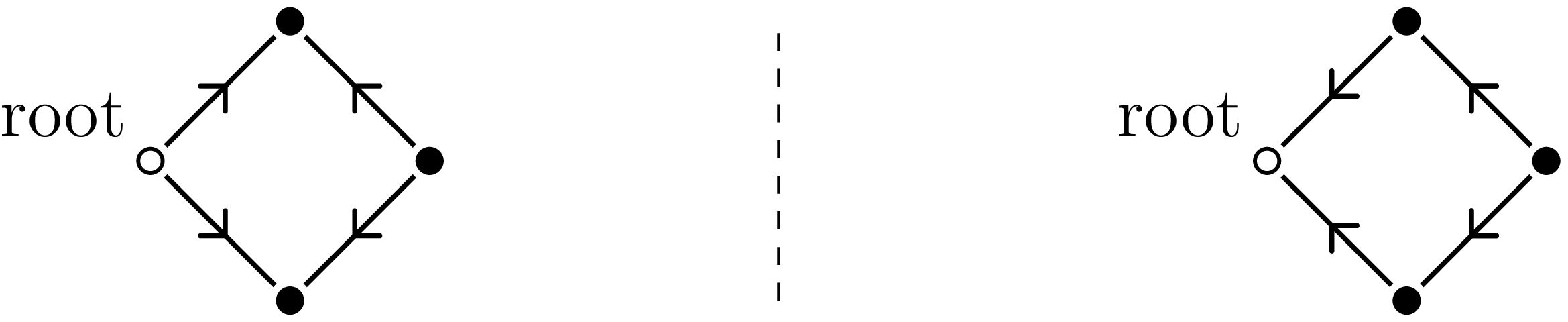


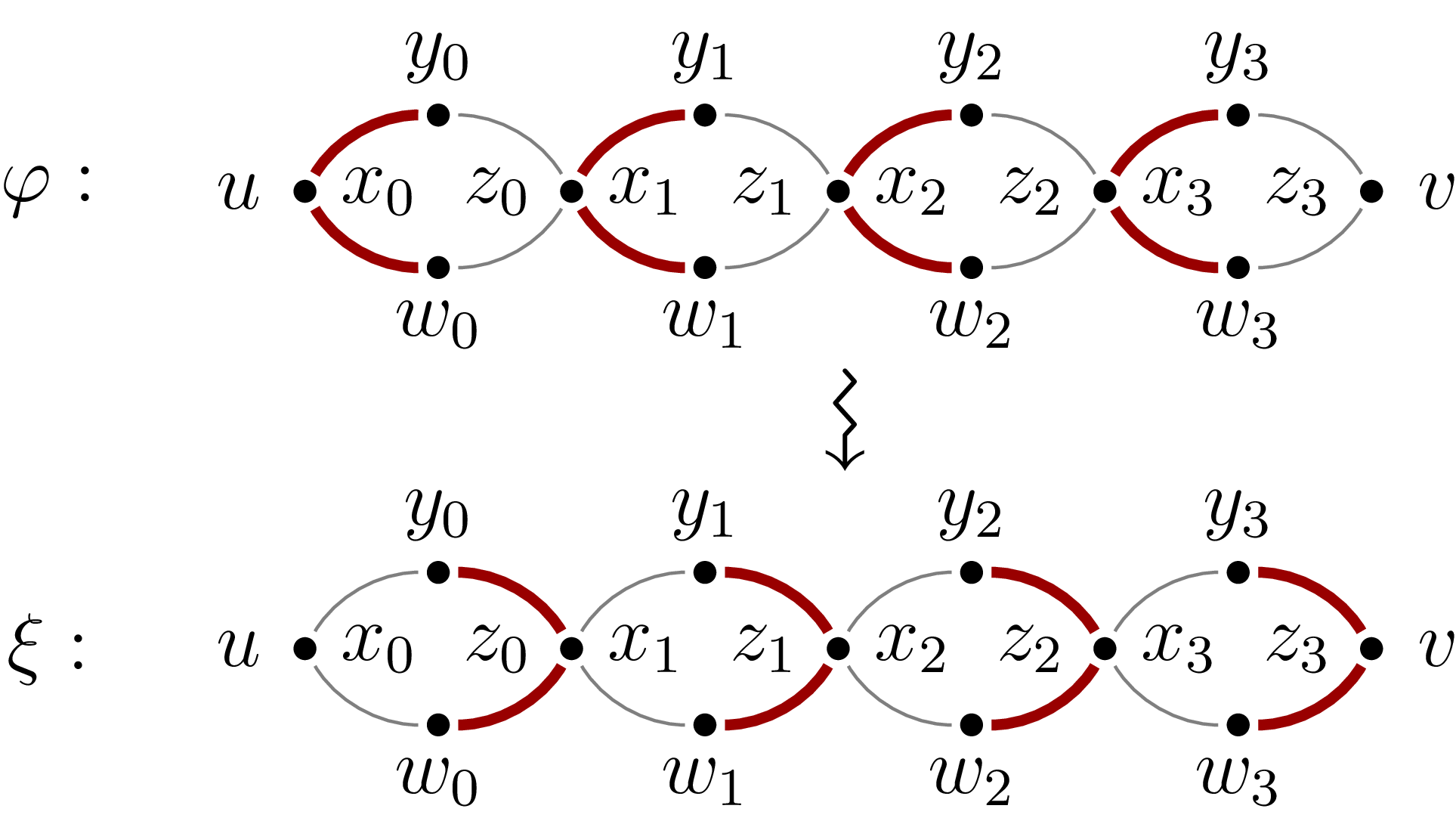


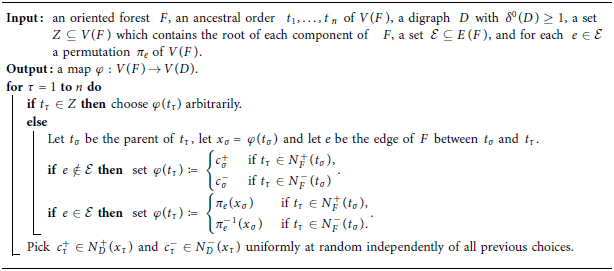

 Open access

