





Introduction
Fishers, as with most humans, are predominately risk-averse, preferring certainty and safety in their decisions and behaviours (Eggert & Martinsson Reference Eggert and Martinsson2004, Holland Reference Holland2008, Brick et al. Reference Brick, Visser and Burns2012, Andrews et al. Reference Andrews, Wolfe, Nayak and Armitage2021). Despite potential income loss, fishers have demonstrated a reluctance to leave a fishery, change fishing practices or diversify their livelihoods (Marschke & Berkes Reference Marschke and Berkes2006, Cinner et al. Reference Cinner, Daw and McCLanahan2009, Béné et al. Reference Béné, Frankenberger, Griffin, Langworthy, Mueller and Martin2019). Indeed, this reluctance to respond to environmental changes may create limits to the adaptation strategies of fishers, not only undermining environmental conservation initiatives but also potentially reinforcing the vulnerabilities of fishers. This pattern reflects loss aversion – the idea that, in risky and uncertain contexts, people prioritize the minimization of losses, despite the potential for substantial gains (Kahneman & Tversky Reference Kahneman and Tversky1979). Loss aversion suggests that people are not simply motivated by the maximization of their expected monetary outcomes but by a tendency to avoid any potential for a loss (Harrison & Rutström Reference Harrison and Rutström2009). While loss aversion has been studied in common-pool resource contexts (Camerer Reference Camerer, Camerer, Loewenstein and Rabin2011), it has scarcely been applied to small-scale fisheries (SSFs) conservation and management contexts.
Loss aversion is particularly salient with activities that may be threatened (Kahneman Reference Kahneman2011). For example, fishers may have difficulty accepting the potential introduction of new fisheries regulations such as catch limits or marine protected areas because they may be felt as a loss of traditional practices or future income, despite proposed conservation goals (Pauly Reference Pauly1995). Indeed, people will – often unconsciously – evaluate a decision based on whether the options are framed as positive or negative trade-offs (Lakoff Reference Lakoff2010, Kahneman & Tversky Reference Kahneman, Tversky, MacLean and Ziemba2013). To test loss aversion, valued assets are often translated into some monetary value for comparison across a standardized metric (Kronen Reference Kronen2007, Grillos Reference Grillos2017). Yet, many valued components of SSFs are not objective, material or monetary (Abrahamse & Steg Reference Abrahamse and Steg2013, Andrews et al. Reference Andrews, Wolfe, Nayak and Armitage2021). While previous work has assigned them a monetary value, there are concerns that this approach may fail to consider the multi-dimensionality of these assets (Brick et al. Reference Brick, Visser and Burns2012, White et al. Reference White, Bratman, Pahl, Young, Cracknell and Elliott2020) and may be culturally inappropriate (Chan et al. Reference Chan, Guerry, Balvanera, Klain, Satterfield and Basurto2012, Christie et al. Reference Christie, Fazey, Cooper, Hyde and Kenter2012). As a result, many of these variables are not considered in studies on loss aversion.
Differences in loss aversion are often associated with the personal characteristics of the decision-maker (Sayman & Öncüler Reference Sayman and Öncüler2005, Ert & Haruvy Reference Ert and Haruvy2017). For instance, age and income are correlated with higher loss aversion, while education and gender do not significantly predict it (Johnson et al. Reference Johnson, Gächter and Herrmann2006). Gächter et al. (Reference Gächter, Johnson and Herrmann2022) and Mrkva et al. (Reference Mrkva, Johnson, Gächter and Herrmann2020) found in both risky and riskless choices that loss aversion tends to increase with age and income and decreases with education. In addition, Johnson et al. (Reference Johnson, Gächter and Herrmann2006) found that as knowledge or experience in the decision context increased, there was a modest decrease in loss aversion. In SSFs, personal characteristics, including age, years of experience and income, may be anticipated to have similar effects on fishers’ loss aversion. Fishing dependence may also significantly affect fishers’ decision-making and directly influence resource users’ commitment to environmental conservation (Jacob et al. Reference Jacob, Farmer, Jepson and Adams2001, Stedman et al. Reference Stedman, Parkins and Beckley2004).
While studies have focused on loss aversion regarding individual decisions, limited research has looked at loss aversion when the decision has group-level consequences. As fishers often work in crews, a fisher’s loss aversion may affect and be affected by the success of the entire fishing crew. Additionally, collective action decisions are largely defined by and dependent on information-sharing between fishers (Brandstätter et al. Reference Brandstätter, Gigerenzer and Hertwig2006, Ostrom Reference Ostrom2010, Basurto et al. Reference Basurto, Bennett, Lindkvist and Schlüter2020). However, information-sharing not only facilitates the transfer of knowledge related to fishing activities but also contributes to shaping the social and cultural identity of fishers (Colvin et al. Reference Colvin, Witt and Lacey2015). Indeed, the opportunity to share information supports the development of social norms and reinforces a sense of community and shared identity among fishers (Tversky & Kahneman Reference Tversky and Kahneman1974, Unsworth & Fielding Reference Unsworth and Fielding2014). Information-sharing, therefore, may be an indirect driver of tangible values (e.g., catch success), but it also has other intangible and non-monetizable qualities (e.g., identity formation). Non-monetizable values are not commonly included in loss aversion studies.
The extent to which a fisher is likely to consider the group when making decisions is further mediated by social assets, including social trust and collective efficacy (Pretty Reference Pretty2003, Grafton Reference Grafton2005, Emborg et al. Reference Emborg, Daniels and Walker2020). Social trust can be characterized by a sense of reciprocity between fishers (Basurto et al. Reference Basurto, Blanco, Nenadovic and Vollan2016), while collective efficacy is a shared understanding or belief within a group of people that they can execute actions related to a common goal (Delea et al. Reference Delea, Sclar, Woreta, Haardörfer, Nagel and Caruso2018). Equally important, collective efficacy can contribute to fishers’ ability to share information in pursuit of environmental conservation (Yoon Reference Yoon2011). Taken together, social assets and collective efficacy may interact dynamically to influence individual fishing decisions, which may shape fisheries conservation outcomes such as adherence to marine protected areas or fishing regulations.
The dynamics of collective decision-making among fishers and the influence of social assets and collective efficacy can have significant implications for fisheries conservation efforts. In conditions of social and ecological uncertainty, fishers tend to rely on their social capital to navigate these changes (Barnes-Mauthe et al. Reference Barnes-Mauthe, Gray, Arita, Lynham and Leung2015). Indeed, understanding how individual loss aversion interacts with group-level consequences may allow for further understanding of the complexities of sustainable fishing practices. At the same time, in contexts where information sharing and collective efficacy are high, fishers may be more inclined to prioritize the long-term health of the fishery over short-term gains (Hicks et al. Reference Hicks, Stoeckl, Cinner and Robinson2014). Conversely, in situations where social trust is low or collective efficacy is lacking, individual fishers may prioritize personal gains, leading to overexploitation and depletion of fish stocks. Being unaware of the trade-offs being made by resource users and the variables that affect these trade-offs could reinforce undesirable social and ecological conservation outcomes (Gill et al. Reference Gill, Cheng, Glew, Aigner, Bennett and Mascia2019). Understanding how fishers make these trade-offs and the assets they prioritize may lead to greater legitimacy in conservation initiatives.
In this study, we examine the variables contributing to fishers’ loss aversion when making trade-offs between material and non-material valued assets. We explore these dynamics in small-scale fishing communities in Jamaica, where there is documented evidence of social and ecological changes affecting the viability of the fishing industry and its stakeholders. We ask how personal characteristics, fishing dependency and perceived boat dynamics influence loss aversion in fishers when trading off materially valued assets (catch success) and non-materially valued assets (information-sharing opportunities). By exploring the drivers of fishers’ decisions regarding valued assets, this study seeks to provide insights for designing targeted interventions aimed at fostering pro-conservation behaviours that support social and ecological sustainability.
We proposed two hypotheses. Firstly, fishing dependence and perceived boat dynamics variables will significantly contribute to greater loss aversion when both catch success and information-sharing are threatened, independent of personal characteristics. Fishers in Jamaica rely on their fishing social networks to support their fishing strategy development (Wade et al. Reference Wade, Alexander, Gerkey and Biedenweg2023) and adherence to conservation measures (Alexander Reference Alexander, Epstein, Bodin, Armitage and Campbell2018). Additionally, this expectation is based on the notion that individuals who are heavily reliant on fishing and who see their crewmembers as crucial to success will perceive threats to both outcomes as substantial risks. Fishers who perceive their boat dynamics as integral to their fishing success may exhibit heightened loss aversion when faced with threats to catch success and information-sharing. The potential loss of either catch success or information-sharing opportunities may be perceived as a threat to the overall viability and effectiveness of the crew and economic and social well-being, leading to an amplified loss aversion response. Therefore, fishers may be less likely to support new fishing regulations if they perceive them as threatening the viability or effectiveness of their fishing vessels or their fishing efforts.
Secondly, more years of experience and greater age of fishers will contribute to significantly greater loss aversion when only catch success is threatened. Indeed, Marschke et al. (Reference Marschke, Campbell and Armitage2020) found that younger fishers participated in higher-risk fishing methods, such as compressor divers, while older fishers tended to use less risky methods such as fish pots, spearguns or line fishing. This hypothesis further builds on our understanding of the role of socio-demographics in loss aversion (Johnson et al. Reference Johnson, Gächter and Herrmann2006, Mrkva et al. Reference Mrkva, Johnson, Gächter and Herrmann2020, Gächter et al. Reference Gächter, Johnson and Herrmann2022). We suggest that older fishers and those fishers with more years of experience will demonstrate higher loss aversion when catch success is at risk. The potential threat to catch success may be perceived as a direct challenge to the accumulated knowledge and investment of more experienced and older fishers. As a result, older fishers and those with greater years of experience may be more receptive to conservation policies that safeguard their livelihoods and protect the ecosystem.
Methods and analysis
Context and study site
Jamaica’s fishing industry is characterized as small-scale and artisanal (Aiken & Kong Reference Aiken and Kong2000, Kushner et al. Reference Kushner, Edwards, Burke and Cooper2011). There are currently 23 000 registered fishers and 7000 fishing vessels (National Fisheries Authority of Jamaica 2023). Fishers typically fish from one of the 187 fishing beaches using small, motorized boats with outboard engines, targeting a range of species, including parrotfish, snappers, grunts, lobster, conch and dolphinfish. Trip duration ranges from a few hours to 3–5 days. The size of boat crews is often determined by the target species and varies throughout the year. On average, the crew size is two to three persons, but it can be as large as six persons. At the same time, many fishers use spearguns to fish closer to shore.
Jamaica’s fishing industry has faced various social, economic and ecological threats over the years. Jamaica manages its fisheries under an open-access regime, except for Special Fishery Conservation Areas (SFCAs). SFCAs are no-take areas where extractive activities are prohibited (Aiken et al. Reference Aiken, Squire, Kong and Smilke2012). The mix of social and ecological change in Jamaica makes it ideal for exploring how fishers make trade-offs in the face of growing change and the characteristics that may influence those decisions. Similarly, the collectivist nature of fishing activities in the country under an open-access regime allows for exploring how fishers consider their crewmembers when making decisions. Ecological threats, including global climate change, habitat destruction and biodiversity loss, have reduced fish stocks.
Sampling approach
We sampled 20 fishing beaches in Jamaica across four parishes (Portland, St Elizabeth, St Catherine and Clarendon) between February and May 2021 (Fig. 1). The parishes were purposively selected to capture fishing beaches with similar management systems and sources of environmental and social change. We selected fishing beaches from a master list of fishing beaches on the island compiled by local collaborators; we then purposively selected different periods throughout the data collection days when fishers would most likely be at the fishing beaches. These times included early mornings and mid-afternoons to evenings when fishers were preparing or returning from a fishing trip. We obtained verbal informed consent from all participants before participating in the study. This approach was used in consideration of the varying literacy levels of the participants. The study involved in-person activities during the COVID-19 global pandemic, so research assistants followed all public health restrictions.
Map of sampling sites in Jamaica.

Experimental design
We used a structured questionnaire that included questions on personal characteristics, fishing dependence and perceived boat dynamics (Fig. 1 & Appendix S2) and included a modified simple lottery choice task. Our experimental design was modified based on previous studies that measured risk and loss aversion (Harrison & Rutström Reference Harrison and Rutström2009, Harrison et al. Reference Harrison, Humphrey and Verschoor2010, Bibby & Ferguson Reference Bibby and Ferguson2011, Brick et al. Reference Brick, Visser and Burns2012). Participants were asked to make a hypothetical gamble between two valued assets (Table 1). The experiment had two components: the first contrasting potential catch success with information-sharing opportunities and the second focusing solely on potential catch success. Information-sharing was broadly described as any communication that might contribute to the development of fishing strategies, including sea conditions, perceived hotspots, the presence of enforcement officers or gear innovations. The rationale was to investigate whether the influence of the independent variables on loss aversion differed when fishers had to make a choice when only catch success (a material asset) was being threatened versus when the choice was between catch success and information-sharing opportunities (a non-material asset).
Experimental design of choice options.

Before the experimental component started, participants were instructed: ‘You will be asked to make hypothetical gambles on factors that may influence your decisions on your fishing strategies.’ The choice prompt read: ‘If I flip a coin and the coin turns up heads, you lose 5% of your catch; if the coin turns up tails, you gain 10% in catch. Would you accept this bet?’ Our decision to limit the probabilities to 50% was to ensure ease of comprehension by the participants (Brick et al. Reference Brick, Visser and Burns2012). Unlike traditional choice experiments aiming to estimate utility specifications, our study aimed to understand the factors influencing participants’ loss aversion based on their subjective assessments of gains and losses.
To assess the effects of information-sharing versus catch success, we asked participants to make decisions between communicating with their crew (information-sharing opportunities) and catch success (Table 1). For the information-sharing opportunities represented in variable A, we increased the number of days fishers could communicate with their crewmembers per week based on the communication status quo within fishing crews in Jamaica. In variable B, the starting point was 10% and increased by 5% to capture how fishers’ loss aversion is influenced by the magnitude of change (Table 1). The potential gains in catch were paired with fewer days of communication, while potential losses in catch were paired with more days of communication. This variation captured whether the potential for gains in catch success overrides the loss of opportunities for information-sharing and vice versa.
To focus on the effects solely of catch success, we increased the percentages of losses and gains of catch success throughout the options, such that the gains always remained 5% higher than the potential losses. Our goal was to determine whether fishers would minimize the potential for a loss despite the higher potential for gains and potentially to identify a tipping point where potential for a loss was perceived as more important than potential for gains.
Analysis
Before running the analyses in this study, we tested our data for response biases, where a respondent responded ‘yes’ to all questions or ‘no’ to all questions, which may be due to difficulty understanding the questions or social desirability bias (Krosnick Reference Krosnick1991). For this analysis, we removed all occurrences where this pattern was observed. We calculated the means and standard deviations of the personal characteristics and fishing dependence variables to analyse our independent variables. To reduce collective efficacy and social trust items into respective indices, we measured the internal consistency of responses using Cronbach’s alpha reliability coefficient (Cronbach Reference Cronbach1951, Vaske Reference Vaske2019). To explore our dependent variable (whether fishers would accept or reject the gamble), we first calculated the average response rates of participants to each gamble. We then used a one-sample t-test on the response rates for each pairing of the variables to assess whether there were differences in fishers’ responses to the choice options. Lastly, to calculate the variables that contributed to fishers’ loss aversion, we used simultaneous binary logistic regression models because these allowed us to examine the relationship between the dependent variable, fishers’ loss aversion and the independent variables in a dichotomous format. In the results, we present the odds ratio statistic for each independent variable, Exp(B). The odds ratio is described as the probability of an event – that is, saying ‘yes’ to accepting the gamble – occurring when there is a one-point change in the independent variable.
Results
Descriptive statistics
We sampled 78 fishers, the majority of whom were male (n = 70), with an average age of 43 years (Table 2). The average in terms of years of fishing experience across the sample was 17. A greater proportion of our sample identified as crewmembers (n = 43) versus captains (n = 33), while the majority were full-time fishers (n = 57). The mean number of persons on fishing boats was between two and three, with more fishers indicating that they fish from one main boat (n = 40) compared to multiple boats (n = 36).
Descriptive statistics of the personal characteristics, fishing dependency and perceived boat dynamics variables.
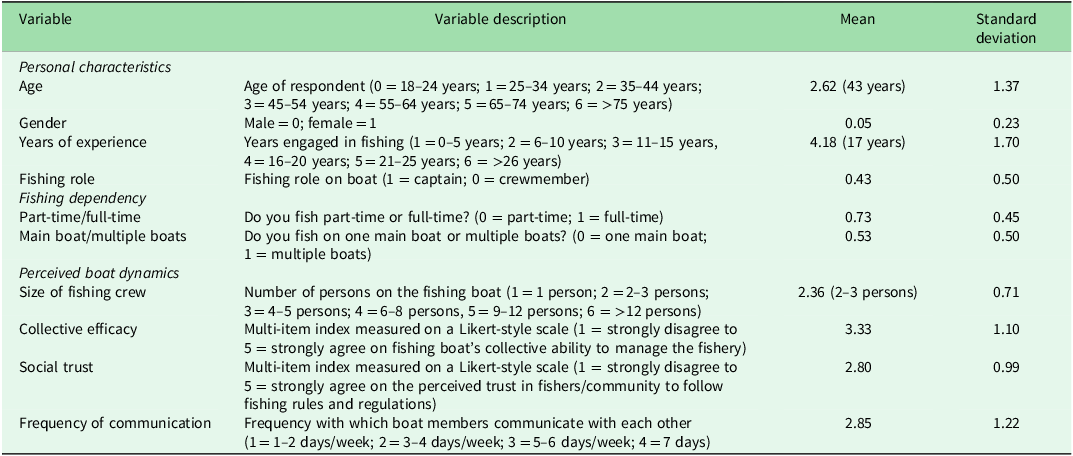
The collective efficacy items were internally reliable (Cronbach’s alpha = 0.92), with an average score of 3.30 (out of 5). For the social trust variable, the original Cronbach’s alpha was 0.836. However, if the first item of the index (‘In general, I trust most people in my community’) was removed, Cronbach’s alpha increased to 0.861. Therefore, we decided to remove the first item of the social trust variable, whereupon the average social trust became 2.80.
Distribution of choice responses
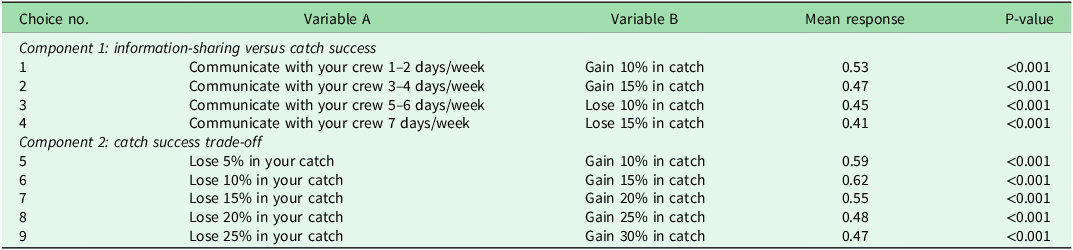
Across all choice options, there were significant differences in acceptance rates (Table 3). For choices that contrasted information-sharing opportunities and catch success, the average acceptance rate was 0.47, while the average for choices that only contrasted catch success was 0.54. In contrasting information-sharing opportunities and catch success, the lowest mean acceptance rate of 0.41 was for choice 4 (communicate with crew 7 days per week versus lose 15% in catch). The highest mean of 0.53 was observed for choice 1 (communicate with crew 1–2 days per week versus gain 10% in catch). In contrasting only variation in catch success, the highest mean response of 0.62 was observed for choice 6 (lose 10% in catch versus gain 15% in catch). The lowest mean acceptance rate of 0.47 was observed for choice 9 (lose 25% in catch versus gain 30% in catch).
Mean responses (two-point scale: 0 = no; 1 = yes) and p-values for participant responses to each choice set.
Predicting loss aversion to information-sharing opportunities
The models for all choice options trading crew communication and catch success were statistically significant, as indicated by the likelihood ratio tests: choice 1 (χ2(11) = 31.152, p = 0.001); choice 2 (χ2(11) = 19.335, p = 0.055); choice 3 (χ2(11) = 23.516, p = 0.015); and choice 4 (χ2(11) = 25.398, p = 0.008).
The goodness of fit of all models exceeded the 0.05 threshold (Hosmer and Lemeshow test: choice 1 = 0.126; choice 2 = 0.217; choice 3 = 0.576; choice 4 = 0.811). The Nagelkerke R2 (or pseudo-R2) on average explained 0.401 of the variation across the four choice options. Classification tables showed that all four choice options were predicted above the recommended 50% threshold (choice 1 = 52.9%; choice 2 = 73.9%; choice 3 = 74.3%; choice 4 = 84.3%).
In all models, the crew size and communication frequency were the most common significant predictors of fishers’ loss aversion. Social trust was the only other significant predictor of fishers’ decisions. In choice 1, all other variables being constant, as fishers’ communication frequency decreased, they were 0.374-times more likely to accept communicating with their crew 1–2 days per week versus gaining 10% in catch (Table S1 in Appendix S1). Given the same choice, as the size of the fishing crews increased, fishers were 3.72-times more likely to accept the choice. Lastly, as social trust increased, fishers were 3.412-times more likely to accept the choice of communicating with their crew 1–2 days per week versus gaining 10% in catch. In choice 2, between communicating with crew for 3–4 days per week or gaining 10% in catch, as communication frequency decreased, fishers were 0.402-times more likely to accept this choice option (Table S1 in Appendix S1). For choice 3, as the size of the fishing crew increased, fishers were 3.062-times more likely to accept the choice of communicating with their crew 5–6 days per week or gaining 10% in catch success (Table S1 in Appendix S1). Similarly, for the same choice option, as fishers’ communication frequency decreased, fishers were 0.377-times more likely to accept this choice option. Lastly, in choice 4, as the size of the fishing crew increased, fishers were 7.382-times more likely to accept the choice of communicating with their crew 7 days per week or gaining 10% in catch success (Table S1 in Appendix S1).
Predicting loss aversion to catch success
The models for all choice options varying catch success were also statistically significant, as indicated by the likelihood ratio tests: choice 5 (χ2(11) = 22.904, p = 0.018), choice 6 (χ2(11) = 21.797, p = 0.026), choice 7 (χ2(11) = 29.810, p = 0.002), choice 8 (χ2(11) = 34.271, p < 0.001) and choice 9 (χ2(11) = 19.189, p = 0.058).
The goodness of fit for all models was acceptable (Hosmer and Lemeshow test: choice 5 = 0.479; choice 6 = 0.280; choice 7 = 0.240; choice 8 = 0.733; choice 9 = 0.973), and on average 41.6% of the variation was explained across the five choice options (Nagelkerke R2). The classification tables correctly predicted that all five of our models were above the 50% threshold (choice 5 = 70.0%; choice 6 = 77.9%; choice 7 = 75.0%; choice 8 = 84.1%; choice 9 = 75.4%).
In all models, the size of the fishing crew and communication frequency were the two most common significant predictors of fishers’ loss aversion. Other significant predictors were gender (choices 5 and 6), collective efficacy (choices 6 and 8) and years of fishing experience (choice 8). In choice 5, as communication frequency between crewmembers increased, fishers were 2.576-times more likely to accept losing 10% catch or gaining 15% in catch (Table S1 in Appendix S1). In choice 6, we found three variables significantly contributing to fishers’ acceptance of this choice (Table S1 in Appendix S1). As collective efficacy increased, fishers were 2.171-times more likely to accept this choice option. On the other hand, as the size of the fishing crew decreased, fishers were 0.261-times more likely to accept this choice. Years of fishing experience, size of fishing crew, collective efficacy and communication frequency significantly contributed to the fishers’ decision to accept choice 8 (choice between losing 20% in catch versus gaining 25% in catch; Table S1 in Appendix S1). As the size of the fishing crew decreased, fishers were 0.205-times more likely to accept this choice option. The likelihood of fishers accepting this choice option significantly increased with years of fishing experience, collective efficacy and communication frequency by factors of 2.005, 2.900 and 3.262, respectively. For choice 9 (between losing 25% in catch versus gaining 30% in catch), communication frequency was the only variable to significantly contribute to fishers’ acceptance of this option (Table S1 in Appendix S1). As communication frequency increased, fishers were 2.204-times more likely to accept this choice.
Discussion
We aimed to describe the relationship between fisheries conservation and decision-making processes among small-scale fishers. Fishers are not significantly more inclined to prioritize strictly monetary outcomes over non-monetary outcomes in their decision-making. Our first hypothesis that fishing dependence and boat dynamics would significantly contribute to fishers’ loss aversion when both catch success and information-sharing opportunities were threatened was partially supported. Across the four choice options that contrasted catch success and information-sharing opportunities, the size of fishing crew, social trust and communication frequency significantly contributed to fishers’ loss aversion. Our second hypothesis that age and gender would significantly contribute to fishers’ loss aversion when only catch success was threatened was not supported.
Our results support individuals considering the risk preferences of others when making decisions involving losses and gains (Raub & Snijders Reference Raub and Snijders1997). In SSFs conservation, where individual decisions have collective-level consequences, fishers may be considering the trade-offs made by other crewmembers and the potential effects of their own decisions on the group. This consideration of others may reflect the interdependency within fishing crews in SSFs. These trade-offs and considerations of risk preferences in decision-making have the potential to reduce social dilemmas in SSFs, where the cumulative result of individual decisions contributes to collective problems (Kramer & Brewer Reference Kramer and Brewer1984, Basurto et al. Reference Basurto, Blanco, Nenadovic and Vollan2016). Our results further explore the links between fishers’ decision-making and SSF conservation (Ostrom Reference Ostrom1990, Obregón et al. Reference Obregón, Admiraal, van Putten, Hughes, Tweedley and Loneragan2020).
Loss aversion to information-sharing opportunities and catch success
We found that when accepting potential trade-offs between information-sharing opportunities and catch success, higher opportunities for information-sharing coupled with fewer opportunities for catch success led to the highest levels of loss aversion among fishers. Despite opportunities to increase communication with their crew, fishers placed more weight on the potentially lower catch success. Our findings that fishers showed lower levels of loss aversion when information-sharing opportunities were at the minimum may indicate that fishers’ loss aversion was linked to potential losses in catch success. In choice options where information-sharing opportunities were the lowest, social trust and the size of the fishing crew were significant predictors of fishers’ responses. This suggests that when fishers lack the opportunity to communicate, they are exercising a level of trust in other fishers and an expectation of unspoken cooperation.
The significance of communication frequency in fishers’ loss aversion in three of the four choice options supports existing behavioural economic theory that people tend to place higher weight on the status quo in decision-making (Kahneman et al. Reference Kahneman, Knetsch and Thaler1991, Schmidt & Zank Reference Schmidt and Zank2005). For example, when the communication frequency was higher than the norm of communicating 3–4 days per week, it was no longer a significant contributor to fishers’ loss aversion. At the same time, the combination of the size of the fishing crew and communication frequency as significant predictors of fishers’ loss aversion in choices 2, 3 and 4 corroborates the role of collective action in loss aversion (Ahn et al. Reference Ahn, Ostrom and Walker2003). Notably, in choice 4, where the potential for loss of catch success was lowest, the size of the fishing crew was the only significant contributor to fishers’ loss aversion. This suggests that fishers may perceive a smaller risk of loss in catch success when they are part of a larger fishing crew. The burden of the loss may be reduced psychologically and economically when fishers are part of a larger crew. This finding supports existing loss aversion theory that people prefer working in groups to share potential losses (Charness & Sutter Reference Charness and Sutter2012, Kugler et al. Reference Kugler, Kausel and Kocher2012).
Loss aversion to catch success
In choices that contrasted only changes in catch success, we found lower loss aversion compared to choices trading off catch success and information-sharing. We also found greater diversity in the variables influencing fishers’ loss aversion in these catch-focused choices. Our finding of a decrease in the intensity of loss aversion as the potential gains in catch success increased suggests that the increase in potential gains may not have been substantial enough to outweigh the potential loss. This supports the foundational theory of loss aversion, that gains need to be 1.5–2.0-times greater than potential losses to reduce loss aversion (Kahneman & Tversky Reference Kahneman and Tversky1979).
In contrast to previous studies, we did not find significant relationships between personal characteristics such as age and years of experience on loss aversion, although those studies have predominantly focused on decision-making scenarios with individual consequences (Hjorth & Fosgerau Reference Hjorth and Fosgerau2011, Gächter et al. Reference Gächter, Johnson and Herrmann2022). In our study, fishers’ individual decisions carried collective-level implications, potentially explaining the absence of age and experience as influential factors. Instead, the size of the fishing crew, communication frequency, gender, collective efficacy and years of fishing experience significantly influenced fishers’ loss aversion when trading off choices focused on catch success. These variables may reflect the collective nature of SSFs and underscore the group-level consequences of individual fishers’ choices (Levin & Cross Reference Levin and Cross2004, Aswani et al. Reference Aswani, Gurney, Mulville, Matera and Gurven2013). Indeed, as small-scale fishers typically fish in groups, their fishing success depends on the crew’s collective decisions. By pooling together their resources, knowledge and access, fishing crews can lower the potential consequences of losses while increasing the likelihood of gains (Jentoft et al. Reference Jentoft, Bavinck, Alonso-Población, Child, Diegues and Kalikoski2018).
Gender significantly predicted fishers’ loss aversion in choices 5 and 6, echoing prior research showing that women tend to exhibit greater loss aversion (Schmidt & Traub Reference Schmidt and Traub2002); however, more than 90% of our sample was male, and this gender effect might not hold true in a more evenly distributed sample. In choices 6 and 8, collective efficacy was a significant predictor of fishers’ loss aversion, interacting with variables such as gender, experience, crew size and communication frequency. This highlights the importance of confidence in boat dynamics and communication in shaping aversion to losses, even in the absence of explicit threats to information-sharing. Notably, in choices 7–9, communication frequency consistently influenced fishers’ loss aversion, indicating its importance in facilitating crew coordination, which could impact decision-making even when information-sharing is not explicitly at risk. Future studies should explore fishers’ loss aversion when non-materially valued assets are threatened to better understand their decision-making priorities.
Linking loss aversion to small-scale fisheries conservation strategies
Recognizing the significance of loss aversion for fishers’ decisions, the formulation of conservation strategies for SSFs should more explicitly consider the decision priorities of fishers. Although losses may inevitably occur when new conservation measures are introduced, the framing of these measures plays a pivotal role in determining the extent to which fishers are willing to embrace such changes. Presenting new policies such as new catch regulations or protected areas as extensions of current practices and traditions of fishers can foster a sense of continuity, reduce perceived losses and facilitate compliance. Indeed, in ranking the acceptance of various social policy options, Moshinsky and Bar-Hillel (Reference Moshinsky and Bar-Hillel2010) found that simply indicating which policies were the status quo was enough to influence a person’s acceptance of them.
Our study further confirms that in collective contexts, social distance plays an important role in individual loss aversion. For example, social distance between two persons plays a significant role in risk and loss aversion when individuals are making decisions for themselves, strangers or friends (Ziegler & Tunney Reference Ziegler and Tunney2015, Zhang et al. Reference Zhang, Liu, Chen, Shang and Liu2017). Although we did not explicitly ask participants to consider others when making their choices, in SSFs and other common-pool contexts, individuals often depend on each other. The prevalence of fishers’ boat dynamics as variables significantly contributing to fishers’ loss aversion provides evidence that fishers were implicitly and explicitly considering the collective consequences of their decisions.
Our study underscores the importance of integrating loss aversion into existing conservation efforts and policy development. Recognizing the diverse influences on fishers’ decision-making processes, conservation strategies should be tailored to their priorities while mitigating potential losses (Fulton 2021). By recognizing the intricate balance between conservation goals and the socio-economic dynamics of SSF communities, policies can be developed in ways that foster continuity with existing practices (Iftekhar & Pannell Reference Iftekhar and Pannell2015). Emphasizing the continuity of new measures with traditional methods can reduce perceived losses and facilitate greater compliance among fishers. Moreover, inclusive conservation efforts can effectively engage fishing communities and leverage their local knowledge to develop sustainable solutions.
Conclusion
This study contributes to existing calls for the intentional consideration of fishers’ perspectives in fisheries management policy and planning. A holistic approach to SSFs conservation must encompass both tangible measures, such as catch quotas and gear restrictions, and intangible elements, such as promoting information-sharing networks and collective action. Understanding the multifaceted decision-making processes of fishers is essential for conservation measures to be effective. For example, when implementing new fisheries regulations such as area closures, consideration should be given to how the closures might affect fishers’ economic well-being, but also how such closures might affect their cultural attachment to the area.
As many small-island states, including Jamaica, set policies to meet global and national goals, such as proposing the diversification of fish catch or increasing protected areas, it is becoming increasingly clear that for these policies to achieve their outcomes they must be designed considering the diverse motivations of fishers. Indeed, our study demonstrated that fishers’ decisions are nuanced, and the variables that influence their final decisions will be dependent on the importance fishers place on the potential outcomes. Our study reveals that fishers may not prioritize catch success over information-sharing. The similarity in loss aversion between choices involving catch success alone and those with information-sharing suggests that fishers may overlook opportunities for information-sharing despite recognizing its importance, as it is intertwined with catch success. Supporting fishers’ social networks could potentially improve future catch success while also supporting conservation goals (Salas & Gaertner Reference Salas and Gaertner2004, Alexander et al. Reference Alexander, Epstein, Bodin, Armitage and Campbell2018). By integrating how fishers value monetary and non-monetary assets, conservation efforts could be more effectively tailored to the needs of local fishing communities while supporting the long-term viability of conservation initiatives.
Supplementary material
To view supplementary material for this article, please visit https://doi.org/10.1017/S0376892924000134.
Acknowledgements
We are grateful to our local implementing partners, including the Alligator Head Foundation, BREDS – Treasure Beach Foundation, the Caribbean Coastal Area Management Foundation and Jamaica’s National Fisheries Authority. We acknowledge the fishers across Jamaica who have collaborated with our research team, sharing their knowledge and experiences and contributing as research partners.
Author contributions
EW: Conceptualization, methodology, formal analysis, investigation, writing – original draft, writing – review & editing, project administration, funding acquisition; KB: Writing – review and editing, funding acquisition, supervision.
Financial support
This work was supported by the Sasakawa Young Leaders Fellowship Fund (SYLFF).
Competing interests
The authors declare none.
Ethical standards
The authors assert that all procedures contributing to this work comply with the applicable ethical standards of the relevant national and institutional committees on human experimentation; the study was approved by Oregon State University’s Institutional Review Board (IRB-2021-0861).


 Open access

