




Introduction
Flank eruptions in basaltic calderas are mainly caused by lateral magma draining from a common shallow magma chamber (Moore Reference Moore and Clague1992). Most of these eruptions are effusive; however, they might be succeeded by caldera collapse, magma draining, or explosive eruptions (e.g., Kaneko et al. Reference Kaneko, Yasuda, Shimano, Nakada, Fujii, Kanazawa, Nishizawa and Matsumoto2005; Simkin and Howard Reference Simkin and Howard1970). Therefore, determining if these eruptions are linked to the central caldera (summit conduit) or not (peripheral dike intrusion) is crucial for a better understanding of basaltic calderas and their hazard assessment.
Flank eruptions may be fed by sub-horizontal or radial dikes from a central conduit, likely related to local compressional stresses or aligned along preexisting tectonic structures (i.e., Acocella and Neri Reference Acocella and Neri2003). Volcanic rift zones represent preferred magma pathways because of their extensional component (crustal weakness zones; Gudmundsson and Loetveit Reference Gudmundsson and Loetveit2005). For instance, most eruptions in the Kilauea and Mauna Loa basaltic calderas originate at the rift zones, and areas downhill of rift zones are more likely to be covered by future lava flows (Patrick et al. Reference Patrick, Houghton, Anderson, Poland, Montgomery-Brown, Johanson, Thelen and Elias2020).
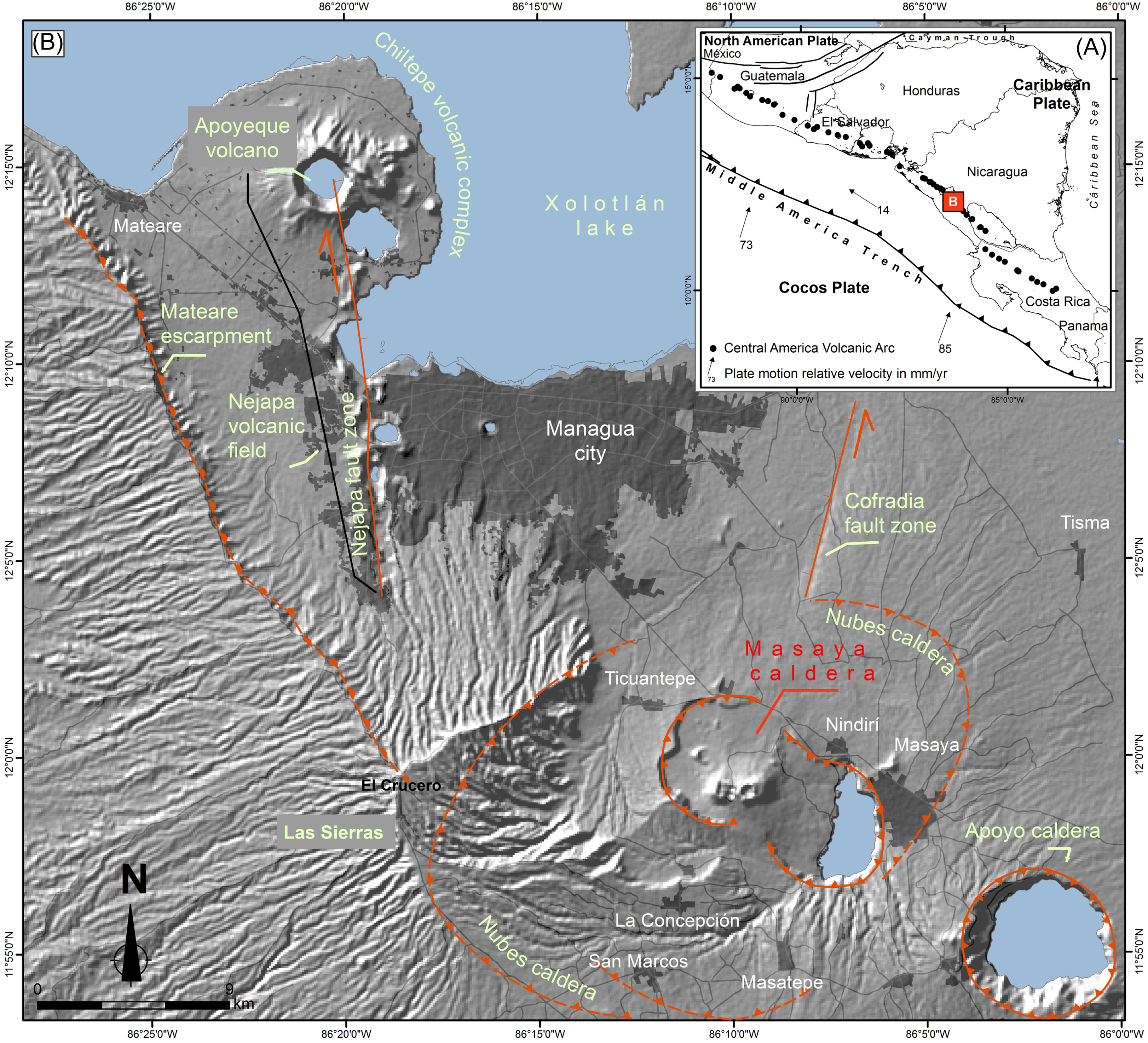
The Masaya caldera complex is a dominantly effusive 11 × 6 km-diameter basaltic caldera that belongs to the central portion of the Nicaraguan Volcanic Arc, located in the SE Managua Graben (Figure 1) (Avellán et al. Reference Avellán, Macías and Pardo2012; La Femina et al. Reference La Femina, Dixon and Strauch2002; Girard and van Wyk de Vries Reference Girard and de Vries2005). Masaya is currently unrest in a post-caldera phase; it has an active lava lake that occupies one of the summit craters (Santiago) and emits continuous gasses (Global Volcanism Program 2024). Over a dozen intra-caldera vents have sourced eruptions, and pit craters have formed due to magma draining (Harris Reference Harris2009; Rymer et al. Reference Rymer, van Wyk de Vries, Stix and Williams-Jones1998). Historic eruptions since 1529 CE are mainly associated with the Masaya-Nindirí vents (Fernández de Oviedo Reference Fernández de Oviedo1851) and have impacted the nearest localities, including Managua, Nicaragua’s capital city. The last two eruptions happened in 1670 and 1772 CE; the former flowed down the northern slope related to an overflow of the Nindirí lava lake, and the latter took place from a fissure on the northern flank of Masaya cone (McBirney Reference McBirney1956).
The tectonic setting of the Masaya caldera in the Nicaraguan Volcanic Arc (A), its location, and main volcanic and tectonic structures (B). Projected coordinate system NAD 1927 UTM 16N.

Many recent lava flows in the northern flank of the Masaya caldera remain unstudied. Determining the age of these eruptions and their relation to Masaya’s post-caldera activity is essential to complete the geological record for a better hazard assessment. Therefore, this work focuses on five effusive eruptions in the northern slopes of the Masaya caldera. The products were studied via geological mapping, radiocarbon dating, and geochemical analyses to determine their radiometric age and volcanic provenance. This allowed to identify new Masaya’s flank eruptions.
Methods
To determine the age of five flank eruptions from the Masaya caldera, the distribution of each lava flow unit was mapped to ensure that the collected samples were obtained directly from the paleosols buried by each event. The mapping comprised tracing the geological contacts and analyzing the geomorphological chronology of the eruptions aided by satellite images obtained from the Basemap tool in ArcMap® 10.2 software. This helped us know the location of the eruptive vents and define the extension of each lava flow unit, considering the presence of vegetation, texture, and color contrast on the lava flow rocks. During the edition of the lithological contacts, the orthophotographs with a single band and pixel depth of 8 bit acquired from Instituto Nicaragüense de Estudios Territoriales were superimposed and referenced. 1988 images of the regional topographic map were used to corroborate some vectorial parameters. The map edition was georeferenced to the coordinate system GCS WGS 1984. After that, geological mapping was performed; it helped us defining each lava flow unit’s distribution and stratigraphic position. This geological map also includes the two historical eruptions of 1670 and 1772 CE that occurred within the Masaya caldera.
After mapping, samples of paleosols were obtained directly from the paleosols buried by each event. Then, five samples of paleosols were collected. Three samples were collected from small manual pits made in front or on the edge of each lava flow unit emitted by different eruptive vents, while the other two samples were collected from excavation quarries. All samples were taken within 5 cm of the upper paleosol, below and in direct contact with each lava flow deposit. 10 g was sent to the laboratory to be analyzed by an accelerator mass spectrometry (AMS) at the Beta Analytic testing laboratory in Miami, Florida, USA. The standard methodology used in this laboratory is explained fully at Beta Analytic’s (Reference Analytic2025) website.
For this study, a total of seven new whole-rock analyses were carried out. Major and trace elements were determined in five rock samples from each of the lava flows identified on the northern flank of the Masaya caldera, and one rock sample for each of the historical eruptions that occurred within the Masaya caldera. All samples were normalized to an anhydrous base and plotted with the help of Igpet® software. Detection limit values for major elements are 0.01%, and ≤ 2 ppm for trace elements. The whole-rock concentrations were performed using the following package: Lithium Metaborate/Tetraborate Fusion—ICP and ICP-MS (Inductively Coupled Plasma emission Mass Spectrometry) to determine all major elements and some trace elements; also, 4B1-Total Digestion-ICP, and 4B-INAA (Instrumental Neutron Activation Analysis) techniques for other trace elements in Activation Laboratories LTD at Ancaster, Ontario, Canada (Actlabs 2025). We compare the geochemical data obtained from historical eruptions that occurred within the caldera with the lava flows that took place on Masaya’s northern flank for correlation and using the geochemical data as fingerprinting tools. This helped us to understand the geochemical characteristics of the lava flow units and know the provenance of the magmas before they reached the surface.
Results
Lava flow units
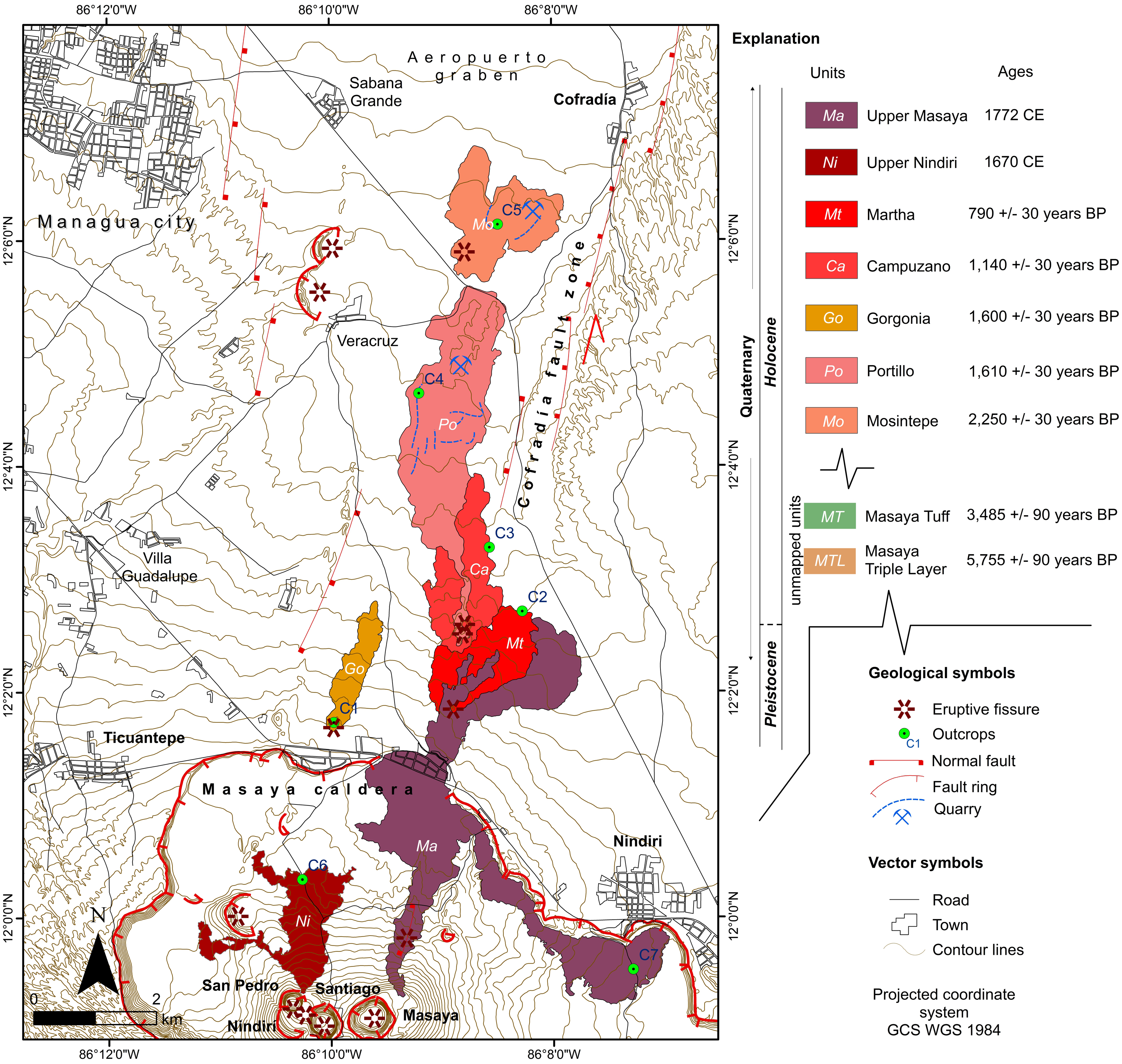
Geological mapping helped identify five lava flows on the northern outer flank of the Masaya caldera’s ring fault border (Figure 2). These represent fissure effusive eruptions located between 4.8 and 12.8 km from the active post-caldera pit craters known as Nindirí, Santiago, and Masaya (Figure 2). The Masaya’s northern flank holds the Aeropuerto graben, and the five volcanic fissures are contained in this tectonic structure (Figure 2). Three of these units, defined here as Portillo (Po), Campuzano (Ca), and Martha (Mt), are aligned in the southeastern end of the graben along the Cofradía fault zone (Figure 2). The other two units, Mosintepe (Mo) and Gorgonia (Go), are placed in the central part of the graben (Figure 2). The two historical eruptions of 1670 (Upper Nindirí Unit) and 1772 (Upper Masaya Unit) CE were also identified in the Nindirí post-caldera pit crater rim and the northern flank of the Masaya post-caldera volcano, respectively (Figure 2). The 1772 CE lava flow fissure has an NNE direction, parallel to the Cofradía fault zone.
Geological map of the Masaya caldera’s northern portion, main eruptive fissures, and stratigraphic column for the studied volcanic units. The age of the Masaya Tuff (MT) Unit in the stratigraphic column was obtained from Avellán et al. (Reference Avellán, Macías and Pardo2012).

The volcanic landforms associated with the fissures (vents) of each lava flow are small spatter cones between 10 and 40 m high with basal diameters from 0.1 to 0.2 km. These spatter cones are formed by welded and agglutinated scoria fragments with massive facies. All the lava flows flowed northwards, reaching between 1.8 and 7.9 km (Table 1). They covered areas between 0.8 and 6.5 km2, with bulk volumes from 0.02 to 0.51 km3 (Table 1). All lava flow units present a massive structure with autobreccia facies in their border, top, and front portions. The rocks that make up these lava flows are formed by a gray groundmass and have a dominant fine-grained porphyritic texture with plagioclase (55–47 vol%), pyroxene (45–29 vol%), olivine (11–5 vol%), and Fe-Ti oxide (5–1.7 vol%) phenocrysts and microphenocrysts (Table 1).
Main physical characteristics of the studied lava flow units.

Radiocarbon ages
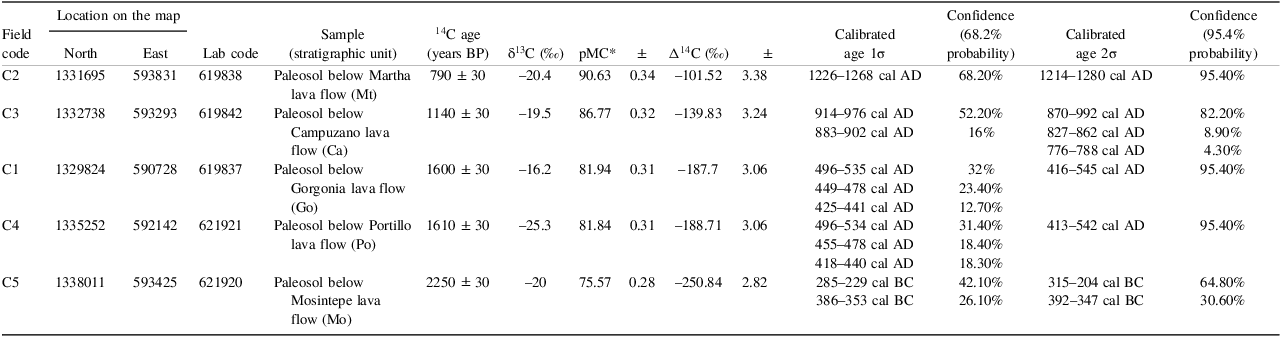
The radiocarbon ages obtained by AMS from the collected paleosols were reported as conventional 14C ages in years BP (Table 2) and accompanied by their values corresponding to δ13C, percent Modern Carbon, and Δ14C (Table 2). These radiocarbon ages were calibrated to calendar years using the high probability density range method proposed by Ramsey (Reference Ramsey2009) through the IntCal20 terrestrial calibration curve of Reimer et al. (Reference Reimer2020) for 14C samples from the Northern Hemisphere. The calibrated age ranges calculated present values between 68.2% (1σ) and 95.4% (2σ) of probability (Table 2).
Radiometric AMS 14C ages results in years BP and calibrated to calendar dates BC and AD

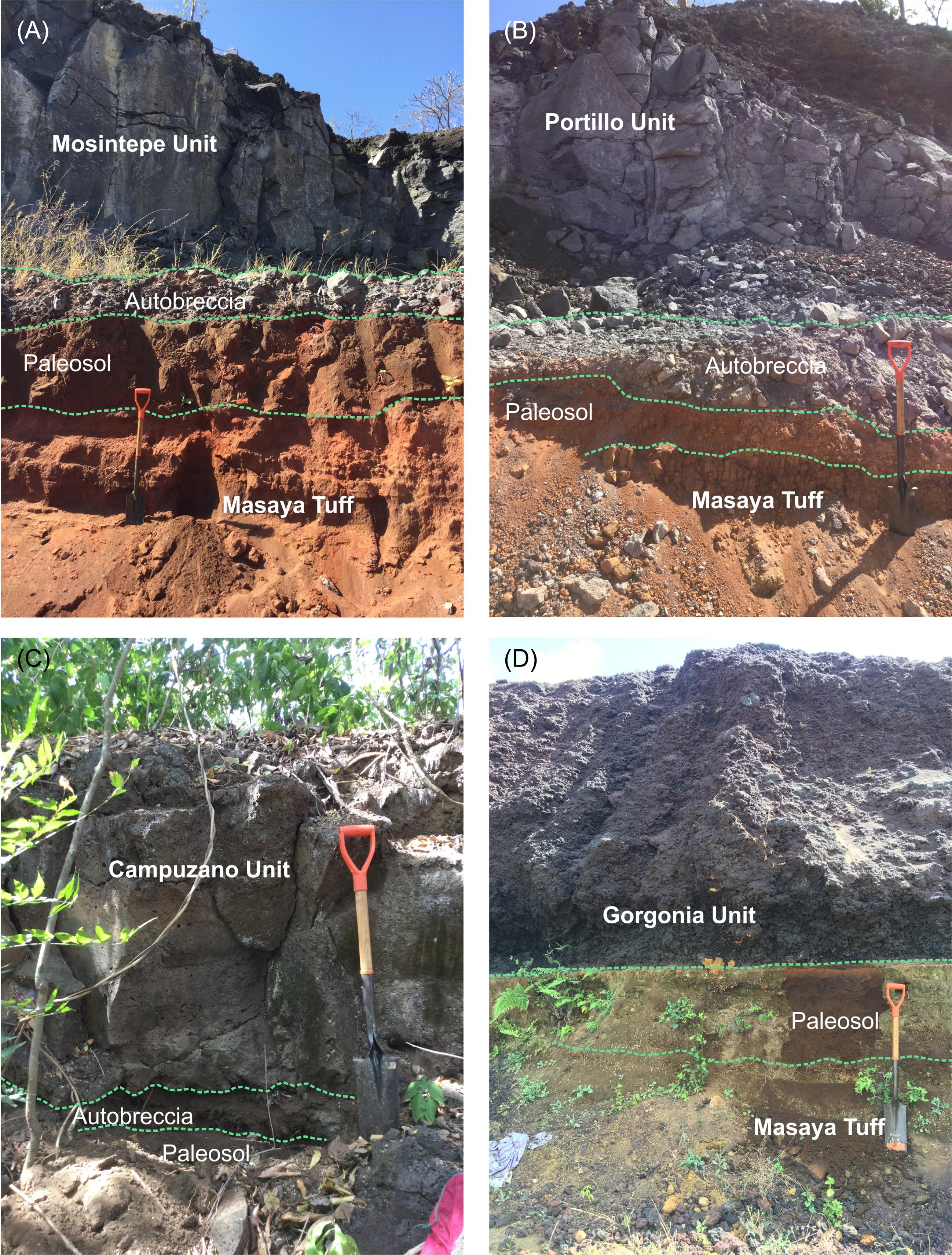
Two paleosol samples were collected at sites C4 and C5 (Figure 2) directly from the outcrops exposed in the quarries, corresponding to the Mo and Po Units (Figures 2, 3A, and 3B). These paleosols are reddish and are between 30 and 10 cm thick. They are reddish-brown, hardened, and have a massive structure with a clayey upper portion rich in hummus and a silty-sandy lower portion. These paleosols were developed from the deposit of the explosive eruption known as Masaya Tuff, which was recorded with an age of 3485 ± 90 yr BP (Avellán et al. Reference Avellán, Macías and Pardo2012) and overlain by the lava flow units of Mo and Po (Figures 3A and 3B). Autobreccia facies of the lava flows in the lower portion trace the contact with the paleosols. The other three paleosol samples were collected at sites C1, C2, and C3 (Figures 2, 3C, and 3D) after excavating small pits with a shovel to expose the paleosols underlying the lava flow units Go, Ca, and Mt. These paleosols are up to 20 cm thick, dark brown, massive, slightly hardened, and enriched with black hummus and clayey silt. The eruption of 3.48 ka ago from the Masaya caldera is also underlying these paleosols, composed of gray tephra with lamellar structure, hardened and made up entirely of volcanic ash, recognized as a stratigraphic marker throughout the region.
Field outcrops of the Mosintepe, Portillo, Campuzano, and Gorgonia Units and their respective paleosols. The paleosols underlie the autobreccia facies, which form at the base of the lava flows.

AMS 14C dating obtained from carbon disseminated within the paleosols collected at the base of the lava flows revealed radiometric ages of 2250 ± 30 years BP for Mo Unit, 1610 ± 30 years BP for Po Unit, 1600 ± 30 years BP for Go Unit, 1140 ± 30 years BP for Ca Unit, and 790 ± 30 years BP for Mt Unit (Table 2). They reveal Δ14C values of –250.84 ± 2.82‰ for the Mo Unit, –188.71 ± 3.06‰ for the Po Unit, –187.7 ± 3.06‰ for the Go Unit, –139.83 ± 3.24‰ for the Ca Unit, and –101.52 ± 3.38‰ for the Mt Unit (Table 2).
Whole-rock composition
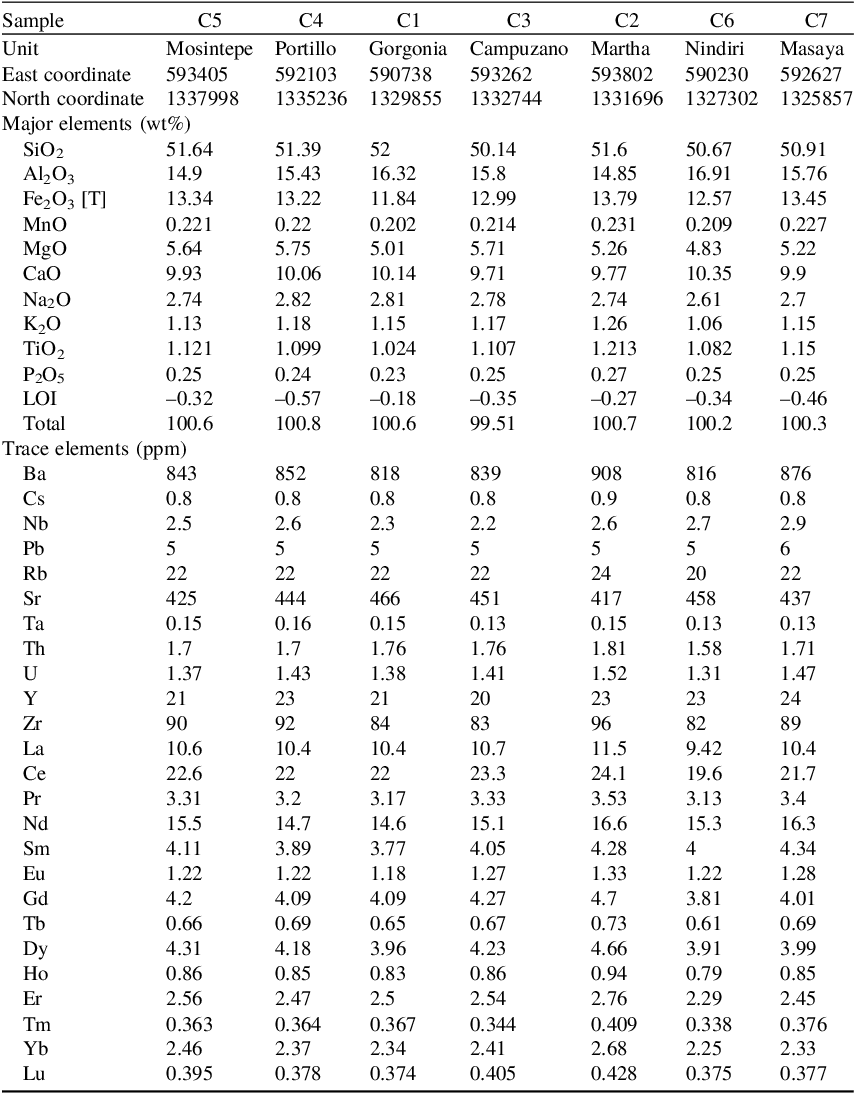
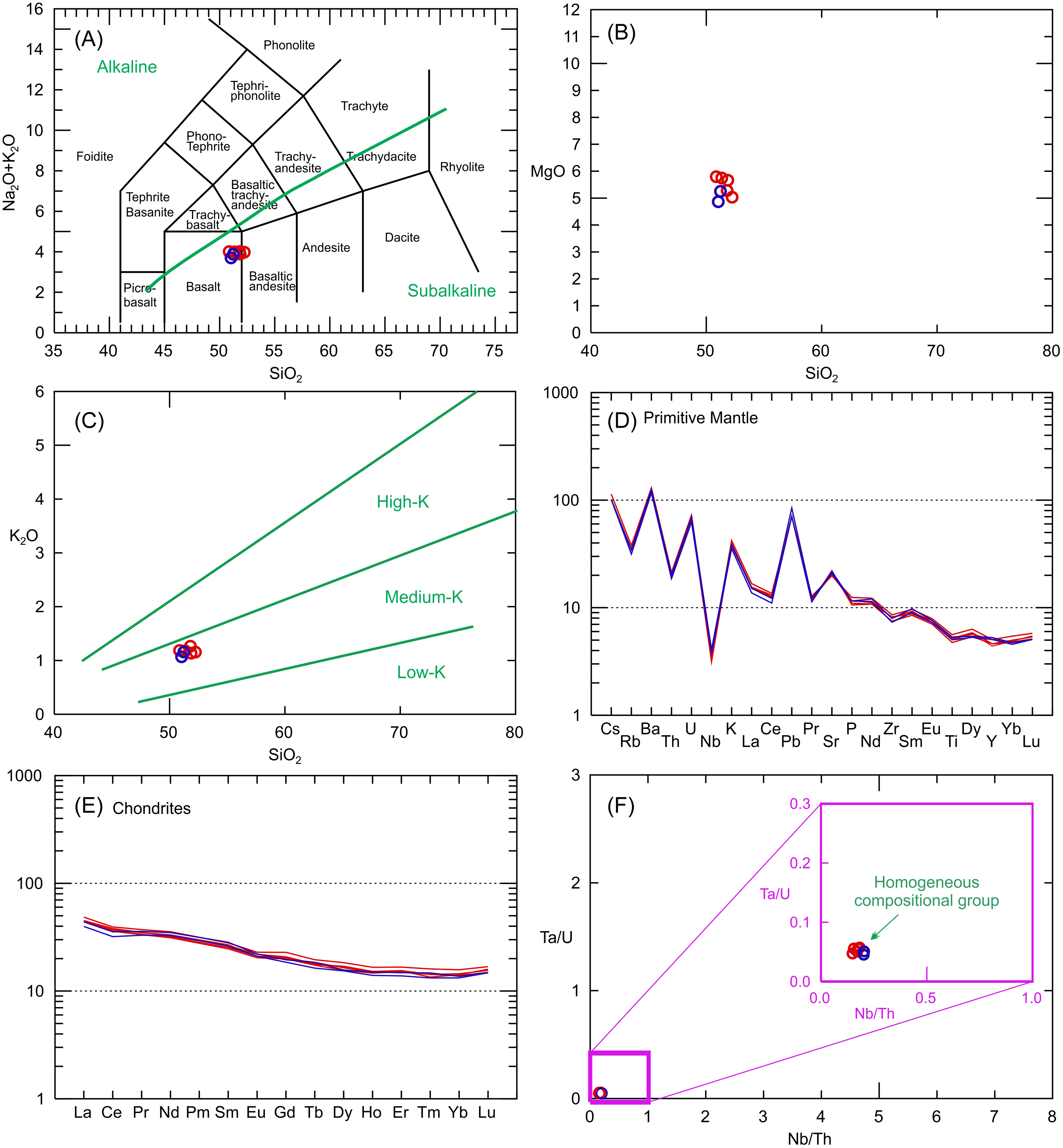
Almost all the lava flow rocks are of basaltic composition, except for the Go Unit, which is between the border of basaltic and basaltic andesite rocks (SiO2 50.14–52 wt%) with MgO contents between 4.83 and 5.75 wt% (Table 3; Figures 4A and 4B). All the samples have sub-alkaline affinities and medium-K contents (Figure 4C).
Geochemical analyses results for major and trace elements of the studied lava flow units

Geochemical results for the studied lava flows. A, Total alkalis vs. silica diagram after Le Maitre et al. (1989). After Irvine and Baragar (Reference Irvine and Baragar1971), the green line divides alkaline and sub-alkaline rocks. B, MgO vs. SiO 2 Harker diagram. C, K2O vs. SiO2 Harker diagram after Gill (Reference Gill1981) showing that all the samples have medium-K content. D, Trace element plot normalized to primitive mantle from Sun and McDonough (Reference Sun and McDonough1989). E, Multi-element plot comparing normalized rare earth elements to chondrite values in ppm from Sun and McDonough (Reference Sun and McDonough1989). F, Ta/U vs. Nb/Th Harker diagram revealing a homogeneous compositional group. The red symbols represent the five studied lava flows in Masaya’s northern rift zone (Mosintepe, Portillo, Gorgonia, Campuzano, and Martha), and the blue symbols represent the historical eruptions of 1670 (Upper Nindirí) and 1772 (Upper Masaya) CE within the Masaya caldera for comparison.

Incompatible trace elements, graphed in a primitive mantle-normalized diagram, exhibit an identical pattern, revealing a relative enrichment in most incompatible elements (Cs, Rb, Ba, K, Pb, and Sr) in comparison with high field strength elements (Th, Nb, Zr, Ti, and Y) (Figure 4D). A multi-element rare earth graphic (Sun and McDonough Reference Sun and McDonough1989) points out that the rocks are slightly enriched in light rare earth elements in contrast to heavy rare earth elements (Figure 4E). All rocks display identical rare earth element concentrations without significant Eu anomalies (Figure 4D). Selected high-field strength trace elements reveal a homogeneous compositional group (Nb/Th-Ta/U) (Figure 4F).
Discussion
Radiocarbon geochronology
During an effusive eruption, the lava flows rapidly cover the soil. The thick lava flows aid in preserving the vertical paleosol profile, avoiding the migration of organic matter to lower horizons (Xu et al. Reference Xu, Hoshizumi, Uto and Freeman2013). Thus, radiometric AMS 14C ages obtained from the disseminated charcoal within the paleosol’s top portion covered by a lava flow represent the closest eruption age. This has been performed in several Holocene lava flows, which have been successfully dated with radiocarbon from dispersed charcoal in the paleosol beneath it (e.g., Big Island in Hawaii, Rubin et al. Reference Rubin, Gargulinski and McGeehin1987; Iceland, Hauptfleisch and Einarsson Reference Hauptfleisch and Einarsson2012; and Nicaragua, Avellán et al. Reference Avellán, Gómez-Vasconcelos, Macías and Velásquez2023).
The resultant AMS 14C ages from scattered charcoal within the paleosol’s top portion covered by the studied lava flows help obtain the Masaya flank eruption’s geochronological record. Δ14C shows negative values that increase with 14C ages (Table 2), which indicates that the dated paleosols have remained in a closed system isolated from the atmosphere, allowing radioactive decay (e.g., Trumbore et al. Reference Trumbore, Sierra, Hicks-Pries, Schuur, Druffel and Trumbore2016), and thus providing reliable ages.
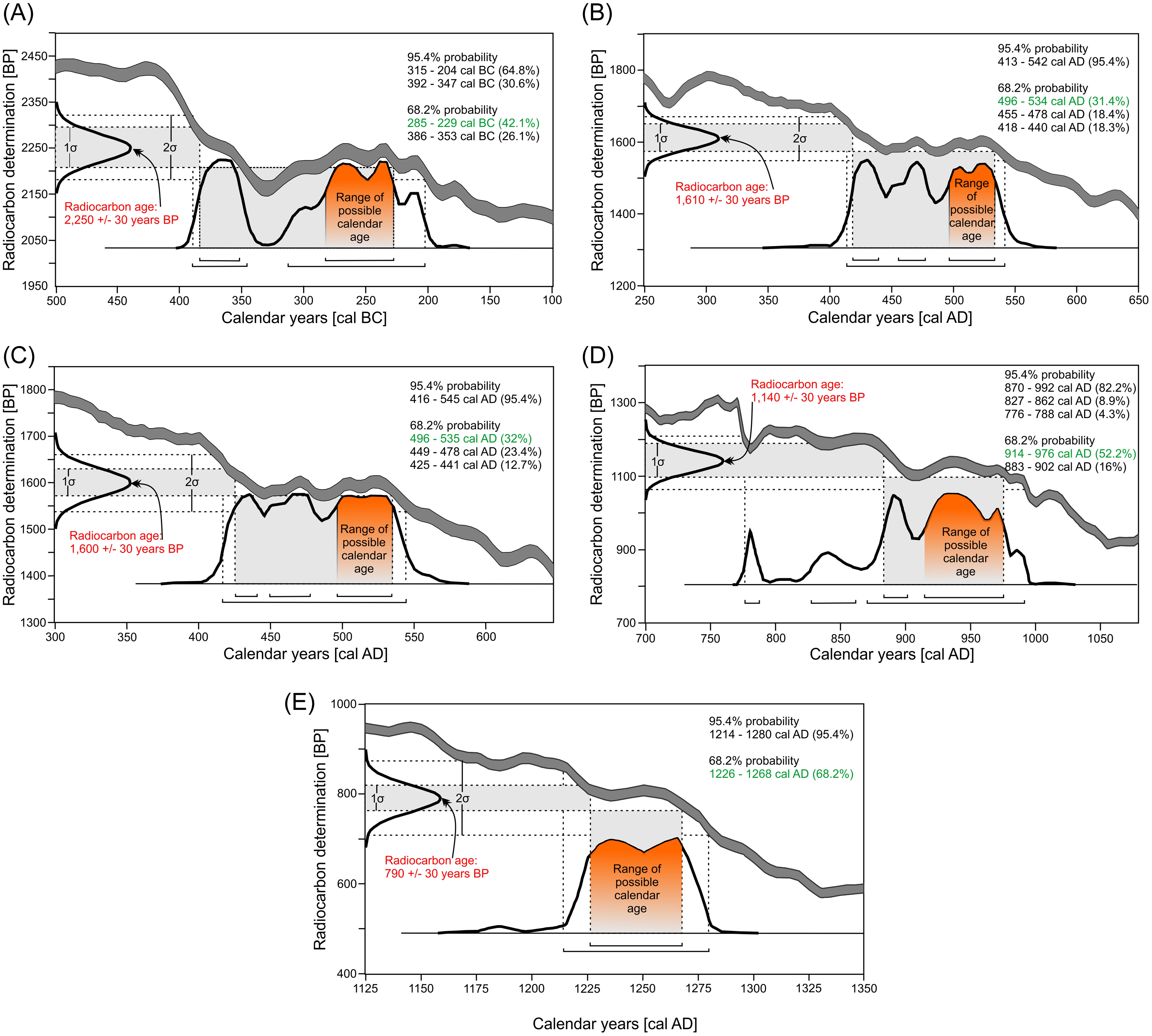
AMS 14C dating of the paleosol sample beneath the Mosintepe lava flow provided an age of 2250 ± 30 years BP, corresponding to calendar age intervals on the calibration curve between 285–229 and 386-353 cal BC at 1σ (68.2% probability) (Table 2; Figure 5A). The highest probability range with confidence of up to 42.1% within 1σ of the Mo Unit overlaps the highest probability interval within 2σ (Figure 5A). The most likely calendar age of this eruption falls in the range of 285–229 cal BC. The Mo Unit is isolated from the other lava flows, without a direct stratigraphic relationship. However, we consider that the age for this eruption is consistent with its stratigraphic position because the underlying paleosol was developed from the Masaya Tuff, which was reported with an age of 3485 ± 90 years BP (Avellán et al. Reference Avellán, Macías and Pardo2012).
Conventional and calibrated AMS 14C dating results for the five studied lava flows. A, Age of the sample taken from the paleosol underlying the Mosintepe lava flow. B, Age from the paleosol underlying the Portillo lava flow; C, Age from the paleosol underlying the Gorgonia lava flow. D, Age from the paleosol underlying the Campuzano lava flow. E, Age from the paleosol underlying the Martha lava flow. The radiocarbon ages were calibrated to calendar years using IntCal20 (e.g., Ramsey Reference Ramsey2009; Reimer et al. Reference Reimer2020).

The age of the paleosol beneath the Portillo lava flow of 1610 ± 30 years BP provided calibrated age intervals of 496–534, 455–478, and 418–440 cal AD at 1σ (Table 2; Figure 5B); the first mentioned interval presents the highest reliability value with 31.4%, so we propose it as the calibrated age of this eruption (Table 2; Figure 5B). The age obtained for the Po Unit is consistent with its stratigraphic position since it also overlies the Masaya Tuff eruption of 3.5 ka and is partially overlain by the younger Campuzano lava flow.
By examining the age of the paleosol beneath the Gorgonia lava flow of 1600 ± 30 years BP, it corresponds to calendar age intervals of 496–535, 449–478, and 425–441 cal AD in 1σ (Table 2; Figure 5C). Considering the highest reliability with 32%, we propose the 496–535 cal AD interval as the age of the Go eruption. This unit is also isolated from the other units. However, the age is consistent with its stratigraphic position because it overlies the 3.5 ka Masaya Tuff. The Go eruption interval is equivalent to 496–535 cal AD, coinciding with the age range of the Po Unit, suggesting that these two lava flows could result from simultaneous eruptions, although not necessarily from the same eruption because the mapping reveals that they are spatially distinct fissural events.
The age of the paleosol beneath the Campuzano lava flow of 1140 ± 30 years BP produced calendar age intervals of 914–976 and 883–902 cal AD in 1σ (Table 2; Figure 5D). We propose that the youngest age interval of 914–976 cal AD is the calibrated age of the Ca Unit eruption, considering a 52.2% reliability. The radiometric age of this eruption is consistent with its stratigraphic position. In addition, this lava flow was located on the paleosol formed on the 3.5 ka Masaya Tuff deposit. The Ca Unit partially covers the 1.6 ka Portillo lava flow and is overlain by the younger Martha lava flow.
The age of the paleosol underlying the Martha lava flow of 790 ± 30 years BP resulted in a calendar age interval of 1226–1268 cal AD in 1σ, presenting a simple distribution curve with a confidence value of up to 68.2% (Table 2; Figure 5E). Thus, we consider that this age range corresponds to the calibrated age of the eruption. The radiometric age obtained for this eruption is consistent with its stratigraphic position because the Ma lava flow is overlying the Ca Unit and is partially covered by the 1772 lava flow that occurred on the flank of the post-caldera Masaya volcano.
Volcanic provenance
It was determined that at least five lava flows occurred on the northern flank of the Masaya caldera parallel to the Cofradía fault zone (Figure 2), with eruptive centers located 0.7 to 8.2 km from the caldera’s fault rim. The eruptive vents built small spatter cones linked to different lava flow units, each recognized as an independent eruption. Surface geological mapping suggests that these lava flows may correspond to monogenetic volcanoes sourced by independent magma feeder dikes (e.g., Gómez-Vasconcelos et al. Reference Gómez-Vasconcelos, Avellán, Macías, Cisneros-Máximo, Sánchez-Núñez and Miggins2023). However, after chemical examination of major and trace elements, it is suggested that magmas share a common provenance.
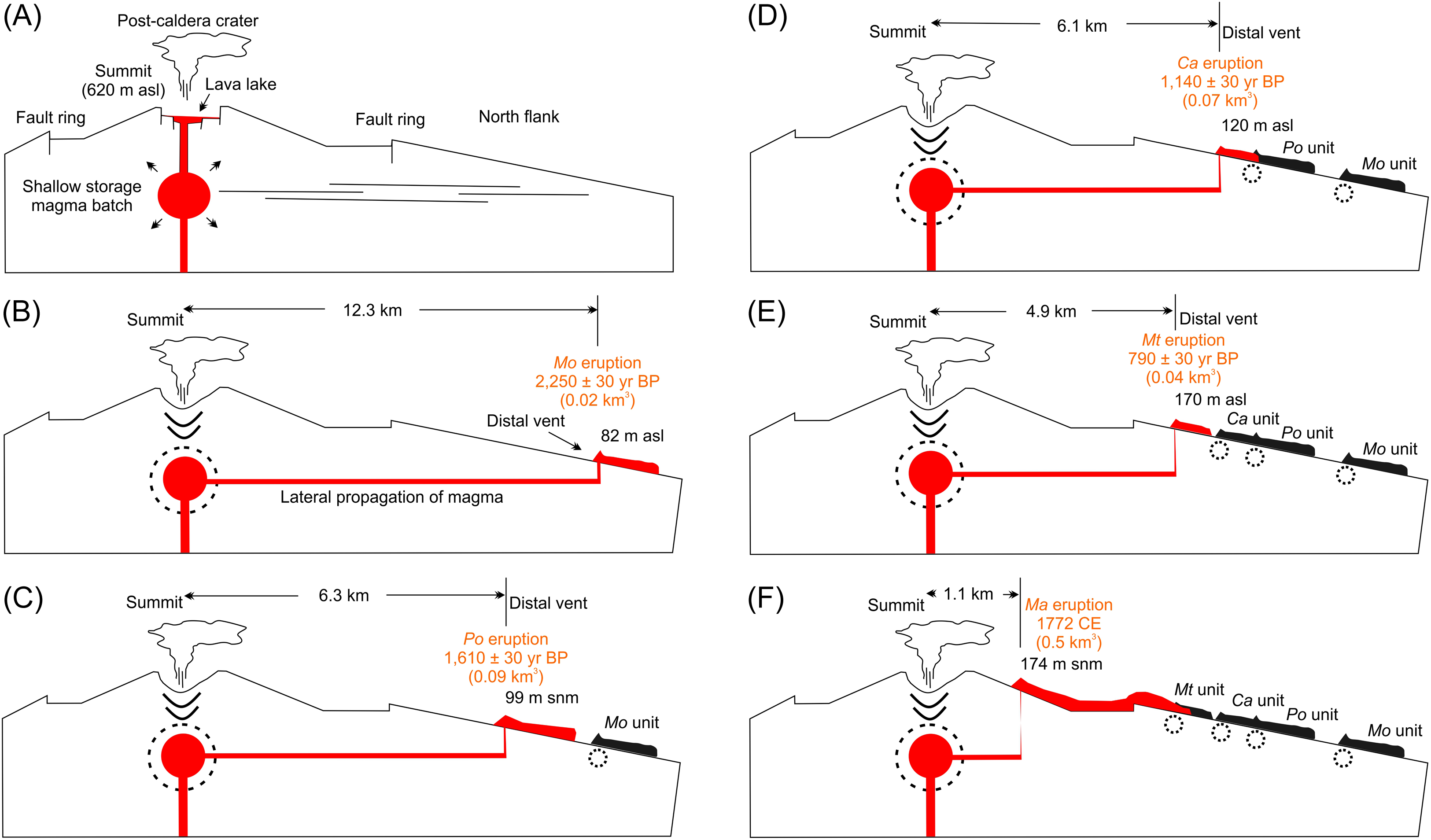
Rocks collected from Masaya’s northern flank and the 1670 and 1772 historical eruptions within the caldera show almost identical lithological and petrographical characteristics (Figure 4). All rocks are gray, fine-grained, and porphyritic with plagioclase (55–47 vol%), pyroxene (45–29 vol%), olivine (11–5 vol%), and Fe-Ti oxides (5–1.7 vol%). All lava flow units have a very narrow range in composition, from dominantly silica-rich basalt to basaltic andesite (50.14–52.00 wt% SiO2) (Figure 4A). They also present similar MgO content with values between 4.83 and 5.75 wt% (Figure 4B; Table 3), and medium-K2O content between 1.07 and 1.27 wt% (Figure 4C; Table 3). On the other hand, selected high-field strength trace elements also reveal a homogeneous compositional group (Nb/Th-Ta/U) (e.g., Avellán et al. Reference Avellán, Cardona-Melchor, Gómez-Vasconcelos, Macías, Layer, Sosa-Ceballos, Ruíz, Benowitz, Cisneros-Máximo, Murcia, Perthon, Reyes-Agustín and García-Tenorio2024; Gómez-Vasconcelos et al. Reference Gómez-Vasconcelos, Macías, Avellán, Sosa-Ceballos, Garduño-Monroy, Cisneros-Máximo, Layer, Benowitz, López-Loera, Mendiola-López and Perton2020) (Figure 4F). This suggests that the post-caldera basaltic effusive eruptions that occurred on the northern flank of the Masaya caldera are comagmatic with the historical eruptions that occurred in 1670 and 1772 CE within the caldera (Figure 2). In addition, the concentrations of trace elements reveal that all lava flows show identical behavior to the historical eruptions within the caldera (Figures 4D and 4E). This indicates that all these flank eruptions were affected by similar magmatic processes before reaching the surface and evidences a common geochemical fingerprint (e.g., Casadevall and Dzurisin Reference Casadeval and Dzurisin1987). Therefore, these similar characteristics suggest that Masaya’s northern flank eruptions are independent structures that originated from the same magma chamber that feeds Masaya caldera (Figure 6).
Sketch model for Masaya’s lateral magma propagation from the central magma batch to the northern flank to feed Mosintepe, Portillo, Gogonia, Campuzano, and Martha lava flows.

This suggests that magma propagated laterally from Masaya’s central magma system (Figure 6) controlled by a local compressional stress field due to the surface load of the large caldera. It is believed that this compressional stress impedes effusive, volatile-poor, dense magmas from reaching the surface; thus, they can only propagate laterally on the volcano’s slopes (e.g., Gudmundsson Reference Gudmundsson2020; Pinel and Jaupart Reference Pinel and Jaupart2004). Therefore, post-caldera volatile-poor magmas in Masaya will likely propagate horizontally to feed a distal flank vent (up to 13 km from the summit crater). Flank eruptions here migrate north because the N–S Aeropuerto graben and associated bounding faults (i.e., Cofradía fault; Figure 2) represent Masaya’s local volcanic rift zone, and this crustal transtensional weakness assists magma emplacement (Girard and de Vries Reference Girard and de Vries2005). Furthermore, this study reveals that flank eruptions are recurrent in the Masaya caldera along the northern volcanic rift zone.
Kilauea and Mauna Loa volcanoes present well-documented examples of flank eruptions in their geological record (Holcomb Reference Holcomb1987; Lockwood and Lipman Reference Lockwood and Lipman1987; Lockwood et al. Reference Lockwood, Dvorak, English, Koyanagi, Okamura, Summers and Tanigawa1987; Tilling et al. Reference Tilling, Christiansen, Duffield, Endo, Holcomb, Koyanagi, Peterson and Unger1987; Wolfe et al. Reference Wolfe, Garcia, Jackson, Koyanagi, Neal and Okamura1987). Flank eruptions linked to local rift zones are also common in Piton de la Fournaise (Peltier et al. Reference Peltier, Ferrazzini, Staudacher and Bachèlery2005), Ambryn (Németh and Cronin Reference Németh and Cronin2008), Nyiragongo (Komorowski Reference Komorowski2002), Fjallgardar in Iceland (Löw et al. Reference Löw, Halldórsson, Beier, Bali, Matthews, Guðfinnsson, Marshall, Helgason, Ranta, Abersteiner, Barnes and Caracciolo2025) and Etna volcanoes (Acocella and Neri Reference Acocella and Neri2003). Flank eruptions from these volcanoes report lateral dike propagation from the volcano summit over great distances, up to 100 km, although mean flank eruptions are found within the first 20 km from the summit crater (Löw et al. Reference Löw, Halldórsson, Beier, Bali, Matthews, Guðfinnsson, Marshall, Helgason, Ranta, Abersteiner, Barnes and Caracciolo2025; Patrick et al. Reference Patrick, Houghton, Anderson, Poland, Montgomery-Brown, Johanson, Thelen and Elias2020).
As these studied eruptions show a similarity in mineral paragenesis, behavior of trace element concentrations, and K content, it reveals that the magmas were stored in the same shallow magma chamber and cannot be considered as monogenetic volcanoes. A monogenetic volcano would show a rapid ascent from the deep crust, thus a less differentiated magma with depletion in K content (e.g., primitive or tholeiitic magma; Avellán et al. Reference Avellán, Macías and Pardo2012) and less fractionated rare earth elements.
Regional geochronological context
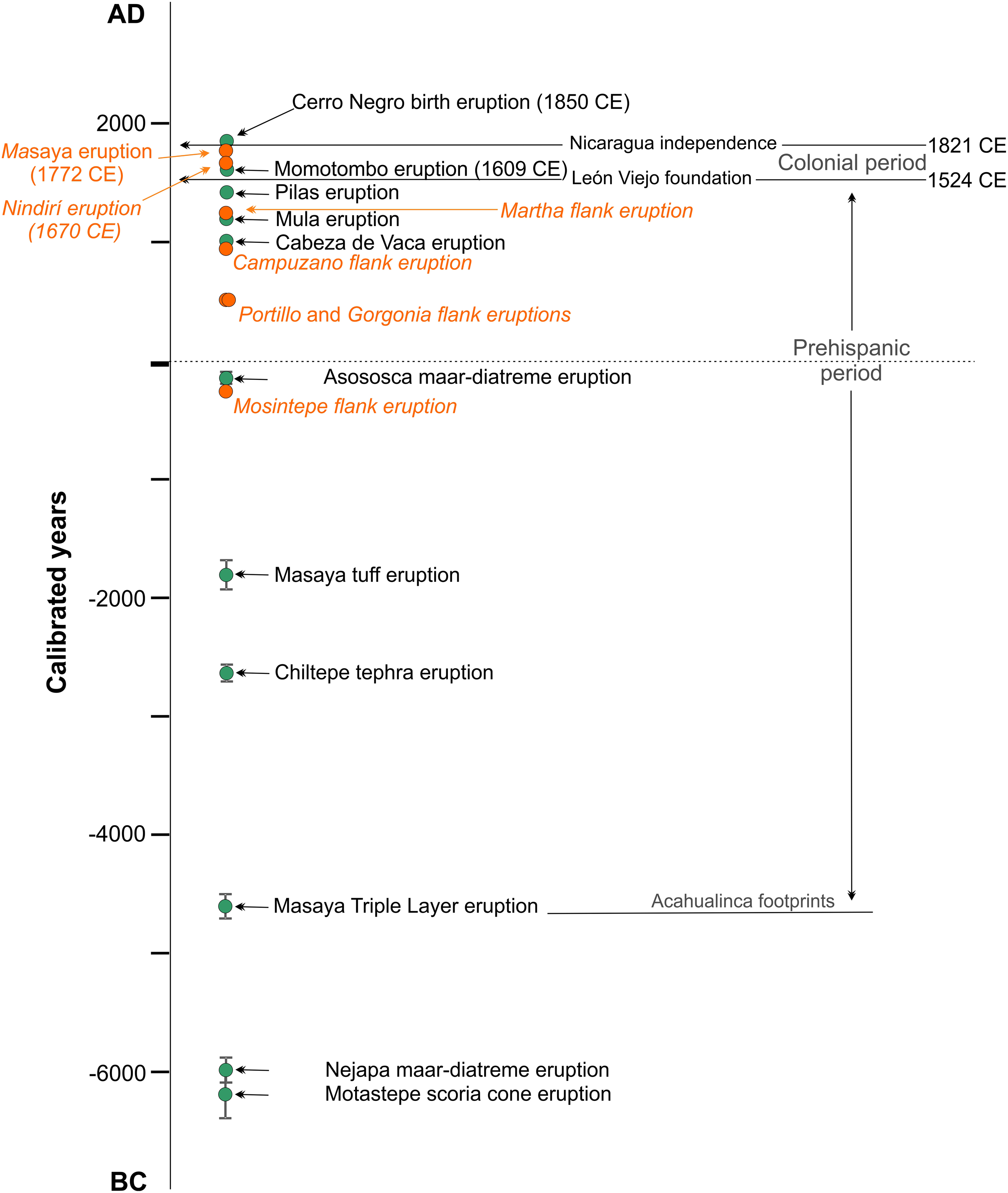
The new AMS 14C ages reveal Masaya’s frequent effusive activity during the Holocene. The Mo eruption happened on the northern flank of the Masaya caldera in the mid-3rd century BC, emitting a bulk volume of 0.02 km3 (Figures 2 and 6B). Later, two other eruptions (Po and Go Units) took place in the late 5th and early 6th century AD, emitting a bulk volume of 0.09 and 0.04 km3, respectively (Figures 2 and 6C). Afterward, another eruption occurred in the mid-10th century AD (Ca Unit), emitting a bulk volume of 0.07 km3 (Figures 2 and 6D). Then, the Ma Unit occurred in the mid-13th century AD and emitted a bulk volume of 0.04 km3 (Figures 2 and 6E). All these eruptions happened during the pre-Hispanic period (Figure 7).
Graphical representation showing Masaya’s eruptions and the stratigraphic relationship with other documented Holocene eruptions in the Nicaraguan Volcanic Arc.

At the beginning of the colonial period, the Masaya caldera developed a shallow lava lake in the Nindirí post-caldera crater (Fernández de Oviedo Reference Fernández de Oviedo1851) (Figure 2). The Santiago and San Pedro post-caldera pit craters formed at the caldera’s summit, sourcing lava lakes (Harris Reference Harris2009; Rymer et al. Reference Rymer, van Wyk de Vries, Stix and Williams-Jones1998). Historic effusive eruptions include the one from the Nindirí crater in 1670 CE (Figure 7) that emplaced a 2.4 km-long lava flow with 0.1 km3 of emitted bulk volume. The last recorded eruption was the one from the Masaya post-caldera crater in 1772 CE. This lava flow emitted a minimum bulk volume of 0.51 km3 and reached 7.9 km to the north, surpassing the caldera’s ring fault border and partially covering Mt Unit (Table 1; Figures 2 and 6F).
Although the geological record is still poorly established, this work reveals that the Masaya caldera is an active volcanic system and is currently dominantly effusive. Up to nine eruptions have been recorded during the Holocene. Two explosive eruptions, the Masaya Tuff and the Masaya Triple Layer, occurred at 3.485 ± 90 and 5755 ± 90 years BP, respectively (Avellán et al. Reference Avellán, Macías and Pardo2012) (Figures 3 and 7), and seven effusive eruptions, including five flank eruptions (studied here) and the historical 1670 and 1772 CE eruptions. This results in an average recurrence rate of 1.45 × 10⁻³ eruptions/year for the last 5.7 ka, equivalent to a return period of 633 years. For effusive flank eruptions, the average recurrence rate is 2.5 × 10⁻³ eruptions/year for the last 2.25 ka, equivalent to a return period of 375 years, which is twice as often. However, these values should be handled carefully because the Masaya caldera geological record of effusive eruptions remains incomplete.
Flank eruptions are also geochronologically interspersed with other regional eruptions. Like the one that occurred in the Nejapa volcanic field with a radiometric age of 2130 ± 40 years BP (Avellán et al. Reference Avellán, Macías and Pardo2012), which is younger than the Mosintepe eruption and older than the Portillo, Gorgonia, and Campuzano eruptions (Figure 7). While the Martha eruption is interspersed with monogenetic Mula and Pilas eruptions that occurred north of the Cerro Negro volcano (Figure 7).
Conclusions
This study reports five new flank eruptions in the northern rift zone of the Masaya caldera within the N–S Aeropuerto graben and parallel to the Cofradía fault zone. These eruptions comprise effusive and basaltic lava flows up to 8 km long from their vent, releasing a total bulk volume of 0.26 km3. Radiocarbon AMS dates are 285–229 cal BC for Mosintepe, 496–534 cal AD for Portillo, 496–535 cal AD for Gorgonia, 914–976 cal AD for Campuzano, and 1226–1268 cal AD for Martha. Geochemistry reveals that these magmas have a common origin with the Masaya caldera, suggesting that lateral magma draining happens frequently from a shallow magma batch.
The active Masaya caldera is primarily effusive, where flank eruptions happen every ca. 375 years. Therefore, future effusive flank eruptions will likely develop in its northern rift zone, putting downward-sloping localities like Veracruz, Cofradía, Sabana Grande, eastern Managua, and new settlements at risk. Urban growth should be regulated to avoid future impacts in this area, and these eruptions should be considered to complete the caldera’s geological record for a better hazard and risk assessment.
Acknowledgments
This work is dedicated to the memory of geologists Glen Hodgson, Alberto Pilato, Antonio Alvarez, Mario Chavez, Mayra Guerrero, and Ricardo López. Special thanks to N. Castillo for his valuable support during fieldwork. We also thank N. Fitz for his help in data processing, and thanks to J.A. Gómez for her support in the preparation of the thin sections. We thank A.J.T. Jull, K. Németh, and H. Murcia for their valuable reviews that helped improve the manuscript.
Declaration of competing interests
The authors declare no conflicts or competing interests.


 Open access

