


There are many Chinese men who just need one thing – to take a picture with a European woman. That is it. It is over after then. This raises their social status. If you have connections with foreigners, beautiful foreigners, then you are special somehow. They are promoting themselves at the expense of foreigners.Footnote 1
In earlier parts of the book, I discussed how, in an effort to project China’s growing global power and influence with its neighbours, the Chinese authorities and the public actively shape popular perceptions, fostering the belief that Chinese–Slavic marriages have become a significant social phenomenon. In this context, the hyperreal refers to the constructed, exaggerated portrayals of these unions, which blur the line between reality and fiction through media and popular culture. In this chapter, I turn to a manifestation of the hyperreality of Chinese–foreign marriages through the analysis of an example of the state-sponsored people-to-people exchanges – a group wedding festival that brings together Russian and Chinese brides and grooms on the Chinese–Russian border. Until the Covid pandemic interrupted this event in 2020, ever since 2012 an international group wedding ceremony (国际集体婚礼 guoji jiti hunli) had been held annually in Jiayin on the Chinese side of the Heilongjiang River that marks the border between China and Russia. Held on the late summer Chinese lunar day qixi jie [七夕节] (known as Chinese ‘St Valentine’s Day’), the official goal of this event was to promote closer relations between Chinese and Russians. In this way, a popular traditional festival has become an occasion for new articulations and celebrations of international love and desire. Several factors, such as the symbolic meaning of the location, timing and aesthetics of the event as well as the national, racial and gender identity of participants, reflect China’s national aspirations. This local, state-promoted group wedding is not incidental to China’s foreign relations, nor does it merely reflect them. This event provides an important setting for observing China’s geopolitical imaginaries and national desires but also for testing and contesting them.Footnote 2 It encapsulates the hyperreality of the Chinese–Russian romance and serves as fitting material to draw out how national dreams play out at the micro level. In order to understand what motivates this curious and lavish event, and to get a close understanding of how marriage, cross-border romance and border governance intersect, reflecting the desires of the Chinese nation, I embarked in 2018 on a visual ethnographic journey to observe this occasion.
7.1 Nation, Marriage and White Female Bodies
I arrived at Jiayin on 16 August 2018 as the sun was setting, leaving its glorious reflection in the Heilongjiang river border that flows through China and Russia. The opposite bank seemed very close – the contours of the trees and houses on the Russian side of the river could be clearly made out. The main town square was bustling with preparations for the event the following day. The stage extending into the amphitheatre was already in place. Children and young models were practising on a catwalk, wearing wedding and evening dresses.
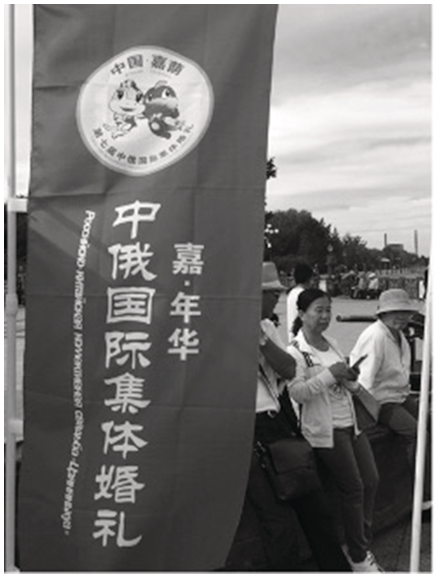
The mascots for the event – two cartoon dinosaurs, decorated with the symbols of Russia and China – and a Russian doll and a Chinese ‘double happiness’ knot adorned the posters and flags (Fig. 7.1). These mascots paid homage to the archaeological site that has made Jiayin famous in China as the birthplace of dinosaurs. The promotional materials for the group wedding played with the symbols of Jiayin’s ancient past. This was the site of the earliest life found on earth and it was promoted as a meeting point of people from neighbouring cultures and traditions that had rarely mingled in the past. Residents performed a traditional Chinese fan dance. For a town with 20,000 inhabitants, the show must have felt special and important. The preparations highlighted the aesthetic expression of the party-state’s governing technologies of love, family and national borders.Footnote 3 Combined with the symbols of prehistoric life, including the statue of a dinosaur adorning the town square, the references to evolution, history and biology were hard to miss.
Chinese–Russian group wedding banner, featuring two dinosaur mascots.

The space and timing of the event were also instructive. In terms of place, the location of the annual wedding event on the China–Russia border was clearly ideal for celebrating international love and romance. It was set in Manchuria, which is celebrated in China as a cultural, religious and geopolitical crossroads where Asian, Central Asian, European and indigenous systems meet. This ascribed character has long contributed to sexualised and romanticised symbolic constructions of Manchuria as a place of mystery, wilderness and exile. My departing point for this research journey began with the struggle to find evidence of a growing trend of Chinese–Russian marriages, despite abundant media reports dedicated to this topic. Returning to the Chinese–Russian border in Manchuria for a group wedding event was symbolic of the hyperreal condition that I described in the Introduction. The micro celebration of the Chinese–Russian romance speaks to the questions of geopolitics, national desire, marriage, gender and race and conveys how China’s dream of global power relates to the sphere of family relations with foreigners and is projected onto and plays out on the bodies of people.
Temporally, the choice of the Qixi festival as a suitable occasion to host an international group wedding was no accident. The Chinese Qixi Jie falls on the seventh day of the seventh month and has been celebrated since the Han dynasty (202 BCE – 220 CE). In recent years, the festival has gained in popularity among Chinese retailers, consumers and propagandists alike. It originates in the mythical story of the human cowherd Niulan and his beloved Zhinü, the goddess of weaving, whose mother forbade the couple to meet, either on earth or in heaven, and built a river of stars to keep them apart. Once a year, magpies build a bridge across the river for the lovers to meet. The symbolism of the Qixi festival is that it is an annual occasion to bring together people separated by the river border in celebration of love, loyalty, dedication and a sense of togetherness. Not only can we draw direct parallels between the story of Niulan and Zhinü and the Russian and Chinese people who are separated by a river border, we can also see how a group wedding on the occasion of this traditional festival can revive Chinese folk traditions and transform them into an instrument of cultural governance and public diplomacy around the China–Russia border.
A longing to be recognised by the world as an important economic and political power is one of the driving forces of China’s development and infrastructural projects. It is manifested in Xi Jinping’s signature project, the Belt and Road Initiative – to win the ‘hearts and minds’ of people around the world through ‘people-to-people’ exchanges. This mix of biopolitical and geopolitical objectives is made manifest in the seemingly light-hearted celebration of cross-border weddings. But state entertainment is not innocent of state propaganda and ideology. Mass entertainment has been an important tool of the Chinese party-state’s propaganda work, and in the reform era, ‘politics-lite’ events became an increasingly popular channel for propaganda and thought work.Footnote 4 Similarly, Vivienne Shue has observed that, since Xi’s ascent to power, the Party’s performance and legitimation techniques have taken on novel forms of ‘propaganda diffusion’ aimed at radiating its ‘positive spirit, outward’ (emphasis in the original) to charm the world into admiring China.Footnote 5
National holidays, folk festivals and celebrations all present an opportunity to publicise the Party’s political messages. The popular traditional festival of love is a fitting occasion to project a model of a desirable marriage and family to serve the purposes of a China on the ascendant. Marriage and family have historically been the cornerstone of the Confucian political order and played a key role in Mao’s model of a socialist society. The reform era reiterates the unchanged normative treatment by the state of the heterosexual family structure, which is fundamental to the current national project. The concept of romantic love entered Chinese society at the beginning of the twentieth century along with the other ideas of modernity that Chinese intellectuals imported from the West.Footnote 6 Ever since the 1980s, alongside the proliferation of marketisation and consumerism, romantic love has become a site for marketing extravagant wedding services and goods. Like in the West where the idea of St Valentine’s Day was popularised by commercial interests and the drive for consumption, Qixi Jie primarily fulfils the state’s market agenda. However, it also reflects ideological aspects of the state which is closely involved in the private lives of Chinese citizens by regulating their marriage, childbearing and reproductive lives. By reflecting in this chapter on my audiovisual engagement with the festival’s celebration, I seek to show what this group wedding celebration symbolises and the expression that it takes in relation to the changing dimensions of China’s national desire for global power and the role of white female bodies in it.Footnote 7 This state-sponsored celebration of Chinese–foreign marriages demonstrates the complex entanglement of intimate geopolitics at the global, national and local levels and reflects micro-level changes that are central to the way China sees its changing role in the world and its own core values and norms. The group wedding event presents itself as a curious example of Chinese dreaming that reflects a national desire to possess female whiteness as a marker of growing global (masculine) power.
Even though on the day of the event there was little contact between the Chinese and Russian groups of participants, the ideal form of family being promoted was the Chinese man/Russian woman couple that was presented as a special feature of the event.
The links between the practice of marriage and the nation are brought together in this event. Critical feminist and queer scholars have long argued that, historically, marriage has been constructed and maintained by the state to create a dominant normative social order and to police difference.Footnote 8 The state’s involvement in sexuality, marriage, intimacy and family life has been central to its control of the people and cannot be separated from ideas of race, nationhood and belonging.Footnote 9 From 1978 to 2016 these concepts informed family planning and the one-child policies concerned with increasing the quality of the Chinese population.Footnote 10 Subsequently, ever since central government has recognised China’s demographic crisis, the tone and priorities of population policies have changed to encourage families to have three children. Alongside these transformations, the wider meanings of these policies, including their racialised and gendered undertones, need renewed interpretations. Having undertaken text-based research on the politics of marriage and migration and having spoken to Russian-speaking women about their experiences, I knew that many women who had married Chinese men and lived in China encountered cultural, familial and legal struggles. What does the focus on the fleeting moment of happy wedding celebrations convey? I wanted to capture this on camera by filming the professional and amateur reporters, the drones and the attention that they focused on the foreign participants.
Using an audiovisual medium to observe the processes involved in making the event allowed me to document the embodiment of national desires and connect the ethnographic realities of the Chinese dream of international marriages with political strategies on the level of state policy.Footnote 11 The group wedding emerged as a microcosm of the broad norms and values that inform and structure China’s dream of global power and national rejuvenation. My audiovisual exploration of the group wedding drew my attention to the role of the ‘male gaze’ that bridges individual and national desire and the potential of the camera lens to divert the gaze to the observing subject. Whereas the main chapters have approached the topic of Chinese–post-Soviet marriages from the perspective of sovereign concerns on national security and population management through the lens of hyperreal constructions and women’s experiences of navigating Chinese patriarchal borders, this chapter reflects on the embodied processes taking place on the border, the role of the male gaze and possible ways of interrupting it. Employing film-making as a research method allowed me to show from a different angle what my analysis of the visual representations, state regulations and women’s experiences in Chinese–Russian marriages in China has revealed: a full-bodied interplay of gendered and racialised power dynamics and gazing.
In what follows I describe my experience of entering the space and time of the group wedding in the framework of one day. As I was perceived as a ‘Russian woman’ with a camera, I not only observed the dynamics of gazing between Chinese visitors, state representatives and the newly wed couples, I also became involved in it. During the documentation of my encounters and observations I drew attention to the role of bodies, performance and gazing that characterised the event. The particulars of gazing became apparent to me only during my subsequent review and analysis of the footage. This has allowed me to draw attention to and critique the underlying, unseen and unspoken forces shaping China’s ambitions for global power. The camera catalysed ideas about China’s longing for a particular kind of international marriage. My filmic ethnography reveals what Ann Stoler calls the societal marrow, the invisible yet strongly felt system of norms and convictions that organise a society from within.Footnote 12 Here, I explore the disruptive potential of reversing the gaze to the looking subject of the state. I reflect on how observing the group wedding with the camera created moments where the culture and structure of racism, sexism and patriarchy, which are tacitly inscribed in and explicitly expressed in state representational practices, became open to critique.
China’s international mega-events, including the Beijing Olympics, the Shanghai World Expo, the Guangzhou Asian Games and, more recently, the Beijing Winter Olympics, have attracted academic and popular attention worldwide.Footnote 13 Yet the significance of a state-sponsored event along China’s periphery on the occasion of a local festival celebrating love and romance must not be underestimated. Like Sihecun, the fictitious Russian brides village, which originally triggered my interest in exploring Chinese–Russian marriages, the group wedding could be seen as a micro event, or what Veena Das has called a non-critical event. Nevertheless it is worth research scrutiny because it shows how the regimes of power and knowledge are sustained and reproduced.Footnote 14 In his research in Xinjiang, Tobin shows that minor events are not really minor, even if they are remote and apparently insignificant, because they may underscore the centrality of the periphery to China’s centre.Footnote 15 Tobin’s research shows how undesirable groups of Uighurs and other Muslim groups in the western part of China are denied a place in the Chinese national narratives of its past, present and future. My engagement with the Chinese–Russian group wedding ceremony shows the national desire to welcome particular kinds of bodies and include them into the Chinese nation through certain articulations of the ideal family form.
7.2 Under the Male Gaze
In the morning of the group wedding the town square was empty. I could not find any information about the wedding programme and decided to ask someone. My affiliation to Jilin University helped and one of the local organisers agreed to talk to me on camera. The main purpose of the event, the official explained, was to create ‘a beautiful occasion to celebrate Qixi’. Twenty-two couples were taking part in the ceremony, ten from Russia and twelve from China, but none of them seemed to be Chinese–Russian. I asked if the organisers had also invited Russian–Chinese couples to participate in the event. As if anticipating my question, the organiser said that a Russian–Chinese couple with a pair of ‘beautiful sons’ were taking part in the show. She said, ‘we all envy (羡慕 xianmu) them for having such beautiful children’. Her open admiration of the beauty of mixed Eurasian children made me uncomfortable. ‘Clever and beautiful’ (聪明 congmin and 漂亮 piaoliang), as I learnt throughout my study, was a code for high quality (suzhi) people in China. The pervasiveness of suzhi discourses indicated to me the extent of the influence of eugenics. The official added that all the participating couples were staying in the town’s best hotel nearby and that, if I wanted to talk to them, I should go there.
On my approach to the hotel, I noticed a group of young Russian-looking women leaving a coach. I started talking to them in Russian with my camera ready to roll. ‘Are you brides?’ I asked. ‘No, models. There will be a fashion show during the event,’ one of them replied. As I felt that the women were happy to continue interacting with me through the camera, I continued asking them questions. They were eager to talk about their lives in China. They explained that they had come to Jiayin by coach from Harbin the night before. They had lived and worked as models in China for the past three to four years. They explained that, at first, they had found being the centre of public attention in China new, unusual and interesting, but soon it started to irritate and bother them. One of them even said that she became paranoid when she saw people pointing mobile phones at her. ‘Well, you can get a sense of what we are talking about if you look behind you,’ one woman noted.
I turned around with my camera and saw a group of photojournalists all aiming their cameras at us and smiling. I caught their look on my camera and turned back to the women I was talking to. It was apparent from the expressions on the models’ faces that they were annoyed by the photojournalists’ uninvited intrusion into our conversation but also that they seemed very accustomed to it. I had just experienced the objectification that my research participants were discussing in our conversations about their experiences in China. Returning the gaze of my camera to subjects looking at me, while capturing the reaction of the objects of the gaze, became my strategy to explore and film this event.
While I was waiting at the entrance to the hotel with my camera on display and ready to film, a Chinese woman approached me. She introduced herself in Russian as Nona. She seemed keen to strike up a conversation with me. She was obviously in charge of the event as she was giving orders to the Chinese hosts and the participating couples. It was not clear to me whether Nona approached me because I was an unfamiliar Russian-looking face or because I had a camera in my hands, but she was friendly and curious about why I was there. She spoke good Russian and explained that her business focused on finding and contracting Russian artists and models to work in the entertainment industry in China’s north-east. As I learnt during the day, Nona performed several roles at the wedding ceremony. She recruited participants from Russia and served as their translator and she mediated between the local organisers, photographers, dance coaches, make-up artists and participants. She asked me why I was interested in the event. When I explained that I was doing research about Chinese–Russian marriages, the first thing Nona told me was that she knew many couples like that. She went on to say that many Russian women wanted to marry Chinese men, but even more Chinese men were interested in finding a Russian wife. She then scrolled through pictures on her smartphone to find an image of a hunxue toddler and said that the baby was Russian–Chinese and that all Chinese–Russian children were very beautiful. As in my exchange with the official earlier that day, the conviction with which Nona stated casually on camera her belief in the beauty and genetic potency of mixing specific kinds of people highlighted the influence of eugenics that continues to inform the knowledge about national strength in Chinese official and popular narratives.
As I finished chatting with Nona, couples in wedding attire started to come out of the front door of the hotel. I asked one young Russian couple how they had become involved in the event. They said that they had heard from friends who had taken part in it the year before and decided to apply, although they themselves were not married. I later discovered that conditions for entry were different for Russian and Chinese participants. The Chinese couples had to go through a selection process. They had to be good-looking and their marriage had to be registered in the same calendar year in which the group wedding was held, while many Russian couples were not yet married or had been married for several years and already had children. The Russian couples paid 10,000 roubles (less than 250 USD) to participate, which included their transport from Russia, hotel accommodation for three nights, meals, wedding outfits, grooming on the day, photographs and a boat tour along the River Amur. I could not find out how much the Chinese couples had paid to take part in the event. The group of Russian couples kept to themselves, while the Chinese brides and grooms primarily interacted with each other rather than engaging with visitors from across the river border. The only instances of close contact between Chinese and Russian participants occurred when the photographers or journalists covering the event initiated them or when the organisers asked the couples to pose for a group picture or dance together for a Douyin (a Chinese version of TikTok) video. I did not observe any informal interactions between Chinese and Russian participants.
There was a strong presence of national and local media throughout the day, including photojournalists affiliated with Sina.com, Heilongjiang TV and other stations who were eagerly documenting the event in different media formats. Drones were buzzing through the air and photographers with tripods elbowed each other to get the best spot for a perfect image of the event and its fair-skinned participants. In addition to professional media representatives, several vloggers and livestreamers were busy making live broadcasts. One zhibo (livestreaming) enthusiast was simultaneously filming, commenting on and broadcasting live footage to his followers. When I asked if he was enjoying the event, he said yes and immediately asked if I could find him a Russian girlfriend. This heavy media presence gave weight to my intuitions about the significance of this event.
As the only Russian speaker who was not directly involved in the event, I easily found people to talk to during the day. The participating Russian mock brides seemed to be happy to speak in Russian to someone they had just met. They told me that they felt like celebrities. The Chinese men took every opportunity to have a snapshot taken with them, without bothering with introductions or asking for permission to take photos. The unspoken arrangement was that the group wedding participants were there to be looked at and photographed with – they were presented as objects of intense Chinese (mostly male) attention and desire. Some women visibly enjoyed being presented on display for male desire and embraced their moment of stardom. These gendered moments of female performance for attention and being the object of the male gaze brought me closer to the feeling that the women whom I had talked to during my research described – they liked the attention that they attracted at first, but then compared it to a cattle market. My unexpected presence with the camera during the event created opportunities to open up conversations and create visual fragments to reflect on the power relations between the Chinese hosts equipped with cameras and the Russian brides posing for the occasion. But I could also observe the reactions I received when I started to disrupt the norm by returning their gaze. I found myself treading a fine line between subverting the gazing gazers and becoming one of them. The Russian-looking woman in me, who also attracted the attention of the Chinese reporters and audience, turned my camera practice into a form of resistance.
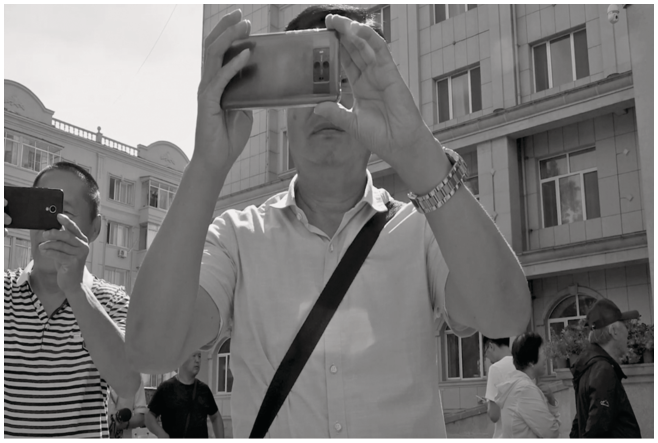
Ways of looking signal the power relations between people or between people and the camera. Amad relates ‘the centrality of the gaze’ to the history of the West’s encounter with the Other.Footnote 16 Cinema and visual studies have drawn attention to the production of colonial films and the capacity of the ‘returned gaze’ to reverse the relationship between the viewer and the viewed, where the subaltern gaze ‘pricks us with their pain’.Footnote 17 Returning the gaze and looking back were important strategies for resisting colonial power and dominance during colonial and postcolonial periods in Euro-America.Footnote 18 These strategies take on many different forms and vary according to sociopolitical and cultural contexts, going beyond directly looking at the camera. Diverting the gaze by pointing the lens at the looking subject destabilises the binary opposition between the agent and the object of their gaze, fragmenting the visual field they occupy (Fig. 7.2). This visual field is informed by the intersubjective links between our own gaze and the unfamiliar.
Returning the gaze of the looking subject.

Returning the gaze here exposed the normativity of gendered and racialised bodies in the service of building the nation and, in doing so, also enabled me to engage with how these relate to my position as a scholar. It is this ethnographic density lying in the positionality and consequent relationality among people and groups that inform analyses about social life that take place between macro and micro politics, top and bottom, theory and practice. At the core of this relationality were the white female bodies used as a tool of Chinese propaganda to showcase the lure of China to foreigners and a potential genetic material for hunxue children and the lustful gaze of the state represented by the male cameramen, drones and the audience. This lustful gaze of the state, as manifested through its technological and human agentism, underscores a broader theme of power, desire and control in China’s interactions with foreign bodies.
7.3 In between Gazing and Being Gazed at
The camera allowed me to mediate my position between subjects and objects of the gazing relationship and opened up the possibility of playing with the dynamics of gazing that characterised the event. My being of interest to the Chinese media representatives and the general audience gradually drew me into camera duels and games with the Chinese reporters.
After the obligatory group picture at the hotel entrance, the participants made their way to the main square where the ceremony was due to take place. The grooms rode pink bicycles festooned with helium balloons while the brides followed behind them in pink limousines, accompanied by the crowd of photographers and onlookers. The seats in the front rows in the town square on the Heilongjiang riverbank facing the Russian side were reserved for the VIP guests, mostly men, from local party and business organisations. Economic and state interests clearly gave shape to the event. Then the official part of the ceremony began. The master of ceremonies solemnly introduced the guests: the Standing Committee of the Yichun Municipal Party Committee and Minister of Publicity, Chairman of the Wedding Industry Committee of the China Federation of Commerce, Vice President of the Wedding Industry Committee of the China Federation of Commerce, and so on and so forth. Focusing on their faces, I noticed how each of them performed a seriousness in line with their positions as representatives of the state although this was supposed to be a day of entertainment and joy. The state as the enabler of kinship and love here provided the framework for the event.
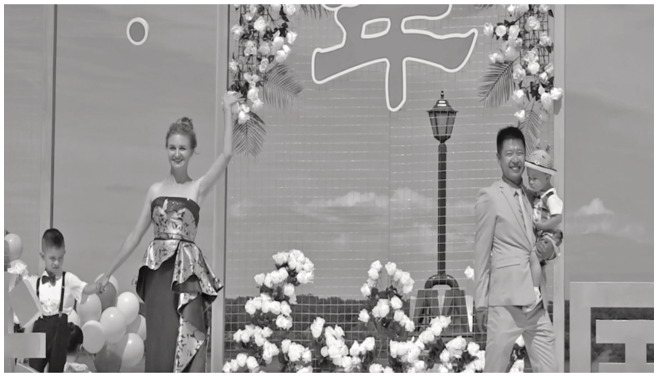
The order of ceremony was carefully choreographed and this patronage was emphasised by having all speakers direct their gaze towards the front. When the participating couples went up onto the stage, a ‘model Chinese couple’ in their seventies were invited to the podium to talk about their married life and congratulate the couples. This was followed by several performances by a Russian folk singer and a Russian dance group and a solo sung by a Chinese boy. The concert concluded with a fashion show. A Russian–Chinese couple and their two sons walked onto the podium in evening dress to open the fashion show, in which the models whom I had met earlier that day took part (Fig. 7.3). The concluding section of the official part of the event highlighted the value of inter-racial Russian wife/Chinese husband marriages and their ethnically mixed children. It also alluded to the entanglement of politics and business. It showed that marriage and the family are high on the Party’s agenda, together with the wedding industry, important to sustaining China’s market-centred development. The aesthetic emphasis placed on the international couple and particularly their Chinese–Russian variant points to the fascination with and desire for foreign engagement in China’s goal of development, albeit on their own terms.
A Chinese–Russian family open the fashion show at the international group wedding event in Jiayin.

The group wedding can be read as an example of a cultural performance that celebrates a biopolitical order aiming to build a beautiful, healthy, wealthy and strong nation. It is integral to China’s governing regime produced by the ‘technologies of love’Footnote 19 that shape the common norms and practices of human conduct in the not-so-private domains of marriage and family. The forms of intimacy that are acceptable and desirable, and how these relationships should be celebrated, are codified and normalised in the power–knowledge nexus dominated by the interests of the Party and market actors. Formulations of governmentality techniques of love and sex not only determine the conditions for belonging, but also paint the emotional landscape of desire and lust. They connect history and an imagined future in a sequence of processes and exchanges that culminate in the celebration of new forms of relationship and life, fitting for a rising China. Dinosaur statues juxtaposed with an inter-racial couple on the stage connect narratives of the past with narratives of imagined futures in a sequence of processes and exchanges that climax in the celebration of the ideal white wife/Chinese husband type of marriage. By staging the group wedding and showcasing an ideal model of an inter-racial couple for Chinese audiences, the state erected a screen for people to enjoy and to project their wishes on, fetishising certain forms of intimacy as appropriate and even desirable.Footnote 20
It is not surprising that key local politicians and businesses were present in the audience. Looking at the body is a political act, and the conception and realisation of this event highlighted the asymmetry of political relations between Russia and China. The roles played by the participating parties throughout the day showed the male Chinese national desire to be near to and dominate Russian female bodies, which was embedded in the organisational and symbolic fabric of the event. The voyeurism of the Chinese state was evident in how the Russian brides were presented as the objects of male longing. The subjugation of white bodies through their objectification into symbols of pleasure and prestige created the sense that Russians were dependent on Chinese power, which could determine what the participants should wear, how they should look, dance and perform to please Chinese audiences. Ironically, for the high-profile party officials, marrying a foreign woman could damage their prospects for career growth, as some of my interviewees discovered.
7.4 Hyperreal Illusion
While I was filming the event, my main focus was on capturing on screen the dynamics, language and aesthetics of the ceremony, but what became apparent in the editing process was the dynamic relation between looking and being looked at, and the blurring of the boundaries between the two, offered by the possibilities of reversing the gaze. The Chinese male gaze was the feature that I observed and experienced intensely myself as the day unfolded, yet the centrality of this human interaction became apparent to me only in the editing suite. Kirsten Hastrup calls this ‘the show-up effect’ of filmed footage that restores some of the filmmaker’s unnoticed or forgotten experiences.Footnote 21 I also realised, when I looked back at my footage, that the Chinese men’s unceremonious approach to taking pictures made me subconsciously bolder and braver with my camera too, so that I felt much freer to direct my camera lens at them.
The more I followed the flow of these interactions, the more I realised how the international group wedding event was scripted towards addressing Chinese national (male) desires and was deeply racialised and gendered in its conception, presentation and consumption of the ‘Russian brides’.Footnote 22 When the Chinese cameramen directed their cameras at me, I identified as the object of the gaze. Yet, the camera equipment gave me an empowered ‘viewing position’ that I embraced.Footnote 23 The camera enabled me to navigate and explore my position in relation to that of my counterparts, which revealed a great deal of the complexity and ambiguity of positions in an entangled web of multiple roles, narratives and imaginings.
Zooming in on the gazing Chinese men lay bare the key scripted dynamic of the group wedding – a state-funded occasion for the local political and business elite and residents to stare at white women in white wedding dresses. This was an embodied and affective social space or contact zone that revealed the asymmetries of power relations and how, in the words of Mary Louise Pratt, the meeting subjects ‘grapple with each other’, negotiating social spaces marked by the histories of colonialisms and other forms of subjugation.Footnote 24As an explorative device and a tool for provocation, the camera mediated and directed these intermingling practices in which I found film-making revelatory for research purposes.
According to official narratives reiterated by the organisers and participants on the day of the group wedding, the event was about strengthening ties between people from both sides of the border. Yet I discovered that the significance of the group wedding lay far beyond China’s relations with Russia. Not only did the event address bilateral relations; it pointed to the way that China relates to the international order and envisages its place within it. It is no accident that the event was called the ‘Russian–Chinese international group wedding’. Female Russian bodies took up a privileged position as objects of admiration and desire, but they also represented the whole Western world lying beyond Russia. As China’s Other, Russia connects it to the world and the global racialised order designed and dominated by Euro-America. The borders of China here do not emerge as territorial or fixed structures but are articulated through the performative practices of identity claims and interrogations of embodied geopolitics.Footnote 25
It is important to read critically the culture of the ideal body produced through narratives, discourses and visual practices. Susan Brownell argues that we need to interrogate the symbolism and meanings attributed to particular bodies occupying centre stage in national ‘myths, symbols, rituals, and so on’.Footnote 26 The body is key to the way that Chinese constructions and practices of national identity work. They are manifested in Chinese language constructions, including the character for body (身 shen) which appears in Chinese words for person, self and identity.Footnote 27 Body politics have played an important role in shaping China’s national historical discourses and its quest for global power and prominence.Footnote 28 For example, Callahan, in his analysis of the constructions of the Chinese self through relations with foreigners, discusses Chinese depictions of foreigners in a hierarchical way with noses that can be good or bad, depending on their friendliness to China.Footnote 29 Thus, Soviet allies were depicted as good foreigners and strong warriors with high-bridged noses during the period of friendly relations and as evil with big ugly noses during the period of conflict.Footnote 30
As in earlier national aspirations, including that of hosting the Olympics, the China Dream is infused with a particular body imagery. For example, in contrast to the 2008 Olympics, which focused on celebrating individual Chinese athletes and their contribution to the Chinese nation, the 2022 Beijing Winter Olympics exalted the sporting achievements and body features of mixed American and Chinese Gu Ailing who, after winning her first Olympic gold for China, became the national symbol of a cosmopolitan patriot. Born to a Chinese–American couple and raised by her mother in the USA, Gu Ailing became the pin-up girl of the Chinese state and international businesses because of her success, her use of spoken Chinese, her inter-racial beauty and her decision to take up Chinese citizenship so she could represent China in international sporting competitions.
In the same way, the juxtaposition of Chinese men and Russian women’s bodies in the international group wedding highlighted the place of the gendered and embodied politics of race in China’s relations with the world and the value attributed to whiteness in China’s dream of national rejuvenation. White female bodies were not only accepted as avatars of the ‘international’, beautiful and valuable, but also presented as intense desire to possess one by (at least) having one’s picture taken with one. Regardless of the stated official goal of the event, it appeared to me that its main purpose was to create an occasion for locals and visitors to gaze at and take pictures of (and of themselves with) beautifully presented Russian brides, even when they were not married to Chinese men or were not brides at all. The Chinese men took every opportunity to get a memorable snapshot with one of them, without introducing themselves or asking for permission to take photos. The presumption was that the participants were there to be looked at and photographed alongside – they were presented as sexualised objects for the intense attention of the Chinese (mostly male) viewers.
The wedding ceremony created an intersubjective hyperreal moment, where the Russian brides appeared as stars – stylised images for the audience to consume – while the Chinese men could envision themselves as successful and imagine being alongside a foreign wife. The event constructed a hyperreal illusion of the Russian brides’ proximity and availability, fuelling some Chinese men’s desire to have a white wife. As one Chinese visitor livestreaming to his followers noted: ‘They are all married here, but next year I hope to be sitting in a carriage with one of them.’

 Open access