





Introduction and statement of the main results
Sylvester’s law of inertia states that the $GL(N,\mathbb {C})$
-adjoint orbit
$GL(N,\mathbb {C})$
-adjoint orbit $\{x^*zx \mid x\in GL(N,\mathbb {C})\}$
of a self-adjoint
$\{x^*zx \mid x\in GL(N,\mathbb {C})\}$
of a self-adjoint $N\times N$
-matrix z only remembers its signature
$N\times N$
-matrix z only remembers its signature
 $$\begin{align*}\varsigma(z) = (N_+,N_-,N_0), \end{align*}$$
with $N_0$
the number of zero eigenvalues and
$N_0$
the number of zero eigenvalues and $N_{\pm }$
the number of positive/negative eigenvalues of z. With
$N_{\pm }$
the number of positive/negative eigenvalues of z. With
 $$\begin{align*}{\mathrm{Sign}} = \{(N_+,N_-,N_0) \in \mathbb{Z}_{\geq 0}^3\mid N_++N_- +N_0= N\}, \end{align*}$$
we have more precisely that, with $H(N)$
the space of self-adjoint N-by-N-matrices, we obtain a bijection
$H(N)$
the space of self-adjoint N-by-N-matrices, we obtain a bijection
 $$ \begin{align} H(N)/GL(N,\mathbb{C}) \cong {\mathrm{Sign}},\qquad \{x^*zx\mid x\in GL(N,\mathbb{C})\} \mapsto \varsigma(z). \end{align} $$
In this paper, we will look for a quantum analogue of (0.1).
Let $0<q<1$
, and let
$0<q<1$
, and let $\hat {R} \in M_N(\mathbb {C}) \otimes M_N(\mathbb {C})$
be the braid operator
$\hat {R} \in M_N(\mathbb {C}) \otimes M_N(\mathbb {C})$
be the braid operator
 $$ \begin{align} \hat{R} = \sum_{i,j} q^{-\delta_{ij}}e_{ji}\otimes e_{ij} + (q^{-1} -q)\sum_{i<j} e_{jj} \otimes e_{ii}, \end{align} $$
where $e_{ij}$
is the standard matrix unit taking the basis vector
$e_{ij}$
is the standard matrix unit taking the basis vector $e_j$
to
$e_j$
to $e_i$
. It satisfies the braid relation
$e_i$
. It satisfies the braid relation
 $$\begin{align*}\hat{R}_{12}\hat{R}_{23}\hat{R}_{12} = \hat{R}_{23} \hat{R}_{12}\hat{R}_{23}, \end{align*}$$
where we use the usual leg numbering notation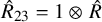 $\hat {R}_{23} = 1\otimes \hat {R}$
etc. It also satisfies the Hecke relation
$\hat {R}_{23} = 1\otimes \hat {R}$
etc. It also satisfies the Hecke relation
 $$\begin{align*}(\hat{R}-q^{-1})(\hat{R}+q) = \hat{R}^2 +(q-q^{-1})\hat{R} -1 = 0 \end{align*}$$
and is self-adjoint, $\hat {R}^* = \hat {R}$
. The matrix
$\hat {R}^* = \hat {R}$
. The matrix $\hat {R}$
is in particular invertible, with
$\hat {R}$
is in particular invertible, with
 $$\begin{align*}\hat{R}^{-1} = \sum_{i,j} q^{\delta_{ij}}e_{ij}\otimes e_{ji} + (q -q^{-1})\sum_{i<j} e_{ii} \otimes e_{jj}. \end{align*}$$
Definition. The Reflection Equation Algebra (REA) is the universal unital complex algebra $\mathcal {O}_{q}^{\mathrm {br}}(M_N(\mathbb {C}))$
generated by elements
$\mathcal {O}_{q}^{\mathrm {br}}(M_N(\mathbb {C}))$
generated by elements $z_{ij}$
for
$z_{ij}$
for $1\leq i,j\leq N$
such that, gathering these into a matrix
$1\leq i,j\leq N$
such that, gathering these into a matrix
 $$\begin{align*}Z = (z_{ij})_{i,j} \in M_N(\mathcal{O}_q^{\mathrm{br}}(M_N(\mathbb{C}))), \end{align*}$$
the following reflection equation is satisfied inside $M_N(\mathbb {C}) \otimes M_N(\mathcal {O}_q^{\mathrm {br}}(M_N(\mathbb {C})))$
:
$M_N(\mathbb {C}) \otimes M_N(\mathcal {O}_q^{\mathrm {br}}(M_N(\mathbb {C})))$
:
 $$ \begin{align} \hat{R}(1\otimes Z) \hat{R}(1\otimes Z) = (1\otimes Z) \hat{R}(1\otimes Z)\hat{R}, \end{align} $$
identifying $M_N(\mathbb {C}) \subseteq M_N(\mathcal {O}_q^{\mathrm {br}}(M_N(\mathbb {C})))$
via the natural inclusion
$M_N(\mathbb {C}) \subseteq M_N(\mathcal {O}_q^{\mathrm {br}}(M_N(\mathbb {C})))$
via the natural inclusion $\mathbb {C} \subseteq \mathcal {O}_q^{\mathrm {br}}(M_N(\mathbb {C}))$
.
$\mathbb {C} \subseteq \mathcal {O}_q^{\mathrm {br}}(M_N(\mathbb {C}))$
.
We define the $*$
-REA
$*$
-REA $\mathcal {O}_{q}(H(N))$
as
$\mathcal {O}_{q}(H(N))$
as $\mathcal {O}_{q}^{\mathrm {br}}(M_N(\mathbb {C}))$
endowed with the
$\mathcal {O}_{q}^{\mathrm {br}}(M_N(\mathbb {C}))$
endowed with the $*$
-structure
$*$
-structure $Z^* = Z$
, that is,
$Z^* = Z$
, that is,
 $$\begin{align*}z_{ij}^* = z_{ji},\qquad \forall 1\leq i,j\leq N. \end{align*}$$
Of course, one can write out (0.3) directly in terms of relations for the $z_{ij}$
, but these are not very illuminating (see (2.1)). Yet an alternative way of writing (0.3) is by the identification
$z_{ij}$
, but these are not very illuminating (see (2.1)). Yet an alternative way of writing (0.3) is by the identification
 $$ \begin{align} M_N(\mathcal{O}_q^{\mathrm{br}}(M_N(\mathbb{C}))) \cong M_N(\mathbb{C})\otimes \mathcal{O}_q^{\mathrm{br}}(M_N(\mathbb{C})), \qquad (a_{ij})_{ij} \mapsto \sum_{i,j}e_{ij} \otimes a_{ij},\qquad a_{ij} \in \mathcal{O}_q^{\mathrm{br}}(M_N(\mathbb{C})), \end{align} $$
by which (0.3) becomes the following identity in $M_N(\mathbb {C})\otimes M_N(\mathbb {C})\otimes \mathcal {O}_q^{\mathrm {br}}(M_N(\mathbb {C}))$
:
$M_N(\mathbb {C})\otimes M_N(\mathbb {C})\otimes \mathcal {O}_q^{\mathrm {br}}(M_N(\mathbb {C}))$
:
 $$ \begin{align} \hat{R}_{12}Z_{23} \hat{R}_{12}Z_{23} = Z_{23} \hat{R}_{12}Z_{23}\hat{R}_{12}. \end{align} $$
The reflection equation (with parameters) arose in the work of Cherednik [Reference CherednikCh84] on quantum scattering on the half line, and the associated algebra (together with its variants) was studied from the algebraic perspective in, for example, [Reference MajidMaj91, Reference Kulish and SklyaninKS92, Reference Kulish and SasakiKS93, Reference Kulish, Sasaki and SchwiebertKSS93, Reference MajidMaj94, Reference Pyatov and SaponovPS95, Reference Donin and MudrovDM02a, Reference MudrovMud02, Reference Donin, Kulish and MudrovDKM03, Reference MudrovMud06, Reference Kolb and StokmanKS09, Reference Jordan and WhiteJW20]. One can view $\mathcal {O}_q(H(N))$
as a quantization of the
$\mathcal {O}_q(H(N))$
as a quantization of the $*$
-algebra of complex-valued polynomial functions on
$*$
-algebra of complex-valued polynomial functions on $H(N)$
.
$H(N)$
.
We will be interested in studying the representations of $\mathcal {O}_q(H(N))$
. By representation of a unital
$\mathcal {O}_q(H(N))$
. By representation of a unital $*$
-algebra A on a Hilbert space
$*$
-algebra A on a Hilbert space $\mathcal {H}$
we mean a unital
$\mathcal {H}$
we mean a unital $*$
-homomorphism of A into the
$*$
-homomorphism of A into the $*$
-algebra
$*$
-algebra $B(\mathcal {H})$
of bounded operators on
$B(\mathcal {H})$
of bounded operators on $\mathcal {H}$
,
$\mathcal {H}$
,
 $$\begin{align*}\pi: A\rightarrow B(\mathcal{H}). \end{align*}$$
It is called irreducible if $\mathcal {H}$
is the only nonzero
$\mathcal {H}$
is the only nonzero $\pi (A)$
-invariant closed subspace of
$\pi (A)$
-invariant closed subspace of $\mathcal {H}$
, and a factor representation if the commutant
$\mathcal {H}$
, and a factor representation if the commutant $\pi (A)'$
is a factor (i.e., has trivial centre). It is called type I if the bicommutant
$\pi (A)'$
is a factor (i.e., has trivial centre). It is called type I if the bicommutant $\pi (A)"$
is a type I von Neumann algebra. We call A type I if all its representations are type I, or equivalently, if for any irreducible representation
$\pi (A)"$
is a type I von Neumann algebra. We call A type I if all its representations are type I, or equivalently, if for any irreducible representation $\pi $
the norm-closure of
$\pi $
the norm-closure of $\pi (A)$
contains the compact operators [Reference SakaiSak67]. If A is type I, any factor representation is irreducible up to multiplicity. We call A C
$\pi (A)$
contains the compact operators [Reference SakaiSak67]. If A is type I, any factor representation is irreducible up to multiplicity. We call A C $^*$
-faithful if its representations separate elements.
$^*$
-faithful if its representations separate elements.
The following result is proven as Theorem 5.13 in the paper.
Theorem A. The unital $*$
-algebra
$*$
-algebra $\mathcal {O}_q(H(N))$
is C
$\mathcal {O}_q(H(N))$
is C $^*$
-faithful and type I.
$^*$
-faithful and type I.
In fact, C $^*$
-faithfulness follows from well-known results, but for the type I-condition this is less clear.
$^*$
-faithfulness follows from well-known results, but for the type I-condition this is less clear.
An important observation concerning $\mathcal {O}_q(H(N))$
is that its generating matrix Z satisfies a quantum Cayley-Hamilton equation [Reference Pyatov and SaponovPS95, Reference Jordan and WhiteJW20]: there exist canonical central self-adjoint
$\mathcal {O}_q(H(N))$
is that its generating matrix Z satisfies a quantum Cayley-Hamilton equation [Reference Pyatov and SaponovPS95, Reference Jordan and WhiteJW20]: there exist canonical central self-adjoint $\sigma _k \in \mathcal {O}_q(H(N))$
with
$\sigma _k \in \mathcal {O}_q(H(N))$
with
 $$\begin{align*}\sum_{k=0}^N (-1)^k \sigma_k Z ^{N-k} = 0,\qquad \textrm{where }\sigma_0 = 1. \end{align*}$$
In particular,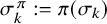 $\sigma ^{\pi }_k:= \pi (\sigma _k)$
is a real scalar for each factor representation
$\sigma ^{\pi }_k:= \pi (\sigma _k)$
is a real scalar for each factor representation $\pi $
of
$\pi $
of $\mathcal {O}_q(H(N))$
. We then call
$\mathcal {O}_q(H(N))$
. We then call
 $$ \begin{align} P_{\pi}(x) = \sum_{k=0}^N (-1)^k \sigma_k^{\pi} x^{N-k} \end{align} $$
the characteristic polynomial of $\pi $
. Our second result can be stated as follows, see Theorem 5.7.
$\pi $
. Our second result can be stated as follows, see Theorem 5.7.
Theorem B. Let P be a monic real polynomial of degree N. Then $P =P_{\pi }$
for a factor representation
$P =P_{\pi }$
for a factor representation $\pi $
of
$\pi $
of $\mathcal {O}_q(H(N))$
if and only if there exist
$\mathcal {O}_q(H(N))$
if and only if there exist $\alpha ,\beta \in \mathbb {R}$
such that the multiset of roots of P is of the form
$\alpha ,\beta \in \mathbb {R}$
such that the multiset of roots of P is of the form
 $$ \begin{align} \{q^{2\alpha+2m_1},\ldots,q^{2\alpha + 2m_{N_+}},-q^{2\beta + 2n_1},\ldots,-q^{2\beta + 2n_{N_-}},\underbrace{0,\ldots, 0}_{N_0}\} \end{align} $$
for certain $N_+,N_-,N_0 \in \mathbb {Z}_{\geq 0}$
with
$N_+,N_-,N_0 \in \mathbb {Z}_{\geq 0}$
with $N_++N_-+N_0= N$
, and certain
$N_++N_-+N_0= N$
, and certain $m_i,n_i \in \mathbb {Z}$
with
$m_i,n_i \in \mathbb {Z}$
with $m_i \neq m_j$
and
$m_i \neq m_j$
and $n_i \neq n_j$
for
$n_i \neq n_j$
for $i\neq j$
.
$i\neq j$
.
Write $[r] = r+ \mathbb {Z} \in \mathbb {R}/\mathbb {Z}$
. For
$[r] = r+ \mathbb {Z} \in \mathbb {R}/\mathbb {Z}$
. For $\pi $
a factor representation with multiset of roots of
$\pi $
a factor representation with multiset of roots of $P_{\pi }$
given by (0.7), we write
$P_{\pi }$
given by (0.7), we write
 $$\begin{align*}\varsigma(\pi) = (N_+,N_-,N_0), \qquad \varsigma_{{\mathrm{ext}}}(\pi) = ([\beta-\alpha],N_+,N_-,N_0,). \end{align*}$$
We call $\varsigma (\pi )$
the signature of
$\varsigma (\pi )$
the signature of $\pi $
and
$\pi $
and $\varsigma _{{\mathrm {ext}}}(\pi )$
the extended signature of
$\varsigma _{{\mathrm {ext}}}(\pi )$
the extended signature of $\pi $
. Here we put, by convention,
$\pi $
. Here we put, by convention, $[\beta - \alpha ] = 0$
if
$[\beta - \alpha ] = 0$
if $N_+N_-=0$
. In general, we call a quadruple
$N_+N_-=0$
. In general, we call a quadruple $\varsigma _{{\mathrm {ext}}} = ([r],N_+,N_-,N_0)$
an extended signature (of rank N) if
$\varsigma _{{\mathrm {ext}}} = ([r],N_+,N_-,N_0)$
an extended signature (of rank N) if $[r]\in \mathbb {R}/\mathbb {Z}$
and
$[r]\in \mathbb {R}/\mathbb {Z}$
and $N_+,N_-,N_0 \in \mathbb {Z}_{\geq 0}$
with
$N_+,N_-,N_0 \in \mathbb {Z}_{\geq 0}$
with $N_++N_-+N_0 = N$
and
$N_++N_-+N_0 = N$
and $[r]=0$
if
$[r]=0$
if $N_+N_- = 0$
. We denote
$N_+N_- = 0$
. We denote
 $$\begin{align*}{\mathrm{Sign}}^{{\mathrm{ext}}} = \{\textrm{extended signatures}\}. \end{align*}$$
Note that we have the purely quantum phenomenon of an extra parameter $[r]$
in the extended signature. This extra parameter is connected in a natural way to the extra parameter present in the quantization of the Hermitian symmetric space
$[r]$
in the extended signature. This extra parameter is connected in a natural way to the extra parameter present in the quantization of the Hermitian symmetric space $U(N)/U(m)\times U(n)$
[Reference LetzterLet99, Reference KolbKol14, Reference De Commer, Neshveyev, Tuset and YamashitaDCNTY19, Reference De Commer, Neshveyev, Tuset and YamashitaDCNTY23]. For earlier particular instances of this, see [Reference PodleśPod87] for the case of quantum spheres (
$U(N)/U(m)\times U(n)$
[Reference LetzterLet99, Reference KolbKol14, Reference De Commer, Neshveyev, Tuset and YamashitaDCNTY19, Reference De Commer, Neshveyev, Tuset and YamashitaDCNTY23]. For earlier particular instances of this, see [Reference PodleśPod87] for the case of quantum spheres ( $m=n=1$
) and [Reference Dijkhuizen and NoumiDN98] for the case of quantum projective spaces (
$m=n=1$
) and [Reference Dijkhuizen and NoumiDN98] for the case of quantum projective spaces ( $m=1$
and n arbitrary).
$m=1$
and n arbitrary).
To state our next main result, consider the W $^*$
-categoryFootnote 1 [Reference Ghez, Lima and RobertsGLR85]
$^*$
-categoryFootnote 1 [Reference Ghez, Lima and RobertsGLR85]
 $$ \begin{align} \mathbf{H}_q(N) = \{\textrm{representations of }\mathcal{O}_q(H(N)) \textrm{ on Hilbert spaces} \}. \end{align} $$
Recall that for a given unital $*$
-algebra A, a representation
$*$
-algebra A, a representation $\pi ': A \rightarrow B(\mathcal {G})$
is weakly contained in a representation
$\pi ': A \rightarrow B(\mathcal {G})$
is weakly contained in a representation $\pi : A \rightarrow B(\mathcal {H})$
if
$\pi : A \rightarrow B(\mathcal {H})$
if $\pi '$
factors through a
$\pi '$
factors through a $*$
-homomorphism
$*$
-homomorphism $C^*(\pi ) \rightarrow B(\mathcal {G})$
, with
$C^*(\pi ) \rightarrow B(\mathcal {G})$
, with
 $$ \begin{align} C^*(\pi) = \textrm{ norm-closure of }\pi(A). \end{align} $$
Equivalently, we have $\|\pi '(a)\|\leq \|\pi (a)\|$
for all
$\|\pi '(a)\|\leq \|\pi (a)\|$
for all $a\in A$
. In this case, we write
$a\in A$
. In this case, we write
 $$ \begin{align} \pi' \preccurlyeq \pi. \end{align} $$
We can then consider for each extended signature $\varsigma _{{\mathrm {ext}}}$
the full W
$\varsigma _{{\mathrm {ext}}}$
the full W $^*$
-subcategory
$^*$
-subcategory
 $$\begin{align*}\mathbf{H}_q^{\varsigma_{{\mathrm{ext}}}}(N) \subseteq \mathbf{H}_q(N) \end{align*}$$
consisting of representations $\pi $
such that all factor representations weakly contained in
$\pi $
such that all factor representations weakly contained in $\pi $
have extended signature
$\pi $
have extended signature $\varsigma _{{\mathrm {ext}}}$
. It is immediate from Theorem B that any representation in
$\varsigma _{{\mathrm {ext}}}$
. It is immediate from Theorem B that any representation in $\mathbf {H}_q(N)$
has a disintegration into components of the various
$\mathbf {H}_q(N)$
has a disintegration into components of the various $\mathbf {H}_q^{\varsigma _{{\mathrm {ext}}}}(N)$
, and that each of the
$\mathbf {H}_q^{\varsigma _{{\mathrm {ext}}}}(N)$
, and that each of the $\mathbf {H}_q^{\varsigma _{{\mathrm {ext}}}}(N)$
is nonempty. By Theorem A, we may also replace ‘factor representations’ by ‘irreducible representations’ in the above.
$\mathbf {H}_q^{\varsigma _{{\mathrm {ext}}}}(N)$
is nonempty. By Theorem A, we may also replace ‘factor representations’ by ‘irreducible representations’ in the above.
To link the above with a quantum version of Sylvester’s law of inertia, note first that we may identify
 $$ \begin{align} \mathbf{H}_q(N) \cong \{(\mathcal{H},Z)\mid \mathcal{H} \textrm{ Hilbert space and }Z\in M_N(\mathbb{C})\otimes B(\mathcal{H}) \textrm{ self-adjoint, satisfying } (0.5)\}. \end{align} $$
We can then also consider $\mathbf {G}\mathbf {L}_q(N,\mathbb {C})$
, the W
$\mathbf {G}\mathbf {L}_q(N,\mathbb {C})$
, the W $^*$
-category of couples
$^*$
-category of couples $(\mathcal {G},X)$
with
$(\mathcal {G},X)$
with $\mathcal {G}$
a Hilbert space and
$\mathcal {G}$
a Hilbert space and $X \in M_N(\mathbb {C})\otimes B(\mathcal {G})$
invertible and satisfying
$X \in M_N(\mathbb {C})\otimes B(\mathcal {G})$
invertible and satisfying
 $$ \begin{align} \hat{R}_{12}X_{13}X_{23} = X_{13}X_{23}\hat{R}_{12},\qquad X_{23}\hat{R}_{12} X_{23}^* = X_{13}^* \hat{R}_{12}X_{13}. \end{align} $$
It is easily seen that $\mathbf {G}\mathbf {L}_q(N,\mathbb {C})$
has a tensor product by putting
$\mathbf {G}\mathbf {L}_q(N,\mathbb {C})$
has a tensor product by putting
 $$\begin{align*}(\mathcal{G},X)*(\mathcal{G}',X') = (\mathcal{G} \otimes \mathcal{G}',X_{12}X_{13}'), \end{align*}$$
and that $\mathbf {G}\mathbf {L}_q(N,\mathbb {C})$
acts on
$\mathbf {G}\mathbf {L}_q(N,\mathbb {C})$
acts on $\mathbf {H}_q(N)$
by the right adjoint action,
$\mathbf {H}_q(N)$
by the right adjoint action,
 $$ \begin{align} \mathbf{A}\mathbf{d}: \mathbf{H}_q(N) \times \mathbf{G}\mathbf{L}_q(N,\mathbb{C}) \rightarrow \mathbf{H}_q(N),\qquad \mathbf{A}\mathbf{d}_{(\mathcal{G},X)}(\mathcal{H},Z) = (\mathcal{H} \otimes \mathcal{G},X_{13}^*Z_{12}X_{13}), \end{align} $$
with the usual tensor product map $(f,g) \mapsto f\otimes g$
on morphisms. This makes
$(f,g) \mapsto f\otimes g$
on morphisms. This makes $\mathbf {H}_q(N)$
into a right
$\mathbf {H}_q(N)$
into a right $\mathbf {G}\mathbf {L}_q(N,\mathbb {C})$
-module W
$\mathbf {G}\mathbf {L}_q(N,\mathbb {C})$
-module W $^*$
-category. We refrain from spelling out the details of the latter assertion, as we will only need the operation (0.13) itself, but let us mention in this context Woronowicz’s approach for working on this categorical level to get a grip on operator algebraic quantizations [Reference WoronowiczWor83, Reference WoronowiczWor95].
$^*$
-category. We refrain from spelling out the details of the latter assertion, as we will only need the operation (0.13) itself, but let us mention in this context Woronowicz’s approach for working on this categorical level to get a grip on operator algebraic quantizations [Reference WoronowiczWor83, Reference WoronowiczWor95].
Definition. We say that two factor representations $\pi ,\pi '$
in
$\pi ,\pi '$
in $\mathbf {H}_q(N)$
lie in the same
$\mathbf {H}_q(N)$
lie in the same $\mathbf {G}\mathbf {L}_q(N,\mathbb {C})$
-orbit if there exist
$\mathbf {G}\mathbf {L}_q(N,\mathbb {C})$
-orbit if there exist $\lambda ,\lambda '\in \mathbf {G}\mathbf {L}_q(N,\mathbb {C})$
such that
$\lambda ,\lambda '\in \mathbf {G}\mathbf {L}_q(N,\mathbb {C})$
such that
 $$\begin{align*}\pi \preccurlyeq \mathbf{A}\mathbf{d}_{\lambda}(\pi'),\qquad \pi' \preccurlyeq \mathbf{A}\mathbf{d}_{\lambda'}(\pi). \end{align*}$$
It is easily seen that this is indeed an equivalence relation. Denote by
 $$\begin{align*}\mathbf{H}_q(N)/\mathbf{G}\mathbf{L}_q(N,\mathbb{C}) \end{align*}$$
the quotient of the class of factor representations by this equivalence relation. We can now state our next main result as follows. It will follow immediately from our Theorem 5.12.
Theorem C (Quantized law of inertia)
The map
 $$ \begin{align} \mathbf{H}_q(N)/\mathbf{G}\mathbf{L}_q(N,\mathbb{C}) \rightarrow {\mathrm{Sign}}^{{\mathrm{ext}}},\qquad [\pi] \cong \varsigma_{{\mathrm{ext}}}(\pi) \end{align} $$
is a well-defined bijection.
The precise contents of this paper are as follows. In Section 1, we introduce the quantizations of the groups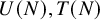 $U(N), T(N)$
and
$U(N), T(N)$
and $GL(N,\mathbb {C})$
, and recall also the connection with the quantized universal enveloping algebra
$GL(N,\mathbb {C})$
, and recall also the connection with the quantized universal enveloping algebra $U_q(\mathfrak {gl}(N,\mathbb {C}))$
and its real form
$U_q(\mathfrak {gl}(N,\mathbb {C}))$
and its real form $U_q(\mathfrak {u}(N))$
. In Section 2, we give some more information on the commutation relations which hold within
$U_q(\mathfrak {u}(N))$
. In Section 2, we give some more information on the commutation relations which hold within $\mathcal {O}_q(H(N))$
, and consider as well the associated actions of quantized
$\mathcal {O}_q(H(N))$
, and consider as well the associated actions of quantized $GL(N,\mathbb {C}),U(N)$
and
$GL(N,\mathbb {C}),U(N)$
and $T(N)$
in a purely algebraic framework. We present the classification of
$T(N)$
in a purely algebraic framework. We present the classification of $*$
-characters of
$*$
-characters of $\mathcal {O}_q(H(N))$
, taken from [Reference MudrovMud02], and of general irreducible
$\mathcal {O}_q(H(N))$
, taken from [Reference MudrovMud02], and of general irreducible $*$
-representations of
$*$
-representations of $\mathcal {O}_q(H(2))$
. In Section 3, we show that factor representations of
$\mathcal {O}_q(H(2))$
. In Section 3, we show that factor representations of $\mathcal {O}_q(H(N))$
allow a spectral weight, and prove a quantized version of the spectral theorem. In Section 4, we look at a particular class of representations called big cell representations. We obtain in this case a complete classification of all irreducible big cell representations. In the final Section 5 we then obtain the main results of the paper.
$\mathcal {O}_q(H(N))$
allow a spectral weight, and prove a quantized version of the spectral theorem. In Section 4, we look at a particular class of representations called big cell representations. We obtain in this case a complete classification of all irreducible big cell representations. In the final Section 5 we then obtain the main results of the paper.
In follow-up papers [Reference De Commer and MooreDCMo25] and [Reference MooreMo25], the above results are refined to obtain a complete classification of all irreducible $*$
-representations of the reflection equation algebra.
$*$
-representations of the reflection equation algebra.
We end this introduction with some common notations that we will make use of.
Throughout the paper, we fix $0<q<1$
.
$0<q<1$
.
We denote by $\{e_1,e_2,\ldots ,e_N\}$
the standard basis vectors of
$\{e_1,e_2,\ldots ,e_N\}$
the standard basis vectors of $\mathbb {C}^N$
. We then also view them as vectors in
$\mathbb {C}^N$
. We then also view them as vectors in $\mathbb {R}^N$
or
$\mathbb {R}^N$
or $\mathbb {Z}^N$
.
$\mathbb {Z}^N$
.
If $V,W$
are vector spaces over
$V,W$
are vector spaces over $\mathbb {C}$
, we denote
$\mathbb {C}$
, we denote $\mathrm {Lin}(V,W)$
for the vector space of
$\mathrm {Lin}(V,W)$
for the vector space of $\mathbb {C}$
-linear maps from V to W.
$\mathbb {C}$
-linear maps from V to W.
For a given set T, we denote by $\mathscr {P}(T)$
the powerset of T. When
$\mathscr {P}(T)$
the powerset of T. When $k \in \mathbb {Z}_{\geq 0}$
, we denote
$k \in \mathbb {Z}_{\geq 0}$
, we denote  for the set $\{1,2,\ldots k\}$
. We denote
$\{1,2,\ldots k\}$
. We denote  for the set of subsets
  with
with $|I| = k$
. We view
$|I| = k$
. We view  as a totally ordered set, and write
 $$\begin{align*}I = \{i_1<\ldots < i_k\} \end{align*}$$
to indicate this. We view  itself as a partially ordered set by
 $$ \begin{align} I \preceq J \qquad \textrm{if and only if}\qquad i_p \leq j_p\textrm{ for all }1\leq p \leq N. \end{align} $$
Note that we have

We further use the following notation: For  and
and  we write

For  , we define the weight of I to be the sum of its elements,
 $$ \begin{align} \mathrm{wt}(I) = \sum_{r=1}^k i_r. \end{align} $$
For $X \in M_N(\mathbb {C})$
and
$X \in M_N(\mathbb {C})$
and  , we denote
 $$\begin{align*}X[I,J] \in M_k(\mathbb{C}) \end{align*}$$
for the submatrix with $X[I,J]_{r,s} = x_{i_r,j_s}$
. The associated minor is written as
$X[I,J]_{r,s} = x_{i_r,j_s}$
. The associated minor is written as
 $$\begin{align*}X_{I,J} = {\mathrm{Det}}(X[I,J]). \end{align*}$$
It will also be convenient to use the following shorthand for a given vector $\lambda \in \mathbb {C}^N$
:
$\lambda \in \mathbb {C}^N$
:
 $$ \begin{align} \lambda_I = \lambda_{i_1}\dots \lambda_{i_k},\quad I = \{i_1,\ldots,i_k\},\qquad \lambda_{\omega} = \lambda_1^{\omega_1}\dots \lambda_{N}^{\omega_N},\quad \omega \in \mathbb{Z}_{\geq0}^{N}, \end{align} $$
so in particular $\lambda _I = \lambda _{\varpi _I}$
with
$\lambda _I = \lambda _{\varpi _I}$
with $(\varpi _I)_i = \delta _{i\in I}$
.
$(\varpi _I)_i = \delta _{i\in I}$
.
Finally, for any permutation $\sigma : A \rightarrow A$
of a finite totally ordered set, we denote
$\sigma : A \rightarrow A$
of a finite totally ordered set, we denote
 $$ \begin{align} l(\sigma) = |\{(i,j) \in A\times A \mid i<j,\sigma(i)>\sigma(j)\}| \end{align} $$
for the number of inversions in $\sigma $
.
$\sigma $
.
1 The W $^*$
-categories
$\mathbf {U}_q(N),\mathbf {T}_q(N)$
,
$\mathbf {G}\mathbf {L}_q(N,\mathbb {C})$
$^*$
-categories
$\mathbf {U}_q(N),\mathbf {T}_q(N)$
,
$\mathbf {G}\mathbf {L}_q(N,\mathbb {C})$


In this section, we recall results and set conventions for the quantizations of the groups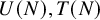 $U(N),T(N)$
and
$U(N),T(N)$
and $GL(N,\mathbb {C})$
which arise as quantum symmetries for the REA
$GL(N,\mathbb {C})$
which arise as quantum symmetries for the REA $\mathcal {O}_q(H(N))$
.
$\mathcal {O}_q(H(N))$
.
1.1 The Hopf algebra
$U_q(\mathfrak {gl}(N,\mathbb {C}))$
and its real form
$U_q(\mathfrak {u}(N))$


For the following, we refer to any standard reference work on quantum groups, for example, [Reference Klimyk and SchmüdgenKS97]. We adapt results to fit our conventions.
Definition 1.1. We define $U_q(\mathfrak {n}(N))$
as the universal unital
$U_q(\mathfrak {n}(N))$
as the universal unital $\mathbb {C}$
-algebra generated by elements
$\mathbb {C}$
-algebra generated by elements $E_1,\ldots , E_{N-1}$
such that
$E_1,\ldots , E_{N-1}$
such that $E_iE_j = E_jE_i$
for all
$E_iE_j = E_jE_i$
for all $1\leq i,j< N$
with
$1\leq i,j< N$
with $|i-j|\geq 2$
, and such that for all
$|i-j|\geq 2$
, and such that for all $1\leq i,j< N$
with
$1\leq i,j< N$
with $|i-j|= 1$
it holds that
$|i-j|= 1$
it holds that
 $$ \begin{align} E_i^2E_j - (q+q^{-1})E_iE_jE_i + E_jE_i^2 =0, \end{align} $$
We define $U_q(\mathfrak {n}^-(N))$
as an independent copy of
$U_q(\mathfrak {n}^-(N))$
as an independent copy of $U_q(\mathfrak {n}(N))$
, with generators written as
$U_q(\mathfrak {n}(N))$
, with generators written as $F_i$
for
$F_i$
for $1\leq i < N$
.
$1\leq i < N$
.
We define $U_q(\mathfrak {h}(N))$
as the
$U_q(\mathfrak {h}(N))$
as the $\mathbb {C}$
-algebra
$\mathbb {C}$
-algebra $\mathbb {C}[K_1^{\pm 1},\ldots , K_N^{\pm 1}]$
, and write
$\mathbb {C}[K_1^{\pm 1},\ldots , K_N^{\pm 1}]$
, and write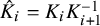 $\hat {K}_i = K_iK_{i+1}^{-1}$
for
$\hat {K}_i = K_iK_{i+1}^{-1}$
for $1\leq i < N$
.
$1\leq i < N$
.
We define $U_q(\mathfrak {gl}(N,\mathbb {C}))$
as the algebra generated by
$U_q(\mathfrak {gl}(N,\mathbb {C}))$
as the algebra generated by $U_q(\mathfrak {n}(N)),U_q(\mathfrak {h}(N)),U_q(\mathfrak {n}^-(N))$
with extra relations
$U_q(\mathfrak {n}(N)),U_q(\mathfrak {h}(N)),U_q(\mathfrak {n}^-(N))$
with extra relations
 $$ \begin{align} K_iE_j =q^{\delta_{ij}-\delta_{i,j+1}}E_j K_i,\qquad 1 \leq i\leq N,1\leq j< N, \end{align} $$
 $$ \begin{align} K_iF_j =q^{\delta_{i,j+1}-\delta_{ij}}F_j K_i,\qquad 1 \leq i\leq N,1\leq j< N, \end{align} $$
 $$ \begin{align} E_i F_j - F_jE_i= \delta_{ij} \frac{\hat{K}_i - \hat{K}_i^{-1}}{q-q^{-1}},\qquad 1\leq i,j<N. \end{align} $$
Note that $U_q(\mathfrak {h}(N))$
is just the group algebra of
$U_q(\mathfrak {h}(N))$
is just the group algebra of $\mathbb {Z}^N$
, and in particular does not depend on q. The notation
$\mathbb {Z}^N$
, and in particular does not depend on q. The notation $U_q(\mathfrak {h}(N))$
is purely meant to guide classical intuition as to the role that this algebra plays in the theory.
$U_q(\mathfrak {h}(N))$
is purely meant to guide classical intuition as to the role that this algebra plays in the theory.
By, for example, the proof of [Reference Klimyk and SchmüdgenKS97, Theorem 6.14], the following multiplication maps are bijective:
 $$ \begin{align} U_q(\mathfrak{n}(N)) \otimes U_q(\mathfrak{h}(N)) \otimes U_q(\mathfrak{n}^-(N)) \rightarrow U_q(\mathfrak{gl}(N,\mathbb{C})), \end{align} $$
 $$ \begin{align} U_q(\mathfrak{n}^-(N)) \otimes U_q(\mathfrak{h}(N)) \otimes U_q(\mathfrak{n}(N)) \rightarrow U_q(\mathfrak{gl}(N,\mathbb{C})). \end{align} $$
Definition 1.2. We let $U_q(\mathfrak {b}(N))$
and
$U_q(\mathfrak {b}(N))$
and $U_q(\mathfrak {b}^-(N))$
be the subalgebras of
$U_q(\mathfrak {b}^-(N))$
be the subalgebras of $U_q(\mathfrak {gl}(N,\mathbb {C}))$
, generated by the
$U_q(\mathfrak {gl}(N,\mathbb {C}))$
, generated by the $K_{i}^{\pm 1}$
and
$K_{i}^{\pm 1}$
and $E_i$
, respectively the
$E_i$
, respectively the $K_i^{\pm 1}$
and
$K_i^{\pm 1}$
and $F_i$
.
$F_i$
.
By (1.5), one has that $U_q(\mathfrak {b}(N))$
, resp.
$U_q(\mathfrak {b}(N))$
, resp. $U_q(\mathfrak {b}^-(N))$
, is isomorphic to the universal algebra generated by
$U_q(\mathfrak {b}^-(N))$
, is isomorphic to the universal algebra generated by $U_q(\mathfrak {h}(N))$
and
$U_q(\mathfrak {h}(N))$
and $U_q(\mathfrak {n}(N))$
, resp.
$U_q(\mathfrak {n}(N))$
, resp. $U_q(\mathfrak {h}(N))$
and
$U_q(\mathfrak {h}(N))$
and $U_q(\mathfrak {n}^-(N))$
, satisfying the commutation relations (1.2), resp. (1.3).
$U_q(\mathfrak {n}^-(N))$
, satisfying the commutation relations (1.2), resp. (1.3).
Definition 1.3. We endow $U_q(\mathfrak {gl}(N,\mathbb {C}))$
with the Hopf algebra structure
$U_q(\mathfrak {gl}(N,\mathbb {C}))$
with the Hopf algebra structure
 $$ \begin{align} \Delta(K_i) = K_i \otimes K_i,\qquad \Delta(E_i) = E_i \otimes 1 + \hat{K}_i\otimes E_i,\qquad \Delta(F_i) = F_i \otimes \hat{K}_i^{-1} + 1 \otimes F_i, \end{align} $$
where counit and antipode are determined by
 $$ \begin{align} \varepsilon(E_i) = \varepsilon(F_i)= 0,\quad \varepsilon(K_i) = 1,\qquad S(E_i) = -\hat{K}_i^{-1}E_i,\quad S(F_i) = -F_i\hat{K}_i,\quad S(K_i) = K_i^{-1}. \end{align} $$
Note that $U_q(\mathfrak {b}(N))$
and
$U_q(\mathfrak {b}(N))$
and $U_q(\mathfrak {b}^-(N))$
are then Hopf subalgebras.
$U_q(\mathfrak {b}^-(N))$
are then Hopf subalgebras.
Definition 1.4. The Hopf $*$
-algebra
$*$
-algebra $U_q(\mathfrak {u}(N))$
has underlying Hopf algebra
$U_q(\mathfrak {u}(N))$
has underlying Hopf algebra $U_q(\mathfrak {gl}(N,\mathbb {C}))$
and
$U_q(\mathfrak {gl}(N,\mathbb {C}))$
and $*$
-structure
$*$
-structure
 $$ \begin{align} K_i^* = K_i,\qquad E_i^* = q^{-1}F_i\hat{K}_i,\qquad F_i^* = q\hat{K}_i^{-1}E_i. \end{align} $$
A weight vector in a $U_q(\mathfrak {gl}(N,\mathbb {C}))$
-module is a joint (nonzero) eigenvector for all
$U_q(\mathfrak {gl}(N,\mathbb {C}))$
-module is a joint (nonzero) eigenvector for all $K_i$
. A weight vector v is said to be
$K_i$
. A weight vector v is said to be
-
○ a highest weight vector if
$E_i v = 0$
for all i, -
○ an admissible weight vector if the associated eigenvalues of the
$K_i$
are positive. The unique
$\lambda \in \mathbb {R}^N$
such that
$K_iv = q^{\lambda _i}v$
is then called the weight
Footnote 2
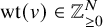
$\mathrm {wt}(v)$
of v, -
○ an integral weight vector if v is admissible and
$\mathrm {wt}(v)\in \mathbb {Z}^N$
, and -
○ a positive integral weight vector if v is integral and
$\mathrm {wt}(v) \in \mathbb {Z}_{\geq 0}^{N}$
.


A $U_q(\mathfrak {gl}(N,\mathbb {C}))$
-module is admissible, resp. integral, resp. positive integral if it has a basis of admissible, resp. integral, resp. positive integral weight vectors.
$U_q(\mathfrak {gl}(N,\mathbb {C}))$
-module is admissible, resp. integral, resp. positive integral if it has a basis of admissible, resp. integral, resp. positive integral weight vectors.
Denote the set of weakly integral, integral and positive integral weights respectively as
 $$\begin{align*}P_{{\mathrm{w.int}}} = \{\lambda = (\lambda_1,\ldots,\lambda_N) \in \mathbb{R}^N \mid \lambda_i - \lambda_j \in \mathbb{Z} \textrm{ for all }i,j\},\qquad P_{{\mathrm{int}}} = \mathbb{Z}^N,\qquad P_{{\mathrm{pos.int}}} = \mathbb{Z}_{\geq0}^{N}. \end{align*}$$
Call a vector $\lambda \in \mathbb {R}^N$
dominant if
$\lambda \in \mathbb {R}^N$
dominant if $\lambda _i \geq \lambda _{j}$
whenever
$\lambda _i \geq \lambda _{j}$
whenever $i\leq j$
. The dominant vectors in
$i\leq j$
. The dominant vectors in $P_{\bullet }$
are denoted as
$P_{\bullet }$
are denoted as $P_{\bullet }^{{\mathrm {dom}}}$
. We also denote the standard bilinear form on
$P_{\bullet }^{{\mathrm {dom}}}$
. We also denote the standard bilinear form on $\mathbb {R}^N$
as
$\mathbb {R}^N$
as
 $$\begin{align*}(\omega,\chi) = \sum_{i=1}^N \omega_i \chi_i. \end{align*}$$
We write $Q \subseteq P_{{\mathrm {int}}}$
for the root lattice consisting of integral weights
$Q \subseteq P_{{\mathrm {int}}}$
for the root lattice consisting of integral weights $\lambda $
with
$\lambda $
with $\sum \lambda _i = 0$
, and
$\sum \lambda _i = 0$
, and $Q^+ \subseteq Q$
for the
$Q^+ \subseteq Q$
for the $\mathbb {Z}_{\geq 0}$
-span of the
$\mathbb {Z}_{\geq 0}$
-span of the $\mathbf {a}_i = e_i -e_{i+1}$
for
$\mathbf {a}_i = e_i -e_{i+1}$
for $1\leq i<N$
. For
$1\leq i<N$
. For $\omega ,\omega '\in P_{{\mathrm {int}}}$
we write
$\omega ,\omega '\in P_{{\mathrm {int}}}$
we write
 $$\begin{align*}\omega \preceq \omega' \quad \Leftrightarrow \quad \omega' - \omega \in Q^+ \qquad \Leftrightarrow \qquad \sum_{k=1}^N \omega_k = \sum_{k=1}^N \omega_k'\textrm{ and } \sum_{k=1}^l \omega_k \leq \sum_{k=1}^l \omega_k' \textrm{ for all }1\leq l \leq N. \end{align*}$$
Note that the order (0.15) can be related to the partial order on $P_{{\mathrm {int}}}$
as follows: with
$P_{{\mathrm {int}}}$
as follows: with

we have
 $$\begin{align*}I \preceq J \qquad \textrm{if and only if} \qquad \varpi_J \preceq \varpi_I. \end{align*}$$
In the following, we will simply identify a $\{0,1\}$
-valued weight
$\{0,1\}$
-valued weight $\lambda $
with its associated set,
$\lambda $
with its associated set,
 $$ \begin{align} \lambda = \varpi_I = I = \{i \mid \lambda_i= 1\}. \end{align} $$
The following is well-known, see, for example, [Reference Klimyk and SchmüdgenKS97, Theorem 7.23] for the case of integral weights. Recall here that for an algebra A and an A-module M, a vector $m\in M$
is cyclic if
$m\in M$
is cyclic if $Am =M$
.
$Am =M$
.
Theorem 1.5.
-
○ All admissible, resp. (positive) integral finite-dimensional
$U_q(\mathfrak {gl}(N,\mathbb {C}))$
-modules decompose as a direct sum of irreducible admissible, resp. (positive) integral modules. -
○ An admissible module V is irreducible if and only if it has a cyclic highest weight vector, and the associated highest weight
$\lambda $
completely determines V (up to isomorphism). We write
$V_{\lambda }$
for a fixed model of such an irreducible admissible module with highest weight
$\lambda $
. -
○ An element
$\lambda \in \mathbb {R}^N$
arises as a highest weight of an irreducible admissible, resp. (positive) integral
$U_q(\mathfrak {gl}(N,\mathbb {C}))$
-module if and only if
$\lambda \in P_{{\mathrm {w.int}}}^{{\mathrm {dom}}}$
, resp.
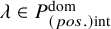
$\lambda \in P_{(pos.){\mathrm {int}}}^{{\mathrm {dom}}}$
. -
○ The weights
$\omega $
of an irreducible admissible module
$V_{\lambda }$
satisfy
$\omega \preceq \lambda $
. -
○ A finite-dimensional admissible
$U_q(\mathfrak {gl}(N,\mathbb {C}))$
-module V has a Hilbert space structure for which it is a representation of
$U_q(\mathfrak {u}(N))$
. Its scalar product is unique up to a positive scalar when V is irreducible.







We briefly comment below on why the $V_{\lambda }$
with
$V_{\lambda }$
with $\lambda \in P_{{\mathrm {pos.int}}}^{{\mathrm {dom}}}$
are positive integral modules.
$\lambda \in P_{{\mathrm {pos.int}}}^{{\mathrm {dom}}}$
are positive integral modules.
Using the notation (1.10), consider the irreducible positive integral modules  for
for $0\leq k \leq N$
. Here
$0\leq k \leq N$
. Here  is the trivial module, given by the counit, while we can identify
  as the vector $U_q(\mathfrak {gl}(N,\mathbb {C}))$
-module, defined by
$U_q(\mathfrak {gl}(N,\mathbb {C}))$
-module, defined by
 $$ \begin{align} \Theta: U_q(\mathfrak{gl}(N,\mathbb{C})) \rightarrow {\mathrm{End}}(\mathbb{C}^N),\qquad \Theta(K_i)e_j = q^{\delta_{ij}}e_j,\quad \Theta(E_i) e_j = \delta_{i,j-1}e_{j-1},\quad \Theta(F_i) e_j = \delta_{ij} e_{j+1}. \end{align} $$
Note that $\Theta $
defines in fact a representation of
$\Theta $
defines in fact a representation of $U_q(\mathfrak {u}(N))$
, with the standard basis of
$U_q(\mathfrak {u}(N))$
, with the standard basis of $\mathbb {C}^N$
as orthonormal basis.
$\mathbb {C}^N$
as orthonormal basis.
To construct the other modules  , we follow [Reference Parshall and WangPW91, Chapter 8]. Consider the quadratic algebra $\wedge _q(\mathbb {C}^N)$
generated by vectors
$\wedge _q(\mathbb {C}^N)$
generated by vectors $\{e_i\mid 1\leq i\leq N\}$
with defining relations given by
$\{e_i\mid 1\leq i\leq N\}$
with defining relations given by $e_i \wedge _q e_i = 0$
and
$e_i \wedge _q e_i = 0$
and
 $$\begin{align*}e_j \wedge_q e_i = -q e_i \wedge_q e_j,\qquad 1\leq i<j \leq N. \end{align*}$$
In other words, we are dividing out the tensor algebra of $\mathbb {C}^N$
by the image of
$\mathbb {C}^N$
by the image of
 $$\begin{align*}\hat{R}+q: \mathbb{C}^N \otimes \mathbb{C}^N \rightarrow \mathbb{C}^N \otimes \mathbb{C}^N. \end{align*}$$
Noting that $\hat {R}$
is an intertwiner for
$\hat {R}$
is an intertwiner for $\Theta ^{*2} := (\Theta \otimes \Theta )\circ \Delta $
, we get that
$\Theta ^{*2} := (\Theta \otimes \Theta )\circ \Delta $
, we get that $\wedge _q(\mathbb {C}^N)$
is a
$\wedge _q(\mathbb {C}^N)$
is a $U_q(\mathfrak {gl}(N,\mathbb {C}))$
-module algebra:
$U_q(\mathfrak {gl}(N,\mathbb {C}))$
-module algebra:
 $$ \begin{align} \rhd: U_q(\mathfrak{gl}(N,\mathbb{C}))\otimes \Lambda_q(\mathbb{C}^N) \rightarrow \Lambda_q(\mathbb{C}^N),\qquad x\rhd (ab) = (x_{(1)}\rhd a)(x_{(2)}\rhd b), \quad x \rhd 1 = \varepsilon(x)1, \end{align} $$
where we use the (sumless) Sweedler notation
 $$\begin{align*}\Delta(x) = x_{(1)}\otimes x_{(2)}. \end{align*}$$
Denoting

we obtain that $\wedge _q^k(\mathbb {C}^N)$
is a model for
$\wedge _q^k(\mathbb {C}^N)$
is a model for  . We can also represent $\wedge _q^k(\mathbb {C}^N)$
directly as
$\wedge _q^k(\mathbb {C}^N)$
directly as
 $$\begin{align*}\wedge_q^k(\mathbb{C}^N) = (\mathbb{C}^N)^{\otimes k} \Big/ \sum_{i=1}^{k-1} \mathrm{Im}(\hat{R}_{i,i+1}+q), \end{align*}$$
and the $e_I$
will give a basis for
$e_I$
will give a basis for $\wedge _q^k(\mathbb {C}^N)$
. With the
$\wedge _q^k(\mathbb {C}^N)$
. With the $e_I$
orthonormal, we obtain a representation of
$e_I$
orthonormal, we obtain a representation of $U_q(\mathfrak {u}(N))$
.
$U_q(\mathfrak {u}(N))$
.
If we now consider a general $V_{\lambda }$
with
$V_{\lambda }$
with $\lambda \in P_{{\mathrm {pos.int}}}^{{\mathrm {dom}}}$
, we see that
$\lambda \in P_{{\mathrm {pos.int}}}^{{\mathrm {dom}}}$
, we see that $V_{\lambda }$
is embedded in some
$V_{\lambda }$
is embedded in some  , sending the highest weight vector of $V_{\lambda }$
to the tensor product of the highest weight vectors in the range. Since the above tensor product is positive integral, the same is true of
$V_{\lambda }$
to the tensor product of the highest weight vectors in the range. Since the above tensor product is positive integral, the same is true of $V_{\lambda }$
.
$V_{\lambda }$
.
1.2 The quantum matrix algebra
$\mathcal {O}_q(M_N(\mathbb {C}))$
and its localisation
$\mathcal {O}_q(GL(N,\mathbb {C}))$


Below, we continue to use the identification (0.4).
Definition 1.6 [Reference Faddeev, Reshetikhin and TakhtajanFRT88]
We define the FRT (= Faddeev-Reshetikhin-Takhtajan) algebra $\mathcal {O}_q(M_N(\mathbb {C}))$
as the universal unital
$\mathcal {O}_q(M_N(\mathbb {C}))$
as the universal unital $\mathbb {C}$
-algebra generated by the matrix entries of
$\mathbb {C}$
-algebra generated by the matrix entries of $X = \sum _{ij} e_{ij} \otimes x_{ij}$
with universal relations
$X = \sum _{ij} e_{ij} \otimes x_{ij}$
with universal relations
 $$ \begin{align} \hat{R}_{12} X_{13}X_{23} = X_{13}X_{23} \hat{R}_{12}. \end{align} $$
It is a bialgebra by the coproduct and counit
 $$\begin{align*}({\mathrm{id}}\otimes \Delta)X = X_{12}X_{13},\qquad ({\mathrm{id}}\otimes \varepsilon)(X) = I_N. \end{align*}$$
Writing out (1.14), we find the following commutation relations between the $x_{ij}$
,
$x_{ij}$
,
 $$ \begin{align} \left\{\begin{array}{lll} x_{ij} x_{kj} = q x_{kj}x_{ij} & \textrm{for} & i<k,\\ x_{ij} x_{ik} = qx_{ik}x_{ij} &\textrm{for}&j<k,\\ x_{ij} x_{kl} = x_{kl} x_{ij}&\textrm{for}& i< k \textrm{ and } j>l,\\ x_{ij}x_{kl} =x_{kl}x_{ij} + (q-q^{-1})x_{il}x_{kj} & \textrm{for}&i<k\textrm{ and } j<l. \end{array}\right. \end{align} $$
As $\hat {R}$
is an intertwiner for the tensor product
$\hat {R}$
is an intertwiner for the tensor product  of the vector module of $U_q(\mathfrak {gl}(N,\mathbb {C}))$
with itself, it follows that there is a pairing of bialgebras between
$U_q(\mathfrak {gl}(N,\mathbb {C}))$
with itself, it follows that there is a pairing of bialgebras between $\mathcal {O}_q(M_N(\mathbb {C}))$
and
$\mathcal {O}_q(M_N(\mathbb {C}))$
and $U_q(\mathfrak {gl}(N,\mathbb {C}))$
, given by
$U_q(\mathfrak {gl}(N,\mathbb {C}))$
, given by
 $$ \begin{align} \tau(x_{ij},x) = \Theta(x)_{ij},\qquad x \in U_q(\mathfrak{gl}(N,\mathbb{C})), \end{align} $$
with $\Theta $
as in (1.11), and with matrix coefficients taken with respect to the standard basis of
$\Theta $
as in (1.11), and with matrix coefficients taken with respect to the standard basis of $\mathbb {C}^N$
.
$\mathbb {C}^N$
.
Stating that this is a pairing simply means that $\tau $
is a bilinear map
$\tau $
is a bilinear map
 $$\begin{align*}\tau: \mathcal{O}_q(M_N(\mathbb{C}))\times U_q(\mathfrak{gl}(N,\mathbb{C})) \rightarrow \mathbb{C} \end{align*}$$
with
 $$\begin{align*}\tau(a,xy) = \tau(a_{(1)},x)\tau(a_{(2)},y),\quad \tau(a,1) = \varepsilon(a),\quad \tau(ab,x)= \tau(a,x_{(1)})\tau(b,x_{(2)}),\quad \tau(1,x) = \varepsilon(x). \end{align*}$$
This duality is nondegenerate [Reference Klimyk and SchmüdgenKS97, Chapter 11, Corollary 22],Footnote 3 so $\tau $
gives injective homomorphisms into the respective vector space duals,
$\tau $
gives injective homomorphisms into the respective vector space duals,
 $$\begin{align*}U_q(\mathfrak{gl}(N,\mathbb{C}))\rightarrow \mathrm{Lin}(\mathcal{O}_q(M_N(\mathbb{C})),\mathbb{C}),\qquad \mathcal{O}_q(M_N(\mathbb{C})) \rightarrow \mathrm{Lin}(U_q(\mathfrak{gl}(N,\mathbb{C})),\mathbb{C}), \end{align*}$$
where the right hand sides are endowed with the convolution algebra structure.
By the universal property, we also see that the comodule structure
 $$\begin{align*}\delta: \mathbb{C}^N \rightarrow \mathbb{C}^N\otimes \mathcal{O}_q(M_N(\mathbb{C})),\qquad e_j \mapsto \sum_i e_i \otimes x_{ij} \end{align*}$$
lifts to a comodule algebra map
 $$ \begin{align} \wedge \delta: \wedge_q(\mathbb{C}^N) \rightarrow \wedge_q(\mathbb{C}^N)\otimes \mathcal{O}_q(M_N(\mathbb{C})), \end{align} $$
which in turn restricts to comodule structures
 $$\begin{align*}\wedge^k\delta: \wedge_q^k(\mathbb{C}^N) \rightarrow \wedge_q^k(\mathbb{C}^N) \otimes \mathcal{O}_q(M_N(\mathbb{C})). \end{align*}$$
It follows that the $U_q(\mathfrak {gl}(N,\mathbb {C}))$
-modules
$U_q(\mathfrak {gl}(N,\mathbb {C}))$
-modules  can be ‘integrated’ to $\mathcal {O}_q(M_N(\mathbb {C}))$
-comodules, that is,
$\mathcal {O}_q(M_N(\mathbb {C}))$
-comodules, that is,

Definition 1.7. For  we define the quantum minors
 $$\begin{align*}x_{IJ} \in \mathcal{O}_q(M_N(\mathbb{C})) \end{align*}$$
as the matrix coefficients of $\wedge ^k\delta $
with respect to the canonical basis, so
$\wedge ^k\delta $
with respect to the canonical basis, so
 $$\begin{align*}\wedge^k\delta(e_J) = \sum_J e_I \otimes x_{IJ}. \end{align*}$$
We then put

and we call  the k-th exterior power of X.
For brevity, we write
 $$\begin{align*}x_I = x_{I,I}. \end{align*}$$
In particular, we denote

It can be shown that ${\mathrm {Det}}_q(X)$
is central [Reference Parshall and WangPW91, Theorem 4.6.1]. More generally, we have
${\mathrm {Det}}_q(X)$
is central [Reference Parshall and WangPW91, Theorem 4.6.1]. More generally, we have

Definition 1.8. We define $\mathcal {O}_q(GL(N,\mathbb {C}))$
as the localisation
$\mathcal {O}_q(GL(N,\mathbb {C}))$
as the localisation
 $$\begin{align*}\mathcal{O}_q(GL(N,\mathbb{C})) = \mathcal{O}_q(M_N(\mathbb{C}))[{\mathrm{Det}}_q(X)^{-1}]. \end{align*}$$
As $\mathcal {O}_q(M_N(\mathbb {C}))$
has no zero divisors [Reference Parshall and WangPW91, Theorem 3.5.1], it embeds in its localisation. Moreover, X becomes invertible in
$\mathcal {O}_q(M_N(\mathbb {C}))$
has no zero divisors [Reference Parshall and WangPW91, Theorem 3.5.1], it embeds in its localisation. Moreover, X becomes invertible in $\mathcal {O}_q(GL(N,\mathbb {C}))$
. This implies that
$\mathcal {O}_q(GL(N,\mathbb {C}))$
. This implies that $\mathcal {O}_q(GL(N,\mathbb {C}))$
becomes a Hopf algebra.
$\mathcal {O}_q(GL(N,\mathbb {C}))$
becomes a Hopf algebra.
The pairing (1.16) extends uniquely to a nondegenerate pairing of Hopf algebras
 $$ \begin{align} \tau: \mathcal{O}_q(GL(N,\mathbb{C})) \otimes U_q(\mathfrak{gl}(N,\mathbb{C})) \rightarrow \mathbb{C}. \end{align} $$
It follows that $\mathcal {O}_q(GL(N,\mathbb {C}))$
is co-semisimple, and that an
$\mathcal {O}_q(GL(N,\mathbb {C}))$
is co-semisimple, and that an $U_q(\mathfrak {gl}(N,\mathbb {C}))$
-module lifts to a
$U_q(\mathfrak {gl}(N,\mathbb {C}))$
-module lifts to a $\mathcal {O}_q(GL(N,\mathbb {C}))$
-comodule through the pairing (1.19) if and only if it is integral. In particular, we can identify the coalgebras
$\mathcal {O}_q(GL(N,\mathbb {C}))$
-comodule through the pairing (1.19) if and only if it is integral. In particular, we can identify the coalgebras
 $$\begin{align*}\mathcal{O}_q(GL(N,\mathbb{C})) \cong \oplus_{\lambda \in P_{{\mathrm{int}}}^{{\mathrm{dom}}}} \mathrm{Lin}({\mathrm{End}}(V_{\lambda}),\mathbb{C}), \end{align*}$$
and hence have a concrete model for the convolution algebra of $\mathcal {O}_q(GL(N,\mathbb {C}))$
,
$\mathcal {O}_q(GL(N,\mathbb {C}))$
,
 $$ \begin{align} \mathscr{U}_q(\mathfrak{gl}(N,\mathbb{C})) := \mathrm{Lin}(\mathcal{O}_q(GL(N,\mathbb{C})),\mathbb{C}) \cong \prod_{\lambda \in P_{{\mathrm{int}}}^{{\mathrm{dom}}}} {\mathrm{End}}(V_{\lambda}). \end{align} $$
Note in particular the following corollary.
Corollary 1.9. A finite-dimensional integral $U_q(\mathfrak {gl}(N,\mathbb {C}))$
-module extends uniquely to a
$U_q(\mathfrak {gl}(N,\mathbb {C}))$
-module extends uniquely to a $\mathscr {U}_q(\mathfrak {gl}(N,\mathbb {C}))$
-module.
$\mathscr {U}_q(\mathfrak {gl}(N,\mathbb {C}))$
-module.
Similar statements hold for tensor products. For example, any tensor product of finite-dimensional integral $U_q(\mathfrak {gl}(N,\mathbb {C}))$
-modules uniquely extends to a module of
$U_q(\mathfrak {gl}(N,\mathbb {C}))$
-modules uniquely extends to a module of
 $$\begin{align*}\mathscr{U}_q(\mathfrak{gl}(N,\mathbb{C})) \widehat{\otimes}\mathscr{U}_q(\mathfrak{gl}(N,\mathbb{C})) := \mathrm{Lin}(\mathcal{O}_q(GL(N,\mathbb{C}))\otimes \mathcal{O}_q(GL(N,\mathbb{C})),\mathbb{C}), \end{align*}$$
and we have an identification
 $$ \begin{align} \mathscr{U}_q(\mathfrak{gl}(N,\mathbb{C})) \widehat{\otimes}\mathscr{U}_q(\mathfrak{gl}(N,\mathbb{C})) \cong \prod_{\lambda,\lambda' \in P_{{\mathrm{int}}}^{{\mathrm{dom}}}} {\mathrm{End}}(V_{\lambda})\otimes {\mathrm{End}}(V_{\lambda'}). \end{align} $$
Going back to $\mathcal {O}_q(M_N(\mathbb {C}))$
, also the following is well-known. Let us give a brief proof.
$\mathcal {O}_q(M_N(\mathbb {C}))$
, also the following is well-known. Let us give a brief proof.
Lemma 1.10. A finite-dimensional $U_q(\mathfrak {gl}(N,\mathbb {C}))$
-module lifts to a
$U_q(\mathfrak {gl}(N,\mathbb {C}))$
-module lifts to a $\mathcal {O}_q(M_N(\mathbb {C}))$
-comodule if and only if it is positive integral.
$\mathcal {O}_q(M_N(\mathbb {C}))$
-comodule if and only if it is positive integral.
Proof. As the $x_{ij}$
generate
$x_{ij}$
generate $\mathcal {O}_q(M_N(\mathbb {C}))$
, any comodule with coefficients in
$\mathcal {O}_q(M_N(\mathbb {C}))$
, any comodule with coefficients in $\mathcal {O}_q(M_N(\mathbb {C}))$
must be a direct summand of
$\mathcal {O}_q(M_N(\mathbb {C}))$
must be a direct summand of $\Theta ^{* m}$
for some m. As these are positive integral modules, we see that the condition in the lemma is necessary. The condition is also sufficient since any comodule with dominant weight
$\Theta ^{* m}$
for some m. As these are positive integral modules, we see that the condition in the lemma is necessary. The condition is also sufficient since any comodule with dominant weight $\lambda \in \mathbb {Z}_{\geq 0}^{N}$
is clearly a direct summand of a tensor product of the
$\lambda \in \mathbb {Z}_{\geq 0}^{N}$
is clearly a direct summand of a tensor product of the  .
.
We can hence denote the dual convolution algebra of $\mathcal {O}_q(M_N(\mathbb {C}))$
as
$\mathcal {O}_q(M_N(\mathbb {C}))$
as
 $$ \begin{align} \mathscr{U}_q^{{\mathrm{pos}}}(\mathfrak{gl}(N,\mathbb{C})) := \mathrm{Lin}(\mathcal{O}_q(M_N(\mathbb{C})),\mathbb{C}) \cong \prod_{\lambda \in P_{{\mathrm{pos.int}}}^{{\mathrm{dom}}}} {\mathrm{End}}(V_{\lambda}). \end{align} $$
Since the positive integral representations of $U_q(\mathfrak {gl}(N,\mathbb {C}))$
are stable under tensor products,
$U_q(\mathfrak {gl}(N,\mathbb {C}))$
are stable under tensor products, $\mathscr {U}_q^{{\mathrm {pos}}}(\mathfrak {gl}(N,\mathbb {C}))$
is still endowed with a coproduct
$\mathscr {U}_q^{{\mathrm {pos}}}(\mathfrak {gl}(N,\mathbb {C}))$
is still endowed with a coproduct
 $$\begin{align*}\Delta^{{\mathrm{pos}}}: \mathscr{U}_q^{{\mathrm{pos}}}(\mathfrak{gl}(N,\mathbb{C})) \rightarrow \mathscr{U}_q^{{\mathrm{pos}}}(\mathfrak{gl}(N,\mathbb{C})) \widehat{\otimes} \mathscr{U}_q^{{\mathrm{pos}}}(\mathfrak{gl}(N,\mathbb{C})). \end{align*}$$
1.3 The W
$^*$
-category
$\mathbf {U}_q(N)$


The Hopf algebra $\mathcal {O}_q(GL(N,\mathbb {C}))$
gives a quantization of
$\mathcal {O}_q(GL(N,\mathbb {C}))$
gives a quantization of $GL(N,\mathbb {C})$
as a complex group variety. To obtain its real form
$GL(N,\mathbb {C})$
as a complex group variety. To obtain its real form $U(N)$
, we endow
$U(N)$
, we endow $\mathcal {O}_q(GL(N,\mathbb {C}))$
with the following
$\mathcal {O}_q(GL(N,\mathbb {C}))$
with the following $*$
-structure.
$*$
-structure.
Definition 1.11. The Hopf $*$
-algebra
$*$
-algebra $\mathcal {O}_q(U(N)) = (\mathcal {O}_q(GL(N,\mathbb {C})),*)$
is determined uniquely by
$\mathcal {O}_q(U(N)) = (\mathcal {O}_q(GL(N,\mathbb {C})),*)$
is determined uniquely by
 $$\begin{align*}X^* = X^{-1}. \end{align*}$$
One can note that this is well-defined as the composition $S(-)^*$
is well-defined, given that
$S(-)^*$
is well-defined, given that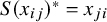 ${S(x_{ij})^* = x_{ji}}$
. This
${S(x_{ij})^* = x_{ji}}$
. This $*$
-structure is compatible with the real form
$*$
-structure is compatible with the real form $U_q(\mathfrak {u}(N))$
under the pairing
$U_q(\mathfrak {u}(N))$
under the pairing $\tau $
of (1.19), in the sense that
$\tau $
of (1.19), in the sense that
 $$ \begin{align} \tau(f,x^*) = \overline{\tau(S(f)^*,x)},\qquad \tau(f^*,x) = \overline{\tau(f,S(x)^*)},\qquad f\in \mathcal{O}_q(U(N)),x \in U_q(\mathfrak{u}(N)). \end{align} $$
When considering $\mathcal {O}_q(U(N))$
, we will denote the generating matrix as U rather than X.
$\mathcal {O}_q(U(N))$
, we will denote the generating matrix as U rather than X.
Definition 1.12. We let $\mathbf {U}_q(N)$
be the W
$\mathbf {U}_q(N)$
be the W $^*$
-category of representations of
$^*$
-category of representations of $\mathcal {O}_q(U(N))$
.
$\mathcal {O}_q(U(N))$
.
Equivalently, we may see this as the full W $^*$
-subcategory of
$^*$
-subcategory of $\mathbf {G}\mathbf {L}_q(N,\mathbb {C})$
(defined above (0.12)) given by couples
$\mathbf {G}\mathbf {L}_q(N,\mathbb {C})$
(defined above (0.12)) given by couples $(\mathcal {H},U)$
with U unitary. This is a tensor W
$(\mathcal {H},U)$
with U unitary. This is a tensor W $^*$
-subcategory, and the tensor product coincides with the one on
$^*$
-subcategory, and the tensor product coincides with the one on $\mathcal {O}_q(U(N))$
-representations given by the coproduct,
$\mathcal {O}_q(U(N))$
-representations given by the coproduct,
 $$ \begin{align} \pi*\pi' := (\pi\otimes \pi')\Delta. \end{align} $$
It follows by the Tannaka–Krein-reconstruction theorem [Reference WoronowiczWor88], together with the fact that $\mathcal {O}_q(U(N))$
is nondegenerately paired with
$\mathcal {O}_q(U(N))$
is nondegenerately paired with $U_q(\mathfrak {u}(N))$
, that
$U_q(\mathfrak {u}(N))$
, that $\mathcal {O}_q(U(N))$
is C
$\mathcal {O}_q(U(N))$
is C $^*$
-faithful. This implies that the Hopf
$^*$
-faithful. This implies that the Hopf $*$
-algebra
$*$
-algebra
 $$\begin{align*}U_q(N) := (\mathcal{O}_q(U(N)),\Delta) \end{align*}$$
defines a compact quantum group [Reference WoronowiczWor87, Reference Levendorskii and SoibelmanLS91, Reference Dijkhuizen and KoornwinderDK94]: there exists on $\mathcal {O}_q(U(N))$
a (necessarily faithful, necessarily unique) invariant state
$\mathcal {O}_q(U(N))$
a (necessarily faithful, necessarily unique) invariant state
 $$\begin{align*}\int_{U_q(N)}: \mathcal{O}_q(U(N)) \rightarrow \mathbb{C}, \end{align*}$$
called the Haar integral. The above conditions mean that, for all $f\in \mathcal {O}_q(U(N))$
,
$f\in \mathcal {O}_q(U(N))$
,
 $$\begin{align*}\int_{U_q(N)} f^*f \geq 0,\qquad \int_{U_q(N)}1 = 1,\qquad \left(\int_{U_q(N)}\otimes {\mathrm{id}}\right)\Delta(f) = \int_{U_q(N)}f = \left({\mathrm{id}}\otimes \int_{U_q(N)}\right)\Delta(f). \end{align*}$$
We can then consider the universal C $^*$
-envelope
$^*$
-envelope $C_q(U(N))$
of
$C_q(U(N))$
of $\mathcal {O}_q(U(N))$
. On the other hand, one can also consider the associated reduced C
$\mathcal {O}_q(U(N))$
. On the other hand, one can also consider the associated reduced C $^*$
-envelope, given by completing
$^*$
-envelope, given by completing $\mathcal {O}_q(U(N))$
in its natural representation
$\mathcal {O}_q(U(N))$
in its natural representation $\lambda _{{\mathrm {st}}}$
on the GNS-space
$\lambda _{{\mathrm {st}}}$
on the GNS-space $L^2_q(U(N))$
with respect to
$L^2_q(U(N))$
with respect to $\int _{U_q(N)}$
.
$\int _{U_q(N)}$
.
Proposition 1.13 [Reference Neshveyev and TusetNT13, Theorem 2.7.14]
The compact quantum group $U_q(N)$
is coamenable: the GNS-representation
$U_q(N)$
is coamenable: the GNS-representation $\lambda _{{\mathrm {st}}}$
lifts to a faithful representation of
$\lambda _{{\mathrm {st}}}$
lifts to a faithful representation of $C_q(U(N))$
.
$C_q(U(N))$
.
Let us look at the finer structure of $\mathbf {U}_q(N)$
.
$\mathbf {U}_q(N)$
.
First, recall that the Hopf $*$
-algebra
$*$
-algebra $\mathcal {O}_q(SU(2))$
is the universal unital Hopf
$\mathcal {O}_q(SU(2))$
is the universal unital Hopf $*$
-algebra generated by
$*$
-algebra generated by $a,c$
with the requirement that
$a,c$
with the requirement that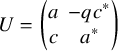 $U=\begin {pmatrix} a & -qc^* \\ c& a^*\end {pmatrix}$
is a unitary corepresentation matrix. Any irreducible representation of
$U=\begin {pmatrix} a & -qc^* \\ c& a^*\end {pmatrix}$
is a unitary corepresentation matrix. Any irreducible representation of $\mathcal {O}_q(SU(2))$
is equivalent to one of the following list of mutually inequivalent irreducible representations: the family of
$\mathcal {O}_q(SU(2))$
is equivalent to one of the following list of mutually inequivalent irreducible representations: the family of $*$
-characters
$*$
-characters $\chi _{\theta }$
and the family of representations
$\chi _{\theta }$
and the family of representations $\mathbf {s}*\chi _{\theta }$
, where
$\mathbf {s}*\chi _{\theta }$
, where $\chi _{\theta }$
is the
$\chi _{\theta }$
is the $*$
-character
$*$
-character
 $$\begin{align*}\chi_{\theta}(U) = \begin{pmatrix} e^{2\pi i\theta} & 0 \\0 & e^{-2\pi i\theta}\end{pmatrix},\qquad \theta \in \mathbb{R}/\mathbb{Z}, \end{align*}$$
and where $\mathbf {s}$
is the representation on
$\mathbf {s}$
is the representation on $l^2(\mathbb {N})$
given by
$l^2(\mathbb {N})$
given by
 $$\begin{align*}\mathbf{s}(a)e_n = (1-q^{2n})^{1/2}e_{n-1},\qquad \mathbf{s}(c)e_n = q^{n} e_{n}. \end{align*}$$
Now $\mathcal {O}_q(SU(2))$
is dual to
$\mathcal {O}_q(SU(2))$
is dual to $U_q(\mathfrak {su}(2))$
, defined as the
$U_q(\mathfrak {su}(2))$
, defined as the $*$
-subalgebra of
$*$
-subalgebra of $U_q(\mathfrak {u}(2))$
generated by
$U_q(\mathfrak {u}(2))$
generated by $E,F,\hat {K}^{\pm 1}$
. Since
$E,F,\hat {K}^{\pm 1}$
. Since $U_q(\mathfrak {su}(2))$
has for each
$U_q(\mathfrak {su}(2))$
has for each $1\leq i < N$
a copy in
$1\leq i < N$
a copy in $U_q(\mathfrak {u}(N))$
, generated by
$U_q(\mathfrak {u}(N))$
, generated by $E_i, F_i$
and
$E_i, F_i$
and $\hat {K}_i$
, we obtain a corresponding restriction map
$\hat {K}_i$
, we obtain a corresponding restriction map
 $$\begin{align*}\mathrm{res}_i: \mathcal{O}_q(U(N)) \rightarrow \mathcal{O}_q(SU(2)),\qquad 1\leq i <N. \end{align*}$$
We denote $\mathbf {s}_i = \mathbf {s} \circ \mathrm {res}_i$
. On the other hand, we also have for
$\mathbf {s}_i = \mathbf {s} \circ \mathrm {res}_i$
. On the other hand, we also have for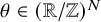 $\theta \in (\mathbb {R}/\mathbb {Z})^N$
the
$\theta \in (\mathbb {R}/\mathbb {Z})^N$
the $*$
-character
$*$
-character
 $$\begin{align*}\chi_{\theta}: \mathcal{O}_q(U(N)) \rightarrow \mathbb{C},\quad U_{kl} \mapsto \delta_{kl} e^{2\pi i \theta_k}. \end{align*}$$
Theorem 1.14 [Reference KoelinkKoe91, Reference Levendorskii and SoibelmanLS91]
The C $^*$
-algebra
$^*$
-algebra $C_q(U(N))$
is type I. Any irreducible representation of
$C_q(U(N))$
is type I. Any irreducible representation of $\mathcal {O}_q(U(N))$
is isomorphic to a representation
$\mathcal {O}_q(U(N))$
is isomorphic to a representation $\mathbf {s}_w* \chi _{\theta }$
, where
$\mathbf {s}_w* \chi _{\theta }$
, where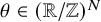 $\theta \in (\mathbb {R}/\mathbb {Z})^N$
, where
$\theta \in (\mathbb {R}/\mathbb {Z})^N$
, where  , and where $\mathbf {s}_w = \mathbf {s}_{i_1}*\ldots *\mathbf {s}_{i_k}$
for
$\mathbf {s}_w = \mathbf {s}_{i_1}*\ldots *\mathbf {s}_{i_k}$
for $w = s_{i_1}s_{i_2}\ldots s_{i_k}$
a reduced expression in terms of the elementary transpositions
$w = s_{i_1}s_{i_2}\ldots s_{i_k}$
a reduced expression in terms of the elementary transpositions $s_i = (i,i+1)$
. Any two of these irreducible representations are unitarily equivalent if and only if the corresponding elements in
$s_i = (i,i+1)$
. Any two of these irreducible representations are unitarily equivalent if and only if the corresponding elements in  and
and $(\mathbb {R}/\mathbb {Z})^N$
are equal.
$(\mathbb {R}/\mathbb {Z})^N$
are equal.
In particular, $\mathbf {s}_w$
only depends on the reduced decomposition of w up to unitary equivalence.
$\mathbf {s}_w$
only depends on the reduced decomposition of w up to unitary equivalence.
We also have the following theorem which is a direct consequence of [Reference Reshetikhin and YakimovRY01, Theorem 5.2]. We call a representation of $\mathcal {O}_q(U(N))$
normal if it lifts to a normal representation of the von Neumann algebra
$\mathcal {O}_q(U(N))$
normal if it lifts to a normal representation of the von Neumann algebra
 $$\begin{align*}L^{\infty}_q(U(N)) := \lambda_{{\mathrm{st}}}(\mathcal{O}_q(U(N)))". \end{align*}$$
Theorem 1.15. Let $M=\binom {N}{2}$
, and let
$M=\binom {N}{2}$
, and let $s_{i_1}\ldots s_{i_{M}}$
be a fixed reduced expression for the longest word
$s_{i_1}\ldots s_{i_{M}}$
be a fixed reduced expression for the longest word $w_0$
in
$w_0$
in  . Let
. Let $\mathbf {s}_{w_0} = \mathbf {s}_{i_1}*\ldots *\mathbf {s}_{i_{M}}$
. Then
$\mathbf {s}_{w_0} = \mathbf {s}_{i_1}*\ldots *\mathbf {s}_{i_{M}}$
. Then
 $$\begin{align*}\lambda_0 = \int_{(\mathbb{R}/\mathbb{Z})^N} \mathbf{s}_{w_0}*\chi_{\theta}{\mathrm{d}\!} \theta \end{align*}$$
is a faithful normal representation of $\mathcal {O}_q(U(N))$
. Moreover,
$\mathcal {O}_q(U(N))$
. Moreover,
 $$\begin{align*}\lambda_{{\mathrm{st}}} \cong \int_{(\mathbb{R}/\mathbb{Z})^N}\mathbf{s}_{w_0}*\mathbf{s}_{w_0}*\chi_{\theta}{\mathrm{d}\!} \theta \cong \oplus_{\mathbb{N}} \lambda_0. \end{align*}$$
1.4 The W
$^*$
-category
$\mathbf {T}_q(N)$


Definition 1.16. We define $\mathcal {O}_q(B(N))$
as the quotient algebra of
$\mathcal {O}_q(B(N))$
as the quotient algebra of $\mathcal {O}_q(GL(N,\mathbb {C}))$
by putting
$\mathcal {O}_q(GL(N,\mathbb {C}))$
by putting $x_{ij} =0$
for
$x_{ij} =0$
for $i>j$
. We denote by
$i>j$
. We denote by
 $$\begin{align*}\pi_B: \mathcal{O}_q(GL(N,\mathbb{C})) \rightarrow \mathcal{O}_q(B(N)) \end{align*}$$
the quotient map. We write the resulting images of $x_{ij}$
as
$x_{ij}$
as $t_{ij}$
(when not zero).
$t_{ij}$
(when not zero).
In the following, we put $t_{ii} = t_i$
. Then
$t_{ii} = t_i$
. Then $\mathcal {O}_q(B(N))$
is the universal algebra generated by invertible elements
$\mathcal {O}_q(B(N))$
is the universal algebra generated by invertible elements $t_{i}$
for
$t_{i}$
for $1\leq i\leq N$
and elements
$1\leq i\leq N$
and elements $t_{ij}$
with
$t_{ij}$
with $1\leq i<j\leq N$
such that the following relations hold:
$1\leq i<j\leq N$
such that the following relations hold:
 $$\begin{align*}t_i t_{kl} = q^{\delta_{ik}-\delta_{il}}t_{kl}t_i,\qquad k\leq l, \end{align*}$$
 $$ \begin{align} \left\{\begin{array}{lll} t_{ij} t_{kj} = q t_{kj}t_{ij} & \textrm{for} & i<k<j,\\ t_{ij} t_{ik} = qt_{ik}t_{ij} &\textrm{for}&i<j<k,\\ t_{ij} t_{kl} = t_{kl} t_{ij}&\textrm{for}& i< k \textrm{ and } j>l,\\ t_{ij}t_{kl} =t_{kl}t_{ij} + (q-q^{-1})t_{il}t_{kj} & \textrm{for}&i<k\textrm{ and } j<l. \end{array}\right. \end{align} $$
The pairing (1.19) restricts to a nondegenerate pairing of Hopf algebras
 $$ \begin{align} \tau: \mathcal{O}_q(B(N))\times U_q(\mathfrak{b}(N))\rightarrow \mathbb{C}. \end{align} $$
On the other hand, we have the following result which is for example contained in [Reference Klimyk and SchmüdgenKS97, Theorem 8.33].
Lemma 1.17. There is an isomorphism of Hopf algebras
 $$ \begin{align} \kappa: U_q(\mathfrak{b}^-(N))^{\mathrm{cop}}\rightarrow \mathcal{O}_q(B(N)),\qquad K_i \mapsto t_{i}^{-1},\quad F_i \mapsto (q^{-1}-q)^{-1} t_{i,i+1}t_{i+1}^{-1}. \end{align} $$
We denote the inverse as
 $$ \begin{align} \iota: \mathcal{O}_q(B(N))\rightarrow U_q(\mathfrak{b}^-(N))^{\mathrm{cop}}, \end{align} $$
so in particular
 $$\begin{align*}\iota(t_{i}) = K_i^{-1},\qquad \iota(t_{i,i+1}) = (q^{-1}-q)F_iK_{i+1}^{-1}. \end{align*}$$
The inverse map $\iota $
has a more conceptual description as follows. With
$\iota $
has a more conceptual description as follows. With $\Sigma $
the flip map, consider the Yang-Baxter matrix
$\Sigma $
the flip map, consider the Yang-Baxter matrix
 $$\begin{align*}R = \Sigma \circ \hat{R} = \sum_{i,j} q^{-\delta_{ij}}e_{ii}\otimes e_{jj} + (q^{-1} -q)\sum_{i<j} e_{ij} \otimes e_{ji}. \end{align*}$$
From R one obtains the skew bicharacter $\mathbf {r}: \mathcal {O}_q(M_N(\mathbb {C}))\otimes \mathcal {O}_q(M_N(\mathbb {C})) \rightarrow \mathbb {C}$
, uniquely determined by
$\mathbf {r}: \mathcal {O}_q(M_N(\mathbb {C}))\otimes \mathcal {O}_q(M_N(\mathbb {C})) \rightarrow \mathbb {C}$
, uniquely determined by
 $$ \begin{align} ({\mathrm{id}}\otimes {\mathrm{id}}\otimes \mathbf{r})(X_{13}X_{24}) = R. \end{align} $$
This follows from the relations of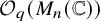 $\mathcal {O}_q(M_n(\mathbb {C}))$
, together with the defining properties of a skew bicharacter:
$\mathcal {O}_q(M_n(\mathbb {C}))$
, together with the defining properties of a skew bicharacter:
 $$ \begin{align} \mathbf{r}(ab,c) = \mathbf{r}(a,c_{(1)})\mathbf{r}(b,c_{(2)}),\quad \mathbf{r}(a,bc) = \mathbf{r}(a_{(2)},b)\mathbf{r}(a_{(1)},c),\qquad \mathbf{r}(a,1) = \varepsilon(a),\quad \mathbf{r}(1,b) = \varepsilon(b). \end{align} $$
This skew bicharacter automatically extends to $\mathcal {O}_q(GL(N,\mathbb {C}))$
.
$\mathcal {O}_q(GL(N,\mathbb {C}))$
.
Through (1.21), we can view $\mathbf {r}$
as being induced by an element
$\mathbf {r}$
as being induced by an element
 $$\begin{align*}\mathscr{R} \in \mathscr{U}_q(\mathfrak{gl}(N,\mathbb{C})) \widehat{\otimes} \mathscr{U}_q(\mathfrak{gl}(N,\mathbb{C})) = \prod_{\lambda,\kappa\in P_{{\mathrm{int}}}^{{\mathrm{dom}}}} {\mathrm{End}}(V_{\lambda}) \otimes {\mathrm{End}}(V_{\kappa}), \end{align*}$$
the universal R-matrix, which then satisfies
 $$ \begin{align} (\Delta\otimes {\mathrm{id}})\mathscr{R} = \mathscr{R}_{13}\mathscr{R}_{23},\quad ({\mathrm{id}}\otimes \Delta)\mathscr{R} = \mathscr{R}_{13}\mathscr{R}_{12}, \end{align} $$
 $$ \begin{align} \mathscr{R} \Delta(-) = \Delta^{\mathrm{op}}(-)\mathscr{R}. \end{align} $$
These identities can be interpreted within the dual vector space of $\otimes _{i=1}^n \mathcal {O}_q(GL(N,\mathbb {C}))$
for appropriate n. We further have that
$\otimes _{i=1}^n \mathcal {O}_q(GL(N,\mathbb {C}))$
for appropriate n. We further have that
 $$ \begin{align} \mathscr{R}(\xi\otimes \eta) = q^{-(\mathrm{wt}(\xi),\mathrm{wt}(\eta))}\xi\otimes \eta \end{align} $$
for a highest weight vector $\xi $
and lowest weight vector
$\xi $
and lowest weight vector $\eta $
. Together with (1.32) this uniquely determines
$\eta $
. Together with (1.32) this uniquely determines $\mathscr {R}$
.
$\mathscr {R}$
.
We will need the following information on $\mathscr {R}$
. For
$\mathscr {R}$
. For $\alpha \in Q^+ \subseteq \mathbb {R}^N$
, consider the finite-dimensional spaces
$\alpha \in Q^+ \subseteq \mathbb {R}^N$
, consider the finite-dimensional spaces
 $$ \begin{align} U_q(\mathfrak{n}(N))_{\alpha} = \{X \in U_q(\mathfrak{n}(N))\mid K_i XK_i^{-1} = q^{\alpha_i}X\}, \end{align} $$
 $$ \begin{align} U_q(\mathfrak{n}^-(N))_{-\alpha} = \{X \in U_q(\mathfrak{n}^-(N))\mid K_i XK_i^{-1} = q^{-\alpha_i}X\}. \end{align} $$
Then one can factorize
 $$ \begin{align} \mathscr{R} = \widetilde{\mathscr{R}} \mathscr{Q}, \end{align} $$
where for general weight vectors $\xi ,\eta $
 $$ \begin{align} \mathscr{Q}(\xi\otimes \eta) = q^{-(\mathrm{wt}(\xi),\mathrm{wt}(\eta))}\xi\otimes \eta \end{align} $$
and
 $$ \begin{align} \widetilde{\mathscr{R}} = \sum_{\alpha \in Q^+} \widetilde{\mathscr{R}}_{\alpha},\qquad \widetilde{\mathscr{R}}_{\alpha} \in U_q(\mathfrak{n}(N))_{\alpha} \otimes U_q(\mathfrak{n}^-(N))_{-\alpha}. \end{align} $$
The latter sum converges weakly as a functional on $\mathcal {O}_q(GL(N,\mathbb {C}))^{\otimes 2}$
: for any
$\mathcal {O}_q(GL(N,\mathbb {C}))^{\otimes 2}$
: for any $f,g\in \mathcal {O}_q(GL(N,\mathbb {C}))$
, the sum
$f,g\in \mathcal {O}_q(GL(N,\mathbb {C}))$
, the sum
 $$\begin{align*}\sum_{\alpha} \tau(f\otimes g,\widetilde{\mathscr{R}}_{\alpha}) \end{align*}$$
contains only finitely many nonzero terms. We have for example, for $\mathbf {a}_r = e_r - e_{r+1}$
,
$\mathbf {a}_r = e_r - e_{r+1}$
,
 $$ \begin{align} \widetilde{\mathscr{R}}_{0} = 1\otimes 1,\qquad \widetilde{\mathscr{R}}_{\mathbf{a}_r} = (q^{-1}-q) E_r \otimes F_r. \end{align} $$
It can now be checked that the map
 $$ \begin{align} \mathcal{O}_q(GL(N,\mathbb{C})) \rightarrow \mathscr{U}_q(\mathfrak{gl}(N,\mathbb{C})),\qquad f\mapsto (\tau(f,-)\otimes {\mathrm{id}})\mathscr{R} \end{align} $$
factors through a map $\mathcal {O}_q(B(N)) \rightarrow U_q(\mathfrak {b}^-(N))$
, which is precisely the map
$\mathcal {O}_q(B(N)) \rightarrow U_q(\mathfrak {b}^-(N))$
, which is precisely the map $\iota $
:
$\iota $
:
 $$ \begin{align} \iota: \mathcal{O}_q(B(N)) \rightarrow U_q(\mathfrak{b}^-(N))^{\mathrm{cop}},\quad f\mapsto (\tau(f,-)\otimes {\mathrm{id}})\mathscr{R}. \end{align} $$
The above gives a quantization of the group of invertible upper triangular matrices as a complex algebraic group. We now want to quantize the underlying real space.
If A is a complex algebra, we denote by $A^{*}$
its formal antilinear, anti-isomorphic copy: it is the unique structure of complex algebra on the set of formal symbols
$A^{*}$
its formal antilinear, anti-isomorphic copy: it is the unique structure of complex algebra on the set of formal symbols $\{a^*\mid a\in A\}$
such that
$\{a^*\mid a\in A\}$
such that
 $$\begin{align*}A \rightarrow A^*,\qquad a \mapsto a^* \end{align*}$$
is an antilinear, antimultiplicative map.
Definition 1.18. The unital $*$
-algebra
$*$
-algebra $\mathcal {O}_q^{\mathbb {R}}(B(N))$
is generated by
$\mathcal {O}_q^{\mathbb {R}}(B(N))$
is generated by $\mathcal {O}_q(B(N))$
and
$\mathcal {O}_q(B(N))$
and $\mathcal {O}_q(B(N))^*$
, with relations
$\mathcal {O}_q(B(N))^*$
, with relations
 $$ \begin{align} T_{23}\hat{R}_{12}T^*_{23} = T^*_{13}\hat{R}_{12}T_{13}. \end{align} $$
We define $\mathcal {O}_q(T(N))$
as the quotient of
$\mathcal {O}_q(T(N))$
as the quotient of $\mathcal {O}_q^{\mathbb {R}}(B(N))$
by putting
$\mathcal {O}_q^{\mathbb {R}}(B(N))$
by putting $t_{i}^* = t_i$
for all i.
$t_{i}^* = t_i$
for all i.
We have that $\mathcal {O}_q(T(N))$
is the universal unital
$\mathcal {O}_q(T(N))$
is the universal unital $*$
-algebra generated by invertible self-adjoint elements
$*$
-algebra generated by invertible self-adjoint elements $t_i=t_{ii}$
for
$t_i=t_{ii}$
for $1\leq i \leq N$
and elements
$1\leq i \leq N$
and elements $t_{ij}$
with
$t_{ij}$
with $1\leq i<j\leq N$
such that (1.25) holds, as well as
$1\leq i<j\leq N$
such that (1.25) holds, as well as
 $$ \begin{align} \left\{\begin{array}{lllll} t_{kj}t_{li}^{*} - t_{li}^{*}t_{kj}&=&0,&& i\neq j, k\neq l,\\ t_{kj}t_{lj}^{*} - qt_{lj}^{*}t_{kj}&=& -(1-q^2)\sum_{i<j} t_{ki}t_{li}^{*} ,&&k\neq l,\\ qt_{kj}t_{ki}^{*}- t_{ki}^{*}t_{kj} &=& (1-q^2)\sum_{k<l\leq\mathrm{min}\{i,j\}} t_{li}^{*}t_{lj},&& i\neq j, \\ t_{kj}t_{kj}^{*}- t_{kj}^{*}t_{kj} &=& (1-q^2)\left(\sum_{k<l\leq j} t_{lj}^{*}t_{lj} - \sum_{k\leq l<j} t_{kl}t_{kl}^{*}\right). && \end{array}\right. \end{align} $$
Then $\mathcal {O}_q(T(N))$
is a Hopf
$\mathcal {O}_q(T(N))$
is a Hopf $*$
-algebra for the unique coproduct such that
$*$
-algebra for the unique coproduct such that
 $$ \begin{align} ({\mathrm{id}}\otimes \Delta)(T) = T_{12}T_{13}. \end{align} $$
The Hopf algebra isomorphism (1.27) extends uniquely to a Hopf $*$
-algebra isomorphism
$*$
-algebra isomorphism
 $$ \begin{align} \kappa: U_q(\mathfrak{u}(N))^{\mathrm{cop}} \rightarrow \mathcal{O}_q(T(N)). \end{align} $$
whose inverse we again denote by
 $$ \begin{align} \iota: \mathcal{O}_q(T(N)) \rightarrow U_q(\mathfrak{u}(N))^{\mathrm{cop}}. \end{align} $$
Consider now the W $^*$
-category
$^*$
-category $\mathbf {T}_q(N)$
of representations
$\mathbf {T}_q(N)$
of representations $\lambda $
of
$\lambda $
of $\mathcal {O}_q(T(N))$
for which the
$\mathcal {O}_q(T(N))$
for which the $\lambda (t_{i})$
are positive operators. Equivalently, we can view
$\lambda (t_{i})$
are positive operators. Equivalently, we can view $\mathbf {T}_q(N)$
as the monoidal W
$\mathbf {T}_q(N)$
as the monoidal W $^*$
-subcategory of
$^*$
-subcategory of $\mathbf {G}\mathbf {L}_q(N,\mathbb {C})$
consisting of all
$\mathbf {G}\mathbf {L}_q(N,\mathbb {C})$
consisting of all $(\mathcal {H},T)$
for which T is upper triangular, with positive, invertible operators on the diagonal. Again, the monoidal structure is the same as the one induced by the coproduct of
$(\mathcal {H},T)$
for which T is upper triangular, with positive, invertible operators on the diagonal. Again, the monoidal structure is the same as the one induced by the coproduct of $\mathcal {O}_q(T(N))$
.
$\mathcal {O}_q(T(N))$
.
By the $*$
-isomorphism (1.46), a finite-dimensional admissible
$*$
-isomorphism (1.46), a finite-dimensional admissible $U_q(\mathfrak {u}(N))$
-representation becomes a
$U_q(\mathfrak {u}(N))$
-representation becomes a $\mathcal {O}_q(T(N))$
-representation in
$\mathcal {O}_q(T(N))$
-representation in $\mathbf {T}_q(N)$
, and we can transfer the unitary irreducible admissible representations
$\mathbf {T}_q(N)$
, and we can transfer the unitary irreducible admissible representations $V_{\lambda }$
for
$V_{\lambda }$
for $\lambda \in P_{{\mathrm {w.int}}}^{{\mathrm {dom}}}$
to representations of
$\lambda \in P_{{\mathrm {w.int}}}^{{\mathrm {dom}}}$
to representations of $\mathcal {O}_q(T(N))$
. We then have the following.
$\mathcal {O}_q(T(N))$
. We then have the following.
Theorem 1.19. Every representation in $\mathbf {T}_q(N)$
is a direct integral (with multiplicities) of irreducible representations. The irreducible representations in
$\mathbf {T}_q(N)$
is a direct integral (with multiplicities) of irreducible representations. The irreducible representations in $\mathbf {T}_q(N)$
are finite-dimensional, and parametrized by
$\mathbf {T}_q(N)$
are finite-dimensional, and parametrized by $P_{{\mathrm {w.int}}}^{{\mathrm {dom}}}$
.
$P_{{\mathrm {w.int}}}^{{\mathrm {dom}}}$
.
Proof. We only sketch a possible proof. The boundedness of $t_i$
and
$t_i$
and $t_i^{-1}$
, together with their q-commutation relations with
$t_i^{-1}$
, together with their q-commutation relations with $t_{i,i+1}$
and
$t_{i,i+1}$
and $t_{i,i+1}^*$
, implies that each irreducible representation in
$t_{i,i+1}^*$
, implies that each irreducible representation in $\mathbf {T}_q(N)$
must be of the form
$\mathbf {T}_q(N)$
must be of the form $V_{\lambda }$
for
$V_{\lambda }$
for $\lambda \in P_{{\mathrm {w.int}}}^{{\mathrm {dom}}}$
. It then follows from general C
$\lambda \in P_{{\mathrm {w.int}}}^{{\mathrm {dom}}}$
. It then follows from general C $^*$
-algebra theory that if we have a representation in
$^*$
-algebra theory that if we have a representation in $\mathbf {T}_q(N)$
for which the central element
$\mathbf {T}_q(N)$
for which the central element ${\mathrm {Det}}_q(T)=t_1\ldots t_n$
acts as a scalar, the representation must be a direct sum of joint eigenspaces for the
${\mathrm {Det}}_q(T)=t_1\ldots t_n$
acts as a scalar, the representation must be a direct sum of joint eigenspaces for the $t_i$
, and hence must be a (possibly infinite) direct sum of
$t_i$
, and hence must be a (possibly infinite) direct sum of $V_{\lambda }$
’s. On the other hand, any representation in
$V_{\lambda }$
’s. On the other hand, any representation in $\mathbf {T}_q(N)$
can be written as a direct integral of representations for which the central element
$\mathbf {T}_q(N)$
can be written as a direct integral of representations for which the central element ${\mathrm {Det}}_q(T)$
is a positive scalar. Combining these two facts, we obtain the result in the theorem.
${\mathrm {Det}}_q(T)$
is a positive scalar. Combining these two facts, we obtain the result in the theorem.
1.5 The W
$^*$
-category
$\mathbf {G}\mathbf {L}_q(N,\mathbb {C})$


Definition 1.20. We define the FRT double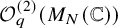 $\mathcal {O}_{q}^{(2)}(M_N(\mathbb {C}))$
as the universal
$\mathcal {O}_{q}^{(2)}(M_N(\mathbb {C}))$
as the universal $\mathbb {C}$
-algebra generated by the matrix entries of
$\mathbb {C}$
-algebra generated by the matrix entries of $X = \sum _{ij} e_{ij} \otimes x_{ij}$
and
$X = \sum _{ij} e_{ij} \otimes x_{ij}$
and $Y = \sum _{ij} e_{ij} \otimes y_{ij}$
with universal relations
$Y = \sum _{ij} e_{ij} \otimes y_{ij}$
with universal relations
 $$ \begin{align} \hat{R}_{12}X_{13}X_{23} = X_{13}X_{23}\hat{R}_{12},\qquad \hat{R}_{12}Y_{23}Y_{13} = Y_ {23}Y_{13}\hat{R}_{12},\qquad X_{23}\hat{R}_{12}Y_{23} = Y_{13}\hat{R}_{12}X_{13}. \end{align} $$
We define $\mathcal {O}_{q}^{\mathbb {R}}(M_N(\mathbb {C}))$
as
$\mathcal {O}_{q}^{\mathbb {R}}(M_N(\mathbb {C}))$
as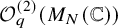 $\mathcal {O}_{q}^{(2)}(M_N(\mathbb {C}))$
endowed with the
$\mathcal {O}_{q}^{(2)}(M_N(\mathbb {C}))$
endowed with the $*$
-structure
$*$
-structure
 $$\begin{align*}X^{*} = Y,\qquad Y^{*} = X. \end{align*}$$
The commutation relations can be written out as follows: apart from the relations in (1.15), we also have
 $$ \begin{align} \left\{\begin{array}{lllll} x_{kj} x_{li}^{*} - x_{li}^{*}x_{kj}&=&0,&& i\neq j, k\neq l,\\ x_{kj}x_{lj}^{*} - qx_{lj}^{*}x_{kj}&=& -(1-q^2)\sum_{i<j} x_{ki}x_{li}^{*} ,&&k\neq l,\\ qx_{kj}x_{ki}^{*}- x_{ki}^{*}x_{kj} &=& (1-q^2)\sum_{k<l} x_{li}^{*}x_{lj},&& i\neq j, \\ x_{kj}x_{kj}^{*}- x_{kj}^{*}x_{kj} &=& (1-q^2)\left(\sum_{k<l} x_{lj}^{*}x_{lj} - \sum_{l<j} x_{kl}x_{kl}^{*}\right). && \end{array}\right. \end{align} $$
The element ${\mathrm {Det}}_q(X)$
is central in
${\mathrm {Det}}_q(X)$
is central in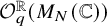 $\mathcal {O}_{q}^{\mathbb {R}}(M_N(\mathbb {C}))$
[Reference De Commer and FloréDCF19, Lemma 3.5], so with
$\mathcal {O}_{q}^{\mathbb {R}}(M_N(\mathbb {C}))$
[Reference De Commer and FloréDCF19, Lemma 3.5], so with ${\mathrm {Det}}_q(X^{*}) := {\mathrm {Det}}_q(X)^{*}$
, we can define the Hopf
${\mathrm {Det}}_q(X^{*}) := {\mathrm {Det}}_q(X)^{*}$
, we can define the Hopf $*$
-algebra
$*$
-algebra $\mathcal {O}_q^{\mathbb {R}}(GL(N,\mathbb {C}))$
as the localisation
$\mathcal {O}_q^{\mathbb {R}}(GL(N,\mathbb {C}))$
as the localisation
 $$\begin{align*}\mathcal{O}_{q}^{\mathbb{R}}(GL(N,\mathbb{C})) = \mathcal{O}_{q}^{\mathbb{R}}(M_N(\mathbb{C}))[{\mathrm{Det}}_q(X)^{-1},{\mathrm{Det}}_q(X^{*})^{-1}]. \end{align*}$$
The W $^*$
-category
$^*$
-category $\mathbf {G}\mathbf {L}_q(N,\mathbb {C})$
, defined below (0.11), can be identified with the representation category of
$\mathbf {G}\mathbf {L}_q(N,\mathbb {C})$
, defined below (0.11), can be identified with the representation category of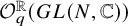 $\mathcal {O}_q^{\mathbb {R}}(GL(N,\mathbb {C}))$
: we only need to observe that since
$\mathcal {O}_q^{\mathbb {R}}(GL(N,\mathbb {C}))$
: we only need to observe that since ${\mathrm {Det}}_q(X)$
arises as a direct summand of
${\mathrm {Det}}_q(X)$
arises as a direct summand of $X^{\otimes n}$
, any representation of
$X^{\otimes n}$
, any representation of $\mathcal {O}_q^{\mathbb {R}}(M_N(\mathbb {C}))$
for which the image of X is invertible, extends to a
$\mathcal {O}_q^{\mathbb {R}}(M_N(\mathbb {C}))$
for which the image of X is invertible, extends to a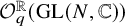 $\mathcal {O}_q^{\mathbb {R}}(\mathrm {GL}(N,\mathbb {C}))$
-representation.
$\mathcal {O}_q^{\mathbb {R}}(\mathrm {GL}(N,\mathbb {C}))$
-representation.
We have natural quotient maps of Hopf $*$
-algebras
$*$
-algebras
 $$\begin{align*}\pi_U: \mathcal{O}_q^{\mathbb{R}}(GL(N,\mathbb{C})) \rightarrow \mathcal{O}_q(U(N)),\qquad X \mapsto U, \end{align*}$$
 $$\begin{align*}\pi_T: \mathcal{O}_q^{\mathbb{R}}(GL(N,\mathbb{C}))\rightarrow \mathcal{O}_q(T(N)),\quad X\mapsto T, \end{align*}$$
leading to W $^*$
-functors
$^*$
-functors


The following is a categorical analogue of the Gauss decomposition.
Theorem 1.21. For any irreducible representation $\lambda $
in
$\lambda $
in $\mathbf {G}\mathbf {L}_q(N,\mathbb {C})$
, there exist unique (up to unitary equivalence) irreducible representations
$\mathbf {G}\mathbf {L}_q(N,\mathbb {C})$
, there exist unique (up to unitary equivalence) irreducible representations $\lambda _U,\lambda _U'$
in
$\lambda _U,\lambda _U'$
in $\mathbf {U}_q(N)$
and unique (up to unitary equivalence) irreducible representations
$\mathbf {U}_q(N)$
and unique (up to unitary equivalence) irreducible representations $\lambda _T,\lambda _T'$
in
$\lambda _T,\lambda _T'$
in $\mathbf {T}_q(N)$
such that
$\mathbf {T}_q(N)$
such that

Proof. The proof of [Reference De Commer and FloréDCF19, Proposition 4.18] can be immediately adapted.
More generally, [Reference De Commer and FloréDCF19, Proposition 4.18] implies that any representation of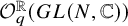 $\mathcal {O}_q^{\mathbb {R}}(GL(N,\mathbb {C}))$
is weakly contained in a representation of the form
$\mathcal {O}_q^{\mathbb {R}}(GL(N,\mathbb {C}))$
is weakly contained in a representation of the form  for
for $\lambda \in \mathbf {U}_q(N)$
and
$\lambda \in \mathbf {U}_q(N)$
and $\lambda '\in \mathbf {T}_q(N)$
.
$\lambda '\in \mathbf {T}_q(N)$
.
2 The W
$^*$
-category
$\mathbf {H}_q(N)$


2.1 Quantum hermitian matrices
Consider $\mathcal {O}_q(H(N))$
as defined via (0.5). Writing
$\mathcal {O}_q(H(N))$
as defined via (0.5). Writing $\tau = q^{-1}-q$
, these relations can be written out entrywise as
$\tau = q^{-1}-q$
, these relations can be written out entrywise as
 $$ \begin{align} q^{-\delta_{ik} -\delta_{jk}} & z_{ij} z_{kl} + \delta_{k<i}\tau q^{-\delta_{ij}} z_{kj}z_{il} +\delta_{jk} \tau q^{-\delta_{ij}}\sum_{p<j} z_{ip} z_{pl} + \delta_{ij} \delta_{k<i}\tau^2 \sum_{p<i} z_{kp}z_{pl} \nonumber\\ & = q^{-\delta_{il}-\delta_{jl}} z_{kl} z_{ij} + \delta_{l<j}\tau q^{-\delta_{ij}} z_{kj}z_{il} + \delta_{il}\tau q^{-\delta_{ij}} \sum_{p<i} z_{kp}z_{pj} +\delta_{ij}\delta_{l<j} \tau \sum_{p<j} z_{kp}z_{pl}. \end{align} $$
In [Reference MudrovMud02, Theorem 2.2], using just the above relations, Mudrov was able to classify all characters of the reflection equation algebra. From this, we can easily obtain also a classification of all $*$
-characters
Footnote 4
$*$
-characters
Footnote 4
 $$\begin{align*}\chi: \mathcal{O}_q(H(N)) \rightarrow \mathbb{C}. \end{align*}$$
Theorem 2.1. Each $*$
-character
$*$
-character $\chi $
of
$\chi $
of $\mathcal {O}_q(H(N))$
is of the form
$\mathcal {O}_q(H(N))$
is of the form $\chi = \chi _{k,l,a,c,y}$
where
$\chi = \chi _{k,l,a,c,y}$
where
-
○
$k,l\in \mathbb {Z}_{\geq 0}$
with
$k+l \leq N-l$
, -
○
$a>0$
and
$c\in \mathbb {R}^{\times }$
, -
○
$y = (y_{0},y_{1},\ldots ,y_{l-1})$
with
$y_i\in \mathbb {C}$
and
$|y_i| = 1$
,







such that
 $$\begin{align*}\chi(Z) = c\left(a \sum_{i = k+l+1}^{N} e_{ii} - a^{-1} \sum_{i=N-l+1}^N e_{ii} + \sum_{i=0}^{l-1} (y_{i} e_{k+i+1,N-i} + \overline{y_{i}} e_{N-i,k+i+1})\right). \end{align*}$$
Proof. It follows immediately from [Reference MudrovMud02, Theorem 2.2] upon checking self-adjointness of the solutions presented there.
For example, for $N= 4$
we have the following types of solutions, where empty entries signify
$N= 4$
we have the following types of solutions, where empty entries signify $0$
:
$0$
:
 $$\begin{align*}\begin{pmatrix} &&& \\ &&& \\ &&& \\ &&& \end{pmatrix}\,,\quad \begin{pmatrix} &&& \\ &&& \\ &&& \\ &&& c \end{pmatrix}\,,\quad \begin{pmatrix} &&& \\ &&& \\ && c& \\ &&& c \end{pmatrix}\,, \quad \begin{pmatrix} &&& \\ & c&& \\ && c& \\ &&& c \end{pmatrix}\,,\quad \begin{pmatrix} c &&& \\ & c&&\\ && c& \\ &&& c \end{pmatrix}\,, \end{align*}$$
 $$\begin{align*}c \begin{pmatrix} &&& \\ &&& \\ &&& y_0 \\ && \overline{y_0} & a-a^{-1}\end{pmatrix}\,,\quad c\begin{pmatrix} &&& \\ &&& y_0 \\ && a& \\ &\overline{y_0} && a-a^{-1}\end{pmatrix}\,,\quad c\begin{pmatrix} &&& y_0 \\ & a && \\ && a & \\ \overline{y_0} &&& a-a^{-1}\end{pmatrix}\,,\end{align*}$$
 $$\begin{align*}c\begin{pmatrix} &&& y_0 \\ &&y_1 & \\ &\overline{y_1} & a-a^{-1} & \\ \overline{y_0} &&&a-a^{-1}\end{pmatrix}\,. \end{align*}$$
2.2 Classification of irreducible representations for
$N=2$

For $\mathcal {O}_q(H(2))$
, one can work directly from the defining relations to obtain a classification of the irreducible representations.
$\mathcal {O}_q(H(2))$
, one can work directly from the defining relations to obtain a classification of the irreducible representations.
Fix in the following $N=2$
, and write
$N=2$
, and write
 $$\begin{align*}Z = \begin{pmatrix} z & w \\ v & u\end{pmatrix} \in M_2(\mathcal{O}_q(H(2))). \end{align*}$$
Define the quantum trace T and quantum determinant D to be
 $$\begin{align*}T = {\mathrm{Tr}}_q(Z) = qz + q^{-1}u,\qquad D = {\mathrm{Det}}_q(Z) = uz -q^{-2}vw. \end{align*}$$
We find by a tedious but direct comparison with (2.1) that the universal relations of $\mathcal {O}_q(H(2))$
are centrality and self-adjointness of
$\mathcal {O}_q(H(2))$
are centrality and self-adjointness of $T,D$
together with the relations
$T,D$
together with the relations
 $$\begin{align*}z^* = z,\quad w^* = v,\quad zw = q^2wz,\qquad vz = q^2zv \end{align*}$$
and
 $$\begin{align*}q^{-2}vw = -D+qTz - q^{2}z^2,\qquad q^{-2}wv = -D+q^{-1}Tz -q^{-2}z^2. \end{align*}$$
For A a unital commutative $*$
-algebra, write
$*$
-algebra, write ${\mathrm {Spec}}_*(A)$
for the space of unital
${\mathrm {Spec}}_*(A)$
for the space of unital $*$
-characters. For A a general
$*$
-characters. For A a general $*$
-algebra, write
$*$
-algebra, write $\mathscr {Z}(A)$
for the centre of A.
$\mathscr {Z}(A)$
for the centre of A.
Exploiting the fact that z either commutes or $q^{\pm 2}$
-commutes with all generators, one sees that
$q^{\pm 2}$
-commutes with all generators, one sees that $\pi (z)$
must be diagonalizable for any irreducible representation
$\pi (z)$
must be diagonalizable for any irreducible representation $\pi $
, and that moreover
$\pi $
, and that moreover $\pi (v)$
must vanish on some eigenvector of
$\pi (v)$
must vanish on some eigenvector of $\pi (z)$
if
$\pi (z)$
if $\pi (z)$
is not identically zero. The reader will then have no difficulty in providing the details for the following proposition.
$\pi (z)$
is not identically zero. The reader will then have no difficulty in providing the details for the following proposition.
Proposition 2.2. We have $\mathscr {Z}(\mathcal {O}_q(H(2))) \cong \mathbb {C}[D,T]$
. Identifying
$\mathscr {Z}(\mathcal {O}_q(H(2))) \cong \mathbb {C}[D,T]$
. Identifying ${\mathrm {Spec}}_*(\mathbb {C}[D,T])\cong \mathbb {R}^2/{\mathrm {Sym}}(2)$
via
${\mathrm {Spec}}_*(\mathbb {C}[D,T])\cong \mathbb {R}^2/{\mathrm {Sym}}(2)$
via
 $$\begin{align*}\chi \mapsto \{\textrm{roots of }\lambda^2 -\chi(T)\lambda + \chi(D)\}, \end{align*}$$
we have that there exists a (nonzero) irreducible representation of $\mathcal {O}_q(H(2))$
fibering over
$\mathcal {O}_q(H(2))$
fibering over $\lambda \in \mathbb {R}^2/{\mathrm {Sym}}(2)$
if and only if
$\lambda \in \mathbb {R}^2/{\mathrm {Sym}}(2)$
if and only if
 $$\begin{align*}\lambda \in \Lambda_q = \Lambda_- \cup \Lambda_0 \cup \Lambda_+ \end{align*}$$
with
 $$ \begin{align*} \Lambda_0 &= \{\{0,\lambda\}\mid \lambda \in \mathbb{R}\},\\ \Lambda_+ &= \{\{cq^{n+1},cq^{-n-1}\}\mid c\in \mathbb{R}^{\times}, n\in \mathbb{Z}_{\geq0}\}, \\ \Lambda_- &= \{\{\lambda_+,\lambda_-\}\mid \lambda_+ \in \mathbb{R}_{>0},\lambda_- \in \mathbb{R}_{<0}\}. \end{align*} $$
More precisely:
-
(1) There is a unique irreducible representation fibering over
$\{cq^{n+1},cq^{-n-1}\}\in \Lambda _+$
, namely
$$\begin{align*}\mathcal{S}_{c^2,n}\cong \mathbb{C}^{n+1},\qquad ze_k= cq^{-n+2k}e_k,\quad ve_0 = 0. \end{align*}$$
We say that it has rank
$2$
and shape
$\begin {pmatrix} \mathrm {sgn}(c) & 0 \\ 0 & \mathrm {sgn}(c) \end {pmatrix}$
. -
(2) For
$\{0,\lambda \} \in \Lambda _0$
we have the
$*$
-character
$\chi (z) = \chi (v) = \chi (w) =0$
. When
$\lambda =0$
this is the only irreducible representation, and we say that it has rank
$0$
. If
$\lambda \neq 0$
the only other irreducible representation is given by and we say that it has rank
$$\begin{align*}\mathcal{S}_{0,\lambda} \cong l^2(\mathbb{N}),\quad ze_n = q^{2n+1}\lambda e_n,\quad ve_0 = 0, \end{align*}$$
$1$
and shape
$\begin {pmatrix} 1 & 0 \\ 0 & 0 \end {pmatrix}$
.
-
(3) For
$\{ca,-ca^{-1}\} \in \Lambda _-$
with
$a,c>0$
, we have as complete list of nonequivalent irreducible representations the following.-
(a) The
$*$
-characters
$\chi _{\theta }$
for
$\theta \in [0,1)$
, with
$\chi _{\theta }(z)= 0$
and
$\chi _{\theta }(v) = qce^{2\pi i\theta }$
. We say that they have rank
$2$
and shape
$\begin {pmatrix} 0 & e^{-2\pi i\theta } \\ e^{2\pi i\theta } & 0 \end {pmatrix}$
. -
(b) The representations
$$\begin{align*}\mathcal{S}^{\pm}_{-c^2,a} \cong l^2(\mathbb{N}),\qquad ze_n = \pm ca^{\pm 1} q^{2n+1}e_n,\qquad ve_0 =0. \end{align*}$$
We say that they have rank
$2$
and shape
$\begin {pmatrix} \pm 1 & 0 \\ 0 & \mp 1\end {pmatrix}$
.
-



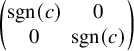


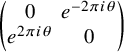


A general definition of the rank of a representation will be given in Section 2.7. The terminology ‘shape’ will be further motivated and generalized in [Reference De Commer and MooreDCMo25].
Corollary 2.3. The $*$
-algebra
$*$
-algebra $\mathcal {O}_q(H(2))$
is type I.
$\mathcal {O}_q(H(2))$
is type I.
Proof. One immediately checks that $\pi (z)$
is always a nonzero compact operator, for any of the nonscalar irreducible representations
$\pi (z)$
is always a nonzero compact operator, for any of the nonscalar irreducible representations $\pi $
in Proposition 2.2.
$\pi $
in Proposition 2.2.
2.3 Covariantisation
For the following, see, for example, [Reference MajidMaj95], [Reference Klimyk and SchmüdgenKS97, Chapter 8-10] or [Reference Donin, Kulish and MudrovDKM03].
Recall the skew bicharacter $\mathbf {r}$
from (1.29). This defines a coquasitriangular structure on
$\mathbf {r}$
from (1.29). This defines a coquasitriangular structure on $\mathcal {O}_q(GL(N,\mathbb {C}))$
, in the sense that we also have the ‘braided commutativity’ property
$\mathcal {O}_q(GL(N,\mathbb {C}))$
, in the sense that we also have the ‘braided commutativity’ property
 $$ \begin{align} \mathbf{r}(a_{(1)},b_{(1)})a_{(2)}b_{(2)} = b_{(1)}a_{(1)} \mathbf{r}(a_{(2)},b_{(2)}). \end{align} $$
Since R is invertible, the functional $\mathbf {r}: A\otimes A \rightarrow \mathbb {C}$
has a convolution inverse
$\mathbf {r}: A\otimes A \rightarrow \mathbb {C}$
has a convolution inverse $\mathbf {r}^{-1}$
, where we endow
$\mathbf {r}^{-1}$
, where we endow $A\otimes A$
with the tensor product coalgebra structure. Then (2.2) can alternatively be written as
$A\otimes A$
with the tensor product coalgebra structure. Then (2.2) can alternatively be written as
 $$ \begin{align} \mathbf{r}^{-1}(b_{(1)},a_{(1)})a_{(2)}b_{(2)} = b_{(1)}a_{(1)} \mathbf{r}^{-1}(b_{(2)},a_{(2)}), \end{align} $$
or as
 $$ \begin{align} ab = \mathbf{r}^{-1}(a_{(1)},b_{(1)})b_{(2)}a_{(2)} \mathbf{r}(a_{(3)},b_{(3)}) = \mathbf{r}(b_{(1)},a_{(1)})b_{(2)}a_{(2)} \mathbf{r}^{-1}(b_{(3)},a_{(3)}). \end{align} $$
However, $\mathbf {r}$
also has a convolution inverse
$\mathbf {r}$
also has a convolution inverse $\mathbf {r}'$
when considered as a functional on
$\mathbf {r}'$
when considered as a functional on $(A,\Delta )\otimes (A,\Delta ^{\mathrm {op}})$
. Then
$(A,\Delta )\otimes (A,\Delta ^{\mathrm {op}})$
. Then $\mathbf {r}'$
is uniquely determined by
$\mathbf {r}'$
is uniquely determined by
 $$\begin{align*}\mathbf{r}'(ab,c) = \mathbf{r}'(a,c_{(2)})\mathbf{r}'(b,c_{(1)}),\quad\!\! \mathbf{r}'(a,bc) = \mathbf{r}'(a_{(1)},b)\mathbf{r}'(a_{(2)},c),\quad\!\! \mathbf{r}'(a,1) = \varepsilon(a),\quad\!\! \mathbf{r}'(1,b) = \varepsilon(b) \end{align*}$$
and, with t the ordinary transpose of a matrix,
 $$\begin{align*}({\mathrm{id}}\otimes {\mathrm{id}}\otimes \mathbf{r}')(X_{13}X_{24}) = R' := ((R^{{\mathrm{id}}\otimes t})^{-1})^{{\mathrm{id}}\otimes t} = \sum_{i,j} q^{\delta_{ij}}e_{ii}\otimes e_{jj} + (q-q^{-1})\sum_{i<j} q^{2(j-i)} e_{ij}\otimes e_{ji}. \end{align*}$$
These properties of $\mathbf {r}$
allow to endow
$\mathbf {r}$
allow to endow $\mathcal {O}_q(M_N(\mathbb {C}))$
with the new product
$\mathcal {O}_q(M_N(\mathbb {C}))$
with the new product
 $$ \begin{align} f*g = \mathbf{r}(f_{(1)},g_{(2)})f_{(2)}g_{(3)} \mathbf{r}'(f_{(3)},g_{(1)}), \end{align} $$
which can be checked to be associative and unital (with the same unit). Inverting (2.5), we obtain that the original product can be obtained from the deformed product via
 $$ \begin{align} fg = \mathbf{r}^{-1}(f_{(1)},g_{(1)})f_{(2)}*g_{(3)} \mathbf{r}(f_{(3)},g_{(2)}). \end{align} $$
One has the following result, see, for example, [Reference MajidMaj95, Section 7.4] or [Reference Klimyk and SchmüdgenKS97, Example 10.18].
Theorem 2.4. There exists a (unique) isomorphism of algebras
 $$ \begin{align} \Phi: \mathcal{O}_q(H(N)) \rightarrow (\mathcal{O}_q(M_N(\mathbb{C})),*),\qquad Z \mapsto X. \end{align} $$
The $*$
-structure of
$*$
-structure of $\mathcal {O}_q(H(N))$
can be transported along
$\mathcal {O}_q(H(N))$
can be transported along $\Phi $
to a
$\Phi $
to a $*$
-structure on
$*$
-structure on $(\mathcal {O}_q(M_N(\mathbb {C})),*)$
, which we denote by
$(\mathcal {O}_q(M_N(\mathbb {C})),*)$
, which we denote by $f \mapsto f^{\#}$
. Concretely, we have
$f \mapsto f^{\#}$
. Concretely, we have
 $$ \begin{align} x_{ij}^{\#} = x_{ji}. \end{align} $$
The above isomorphism allows to define quantum minors inside $\mathcal {O}_q(H(N))$
.
$\mathcal {O}_q(H(N))$
.
Definition 2.5. For  , we define the quantum minors
 $$ \begin{align} z_{IJ} = \Phi^{-1}(x_{IJ}). \end{align} $$
More generally, if V is a $\mathcal {O}_q(M_N(\mathbb {C}))$
-comodule, we denote by
$\mathcal {O}_q(M_N(\mathbb {C}))$
-comodule, we denote by
 $$ \begin{align} X_V(\xi,\eta) \in \mathcal{O}_q(M_N(\mathbb{C})),\qquad \xi,\eta\in V \end{align} $$
the corresponding matrix units, and we similarly write
 $$\begin{align*}Z_V(\xi,\eta) = \Phi^{-1}(X_V(\xi,\eta)) \in \mathcal{O}_q(H(N)). \end{align*}$$
Then the quantum minors $z_{IJ}$
arise as matrix coefficients of
$z_{IJ}$
arise as matrix coefficients of

Lemma 2.6. The $*$
-structure on
$*$
-structure on $\mathcal {O}_q(H(N))$
satisfies
$\mathcal {O}_q(H(N))$
satisfies
 $$ \begin{align} z_{IJ}^* = z_{JI},\qquad Z_V(\xi,\eta)^* = Z_V(\eta,\xi), \end{align} $$
Proof. First note that $\#$
, as defined by (2.8), extends uniquely to an antilinear automorphism on
$\#$
, as defined by (2.8), extends uniquely to an antilinear automorphism on $\mathcal {O}_q(M_N(\mathbb {C}))$
with the original product. This automorphism will then be anticomultiplicative:
$\mathcal {O}_q(M_N(\mathbb {C}))$
with the original product. This automorphism will then be anticomultiplicative:
 $$\begin{align*}\Delta(f^{\#}) =f_{(2)}^{\;\#}\otimes f_{(1)}^{\;\#},\qquad f\in \mathcal{O}_q(M_N(\mathbb{C})). \end{align*}$$
As then
 $$ \begin{align} \mathbf{r}(f^{\#},g^{\#}) = \overline{\mathbf{r}(g,f)},\qquad f,g\in \{x_{ij}\mid 1\leq i,j\leq N\}, \end{align} $$
it follows by (1.30) that (2.13) holds for all $f,g\in \mathcal {O}_q(M_N(\mathbb {C}))$
. The same condition must then hold for
$f,g\in \mathcal {O}_q(M_N(\mathbb {C}))$
. The same condition must then hold for $\mathbf {r}'$
. But this is easily seen to imply (using (2.5) and (2.2)) that
$\mathbf {r}'$
. But this is easily seen to imply (using (2.5) and (2.2)) that
 $$\begin{align*}(f*g)^{\#} = g^{\#}*f^{\#},\qquad f,g\in \mathcal{O}_q(M_N(\mathbb{C})). \end{align*}$$
It follows that $z \mapsto \Phi ^{-1}(\Phi (z)^{\#})$
must coincide with the original
$z \mapsto \Phi ^{-1}(\Phi (z)^{\#})$
must coincide with the original $*$
-structure on
$*$
-structure on $\mathcal {O}_q(H(N))$
, as it coincides on the generators
$\mathcal {O}_q(H(N))$
, as it coincides on the generators $z_{ij}$
.
$z_{ij}$
.
The conclusion now follows by the easy verification that
 $$\begin{align*}X_V(\xi,\eta)^{\#} = X_V(\eta,\xi), \end{align*}$$
using that $\#$
is multiplicative on
$\#$
is multiplicative on $\mathcal {O}_q(M_N(\mathbb {C}))$
with the original product.
$\mathcal {O}_q(M_N(\mathbb {C}))$
with the original product.
2.4 Commutation relations and Laplace expansions
For  and
and 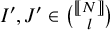 , denote
 $$ \begin{align} \hat{R}^{IJ}_{I'J'} := \mathbf{r}(x_{JI},x_{I'J'}) \end{align} $$
and

By the braided commutativity (2.2), one gets that

Lemma 2.7. We have
 $$ \begin{align} \hat{R}^{IJ}_{I'J'} \neq 0 \quad \textrm{only if}\quad J\preceq I,J'\preceq I'\quad \textrm{and}\quad J \setminus I = J'\setminus I',\;I\setminus J = I'\setminus J'. \end{align} $$
Moreover,
 $$\begin{align*}\hat{R}^{II}_{I'I'} = q^{- |I\cap I'|}. \end{align*}$$
We also write  and
and

The $(\hat {R}^{-1})_{I'J'}^{IJ}$
satisfy the same conditions (2.16) except that now
$(\hat {R}^{-1})_{I'J'}^{IJ}$
satisfy the same conditions (2.16) except that now $(\hat {R}^{-1})^{II}_{I'I'} = q^{|I\cap I'|}$
.
$(\hat {R}^{-1})^{II}_{I'I'} = q^{|I\cap I'|}$
.
We have the following q-analogue of the Laplace expansion [Reference Parshall and WangPW91, Theorem 4.4.3], which can be obtained by using the comodule algebra $\wedge _q(\mathbb {C}^N)$
. We use the notation as introduced in (0.16).
$\wedge _q(\mathbb {C}^N)$
. We use the notation as introduced in (0.16).
Proposition 2.8. For  and
and 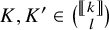 the following identities hold in $\mathcal {O}_q(M_N(\mathbb {C}))$
,
$\mathcal {O}_q(M_N(\mathbb {C}))$
,


Using Theorem 2.4 and (2.15), we see that the quantum minors from (2.11) satisfy

By (2.19) we obtain the following commutation relations between the $z_{IJ}$
: for all
$z_{IJ}$
: for all $I,J,I',J'$
 $$ \begin{align} \sum_{K,L,L'} \left(\sum_{P'}\hat{R}_{JK}^{P'I'}\hat{R}_{P'L'}^{IL}\right) z_{KL} z_{L'J'} = \sum_{K,L,L'} \left(\sum_{P'}\hat{R}_{JK}^{P'L'}\hat{R}_{P'J'}^{IL}\right) z_{I'L'} z_{KL}. \end{align} $$
Putting 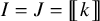 and using (2.16), we obtain from (2.20) that the leading quantum minors

are mutually commuting self-adjoint elements which satisfy q-commutation relations with the $z_{IJ}$
, namely
$z_{IJ}$
, namely

In particular, we can consider the localisation

Also the Laplace expansion has an analogue in $\mathcal {O}_q(H(N))$
.
$\mathcal {O}_q(H(N))$
.
Proposition 2.9. For  and
and  with
with $m\leq k \leq N$
we have
$m\leq k \leq N$
we have

and


2.5 Actions by quantum groups
The right action (0.13) of $\mathbf {G}\mathbf {L}_q(N,\mathbb {C})$
on
$\mathbf {G}\mathbf {L}_q(N,\mathbb {C})$
on $\mathbf {H}_q(N)$
is implemented by a coaction (= comodule
$\mathbf {H}_q(N)$
is implemented by a coaction (= comodule $*$
-algebra structure)
$*$
-algebra structure)
 $$ \begin{align} {\mathrm{Ad}}^{GL}_q: \mathcal{O}_q(H(N)) \rightarrow \mathcal{O}_q(H(N)) \otimes \mathcal{O}_q^{\mathbb{R}}(GL(N,\mathbb{C})),\qquad Z \mapsto X_{13}^{*}Z_{12}X_{13}. \end{align} $$
The well-definedness of ${\mathrm {Ad}}^{GL}_q$
is immediate from the defining relations.
${\mathrm {Ad}}^{GL}_q$
is immediate from the defining relations.
Similarly, the restrictions of the above action to actions of $\mathbf {U}_q(N)$
and
$\mathbf {U}_q(N)$
and $\mathbf {T}_q(N)$
on
$\mathbf {T}_q(N)$
on $\mathbf {H}_q(N)$
, arise from coactions
$\mathbf {H}_q(N)$
, arise from coactions
 $$ \begin{align} {\mathrm{Ad}}^{U}_q: \mathcal{O}_q(H(N)) \rightarrow \mathcal{O}_q(H(N)) \otimes \mathcal{O}_q(U(N)),\qquad Z \mapsto U_{13}^{*}Z_{12}U_{13}. \end{align} $$
 $$ \begin{align} {\mathrm{Ad}}^{T}_q: \mathcal{O}_q(H(N)) \rightarrow \mathcal{O}_q(H(N)) \otimes \mathcal{O}_q(T(N)),\qquad Z \mapsto T_{13}^{*}Z_{12}T_{13}. \end{align} $$
Using the pairing (1.19) between $\mathcal {O}_q(U(N))$
and
$\mathcal {O}_q(U(N))$
and $U_q(\mathfrak {u}(N))$
, the
$U_q(\mathfrak {u}(N))$
, the $*$
-algebra
$*$
-algebra $\mathcal {O}_q(H(N))$
becomes a left
$\mathcal {O}_q(H(N))$
becomes a left $U_q(\mathfrak {u}(N))$
-module
$U_q(\mathfrak {u}(N))$
-module $*$
-algebra by considering the infinitesimal action dual to
$*$
-algebra by considering the infinitesimal action dual to ${\mathrm {Ad}}^U_q$
,
${\mathrm {Ad}}^U_q$
,
 $$ \begin{align} x\rhd z = ({\mathrm{id}}\otimes \tau(-,x)){\mathrm{Ad}}^U_q(z),\qquad x\in U_q(\mathfrak{u}(N)),z\in\mathcal{O}_q(H(N)). \end{align} $$
One has the global formula
 $$ \begin{align} x\rhd Z_{V}(\xi,\eta)= Z_{V}(S(x_{(1)})^*\xi,x_{(2)}\eta). \end{align} $$
Indeed, one notes that the right hand side also defines a module $*$
-algebra structure on
$*$
-algebra structure on $\mathcal {O}_q(H(N))$
, so that the identity only needs to be checked on the generating matrix, where it is obvious.
$\mathcal {O}_q(H(N))$
, so that the identity only needs to be checked on the generating matrix, where it is obvious.
Classically, the $U(N)$
-orbit of the identity matrix in
$U(N)$
-orbit of the identity matrix in $H(N)$
is of course trivial under the adjoint action. On the other hand, by the Cholesky decomposition one has that the
$H(N)$
is of course trivial under the adjoint action. On the other hand, by the Cholesky decomposition one has that the $T(N)$
-orbit of the identity matrix under the adjoint action gives the space of all positive-definite matrices. As the latter are Zariski dense in
$T(N)$
-orbit of the identity matrix under the adjoint action gives the space of all positive-definite matrices. As the latter are Zariski dense in $H(N)$
, the following proposition is not surprising. We will use in the statement the map
$H(N)$
, the following proposition is not surprising. We will use in the statement the map $\iota $
from (1.40), the infinitesimal adjoint action (2.29) as well as the right adjoint action
$\iota $
from (1.40), the infinitesimal adjoint action (2.29) as well as the right adjoint action $\blacktriangleleft $
of
$\blacktriangleleft $
of $\mathcal {O}_q(T(N))$
on
$\mathcal {O}_q(T(N))$
on $\mathcal {O}_{q}(T(N))$
, given by
$\mathcal {O}_{q}(T(N))$
, given by
 $$ \begin{align} x \blacktriangleleft g = S(g_{(1)})xg_{(2)},\qquad x,g\in \mathcal{O}_q(T(N)), \end{align} $$
with S denoting the antipode.
Proposition 2.10. The $*$
-homomorphism
$*$
-homomorphism
 $$\begin{align*}i_T:\mathcal{O}_q(H(N)) \rightarrow \mathcal{O}_q(T(N)),\qquad Z \mapsto T^*T \end{align*}$$
is injective, and
 $$\begin{align*}i_{T}(\iota(S(g))\rhd f) = i_{T}(f) \blacktriangleleft g,\qquad f\in \mathcal{O}_q(H(N)), g\in \mathcal{O}_q(T(N)). \end{align*}$$
Proof. This is well-known, cf. [Reference BaumannBau00, Theorem 3].
More generally, we have for any positive integral $U_q(\mathfrak {u}(N))$
-representation V that
$U_q(\mathfrak {u}(N))$
-representation V that
 $$ \begin{align} ({\mathrm{id}}\otimes i_T) Z_V = T_V^*T_V, \end{align} $$
writing $T_V$
for the image of
$T_V$
for the image of $X_V$
in
$X_V$
in ${\mathrm {End}}(V)\otimes \mathcal {O}_q(T(N))$
. See the proof of Lemma 4.6 for a more general statement. In particular,
${\mathrm {End}}(V)\otimes \mathcal {O}_q(T(N))$
. See the proof of Lemma 4.6 for a more general statement. In particular,

2.6 Inclusions and quotients between the
$\mathcal {O}_q(H(N))$

One can map $\mathcal {O}_q(H(K))$
into
$\mathcal {O}_q(H(K))$
into $\mathcal {O}_q(H(N))$
by placement in the upper left corner:
$\mathcal {O}_q(H(N))$
by placement in the upper left corner:
 $$ \begin{align} \mathcal{O}_q(H(K)) \rightarrow \mathcal{O}_q(H(N)),\qquad z_{ij}\mapsto z_{ij},\qquad 1\leq i,j\leq K. \end{align} $$
Similarly, we can also project down to the right bottom corner:
Lemma 2.11. Let $J_M$
be the 2-sided
$J_M$
be the 2-sided $*$
-ideal generated by the
$*$
-ideal generated by the $z_{ij}$
with
$z_{ij}$
with $1\leq i \leq M$
and
$1\leq i \leq M$
and $1\leq j \leq N$
. Then
$1\leq j \leq N$
. Then
 $$\begin{align*}\mathcal{O}_q(H(N))/J_M \cong \mathcal{O}_q(H(N-M)),\qquad (z_{ij})_{1\leq i,j\leq N} \mapsto \begin{pmatrix} 0_M & 0_{M,N-M} \\ 0_{N-M,M} & (z_{ij})_{1\leq i,j\leq N-M}\end{pmatrix} \end{align*}$$
is a $*$
-homomorphism.
$*$
-homomorphism.
Proof. This follows immediately from the universal relations (2.1).
We will now show that, upon a small modification, the corner (2.34) can also be embedded in a different way. Namely, let $1\leq k \leq l \leq N$
, and put
$1\leq k \leq l \leq N$
, and put $M = l-k+1$
. Let
$M = l-k+1$
. Let $U_q(\mathfrak {u}(M))_{k,l} \subseteq U_q(\mathfrak {u}(N))$
be generated by the
$U_q(\mathfrak {u}(M))_{k,l} \subseteq U_q(\mathfrak {u}(N))$
be generated by the $E_i,F_i$
with
$E_i,F_i$
with $k\leq i <l$
and the
$k\leq i <l$
and the $K_i^{\pm 1}$
with
$K_i^{\pm 1}$
with $k \leq i \leq l$
. Then we can consider the restriction of the infinitesimal adjoint action
$k \leq i \leq l$
. Then we can consider the restriction of the infinitesimal adjoint action $\rhd $
to
$\rhd $
to $U_q(\mathfrak {u}(M))$
via
$U_q(\mathfrak {u}(M))$
via $U_q(\mathfrak {u}(M)) \cong U_q(\mathfrak {u}(M))_{k,l}$
.
$U_q(\mathfrak {u}(M)) \cong U_q(\mathfrak {u}(M))_{k,l}$
.
Proposition 2.12. There is a unique $U_q(\mathfrak {u}(M))$
-equivariant
$U_q(\mathfrak {u}(M))$
-equivariant $*$
-homomorphism
$*$
-homomorphism
 $$ \begin{align} \rho_{k,l}: \mathcal{O}_q(H(M)) \rightarrow \mathcal{O}_q(H(N)) \end{align} $$
such that  . Moreover, we then have
  .
.
Proof. By (4.3) and (1.44), it follows immediately that we have a Hopf $*$
-algebra homomorphism
$*$
-algebra homomorphism
 $$\begin{align*}\kappa_{k,l}: \mathcal{O}_q(T(M)) \rightarrow \mathcal{O}_q(T(N)),\qquad t_{ij} \mapsto t_{i+k-1,j+k-1}. \end{align*}$$
Then as the adjoint action $\blacktriangleleft $
, defined in (2.31), is inner, we have
$\blacktriangleleft $
, defined in (2.31), is inner, we have
 $$\begin{align*}\kappa_{k,l}(x \blacktriangleleft y) = \kappa_{k,l}(x) \blacktriangleleft \kappa_{k,l}(y),\qquad x,y\in \mathcal{O}_q(T(M)). \end{align*}$$
Consider now the modified $*$
-homomorphism
$*$
-homomorphism
 $$\begin{align*}\widetilde{\kappa}_{k,l}: \mathcal{O}_q(T(M)) \rightarrow \mathcal{O}_q(T(N)),\quad t_{ij} \mapsto t_1\ldots t_{k-1} \kappa_{k,l}(t_{ij}), \end{align*}$$
using that $t_i$
for
$t_i$
for $i<k$
commutes with all elements of
$i<k$
commutes with all elements of $\kappa _{k,l}(\mathcal {O}_q(T(M)))$
. Then we clearly still have
$\kappa _{k,l}(\mathcal {O}_q(T(M)))$
. Then we clearly still have
 $$\begin{align*}\widetilde{\kappa}_{k,l}(x \blacktriangleleft y) = \widetilde{\kappa}_{k,l}(x) \blacktriangleleft \kappa_{k,l}(y), \qquad x,y\in \mathcal{O}_q(T(M)). \end{align*}$$
Pulling $\widetilde {\kappa }_{k,l}$
back through the respective embeddings
$\widetilde {\kappa }_{k,l}$
back through the respective embeddings $i_T$
, we hence obtain from Proposition 2.10 a
$i_T$
, we hence obtain from Proposition 2.10 a $U_q(\mathfrak {u}(M))$
-equivariant
$U_q(\mathfrak {u}(M))$
-equivariant $*$
-homomorphism (2.35), which must be unique since
$*$
-homomorphism (2.35), which must be unique since $z_{11}$
is a generator for
$z_{11}$
is a generator for $\mathcal {O}_q(H(M))$
as a module
$\mathcal {O}_q(H(M))$
as a module $*$
-algebra. It is also immediate from the above construction and (2.33) that
$*$
-algebra. It is also immediate from the above construction and (2.33) that  .
.
2.7 Rank of a representation
Definition 2.13. Let $1\leq M \leq N$
. We define
$1\leq M \leq N$
. We define $I_M$
to be the 2-sided
$I_M$
to be the 2-sided $*$
-ideal of
$*$
-ideal of $\mathcal {O}_q(H(N))$
generated by all
$\mathcal {O}_q(H(N))$
generated by all $z_{IJ}$
with
$z_{IJ}$
with  for
for $k\geq M$
. We define
$k\geq M$
. We define
 $$\begin{align*}\mathcal{O}_q^{\leq M}(H(N)) = \mathcal{O}_q(H(N))/I_{M+1}. \end{align*}$$
By convention, we put $I_{N+1} =\{0\}$
.
$I_{N+1} =\{0\}$
.
Lemma 2.14. The ideal $I_M$
is generated as a 2-sided
$I_M$
is generated as a 2-sided $*$
-ideal by the
$*$
-ideal by the $z_{IJ}$
with
$z_{IJ}$
with  .
.
Proof. This follows directly from the Laplace expansion (2.23).
Definition 2.15. We say that a representation $\pi $
of
$\pi $
of $\mathcal {O}_q(H(N))$
is of rank M if
$\mathcal {O}_q(H(N))$
is of rank M if $I_{M+1} \subseteq {\mathrm {Ker}}(\pi )$
but
$I_{M+1} \subseteq {\mathrm {Ker}}(\pi )$
but $I_{M} \nsubseteq {\mathrm {Ker}}(\pi )$
.
$I_{M} \nsubseteq {\mathrm {Ker}}(\pi )$
.
3 Spectral weight
3.1 Spectral weight
Let $\mathscr {Z}(\mathcal {O}_q(H(N)))$
be the centre of
$\mathscr {Z}(\mathcal {O}_q(H(N)))$
be the centre of $\mathcal {O}_q(H(N))$
, and let
$\mathcal {O}_q(H(N))$
, and let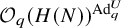 $\mathcal {O}_q(H(N))^{{\mathrm {Ad}}^U_q}$
be the
$\mathcal {O}_q(H(N))^{{\mathrm {Ad}}^U_q}$
be the $*$
-algebra of coinvariants for the coaction (2.27),
$*$
-algebra of coinvariants for the coaction (2.27),
 $$\begin{align*}\mathcal{O}_q(H(N))^{{\mathrm{Ad}}^U_q} = \{z\in \mathcal{O}_q(H(N)) \mid {\mathrm{Ad}}^U_q(z) = z\otimes 1\}. \end{align*}$$
The following result is well-known. For the convenience of a direct reference for the $GL$
-setting, we refer to [Reference De Commer and FloréDCF19, Lemma 3.30].
$GL$
-setting, we refer to [Reference De Commer and FloréDCF19, Lemma 3.30].
Theorem 3.1. An element of $\mathcal {O}_q(H(N))$
is central if and only if it is
$\mathcal {O}_q(H(N))$
is central if and only if it is ${\mathrm {Ad}}^U_q$
-coinvariant, that is,
${\mathrm {Ad}}^U_q$
-coinvariant, that is,
 $$\begin{align*}\mathscr{Z}(\mathcal{O}_q(H(N))) = \mathcal{O}_q(H(N))^{{\mathrm{Ad}}^U_q}. \end{align*}$$
The centre of $\mathcal {O}_q(H(N))$
can further be described explicitly, see [Reference Jordan and WhiteJW20, Theorem 1.3] or also [Reference FloréFlo20, (1.12)].
$\mathcal {O}_q(H(N))$
can further be described explicitly, see [Reference Jordan and WhiteJW20, Theorem 1.3] or also [Reference FloréFlo20, (1.12)].
Theorem 3.2. We have $\mathscr {Z}(\mathcal {O}_q(H(N))) \cong \mathbb {C}[\sigma _1,\ldots ,\sigma _N]$
, where the
$\mathscr {Z}(\mathcal {O}_q(H(N))) \cong \mathbb {C}[\sigma _1,\ldots ,\sigma _N]$
, where the $\sigma _k$
are self-adjoint, algebraically independent elements given byFootnote 5
$\sigma _k$
are self-adjoint, algebraically independent elements given byFootnote 5

where ${\mathrm {Sym}}(I)$
is the group of permutations of
${\mathrm {Sym}}(I)$
is the group of permutations of  leaving the complement of $I = \{i_1<\ldots < i_k\}$
pointwise fixed, where
$I = \{i_1<\ldots < i_k\}$
pointwise fixed, where $\mathrm {wt}(I)$
is as in (0.17), and where
$\mathrm {wt}(I)$
is as in (0.17), and where $a(\sigma ) = |\{l\mid \sigma (l)<l\}|$
(called the antiexceedance).
$a(\sigma ) = |\{l\mid \sigma (l)<l\}|$
(called the antiexceedance).
Moreover, the following quantum Cayley-Hamilton identity holds: with $\sigma _0 = 1$
, we have
$\sigma _0 = 1$
, we have
 $$ \begin{align} \sum_{k=0}^N (-1)^k \sigma_k Z ^{N-k} = 0. \end{align} $$
In particular, we define the quantum trace and quantum determinant
 $$\begin{align*}{\mathrm{Tr}}_q(Z) = q^{-(N-1)}\sigma_1 = q^{N+1}\sum_{i=1}^N q^{-2i}z_{ii}, \end{align*}$$

It can be shown [Reference Jordan and WhiteJW20] that

As we have a unital $*$
-homomorphism
$*$
-homomorphism $\mathcal {O}_q(H(K)) \rightarrow \mathcal {O}_q(H(N))$
by
$\mathcal {O}_q(H(K)) \rightarrow \mathcal {O}_q(H(N))$
by $Z \mapsto (z_{ij})_{1\leq i,j\leq K}$
, we obtain
$Z \mapsto (z_{ij})_{1\leq i,j\leq K}$
, we obtain

Applying $*$
, we also obtain the alternative version
$*$
, we also obtain the alternative version

If $\pi $
is a factor representation of
$\pi $
is a factor representation of $\mathcal {O}_q(H(N))$
, then
$\mathcal {O}_q(H(N))$
, then $\pi $
restricts to a
$\pi $
restricts to a $*$
-character on
$*$
-character on $\mathscr {Z}(\mathcal {O}_q(H(N)))$
.
$\mathscr {Z}(\mathcal {O}_q(H(N)))$
.
Definition 3.3. If $\pi : \mathcal {O}_q(H(N)) \rightarrow B(\mathcal {H})$
is a factor representation, we denote
$\pi : \mathcal {O}_q(H(N)) \rightarrow B(\mathcal {H})$
is a factor representation, we denote
 $$\begin{align*}\chi_{\pi}^{\mathscr{Z}}: \mathscr{Z}(\mathcal{O}_q(H(N))) \rightarrow \mathbb{C},\qquad \sigma_k \mapsto \sigma_k^{\pi} \end{align*}$$
for the associated $*$
-character on
$*$
-character on $\mathscr {Z}(\mathcal {O}_q(H(N)))$
, and call it the central
$\mathscr {Z}(\mathcal {O}_q(H(N)))$
, and call it the central $*$
-character of
$*$
-character of $\pi $
.
$\pi $
.
We call $s\in \mathbb {R}^N$
centrally admissible if there exists a factor representation
$s\in \mathbb {R}^N$
centrally admissible if there exists a factor representation $\pi $
such that
$\pi $
such that
 $$\begin{align*}\sigma_k^{\pi} = s_k,\qquad 1\leq k \leq N. \end{align*}$$
We call $\lambda \in \mathbb {R}^N/{\mathrm {Sym}}(N)$
a spectral weight if there exists a centrally admissible
$\lambda \in \mathbb {R}^N/{\mathrm {Sym}}(N)$
a spectral weight if there exists a centrally admissible $s \in \mathbb {R}^N$
for which
$s \in \mathbb {R}^N$
for which $\lambda $
is the multiset of roots of the polynomial
$\lambda $
is the multiset of roots of the polynomial
 $$\begin{align*}P_s(x) = \sum_k (-1)^k s_k x^{k}, \end{align*}$$
and we denote
 $$\begin{align*}\Lambda_q = \{ \textrm{spectral weights} \}. \end{align*}$$
For $\pi $
a factor representation of
$\pi $
a factor representation of $\mathcal {O}_q(H(N))$
, we denote by
$\mathcal {O}_q(H(N))$
, we denote by $\lambda _{\pi }$
the spectral weight of
$\lambda _{\pi }$
the spectral weight of $\pi $
, given as the multiset of roots of
$\pi $
, given as the multiset of roots of $P_s$
for
$P_s$
for $s_k = \sigma _k^{\pi }$
.
$s_k = \sigma _k^{\pi }$
.
Note that Theorem B concretely identifies the set $\Lambda _q$
. For now, we will content ourselves to show in the next section that
$\Lambda _q$
. For now, we will content ourselves to show in the next section that $\Lambda _q$
parametrises
$\Lambda _q$
parametrises $\mathbf {U}_q(N)$
-orbits.
$\mathbf {U}_q(N)$
-orbits.
3.2 Orbits under
$\mathbf {U}_q(N)$

The results in this section will be a bit more general than needed for our immediate purposes. We start with the following well-known general fact.
Proposition 3.4. Let $\mathbb {G}$
be a compact quantum group with associated Hopf
$\mathbb {G}$
be a compact quantum group with associated Hopf $*$
-algebra
$*$
-algebra $H = \mathcal {O}(\mathbb {G})$
, and let A be a unital
$H = \mathcal {O}(\mathbb {G})$
, and let A be a unital $*$
-algebra with coaction
$*$
-algebra with coaction
 $$\begin{align*}\alpha: A \rightarrow A\otimes H. \end{align*}$$
Assume that the algebra of coinvariants $A^{\alpha } = \{a \in A \mid \alpha (a) = a\otimes 1\}$
is trivial,
$A^{\alpha } = \{a \in A \mid \alpha (a) = a\otimes 1\}$
is trivial,
 $$\begin{align*}A^{\alpha} = \mathbb{C}. \end{align*}$$
Then all representations of A on pre-Hilbert spaces are bounded, and A admits a universal C $^*$
-envelope.
$^*$
-envelope.
Proof. Any element $v\in A$
lies in a finite dimensional comodule V, which can be given an invariant Hilbert space structure. Denoting
$v\in A$
lies in a finite dimensional comodule V, which can be given an invariant Hilbert space structure. Denoting $b_1,\ldots ,b_n$
for an orthonormal basis with respect to this Hilbert space structure, we have that
$b_1,\ldots ,b_n$
for an orthonormal basis with respect to this Hilbert space structure, we have that $\sum _i b_i^*b_i$
is a coinvariant vector, hence equal to a scalar C. Then all
$\sum _i b_i^*b_i$
is a coinvariant vector, hence equal to a scalar C. Then all $b_i$
, and in particular v, are (uniformly) bounded under any representation of A on a pre-Hilbert space.
$b_i$
, and in particular v, are (uniformly) bounded under any representation of A on a pre-Hilbert space.
To apply this to the representation theory of $\mathcal {O}_q(H(N))$
, note that, by Theorem 3.2, any
$\mathcal {O}_q(H(N))$
, note that, by Theorem 3.2, any $s\in \mathbb {R}^N$
determines a
$s\in \mathbb {R}^N$
determines a $*$
-character
$*$
-character $\chi _s: \mathscr {Z}(\mathcal {O}_q(H(N))) \rightarrow \mathbb {C}$
such that
$\chi _s: \mathscr {Z}(\mathcal {O}_q(H(N))) \rightarrow \mathbb {C}$
such that $\chi _{s}(\sigma _k) = s_k$
for all
$\chi _{s}(\sigma _k) = s_k$
for all $1\leq k\leq N$
.
$1\leq k\leq N$
.
Definition 3.5. For $s\in \mathbb {R}^N$
, we define the
$s\in \mathbb {R}^N$
, we define the $*$
-algebra
$*$
-algebra $\mathcal {O}_q(O_s)$
as the quotient of
$\mathcal {O}_q(O_s)$
as the quotient of $\mathcal {O}_q(H(N))$
by the extra relations
$\mathcal {O}_q(H(N))$
by the extra relations
 $$\begin{align*}\sigma_k = s_k. \end{align*}$$
We call $\mathcal {O}_q(O_s)$
the quantum orbit
$\mathcal {O}_q(O_s)$
the quantum orbit $*$
-algebra at parameter s.
$*$
-algebra at parameter s.
These quantum orbit algebras were studied from the viewpoint of deformation quantization in [Reference Donin and MudrovDM02b].
The following is clear by Theorem 3.1.
Proposition 3.6. The coaction ${\mathrm {Ad}}^U_q$
descends to a coaction of
${\mathrm {Ad}}^U_q$
descends to a coaction of $\mathcal {O}_q(U(N))$
on
$\mathcal {O}_q(U(N))$
on $\mathcal {O}_q(O_s)$
, and
$\mathcal {O}_q(O_s)$
, and
 $$ \begin{align} \mathcal{O}_q(O_s)^{{\mathrm{Ad}}^U_q} = \mathbb{C}. \end{align} $$
By Proposition 3.4, we now obtain:
Corollary 3.7. Each $\mathcal {O}_q(O_s)$
admits a universal C
$\mathcal {O}_q(O_s)$
admits a universal C $^*$
-envelope
$^*$
-envelope $C_q(O_s)$
. More generally, a
$C_q(O_s)$
. More generally, a $*$
-representation of
$*$
-representation of $\mathcal {O}_q(H(N))$
on a pre-Hilbert space is bounded as soon as it is bounded on its centre.
$\mathcal {O}_q(H(N))$
on a pre-Hilbert space is bounded as soon as it is bounded on its centre.
Note that the canonical map $\mathcal {O}_q(O_s) \rightarrow C_q(O_s)$
need not be injective, even when s is centrally admissible.
$\mathcal {O}_q(O_s) \rightarrow C_q(O_s)$
need not be injective, even when s is centrally admissible.
Let us return now to a general compact quantum group $\mathbb {G}$
with associated Hopf
$\mathbb {G}$
with associated Hopf $*$
-algebra
$*$
-algebra $H = \mathcal {O}(\mathbb {G})$
. Let
$H = \mathcal {O}(\mathbb {G})$
. Let $L^{\infty }(\mathbb {G})$
be its associated von Neumann algebra, obtained as the double commutant of
$L^{\infty }(\mathbb {G})$
be its associated von Neumann algebra, obtained as the double commutant of $\mathcal {O}(\mathbb {G})$
in its GNS-representation
$\mathcal {O}(\mathbb {G})$
in its GNS-representation $\lambda _{{\mathrm {st}}}$
with respect to its invariant state
$\lambda _{{\mathrm {st}}}$
with respect to its invariant state $\int _{\mathbb {G}}$
.
$\int _{\mathbb {G}}$
.
Definition 3.8. Let A be a unital $*$
-algebra with a coaction
$*$
-algebra with a coaction
 $$\begin{align*}\alpha: A \rightarrow A\otimes \mathcal{O}(\mathbb{G}). \end{align*}$$
We say that a representation $\pi $
of A is
$\pi $
of A is $\alpha $
-compatible if
$\alpha $
-compatible if $\alpha $
descends to a coaction on
$\alpha $
descends to a coaction on $\pi (A)$
. We say that moreover
$\pi (A)$
. We say that moreover $\pi $
is normal
$\pi $
is normal $\alpha $
-compatible if
$\alpha $
-compatible if $\alpha $
extends to a normal
$\alpha $
extends to a normal $*$
-homomorphism
$*$
-homomorphism
 $$\begin{align*}\pi(A)" \rightarrow \pi(A)"\overline{\otimes} L^{\infty}(\mathbb{G}). \end{align*}$$
When $\pi _1,\pi _2$
are representations of a unital
$\pi _1,\pi _2$
are representations of a unital $*$
-algebra A, we say that
$*$
-algebra A, we say that $\pi _1$
and
$\pi _1$
and $\pi _2$
are stably unitarily equivalent if
$\pi _2$
are stably unitarily equivalent if $\oplus _{i\in I} \pi _1$
is unitarily equivalent to
$\oplus _{i\in I} \pi _1$
is unitarily equivalent to $\oplus _{j\in J} \pi _2$
for some index sets
$\oplus _{j\in J} \pi _2$
for some index sets $I,J$
.
$I,J$
.
Proposition 3.9. Let A be a unital $*$
-algebra with coaction
$*$
-algebra with coaction $\alpha : A \rightarrow A\otimes \mathcal {O}(\mathbb {G})$
.
$\alpha : A \rightarrow A\otimes \mathcal {O}(\mathbb {G})$
.
-
1. If
$\pi $
is any representation of A, then
$\pi *\lambda _{{\mathrm {st}}}$
is a normal
$\alpha $
-compatible representation, where
$\pi *\lambda _{{\mathrm {st}}} = (\pi \otimes \lambda _{{\mathrm {st}}})\circ \alpha $
. Conversely, any normal
$\alpha $
-compatible representation
$\pi $
is stably unitarily equivalent to
$\pi * \lambda _{{\mathrm {st}}}$
. -
2. If
$\pi $
is a normal
$\alpha $
-compatible representation of A, and
$\pi _{\mathbb {G},\mathbb {H}}: \mathcal {O}(\mathbb {G}) \rightarrow \mathcal {O}(\mathbb {H})$
defines a compact quantum subgroup, then
$\alpha _{\mid \mathbb {H}} = ({\mathrm {id}}\otimes \pi _{\mathbb {G},\mathbb {H}})\alpha $
is a coaction by
$\mathcal {O}(\mathbb {H})$
and
$\pi $
is a normal
$\alpha _{\mid \mathbb {H}}$
-compatible representation.






Proof. Let V be the right regular unitary corepresentation
 $$\begin{align*}L^2(\mathbb{G}) \otimes L^2(\mathbb{G}) \rightarrow L^2(\mathbb{G}) \otimes L^2(\mathbb{G}), \quad f\otimes g \mapsto \Delta(f)(1\otimes g),\qquad f,g\in\mathcal{O}(\mathbb{G}). \end{align*}$$
If then $\pi $
is a representation of A, we have that
$\pi $
is a representation of A, we have that
 $$\begin{align*}(\pi*\lambda_{{\mathrm{st}}}\otimes \lambda_{{\mathrm{st}}})(\alpha(x))= V_{23} (\pi*\lambda_{{\mathrm{st}}}(x)\otimes 1)V_{23}^*, \end{align*}$$
proving that $\pi *\lambda _{{\mathrm {st}}}$
is normal
$\pi *\lambda _{{\mathrm {st}}}$
is normal $\alpha $
-compatible. This proves the first half of (1).
$\alpha $
-compatible. This proves the first half of (1).
Conversely, if $\pi $
is normal
$\pi $
is normal $\alpha $
-compatible, let
$\alpha $
-compatible, let $N = \pi (A)"$
and consider the normal coaction
$N = \pi (A)"$
and consider the normal coaction $\alpha _{\pi }: N \rightarrow N \overline {\otimes }L^{\infty }(\mathbb {G})$
. Let
$\alpha _{\pi }: N \rightarrow N \overline {\otimes }L^{\infty }(\mathbb {G})$
. Let $E: N \rightarrow N^{\alpha }$
be the faithful normal conditional expectation
$E: N \rightarrow N^{\alpha }$
be the faithful normal conditional expectation
 $$\begin{align*}E(n) = \left({\mathrm{id}}\otimes \int_{\mathbb{G}}\right)\alpha_{\pi}(n) \in N^{\alpha},\qquad n \in N. \end{align*}$$
Then on $L^2(N)$
, as obtained from
$L^2(N)$
, as obtained from $L^2(N^{\alpha })$
through induction by E, we obtain the unitary
$L^2(N^{\alpha })$
through induction by E, we obtain the unitary
 $$\begin{align*}V_{\pi,\alpha}: L^2(N) \otimes L^2(\mathbb{G}) \rightarrow L^2(N) \otimes L^2(\mathbb{G}),\quad n\xi\otimes \eta \mapsto \alpha(n)(\xi\otimes \eta),\quad n\in N,\xi\in L^2(N^{\alpha}),\eta\in L^2(\mathbb{G}). \end{align*}$$
Then, with $\pi _N$
the GNS-representation of N,
$\pi _N$
the GNS-representation of N,
 $$\begin{align*}\pi_N*\lambda_{{\mathrm{st}}}(n) = V_{\pi,\alpha}(\pi_N(n)\otimes 1)V_{\pi,\alpha}^*. \end{align*}$$
As $\pi $
and
$\pi $
and $\pi _N$
are stably unitarily equivalent (being faithful normal representations of N), this finishes the proof of (1). Moreover, if
$\pi _N$
are stably unitarily equivalent (being faithful normal representations of N), this finishes the proof of (1). Moreover, if $\mathbb {H}$
is a subgroup of
$\mathbb {H}$
is a subgroup of $\mathbb {G}$
, consider
$\mathbb {G}$
, consider
 $$\begin{align*}V_{\mathbb{G},\mathbb{H}}: L^2(\mathbb{G}) \otimes L^2(\mathbb{H})\rightarrow L^2(\mathbb{G}) \otimes L^2(\mathbb{H}),\quad f\otimes h \mapsto ({\mathrm{id}}\otimes \pi_{\mathbb{G},\mathbb{H}})\Delta(f)(1\otimes h),\quad f\in \mathcal{O}(\mathbb{G}),h\in \mathcal{O}(\mathbb{H}). \end{align*}$$
Then by [Reference VaesVae01, Theorem 2.7], we obtain a unique normal coaction $\alpha _{\pi ,\mathbb {H}}$
of
$\alpha _{\pi ,\mathbb {H}}$
of $L^{\infty }(\mathbb {H})$
on N such that
$L^{\infty }(\mathbb {H})$
on N such that
 $$\begin{align*}(V_{\mathbb{G},\mathbb{H}})_{23}\alpha_{\pi}(n)_{12}(V_{\mathbb{G},\mathbb{H}})_{23}^* = (V_{\pi,\alpha})_{12}\alpha_{\pi,\mathbb{H}}(n)_{13}(V_{\pi,\alpha})_{12}^*. \end{align*}$$
It is then easily verified that
 $$\begin{align*}\alpha_{\pi,\mathbb{H}}(\pi(a)) = (\pi \otimes \pi_{\mathbb{G},\mathbb{H}})\alpha(a),\qquad a\in A, \end{align*}$$
proving (2).
The first point of the previous proposition can be strengthened under the condition that A has trivial coinvariants.
Proposition 3.10. Let A be a unital $*$
-algebra with coaction
$*$
-algebra with coaction $\alpha : A \rightarrow A\otimes \mathcal {O}(\mathbb {G})$
, and assume
$\alpha : A \rightarrow A\otimes \mathcal {O}(\mathbb {G})$
, and assume $A^{\alpha } = \mathbb {C}$
. Then any two normal
$A^{\alpha } = \mathbb {C}$
. Then any two normal $\alpha $
-compatible representations are stably unitarily equivalent.
$\alpha $
-compatible representations are stably unitarily equivalent.
Proof. Reprising the notation of the proof of the previous proposition, the conditional expectation E now becomes a faithful normal state $\varphi $
. It is then clear that N must be the von Neumann algebra obtained from the GNS-representation of A with respect to
$\varphi $
. It is then clear that N must be the von Neumann algebra obtained from the GNS-representation of A with respect to $\varphi $
. But as this means N is independent of
$\varphi $
. But as this means N is independent of $\pi $
, this proves the proposition.
$\pi $
, this proves the proposition.
Lemma 3.11. Let $\mathbb {G}$
be a coamenable compact quantum group, and let
$\mathbb {G}$
be a coamenable compact quantum group, and let $\alpha :A \rightarrow A \otimes \mathcal {O}(\mathbb {G})$
be a coaction on a unital
$\alpha :A \rightarrow A \otimes \mathcal {O}(\mathbb {G})$
be a coaction on a unital $*$
-algebra A. Let
$*$
-algebra A. Let $\pi $
be a representation of A. Then
$\pi $
be a representation of A. Then $\pi $
is weakly contained in
$\pi $
is weakly contained in $\pi *\lambda _{{\mathrm {st}}} = (\pi \otimes \lambda _{{\mathrm {st}}})\circ \alpha $
.
$\pi *\lambda _{{\mathrm {st}}} = (\pi \otimes \lambda _{{\mathrm {st}}})\circ \alpha $
.
Proof. Let $C(\mathbb {G})$
be the closure of
$C(\mathbb {G})$
be the closure of $\mathcal {O}(\mathbb {G})$
in its standard representation. As
$\mathcal {O}(\mathbb {G})$
in its standard representation. As $\mathbb {G}$
is coamenable, the C
$\mathbb {G}$
is coamenable, the C $^*$
-algebra
$^*$
-algebra $C(\mathbb {G})$
admits the counit
$C(\mathbb {G})$
admits the counit $*$
-character
$*$
-character $\varepsilon $
. So
$\varepsilon $
. So $\pi $
factors through
$\pi $
factors through $\pi *\lambda _{{\mathrm {st}}}$
by applying
$\pi *\lambda _{{\mathrm {st}}}$
by applying $\iota \otimes \varepsilon $
.
$\iota \otimes \varepsilon $
.
Corollary 3.12. Let $\mathbb {G}$
be a coamenable compact quantum group, and let
$\mathbb {G}$
be a coamenable compact quantum group, and let $A \rightarrow A \otimes \mathcal {O}(\mathbb {G})$
be a coaction on a unital
$A \rightarrow A \otimes \mathcal {O}(\mathbb {G})$
be a coaction on a unital $*$
-algebra A with trivial coinvariants. Let
$*$
-algebra A with trivial coinvariants. Let $\pi ,\pi '$
be representations of A. Then
$\pi ,\pi '$
be representations of A. Then $\pi '\preccurlyeq \pi *\lambda _{{\mathrm {st}}}$
.
$\pi '\preccurlyeq \pi *\lambda _{{\mathrm {st}}}$
.
Proof. Let $A_u$
be the universal C
$A_u$
be the universal C $^*$
-envelope of A, and let
$^*$
-envelope of A, and let $\pi _u$
be some faithful representation of
$\pi _u$
be some faithful representation of $A_u$
. Then
$A_u$
. Then $\alpha $
extends to a coaction
$\alpha $
extends to a coaction $\alpha _u: A_u \rightarrow A_u \otimes C(\mathbb {G})$
which still has trivial coinvariants. In particular, we obtain on
$\alpha _u: A_u \rightarrow A_u \otimes C(\mathbb {G})$
which still has trivial coinvariants. In particular, we obtain on $A_u$
a unique state
$A_u$
a unique state $\varphi $
determined by
$\varphi $
determined by
 $$\begin{align*}\varphi(x)1_{A_u} = \left({\mathrm{id}}\otimes \int_{\mathbb{G}}\right)\alpha_u(x). \end{align*}$$
Since $\int _{\mathbb {G}}$
is faithful on
$\int _{\mathbb {G}}$
is faithful on $C(\mathbb {G})$
, and
$C(\mathbb {G})$
, and $\alpha _u$
is faithful, it follows that
$\alpha _u$
is faithful, it follows that $\varphi $
is faithful. Hence
$\varphi $
is faithful. Hence $A_u \cong C^*(\pi *\lambda _{{\mathrm {st}}})$
, and in particular
$A_u \cong C^*(\pi *\lambda _{{\mathrm {st}}})$
, and in particular $\pi ' \preccurlyeq \pi *\lambda _{{\mathrm {st}}}$
.
$\pi ' \preccurlyeq \pi *\lambda _{{\mathrm {st}}}$
.
Returning now to $\mathbb {G} = U_q(N)$
, let us say that two factor representations
$\mathbb {G} = U_q(N)$
, let us say that two factor representations $\pi ,\pi '$
of
$\pi ,\pi '$
of $\mathcal {O}_q(H(N))$
lie in the same
$\mathcal {O}_q(H(N))$
lie in the same $\mathbf {U}_q(N)$
-orbit if there exist
$\mathbf {U}_q(N)$
-orbit if there exist $\lambda ,\lambda '\in \mathbf {U}_q(N)$
such that
$\lambda ,\lambda '\in \mathbf {U}_q(N)$
such that
 $$\begin{align*}\pi \preccurlyeq \pi'*\lambda,\qquad \pi'\preccurlyeq \pi*\lambda. \end{align*}$$
The following theorem is a quantum analogue of the spectral theorem for finite-dimensional self-adjoint matrices.
Theorem 3.13. Two factor representations in $\mathbf {H}_q(N)$
lie in the same
$\mathbf {H}_q(N)$
lie in the same $\mathbf {U}_q(N)$
-orbit if and only if they have the same spectral weight.
$\mathbf {U}_q(N)$
-orbit if and only if they have the same spectral weight.
Proof. Assume that $\pi ,\pi '$
have the same spectral weight. Then they factor through a representation of
$\pi ,\pi '$
have the same spectral weight. Then they factor through a representation of $\mathcal {O}_q(O_s)$
for some s, and so
$\mathcal {O}_q(O_s)$
for some s, and so $\pi ,\pi '$
lie in the same
$\pi ,\pi '$
lie in the same $\mathbf {U}_q(N)$
-orbit by Corollary 3.12.
$\mathbf {U}_q(N)$
-orbit by Corollary 3.12.
Conversely, assume $\pi ,\pi '$
lie in the same
$\pi ,\pi '$
lie in the same $\mathbf {U}_q(N)$
-orbit, and choose a representation
$\mathbf {U}_q(N)$
-orbit, and choose a representation $\rho \in \mathbf {U}_q(N)$
such that
$\rho \in \mathbf {U}_q(N)$
such that
 $$\begin{align*}\pi' \preccurlyeq \pi*\rho. \end{align*}$$
Since $\mathcal {O}_q(H(N))^{{\mathrm {Ad}}_q} = \mathscr {Z}(\mathcal {O}_q(H(N)))$
, we find that
$\mathcal {O}_q(H(N))^{{\mathrm {Ad}}_q} = \mathscr {Z}(\mathcal {O}_q(H(N)))$
, we find that
 $$\begin{align*}(\pi*\rho)(\sigma_k) = \pi(\sigma_k)\otimes 1,\qquad 1\leq k \leq N \end{align*}$$
so that $\pi *\rho $
factors over
$\pi *\rho $
factors over $\mathcal {O}_q(O_s)$
. As
$\mathcal {O}_q(O_s)$
. As $\pi ' \preccurlyeq \pi *\rho $
, the same must be true for
$\pi ' \preccurlyeq \pi *\rho $
, the same must be true for $\pi '$
. This implies that the spectral weights of
$\pi '$
. This implies that the spectral weights of $\pi $
and
$\pi $
and $\pi '$
must coincide.
$\pi '$
must coincide.
4 Big cell representations
4.1 Big cell representations
Definition 4.1. We define a representation $\pi $
of
$\pi $
of $\mathcal {O}_q(H(N))$
to be a big cell representation of rank M if
$\mathcal {O}_q(H(N))$
to be a big cell representation of rank M if $\pi $
is of rank M and
$\pi $
is of rank M and  for all $k\leq M$
.
$k\leq M$
.
We define a representation to be a (generic) big cell representation if it is a direct sum of big cell representations (of possibly varying rank).
To understand big cell representations, it is convenient to consider a deformation of $\mathcal {O}_q(T(N))$
. This is what we turn to next.
$\mathcal {O}_q(T(N))$
. This is what we turn to next.
4.2 Deformed quantized function algebras
$\mathcal {O}_q^{\epsilon }(T(N))$

For $\epsilon \in \mathbb {R}^N$
, let
$\epsilon \in \mathbb {R}^N$
, let

Define, for $\epsilon \in \mathbb {R}^N$
, the
$\epsilon \in \mathbb {R}^N$
, the $\epsilon $
-deformed braid operator by
$\epsilon $
-deformed braid operator by
 $$\begin{align*}\hat{R}_{\epsilon} = \sum_{i,j} q^{-\delta_{ij}} e_{ji}\otimes e_{ij} +(q^{-1}-q)\sum_{i<j} \epsilon_{(i,j]} e_{jj}\otimes e_{ii}, \end{align*}$$
When $\epsilon _i = 1$
for all i, we write
$\epsilon _i = 1$
for all i, we write $\epsilon = +$
, so, for example,
$\epsilon = +$
, so, for example, $\hat {R}_+ = \hat {R}$
.
$\hat {R}_+ = \hat {R}$
.
Definition 4.2. We define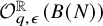 $\mathcal {O}_{q,\epsilon }^{\mathbb {R}}(B(N))$
to be the algebra generated by
$\mathcal {O}_{q,\epsilon }^{\mathbb {R}}(B(N))$
to be the algebra generated by $\mathcal {O}_q(B(N))$
and an independent copy of
$\mathcal {O}_q(B(N))$
and an independent copy of $\mathcal {O}_q(B(N))^*$
, together with the extra relations
$\mathcal {O}_q(B(N))^*$
, together with the extra relations
 $$ \begin{align} T_{23}\hat{R}_{12}T^*_{23} = T^*_{13}\hat{R}_{\epsilon,12}T_{13}. \end{align} $$
We define $\mathcal {O}_q^{\epsilon }(T(N))$
as the quotient of
$\mathcal {O}_q^{\epsilon }(T(N))$
as the quotient of $\mathcal {O}_{q,\epsilon }^{\mathbb {R}}(B(N))$
by the further relations
$\mathcal {O}_{q,\epsilon }^{\mathbb {R}}(B(N))$
by the further relations $t_{i}^* = t_i$
for all i.
$t_{i}^* = t_i$
for all i.
We then have that $\mathcal {O}_q^{\epsilon }(T(N))$
is the universal unital
$\mathcal {O}_q^{\epsilon }(T(N))$
is the universal unital $*$
-algebra generated by invertible elements
$*$
-algebra generated by invertible elements $t_i$
for
$t_i$
for $1\leq i \leq N$
and elements
$1\leq i \leq N$
and elements $t_{ij}$
with
$t_{ij}$
with $1\leq i<j\leq N$
such that (1.25) hold, as well as
$1\leq i<j\leq N$
such that (1.25) hold, as well as
 $$ \begin{align} \left\{\begin{array}{lllll} t_{kj} t_{li}^{*} - t_{li}^{*}t_{kj}&=&0,&& i\neq j, k\neq l,\\ t_{kj}t_{lj}^{*} - qt_{lj}^{*}t_{kj}&=& -(1-q^2)\sum_{i<j} t_{ki}t_{li}^{*} ,&&k\neq l,\\ qt_{kj}t_{ki}^{*}- t_{ki}^{*}t_{kj} &=& (1-q^2)\sum_{k<l\leq\mathrm{min}\{i,j\}} \epsilon_{(k,l]}t_{li}^{*}t_{lj},&& i\neq j, \\ t_{kj}t_{kj}^{*}- t_{kj}^{*}t_{kj} &=& (1-q^2)\left(\sum_{k<l\leq j} \epsilon_{(k,l]} t_{lj}^{*}t_{lj} - \sum_{k\leq l<j} t_{kl}t_{kl}^{*}\right). && \end{array}\right. \end{align} $$
When $\epsilon = + = (+,+,\ldots ,+)$
, we find back
$\epsilon = + = (+,+,\ldots ,+)$
, we find back $\mathcal {O}_q(T(N))$
.
$\mathcal {O}_q(T(N))$
.
In what follows we need a slightly more general class of $*$
-algebras
$*$
-algebras $\mathcal {O}_q^{\epsilon }(T(N))$
parametrized by
$\mathcal {O}_q^{\epsilon }(T(N))$
parametrized by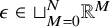 $\epsilon \in \sqcup _{M=0}^N \mathbb {R}^M$
.
$\epsilon \in \sqcup _{M=0}^N \mathbb {R}^M$
.
Definition 4.3. Assume that $M \leq N$
, and let
$M \leq N$
, and let $\epsilon \in \mathbb {R}^M$
. We define
$\epsilon \in \mathbb {R}^M$
. We define $\mathcal {O}_q^{\leq M}(B(N))\subseteq \mathcal {O}_q(B(N))$
as the unital subalgebra generated by the
$\mathcal {O}_q^{\leq M}(B(N))\subseteq \mathcal {O}_q(B(N))$
as the unital subalgebra generated by the $t_i^{\pm 1}$
and
$t_i^{\pm 1}$
and $t_{ij}$
with
$t_{ij}$
with $i\leq M$
and
$i\leq M$
and $j\leq N$
. We define
$j\leq N$
. We define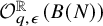 $\mathcal {O}_{q,\epsilon }^{\mathbb {R}}(B(N))$
to be the
$\mathcal {O}_{q,\epsilon }^{\mathbb {R}}(B(N))$
to be the $*$
-subalgebra of
$*$
-subalgebra of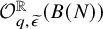 $\mathcal {O}_{q,\widetilde {\epsilon }}^{\mathbb {R}}(B(N))$
generated by
$\mathcal {O}_{q,\widetilde {\epsilon }}^{\mathbb {R}}(B(N))$
generated by $\mathcal {O}_q^{\leq M}(B(N))$
, where
$\mathcal {O}_q^{\leq M}(B(N))$
, where
 $$ \begin{align} \widetilde{\epsilon} = (\epsilon,0,\ldots,0)\in \mathbb{R}^N. \end{align} $$
Similarly, we define $\mathcal {O}_q^{\epsilon }(T(N))$
as the
$\mathcal {O}_q^{\epsilon }(T(N))$
as the $*$
-subalgebra of
$*$
-subalgebra of $\mathcal {O}_q^{\widetilde {\epsilon }}(T(N))$
generated by the
$\mathcal {O}_q^{\widetilde {\epsilon }}(T(N))$
generated by the $t_i^{\pm 1}$
and
$t_i^{\pm 1}$
and $t_{ij}$
with
$t_{ij}$
with $i\leq M$
and
$i\leq M$
and $j\leq N$
.
$j\leq N$
.
Note that, for example, $\mathcal {O}_{q,\epsilon }^{\mathbb {R}}(B(N))$
implicitly depends on M, the dimension of the vector space in which the vector
$\mathcal {O}_{q,\epsilon }^{\mathbb {R}}(B(N))$
implicitly depends on M, the dimension of the vector space in which the vector $\epsilon $
lives.
$\epsilon $
lives.
We denote
 $$\begin{align*}\pi_T: \mathcal{O}_{q,\epsilon}^{\mathbb{R}}(B(N)) \rightarrow \mathcal{O}_q^{\epsilon}(T(N)) \end{align*}$$
for the natural quotient map.
Lemma 4.4. The multiplication maps
 $$ \begin{align} \mathcal{O}_q^{\leq M}(B(N))^* \otimes \mathcal{O}_q^{\leq M}(B(N)) \rightarrow \mathcal{O}_{q,\epsilon}^{\mathbb{R}}(B(N)),\quad x^*\otimes y\mapsto x^*y \end{align} $$
 $$ \begin{align} \mathcal{O}_q^{\leq M}(B(N)) \otimes \mathcal{O}_q^{\leq M}(B(N))^* \rightarrow \mathcal{O}_{q,\epsilon}^{\mathbb{R}}(B(N)),\quad x\otimes y^*\mapsto xy^* \end{align} $$
are bijective.
Here we note that, on the left hand side, we consider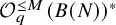 $\mathcal {O}_q^{\leq M}(B(N))^*$
to be a formal antilinear, anti-isomorphic copy of
$\mathcal {O}_q^{\leq M}(B(N))^*$
to be a formal antilinear, anti-isomorphic copy of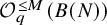 $\mathcal {O}_q^{\leq M}(B(N))$
.
$\mathcal {O}_q^{\leq M}(B(N))$
.
Proof. Let us first prove the result for $\epsilon \in \mathbb {R}^N$
(so
$\epsilon \in \mathbb {R}^N$
(so $M=N$
). From the concrete commutation relations (4.3) and an easy induction argument, it is already clear that the maps will be surjective.
$M=N$
). From the concrete commutation relations (4.3) and an easy induction argument, it is already clear that the maps will be surjective.
Let us show that (4.6) is injective, the proof for (4.5) is similar. Note first that there exists a unique skew bicharacter
 $$ \begin{align} \mathbf{r}_{\epsilon}: \mathcal{O}_q(GL(N,\mathbb{C})) \otimes \mathcal{O}_q(GL(N,\mathbb{C})) \rightarrow \mathbb{C} \end{align} $$
such that, with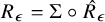 $R_{\epsilon } = \Sigma \circ \hat {R}_{\epsilon }$
,
$R_{\epsilon } = \Sigma \circ \hat {R}_{\epsilon }$
,
 $$\begin{align*}({\mathrm{id}}\otimes {\mathrm{id}}\otimes \mathbf{r}_{\epsilon})X_{13}X_{24} = R_{\epsilon}. \end{align*}$$
In fact, $\mathbf {r}_{\epsilon }$
is obtained by pairing with
$\mathbf {r}_{\epsilon }$
is obtained by pairing with $(\nu _{\epsilon }\otimes {\mathrm {id}})\mathscr {R} = ({\mathrm {id}}\otimes \nu _{\epsilon })\mathscr {R}$
, where
$(\nu _{\epsilon }\otimes {\mathrm {id}})\mathscr {R} = ({\mathrm {id}}\otimes \nu _{\epsilon })\mathscr {R}$
, where $\nu _{\epsilon }$
is (the completion of) the Hopf algebra endomorphism of
$\nu _{\epsilon }$
is (the completion of) the Hopf algebra endomorphism of $U_q(\mathfrak {b}(N))$
, resp.
$U_q(\mathfrak {b}(N))$
, resp. $U_q(\mathfrak {b}^-(N))$
with
$U_q(\mathfrak {b}^-(N))$
with
 $$ \begin{align} \nu_{\epsilon}(K_i) = K_i,\qquad \nu_{\epsilon}(E_i) = \epsilon_{i+1}E_i,\qquad \nu_{\epsilon}(F_i) = \epsilon_{i+1}F_i. \end{align} $$
This $\mathbf {r}_{\epsilon }$
descends to a skew bicharacter
$\mathbf {r}_{\epsilon }$
descends to a skew bicharacter
 $$\begin{align*}\mathbf{r}_{\epsilon}: \mathcal{O}_q(B(N)) \otimes \mathcal{O}_q(B^-(N)) \rightarrow \mathbb{C}. \end{align*}$$
We can then define on $\mathcal {O}_q^{\leq M}(B(N))^* \otimes \mathcal {O}_q^{\leq M}(B(N))$
a unique associative product such that
$\mathcal {O}_q^{\leq M}(B(N))^* \otimes \mathcal {O}_q^{\leq M}(B(N))$
a unique associative product such that
 $$\begin{align*}(z^*\otimes x)(y^*\otimes w) := \mathbf{r}_{\epsilon}(S(x_{(1)}),y_{(1)}^*)z^*y_{(2)}^{*}\otimes x_{(2)}w \mathbf{r}(x_{(3)},y_{(3)}^*), \end{align*}$$
where we view $\mathcal {O}_q(B^-(N)) = \mathcal {O}_q(B(N))^*$
with respect to the compact real form on
$\mathcal {O}_q(B^-(N)) = \mathcal {O}_q(B(N))^*$
with respect to the compact real form on $\mathcal {O}_q(GL(N,\mathbb {C}))$
. The universal relations for
$\mathcal {O}_q(GL(N,\mathbb {C}))$
. The universal relations for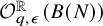 $\mathcal {O}_{q,\epsilon }^{\mathbb {R}}(B(N))$
now allow to construct a splitting map
$\mathcal {O}_{q,\epsilon }^{\mathbb {R}}(B(N))$
now allow to construct a splitting map
 $$\begin{align*}\mathcal{O}_{q,\epsilon}^{\mathbb{R}}(B(N)) \rightarrow \mathcal{O}_q^{\leq M}(B(N)) \otimes \mathcal{O}_q^{\leq M}(B(N))^* \end{align*}$$
for (4.6), from which the injectivity of (4.6) directly follows.
Assume now in general that $\epsilon \in \mathbb {R}^M$
. Clearly, the multiplication maps (4.5) and (4.6) will then be injective by the first part of the proof. But they are also still surjective: all the right hand terms of (4.3) involving
$\epsilon \in \mathbb {R}^M$
. Clearly, the multiplication maps (4.5) and (4.6) will then be injective by the first part of the proof. But they are also still surjective: all the right hand terms of (4.3) involving $t_{ij}$
for
$t_{ij}$
for $i>M$
involve a factor
$i>M$
involve a factor $\widetilde {\epsilon }_i = 0$
, from which it follows directly that the ranges of our multiplication maps are already closed under multiplication.
$\widetilde {\epsilon }_i = 0$
, from which it follows directly that the ranges of our multiplication maps are already closed under multiplication.
Fix $\epsilon \in \mathbb {R}^N$
, and recall the notations (0.18), (1.22) and (4.1). Define
$\epsilon \in \mathbb {R}^N$
, and recall the notations (0.18), (1.22) and (4.1). Define $\mathscr {E}_{\epsilon } \in \mathscr {U}_q^{{\mathrm {pos}}}(\mathfrak {gl}(N,\mathbb {C}))$
by
$\mathscr {E}_{\epsilon } \in \mathscr {U}_q^{{\mathrm {pos}}}(\mathfrak {gl}(N,\mathbb {C}))$
by
 $$\begin{align*}\mathscr{E}_{\epsilon}\xi = (\eta_{\epsilon})_{\mathrm{wt}(\xi)}\xi, \end{align*}$$
which is meaningful since $\xi \in V_{\lambda }$
has
$\xi \in V_{\lambda }$
has $\mathrm {wt}(\xi ) \in P_{{\mathrm {pos.int}}}$
for
$\mathrm {wt}(\xi ) \in P_{{\mathrm {pos.int}}}$
for $\lambda \in P_{{\mathrm {pos.int}}}^{{\mathrm {dom}}}$
. In the above, we put
$\lambda \in P_{{\mathrm {pos.int}}}^{{\mathrm {dom}}}$
. In the above, we put $0^0=1$
by convention. For example, for the vector module we get
$0^0=1$
by convention. For example, for the vector module we get

Lemma 4.5. There is a unique $*$
-homomorphism
$*$
-homomorphism
 $$ \begin{align} i_{B}^{\epsilon}: \mathcal{O}_q(H(N)) \rightarrow \mathcal{O}_{q,\epsilon}^{\mathbb{R}}(B(N)),\quad Z \mapsto T^{*}(E_{\epsilon}\otimes 1) T. \end{align} $$
Proof. This follows directly from the defining relations, using the easily computed identity
 $$\begin{align*}(1\otimes E_{\epsilon})\hat{R}_{\epsilon}(1\otimes E_{\epsilon})\hat{R} = \hat{R}(1\otimes E_{\epsilon})\hat{R}_{\epsilon}(1\otimes E_{\epsilon}). \end{align*}$$
We denote then also
 $$ \begin{align} i_{T}^{\epsilon}: \mathcal{O}_q(H(N)) \rightarrow \mathcal{O}_{q}^{\epsilon}(T(N)),\quad Z \mapsto T^{*}(E_{\epsilon}\otimes 1) T. \end{align} $$
We can also give again a more global form of these maps as follows, using notation as in (2.32) and viewing $T_V \in {\mathrm {End}}(V)\otimes \mathcal {O}_q(B(N))$
:
$T_V \in {\mathrm {End}}(V)\otimes \mathcal {O}_q(B(N))$
:
Lemma 4.6. The map $i_{B}^{\epsilon }$
from (4.9) is given by
$i_{B}^{\epsilon }$
from (4.9) is given by
 $$ \begin{align} i_{B}^{\epsilon}: \mathcal{O}_q(H(N)) \rightarrow \mathcal{O}_{q,\epsilon}^{\mathbb{R}}(B(N)),\quad Z_V(\xi,\eta) \mapsto \sum_{i,j} T_V(e_i,\xi)^* \langle e_i,\mathscr{E}_{\epsilon}e_j\rangle T_V(e_j,\eta), \end{align} $$
where $\{e_i\}$
is an arbitrary orthonormal basis of V.
$\{e_i\}$
is an arbitrary orthonormal basis of V.
Proof. Viewing $U_q(\mathfrak {gl}(N,\mathbb {C})) \subseteq \mathscr {U}_q^{{\mathrm {pos}}}(\mathfrak {gl}(N,\mathbb {C}))$
, it is easily seen that
$U_q(\mathfrak {gl}(N,\mathbb {C})) \subseteq \mathscr {U}_q^{{\mathrm {pos}}}(\mathfrak {gl}(N,\mathbb {C}))$
, it is easily seen that $\epsilon _{i+1} \mathscr {E}_{\epsilon } E_i = E_i \mathscr {E}_{\epsilon }$
. Hence, with
$\epsilon _{i+1} \mathscr {E}_{\epsilon } E_i = E_i \mathscr {E}_{\epsilon }$
. Hence, with $\nu _{\epsilon }$
as in (4.8), we have
$\nu _{\epsilon }$
as in (4.8), we have $\mathscr {E}_{\epsilon } \nu _{\epsilon }(X) = X\mathscr {E}_{\epsilon }$
for
$\mathscr {E}_{\epsilon } \nu _{\epsilon }(X) = X\mathscr {E}_{\epsilon }$
for $X \in U_q(\mathfrak {b}(N))$
, and so
$X \in U_q(\mathfrak {b}(N))$
, and so
 $$\begin{align*}(\mathscr{E}_{\epsilon}\otimes 1)\mathscr{R}_{\epsilon} = \mathscr{R}(\mathscr{E}_{\epsilon}\otimes 1),\qquad \textrm{with } \mathscr{R}_{\epsilon} = (\nu_{\epsilon}\otimes {\mathrm{id}})\mathscr{R}. \end{align*}$$
Since also $\mathscr {E}_{\epsilon }$
is grouplike, that is,
$\mathscr {E}_{\epsilon }$
is grouplike, that is, $\Delta ^{{\mathrm {pos}}}(\mathscr {E}_{\epsilon }) = \mathscr {E}_{\epsilon }\otimes \mathscr {E}_{\epsilon }$
, we find that
$\Delta ^{{\mathrm {pos}}}(\mathscr {E}_{\epsilon }) = \mathscr {E}_{\epsilon }\otimes \mathscr {E}_{\epsilon }$
, we find that
 $$\begin{align*}\mathscr{R}\Delta^{{\mathrm{pos}}}(\mathscr{E}_{\epsilon}) = (\mathscr{E}_{\epsilon} \otimes 1)\mathscr{R}_{\epsilon}(1\otimes \mathscr{E}_{\epsilon}). \end{align*}$$
Noting that $({\mathrm {id}}\otimes S)\mathscr {R}_{\epsilon }$
is the inverse of
$({\mathrm {id}}\otimes S)\mathscr {R}_{\epsilon }$
is the inverse of $\mathscr {R}_{\epsilon }$
in
$\mathscr {R}_{\epsilon }$
in $\mathscr {U}_q(\mathfrak {gl}(N,\mathbb {C}))\widehat {\otimes } \mathscr {U}_q(\mathfrak {gl}(N,\mathbb {C}))^{\mathrm {op}}$
, it is now easily verified through the global formula (2.7) for the product of
$\mathscr {U}_q(\mathfrak {gl}(N,\mathbb {C}))\widehat {\otimes } \mathscr {U}_q(\mathfrak {gl}(N,\mathbb {C}))^{\mathrm {op}}$
, it is now easily verified through the global formula (2.7) for the product of $\mathcal {O}_q(H(N))$
, that the map defined by (4.11) is a
$\mathcal {O}_q(H(N))$
, that the map defined by (4.11) is a $*$
-homomorphism. To show that it coincides with
$*$
-homomorphism. To show that it coincides with $i_{B}^{\epsilon }$
it is sufficient to verify equality on the generating matrix Z, which is immediate.
$i_{B}^{\epsilon }$
it is sufficient to verify equality on the generating matrix Z, which is immediate.
Recall now the localisation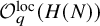 $\mathcal {O}_q^{{\mathrm {loc}}}(H(N))$
from (2.22). More generally, recalling Definition 2.13, we can consider the localisation
$\mathcal {O}_q^{{\mathrm {loc}}}(H(N))$
from (2.22). More generally, recalling Definition 2.13, we can consider the localisation
 $$\begin{align*}\mathcal{O}_{q,\leq M}^{{\mathrm{loc}}}(H(N)) = \mathcal{O}_{q}^{\leq M}(H(N))[z_1^{-1},\ldots,z_M^{-1}]. \end{align*}$$
Our aim is to give a different description of $\mathcal {O}_{q,\leq M}^{{\mathrm {loc}}}(H(N))$
. We start with the following lemma.
$\mathcal {O}_{q,\leq M}^{{\mathrm {loc}}}(H(N))$
. We start with the following lemma.
Lemma 4.7. We have

Proof. Noting that  (as in (1.13)) is a highest weight vector for
  , this follows immediately upon applying the formula (4.11), the fact that
  for
for  (using the scalar product as in the last bullet point of Theorem 1.5), by (for example) the nondegeneracy of (1.26), and the fact that
  .
.
Proposition 4.8. Let $\epsilon \in (\mathbb {R}\setminus \{0\})^M$
. Then the map
$\epsilon \in (\mathbb {R}\setminus \{0\})^M$
. Then the map $i_T^{\epsilon }$
from (4.10) factors through an injective
$i_T^{\epsilon }$
from (4.10) factors through an injective $*$
-homomorphism
$*$
-homomorphism
 $$\begin{align*}j_T^{\epsilon}: \mathcal{O}_{q,\leq M}^{{\mathrm{loc}}}(H(N)) \rightarrow \mathcal{O}_q^{\epsilon}(T(N)). \end{align*}$$
Moreover, the range of $j_T^{\epsilon }$
is the unital
$j_T^{\epsilon }$
is the unital $*$
-algebra generated by all
$*$
-algebra generated by all $t_i^{\pm 2}$
for
$t_i^{\pm 2}$
for $1\leq i \leq M$
and
$1\leq i \leq M$
and $t_it_{ij}$
with
$t_it_{ij}$
with $1\leq i\leq M$
and
$1\leq i\leq M$
and $i<j\leq N$
.
$i<j\leq N$
.
Note that the proof will actually show that the restriction of $j_T^{\epsilon }$
to
$j_T^{\epsilon }$
to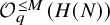 $\mathcal {O}_{q}^{\leq M}(H(N))$
is injective, so that it indirectly also shows that
$\mathcal {O}_{q}^{\leq M}(H(N))$
is injective, so that it indirectly also shows that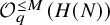 $\mathcal {O}_{q}^{\leq M}(H(N))$
embeds in its localisation.
$\mathcal {O}_{q}^{\leq M}(H(N))$
embeds in its localisation.
Proof. Let $\widetilde {\epsilon }$
be as in (4.4). It is clear by the formula for (4.11), the definition of
$\widetilde {\epsilon }$
be as in (4.4). It is clear by the formula for (4.11), the definition of $I_{M+1}$
in Definition 2.13 and Lemma 4.7 that
$I_{M+1}$
in Definition 2.13 and Lemma 4.7 that $i_B^{\epsilon }$
factors through a
$i_B^{\epsilon }$
factors through a $*$
-homomorphism
$*$
-homomorphism
 $$ \begin{align} j_B^{\epsilon}: \mathcal{O}_{q,\leq M}^{{\mathrm{loc}}}(H(N)) \rightarrow \mathcal{O}_{q,\epsilon}^{\mathbb{R}}(B(N))\subseteq \mathcal{O}_{q,\widetilde{\epsilon}}^{\mathbb{R}}(B(N)) \end{align} $$
Choose now for each $\lambda \in P_{{\mathrm {pos.int}}}^{{\mathrm {dom}}}$
an orthonormal basis of weight vectors
$\lambda \in P_{{\mathrm {pos.int}}}^{{\mathrm {dom}}}$
an orthonormal basis of weight vectors $\{\xi _{\lambda ,i}\mid i \in I_{\lambda }\}$
for
$\{\xi _{\lambda ,i}\mid i \in I_{\lambda }\}$
for $V_{\lambda }$
, and put
$V_{\lambda }$
, and put $\omega _{\lambda ,i} = \mathrm {wt}(\xi _{\lambda ,i})$
and
$\omega _{\lambda ,i} = \mathrm {wt}(\xi _{\lambda ,i})$
and $\alpha _{\lambda ,i} = \lambda - \omega _{\lambda ,i}$
. Recalling the notation (1.34), we can then choose
$\alpha _{\lambda ,i} = \lambda - \omega _{\lambda ,i}$
. Recalling the notation (1.34), we can then choose $a_{\lambda ,i} \in U_q(\mathfrak {n})_{\alpha _{\lambda ,i}}$
with
$a_{\lambda ,i} \in U_q(\mathfrak {n})_{\alpha _{\lambda ,i}}$
with $a_{\lambda ,i}\xi _{\lambda ,j} = \delta _{ij}\xi _{\lambda }$
whenever
$a_{\lambda ,i}\xi _{\lambda ,j} = \delta _{ij}\xi _{\lambda }$
whenever $\alpha _{\lambda ,i} = \alpha _{\lambda ,j}$
, where
$\alpha _{\lambda ,i} = \alpha _{\lambda ,j}$
, where $\xi _{\lambda }$
is a chosen highest weight vector of
$\xi _{\lambda }$
is a chosen highest weight vector of $V_{\lambda }$
(of unit length).
$V_{\lambda }$
(of unit length).
Assume then that we have a nontrivial finite linear combination
 $$\begin{align*}C = \sum_{\lambda\in P_{{\mathrm{pos.int}}}^{{\mathrm{dom}}}}\sum_{k,l\in I_{\lambda}} a_{\lambda,k,l} z_{\lambda}(\xi_{\lambda,k},\xi_{\lambda,l}) \in {\mathrm{Ker}}(i_B^{\epsilon}), \end{align*}$$
with $a_{\lambda ,k,l} =0$
for all but finitely many indices. We will show that
$a_{\lambda ,k,l} =0$
for all but finitely many indices. We will show that $C\in I_{M+1}$
.
$C\in I_{M+1}$
.
Note first that $i_B^{\epsilon }(C)=0$
gives
$i_B^{\epsilon }(C)=0$
gives
 $$\begin{align*}\sum_{\lambda}\sum_{k,l,r\in I_{\lambda}} a_{\lambda,k,l} T_{\lambda}(\xi_{\lambda,r},\xi_{\lambda,k})^* \langle \xi_{\lambda,r},\mathscr{E}_{\widetilde{\epsilon}}\xi_{\lambda,r}\rangle T_{\lambda}(\xi_{\lambda,r},\xi_{\lambda,l}) =0. \end{align*}$$
From (4.5) we deduce that
 $$ \begin{align} \sum_{\lambda}\sum_{k,l,r\in I_{\lambda}} \langle \xi_{\lambda,r},\mathscr{E}_{\widetilde{\epsilon}}\xi_{\lambda,r}\rangle a_{\lambda,k,l} T_{\lambda}(\xi_{\lambda,r},\xi_{\lambda,k})^* \otimes T_{\lambda}(\xi_{\lambda,r},\xi_{\lambda,l}) =0. \end{align} $$
Let now $K_{\alpha ,\beta }$
, for
$K_{\alpha ,\beta }$
, for $\alpha ,\beta \in Q^+$
, be the set of
$\alpha ,\beta \in Q^+$
, be the set of $(\lambda ,k,l)$
with
$(\lambda ,k,l)$
with
 $$\begin{align*}a_{\lambda,k,l}\neq0,\qquad \mathrm{wt}(\xi_{\lambda}) - \mathrm{wt}(\xi_{\lambda,k})= \alpha,\qquad \mathrm{wt}(\xi_{\lambda}) - \mathrm{wt}(\xi_{\lambda_i,l})= \beta. \end{align*}$$
Let K be the set of $(\alpha ,\beta )$
with
$(\alpha ,\beta )$
with $K_{\alpha ,\beta }\neq \emptyset $
, and pick
$K_{\alpha ,\beta }\neq \emptyset $
, and pick $(\alpha _0,\beta _0)\in K$
maximal with respect to the coordinatewise partial order
$(\alpha _0,\beta _0)\in K$
maximal with respect to the coordinatewise partial order $(\alpha ,\beta )\preccurlyeq (\alpha ',\beta ') \Leftrightarrow \alpha \preccurlyeq \alpha '$
and
$(\alpha ,\beta )\preccurlyeq (\alpha ',\beta ') \Leftrightarrow \alpha \preccurlyeq \alpha '$
and $\beta \preccurlyeq \beta '$
. Pick
$\beta \preccurlyeq \beta '$
. Pick $(\lambda _0,k_0,l_0) \in K_{\alpha _0,\beta _0}$
. Then
$(\lambda _0,k_0,l_0) \in K_{\alpha _0,\beta _0}$
. Then $a_{\lambda _0,k_0}\xi _{\lambda ,k}\otimes a_{\lambda _0,l_0}\xi _{\lambda ,l}$
will be a multiple of
$a_{\lambda _0,k_0}\xi _{\lambda ,k}\otimes a_{\lambda _0,l_0}\xi _{\lambda ,l}$
will be a multiple of $\xi _{\lambda }\otimes \xi _{\lambda }$
for each
$\xi _{\lambda }\otimes \xi _{\lambda }$
for each $(\lambda ,k,l) \in K_{\alpha _0,\beta _0}$
, and zero for all other
$(\lambda ,k,l) \in K_{\alpha _0,\beta _0}$
, and zero for all other $(\lambda ,k,l)\in K_{\alpha ,\beta }$
with
$(\lambda ,k,l)\in K_{\alpha ,\beta }$
with $(\alpha ,\beta )\neq (\alpha _0,\beta _0)$
. Hence upon applying
$(\alpha ,\beta )\neq (\alpha _0,\beta _0)$
. Hence upon applying $({\mathrm {id}}\otimes \tau (-,a_{\lambda _{i_0},l_0}))\Delta $
to the second tensorand and
$({\mathrm {id}}\otimes \tau (-,a_{\lambda _{i_0},l_0}))\Delta $
to the second tensorand and $({\mathrm {id}}\otimes \overline {\tau (a_{\lambda _{i_0},k_0},-*)})\Delta $
to the first tensorand of (4.13), we see that there exist
$({\mathrm {id}}\otimes \overline {\tau (a_{\lambda _{i_0},k_0},-*)})\Delta $
to the first tensorand of (4.13), we see that there exist $c_{\lambda ,k,l} \in \mathbb {C}$
with
$c_{\lambda ,k,l} \in \mathbb {C}$
with $c_{\lambda _0,k_0,l_0} = 1$
, with all other
$c_{\lambda _0,k_0,l_0} = 1$
, with all other $c_{\lambda _0,k,l}= 0$
, and
$c_{\lambda _0,k,l}= 0$
, and
 $$\begin{align*}\sum_{(\lambda,k,l) \in K_{\alpha_0,\beta_0}}\sum_{r\in I_{\lambda}} \langle \xi_{\lambda,r},\mathscr{E}_{\widetilde{\epsilon}}\xi_{\lambda,r}\rangle a_{\lambda,k,l}c_{\lambda ,k,l} T_{\lambda}(\xi_{\lambda,r},\xi_{\lambda})^* \otimes T_{\lambda}(\xi_{\lambda,r},\xi_{\lambda}) =0, \end{align*}$$
which simplifies to
 $$\begin{align*}\sum_{(\lambda,k,l) \in K_{\alpha_0,\beta_0}} \langle \xi_{\lambda},\mathscr{E}_{\widetilde{\epsilon}}\xi_{\lambda}\rangle a_{\lambda,k,l}c_{\lambda,k,l} T_{\lambda}(\xi_{\lambda},\xi_{\lambda})^* \otimes T_{\lambda}(\xi_{\lambda},\xi_{\lambda}) =0. \end{align*}$$
Since the $T_{\lambda }(\xi _{\lambda },\xi _{\lambda })$
are linearly independent, we deduce that
$T_{\lambda }(\xi _{\lambda },\xi _{\lambda })$
are linearly independent, we deduce that
 $$\begin{align*}\langle \xi_{\lambda_{0}},\mathscr{E}_{\widetilde{\epsilon}}\xi_{\lambda_{0}} \rangle = (\eta_{\widetilde{\epsilon}})_{\lambda_0} = 0. \end{align*}$$
By our assumption on $\epsilon $
, this can only happen if
$\epsilon $
, this can only happen if $(\lambda _0)_k>0$
for some
$(\lambda _0)_k>0$
for some $k\geq M+1$
.
$k\geq M+1$
.
Now the linear span of all the $X_{\lambda }(\xi ,\eta )$
with
$X_{\lambda }(\xi ,\eta )$
with $\lambda _k>0$
for some
$\lambda _k>0$
for some $k\geq M+1$
equals the
$k\geq M+1$
equals the $2$
-sided ideal generated by all
$2$
-sided ideal generated by all  for
for $k\geq M+1$
in
$k\geq M+1$
in $\mathcal {O}_q(M_N(\mathbb {C}))$
, since any
$\mathcal {O}_q(M_N(\mathbb {C}))$
, since any $V_{\lambda }$
can be identified with the representation spanned by the tensor product of the highest weight vectors in
$V_{\lambda }$
can be identified with the representation spanned by the tensor product of the highest weight vectors in 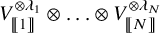 . It follows that $I_{M+1}$
is the linear span of all the
$I_{M+1}$
is the linear span of all the $Z_{\lambda }(\xi ,\eta )$
with
$Z_{\lambda }(\xi ,\eta )$
with $\lambda _k>0$
for some
$\lambda _k>0$
for some $k\geq M+1$
. In particular,
$k\geq M+1$
. In particular, $Z_{\lambda _0}(\xi _{\lambda _0,k_0},\xi _{\lambda _0,l_0}) \in I_{M+1}$
. By induction on the number of nonzero terms in C, we now find that
$Z_{\lambda _0}(\xi _{\lambda _0,k_0},\xi _{\lambda _0,l_0}) \in I_{M+1}$
. By induction on the number of nonzero terms in C, we now find that $C \in I_{M+1}$
. It follows that (4.12) is injective.
$C \in I_{M+1}$
. It follows that (4.12) is injective.
Let us now determine the range of (4.12). Let $\mathscr {A}$
be the
$\mathscr {A}$
be the $*$
-subalgebra of
$*$
-subalgebra of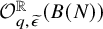 $\mathcal {O}_{q,\widetilde {\epsilon }}^{\mathbb {R}}(B(N))$
generated by the
$\mathcal {O}_{q,\widetilde {\epsilon }}^{\mathbb {R}}(B(N))$
generated by the $(t_{ii}^{*}t_{ii})^{-1}$
and
$(t_{ii}^{*}t_{ii})^{-1}$
and $t_{ii}^*t_{ij}$
for
$t_{ii}^*t_{ij}$
for $1\leq i \leq M$
and
$1\leq i \leq M$
and $1\leq j \leq N$
. Since
$1\leq j \leq N$
. Since

it follows by induction that $j^{\epsilon }_B(\mathcal {O}_{q,\leq M}^{{\mathrm {loc}}}(H(N)))$
contains all
$j^{\epsilon }_B(\mathcal {O}_{q,\leq M}^{{\mathrm {loc}}}(H(N)))$
contains all  , and hence $\mathscr {A} \subseteq j^{\epsilon }_B(\mathcal {O}_{q,\leq M}^{{\mathrm {loc}}}(H(N)))$
. But (4.14) also shows that this inclusion holds in the other direction, so
$\mathscr {A} \subseteq j^{\epsilon }_B(\mathcal {O}_{q,\leq M}^{{\mathrm {loc}}}(H(N)))$
. But (4.14) also shows that this inclusion holds in the other direction, so $\mathscr {A} = j^{\epsilon }_B(\mathcal {O}_{q,\leq M}^{{\mathrm {loc}}}(H(N)))$
.
$\mathscr {A} = j^{\epsilon }_B(\mathcal {O}_{q,\leq M}^{{\mathrm {loc}}}(H(N)))$
.
The proposition now follows since the map $\pi _T: \mathscr {A} \rightarrow \mathcal {O}_q^{\epsilon }(T(N))$
is injective.
$\pi _T: \mathscr {A} \rightarrow \mathcal {O}_q^{\epsilon }(T(N))$
is injective.
We have for $\mathcal {O}_q^{\epsilon }(T(N))$
a triangular decomposition: with
$\mathcal {O}_q^{\epsilon }(T(N))$
a triangular decomposition: with $\mathcal {O}_q^{\leq M}(\mathscr {N}(N)) \subseteq \mathcal {O}_q^{\leq M}(B(N))$
the unital algebra generated by the
$\mathcal {O}_q^{\leq M}(\mathscr {N}(N)) \subseteq \mathcal {O}_q^{\leq M}(B(N))$
the unital algebra generated by the $t_{ij}$
with
$t_{ij}$
with $i<j$
, and with
$i<j$
, and with $\mathcal {O}_q(D(M))$
the algebra of Laurent polynomials in the
$\mathcal {O}_q(D(M))$
the algebra of Laurent polynomials in the $t_i$
for
$t_i$
for $1\leq i \leq M$
, we have that multiplication provides an isomorphism
$1\leq i \leq M$
, we have that multiplication provides an isomorphism
 $$ \begin{align} \mathcal{O}_q^{\leq M}(\mathscr{N}(N)) \otimes \mathcal{O}_q(D(M)) \otimes \mathcal{O}_q^{\leq M}(\mathscr{N}(N))^* \rightarrow \mathcal{O}_q^{\epsilon}(T(N)). \end{align} $$
Consider the associated projection map
 $$\begin{align*}\mathscr{P}_{\epsilon}: \mathcal{O}_q^{\epsilon}(T(N)) \rightarrow \mathcal{O}_q(D(M)),\quad XYZ \mapsto \varepsilon(X)Y\varepsilon(Z). \end{align*}$$
Then with $\mathcal {O}_q^{\epsilon }(T(N))_0$
the centralizer of
$\mathcal {O}_q^{\epsilon }(T(N))_0$
the centralizer of $\mathcal {O}_q(D(M))$
in
$\mathcal {O}_q(D(M))$
in $\mathcal {O}_q^{\epsilon }(T(N))$
, we obtain that
$\mathcal {O}_q^{\epsilon }(T(N))$
, we obtain that $\mathscr {P}_{\epsilon }:\mathcal {O}_q^{\epsilon }(T(N))_0 \rightarrow \mathcal {O}_q(D(M))$
is a
$\mathscr {P}_{\epsilon }:\mathcal {O}_q^{\epsilon }(T(N))_0 \rightarrow \mathcal {O}_q(D(M))$
is a $*$
-homomorphism. In particular, we obtain a
$*$
-homomorphism. In particular, we obtain a $*$
-homomorphism
$*$
-homomorphism
 $$\begin{align*}\chi_{\mathrm{HC}}^{\epsilon} = \mathscr{P}_{\epsilon} \circ i_T^{\epsilon}: \mathscr{Z}(\mathcal{O}_q(H(N))) \rightarrow \mathcal{O}_q(D(M)), \end{align*}$$
called the Harish-Chandra map.
Proposition 4.9. With $e_k$
the k-th elementary symmetric polynomial in N variables, we have
$e_k$
the k-th elementary symmetric polynomial in N variables, we have

Note that the right hand side indeed lies in $\mathcal {O}_q(D(M))$
.
$\mathcal {O}_q(D(M))$
.
Proof. If $\epsilon = +$
this is well-known, see, for example, [Reference De Commer and FloréDCF19, Corollary 3.34]. To obtain the general case, let
$\epsilon = +$
this is well-known, see, for example, [Reference De Commer and FloréDCF19, Corollary 3.34]. To obtain the general case, let $\mathcal {O}_q(\widetilde {D}(N)) \subseteq \mathcal {O}_q^{{\mathrm {loc}}}(H(N))$
be generated by the
$\mathcal {O}_q(\widetilde {D}(N)) \subseteq \mathcal {O}_q^{{\mathrm {loc}}}(H(N))$
be generated by the  , and let $\mathcal {O}_q(\widetilde {\mathscr {N}}(N))$
be generated by the inverse images of the
$\mathcal {O}_q(\widetilde {\mathscr {N}}(N))$
be generated by the inverse images of the $t_it_{ij}$
under
$t_it_{ij}$
under $i_T$
. Then it is clear from Proposition 4.8 that we obtain a triangular decomposition
$i_T$
. Then it is clear from Proposition 4.8 that we obtain a triangular decomposition
 $$\begin{align*}\mathcal{O}_q(\widetilde{\mathscr{N}}(N)) \otimes \mathcal{O}_q(\widetilde{D}(N)) \otimes \mathcal{O}_q(\widetilde{\mathscr{N}}(N))^* \rightarrow \mathcal{O}_q^{{\mathrm{loc}}}(H(N)). \end{align*}$$
with associated projection map
 $$\begin{align*}\widetilde{\mathscr{P}}: \mathcal{O}_q^{{\mathrm{loc}}}(H(N)) \rightarrow \mathcal{O}_q(\widetilde{D}(N)),\quad XYZ \mapsto \varepsilon(i_T(X))Y\varepsilon(i_T(Z)). \end{align*}$$
This triangular decomposition is then however seen to be compatible with any of the embeddings $i_T^{\epsilon }$
for
$i_T^{\epsilon }$
for $\epsilon \in (\mathbb {R}\setminus \{0\})^N$
, that is,
$\epsilon \in (\mathbb {R}\setminus \{0\})^N$
, that is,
 $$\begin{align*}\mathscr{P}_{\epsilon} \circ i_T^{\epsilon} = i_T^{\epsilon}\circ \widetilde{\mathscr{P}}. \end{align*}$$
The identity (4.16) now follows in this case from Lemma 4.7. The general case follows since both sides of (4.16) are continuous in $\epsilon $
.
$\epsilon $
.
4.3 Big cell representations of
$\mathcal {O}_q^{\epsilon }(T(N))$

To classify the irreducible big cell representations of $\mathcal {O}_q(H(N))$
, we will relate them to the representation theory of the
$\mathcal {O}_q(H(N))$
, we will relate them to the representation theory of the $\mathcal {O}_q^{\epsilon }(T(N))$
.
$\mathcal {O}_q^{\epsilon }(T(N))$
.
We first introduce some terminology.
Definition 4.10. Let V be an $\mathcal {O}_q^{\epsilon }(T(N))$
-module, where
$\mathcal {O}_q^{\epsilon }(T(N))$
-module, where $\epsilon \in \mathbb {R}^M$
.
$\epsilon \in \mathbb {R}^M$
.
We call a vector $\xi \in V$
a weight vector if it is a joint eigenvector of all
$\xi \in V$
a weight vector if it is a joint eigenvector of all $t_i$
, for
$t_i$
, for $1\leq i \leq M$
. We call
$1\leq i \leq M$
. We call $\xi \in V$
a highest weight vector if
$\xi \in V$
a highest weight vector if $\xi $
is a weight vector and
$\xi $
is a weight vector and $\mathcal {O}_q^{\leq M}(\mathscr {N}(N))^*\xi = 0$
. We call a weight vector
$\mathcal {O}_q^{\leq M}(\mathscr {N}(N))^*\xi = 0$
. We call a weight vector $\xi \in V$
admissible if the associated eigenvalues of the
$\xi \in V$
admissible if the associated eigenvalues of the $t_i$
are strictly positive. We then say that
$t_i$
are strictly positive. We then say that $\xi $
has weight
$\xi $
has weight $r \in \mathbb {R}^M$
if
$r \in \mathbb {R}^M$
if $t_{i} \xi =q^{r_i} \xi $
for all
$t_{i} \xi =q^{r_i} \xi $
for all $1\leq i\leq M$
.
$1\leq i\leq M$
.
We call V admissible if it is finitely generated, has a vector basis of admissible weight vectors, and is locally finite as an $\mathcal {O}_q^{\leq M}(\mathscr {N}(N))^*$
-module, that is, the
$\mathcal {O}_q^{\leq M}(\mathscr {N}(N))^*$
-module, that is, the $\mathcal {O}_q^{\leq M}(\mathscr {N}(N))^*\xi $
are finite dimensional for each
$\mathcal {O}_q^{\leq M}(\mathscr {N}(N))^*\xi $
are finite dimensional for each $\xi \in V$
.
$\xi \in V$
.
We call V an admissible unitary module if moreover V is a pre-Hilbert space for which the $*$
-structure is compatible with the inner product,
$*$
-structure is compatible with the inner product,
 $$\begin{align*}\langle \xi,x\eta\rangle = \langle x^*\xi,\eta\rangle,\qquad \forall \xi,\eta \in V,x\in \mathcal{O}_q^{\epsilon}(T(N)). \end{align*}$$
Recall the triangular decomposition (4.15). It then follows immediately from this decomposition that the weight spaces of admissible $\mathcal {O}_q^{\epsilon }(T(N))$
-modules are finite dimensional. It is then also easily concluded that any admissible unitary module is a direct sum of admissible unitary highest weight modules, that is, admissible unitary modules generated by a highest weight vector.
$\mathcal {O}_q^{\epsilon }(T(N))$
-modules are finite dimensional. It is then also easily concluded that any admissible unitary module is a direct sum of admissible unitary highest weight modules, that is, admissible unitary modules generated by a highest weight vector.
More generally, we call an $\mathcal {O}_q^{\epsilon }(T(N))$
-module V a highest weight module if it is generated by a highest weight vector. For example, using again the triangular decomposition (4.15), we can define a notion of Verma module
$\mathcal {O}_q^{\epsilon }(T(N))$
-module V a highest weight module if it is generated by a highest weight vector. For example, using again the triangular decomposition (4.15), we can define a notion of Verma module $M_r$
at a given highest weight r, uniquely determined by the fact that, with
$M_r$
at a given highest weight r, uniquely determined by the fact that, with $\xi _r$
the highest weight vector, the map
$\xi _r$
the highest weight vector, the map
 $$\begin{align*}\mathcal{O}_q^{\leq M}(\mathscr{N}(N)) \rightarrow M_r,\quad x \mapsto x\xi_r \end{align*}$$
is a linear isomorphism. Then, up to a scalar, there exists a unique $*$
-invariant Hermitian scalar product
$*$
-invariant Hermitian scalar product $\langle -,-\rangle $
on
$\langle -,-\rangle $
on $M_r$
. Following for example the discussion in [Reference Joseph and LetzterJL92, Section 5], we also see that if V is an arbitrary highest weight module with highest weight r, then from the fact that the kernel of the natural map
$M_r$
. Following for example the discussion in [Reference Joseph and LetzterJL92, Section 5], we also see that if V is an arbitrary highest weight module with highest weight r, then from the fact that the kernel of the natural map $M_r \rightarrow V$
must necessarily be in the kernel of
$M_r \rightarrow V$
must necessarily be in the kernel of $\langle -,-\rangle $
, it follows that (up to a scalar) there exists a unique
$\langle -,-\rangle $
, it follows that (up to a scalar) there exists a unique $*$
-invariant Hermitian scalar product on V. We call V unitarizable if this scalar product is positive-definite. Note that if the Hermitian scalar product is only positive semi-definite, then its kernel will be
$*$
-invariant Hermitian scalar product on V. We call V unitarizable if this scalar product is positive-definite. Note that if the Hermitian scalar product is only positive semi-definite, then its kernel will be $\mathcal {O}_q^{\epsilon }(T(N))$
-invariant, and the quotient by this kernel will be unitarizable. In any case, we always normalize the scalar product such that the highest weight vector has norm
$\mathcal {O}_q^{\epsilon }(T(N))$
-invariant, and the quotient by this kernel will be unitarizable. In any case, we always normalize the scalar product such that the highest weight vector has norm $1$
. We see in particular that there is a one-to-one correspondence between unitarizable highest weight modules and admissible unitary highest weight modules (with their normalized highest weight vectors fixed).
$1$
. We see in particular that there is a one-to-one correspondence between unitarizable highest weight modules and admissible unitary highest weight modules (with their normalized highest weight vectors fixed).
We summarize the above results in the following proposition.
Proposition 4.11. For $\epsilon \in \mathbb {R}^M$
, there exists an admissible unitary highest weight-module
$\epsilon \in \mathbb {R}^M$
, there exists an admissible unitary highest weight-module $V_r$
for
$V_r$
for $\mathcal {O}_q^{\epsilon }(T(N))$
with highest weight
$\mathcal {O}_q^{\epsilon }(T(N))$
with highest weight $r\in \mathbb {R}^M$
if and only if the invariant form on the Verma module
$r\in \mathbb {R}^M$
if and only if the invariant form on the Verma module $M_r$
is positive semi-definite. Moreover,
$M_r$
is positive semi-definite. Moreover, $V_r$
is then unique up to unitary equivalence.
$V_r$
is then unique up to unitary equivalence.
Definition 4.12. We call a vector $r\in \mathbb {R}^M \epsilon $
-admissible if there exists an admissible unitary highest weight module for
$r\in \mathbb {R}^M \epsilon $
-admissible if there exists an admissible unitary highest weight module for $\mathcal {O}_q^{\epsilon }(T(N))$
with highest weight r.
$\mathcal {O}_q^{\epsilon }(T(N))$
with highest weight r.
Let us now return to $\mathcal {O}_q(H(N))$
. Assume that
$\mathcal {O}_q(H(N))$
. Assume that $\pi $
is an irreducible big cell representation of rank M on a Hilbert space
$\pi $
is an irreducible big cell representation of rank M on a Hilbert space $\mathcal {H}_{\pi }$
. By irreducibility, it will necessarily factor over some
$\mathcal {H}_{\pi }$
. By irreducibility, it will necessarily factor over some $\mathcal {O}_q(O_s)$
(Definition 3.5), and we then also call
$\mathcal {O}_q(O_s)$
(Definition 3.5), and we then also call $\pi $
a big cell representation of
$\pi $
a big cell representation of $\mathcal {O}_q(O_s)$
. Furthermore, there exist unique signs
$\mathcal {O}_q(O_s)$
. Furthermore, there exist unique signs $\eta _k \in \{\pm 1\}$
such that the
$\eta _k \in \{\pm 1\}$
such that the  for
for $k \leq M$
are positive operators. We will then refer to
$k \leq M$
are positive operators. We will then refer to $\eta $
or
$\eta $
or $\widetilde {\eta } = (\eta ,0,0,\ldots ,0) \in \{-1,0,1\}^N$
as the signature of
$\widetilde {\eta } = (\eta ,0,0,\ldots ,0) \in \{-1,0,1\}^N$
as the signature of $\pi $
(we will show in Theorem 4.17 that there is no clash with the notion of signature from the Introduction). In the following we will write again
$\pi $
(we will show in Theorem 4.17 that there is no clash with the notion of signature from the Introduction). In the following we will write again

By irreducibility, it is also clear that the  will have a joint eigenvector basis, so that $V_{\pi }$
, the sum of their weight spaces, is dense in
$V_{\pi }$
, the sum of their weight spaces, is dense in $\mathcal {H}_{\pi }$
. The subspace
$\mathcal {H}_{\pi }$
. The subspace $V_{\pi }$
will clearly be invariant under
$V_{\pi }$
will clearly be invariant under $\mathcal {O}_q(H(N))$
.
$\mathcal {O}_q(H(N))$
.
In the following proposition, we reprise the notation from (4.10) and Proposition 4.8.
Proposition 4.13. Let $\pi $
be an irreducible big cell representation of
$\pi $
be an irreducible big cell representation of $\mathcal {O}_q(H(N))$
of signature
$\mathcal {O}_q(H(N))$
of signature $\eta \in \{\pm 1\}^M$
, and let
$\eta \in \{\pm 1\}^M$
, and let $\epsilon \in \{\pm 1\}^M$
be the unique sign vector such that
$\epsilon \in \{\pm 1\}^M$
be the unique sign vector such that

-
○ The restriction of
$\pi $
to
$V_{\pi }$
can be uniquely extended to an admissible unitary highest weight module
$\pi '$
of
$\mathcal {O}_q^{\epsilon }(T(N))$
on
$V_{\pi }$
through the map
$i_{T}^{\epsilon }$
. -
○ Conversely, any admissible unitary highest weight module of
$\mathcal {O}_q^{\epsilon }(T(N))$
restricts and completes to an irreducible big cell representation of rank M for
$\mathcal {O}_q(H(N))$
.


Proof. As the  are diagonalizable with spectrum of constant sign
  , it follows from Lemma 4.7 and Proposition 4.8 that we can extend the restriction of $\pi $
to
$\pi $
to $V_{\pi }$
uniquely to an admissible unitary highest weight module
$V_{\pi }$
uniquely to an admissible unitary highest weight module $\pi '$
of
$\pi '$
of $\mathcal {O}_q^{\epsilon }(T(N))$
, and
$\mathcal {O}_q^{\epsilon }(T(N))$
, and $V_{\pi }$
is then the linear span of weight vectors for
$V_{\pi }$
is then the linear span of weight vectors for $\mathcal {O}_q^{\epsilon }(T(N))$
. As each
$\mathcal {O}_q^{\epsilon }(T(N))$
. As each  for
for $1\leq k\leq M$
is bounded, it also follows that any vector in
$1\leq k\leq M$
is bounded, it also follows that any vector in $V_{\pi }$
must be locally
$V_{\pi }$
must be locally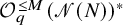 $\mathcal {O}_q^{\leq M}(\mathscr {N}(N))^*$
-finite. In particular, there must exist a highest weight vector
$\mathcal {O}_q^{\leq M}(\mathscr {N}(N))^*$
-finite. In particular, there must exist a highest weight vector $\xi $
for
$\xi $
for $\pi '$
. Since
$\pi '$
. Since $\pi (\mathcal {O}_q(H(N)))\xi = \pi '(\mathcal {O}_q^{\epsilon }(T(N)))\xi $
, it follows that
$\pi (\mathcal {O}_q(H(N)))\xi = \pi '(\mathcal {O}_q^{\epsilon }(T(N)))\xi $
, it follows that $\pi (\mathcal {O}_q(H(N)))\xi $
is a direct sum of finite-dimensional weight spaces for
$\pi (\mathcal {O}_q(H(N)))\xi $
is a direct sum of finite-dimensional weight spaces for $\mathcal {O}_q(H(N))$
. Since the closure of
$\mathcal {O}_q(H(N))$
. Since the closure of $\pi (\mathcal {O}_q(H(N)))\xi $
equals
$\pi (\mathcal {O}_q(H(N)))\xi $
equals $\mathcal {H}_{\pi }$
by irreducibility of
$\mathcal {H}_{\pi }$
by irreducibility of $\pi $
, this implies that
$\pi $
, this implies that $V_{\pi } = \mathcal {O}_q(H(N)) \xi $
, and hence
$V_{\pi } = \mathcal {O}_q(H(N)) \xi $
, and hence $\xi $
is a cyclic highest weight vector for
$\xi $
is a cyclic highest weight vector for $\pi '$
.
$\pi '$
.
We have now shown that $\pi '$
is an admissible unitary highest weight module. To see conversely that any admissible unitary highest weight module
$\pi '$
is an admissible unitary highest weight module. To see conversely that any admissible unitary highest weight module $(V_{\pi '},\pi ')$
of
$(V_{\pi '},\pi ')$
of $\mathcal {O}_q^{\epsilon }(T(N))$
restricts to an irreducible big cell representation of
$\mathcal {O}_q^{\epsilon }(T(N))$
restricts to an irreducible big cell representation of $\mathcal {O}_q(H(N))$
with signature
$\mathcal {O}_q(H(N))$
with signature $\eta $
, let us first verify that
$\eta $
, let us first verify that $\pi = \pi '\circ i_T^{\epsilon }$
determines a bounded
$\pi = \pi '\circ i_T^{\epsilon }$
determines a bounded $*$
-representation of
$*$
-representation of $\mathcal {O}_q(H(N))$
on the pre-Hilbert space
$\mathcal {O}_q(H(N))$
on the pre-Hilbert space $V_{\pi '}$
. Indeed, it is clear that
$V_{\pi '}$
. Indeed, it is clear that $\pi $
will factor over a
$\pi $
will factor over a $*$
-character on the centre of
$*$
-character on the centre of $\mathcal {O}_q(H(N))$
. Boundedness then follows from Corollary 3.7. To see that
$\mathcal {O}_q(H(N))$
. Boundedness then follows from Corollary 3.7. To see that $\pi $
is irreducible, note that any bounded intertwiner T for
$\pi $
is irreducible, note that any bounded intertwiner T for $\pi $
must preserve the weight spaces of the
$\pi $
must preserve the weight spaces of the  . Then T preserves $V_{\pi '}$
and is also an intertwiner for the
$V_{\pi '}$
and is also an intertwiner for the $\mathcal {O}_q^{\epsilon }(T(N))$
-representation, hence constant.
$\mathcal {O}_q^{\epsilon }(T(N))$
-representation, hence constant.
The classification of the irreducible big cell representations thus follows from the classification of the admissible unitary highest weight modules of the $\mathcal {O}_q^{\epsilon }(T(N))$
. To state the latter classification result, we first introduce the following auxiliary terminology.
$\mathcal {O}_q^{\epsilon }(T(N))$
. To state the latter classification result, we first introduce the following auxiliary terminology.
Definition 4.14. Let $\epsilon \in \{-1,0,1\}^{M}$
. We say that
$\epsilon \in \{-1,0,1\}^{M}$
. We say that $r \in \mathbb {R}^M$
is
$r \in \mathbb {R}^M$
is $\epsilon $
-adapted if and only if the following condition holds: for any
$\epsilon $
-adapted if and only if the following condition holds: for any $1\leq s<t\leq M$
with
$1\leq s<t\leq M$
with $\epsilon _{(s,t]} = 1$
one has
$\epsilon _{(s,t]} = 1$
one has
 $$ \begin{align} (r_t+t)-(r_s+s) \in \mathbb{Z}_{>0}. \end{align} $$
It is easily seen that when $\epsilon \in \{\pm 1\}^M$
, then (4.17) is satisfied if and only if there exist
$\epsilon \in \{\pm 1\}^M$
, then (4.17) is satisfied if and only if there exist $\alpha _+,\alpha _- \in \mathbb {R}$
and
$\alpha _+,\alpha _- \in \mathbb {R}$
and $N_+,N_- \in \mathbb {Z}_{\geq 0}$
with
$N_+,N_- \in \mathbb {Z}_{\geq 0}$
with $N_++ N_- = M$
, a subset
$N_++ N_- = M$
, a subset  and integers $m_{i_1}<m_{i_2} < \ldots <m_{i_{N_+}}$
and
$m_{i_1}<m_{i_2} < \ldots <m_{i_{N_+}}$
and $m_{i_1'} <m_{i_2'} <\ldots < m_{i_{N_-}'}$
for
$m_{i_1'} <m_{i_2'} <\ldots < m_{i_{N_-}'}$
for  , such that

Theorem 4.15. Let $\epsilon \in \{-1,0,1\}^M$
. Then r is
$\epsilon \in \{-1,0,1\}^M$
. Then r is $\epsilon $
-admissible for
$\epsilon $
-admissible for $\mathcal {O}_q^{\epsilon }(T(N))$
if and only if r is
$\mathcal {O}_q^{\epsilon }(T(N))$
if and only if r is $\epsilon $
-adapted.
$\epsilon $
-adapted.
We will prove this theorem in the next section. For now, let us deduce the consequences for the representation theory of $\mathcal {O}_q(H(N))$
.
$\mathcal {O}_q(H(N))$
.
Theorem 4.16. An irreducible big cell representation $\pi $
of
$\pi $
of $\mathcal {O}_q(H(N))$
of signature
$\mathcal {O}_q(H(N))$
of signature $(\eta _1,\ldots ,\eta _m)$
factors through a unique admissible unitary highest weight module
$(\eta _1,\ldots ,\eta _m)$
factors through a unique admissible unitary highest weight module $V_{r(\pi )}$
of
$V_{r(\pi )}$
of $\mathcal {O}_q^{\epsilon }(T(N))$
, where
$\mathcal {O}_q^{\epsilon }(T(N))$
, where  . Moreover, two irreducible big cell representations $\pi _1,\pi _2$
are unitary equivalent if and only if they have the same signature and
$\pi _1,\pi _2$
are unitary equivalent if and only if they have the same signature and $r(\pi _1) = r(\pi _2)$
. We have
$r(\pi _1) = r(\pi _2)$
. We have $r = r(\pi )$
for some irreducible big cell representation
$r = r(\pi )$
for some irreducible big cell representation $\pi $
of
$\pi $
of $\mathcal {O}_q(H(N))$
of signature
$\mathcal {O}_q(H(N))$
of signature $\eta $
if and only if r is
$\eta $
if and only if r is $\epsilon $
-adapted for the unique
$\epsilon $
-adapted for the unique $\epsilon \in \{\pm 1\}^M$
with
$\epsilon \in \{\pm 1\}^M$
with  .
.
Proof. The first part of the theorem follows from Proposition 4.13 and Proposition 4.11. The latter part then follows from Theorem 4.15.
Theorem 4.17.
-
1. Let
$s \in \mathbb {R}^N$
. Then the
$*$
-character
$\chi _s$
on
$\mathscr {Z}(\mathcal {O}_q(H(N)))$
arises as the central
$*$
-character of an irreducible big cell representation if and only if the roots of are of the form
$$\begin{align*}P_s(x) = \sum_{k=0}^N (-1)^k s_k x^{N-k} \end{align*}$$
(4.18)with
$$ \begin{align} \{ q^{2\alpha+2m_1},\ldots,q^{2\alpha + 2m_{N_+}},-q^{2\beta + 2n_1},\ldots,-q^{2\beta + 2n_{N_-}},\underbrace{0,\ldots, 0}_{N_0}\} \end{align} $$
$\alpha ,\beta \in \mathbb {R}$
and
$m_i, n_i \in \mathbb {Z}$
with
$m_i\neq m_j$
and
$n_i \neq n_j$
for all
$i\neq j$
. Moreover, if
$\chi _s$
arises from the irreducible big cell representation
$\pi $
and
$P_s$
is of the above form, then necessarily
$\pi $
has rank
$N-N_0$
and there are exactly
$N_+$
values
$\eta _k=+$
, with
$\eta \in \{\pm 1\}^M$
the signature of
$\pi $
.
-
2. There is at most one irreducible big cell representation of a given rank and signature with fixed central
$*$
-character.





Proof. Let $\pi $
be an irreducible big cell representation of rank M with signature
$\pi $
be an irreducible big cell representation of rank M with signature $\eta \in \{\pm 1\}^M$
and highest weight r for the associated
$\eta \in \{\pm 1\}^M$
and highest weight r for the associated $\mathcal {O}_q^{\epsilon }(T(N))$
-module, where
$\mathcal {O}_q^{\epsilon }(T(N))$
-module, where $\epsilon \in \{\pm 1\}^M$
with
$\epsilon \in \{\pm 1\}^M$
with  . By applying $i_T^{\epsilon }(\sigma _k)$
on a highest weight vector, we see from Proposition 4.9 that we will have
$i_T^{\epsilon }(\sigma _k)$
on a highest weight vector, we see from Proposition 4.9 that we will have
 $$\begin{align*}\sigma_k^{\pi} = e_k(\eta_1q^{2r_1},\eta_2q^{2r_2+2},\ldots,\eta_N q^{2r_N+2N-2}), \end{align*}$$
where we put $\eta _m= 0$
for
$\eta _m= 0$
for $m>M$
(and take the values
$m>M$
(and take the values $r_m$
for
$r_m$
for $m>M$
arbitrary). It follows that the roots of
$m>M$
arbitrary). It follows that the roots of $P_s(x)$
for
$P_s(x)$
for $s_k = \sigma _k^{\pi }$
are given by the
$s_k = \sigma _k^{\pi }$
are given by the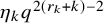 $\eta _k q^{2(r_k+k)-2}$
. From Theorem 4.16 and the discussion following Definition 4.14, we see that then necessarily these roots must be of the form stated in the first item of the theorem, with
$\eta _k q^{2(r_k+k)-2}$
. From Theorem 4.16 and the discussion following Definition 4.14, we see that then necessarily these roots must be of the form stated in the first item of the theorem, with $N_0 = N-M$
and
$N_0 = N-M$
and $N_+$
the number of positive values of
$N_+$
the number of positive values of $\eta $
.
$\eta $
.
On the other hand, given an arbitrary $\epsilon \in \{\pm 1\}^M$
for
$\epsilon \in \{\pm 1\}^M$
for $M = N- N_0$
, any set of roots of the form (4.18) for which
$M = N- N_0$
, any set of roots of the form (4.18) for which $N_+$
equals the number of positive
$N_+$
equals the number of positive  can be ordered in a unique way as to have them satisfy the $\epsilon $
-adaptedness condition. Then again by Theorem 4.16, we obtain the ‘if’-part of the first item as well as the second item of the theorem.
$\epsilon $
-adaptedness condition. Then again by Theorem 4.16, we obtain the ‘if’-part of the first item as well as the second item of the theorem.
As an immediate corollary, we have the following.
Corollary 4.18. For a given $s\in \mathbb {R}^N$
, there are only finitely many irreducible big cell representations of
$s\in \mathbb {R}^N$
, there are only finitely many irreducible big cell representations of $\mathcal {O}_q(O_s)$
.
$\mathcal {O}_q(O_s)$
.
Proof. This follows from the second part of Theorem 4.17. We moreover get the explicit bound $\binom {N_++N_-}{N_+}$
, with
$\binom {N_++N_-}{N_+}$
, with $N_++N_-$
the number of nonzero entries of s and
$N_++N_-$
the number of nonzero entries of s and $N_+$
the number of strictly positive entries of s.
$N_+$
the number of strictly positive entries of s.
4.4 Classification of highest weights for
$\mathcal {O}_q^{\epsilon }(T(N))$

We now prove Theorem 4.15. First, we show that we can restrict to the case $M= N$
.
$M= N$
.
Lemma 4.19. Assume Theorem 4.15 holds when $M=N$
. Then it also holds for
$M=N$
. Then it also holds for $M\leq N$
arbitrary.
$M\leq N$
arbitrary.
Proof. Let $M\leq N$
, and let
$M\leq N$
, and let $\pi $
be an admissible unitary highest weight module of
$\pi $
be an admissible unitary highest weight module of $\mathcal {O}_q^{\epsilon }(T(N))$
for
$\mathcal {O}_q^{\epsilon }(T(N))$
for $\epsilon \in \{-1,0,1\}^M$
. By restricting
$\epsilon \in \{-1,0,1\}^M$
. By restricting $\pi $
to
$\pi $
to $\mathcal {O}_q^{\epsilon }(T(M))$
, we obtain that r needs to be
$\mathcal {O}_q^{\epsilon }(T(M))$
, we obtain that r needs to be $\epsilon $
-adapted by the hypothesis. To see that this condition is also sufficient, let r be
$\epsilon $
-adapted by the hypothesis. To see that this condition is also sufficient, let r be $\epsilon $
-adapted and put
$\epsilon $
-adapted and put $\tilde {r} = (r,1,\ldots ,1)$
and
$\tilde {r} = (r,1,\ldots ,1)$
and $\tilde {\epsilon } = (\epsilon ,0,\ldots ,0)$
. Then
$\tilde {\epsilon } = (\epsilon ,0,\ldots ,0)$
. Then $\tilde {r}$
is
$\tilde {r}$
is $\tilde {\epsilon }$
-adapted and hence
$\tilde {\epsilon }$
-adapted and hence $\tilde {\epsilon }$
-admissible, again by the hypothesis. There hence exists an admissible unitary highest module
$\tilde {\epsilon }$
-admissible, again by the hypothesis. There hence exists an admissible unitary highest module $V_{\tilde {r}}$
of
$V_{\tilde {r}}$
of $\mathcal {O}_q^{\tilde {\epsilon }}(T(N))$
with highest weight
$\mathcal {O}_q^{\tilde {\epsilon }}(T(N))$
with highest weight $\tilde {r}$
. If
$\tilde {r}$
. If $\xi $
is its highest weight vector, we then immediately obtain that
$\xi $
is its highest weight vector, we then immediately obtain that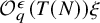 $\mathcal {O}_q^{\epsilon }(T(N))\xi $
is a highest weight
$\mathcal {O}_q^{\epsilon }(T(N))\xi $
is a highest weight $*$
-representation of
$*$
-representation of $\mathcal {O}_q^{\epsilon }(T(N))$
at highest weight r, so r is
$\mathcal {O}_q^{\epsilon }(T(N))$
at highest weight r, so r is $\epsilon $
-admissible.
$\epsilon $
-admissible.
The classification in Theorem 4.15 for the case $N=M$
can be done straightforwardly using analogues of Gelfand–Tsetlin patterns. We recall the specifics [Reference Shibukawa, Takebayashi and UenoSTU90] (see also [Reference Klimyk and SchmüdgenKS97, Section 7.3.3]), adapted to the
$N=M$
can be done straightforwardly using analogues of Gelfand–Tsetlin patterns. We recall the specifics [Reference Shibukawa, Takebayashi and UenoSTU90] (see also [Reference Klimyk and SchmüdgenKS97, Section 7.3.3]), adapted to the $\epsilon $
-deformed setting. The following proposition holds for arbitrary
$\epsilon $
-deformed setting. The following proposition holds for arbitrary $\epsilon \in \mathbb {R}^N$
.
$\epsilon \in \mathbb {R}^N$
.
Proposition 4.20. Let $r\in \mathbb {R}^N$
. Let
$r\in \mathbb {R}^N$
. Let $M_{r}$
be the Verma module for
$M_{r}$
be the Verma module for $\mathcal {O}_{q}^{\epsilon }(T(N))$
at highest weight r, and let
$\mathcal {O}_{q}^{\epsilon }(T(N))$
at highest weight r, and let $V_r$
be the corresponding simple quotient. Write
$V_r$
be the corresponding simple quotient. Write
 $$\begin{align*}w = (w_1,\ldots,w_N) = (q^{r_1},\ldots,q^{r_N}). \end{align*}$$
Then $V_r$
has a spanning set
$V_r$
has a spanning set $\xi (P)$
(as a vector space) labeled by symbols P where
$\xi (P)$
(as a vector space) labeled by symbols P where $P=(P_1,\ldots , P_{N-1})$
for
$P=(P_1,\ldots , P_{N-1})$
for
 $$\begin{align*}P_k = (P_{1k},\ldots,P_{kk}) \in \mathbb{Z}_{\geq 0}^{k}, \end{align*}$$
where $\xi (P)$
is a weight vector with
$\xi (P)$
is a weight vector with
 $$\begin{align*}t_k \xi(P) = w_k q^{\sum_{i=k}^{N-1} P_{ki}- \sum_{i=1}^{k-1} P_{i,k-1}}, \end{align*}$$
and where
 $$ \begin{align} \langle \xi(P),\xi(P')\rangle = \delta_{P,P'} c_P \end{align} $$
for
 $$ \begin{align} c_P = \tau_1(P)\ldots\tau_{N-1}(P)c_P' \end{align} $$
with
 $$\begin{align*}0< c_P' = \prod_{k=1}^{N-1} \prod_{1\leq i \leq j \leq k} (q^{-1}-q)^{-2P_{ik}} q^{-P_{ik}((r_j+j-r_i-i) + \sum_{l=k}^{N-1} (P_{jl}-P_{il}) + (r_{j+1}+j+1-r_i-i)+ \sum_{l=k+1}^{N-1} (P_{j+1,l}-P_{il}) )} \end{align*}$$
and with
 $$ \begin{align} \tau_{k}(P) &= \prod_{1\leq i \leq j \leq k} \left(\epsilon_{(i,j]}\frac{w_j^2}{w_i^2} q^{2(j-i+1)+2 \sum_{l=k}^{N-1}(P_{jl} - P_{il})};q^2\right)_{P_{ik}} \nonumber\\& \qquad\qquad\qquad\qquad\quad\qquad\times \left(\epsilon_{(i,j+1]}\frac{w_{j+1}^2}{w_{i}^2} q^{2(j-i+1) -2P_{ik}+2 \sum_{l=k+1}^{N-1}(P_{j+1,l} -P_{il})};q^2\right)_{P_{ik}} \end{align} $$
where we use the notation
 $$\begin{align*}(a;q^2)_m = (1-a)(1-q^2a)\ldots (1-q^{2m-2}a). \end{align*}$$
Note that the $(\xi (P))_P$
need in general not form a basis of
$(\xi (P))_P$
need in general not form a basis of $V_r$
- for this one needs to throw away the terms where (4.21) becomes zero. We will not need the detailed information on when this precisely happens - we will only need to determine when the
$V_r$
- for this one needs to throw away the terms where (4.21) becomes zero. We will not need the detailed information on when this precisely happens - we will only need to determine when the $\tau _k(P)$
are always
$\tau _k(P)$
are always $\geq 0$
. Also note that with respect to the usual Gelfand–Tsetlin patterns, we are considering rather differences of values along a diagonal row (e.g.,
$\geq 0$
. Also note that with respect to the usual Gelfand–Tsetlin patterns, we are considering rather differences of values along a diagonal row (e.g., $P_{ik} = \mu _{i-1,k}-\mu _{i-1,k-1}$
in comparison with equation (2.16) in [Reference Shibukawa, Takebayashi and UenoSTU90]): this is to keep the values of the Gelfand–Tsetlin pattern inside
$P_{ik} = \mu _{i-1,k}-\mu _{i-1,k-1}$
in comparison with equation (2.16) in [Reference Shibukawa, Takebayashi and UenoSTU90]): this is to keep the values of the Gelfand–Tsetlin pattern inside $\mathbb {Z}_{\geq 0}$
, so that the possible noninteger values (which need to be considered in the
$\mathbb {Z}_{\geq 0}$
, so that the possible noninteger values (which need to be considered in the $\epsilon $
-deformed setting) can be concentrated in the weights
$\epsilon $
-deformed setting) can be concentrated in the weights $w_k = q^{r_k}$
(with
$w_k = q^{r_k}$
(with $r_k = -\mu _{k-1,N-1}$
corresponding to the values in the top row of equation (2.16) in [Reference Shibukawa, Takebayashi and UenoSTU90], taking into account that they are considering rank
$r_k = -\mu _{k-1,N-1}$
corresponding to the values in the top row of equation (2.16) in [Reference Shibukawa, Takebayashi and UenoSTU90], taking into account that they are considering rank $N+1$
instead of N).
$N+1$
instead of N).
Proof. Put $U_q^{\epsilon }(\mathfrak {u}(N))$
the
$U_q^{\epsilon }(\mathfrak {u}(N))$
the $*$
-algebra as defined in Definition 1.1, except that the relation (1.4) has been changed to
$*$
-algebra as defined in Definition 1.1, except that the relation (1.4) has been changed to
 $$ \begin{align} E_iF_j - F_jE_i = \delta_{ij} \frac{\epsilon_i\widehat{K}_i - \widehat{K}_i^{-1}}{q-q^{-1}}. \end{align} $$
We keep the same $*$
-structure (1.9).
$*$
-structure (1.9).
The $*$
-algebra isomorphism (1.46) deforms to an isomorphism of
$*$
-algebra isomorphism (1.46) deforms to an isomorphism of $*$
-algebras
$*$
-algebras $\iota _{\epsilon }:O_q^{\epsilon }(T(N)) \cong U_q^{\epsilon }(\mathfrak {u}(N))$
, in such a way that we have
$\iota _{\epsilon }:O_q^{\epsilon }(T(N)) \cong U_q^{\epsilon }(\mathfrak {u}(N))$
, in such a way that we have
 $$\begin{align*}\iota_{\epsilon}(t_i) = K_i^{-1},\qquad \iota_{\epsilon}(t_{i,i+1}) = (q^{-1}-q)F_iK_{i+1}^{-1}. \end{align*}$$
We will in the following view this isomorphism as an identification.
It will be convenient to add self-adjoint square roots $K_i^{1/2}$
of the
$K_i^{1/2}$
of the $K_i$
to
$K_i$
to $U_q^{\epsilon }(\mathfrak {u}(N))$
. We denote the resulting
$U_q^{\epsilon }(\mathfrak {u}(N))$
. We denote the resulting $*$
-algebra as
$*$
-algebra as $\breve {U}_q(\mathfrak {u}(N))$
. Clearly any admissible
$\breve {U}_q(\mathfrak {u}(N))$
. Clearly any admissible $\mathcal {O}_q^{\epsilon }(T(N))$
-module extends uniquely to a
$\mathcal {O}_q^{\epsilon }(T(N))$
-module extends uniquely to a $\breve {U}_q(\mathfrak {u}(N))$
-module for which the
$\breve {U}_q(\mathfrak {u}(N))$
-module for which the $K_i^{1/2}$
have positive eigenvalues.
$K_i^{1/2}$
have positive eigenvalues.
Consider then the following elements in $\breve {U}_q(\mathfrak {u}(N))$
:
$\breve {U}_q(\mathfrak {u}(N))$
:
 $$\begin{align*}d_{kk} = 1,\qquad c_{kk} = 1, \end{align*}$$
 $$ \begin{align} d_{k,k-1} = f_k = q^{-1/2}F_k \hat{K}_k^{1/2},\qquad c_{k-1,k} = e_k =f_k^* = q^{1/2} \hat{K}_i^{-1/2}E_i, \end{align} $$
and inductively
 $$\begin{align*}d_{ki} = \langle K_{i+1}K_k^{-1}q^{k-i}\rangle_{i+1,k} f_kd_{k-1,i} - \langle K_{i+1} K_k^{-1}q^{k-i-1}\rangle_{i+1,k} d_{k-1,i}f_k, \end{align*}$$
 $$\begin{align*}c_{ik} = d_{ki}^* = c_{i,k-1}e_k \langle K_{i+1}K_k^{-1}q^{k-i}\rangle_{i+1,k} - e_k c_{i,k-1} \langle K_{i+1} K_k^{-1}q^{k-i-1}\rangle_{i+1,k}, \end{align*}$$
where $0 \leq i <k \leq N-1$
and
$0 \leq i <k \leq N-1$
and
 $$\begin{align*}\langle a\rangle_{i,k} = \frac{\epsilon_{(i,k]}a -a^{-1}}{q-q^{-1}}. \end{align*}$$
For $P = (P_1,\ldots , P_{N-1})$
with
$P = (P_1,\ldots , P_{N-1})$
with $P_k = (P_{1k},\ldots ,P_{kk}) \in \mathbb {Z}_{\geq 0}^{k}$
a symbol as above, write
$P_k = (P_{1k},\ldots ,P_{kk}) \in \mathbb {Z}_{\geq 0}^{k}$
a symbol as above, write
 $$\begin{align*}d_{k}^{P_k} = d_{k,0}^{P_{1k}}\ldots d_{k,k-1}^{P_{kk}},\quad d^P = d_1^{P_1}\ldots d_{N-1}^{P_{N-1}}, \qquad c_k^{P_k} = (d_k^{P_k})^*,\quad c^P = (d^P)^*. \end{align*}$$
With $\xi _r$
the highest weight vector of
$\xi _r$
the highest weight vector of $M_r$
, put
$M_r$
, put
 $$\begin{align*}\xi(P) = d^P \xi_r \in M_r. \end{align*}$$
Then we claim that (4.19) holds (in $M_r$
and hence in
$M_r$
and hence in $V_r$
). To see this, one can either repeat the arguments of [Reference Shibukawa, Takebayashi and UenoSTU90], or argue as follows. Assume we are in the case
$V_r$
). To see this, one can either repeat the arguments of [Reference Shibukawa, Takebayashi and UenoSTU90], or argue as follows. Assume we are in the case $\epsilon _i>0$
for all i, and write
$\epsilon _i>0$
for all i, and write
 $$\begin{align*}\widetilde{e}_i = \epsilon_{i+1}^{-1/4} e_i,\qquad \widetilde{f}_i = \epsilon_{i+1}^{-1/4} f_i,\qquad \widetilde{K}_i^{1/2} = \epsilon_{(i,N]}^{1/4}K_i^{1/2}. \end{align*}$$
Then the $\widetilde {e}_i,\widetilde {f}_i,\widetilde {K}_i^{1/2}$
establish an isomorphic copy of
$\widetilde {e}_i,\widetilde {f}_i,\widetilde {K}_i^{1/2}$
establish an isomorphic copy of $\breve {U}_q(\mathfrak {u}(N))$
. Up to reindexing, the elements
$\breve {U}_q(\mathfrak {u}(N))$
. Up to reindexing, the elements
 $$\begin{align*}\widetilde{d}_{k,k-1} = \widetilde{f}_k,\quad \widetilde{d}_{ki} = \langle \widetilde{K}_{i+1}\widetilde{K}_k^{-1}q^{k-i}\rangle \widetilde{f}_k\widetilde{d}_{k-1,i} - \langle \widetilde{K}_{i+1} \widetilde{K}_k^{-1}q^{k-i+1}\rangle \widetilde{d}_{k-1,i}\widetilde{f}_k \end{align*}$$
and their adjoints then correspond to the elements as defined in [Reference Shibukawa, Takebayashi and UenoSTU90]. Upon noticing that
 $$\begin{align*}\widetilde{K}_i \xi_r = q^{-r_i'} \xi_r,\qquad q^{-r_i'} = \epsilon_{(i,N]}^{1/2} q^{-r_i}, \end{align*}$$
and
 $$\begin{align*}d^P = \left(\prod_{1\leq i \leq k< N} \left(\epsilon_{(i,k+1]}^{1/4} \prod_{i< j \leq k} \epsilon_{(i,j]}^{1/2}\right)^{P_{i,k}}\right)\widetilde{d}^P, \end{align*}$$
one can easily deduce (4.19) directly from [Reference Shibukawa, Takebayashi and UenoSTU90]. This identity however continues to hold true for general $\epsilon $
by continuity of the multiplication structure in the parameter
$\epsilon $
by continuity of the multiplication structure in the parameter $\epsilon $
.
$\epsilon $
.
To finish the proof, we need to show that the $\xi (P)$
span
$\xi (P)$
span $V_r$
. To see this, let
$V_r$
. To see this, let $\widetilde {M}_r$
be a vector with basis elements
$\widetilde {M}_r$
be a vector with basis elements $\xi '(P)$
labeled by the P as above. Define on
$\xi '(P)$
labeled by the P as above. Define on $\widetilde {M}_r$
operators
$\widetilde {M}_r$
operators $K_i,e_i,f_i$
by the following formulas:
$K_i,e_i,f_i$
by the following formulas:
 $$\begin{align*}K_i \xi'(P) = q^{-r_i} q^{\sum_{j=1}^{i-1} P_{j,i-1}-\sum_{j=i}^{N-1} P_{ij}}\xi'(P), \ \ \ \qquad \end{align*}$$
 $$\begin{align*}e_i \xi'(P) = \sum_{j=1}^{i} a_{j,i}(P) \widetilde{\xi}(P+\delta_{j}(i-1) - \delta_{j}(i)), \end{align*}$$
 $$\begin{align*}f_i \xi'(P) = \sum_{j=1}^{i} b_{j,i}(P) \widetilde{\xi}(P-\delta_{j}(i-1) + \delta_{j}(i)), \end{align*}$$
where $\widetilde {\xi }(P\pm \delta _{j}(i-1) \mp \delta _{j}(i))$
means replacing
$\widetilde {\xi }(P\pm \delta _{j}(i-1) \mp \delta _{j}(i))$
means replacing $P_{j,i-1}$
by
$P_{j,i-1}$
by $P_{j,i-1}\pm 1$
and
$P_{j,i-1}\pm 1$
and $P_{j,i}$
by
$P_{j,i}$
by $P_{j,i}\mp 1$
, and where, with
$P_{j,i}\mp 1$
, and where, with
 $$\begin{align*}[x]_\epsilon = \frac{\epsilon q^x - q^{-x}}{q-q^{-1}},\qquad [x]^{\epsilon} = \frac{q^x - \epsilon q^{-x}}{q-q^{-1}}, \end{align*}$$
 $$ \begin{align*} a_{j,i}(P) = - & \frac{\prod_{1\leq k\leq j} [-r_{k}+r_{j} -\sum_{l=i+1}^{N-1} P_{k,l} + \sum_{l=i}^{N-1} P_{j,l}+j-k]_{\epsilon_{(k,j]}}} {\prod_{1\leq k< j} [-r_{k}+r_{j} -\sum_{l=i+1}^{N-1} P_{k,l} + \sum_{l=i}^{N-1} P_{j,l}+j-k]_{\epsilon_{(k,j]}}} \\ &\qquad\qquad\qquad \times \frac{\prod_{j<k\leq i+1} [-r_{k}+r_{j} -\sum_{l=i+1}^{N-1} P_{k,l} + \sum_{l=i}^{N-1} P_{j,l}+j-k]^{\epsilon_{(j,k]}}}{\prod_{j<k\leq i} [-r_{k}+r_{j} -\sum_{l=i+1}^{N-1} P_{k,l} + \sum_{l=i}^{N-1} P_{j,l}+j-k]^{\epsilon_{(j,k]}}}, \end{align*} $$
 $$ \begin{align*} \kern-12pt b_{j,i}(P) = & \frac{\prod_{1\leq k\leq j} [-r_{k}+r_{j} -\sum_{l=i+1}^{N-1} P_{k,l} + \sum_{l=i}^{N-1} P_{j,l}+j-k]_{\epsilon_{(k,j]}}} {\prod_{1\leq k< j} [-r_{k}+r_{j} -\sum_{l=i+1}^{N-1} P_{k,l} + \sum_{l=i}^{N-1} P_{j,l}+j-k]_{\epsilon_{(k,j]}}} \\ &\qquad\qquad\qquad \times \frac{\prod_{j<k\leq i-1} [-r_{k}+r_{j} -\sum_{l=i-1}^{N-1} P_{k,l} + \sum_{l=i}^{N-1} P_{j,l}+j-k]^{\epsilon_{(j,k]}}}{\prod_{j<k\leq i} [-r_{k}+r_{j} -\sum_{l=i+1}^{N-1} P_{k,l} + \sum_{l=i}^{N-1} P_{j,l}+j-k]^{\epsilon_{(j,k]}}} \end{align*} $$
It can then be shown that these elements satisfy the defining relations for $\breve {U}_q^{\epsilon }(\mathfrak {u}(N))$
(using the alternative generators in (4.23)). Namely, we use [Reference Shibukawa, Takebayashi and UenoSTU90, Theorem 2.11] to see that the defining relations hold when evaluated on a given
$\breve {U}_q^{\epsilon }(\mathfrak {u}(N))$
(using the alternative generators in (4.23)). Namely, we use [Reference Shibukawa, Takebayashi and UenoSTU90, Theorem 2.11] to see that the defining relations hold when evaluated on a given $\xi '(P)$
when
$\xi '(P)$
when $\epsilon = +$
and r is any large enough integral weight, after which one can conclude by a rescaling argument together with a Zariski density argument.
$\epsilon = +$
and r is any large enough integral weight, after which one can conclude by a rescaling argument together with a Zariski density argument.
Similarly, one concludes that
 $$\begin{align*}\xi'(P) = d^P \xi_r', \end{align*}$$
where $\xi _r' = \xi '(0)$
corresponds to the diagram
$\xi _r' = \xi '(0)$
corresponds to the diagram $0_{ik}=0$
for all
$0_{ik}=0$
for all $i,k$
. It follows that
$i,k$
. It follows that $\widetilde {M}_r$
is a highest weight representation. By the universal property of
$\widetilde {M}_r$
is a highest weight representation. By the universal property of $M_r$
, we obtain a (necessarily surjective)
$M_r$
, we obtain a (necessarily surjective) $\breve {U}_q^{\epsilon }(\mathfrak {u}(N))$
-linear map
$\breve {U}_q^{\epsilon }(\mathfrak {u}(N))$
-linear map $M_r\rightarrow \widetilde {M}_r$
sending
$M_r\rightarrow \widetilde {M}_r$
sending $\xi (P)$
to
$\xi (P)$
to $\xi '(P)$
. But since the quotient map
$\xi '(P)$
. But since the quotient map $M_r \rightarrow V_r$
must factor through
$M_r \rightarrow V_r$
must factor through $\widetilde {M}_r$
, it follows that the
$\widetilde {M}_r$
, it follows that the $\xi (P)$
span
$\xi (P)$
span $V_r$
.
$V_r$
.
We can now prove Theorem 4.15. We restrict now to the case of $\epsilon \in \{-1,0,1\}^{N}$
.
$\epsilon \in \{-1,0,1\}^{N}$
.
Assume first that r is $\epsilon $
-admissible. Assume that
$\epsilon $
-admissible. Assume that $s<t$
with
$s<t$
with $\epsilon _{(s,t]} = 1$
. We can find a subdivision
$\epsilon _{(s,t]} = 1$
. We can find a subdivision $s = s_0 <s_1< \ldots < s_n = t$
such that the following holds: each
$s = s_0 <s_1< \ldots < s_n = t$
such that the following holds: each $\epsilon _{(s_i,s_{i+1}]} =1$
and
$\epsilon _{(s_i,s_{i+1}]} =1$
and $\epsilon _{(s_i,p]} <0$
for
$\epsilon _{(s_i,p]} <0$
for $p<s_{i+1}$
. If the condition (4.17) holds for all
$p<s_{i+1}$
. If the condition (4.17) holds for all $s_i < s_{i+1}$
, it clearly also holds for
$s_i < s_{i+1}$
, it clearly also holds for $s<t$
. We may hence assume already that
$s<t$
. We may hence assume already that $\epsilon _{(s,p]} <0$
for
$\epsilon _{(s,p]} <0$
for $p<t$
.
$p<t$
.
Consider the symbol P with $P_{ik} = 0$
unless
$P_{ik} = 0$
unless $i=s$
and
$i=s$
and $k = t-1$
, in which case we write
$k = t-1$
, in which case we write $P_{s,t-1} = m$
. Then one easily sees that the sign of (4.20) equals the sign of
$P_{s,t-1} = m$
. Then one easily sees that the sign of (4.20) equals the sign of
 $$\begin{align*}\left(\frac{w_{t}^2}{w_s^2} q^{2(t-s)-2m};q^2\right)_m = (q^{2((r_t+t)-(r_s +s)-m)};q^2)_m. \end{align*}$$
The latter will be $\geq 0$
for all
$\geq 0$
for all $m\in \mathbb {Z}_{\geq 0}$
if and only if
$m\in \mathbb {Z}_{\geq 0}$
if and only if $(r_t+t) - (r_s+s) -1 \in \mathbb {Z}_{\geq 0}$
. Hence r is
$(r_t+t) - (r_s+s) -1 \in \mathbb {Z}_{\geq 0}$
. Hence r is $\epsilon $
-adapted.
$\epsilon $
-adapted.
Conversely, assume that r is $\epsilon $
-adapted. By Proposition 4.11 we only need to show that the scalar product in Proposition 4.20 is positive semi-definite, which will hold if and only if we have
$\epsilon $
-adapted. By Proposition 4.11 we only need to show that the scalar product in Proposition 4.20 is positive semi-definite, which will hold if and only if we have $c_M \geq 0$
for all M, or equivalently,
$c_M \geq 0$
for all M, or equivalently, $\prod _{k=1}^{N-1}\tau _k(P) \geq 0$
.
$\prod _{k=1}^{N-1}\tau _k(P) \geq 0$
.
Now we can reorder
 $$\begin{align*}\prod_{k=1}^{N-1}\tau_k(P) = \prod_{i\leq j} \kappa_{ij}(P) \end{align*}$$
with $\kappa _{ii}(P) = \prod _{k\geq i} (q^2;q^2)_{P_{ik}}>0$
and, for
$\kappa _{ii}(P) = \prod _{k\geq i} (q^2;q^2)_{P_{ik}}>0$
and, for $i<j$
,
$i<j$
,
 $$ \begin{align*} \kappa_{ij}(P) &= \prod_{k\geq j} \left(\epsilon_{(i,j]}\frac{w_j^2}{w_i^2} q^{2(j-i+1)+2 \sum_{l=k}^{N-1}(P_{jl} - P_{il})};q^2\right)_{P_{ik}} \\& \qquad\qquad\qquad\qquad\qquad\quad\qquad \times \prod_{k\geq j+1} \left(\epsilon_{(i,j]}\frac{w_{j}^2}{w_{i}^2} q^{2(j-i) -2P_{ik}+2 \sum_{l=k+1}^{N-1}(P_{jl} -P_{il})};q^2\right)_{P_{ik}}. \end{align*} $$
Clearly $\kappa _{ij}(P) \geq 0$
if
$\kappa _{ij}(P) \geq 0$
if $\epsilon _{(i,j]} \leq 0$
. On the other hand, if
$\epsilon _{(i,j]} \leq 0$
. On the other hand, if $i<j$
with
$i<j$
with $\epsilon _{(i,j]} = 1$
, we may by
$\epsilon _{(i,j]} = 1$
, we may by $\epsilon $
-adaptedness write
$\epsilon $
-adaptedness write $r_j - r_i = m_{ij}+i-j+1$
for
$r_j - r_i = m_{ij}+i-j+1$
for $m_{ij}\geq 0$
. Then we can rewrite
$m_{ij}\geq 0$
. Then we can rewrite
 $$\begin{align*}\kappa_{ij}(P) = \prod_{k\geq j} \alpha_{ijk} \prod_{k\geq j+1} \beta_{ijk} \end{align*}$$
with
 $$\begin{align*}\alpha_{ijk} &= \left(q^{2(m_{ij} + \sum_{l=k+2} P_{jl} - \sum_{l=k+1} P_{il}) + 2 -2P_{ik} + 2P_{j,k+1} +2P_{jk} + 2};q^2\right)_{P_{ik}},\\\beta_{ijk}& = \left(q^{2(m_{ij} + \sum_{l=k+2} P_{jl} - \sum_{l=k+1} P_{il}) + 2 -2P_{ik} + 2P_{j,k+1}};q^2\right)_{P_{ik}}. \end{align*}$$
Assume that $\kappa _{ij}(P) \neq 0$
. Then as
$\kappa _{ij}(P) \neq 0$
. Then as $m_{ij} \geq 0$
, we see by considering
$m_{ij} \geq 0$
, we see by considering $\beta _{ij,N-1}$
that necessarily
$\beta _{ij,N-1}$
that necessarily $m_{ij} - P_{i,N-1}\geq 0$
, and hence
$m_{ij} - P_{i,N-1}\geq 0$
, and hence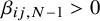 $\beta _{ij,N-1}>0$
. By induction, we then see that
$\beta _{ij,N-1}>0$
. By induction, we then see that
 $$ \begin{align} m_{ij} + \sum_{l=k+1} P_{jl} - \sum_{l=k} P_{il} \geq 0,\qquad \textrm{for all }k\geq j+1, \end{align} $$
and so all $\beta _{ijk}>0$
for
$\beta _{ijk}>0$
for $k\geq j+1$
. It is then clear from the form of the
$k\geq j+1$
. It is then clear from the form of the $\alpha _{ijk}$
and (4.24) that also
$\alpha _{ijk}$
and (4.24) that also $\alpha _{ijk}>0$
for all
$\alpha _{ijk}>0$
for all $k\geq j$
.
$k\geq j$
.
It follows that $\kappa _{ij}(P) \geq 0$
for all
$\kappa _{ij}(P) \geq 0$
for all $i\leq j$
, and hence r is
$i\leq j$
, and hence r is $\epsilon $
-admissible.
$\epsilon $
-admissible.
This finishes the proof of Theorem 4.15.
5 A quantized version of Sylvester’s law of inertia
We now use the classification of irreducible big cell representations for $\mathcal {O}_q(H(N))$
to prove our main results.
$\mathcal {O}_q(H(N))$
to prove our main results.
5.1 Weak containment
Our aim is to show that any representation of $\mathcal {O}_q(H(N))$
is weakly contained in a big cell representation. We will need some preparatory lemmas. Recall that
$\mathcal {O}_q(H(N))$
is weakly contained in a big cell representation. We will need some preparatory lemmas. Recall that
 $$\begin{align*}{\mathrm{Ad}}_{\lambda}(\pi) = (\pi \otimes \lambda)\circ {\mathrm{Ad}}_q^U \end{align*}$$
for $\pi $
, resp.
$\pi $
, resp. $\lambda $
a representation of
$\lambda $
a representation of $\mathcal {O}_q(H(N))$
, resp.
$\mathcal {O}_q(H(N))$
, resp. $\mathcal {O}_q(U(N))$
. For flexibility, we also use the notation
$\mathcal {O}_q(U(N))$
. For flexibility, we also use the notation
 $$\begin{align*}\pi *\lambda = {\mathrm{Ad}}_{\lambda}(\pi) \end{align*}$$
Let us restate Lemma 3.11 for our particular case of interest.
Lemma 5.1. Let $\pi $
be a representation of
$\pi $
be a representation of $\mathcal {O}_q(H(N))$
. Then
$\mathcal {O}_q(H(N))$
. Then $\pi $
is weakly contained in
$\pi $
is weakly contained in ${\mathrm {Ad}}_{\lambda _{{\mathrm {st}}}}(\pi )$
.
${\mathrm {Ad}}_{\lambda _{{\mathrm {st}}}}(\pi )$
.
Lemma 5.2. Any big cell representation $\pi $
of
$\pi $
of $\mathcal {O}_q(H(N))$
is a direct integral of irreducible big cell representations. Moreover, if
$\mathcal {O}_q(H(N))$
is a direct integral of irreducible big cell representations. Moreover, if $\pi $
factors over some
$\pi $
factors over some $\mathcal {O}_q(O_s)$
, then
$\mathcal {O}_q(O_s)$
, then $\pi $
is a direct sum of irreducible big cell representations.
$\pi $
is a direct sum of irreducible big cell representations.
Proof. It is sufficient to consider big cell representations of rank M. However, such a representation will clearly disintegrate into a direct integral of factorial big cell representations $\pi $
of rank M, that is, with
$\pi $
of rank M, that is, with $\pi (\mathcal {O}_q(H(N))"$
a factor. It is thus sufficient to show that any factorial big cell representation
$\pi (\mathcal {O}_q(H(N))"$
a factor. It is thus sufficient to show that any factorial big cell representation $\pi $
is a direct sum of irreducibles. This will then automatically prove also the moreover part of the lemma, by Corollary 4.18.
$\pi $
is a direct sum of irreducibles. This will then automatically prove also the moreover part of the lemma, by Corollary 4.18.
Note now that a factorial big cell representation $\pi $
automatically has a fixed signature
$\pi $
automatically has a fixed signature $\eta $
, and that moreover
$\eta $
, and that moreover $\mathcal {H}_{\pi }$
has an orthonormal basis of weight vectors for the
$\mathcal {H}_{\pi }$
has an orthonormal basis of weight vectors for the  with
with $k\leq M$
. Let
$k\leq M$
. Let $V_{\pi }$
be the algebraic sum of these eigenspaces. Then with
$V_{\pi }$
be the algebraic sum of these eigenspaces. Then with $\epsilon \in \{\pm 1\}^M$
such that
$\epsilon \in \{\pm 1\}^M$
such that $\eta = \eta _{\epsilon }$
, we have that
$\eta = \eta _{\epsilon }$
, we have that $\pi $
extends on
$\pi $
extends on $V_{\pi }$
to a
$V_{\pi }$
to a $^*$
-representation of
$^*$
-representation of $\mathcal {O}_{q}^{\epsilon }(T(N))$
through
$\mathcal {O}_{q}^{\epsilon }(T(N))$
through $i_{\epsilon }^T$
. Let
$i_{\epsilon }^T$
. Let $V_h \subseteq V_{\pi }$
be the subspace of vectors
$V_h \subseteq V_{\pi }$
be the subspace of vectors $\xi $
with
$\xi $
with $\mathcal {O}_q^{\leq M}(\mathscr {N}(N))^* \xi = 0$
. Then
$\mathcal {O}_q^{\leq M}(\mathscr {N}(N))^* \xi = 0$
. Then $V_h$
will be invariant under the
$V_h$
will be invariant under the  , and hence the linear span of the highest weight vectors for $\pi $
. As
$\pi $
. As  , we have by boundedness of the operators
  that the vector space $V_h$
will be nonempty.
$V_h$
will be nonempty.
Now any element in $\pi (\mathcal {O}_q(H(N)))'$
will preserve the homogenous components of
$\pi (\mathcal {O}_q(H(N)))'$
will preserve the homogenous components of $V_h$
. On the other hand, if
$V_h$
. On the other hand, if $\xi ,\eta \in V_h$
are orthogonal vectors, it follows from the triangular decomposition (4.15) that
$\xi ,\eta \in V_h$
are orthogonal vectors, it follows from the triangular decomposition (4.15) that $\mathcal {O}_q(H(N))\xi $
and
$\mathcal {O}_q(H(N))\xi $
and $\mathcal {O}_q(H(N))\eta $
will be orthogonal. By factoriality of
$\mathcal {O}_q(H(N))\eta $
will be orthogonal. By factoriality of $\pi $
, we hence deduce that
$\pi $
, we hence deduce that $V_h$
must consist of a single homogeneous component, which moreover must then generate the representation
$V_h$
must consist of a single homogeneous component, which moreover must then generate the representation $\pi $
. If then
$\pi $
. If then $\{\xi _k\}$
is an orthonormal basis of
$\{\xi _k\}$
is an orthonormal basis of $V_h$
, it follows that
$V_h$
, it follows that $\pi = \oplus _k \pi _k$
with
$\pi = \oplus _k \pi _k$
with $\pi _k$
the restriction of
$\pi _k$
the restriction of $\pi $
to the closure of
$\pi $
to the closure of $\mathcal {O}_q(H(N)) \xi _k$
. Since clearly each
$\mathcal {O}_q(H(N)) \xi _k$
. Since clearly each $\pi _k$
is an irreducible big cell representation, we are done.
$\pi _k$
is an irreducible big cell representation, we are done.
In the next lemma, we will use that for A a unital $*$
-algebra with coaction
$*$
-algebra with coaction $\alpha : A \rightarrow A\otimes \mathcal {O}(\mathbb {G})$
by a compact quantum group
$\alpha : A \rightarrow A\otimes \mathcal {O}(\mathbb {G})$
by a compact quantum group $\mathbb {G}$
, and
$\mathbb {G}$
, and $\pi \cong \int _X^{\oplus } \pi _x {\mathrm {d}\!} \mu (x)$
a direct integral decomposition of a representation
$\pi \cong \int _X^{\oplus } \pi _x {\mathrm {d}\!} \mu (x)$
a direct integral decomposition of a representation $\pi $
of A, then
$\pi $
of A, then
 $$\begin{align*}\pi * \lambda \cong \int_X^{\oplus} (\pi_x * \lambda){\mathrm{d}\!} \mu(x) \end{align*}$$
for any representation $\lambda $
of
$\lambda $
of $\mathcal {O}(\mathbb {G})$
. Indeed, the isomorphism is established through the unitary operator
$\mathcal {O}(\mathbb {G})$
. Indeed, the isomorphism is established through the unitary operator
 $$\begin{align*}\int_X^{\oplus} \left(\mathcal{H}_{\pi_x}\otimes \mathcal{H}_{\lambda}\right){\mathrm{d}\!} \mu(x) \cong \left(\int_X^{\oplus} \mathcal{H}_{\pi_x} {\mathrm{d}\!} \mu(x)\right)\otimes \mathcal{H}_{\lambda}. \end{align*}$$
We will use this in combination with the fact that any representation of a (separable) type I C $^*$
-algebra disintegrates into a direct integral of irreducible representations. We reprise the notation from Section 2.2.
$^*$
-algebra disintegrates into a direct integral of irreducible representations. We reprise the notation from Section 2.2.
Lemma 5.3. If a representation $\pi $
of
$\pi $
of $\mathcal {O}_q(H(2))$
is
$\mathcal {O}_q(H(2))$
is ${\mathrm {Ad}}^U_q$
-compatible and normal, then
${\mathrm {Ad}}^U_q$
-compatible and normal, then ${\mathrm {Ker}}(\pi (z))$
is
${\mathrm {Ker}}(\pi (z))$
is $\mathcal {O}_q(H(2))$
-invariant and
$\mathcal {O}_q(H(2))$
-invariant and $\pi (Z)_{\mid \mathbb {C}^2 \otimes {\mathrm {Ker}}(\pi (z))} = 0$
.
$\pi (Z)_{\mid \mathbb {C}^2 \otimes {\mathrm {Ker}}(\pi (z))} = 0$
.
Proof. The $\mathcal {O}_q(H(2))$
-invariance of
$\mathcal {O}_q(H(2))$
-invariance of ${\mathrm {Ker}}(\pi (z))$
is immediate as
${\mathrm {Ker}}(\pi (z))$
is immediate as $z q$
-commutes with the other generators. Further, since
$z q$
-commutes with the other generators. Further, since $\pi $
is assumed normal, we have by Proposition 3.9 that
$\pi $
is assumed normal, we have by Proposition 3.9 that ${\mathrm {Ad}}_{\lambda _{{\mathrm {st}}}}(\pi )$
is unitarily equivalent to a direct sum of copies of
${\mathrm {Ad}}_{\lambda _{{\mathrm {st}}}}(\pi )$
is unitarily equivalent to a direct sum of copies of $\pi $
. By Corollary 2.3 and the remark preceding the lemma, it is then sufficient to prove that the kernel of
$\pi $
. By Corollary 2.3 and the remark preceding the lemma, it is then sufficient to prove that the kernel of $\pi (z)$
is zero for
$\pi (z)$
is zero for $\pi = {\mathrm {Ad}}{\lambda _{{\mathrm {st}}}}(\pi ')$
with
$\pi = {\mathrm {Ad}}{\lambda _{{\mathrm {st}}}}(\pi ')$
with $\pi '$
an irreducible representation of
$\pi '$
an irreducible representation of $\mathcal {O}_q(H(2))$
distinct from the zero
$\mathcal {O}_q(H(2))$
distinct from the zero $*$
-character
$*$
-character $Z \mapsto 0$
.
$Z \mapsto 0$
.
If $\pi '$
is as in case (1) of Proposition 2.2, then there exists
$\pi '$
is as in case (1) of Proposition 2.2, then there exists $m>0$
with
$m>0$
with $m\leq \pi '(Z)$
, hence also
$m\leq \pi '(Z)$
, hence also $m\leq ({\mathrm {Ad}}_{\lambda _{{\mathrm {st}}}}(\pi '))(z) = (\langle e_1,-e_1\rangle \otimes \pi ' \otimes \lambda _{{\mathrm {st}}})(U_{13}^*Z_{12}U_{13})$
.
$m\leq ({\mathrm {Ad}}_{\lambda _{{\mathrm {st}}}}(\pi '))(z) = (\langle e_1,-e_1\rangle \otimes \pi ' \otimes \lambda _{{\mathrm {st}}})(U_{13}^*Z_{12}U_{13})$
.
If we are in the case (2) or case (3), we may by Proposition 3.10 assume that $\pi '$
is any nonzero
$\pi '$
is any nonzero $*$
-character
$*$
-character $\chi $
of
$\chi $
of $\mathcal {O}_q(H(2))$
, say
$\mathcal {O}_q(H(2))$
, say $\chi (Z) = \begin {pmatrix} 0 & x \\ x & y\end {pmatrix}$
for
$\chi (Z) = \begin {pmatrix} 0 & x \\ x & y\end {pmatrix}$
for $x,y\in \mathbb {R}$
. But it can be checked by a direct spectral computation that
$x,y\in \mathbb {R}$
. But it can be checked by a direct spectral computation that
 $$\begin{align*}({\mathrm{Ad}}_{\lambda_{{\mathrm{st}}}}(\chi))(z) = xa^*c + yc^*c + xc^*a \in B(L^2(SU_q(2))) \end{align*}$$
does not have $0$
in its point spectrum if
$0$
in its point spectrum if $(x,y)\neq (0,0)$
, cf. [Reference Masuda, Nakagami and WatanabeMNW91].
$(x,y)\neq (0,0)$
, cf. [Reference Masuda, Nakagami and WatanabeMNW91].
Lemma 5.4. Let $\pi $
be a big cell representation of
$\pi $
be a big cell representation of $\mathcal {O}_q(H(2))$
of signature
$\mathcal {O}_q(H(2))$
of signature $(\eta _1,\eta _2)$
with
$(\eta _1,\eta _2)$
with $\eta _1\eta _2 = -1$
. Then
$\eta _1\eta _2 = -1$
. Then $\pi *\mathbf {s} = \pi _1 \oplus \pi _2$
with
$\pi *\mathbf {s} = \pi _1 \oplus \pi _2$
with $\pi _1$
of signature
$\pi _1$
of signature $(\eta _1,\eta _2)$
and
$(\eta _1,\eta _2)$
and $\pi _2$
of signature
$\pi _2$
of signature $(\eta _2,\eta _1)$
.
$(\eta _2,\eta _1)$
.
Proof. By Corollary 2.3 and the discussion above Lemma 5.3, it is sufficient to prove the lemma for $\pi $
irreducible. Now the conditions imply that we are in the case
$\pi $
irreducible. Now the conditions imply that we are in the case $(3,b)$
of Proposition 2.2, so
$(3,b)$
of Proposition 2.2, so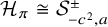 $\mathcal {H}_{\pi } \cong \mathcal {S}_{-c^2,a}^{\pm }$
for some choice of sign and
$\mathcal {H}_{\pi } \cong \mathcal {S}_{-c^2,a}^{\pm }$
for some choice of sign and $a,c>0$
. But then
$a,c>0$
. But then
 $$\begin{align*}\mathcal{S}^{\pm}_{-c^2,a}*\mathbf{s} \cong \mathcal{H} \otimes (\mathcal{S}^+_{-c^2,a} \oplus \mathcal{S}^-_{-c^2,a}) \end{align*}$$
with $\mathcal {H}$
some countable multiplicity Hilbert space, see, for example, [Reference De CommerDeC20, Proposition 1.14].
$\mathcal {H}$
some countable multiplicity Hilbert space, see, for example, [Reference De CommerDeC20, Proposition 1.14].
Proposition 5.5. Let $\pi $
be a normal
$\pi $
be a normal ${\mathrm {Ad}}^U_q$
-compatible representation of
${\mathrm {Ad}}^U_q$
-compatible representation of $\mathcal {O}_q(H(N))$
. Then
$\mathcal {O}_q(H(N))$
. Then $\pi $
is a big cell representation.
$\pi $
is a big cell representation.
Proof. Let us in the proof write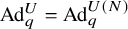 ${\mathrm {Ad}}^U_q= {\mathrm {Ad}}^{U(N)}_q$
.
${\mathrm {Ad}}^U_q= {\mathrm {Ad}}^{U(N)}_q$
.
We give a proof by induction.
The lemma holds trivially for $N=1$
.
$N=1$
.
Assume now that the lemma holds for $N-1$
, and let
$N-1$
, and let $\pi $
be a normal
$\pi $
be a normal ${\mathrm {Ad}}^{U(N)}_q$
-compatible representation of
${\mathrm {Ad}}^{U(N)}_q$
-compatible representation of $\mathcal {O}_q(H(N))$
. Let
$\mathcal {O}_q(H(N))$
. Let $\mathcal {H}_1 = {\mathrm {Ker}}(\pi (z_{11}))$
and
$\mathcal {H}_1 = {\mathrm {Ker}}(\pi (z_{11}))$
and $\mathcal {H}_2 = \mathcal {H}^{\perp }_1$
. Then
$\mathcal {H}_2 = \mathcal {H}^{\perp }_1$
. Then $\pi $
restricts to representations
$\pi $
restricts to representations $\pi _i$
of
$\pi _i$
of $\mathcal {O}_q(H(N))$
on
$\mathcal {O}_q(H(N))$
on $\mathcal {H}_i$
. Let us show that these representations are normal
$\mathcal {H}_i$
. Let us show that these representations are normal ${\mathrm {Ad}}^{U(N)}_q$
-compatible. Indeed, consider
${\mathrm {Ad}}^{U(N)}_q$
-compatible. Indeed, consider $\mathcal {O}_q(H(2))$
embedded in the upper left hand corner of
$\mathcal {O}_q(H(2))$
embedded in the upper left hand corner of $\mathcal {O}_q(H(N))$
. As the restriction of
$\mathcal {O}_q(H(N))$
. As the restriction of $\pi $
to
$\pi $
to $\mathcal {O}_q(H(2))$
is normal
$\mathcal {O}_q(H(2))$
is normal ${\mathrm {Ad}}^{U(2)}_q$
-compatible by Proposition 3.9, we have by the previous lemma that
${\mathrm {Ad}}^{U(2)}_q$
-compatible by Proposition 3.9, we have by the previous lemma that $\pi _1(z_{ij}) = 0$
for
$\pi _1(z_{ij}) = 0$
for $1\leq i,j\leq 2$
, and hence
$1\leq i,j\leq 2$
, and hence $(\pi _1 * \mathbf {s}_1)(z_{11}) =0$
. Since
$(\pi _1 * \mathbf {s}_1)(z_{11}) =0$
. Since $(\pi *\mathbf {s}_i)(z_{11}) = \pi (z_{11})\otimes 1$
for
$(\pi *\mathbf {s}_i)(z_{11}) = \pi (z_{11})\otimes 1$
for $i\geq 2$
, we find by using
$i\geq 2$
, we find by using
 $$\begin{align*}w_0 = (s_1s_2\ldots s_N)(s_2s_3\ldots s_N)\ldots (s_{N-1}s_N)s_N \end{align*}$$
that $(\pi _1*\lambda _{{\mathrm {st}}})(z_{11}) = 0$
. Writing
$(\pi _1*\lambda _{{\mathrm {st}}})(z_{11}) = 0$
. Writing $p_1$
for the projection onto
$p_1$
for the projection onto $\mathcal {H}_1$
, we have by the q-commutation relations for
$\mathcal {H}_1$
, we have by the q-commutation relations for $z_{11}$
that
$z_{11}$
that $p_1 \in \mathscr {Z}(\pi (\mathcal {O}_q(H(N)))")$
and, by the arguments above,
$p_1 \in \mathscr {Z}(\pi (\mathcal {O}_q(H(N)))")$
and, by the arguments above, $p_1\otimes 1 \leq {\mathrm {Ad}}_q^{U(N)}(p_1) $
. On the other hand, since
$p_1\otimes 1 \leq {\mathrm {Ad}}_q^{U(N)}(p_1) $
. On the other hand, since $E(z) = \left ({\mathrm {id}}\otimes \int _{U_q(N)}\right ){\mathrm {Ad}}_q^{U(N)}(z)$
is a faithful conditional expectation of
$E(z) = \left ({\mathrm {id}}\otimes \int _{U_q(N)}\right ){\mathrm {Ad}}_q^{U(N)}(z)$
is a faithful conditional expectation of $\pi (\mathcal {O}_q(H(N)))"$
onto
$\pi (\mathcal {O}_q(H(N)))"$
onto $\pi (\mathscr {Z}(\mathcal {O}_q(H(N))))"$
, it follows easily that
$\pi (\mathscr {Z}(\mathcal {O}_q(H(N))))"$
, it follows easily that $p_1 = E(p_1)$
and hence in fact
$p_1 = E(p_1)$
and hence in fact ${\mathrm {Ad}}_q^{U(N)}(p_1) = p_1\otimes 1$
. Hence
${\mathrm {Ad}}_q^{U(N)}(p_1) = p_1\otimes 1$
. Hence $\pi _1$
is an
$\pi _1$
is an ${\mathrm {Ad}}^{U(N)}_q$
-compatible normal representation of
${\mathrm {Ad}}^{U(N)}_q$
-compatible normal representation of $\mathcal {O}_q(H(N))$
, and the same must then hold for
$\mathcal {O}_q(H(N))$
, and the same must then hold for $\pi _2$
.
$\pi _2$
.
It hence suffices to prove our proposition in two specific cases, namely $\pi (z_{11}) =0$
and
$\pi (z_{11}) =0$
and ${\mathrm {Ker}}(\pi (z_{11}))= \{0\}$
.
${\mathrm {Ker}}(\pi (z_{11}))= \{0\}$
.
In the first case, it follows by ${\mathrm {Ad}}^{U(N)}_q$
-compatibility that in fact
${\mathrm {Ad}}^{U(N)}_q$
-compatibility that in fact $\pi (U_q(\mathfrak {u}(N))\rhd z_{11})=0$
, hence, by (2.30),
$\pi (U_q(\mathfrak {u}(N))\rhd z_{11})=0$
, hence, by (2.30), $\pi (z_{ij})=0$
for all
$\pi (z_{ij})=0$
for all $i,j$
, and
$i,j$
, and $\pi $
is up to amplification with some multiplicity Hilbert space the unique big cell representation of rank
$\pi $
is up to amplification with some multiplicity Hilbert space the unique big cell representation of rank $0$
.
$0$
.
Consider now the second case. Denoting by $\mathcal {O}_q(U(N)) \rightarrow \mathcal {O}_q(U(N-1))$
the restriction map to the lower right corner, we obtain by restriction that
$\mathcal {O}_q(U(N)) \rightarrow \mathcal {O}_q(U(N-1))$
the restriction map to the lower right corner, we obtain by restriction that $\pi $
is an
$\pi $
is an ${\mathrm {Ad}}^{U(N-1)}_q$
-compatible normal representation, using again Proposition 3.9. Through the map
${\mathrm {Ad}}^{U(N-1)}_q$
-compatible normal representation, using again Proposition 3.9. Through the map $ \rho _{2,N}$
defined in (2.35), we obtain an
$ \rho _{2,N}$
defined in (2.35), we obtain an ${\mathrm {Ad}}^{U(N-1)}_q$
-compatible normal representation
${\mathrm {Ad}}^{U(N-1)}_q$
-compatible normal representation $\pi $
of
$\pi $
of $\mathcal {O}_q(H(N-1))$
. By induction,
$\mathcal {O}_q(H(N-1))$
. By induction, $\mathscr {H}_{\pi }$
is a big cell representation of
$\mathscr {H}_{\pi }$
is a big cell representation of $\mathcal {O}_q(H(N-1))$
. But since
$\mathcal {O}_q(H(N-1))$
. But since ${\mathrm {Ker}}(\pi (z_{11}))= 0$
by assumption, this makes
${\mathrm {Ker}}(\pi (z_{11}))= 0$
by assumption, this makes $\pi $
into a big cell representation of
$\pi $
into a big cell representation of $\mathcal {O}_q(H(N))$
.
$\mathcal {O}_q(H(N))$
.
Theorem 5.6. Any irreducible representation $\pi $
of
$\pi $
of $\mathcal {O}_q(H(N))$
is weakly contained in an irreducible big cell representation.
$\mathcal {O}_q(H(N))$
is weakly contained in an irreducible big cell representation.
Proof. By Lemma 5.1, $\pi $
is weakly contained in
$\pi $
is weakly contained in $\pi *\lambda _{{\mathrm {st}}}$
, which by Proposition 5.5 is a big cell representation. Now as
$\pi *\lambda _{{\mathrm {st}}}$
, which by Proposition 5.5 is a big cell representation. Now as $\pi *\lambda _{{\mathrm {st}}}$
acts as a
$\pi *\lambda _{{\mathrm {st}}}$
acts as a $*$
-character on the centre of
$*$
-character on the centre of $\mathcal {O}_q(H(N))$
, it follows by Lemma 5.2 and Corollary 4.18 that
$\mathcal {O}_q(H(N))$
, it follows by Lemma 5.2 and Corollary 4.18 that $\pi *\lambda _{{\mathrm {st}}}$
must be an amplification of a finite number of irreducible big cell representations of
$\pi *\lambda _{{\mathrm {st}}}$
must be an amplification of a finite number of irreducible big cell representations of $\mathcal {O}_q(H(N))$
. Hence
$\mathcal {O}_q(H(N))$
. Hence $\pi $
must be weakly contained in an irreducible big cell representation.
$\pi $
must be weakly contained in an irreducible big cell representation.
5.2 Quantized Sylvester’s law of inertia
We prove our main theorems. We start with Theorem B.
Theorem 5.7. Let $s\in \mathbb {R}^N$
. Then s is centrally admissible if and only if all nonzero roots of the polynomial
$s\in \mathbb {R}^N$
. Then s is centrally admissible if and only if all nonzero roots of the polynomial
 $$ \begin{align} P_s(z) = \sum_{k=0}^N (-1)^k s_k z ^{N-k} \end{align} $$
are real with multiplicity $1$
, and moreover the quotients of nonzero roots of the same sign lie in
$1$
, and moreover the quotients of nonzero roots of the same sign lie in $q^{2\mathbb {Z}}$
.
$q^{2\mathbb {Z}}$
.
In other words, s is admissible if and only if we have a factorisation
 $$\begin{align*}P_s(z) = z^{N_0}(z- q^{2\alpha + 2m_1})\ldots (z- q^{2\alpha + 2m_{N_+}}) (z+ q^{2\beta + 2n_1})\ldots (z+ q^{2\beta + 2n_{N_-}}) \end{align*}$$
where $\alpha ,\beta \in \mathbb {R}$
and
$\alpha ,\beta \in \mathbb {R}$
and $m_i,n_i \in \mathbb {Z}_{\geq 0}$
with the
$m_i,n_i \in \mathbb {Z}_{\geq 0}$
with the $m_i-m_j \neq 0$
and
$m_i-m_j \neq 0$
and $n_i-n_j\neq 0$
for
$n_i-n_j\neq 0$
for $i\neq j$
, which is the formulation in Theorem B.
$i\neq j$
, which is the formulation in Theorem B.
Proof. Assume that s is centrally admissible. By Theorem 5.6 it follows that there exists an irreducible big cell representation $\pi $
of
$\pi $
of $\mathcal {O}_q(H(N))$
such that
$\mathcal {O}_q(H(N))$
such that $\sigma _k^{\pi } = s_k$
. The theorem now follows from Theorem 4.17.
$\sigma _k^{\pi } = s_k$
. The theorem now follows from Theorem 4.17.
To prove Theorem C, we start with the following lemmas.
Lemma 5.8. Let $\pi $
be an irreducible big cell representation of rank M with signature
$\pi $
be an irreducible big cell representation of rank M with signature $\eta $
, and assume
$\eta $
, and assume $k < N_++ N_-$
with
$k < N_++ N_-$
with $\eta _k \eta _{k+1} < 0$
. Then there exists an irreducible big cell representation
$\eta _k \eta _{k+1} < 0$
. Then there exists an irreducible big cell representation $\pi ' \subseteq \pi * \mathbf {s}_k$
of rank M such that
$\pi ' \subseteq \pi * \mathbf {s}_k$
of rank M such that $\pi '$
has signature
$\pi '$
has signature
 $$\begin{align*}\eta' = (\eta_1,\ldots,\eta_{k-1},\eta_{k+1},\eta_k,\eta_{k+2},\ldots,\eta_M). \end{align*}$$
Proof. Assume that $\pi $
factors over
$\pi $
factors over $\mathcal {O}_q(O_s)$
. Clearly we will have
$\mathcal {O}_q(O_s)$
. Clearly we will have

for $r < k$
or
$r < k$
or $r>k+1$
. On the other hand, consider the representation
$r>k+1$
. On the other hand, consider the representation $\pi \circ \rho _{k,k+1}$
of
$\pi \circ \rho _{k,k+1}$
of $\mathcal {O}_q(H(2))$
with
$\mathcal {O}_q(H(2))$
with $\rho _{k,k+1}$
as in Proposition 2.12. Then clearly
$\rho _{k,k+1}$
as in Proposition 2.12. Then clearly $\pi \circ \rho _{k,k+1}$
has fixed signature
$\pi \circ \rho _{k,k+1}$
has fixed signature  with
with  by the assumption on k. By equivariance of $\rho _{k,k+1}$
, we have
$\rho _{k,k+1}$
, we have $(\pi * \mathbf {s}_k) \circ \rho _{k,k+1} = (\pi \circ \rho _{k,k+1})*\mathbf {s}$
, hence by Lemma 5.4 it follows that
$(\pi * \mathbf {s}_k) \circ \rho _{k,k+1} = (\pi \circ \rho _{k,k+1})*\mathbf {s}$
, hence by Lemma 5.4 it follows that $\pi * \mathbf {s}_k$
contains a subrepresentation of signature
$\pi * \mathbf {s}_k$
contains a subrepresentation of signature $\eta '$
. As
$\eta '$
. As $\pi * \mathbf {s}_k$
splits as a direct sum of irreducible big cell representations of
$\pi * \mathbf {s}_k$
splits as a direct sum of irreducible big cell representations of $\mathcal {O}_q(O_s)$
by Lemma 5.2, it follows that there exists an irreducible big cell representation
$\mathcal {O}_q(O_s)$
by Lemma 5.2, it follows that there exists an irreducible big cell representation $\pi ' \subseteq \pi * \mathbf {s}_k$
of signature
$\pi ' \subseteq \pi * \mathbf {s}_k$
of signature $\eta '$
.
$\eta '$
.
Lemma 5.9. Let $s \in \mathbb {R}^N$
be centrally admissible, and let
$s \in \mathbb {R}^N$
be centrally admissible, and let $\pi ,\pi '$
be representations of
$\pi ,\pi '$
be representations of $\mathcal {O}_q(O_s)$
. Then
$\mathcal {O}_q(O_s)$
. Then $\pi ' \preccurlyeq {\mathrm {Ad}}_{\lambda _{{\mathrm {st}}}}(\pi )$
.
$\pi ' \preccurlyeq {\mathrm {Ad}}_{\lambda _{{\mathrm {st}}}}(\pi )$
.
Proof. This is a special case of Corollary 3.12.
For $\lambda \in \mathbf {T}_q(N)$
an admissible (hence finite dimensional) irreducible representation, let us denote by
$\lambda \in \mathbf {T}_q(N)$
an admissible (hence finite dimensional) irreducible representation, let us denote by $\lambda ^c$
the contragredient unitary representation, uniquely determined by the fact that the trivial representation is contained in
$\lambda ^c$
the contragredient unitary representation, uniquely determined by the fact that the trivial representation is contained in $\lambda ^c * \lambda $
. By taking direct sums, one can define
$\lambda ^c * \lambda $
. By taking direct sums, one can define $\lambda ^c$
for any admissible representation. Then we have the following standard Frobenius reciprocity.
$\lambda ^c$
for any admissible representation. Then we have the following standard Frobenius reciprocity.
Lemma 5.10. Let $\pi ,\pi ' \in \mathbf {H}_q(N)$
be irreducible, and let
$\pi ,\pi ' \in \mathbf {H}_q(N)$
be irreducible, and let $\lambda \in \mathbf {T}_q(N)$
be finite dimensional. If
$\lambda \in \mathbf {T}_q(N)$
be finite dimensional. If $\pi \subseteq \pi '*\lambda $
, then
$\pi \subseteq \pi '*\lambda $
, then $\pi ' \subseteq \pi *\lambda ^c$
.
$\pi ' \subseteq \pi *\lambda ^c$
.
Lemma 5.11. Let $\eta $
be a signature
$\eta $
be a signature
 $$\begin{align*}\eta = {\mathrm{diag}}(\underbrace{1,\ldots,1}_{N_+},\underbrace{-1,\ldots,-1}_{N_-}), \end{align*}$$
and let $\pi ,\pi '$
be two associated irreducible big cell representations with respective weights r and
$\pi ,\pi '$
be two associated irreducible big cell representations with respective weights r and $r'$
.
$r'$
.
-
1. If
$N_+N_- = 0$
, then there exists an admissible
$\mathcal {O}_q(T(N))$
-representation
$\lambda $
with
$\pi '\subseteq \pi * \lambda $
. -
2. If
$N_+N_-\neq 0$
, then there exists an admissible
$\mathcal {O}_q(T(N))$
-representation
$\lambda $
with
$\pi '\subseteq \pi * \lambda $
if and only if
$r_{N_++N_-} - r_{N_+} \in (r_{N_++N_-}' - r_{N_-}') + \mathbb {Z}$
.



Proof. We know from Theorem 4.16 that
 $$\begin{align*}r = (\alpha + m_1,\ldots,\alpha + m_{N_+},\beta + n_1,\ldots,\beta + n_{N_-}), \end{align*}$$
with $m_1\leq m_2\leq \ldots \leq m_{N_+}$
and
$m_1\leq m_2\leq \ldots \leq m_{N_+}$
and $n_1\leq n_2 \leq \ldots \leq n_{N_-}$
in
$n_1\leq n_2 \leq \ldots \leq n_{N_-}$
in $\mathbb {Z}_{\geq 0}$
, and
$\mathbb {Z}_{\geq 0}$
, and $\alpha ,\beta \in \mathbb {R}$
. Similarly
$\alpha ,\beta \in \mathbb {R}$
. Similarly
 $$\begin{align*}r' = (\alpha' + m_1',\ldots,\alpha'+ m_{N_+}',\beta' + n_1',\ldots,\beta' + n_{N_-}'), \end{align*}$$
Now any weight vector for $\mathcal {O}_q(T(N))$
has weight of the form
$\mathcal {O}_q(T(N))$
has weight of the form $(\gamma + k_1,\ldots ,\gamma + k_N)$
for
$(\gamma + k_1,\ldots ,\gamma + k_N)$
for $\gamma \in \mathbb {R}$
and
$\gamma \in \mathbb {R}$
and $k_1 \leq \ldots \leq k_N$
in
$k_1 \leq \ldots \leq k_N$
in $\mathbb {Z}_{\geq 0}$
. This already shows that the conditions in the lemma are necessary. To see that they are sufficient, let us first multiply both representations with a one-dimensional admissible representation
$\mathbb {Z}_{\geq 0}$
. This already shows that the conditions in the lemma are necessary. To see that they are sufficient, let us first multiply both representations with a one-dimensional admissible representation $t_{ij} \mapsto c\delta _{ij}$
of
$t_{ij} \mapsto c\delta _{ij}$
of $\mathcal {O}_q(T(N))$
to ensure
$\mathcal {O}_q(T(N))$
to ensure $\alpha = \alpha ' = 0$
. Pick then
$\alpha = \alpha ' = 0$
. Pick then $p \in \mathbb {Z}_{\geq 0}$
large enough so that
$p \in \mathbb {Z}_{\geq 0}$
large enough so that
 $$\begin{align*}m_1 \leq m_2 \leq \ldots \leq m_{N_+} \leq n_1 + p \leq \ldots \leq n_{N_-} + p, \end{align*}$$
 $$\begin{align*}m_1' \leq m_2 '\leq \ldots \leq m_{N_+}' \leq n_1' + p \leq \ldots \leq n_{N_-}' + p. \end{align*}$$
Consider now the finite-dimensional admissible representation $\lambda _1 = \pi _{(m_1,\ldots ,m_{N_+},n_1+p,\ldots ,n_{N_-}+p,K,\ldots ,K)} \in \mathbf {T}_q(N)$
, where
$\lambda _1 = \pi _{(m_1,\ldots ,m_{N_+},n_1+p,\ldots ,n_{N_-}+p,K,\ldots ,K)} \in \mathbf {T}_q(N)$
, where $K \in \mathbb {Z}_{\geq n_{N-}+p}$
is arbitrary. Let
$K \in \mathbb {Z}_{\geq n_{N-}+p}$
is arbitrary. Let $\pi _0 = \pi _{S,(0,\ldots ,0,\beta -p,\ldots ,\beta -p,0,\ldots 0)}$
. Then by restricting to the tensor product of the highest weights, we see that
$\pi _0 = \pi _{S,(0,\ldots ,0,\beta -p,\ldots ,\beta -p,0,\ldots 0)}$
. Then by restricting to the tensor product of the highest weights, we see that
 $$\begin{align*}\pi_{S,r} \subseteq \pi_0 * \lambda_1. \end{align*}$$
Similarly, there exists a finite-dimensional admissible representation $\lambda _2 \in \mathbf {T}_q(N)$
with
$\lambda _2 \in \mathbf {T}_q(N)$
with
 $$\begin{align*}\pi_{S,r'} \subseteq \pi_0*\lambda_2. \end{align*}$$
Hence, by the Frobenius reciprocity of Lemma 5.10,
 $$\begin{align*}\pi_{S,r'} \subseteq \pi_0 * \lambda_2 \subseteq \pi_{S,r} * \lambda_1^{c} *\lambda_2. \end{align*}$$
We now prove Theorem C.
Theorem 5.12. Let $\pi \in \mathbf {H}_q(N)$
be a representation of extended signature
$\pi \in \mathbf {H}_q(N)$
be a representation of extended signature $([r],N_+,N_-,N_0)$
. Then
$([r],N_+,N_-,N_0)$
. Then ${\mathrm {Ad}}_{\lambda }(\pi )$
has the same extended signature for any
${\mathrm {Ad}}_{\lambda }(\pi )$
has the same extended signature for any $\lambda \in \mathbf {G}\mathbf {L}_q(N,\mathbb {C})$
. Moreover, if
$\lambda \in \mathbf {G}\mathbf {L}_q(N,\mathbb {C})$
. Moreover, if $\pi ,\pi ' \in \mathbf {H}_q(N)$
are irreducible representations of the same extended signature, then there exists such a
$\pi ,\pi ' \in \mathbf {H}_q(N)$
are irreducible representations of the same extended signature, then there exists such a $\lambda \in \mathbf {G}\mathbf {L}_q(N,\mathbb {C})$
with
$\lambda \in \mathbf {G}\mathbf {L}_q(N,\mathbb {C})$
with
 $$\begin{align*}\pi' \preccurlyeq {\mathrm{Ad}}_{\lambda}(\pi). \end{align*}$$
Proof. Let us prove the first part of the theorem.
Clearly $\pi _1\preccurlyeq \pi _2$
and
$\pi _1\preccurlyeq \pi _2$
and $\pi _2$
of extended signature
$\pi _2$
of extended signature $([r],N_+,N_-,N_0)$
imply
$([r],N_+,N_-,N_0)$
imply $\pi _1$
of the same extended signature. By the remark following Theorem 1.21, it is hence enough to show that if
$\pi _1$
of the same extended signature. By the remark following Theorem 1.21, it is hence enough to show that if $\pi $
is of extended signature
$\pi $
is of extended signature $([r],N_+,N_-,N_0)$
, then also
$([r],N_+,N_-,N_0)$
, then also $\pi * \lambda _{{\mathrm {st}}}*\lambda '$
has extended signature
$\pi * \lambda _{{\mathrm {st}}}*\lambda '$
has extended signature $([r],N_+,N_-,N_0)$
, for
$([r],N_+,N_-,N_0)$
, for $\lambda _{{\mathrm {st}}}$
the standard representation of
$\lambda _{{\mathrm {st}}}$
the standard representation of $\mathcal {O}_q(U(N))$
and
$\mathcal {O}_q(U(N))$
and $\lambda '$
an irreducible admissible representation of
$\lambda '$
an irreducible admissible representation of $\mathcal {O}_q(T(N))$
. Now since the centre of
$\mathcal {O}_q(T(N))$
. Now since the centre of $\mathcal {O}_q(H(N))$
is
$\mathcal {O}_q(H(N))$
is $Ad_q^U$
-coinvariant, clearly
$Ad_q^U$
-coinvariant, clearly $\pi * \lambda _{{\mathrm {st}}}$
has the same signature as
$\pi * \lambda _{{\mathrm {st}}}$
has the same signature as $\pi $
. By Proposition 3.9 and Proposition 5.5 we may hence assume that
$\pi $
. By Proposition 3.9 and Proposition 5.5 we may hence assume that $\pi $
is an irreducible big cell representation, and we want to show that
$\pi $
is an irreducible big cell representation, and we want to show that $\pi *\lambda '$
has the same extended signature. But since
$\pi *\lambda '$
has the same extended signature. But since $\pi $
factors through
$\pi $
factors through $\mathcal {O}_q(H(N)) \rightarrow \mathcal {O}_q^{\leq M}(H(N)) \rightarrow \mathcal {O}_q^{\leq M}(T(N))$
, and
$\mathcal {O}_q(H(N)) \rightarrow \mathcal {O}_q^{\leq M}(H(N)) \rightarrow \mathcal {O}_q^{\leq M}(T(N))$
, and ${\mathrm {Ad}}_q^T$
factors through a coaction on
${\mathrm {Ad}}_q^T$
factors through a coaction on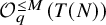 $\mathcal {O}_q^{\leq M}(T(N))$
, it follows that
$\mathcal {O}_q^{\leq M}(T(N))$
, it follows that $\pi *\lambda '$
has rank M. Moreover, since
$\pi *\lambda '$
has rank M. Moreover, since  , we see that $\pi *\lambda '$
is a big cell representation. As the
$\pi *\lambda '$
is a big cell representation. As the  are diagonalizable, $\pi *\lambda '$
must be a direct sum of irreducible big cell representations. But since the extended signature of an irreducible big cell representation can be read off from any of its weight spaces, it follows straightforwardly that
$\pi *\lambda '$
must be a direct sum of irreducible big cell representations. But since the extended signature of an irreducible big cell representation can be read off from any of its weight spaces, it follows straightforwardly that $\pi *\lambda '$
has extended signature
$\pi *\lambda '$
has extended signature $([r],N_+,N_-,N_0)$
. This proves the first part of the theorem.
$([r],N_+,N_-,N_0)$
. This proves the first part of the theorem.
To prove the second part of the theorem, assume that $\pi ,\pi '$
are irreducible representations of
$\pi ,\pi '$
are irreducible representations of $\mathcal {O}_q(H(N))$
of extended signature
$\mathcal {O}_q(H(N))$
of extended signature $([r],N_+,N_-,N_0)$
. We may assume that
$([r],N_+,N_-,N_0)$
. We may assume that $\pi ,\pi '$
are irreducible. To show that there exists
$\pi ,\pi '$
are irreducible. To show that there exists $\lambda \in \mathbf {G}\mathbf {L}_q(N)$
so that
$\lambda \in \mathbf {G}\mathbf {L}_q(N)$
so that $\pi ' \preccurlyeq \pi *\lambda $
, we may by Lemma 5.1 and Proposition 5.5 assume that
$\pi ' \preccurlyeq \pi *\lambda $
, we may by Lemma 5.1 and Proposition 5.5 assume that $\pi $
is an irreducible big cell representation. By applying Lemma 5.8 repeatedly and then applying Lemma 5.9, we may assume that
$\pi $
is an irreducible big cell representation. By applying Lemma 5.8 repeatedly and then applying Lemma 5.9, we may assume that $\pi '$
and
$\pi '$
and $\pi $
have signature
$\pi $
have signature ${\mathrm {diag}}(\underbrace {1,\ldots ,1}_{N_+},\underbrace {-1,\ldots ,-1}_{N_-},\underbrace {0,\ldots ,0}_{N_0})$
. But for these the conclusion of the theorem follows immediately from Lemma 5.11.
${\mathrm {diag}}(\underbrace {1,\ldots ,1}_{N_+},\underbrace {-1,\ldots ,-1}_{N_-},\underbrace {0,\ldots ,0}_{N_0})$
. But for these the conclusion of the theorem follows immediately from Lemma 5.11.
Theorem 5.13. The $*$
-algebra
$*$
-algebra $\mathcal {O}_q(H(N))$
is C
$\mathcal {O}_q(H(N))$
is C $^*$
-faithful and type I.
$^*$
-faithful and type I.
Proof. The C $^*$
-faithfulness of
$^*$
-faithfulness of $\mathcal {O}_q(H(N))$
follows easily from known results, for example the injectivity of
$\mathcal {O}_q(H(N))$
follows easily from known results, for example the injectivity of $\pi _T$
in Proposition 2.10 and the fact that the finite-dimensional
$\pi _T$
in Proposition 2.10 and the fact that the finite-dimensional $*$
-representations of
$*$
-representations of $\mathcal {O}_q(T(N))$
separate the elements of
$\mathcal {O}_q(T(N))$
separate the elements of $\mathcal {O}_q(T(N))$
.
$\mathcal {O}_q(T(N))$
.
Let now $\varsigma _{{\mathrm {ext}}} = ([r],N_+,N_-,N_0)$
be an extended signature, and let
$\varsigma _{{\mathrm {ext}}} = ([r],N_+,N_-,N_0)$
be an extended signature, and let $\chi _r$
be a
$\chi _r$
be a $*$
-character of extended signature
$*$
-character of extended signature $\varsigma _{{\mathrm {ext}}}$
. For example, if
$\varsigma _{{\mathrm {ext}}}$
. For example, if $N_+N_-\neq 0$
and
$N_+N_-\neq 0$
and $L = \max \{N_+,N_-\}-|N_+-N_-|$
, we can take the
$L = \max \{N_+,N_-\}-|N_+-N_-|$
, we can take the $*$
-character
$*$
-character
 $$\begin{align*}\chi_r: \mathcal{O}_q(H(N)) \mapsto \mathbb{C},\quad Z \mapsto \pm \left(q^{-r}\sum_{i=N_0+L+1}^N e_{ii}+ \sum_{i=1}^L(e_{N_0+i,N-i} + e_{N-i,N_0+i})- q^{r} \sum_{i=1}^L e_{N-i+1,N-i+1}\right) \end{align*}$$
where $|N_+-N_-| = \pm (N_+-N_-)$
.
$|N_+-N_-| = \pm (N_+-N_-)$
.
Let $\pi $
be an arbitrary irreducible representation of
$\pi $
be an arbitrary irreducible representation of $\mathcal {O}_q(H(N))$
. Then
$\mathcal {O}_q(H(N))$
. Then $\pi $
has a well-defined extended signature
$\pi $
has a well-defined extended signature $\varsigma _{{\mathrm {ext}}}$
. From Theorem 5.12 we know that
$\varsigma _{{\mathrm {ext}}}$
. From Theorem 5.12 we know that $\pi $
is weakly contained in
$\pi $
is weakly contained in $\chi _r * \lambda $
for some representation
$\chi _r * \lambda $
for some representation $\lambda $
of
$\lambda $
of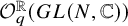 $\mathcal {O}_q^{\mathbb {R}}(GL(N,\mathbb {C}))$
. However, every irreducible representation of
$\mathcal {O}_q^{\mathbb {R}}(GL(N,\mathbb {C}))$
. However, every irreducible representation of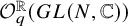 $\mathcal {O}_q^{\mathbb {R}}(GL(N,\mathbb {C}))$
factors through an irreducible representation of
$\mathcal {O}_q^{\mathbb {R}}(GL(N,\mathbb {C}))$
factors through an irreducible representation of $\mathcal {O}_q(U(N)) \otimes \mathcal {O}_q(T(N))$
. In particular, there exists an irreducible (and hence finite-dimensional) admissible representation
$\mathcal {O}_q(U(N)) \otimes \mathcal {O}_q(T(N))$
. In particular, there exists an irreducible (and hence finite-dimensional) admissible representation $\lambda '$
of
$\lambda '$
of $\mathcal {O}_q(T(N))$
such that
$\mathcal {O}_q(T(N))$
such that $C^*(\pi )$
is a quotient C
$C^*(\pi )$
is a quotient C $^*$
-algebra of a C
$^*$
-algebra of a C $^*$
-subalgebra of
$^*$
-subalgebra of $C(U_q(N))\otimes B(\mathcal {H}_{\lambda '})$
. As the latter C
$C(U_q(N))\otimes B(\mathcal {H}_{\lambda '})$
. As the latter C $^*$
-algebra is type I, it follows that
$^*$
-algebra is type I, it follows that $C^*(\pi )$
is type I.
$C^*(\pi )$
is type I.
Competing interests
The authors have no competing interests to declare.
Funding statement
The work of K.DC. and S.T.M. was supported by the FWO grants G025115N and G032919N. S.T.M. was additionally supported by Narodowe Centrum Nauki, grant number 2017/26/A/ST1/00189.





 Open access

