

Introduction
Historical censuses have long been valuable sources for understanding the past, but their use as sources about women’s work has been highly debated. Gender and labor historians have critically reinterpreted census data about women’s work, viewing it as inaccurate and unreliable (see, e.g., Humphries and Sarasúa Reference Humphries and Sarasúa2012; Stanfors Reference Stanfors2014; Vikström Reference Vikström2011). However, others argue the issue is about validity rather than reliability, and that censuses are only invalid when there is a mismatch between the censuses’ purposes and what historians would like to know (see, e.g., Lindström Reference Lindström2020; Shaw-Taylor Reference Shaw-Taylor and Goose2007; You Reference You2020a). Moreover, despite these criticisms, censuses are also credited with providing relatively comprehensive, accessible, and representative information on women’s work, which many other sources lack (see, e.g., Anderson Reference Anderson1999; Sarti et al. Reference Sarti, Bellavitis, Martini, Sarti, Bellavitis and Martini2018). Given these opposing viewpoints, censuses now hold a complex status as historical sources about women’s work. For instance, it is not altogether clear if or when censuses are useful sources about women’s work, or how they should be approached. This article departs from these uncertainties and seeks to provide some answers and guidance.
Specifically, this article explores significant potentials and issues of censuses’ representations of women’s work. To this end, it presents five novel analytical approaches that serve to enhance readings and interpretations of census materials through leveraging and recognizing censuses’ inherent qualities. Moreover, through detailed examination of Swedish census materials from 1910 to 1940, this article demonstrates that historical census personnel engaged with women’s work in more sophisticated ways than previously recognized and that censuses’ representations were complex. Ultimately, the five approaches can aid researchers in exploring and assessing potentials and issues associated with censuses’ representations of women’s work, which is imperative when determining if and how censuses are valid sources for one’s research goals.
Significant issues regarding censuses’ representations of women’s work have previously been identified. In order to develop and position this article’s five approaches, central concepts from a critical perspective of censuses are first presented and critiqued. Concepts such as “undercounting” are commonly used to deem censuses’ information on women’s work unreliable. While such concepts are to some degree appropriate descriptions, their downsides include that they simplify complex ways of counting and conceal differences between censuses. Furthermore, few solutions to censuses’ unreliability are provided beyond re-calculating women’s work or dismissing censuses altogether (see, Humphries and Sarasúa Reference Humphries and Sarasúa2012). Therefore, to be able to appropriately use censuses as sources about women’s work, there is a need for more careful readings of censuses that lie in between a wholly uncritical view and the view of censuses as unusable. The approaches presented in this article contribute to filling this gap in perspective by recognizing that historical censuses are reliable and often valid, though biased and complex. They underpin this article’s overall conclusion, which is that censuses can, despite their biases, offer historians a wealth of useful and even accurate (i.e., valid and authentic) information about women’s work when analyzed contextually.
The Swedish censuses from 1910 to 1940 serve as a case study in this article, and an assumption is that census analyses should indeed build on specific censuses. As is demonstrated by the approaches in this article, each census reflects the contexts of its time and place and is therefore unique. Thus, to assess censuses beyond very general terms, one must examine their specific mechanisms. Swedish censuses stand out internationally because most of them were transcriptions of church records, rather than being products of special census surveys. Additionally, the Swedish census apparatus has a particularly long history dating back to the seventeenth century (Sköld Reference Sköld2004). By 1910, Swedish censuses were carefully planned, comprehensive, and had more enumerative categories than censuses from other countries. Over time, the methods and focuses of the Swedish censuses evolved, so that each also offers insights into changes in statistical practices. Since these censuses’ reliability and validity have caused debate (see, e.g., Nyberg Reference Nyberg1994; Stanfors Reference Stanfors2014; Vikström Reference Vikström2011), there is a need for learning more about how women’s work was represented in Swedish censuses and for taking a balanced but critical approach to analyzing them. Moreover, understanding and exploring women’s work in Swedish historical materials has become particularly relevant considering the ongoing digitalization of Swedish censuses and the development of related datasets (including SEDD, POPLINK, and more; see: Swedpop n.d.).
Following this introduction, the next main section, “Contemporary concepts on censuses’ representations of women’s work,” presents the critical perspective on censuses. Moreover, through three subsections, three concepts within this critical perspective and their poignant and valuable insights are presented (i.e., “the undercounting of women’s work,” “the creation of the dependent woman,” and “the marketization of work”). The subsequent main section, “critique of the three contemporary concepts,” outlines the overarching critiques I nonetheless have of these concepts, with further inferences about the complexities and value of historical censuses. The next main section, “five analytical approaches,” offers five approaches to examine census representations of women’s work, exemplified through analyses of Swedish censuses from 1910 to 1940. This section consists of six subsections: one explaining the overall methodology and sources, followed by five subsections, each detailing one analytical approach. The article closes with concluding remarks.
Contemporary concepts on censuses’ representations of women’s work
From a critical perspective, censuses are historically situated documents that often fail to help historians uncover information about women’s work, rendering them problematic or even unusable. This perspective adopts an anti-positivist stance, questioning the objectivity of truth, as census data are identified as representing societal aspects in specific and non-neutral ways. Here, “non-neutral” refers to the fact that censuses through their different forms of representation – e.g., naming, classifying, counting, tabulating, and concluding – incorporate and disseminate ideas about gender. Through emphases and exclusions, censuses inevitably attach specific ideas and meanings to femininity, though these ideas and meanings may be more or less normative. Scholars taking a critical perspective on censuses assess censuses’ specific non-neutral representations of women’s work negatively, claiming that historical censuses convey gender ideals that distort or misrepresent what women actually did for work.
This perspective differs from an alternative of viewing census results to a larger extent as neutral and true (cf. critique raised by Humphries and Sarasúa (Reference Humphries and Sarasúa2012) against uncritical census usage). Scott (Reference Scott1988: 113–14) points out that uncritical approaches might be due to the convenience and persuasiveness of numbers when they are believed to convey accurate and objective knowledge. Sjöström (Reference Sjöström1998) notes that this view of numbers reflects original views about censuses: they were believed to accurately measure external social phenomena and aimed at providing true knowledge to control societal structures. If researchers adopt this belief, it can lead to uncritical reproduction of census results as well. While censuses contain much useful information for historians, treating this information uncritically as a neutral reflection of some inconceivable neutral social reality is increasingly challenged. Instead, many scholars, also covering themes beyond women’s work, have realized that censuses are dynamic, non-neutral, and create reality themselves (e.g., Thorvaldsen Reference Thorvaldsen2014; Wisselgren and Vikström Reference Wisselgren and Vikström2023).
Within this overall critical perspective, specific critiques vary in focus and argument. To clarify, I have organized the critical perspective into three distinct concepts, namely “the undercounting of women’s work,” “the creation of the dependent woman,” and “the marketization of work.” The following three subsections delve into these core concepts of the critical perspective, highlighting their valuable and thought-provoking insights for historians.
The undercounting of women’s work
Numerous historians have highlighted the inaccuracies of historical censuses by focusing on how censuses fail to correctly count women’s work, specifically with regard to work that is paid, productive, or has a labor market attachment (see, e.g., Benería Reference Benería1981; Folbre Reference Folbre1991; Higgs Reference Higgs1987; Hill Reference Hill1993; Humphries and Sarasúa Reference Humphries and Sarasúa2012; Stanfors Reference Stanfors2014; Vikström Reference Vikström2011). Criticisms of censuses’ undercounting of women’s work have highlighted reliability issues with regard to the specificity and accuracy of the registered activities and work women performed. Historians Anderson (Reference Anderson1992) and August (Reference August1994) note that undercounting typically occurred in two ways: when women’s productive work was not listed in census forms, or when statisticians erased details or omitted results about women from the published censuses.
Furthermore, numerous historians point out that women’s work was often part-time, irregular, or unskilled, and therefore frequently overlooked, as it was considered secondary to their roles as housewives or to their husbands’ provision (e.g., Hill Reference Hill1993; Sarti Reference Sarti, Sarti, Bellavitis and Martini2018). This relates to census criticism that has existed for a long time, though undercounting was not always the applied term. For instance, Swedish social scientists in 1917 criticized censuses for ignoring industrial homework, a predominantly female workforce (Socialstyrelsen 1917: 36). Undercounting was not limited to work with these traits, however. Another example, which historians frequently note, is the undercounting of wives working on family farms and in family businesses, who were often counted as unoccupied (e.g., Higgs Reference Higgs1987; Hill Reference Hill1993; Nyberg Reference Nyberg1989, Reference Nyberg1994). Consequently, occupational enumerations sometimes excluded the work of women engaged in the same activities as their husbands, who were, in contrast, counted as occupied.
We can learn a lot from the issue of undercounting, including the societal dynamics that have led to it and its consequences for the ways censuses shape ideas of gender and work. Undercounting highlights the influence of patriarchal norms and the “separate spheres” ideology, which prescribed to women the ideal of not engaging in productive work (Kerber Reference Kerber1988). As Folbre (Reference Folbre1991) and Higgs (Reference Higgs1987) point out, this ideal could lead to women’s productive work being overlooked in statistics, either because it was not thought of as work or was hidden due to shame for not conforming to societal norms. Furthermore, many historians argue that censuses are androcentric (i.e., male-centered) because authorities were primarily interested in adult males, and censuses were designed to capture male life-course patterns more effectively (e.g., Folbre Reference Folbre1991; Hakim Reference Hakim1980). For example, the census logic categorized people by a single occupation, reflecting one position within the economy (Scott Reference Scott1988), a pattern that more accurately reflected men than women. As a result, women’s diverse types of work were likely omitted more often than men’s work (Hakim Reference Hakim1980).
The creation of the dependent woman
“The creation of the dependent woman” is another concept associated with censuses. This was first concluded in Deacon’s (1985) article on Australian censuses. Deacon argued that the Australian censuses gradually excluded women from occupational statistics toward the late nineteenth century. Women, labeled as non-workers, were primarily identified by their household roles, such as “daughter” or “housewife,” and placed in tables indicating their dependency on a household provider, usually a father or husband. Higgs’s (1987) study of British censuses echoed this notion of the dependent woman. Higgs (Reference Higgs1987: 72) concluded that women were increasingly “assumed to be the unoccupied dependents of men, irrespective of whether or not the product of their labour was consumed within the home or entered the market economy.” The same tendency of increasingly over time defining women as housewives, and housewives as unoccupied and dependent, has been identified in Italian and Spanish censuses as well (Boderías Reference Boderías, Sarti, Bellavitis and Martini2018; Sarti Reference Sarti, Sarti, Bellavitis and Martini2018). This view of censuses, like that of undercounting, highlights how the ideology of separate spheres influenced statistical representations and how statistics could reinforce the separate spheres. The separate spheres ideology is seen as pervasive, whereby the differences between (representations of) men and women is seen as the most prominent census feature.
The tension between organizing censuses around an individualistic principle versus a household principle may partly explain why women, but not men, often appear as dependents in census records. The individualistic principle emphasizes what people do (work) and defines their economic activities, whereas the household principle considers what people live from (provision) and assigns them a household position. While modern censuses have been interpreted to increasingly and ideally adhere to the individualistic principle for all (see, e.g., Goyer and Draaijer Reference Goyer and Draaijer1992: 4), the findings of both Anderson (Reference Anderson1992) and Roll-Hansen (Reference Roll-Hansen2012) show that the household principle applied to women in censuses well into the twentieth century, alongside the individualistic principle. Statisticians struggled to choose to emphasize a woman’s household status or occupational status, as there was no a priori way to categorize especially married women and housework. As Roll-Hansen (Reference Roll-Hansen2012: 20) puts it, married women were seen in statistical terms as both individuals and non-individuals, and housework was viewed as both work and non-work. The equivalent ambiguities did seemingly not apply to men’s work. Resultingly, the household principle applied more to women than to men, thereby emphasizing women’s dependency on other household members more than men’s dependencies. However, various other representations are also present in statistical records. Still, historians often identify the dependent and non-productive household position as the dominant female position documented in censuses (e.g., Deacon Reference Deacon1985; Folbre Reference Folbre1991).
The marketization of work
A third concept with gendered consequences is “the marketization of work.” According to Topalov (Reference Topalov2001), this development appeared in late nineteenth-century censuses. Topalov explains how a market – and measurability – centered definition of work emerged in many countries’ censuses, meaning occupations were enumerated, and the occupation “involved monetary remuneration, obtained either by the selling of goods or services or the exercise of wage–paying or salaried employment” (ibid.: 85). Zimmermann (Reference Zimmermann, Smelser and Baltes2001) observes a similar trend, noting that work has been reduced to labor in modern Western capitalist societies. This shift moved work from being any activity aimed at sustaining one’s livelihood to being an abstract and quantifiable product; labor is measurable in time and money, sold for wages, and exchanged for subordination on the labor market. Since women were less likely than men to engage with the labor market, possess occupations, or receive wages, the marketization of work explains why women were increasingly categorized as unoccupied. An illustration of this tendency central to Topalov’s argument is the differentiation of housework, which was previously one broad category (Topalov Reference Topalov2001: 86). This differentiation has resulted in unpaid housewives being defined as unoccupied, and paid servants being occupied in most modern censuses.
The Swedish term yrke translates to occupation and has been used in all modern Swedish censuses (that is, censuses since 1860). Similarly, yrkesutövare is a commonly used term in Swedish censuses denoting an occupied person. The term förvärvsarbete is generally translated to gainful employment and was not used in Swedish censuses before 1945, where statisticians rather distinguished occupied people from family members (Nyberg Reference Nyberg1989: 144, 226). Gainful employment has, though, been frequently used since, generally denoting paid work today. When applying this term to historical censuses, one should be careful of confounding gainful employment with just paid work. According to Nyberg (Reference Nyberg1987), gainful employment (or possessing an occupation, according to census terminology) included both paid work and some forms of unpaid work, such as being an assisting family member. This challenges Topalov’s conclusions and will be further explored in this article. Labor force participation is a term not used in early twentieth century Swedish censuses but rather applied to them more recently. It includes people in the labor force, meaning people who are employed or unemployed and seeking employment, but this definition is not always compatible with census nomenclatures (Stanfors Reference Stanfors2014: 517, 533). In line with the marketization of work, unpaid housework is excluded from the most common interpretations of these terms (as noted by, e.g., Anderson Reference Anderson1992: 31; Stanfors Reference Stanfors2014: 517).
The marketization of work is crucial because it highlights inconsistencies in work characterizations by census nomenclatures across different countries and over time. Work is a multifaceted concept without a clear definition or distinction from other activities (see, e.g., Roll-Hansen Reference Roll-Hansen2012: 9; Sarti et al. Reference Sarti, Bellavitis, Martini, Sarti, Bellavitis and Martini2018: 5–9). Modern censuses since the late nineteenth century have generally adopted and spread a marked-centered understanding of work, notwithstanding different categorizations in censuses and definitional ambiguities. Moreover, censuses and other sources have impacted cultural understandings of work; for the general public, too, work has become synonymous with labor. Feminist scholars criticize this tendency, noting the irony of the necessity and invisibility of women’s work and labeling dichotomies of work false (e.g., Rose Reference Rose1993; Sangolt Reference Sangolt1997). Efforts are being made to counteract these much-critiqued tendencies, such as applying broader definitions of work that encompass both paid and unpaid work, and all activities towards making a living (see, e.g., Fiebranz et al. Reference Fiebranz, Lindberg, Lindström and Ågren2011). Hence, censuses are part of a larger discussion about meanings attached to the term work.
Critique of the three contemporary concepts
Censuses have been used and evaluated as historical sources, giving them new meanings by historians after they were first produced. “The undercounting of women’s work,” “the creation of the dependent woman,” and “the marketization of work” are recent concepts used to ascribe certain characteristics to censuses, speaking to the censuses’ (in)accuracies and biases. The concepts historians apply to historical censuses necessarily emphasize certain phenomena in specific ways while downplaying others, potentially limiting comprehensive understandings of censuses by labeling them in one-sided and rigid ways. These consequences are drawbacks of trying to make such a complex source more comprehensible. While simplification is oftentimes necessary, gender historians have also aimed to make “the simple complex and the invisible visible” (see Hagemann Reference Hagemann, Agneta Emanuelsson, Wikander and Åberg1990). I believe historians should strive to achieve this goal when using historical censuses through emphasizing their complexities and contextual nature.
When analyzing censuses, we often project current viewpoints and biases onto them. Some scholars argue that being influenced by contemporary perspectives is not only unavoidable but also desirable. For example, standardized classifications created in more recent times, such as HISCO, have simplified data management and enabled international comparisons (van Leeuwen et al. Reference van Leeuwen, Maas and Miles2004). Another example is the view that today’s feminist insights and language about women’s subordination should help historians uncover and critique past gender inequalities. However, this feminist viewpoint has been criticized for leading to ahistorical and essentialist conclusions (see, e.g., Scott Reference Scott1988: 15–27). Within the context of this article, there is an equivalent concern that we might confound our ideas with historical ones, creating obstacles to understanding historical sources on their own terms. This issue should always be considered when assessing the use of contemporary classifications or terminology. Below, I discuss specific examples building on these concerns and related to the three critical concepts.
The concept of undercounting contains a conceptual contradiction that needs addressing. Research describing representations of women’s work in censuses as “undercounting” suggests that censuses are not neutral descriptions of reality. This perspective aligns with a constructivist view of censuses, which views statistical variables as conventional, socially constructed, and non-definite (Desrosières Reference Desrosières2001). This implies that no variable can be free from constructivist consequences, meaning there is no neutral and objectively correct measurement of women’s work. Yet, the semantics of the word “undercounting” implies the existence of a correct count that is neither under nor over, and those arguing that censuses undercount often suggest using other sources and definitions for a more correct count of women’s work, again suggesting that a correct count does exist (see, e.g., Humphries and Sarasúa Reference Humphries and Sarasúa2012: 50–54). However, this stance may lead to inconsistencies with a constructivist perspective, where no measurement is correct in itself but only in relation to constructed standards with ideological implications. Hence, if using terms like undercounting, we must also recognize the underpinnings of our standards for correct and wrong counting and make note of how our standards are also constructed. While many scholars show awareness for the implications of their choices of measurement and representations, there is often room for greater awareness of the impact of the researcher and their contemporaneity, as well as for what might be lost when calculating women’s work in alternative ways.
New estimates of women’s labor force participation, whether from re–calculations or re–classifications of census statistics or from calculations from alternative sources, each come with their own issues. In the former case, scholars construct numerical findings that are also non-neutral (as seen in Lambert et al. Reference Lambert, Zijdeman, van Leeuwen, Maas and Prandy2013; van Leeuwen et al. Reference van Leeuwen, Maas and Miles2004). Some argue that imposing our own measurements onto historical censuses can be advantageous, but this sacrifices the historicity of the data, which may itself be a fruitful source of information. As Hill (Reference Hill1993: 92) points out, by creating our own measurements of work, we often fail to recognize that we are simultaneously replacing past biases with our own, about which we are even less informed. Additionally, re-calculating census data presents practical issues due to ambiguities in the data about work, requiring choices that themselves have non-neutral implications; following Sarti (Reference Sarti, Sarti, Bellavitis and Martini2018: 200), “Any criterion to distinguish ‘working’ women from housewives is ‘ideological.’” In the latter case, using alternative sources such as household records or court documents to calculate features of women’s work may present larger representational issues than censuses, as pointed out by M. Anderson (Reference Anderson1999: 16). For example, court records have been found to underrepresent women’s work, especially in agriculture (Lindström and Ågren Reference Lindström and Ågren2023). Moreover, alternative sources represent and count work in ways that are ideological, historically contextual, and therefore non-neutral – this, historians cannot evade in any source.
The concept of the dependent woman in censuses illustrates how historians’ ideas shape findings. Chances are that historians can identify both independent women and dependent men in censuses if we adjust our approach to look for them and choose to emphasize them. By labeling censuses in particular ways (for instance, as creating the dependent woman), we contribute to creating gender ourselves by focusing on specific gendered representations and ignoring others. One strength of gender research is its ability to uncover seemingly gender-neutral representations as gendered and implying dependency or oppression. However, focusing on the dependent woman might obscure other valuable representations in censuses that offer different insights into gender and work. Additionally, the concept of the dependent woman may derive more from our own biases toward analyzing separate spheres and gender inequality, rather than from what people conceptualized at the time. As a result, we might be exaggerating the significance of dependencies and gender differences in society, people’s mindsets, and representations within sources. The separate spheres ideology, and its implications for how historical gender relations are interpreted, has become a pervasive assumption of labor history, which other historians have likewise claimed needs to be interrogated and critiqued (e.g., Rose Reference Rose1993; Sarti et al. Reference Sarti, Bellavitis, Martini, Sarti, Bellavitis and Martini2018).
Some scholars argue that terms like “undercounting” or “the creation of the dependent woman” may not accurately describe historical censuses. Research by Anderson (Reference Anderson1999), McKay (Reference McKay and Goose2007), and Shaw-Taylor (Reference Shaw-Taylor and Goose2007) rather indicates that British censuses accurately recorded married women’s full-time employment. You (Reference You2020a: 109) claims that “little factual evidence has been provided to show that the censuses are demonstrably inaccurate.” In another study using British and Welsh censuses from the late nineteenth century, You (Reference You2020b) rather finds an overreporting of women’s occupations as wives of business owners. McGeevor (Reference McGeevor2014: 490) notes that census enumerators adhered to census instructions, and that “to suggest that all working women were intentionally classified by the GRO [General Register Office] as ‘dependents’ in spite of their earning capacity is […] not borne out by the evidence” (ibid.: 491). The main issue seems to be a “disparity between what historians would ideally want to know about women’s work and what the census tried to capture” (You Reference You2020a: 109), rather than there being a general issue of undercounting or the creation of the dependent woman. However, the quality of reporting of women’s work may differ between censuses and among specific groups of women within a single census, making closer analysis of specific censuses essential.
Even the concept of the marketization of work can be somewhat problematic. Specifically, the linear narrative it suggests is not entirely accurate. As mentioned, Nyberg (Reference Nyberg1987, Reference Nyberg1989) points out that some unpaid work could be considered an occupation. Additionally, Roll-Hansen (Reference Roll-Hansen2012) discovered that Norwegian censuses did not strictly follow the expected division between paid and unpaid work when classifying women’s work. Unpaid housework could still be considered labor, even in Norwegian censuses into the twentieth century. This suggests that the marketization of work too rigidly labels how censuses represent women’s work and hides variation between censuses. While the marketization of work partly explains why women were gradually excluded from occupational statistics, it oversimplifies this tendency. Such exclusion was neither clear-cut nor linear. Closer analyses of census data from other countries may rather reveal that the development of occupational systems and divisions was more complex and non-linear. This encourages detailed examination of other censuses in order to identify when the marketization of work did or did not apply.
Five analytical approaches
Overall methodology and sources
Building on the critical analysis of contemporary concepts, this section presents five analytical approaches that aim to expand our understanding of censuses’ representations of women’s work. These approaches draw from previous research about the contextual, complex, and processual qualities of censuses, and research that does not necessarily deem censuses useless or inaccurate, including works by, for example, Hill (Reference Hill1993), Roll-Hansen (Reference Roll-Hansen2012), Scott (Reference Scott1988), and Shaw-Taylor (Reference Shaw-Taylor and Goose2007). The five approaches synthesize salient themes from such research and from close readings of Swedish census materials. The emphasis on nuancing, contextualizing, and even complicating representations of women’s work in censuses has led to five approaches that consequently also emphasize these qualities in censuses. The approaches lead to the conclusion that censuses are valuable sources about gender and work, specifically as a source about historical perceptions and constructions thereof. When applied, these approaches serve as analytical tools, enabling others to contextualize and leverage inherent qualities of censuses and to promote further knowledge about representations of women’s work in censuses.
I turn my attention to the Swedish censuses from 1910 to 1940, which include five censuses: the regular censuses of 1910, 1920, 1930, and 1940, and the special census of 1935/1936. Collectively, these censuses serve as a case study for applying the five analytical approaches, and while the illustrated case is specific to Sweden, the approaches can be applied more broadly to other countries’ historical censuses. These Swedish censuses stem from a period of expansive census ambitions nationally and internationally – that is, census machinery expanded on its variables and tables to answer an increasing number of political inquiries. Despite often being used in Swedish demographic and historical research, Swedish censuses have seldom been studied from a critical and constructivist perspective looking beyond the numbers, except for some analyses covering earlier Swedish population statistics or other topics than women’s work (e.g., Jonsson Reference Jonsson and Sandgren2018; Sköld Reference Sköld2004; Wisselgren and Vikström Reference Wisselgren and Vikström2023). While much of the critical evaluation of censuses has come from Anglo–American research, Swedish censuses can offer insight into a different statistical tradition, which has been construed as being especially comprehensive and well-established (Axelsson and Wisselgren Reference Axelsson and Wisselgren2016), and as belonging to a country where the separate spheres played a lesser role than in the Anglo–American context (Sommestad Reference Sommestad1997).
I apply a broad outlook on what constitutes census source materials, exploring different document types. I use government opinions and propositions about the expansion of the census apparatus, where statements from politicians and organizations were collected, to uncover the political ambitions and purposes behind these censuses (Riksdagen 1918, 1919, 1935). Furthermore, I use census reports with their conclusions and summary tables to uncover foundations of the representations of women’s work in the censuses (Statistiska Centralbyrån 1917, 1926, 1927, 1936, 1937a, 1937b, 1938, 1940, 1943). For the same purpose, I have also used the instructions given to enumerators and statistical personnel for producing the census tables and publications (ibid.). Finally, I investigate the most commonly used census material: the microdata for every individual, in the form of scanned copies of original census tables (Statistiska Centralbyrån n.d.).
The most common data categories in Swedish historical censuses were parish, people’s names, relation to the household head, main occupation, civil status, birth year and place, disability, ethnicity, nationality, and religion. These variables were generally collected in other countries, too. However, unlike other countries’ censuses, the regular Swedish censuses were collected by transcribing information from parish books (församlingsboksutdrag) onto census forms. In addition to using parish books, occupational information was complemented with poll tax registers. For the 1920 and 1930 censuses, information on income and wealth was additionally collected from income tax returns and taxpayer registers (Axelsson and Wisselgren Reference Axelsson and Wisselgren2016: 65; Statistiska Centralbyrån 1917: 7*; 1926: 5–10; 1943: 2*–9*). The 1935/36 census used a different collection method than the other analyzed censuses. While basic demographic data on the whole population was collected from parish books in 1935, information on occupations and living conditions was gathered for only one-fifth of the population in a special survey in 1936. This survey used the direct method used in other countries, too – that is, canvassers collecting information onto census forms when visiting households. Only secondarily was information completed from parish books where needed (Statistiska Centralbyrån 1940: 2*–4*).
According to Swedish census publications, the indirect collection method using parish books and complementary materials was superior to using canvassers (e.g., Statistiska Centralbyrån 1926: 2). Besides its main advantage of being more cost-efficient, this method can be surmised to have led to fewer omissions and more updated information since parish books were continually updated by parish ministers knowledgeable of their parishioners. For instance, the indirect method often seems to have resulted in more accurate age reporting, with less age heaping than for the direct method. However, complementary information from poll tax registers was noted to be essential for satisfactory information due to initial inconsistencies in the transcriptions (ibid.: 3). The direct method used in 1936 and in other countries was less cost- and time-efficient but allowed for more collected information than the indirect method. Census statisticians noted, however, that some occupational information from 1936 was dubious and had to be re-acquired in about 30,000 cases (Statistiska Centralbyrån 1940: 2*).
Altogether, it is unclear if the indirect method in itself leads to a significant distinctiveness in the quality and quantity of information in the regular Swedish censuses. Certainly, country- and census-specific differences in representations of women’s work are more impacted by standards for auditing, counting, and classifying largely independent of collection method. For instance, whether wives in agriculture count as occupied depends on ideas about women, households, and statistical norms, and it may or may not be a standard in censuses stemming from either direct or indirect methods. The analytical approaches presented below can be applied to any historical census regardless of collection method because their principles are broad, but the results they yield will be specific to each census according to its standards for representing women’s work.
(1) Recognizing censuses’ purposes
Considering the contexts of censuses, such as their original purposes, allows scholars to understand that perceived inadequacies or undercounting actually provided logical and adequate information for when the censuses were created. This contextual perspective has been previously suggested by scholars like Boderías (Reference Boderías, Sarti, Bellavitis and Martini2018), Lindström (Reference Lindström2020), and Shaw-Taylor (Reference Shaw-Taylor and Goose2007), who argue that censuses are accurate when viewed in relation to their instructions and historical contexts. Scholars who include these contextual aspects may better demonstrate their understanding of the context-dependent and non-neutral nature of censuses. Those who similarly supplement numerical census data with narrative census sources are able to incorporate the perspectives of the authorities responsible for the censuses, rather than relying solely on modern interpretations of issues to do with historical populations. Analyses of censuses’ purposes may also aid in understanding censuses’ inclusions and exclusions to best be able to leverage them.
Swedish authorities aimed to improve and expand the scope of the 1920 census’s occupational statistics. To achieve this, they established a parliamentary committee to explore the needs for such statistical expansion. The committee gathered statements from various organizations and governmental agencies about their statistical needs and desires. These statements were included in publications and now serve as historical source materials, illustrating censuses as political documents (see, e.g., Riksdagen 1918; 1919). Contributors included the National Board of Health and Welfare (Socialstyrelsen), the Chamber of Commerce (Kommerskollegium), the Federation of Swedish Industries (Sveriges industriförbund), and a federation of Swedish farmers (Sveriges allmänna lantbrukssällskap). Since these organizations and agencies used occupational statistics, their opinions likely influenced eventual statistical priorities.
The National Board of Health and Welfare expressed a need for reliable and detailed occupational statistics. They wanted to group people by occupation and attain a representative source for their administrative tasks. According to them, occupational statistics could illuminate issues about collective agreements, workplace accidents, unemployment, and general conditions within specific occupations (Riksdagen 1918: 13–15). The National Board’s main focus was to investigate the occupied part of the population and what they termed “the rational organization of the labor market” (ibid.: 14). Additionally, they were interested in social issues such as emigration, marriage, and the number of children in relation to each occupation (ibid.: 14). While there is no direct mention of gender, one certainly needed information about female laborers to study the issues they were interested in.
Organizations and agencies had a clear predilection when writing to the committee about improving the quality and quantity of occupational statistics. Their focus was on managing specific aspects of the labor market and the occupied population. As a result, their opinions did not include improving data collection on non-labor market aspects, nor was this the intention behind the occupational statistics. The Federation of Swedish Industries supported the proposal for improved occupational statistics to gain more knowledge about workers’ distribution across industrial branches (Riksdagen 1919: 10). Similarly, the Chamber of Commerce stressed the need for more knowledge about craftsmen and merchants (Riksdagen 1918: 17). Both of these organizations therefore looked into predominantly male sectors but did not explicitly mention gender aspects to their subjects of study. They were likely aware that women labored in industries and commerce and therefore did not exclude women from their idea of the laborer. The impression from these opinions is that having more information on both female and male laborers was beneficial.
The agricultural federation was the only organization to mention the need for better statistics about women specifically. They acknowledged that women worked extensively in agriculture, and they therefore saw a need for accounts of the age distribution of female workers (Riksdagen 1919: 12). However, this short statement about women’s work did not specify which women should count as occupied in the agricultural sector, an issue that would later become prominent (see, e.g., Statistiska Centralbyrån 1936: 12*). At this stage of planning occupational statistics, issues like ambiguities and overlapping work and household identities, which would need addressing later, had not been problematized. Since there were no apparent issues with documenting female laborers in any sector at this stage of planning, they were just as conceptually perceptible as male laborers, thereby leading to aspirations to document both male and female laborers across the board.
(2) Focusing on women’s labor
Before 1910, Swedish censuses devoted little space to occupational statistics and even less attention to the gender of the laborer and its intersections with age or civil status. However, over time, it became more important for census statisticians to identify and make visible female laborers. Still, the female non-laborer (e.g., those performing reproductive work) remained less attributable besides being grouped according to the occupation of their heads of household. Evidence for statisticians’ greater interest in female laborers is found within census instructions, which specified the enumeration of women, as well as by the increased number of summary tables about women’s labor.
Modern Swedish censuses from 1860 had always included a couple of tables detailing the number of men and women in each occupational sector. In 1880, censuses began counting wives without an occupation, and from 1890, they counted dependent female and male children. In 1910, the census classified female-dominated “domestic work” as an occupational sector for the first time. Before this, all servants were categorized as household members, grouped by their household heads’ occupation. This change in 1910 enhanced the idea that people could live self-reliantly from paid domestic work, which was practically and symbolically meaningful. Additionally, the 1910 census expanded its occupational statistics by including age distributions of female and male laborers in various occupations and household positions (e.g., Statistiska Centralbyrån 1917: tables I, 6, and 7). The 1910 census publication also clarified that this expansion addressed a well-known census deficiency: the lack of detailed occupational statistics (ibid.: 7*).
The 1920 census was the first to dedicate two entire publications to occupational statistics, and it included secondary occupation, income, and wealth for the first time in a Swedish census. Statisticians aimed to expand and improve these statistics by collecting data on people’s occupations from both parish records and poll tax registers. The poll tax register forms for 1920 and 1930 included instructions explicitly specifying the collection of women’s occupational information. It stated that the occupation should, if possible, be stated for each man or woman aged 15 years or older, including the wife and other family members, if they possessed or exercised a particular profession, occupation, or service (Statistiska Centralbyrån 1926: 158). This instruction suggests census statisticians were aware of and wanted to correct omissions of women’s and family members’ occupations. It also shows their intention to highlight working women – not just dependent women – and their understanding that occupied people were not limited to men or household heads.
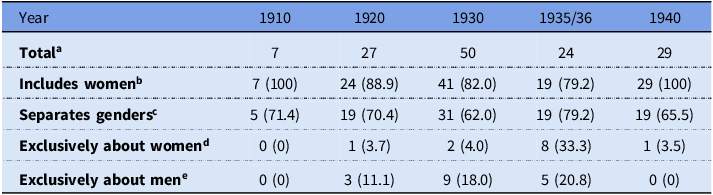
The Swedish censuses of 1920, 1930, and 1935/36 are the most detailed regarding women’s labor due to dedicated narrative sections on women’s “professional activity,” discussing women’s share in each occupational sector and changes in women’s labor force participation over time. Each census after 1910 has many tables about occupational statistics in general, of which many focus on women to some degree (see Table 1). This does not mean that occupied women always received equal attention to occupied men; this varied slightly between censuses but was always close to equal. In a vast majority of occupational tables in Swedish censuses between 1910 and 1940, data about women underpinned the results, and results about women could be inferred separately. The 1935/36 census aimed to learn more about women’s full- and part-time labor specifically and had a particularly large number of tables exclusively about women (8 such tables compared to 2 tables focusing exclusively on men).
Frequencies and percentages of occupational tables with different levels of information about women and men

Source: Statistiska Centralbyrån 1917, 1926, 1927, 1936, 1937a, 1937b, 1938, 1940, 1943
Note: Frequencies, and percentages (of the column’s total) in brackets.
a Total number of tables in the occupational statistics, including about main and secondary occupation, income, wealth, education, and previous occupation.
b Tables with data about women and men together underpinning the results.
c Tables with results about women that can be inferred separately from results about men.
d Tables that include data exclusively about women.
e Tables that include data exclusively about men.
Despite today’s impressions suggesting women were often excluded from occupational statistics, these censuses instead show that occupied women became a central object of study. Accordingly, it is misleading to suggest that women were only represented as dependents in censuses; besides creating dependent women, censuses have also created independent, working women. All women, including occupied women, became beings of political and statistical interest. The preoccupation in censuses with occupied women, besides unoccupied women, can be connected to Foucauldian perspectives on biopolitics or governmentality, in which managing the labor force was crucial for state objectives (Foucault Reference Foucault, Burchell, Gordon and Miller1991 [1978]; see also, Hacking Reference Hacking, Burchell, Gordon and Miller1991). For instance, from the 1920s and especially in the 1930s, the censuses’ occupational statistics on women supported inquiries into the much-discussed problem of the declining birthrate and its connections to women’s roles in the household and the labor force. This theme was notably addressed in the Myrdals’ influential book Crisis in the Population Question (Kris i befolkningsfrågan), where censuses were an important source (Myrdal and Myrdal Reference Myrdal and Myrdal1934). Around the same time, amid debates about women’s roles in the household and the labor force, the 1935/36 special census was specifically commissioned to further uncover these issues (Riksdagen 1935: 2).
(3) Identifying reflective accuracy
A complement to today’s aspects on censuses’ accuracy is examining what was written on the topic of accuracy in the censuses themselves. This helps identify statisticians’ concerns and solutions, allowing historians to better interpret the reasons behind changes in census results and to name the core issues existing within censuses. The Swedish census publications are quite self-reflective. They include statements about the enumerations’ limitations and criticisms of the statistical choices in previous censuses. Self-reflexivity is likely present in census materials of many other countries; Sarti (Reference Sarti, Sarti, Bellavitis and Martini2018) has shown a self-reflective consciousness in Italian historical censuses akin to the tendency I find in these Swedish censuses. Although statisticians were aware of issues we still recognize today, they nevertheless believed their results could say something constructive about the social world they aimed to capture. Contrary to the image of a solely positivist-inclined statistician of that era (as seen in, e.g., Boderías Reference Boderías, Sarti, Bellavitis and Martini2018: 166), census statisticians were capable of criticizing and contextualizing their materials, particularly concerning data collection.
The Swedish census publications of 1910, 1920, and 1930 discussed the deficiencies of occupational information, which was said to be vague in some cases. These census publications stated that data about occupations had been improved to some extent, and each claimed that earlier censuses suffered from worse issues (Statistiska Centralbyrån 1917: 6*–7*; 1926: 3–6; 1936: 1*). The 1920 census marked a particular shift towards acknowledging the non-comparability of census results due to measurement changes. It was the first Swedish census to question how much of the change in occupational sectors’ sizes since the previous census (1910) was caused by “a real increase” rather than categorization changes (Statistiska Centralbyrån 1926: 30–31). When writing about women’s labor in 1920, census statisticians similarly claimed that the increase in the labor force participation for both women and men was partly due to more complete occupational information (Statistiska Centralbyrån 1927: 15–16).
Later censuses reveal more awareness of the challenges in distinguishing between the occupied and unoccupied female populations. In the 1930 census, statisticians noted gray areas between being occupied and unoccupied and wrote that women engaged in housework on farms were especially difficult to classify. These women’s occupational status was unclear because it depended on how much they worked on the farm alongside housework, which was practically difficult to discern (Statistiska Centralbyrån 1938: 3). The 1935/36 census explicitly stated that its results could not be directly compared to other censuses due to representability issues, a different collection method, and new rules for categorizing part-time working women and some dependent family members (Statistiska Centralbyrån 1940: 2*, 6*). The 1940 census, like its predecessors, was considered an improvement in statistical methods. However, it introduced a new classification scheme that created comparability issues: unlike earlier censuses, the “independently unemployed” were now classified as unoccupied (Statistiska Centralbyrån 1943: 17*). Census statisticians remained concerned about incomplete information on housework and the occupations of wives and family members (ibid.: 9*). From this approach, we may learn that many concerns of historians today were shared by census personnel at different points in time, and that the census personnel’s perspectives can be used to identify issues and solutions in comparing censuses across time.
(4) Revealing occupational ambiguities
The censuses broke down occupation into several sub-characteristics. This complexity is evident in the 1940 census’s occupational coding scheme, for instance, which uses eight numbers to represent: occupational/family position, sector, social class, individual profession (e.g., carpenter), and general type of position (e.g., state employed, technical education). The first number in the code – occupational/family position – indicated whether someone was occupied or unoccupied. This principle applied to all the discussed Swedish censuses, though specific positions varied slightly from year to year. In both 1920 and 1930, the occupational/family positions were: (1) occupied men, (2) occupied women, (3) wives without an occupation, (4) boys under the age of 15, (5) girls under the age of 15, (6) male family members over the age of 15, and (7) female family members over the age of 15. Only the first two groups were considered occupied by the censuses’ definitions; the rest were unoccupied family members.
In this schematic setup, household and occupational positions were intertwined, with people categorized as either family members (unoccupied dependents) or occupied (providers/heads of households). The occupational enumeration and coding documented a mixture of several characteristics simultaneously, for example, possession of occupation and household position, which incorporated gender, age, and civil status. Jonsson (Reference Jonsson and Sandgren2018) also finds that this led to ambiguous meanings behind some enumerations. There are many gray areas in people’s occupational statuses because people often hold both occupational and family identities simultaneously, and because occupations and family constellations vary and are complex. Examining how these ambiguities were resolved – by identifying internal inconsistencies to censuses and explaining the statistical choices that were actually made, such as when and why a person’s household or occupational position was given greater weight – allows us to identify interesting and nuanced dynamics within censuses. This approach allows us to go beyond labeling these dynamics in one-sided ways, such as by saying more than that they simply created the dependent woman.
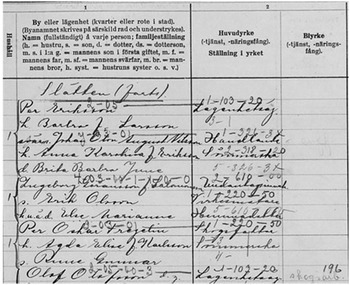
Married women present an intriguing case in census records: when were they categorized as “occupied” (position 2) versus “wives without an occupation” (position 3)? Typically, household position was a significant identity marker for married women, and census practices tended to designate only one provider per household. As a result, most married women (about 96 percent) were classified as unoccupied wives (position 3). Considering this, it might be surprising that any married women were recognized as occupied. However, some were, particularly if they had distinct professions (e.g., “teacher,” “midwife,” or “spinner”) and/or if they were the household head. Seemingly small differences in household position or unregistered levels of work could contribute towards determining occupational statuses, sometimes in unexpected ways. One example is seen in Figure 1, which represents many similar cases I have encountered in censuses. In this census page, rows five and eleven show that two women, both seamstresses, were recorded differently. Both were married, had one young child, and were of similar age (29 and 27). The first woman, living with her husband, child, and her parents, received the code “2-318-20,” indicating that she was occupied but not in accordance with her title, “seamstress”; the code rather indicates that she was a business owner trading miscellaneous goods. The second woman, living with just her husband and child, was given the code “3-220-50,” meaning that she was unoccupied and provided for by her husband in his profession as a forest administrator.
A census table page.
Source: Statistiska Centralbyrån (1930) “Församlingsboksutdrag: 1930 års folkräkning,” [Parish book excerpt: The census of 1930] Riksarkivet, sok.riksarkivet.se/nad?postid=Arkis%204c42467d-9b89-11d5-a701-0002440207bb (accessed November 28, 2024)

These examples demonstrate that occupational codes did not always correspond directly to the given occupational title. Though many titled “seamstress” were coded as seamstresses (code “2-254-**”), these two women were not. Did the enumerators disregard census instructions in these cases? Possibly. However, the discrepancies might also be due to legitimate reasons such that results were nonetheless believed to align with the census instructions. Enumerators were local parish ministers often familiar with their parishioners. Therefore, the occupational codes may reflect subtle differences, not all recorded, including time spent working, actual work tasks, household positions within a more complex household dynamic, or perceived dependencies on husbands and other household members. One issue with standardizing these occupational codes today is that it might further obscure these subtle, but unknown, differences between women.
In Swedish censuses, married women were sometimes considered “occupied” even without having a registered occupation with a market-relation or being actively occupied. This distinction arose because Swedish censuses differentiated between “the occupied in actual terms” and “the occupied in statistical terms.” Researchers today should be mindful of these two ways of counting the occupied population when deciding which version to apply. The latter (but not the former) includes an additional sectorial occupational category labeled “others.” If someone was counted as occupied only in statistical terms, it often meant that they could support themselves financially in some way without being actively occupied. Yet, they counted as occupied in the statistical sense. For instance, the wives in the “others” sector most often lived in households with absent husbands. They were then either coded by their own previous occupation or by their absent husbands’ occupation. Thus, being a “carpenter’s wife” was technically considered an occupation within the “others” sector specifically. This exemplifies a situation where dependency was indicated in censuses (see: the dependent woman), but where these women were at the same time not non-working dependents; here, they were regarded as occupied, indicating a household leadership role and some form of autonomy nonetheless. This is not a clear-cut case of dependency being emphasized in censuses, because it represents a more complex family situation and representation than such.
“Others” is a curious category that included individuals with unspecified occupations, widows (defined by their deceased husbands’ occupations), tenants, previously occupied people, capitalists, prisoners, paupers, and those receiving public financial support. This ambiguous sectorial occupational category often resulted in individuals being listed as occupied in census publications, yet not always considered occupied in all census tables. While this category often meant that men were counted as occupied in ambiguous cases, this also applied to a large number of women, as demonstrated with the wives described above. “Others” included 157,333 women in total in 1910, and by 1930, it had risen to 198,377 women (Statistiska Centralbyrån 1917: 448; 1937b: 45). This category notably counted widows as occupied in statistical terms, but not in actual terms. A key distinction concerns widows who were included in the occupied population (in the “others” sectorial category within occupational/family position 2) versus widows who were counted as unoccupied (in occupied/family position 7). What seemed most important in this regard was having economic means, usually from a deceased husband, that was enough to live off of, as well as the absence of other household members (like a son, daughter, or sibling) with relatively clearer occupational statuses from which dependency could be defined in relation to. However, actively participating in an occupation, or having a distinct professional title or a connection to the market economy, was not a requirement in order to be considered occupied in these cases. This proves that the concept of the marketization of work did not always apply.
Daughters over the age of 15 were another group that could be counted in various ways. They could be classified either in family position 7 (i.e., female family members over the age of 15) or as occupied in position 2 (i.e., occupied women). The case of daughters in the agricultural sector was often discussed in censuses due to its many unclear cases (e.g., Statistiska Centralbyrån 1943: 14*–15*). Rather than solving the issue by, for instance, always classifying family members as unoccupied, census statisticians seemingly found it important to recognize some family members as occupied. The benefit of better reflecting the perceived social reality presumably outweighed the disadvantages of creating extra work for statistical personnel in resolving unclear cases and in sometimes defining multiple providers per family. Therefore, Swedish censuses defined people as occupied if they were workers, self-employed, or assisting family members.
The criteria for who counted as assisting family members were always changing. The changes include some of the following: In 1910 and earlier, only sons over the age of 15 with a head of household in agriculture or handicrafts were defined as occupied as assisting family members (Statistiska Centralbyrån 1917: 8*). In 1920, the definition expanded to include male or female children, siblings, children-in-law, and extended family over the age of 15 (but not spouses), whose main activity was assisting the head of household in agriculture (Statistiska Centralbyrån 1927: 27). In 1930, assisting family members could be male or female children, siblings, or children-in-law over the age of 15 assisting their head of household in agriculture, handicrafts, industry, or trade (Statistiska Centralbyrån 1938: 17, 546). In 1940, assisting family members additionally included wives assisting in family businesses, but not in agriculture (Statistiska Centralbyrån 1943: 14*).
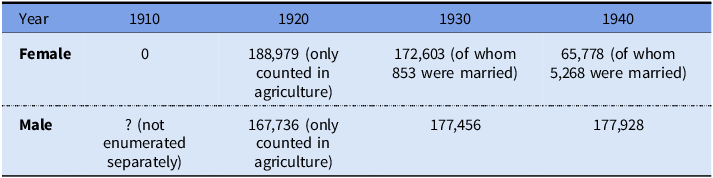
This group of assisting family members is special in many ways. They are often defined unstably, with ambiguous cases bordering on unoccupied family members. For instance, those performing or assisting with housework were not counted as occupied, but the demarcation between housework and agricultural or business work was blurry. Enumerators were rather generous in defining family members as occupied, often classifying both male and female family members as occupied in ambiguous cases such as in agriculture, though this was less common for women in 1940 (see Table 2). Assisting family members did not need to have an income; most often, they did not. They also did not need to have an occupational enumeration. Statisticians frequently assumed that able-bodied adult children living at home in an agricultural setting were assisting family members and occupied, even without having an occupational enumeration to their name (Statistiska Centralbyrån 1927: 11). The exemplified assisting family members, along with those in the sector “others,” show that people were often defined as occupied based on an evaluation of their family relations rather than solely on their individual occupational position, and that they could be denoted by a family relation (i.e., by dependency) but nonetheless be considered occupied.
Number of assisting family members counted in Swedish censuses, 1910–1940
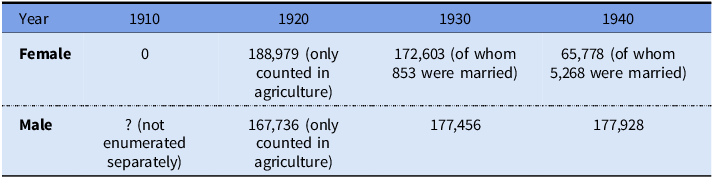
Source: Statistiska Centralbyrån 1927: 27; 1938: 17; 1943: 378–79.
It is important to note that everyone’s occupational status – not just women’s – was evaluated based on their means of provision, physical ability, and occupational position relative to the provision and occupational positions of other household members. For instance, in relatively rare cases, even married men were coded as unoccupied and dependent on the occupations of others, including their wives, mothers, or daughters. These married men were removed from the occupied population if they were not able-bodied (due to an injury, disability, or age) and if a household member was present who could better represent the household provider role. It is also true that differences in gender, civil status, and age led to varied evaluations of factors like provision or ability, affecting the likelihood of being classified as occupied or unoccupied in statistics. For instance, married women in particular were less likely to be registered with an occupation or coded as occupied than were married men in comparative situations. As already discussed, this was the case for wives and husbands working on a family farm – one of the most valid arguments from the concept of undercounting. Another example of this is that of retired married women living only with their husbands, who were sometimes coded as unoccupied and dependent on his occupation, even if she had retired from her own line of work, and regardless of whether he was retired. This occurred despite the censuses having an occupational code for “retired professionals” in the “others” sector, which was theoretically gender-neutral. In contrast, I have found no exceptions to the rule that retired married men living only with their wives were defined as occupied in the “others” sector as retired professionals.
(5) Analyzing new data categories
Around the turn of the twentieth century, it became quite common in Western European and American censuses to enumerate secondary occupations, income, wealth, and educational attainment. The 1920 Swedish census was the first Swedish census to gather new occupational data beyond main occupation, including men’s secondary occupation and both men’s and women’s income and wealth, though the data was considered inadequate at the time (Statistiska Centralbyrån 1926: 9). The 1930 census is regarded as the most comprehensive Swedish census (Axelsson and Wisselgren Reference Axelsson and Wisselgren2016), covering main and secondary occupations, income, wealth, previous occupation in 1925, educational attainment, and more. The special 1935/36 census collected the same information as in 1930 but updated previous occupations to reflect 1930 and only surveyed about one-fifth of the Swedish population. Due to the war economy, the 1940 census reduced the amount of information and tables (Statistiska Centralbyrån 1943: 1*); it collected and presented findings about main occupation and additionally collected but did not present findings on secondary occupation.
Though these variables have been included in at least one census in many countries, they have not been previously evaluated to determine the quality of censuses’ information about women’s work. Analyzing these variables may offer more insights into how censuses represent women’s work by broadening perspectives and introducing new analytical concepts. However, such analysis may broadly align with the concepts of “undercounting,” “the creation of the dependent woman,” and “the marketization of work” for those who hold those views, but conclusions depend on the census in question. For example, in the 1930 Swedish census, a secondary occupation needed to generate an annual income of at least 50 Swedish kronor to be enumerated (Statistiska Centralbyrån 1936: 551). To put this in perspective, the average annual income in 1930 for men and women in manufacturing industry and trade was 2,850 Swedish kronor and 1,662 Swedish kronor, respectively (Socialstyrelsen 1931: 44). Women in other occupations such as day laborers, maids, cleaners, and farmers earned significantly less (in cash), with the annual income, for instance, being 434 Swedish kronor for female servants in rural areas (Socialstyrelsen 1931: 11). In particular, the census instructions regarding secondary occupation would likely have excluded especially much of the part-time and casual work that many women had. Instructions differed in 1935/36, where there was no lower income limit for a secondary occupation to be registered, allowing more women’s work to be registered than before. However, a development in this census was that married women with only a secondary occupation (but not a main occupation) were always defined as unoccupied, unlike in the 1930 census (Statistiska Centralbyrån 1940: 9*), a choice that could be viewed as representing married women as dependents.
As pointed out in the 1920 census, low incomes were sometimes missing from the data on income and wealth since the income tax returns did not obligate lower-income people to submit a tax return (Statistiska Centralbyrån 1926: 43). Though this problem was oftentimes overcome by additional sources, it is nonetheless probable that some low-income women’s work and income stemming from casual work was excluded. Furthermore, according to instructions, the income and wealth of most children and wives was recorded as part of the husbands’ income and wealth in the 1920 and 1930 censuses, as a type of total household income (Statistiska Centralbyrån 1940: 3*). Therefore, these censuses hide married women’s and children’s economic contributions and may lead researchers to credit husbands with wives’ incomes. However, the 1935/36 census again demonstrates different representations of women’s work through a different counting standard. Since statisticians at the time were particularly concerned with connections between wives’ incomes and childbearing, this census enumerated the income and wealth of wives and children separately from the husbands’ income and wealth (ibid.: 3*). As demonstrated by these census differences, scrutinizing censuses’ numerous standards individually and comparatively can enable historians to more intricately engage with past representations of women’s work.
Concluding remarks
Historical censuses are comprehensive non-neutrally constructed documents, complicating their use for today’s historians. In one sense, censuses are embedded with real and perceived gender roles translated into statistically meaningful information, and this occurred in non-gender-neutral ways. Women and men have been counted with different standards within and between censuses. This poses challenges for scholars needing standardized materials or preferring newer counting standards to substitute past ways of counting. For these scholars, censuses are not always accurate or useful as historical sources in the sense of being testimonies of the past. While standardization may be necessary for some historical studies, it is crucial to remember that no counting standard – old or new – is ideologically neutral. New standards might come at the expense of historicity and richer representations of the past’s social and cultural aspects.
Indeed, censuses are rich in details that can ultimately aid historians in understanding a time period. This is a particular strength even when their testimonial qualities are deemed inadequate. Besides being a testimony of facts, which may be viewed as more or less accurate, censuses are historical sources in the sense of being relics of the past. As such, censuses are authentic of a time period from which they cannot be separated, capturing not just facts but also contexts in which they were created. Elements such as style and focus in censuses reflect statistical thinking, technical practices, political priorities, and governmental power, and so on. Censuses reveal material, ideological, and technical elements to the population, gender, and work, as well as situatedness and nuances thereof. By containing such information, censuses serve as valuable sources about the constructed and social world and ultimately about the power contained in discourses. The five analytical approaches presented in this article serve to make visible some of the qualities that censuses have due to being relics, besides their testimonial qualities. Though concrete conclusions when applying these approaches will be specific to each analyzed census – in this case, the set of Swedish censuses from 1910 to 1940 – these approaches have broad applicability with regard to revealing relic-related qualities in any census.
Beyond reflecting their contexts, censuses have a performative aspect: they have also constructed reality by forming ideas about gender and work. Facts within censuses may subsequently become reality by, for instance, shaping people’s perceptions and beliefs, impacting political decisions which have had very real consequences, or inspiring artistic expression (Sarti et al. Reference Sarti, Bellavitis, Martini, Sarti, Bellavitis and Martini2018: 31; Anderson Reference Anderson2008). Therefore, one way to use censuses as historical sources is to recognize their results as true because of their societal impacts, regardless of how accurate or inaccurate we judge their results today. Censuses are embedded with and disseminate ideas about gender and work, making them inevitably informative, authentic, and even accurate of a particular time, place, and genre.
This article encourages a number of closely intertwined viewpoints and approaches that have previously not been the primary emphasis in research, especially in quantitative research. The analytical approaches and conclusions offered in this article may therefore have significant implications for how historians approach censuses for future studies. For instance, the article argues against dismissing censuses outright as a fruitful source about women’s work. Instead, it advocates for leveraging their inherent qualities in new and creative ways. Even if censuses’ contents are deemed insufficient as testimonies for what a researcher wishes to know, they can still provide useful information because they are also relics from the past. Hence, they still offer insights into women’s work and societal roles through their constructed and contextual qualities. This view additionally inspires analyses that focus not just on census results but also on the processes and decisions behind censuses. Such an approach helps us understand the thinking and dilemmas of the time and fosters empathy toward historical subjects. Another encouragement from this article is to adopt approaches towards censuses that incorporate close reading, exemplification, and contextualization of specific censuses. This breathes life into statistical sources and is essential either for confirming concepts or for instead proving that census data are more complex than first assumed. This article has done the latter – that is, emphasized complexity in census data about gender and work – and this supports moving away from one-sided labeling of censuses and to instead think more critically about when such labels are applicable.

 Open access

