


I honestly believe it is better to know nothing than to know what ain’t so. (Billing, Reference Billing1874)
1. Introduction
Many purchasing decisions require searching for information over days, weeks, months, or even years. For example, when looking for a new car, the consumer may search online today, read a few reviews at specialized websites during the week, and visit a car dealer the next weekend but only decide upon the purchase (or not) sometime later. Often, consumers acquire knowledge and learn about products over time, and must decide based, at least partly, on attribute information stored in memory (Dick et al., Reference Dick, Chakravarti and Biehal1990; Lee, Reference Lee2002; Lynch and Srull, Reference Lynch and Srull1982). However, it is not rare for consumers to learn information about products and forget a large amount of it (Walters and Hershfield, Reference Walters and Hershfield2020).
In the context of perfect information, learning and forgetting should be less of a problem. However, products in the marketplace are rarely described completely and consumers commonly find themselves having to make decisions considering only the available information (Chuang et al., Reference Chuang, Kao, Cheng and Chou2012; Kardes et al., Reference Kardes, Posavac, Silvera, Cronley, Sanbonmatsu, Schertzer, Miller, Herr and Chandrashekaran2006; Kivetz and Simonson, Reference Kivetz and Simonson2000; Pfeiffer et al., Reference Pfeiffer, Deval, Kardes, Ewing, Han and Cronley2014) and previous research has shown that individuals usually fail to notice the absence of relevant information (Kardes and Sanbonmatsu, Reference Kardes and Sanbonmatsu2003; Sah and Read, Reference Sah and Read2020; Sanbonmatsu et al., Reference Sanbonmatsu, Kardes and Herr1992, Reference Sanbonmatsu, Kardes, Posavac and Houghton1997, Reference Sanbonmatsu, Kardes, Houghton, Ho and Posavac2003). This insensitivity to missing information, or ‘omission neglect’ (Kardes and Sanbonmatsu, Reference Kardes and Sanbonmatsu2003), often leads consumers to form extreme and confidently held judgments, albeit based on weak evidence (Kardes et al., Reference Kardes, Posavac and Cronley2004, Reference Kardes, Posavac, Silvera, Cronley, Sanbonmatsu, Schertzer, Miller, Herr and Chandrashekaran2006; Sanbonmatsu et al., Reference Sanbonmatsu, Kardes, Posavac and Houghton1997).
Sensitivity to missing information may be heightened when consumers acquire knowledge about the relevant attributes of a product before a purchasing decision, reducing both their satisfaction with the amount of information presented (Kardes et al., Reference Kardes, Posavac, Silvera, Cronley, Sanbonmatsu, Schertzer, Miller, Herr and Chandrashekaran2006) and their confidence in the decision (Gunasti and Ross, Reference Gunasti and Ross2009; Kardes et al., Reference Kardes, Posavac, Silvera, Cronley, Sanbonmatsu, Schertzer, Miller, Herr and Chandrashekaran2006; Sah and Read, Reference Sah and Read2020; Sanbonmatsu et al., Reference Sanbonmatsu, Kardes, Posavac and Houghton1997, Reference Sanbonmatsu, Kardes, Houghton, Ho and Posavac2003; Walters et al., Reference Walters, Fernbach, Fox and Sloman2017). However, if consumers make the decision sometime after the knowledge acquisition, are they still able to recall what was learned before and detect the absence of information relevant to the decision? If they do not, is there any consequence for the decision-making?
In this paper, we examine situations in which individuals acquire knowledge about products in the marketplace and face a purchasing decision in which products and services are described incompletely, either immediately or after some delay. In actual decision-making situations, consumers may decide to choose or defer the choice and collect more information. Previous studies have found that choice tasks involving uncertainty increase the likelihood of choice deferral (Dhar, Reference Dhar1996, Reference Dhar1997; Tversky and Shafir, Reference Tversky and Shafir1992; White and Hoffrage, Reference White and Hoffrage2009). We predict that consumers who face a purchasing decision immediately after acquiring knowledge about a product will detect missing information, display lower levels of decision confidence, and defer the choice more frequently. In contrast, when consumers delay the purchase decision after acquiring knowledge, memories of product knowledge may fade away and, despite being less able to detect missing information, consumers will remain confident that they have the right amount of knowledge and will defer choice less frequently.
Investigating the effect of detection of missing information on choice deferral over time is consequential for three reasons. First, most everyday consumption situations require consumers to make decisions based on incomplete product descriptions, with most consumers having the option of deferring their choice (Dhar, Reference Dhar1997). We evidence that choice deferral may be an efficient strategy for consumers to avoid suboptimal decisions in contexts of choice sets described incompletely. Second, consumers tend to overestimate how much they know (e.g., Sanbonmatsu et al., Reference Sanbonmatsu, Mazur, Pfeiffer, Kardes and Posavac2012) and rarely are motivated to search for missing information (Kardes et al., Reference Kardes, Posavac, Gaffney, Kahle, Lowrey and Huber2022). We show how knowledge acquisition is important to debias omission neglect, but only when the decision is made sooner rather than later. Third, most past research neglected the fact that consumers do not make purchasing decisions immediately after acquiring knowledge. Examining the effect of delaying a decision after acquiring knowledge is relevant to understanding in which circumstances searching for information is more or less beneficial for consumers.
Because we are interested in examining how decision delay influences omission neglect and choice deferral and the role of knowledge acquisition in these processes, we first discuss the concepts of omission neglect and choice deferral and then develop the research hypotheses. After our conceptual overview, we present three studies aimed at testing the effect of decision delay on choice deferral and the roles played by missing information detection and decision confidence on choice in the consumer decision-making process. Lastly, we summarize our findings and suggest future directions for practitioners and consumers.
2. Omission neglect
The benefits and attributes of products in advertising, promotional material, reviews, salespersons’ pitches, and so forth are rarely described completely because marketers only highlight the attributes that give them a competitive edge in the market (Gunasti and Ross, Reference Gunasti and Ross2009; Kardes et al., Reference Kardes, Posavac and Cronley2004; Kivetz and Simonson, Reference Kivetz and Simonson2000; Pfeiffer et al., Reference Pfeiffer, Deval, Kardes, Ewing, Han and Cronley2014). In these contexts, individuals usually fail to notice the absence of relevant information and form more extreme and confidently held judgments based on incomplete information, a phenomenon known as ‘omission neglect’ (Kardes et al., Reference Kardes, Posavac and Cronley2004, Reference Kardes, Posavac, Silvera, Cronley, Sanbonmatsu, Schertzer, Miller, Herr and Chandrashekaran2006; Kardes and Sanbonmatsu, Reference Kardes and Sanbonmatsu2003; Sah and Read, Reference Sah and Read2020; Sanbonmatsu et al., Reference Sanbonmatsu, Kardes and Herr1992, Reference Sanbonmatsu, Kardes, Posavac and Houghton1997, Reference Sanbonmatsu, Kardes, Houghton, Ho and Posavac2003).
However, when prompted to detect missing information, consumers reduce their confidence in the available information and form more moderate and appropriate evaluations (Gunasti and Ross, Reference Gunasti and Ross2009; Kardes et al., Reference Kardes, Posavac, Silvera, Cronley, Sanbonmatsu, Schertzer, Miller, Herr and Chandrashekaran2006; Sah and Read, Reference Sah and Read2020; Sanbonmatsu et al., Reference Sanbonmatsu, Kardes, Houghton, Ho and Posavac2003; Walters et al., Reference Walters, Fernbach, Fox and Sloman2017). Strategies such as encouraging individuals to elaborate on their criteria for judgment (Kardes et al., Reference Kardes, Posavac, Silvera, Cronley, Sanbonmatsu, Schertzer, Miller, Herr and Chandrashekaran2006), deliberately forming inferences about unmentioned product attributes (Gunasti and Ross, Reference Gunasti and Ross2009; Sanbonmatsu et al., Reference Sanbonmatsu, Kardes and Sansone1991), processing comparative information of non-alignable differences (Kardes and Sanbonmatsu, Reference Kardes and Sanbonmatsu1993; Sanbonmatsu et al., Reference Sanbonmatsu, Kardes, Houghton, Ho and Posavac2003), employing the consider-the-unknown technique (Walters et al., Reference Walters, Fernbach, Fox and Sloman2017), or stimulating the feeling of not knowing it all (Yang et al., Reference Yang, Carmon, Ariely and Norton2019) have been shown to enhance the perception of missing attributes in product evaluation tasks. When missing information is made more salient, the confidence in the strength of available evidence is decreased, pushing consumers to adjust their evaluations and moderate their judgments (Kardes et al., Reference Kardes, Posavac, Silvera, Cronley, Sanbonmatsu, Schertzer, Miller, Herr and Chandrashekaran2006; Sanbonmatsu et al., Reference Sanbonmatsu, Kardes and Sansone1991, Reference Sanbonmatsu, Kardes, Posavac and Houghton1997).
One of the strategies to debias omission neglect is to provide consumers with knowledge of the target product category (Sanbonmatsu et al., Reference Sanbonmatsu, Kardes and Sansone1991, Reference Sanbonmatsu, Kardes and Herr1992). However, many purchase decisions are made after consumers take the time to research their purchases and acquire additional knowledge. Despite consumers’ well-meaning intentions, this delay may do more harm than good. Over time, learned information is likely to fade, and consumers may be more susceptible to omission neglect bias. Despite how normative this example appears to be, little research examined the impact of missing information over time. In one exception, Sanbonmatsu et al. (Reference Sanbonmatsu, Kardes and Sansone1991) asked participants to infer the durability of a bicycle right after (vs. 1 week later) receiving favorable information about the bicycle’s ride and handling, but information regarding the bicycle’s durability was omitted. They found that participants judged the durability of the bicycle more positively and held more confident opinions when the task was performed 1 week after (vs. immediately after) reading the bicycle description. Over time, product attribute recall decreased, and participants failed to realize that they never received any information regarding the durability of the bicycle. Whereas Sanbonmatsu et al. (Reference Sanbonmatsu, Kardes and Sansone1991) focused on judgments resulting from inferences, the current research focuses on decision outcomes resulting from acquiring knowledge. We believe that choice deferral and decision confidence resulting from knowledge acquisition represent more precisely actual conditions found in the marketplace by consumers. In the next section, we examine the consequences of detecting missing information on the likelihood of whether to choose or defer choice.
3. Choice deferral
When a choice task entails higher (lower) levels of uncertainty or conflict, consumers will likely display lower (higher) levels of confidence in making a decision (i.e., consummating the choice), leading to more (less) choice deferral (Dhar, Reference Dhar1996, Reference Dhar1997; Greenleaf and Lehmann, Reference Greenleaf and Lehmann1995; Gunasti and Ross, Reference Gunasti and Ross2009; Tversky and Shafir, Reference Tversky and Shafir1992; White et al., Reference White, Hafenbrädl, Hoffrage, Reisen and Woike2011; White and Hoffrage, Reference White and Hoffrage2009). A choice task entailing products described incompletely is likely to render higher levels of uncertainty than those in which products are described more comprehensively (Chuang et al., Reference Chuang, Kao, Cheng and Chou2012; Sheng et al., Reference Sheng, Parker and Nakamoto2005). Indeed, Gunasti and Ross (Reference Gunasti and Ross2009) found that participants presented with choice sets displayed in a product-attribute matrix were more uncertain about making a choice and deferred more the choice when each option in the choice set was presented with one of the attributes missing than when options were presented with all attributes available.
However, as previously mentioned, consumers often fail to detect missing information on relevant attributes in a choice task, unless missing information is made explicit, as in Gunasti and Ross (Reference Gunasti and Ross2009). Precisely because they are ignorant of what they do not know, their perceptions of uncertainty in the choice are likely to be lower (e.g., known unknowns; Walters et al., Reference Walters, Fernbach, Fox and Sloman2017). This neglect often leads to overconfidence in decision-making processes (Sanbonmatsu et al., Reference Sanbonmatsu, Kardes and Sansone1991) and results in less choice deferral.
Choice deferral often leads to better decisions when consumers search for additional information or better alternatives. As Gunasti and Ross (Reference Gunasti and Ross2009, p. 833) illustrated, choosing an option in purchasing decision contexts involving uncertainty due to missing information may be detrimental to consumer welfare. For example, when brands omit negative product information, positive information is often used as an inferential basis for judgment and therefore consumers may make suboptimal purchases based solely on the information that is provided to them by the brand (Gunasti and Ross, Reference Gunasti and Ross2009). As put by Kardes et al. (Reference Kardes, Posavac, Silvera, Cronley, Sanbonmatsu, Schertzer, Miller, Herr and Chandrashekaran2006, p. 791), ‘to the extent that consumers exhibit omission neglect in their brand judgments, they are likely to make suboptimal decisions’. Therefore, we take a normative stance that choice deferral in uncertain contexts should be, in general, the right thing to do. In the next section, we interweave the concepts of omission neglect and choice deferral to formulate the hypotheses that guided this research.
4. Knowledge acquisition, decision delay, and choice outcomes
In the present research, we are interested in understanding the effects of the temporal distance between acquiring relevant information about attributes of products (i.e., henceforth, ‘decision delay’) and performing a choice task in which there is incomplete information, on the detection of missing information, decision confidence, and the likelihood to defer the choice decision. Choice (and decision-making more generally) often requires the collection, evaluation, and integration of information that is retrieved from memory or inferred by stimuli situationally available (Lynch and Srull, Reference Lynch and Srull1982; Srull and Wyer, Reference Srull and Wyer1989). We posit that the delay between learning and deciding should influence the outcome of a decision under contexts involving missing information. This is because the decision-maker is likely to form judgments based on various processing mechanisms, contingent on whether pertinent information is present in the immediate context or based largely on information previously stored in memory (Adaval and Wyer, Reference Adaval and Wyer2011; Srull and Wyer, Reference Srull and Wyer1989; Wyer and Srull, Reference Wyer and Srull1986; Xu and Wyer, Reference Xu and Wyer2010).
Thus, we posit that, when choice immediately follows the acquisition of knowledge concerning relevant attributes of the product, consumers will be better equipped to detect missing information and more uncertain when choosing among options in a choice set in which information is incomplete. Consequently, realizing that key information to make a well-informed choice is missing should render the decision-maker less confident, and more likely to defer the choice. Conversely, if the choice task and the acquisition of knowledge are separated in time, decision-makers will have to rely on their ability to retain the previously acquired knowledge.
Over time, memory fades and acquired product knowledge is likely to decrease such that consumers likely will overlook missing information. Past research often shows that consumers form inappropriately extreme and confidently held judgments based on insufficient evidence when they neglect or are unaware that some of the information that is relevant to a choice or evaluation task is missing (Sanbonmatsu et al., Reference Sanbonmatsu, Kardes and Sansone1991, Reference Sanbonmatsu, Kardes and Herr1992, Reference Sanbonmatsu, Kardes, Posavac and Houghton1997, Reference Sanbonmatsu, Kardes, Houghton, Ho and Posavac2003). In addition, individuals tend to overestimate how much they know and often consider themselves more knowledgeable than they are (e.g., Dunning–Kruger effect; Dunning et al., Reference Dunning, Griffin, Milojkovic and Ross1990; Hall et al., Reference Hall, Ariss and Todorov2007; Kruger and Dunning, Reference Kruger and Dunning1999; Meyers et al., Reference Meyers, Turpin, Białek, Fugelsang and Koehler2020). Even when individuals fail to recall product-relevant information, they tend to display overconfidence (i.e., when subjective accuracy falls behind objective accuracy) because subjective memory experiences often guide decision-making independently of objective accuracy (Hembacher and Ghetti, Reference Hembacher and Ghetti2017).
Therefore, compared with individuals who acquire knowledge and are faced with a decision immediately after, those who delay the decision should experience higher levels of confidence in the choice task and defer choice less frequently (Gunasti and Ross, Reference Gunasti and Ross2009). Based on this discussion, we propose the following hypotheses involving the comparison of consumers who obtain knowledge and choose immediately and consumers who obtain knowledge but delay the choice:
-
H1: Compared with consumers who acquire knowledge about products and delay their purchasing decision, consumers who do not delay will (a) be more likely to detect missing information, (b) feel less confident in their purchase decision, and (c) defer their purchase decision more often.
-
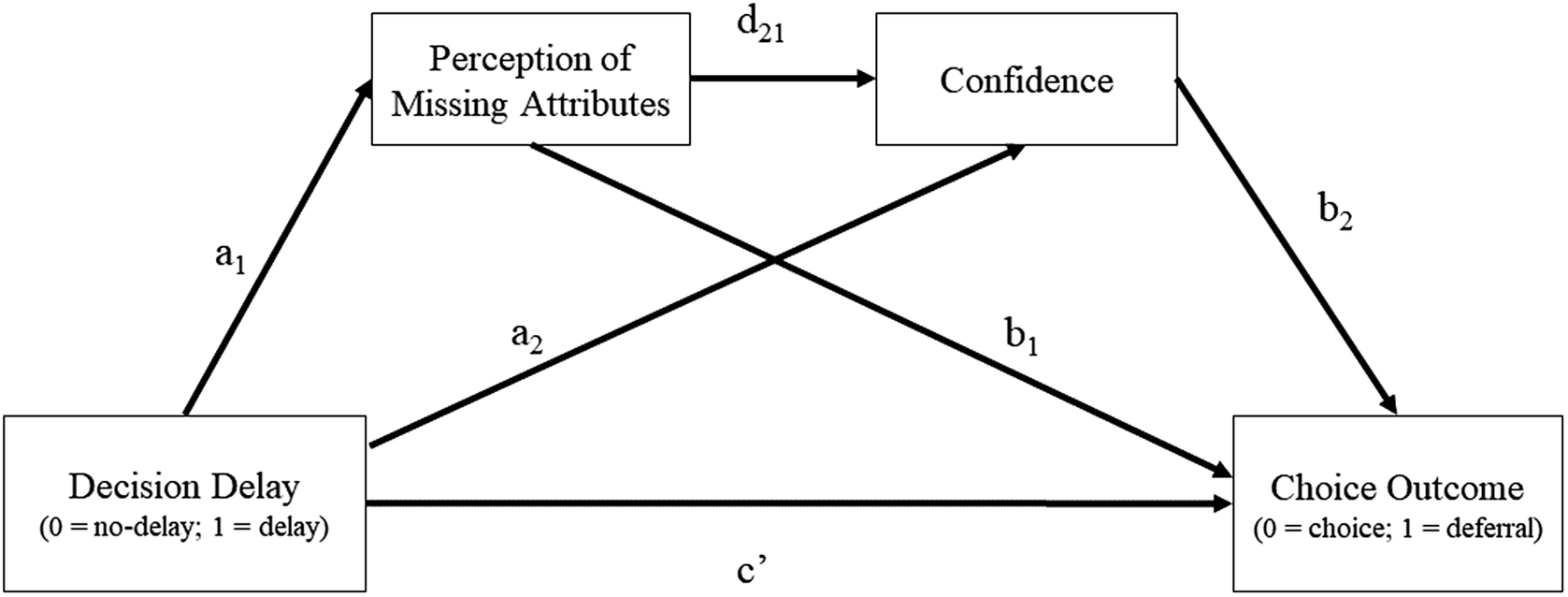
H2: Detection of missing information and decision confidence serially mediate the influence of decision delay on decision-making, such that consumers who acquire knowledge and choose immediately are more able to detect missing information that leads to lower decision confidence, which results in more choice deferral compared with consumers who acquire knowledge and delay the decision. The serial mediation model predicted in H2 is depicted in Figure 1.
Path diagram showing the direct effect and causal paths linking decision delay after knowledge acquisition and decision outcome, in a choice task with missing information.
5. Study 1
In this first experiment, we assess our hypotheses concerning the influence of decision delay on the detection of missing information, decision confidence, and choice deferral.
5.1. Participants and design
We recruited 114 undergraduate students of social sciences (59% females; M age = 20.8 years; SD = 4.03) during class breaks to participate in a between-subjects, two-condition experiment (decision delay: no-delay × 1-week delay) in exchange for a chocolate bar. Upon accessing the questionnaire available at the Qualtrics Platform in the computer laboratory, participants were randomly assigned to one of the experimental conditions.
5.2. Procedures
At the outset of the experiment, participants were asked to rate the relative importance of six attributes of a cable TV plan. We choose cable TV plans as stimuli based on the assumption that college students could eventually purchase one but did not have extensive knowledge to make an informed decision. Asking consumers to rate presented and missing product attributes before providing overall product evaluations is an effective technique for improving judgment by increasing sensitivity to omissions (Kardes et al., Reference Kardes, Posavac, Silvera, Cronley, Sanbonmatsu, Schertzer, Miller, Herr and Chandrashekaran2006). Initially, the following instructions were presented to participants:
It is known that some characteristics of a product or service can be more important for one person and less important for another person. Experience shows that identifying what is important and what is not important before buying a product or service can help to improve decision-making. In this question, we want you to think about what would be more or less important for you if you had decided to buy a cable TV combo (cable TV, broadband, landline phone, and cell phone) today. Please use a percentage scale to indicate the importance of each of the following attributes. If you assign zero to an attribute, it means that the attribute is not important at all. Giving twice the points for one attribute over another means that it is twice as important as another attribute. Remember that the number of points must total 100 (please ignore the importance of the price, as we already know that the price is very important for everyone).
After reading the instructions, participants were asked to rate the importance of six cable TV plans’ attributes: ‘Broadband speed for Internet access at home’, ‘Movie Channels (HBO, etc.) included in the subscription’, ‘Mobile internet data package on cell phone’, ‘Free minutes included on mobile’, ‘Pause function on live TV programming’, and ‘Number of free additional points for more than one TV’. This procedure consisted of our knowledge acquisition task.
Next, all participants were presented with four options of cable TV plans (A, B, C, or D). The options were described along with four attributes that were not present in the knowledge acquisition task (‘Total number of channels’, ‘Number of HD channels’, ‘Free minutes included on landline’, and ‘Live schedule recording’) (Appendix 1 of the Supplementary Material). Participants were then asked to review and choose one of the options or to defer the choice and collect more information. This consisted of our decision task.
Participants in the no-delay condition (N = 63) performed the decision task immediately after the knowledge acquisition task, and subsequently completed the dependent measures of the study. However, participants in the 1-week delay condition (N = 119) were dismissed after the knowledge acquisition task. Importantly, these participants were not warned about the second part of the study beforehand because we wanted to explore the spontaneous acquisition of knowledge, and alerting them about the second phase could bias their information search during the week. Exactly 1 week later, they were invited by email, WhatsApp, and phone to take part in a follow-up round of the study in exchange for a chocolate bar. Those who accepted (N = 51; attrition rate = 57%) performed the decision task and subsequently completed the same dependent measures as the participants of the no-delay condition. The 1-week delay was chosen to be consistent with both, previous omission neglect literature (Sanbonmatsu et al., Reference Sanbonmatsu, Kardes and Sansone1991) as well as the literature on memory more broadly (Haugtvedt et al., Reference Haugtvedt, Schumann, Schneier and Warren1994; Muehling and Laczniak, Reference Muehling and Laczniak1988; Watts and Holt, Reference Watts and Holt1979). After the decision task, participants rated their confidence in the decision (‘How confident you are in having made the right decision’; 1 = Not at all confident; 9 = Highly confident).
Participants were also asked to rate their satisfaction with the information provided (1 = Not at all; 9 = Very satisfied), and to what extent they judged the information provided sufficient to make the decision (1 = Not at all; 9 = Very much). We collapsed these measures to form a composite index of information satisfaction (r = .73; p < .01). Next, following Sanbonmatsu et al. (Reference Sanbonmatsu, Kardes, Houghton, Ho and Posavac2003), participants were requested to rate the relative importance of a list of attributes by assigning percentage weights in spaces provided next to each attribute. They were informed that the percentage reflected the proportional influence or weight of an attribute, and the number of percentage points should total 100 (the questionnaire software ensured that the total added exactly 100 points). The list contained the four attributes that described the options presented in the decision task along with a fifth alternative titled ‘all other attributes’. Because the attributes included in the knowledge acquisition task were missing in the decision task, a participant who perceives that attributes relevant to the decision are absent from the descriptions of the options should assign higher scores to ‘all other attributes’, and this score consisted of our measure of missing information detection. Finally, participants reported demographic information and were thanked for their participation.
5.3. Results
We performed a series of independent samples t-tests to test H1a and H1b, and contingency analysis to test H1c. The results are summarized in Figure 2.
The influence of decision delay between knowledge acquisition (delay vs. no delay) on (A) perceptions of missing attributes, (B) confidence in the decision, and (C) the decision to defer the choice (Study 1, cable TV plans; N = 114).

5.3.1. Perception of missing attributes
According to H1a, after acquiring knowledge about the important features of cable TV plans, those who decided immediately would detect more missing information than those who delayed their decision. Indeed, an independent samples t-test revealed that participants in the no-delay condition assigned more importance to attributes not presented in the decision task than participants in the 1-week delay condition (M no-delay = 20.1, SD = 21.5 vs. M delay = 11.8, SD = 16.4; t(112) = 2.29; p = .02; η 2 = 0.045) (Figure 2A). In addition, participants in the no-delay condition, compared with those in the delay condition, reported less satisfaction with the information provided (M no-delay = 5.65, SD = 2.01 vs. M delay = 6.60, SD = 1.57; t(112) = 2.75; p < .01; η 2 = 0.063). Further, the importance assigned to attributes not presented was significantly and negatively related to satisfaction with the information provided (r = −.26; p < .01), indicating that the higher the score, the less the information provided was perceived as sufficient/satisfactory. Together, the results suggest that the timing of the decision after knowledge acquisition affected the detection of missing attributes, such that participants who delayed the decision were significantly less able to detect the missing information than those who made the decision immediately after acquiring knowledge.
5.3.2. Decision Confidence
We also predicted that decision confidence would be higher among individuals who delayed their decision versus those who decided soon after learning about the relevant cable TV plan attributes (H1b). As expected, an independent samples t-test showed that decision confidence was lower among participants in the no-delay condition compared with those in the 1-week delay condition (M no-delay = 6.27, SD = 1.74 vs. M delay = 7.10, SD = 1.54; t(112) = 2.39; p = .02; η 2 = 0.071) (Figure 2B).
5.3.3. Choice deferral
Our third prediction was that people would defer more the choice when deciding immediately after than when delaying the choice (H1c). Indeed, participants in the no-delay condition were more likely to defer choice (52.4%) than participants in the 1-week delay condition (33.3%; χ 2 (1) = 4.15; p = .04) (Figure 2C).
5.4. Discussion
In this study, participants acquired knowledge of attributes of a cable TV plan and then were faced with a choice task wherein similar brands were described by attributes not mentioned in the learning phase. We predicted that the lack of information would render the choice task more uncertain, thereby lowering confidence in the decision, and ultimately leading participants to defer their choice. However, we expected differences, depending on whether the decision was made immediately or 1 week after the initial learning phase. The results largely supported our predictions. Participants who decided immediately were more likely to detect the missing information in the descriptions of the cable TV brands, compared with those who learned and had their decision delayed. Consequently, participants’ decisions were made with less confidence when the choice was made immediately after the learning phase, compared with when it was delayed, leading them to defer the choice more frequently.
6. Study 2
The objectives of this second study were (a) to provide the generalization of the findings of Study 1 with a different product category (air conditioner) and (b) to examine the effect of another strategy of acquiring knowledge on omission detection and choice deferral (reading a consumer guide, as opposed to rating attributes). As in Study 1, participants acquired knowledge about the main attributes of the target object—air conditioners—and were then asked to choose between two fictitious brands or to defer choice. The decision to utilize air conditioners as stimuli was predicated on the assumption that respondents (undergraduate students) would have little knowledge about this product category, especially because we described it with attributes that were quite technical. Therefore, compared with cable TVs, the influence of previous knowledge on the choice task is likely to be even lower. Additionally, in this study, we added a control condition wherein participants were submitted to the choice task without having had access to any knowledge acquisition about air conditioners beforehand.
6.1. Participants and design
One hundred sixty-nine social sciences undergraduate students (67% females; M age = 20.3 years; SD = 3.38) were invited during class breaks to participate in a between-subjects, three-condition experiment (decision delay: no-delay × 1-week delay × control) in exchange for a chocolate bar. Participants were randomly assigned to one of three conditions. The questionnaire was made available through the Qualtrics Platform, and data were collected in a computer laboratory.
6.2. Procedures
At the outset of the experiment, participants of both the no-delay and 1-week delay conditions were asked to review an alleged ‘air conditioner purchasing guide’ (Appendix 2 of the Supplementary Material) describing the importance of eight key attributes that should be taken into account when purchasing an air conditioner. After this initial knowledge acquisition task, participants were asked to review the information about two fictitious air conditioner brands (‘Cube’ and ‘Shaft’) described along with four attributes. Of importance, the attributes describing the two air conditioner brands (Filtration, Noise Level, Presence and Sun Sensor, and Dehumidifying Function) were not present in the purchasing guide, increasing the odds of detection of missing information (Appendix 3 of the Supplementary Material). After reviewing the two brands, participants were asked to choose one of the brands or to defer the choice and collect more information. Participants in the no-delay condition (N = 61) performed the decision task immediately after the learning task, whereas participants in the 1-week delay condition (final N = 47; attrition rate = 48%) were dismissed after the knowledge acquisition task and invited by email, WhatsApp, and phone to take part in the final step of the study exactly 1 week later in exchange for a chocolate bar. To check for nonresponse bias, we compared the demographics of those who participated in the acquisition knowledge task and did not return for the second part of the study (N = 43) with those who returned (N = 47) and did not observe any significant differences (all p’s > .2) (Appendix 4 of the Supplementary Material). As in Study 1, participants in the 1-week delay condition were not instructed about the second part beforehand. Participants in the control condition (N = 61) performed the choice task without being previously exposed to the purchasing guide. After the choice task, all participants completed the same measures of confidence and satisfaction with the information provided (r = .75; p < .01) as in Study 1.
6.3. Results
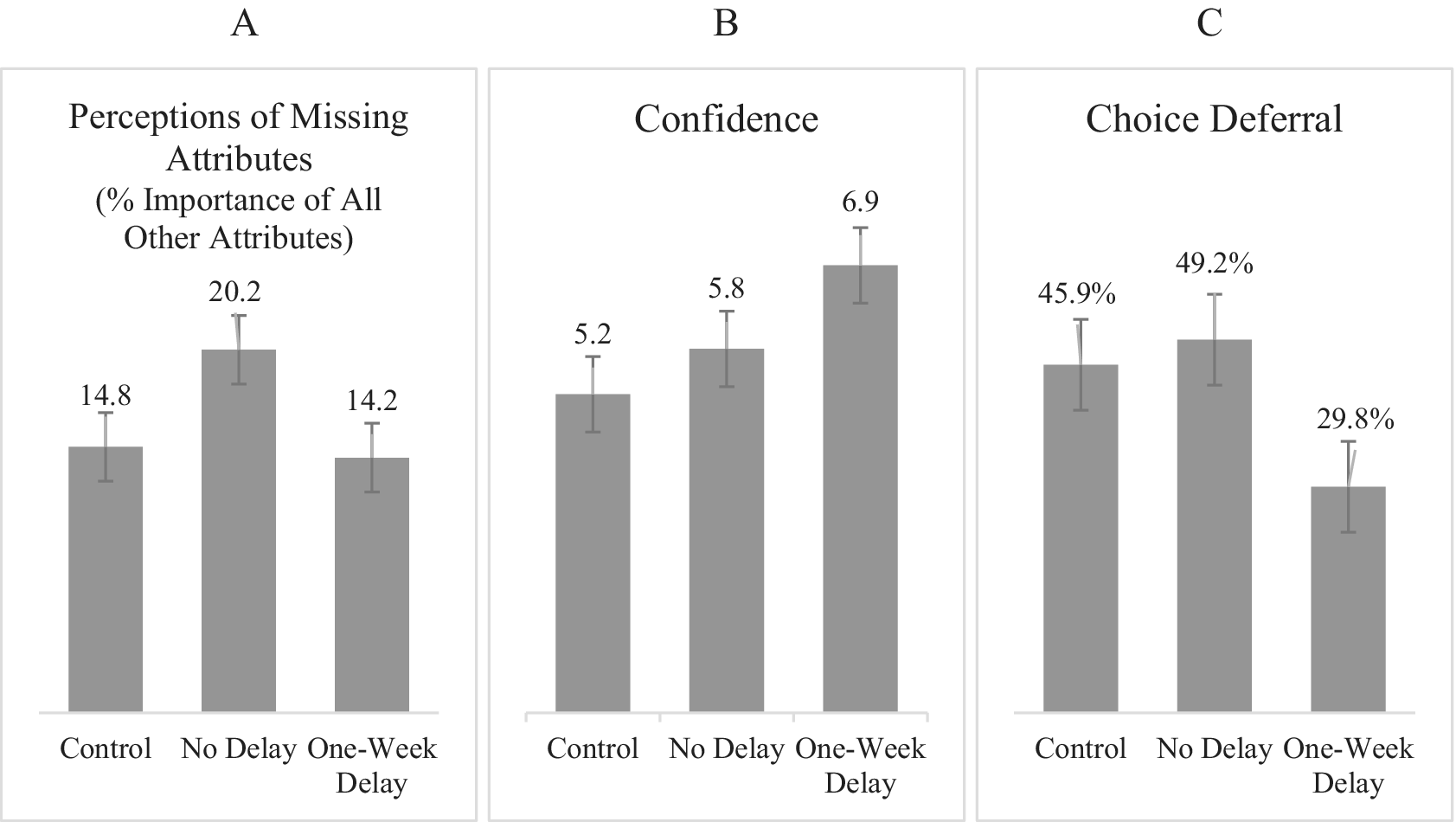
We performed one-way ANOVAs to test H1a and H1b, and contingency analysis to test H1c. The results are summarized in Figure 3.
The influence of decision delay between knowledge acquisition (delay vs. no delay vs. control) on (A) perceptions of missing attributes, (B) confidence in the decision, and (C) the decision to defer the choice (Study 2, air conditioners; N = 169).
6.3.1. Perception of missing attributes
The results revealed a significant main effect of decision delay on the importance assigned to attributes not presented in the decision task (F(2, 166) = 3.22; p = .04; η 2 = 0.04). Post hoc tests revealed that those in the no-delay condition assigned significantly more importance to attributes not presented in the choice task (M = 20.2, SD = 15.8) than both participants in the 1-week delay condition (M = 14.2, SD = 12.8; p = .03; η 2 = 0.04) and in the control condition (M = 14.8, SD = 12.8; p = .04; η 2 = 0.03). No difference was found between participants in the control condition and participants in the 1-week delay condition (p = .81) (Figure 3A). The results are consistent with our prediction that people would detect missing attributes to a greater extent when deciding shortly versus 1 week after learning important attributes of air conditioners (H1a).
Additionally, participants in the no-delay condition were less satisfied with the information provided (M = 4.98, SD = 2.09) than participants in the 1-week delay condition (M = 6.15, SD = 1.51; p < .01; η 2 = 0.09), but equally satisfied as participants in the control condition (M = 5.10, SD = 1.61; p = .70). Finally, participants in the control condition were less satisfied (p < .01; η 2 = 0.10) than participants in the 1-week delay condition. Together, analysis of both variables suggests that participants who acquired knowledge and performed the decision task immediately after were more able to detect missing information.
6.3.2. Decision Confidence
A significant main effect of decision delay on confidence was observed (F(2, 166) = 13.5; p < .01; η 2 = 0.14). Post hoc tests showed that decision confidence among those in the no-delay condition (M = 5.18, SD = 1.95) was significantly lower than those in the delayed condition (M = 6.87, SD = 1.01; p < .01; η 2 = 0.14) and in the control condition (M = 5.80, SD = 1.80; p = .04; η 2 = 0.07), supporting the hypothesis that people take more confidently held decisions despite neglecting attributes that are relevant to the decision (H1b). Interestingly, the confidence of participants in the control condition was significantly lower than that of participants in the delayed condition (p < .01; η 2 = 0.11) (Figure 3B).
6.3.3. Choice Deferral
Participants in the no-delay condition deferred choice (49.2%) more frequently than participants in the 1-week delay condition (29.8%; χ 2 (1) = 4.14; p = .04), but not more than participants in the control condition (45.9%; χ 2 (1) = .13; p = .72), lending support to our prediction that people would defer more the choice of the air conditioner when confronted with the purchase decision immediately rather than 1 week after learning about the key features of air conditioners (H1c) (Figure 3C). As would be expected from their lower levels of satisfaction with the information and lower levels of confidence, participants of the control condition also deferred choice more frequently than participants in the 1-week delay condition, although the difference was only marginally significant (χ 2 (1) = 2.90; p = .09).
6.4. Discussion
As in the previous study, participants acquired knowledge about important attributes of air conditioners and then were faced with a choice task wherein similar brands were described by attributes not mentioned in the learning phase. Thus, the lack of information should render the choice task more uncertain, lower confidence in the decision, and lead participants to defer choice more often. The results largely replicated those of Study 1. Participants who decided immediately were more likely to detect the missing information in the descriptions of the air conditioner brands, compared with those who learned and had their decision delayed. Consequently, they were less confident and deferred the choice more frequently.
Importantly, this study included a control condition in which participants received no information about air conditioners, and so had to decide based on their baseline knowledge, which, for a product described at a highly technical level, should be negligible. Interestingly, like in the no-delay condition, participants in the control condition were less confident and deferred choice more frequently than those in the 1-week delay condition. In contrast, they were as unable as participants in the 1-week delay condition to detect missing information. One could argue that, if the memory of what had been learned faded, participants in the 1-week delay condition should behave similarly to those who never learned. So, what could explain this difference?
The combined results of perceptions of missing information, satisfaction with the information provided, and confidence in the decision suggest that the source of confidence, or lack thereof, is likely different across conditions. Participants who read the guide and decided immediately lacked confidence because they perceived missing information and were dissatisfied with the information. Those who did not have access to the guide (control condition) lacked confidence because they felt they could not precisely pinpoint what information was needed. On the other hand, those who delayed the decision are likely to have forgotten the knowledge acquired over time. Despite this, they reported being satisfied with the information provided. This, together with their higher confidence in the decision, suggests that they judged themselves capable of relying on the knowledge they had acquired, although much of the memory of this information had probably been weakened. Thus, participants in the delayed condition may have experienced a ‘feeling of knowing’ (Costermans et al., Reference Costermans, Lories and Ansay1992; Perfect and Hollins, Reference Perfect and Hollins1999), producing an illusory feeling that the consumer already has enough knowledge to support their decision.
The overconfidence demonstrated by participants in the delayed condition is also consistent with research on the Dunning–Krueger effect, whereby people tend to overestimate their knowledge, especially those people with limited knowledge (Dunning et al., Reference Dunning, Griffin, Milojkovic and Ross1990; Kruger and Dunning, Reference Kruger and Dunning1999). Recent research has shown that overconfidence is particularly strong at the initial stages of learning, which is consistent with the context of our experiment in which participants were novices and were asked to learn relevant information about a product. Sanchez and Dunning (Reference Sanchez and Dunning2018, Reference Sanchez and Dunning2020) provided empirical evidence for what they called the beginner’s bubble hypothesis in which people who have little knowledge or skills are usually cautious and unsure, but after initial learning, even just a little, these beginners rapidly become overconfident. In other words, at the early stages of learning, consumers’ subjective knowledge is greater than their accuracy (i.e., they are miscalibrated), and tend to display confidence levels that lag behind their accuracy in task performances (Dunning et al., Reference Dunning, Griffin, Milojkovic and Ross1990; Kruger and Dunning, Reference Kruger and Dunning1999). In summary, participants in the delayed condition were victims of the beginners’ bubble of overconfidence, that is, even though they were as unknowledgeable as participants of the control condition, they displayed more confidence in their decision. Consequently, these participants deferred choice less frequently, despite neglecting the missing information to a greater extent than participants in the other conditions.
Although we have observed in two studies that participants of the 1-week delay group were overconfident, one question remains: were they overconfident before the decision, or did they become more confident after deciding? According to the cognitive dissonance theory (Festinger, Reference Festinger1957), participants could have declared being confident to maintain coherence with their previous decision. To rule out this possibility, in Study 3, decision confidence was measured before the decision task.
7. Study 3
The objective of this third study was to further generalize our findings in Studies 1 and 2 with a sample of an adult population, and with a different product category (portable grills). Additionally, we introduced other variations in this study, relative to the previous ones. First, we assess the memory of participants to determine if the information previously learned had been forgotten in the 1-week delay condition to validate our assumptions regarding memory. Second, we measured confidence before the decision to examine if participants in the 1-week delay condition were already overconfident even before making the purchase decision. This also allows for a test of the serially mediated effects in our model (Figure 1), in which confidence precedes perceptions of missing attributes.
7.1. Participants and design
Two hundred thirty-eight participants recruited from MTurk (M age = 37.7, SD = 11.6; 40% females) participated in a two-condition (decision delay: no-delay × 1-week delay) experiment. The age of the participants ranged from 19 to 67 years, with most participants falling in the 30–39 (40%) and 20–29 ranges (27%). Regarding participants’ highest education level, most participants had some (14%) or a full college degree (51%). Participants’ income was quite diverse: 27% earned up to $29,999, 19% from $30,000 to $49,999, 25% from $50,000 to $69,999, and 29% had earnings superior to $70,000.
7.2. Procedures
Participants were recruited from Amazon Mechanical Turk online panel in exchange for $1.00 for those allocated randomly to the no-delay condition or $1.50 ($0.50 for the first part and $1.00 for the second part) for those allocated randomly to the 1-week delay condition. Participants were recruited for an alleged survey about home appliance ownership. In the beginning, they were requested to report which products were on a list of home appliances they owned. Participants who reported owning a portable grill were thanked for their participation and taken to the end of the survey. We excluded owners because we wanted to test the influence of acquiring new knowledge on omission detection and choice deferral and product owners are more likely to have previous knowledge about the target product and use this knowledge when making judgments and decisions.
Those who did not own a portable grill, however, were invited to take part in a survey about portable grills and remained in the study. Next, they were told that they should read a quick guide containing important information about portable grills. This acted as our knowledge acquisition phase. The guide described eight important features that people should consider when buying a portable grill (fuel type, top grilling area, smoke control, stabilizer base, flare-up resistance, number of vents, quick-fold legs, and grease collector) (Appendix 5 of the Supplementary Material). Next, participants were asked to consider carefully the characteristics described, select the five most important ones, and write them in the spaces provided to make sure that they understood the information described in the guide as well as to fix them in their memory (Sanbonmatsu et al., Reference Sanbonmatsu, Kardes and Sansone1991). At this point, participants in the 1-week delay condition were thanked and dismissed without further instructions.
Next, participants in all conditions were asked to review three versions of portable grills (brands AYR, BJD, and DMT) featuring four attributes (weight, material, pre-heat waiting time, and price) (see Appendix 6 of the Supplementary Material). Of importance, the four attributes in the choice task were not featured in the guide used in the knowledge acquisition phase. Next, we assessed participants’ confidence in their ability to make an informed decision before our choice task (‘How confident would you feel that you can choose the best option among the three models available in this store?’; 1 = Not confident at all; 9 = Highly confident). Following our confidence measure, participants were asked to choose between three portable grills or to defer the choice and collect more information. As in the previous studies, participants in the no-delay condition (N = 114) performed the choice task immediately after the knowledge acquisition task, whereas participants in the 1-week delay condition (final N = 124; attrition rate = 59%) were invited to complete the study exactly 1 week later. As we did in Study 2, to check for nonresponse bias, we compared the demographics of those who participated in the acquisition knowledge phase and did not return for the second phase of the study (N = 43) with those who returned (N = 124) and did not observe any significant differences (all p’s > .2) (Appendix 7 of the Supplementary Material).
After the choice task, we assessed the detection of missing attributes and satisfaction with the information provided (r = .85; p < .01) as in the previous studies. Following this procedure, we measured participants’ memory of product information learned via the knowledge acquisition task. We listed 20 portable grill attributes (eight of which were described in the guide) and asked participants to select the five attributes they had previously chosen as the most important ones at the beginning of the study. The number of attributes that matched those previously chosen served as the measure for learning memory. Finally, participants reported demographic data and were thanked for their participation.
7.3. Results
We performed the same analyses as in Study 1. Because the sample was more diverse than in the previous studies, we also performed ANCOVAs with age, education, and income as covariates. None of the covariates were significant (all p’s > .10), and neither altered the overall results.
7.3.1. Perception of missing attributes
Participants in the no-delay condition assigned more importance to attributes not presented than participants in the 1-week delay condition (M no-delay = 18.4, SD = 22.4 vs. M delay = 10.9, SD = 15.8; t(236) = 2.99; p < .01; η 2 = .04). As in the previous studies, participants in the no-delay condition were less satisfied with the information provided (M no-delay = 4.25, SD = 2.29 vs. M delay = 5.53, SD = 2.10; t(236) = 4.48; p < .01; η 2 = .08) (Figure 4A). The results support our prediction that people would detect less missing information about portable grills when the decision task is performed a week versus immediately after knowledge about features of portable grills is acquired (H1a).
The influence of decision delay between knowledge acquisition (delay vs. no delay) on (A) perceptions of missing attributes, (B) confidence in the decision, and (C) the decision to defer the choice (Study 3; N = 238).

7.3.2. Decision Confidence
Participants in the no-delay condition were significantly less confident in the choice they were about to make than those in the 1-week delay condition (M no-delay = 5.03, SD = 2.03 vs. M delay = 5.93, SD = 2.14; t(236) = −2.34; p < .02; η 2 = .045). The results offer support to H1b, in that participants would be more confident in the purchasing decision despite not noticing that relevant information about portable grills acquired previously (which was forgotten, as we show next) had been omitted (Figure 4B).
7.3.3. Choice Deferral
Participants in the no-delay condition were more likely to defer choice (64.4%) than participants in the 1-week delay condition (35.6%; χ 2 (1) = 11.4; p < .01) (Figure 4C). As predicted (H1c), participants deferred more the choice when confronted with the purchasing decision lacking relevant information about a portable grill when the decision was performed immediately versus 1 week after learning about key attributes of the product.
7.3.4. Objective memory
The accuracy of participants in recalling the features they had selected at the beginning of the survey instrument was considerably higher in the no-delay condition (M = 4.5) compared with the 1-week delay condition (M = 2.3; t(355) = 15.4; p < .01). The results support our assumption that participants in the delayed condition indeed forgot what they had learned 1 week before and, as consequence, were less likely to detect missing information. They were overconfident, despite having forgotten and not being able to detect missing information.
7.3.5. Serial mediation of missing attributes detection and confidence decision
We used Hayes’ (Reference Hayes2018) PROCESS macro to test our serial mediation hypothesis, that is, missing information detection reduces confidence in the decision, which in turn increases choice deferral (H2). PROCESS is an observed variable OLS and/or logistic regression path analysis modeling tool macro for estimating direct and indirect effects in single and multiple mediator models (parallel and serial), and/or interactions in moderation models. We used PROCESS Model 6, which is equivalent to the model depicted in Figure 1. A serial mediation model predicts that there is an indirect effect of the predictor on the dependent variable by at least two other variables and that there is a causal chain linking the mediators with a specified direction flow. Specifically, in our model, decision delay (1-week delay = 0; no-delay = 1) was entered as the predictor, the importance assigned to attributes not presented in the choice task (i.e., the score on ‘all other attributes’) and decision confidence were entered as serial mediators, in this order, and choice deferral (0 = Choose; 1 = Defer) was entered as the dependent variable.
The results revealed a marginally significant direct effect (b = .64; SE = .07; p = .07), and, most importantly, a positive and significant effect of the serial mediation (a 1 × d 21 × b 2 = .14; SE = .06; [.04: .28]), suggesting that deciding immediately after acquiring knowledge (vs. 1 week later) increases the likelihood of deferring the choice. Specifically, there was a positive and significant effect of deciding immediately (vs. delaying the decision) on the probability of deferring the choice through both the perception of missing attributes (a 1 × b 1 = .31; SE = .14; [.09: .63]) and through decision confidence (a 2 × b 2 = .31; SE = .14; [.08: .81]). Overall, we found support for H2.
7.4. Discussion
The results of Study 3 supported our predictions, as well as offered further generalization of our findings by testing an older adult sample. Additionally, we conducted Study 3 within a new and different product category suggesting further generalization of the effects previously observed. Further, in this study, we confirmed that participants in the 1-week delay condition were considerably less able than participants in the no-delay condition to remember the relevant attributes of portable grills they had indicated were the most important, suggesting that the attributes described in the knowledge acquisition phase had been forgotten at the time of decision. These results indeed suggest that participants in the delayed condition experienced the beginners’ bubble of overconfidence (Sanchez and Dunning, Reference Sanchez and Dunning2018, Reference Sanchez and Dunning2020). They forgot much of what they had learned yet were still confident. Finally, we found support for H2, in that acquiring knowledge and deciding immediately, relative to delaying the decision, increases the perception that important information to take the decision is missing, which in turn decreases confidence to take the decision, which ultimately increases the likelihood of choice deferral.
8. General Discussion
In this paper, we investigate the effects of acquiring knowledge and forgetting on choice deferral, detection of missing information, and decision confidence. In three experiments using three different products as stimuli (cable TV plan, air conditioner, and portable grills), we provide support for our hypotheses that consumers who acquire knowledge and whose decision is delayed feel more confident and defer choice less despite being less able to detect missing information, relative to those whose choice was not delayed. Moreover, we show that consumers who acquire knowledge about a product and delay the decision are unable to detect important missing attributes as much as those who do not acquire knowledge at all. However, unlike consumers who did not acquire knowledge, those who acquired knowledge and whose decisions are delayed displayed higher levels of confidence.
Our findings contribute to the literature on omission neglect by investigating the effects of memory retention of relevant information about attributes of a category on choice tasks involving incomplete information. The effects of memory on omission neglect have been previously investigated to examine the strength of inferences about missing attributes of a single target object and its influence on judgments of these objects (Gunasti and Ross, Reference Gunasti and Ross2009; Sanbonmatsu et al., Reference Sanbonmatsu, Kardes and Sansone1991). We add to this literature by showing that consumers often make confidently held judgments based on illusory knowledge, overlooking important attributes in a choice task, which leads them to make suboptimal decisions.
This paper also contributes to the literature on overconfidence, extending it to the consumption domain. Individuals tend to think they know more than they do (Alba and Hutchinson, Reference Alba and Hutchinson2000; Kruger and Dunning, Reference Kruger and Dunning1999), and this feeling is stronger in the initial stages of learning (Sanchez and Dunning, Reference Sanchez and Dunning2018, Reference Sanchez and Dunning2020). Our findings suggest that consumers experience overconfidence in choice tasks when the decision is delayed. Drawing from the literature on overconfidence (Hall et al., Reference Hall, Ariss and Todorov2007; Kruger and Dunning, Reference Kruger and Dunning1999; Sanchez and Dunning, Reference Sanchez and Dunning2018, Reference Sanchez and Dunning2020), the results of our studies suggest that consumers whose decision was delayed after acquiring new and relevant knowledge about a product category experienced the beginners’ bubble of overconfidence (Sanchez and Dunning, Reference Sanchez and Dunning2018). Despite having forgotten most of the information they had learned, they remained confident in the choice task for which the forgotten information would have helped them make a more informed decision. Consequently, these individuals were more likely to make confidently held judgments and defer the purchasing decision less. In contrast, consumers whose memories of the acquired knowledge were still fresh were able to perceive the lack of relevant information, lowered their confidence, and thus deferred the choice more frequently.
Gunasti and Ross (Reference Gunasti and Ross2009) found no differences between prompted versus unprompted inferences on choice deferral. This result suggests that their participants took the hypothetical choice task seriously because if they did not, participants in unprompted inference conditions would have engaged in minimal information processing and would have exhibited relatively high levels of choice deferral. Our choice tasks were adapted from Gunasti and Ross (Reference Gunasti and Ross2009), and our experimental instructions encouraged participants to think carefully about our choice problems. Our results, considered together with those of Gunasti and Ross (Reference Gunasti and Ross2009), suggest that inferences that fill in missing details can produce an illusion of knowledge that leads people to assume that they know more about a topic than they actually do (Sloman and Fernbach, Reference Sloman and Fernbach2017). This illusion can lead to extreme beliefs that encourage action (i.e., choice) over inaction (i.e., choice deferral).
The paper also contributes to the literature on information search. Previous literature has suggested that consumers search less than they should and that they would be better off by investing more resources in search (Moorthy et al., Reference Moorthy, Ratchford and Talukdar1997). However, our results suggest that consumers may be worse off when they search for information in scenarios in which they take too long to decide in the prevailing contexts of incomplete information about products provided by marketing agents. Of course, we do not suggest that all search is harmful, but our results suggest that learning and delaying the decision can be deleterious to the decision process.
Our results suggest that acquiring knowledge before deciding improves decision quality, but retaining the knowledge is even more important. For marketers, our results suggest that consumers are likely to defer choices if they realize that they do not have all the needed information to make a decision. Therefore, as our data suggest, the more information marketers can provide to consumers, the more likely they are to make the decision sooner.
Despite the contribution to three different streams of literature, our studies have a few limitations that must be observed. First, as mentioned, we investigated only incidental learning rather than purposeful learning. Future studies should investigate whether consumers can retain relevant information in memory and detect missing information when they are aware the choice task will be made in the future. Further, we suggested that normative search occurs over time, that is, consumers read a newspaper today, search on the internet a week later, visit a store, gather information from their friends, read reviews made by experts, and finally make a decision. However, in our study, participants were exposed to only one piece of information, and then their decision was delayed for 1 week. Future studies should investigate how searching for different types and amounts of information over time can influence the decision process in contexts involving missing information.
Second, our studies involved choice tasks wherein the options were purposefully made equally attractive. In the real world, however, consumers are also faced with options with dissimilar attractiveness. Future studies should investigate if the results of these studies hold when choice sets are more diverse and the options appeal to different segments of consumers.
Third, the design of our studies involved hypothetical choices that were non-consequential to the participants. Thus, participants were likely less motivated to attend to and retain the knowledge acquired in the learning phase. Future research in this domain would benefit significantly from testing these hypotheses on consequential and real choices. However, because of random allocation, lack of motivation or incentives were common in both conditions, so we believe that the differences we have found would still hold in more consequential choice tasks, although the large differences in memory retention, as seen in Study 3, can be lessened in real purchasing decisions.
Future research would also benefit from testing various intervals of delayed decision-making. Our studies utilized the common 1-week delay paradigm (Haugtvedt et al., Reference Haugtvedt, Schumann, Schneier and Warren1994; Muehling and Laczniak, Reference Muehling and Laczniak1988; Watts and Holt, Reference Watts and Holt1979); however, there is evidence to suggest that inferences concerning missing information may vary with increased distance between the initial learning phase and testing (Cronley et al., Reference Cronley, Kardes, Moorthy, Houghton, Julie and Ronald2002). However, our hypothesis, supported by three experiments, offers converging evidence of the role of limited information and choice delay in purchase deferral.
Supplementary materials
To view supplementary material for this article, please visit https://doi.org/10.1017/jdm.2022.2.
Funding statement
Murilo Carrazedo M. Costa Filho was supported by Fundação de Amparo à Pesquisa do Estado de São Paulo under grant 2018/24593-4.
Competing interest
The authors declare none.


 Open access

