


1. Introduction
Existing theories on authoritarianism have argued that investment in ruling partyFootnote 1 institutions mitigates the power-sharing problem between a leader and regime elites, thereby prolonging the regime’s lifespan (Meng et al., Reference Meng, Paine and Powell2023; Magaloni & Kricheli, Reference Magaloni and Kricheli2010). Regular party meetings alleviate collective decision problems among elites and enable elites to monitor the leader’s adherence to pacts (Svolik and Boix, Reference Boix and Svolik2013). Collective decision-making systems, especially in leadership selections, allow them to participate in the regime’s pivotal decision-making (Geddes, Reference Geddes2003; Magaloni, Reference Magaloni2008). In doing so, the ruling party empowers elites and thereby prevents leaders from usurping elites’ interests. Since the power-sharing problems intensify under strong elites,Footnote 2 weaker leaders are more induced to institutionalise their regimes (Paine, Reference Paine2021; Meng, Reference Meng2019).Footnote 3
These studies, however, account for only a small handful of cases of authoritarian party building. Several scholars have pointed out that the majority of ruling parties only last for a short period of time (e.g., Smith, Reference Smith2005; Meng, Reference Meng2021). There are also a number of cases in which party building has been undertaken by strong leaders who are relatively immune to coups. Did the strong leaders face power-sharing problems with weak elites? Moreover, such ‘ruling parties of strong leaders’ often lack institutions that would guarantee the elites’ future access to state resources (Meng, Reference Meng2019).Footnote 4 These facts raise the question: why do so many leaders establish ruling parties?
Answering these questions, this paper argues that broader range of ruling parties are created to resolve commitment problem than previously thought: Even less institutionalised ruling parties created by strong leaders can mitigate power-sharing problems, even if these parties ultimately collapse within a short period. This conclusion differs from the existing theories in the following three respects.
First, this paper assumes that some non-democratic regimes lack the capability or willingness to punish former elites who rebelled against them, and the defectors continue consuming a payoff even after being ousted from the ruling coalition (Way, Reference Way2015). This payoff, the ‘loser’s share’, partly depends on the leaders’ governability and the degree of centralisation within the political systems. As the loser’s share diminishes, the elites’ bargaining power also decreases. In highly repressive and centralised regimes, even elites who can overthrow a leader only with a low probability become ambitious enough to rebel against the leader. Consequently, even strong leaders face power-sharing problems with weak elites.
Second, this paper argues that some ruling parties serve to delay conflicts between leaders and elites rather than prevent them. Especially when state leadership is highly attractive to actors, leaders become more reluctant to fight elites, while elites become more ambitious or reckless. Then, even if conflict with the elites is inevitable, the leaders invest resources in ruling parties to procrastinate the conflict.
Third, even ruling parties that lack collective control over pivotal decision-making can resolve or alleviate the power-sharing problem. By appointing elites to parties’ national executive committees, leaders allow them to invite their cohorts to parliament through the parties’ candidate nomination process. In doing so, ruling parties shift the power balance between leaders and elites towards the latter, which makes it difficult for leaders to breach promises on rent distribution. This third point defines the scope of my model. It potentially explains the creation of ruling parties through which leaders delegate party members the right to nominate candidates in parliamentary elections. According to V-Party dataset, in more than 70% of authoritarian ruling parties, their national executive committees or local/regional party organisations decide which candidates will run for the party in national legislative elections. This paper does not explain the other 30% of parties where party leader unilaterally appoints candidates.
A mixed-methods approach is employed to show these three points. The second section informally presents formally insights on authoritarian party building. The third section points out the drawbacks of existing theories on authoritarian party building. In the fourth section, I developed a formal model of authoritarian bargaining to demonstrate the second and third points – even strong leaders’ short-lived parties contribute to regime cohesion. Following Meng (Reference Meng2019), my model revolves around the power balance between a leader and an elite, while I introduce two critical variables, the ‘loser’ s share’ and the ‘indivisible benefit’. The fifth section illustrates the above three arguments with a comparative case study of the Shevardnadze regime in Georgia (1992–2003) and the Yeltsin regime in Russia (1991–1999). Even though Shevardnadze was enjoying a more substantial position towards elites than Yeltsin, Shevardnadze created a ruling party, whereas Yeltsin did not. I suggest that differences in the loser’s share between the two cases lead to this contrast. I also show that Shevardnadze’s party, the Citizens’ Union of Georgia (CUG), contributed to the regime’s longevity, although it was institutionally underdeveloped and short-lived.
2. Theories on authoritarian party building
Why do some authoritarian leaders invest their resources in ruling parties? Many existing theories have argued that highly institutionalised ruling parties prolong the regimes’ lifespan by facilitating the cohesion of pro-regime elites (Meng et al., Reference Meng, Paine and Powell2023). Since no leader can govern her country by herself, they make a pact with elites through which the leaders promise future rent distribution in exchange for their cooperation in governance. However, authoritarian regimes inherently lack an independent authority with the power to enforce agreements between leaders and elites. Even if a leader is willing to comply with a pact with elites, they do not trust her, and their suspicion may lead to unnecessary, regime-destabilising confrontations. This is the power-sharing problem (Svolik, Reference Svolik2012; Gandhi, Reference Gandhi2004).
Nominally democratic institutions, including ruling parties, resolve this problem in several ways (Meng et al., Reference Meng, Paine and Powell2023). First, a regular meeting of high-level regime members embedded in the institutions increases the interaction among elites, resolving a collective action problem against their leader, which makes it easier for elites to defeat the leader when the latter tries to violate elites’ rights by resolving the collective action problem among them (Boix & Svolik, Reference Boix and Svolik2013; Gehlbach & Keefer, Reference Gehlbach and Keefer2012). Second, high communication density also increases informational transparency within regime, which enables elites to detect the leader’s opportunism (Boix & Svolik, Reference Boix and Svolik2013; Svolik, Reference Svolik2012). Third, authoritarian legislature and ruling party with a collective decision-making system guarantee the influence over the distribution of crucial posts and material benefits to elites (Geddes, Reference Geddes2003; Magaloni, Reference Magaloni2008).
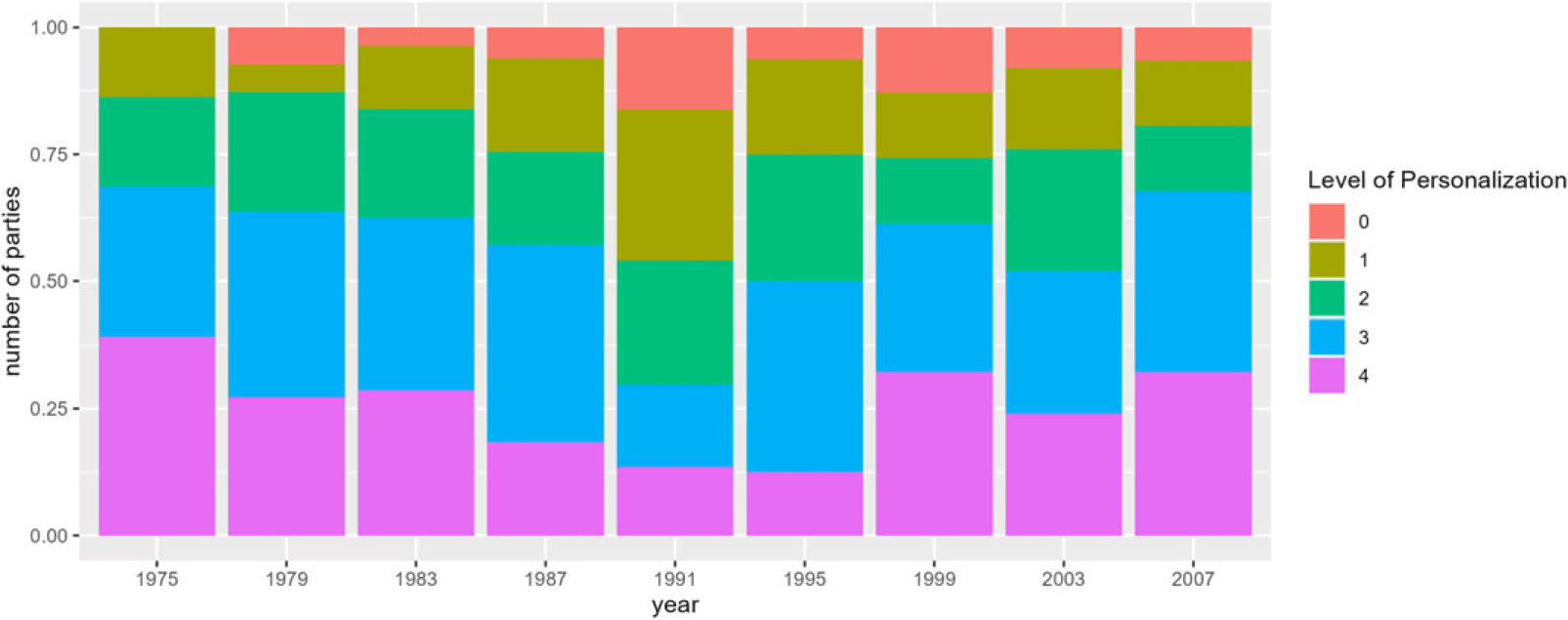
These arguments explain only a tiny handful of authoritarian party building situations from three perspectives. First, the above-mentioned theories imply that only parties equipped with well-developed institutions can contribute to regime longevity. Some statistical studies support the correlation between party strength and regime longevity (Geddes, Reference Geddes2003; Reuter, Reference Reuter2022; Kavasoglu, Reference Kavasoglu2022). Figure 1 shows that the majority of authoritarian ruling parties in almost all periods sorely or mainly focused on the personal will and priorities of one individual party leader. What did leaders expect from these parties?
Personalisation of authoritarian ruling parties. The vertical axis shows the proportion of authoritarian ruling parties with various levels of personalisation. I code parties that have more than 50% of seats in national legislatures in non-democratic countries as ‘authoritarian ruling parties’. The number of seats each party has is based on the V-Party dataset (Lührmann et al., Reference Lührmann, Düpont and Higashijima2020). The regime classification relies on the Autocratic Regimes dataset (Geddes et al., Reference Geddes, Wright and Frantz2014). The level of party personalisation is based on the four-degree assessment of the V-Party. (Lührmann et al., Reference Lührmann, Düpont and Higashijima2020): 0: The party is not focused on the personal will and priorities of one individual leader. 1: The party is occasionally focused on the personal will and priorities of one individual party leader. 2: The party is somewhat focused on the personal will and priorities of one individual party leader. 3: The party is mainly focused on the personal will and priorities of one individual party leader. 4: The party is solely focused on the personal will and priorities of one individual party leader.
Second, the existing theories imply that ruling parties are created by leaders who face serious power-sharing problems. Meng (Reference Meng2019) formally shows that executive constraints created by weak leaders have a regime-stabilising effect. If so, why do some strong leaders create institutions, including ruling parties? Indeed, there are stronger leaders equipped with ruling parties and weaker leaders without parties. The comparison between two post-Communist leaders, Boris Yeltsin and Eduard Shevardnadze, is illustrative. When Shevardnadze was appointed to the second president of Georgia, he was in a strong position relative to elites. As the former first secretary of the Georgian Communist Party, he enjoyed a broad network and a high authority among traditional Georgian elites. In public politics, there was no politician who rivaled him in popularity. On the other hand, the first president of Russia, Boris Yeltsin, was weak vis-à-vis elites throughout his presidency. Unlike Shevardnadze, Yeltsin had not expanded either a personal network or authority among traditional elites before the independence because he had not occupied a federal-level post in the Soviet communist party. Despite this contrast, Shevardnadze founded a ruling party, while Yeltsin did not.
Furthermore, some empirical studies imply that even the presence of institutionally strong parties does not correlate with regime longevity. While replicating the above-mentioned statistical analysis of Geddes (Reference Geddes2003), Smith (Reference Smith2005) elucidates that that result is driven by two outliers: Mexico and the Soviet Union. After eliminating these parties from his dataset, he shows that the effect of ruling parties loses its statistical significance. Meng (Reference Meng2021) shows that many ruling parties that have been coded as strong ones are unable to survive the death or departure of the founding leader. These empirical analyses cast fundamental doubt on a leader’s motivation for party building.
In order to explain the broader range of authoritarian party building, this paper argues that even less institutionalised ruling parties that are created by strong leaders can resolve or alleviate the power-sharing problem, even if the parties collapse for a short period. Before formalising my arguments, I informally summarise three main points in the rest of this section.
2.1. Function of ruling parties
First, like existing works, I argue that authoritarian leaders create ruling parties to stabilise their regimes. Essentially, my theory builds on Meng (Reference Meng2019). She formalises that quasi-democratic institutions resolve the power-sharing problem by changing the underlying distribution of power between leaders and elites in favour of the latter. She also argues that executive constraint is necessary to manipulate this power balance. Leaders can empower elites by appointing them to high posts in the executive branches, such as a vice-president, a defence minister, and a prime minister.
While agreeing with her first insight, I put forth that the parties’ control over parliaments also empowers ruling elites. As Figure 2 shows, in almost all ruling parties, national or regional party leadership (i.e., an executive committee) collectively decides which candidates will run for the party in national legislative elections. In other words, there are only a few parties where their party leaders unilaterally decide on which candidates will run (Lührmann et al., Reference Lührmann, Düpont and Higashijima2020).
Candidate nomination of authoritarian ruling parties. The vertical axis shows the proportion of authoritarian ruling parties with various levels of personalisation. I coded as ‘authoritarian ruling parties’ ones that have more than 50% of seats in national legislature in non-democratic countries. The number of seats each party has is based on the V-Party dataset (Lührmann et al., Reference Lührmann, Düpont and Higashijima2020). The regime classification relies on the Autocratic Regimes dataset (Geddes et al., Reference Geddes, Wright and Frantz2014). The level of party personalisation is based on the four-degree assessment of the V-Party. (Lührmann et al., Reference Lührmann, Düpont and Higashijima2020): 0: The party leader unilaterally decides on which candidates will run for the party in national legislative elections. 1: The national party leadership (i.e., an executive committee) collectively decides which candidates will run for the party in national legislative elections. 2: Delegates of local/regional organisations decide which candidates will run for the party in national legislative elections. 3: All party members decide on which candidates will run for the party in national legislative elections in primaries/caucuses. 4: All registered voters decide on which candidates will run for the party in national legislative elections in primaries/caucuses. No authoritarian ruling party has Score 4.

Elites who are appointed as members of the parties’ executive committee can invite their personal friends to parliament through their candidate lists, which enables elites to build their network and support base in political communities. Compared with the ministership of defence or finance, the seats in the parties’ executive committee give only little power to the elite. But it has a significant effect especially for weak elites, who lack political experience and networks, which increases their probability of defeating the leader. Building a party organisation increases posts in the ruling coalition, which makes it easier for leaders to delegate power. This argument is consistent with the result of Reuter’s (2022) statistical analysis, according to which the collective candidate nomination system correlates with regime longevity.
2.2. Party building of strong leaders
The second point is that even strong leaders have an incentive to found a ruling party. All existing theories that are mentioned in the last section deal with a highly closed political regime, assuming that if an elite (he) defects a leader (she) and fails to overthrow her,Footnote 5 then he loses everything (Meng, Reference Meng2019; Paine, Reference Paine2021, Reference Paine2022; Little and Paine, Reference Little and Paine2024). This assumption is relevant to the cases of highly closed authoritarian regimes such as North Korea, Chile under Augusto Pinochet, and today’s China.
As I show below, there are more ‘tolerant’ authoritarian regimes, where elites who failed in defection are allowed to consume benefits. I term this benefit a ‘loser’s share’. Intuitively, the elite who can defeat the leader with a high probability may consume the large loser’s share, and vice versa. Its scale is also determined by the following regime-specific factors such as state capacity, regime centralisation, and feature of elites:
State capacity: Some authoritarian regimes are too fragmented and weak to monopolise political control. Those leaders lack the capability to engage in ‘bad’ behaviour, such as repressing opposition, stealing elections, or shutting down democratic institutions. In post-Soviet countries, for instance, the sudden disappearance of the Communist Party left succeeding governments with highly limited law enforcement powers (Levitsky & Way, Reference Levitsky and Way2012; Hale, Reference Hale2005). New leaders such as Leonid Kuchma in Ukraine could not punish opponents. Leaders’ personality and political culture also influence repressiveness (See Way, Reference Way2015; Hale, Reference Hale2014).
Regime centralisation: The extent to which political power is centralised on a national executive head (e.g., presidents in presidential countries, kings in monarchy, and prime ministers under parliamentary constitutions) significantly influences the loser’s share of the regime. Suppose political power is dispersed among other agencies such as the national executive, parliament, and publicly elected governors. Then, an elite who failed to defeat the leader consumes benefits from a parliamentary seat or mayorship even after being ousted from the central government if he has enough popularity to obtain the position. Under premier-presidential systems, these elites may even have the opportunity to win the premiership and organise a cabinet (Elgie, Reference Elgie2007). In contrast, when the national leader allocates all political and economic resources in the country, defectors are eliminated from all lucrative posts.
Feature of elites: The power resource of potential defectors also matters. Consider the case of an elite who is exerting so significant political influence as an army general that he will defeat a president with a high probability. However, if the position granted by the president is his only power resource, he will be ousted from the army and lose everything. This is the case even in highly tolerant dictatorships (see Woldense, Reference Woldense2022). A case describing a clear contrast is when a leading elite group is business elites. If a political regime is less repressive, such elites keep economic wealth even after a failed rebellion. An illustrative example is a Ukrainian Oligarch, Yulia Tymoshenko. After entering politics as a pro-regime parliamentary deputy, she tried to impeach Kuchma in 1997. Even though Kuchma wanted to punish her through a state prosecutor, she was saved from prosecution by parliamentary immunity, which the legislature refused to lift. Kuchma could not even expropriate the vast amount of income that Tymoshenko had already accumulated. Much of her wealth is in foreign bank accounts outside Kuchma’s reach (Way, Reference Way2015). That means her loser’s share was high.
This paper will collectively refer to these factors as the ‘tolerance to losers’. Non-democratic regimes with low state abilities and decentralised political systems can be called tolerant to some elites, such as business elites. These regimes allow elites who defect from the leaders to consume much of the loser’s share. In contrast, non-democratic regimes characterised by high state ability and centralised political systems are intolerant to other elites, such as army generals.
The presence of a high loser share makes the leader-elite bargaining more difficult. As the loser’s share of elites becomes larger, a leader needs to make more offers to prevent their defection. The most challenging situation for leaders is when an elite is strong today but becomes weaker tomorrow. Given the above intuition, the periodical payoff of this elite will radically decline, especially when the regime is highly repressive and centralised.
2.3. Effect of authoritarian party building
The third point is that even if most authoritarian ruling parties end up short-lived, it may be misleading to conclude that these parties did not contribute to the regime’s durability. As Reuter (Reference Reuter2017) points out, strong ruling parties may be short-lived for reasons unrelated to their organisational capacity. If a short-lived regime with a ruling party had not created the party, the regime would have collapsed for a shorter period.
The next question is under which condition short-lived parties are created. Intuitively, such a party likely emerges when an elite is so ambitious that an inner-regime conflict is inevitable, and a leader is hesitant to fight with elites. In existing bargaining models between a leader and an elite, however, this condition unlikely holds because those models assume that the leader can abandon the entire regime income to the elite. This assumption enables the leader to buy off the elite no matter how ambitious he is. In an actual situation, it is hard to imagine a state leader giving over ‘everything’ to elites while keeping her position. Constitutional laws and customs disallow the leader to transfer some kinds of incumbency interests. One example is transferring an honourable title such as ‘president’ or ‘king’. State leaders are also granted official residences and opportunities for media exposure. In my model, the leader enjoys two benefits – divisible and indivisible. While the bargaining with the elite centres around the divisible part, the leader holds the entire indivisible part unless she is overthrown. To get the indivisible part, the elite must rebel and deprive the throne. As shown in the next section, this modification makes bargaining difficult because elites may not be satisfied even if the leader offers them the whole divisible benefit.
3. Alternative explanations
This paper explains authoritarian party building by focusing on its function to resolve or alleviate the power-sharing problem. Existing literature has also pointed out some other mechanisms through which ruling parties prolong the lifespan of authoritarian regimes. This section demonstrates that these functions do not sufficiently explain authoritarian party buildings.
The first argument focuses on parties’ mass organisation rather than elite-level institutions. A ruling party’s mass organisation helps authoritarianism penetrate society by expanding the regime’s presence at the grassroots, mobilising supporters, and gathering information (Reuter, Reference Reuter2022; Geddes et al., Reference Geddes, Wright and Frantz2018; Zeng, Reference Zeng2021).
Political party is not the only device for regimes to penetrate through society. Although all authoritarian leaders need support from the masses, only a part of them procure it through party organisations. In contrast, others rely on other forms of social organisation, including informal para-party entities (Handlin, Reference Handlin2016). Since his inauguration in 1994, the Belarussian dictator, Aleksandr Lukashenka, had never possessed a ruling party until 2023. The majority of parliamentary seats belonged to independents who were supporting Lukashenka (Hall, Reference Hall2023). Instead of a formal party organisation, Lukashenka relied on civil society organisations to govern the society (Astapova et al., Reference Astapova, Navumau, Nizhnikau and Polishchuk2022). Why do some leaders create parties while others do not?
Second, some scholars argue that less institutionalised ruling parties empower state leaders at the expense of elites, thereby establishing personalist rule (e.g., Slater, Reference Slater2003; Frantz et al., Reference Frantz, Kendall-Taylor, Nietsche and Wright2021). Geddes et al. (Reference Geddes, Wright and Frantz2018) theoretically explain leaders’ motivation to establish less-institutionalised parties. After leaders achieve power by force, their positions depend on the support of military officers, which is volatile. To concentrate power at their expense, the leader creates a ruling party stuffed with civilian supporters.
Yet not all less institutionalised ruling parties are created by leaders who are frightened by armed supporters. In the post-Soviet space, some leaders created ruling parties while others did not. Since the Soviet era, military officers have been traditionally politically less active. How should we explain this diversity?
4. Theoretical model
We use a two-period bargaining game ( $t = 1,2$
) in which an incumbent (she) and an elite (he) divide the regime income, normalised to size 1 in each period. In the first period, the incumbent offers
$t = 1,2$
) in which an incumbent (she) and an elite (he) divide the regime income, normalised to size 1 in each period. In the first period, the incumbent offers ${x_1} \in \left[ {0,1} \right]$
to the elite, who can then accept or reject it. If the elite accepts within that period, then
${x_1} \in \left[ {0,1} \right]$
to the elite, who can then accept or reject it. If the elite accepts within that period, then $1 - {x_1}$
remains under the incumbent’s control, and the regime survives peacefully. In addition to the divisible pie, the incumbent also receives the benefit of incumbency,
$1 - {x_1}$
remains under the incumbent’s control, and the regime survives peacefully. In addition to the divisible pie, the incumbent also receives the benefit of incumbency, $b$
, which is indivisible. The payoff for the elite and the incumbent in Period 1 is
$b$
, which is indivisible. The payoff for the elite and the incumbent in Period 1 is ${x_1}$
and
${x_1}$
and $1 - {x_1} + b$
, respectively. The game continues into the second period, and the incumbent makes a new offer,
$1 - {x_1} + b$
, respectively. The game continues into the second period, and the incumbent makes a new offer, ${x_2} \in \left[ {0,1} \right]$
. We assume that the invisible benefit is smaller than the divisible one,
${x_2} \in \left[ {0,1} \right]$
. We assume that the invisible benefit is smaller than the divisible one, $b \in \left( {0,1} \right)$
.
$b \in \left( {0,1} \right)$
.
The model assumes that failure of bargaining entails conflict over the benefit from incumbency, $1 + b$
. However, fighting is costly and destroys a fraction of the regime’s income (Meng, Reference Meng2019). If conflict occurs, it shrinks to
$1 + b$
. However, fighting is costly and destroys a fraction of the regime’s income (Meng, Reference Meng2019). If conflict occurs, it shrinks to ${\rm{\sigma }} + b$
, where
${\rm{\sigma }} + b$
, where ${\rm{\sigma }} \in \left[ {0,1} \right).\;$
The elite wins with probability
${\rm{\sigma }} \in \left[ {0,1} \right).\;$
The elite wins with probability ${p_t}$
, and the incumbent wins with probability
${p_t}$
, and the incumbent wins with probability $1 - {p_t}$
. Since
$1 - {p_t}$
. Since ${p_t}$
is proportionate,
${p_t}$
is proportionate, ${p_t} \in \left[ {0,1} \right]$
. In the case of ‘Elite Win’, the elite monopolises the regime income
${p_t} \in \left[ {0,1} \right]$
. In the case of ‘Elite Win’, the elite monopolises the regime income ${\rm{\sigma }} + b$
, and the incumbent loses all. In the case of an ‘Incumbent Win’, the elite is left with only
${\rm{\sigma }} + b$
, and the incumbent loses all. In the case of an ‘Incumbent Win’, the elite is left with only $k\left( {{p_t}} \right)$
, while the incumbent receives
$k\left( {{p_t}} \right)$
, while the incumbent receives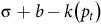 ${\rm{\sigma }} + b - k\left( {{p_t}} \right)$
. If fighting occurs in Period 1, both parties receive the same payoff in Period 2. The model assumes the strict convexity of
${\rm{\sigma }} + b - k\left( {{p_t}} \right)$
. If fighting occurs in Period 1, both parties receive the same payoff in Period 2. The model assumes the strict convexity of $k\left( {{p_t}} \right)$
in
$k\left( {{p_t}} \right)$
in ${p_t}$
. That means:
${p_t}$
. That means:
 $$k'\left( {{p_t}} \right) \gt 0$$
 $$k''\left( {{p_t}} \right) \lt 0$$
 $$\mathop {{{lim}} }\limits_{{p_t} \to 1} k\left( {{p_t}} \right) = \bar k \lt {\rm{\sigma }}$$
where $\bar k$
refers to the maximum payoff for the elite after the failed rebellion. The assumption
$\bar k$
refers to the maximum payoff for the elite after the failed rebellion. The assumption $\bar k \lt {\rm{\sigma }}$
is necessary because the definition of
$\bar k \lt {\rm{\sigma }}$
is necessary because the definition of $b$
disenables the elite from eroding it.
$b$
disenables the elite from eroding it.
At the start of the game, the incumbent decides whether to establish a ruling party. Ruling parties shift inner-regime power balance in favour of elite (Meng, Reference Meng2019). The degree of the elite empowerment by the party is denoted by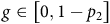 $g \in \left[ {0,1 - {p_2}} \right]$
. If the incumbent selects
$g \in \left[ {0,1 - {p_2}} \right]$
. If the incumbent selects $g$
, then Period 2’s distribution of power within the regime will be
$g$
, then Period 2’s distribution of power within the regime will be ${p_2} + g$
.
${p_2} + g$
.
The game proceeds as follows:
-
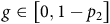
1. At the start of the game, the incumbent selects $g \in \left[ {0,1 - {p_2}} \right]$
, and the elite observes this choice.
$g \in \left[ {0,1 - {p_2}} \right]$
, and the elite observes this choice. -
2. The incumbent offers
${x_1} \in \left[ {0,1} \right]$
. -
3. The elite accepts or rejects the offer of
${x_1}$
.-
(a) If the elite rejects the offer, conflict occurs. If conflict occurs, then each player receives the payoff mentioned above, depending on the outcome in Period 1. Neither player engages in decision-making in Period 2, and the players receive the same amount of payoff as in Period 1.
-
(b) If the elite accepts the offer, then E receives
${x_1}$
, and A receives
$1 - {x_1} + b$
. The game moves on to the next decision-making step.
-
-
4. The incumbent offers
${x_2} \in \left[ {0,1} \right]$
. -
5. The elite accepts or rejects the offer of
${x_2}$
.-
(a) If the elite rejects the offer, conflict occurs. If conflict occurs, then each player receives the payoff mentioned previously, depending on the outcome in Period 2. Independent of the outcome, the players never lose their payoffs in Period 1:
${x_1}$
for the elite and
$1 - {x_1} + b$
for the incumbent. -
(b) If the elite accepts the offer, then the elite receives
${x_2}$
, and the incumbent receives
$1 - {x_2} + b$
in addition to the payoff they received in Period 1.
-


To avoid trivialities, we add one more assumption:
 $${\rm{\sigma }} + b \gt 1$$
Otherwise, no matter how strong the elite is, the leader can buy him off.
Since this model is a finite game of perfect information, the equilibrium solution concept is subgame perfect Nash equilibrium.
4.1. Discussion of assumptions
4.1.1 Elites’ relative strength
The concept of ‘elites’ ability to overthrow leaders’ denoted by $p$
derives from Meng (Reference Meng2019). Meng argues that it is equivalent to the power distribution between leaders and elites. It partly depends on elites’ position that bestows them material resources, power, and prestige, allowing them to consolidate their own bases of support. Meng also implies that the power balance is determined by leaders’ career. She labels that the Cameroonian president, Ahmadou Ahijo, as a weak leader because he was not a national independence hero. In contrast, the president of Cote d’Ivoire, Felix Houphouet-Boigny, is labelled as a ‘strong leader’. He was born into a family of hereditary chiefs of the Baoule´ group and became chief of the Akoue´ tribe through hereditary succession at a very young age. Then he organised one of the earliest independence organisations and gained high authority during the decolonisation process. Following Meng (Reference Meng2019), a lot of studies engage the same concept of the relative strength of elites into the core of their models (e.g., Paine, Reference Paine2021).
$p$
derives from Meng (Reference Meng2019). Meng argues that it is equivalent to the power distribution between leaders and elites. It partly depends on elites’ position that bestows them material resources, power, and prestige, allowing them to consolidate their own bases of support. Meng also implies that the power balance is determined by leaders’ career. She labels that the Cameroonian president, Ahmadou Ahijo, as a weak leader because he was not a national independence hero. In contrast, the president of Cote d’Ivoire, Felix Houphouet-Boigny, is labelled as a ‘strong leader’. He was born into a family of hereditary chiefs of the Baoule´ group and became chief of the Akoue´ tribe through hereditary succession at a very young age. Then he organised one of the earliest independence organisations and gained high authority during the decolonisation process. Following Meng (Reference Meng2019), a lot of studies engage the same concept of the relative strength of elites into the core of their models (e.g., Paine, Reference Paine2021).
4.1.2 Relationship between
$p$
and
$k$


The loser’s share increases in the relative strength of elites, so my model has denoted $k$
as a function of
$k$
as a function of ${p_t}$
. The slope of
${p_t}$
. The slope of $k\left( {{p_t}} \right)$
refers to the relationship between the elite’s strength and his loser share, which is determined, as argued in the second section, by the regime’s repressiveness, the position of elites, and the design of political system.
$k\left( {{p_t}} \right)$
refers to the relationship between the elite’s strength and his loser share, which is determined, as argued in the second section, by the regime’s repressiveness, the position of elites, and the design of political system.
Depending on these factors, even the elite with high ${p_t}$
consumes only few
${p_t}$
consumes only few $k\left( {{p_t}} \right)$
. Figure 3 demonstrates two examples. The above curve represents the case of a decentralised and tolerant regime. Even weak elites consume a high payoff after a failed rebellion. The maximum value of the loser’s share
$k\left( {{p_t}} \right)$
. Figure 3 demonstrates two examples. The above curve represents the case of a decentralised and tolerant regime. Even weak elites consume a high payoff after a failed rebellion. The maximum value of the loser’s share $\bar k$
is also high. The below curve, in contrast, represents a centralised and intolerant regime. Even strong (high
$\bar k$
is also high. The below curve, in contrast, represents a centralised and intolerant regime. Even strong (high $p$
) elites face poverty when they lose in a rebellion attempt.
$p$
) elites face poverty when they lose in a rebellion attempt.
Relationship between the elite’s strength and the loser’s share. The p-axis refers to the strength of elites in relative to leaders. The vertical axis refers to loser’s share of elites when their strength is ${p_t}$
.
${p_t}$
.

Recall the comparison between business elites and military elites in the second section. For a business elite, his probability of defeating the leader, ${p_t}$
, correlates with the amount of his wealth. If he fails to overthrow the leader for a short period, his fate depends on the regime tolerance. If the regime is highly repressive, then the leader deprives the businessperson of his whole wealth. His
${p_t}$
, correlates with the amount of his wealth. If he fails to overthrow the leader for a short period, his fate depends on the regime tolerance. If the regime is highly repressive, then the leader deprives the businessperson of his whole wealth. His $k\left( {{p_t}} \right)$
follows the below line in Figure 3. If the regime is more tolerant, then the elite keeps his fortune, even though he is ousted from the ruling coalition. This is the case of the above line in Figure 3.
$k\left( {{p_t}} \right)$
follows the below line in Figure 3. If the regime is more tolerant, then the elite keeps his fortune, even though he is ousted from the ruling coalition. This is the case of the above line in Figure 3.
Political centralisation also matters. Suppose an elite with high popularity among citizens, which assures him the high ability to defeat the leader (high ${p_t}$
). What happens to him when he defects from the regime and fails to defeat the leader? If a publicly elected governor or mayor is granted high authority, then he gains this post and consumes a high payoff (the above line in Figure 3). In contrast, if all political power concentrates on the national executive branch, he becomes just a ‘popular activist’ (the below line in Figure 3).
${p_t}$
). What happens to him when he defects from the regime and fails to defeat the leader? If a publicly elected governor or mayor is granted high authority, then he gains this post and consumes a high payoff (the above line in Figure 3). In contrast, if all political power concentrates on the national executive branch, he becomes just a ‘popular activist’ (the below line in Figure 3).
4.2. Negotiation without party
First, we analyse the case where the leader does not have the option of party building. As shown below, there is a condition under which an inner-regime conflict is inevitable, even though the leader wants to avoid it.
From the backward induction, we derive two lemmas on the leader’s ability to deter the elite defection.
4.2.1 Lemma 1
There exists a unique threshold ${\hat p_2}$
, such that the elite is deterrable in Period 2 if and only if
${\hat p_2}$
, such that the elite is deterrable in Period 2 if and only if ${p_2} \lt {\hat p_2}$
.
${p_2} \lt {\hat p_2}$
.
See the proof in Appendix.
4.2.2 Lemma 2
There exists a unique threshold ${\hat p_1}\left( {{p_2}} \right)$
, such that the elite is deterrable in Period 1 only if
${\hat p_1}\left( {{p_2}} \right)$
, such that the elite is deterrable in Period 1 only if ${p_1} \lt {\hat p_1}\left( {{p_2}} \right)$
. Also, this threshold strictly increases in
${p_1} \lt {\hat p_1}\left( {{p_2}} \right)$
. Also, this threshold strictly increases in ${p_2}$
. The threshold
${p_2}$
. The threshold ${\hat p_1}\left( {{p_2}} \right)$
is defined as the solution of the following equation:
${\hat p_1}\left( {{p_2}} \right)$
is defined as the solution of the following equation:
 $$2\left[ {\left( {b + \sigma } \right){p_1} + {\rm{k}}\left( {{p_1}} \right)\left( {1 - {p_1}} \right)} \right] - \left( {b + \sigma } \right){p_2} - k\left( {{p_2}} \right)\left( {1 - {p_2}} \right) = 0$$
See the proof in Appendix.
Lemma 1 and 2 both imply that the elite with lower ${p_t}$
is more likely deterrable in period
${p_t}$
is more likely deterrable in period $t$
. This argument is consistent with the intuition and conclusion of Meng (Reference Meng2019). At first glance, the increase of
$t$
. This argument is consistent with the intuition and conclusion of Meng (Reference Meng2019). At first glance, the increase of ${p_t}$
in my model seems to have a greater effect on deterrability than Meng’s model because my model not only raises the high
${p_t}$
in my model seems to have a greater effect on deterrability than Meng’s model because my model not only raises the high ${p_t}$
as the elite’s prospect for a successful rebellion but also increases the loser’s share, which makes it difficult for the leader to satisfy the elite.
${p_t}$
as the elite’s prospect for a successful rebellion but also increases the loser’s share, which makes it difficult for the leader to satisfy the elite.
As the following sections show, however, the effect of the increase in $k\left( {{p_t}} \right)$
is more nuanced. The second part of Lemma 2 implies that the elite is likely deterrable in Period 1 when they will become stronger. The logic is simply that high
$k\left( {{p_t}} \right)$
is more nuanced. The second part of Lemma 2 implies that the elite is likely deterrable in Period 1 when they will become stronger. The logic is simply that high ${p_2}$
guarantees a high payoff for the elite in Period 2, regardless of whether the leader buys him off in Period 2, which makes him think that holding off in Period 1, ‘Even if the leader only offers me a little at this moment, I will get a lot in the future, so let’s hold off for now’.
${p_2}$
guarantees a high payoff for the elite in Period 2, regardless of whether the leader buys him off in Period 2, which makes him think that holding off in Period 1, ‘Even if the leader only offers me a little at this moment, I will get a lot in the future, so let’s hold off for now’.
Even if the conditions of Lemmas 1 and 2 hold, the leader may not have incentive to deter the elite. In other words, the leader becomes ambitious and aggressive under a certain condition.
4.2.3 Proposition 3
In Period 2, the leader always prefers peace with the elite as long as it is possible. In Period 1, the leader always prefers peace, regardless of whether the elite is deterrable in Period 2.
See the proof in Appendix.
This proposition is a key element of this paper. The leader prefers to keep the alliance with the elite even if she knows they will fight later. At the first glance this argument may seem counterintuitive, but political leaders often form coalitions that clearly will not last. Proposition 3 implies that the formation of such a fragile coalition is rational for the leader.
4.3. Party building and its limitation
Suppose that ${p_1} \lt {\hat p_1}\left( {{p_2}} \right)$
such that the leader relies on party building to deter the elite. As argued above, this paper models the effect of party building following the idea of Meng (Reference Meng2019). By building a ruling party, the leader increases the future ability of the elite to defeat the leader.
${p_1} \lt {\hat p_1}\left( {{p_2}} \right)$
such that the leader relies on party building to deter the elite. As argued above, this paper models the effect of party building following the idea of Meng (Reference Meng2019). By building a ruling party, the leader increases the future ability of the elite to defeat the leader.
4.3.1 Proposition 4: authoritarian party building
-
a) There exists a threshold of
${p_1}$
,
${\bar p_1}$
, such that the leader prevents the elite from fighting if and only if
${p_1} \in \left( {{{\hat p}_1},{{\bar p}_1}} \right]$
. -
b) Self-destructive party building happens if and only if
${p_1} \gt {\hat p_2}$
.


See the proof in Appendix.
Informally saying, the ruling party is created when the leader is not too strong and not too weak. While this result is the same as Reuter (Reference Reuter2017), the mechanisms that bring this result are different. According to Reuter, too strong leaders do not create a ruling party because they can achieve many of their political goals without relying on the leader. There is the danger that elites will capture the state, but this frequently does not happen because elites face collective action and coordination problems among themselves (Reuter Reference Reuter2017). On the other hand, my model implies that the leader confronting the strong elite must be prepared to fight with him.
Now, we have three thresholds determining the equilibrium strategy: ${\hat p_2}$
,
${\hat p_2}$
, ${\hat p_1}$
, and
${\hat p_1}$
, and ${\bar p_1}$
.
${\bar p_1}$
.
4.3.2 Proposition 5: comparison of thresholds ${\hat p_1} \le {\hat p_2}$
if the elite is deterrable in Period 2,
${\hat p_1} \le {\hat p_2}$
if the elite is deterrable in Period 2, ${\hat p_1} \gt {\hat p_2}$
if the elite is deterrable in Period 2.
${\hat p_1} \gt {\hat p_2}$
if the elite is deterrable in Period 2. ${\hat p_2} \lt {\bar p_1}$
if and only if
${\hat p_2} \lt {\bar p_1}$
if and only if $1 \lt {\rm{\sigma }} + b$
.
$1 \lt {\rm{\sigma }} + b$
.
See the proof in Appendix.
Figure 4 graphically represents the equilibrium results. Logically, five equilibria can be assumed: (1) ‘Peace without Party’, whereby the leader does not establish a party, and conflict does not occur in either period. The aforementioned case of Lukashenka falls into this result. Some military dictatorships and dynasties also last for long years without ruling party. Muammar Gaddafi was, for instance, governing Libya without party from 1970 to 2011; (2) ‘Conflict in Period 1’, whereby the leader does not establish a party, and conflict occurs in Period 1. The first Ukrainian president, Leonid Kravchuk, had not joined any political party since the collapse of the Soviet Union. In the absence of the stable support base in parliament, he failed to be reelected in the 1994 presidential election; (3) ‘Conflict in Period 2’, whereby the leader does not establish a party, and conflict occurs in Period 2. Like Kravchuk, the first president of Kyrgyzstan, Askar Akaev did not join any political party, while he kept the presidency for longer than his Ukrainian colleague; (4) ‘Long-lived Party’, whereby the leader establishes a party, and conflict does not occur in either period. Its typical cases are the Partido Revolucionario Institucional in Mexico, the Chinese Communist Party; (5) ‘Short-lived Party’, whereby the leader establishes a party, but conflict occurs in Period 2. The above-mentioned self-destructive party building is included in the last category. Shevardnadze of Georgia falls into this category.
The most interesting outcome is the Short-lived Party. The leader may empower the elite by creating a party, even though she knows the empowered elite will be rebelling in the next period. This strange idea is justifiable because she knows the elite will be weaker tomorrow than today. Therefore, she tries to postpone the fight against the elite as much as possible.
4.4. Comparative statics: effect of regime tolerance and centralisation
We now turn our attention to the degree of the loser’s share. To simplify the argument, this section compares two cases: a tolerant and decentralised regime with ${k^h}\left( {{p_t}} \right)$
and an intolerant and centralised regime with
${k^h}\left( {{p_t}} \right)$
and an intolerant and centralised regime with ${k^l}\left( {{p_t}} \right)$
, such that
${k^l}\left( {{p_t}} \right)$
, such that ${k^h}\left( {{p_t}} \right) {k^l}\left( {{p_t}} \right)$
for all
${k^h}\left( {{p_t}} \right) {k^l}\left( {{p_t}} \right)$
for all ${p_t}$
(see Figure 3).
${p_t}$
(see Figure 3).
In order to assess the effect of $k\left( {{p_t}} \right)$
on
$k\left( {{p_t}} \right)$
on ${p_t}$
, let us consider
${p_t}$
, let us consider $k\left( {{p_t}} \right)$
exogenous from
$k\left( {{p_t}} \right)$
exogenous from ${p_t}$
. That means, we ignore that
${p_t}$
. That means, we ignore that $k$
is the function of
$k$
is the function of ${p_t}$
and denote the solutions of Equation (2) by
${p_t}$
and denote the solutions of Equation (2) by $\left( {{{\hat p}_2},{k_{{{\hat p}_2}}}} \right)$
.
$\left( {{{\hat p}_2},{k_{{{\hat p}_2}}}} \right)$
.
That means,
 $$\left( {{\rm{\sigma }} + b} \right){\hat p_2}{ + k_{{{\hat p}_2}}}\left( {1 - {{\hat p}_2}} \right) - 1 = 0$$
Implicitly differentiation gives
 $${{\partial {{\hat p}_2}} \over {\partial {k_{{{\hat p}_2}}}}} = {{ - \left( {1 - {{\hat p}_2}} \right)} \over {\sigma + b - {k_{{{\hat p}_2}}}}} \lt 0$$
whose inequation follows from the assumption ${\rm{\sigma }} + b \gt \bar k$
. This implies that when the loser’s share is large (high
${\rm{\sigma }} + b \gt \bar k$
. This implies that when the loser’s share is large (high ${k_{{{\hat p}_2}}}$
), the threshold
${k_{{{\hat p}_2}}}$
), the threshold ${\hat p_2}$
becomes lower.
${\hat p_2}$
becomes lower.
The same way can be applied to the thresholds in Period 1. Let us ignore that $k$
is the function of
$k$
is the function of ${p_t}$
and denote the solutions of Equation (3) by
${p_t}$
and denote the solutions of Equation (3) by $\left( {{{\hat p}_1},{k_{{{\hat p}_1}}},{k_{{{\hat p}_2}}}} \right)$
:
$\left( {{{\hat p}_1},{k_{{{\hat p}_1}}},{k_{{{\hat p}_2}}}} \right)$
:
 $$2\left( {{\rm{\sigma }} + b} \right){\hat p_1} + 2{k_{{{\hat p}_1}}}\left( {1 - {{\hat p}_1}} \right) - \left( {{\rm{\sigma }} + b} \right){p_2} - {k_{{{\hat p}_2}}}\left( {1 - {p_2}} \right) - 1 = 0$$
Implicitly differentiation gives
 $$2{{\partial {{\hat p}_1}} \over {\partial {k_{{{\hat p}_1}}}}}\left[ {\left( {\sigma + b} \right) - {k_{{{\hat p}_1}}}} \right] = 2{\hat p_1} - 2 + {{\partial {k_{{{\hat p}_2}}}} \over {\partial {k_{{{\hat p}_1}}}}}\left( {1 - {p_2}} \right)$$
When ${{\partial {k_{{{\hat p}_2}}}} \over {\partial {k_{{{\hat p}_1}}}}}$
is sufficiently large,
${{\partial {k_{{{\hat p}_2}}}} \over {\partial {k_{{{\hat p}_1}}}}}$
is sufficiently large, ${{\partial {{\hat p}_1}} \over {\partial {k_{{{\hat p}_1}}}}}$
is positive. Consider two arbitrary solutions of Equation (3),
${{\partial {{\hat p}_1}} \over {\partial {k_{{{\hat p}_1}}}}}$
is positive. Consider two arbitrary solutions of Equation (3), $\left( {\tilde p_1^1,\tilde k_1^1\left( {\tilde p_1^1} \right)} \right)$
and
$\left( {\tilde p_1^1,\tilde k_1^1\left( {\tilde p_1^1} \right)} \right)$
and $\left( {\tilde p_1^2,\tilde k_1^2\left( {\tilde p_1^2} \right)} \right)$
, such that
$\left( {\tilde p_1^2,\tilde k_1^2\left( {\tilde p_1^2} \right)} \right)$
, such that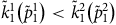 $\tilde k_1^1\left( {\tilde p_1^1} \right) \lt \tilde k_1^2\left( {\tilde p_1^2} \right)$
. Then,
$\tilde k_1^1\left( {\tilde p_1^1} \right) \lt \tilde k_1^2\left( {\tilde p_1^2} \right)$
. Then, $\tilde p_1^1 \gt \tilde p_1^2$
always holds, which implies the below proposition.
$\tilde p_1^1 \gt \tilde p_1^2$
always holds, which implies the below proposition.
4.4.1 Proposition 6
Suppose ${{\partial {k_{{{\hat p}_2}}}} \over {\partial {k_{{{\hat p}_1}}}}}$
is sufficiently large. The elite becomes easier for the leader to buy off in Period 1 as the regime becomes friendly to the elite who loses.
${{\partial {k_{{{\hat p}_2}}}} \over {\partial {k_{{{\hat p}_1}}}}}$
is sufficiently large. The elite becomes easier for the leader to buy off in Period 1 as the regime becomes friendly to the elite who loses.
Low repressiveness and decentralisation have a subtle effect on the authoritarian negotiation. On the one hand, they increase the loser’s share in Period 1, which makes it difficult for the leader to buy off the elite. On the other hand, since this model assumes that the repressiveness and the decentralisation does not vary among time, they also increase the loser’s share in Period 2. As of Period 1 the elite knows that he will consume a high payoff in the future if he remains in the regime. Thus, the leader can readily buy off the elite in Period two. In contrast, if the regime is highly repressive and centralised, then the elite becomes more resolved in Period 1 because he know that he will consume only few loser’s share in Period 2.
The Appendix shows the relationship between curve $k\left( {{p_t}} \right)$
and other thresholds. Figure 5 compares the thresholds determining equilibrium outcomes between regimes with the high loser’s share and the low one. This figure has several implications. First, when the loser’s share is large, even a relatively strong elite is deterrable in Period 1, while even a relatively weak elite is undeterrable. Second, suppose that
$k\left( {{p_t}} \right)$
and other thresholds. Figure 5 compares the thresholds determining equilibrium outcomes between regimes with the high loser’s share and the low one. This figure has several implications. First, when the loser’s share is large, even a relatively strong elite is deterrable in Period 1, while even a relatively weak elite is undeterrable. Second, suppose that $k\left( {{{\hat p}_2}} \right)$
and
$k\left( {{{\hat p}_2}} \right)$
and $k\left( {{{\bar p}_1}} \right)$
increase by the same degree. Formally,
$k\left( {{{\bar p}_1}} \right)$
increase by the same degree. Formally,
 $${k^h}\left( {{{\hat p}_2}} \right) - {k^l}\left( {{{\hat p}_2}} \right) = {k^h}\left( {{{\bar p}_1}} \right) - {k^l}\left( {{{\bar p}_1}} \right) = {\rm{\delta }}$$
Equilibria and elite’s initial strength. (a) Case of ${p_2} \le {\hat p_2}$
. (b) Case of
${p_2} \le {\hat p_2}$
. (b) Case of ${p_2} \gt {\hat p_2}$
.
${p_2} \gt {\hat p_2}$
.

Effect of the loser’s share on equilibria. (a) When the loser’s share is large, ${k^h}\left( {{p_t}} \right)$
. The arrows represent the change of the thresholds when the loser’s share increases. (b) When the loser is small,
${k^h}\left( {{p_t}} \right)$
. The arrows represent the change of the thresholds when the loser’s share increases. (b) When the loser is small, ${k^l}\left( {{p_t}} \right)$
. The arrows represent the change of the thresholds when the loser’s share decreases.
${k^l}\left( {{p_t}} \right)$
. The arrows represent the change of the thresholds when the loser’s share decreases.

Then, the decrease in the loser’s share does not change the width of the self-destructive party building but shifts it to the right.
4.4.2 Discussion
Let us go back to the initial question of this paper: why do some stronger leaders create ruling parties while weaker ones do not? My model reveals two patterns that make this possible. First, the weak leader is too weak to deter elites, even by creating a ruling party. Such a leader falls into the region ‘Conflict in Period 1’, while the stronger leader falls into the ‘Short-lived Party’ or ‘Long-lived Party’ regions. Second, the weak leader heads a regime that is decentralised and tolerant towards the potential defector and, thus, guarantees a high loser’s share, ${k^h}\left( {{p_t}} \right)$
. In this case, the regions of ‘Conflict in Period 2’ and ‘Peace’ swallow up the relatively weak leader (See Figure 5a). The relatively strong leader who permits only little loser’s share
${k^h}\left( {{p_t}} \right)$
. In this case, the regions of ‘Conflict in Period 2’ and ‘Peace’ swallow up the relatively weak leader (See Figure 5a). The relatively strong leader who permits only little loser’s share ${k^l}\left( {{p_t}} \right)$
falls into the region of either ‘Long-lived Party’ or ‘Short-lived Party’ because the threshold
${k^l}\left( {{p_t}} \right)$
falls into the region of either ‘Long-lived Party’ or ‘Short-lived Party’ because the threshold ${\hat p_1}$
is low (see Figure 5b).
${\hat p_1}$
is low (see Figure 5b).
It should be reemphasised that the word ‘strength’ in this paper means the probability of a player winning in a conflict when it happens. Thus, a leader constrained by a decentralised political system and unwilling to punish a defector can be ‘strong’.Footnote
6
Some existing models consider that these features mean the leader’s weakness. Based on this broader comprehension, the leader’s strength has a subtle effect on the outcome. While ${p_1}$
decreases, the threshold for party building,
${p_1}$
decreases, the threshold for party building, ${\hat p_1}$
, also decreases. However, since my model centres on the rebellion occurrence, it is intuitive to simply define the odds of the leader winning as her strength.
${\hat p_1}$
, also decreases. However, since my model centres on the rebellion occurrence, it is intuitive to simply define the odds of the leader winning as her strength.
5. Shevardnadze vs. Yeltsin
The penultimate section is devoted to comparative case studies of Georgia and Russia to illustrate two theoretical insights from the above sections. First, my model implies that even strong leaders build ruling parties to resolve or alleviate the power-sharing problem, especially when a loser’s share is low. One aim of this section is to show that Shevardnadze, the second president of Georgia, founded his ruling party, the CUG, even though he was strong relative to his elites. However, ‘strength’ is a relative concept. The word ‘a strong leader’ always means a leader who is stronger than other leader(s). I juxtapose Shevardnadze with Yeltsin as a weak leader who did not create a ruling party. This contrast can be explained by the difference in political systems: Georgia was more centralised than Russia.
Second, even less institutionalised ruling parties can resolve or alleviate the power-sharing problem. The CUG was not equipped with organisational mechanisms that are argued to alleviate the commitment problem by existing theories. However, the CUG prolonged the regime’s lifespan in a way that the existing literature has not pointed out. The case study section illustrates that the CUG played this function by delegating candidate selection power to elites. The CUG did not have control over the executive branch, although it occupied the parliamentary majority. Nevertheless, the party’s secretary general, Zurab Zhvania, extended his bargaining power by intervening in the party’s candidate selection process, which finally also helped him defeat Shevardnadze in 2004.Footnote 7
5.1. Shevardnadze
Shevardnadze came to power as a weak leader in March 1992. Following the ousting of Georgia’s first president, Zviad Gamsakhurdia, in a military coup, the politically inexperienced coup plotters decided to recall Shevardnadze. Crucial decisions were taken by the coup leaders, while Shevardnadze’s position was initially more symbolic than real (Wheatley, Reference Wheatley2005: 70).
By the autumn of 1993, Shevardnadze succeeded in concentrating real political power by eliminating strong warlords (Wheatley, Reference Wheatley2005: 68). Shevardnadze dissolved their private military forces and deprived them of official positions in government. Several factors led to the success of Shevardnadze’s power concentration. First, during the Soviet era, Shevardnadze had governed Georgian as the first secretary of the Georgian Communist Party. The personal network and authority he had stuck during the communist era enabled him to rely on his former colleagues who were exerting formal and informal power even after the independence. Second, Georgia experienced two consecutive civil wars in South Ossetia and Abkhazia. In this crisis of the state, the Georgian population pinned hopes for Shevardnadze, who embodied stability and domestic peace (Jones, Reference Jones2012: 90). High reputation and network in both Russia and Western countries also contributed to his power concentration.
Interestingly, Shevardnadze created a new ruling party after the concentration of power. He announced the formation of a new political party, and in November 1993, the CUG emerged as an amalgam of various social sectors that included former communists, intellectual elites from the Soviet era, and young political activists, as reflected in the initial party functionary list. Although he assumed the office of Party Chairman, Shevardnadze appointed Zurab Zhvania, who had been the leader of a minor political party before joining the CUG, as General Secretary.
For several reasons, it is hard to believe that Shevardnadze created this party to alleviate the commitment problem with a strong elite. First, unlike Yeltsin, Shevardnadze had never confronted an organised opposition party. While Shevardnadze won the status of interim state leader with 97.2% of the vote in the 1992 general elections, the same elections brought about a proliferation of parties. The effective number of parties reached 19.7%. Following the founding of the CUG in 1993, no party gained more seats than the CUG in any of the parliamentary elections prior to the Rose Revolution in 2003. The Communist Party of Georgia never recovered from its collapse in 1991.
Second, Shevardnadze delegated de facto party leadership to the weakest elite within his ruling coalition – Zhvania. Before joining the CUG, Zhvania led the Green Party, a small political party launched as part of an environmental movement during the Soviet era. Although the Green Party won 11 seats in the 1992 general elections, Zhvania had neither political experience nor an established patron–clientele network. He also lacked broad support from society. After becoming chairperson of the parliament and resigning as the General Secretary, Zhvania assumed the role of de facto party leader, wielding significant influence in the candidate selection process in elections (Furusawa, Reference Furusawa2022). The allies of Zhvania consecutively occupied the post of the General Secretary. Another prominent figure of the CUG was Mikheil Saakashvili. Although Saakashvili had no political experience prior to the 1995 parliamentary election, Zhvania and Shevardnadze invited him to join the parliament through the party’s proportional list, later appointing him as the head of the party’s parliamentary faction in 1998. Given the political inexperience and low visibility of the two young party leaders, it is unlikely that Shevardnadze faced an urgent commitment problem with the Zhvania group.
Another feature of this party building is that CUG lacked organisational mechanisms that are argued to alleviate the commitment problem argued by existing theories. It lacked both collective control of a broad range of resources and deliberative institutions (Kakachia and Lebanidze, Reference Kakachia and Lebanidze2016). While the two young party leaders enjoyed parliamentary control, their influence never reached the executive branches. Despite its success in the parliamentary elections in 1995 and 1999, the CUG remained no more than a part of Shevardnadze’s broad ruling coalition, which contained a number of ministers who were far more influential than Zhvania, such as Kakha Targamadze, Minister of Internal Affairs, and Vano Chkhartishvili, Minister of the Economy, who maintained their distance from the CUG leadership. Some of these ministers even belonged to parties other than the CUG. The regional governors and local mayors (Furusawa, Reference Furusawa2022) also controlled personal networks throughout their respective territories and significantly contributed to vote mobilisation for the CUG in every election, even though they were excluded from the party leadership in Tbilisi. The party, in turn, had no voice in the decision-making of regional and local administration (Furusawa, Reference Furusawa2022). Thus, the CUG never seized collective control outside the parliament, which meant that it could not guarantee future resource access to the broad range of elites.
The CUG in parliament and the power elites in the executive branches moved to overt confrontation when the CUG’s parliamentary faction launched an anti-corruption campaign in 1998. The main driver of the anti-corruption movement was the head of the party’s parliamentary faction, Mikheil Saakashvili. He and his allies in the CUG faction succeeded in forcing several ministers to resign. The appointment of Saakashvili as Minister of Justice intensified his attacks, even targeting Shevardnadze in some of his harsh criticisms. In 2001, Saakashvili resigned from his ministerial position and, at the same time, departed from the CUG to join a new opposition force, the National Movement. In that same year, Zhvania moved to another opposition faction in the parliament, the Democrats; 26 deputies followed him (Furusawa, Reference Furusawa2022). These developments provide compelling evidence that the CUG was not incapable of stabilising the regime; rather, its collapse led to the defeat of the regime as a whole. It lacked a collective decision-making system, a routinised promotion mechanism, or a deliberative system to mediate conflict (Brownlee, Reference Brownlee2007).
The case of Shevardnadze presents two deviations from existing theories, which can be explained by my model. First, this party building empowered the elites who were weak relative to the leader. My model implies that leaders can face a commitment problem even with weak elites in a highly centralised political system such as the Shevardnadze regime. In contrast to Yeltsin, Shevardnadze oversaw an extremely centralised administrative system that mandated that regional governors and mayors be appointed by the president. The constitution authorised few rights for minority parliamentarians, which meant that if the elites were to rebel against Shevardnadze and fail in their attempt, they would be removed from all prominent political positions. This cost was especially severe for elites without personal connections, like Zhvania. As Figure 5b shows, when $k\left( {{p_t}} \right)$
is low, the threshold for deterrence in Period 1
$k\left( {{p_t}} \right)$
is low, the threshold for deterrence in Period 1 ${\hat p_1}$
comes lower. Thus, even relatively weak elites become undeterrable.
${\hat p_1}$
comes lower. Thus, even relatively weak elites become undeterrable.
The second deviation from existing theories is that CUG was not equipped with organisational mechanisms that are argued to alleviate the commitment problem by existing theories. My model implies that the CUG actually did succeed in resolving the commitment problem, at least for a short period and in a rough way, rather than institutionalised mechanisms. The key point is that the benefits Zhvania gained from the CUG helped him defeat Shevardnadze. His first weapon was his significant influence over the candidate selection process. As de facto party leader, Zhvania invited a number of inexperienced young politicians to parliament, most of whom followed their patron when he broke with the party in 2002. His second weapon, granted to him by the CUG, was his enhanced reputation. His parliamentary posts and his flamboyant anti-corruption campaign in parliament allowed Zhvania and, more especially, Saakashvili to expand their personal popularity. Through mass media, they established a public image as ‘young reformers’ struggling with the ‘old communist nomenklatura’ in the executive branches. The latter group was depicted as corrupt, anti-democratic, and pro-Russian gangs. In contrast, the Zhvania group, whose members had played no political role during the Soviet era, were seen as the pro-Western standard-bearers of democracy. This image enabled them to mobilise large-scale anti-Shevardnadze demonstrations to overthrow the incumbent. The CUG increased the probability of the young elites defeating their former leader, as denoted by ${p_2}$
in the model.
${p_2}$
in the model.
This is the mechanism of the CUG through which Shevardnadze avoided the challenge of the Zhvania group during the first half of his presidency. Consider the calculation of Zhvania and Saakashvili during the initial period. From the founding of the CUG, Shevardnadze and the Zhvania group sought different policy directions. Zhvania was dissatisfied that Shevardnadze left the ‘old communist nomenklatura’ in important executive positions. Yet the Zhvania group was too weak to challenge Shevardnadze as an independent force during the initial years of the regime (low ${p_1}$
). The establishment of the CUG brightened their prospects, as they could expect that the parliamentary positions bestowed on them by the ruling party would enhance their bargaining power,
${p_1}$
). The establishment of the CUG brightened their prospects, as they could expect that the parliamentary positions bestowed on them by the ruling party would enhance their bargaining power, ${p_2} + g$
. Thus, it was a rational choice for them to remain in the regime for a time, waiting for their public reputation and support base within the regime until they were strong enough to successfully challenge and defeat Shevardnadze during his second presidential term, at which point they departed from the party. Such a rough power-sharing mechanism maximised the ruling coalition for a short term.
${p_2} + g$
. Thus, it was a rational choice for them to remain in the regime for a time, waiting for their public reputation and support base within the regime until they were strong enough to successfully challenge and defeat Shevardnadze during his second presidential term, at which point they departed from the party. Such a rough power-sharing mechanism maximised the ruling coalition for a short term.
5.3. Yeltsin
Russian polity in the 1990s is characterised by the weak, unstable position of President Yeltsin, as well as the presence of strong, autonomous elites. The combination of the legacy of a state-controlled economy and an orchestrated departure from it generated two major autonomous political actors. The first was the politicised financial-industrial groups that emerged from the rapid privatisation promoted by a biased media campaign for Yeltsin through TV channels and newspapers under their control while directly funding his election campaign (Hale, Reference Hale2005: 163). Yet, the economic elites did not exclusively support Yeltsin. The power balance between the businessmen and the state under Yeltsin was tipped in favour of the former (Sharafutdinova, Reference Sharafutdinova2010: 142), which enabled them to ‘hedge’ their bets and support opposition parties in the 1990s (Hale, Reference Hale2005: 163).
The second group was composed of regional governors who typically had the power to push for local institutional reform, including the privatisation process, in ways that worked to their advantage. This gave them the opportunity to build vast patron–clientele networks. They ignored central directives, gained de facto control over natural resources in their territories, and dictated policy in areas that were officially the realm of the central government (Levitsky and Way, Reference Levitsky and Way2012). By leaving regional companies in their hands, some governors were able to establish authoritarian control over their territory. Mayor Yury Luzhkov of Moscow is a typical example of such a governor who succeeded in building an autonomous regional power base. Although many regional elites were the former functionaries of the Soviet communist party, Yeltsin had not established a personal network with them during Soviet era because he had not occupied any post in Moscow (Hale, Reference Hale2003; Hale, Reference Hale2014).
As a result, Yeltsin faced more threats from both inside and outside the regime than Shevardnadze. While Shevardnadze came to power with 97.9% of votes in the 1992 general elections, Yeltsin gained 58.5% of votes in the first presidential election in 1991. Although the last Russian Supreme Soviet elections in 1990 gave Yeltsin a precarious majority, the collapse of the Soviet Union deprived his alliance of the common purpose that had united them. Radical economic reforms that were destroying the standard of living of the Russian populace led to a confrontation between Yeltsin and the parliament, which was settled by an attack on the latter in 1993. Two radical opposition parties, the Liberal Democratic Party of Russia and the Communist Party of the Russian Federation, attended the parliamentary elections of the same year. Yeltsin did not have sufficient personal popularity to confront the radical opposition alone; he needed to ally with the strong elites who exerted autonomous political power in both the political and economic spheres. In 1996, he was reelected as president, but he gained only 35.7% of votes in the first round.
Yeltsin’s alliance did not take the form of a sturdy ruling party. After the Communist Party was banned in 1991, President Yeltsin chose not to build a party. Although he was backed by several parties, Yeltsin did little to strengthen these organisations. Indeed, he often circumvented them, adopting a strategy of ‘enhancing his personal authority to the neglect of institution building’. Under Yeltsin, therefore, party scope and cohesion were low (Levitsky and Way, Reference Levitsky and Way2012).
His potentially unstable coalition ended with defections of prominent elites in his second presidency. Mayor Yury Luzhkov of Moscow and former Prime Minister Yevgenii Primakov, whom Yeltsin had sacked for political reasons (Hale, Reference Hale2014: 267), came together under the banner of a new opposition party, All Fatherland-Russia (OVR), which attracted a large number of other regional governors with strong election machines (McFaul and Colton, Reference McFaul and Colton2003).
Why did not Yeltsin anchor the elites through party building? Existing formal models (e.g., Meng Reference Meng2019; Little and Paine, Reference Little and Paine2024) predict that weak leaders like Yeltsin would establish a ruling party to protect themselves against both threats. However, Yeltsin had no monolithic supporting base in the parliament, and although some ruling party projects were launched by the Kremlin, none ever came top in the parliamentary elections. According to Reuter (Reference Reuter2017), the principal reason for this was that Yeltsin lacked initiative, and such failures were brought about by his lack of commitment and the reluctance of federal elites to coordinate within the nascent parties.
Our proposed model accounts for Yeltsin’s motivation. Figure 5a effectively portrays his regime – a regime that is highly decentralised and, thus, provides high $k\left( {{p_t}} \right)$
. As the regime becomes more vulnerable to outsiders and the polity becomes more tolerant of failed defectors, the interval for ‘Conflict in Period 2’ expands to the right. Thus, even for weak leaders whose
$k\left( {{p_t}} \right)$
. As the regime becomes more vulnerable to outsiders and the polity becomes more tolerant of failed defectors, the interval for ‘Conflict in Period 2’ expands to the right. Thus, even for weak leaders whose ${p_1}$
is relatively high, the optimal strategy would be to refrain from establishing a regime party and then confronting the elites.
${p_1}$
is relatively high, the optimal strategy would be to refrain from establishing a regime party and then confronting the elites.
6. Conclusion
Existing literature has explained authoritarian party building by pointing out its regime-stabilising effect. However, there is no clear consensus on what parties contribute to regime stability. This paper shows the broader range of authoritarian ruling parties prolongs the lifespan of regimes by resolving or alleviating the power-sharing problem. First, even less-institutionalised ruling parties stabilise power-sharing by granting elites candidate nomination power in parliamentary elections. As the Georgian case demonstrates, this power will increase the elites’ ability to defeat their leaders. Since the elites know it, elites, even if they are dissatisfied with their leaders, remain in regimes at least until their power increases. Second, even a leader whose power is strong vis-a-vis elites can suffer from the power-sharing problem. Especially when regimes are highly centralised and repressive, elites become ambitious even if they can defeat their leaders only at low odds. Third, even short-lived ruling parties alleviate the power-sharing problem. When leaders are hesitant to fight with elites, and their conflicts are inevitable, the leaders try to delay the conflicts rather than avoid them.
This paper has three limitations and implications for future research. First, the above conclusions do not claim that all ruling parties are created to resolve the power-sharing problem. Some scholars argue that some leaders create ruling parties to empower themselves at the expense of regime elites (Slater, Reference Slater2003; Geddes et al., Reference Geddes, Wright and Frantz2018; Isaacs & Whitmore, Reference Isaacs and Whitmore2014). It should be noted that these two functions of party building, the empowerment of leaders and the empowerment of elites, are not mutually exclusive concepts. Suppose that a leader is surrounded by two elites: a loyal one and a disloyal one. Then, appointing the loyal elite to a party leadership, the leader empowers not only the loyal elite but also herself vis-a-vis the disloyal elite. While this paper presents the two-player game, the game of bargaining among such three actors models a subtle effect of party building.
Second, party building is not the only device for power-sharing. Existing theories argue that authoritarian legislatures and constitutions also solve the power-sharing problem. Future studies should investigate under which conditions ruling parties are chosen as the commitment device.
Third, the implications of this model should be tested by statistical analysis. One key variable in my model is the power balance between leaders and elites, denoted by p. Although several cross-national analyses of authoritarian regimes have already focused on this variable, the measure of power balance remains underdeveloped. Testing my model empirically is a task for future research.
Supplementary material
The supplementary material for this article can be found at https://doi.org/10.1017/S1468109924000124


 Open access

