

Introduction
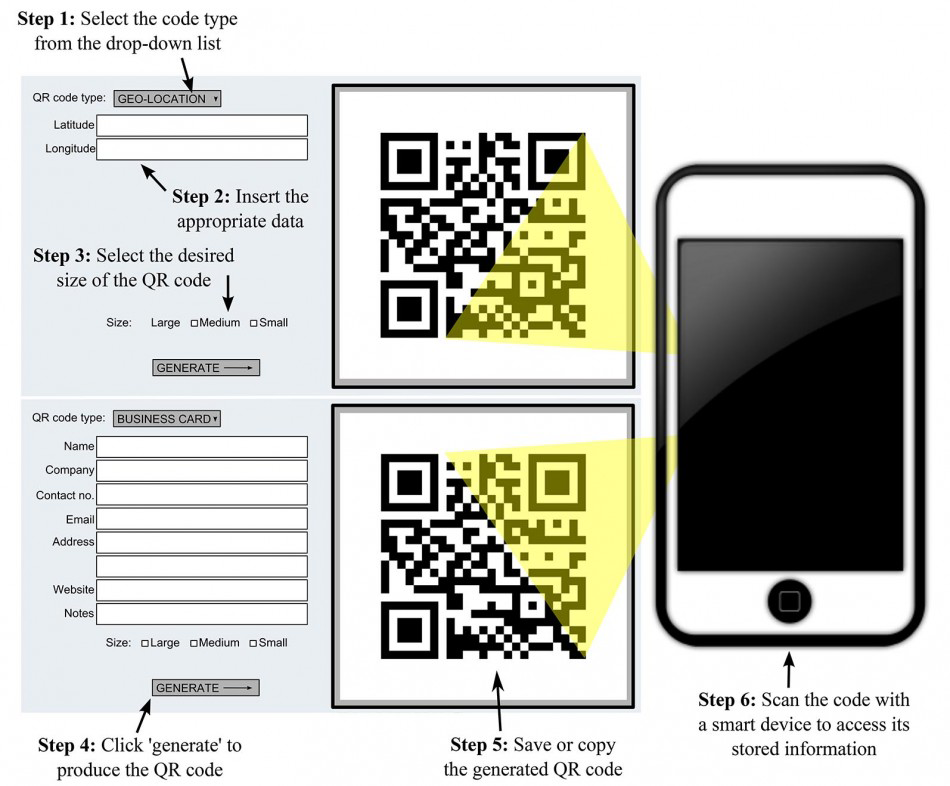
The production of QR Codes (based on https://zxing.appspot.com; accessed 19 November 2015): to create a QR Code, the type of code is selected (e.g. text, URL, geo-location) and the data tabs change accordingly; the required information is inserted and a QR Code is generated and displayed on the page.

Quick Response (QR) Codes are 2D, pixelated matrices that can be loaded or embedded with information. These codes can store contact details, text, GPS coordinates, URLs and other data, and can easily be created using an online QR Code generator via websites or applications; the required content type is selected and the relevant data or information is entered into the appropriate dialogue boxes. Clicking ‘Generate’ creates a unique QR Code that can then be inserted into documents, presentations and posters, or printed and used on site (Figure 1). QR Codes offer a number of attractive features: up to 7000 characters can be loaded into a single code (a barcode stores only 20); they are free to create; any smart device can read them; data are stored securely online; and they have 30 per cent error-correction capabilities, making them readable if damaged, impaired or obscured. These features make them useful tools for archaeologists and heritage practitioners.
Using QR Codes in archaeology
Perhaps the greatest advantage of QR Codes for the field archaeologist is their ability to store data safely online. When surveying, for example, codes can be generated to contain information on each site identified, including text and GPS coordinates. When the code is scanned, the viewer is able to access this information easily or view the location of the site through services such as GoogleEarth. During excavations, QR Codes can be loaded with data relating to loci or features, enabling field workers to access this information by scanning the code. They can also be used to tag artefact bags, storing data securely online, eliminating problems with hand-written labels and reducing other handling errors. Incorporating QR Codes into the fieldwork process provides a degree of reflexivity between the field worker and the archaeological finds, enhancing the role of the latter in the interpretive process (see Reference HodderHodder 1997). The effective use of QR Codes can also allow workers to follow the excavation process better and facilitate a robust field-recovery programme.
A major attraction of QR Codes for archaeologists is in the presentation of data or findings. Using QR Codes allows a reader, learner or viewer to interact with archaeological information and, further, to access additional data that might not generally be presented. For example, at a World War II memorial in Washington D.C., visitors can scan QR Codes to access historical records, online resources and radio broadcasts, such as Franklin Roosevelt’s ‘Day of Infamy’ speech (Compton et al. 2012). QR Codes have also been used to guide visitors through museum galleries, making use of their location-sensitive capabilities (Galani et al. 2013). In Northumberland, UK, the ‘Rock Art on Mobile Phones’ project has used QR Codes, amongst other technologies, at rock art sites to enhance visitors’ experiences by connecting them with additional online information (Mazel et al. 2012).
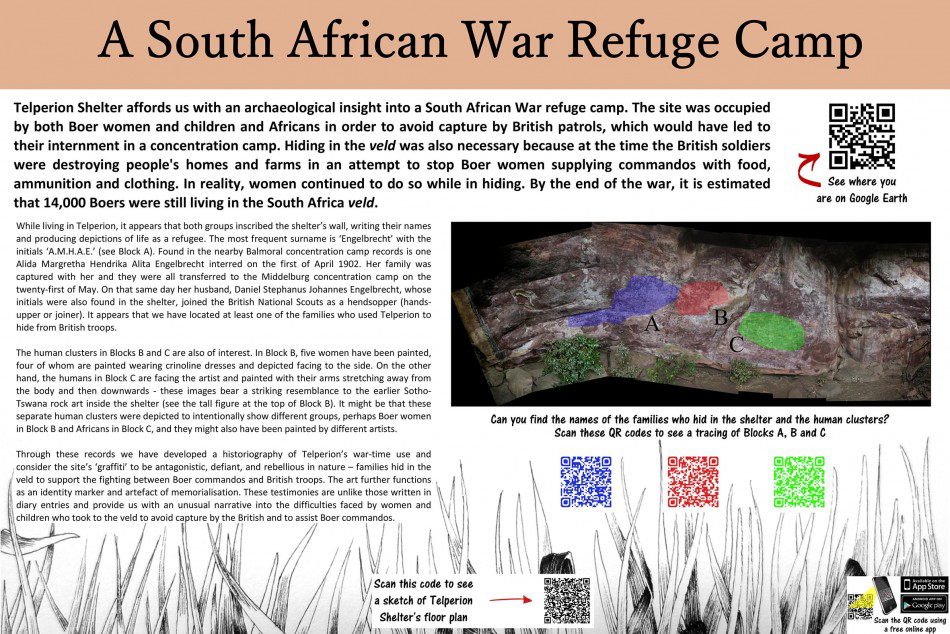
At Telperion Shelter, in South Africa’s Mpumalanga province, QR Codes are being used not only to assist with archaeological research at the site (Forssman et al. in press), but also to facilitate community engagement with the rock shelter. For example, QR Codes have been incorporated into information boards that will be displayed at the site, providing the viewer with a geographical location, a site diagram and tracings of the relevant panels described in the text (Figures 2 & 3). Ongoing work includes using QR Codes to provide text in different languages, including Afrikaans and Pedi (which are spoken locally), and linking people to video footage of archaeological work in progress at the site. Therefore, not only can the use of QR Codes connect viewers to otherwise under-utilised sources of information, it can also enrich access to the historical significance of the rock shelter for people with diverse backgrounds, interests and languages.
An information board for Telperion Shelter’s South African war-period graffiti.

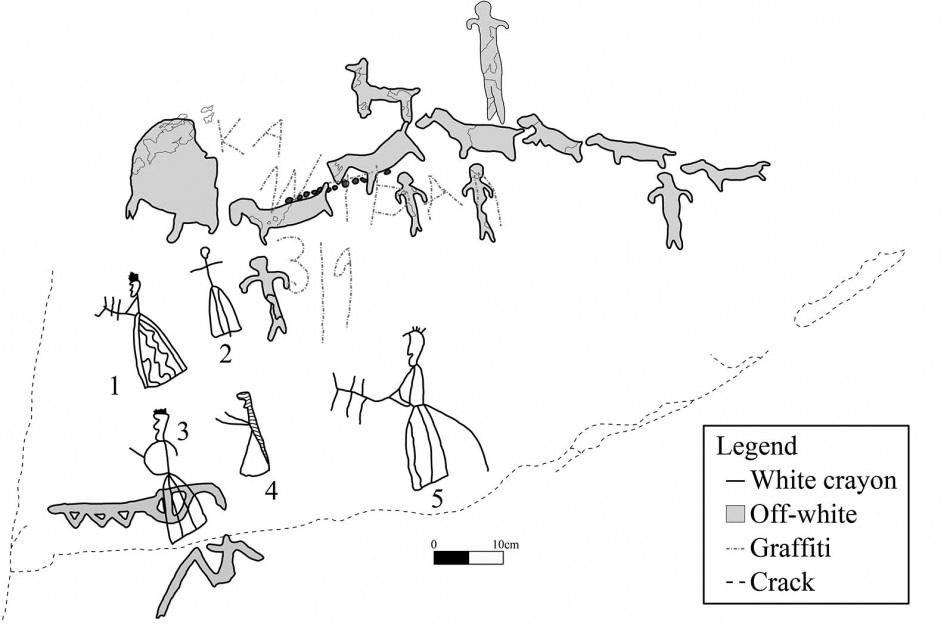
An example of content linked to a QR Code at the Telperion Shelter, South Africa: if, for example, the red QR Code in Figure 2 is scanned, this tracing of the figures in block B appears; figures 1–5 are thought to represent Boer women in crinoline dresses; all other figures are earlier Sotho-Tswana art.

Conclusion
QR Codes provide a means of improving the accessibility of archaeological discoveries as well as the amount of information that can be communicated to users. Using these coded matrices, it is possible to connect viewers with voice or video recordings, geospatial data, language translations, site data, contact information and additional explanations, diagrams and other source materials. Thus, QR Codes have the ability to develop the ways in which viewers, readers, learners, tourists and, importantly, communities engage with archaeological findings.
Acknowledgements
I wish to thank Jacqueline Jordaan, Kath Forssman, Gerhard Jordaan and Christian Louw for discussions pertaining to our ongoing research at Telperion Shelter and the use of QR Codes.