
Skip to main content Accessibility help
×
  • Cited by 1
    • Show more authors
    • Open Access
      You have digital access to this book
    • Select format
    • Publisher:
      Cambridge University Press
      Publication date:
      02 November 2023
      09 November 2023
      ISBN:
      9781009299985
      9781009299954
      9781009299961
      Creative Commons:
      Creative Common License - CC Creative Common License - BY Creative Common License - NC
      This content is Open Access and distributed under the terms of the Creative Commons Attribution licence CC-BY-NC 4.0.
      https://creativecommons.org/creativelicenses
      Dimensions:
      (229 x 152 mm)
      Weight & Pages:
      0.87kg, 542 Pages
      Dimensions:
      (229 x 152 mm)
      Weight & Pages:
      0.77kg, 534 Pages
    Open Access
    You have digital access to this book
    Selected: Digital
    View content
    Add to cart View cart Buy from Cambridge.org

    Book description

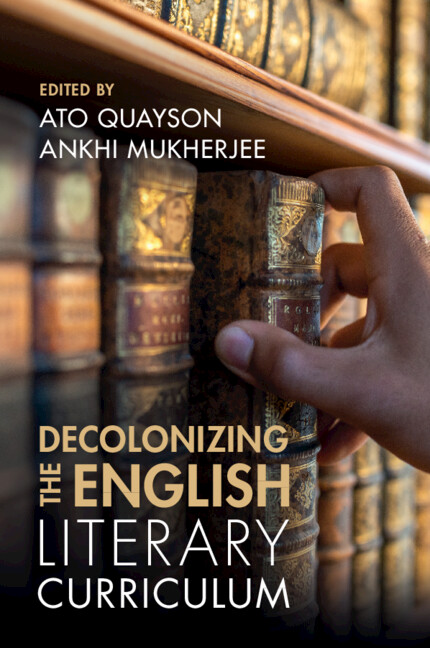
    George Floyd's death on May 25th 2020 marked a watershed in reactions to anti-Black racism in the United States and elsewhere. Intense demonstrations around the world followed. Within literary studies, the demonstrations accelerated the scrutiny of the literary curriculum, the need to diversify the curriculum, and the need to incorporate more Black writers. Decolonizing the English Literary Curriculum is a major collection that aims to address these issues from a global perspective. An international team of leading scholars illustrate the necessity and advantages of reform from specific decolonial perspectives, with evidence-based arguments from classroom contexts, as well as establishing new critical agendas. The significance of Decolonizing the English Literary Curriculum lies in the complete overhaul it proposes for the study of English literature. It reconnects English studies, the humanities, and the modern, international university to issues of racial and social justice. This book is also available as Open Access on Cambridge Core.

    Reviews

    ‘Broad in its geographical and historical scope and drawing on the expertise of scholars from all the continents, Decolonizing the English Literary Curriculum will be the primer for English literary studies for many years to come. The book stands out for its diversity of perspectives, its expansive understanding of different forms of decoloniality, and its range of critical references.’

    Simon Gikandi - Class of 1943 University Professor of English, Princeton University

    ‘Recommended.’

    L. Zhang Source: CHOICE

    Refine List

    Actions for selected content:

    Select all | Deselect all
    • View selected items
    • Export citations
    • Download PDF (zip)
    • Save to Kindle
    • Save to Dropbox
    • Save to Google Drive

    Save Search

    You can save your searches here and later view and run them again in "My saved searches".

    Please provide a title, maximum of 40 characters.
    ×

    Contents

    Full book PDF

    Page 1 of 2


    • Decolonizing the English Literary Curriculum
      pp i-ii
    • Decolonizing the English Literary Curriculum - Title page
      pp iii-iii
    • Copyright page
      pp iv-iv
    • Contents
      pp v-vii
    • Contributors
      pp viii-ix
    • Acknowledgments
      pp x-x
    • Introduction
      pp 1-20
    • Part I - Identities
      pp 21-146
    • Chapter 1 - Decolonizing the University
      pp 23-41
    • Chapter 2 - Decolonizing the English Department in Ireland
      pp 42-59
    • Chapter 4 - Decolonizing Literary Pedagogies in Australia and Aotearoa New Zealand
      pp 80-109
    • Chapter 5 - Genders, Sexualities, and Decolonial Methodologies
      pp 110-126
    • Chapter 6 - Black British Literature Decolonizing the Curriculum
      pp 127-146
    • Part II - Methodologies
      pp 147-280
    • Chapter 7 - Theories of Anthologizing and Decolonization
      pp 149-166
    • Chapter 8 - Confabulation as Decolonial Pedagogy in Singapore Literature
      pp 167-184
    • Chapter 9 - Marxism, Postcolonialism, and the Decolonization of Literary Studies
      pp 185-199
    • Chapter 10 - Against Ethnography
      pp 200-213
    • On Teaching Minority Literature
    • Chapter 13 - Reading for Justice
      pp 256-280
    • On the Pleasures and Pitfalls of a Decolonizing Pedagogy
    • Part III - Interdisciplinarity and Literary Studies
      pp 281-346
    • Chapter 14 - Literature, Human Rights Law, and the Return of Decolonization
      pp 283-299
    • Chapter 15 - Decolonizing Literary Interpretation through Disability
      pp 300-314
    • Chapter 16 - Decolonizing the Bible as Literature
      pp 315-330
    • Chapter 17 - Decolonizing Literature
      pp 331-346
    • A History of Medicine Perspective
    • Part IV - Canon Revisions
      pp 347-505
    • Chapter 18 - Decolonizing the Medieval Literary Curriculum
      pp 349-366
    • Chapter 19 - The Decolonial Imaginary of Borderlands Shakespeare
      pp 367-385

    Page 1 of 2


    Metrics

    Altmetric attention score

    Full text views

    Total number of HTML views: 0
    Total number of PDF views: 0 *
    Loading metrics...

    Book summary page views

    Total views: 0 *
    Loading metrics...

    * Views captured on Cambridge Core between #date#. This data will be updated every 24 hours.

    Usage data cannot currently be displayed.

    Accessibility standard: Unknown

    Why this information is here

    This section outlines the accessibility features of this content - including support for screen readers, full keyboard navigation and high-contrast display options. This may not be relevant for you.

    Accessibility Information

    Accessibility compliance for the HTML of this book is currently unknown and may be updated in the future.
