

Introduction
The early Neolithic in southwest Asia (c. 9700–6600 bc) presents several features of innovation, among them domestication, animal herding, crop cultivation and the emergence of the first large villages, which had a profound impact on the development of human–animal relationships and social interactions (Kuijt Reference Kuijt2000b; Watkins Reference Watkins2023). Ongoing research on the social developments that accompanied such key transitions is still trying to untangle the complex underlying dynamics, particularly the significance of symbolic and ritual production that richly developed in many Neolithic communities. Large, decorated monuments such as the T-shaped pillars of Göbekli Tepe (Schmidt Reference Schmidt and Wittwar2012), public buildings adorned with rich symbolic features found at Tell ‘Abr 3 in Syria (Yartah Reference Yartah2013) and mural depictions and installations visible at the Late Neolithic site of Çatalhöyük in Central Anatolia (Hodder Reference Hodder2011) are, while different, some of the evidence tied to unprecedented symbolic behaviours. Although the foraging-to-farming transition occurred at a different pace and varied from region to region (Özdoğan Reference Özdoğan, Matthiae, Pinnock, Nigro and Marchetti2010), the material culture shows a high degree of interconnections among distant communities since the early Neolithic phases (c. 9700‒6600 cal. bc), as evidenced by the trade of obsidian tools (Ibañez et al. Reference Ibáñez, Ortega, Campos, Khalidi and Méndez2015), personal adornments (Belfer-Cohen & Goring-Morris Reference Belfer-Cohen and Goring-Morris2024), skull treatments in mortuary rituals (Benz Reference Benz, Kienlin and Zimmermann2012) and similar stylistic traditions and ideas suggesting shared beliefs and mutual understanding between groups belonging to different cultural backgrounds (Mithen et al. Reference Mithen, Richardson and Finlayson2023).
The role of images and figurative objects (e.g. clay figurines) for this period has been the subject of several studies but no attempt has been made to associate specific instances of Neolithic imagery with the origins of graphic codes, although similar endeavours were pursued to interpret earlier Palaeolithic cave art (Bacon et al. Reference Bacon, Khatiri, Palmer, Freeth, Pettitt and Kentridge2023; Ferrara Reference Ferrara and Dalarun2023; Pettitt Reference Pettitt, Gaudzinski-Windheuser and Jöris2021; von Petzinger Reference von Petzinger2016). Previous research on Neolithic imagery has highlighted the pivotal role that symbols have had in shaping behavioural attitudes in the challenging transition from the hunting-gathering phase to farming (Cauvin Reference Cauvin2000). This has prompted research on key concepts around the idea of external symbolic storage (Watkins Reference Watkins2004), ritual and ideology (Verhoeven Reference Verhoeven2002), agency (Finlayson Reference Finlayson, Bolger and Maguire2010) and other cultural practices (Benz & Bauer Reference Benz and Bauer2013; Reference Benz and Bauer2021; Hodder & Meskell Reference Hodder and Meskell2011) adopted to manage the increasing social ties and shifting economies of Neolithic populations successfully. Recent work on the role of iconicity in relation to social behaviour has outlined the ‘ontological’ characters and cultural meanings that imagery may reflect (Fagan Reference Fagan2017; Hodder Reference Hodder2019; Reference Hodder2020), but no research, with the exception of a few sporadic observations (e.g. Morenz Reference Morenz2014; Reference Morenz2021), has set out to interpret symbols as part of a shared system of graphic codes, despite the archaeological indications on how growing networking practices put face-to-face relationships in Neolithic groups to the test (Coward & Dunbar Reference Coward, Dunbar, Dunbar, Gamble and Gowlett2014; Dunbar et al. Reference Dunbar, Gamble and Gowlett2014; Kuijt Reference Kuijt2000a).
In archaeology, traditional approaches to prehistoric symbolism often overlook the communicative potential of images, as Western research has strongly dichotomized graphic communication from symbolic art in prehistory, creating a somewhat artificial divide (Gelb Reference Gelb1963; Houston Reference Houston2004; Sampson Reference Sampson1985). Furthermore, semiotic studies that rely heavily on concepts such as linguistic signs, thus linking signs closely to language notation, have created an artificial division between words and images (Belting Reference Belting2011; Elkins Reference Elkins1999; Mitchell Reference Mitchell2015). Dichotomies are ineffective theoretical approaches to the interpretation of symbolism in the Neolithic (cf. Banning Reference Banning2011) and prevent an appraisal of the multifaceted sense of image production and their social significance in preliterate communities.
From this premise, here we posit that some iconographic and geometric shapes were created not so much to express a general cultural experience or understanding of the world, but rather as the result of long-range trajectories of code-making for specific and precise communicative purposes. In the first section we will introduce graphic communication in preliterate societies, in particular the concept of semasiography as applied to ancient visual art. As parallels, we will consider ethnographic examples from Amerindian cultures that best highlight semasiographic notations. Such conceptual framing will provide the basis for how to identify semasiography, namely a non-phonetic, but structured and coherent communication system made of graphic codes, as observable in preliterate contexts. In the second section, we will discuss specific image systems chronologically associated with the early Pre-Pottery Neolithic phases (c. 9700–8200 bc) found on monumental architecture from the Urfa region and on portable objects in the Levant and the highlands of southeastern Anatolia, from a novel perspective, which will pivot on the indication of a potentially shared and codified system of graphic communication aimed at conveying distinct, specific narratives and/or performance-based instructions.
Semasiography in ancient visual communication
Definitions of graphic notations, writing, code making and other systems of visual communication are still a matter of debate. Approaches to writing from a non-glottographic perspective (Boone Reference Boone and Houston2004; Englehardt Reference Englehardt2013; Ferrara Reference Ferrara and Portnowitz2022; Reference Ferrara and Dalarun2023; Mikulska & Offner Reference Mikulska and Offner2019) involve broader perspectives on what the definition implies, highlighting the aspects of writing that are not specifically tied to systematic phonographic notation (sound-sign) but as a multi-modal system that should encompass metalinguistic properties. Semasiography is an umbrella term covering a range of visual communication techniques, not intended to reflect specific language-dependent notations (Sampson Reference Sampson1985), but as a ‘conventionalized systems of visual notation arranged primarily around non-phonetic principles of ordering, whose overall meanings are derived from the spatial and/or performative relationships among the constituent elements’ (Jackson Reference Jackson and Englehardt2013, 22).
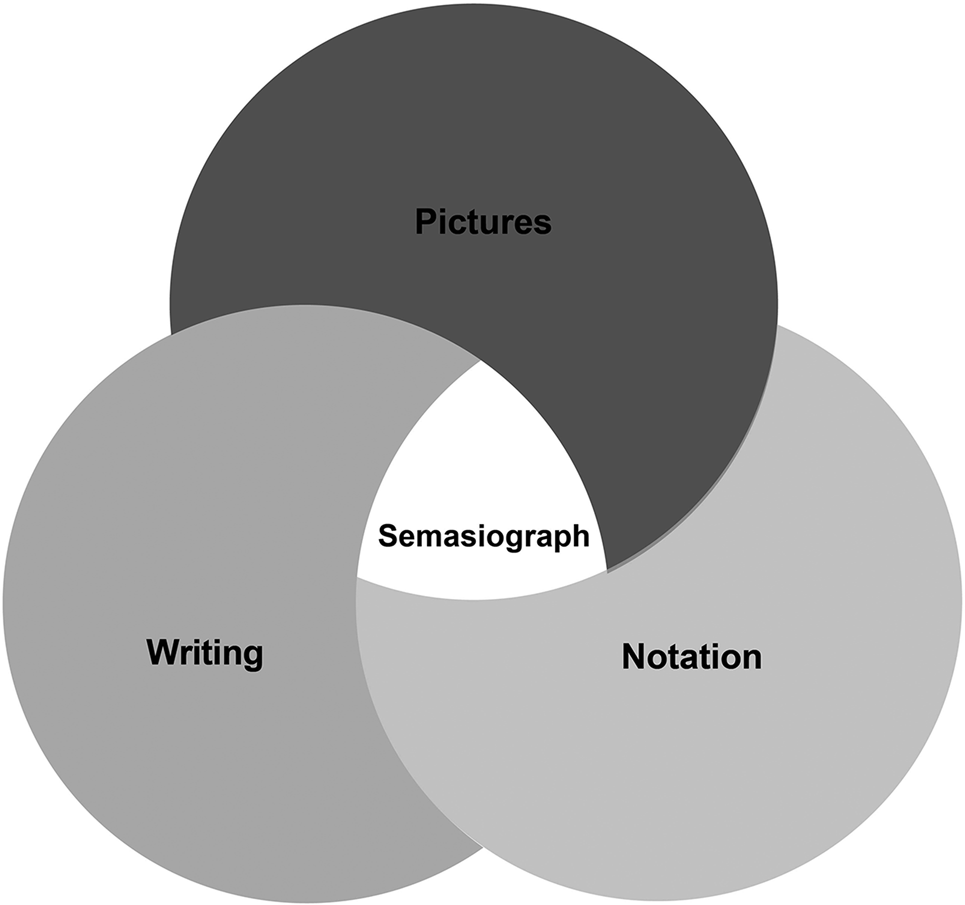
Such visual reproductions (as seen for example in road signs, mathematical and music notations) involve mental processes and related activities that do not necessarily depend on reproducing language notation or utterances and can, crucially, be understood meta-linguistically. Semasiographs reside in between the three visual communication nodes of writing, notation and pictures, within that grey zone where images, marks and operational systems interact with each other (Fig. 1). The three spheres can lie in a system of cross-overs, with some conceptual overlap. They can also co-exist in the same sphere, and defining their functional role can be difficult (e.g. an X can function as a letter of the alphabet as much as a semasiograph indicating voting or erasing).
The tripartite model of visual communication. (Modified after Jackson Reference Jackson and Englehardt2013, fig. 4.2.)
So, if tags for notation and iconography as symbolic behaviour are recognized systems of visual communication since Palaeolithic times (Pettitt Reference Pettitt, Gaudzinski-Windheuser and Jöris2021), and writing too, as a phonographic phenomenon, is attested since the beginning of the fourth millennium bc, semasiography, conversely, is still not clearly situated. A recent growing body of evidence from Amerindian cultures is introducing the role of semasiography (otherwise known as picture-writing) in the realm of ancient visual narratives (Boone Reference Boone and Houston2004; Déléage Reference Déléage2013). For instance, ethnographic evidence has shown that communities have often been able to record and transmit their oral traditions via figurative depictions. A famous example is the evidence from the Kuna indigenous people in Panama, which consists of a set of illustrations aimed at recalling ancient chants and reading them orally (Severi Reference Severi and Salvador1997). Their shamanic tradition is based on transmitting knowledge through images. Learners are taught to recognize single icons and associate them to specific meanings, such as locations or mythical beings, while memorizing ancient storylines orally transmitted by the teachers. The scenes of the ancient Kuna drawings can thus be interpreted with precision, and recitation of the ancient chants is executed by linking the icons, including their graphic variations, relative position and perspectives, in a meaningful way. This prompts the recognition of a standardized, conventional practice. Another similar example is known among the Western Apache in northern America. The Silas John prayers of the Apaches consist of a set of symbols that explicitly instruct the reader on ‘what to say’ or ‘what to do’, namely a recital of a specific prayer line or the performance of a ritual action (Basso Reference Basso1990, 39). Moreover, encoding communicative statements through figurative depictions has also been argued for the Australian aboriginal art that not only recalls ancient myths and stories, but also encourages religious belief and the observance of ethical rules and ritual practices (Morphy Reference Morphy1991).
If semasiographs are thus images that convey specific, conventional sets of meanings in close association, they also, at the same time, instruct specific performances, otherwise known as operational semasiographies (Jackson Reference Jackson and Englehardt2013). Unlike stand-alone emblems and symbols, semasiographs are created to mediate complex ideas and related actions. This is evident in the spatial distribution where lines, icons and visual frames set the stage for an integrated comprehension of visually transmitted messages. Such an approach has been applied to Pre-Columbian ancient art, by illustrating how calendrical grids displayed in Aztec divinatory practices are composed by semasiographic systems, through which the ‘reader’ can foresee events on certain days by matching figurative scenes displayed in the tables and charts (Boone Reference Boone and Houston2004, 337‒44). Also, Moche ceramics (c. 100–800 ad) from Peru show narratives of, for example, sacrifice ceremonies or warriors in battle, depicted in clusters and linked together by sign indicators (Jackson Reference Jackson and Englehardt2013). These ceramics, which were mainly used for ritual purposes, particularly for funerary offerings, are aimed at mediating and facilitating religious ceremonies. The objects themselves, through their visual cues, convey meta-textual meanings, enabling a precise and directed ritual performance. Indeed, materiality, in this regard, can play an important role in conveying meaning through engagement between users and objects (Malafouris & Renfrew Reference Malafouris and Renfrew2010).
The ethnographic examples of visual communication from the ancient cultures of the New World point in the direction of clear code-making and show the possibilities of fluid interfaces between writing, notational marks and pictures, and that the intersection of these realms generates a domain where semasiography can fit neatly. This potential of coded visual communication is very promising and deserving of attention, especially in relation to preliterate contexts of iconographic visual representations in southwest Asia during the Neolithic period in question. In this respect, the data provides an opportunity to examine preliterate symbolism from a novel perspective.
Tracing communicational codes in the early Neolithic
Identifying semasiographs in prehistoric contexts is inherently challenging as graphic codes are not isolated entities, but are often mixed up with other types of representations and possibly related to unclear performative actions. The interconnection of symbols, their significance and mediating function in transmitting knowledge must be framed within existing cultural practices and traditions of the Neolithic, much of which is unknown. However, semasiographic markings are identifiable in the archaeological record, providing important insights into Neolithic symbol-making experimentation and adaptation to the new ways of life we can reconstruct for the late hunter-gatherers and early agro-pastoralists of that period.
The key aspects that enable the recognition of code-making are multiple and adapted to the material and visual context. The main principle is based on the reproduction of salient images, namely unequivocal motifs that are easy to understand and can be combined, juxtaposed, extrapolated, and related to other visual outputs. Moreover, the combinatorial potential and the association of images in orderly visual spaces create defined sequences and syntaxes, and this is another key aspect that enables readers and audiences to see and understand the images at a glance, following a clear structured arrangement. Hence, the logical association of images, the selection of shapes, and the visual framework constitute the cornerstones of semasiographic notation. All these aspects and related modes of communication via material objects can be distinguished from general forms of art or simple stylistic choices and cultural expressions because the patterns of symbolic association that characterise semasiography are evident in multiple attestations, as it will be shown below. Recognizing the presence of communicational codes in prehistoric images has the potential to open a novel investigation of the above-illustrated types of semasiographies (e.g. operational, narrative) at play in the preliterate phases.
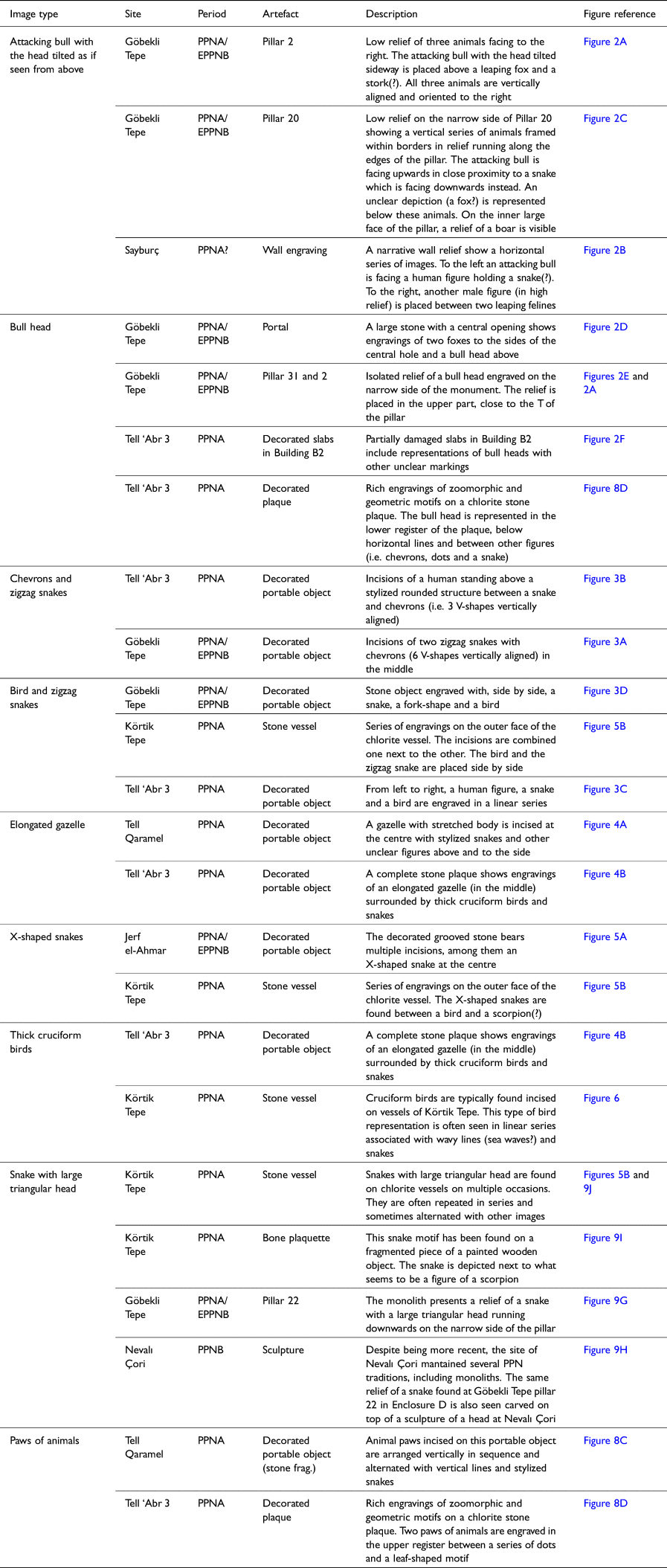
In the following sections we analyse distinct salient motifs from the early Neolithic, such as bull representations, depicted on monuments and portable objects. These examples are listed in Table 1. We highlight the patterns through which the selection, configuration and juxtaposition of such images are not simply haphazard or vague, or motivated by mere stylistic choices. Conversely, they follow arrangements that were likely made to encode specific meaning and coherent structuring. For the sake of consistency, we therefore consider evidence that belongs to the same archaeological horizon and the same geographical area. This is to mitigate any potential risk of corralling data through an indiscriminate method or by cherry-picking specific cases. It is important that the evidence be coherent and systematically analysed, especially considering the ambiguity and potential hermeneutical pitfalls inherent in interpreting images.
List of graphic motifs, their contextual details and description of visual frames (See Supplementary Appendix A for further details)
Narrative semasiographies on Neolithic monuments
Images displayed on large stone monuments are among the most puzzling symbolic practices of the Neolithic. Recent archaeological excavations at Sayburç and Karahantepe, and other sites in the Urfa region in southwestern Turkey have brought to light new extraordinary finds. The monuments unearthed at these sites show reliefs of wild animals in motion, such as those found at Göbekli Tepe (cf. Busacca Reference Busacca2017). It is yet to be understood why these animals are shown. At Sayburç, a wall relief shows a human figure in between two felids with open mouths placed next to figures of a squatting human holding a snake (or sling?) facing an attacking bull (Özdoğan Reference Özdoğan2022). Here, the emphasis on action is evident, and a possible apotropaic function can be recognized. Indeed, scenes of gnashing teeth and bull horns pointed towards humans are well known from the Neolithic image repertoire of the same period. The image of the attacking bull at Sayburç was stylistically dated to the early Neolithic, as the exact same depiction is seen in Pillar 2 in enclosure A and Pillar 20 in enclosure D at the site of Göbekli Tepe (Fig. 2).
Occurrences of bull depictions on monuments. (See Supplementary Appendix A for full image references and acknowledgements.)
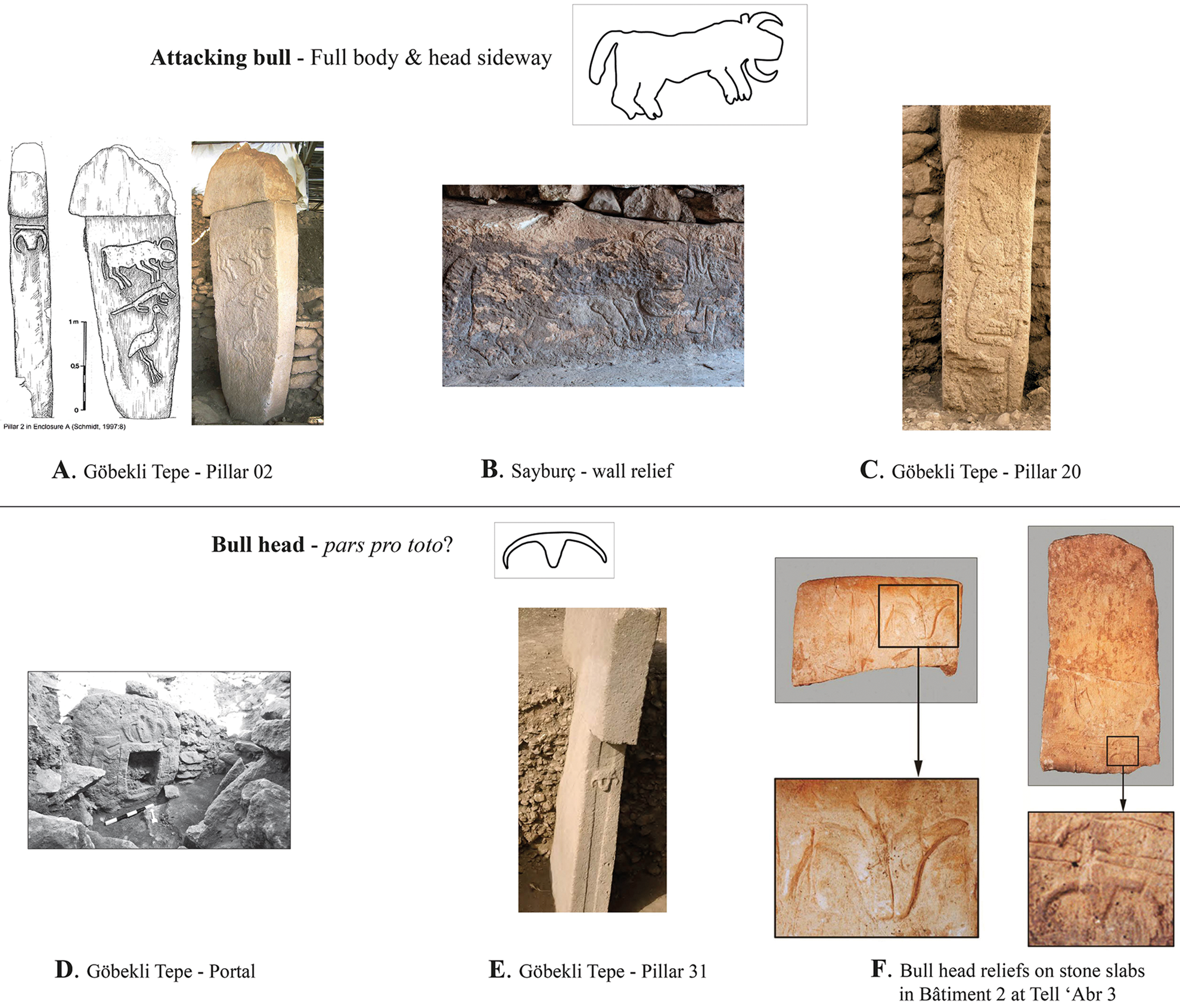
The rich symbolism of aurochs horns is widespread across the Neolithic of southwest Asia. Many architectural installations show bucrania decorating walls, benches, or platforms (e.g. Boncuklu: see Baird et al. Reference Baird, Fairbairn and Martin2017; Çayönü, see Erim-Özdoğan Reference Erim-Özdoğan, Özdoğan, Başgelen and Kuniholm2011; Dja'de: see Coqueugniot Reference Coqueugniot, Manen, Perrin and Guilaine2014). Bull horns are key symbolic figures among Neolithic populations and their images are found in varied archaeological contexts (Cauvin Reference Cauvin2000). At Göbekli Tepe, the depiction of a bull head with horns pointing downwards is seen in relief on the front, thinner side of the T-shaped pillars, with two foxes just above the rectangular edges of a stone portal between monumental buildings B and D (Fig. 2D‒E). The same images are embossed on slabs found in building B2 and also incised on a decorated plaque at Tell ‘Abr 3 (Yartah Reference Yartah2013, 140 and 167). On one slab, two icons are repeated one above the other similarly to the bucrania hanging on house walls at Çatalhöyük, while on the other slab the bull head is depicted next to an unidentified figure (Fig. 2F).
Very similar images in different visual contexts are likely not random but appear to have been created for a specific purpose. Dietrich and Wagner (Reference Dietrich and Wagner2023, 10) suggest that isolated animal depictions found on Göbekli Tepe's armless pillars ‘could be pars pro toto representations of the more complex scene’. They observe that foxes, usually found in scenes, are at times attested in isolation without any decorative embellishment. They could indeed be indicating a metonymic function, which becomes even more plausible if we analyse the contextual framework. In the mural scene at Sayburç the attacking bull is shown in front of a human figure (Fig. 2B), while the same image is placed above a fox on Pillar 02 (Fig. 2A) or facing a snake on Pillar 20 (Fig. 2C). Because of its extremely similar resemblance, the symbol of the attacking bull is undoubtedly recognizable and interchangeable to the extent that it can be juxtaposed to other figures. This could be functional to creating new specific compound meanings and/or attaching a particular metaphorical sense to the projected image.
This idea can be supported by considering ethnographic examples of semasiography. In the Kuna narratives, the representations of villages in the Demon's Chant appear as triangular tents (Severi Reference Severi and Salvador1997, fig. 8.7). Each of them presents different graphic variations. However, when ‘reading’ these drawings, the icons often refer to meanings related to the villages, such as spatial location or proper names, not the object itself (Severi Reference Severi and Salvador1997, 253‒4). What guides the reading of the Kuna composite drawings, in other words, is the combination and spatial arrangement of the different graphic elements (at times repeated, like the villages or jaguars in other Kuna drawings) and their correspondent verbalized meanings or actions.
Interpreting icons as semasiographs could be valid for the monumental imagery discussed here. The full body depiction of an attacking bull is situated in association with different icons and visual frameworks. Both full bodies or just the heads of the bulls are sometimes found on the thinner edge of the human-pillars of Göbekli Tepe (Fig. 2A, C, E), standing alone or jointly with other figures. Also, icons of foxes, snakes, boars and aquatic birds are handled in a similar way, having the exact same details displayed, such as gnashing teeth or paws drawn together in attack. Although the meaning of such alternating juxtapositions remains elusive, the fact the same icons are found in different sites and visual contexts may suggest that these figures might represent conventional graphic codes that, linked together within the same visual architecture, could be part of a narrative or embed distinct meanings or performative instructions that viewers were able to interpret.
Recording codes on portable objects
Portable objects, such as figurines, stone plaques and decorated shaft straighteners are recurrent small finds unearthed from prehistoric contexts such as those of the Neolithic. These, too, can contribute to the argument for code-making, even though interpreting their functions is difficult, since they can be taken as simple tools for everyday use or as symbolic items adopted in funerary rituals. Specifically, engraved plaquettes from early Neolithic contexts have been variably interpreted as, for example, possible shamanic ‘charms’ (Mithen Reference Mithen2022, 173‒4), or as personal identity markers (Baird et al. Reference Baird, Fairbairn and Martin2017, 770; Kodaş et al. Reference Kodaş, Yelözer, Çiftçi and Baysal2022).
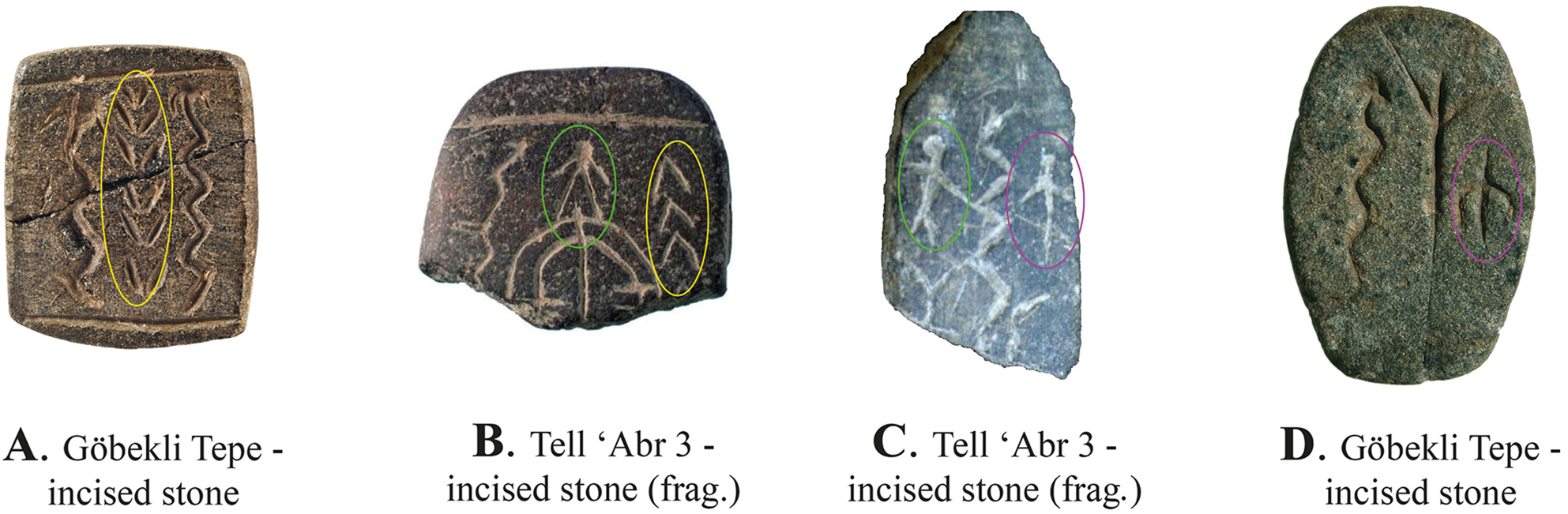
Simple geometric shapes engraved on portable objects together with realistic images are part of the Neolithic repertoire, and their orderly arrangement may represent examples of semasiography, perhaps a more ‘specialized’ type limited to a specific range of topics (cf. Morin Reference Morin2023, 6). Some interesting plaques and shaft straighteners from northern Levant and Upper Mesopotamia show patterns of iconographic elements. They show concatenations of images formed by ordered sets of symbols that are at times repeated and arranged in linear sequences. Plaques from Göbekli Tepe and Tell ‘Abr 3 display a clear sequence of stylized human figures, birds, snakes and V-shapes, which are engraved in sequential order (Fig. 3A‒D).
Sequences of concatenated images (snakes, chevrons, [birds?] and humans) displayed on stone objects with details circled.
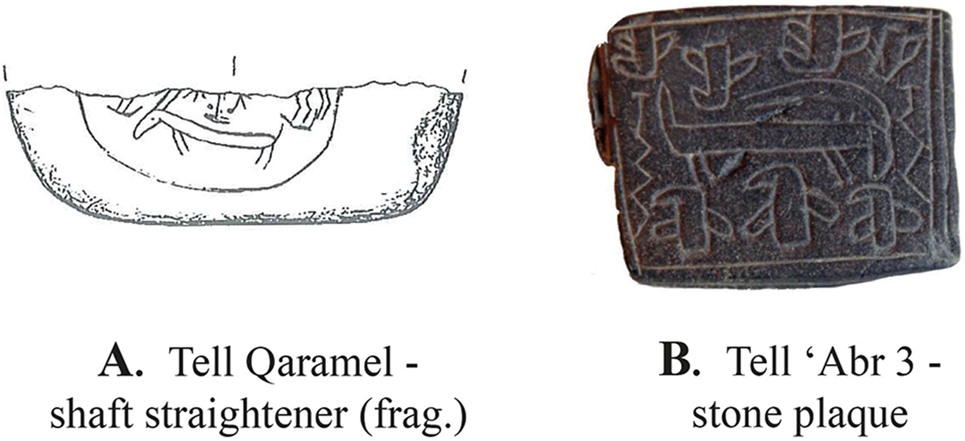
A bird–snake sequence is also visible on a decorated vessel at Körtik Tepe (Fig. 5B). The figures in these examples show how an orderly distribution of salient figures or iterated patterns is a key feature in creating a concatenated set of elements that can express a constructed and complex meaning. A further example is the engraved gazelle stretching its body on a shaft straightener at Tell Qaramel (Fig. 4A). This image is placed in between series of snakes and above other figures that are not visible because the object is fragmented. The same pattern of the gazelle with elongated body is present at Tell ‘Abr 3 (Fig. 4B) and again the quadruped is situated in between stylized snakes.
Salient figure of a gazelle with stretched body between stylized snakes.
Sequences of X-shaped snakes in composite figures (with details highlighted in red), birds, and other stylized animal figures.
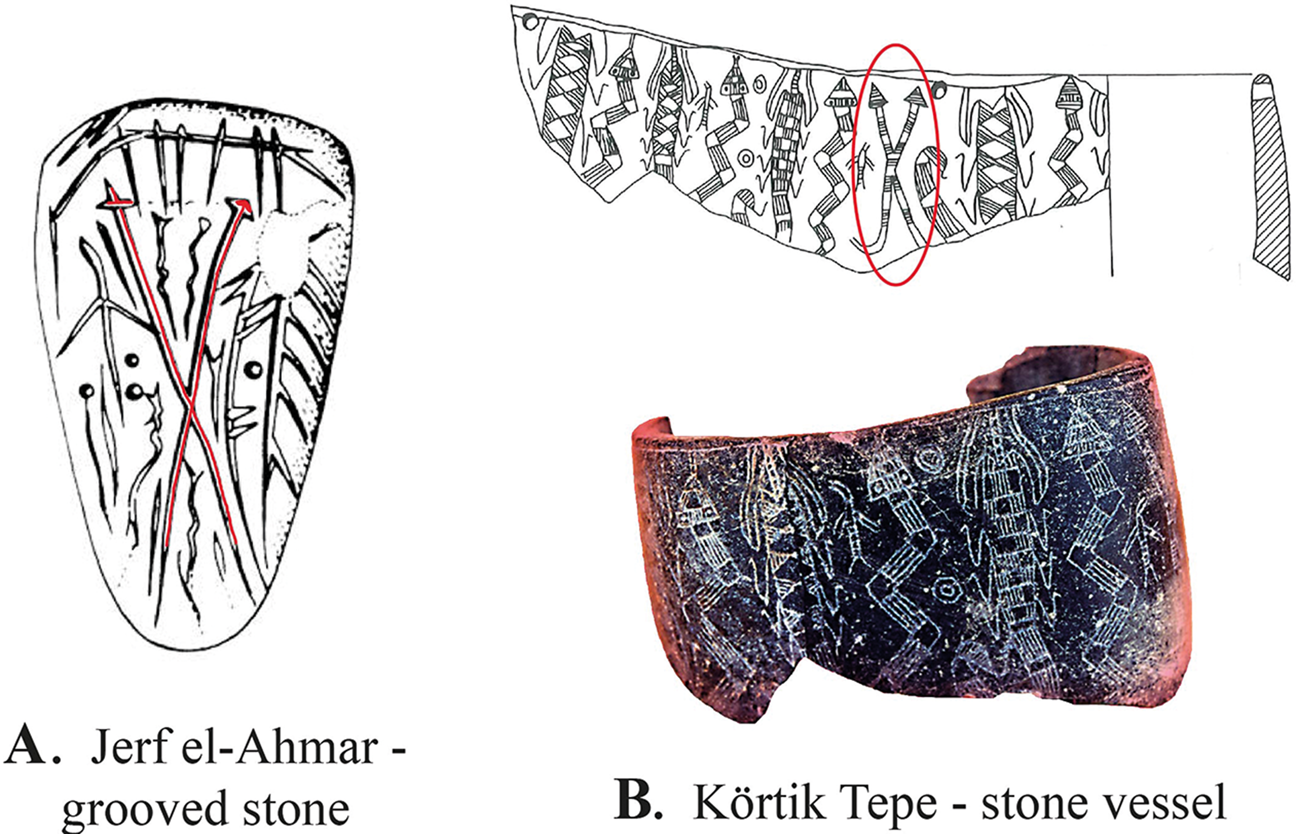
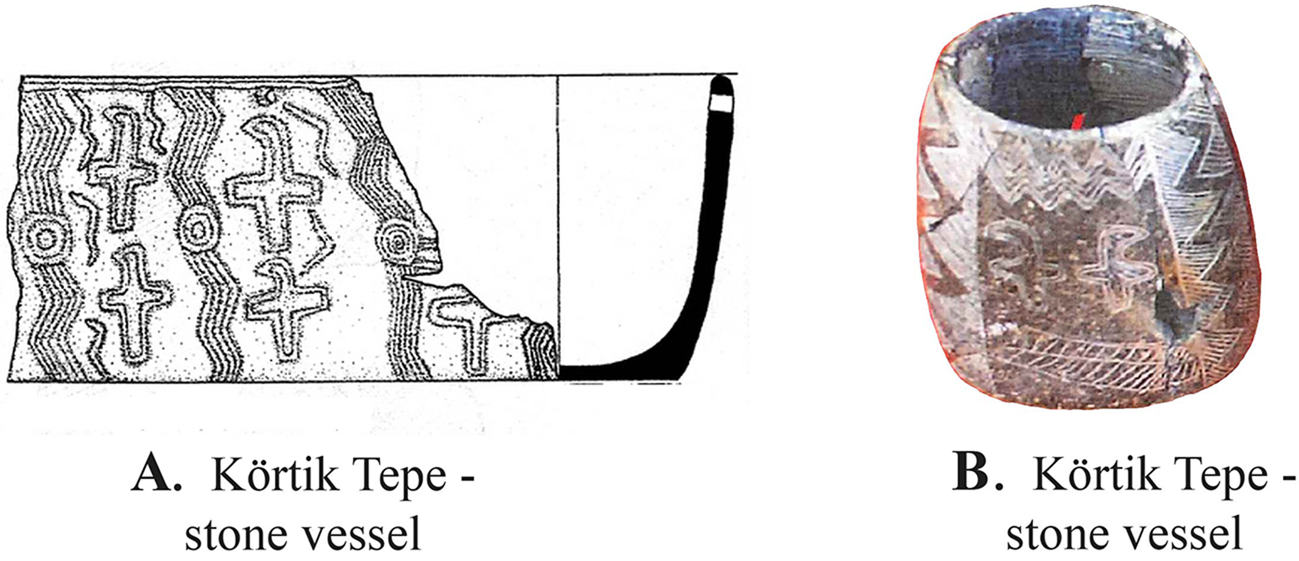
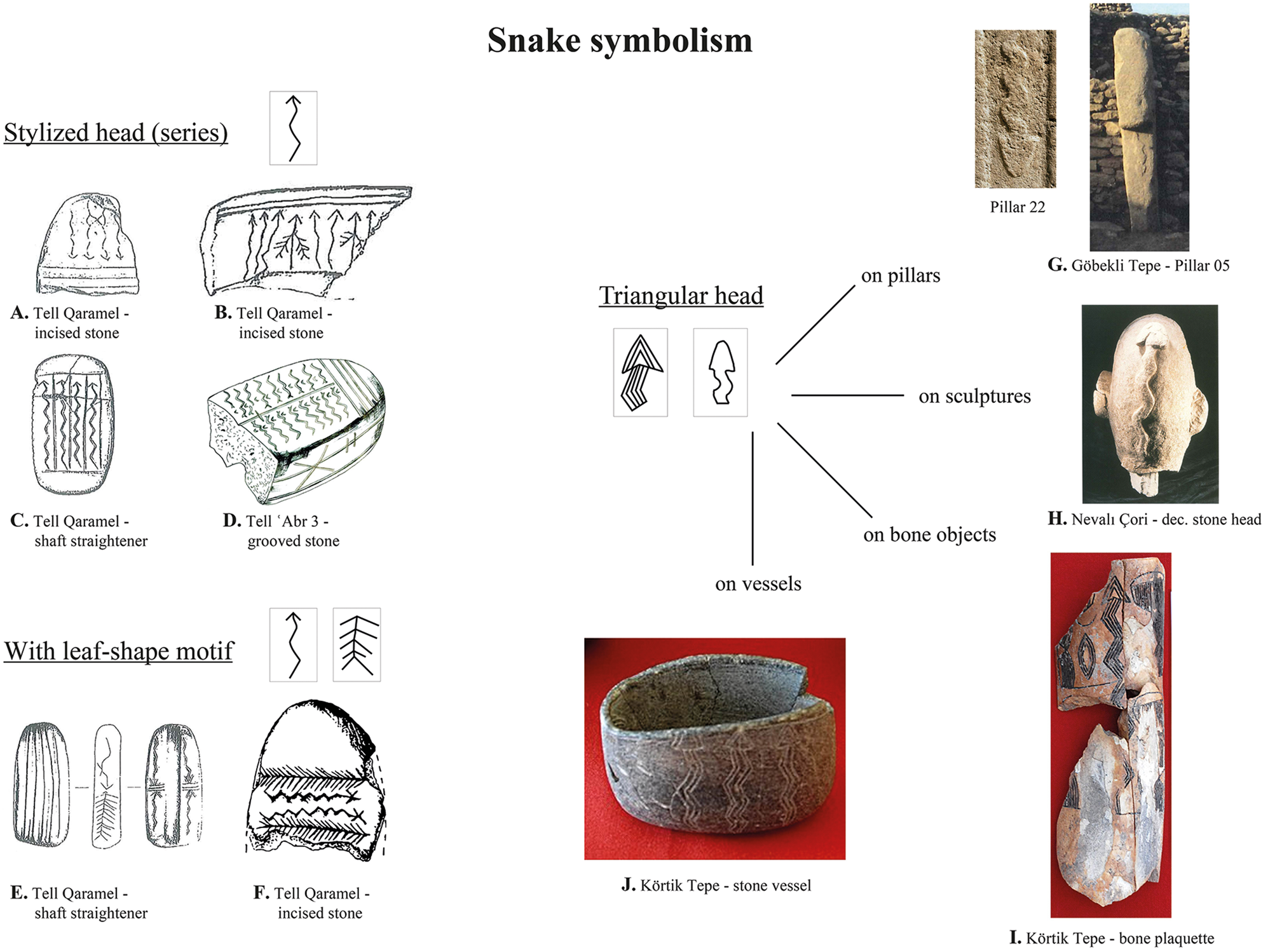
Arranging salient symbolic images is also evident in other examples. At Jerf el Ahmar (Syria), a grooved stone has a depiction of an X-shape of snakes (Fig. 5A) placed in the middle and adorned with other images such as snakes, a bird and other unidentified shapes. The same stylized snakes in the form of an X are clearly noticeable on a vessel at Körtik Tepe (Fig. 5B). Here, the X-shape is drawn next to a bird in both cases and the images present highly similar visual characteristics, such the triangular head of the snakes and the pronounced head of the bird tilted to one side with V-shaped wings. These motifs are different from the cruciform bird representations alternated with zig-zag shapes found at the same site, Körtik Tepe (Fig. 6), corresponding to another set of images engraved on the stone vessels. A similar argument can be made for the zig-zag shapes of snakes associated with leaf motifs (Fig. 9E‒F). The positioning and salience of images are key aspects of meaning-making in which easily recognizable unique symbols (e.g. the X-shaped snakes or the stretched quadrupeds) are suitably juxtaposed, perhaps in a concatenated way that aims to express a specific message by association and, as such, points in the direction of a codified system.
Thick cruciform birds alternating with zig-zag motifs at Körtik Tepe.
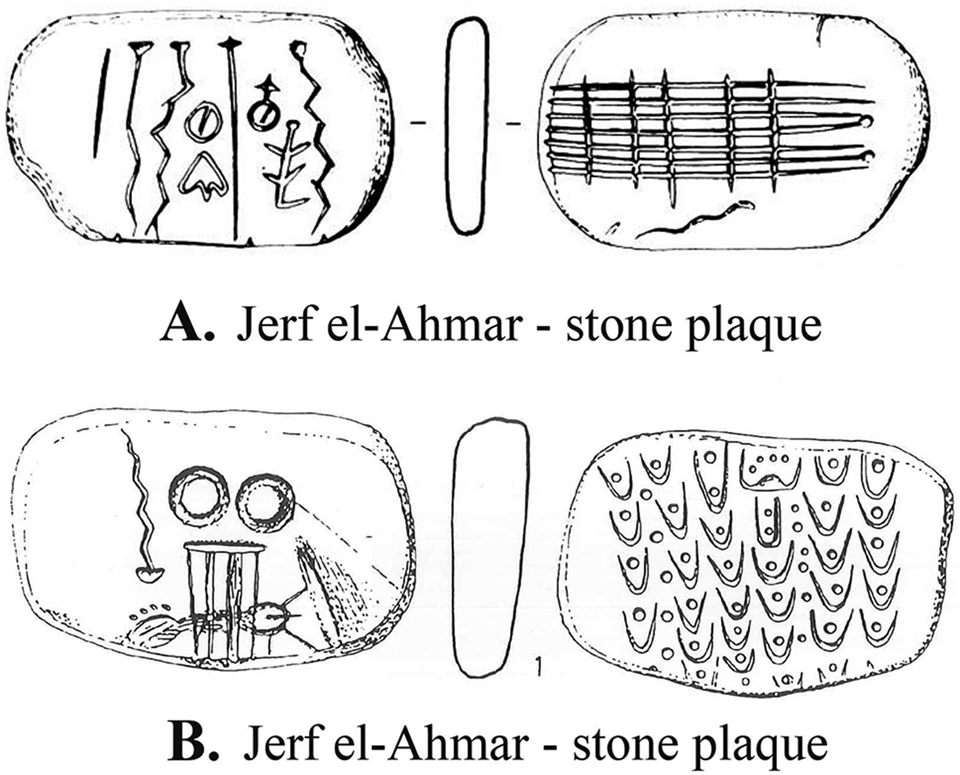
The rich variety of symbolic practices also includes double-sided engravings and separated visual frameworks. Two interesting finds at Jerf el Ahmar (Fig. 7A‒B) are plaques with carvings on both faces. On one side, stylized animals and other unidentified figures are again associated with each other, possibly representing a scene, while on the other side of the plaques, the engravings of geometric shapes are repeated and displayed in a linear fashion. This might suggest that recording or noting through geometric shapes could be referred to the scene depicted on the reverse of the plaques (cf. Morenz Reference Morenz2021). If so, it could be argued that these Neolithic groups deliberately engraved images onto distinct visual registers, each encompassing a codified message.
Engravings of images and geometric shapes on the front and back of two stone plaques at Jerf el-Ahmar.
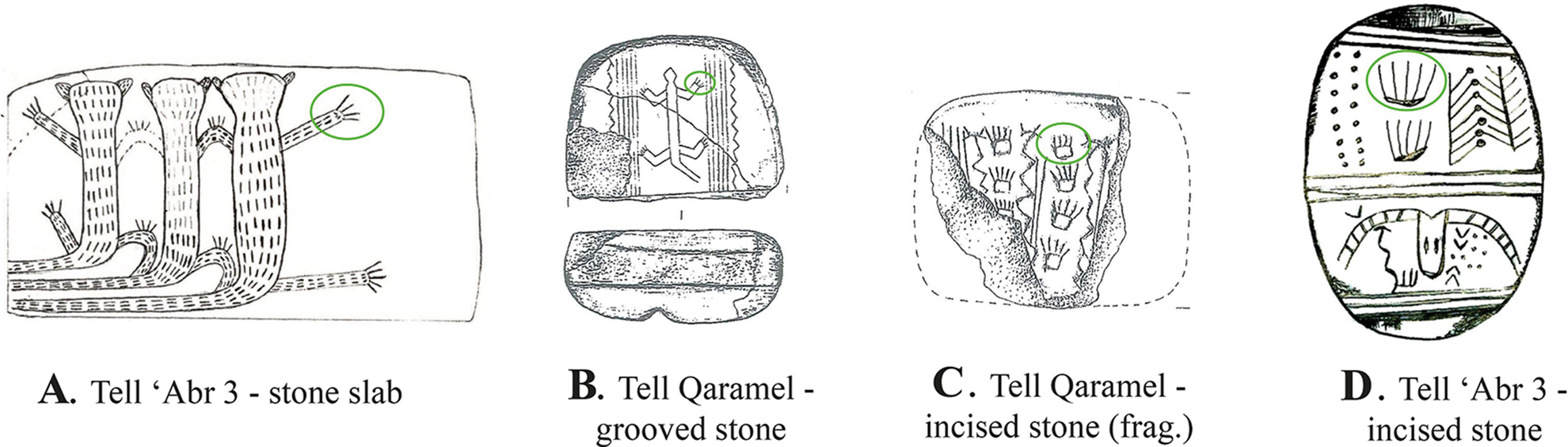
The division of the visual space can also be observed on other small, incised stones in which animal paws (see Fig. 8) are represented in sets. These sequences are not randomly distributed, but placed in visual registers divided by straight vertical and horizontal lines. The engraved paws on the stone plaque of Tell ‘Abr 3 (Fig. 8D) are flanked by two lines of dots and placed above a horned animal head (another possible metonymy expressed through pars pro toto?), distinctly separated.
Depictions of paws of animals and geometric shapes with details circled in green.
Multi-media snake representations.
The incisions discussed here may suggest that knowledge transmission in the Neolithic period was not restricted only to transferring information into external memory storages, but also in engaging into more sophisticated codified symbolic systems via portable and exchangeable objects defined by shared methods of recording to convey distinct and compound meanings. Compositionality, orderly patterns, repetitions, salient images and, crucially, their combinatorial nature and juxtapositions are key aspects that indicate that visual marks on portable objects were not just simple one-to-one notations to be recognized in a vacuum, but they can also form sequential, compounded, integrated messages within a codified architecture.
Interpreting Neolithic symbolism as operational semasiography
Another important aspect of the symbolic production, besides narrative and notational methods, is to detect whether a systematic set of performances is mediated through images. The concept of ritual, which is often brought into the narrative of the Neolithic, refers to a rather undetermined understanding of the relation between objects, imagery and correlated activities. Attempts to relate images to performances have been suggested, for example, in the practice of vulture de-fleshing and beheading observed in skeletal remains and on the pillars of Göbekli Tepe and on the house walls in Çatalhöyük (Pilloud et al. Reference Pilloud, Haddow, Knüsel and Larsen2016). In this regard, the archaeological evidence of figurative depiction framed as potential operational semasiography can help us identify further aspects, particularly regarding the early Neolithic settlements located along the Tigris in northern Mesopotamia, where associations between public gathering, mortuary practices, and images are evident.
Within this regional context, decorated objects are common as large numbers of items have been unearthed at sites such as Gusir Höyük, Körtik Tepe and Hallan Çemi (Karul Reference Karul2020; Özkaya Reference Özkaya and Korkut2004; Rosenberg Reference Rosenberg, Özdoğan, Başgelen and Kuniholm2011). One of the earliest Neolithic sites in the Diyarbakır province is Hallan Çemi, a small village occupied during the tenth millennium bc. A large deposit of animal bones and tools, such as decorated stone bowls and pestles, was found in the central open area and has been interpreted as evidence of communal feasting involving a large consumption of food and drink (Rosenberg Reference Rosenberg, Özdoğan, Başgelen and Kuniholm2011, 63). It is not known what the relationship between feasting and the depictions engraved on the stone vessels might be, and the recurrent interpretation of such finds is often linked to the need to maintain strong social ties between community members through certain cultural practices (Rosenberg Reference Rosenberg, Özdoğan, Başgelen and Kuniholm2011, 63‒4).
Approximately 60 km south of Hallan Çemi, the site of Körtik Tepe is rich in material culture. Incised pestles, carved bowls and decorated grooved stones, which were presumably used as tools for food processing and utensil production, were largely found in mortuary contexts and deliberately broken (Özkaya Reference Özkaya and Korkut2004, 587). Because of their contextual circumstances, these decorated objects have been associated with ritual activities. Naturalistic and geometric motifs were incised on dark chlorite vessels. The figurative compositions, some of which have already been shown above, are characterized by the alternation of wild animal species such as scorpions and snakes, and present wavy lines and highly stylized birds or human figures with a significant degree of standardization (Benz et al. Reference Benz, Alt, Erdal, Şahin, Özkaya and Hodder2018). It cannot be excluded that such mortuary practices involved multiple members of the community, as similarly argued for other sites of the Levant (e.g. Kfar Hahoresh: Goring-Morris & Horwitz Reference Goring-Morris and Horwitz2007) and that the pictorial representations and the objects themselves assumed a key role in this context.
In this regard, the active presence of ritual specialists is a well-attested typical interpretation in relation to the Neolithic context of beliefs and rituals (Benz & Bauer Reference Benz and Bauer2015; Dietrich Reference Dietrich2023; Mithen Reference Mithen2022). Shaman is the usual term for identifying mediators between human and non-human worlds, sometimes identified as charismatic leaders. There are several Neolithic archaeological indicators suggesting the activity of specialized ritual performers. It cannot be ignored that, besides the use of ritual objects such as garments, handheld tools and other instruments, ritual specialists make use of imagery as memory back-up and notational guide to support the intended performance. As for the above-mentioned Amerindian cultures, reading imagery is part of these practices and can represent a crucial element of performance. The representations illustrated in the previous sections, their symbol configurations and interconnection, could be interpreted as operational semasiographies designed to mediate ritual performances and cultural practices, not only as memory aids but also by directing cognition towards specific operations. The individuals involved in these operations do not conceive images as mere artistic depictions, but as key visual and ordered outputs that directly intercede, facilitate and support group activities. Therefore, different semasiographies stand out here. Some codes present some degree of self-sufficiency (cf. Morin Reference Morin2023), but specialized to distinct areas (e.g. some engraved plaques), while others are more general but needed an oral support to be understood and communicated, perhaps only by specialists, which may have involved ritual performance.
Conclusion
Our analysis shows how prehistoric imagery can be interpreted as a constructed set of interrelated meanings made for ‘close reading’. In preliterate context, such as the Neolithic, the existence of a systematic approach to graphic communication is a plausible hypothesis. It is worth pointing out that no linear or continuous development of code-making in the Neolithic can be reconstructed, but rather, what we observe is an experimenting phase in which a diverse range of communicative approaches interplay and change over time. Neolithic symbolism had undoubtedly assumed a key social role (Cauvin Reference Cauvin2000), radically developing along with new socio-economic settings. Symbolic practices naturally evolved, and this indeed has been noted, for example in the typology of animal representation moving towards fewer image representation of wild species (Stordeur Reference Stordeur, Bolger and Maguire2010) and the abandonment of decorated monumental constructions in areas such as the Urfa region towards the end of the Neolithic. All the same, it is very likely that trends and manifestations of code-making played an important role in the socio-cultural dynamics of early Neolithic communities, in particular during phases in which shared patterns of symbolic association, graphic configuration and related performances are observable, as analysed above.
Moreover, the role that tools, monuments, and decorated portable objects played as drivers of social change is to be recognized, independently of socio-economic changes. This has been illustrated, for example in the adoption and management of tokens as effective facilitators of social growth, alongside other administrative devices (Bennison-Chapman Reference Bennison-Chapman2014; Reference Bennison-Chapman, Düring and Akkermans2023). In a similar fashion to semasiographies, tokens were never continuously adopted or actively practised by all Neolithic and later societies, since the archaeological evidence only partially shows clear indicators of these modes of material interaction. On a similar level, just as tokens did, graphic codes attested on portable objects and monumental structures assumed socially and culturally defined roles in the identity formation of early Neolithic groups, particularly in southwest Anatolia and northern Levant.
The archaeological evidence discussed here demonstrates that communities such as Tell ‘Abr 3, Tell Qaramel, Göbekli Tepe and Körtik Tepe rely heavily on shared graphic codes to mediate their increasing and developing relationships with animals, plants and other human groups. The high level of social interconnection among Neolithic communities, the increasingly extended networks and large settlements appearing for the first time in human history suggest that the social developments during this prehistoric period are accompanied by the emergence of not only new cultural practices and ritual forms but also new communication systems.
Emphasis on external symbolic storage (Watkins Reference Watkins2023, 169) and on how symbols accompanied Neolithic transformations has been the focus of attention for several years. Here we aimed to show the mechanisms by which such external symbolic storage was deployed and how code-making gradually and coherently emerged to take on an important role in social life. We suggest that increasingly interconnected communities came to rely on external symbolic forms made of graphic codes to be identified as semasiography emerging from an existing symbolic system. The practical advantage of such a feature is that, in addition to constituting a memory aid and supporting cultural practices, readers have no need to be aided in interpreting or deciphering images and visual marks, as their meaning is embedded in a structured standardization pattern, which allows distinct social entities to connect with each other, overcoming or sidelining language barriers. Although the material discussed here does not show a fully fledged code system such as what we would define as ‘script’ (which is not expected, given the current evidence), what can be observed, however, are trends and patterns that move towards that behaviour.
Much more examination is needed to untangle the multiple aspects of Neolithic lifeways and their symbolic expressions. The theoretical models presented here invite us to rethink and reframe our current perspective on this matter. Rather than seeing Neolithic imagery as distinct isolated emblems or symbols referring to things and concepts within binary one-to-one relationships, we can hope to view Neolithic images from a different angle, as dynamic graphic codes made to express modular sets of meanings, not bound to a specific language but based on shared conventional group practices and visual perspectives.
Supplementary material
For Appendix A, please visit https://doi.org/10.1017/S0959774324000337
Acknowledgements
This article is funded by ERC project INSCRIBE Invention of Scripts and their Beginnings, awarded to Silvia Ferrara. The project has received funding from the European Research Council (ERC) under the European Union's Horizon 2020 research and innovation program, Grant Agreement No. 771127.


 Open access

