

A substantial body of research suggests that states, rather than economic elites, act as the principal agents of economic transformation in cases of “late” development. This thesis yields two questions that have yet to be thoroughly answered in the existing literature: 1) under what conditions are states able to successfully act as such an agent? And 2) who actually tends to control the state under these circumstances? This article addresses these questions through a case study of Francoist Spain. It articulates a path to state-led development in which, following class conflicts that diminish the power of economic elites, an educated “cultural” bourgeoisie (Bildungsbürgertum) takes over the state and uses it as an agent of industrialization.
Spain experienced rapid economic growth in the third quarter of the 20th century. This period of rapid growth, often referred to as the “Spanish Miracle,” coincided with the Franco dictatorship and followed the class conflicts of the Spanish Civil War. This article compares class structures, the origins of state officeholders, and economic policies before and after the Spanish Civil War. It argues that, as a result of the Civil War, Spanish economic elites experienced a significant reduction in their power. In their place, the Bildungsbürgertum—or at least a right-wing faction of it—took control of the state apparatus and systematically deployed state-owned enterprises to discipline private capital, leading to an acceleration of industrialization as compared to previous decades when economic elites held tighter control of the state.
Bildungsbürgertum and the Problem of Historical Agency
Classical social science viewed private capital as the primary social force behind rapid processes of economic change in Western Europe [Wood Reference Wood Ellen1992: 2-11]. Both Marx [Reference Marx and Engels2010: 15-17; Reference Marx and Fowkes1990, 1: 873-907] and Weber [Reference Weber and Parsons2001, xxxvii; Reference Weber and Knight1927: 337] viewed profit-maximizing capitalists as the vanguard of development in early modern Western Europe. More recent studies of industrialization elsewhere have articulated a similar capitalist-as-agent framework. Moore [Reference Moore1966: 149-153] and Beckert [Reference Beckert, Fraser and Gerstle2005: 92-93, 121-122] frame the US Civil War as a process through which the victory of northern industrialists over southern planters allowed the former to consolidate the institutional foundations for rapid industrialization. Zeitlin [Reference Zeitlin1984: 217-220] frames civil wars in late 19th-century Chile as “bourgeois revolutions that never were”— processes through which incipient industrialists tried but failed to impose a comparable institutional framework.
Analyses of “late” industrialization, however, from Tsarist Russia [Gerschenkron Reference Gerschenkron1962: 5-30] to East Asia [Amsden Reference Amsden1989; H.-J. Chang Reference Chang1993; Johnson Reference Johnson1982; Kohli Reference Kohli2004; Wade Reference Wade1990], see the state as the principal agent of development. Underlying this analysis is the problem of the “disappointing historical agent”: in late development, economic elites evidently do not perform the role expected of them by classical social theories. In fact, they may constitute obstacles to rapid industrialization [Chibber Reference Chibber1999: 321-322; Reference Chibber2003: 29-32], and the state must intervene in their stead to achieve it.
The problem of the “disappointing historical agent” outlined above yields two important questions: 1) under what conditions are states able to act as the necessary agents of late development? And 2) who actually controls the state under these circumstances? Existing literature supplies some clues. With respect to the first question, scholars have emphasized the importance of class conflict in generating economic development in early modern Europe [Brenner Reference Brenner1976; Lachmann Reference Lachmann2000] and the 20th-century Global South [Shin Reference Shin1998]. Classics of comparative historical sociology point to the importance of revolutions in generating “modernization” [Moore Reference Moore1966], strengthening the power of the state [Skocpol Reference Skocpol1979], and making the state (at least temporarily) autonomous from the interests of dominant classes [Hamilton Reference Hamilton1982]. These insights combined lead us to hypothesize that the state is able to act as an agent of late development after processes of class conflict that weaken the power of economic elites, who would otherwise act as an obstacle to development.
With respect to the second question— that of who actually controls the state during late development— existing studies of various societies share a structurally similar account in which analogous social strata overthrow a ruling regime and institute a new one which oversees rapid economic change. Together, these accounts suggest that it is not simply the state, but rather a particular social stratum, which we here call the Bildungsbürgertum, that is the historical agent at the helm of late development. Trimberger [Reference Trimberger Ellen1978: 41], for example, argues that late development ensues after “military bureaucrats” lead nationalist “revolutions from above.” This happens when “the officer class—or a significant segment of it—is independent of those classes which control the means of production.” In-depth studies of various historical processes of economic change have arrived at similar conclusions with respect to the role of bureaucrats, intellectuals and military officers: samurai bureaucrats in Meiji Restoration Japan [Beasley Reference Beasley2001: 162-165; M. Cohen Reference Cohen2014: 140-142; Norman Reference Norman E.1940: 61-62, 133-134; Smith Reference Smith Thomas1988: 136-139]; members of the old Ottoman bureaucracy in early Republican Turkey [Keyder Reference Keyder1987: 49-51, 72-75, 103-107, 150-156]; ancien régime lawyers and bureaucrats in the French Revolution [Mooers Reference Mooers1991: 64-96; Bell Reference Bell David1994]; and even dissident intellectuals and reformist technocrats in the transition from state socialism to capitalism in late 20th-century central Europe [Eyal, Szelényi and Townsley Reference Eyal, Szelényi and Townsley1998].
The disparate social groups mentioned above collectively fit the definition of Bildungsbürgertum outlined by Eyal, Szelényi and Townsley [Reference Eyal, Szelényi and Townsley1998]— roughly, a “cultural bourgeoisie,” distinct from economic elites, which stakes its social reproduction on the possession of cultural rather than economic capital and aims to implement “the utopian project of bourgeois society” [10]. I hypothesize that the state’s role as an agent of late development is facilitated by class conflict that weakens economic elites and brings the Bildungsbürgertum to political power. The analysis that follows seeks to elaborate on this hypothesized class dynamic of late development centered on the Bildungsbürgertum through a study of Francoist Spain.
The Franco Regime and the “Spanish Miracle”
Spain experienced rapid economic growth in the third quarter of the 20th century. Between 1950 and 1975, Spanish GDP per capita increased from less than half to 80% of the Western European average [Alcaide Inchausti Reference Alcaide Inchausti2003: 70]. This rapid growth constituted a marked acceleration compared to previous decades: as illustrated in Figure 1, if Spanish industrial production tripled in the half-century between 1875 and 1925, it grew nearly eight-fold in the third quarter of the 20th century.
Index of Spanish Industrial Production, 1929 = 100 (Source: Carreras [Reference Carreras1984: 150-152]).

The causes of this historical process of late development are controversial. From the cursory data outlined above, it is evident that rapid development in Spain closely coincided with the Franco dictatorship (1939-1975) and followed the acute class conflicts of the Spanish Civil War (1936-1939). Yet the notion that the Spanish Civil War and the repressive dictatorship that followed in some way contributed to subsequent economic development in Spain is heavily contested. Some scholars suggest that the Franco regime was completely inimical to development and that it was only external factors that generated growth in spite of the regime’s existence [Carreras Reference Carreras1984: 147; Harrison Reference Harrison1995: 15-16; García Delgado Reference García Delgado1985: 142].
Exogenous factors certainly played an important role in postwar Spanish economic development. These included a general global economic upturn in the post-Second World War decades [Mandel Reference Mandel1999: 558], European integration [Guirao Reference Guirao2021], and Spain’s incorporation into the US-led Cold War alliance, which brought in its tow not only large amounts of dollar aid [Braña, Buesa, and Molero Reference Braña, Buesa and Molero1979: 193], but also transfers of technology [Miranda Encarnación Reference Miranda Encarnación José2004: 638-646] and a general climate of economic certainty that fueled greater investment [Calvo González Reference Calvo González2001: 267-270].
Nevertheless, international political economy is insufficient on its own to explain key aspects of the timing of economic development in Spain. Simply put, an impulse toward industrialization was already evident in the 1940s, before European integration or normalization of relations with the US [Ayala Reference Ayala2024: 135-152]. While overall GDP growth during the 1940s was much slower than in the 1950s and 60s, averaging perhaps as low as 1%, annual growth in gross industrial value-added was relatively high, at almost 4% [Alcaide Inchausti Reference Alcaide Inchausti2003: 36]. Growth in industrial production was particularly marked in certain strategic sectors like aluminum (6%), petroleum refining (12%), and electricity (6.5%). The firms and sectors that led industrial growth in the 1940s, moreover, had substantial overlap with the protagonists of industrialization in the 1950s and 60s [Braña, Buesa, and Molero Reference Braña, Buesa and Molero1983: 102-106]. Capital goods production registered similar advances, supplying 47% of domestic demand in 1951 compared to 33% in 1941 [Martín-Aceña and Comín Comín Reference Martín Aceña and Comín Comín1991: 114]. Clearly, an industrialization impulse preceded shifts in Spain’s position in the world economy during the 1950s. Although these shifts undoubtedly greatly accelerated the pace of industrialization, the origins of industrialization remain to be fully explained. In explaining these origins, we need to turn to Spain’s own domestic class structure.
Our Bildungsbürgertum hypothesis might help explain what exogenous factors cannot about the timing and nature of Spanish industrialization. In fact, scholars have demonstrated that the Spanish Civil War substantially weakened the political, economic and social power of landed and industrial elites [Garmendia and González Portilla Reference Garmendia José, González Portilla, Sánchez, Heras and Ruiz1993; de Riquer Reference Riquer Borja1979; Molinero and Ysàs Reference Molinero and Ysàs1990; Ribas i Massana Reference Ribas i Massana1978; Artola Blanco Reference Artola Blanco2015]. They have also suggested that the government officials of the Franco regime that took power after the war were drawn largely from what Spanish literature has dubbed the “traditional middle class” [Cobo Romero and Ortega López Reference Cobo Romero and María Ortega López2005; Moreno Fonseret and Sevillano Calero Reference Moreno Fonseret and Sevillano Calero2000].Footnote 1 This middle class was rooted in Spain’s central Castilian regions and vested in the universities, the military, and meritocratic bureaucratic recruitment practices (oposiciones) [Genieys Reference Genieys2004: 160-202], and it was distinct from economic elites.
Spain’s traditional middle class roughly meets the definition of Bildungsbürgertum outlined above. Eyal and colleagues (Reference Eyal, Szelényi and Townsley1998, 83) argue that the transition from socialism to capitalism in late 20th-century Eastern Europe was led by a “second Bildungsbürgertum,” composed of reformist technocrats in the old communist bureaucracy and dissident intellectuals. This “second Bildungsbürgertum” was composed, necessarily, of state employees, since the starting point in the transition was state socialism. Although pre-Civil War Spain was quite different from communist Eastern Europe, a similar point can be made about the Spanish Bildungsbürgertum’s ties to the state. In Spain, the civilian bureaucracy and intelligentsia had substantial overlap throughout the 20th century; university professors were all civil servants, and some of the most prestigious careers for lawyers, doctors, economists, engineers and architects (among other professions) could be made in the civil service corps [Medhurst Reference Medhurst Kenneth1973: 103-104, 106-107, 112; Gutiérrez Reñón Reference Gutiérrez Reñón1966: 37-42; Álvarez Álvarez Reference Álvarez Álvarez1984: 39-40; de la Oliva de Castro and Gutiérrez Reñón Reference Oliva de Castro and Gutiérrez Reñón1968: 120-121].
Was slower industrialization in pre-Civil War Spain linked to the problem of economic elites as disappointing historical agents, and the rapid growth of the postwar period an example of the role of the Bildungsbürgertum as protagonist of late development? An affirmative answer would confirm the hypotheses outlined above. Such an answer would require the demonstration of three key points: 1) that slower growth before the Spanish Civil War was linked to the problem of the “disappointing historical agent,” that is, of economic elites as obstacles to rapid development; 2) that, as a result of the Civil War, these economic elites were weakened or eliminated as obstacles to development, and that a Bildungsbürgertum independent of these elites did indeed take control of the Spanish state; and 3) that economic development actually resulted from these changes.
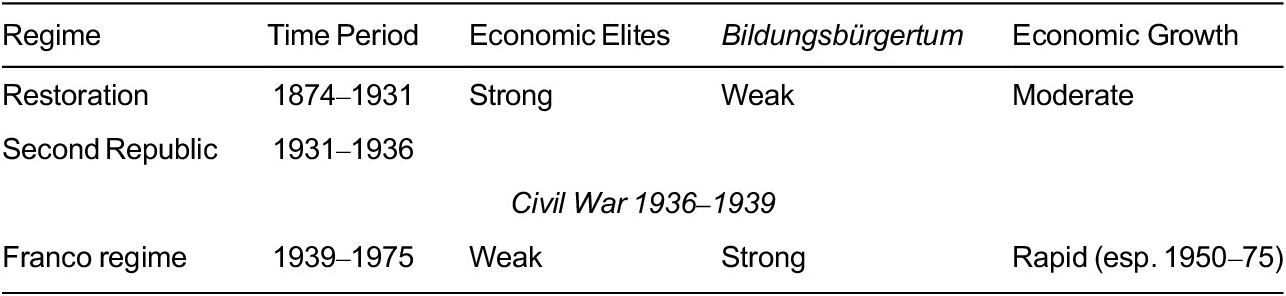
The logic of the empirical analysis that follows, then, is that of a temporal comparison. I compare class structure, the class origins of political officeholders, and industrial policies and economic performance before and after the Spanish Civil War. I argue that during the Restoration (1875-1931) period of constitutional monarchy and the Second Republic (1931-1936), the political power of economic elites was strong, that of the Bildungsbürgertum was weak, and economic growth was moderate. During the Franco regime, in contrast, economic elites were substantially weaker, the Bildungsbürgertum was much stronger, and industrialization was rapid (see Table 1).
Outline of Temporal Comparison – Class Power and Economic Growth

Beyond simply demonstrating a causal relationship between a certain pattern of class change and economic development, I also seek to demonstrate how exactly this relationship worked. In Francoist Spain, I argue, the Bildungsbürgertum’s control of the state was linked to an economic development model that implied direct state involvement in production. Through its widespread use of state-owned enterprises (SOEs), the Bildungsbürgertum-controlled state was able to “discipline” capitalists: state enterprises used competition with private capital or the threat thereof to accelerate productive growth in sectors where it was deemed insufficient or nonexistent.Footnote 2 Through the use of SOEs, the state was thus able to overcome the problem of the disappointing historical agent at the heart of late development.
This argument is not without precedent. Spanish sociologist Juan Linz once suggested that a new “political elite” rose to power under the Franco regime, which “hoped to create a corporative system to integrate the working class, disciplining it… [and] to integrate the professional, technical, and middle classes and the employers into the ‘service of a national economy,’ a single large organization politically controlled by the party men” [Linz Reference Linz Juan and Berger1981: 387-88]. At the same time, “the new political elite used its power and influence to gain access to positions of economic power or privilege by occupying seats on the board of directors of the newly created enterprises of the public sector” [Linz Reference Linz Juan and Berger1981: 391]. Linz thus proposes a causal chain between the ascent of a new political elite, a certain role for public enterprise in the Spanish economy, and a general strategy of economic development under the Franco regime. The details of this causal chain, which have yet to be thoroughly examined, are the focus of the rest of this article and, in this sense, it can be viewed as an expansion upon Linz’s hypotheses.
The Spanish Restoration: Economic Elites as Disappointing Historical Agents
Restoration Class Structure: Economic Elites and the Bildungsbürgertum
Industrial development in Spain during the Restoration was concentrated in two peripheral regions, Catalonia and the Basque Country. As a result, Restoration Spain’s industrial elites had a strongly regional character [Díez Medrano Reference Díez Medrano1995: 43-68]. Catalan industry was rooted in textile production, oriented toward the domestic market and dominated by small firms [Tortella Reference Tortella and Herr2000: 75-80; Moya Valgañón Reference Moya Valgañón1975: 204; Ribas i Massana Reference Ribas i Massana1978: 224-226, 252]. Basque industry was based in the steel and metallurgical sectors, whose high capital requirements generated an industrial structure featuring large industrial conglomerates and “universal” banks [Tuñón de Lara et al. Reference Tuñón de Lara, Valdeón Baruque, Domínguez Ortiz and Serrano2003: 505-507; Tortella Reference Tortella and Herr2000: 307, 356-357; Lorenzo Espinosa Reference Lorenzo Espinosa José1989: 89, 103, 128-129, 205-206].
Foreign capital constituted a third industrial cluster in Restoration Spain, and was particularly important in monopolistic sectors [Comín and Martín Aceña Reference Comín and Martín Aceña1996: 98-101]. By 1930, nine out of the ten largest corporations in Spain by total assets were founded by foreign capital, and virtually all of these corporations were railroads and utilities [Carreras and Tafunell Reference Carreras and Tafunell1994: 20]. Foreign firms were usually headquartered in Madrid and linked to the city’s banking sector [Pérez Reference Pérez Sofía1997: 48-49]. At the heart of this banking sector were rentier elites, many of them nobles, that combined earnings from corporate salaries and stock holdings with substantial rents from rural and urban properties. Around 1930, all of the top ten landowners resident in Madrid, five of the top ten capital earners, three of the top ten urban rentiers, and four of the ten best-paid corporate board members were nobles [Artola Blanco Reference Artola Blanco2015: 34, 38, 42, 45].
Decidedly subordinate during the Restoration was the Bildungsbürgertum, which had its origins in early-modern bureaucratic institutions that distributed the surplus of a peasantry extracted through taxes and tithes: the Church, the military, and the bureaucracy [Anderson Reference Anderson1974: 33-34; de la Oliva de Castro and Gutiérrez Reñón Reference Oliva de Castro and Gutiérrez Reñón1968: 100]. Although in the 17th and 18th centuries this stratum consisted largely of lower-level nobility [Callahan Reference Callahan1966: 446-447; Salgado Omeda Reference Salgado Omeda2002: 740-741], over the course of the 19th it was increasingly filled with non-nobles [Pro Ruiz Reference Pro Ruiz1995: 56-57, 59; Reference Pro Ruiz2004: 619-624].
As industrial and agrarian capitalist elites expanded in peripheral regions of Spain in the 19th and early 20th centuries, the Bildungsbürgertum was consolidated as a group distinct from these economic elites. The Spanish Bildungsbürgertum was particularly important outside of the more prosperous coastal regions [Linz and de Miguel Reference Linz, de Miguel, Merritt and Rokkan1966: 289, 291-293]. The basis of its reproduction continued to lie in the liberal professions, small-scale landownership, and bureaucratic, military and ecclesiastical posts [Giner Reference Giner1968: 8-12; Linz Reference Linz Juan and Berger1981: 367-368; Linz and de Miguel Reference Linz, de Miguel, Merritt and Rokkan1966: 298-306; Medhurst Reference Medhurst Kenneth1973: 103-105; Núñez Seixas Reference Núñez Seixas Xoxé1996: 43; de la Oliva de Castro and Gutiérrez Reñón Reference Oliva de Castro and Gutiérrez Reñón1968: 108-111, 134n; Pro Ruiz Reference Pro Ruiz2004: 612-616, 620-622]. The persistence of this stratum was evident in Spain’s bloated clergy and military officer corps: on the eve of the Restoration, Spain had twice as many clergy relative to population as France, while the Spanish military, when compared with its French counterpart, had six times as many officers relative to its total size [Giner Reference Giner1968: 10, 12].
The Restoration State: Control by Economic Elites
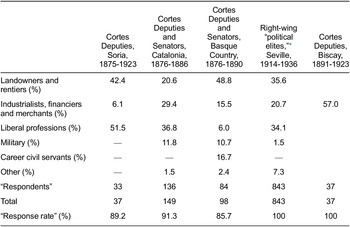
Economic elites, rather than the Bildungsbürgertum, were the dominant force in Spanish politics during the Restoration. Since the Restoration was a constitutional monarchy, a useful indicator of this dominance is the presence of different classes in the Spanish parliament, or “Cortes.” As illustrated in Table 2, economic elites constituted at least half of the representatives at Cortes from a diverse set of regions during the Restoration: Catalonia in 1876-1886, the Basque Country in 1876-1890, the Castilian province of Soria in 1875-1923, the Andalusian province of Seville in 1914-1936, and the Basque province of Biscay in 1891-1923.Footnote 3
Professions (Non-Overlapping) of Restoration State Elites

Sources: Caballero Domínguez, García Encabo and Marcos del Olmo Reference Caballero Domínguez, García Encabo and Marcos del Olmo1995: 43; Palomas i Moncholi Reference Palomas i Moncholi2002, 392-393; Urquijo et al. Reference Urquijo, Agirreazkuenaga, Gracia, Martínez, Alonso, Serrano, Otero and Penche2010: 216, 200; Álvarez Rey Reference Álvarez Rey1990: 225-227; Fernandez Reference Fernandez2017: 116-117. “Non-overlapping” means that individuals were categorized by what was judged to be their main profession in the case that they had several.
* In column four, right-wing “political elites” include various positions in party leadership, city council members from the city of Seville, assembly members in Seville’s provincial legislature, deputies and senators at Cortes, high-level officials in the national government from Seville and candidates in local, provincial and national elections belonging to seven major right-wing parties over the course of the Restoration, the Primo de Rivera dictatorship and the Second Republic: the Partido Conservador, Partido Liberal, Coalición de Derechas, Unión Patriótica, Acción Popular/CEDA, Comunión Tradicionalista, and Renovación Española— see Álvarez Rey Reference Álvarez Rey1990: 224-225.
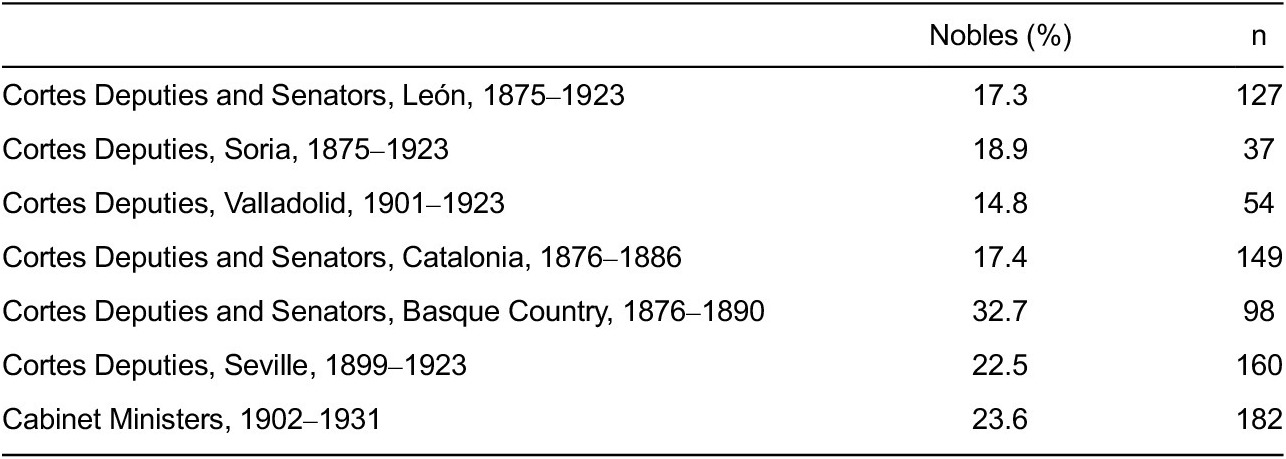
Only in Soria did liberal professionals and professional civil servants constitute more than half of Cortes representatives—and, even then, only barely. In all three other regions, landowners, rentiers and businessmen made up at least half of all representatives. Moreover, as highlighted in Table 3, nobles regularly held one-fifth to one-third of high-ranking positions such as cabinet ministers and Cortes members, with little difference across regions or sub-periods throughout the Restoration.
Presence of Nobility among Restoration Political Elites

Sources: Pelaz López and Serrano García Reference Pelaz López José and García1995: 75, 67; Caballero Domínguez, García Encabo and Marcos del Olmo Reference Caballero Domínguez, García Encabo and Marcos del Olmo1995: 43, 41; Pérez Sánchez et al. Reference Pérez Sánchez, Pérez López, Martín de la Guardia and Cano García1995: 85-86; Palomas i Moncholi Reference Palomas i Moncholi2002: 393, 385; Urquijo et al. Reference Urquijo, Agirreazkuenaga, Gracia, Martínez, Alonso, Serrano, Otero and Penche2010: 212, 200; Álvarez Rey Reference Álvarez Rey1990: 226n11, 215-216; Cuenca Toribio and Miranda García Reference Cuenca Toribio José and Miranda García1992: 87, 101.
Economic Policy: The “Disappointing Historical Agent”
Economic elites’ control of the state during the Restoration translated into policies that bolstered their profits without requiring much from them in return. Spain’s Restoration political economy, in other words, was characterized by state capture and rent-seeking. This rent-seeking was evident, first of all, in tariff policy. In the late 19th and early 20th centuries, Spanish industrialists and agrarian elites used their political power to implement industrial and agricultural tariffs that were significantly (often two or more times) higher than those prevailing in neighboring countries like France, Germany and Italy [González Portilla Reference González Portilla1985: 273-277; Tortella Reference Tortella and Herr2000: 429-430; Chang Reference Chang2002: 17; Simpson Reference Simpson2009: 182-183].
Humiliating defeat in the Spanish-American War, resistance against conscription during colonial wars in Morocco in 1909, and a general expansion of urban class struggles all contributed to what scholars have called a “crisis” of the Restoration political order in the 1910s [Riley Reference Riley2019: 74, 79-81]. This “crisis” caused major concern in elite circles over the prospects of long-term economic development in Spain. Yet resulting government efforts to accelerate industrial development were circumscribed by the interests of the very elites that dominated the state. Spanish industrialists and financiers, like most capitalists, were interested primarily in short-term profits; given their political power, the state could only encourage them to channel their capital into long-term investments by making such investments profitable in the short term.
Beginning in 1917, the Bank of Spain began a policy of offering banks credit, on demand, to the tune of up to 90% of the value of the public securities they held [Pérez Reference Pérez Sofía1997: 48]. This meant that banks could now dedicate assets to industrial investment that would otherwise have to remain liquid, to comply with withdrawal requests [Tortella Casares Reference Tortella Casares1986: 29]. As a result of the policy, dubbed pignoración (“pawning”), it was common for major Spanish banks to have 70 to 80% of their securities portfolios invested in public debt [González Temprano, Sánchez Robayna, and Torres Villanueva Reference González Temprano, Sánchez Robayna and Torres Villanueva1981: 38-39]. In short, the state backed the profits of industrialists, who could continue to produce in an uncompetitive domestic market without being forced to provide productivity increases in return.
A similarly flawed effort was that of the Industrial Credit Bank (Banco de Crédito Industrial, or BCI), established by the Cortes in 1917 to provide medium- and long-term credits to enterprises not linked to the “universal” banks. Yet the BCI was hardly a state-owned bank. Its founding members were a group of private capitalists, about 60% of whom were bankers and 40% industrialists. Of seventeen members on the BCI’s founding board, four were titled aristocrats; the state appointed one delegate to the board, but with only veto power [Tortella Casares Reference Tortella Casares1986: 29-41]. As with the pignoración system, the establishment of the BCI illustrated how efforts to accelerate industrial development in late-Restoration Spain were confined by the political power of private-sector banking and industrial elites. This was a clear example of industrial policy on industrialists’ (and bankers’) terms.
Economic growth and industrialization in Restoration Spain, although significant compared to preceding periods, was still modest. One measure of mediocre performance is industrial employment. In 1910, 14.4% of Spain’s male labor force worked in industry, lower than Germany (48.7%), France (33.5%), Italy (23.6%), Hungary (19.2%), and Russia (15.6%), and only slightly above Bulgaria (12.5%). Although the country’s standing in this measure had generally improved relative to Western and Eastern Europe by 1930, the industrial share of employment still remained below most Western European countries, and much of the improvement could be attributed to a boom in exports and import substitution during the First World War rather than to government policy [Catalan Reference Catalan1993: 112, 117-118]. Spanish steel production per capita in 1930, while much higher than three decades earlier, was still lower than that of Hungary and similar to that of Poland [Carreras and Tafunell Reference Carreras and Tafunell1994: 32; Tortella Reference Tortella and Herr2000: 356-357, 307].
The Franco Regime: Triumph of the Bildungsbürgertum and the SOE Model
Postwar Class Structure: The Weakening of Economic Elites
The Spanish Civil War effected a profound transformation of Spain’s class structure. Although the Nationalist mobilization that brought the Franco regime to power was undoubtedly a reactionary one, it was not led by the economic elites that played such a powerful role in Spain’s Restoration order. During the Restoration, large swathes of the Bildungsbürgertum, especially outside of Catalonia, the Basque Country and Madrid, supported traditional conservative parties of various varieties. Ultimately, they formed the bulk of the leadership of the Carlist, Falangist, and social-Catholic movements that constituted the backbone of the Nationalist mobilization against the Second Republic [Blinkhorn Reference Blinkhorn1975: 213; Balfour Reference Balfour, Lannon, Preston and Carr1990: 231; Lazo and Parejo Reference Lazo and Parejo2003: 244; de Miguel Reference Miguel1975: 185-196; Rodríguez López-Brea Reference Rodríguez López-Brea2022: 407, 416-418, 425]. These movements’ mass base lay in Spain’s smallholding peasantry, which mobilized in a bloody struggle against the rural and urban proletarians who supported the Republican cause [Blinkhorn Reference Blinkhorn1975: 219-224; Cobo Romero and Ortega López Reference Cobo Romero and María Ortega López2005:64-66; Moreno Fonseret and Sevillano Calero Reference Moreno Fonseret and Sevillano Calero2000: 710; Pérez Díaz Reference Pérez Díaz Víctor1977: 119-122].
Spain’s economic elites were thus largely caught in the middle amidst a clash between proletarians and smallholding peasants, both led by different factions of the Spanish middle classes.Footnote 4 With a few exceptions in the case of Basque and Catalan industrialists deeply committed to regional nationalism [Cabrera and Del Rey Reguillo Reference Cabrera, Del Rey Reguillo and Lavigna2007: 72; Lorenzo Espinosa Reference Lorenzo Espinosa José1989: 132-133], almost all of these elites sided with the Nationalists during the war in the interest of preserving their private property. Indeed, economic elites in areas that had remained behind Republican lines for the longest period, like eastern Andalusia and Catalonia, were the most severely weakened during the Civil War. They emerged from the conflict as grateful recipients of their restored assets [Cabrera and Del Rey Reguillo Reference Cabrera, Del Rey Reguillo and Lavigna2007: 73; Molinero and Ysàs Reference Molinero and Ysàs1990: 106; de Riquer Reference Riquer Borja1979: 18-19; Cobo Romero and Ortega López Reference Cobo Romero and María Ortega López2005: 62-63].
Despite the Nationalist victory and the ultimate preservation of private property, Spanish economic elites were still greatly weakened by the Civil War. The income share of the top 0.01% of earners, as measured by tax returns, fell by one-half between 1933 and 1951 [Alvaredo and Saez Reference Alvaredo and Saez2009: 1151].Footnote 5 The average number of domestic workers employed by noble families among Madrid’s top taxpayers declined from seven in 1930 to five in 1941 and four in 1954 [Artola Blanco Reference Artola Blanco2015: 258-260]. The Catalan industrial bourgeoisie was especially hard-hit. The Catalan share of Spanish industrial production declined from 24% to 19% between 1934 and 1949, and the decline was even larger in certain strategic industries like chemicals, shipbuilding and textiles [Ribas i Massana Reference Ribas i Massana1978: 250, 252, 254]. Madrid’s rentier elite was also adversely affected. It was unable to adjust to conditions of high inflation and high agricultural prices during the decade after the Civil War, which valued direct management of agricultural enterprises over fixed incomes from agricultural rents. This, combined with the Franco regime’s freezing of urban rents, produced a crisis of revenues for the rentier elite. Most notably, the Duke of Medinaceli, Spain’s largest pre-Civil War landowner with more than 80,000 hectares, sold most of these lands in the 1940s and became an “anonymous rentier” after purchasing several urban commercial properties [Artola Blanco Reference Artola Blanco2015: 258-260].
Both Basque and Catalan industrialists found themselves in a weakened economic position vis-à-vis the state after the Civil War. During the Second World War and the late 1940s, international economic isolation produced conditions of severe scarcity in Spain, creating shortages of inputs that constrained agricultural and industrial production [Christiansen Reference Christiansen2012: 253–254; Guirao Reference Guirao1998: 23-28, 122-128]. In this context, the Franco regime tightly controlled trade and the domestic allocation of resources [Braña, Buesa, and Molero Reference Braña, Buesa and Molero1983: 91; Christiansen Reference Christiansen2012: 43], which further reinforced the weakening of economic elites. Scholars have pointed toward systematic discrimination against Catalan industrial firms in the distribution of inputs, motivated by the state’s association of the Catalan bourgeoisie with regional separatism [Ribas i Massana Reference Ribas i Massana1978: 135-141]. State control over the distribution of inputs also made Basque industrialists dependent on state demand for their products. In 1941, the Spanish state directly purchased one-third of Basque steel output; by 1945, this had increased to more than one-half [Garmendia and González Portilla Reference Garmendia José, González Portilla, Sánchez, Heras and Ruiz1993: 185].
The Francoist State: Rise of the Bildungsbürgertum
Precisely because of these changes in Spanish class relations during the Civil War, the Bildungsbürgertum attained a degree of control over the state under the Franco regime that it never had during the Restoration. One of the clearest indicators of this trend is the presence of professional civil servants among Franco’s ministers. Compared to the parliamentary regimes of the Restoration and Second Republic, in the Franco dictatorship ministers exercised an unprecedented amount of power. Able to issue ministerial decrees, they represented a delicate balance of power among the political constituencies that mobilized in the Nationalist cause during the Civil War [Álvarez Rosete Reference Álvarez Rosete2003: 171-181, 193-195]. Table 4 illustrates the evolution of the presence of professional bureaucrats and military men in Spain’s cabinet from the second half of the Restoration (1901-1931) to the Second Republic (1931-1936) and the Franco regime (1938-1975). The proportion of ministers who had made their careers as servants of the state (including military men) was 80% under the Franco regime, compared to 58% during the Restoration and 46% during the Second Republic.
Cabinet Ministers by Period

Sources: Cuenca Toribio and Miranda García Reference Cuenca Toribio José and Miranda García1987: 107, 139-140; Reference Cuenca Toribio José and Miranda García1991: 55, 75-76; Reference Cuenca Toribio José and Miranda García1992: 87, 115-117.
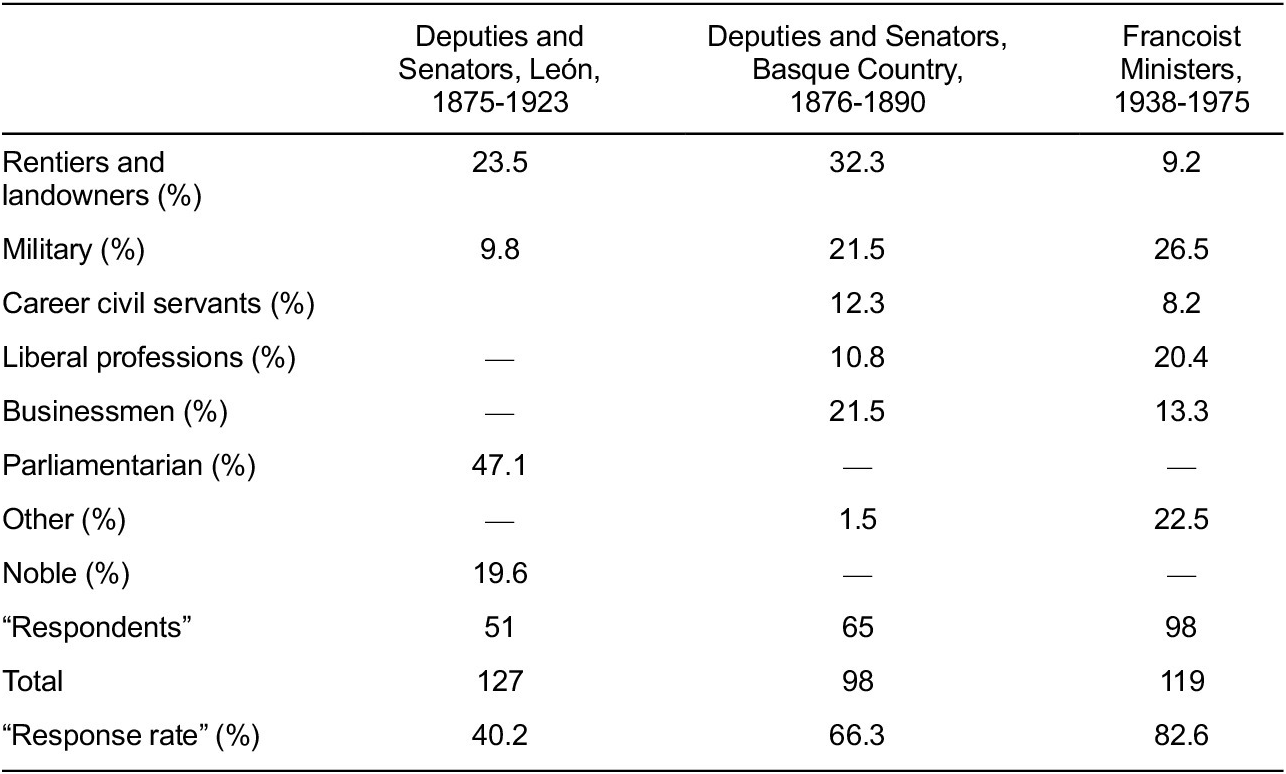
Franco’s ministers were also distinct from Restoration political elites in terms of their deeper class backgrounds. Table 5 illustrates the paternal professions of Francoist ministers and compares them to those of Cortes members from León and the Basque Country during the Restoration. Francoist ministers were much less likely than Restoration legislators to be sons of rentiers, landowners or businessmen. Conversely, they were much more likely to be sons of liberal professionals or military men.
Paternal Profession of Restoration Political Elites and Francoist Ministers

Sources: Pelaz López and Serrano García Reference Pelaz López José and García1995: 75; Urquijo et al. Reference Urquijo, Agirreazkuenaga, Gracia, Martínez, Alonso, Serrano, Otero and Penche2010: 212; Cuenca Toribio and Miranda García Reference Cuenca Toribio José and Miranda García1987: 118, 114. Note that for Francoist ministers, the “other” category is mostly composed of small farmers, small businessmen, and various kinds of white-collar employees not employed by the state.
The Franco regime also saw a significant decline in the proportion of political elites who were nobles. As we have seen, one-fifth to one-third of political elites were nobles during the Restoration (see Table 2). In a study of 900 of the highest-level officials in the Franco regime between 1936 and 1945, Viver [Reference Viver Pi-Sunyer1978: 124-125, 127] finds that only 10.5% were nobles. The figure drops to 6.2% if one excludes those ennobled after 1936; the corresponding figure for cabinet ministers was 11.9%. Moreover, the “Grandes,” or elite nobility with titles from the ancien régime preceding 1834, tended to occupy relatively unimportant state positions.
Liberal professionals and career civil servants were hardly a new presence in Spanish society. What changed under the Franco regime relative to preceding periods was their control of political power. While under the Restoration it was largely economic elites who controlled the state, under the Franco regime these elites were replaced by members of the Bildungsbürgertum, which went from a largely subservient social formation to one in control of the most important decision-making positions.
This remained the case even after a series of “liberalizing” reforms in the late 1950s which have typically been associated with the rise of “technocrats” to power in the Francoist ministries [Baklanoff Reference Baklanoff1976; Casanova Reference Casanova1983; Prados de la Escosura, Rosés and Sanz-Villarroya Reference Prados de la Escosura, Rosés and Sanz-Villarroya2011]. Not only were these reforms often not so liberal—involving, for example, the nationalization of various banks, a tightening of state control over credit flows [Muñoz Reference Muñoz1970: 175-176; Pérez Reference Pérez Sofía1997: 67-68] and the implementation of a series of four-year development plans [de la Torre and García-Zúñiga Reference Torre and García-Zúñiga2013]—but the “technocrats” who implemented them continued to be members of the Bildungsbürgertum. Unlike the technocrats who implemented neoliberal reforms in Latin American countries in later decades, for example, who were often US-educated and closely linked to business interests [Centeno Reference Centeno1994: 118-122, 129; Edwards Reference Edwards2023: 74-79], Spain’s technocrats continued to be traditional liberal professionals and civil servants.
Many of these technocrats were associated with the Opus Dei, which infiltrated the Spanish professoriate in an effort to “conquer” a realm of the state bureaucracy for itself. Reasonable estimates claim that between 1939 and 1951, a quarter of professorship vacancies went to Opus Dei members [Artigues Reference Artigues1968: 1: 36-40, 50-51]. The result was that many of the “technocrats” were university professors and, by corollary, professional civil servants. Laureano López Rodó, the most important of the technocrats in the 1960s, began his career as a law professor in Santiago de Compostela, despite family origins in Catalonia’s industrial petty bourgeoisie [Casanova Reference Casanova1983: 31-32]. In fact, one-third of Franco’s ministers between 1962 and 1969 were university professors, a peak coinciding with government by the technocrats [Álvarez Álvarez Reference Álvarez Álvarez1984: 28]. In short, although the most important professions and political factions varied over time, Bildungsbürgertum control over Spanish state institutions characterized most of the Franco regime’s duration.
The State as Historical Agent: The INI Model
Spanish economic policy changed markedly after the Civil War, in tandem with a transformation in class structure and political power. During the 1940s, the Franco regime instituted a variety of measures intended to accelerate industrialization. For reasons of international isolation as well as nationalist ideology, the new regime desired an industrialization program based on domestic rather than foreign capital. It nationalized Spain’s railroads in 1941, and the telecommunications system in 1945 [Comín Reference Comín2008: 697]. In 1939, it established industrial policy laws granting incentives to firms that entered “national interest” sectors. To ensure that beneficiary firms were Spanish, these laws also imposed local content requirements, required managers to be Spanish nationals, and limited foreign ownership in beneficiary firms to 25% of total capital [Braña, Buesa, and Molero Reference Braña, Buesa and Molero1983: 91; Gómez-Mendoza and San Román Reference Gómez-Mendoza and San Román1997: 697, 700; Ribas i Massana Reference Ribas i Massana1978, 113-15; Schwartz and González Reference Schwartz and González1978: 42-43].
The new industrial policies intended to expand domestic private investment in desired sectors, and to a certain extent they did. Major Basque banks and industrial firms initiated significant investments in new productive capacity during the 1940s [Lorenzo Espinosa Reference Lorenzo Espinosa José1989: 101-103, 132, 212-214, 218-219]. The results, however, were unsatisfactory to regime officials, particularly in basic industrial sectors. Aluminum production—controlled by just one firm, Aluminio Español, founded in 1927 with French, Swiss and American capital—was unable to meet demand in the early 1940s [García Pérez Reference García Pérez2018: 133]. Steel production, totaling 800,000 tons by the end of the decade, was still well below its 1-million-ton peak in 1929 [Quílez Pardo Reference Quílez Pardo Ana2016: 83].
In part, this was a product of the shortages of inputs and raw materials that plagued the Spanish economy during the 1940s [Lorenzo Espinosa Reference Lorenzo Espinosa José1989: 99]. Yet there was also a concern among officials that unsatisfactory results were a product of monopolistic conditions in certain sectors and a general timidity among capitalists to enter new “strategic” industries [Martín-Aceña and Comín Comín Reference Martín Aceña and Comín Comín1991: 82; Moya Valgañón Reference Moya Valgañón1975: 208; Schwartz and González Reference Schwartz and González1978: 39-41]. The most infamous case was the firm Altos Hornos de Vizcaya, which alone controlled 60-70% of Spanish steel and pig iron production in the 1940s [de la Sierra Reference Sierra1950: 26-27; Garmendia and González Portilla Reference Garmendia José, González Portilla, Sánchez, Heras and Ruiz1993: 185; Quílez Pardo Reference Quílez Pardo Ana2016: 83, 87]. Regime officials considered Altos Hornos’s management team to be excessively “pessimistic” about the prospects of expanding steel production [Schwartz and González Reference Schwartz and González1978: 56-57, 70].
The strategy the regime opted for in order to address the perceived insufficiency of private-sector initiative was to establish its own, state-controlled conglomerate, the National Institute of Industry (Instituto Nacional de Industria, INI), in 1941. Over the course of the 1940s and 50s, INI established a strong presence in multiple industrial sectors. By 1960, it accounted for 58% of Spanish refined petroleum production, 22% of steel production, 78% of automotive production and 47% of shipbuilding production [Martín-Aceña and Comín Comín Reference Martín Aceña and Comín Comín1991: 56-57]. By the same year, four of Spain’s ten largest firms by total assets were owned by INI [Carreras and Tafunell Reference Carreras and Tafunell1994: 20].
INI was a manifestation of the developmentalist inclinations of a new political elite with origins in the Bildungsbürgertum. Juan Antonio Suanzes, INI’s president from its founding in 1941 to 1963, came from a provincial family of naval officers and began his career in the naval engineers’ corps. During his time working at a British shipbuilding subsidiary in Spain, he denounced the parent company’s conduct as “tinged with perfectly explicable colonial aspects” and came to believe that Spanish shipbuilding had to be placed “into the hands of the state” such that “foreign influence… did not cross certain limits” [del Arco Blanco Reference Arco Blanco, Quiroga and del Arco Blanco2012: 150]. Suanzes’s investment in a development process led by the state was widely held among Francoist officials of different ideological orientations. In a 1952 speech in Seville, Rafael Cavestany—Minister of Agriculture during the 1950s, an agronomist by profession and the son of an academician at the Real Academia Española—warned landowners “not possessed by the spirit of enterprise” that “for them not one tractor, not one basket of fertilizer. And I am sure that if… it were necessary to expropriate lands, theirs would be the first” [Barciela López, Reference Barciela Lópezn.d.; Reference Barciela López, Sanz and Fernández1996: 385]. Implied in his threat was a belief that it was the state’s role to discipline the private sector in the national interest. Even López Rodó, the “technocrat” known for friendlier relations with the private sector, stated in a 1960 speech that the state was “the first among the enterprises that exist in the country,” “the coordinating agent of the economy” whose role was “the promotion of national labor” (el fomento del trabajo nacional—an obvious reference to the main Catalan employers’ organization, Foment del Treball Nacional, whose professed role the state had evidently usurped) [López Rodó Reference López Rodó1961: 209-211, 213, 224].
In line with this vision, INI and its constituent enterprises were controlled and run not by economic elites but by professional bureaucrats. Working under Suanzes in INI’s general staff were civil servants drawn from the various prestigious civil service corps of engineers and state lawyers (Abogados del Estado) [Schwartz and González Reference Schwartz and González1978: 44]. Viver [Reference Viver Pi-Sunyer1978: 297-298, 306] finds that members of his group of 900 elite “political personnel” that dominated Spanish state institutions during the early part of the Franco regime had posts in 80-90% of INI’s constituent enterprises and controlling posts in 60-70% of them between 1941 and 1965. The vast majority (nearly 80%) of these elite political personnel with posts in INI firms were civil servants or military officers, and only one-fifth were businessmen or industrialists.
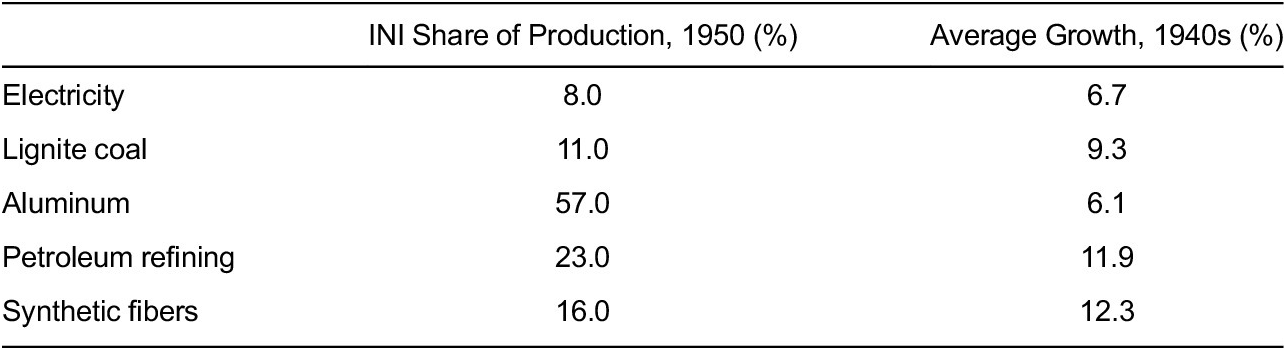
INI played a pivotal role in the Franco regime’s industrialization strategy. The INI firms that began production in the 1940s focused on strategic inputs that addressed economic scarcity, like petroleum refining (ENCASO, 1942, and REPESA, 1948), aluminum (ENDASA, 1943), electricity (ENDESA, 1944), lignite coal (ENCASO), and synthetic fibers (FEFASA, 1940) [Buesa Blanco Reference Buesa Blanco1983: 195, 265; Martín-Aceña and Comín Comín Reference Martín Aceña and Comín Comín1991: 135; Schwartz and González Reference Schwartz and González1978: 52, 56-57, 65, 69]. As shown in table 6 INI’s presence was significant in all these sectors by 1950, and their annual growth during the 1940s significantly outpaced the overall industrial average of 2.3% [Braña, Buesa, and Molero Reference Braña, Buesa and Molero1983: 103-104].
Leading INI Sectors, 1940s

Sources: Buesa Blanco Reference Buesa Blanco1983: 195; Martín Aceña and Comín Comín Reference Martín Aceña and Comín Comín1989: 123; and Braña, Buesa and Molero Reference Braña, Buesa and Molero1983: 103-104.
Nevertheless, the Spanish economy was hampered by systemic shortages until the normalization of diplomatic relations with the United States allowed for alleviation of the balance of payments and the importation of needed production inputs. Spain received large amounts of aid from the United States between 1954 and 1957, which provided foreign exchange to reactivate industrial and agricultural production [González García Reference González García and Preston1978: 79; Braña, Buesa, and Molero Reference Braña, Buesa and Molero1979: 193]. The warming of relations with the US also led to the resumption of normal trade with the rest of Western Europe [Guirao Reference Guirao1998: 5, 153, 158-159].
During the ensuing economic boom of the 1950s, INI turned to more complex industrial sectors, including automobiles (ENASA, 1946 and SEAT, 1950), shipbuilding (EN Bazán, 1947 and Astilleros de Cádiz, 1952), steel (ENSIDESA, 1950) and fertilizers (ENCASO, REPESA, ENSIDESA and SIN) [Buesa Reference Buesa1983: 237-238; Cáceres Ruíz Reference Cáceres Ruíz Juan1997: 4-5; Martín-Aceña and Comín Comín 1991: 135]. These were sectors of extraordinary growth during the 1950s: while annual industrial growth averaged 8.3% overall, the figures were 50.3% in the automotive sector, 34.7% in fertilizers, 12.9% in shipbuilding and 9.8% in steel [Braña, Buesa, and Molero Reference Braña, Buesa and Molero1983: 103-105].
Over the course of the 1940s, 50s and 60s, INI followed a standard pattern of involvement in industrial sectors: expansions in its share of production led the private sector to increase investments in response. This pattern was clear in the steel sector where, in 1956, after ENSIDESA was created, Altos Hornos de Vizcaya began massive investments in steel production [Chilcote Reference Chilcote Ronald1968: 99, 119]. A similar pattern held in fertilizers, where INI’s share of production decreased from 78% to 32% over the course of the 1950s as the private sector ramped up production to compete. By the 1960s, fertilizer production was organized in three competing conglomerates—one owned by INI, one linked to foreign capital, and the third anchored in the domestic private sector [Tamames Reference Tamames1977: 101-102; Robles Teigeiro Reference Robles Teigeiro1992: 199-200].
INI’s historical role transcended its involvement in any one sector, however, and its main function was at a system level. The possibility of direct state involvement in any sector which Spain’s new state elite deemed necessary for development overcame the problem posed by private-sector control over investment: in the last instance, capitalists can always refuse to produce or invest in any particular sector [Chibber Reference Chibber1999: 320-322]. When the state possessed the ability and willingness to compete alongside private-sector capitalists, however, such a refusal was superfluous. This systemic purpose of INI was articulated by the regime itself. As INI’s 1941-42 annual report stated, “the State no longer resigns itself to the simple role of issuing a program or aspiration, and offering more or less indirect incentives, so that private initiative might decide whether or not to satisfy the felt need… it should have at its disposal an institution capable of guaranteeing in all cases the fulfillment of its programs, to the degree it considers vital or necessary” [Martín-Aceña and Comín Comín Reference Martín Aceña and Comín Comín1991: 82].
The new developmentalist elite thus used SOEs to foster system-level competition with private capital and ensure the advancement of its industrialization program. This strategy could not have been conceived without either 1) the Bildungsbürgertum’s conquest of control over the Spanish state, or 2) a significant reduction in the political and economic power of industrial and financial elites. Both of these preconditions were achieved by the Spanish Civil War.
INI in Comparative Perspective
The pattern of INI’s participation in the Spanish economy was relatively unique. State enterprise was no anomaly in the market economies of the postwar world. Yet in most of these economies, state enterprise did not tend to have a significant presence in competitive manufacturing sectors. In the UK, for example, postwar nationalizations created a state sector in electricity, coal, gas, transport and telecoms whose total capital stock was larger than the entire British manufacturing sector. Yet state enterprise did not enter the manufacturing sector at all [Millward Reference Millward1997: 211-212, 222-224].
Pre and postwar nationalizations in France similarly concerned electricity, gas, coal, banking, insurance, rail and air transport and telecoms. But, with the exception of the car manufacturer Renault and the Gnome-et-Rhône aircraft corporation, which were seized from their owners in response to their collaboration with the Nazis, state participation in manufacturing was minimal save for a brief period in the 1980s [Chadeau Reference Chadeau and Toninelli2000: 188, 201-102; Cohen Reference Cohen2010; de Vries and Hoeniger Reference Vries Henry P. and Hoeniger1950: 635-646]. The role of state enterprise in West Germany, meanwhile, was relatively constrained in the postwar era, since the government privatized most state-owned enterprises in the late 1950s and early 60s [Wengenroth Reference Wengenroth and Toninelli2000: 119].
The Francoist state also stood out compared to the fascist regimes of interwar Western Europe in the consistency of its commitment to state enterprise. While INI was established soon after the Franco regime took power, both the Nazi and Italian Fascist regimes actually conducted large privatizations in the early years of their existence (1923-1925 in Italy, 1935-1937 in Germany) in an effort to attract the political support of private capital [Bel Reference Bel2010: 35-44, 48-50; Reference Bel2011: 941-948, 951]. In Spain, the weakening of economic elites during the Civil War meant that the Franco regime did not have to attract the support of capital in this manner.
The closest institutional analogue to INI in terms of its economic role was its original inspiration, the Italian Istituto per la Ricostruzione Industriale (IRI). Created “by accident” in the early 1930s as a result of a government rescue operation of failing banks, the Italian state holding company was revamped in the postwar period and had a presence in diverse manufacturing industries ranging from steel to shipbuilding. As in Spain with INI, IRI became a vital pillar of postwar economic growth in Italy through a strategy in which state manufacturing enterprises competed in the market [Amatori Reference Amatori and Toninelli2000, 130-131, 149; Einaudi Reference Einaudi1948: 24; Ramos Reference Ramos Arthur1991: 54]. Outside of Western Europe, the Spanish development model had another clear analogue in Taiwan under Kuomintang rule, where state enterprise maintained a strong presence in an array of industrial sectors, from sugar and cement to metals, machinery and textiles [Chang and Shih Reference Chang, Shih and Chang1968: 248-249, 259].Footnote 6
While space limits a detailed comparison, the role of state enterprise in Italy and Taiwan raises the question of whether their civil wars affected state-capital relations and class dynamics as was the case in Spain. Indeed, in China and later Taiwan the Chinese Civil War, World War II and the subsequent Kuomintang retreat to Taiwan coincided with a massive expansion and consolidation of the role of state enterprise in industrial development [Bian Reference Bian Morris2005: 73-75; Kirby Reference Kirby1990: 125-128, 132, 136], while in Italy one of the key figures of postwar state enterprise, Enrico Mattei, was a Christian-Democrat who had been a Catholic partisan in the Italian Civil War of 1943-1945 [Amatori Reference Amatori and Toninelli2000: 130, 132, 146]. Future research might investigate whether the paradigm of Bildungsbürgertum-led development described above applies to these cases as well.
Conclusion
This article has explored the pivotal role of the Bildungsbürgertum in the rapid economic development of Francoist Spain. In sharp discontinuity with the pre-Civil War Restoration period, during which the political dominance of traditional economic elites produced slow economic growth, the Franco regime’s ascent brought the Bildungsbürgertum, a stratum relatively independent of these economic elites, to power. This group of intellectuals and bureaucrats utilized state power to spearhead industrial growth, circumventing the limitations imposed by private capital.
Central to this transformation was the establishment of the National Institute of Industry (INI) and the strategic deployment of state-owned enterprises (SOEs). These institutions were instrumental in disciplining private capital, ensuring that industrialization proceeded according to state objectives rather than being hampered by the narrow interests of economic elites. The rise of the Bildungsbürgertum enabled a developmental state model that leveraged public enterprises to foster competition and investment in key sectors. The case of Francoist Spain thus illustrates a broader pattern in late-developing countries where a stratum of reformist bureaucrats and intellectuals, rather than economic elites, acts as the primary agent of rapid economic change.
Additional research might assess the extent to which the model of Bildungsbürgertum-led development outlined above is applicable in the contemporary Global South, given widespread transformations in class structure. This model implies, for example, that the social reproduction and economic interests of the Bildungsbürgertum are separate from those of economic elites—that is, from those of the Wirtschaftsbürgertum. To what extent do analogues of the Spanish Bildungsbürgertum in contemporary developing societies actually tend to be relatively independent in this sense? Answering this question would surely condition the applicability of the development path described above.



 Open access

